




Abstract
Whether organizations can benefit from employee voice depends on the receiving managers’ evaluations, as proposals can be implemented, dismissed, or forwarded to superiors for consideration. Despite its important role in identifying valuable suggestions, research on managers’ evaluations of employees’ proposals is scarce. Grounded in the literature on employee voice, innovation management, social hierarchy, the Elaboration Likelihood Model, and the Hedonic Contingency Model, the current study addresses this research gap by investigating the influence of voice quality, voice content, and managers’ mood on managers’ evaluations of voice. The findings from using a factorial, between-subjects experimental design with 384 German managers as participants demonstrate that managers’ evaluations tend to be higher when voice is of high quality and that managers evaluate promotive voice higher than they do prohibitive voice. No direct or indirect influence of managers’ mood was identified. The study concludes with implications for employees and organizations, limitations, and directions for future research.
Introduction
In the last decade, interest in employee voice, defined as the “discretionary communication of ideas, suggestions, concerns, or opinions about work-related issues with the intent to improve organizational or unit functioning” (Morrison, 2011: 375) has grown increasingly in research and practice (Brinsfield and Edwards, 2020; Morrison, 2023). Voice is a form of extra-role behavior (Van Dyne and LePine, 1998) that is directed to the superiors who can take further action, such as team members, skip-level leaders, and especially line managers (Burris et al., 2013; Wåhlin-Jacobsen, 2020). Voice’s content refers either to new ideas and solutions for improving ways of working (promotive voice) or to existing problems that can cause harm to the organization (prohibitive voice; Liang et al., 2012). Employees’ insights, to which managers often have little access, can improve organizational effectiveness by means of more informed decision-making, better working conditions, and stable processes (Liang et al., 2012; Morrison, 2014; Van Dyne et al., 2003).
Despite these benefits, employees are not always rewarded for their input. While some studies demonstrate that employees who speak up may receive higher performance evaluations (e.g. Whiting et al., 2008), others show the opposite. For instance, Seibert et al. (2001) find a negative relationship between voice and employees’ career progression. The literature explains these differing outcomes as being the result of managers’ evaluations of voice, which determine whether proposals are implemented, dismissed, or forwarded to superiors who can implement them (Glauser, 1984; Marchington and Suter, 2013). Employees may be rewarded in an attempt to reciprocate their commitment or may be punished (Whiting et al., 2012). Studies on managers’ evaluations of voice demonstrate that voice is evaluated more positively by managers when employees are an expert (Stumpf and Süß, 2022), and when proposals are expressed with moderate, not excessive, frequency (Huang et al., 2018). Further, managers value voice that is of high quality such that the proposals are rational, feasible, novel, and in line with the organization’s goals and values (Brykman and Raver, 2021).
Other than a few such examples, research on the evaluation of voice is scarce, and several authors call for further investigation (e.g. Liao et al., 2021; Urbach and Fay, 2018). These calls suggest that research pay more attention to differences in managers’ evaluations of promotive voice compared to prohibitive voice (e.g. Duan et al., 2022; Huang et al., 2018). While promotive voice is future-oriented and refers to improvements that may help managers to achieve their personal goals, prohibitive voice brings attention to existing problems that could potentially undermine their perception of being a successful leader as viewed by others within the organization (Huang et al., 2018; Liang et al., 2012). In this regard, Brykman and Raver (2021) encourage the investigation of voice quality’s influence on managers’ evaluations of both forms of voice, arguing that prohibitive voice, which is generally less valued by managers (Chamberlin et al., 2017), may be evaluated positively when it is of high quality. Pointing out existing problems using high-quality voice may trigger managers’ positive impressions instead of the negative emotions and defensiveness that may have arisen otherwise (Liang et al., 2012).
Further, the influence of managers’ mood—that is, “a set of feelings, ephemeral in nature, varying in intensity and duration, and usually involving more than one emotion” (Lane and Terry, 2000: 17)—as a temporal characteristic is investigated to get a more complete picture of managers’ evaluations of voice and determine whether the content-based differences are due to a specific context. Recent research demonstrates that in addition to considering the attributes of the message and the employee expressing voice, it is crucial to recognize the influence of the recipient and their characteristics on the evaluation of voice (e.g. Urbach and Fay, 2018; Xu et al., 2020). Even voice that is usually evaluated positively by managers, high-quality voice and promotive voice, could be evaluated negatively when the manager to whom it is directed is not in the right mood (Brykman and Raver, 2021, 2023; Chamberlin et al., 2017; Liang et al., 2012).
Against this background, the study investigates the influence of voice quality, voice content, and managers’ mood on managers’ evaluations of voice.
The study contributes to the research on employee voice in several ways. Firstly, it enriches our limited understanding of managers’ evaluations of voice. Through a factorial experiment, the study sheds light on the relative importance of voice quality, voice content, and managers’ mood in shaping their evaluations of voice. These findings can be instrumental in helping employees develop effective communication strategies, while organizations can foster a culture that values and rewards employees’ insights. Secondly, the study provides differentiated information by comparing promotive voice with prohibitive voice in terms of managers’ evaluations. While previous research has demonstrated that both forms of voice may lead to different outcomes (e.g. Chamberlin et al., 2017), many studies do not distinguish between them, resulting in a loss of valuable information (Morrison, 2023). By addressing this gap, the study offers a comprehensive understanding of managers’ evaluations of different forms of voice. Thirdly, existing research has predominantly focused on managers’ stable characteristics (Xu et al., 2020). However, this study integrates managers’ mood as a temporal characteristic, enabling employees to make more informed decisions about when to speak up. Recognizing the influence of managers’ mood on their evaluations of voice enhances employees’ ability to gage the appropriate timing for expressing their concerns or ideas. Fourthly, the study applies the Elaboration Likelihood Model (ELM; Petty and Cacioppo, 1986), the Hedonic Contigency Model (Wegener and Petty, 1994), and the literature on social hierarchy (Keltner et al., 2003; Magee and Galinsky, 2008) on the evaluation of voice. By considering the recipients’ elaboration likelihood and information processing, the study acknowledges that factors influencing an individual’s attitude change (O’Keefe, 1990) may also impact how voice attempts are received. Additionally, managers’ concerns about the implications of voice for their hierarchical position and power within the organization may shape their evaluations of voice. This multi-faceted approach offers a more comprehensive framework for understanding the evaluation of voice. Finally, the study makes a methodological contribution by addressing the call for more experimental investigations in the research field of employee voice (Morrison, 2023). By employing experimental methods, the study enables statements regarding causality to be derived from its findings.
Theoretical background and hypotheses
The role of voice quality in managers’ evaluations of voice
Employees who express voice are generally rewarded with higher performance and promotion evaluations by managers (Chamberlin et al., 2017; Zhang et al., 2022). Managers do so to acknowledge and reciprocate employees’ efforts to improve organizational functioning and their own position as a valuable source of information and ideas in the organization (Blau, 1964). However, in certain situations, employees may also face negative consequences for speaking up, such as receiving lower promotion ratings (Seibert et al., 2001).The distribution of power within organizations offers an explanation for these varied outcomes (Georgesen and Harris, 1998). Due to their hierarchical position, managers possess authority and power that enable them to influence others and have control over valued resources, information, and decisions, including the implementation of employee voice (Anderson and Brion, 2014; Glauser, 1984; Kipnis, 1972; Magee and Galinsky, 2008). Once managers acquire power, they strive to maintain it, as it can lead to an increase in their social status and influence (Magee and Galinsky, 2008). As a result, managers are particularly attentive to situations that help them preserve their hierarchical position and achieve their personal goals (DeCelles et al., 2012; Keltner et al., 2003). Simultaneously, they seek to avoid situations they perceive as threats to their power and status (Anderson and Galinsky, 2006). In order to maintain their power, managers often, for instance, justify the status quo when organizational changes involve adjustments to the hierarchical structure (Jost et al., 2004; Jost and Banaji, 1994). Regarding employee voice, managers evaluate the risk associated with the potential lack of success of new ideas, as well as the implications of their implementation for themselves and their position within the organization (Lonergan et al., 2004; Urbach and Fay, 2021). If managers perceive an idea as a threat to their own position, they tend to act in a self-interested manner, such as by rejecting the idea (Urbach and Fay, 2018). However, when an idea contributes to organizational effectiveness and aligns with managers’ own goals, such as ensuring stable processes, managers are more likely to reciprocate by providing a positive evaluation (Li et al., 2023).
In the case of high-quality voice, managers might feel a particularly strong obligation to reciprocate due to the amount of time, effort, and potential risk that employees willingly invest in developing and communicating rational, feasible, organization-focused, and novel proposals (Brykman and Raver, 2021). Furthermore, managers are likely to attribute a high probability of success, and therefore, the achievement of personal goals, to ideas that demonstrate high quality. Therefore, the first hypothesis is derived:
H1: Managers’ evaluations of voice are more positive when voice quality is high than when it is low.
The role of voice content in managers’ evaluations of voice
This section outlines the influence of high-quality voice’s content—meaning whether it is promotive or prohibitive—on managers’ evaluations.
Voice quality is composed of four dimensions: rationality, feasibility, organizational-focus, and novelty. A glance at the literature suggests that rationality—that is, the role of objective facts and logical arguments (Brykman and Raver, 2021)—may differ in managers’ evaluations of voice depending on the message’s content (promotive vs prohibitive). Prohibitive voice refers to problems that are or could be harmful to the organization (Liang et al., 2012), so solving the issue addressed can be urgent to avoid process errors, accidents, and organizational losses. Based on the previous reasoning, managers may have a heightened interest in resolving identified problems promptly to prevent any negative impact on their reputation and power within the organization (Burris, 2012; Morrison, 2023). Other members of the organization may interpret prohibitive voice as an indication of managerial mistakes (Isaakyan et al., 2021). In contrast, promotive voice usually presents issues that are deferrable, as they often refer to improving the status quo, usually in the long term. Research demonstrates that managers prefer that, whatever the voice content, it be expressed with sufficient time to react (Whiting et al., 2012).
Emotions like anger, sadness, and enthusiasm, refer to the dimension of voice quality that is opposite to rationality (Carr, 2001). Such emotions may be shown when employees talk about a problem by which they are personally affected (Lin and Johnson, 2015), so they may shift managers’ attention from the problem to the employee. Managers’ thinking about how to deal with prohibitive voice may be interrupted by the employees’ emotional state and the need to, for instance, calm and comfort the employee. Managers tend to evaluate voice expressed in a negative emotional state as of less value because they are likely to interpret these proposals as complaints or criticism instead of constructive input (Grant, 2013). In addition, individuals who hold positions of power tend to exhibit lower levels of empathetic concern (Woltin et al., 2011) and engage less in perspective-taking (Galinsky et al., 2006). These tendencies may further contribute to the negative attitudes toward prohibitive voice. With promotive voice, whose endorsement tends to be less urgent but resource-intensive (Liang et al., 2012), managers may tolerate the positive emotions that employees tend to show when talking about ways to improve the status quo (Lin and Johnson, 2015) that may help managers to achieve their own goals. Therefore, rationality may be more important for managers’ evaluations of prohibitive than for promotive voice.
Brykman and Raver (2021) see the next dimension of voice quality, feasibility, as relating to whether the proposal can be implemented, considering the effort that would be required. Burris et al. (2017) demonstrate that managers are more likely to endorse ideas when the ideas require limited resources (i.e. financing, personnel, time, effort, and interdependencies). Managers might not be concerned about the resources necessary to solving the problem, as “the ends may justify the means”, particularly when it comes to prohibitive voice, where the aim is to resolve a problem before it becomes widely known within the organization and jeopardizes managers’ image as a competent leader (Isaakyan et al., 2021). In contrast, the literature on idea management demonstrates that feasibility is usually one of the main selection criteria for choosing ideas for implementation (Gerlach and Brem, 2017) due to the high risk of failure (e.g. Dean et al., 2006; Rietzschel et al., 2019). In many studies, feasibility was rated as the most important factor in participants’ selection of ideas, compared to, for example, the originality of an idea (e.g. Rietzschel et al., 2010). Therefore, managers may usually pay more attention to the feasibility of promotive voice.
The next dimension of voice quality is organizational focus, that is, whether voice is in line with the organization’s goals and values (Brykman and Raver, 2021). Dutton et al. (2001) demonstrate that issue-selling, a subset of voice (Morrison, 2011), is more likely to be successful when it supports the organization’s strategy. Furthermore, according to the literature on innovation management (e.g. Annosi et al., 2020; Herfert and Arbige, 2008), alignment with organizational goals is considered as one of the main metrics of product and R&D portfolios as a basis for managers’ decisions on the pursuit of ideas. When an issue is congruent with what the top management has already decided, managers are likely to evaluate it as important and prioritize its’ implementation. However, solving problems that are addressed by prohibitive voice may be of more importance to managers than solving problems that are addressed by promotive voice because they may perceive not endorsing promotive voice and maintaining the status quo as less consequential. As a result, organization-focus may be more important for managers’ evaluations of promotive voice.
The fourth dimension of voice quality is novelty, which refers to proposals that are unique and new to the organization (Brykman and Raver, 2021). These ideas are more likely than those that are not novel to be considered legitimate and then implemented (Lu et al., 2019). This is because novel ideas tend to receive more attention in organizations and more cognitive resources are devoted to process them (Johnston et al., 1990; Schulz, 2001). The increased effort to think about and understand novel ideas increases the likelihood that further steps will be taken (Li et al., 2013). Thus, an idea’s novelty serves as a selection criterion for line managers’ willingness to seek the necessary resources and support of others. Further, these ideas also tend to receive attention from the organizations’ top management (Dutton and Ashford, 1993), as today’s dynamic environment requires organizations to improve existing processes and to generate new ideas in order to gain competitive advantages. However, novelty increases the chances of an idea’s implementation only up to a point because they are often risky and could have negative consequences for their sponsors’ careers if they fail (Yuan and Woodman, 2010). Highly creative ideas usually require a large number of resources and carry a high risk of failure (Škerlavaj et al., 2014). Novelty in prohibitive voice may be less important for managers, as implementing novel solutions are likely to consume more resources (Reiter-Palmon and Illies, 2004), especially considering that problems expressed with prohibitive voice tend to be urgent. Thus, managers are unlikely to require novelty to endorse prohibitive voice.
In sum, rationality may be more important for managers’ evaluations of prohibitive voice, whereas feasibility, organization focus, and novelty may be more important for their evaluations of promotive voice. Therefore, voice’s quality is overall more important for managers’ perceptions of promotive voice.
To demonstrate whether existing findings on managers’ evaluations of promotive and prohibitive voice (e.g. Chamberlin et al., 2017; Huang et al., 2018) can be supported, also the direct effect of voice’s content on managers’ evaluations will be investigated based on two hypotheses:
H2a: Managers’ evaluations of voice are more positive when the content is promotive than when it is prohibitive.
H2b: Voice’s content moderates the relationship between voice’s quality and managers’ evaluations of voice such that the relationship is stronger when the content is promotive than when it is prohibitive.
The role of managers’ mood in their evaluations of voice
The literature reveals that managers’ mood influences both employees’ expression of voice (Liu et al., 2017) and managers’ evaluations of voice (Xu et al., 2020). Individuals who possess power are more likely to experience positive moods, as they have access to resources and autonomy, whereas individuals without power often experience negative emotions such as fear, grief, and embarrassment (Berdahl and Martorana, 2006; Keltner et al., 2003; Langner and Keltner, 2008). A possible explanation for the influence of mood on the evaluation of voice may be derived from the persuasion literature, as persuasion’s mechanisms are similar to those of the evaluations of voice (Howell et al., 2015; Huang et al., 2018).
According to the ELM, which describes the mechanisms behind persuasion, how an individual processes information depends on the person’s ability and motivation to do so (Petty and Cacioppo, 1986).When an individual is able to process information because of, for example, prior knowledge and is also motivated because, for instance, the topic is personally relevant, the likelihood that the person will elaborate on and respond to the information is high (Petty et al., 1983). As a consequence, information is processed via the central route, which leads to critical thinking, recall of past associations from memory, and persistent attitudes (Haugtvedt et al., 1992; Petty and Cacioppo, 1986). When an individual is neither able nor motivated to process information because of, for example, the topic is not of interest or the person is distracted, the likelihood that the person will elaborate on the information is low (Heesacker et al., 1983). In this case, information is processed via the peripheral route, where cognitive effort is reduced, and attitudes are less stable (Petty and Cacioppo, 1986).
Individuals who possess power tend to align their actions with internal desires because they have higher self-confidence and are less dependent on others (Briñol et al., 2007; Magee and Smith, 2013; Rucker et al., 2012). When powerful individuals have a high elaboration likelihood, for instance, if the message’s topic may facilitate or endanger the achievement of their personal goals (Guinote, 2007), they are more likely to rely on their own opinions, making them resistant to persuasion and conformity pressures (Eaton et al., 2009; Galinsky et al., 2008). In contrast, when the elaboration likehood is low, powerful individuals are more easily persuaded compared to powerless individuals, as power serves as a cue that triggers positive feelings (Briñol et al., 2017).
Additionally, power influences social cognition. High-power individuals tend to engage in automatic social cognition processes such as stereotyping and abstract thinking, while low-power individuals scrutinize others’ behavior more carefully (Keltner et al., 2003; Smith and Trope, 2006).
Research shows that mood influences both the central and the peripheral routes of information processing but in different ways (Petty et al., 1988). When an individual is neither able nor motivated to process a message (low likelihood of elaboration), his or her attitude is influenced by mood via a peripheral process that is consistent with the message’s valence (Petty et al., 2003). Consequently, a positive mood tends to result in a favorable attitude toward the message. Individuals use their mood as a cue to decide how to react to a message instead of evaluating the message’s merits, so they reduce cognitive effort and agree with the message when they feel good and refuse it when they do not (Petty et al., 2003).
When the likelihood of elaboration is high, that is, the individual is able and motivated to process a message, the person scrutinizes the message for its merits. Under this condition, mood can cause individuals to retrieve information from memory; that is, depending on whether they are happy or sad (positive or negative mood) positively or negatively associated with the message (Bower, 1981; Petty et al., 1988).
Another explanation for the effect of mood on attitude change may be derived from the Hedonic Contingency Model (Wegener and Petty, 1994), according to which individuals’ behavior is influenced by how the behavior may affect their mood. If individuals are happy, there is a high risk that their actions make them feel worse, while those who are sad have a high chance to feel better after. When a task is likely to worsen their positive mood, individuals will try to avoid it (Kuykendall and Keating, 1990; Wegener and Petty, 1994). In this regard, Wegener et al. (1995) and van ’t Riet et al. (2010) show that a message is more likely to be processed by happy individuals when it is positively framed and pro-attitudinal because both have uplifting effects. Following this reasoning, positive mood makes individuals more sensitive to potential losses than they are to potential gains (Isen et al., 1988). Individuals who are in a positive mood perceive potential losses as especially unpleasant, so they behave as though they have much to lose—not only the potential loss itself but also their feeling of being happy. Consequently, in a situation of uncertainty, individuals place greater importance on the probability of an outcome than on the outcome’s potential value (Isen et al., 1988), and they consider how they may feel when the result is a loss. In contrast, sad individuals may care less about their behaviors’ potential consequences for their mood because it is already negative, and most behavior would make them feel better (Wegener et al., 1995; Wegener and Petty, 1994). Therefore, messages are processed equally, whether they are uplifting or depressing.
Regarding voice, managers who are in a positive mood may be unmotivated to process a proposal when it is of low quality because they don’t want to waste their time processing voice that is, for example, unfeasible (Brykman and Raver, 2021). Their ability to do so may also be limited when the proposal is, for instance, communicated not rationally but emotionally. However, since the persuasion literature shows that individuals’ attitudes are changed by their mood, whether they have a low or high likelihood of elaborating a message (Petty et al., 1993), happy managers may evaluate voice more positively. Therefore, the following hypothesis is derived:
H3a: Managers’ evaluations of voice are more positive when managers are in a positive mood.
The anticipated effect of managers’ positive mood on their evaluations of voice may be stronger for high-quality voice than it is for low-quality voice. Since happy individuals are more sensitive to potential gains and place greater importance on the probability of an outcome in a situation of uncertainty (Isen et al., 1988), just as managers do to keep their hierarchial position and power within the organization (DeCelles et al., 2012; Keltner et al., 2003), managers might value high-quality voice even more because they assign it a higher probability of success.
Managers who are in a negative mood might evaluate voice in general more negatively, as they tend to refuse messages (Petty et al., 2003) or retrieve information from memory that is negatively associated with employees’ input (Petty et al., 1988). Therefore, the following hypothesis is derived:
H3b: Managers’ mood moderates the relationship between voice quality and their evaluations of voice such that the relationship is stronger when they are in a positive mood.
Moreover, the effect of managers’ positive mood on their perceptions of voice may be stronger for promotive than prohibitive voice. As prohibitive voice means dealing with a problem, happy managers may see its processing as a potential risk to their positive mood (Wegener and Petty, 1994). In addition, the potential loss associated with not implementing prohibitive voice may be interpreted as more unpleasant than maintaining the status quo (Isen et al., 1988). Therefore, the following hypothesis is derived:
H3c: Managers’ mood moderates the relationship between voice content and managers’ evaluations of voice such that the relationship is stronger when managers are in a positive mood.
The hypotheses are visualized in Figure 1.
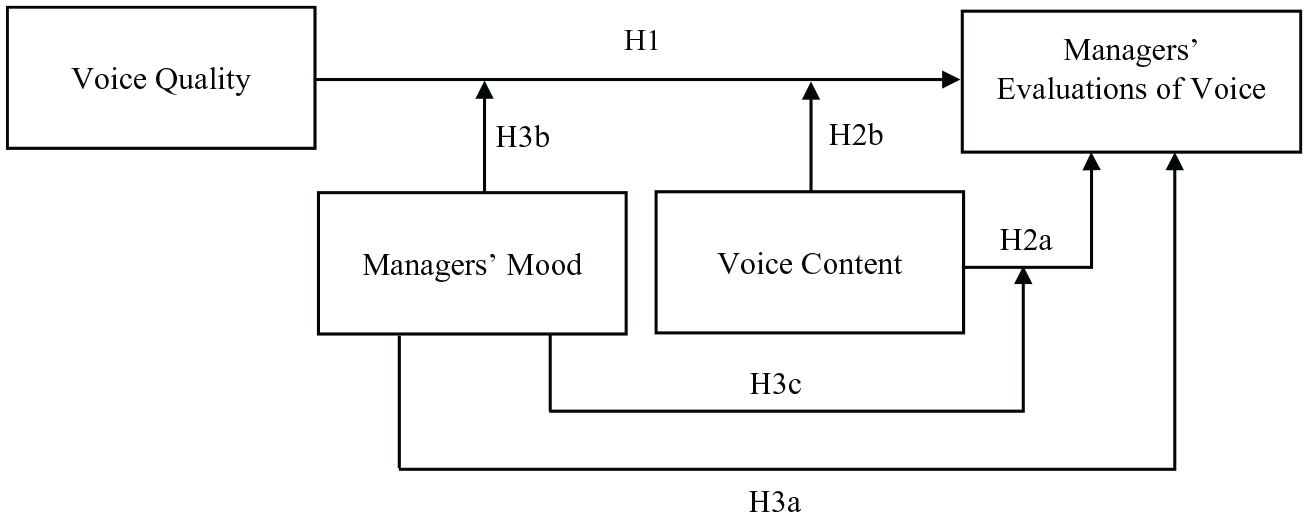
Research model.
Pilot study
Procedure and sample
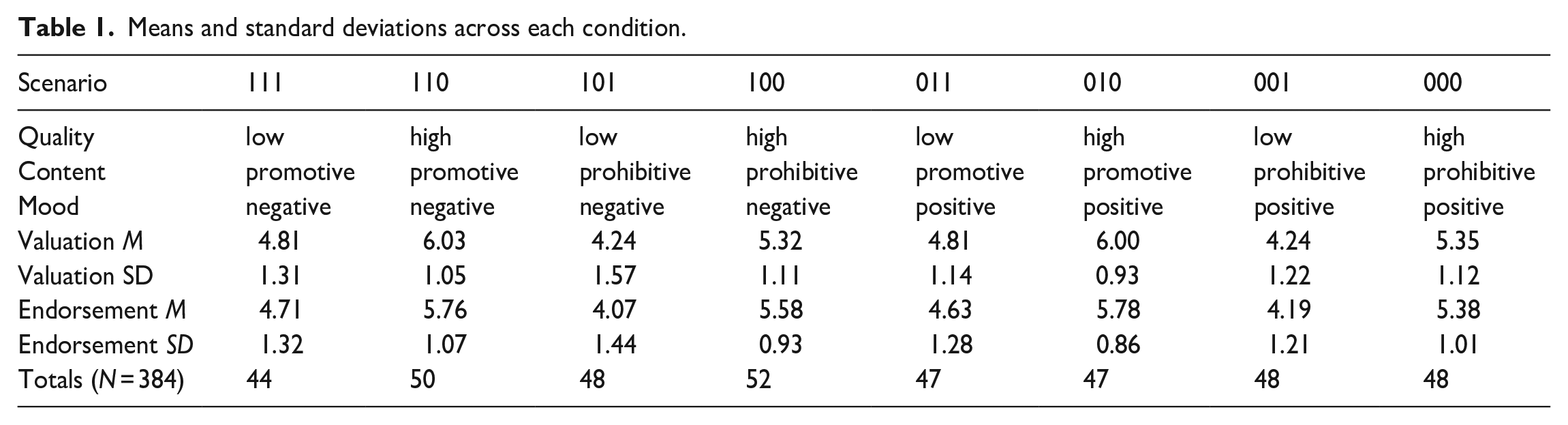
To test the hypotheses, a 2 (voice quality: high or low) × 2 (voice content: promotive or prohibitive) × 2 (managers’ mood: positive or negative) factorial, between-subjects experimental design was employed to test the hypotheses. This method has been used several times to investigate managers’ evaluations of voice (e.g. McClean et al., 2022; Whiting et al., 2012) because of its potential to establish causation by manipulating relevant factors and excluding others that might be confounding (Aguinis and Bradley, 2014).
Before testing the hypotheses, an extensive pilot study was conducted online to ensure the success of the research design and test the implemented manipulations. In this way, also the most appropriate approach to manipulate mood for the present study should be identified (Joseph et al., 2020; Westermann et al., 1996). The manipulations were tested among German employees and students who were recruited through personal networks and social media platforms such as Xing and LinkedIn. Participants were randomly assigned to one of eight scenarios adapted from previous experimental studies that investigated the evaluations of (promotive and prohibitive) voice (Weiss and Morrison, 2019; Welsh et al., 2022). Participants were asked to imagine that they lead a team of nine employees at the airline TravelAir. The airline is facing an increasing number of customer complaints related to two central issues: overbooked flights during rush hours and rude flight attendants. On average, participants took 9.57 minutes to complete the questionnaire in the pilot study.
The final sample consisted of 188 participants, with an average age of 28.38 years and 63.9% holding a university degree. Among the participants, 69.1% were female. Employees and students were selected as participants because existing literature does not suggest differences in the manipulations based on participants’ managerial responsibilities (e.g. Weiss and Morrison, 2019; Westermann et al., 1996).
Manipulations
Promotive voice manipulation
Participants in the promotive voice condition read that TravelAirs’ top management would like to address these issues and would mention them during the next team meeting. The following day, one of the participants’ employees speaks up with a plan for how to deal with the customer complaints by restructuring the flight routes to do a better job of meeting demand during rush hours. In this way, fewer customers would have to switch planes, overbooked flights could be reduced, and flight attendants could stay on schedule. The employee contends that customer satisfaction and TravelAir’s financial gains will increase as a result.
Prohibitive voice manipulation
Participants in the prohibitive voice condition also read that the management of TravelAir would like to address the issues, and top management suggests a plan to restructure the flight routes to do a better job of meeting demand during rush hours. One of the participants’ employees speaks up the next day with concerns that the plan would not reduce overbooked flights, and flight attendants would still have problems staying on schedule. In this scenario, the employee contends that customer satisfaction and TravelAir’s financial gains will continue to decline.
Voice quality manipulation
Then the participants read that they meet with the employee after the meeting to talk about the proposal/concerns. Next, they read that they think that the employees’ arguments either are or are not reasonable and, based on sound logic, that the employee has either considered or not considered whether the organization has the resources to implement the idea and has taken or not taken into account the difficulty of implementing the suggestion. Further, the participants think that the employee’s arguments either align or do not align with the organizations’ goals and either are or are not important for the success of the organization. Finally, the participants read that they think that the employee’s arguments either are or are not novel and innovative (Brykman and Raver, 2021).
Managers’ mood
The participants’ mood was manipulated before they read the TravelAir scenario. Any of several procedures can be used to do so effectively (for overviews, see the meta analyses of Joseph et al., 2020 and Westermann et al., 1996). Following the recommendations delineated in both meta-analyses, the pilot study manipulated mood via either short film clips or short stories and compared their effectiveness. Participants were divided in half regarding whether they watched a film clip or read a short story. Half of the participants in the negative mood/film clip condition watched the death of Mufasa, while participants in the positive mood/film clip condition watched the scene in which the animals sing “Hakuna Matata,” both from the movie The Lion King (as done before by Zhang et al., 2017 and; Zhang et al., 2021). The half of the participants who read a short story read either about the death of a suffering young student or about a happy young student who celebrates acceptance at a favorite university (Johnson and Tversky, 1983; Mittal and Ross, 1998).
Measures
Managers’ mood
Mood was measured using the validated German version (Krohne et al., 1996; α = 0.88) of the PANAS scale (Watson et al., 1988). Participants rated how they feel “right now” using items for such emotions as “sad, active, and enthusiastic” (1 = “not at all”, 9 = “very much”).
Promotive voice and prohibitive voice
Promotive voice was assessed using an adapted version of Liang et al.’s (2012; α = 0.94) six-item scale. The items were translated and then back-translated by an English native speaker. An example item was “The employee raised suggestions to improve the unit’s working procedure” (1 = “strongly disagree”, 7 = “strongly agree”).
Prohibitive voice was assessed using an adapted version of Liang et al.’s (2012; α = 0.85) six-item scale. An example item was “The employee dared to point out problems when they appear in the unit” (1 = “strongly disagree”, 7 = “strongly agree”).
Voice quality
The manipulation of voice quality was checked using adapted versions of Brykman and Raver’s (2021; α = 0.87 for rationality, α = 0.91 for feasibility, α = 0.88 for organizational-focus and α = 0.92 for novelty) scales. The items were translated and then back-translated by an English native speaker. An example item was “The employee gathers considerable information before communicating the arguments” (1 = “strongly disagree”, 7 = “strongly agree”).
Participants’ evaluations of voice
Participants’ evaluations were operationalized using their assessments of the value of their employee’s voice and their endorsement of their employee’s voice to determine whether managers differentiate between these two factors, as discussed in the literature (e.g. Burris, 2012). Their assessment of the value of their employee’s voice was measured using an adapted version of Burris et al.’s (2017; α = 0.93) two-item scale. The items were translated and then back-translated by an English native speaker. An example item was “The input that my employee brought me is useful” (1 = “strongly disagree”, 7 = “strongly agree”).
The participants’ endorsement of their employee’s voice was assessed using an adapted version of Burris et al.’s (2013; α = 0.95) five-item scale. Example items were “How likely are you to support this person’s comments when talking with your supervisor” and “I agree with this person’s input” (1 = “strongly disagree”, 7 = “strongly agree”).
In addition to the manipulation checks, attention (Kung et al., 2018) and instructional manipulation-check items (Oppenheimer et al., 2009) were included, such as “Was the described situation about restructuring flight routes or implementing a new payment system?.” The responses of participants who failed either of these checks were excluded from the analysis.
The scales and items of both, the pilot study and the main study, are presented in this study’s appendix.
Main study
Procedure and sample
The scenarios for the main study were slightly adjusted based on the results of the pilot study. To enhance the effectiveness of the manipulation, the voice content (promotive or prohibitive) was reiterated at the end of each scenario. In the case of promotive voice, participants read that “the employee came forward with an idea and solution to improve TravelAir’s operations.” For prohibitive voice, participants read that “the employee has come forward with concerns about the plan developed by management, which he believes could hurt TravelAir. He has not expressed any ideas for improving operations.” The final versions of the scenarios can be found in the appendix of this study.
The experiment was again conducted online, and participants, now German managers, were recruited in May 2022 via the online panel bilendi & respondi 1 and randomly assigned to one of the eight scenarios. These online panels recruit participants online and provide compensation for completing questionnaires (Behrend et al., 2011). Participation is voluntary and based on personal interests and compensation (Landers and Behrend, 2015). Data obtained from online panels offer several advantages, including demographic diversity and reliability, compared to traditionally collected data (Buhrmester et al., 2011). To enhance the validity of the results, recommendations from the literature, such as implementing attention checks and concealing the study’s purpose, were followed (Cheung et al., 2017). Managers were asked to participate in this study as they are the primary recipient of employee voice (Burris et al., 2013; Wåhlin-Jacobsen, 2020).
It took the participants 7.12 minutes on average to complete the questionnaire in the main study. The main study’s sample consisted of 384 managers from various industries. 49.70% of whom were women. The sample averaged 44.13 years of age, 48.30% had a degree from a university, the average organizational tenure was 13.51 years, the average span of control was 17.18 employees, and the average managerial experience was 10.50 years.
The same items were used to measure the independent and dependent variables in the main study as were used in the pilot study, and the same attention and instructional manipulation-check items were included. Again, the reliability coefficients of the used scales were good (α = 0.83 for managers’ valuations of voice, α = 0.93 for managers endorsements’ of voice). Because of the larger differences in mood induced by the short story in comparison to the film clip, mood was manipulated via the short stories used in the pilot study.
The main study controlled for the managers’ openness to experience using the validated German five-item scale from Rammstedt and John (2005; α = 0.78), as openness to experience may influence managers’ evaluation of voice (Huang et al., 2018). An example item was “I’m curious about many different things” (1 = “strongly disagree”, 7 = “strongly agree”). In addition, managerial self-efficacy was measured using the validated German 10-item scale from Jerusalem and Schwarzer (1999; α = 0.91), as the influence of managerial self-efficacy is also demonstrated (Fast et al., 2014). An example item was “I have no difficulty realizing my intentions and goals” (1 = “strongly disagree”, 7 = “strongly agree”).
Results
Manipulation checks
Managers’ mood
In the positive mood/film clip condition, participants’ positive mood was significantly more positive (M = 5.83, SD = 1.57) than it was for participants in the negative mood/film clip condition (M = 4.28, SD = 1.25, t(89) = −5.18, p < 0.001). In the negative mood/film clip condition, participants’ negative mood was significantly more negative (M = 3.47, SD = 1.43) than it was for participants in the positive mood/film clip condition (M = 2.06, SD = 1.41, t(89) = 4.72, p < 0.001). Participants in the film clip condition also rated on a 9-point scale whether the clip made them feel “negative/depressed” or “positive/uplifted” (e.g. Mittal and Ross, 1998). The ratings for participants in the positive mood/film clip condition were significantly more positive than those for participants in the negative mood/film clip condition (M = 6.37, SD = 1.83 vs M = 3.10, SD = 1.18, t(38) = −6.78, p < 0.001).
The positive mood of participants in the positive mood/short story condition was also significantly more positive (M = 5.78, SD = 1.39) than that of participants in the negative mood/short story condition (M = 3.94, SD = 1.14, t(95) = −7.15, p < 0.001), and the negative mood of participants in the negative mood/short story condition was also significantly more negative (M = 3.39, SD = 1.27) than that of participants in the positive mood/short story condition (M = 1.83, SD = 1.10, t(95) = 6.45, p < 0.001). Ratings for the other manipulation checks were also significantly higher for participants in the positive mood/short story condition than they were for participants in the negative mood/short story condition (M = 6.26, SD = 1.25 vs M = 2.76, SD = 0.94, t(42) = −10.39, p < 0.001).
Promotive voice and prohibitive voice
The responses of participants in the promotive voice condition provided answers that suggested significantly higher levels of promotive voice in their employee’s voice (M = 5.01, SD = 1.37) than participants in the prohibitive voice condition did (M = 3.93, SD = 1.66, t(186) = 4.87, p < 0.001).
Participants in the prohibitive voice condition provided answers that suggested significantly higher levels of prohibitive voice in their employee’s voice (M = 5.30, SD = 1.13) than participants in the promotive voice condition did (M = 3.99, SD = 1.15, t(186) = −7.87, p < 0.001).
Voice quality
Participants in the high-quality voice condition reported significantly higher quality for all four variables (rationality: M = 5.11, SD = 1.11; feasibility: M = 4.58, SD = 1.44; organizational-focus: M = 5.58, SD = 0.90; novelty: M = 5.12, SD = 1.60) than participants in the low-quality voice condition did (rationality: M = 3.13, SD = 1.37, t(186) = −10.80, p < 0.001; feasibility: M = 2.78, SD = 1.38, t(186) = −8.73, p < 0.001; organizational-focus: M = 4.08, SD = 1.54, t(186) = −7.93, p < 0.001; novelty: M = 3.03, SD = 1.49, t(186) = −9.24, p < 0.001).
Hypotheses testing
A three-way multivariate analysis of variance (MANOVA) was conducted to test the hypotheses, which is a common way to analyze factorial experimental data (Cole et al., 1993). A MANOVA allows to test for differences between groups with several dependent variables (Bray and Maxwell, 1985). The results revealed that voice quality has a significant effect on managers’ valuation (F[1, 384] = 89.302; p < 0.001; η² = 0.192) and endorsement of voice (F[1, 384] = 109.489; p < 0.001; η² = 0.226), supporting hypothesis 1. The content of voice has a significant effect on both valuation (F[1, 384] = 26.186; p < 0.001; η² = 0.065) and endorsement (F[1, 384] = 12.580; p < 0.01; η² = 0.032), supporting hypothesis 2b. However, hypothesis 2a, which proposes that voice content moderates the effect of voice quality on managers’ evaluations of voice is not supported, as the MANOVA showed no significant effects for the valuation of voice (F[1, 384] = 0.208; p = 0.649; η² = 0.001) or the endorsement of voice (F[1, 384] = 1.103; p = 0.294; η² = 0.003). The direct effect of managers’ mood on their evaluation of voice was also not supported for the valuation of voice (F[1, 384] = 0.000; p = 0.986; η² = 0.000) or the endorsement of voice (F[1, 384] = 0.085; p = 0.770; η² = 0.000), so hypothesis 3a is not supported. Further, the moderating effect of managers’ mood on the relationship between voice quality and the valuation of voice (F[1, 384] = 0.000; p = 0.992; η² = 0.001) and between voice quality and the endorsement of voice (F[1, 384] = 0.203; p = 0.652; η² = 0.001) or on the relationship between voice content and the valuation of voice (F[1, 384] = 0.018; p = 0.894; η² = 0.000) and between voice content and the endorsement of voice (F[1, 384] = 0.000; p = 0.986; η² = 0.000) was not significant, so hypothesis 3b und 3c are also not supported.
The overall model explains 23.6% of the variance in the valuation of voice (R² = 0.236; corr. R² = 0.222) and 25% of the variance in the endorsement of voice (R² = 0.250; corr. R² = 0.236). Including the control variables showed that openness to experience has a significant effect on managers’ valuation of voice (F[1, 384] = 3.981; p < 0.05; η² = 0.011) but not on their endorsement of voice F[1, 384] = 1.691; p = 0.194; η² = 0.005). As for managerial self-efficacy, significant effects were revealed for managers’ valuation of voice (F[1, 384] = 15.534; p < 0.001; η² = 0.041) and endorsement of voice (F[1, 384] = 21.236; p = < 0.001; η² = 0.055). Other than that, only organizational tenure significantly influenced managers’ endorsement of voice (F[1, 384] = 5.417; p = < 0.05; η² = 0.015).
The means and standard deviations of the valuations and endorsements of voice across each condition are shown in Table 1, and the results of the three-way MANOVA are shown in Table 2.
Means and standard deviations across each condition.
Three-way MANOVA for the valuation of voice (and endorsement of voice).
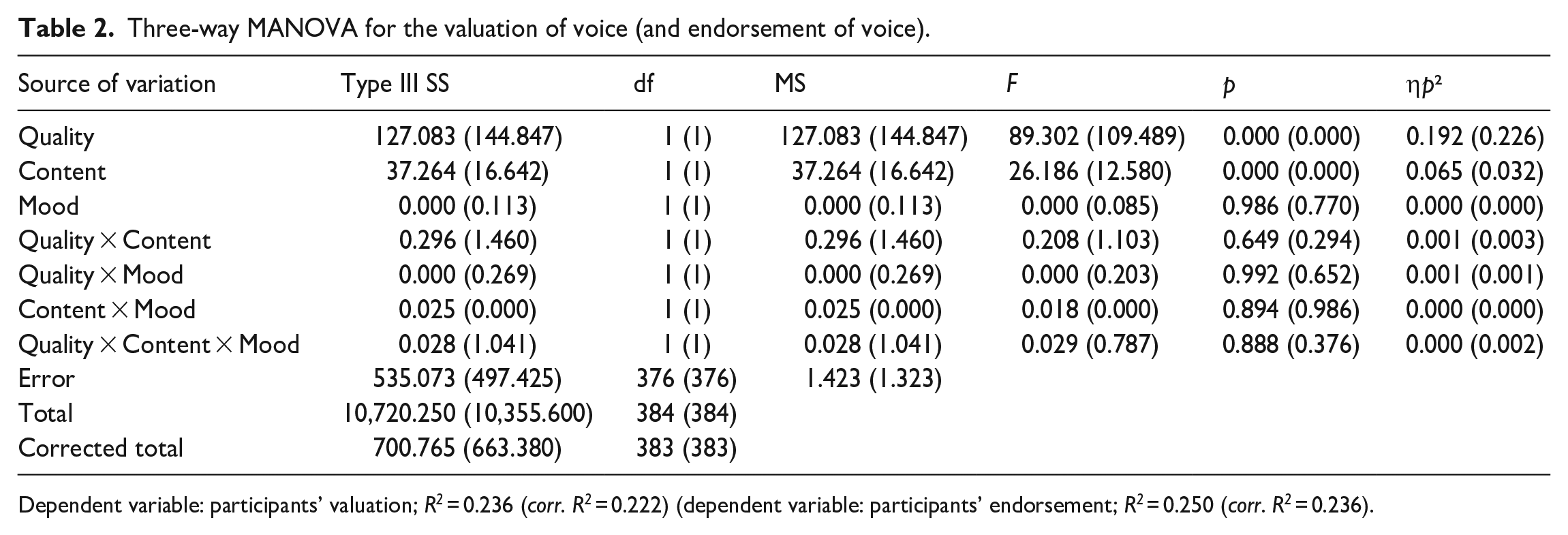
Dependent variable: participants’ valuation; R2 = 0.236 (corr. R2 = 0.222) (dependent variable: participants’ endorsement; R2 = 0.250 (corr. R2 = 0.236).
Discussion
This study investigated the influence of voice quality, voice content, and mood on managers’ evaluations of voice. Managers’ evaluations of voice are more positive when voice is of high quality, a finding that supports those of Brykman and Raver (2021). Evaluating high-quality voice positively is a way for managers to reciprocate employees’ efforts to improve organizational functioning by developing and communicating a proposal that is rational, feasible, novel, and in line with the organizations’ goals and values. In addition, managers most likely attribute a high probability of success and thus of achieving their personal goals, such as keeping their position and power within the organization (DeCelles et al., 2012), to an idea that is of high quality.
This study’s results also show that managers evaluate promotive voice more positively than they do prohibitive voice, supporting the results of Chamberlin et al. (2017) and Huang et al. (2018). As prohibitive voice focuses on factors that are or could be harmful, the employee’s underlying positive intention of preventing harm to the organization may be overshadowed by the message’s implicit criticism (Liang et al., 2012). Particularly when prohibitive voice refers to a problem for which the receiving manager is responsible, the manager may react defensively and evaluate the proposal negatively. The positive intention behind promotive voice, improving future ways of working, is more obvious than that which may be behind prohibitive voice.
Hypothesis 2b, which proposes a moderating effect of voice content on the relationship between voice quality and managers’ evaluations of voice, was not supported, perhaps because voice quality is equally important for managers, regardless of its content, according to this study’s results. Therefore, the four dimensions of voice quality seem to be as relevant to promotive voice as they are to prohibitive voice. Regarding rationality, managers may not prioritize a solution to an existing problem (prohibitive voice) over implementing a new to improve the status quo (promotive voice; Liang et al., 2012). Further, managers may tolerate both the positive emotions of employees who express promotive voice (Lin and Johnson, 2015) and the potentially negative emotions of employees who express prohibitive voice (Zhang et al., 2020). These findings are in contrast to those of Grant and Mayer (2009) and Grant (2013), who contend that employees fare better when they hide their negative emotions while expressing voice.
The persuasion literature shows that peoples’ attitudes may be changed by positive as well as negative emotions. Using fear increases peoples’ awareness of risks, while using sadness may cause them to think about the consequences of not doing as proposed (Dillard and Nabi, 2006). Anger can increase persuasiveness because of the implied threat when messages are framed in terms of potential loss instead of potential gain (Rothman et al., 2006; Rothman and Salovey, 1997). When an employee pictures the consequences that could result if an existing problem like the financial losses that the employee addressed in the prohibitive voice scenario is not fixed, managers may be more willing to take action.
The literature demonstrates that attitude change is also increased when peoples’ negative emotions match those of the recipient (DeSteno et al., 2004). When an angry or sad employee expresses prohibitive voice, managers may also become angry or sad because of the problem or as a direct reaction to the employee’s emotion. As a consequence, managers may be persuaded by both promotive and prohibitive voice equally, leading to the same evaluation.
The study’s results also indicate the importance to managers of the feasibility of voice, which is in line with, for example, Burris et al. (2017). Managers pay attention to feasibility not only when a new idea is proposed (as also shown by Dean et al., 2006 and; Rietzschel et al., 2010) but also when an existing problem has to be solved. For example, Dutton and Webster (1988) show that managers have the most interest in organizational issues whose feasibility they perceive as high. Regarding prohibitive voice, managers might take care to resolve problems as soon as possible before information gets around and their image of a successful leader could be at risk (Isaakyan et al., 2021).
Managers also seem to pay attention to voice’s organizational focus, which is in line with, for example, Dutton et al. (2001) and Garner (2016), who demonstrate that managers may perceive organizational dissent and employees’ disagreement with organizational practices (Kassing, 1998) more positively when the solution presented for an existing problem is aligned with organizational goals. Managers value employees considering their proposals’ effect on the whole organization.
Managers may also prefer that employees spend time and effort developing a problem’s solution to increase its quality in terms of its novelty. They might expect, for example, employees to put sufficient time into constructing an idea, searching for information, and generating alternatives to ensure that the final solutions do not just “plow old ground.” These steps are part of a creative problem-solving process (Reiter-Palmon et al., 1997; Reiter-Palmon and Illies, 2004) that is necessary for organizations to change and survive in the long term (Mumford et al., 1997).
This study’s findings also show that managers’ evaluations of voice are not influenced by their mood, so the results are not in line with those of Xu et al. (2020). Independent of managers’ elaboration likelihood, their positive or negative mood may not influence their opinion of an employee’s proposal, a finding that is contrary to those of, for example, Petty et al. (1988, 2003). Therefore, the assumptions of the ELM (Petty and Cacioppo, 1986) could not be confirmed, nor could those of the Hedonic Contingency Models (Wegener and Petty, 1994). Managers may not consider how an employee’s proposal could influence their mood before evaluating it, so they may not perceive even low-quality prohibitive voice as a threat to their positive mood, which explains why mood had no moderating effects.
One explanation for the mood’s lack of effect on managers’ evaluations of voice may be derived from the emotion regulation literature. Managers tend to regulate their emotions in their interactions with followers, as doing so is considered a key competence for professional and effective leaders (Glasø and Einarsen, 2008; Haver et al., 2013). For example, managers may suppress their true emotions to distance themselves from their followers and to maintain a semblance of objectivity and fairness. Otherwise, privileged relationships with certain employees could develop when interactions with these employees are accompanied by display of the manager’s positive emotions. Furthermore, with reference to the Social Distance Theory of Power (Magee and Smith, 2013), individuals who possess power are often less motivated to engage in interactions with powerless individuals, such as employees, as their control over valuable resources reduces their dependence on them. Because of positive emotions’ potentially positive outcomes, such as more motivated followers, literature suggests that managers should not suppress all emotions but express them only in certain situations (Van Kleef et al., 2009). Emotion regulation appears along a continuum, from conscious and effortful to automatic and unconscious (Grandey, 2000). When an employee expresses voice, the manager’s emotion regulation may, consciously or not, prevent their evaluation from being influenced by their mood.
In addition to emotion regulation, interpersonal affect—the demonstration of one’s positive or negative feelings toward another (Casciaro and Lobo, 2008)—may explain this study’s findings. Referring to the performance appraisal literature, interpersonal affect may overlay such short-term affect as mood to preserve an existing relationship, such as a friendship (Daus, 2001; Robbins and DeNisi, 1998). Therefore, good relationships between managers and their followers may let managers evaluate voice without being influenced by their moods.
The inclusion of control variables demonstrated that managers’ evaluation of voice is positively influenced by managers’ openness to experience and self-efficacy. Openness to experience may lead them to perceive voice as constructive and to assume that the proposal will have a positive influence on organizational functioning (Huang et al., 2018; Whiting et al., 2012). In addition, managers who have high levels of self-efficacy use their competence and capability to ensure effective organizational processes (Fast et al., 2014). Thus, also prohibitive voice may be evaluated positively, as it is no longer perceived as a threat to managers’ image of being a successful leader within the organization (Isaakyan et al., 2021). Further, managers may be less concerned about losing their hierarchical position and power within the organization (DeCelles et al., 2012; Guinote, 2007).
Practical implications
The results of this study have several practical implications. Employees can use these study’s findings to increase the likelihood that they will be rewarded and not punished for their input and that their proposals will be implemented. As Huang et al. (2018) demonstrate, managers evaluate voice expressed at a high frequency negatively because they assume that the proposals are not well thought through. Therefore, employees could consider investing time and effort into developing their proposals before presenting them for evaluation. Even when solving an existing problem seems urgent, presenting a solution immediately may not be worth doing when it is not of high quality. Employees should also be aware that managers are likely to value prohibitive voice less than promotive voice, so employees should consider how to communicate a proposal when they are addressing a current problem to avoid sounding critical.
Organizations could make managers aware that their evaluations of voice are influenced by a number of factors. For example, sensibility training could be integrated into managers’ training. To increase voice’s value to an organization, the organization could train both managers and employees the value of a proposal’s rationality, feasibility, organizational focus, and novelty in increasing the chances that voice will be implemented. Such an approach is especially important to prevent employees from being discouraged when poorly though out proposals are rejected (Morrison, 2014).
Limitations and future research
This study is subject to several limitations. First, voice quality was manipulated using Brykman and Raver’s (2021) overall voice quality scale, so no claims can be made regarding whether the dimensions of voice quality are equally important to managers or they prioritize them differently. Although Brykman and Raver’s (2021) findings give reason to believe the latter, future research is necessary in this regard. Quality may also be “in the eye of the beholder,” leading to differences in the relevance of each of voice quality’s dimensions to managers.
A second limitation stems from the ELM, which is part of this study’s theoretical foundation. Managers’ information processing may be influenced by factors that this study’s experiments did not control for. Whether information is processed via the central or peripheral route depends, among other things, on a topic’s personal relevance to an individual, his or her prior knowledge, and possible distractions (Petty and Cacioppo, 1986). The managers who participated in this study may have, for example, experiences with the airline industry represented in the scenarios, or some managers may have been distracted by family, incoming calls, or other duties. These factors may be especially pertinent because the data collection took place in May 2022, when many people may still have been working from home because of the Corona Pandemic.
Third, only German managers participated in this study, so the findings may not be transferrable to other cultures. Research demonstrates that emotion regulation (Matsumoto et al., 2008) and perceptions of quality (e.g. Insch and McBride, 2004) differ among cultures. Additional research is necessary to determine, for example, whether the evaluations of managers who work in countries with low levels of emotional suppression, such as Portugal, are influenced by their mood.
Fourth, the factorial, experimental design, a research method commonly employed to analyze managers’ evaluations of voice (e.g. McClean et al., 2022), offers strengths, such as the ability to examine causal relationships, but it also has inherent weaknesses (Aguinis and Bradley, 2014). Participants were presented with hypothetical situations where they had to put themselves in the role of a manager at the airline TravelAir, tasked with addressing a growing number of customer complaints. Although the scenarios used were derived from the literature (Weiss and Morrison, 2019; Welsh et al., 2022) and deemed suitable for the research design, it is important to acknowledge that in reality, managers’ evaluations of voice could be influenced by factors that were not considered in this study. The literature suggests that managers’ evaluations of voice, for instance, can be influenced by ego depletion (Li et al., 2019), which may be challenging to manipulate realistically within a hypothetical scenario. Consequently, the generalizability of the findings from this study is limited. In future research, it would be beneficial to conduct field studies (Podsakoff and Podsakoff, 2019) to analyze managers’ evaluation of voice under more realistic circumstances.
Next to field studies, also longitudinal studies could be fruitful, as managers’ evaluations of voice could change over time. In this regard, Huang et al. (2018) find a U-shaped relationship between voice frequency and employees’ performance evaluations. When an employee expresses voice infrequently, managers may assume that the employee does not care much about the organization, while managers may assume that, when an employee expresses voice frequently, his or her proposals are not well thought out. This relationship is particularly strong in the case of prohibitive voice, as managers’ defensiveness may intensify with frequent expressions of prohibitive voice. These negative reactions may be mitigated, resulting in better evaluations, when a proposal is of high quality.
Supplemental Material
sj-docx-1-gjh-10.1177_23970022241231540 – Supplemental material for The influence of voice quality, voice content, and managers’ mood on their evaluations of voice: An experimental investigation
Supplemental material, sj-docx-1-gjh-10.1177_23970022241231540 for The influence of voice quality, voice content, and managers’ mood on their evaluations of voice: An experimental investigation by Robin Stumpf in German Journal of Human Resource Management
Footnotes

References
Supplementary Material
Please find the following supplemental material available below.
For Open Access articles published under a Creative Commons License, all supplemental material carries the same license as the article it is associated with.
For non-Open Access articles published, all supplemental material carries a non-exclusive license, and permission requests for re-use of supplemental material or any part of supplemental material shall be sent directly to the copyright owner as specified in the copyright notice associated with the article.
