



Abstract
Constructive employee voice research has a 50-year tradition, but it is only recently that scholars have begun to focus on the consequences of voice. To date, a systematic review that puts the consequences of constructive voice for the voicer and its recipients—that is, co-workers and managers—at its core is notably absent. We introduce the conceptual metaphor voice echoes to describe that voice creates individual responses for voicers, co-workers, and managers, which further affect how they respond to each other in their roles as voicers and recipients. The purpose of our review is threefold. First, to systematically review the growing body of literature on the consequences of constructive voice for voicers, co-workers, and managers at affective, cognitive, and behavioral levels. Second, to critically analyze the literature on the consequences of voice concerning conceptual and methodological considerations. Third, to outline directions for future research on the consequences of constructive voice.
Introduction
Constructive voice behavior – in short voice – refers to proactive expressions of ideas or suggestions by employees to change practices and procedures at work for the better (Morrison, 2011). Although constructive voice has long been a focal point in organizational research (e.g., Morrison, 2011; Van Dyne & LePine, 1998), scientific interest in its consequences has only recently gained momentum (Morrison, 2023). While earlier research predominantly portrayed constructive voice as desirable (Bashshur & Oc, 2015), scholars are increasingly shedding light on the potential risks for voicers themselves. Voicers may encounter challenges such as rejection of their ideas (e.g., Isaakyan et al., 2021; Popelnukha et al., 2021) and face disparagement or even ostracism by co-workers and managers (e.g., Fast et al., 2014; Ng et al., 2022).
As these examples showcase, voice is a social phenomenon that involves voicers and recipients, including co-workers and managers. Expressing voice, thus, not only has consequences for the voicer but also for co-workers and managers, who may be targeted by or observe voice behavior. An important element of the social dynamic that has so far remained largely elusive is the fact that these voice responses can in turn affect others (e.g., Chen & Treviño, 2023; Kim et al., 2023). For example, a manager who feels threatened by voice may reject voiced suggestions which reduces the voicer's status in the eyes of co-workers. To grasp these dynamics, in the present work, we introduce the conceptual metaphor voice echoes to describe the responses that voice provokes in the voicer, their co-worker(s), and their manager.
Conceptualizing the consequences of voice as voice echoes puts the focus on the reverberation of voice in its social environment, as an important yet underdeveloped area in voice research. As summarized in Figure 1, expressed constructive voice with its characteristics (i.e., source, content, timing, and context) triggers a propagating effect on the voicer, co-workers, and managers and further echoes that are shaped by their responses, which we analyze on affective, cognitive and behavioral levels. As such, we take a focused and nuanced perspective on the consequences of voice for voicers, co-workers, and managers at distinct levels. This expands existing reviews that adapted a broad perspective to include both the antecedents and consequences of voice in organizations (e.g., Morrison, 2023).
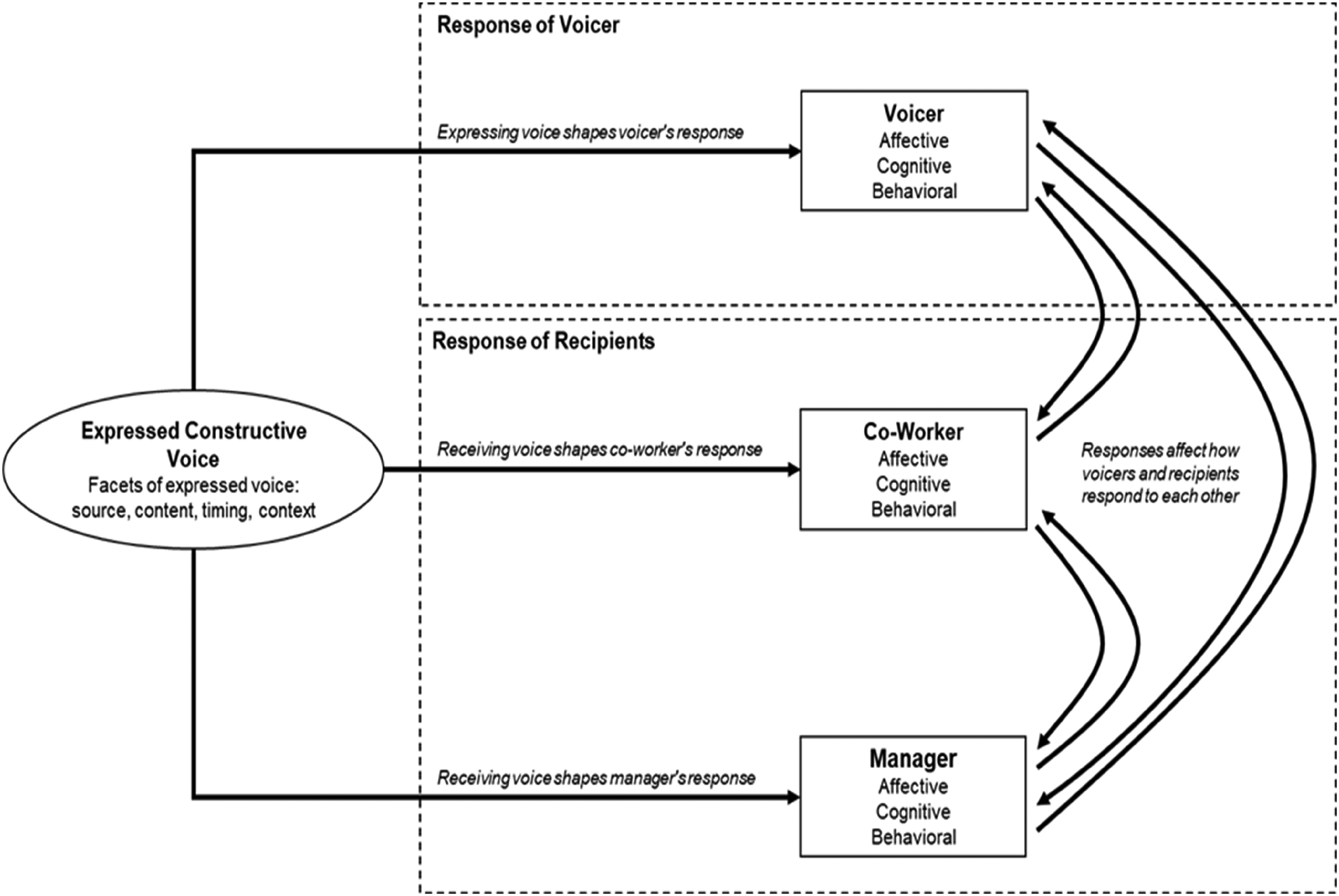
Conceptual model of voice echoes.
Our review advances the literature in three important ways. First, we analyze the consequences of voice as a social process that involves the three roles - voicer, co-worker(s), and managers. Although voice has been recognized as an interpersonal process involving the voicer and the recipient (Chen & Treviño, 2023; Kim et al., 2023; Morrison, 2023), the role of the recipients has not been fully unpacked. For example, Kim et al. (2023) present a dyadic model on the relational voice outcomes between voicers and managers, yet do not consider the role of third parties involved, such as observing co-workers. Similarly, other reviews (e.g., Chen & Treviño, 2023) do not differentiate between managers and co-workers in their role as voice recipients, despite acknowledging that there may be differences. Through systematically reviewing the responses that voice provokes in voicers, co-workers, and managers, we uncover how individuals in each of these roles shape voice echoes individually and by affecting each other's responses. We discuss the key role that managers’ voice endorsement has for voice echoes to travel across voicer and co-workers and show how observing coworkers actively contribute to specific echo pathways.
Second, in addition to distinguishing between the three roles - that is, the voicer, co-worker, and manager -, we unpack three levels at which responses to voice manifest: affective, cognitive, and behavioral. This expands the focus of Chen and Treviño (2023), who consider behavioral outcomes, and Kim et al. (2023), who emphasize behavioral and relational outcomes for voicers and managers. Together, the differentiation of roles and levels provides a nuanced perspective to analyze the consequences of voice. We thereby contribute to a more comprehensive understanding of the processual and systemic (e.g., contagion) effects of voice echoes. We discuss how these echoes are shaped by the content of voice (e.g., promotive vs. prohibitive; voice quality), by co-workers’ and managers’ responses, and by temporal effects.
Third, as adequate methods are the basis of all research efforts (Aguinis & Cronin, 2022; Podsakoff et al., 2016), we integrate critical reflections on conceptual and methodological issues in current research on the consequences of voice. This can help to point out gaps that limit our understanding. Our research thereby unpacks that both theorizing and measurement often remain imprecise in terms of who rates voice and who are the recipients. Further, we demonstrate that managers’ voice endorsement, one of the most studied consequences and key in its role for voice echoes, has been used as an umbrella concept subsuming diverse manager responses, which leads to imprecision and potentially confusion. By highlighting these issues and offering suggestions on how to address them in theorizing and empirical research, the present research offers pathways for future research efforts related to the consequences of voice.
Conceptual Clarification
Employee Voice
Research on employee voice dates back more than 50 years (Hirschman, 1970), and Table 1 shows influential definitions identified in the literature reviewed. While early on, voice was broadly conceptualized as “any attempt at all to change” (Hirschman, 1970, p. 30) later conceptualizations refined it to describe discretionary and verbal expressions to someone inside the organization intended to elicit change (e.g., Liang et al., 2012; Morrison, 2011; Van Dyne & LePine, 1998). Despite a few multi-dimensional exceptions (self-protective, resisting, or destructive motives; Maynes & Podsakoff, 2014; van Dyne et al., 2003), the vast majority of research focuses on constructive voice (see Kim et al., 2023) driven by an intention to change existing work practices for the better. Building on this, we center our review on the consequences of constructive employee voice rather than other types of voice. For the purpose of our review, we, therefore, define employee voice as a discretionary verbal expression that is constructively intended, targeted at changing existing work practices, and addressed to someone inside the organization (horizontally or vertically). Based on this definition, the key criteria to differentiate constructive voice from other proactive behaviors at work, including other types of voice (e.g., self-interested voice; destructive voice; Duan et al., 2020; Maynes & Podsakoff, 2014) are (1) verbalization, (2) constructive intent, (3) orientation to change and (4) inside the organization.
Influential Definitions of Employee Voice in Chronological Order.
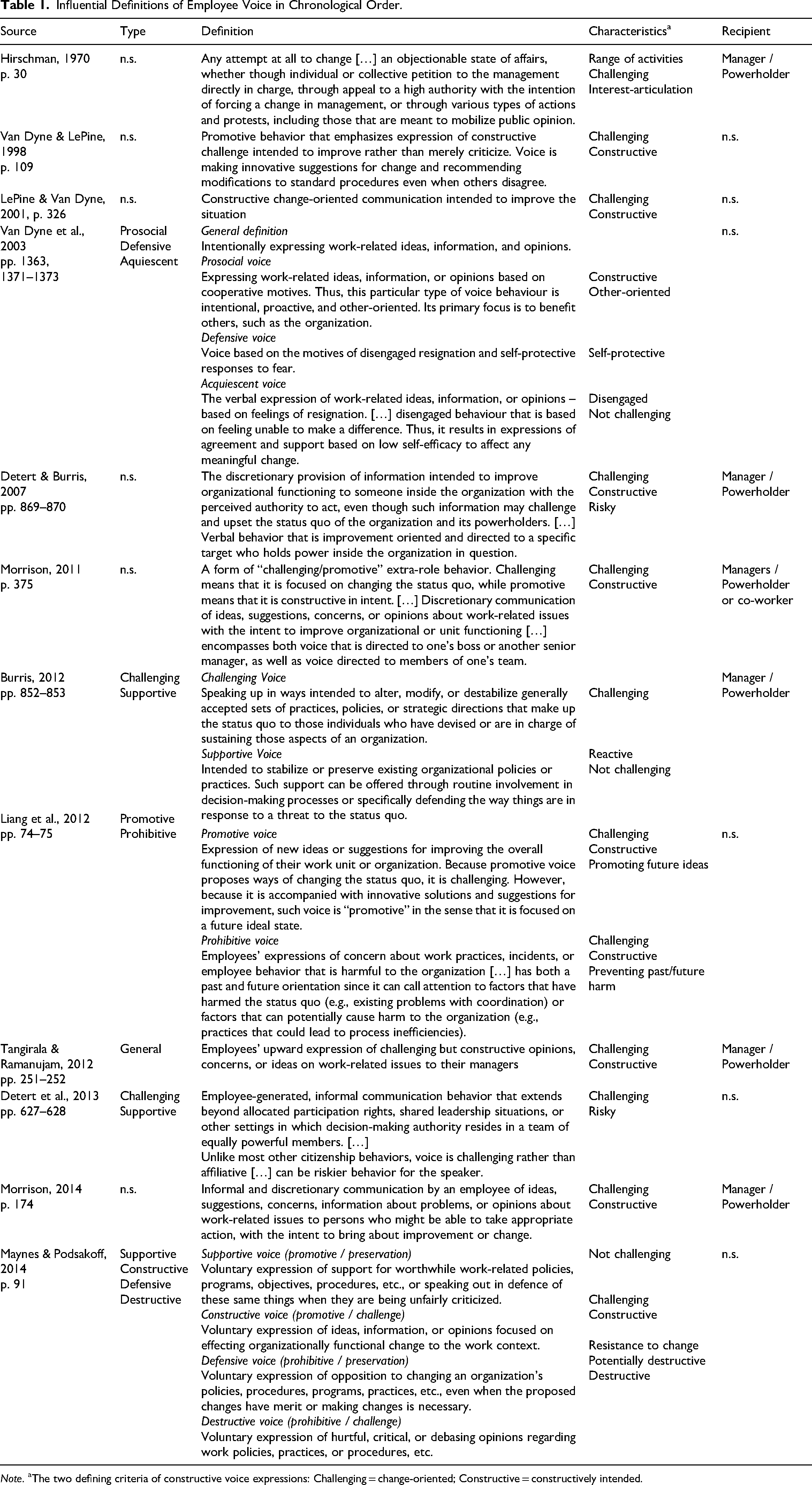
Note. aThe two defining criteria of constructive voice expressions: Challenging = change-oriented; Constructive = constructively intended.
Despite the consensus that constructive voice entails constructively intended expressions of change, it can express different content. One key differentiation is between promotive or prohibitive content (Liang et al., 2012). Whereas promotive voice captures an employee's “expression of new ideas or suggestions for improving the overall functioning of their work unit or organization”, prohibitive voice describes “expressions of concern about work practices, incidents, or employee behavior that are harmful to their organization” (Liang et al., 2012, pp. 74–75). Both are constructive forms of voice as they are challenging (i.e., oriented towards change) yet likewise constructively intended (i.e., aimed at benefiting the unit or organization). Yet they differ in their behavioral content with promotive voice pointing to future possibilities of doing things better, and prohibitive voice pointing to preventing current or future harm (Liang et al., 2012). Due to these content-differences, prohibitive voice may come with increased risks of speaking up, as the “good intention behind pointing to harmful factors may not be easily recognized (…) because of the potential negative emotions and defensiveness invoked in the process” (Liang et al., 2012, p. 75). The distinction between promotive and prohibitive forms of constructive voice is well-established (e.g., Chamberlin et al., 2017; Chen & Treviño, 2022; Li et al., 2017; McClean et al., 2018), yet contrasts Maynes and Podsakoff (2014) who use prohibitive as a label to describe a destructive form of voice (i.e., aimed at stopping, blocking, or hindering).
Voice Echoes
We conceptualize voice echoes as the consequences of voice behavior for the voicer, their co-worker(s), and their manager. Voice echoes are the result of an individual employee verbalizing challenging yet constructive ideas, suggestions, or concerns to someone inside their organization. Therefore, by definition, involving a voicing employee (i.e., voicer) and others, in particular co-workers and managers, who receive voice as either targets or observers (i.e., recipients). Expressed voice can be described by characteristics, such as who the voicer is (source), what they voice about and in what way (content), when and how frequently they voice (timing), and the social situation (context), and these characteristics shape the consequences of voice for voicers and recipients.
The concept of voice echoes emphasizes that voice creates individual responses for voicer and recipients, which can further affect, shape and reinforce how they respond to each other relationally. These individual responses manifest at affective, cognitive, and behavioral levels and they can have further relational consequences (i.e., changing how voicer and/or recipients think or feel about another person or how they behave towards this person). For example, observing voice behavior may lead to increased admiration for the voicer in a co-worker, which will then affect their status perception of the voicer. Another example could be a manager who perceives voice as a threat and, in consequence, perceives the voicer as disloyal. These examples highlight how voice expressions provoke a response in a person, with affective, cognitive, or behavioral consequences for other persons.
In sum, by introducing the concept of voice echoes, our review differentiates between the responses that voice provokes in voicers and recipients (co-workers, managers) at affective, cognitive, and behavioral levels, highlighting how these responses create further reverberations for others. Figure 1 conceptually highlights the different pathways voice can take. We will start by reviewing the literature on the consequences of voice, categorized by role (i.e., voicer, co-worker, manager) and level (i.e., affective, cognitive, behavioral). Following this, we will provide an integrated discussion on voice echoes and how they are shaped by voice content, context, and timing, and outline potential avenues for future research.
Review Methodology
The purpose of the review is threefold: first, to organize and distill existing knowledge in the field of organizational psychology and behavior (representing; Kunisch et al., 2023); second, to identify shortcomings in current conceptualizations and methodologies and suggest ways to improve (problematizing; Cronin & George, 2023; Kunisch et al., 2023); and third, to outline directions for future research on the consequences of voice in organizations.
To identify relevant articles, we followed the five-stage process suggested by Siddaway et al. (2019): scoping, planning, identification, screening and eligibility (see Figure 2 for the details of the complete process). In the scoping stage, we formulated four guiding research questions. These include the exploration of (1) the responses of voicer and recipients (co-worker, manager), (2) the manifestation of these responses at different levels (affective, cognitive, and behavioral), (3) conceptual and methodological shortcomings, and (4) implications for future research.
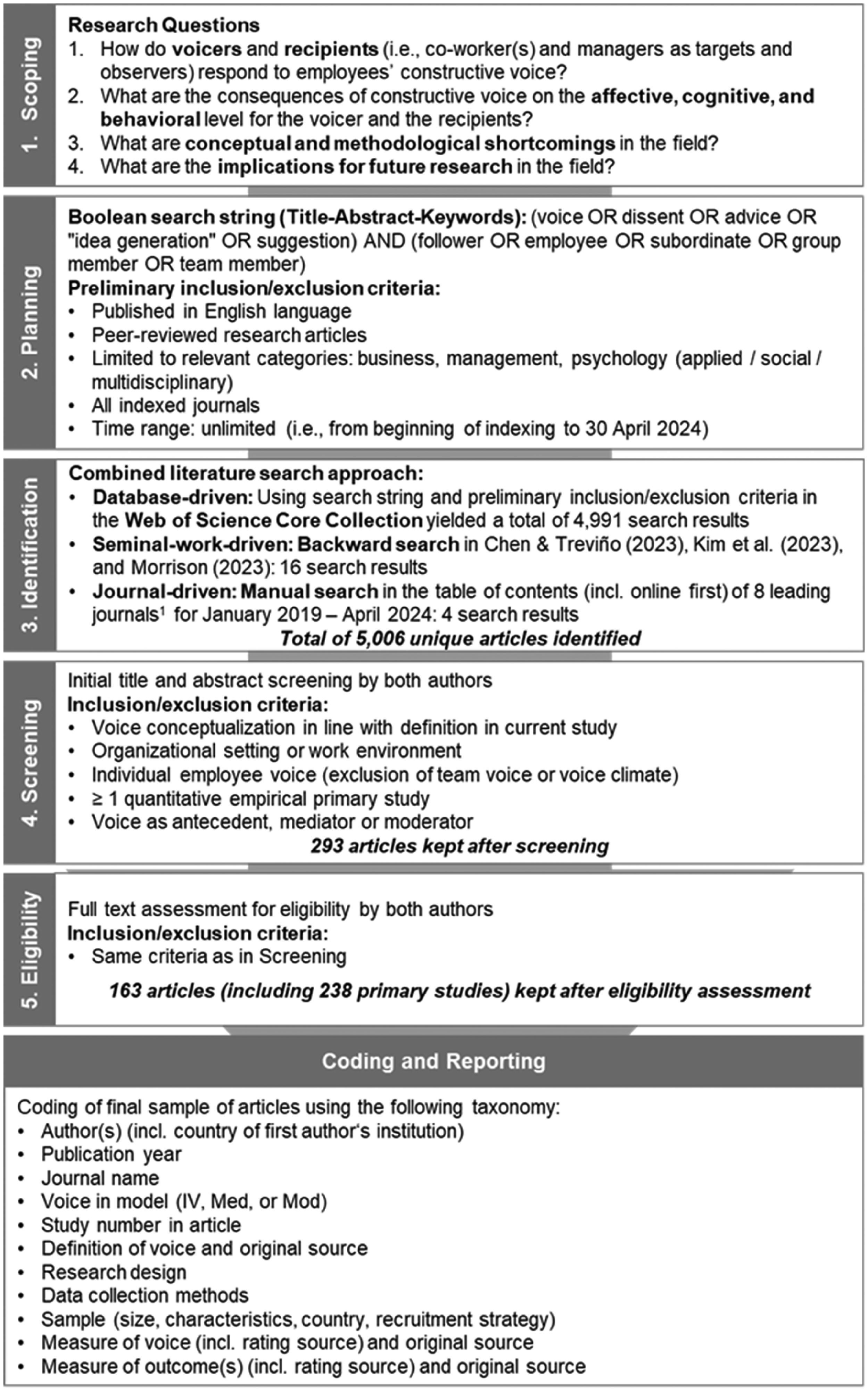
Flowchart of article search and selection.
In the identification stage, we combined three search approaches to obtain a comprehensive and unbiased sample: database-driven, seminal-work-driven and journal-driven (Hiebl, 2023). The different approaches complement each other by contributing their strengths while alleviating their weaknesses (e.g., articles that are not (yet) indexed or not indexed correctly in a database; Siddaway et al., 2019). In the database-driven approach, we searched the Web of Science Core Collection covering peer-reviewed articles published in English. This approach is common in organizational research (e.g., Akkermans et al., 2024; Chen & Treviño, 2023). In an effort to be sensitive to racial biases in the publication process (Avery et al., 2022), we did not restrict our search to specific journals but searched all indexed journals in the categories business, management, psychology (applied/social/multidisciplinary) up to 30 April 2024 without time restrictions. We searched for abstracts, titles and keywords that combined the terms voice (or dissent, advice, idea generation, suggestion) with employee (or follower, subordinate, group member, team member). Applying these criteria with Boolean search operators, the database-driven search yielded 4,986 results. In the seminal-work-driven approach, we conducted a backward search for three recent review articles on employee voice (i.e., Chen & Treviño, 2023; Kim et al., 2023; Morrison, 2023). This led to the inclusion of 16 additional articles. In the journal-driven approach, we searched the in-press articles and tables of contents of the last five years (i.e., January 2019 – April 2024) of eight leading journals (i.e., Academy of Management Journal, Human Relations, Journal of Applied Psychology, Journal of Business Ethics, Journal of Management, Journal of Management Studies, Journal of Organizational Behavior and Personnel Psychology) that regularly publish work on voice. This led to the inclusion of four additional articles (i.e., Huai et al., 2024; Kim et al., 2024; Ni et al., 2024; Rubenstein et al., 2023). In total, 5,006 unique research articles were identified for the screening process.
For the screening, after a joint training phase, both authors screened titles and abstracts to identify potentially eligible articles. The following inclusion/exclusion criteria were defined: (1) voice conceptualization in line with the definition (see above); (2) an organizational setting or work environment; (3) individual employee voice (i.e., excluding team voice and voice climate); (4) at least one quantitative empirical primary study; and (5) voice as antecedent, mediator or moderator. In this phase, the inclusion criteria were applied leniently (Siddaway et al., 2019). This process resulted in the exclusion of 4,703 articles. Subsequently, the authors assessed the eligibility of the remaining 293 articles by means of an exhaustive full-text screening applying the same criteria and discussed all uncertainties until they were resolved by consensus. This resulted in a final sample of 163 empirical articles, which comprised 238 relevant primary studies. The articles were published in 70 different journals, with four journals accounting together for 30% of the sample: Journal of Applied Psychology (n = 18), Frontiers in Psychology (n = 11), Academy of Management Journal (n = 10), and Journal of Organizational Behavior (n = 9).
An overview of all the articles, detailed coding information on all the studies and a full list of journals are available on an Open Science Framework (OSF) project page: https://osf.io/4fmpc/.
Review Findings
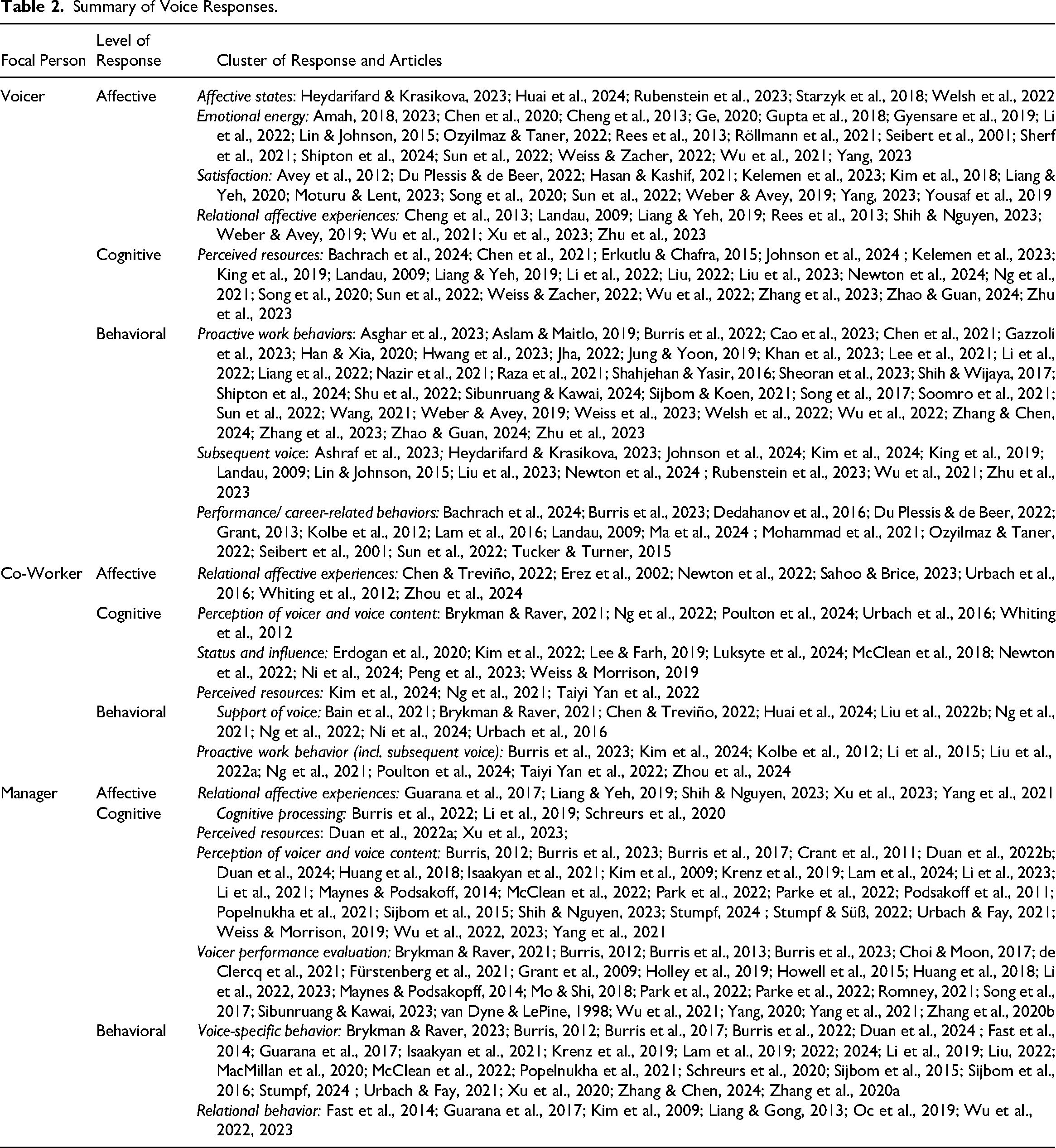
We review the consequences that voice has for voicers, co-workers, and managers, differentiating between affective, cognitive, and behavioral responses. Table 2 summarizes the review findings. For affective responses, we include research on affective states (e.g., affect, emotions), emotional energy constructs (e.g., engagement, fatigue), satisfaction and relational affective experiences (e.g., liking, LMX). For cognitive responses, we include research on the processing of voice as well as perceptions (e.g., perceived resources), attributions (e.g., attributed motives) and evaluations (e.g., manager's evaluation of voicer performance) in response to voice expressions. For behavioral responses, we include voicers’, co-workers’ or managers’ general work behavior (e.g., proactive work behavior), their interpersonal behavior, and for voicers their performance and career-oriented behavior.
Summary of Voice Responses.
The Responses of Voicers to Expressing Voice
The following sections review how voicers feel, think and act after they have expressed voice at work. At affective levels, expressed voice – and receiving recipients’ response to voice – has consequences for voicers’ affective states (e.g., positive/negative affect, pride), emotional energy (e.g., work engagement), satisfaction (e.g., career satisfaction), and their relational affective responses (e.g., relationships with recipients). At cognitive levels, expressed voice affects voicers’ perceived resources (e.g., self-efficacy, social support). At behavioral levels, it shapes their proactive work behavior, in particular their decision to subsequently express voice, and their performance/career-oriented work behavior.
Voicers’ Affective Responses
Research on voicers’ affective states mainly relies on the experience sampling methodology to show that voicers’ more immediate affective responses depend on the content and timing of their voice. Expressing prohibitive voice in meetings decreased voicers’ immediate negative affect, which affective events theory explains as momentary relief from negative tensions (Starzyk et al., 2018). No such changes were found for promotive voice. However, for end-of-workday affect, prohibitive voice was less helpful: On days when voicers expressed prohibitive (promotive) voice, their negative (positive) affect was higher (Heydarifard & Krasikova, 2023). This corroborates findings by Welsh et al. (2022) in which promotive and prohibitive voice elicit diverging affective states, such that voicers felt prouder in response to promotive voice and more anxious in response to prohibitive voice. Furthermore, voicers’ affective responses were shaped by their manager's behavioral response, showing the reverberations of voice that span voicer and recipients. Specifically, encouraging managerial behaviors amplified (attenuated) the feeling of pride (anxiety) in response to promotive (prohibitive) voice. However, manager voice endorsement can be a double-edged sword when considering the voicer in their wider social context: Endorsed voicers felt targeted by co-worker envy (Huai et al., 2024), and – despite experiencing authentic pride – they also felt hubristic pride, which contributed to hostile interpersonal behavior (Rubenstein et al., 2023). These findings highlight the echoes that voice expressions create in teams, importantly that voicer's emotional responses can have relational consequences for co-workers.
Expressing voice affects voicers’ emotional energy, which has mostly been studied in the form of increased or reduced work engagement. Findings from cross-sectional studies indicated that expressing promotive voice is directly and positively related to work engagement (e.g., Cheng et al., 2013; Rees et al., 2013), and thriving at work (Chen et al., 2020). Further, manager voice endorsement was positively related to voicers’ work engagement (Li et al., 2022; Wu et al., 2021). Longitudinal findings showed that voice increases job engagement over the course of three months due to higher levels of appreciation of voice by managers (Weiss & Zacher, 2022; see also Sun et al., 2022). Another longitudinal study found that voice is unrelated to changes in emotional withdrawal (Sherf et al., 2021). In two longitudinal studies, Lin and Johnson (2015) found that different types of voice (i.e., promotive and prohibitive) have different effects on voicer depletion. While promotive voice decreases voicer depletion, prohibitive voice increases it. Adding to this, Röllmann et al. (2021) investigated the effect of voice on voicer vigor and fatigue as a function of their job insecurity. Their results show that voice increases vigor regardless of the level of job insecurity, but it decreases fatigue only when job insecurity is low.
Expressing voice is positively related to voicers’ satisfaction with their job and careers. Whereas Avey et al. (2012) did not find a relationship of voice with satisfaction, various other studies did (e.g., Liang & Yeh, 2019; Moturu & Lent, 2023; Seibert et al., 2001; Sun et al., 2022). Regarding voicers’ relational affective responses, expressing voice has been shown to benefit voicers’ relationships, though having their ideas endorsed does not necessarily yield the same results. Voicing resulted in a more positive relationship with the manager (e.g., Rees et al., 2013; Xu et al., 2023) or organization (Weber & Avey, 2019). However, under certain circumstances, manager voice endorsement resulted in relationship impairment: When voice was endorsed, voicers high (but not low) in grandiose narcissism had more interpersonal conflicts with their co-workers (Rubenstein et al., 2023).
Overall, the research largely suggests that only promotive but not prohibitive voice has positive repercussions on voicers’ affective experiences. This highlights that the benefits of voice may differ at different organizational levels, so that what is positive for the organization (e.g., being aware of concerns) comes at the cost of voicing individuals (e.g., increased depletion). However, the effects of prohibitive voice have been less studied and are partly contradictory. Moreover, under specific circumstances – such as high job uncertainty – even promotive voice leads to adverse affective echoes for the voicer (Röllmann et al., 2021).
Voicers’ Cognitive Responses
Most findings indicate a positive link between voice expressions and voicers’ perceived resources. Expressing voice promotes personal resources (i.e., perceived social status; Chen et al., 2021; organizational identification; Erkutlu & Chafra, 2015; self-efficacy; Song et al., 2020) and can protect the psychological empowerment of politically-skilled voicers in contexts of managerial undermining (Sun et al., 2022). Expressing voice further increases social support resources, suggesting that voicers’ cognitive responses include their social perceptions, in the form of perceived appreciation by co-workers and managers (Weiss & Zacher, 2022), and perceived respect by managers when voicers and managers are aligned in their ratings of voice frequency (Zhang et al., 2023). However, findings that link voice to perceptions of workplace bullying indicate that voice can also diminish social support resources (Liang & Yeh, 2019).
Findings on voicers’ perceived resources following a recipient's response to their voice are mixed, varying based on the type of response that voicers received. Voicers reported higher levels of organization-based self-esteem, perceived respect and identification with their workgroup when their voice was adopted by managers and they retained credit for their contribution (Johnson et al., 2024; Li et al., 2022). However, voicers viewed their voice as low in quality when managers responded negatively (i.e., non-endorsement; Liu, 2022) or when co-workers ostracized them for voicing (Ng et al., 2022). The latter prompted voice echoes to travel from individual to relational cognitive responses: In response to voice-induced co-worker ostracism, voicers not only viewed their own ideas as poor but also devalued the contributions of others (Ng et al., 2022). This highlights how negative cognitive reverberations of voice can bounce from voicers to co-workers. Further, recipients’ responses to voice can limit employees’ resources due to additional workload. Expressing voice itself did not result in overload (Bachrach et al., 2024), yet manager delegation following voice entails overload for voicers due to the additional work associated with implementing the changes. Work overload, in turn, resulted in voicers regretting having spoken up (Newton et al., 2024) as it signaled to them that they failed to protect their resources.
In sum, expressing voice largely benefits voicers at the cognitive level by promoting and protecting their personal (e.g., self-efficacy) and contextual (e.g., perceived appreciation) resources. Yet, risks remain as recipients’ responses to voice can both help or hurt voicers’ perceived resources, depending on the type of response received (e.g., manager endorses voice or not). Notably, voicers’ cognitive reverberations following a recipient's response to their voice highlight the importance of considering cognitive responses within the larger social context, with echoes of voice traveling not only across voicers and managers but also affecting co-workers, who were not initially involved.
Voicers’ Behavioral Responses
Voice behavior is positively related to further proactive work behavior. Voice is positively (negatively) linked with organizational citizenship behavior (counterproductive work behavior; e.g., Raza et al., 2021; Weber & Avey, 2019; but not Jung & Yoon, 2019). Promotive voice is related to more, but prohibitive voice is related to less interpersonal citizenship (Welsh et al., 2022), highlighting further relational consequences of individual voicers’ behavioral responses to voice. Employees who expressed voice also showed initiative for changes (Sijbom & Koen, 2021; Zhang et al., 2023). Wang (2021) found a stronger positive relationship between dynamic work environments and job crafting when employees expressed voice. Whether voice is predictive of voicers’ subsequent voice behavior depends on the voice content and the manager's response to it. The tendency is that promotive (prohibitive) voice increases (decreases) subsequent voice due to reduced (increased) levels of depletion (Heydarifard & Krasikova, 2023; Lin & Johnson, 2015). Voice endorsement by managers promoted voicers’ subsequent voice behavior, especially when managers did not claim credit for voice themselves (Johnson et al., 2024; Wu et al., 2021). However, when voice endorsement takes the form of delegation it reduces subsequent voice due to overload and regret (Newton et al., 2024). Non-endorsement by managers only inspired subsequent voice when managers provided sensitive explanations for their non-endorsement (King et al., 2019). Overall, these findings emphasize that voice expressions trigger a social process (Kim et al., 2023), that unfolds its behavioral consequences for voicers over time and through the reverberations in voice recipients.
Regarding voicer's performance and career-related behavior, cross-sectional studies have consistently found a positive link between voice and innovative or creative performance (e.g., Dedahanov et al., 2016; Song et al., 2017). Notably, four studies used objective or third-party sources to assess voicers’ performance (Bachrach et al., 2024; Burris et al., 2023; Grant, 2013; Seibert et al., 2001), yielding mixed conclusions. Further findings included higher self-reported task performance (when communication skills are high; Ozyilmaz & Taner, 2022), more workplace injuries (when the manager is not open to suggestions; Tucker & Turner, 2015), and no relationship to career growth (Ma et al., 2024). Additionally, research shows a consistent pattern that voicing is related to higher (lower) retention (exit) intentions (Lam et al., 2016; Mohammad et al., 2021), and could buffer turnover intentions in contexts characterized by adverse managerial interactions (Sun et al., 2022).
Despite the accumulation of research, due to the predominance of cross-sectional designs it is not clear whether the behaviors identified are antecedents, correlates, or consequences of voice. More experimental or longitudinal designs (such as those used by Lin & Johnson, 2015; Welsh et al., 2022) are needed to disentangle the causal – and potentially recursive – relationships between expressing voice and subsequent voicer proactive and performance/career-oriented behavior.
Responses of co-workers to receiving voice
In the following, we describe how co-workers feel, think and act in their role as recipients of voice. Witnessing voice – and a manager's response to that voice - provokes relational affective responses in co-workers (e.g., liking). It further shapes co-workers’ perceptions of the voicer and voice content (e.g., perceived voice constructiveness), voicer status and influence, and their perceived personal resources (e.g., voice efficacy). On behavioral levels, co-workers responded to voice with varying degrees of support and proactive work behaviors.
Co-Workers’ Affective Responses
Witnessing voice provokes relational affective responses in co-workers. Specifically, Chen and Treviño (2022) showed in three studies that co-workers experience threat-(elevation-)based emotions in response to witnessing prohibitive (promotive) ethical voice (e.g., feeling tense/worried/afraid vs. moved/inspired/respected). Co-workers’ affective responses to receiving voice in turn had relational consequences for voicers: Co-workers liked voicers more when (a) voice included a solution rather than merely identifying a problem, (b) voicers demonstrated high as compared to low trustworthiness, and (c) organizational norms encouraged voice instead of promoting silence (Whiting et al., 2012). However, unlike supportive verbal expressions, voice did not strengthen co-workers’ friendship with the voicer (Newton et al., 2022).
Co-workers’ Cognitive Responses
Voice behavior – and witnessing managers’ behavioral responses to voice – shapes co-workers’ perceptions of the voicer and voice content, both of which were key explanations for co-workers’ subsequent behavioral response (e.g., negative gossip about the voicer; Ni et al., 2024). Co-workers perceived voicers as more prosocial, when voice included a solution (Whiting et al., 2012) or when the idea fit their achievement motive (Urbach et al., 2016). Co-workers perceived voice as more constructive when it was timed earlier rather than later, was high in quality (e.g., includes a solution, is feasible) or was raised by a trustworthy employee (Brykman & Raver, 2021; Whiting et al., 2012). Witnessing managers’ voice endorsement had consequences for co-workers’ perceptions, emphasizing that co-workers’ cognitive responses can be shaped by managers’ behavioral responses. Co-workers perceived endorsed voicers as more competent (status threating) when voice was seen as low (high) in instrumentality (Ni et al., 2024). Witnessing managers’ voice endorsement further prompted co-workers to perceive voice as both an advancement opportunity (i.e., voice instrumentality) and a threat in the form of a lack of recognition of themselves (Poulton et al., 2024).
A particular stream of research focuses on co-worker perceptions of voicer status and influence. Co-workers ascribed higher status to employees who voiced rather than remained silent, because they saw them as both agentic and communal (Weiss & Morrison, 2019). Longitudinal findings partially supported that voice positively relates to co-workers’ subsequent leadership perceptions (Peng et al., 2023). Differentiating voice by its content showed that promotive, but not prohibitive, voicers were seen as more ethical (Luksyte et al., 2024) and were more often perceived as influential (i.e., leadership emergence) when they were male because their co-workers saw them as having higher social status (McClean et al., 2018). Whether co-workers perceived voicers as influential was a function of both voice, 1 timing, and the social context (Lee & Farh, 2019). Voicers were viewed as more influential when (a) they expressed voice during the idea generation rather than idea enactment phase, and (b) there was a ‘void,’ so that little voice was present in the team. Interestingly, Erdogan et al. (2020) showed that employees who voiced more were not more likely to be seen as a source of job-related advice by their co-workers. Nevertheless, Newton et al. (2022) argued that voice1 reflects human capital as it drives the reputation of voicers such that co-workers would like to work with them in a team. Finally, witnessing voice created cognitive resources for co-workers in the form of voice efficacy (Ng et al., 2021; Taiyi Yan et al., 2022), and moral self-efficacy in the case of ethical voice (Kim et al., 2024), which could explain their subsequent behaviors (e.g., voice behavior).
In sum, co-workers’ cognitive responses to voice are shaped by the content of voice but also by managers’ behavioral responses to voice, in particular managers’ endorsement or non-endorsement. These findings emphasize that co-workers’ cognitive responses can in parts be seen as a reverberation from how managers acted upon receiving voice.
Co-workers’ Behavioral Responses
Co-workers’ support for the voicer depends on the content of voice. For example, only promotive but not prohibitive ethical voice led to verbal co-worker support (Chen & Treviño, 2022). However, when voice content was misaligned with a co-worker's achievement motives, co-workers were less likely to support voicers (Urbach et al., 2016). Furthermore, co-workers were more likely to ostracize a voicer who they perceived as delivering low (vs. high) voice quality (Ng et al., 2021). When voice was endorsed by managers, coworker support became an important factor shaping how much voicers felt pride and envy (Huai et al., 2024), showcasing the role of co-workers in creating reverberations of voice for voicers. Co-workers gossiped more negatively about a voicer whose voice was endorsed when they attributed high rather than low instrumentality intentions (Ni et al., 2024). In addition to voice content, co-workers were more likely to support voice during times of high rather than low job demands because voice was not expected in these circumstances (Liu et al., 2022b).
Through behaviorally supporting voice, co-workers can influence the outcomes of voice. When co-workers publicly endorsed voice (i.e., voice amplification; Bain et al., 2021) it resulted in voicers been seen as higher in social status due to higher perceived voice quality, irrespective of voicer gender or voice content (i.e., promotive, prohibitive). Further, amplifying voice increased co-workers’ own social status in the team as compared to when they remained quiet, self-promoted, or raised additional ideas.
Voice promotes co-workers' proactive behavior. Witnessing voice is contagious and can inspire co-workers to voice directly and via the reverberations it has on managerial behavior. Witnessing voice increased the propensity for co-workers to express voice in the future (Ng et al., 2021), with ethical voice encouraging ethical behavior (Kim et al., 2024). Similarly, witnessing a manager endorsing voice resulted in co-workers’ voice behavior and role modeling proactive behavior more generally (Ni et al., 2024; Poulton et al., 2024). However, witnessing managers’ voice endorsement also triggered co-worker avoidance-oriented counterproductive work behavior due to a perceived threat, especially for co-workers high in neuroticism (Poulton et al., 2024). At the same time, co-workers’ perceptions of status threats due to manager voice endorsement motivated them to self-improve (Liu et al., 2022a). Taiyi Yan et al. (2022) extended the idea of voice contagion to the crossover from managers to employees. Their research found that when a female manager expressed voice, it inspired female employees to voice their ideas as well.
In sum, similarly to cognitive responses by co-workers, co-workers' willingness to support voice and the voicer are shaped by the content of voice (e.g., promotive, high in quality) and the social setting (e.g., manager endorsement, low voice expectations). A notable finding is that co-workers have a dual role as observers and active contributors (e.g., voice amplification). Co-workers thus have a key function in the positive effect that voice can have on the standing of voicers in the team (e.g., social status, leader emergence).
Responses of Managers to Receiving Voice
In the following, we describe how managers feel, think and act as recipients of voice. Given the overall amount of research on managerial responses to voice, surprisingly little is understood about managers’ affective responses to receiving voice, and limited to managers’ relational affective experiences (e.g., LMX). A substantial amount of research demonstrates that managers’ cognitive responses to receiving voice explain their behavioral responses. The literature has distinguished between managers’ cognitive processing of voice, their perceived resources in response to voice (e.g., managerial self-efficacy), their perception of the voicer and the voice content (e.g., perceived threat), and their evaluation of voicers’ performance. At the behavioral level, most research investigated managers’ voice-specific behavioral responses, in particular manager voice endorsement, and to a lesser extent their relational behavior (e.g., granting future voice opportunities).
Managers’ Affective Responses
Receiving voice can shape managers’ relational affective experiences such that managers with strong (weak) social comparison orientation felt more (less) grateful toward the voicer if voice was expressed by a subordinate of the opposite gender (Guarana et al., 2017). Regarding leader-member exchange (LMX), Liang and Yeh (2019) found a positive direct effect, while Xu et al. (2023) found it to be contingent on managers striving for originality. Yang et al. (2021) demonstrated that liking by managers was not dependent on the expertise of voicers, yet managers liked voicers less who skipped hierarchical levels when voicing. Overall, research shows that for some managers (i.e., with weak social comparison orientation or high striving for originality) voice can elicit positive relational affective experiences in the form of gratitude and LMX. However, to fully unpack managers’ affective responses to voice and the voicer, more research is needed (see also Chen & Treviño, 2023). Disentangling when and why positive, mixed, or negative affective managerial responses result from receiving voice will further help better explain the downstream consequences for the voicer and potentially their co-workers.
Managers’ Cognitive Responses
Managers’ cognitive processing effort determines their behavioral response to voice, such that more cognitive processing increases the likelihood for voice endorsement (Burris et al., 2022; Li et al., 2019). How easy it is for managers to cognitively process voice is determined by (a) the consistency of the voice content (i.e., uniformly promotive or prohibitive; not mixed; Burris et al., 2022) and (b) how well the framing of the voice content aligned with their relational distance to the voicer (i.e., colloquial vs polite voice was easier to process from a socially close employee; Schreurs et al., 2020). Few studies focused on managers’ perceived resources in response to voice, demonstrating that voice made managers aware of their personal resources (i.e., information and affect resources; Xu et al., 2023), and enhances their managerial self-efficacy (Duan et al., 2022a).
Findings on managers’ perception of the voicer and voice content are mixed. On the more positive side, managers recognized voicers’ proactivity and positive impact (Maynes & Podsakoff, 2014; Park et al., 2022) and rated them as high in both agency and communion as indicators of social status (Weiss & Morrison, 2019). Job candidates who exhibited a higher level of voice were generally rated as more competent than those who exhibited lower levels (Podsakoff et al., 2011). McClean et al. (2022) provide strong and consistent support for expectancy-violation theory, demonstrating that when women's voice positively violated (vs. conformed to) gender stereotypes, it led to attributions of competence. Managers’ perceptions of the voicer are further shaped by the organizational context. When voice was expressed in more as compared to less individualistic contexts, managers perceived voicers as more competent (Duan et al., 2022b). How managers evaluated the content of voice (i.e., its quality, usefulness, constructiveness) was dependent on the focus of the message (e.g., focused on the work unit rather than the profession more generally; Burris et al., 2017), the strategic timing (Parke et al., 2022), their relationship with the voicer (e.g., LMX; Huang et al., 2018), and the organizational context (e.g., newcomer voice is seen as more constructive in individual contexts; Duan et al., 2022b).
On a more negative side, there is strong support for the view that – in certain circumstances – managers perceived voice and voicers as an inadequate challenge and threat to their ego. Whereas Burris (2012) found that managers perceived voicing employees as less loyal and more threatening than employees who expressed verbal support, subsequent studies emphasized that threat perceptions (e.g., threat appraisals, image threats, perceived personal attacks, or rudeness of voice) depend on a multitude of moderating conditions, including the characteristics of the manager (e.g., performance goal orientation; Sijbom et al., 2015), the voicer (e.g., perceived cynical attributes Kim et al., 2009), the content of voice (i.e., a task-focus but not a relational focus; Krenz et al., 2019; expressing voice as a question; Lam et al., 2024) and the social setting (i.e., voice raised publicly rather than privately; the voicer skipping hierarchical levels; Isaakyan et al., 2021; Yang et al., 2021).
Most research indicated a positive association between expressed voice and managers’ evaluation of voicers’ performance across various research settings and designs (e.g., Howell et al., 2015; Romney, 2021). However, there are three notable contextual effects. First, the content of voice matters, such that the quality of voice positively affects performance evaluations (Brykman & Raver, 2021). Second, a shared perception by both employees and managers matters. Employees overestimating their voice relative to their manager results in a more negative performance evaluation, while alignment or employees underestimating their voice results in a more positive performance evaluation (Burris et al., 2013). Third, managers’ competence (Burris et al., 2023), motivational attributions (e.g., Park et al., 2022), and the organizational context (Sibunruang & Kawai, 2023) affect the voice-performance link. In the context of job applications, referencing past voice expressions helps job applicants receive higher overall evaluations and salary recommendations (Podsakoff et al., 2011).
Taken together, research shows that voice requires managers to invest cognitive effort, may create resources for managers, and that managers’ perceptions of the voicer and the voice content depend on boundary conditions related to the manager, the voicer and the context. Although the general trend is that voice is positively linked with managers’ performance evaluations, a central theme is that voice has the potential to threaten managers (e.g., threat appraisals, image threats), with negative downstream consequences such as voice(r) derogation or reduced voice endorsement (Isaakyan et al., 2021; Popelnukha et al., 2021). Although threat to managers has often been studied, research remains loosely organized and conceptualizes threat broadly (e.g., threat-based emotions, ascribed attack motives; self-threats). For more systematic conceptual integration, existing frameworks on (leader) identity threat could be used (e.g., Bataille & Vough, 2022; Petriglieri, 2011).
Managers’ Behavioral Responses
For managers’ voice-specific behavioral response, research has mainly studied manager voice endorsement (i.e., legitimizing voice by allocating attention and resources to it; Burris, 2012; McClean et al., 2022) and related concepts such as managers’ interest (MacMillan et al., 2020), receptiveness (e.g., Sijbom et al., 2015), support or rejection (Popelnukha et al., 2021; e.g., Xu et al., 2020), implementation (e.g., Brykman & Raver, 2023), resource allocation (Isaakyan et al., 2021) and idea integration (Sijbom et al., 2016). Findings showed three explanations of when and why managers endorse voice. First, voice endorsement is more likely when managers have the ability to process voice and the competence to invest resources in the idea (Burris et al., 2023). Second, voice endorsement is strongly linked to threat perceptions by managers. Voice prompted more endorsement when it was phrased as a question (e.g., voice inquiry; Lam et al., 2024) and expressed by voicers high in humility (Duan et al., 2024), but was less endorsed when it is seen as threatening or rude (e.g., Krenz et al., 2019; Popelnukha et al., 2021). Nevertheless, voice directness – being explicit about the issue raised – promotes voice endorsement as it can enhance the clarity of communication (Lam et al., 2019). Third, voice endorsement depends on voice content, so that it is more likely for voice content that is promotive rather than prohibitive (Lam et al., 2022), high in quality (Brykman & Raver, 2023), or important but requires little implementation effort (Burris et al., 2017) and in parts for content that is counter-stereotypical (i.e., agentic voice for female voicers; McClean et al., 2022).
Research on managers’ relations-oriented behavioral response suggest that managers offer more developmental support (i.e., informal mentoring and both personal and financial support) to voicers characterized by higher (rather than lower) core self-evaluations (Liang & Gong, 2013), trusting rather than cynical attributes (Kim et al., 2009) and shared group membership (Oc et al., 2019). Whether managers were willing to ask voicers for their opinion and grant them future voice opportunities (i.e., voice solicitation), depended on their characteristics, such that voice solicitation was undermined by managers’ ego defensiveness, low levels of leadership self-efficacy (Fast et al., 2014) and high levels of social comparison motivation (Guarana et al., 2017).
Voice Echoes: Integration, Methodological Reflection and Future Research
The purpose of our systematic review is to represent but also problematize the current body of research on voice echoes and make recommendations for this important field to advance. While Morrison (2023) observed that “very little research has examined the effects of voice behaviors on supervisors and colleagues” (p. 89), our review demonstrates a robust and growing body of work examining voice echoes – that is, the individual responses of voicers, co-workers, and managers, which further reverberate in their responses to each other in their roles as voicers and recipients.
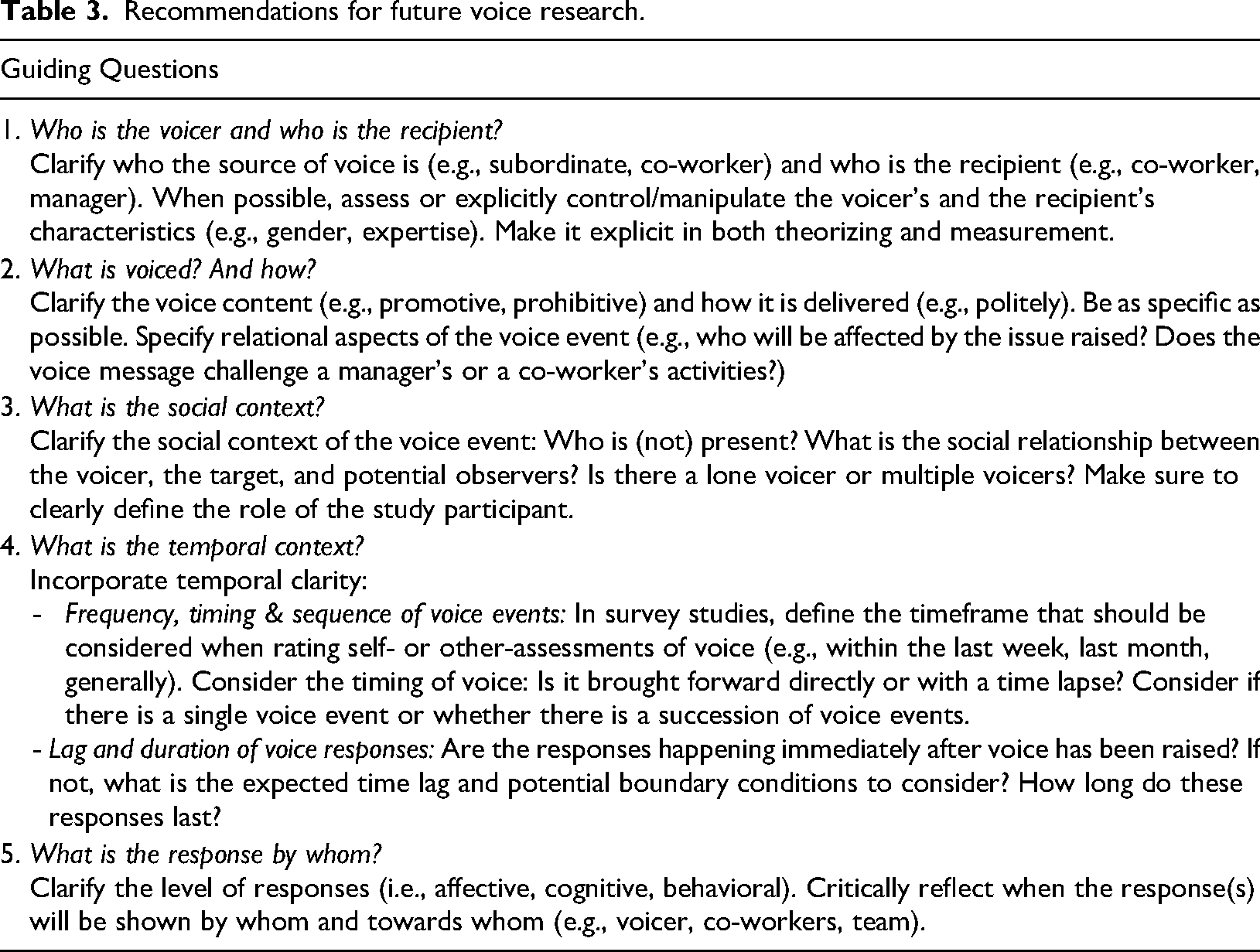
Based on 163 articles (i.e., five times as many as Morrison in her review), including 238 primary studies, we unpacked voice echoes in regard to roles (voicer, co-worker, manager) and on three levels (affective, cognitive, behavioral) to gain a nuanced understanding of the individual and relational responses to voice. In the following section, we will discuss three key themes that emerged and warrant further attention: content, context, and time. We integrate findings for each of these themes and discuss conceptual and methodological shortcomings in the field, which need to be addressed and can spur future research. To support researchers, editors, and reviewers in the conceptualization and evaluation of future work, we synthesize what we learned in the form of recommendations for the design of studies on the consequences of voice in organizations (Table 3).
Recommendations for future voice research.
Voice Cchoes and Voice Content
A notable finding is that voice echoes are content-dependent. Below, we discuss how the content of voice and its measurement shape different outcomes of voice echoes.
Promotive and Prohibitive Content
The literature indicates a consent that promotive voice results in somewhat positive repercussions among voicers (e.g., pride; Heydarifard & Krasikova, 2023; interpersonal citizenship behavior, Welsh et al., 2022) and recipients (e.g., co-worker elevation and support; Chen & Treviño, 2022; manager voice endorsement; Lam et al., 2022), whereas prohibitive voice evolved as less positive and results in more mixed findings. One possible interpretation for the mixed findings on prohibitive voice content is that it describes expressions of concern, which makes it more difficult for recipients to acknowledge the constructive intention. Rather, when receiving prohibitive voice, there is more ambiguity, giving room to a variety of different interpretations - and consequently less clarity in research findings. Another notable observation is that there exists less research on prohibitive voice in general. In fact, most research measured promotive voice content by using the scales by Liang et al. (2012) and Van Dyne and LePine (1998), even if they theorized on constructive voice generally without differentiating between promotive and prohibitive content. The fact that often promotive voice content is studied without being theorized upon is a limitation in the field that adds noise to the interpretation of voice echoes. In our recommendations for future research, we thus encourage aligning theory and measurement by clarifying the voice content (see Table 3).
Recent work by Burris et al. (2022) taps into “mixed voice”, which contains both expressions of concern (prohibitive) and new suggestions (promotive). Burris et al. (2022) conclude that the repercussions of voice are less positive when voice messages are mixed than uniform, due to the enhanced cognitive effort that is required in processing mixed voice content. Interestingly, most experimental research uses both promotive and prohibitive voice content in their scenarios (e.g., a voicer expresses concerns regarding a current strategy and subsequently suggests a different new strategy; Isaakyan et al., 2021; Sijbom et al., 2015). These experimental manipulations limit the opportunity to trace the findings back to either promotive or prohibitive content but tap into the consequences of voice expressions that are mixed in content. On the other hand, mixed voice messages have a higher external validity. It is common for employees in organizations to combine expressions of concerns with new suggestions (Burris et al., 2022) - new ideas often emerge out of a deficit or concern and mentioning a concern can likewise help to set the stage for a new suggestion. Recent work by Krefft et al. (2024) criticizes the dichotomy of promotive versus prohibitive voice due to the ambiguity that remains in differentiating voice content, suggesting to differentiate voice content based on its function (innovation vs. harm), substance (descriptive vs. suggestion for improvement) and temporal orientation (existing issue vs. relevant in the future).
Content Focus: Task, Person, Ethics
Scholars have started to differentiate specific content-foci of voice, which can be classified as task-, person- or ethics-focused expressions. We define task-focused voice as expressions that concern task requirements, responsibilities, information, and goals related to task success (Krenz et al., 2019), resembling agentic attributes of assertiveness (McClean et al., 2022). In contrast, person-focused voice refers to interpersonal relationships either by directly addressing relational aspects (e.g., the collaboration within a team; McClean et al., 2022) or by referring indirectly to another person as part of their voice message (e.g., referring back to other's suggestions or perspectives; Krenz et al., 2019; expressing voice as a direct response to another person's suggestion; Isaakyan et al., 2021). Ethical voice in turn expresses “concerns about violations of societal ethical standards (…) and/or suggestions about upholding societal ethical standards” (Chen & Treviño, 2022, p. 1973). Ethical voice is specific in appealing to ethical principles yet aligns with constructive voice as it does so in order to make a constructive contribution to the organizational functioning.
Especially for task- and person-focused voice, most research was oblivious to potential differences, mixing both task- and person-oriented contents. For example, this is evident in experimental research on managers’ threat perceptions in response to employee voice. A typical experimental scenario described a manager first proposing an action plan, on which a team member - the voicer - subsequently expresses concerns with and proposes an alternative plan (e.g., Burris, 2012; Fast et al., 2014; Isaakyan et al., 2021; Sijbom et al., 2015). In these scenarios, voice is thereby expressed as a direct response to a manager's proposal, incorporating both a task-focused and a person-focused element, and the latter may drive the effect of voice on managers' perceived threat.
Notably, exceptions that disentangle task- and relation-focused voice content are Krenz et al. (2019) and McClean et al. (2022). Krenz et al. (2019) differentiate between voice that is focused on task aspects only (e.g., ‘we need to first review the evidence from our customers’) from voice that incorporates an interpersonal element in addition to their task-focus (e.g., ‘I disagree with your proposal and suggest we first review the evidence from our customers’). McClean et al. (2022) differentiate between agentic (i.e., task-focused) and communal (i.e., person-focused) voice content. Due to the lack of differentiation between task- and person-focused content in the majority of voice research, it is currently not possible to investigate potential differences in their consequences.
Two articles (4 studies) focused on ethical-focused voice and provide initial evidence that the consequences of ethical voice resemble those on constructive voice more generally. Specifically, promotive as compared to prohibitive ethical voice resulted in more positive voice echoes (Chen & Treviño, 2022). Furthermore, witnessing ethical voice elicited self-efficacy and behavioral tendencies in the relevant content-domain (i.e., moral domain; Kim et al., 2024), which parallels work of constructive voice eliciting voice efficacy and behavior (Ng et al., 2021; Taiyi Yan et al., 2022).
Although the classification of task, person, and ethic focus is meaningful and has potential implications for differential consequences (cf. Morrison, 2023), the scholarly evidence relying on different content classifications is still too sparse to determine whether the consequences of constructive voice vary for these specific content foci. We further encourage future research (e.g., on managers’ threat responses) to establish better causality, by differentiating between voice that is expressed in direct response to a manager's proposal (i.e., incorporates a person-related focus) as compared to not.
Voice Quality and Delivery
Another notable aspect to shape voice echoes is the quality and delivery of voice content. To better understand different echo pathways, scholars increasingly move away from measuring if voice is raised (i.e., voice frequency) towards how it is raised (e.g., voice directness, quality or constructive delivery; Lam et al., 2019; Ng et al., 2022; Romney, 2021), which becomes evident in more recent measurements (Figure 3). Brykman and Raver (2021) describe voice quality as recipients’ perception of valuable voice content that is rational (e.g., well-reasoned), feasible (i.e., achievable), organization-focused (i.e., with collective objectives) and novel (i.e., unique). This aligns with theorizing on voice quality as being composed of desirability, feasibility and – in exploration-focused contexts – degree of change (Farh et al., 2024). Findings showed higher voice quality drives more positive voice echoes in recipients, such that co-workers perceived voice as more constructive (Brykman & Raver, 2021), and managers were more likely to endorse it (Brykman & Raver, 2023). Voice quality not only shaped voice echoes but likewise resulted from it: Voicers perceived their voice as lower in quality in response to negative responses from recipients (Liu, 2022; Ng et al., 2022). We encourage future research to further differentiate between the if and the how of voice, and to explicitly include this differentiation in their study design (Table 3). Focusing on the content and delivery of voice can help to overcome differences in existing conceptualizations of voice, such as the degree to which voice is emphasized to be constructively intended (Table 1). In particular, it could help to better understand the fine line between constructive voice being perceived as constructive by recipients or as being perceived as threatening, with the latter being a popular yet still largely disintegrated area in the consequences of voice.
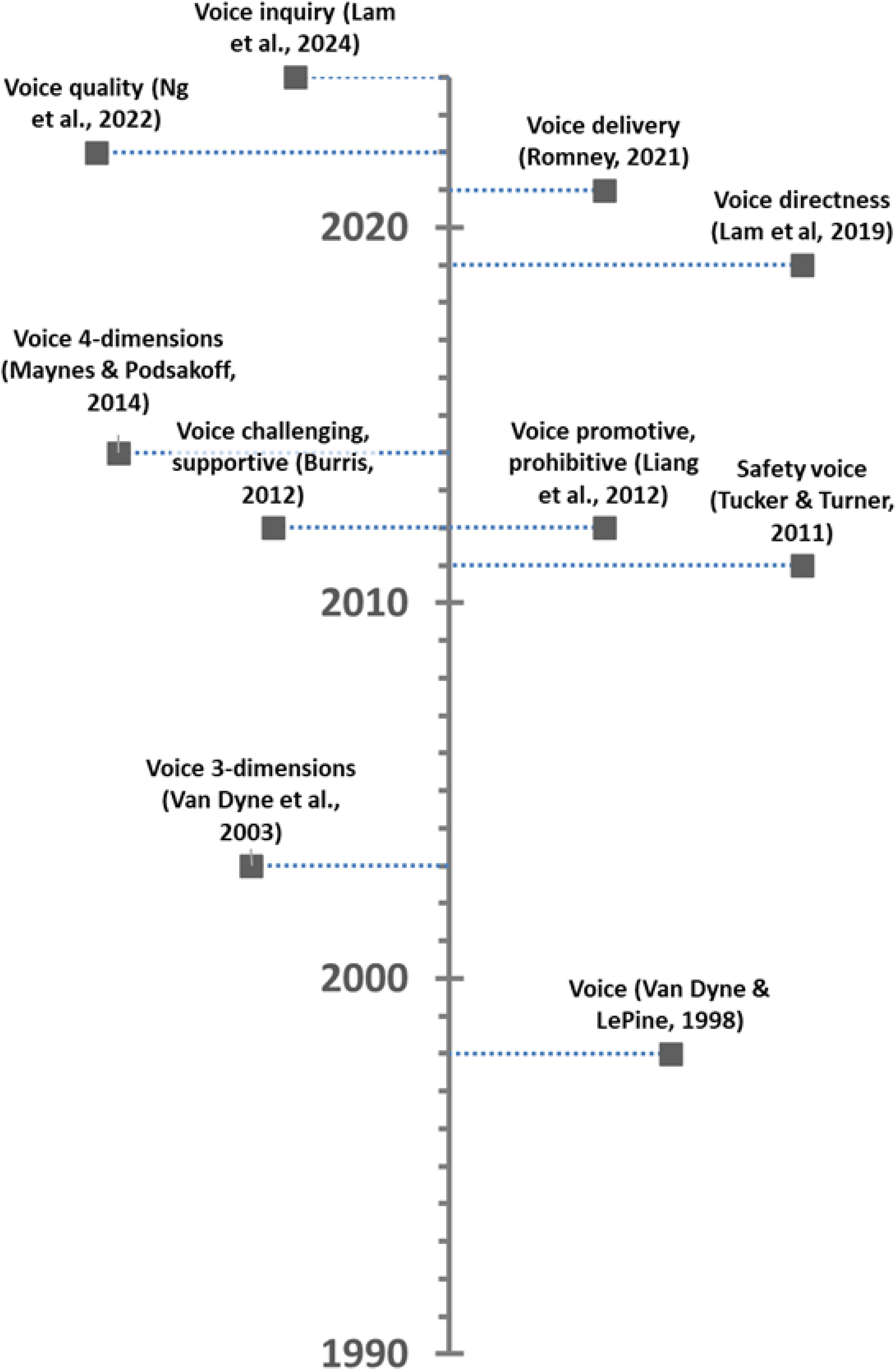
Timelineof prevalent voice measures in research on the consequences of voice.
Constructive Content: Intention Versus Perception
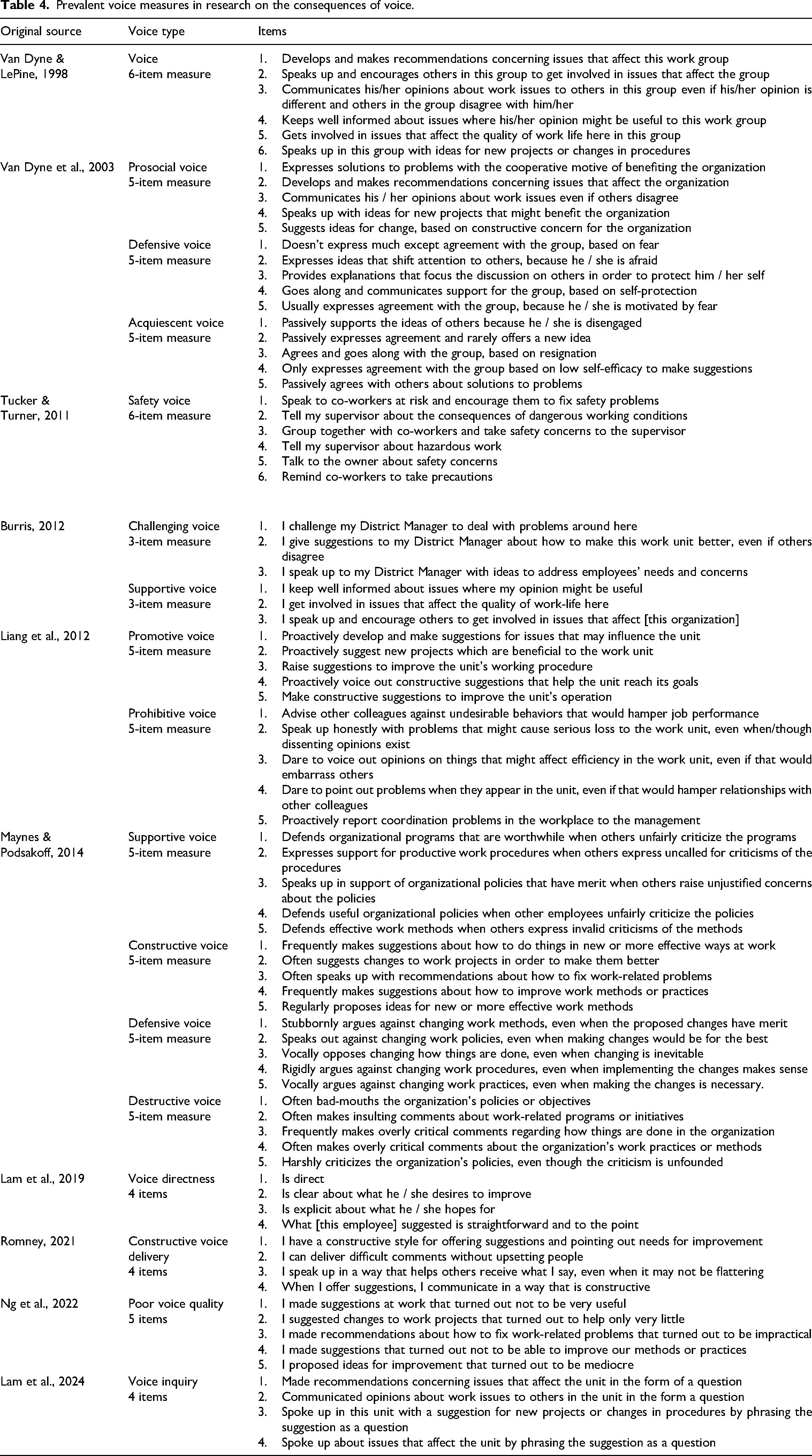
Constructive voice expressions were mainly measured using Likert-style rating scales, most commonly with van Dyne and LePine (1998) and Liang et al. (2012). Table 4 gives an overview of the scales used in the literature reviewed. Scales were often adapted (see Heggestad et al., 2019) and authors relied on both self- and other-ratings. Whereas self-ratings tap into the intention to express constructive voice, other-ratings gauge the extent to which voice expressions are perceived as constructive. Rating voice requires assessing two distinct factors, namely, to recall the frequency of the relevant behavior (i.e., proactive verbal expressions) and to evaluate the constructiveness of the behavior. This blends directly observable behavior with raters’ perceptions of its constructiveness. The latter cannot be directly observed, which makes discrepancies among rating sources likely. Such rating (dis)agreements can in fact explain the outcomes of voice for the voicing employee (Burris et al., 2013).
Prevalent voice measures in research on the consequences of voice.
Assessing the constructiveness of voice expressions can be subject to unmeasured biases, which may in parts explain why the findings on voice consequences are barely generalizable. In particular, rating voice requires “memory sensitivity – that is, the ability to distinguish between those behaviors that occurred and those that did not” (Hansbrough et al., 2015, p. 220), which is affected by raters’ cognitive schemas (e.g., generalized beliefs about the employee) or individual differences (e.g., personality, attribution style). Raters are more likely to endorse behaviors that are consistent with their cognitive schemas - even if they did not actually happen. For example, an employee with proactive self-views (e.g., influential, helpful) will rate themselves high in constructive voice. Likewise, a manager who holds positive views of an employee, for example seeing the employee as a generally strongly identified team member, will perceive their voice as more constructive than a manager with negative views of the employee (Nieberle et al., 2024). In addition to individual biases, research showed that that the social context (e.g., the hierarchy of authority in an organization; Luksyte et al., 2024) affects how likely raters notice constructive voice.
We advise future research on voice consequences to carefully consider the rating source and the theoretical implication this has for their findings. This requires to clearly identify whether the focus is on perceptions of voice (where biases might be less relevant) or actual voice behavior. For measuring the latter, behavioral coding based on idea management platforms, video or chat recordings (Brykman & Raver, 2023; Burris, 2012; Burris et al., 2022; Lee & Farh, 2019) can be reliable sources. Whereas observational methods and behavioral interaction coding are still less common in the research reviewed, they are used in a growing body of research that aims to predict when and about which issues employees decide to speak up (e.g., Meinecke et al., 2016; Weiss et al., 2017, 2018). Since recordings may not always be feasible, scholars can opt to integrate studies with different rating sources (e.g., Burris et al., 2013; Huang et al., 2018) or combine survey-based research with experimental research. Further, approaches that measure specific voice episodes via an event reconstruction technique and subsequent scale ratings (Isaakyan et al., 2021; Lam et al., 2019; Ng et al., 2021; Urbach & Fay, 2021) may more accurately reflect voice behavior by tapping into episodic rather than semantic memory (Hansbrough et al., 2015; Martell & Evans, 2005). Finally, investigating how individual differences affect ratings of voice can be another area for future research to better understand endogeneity biases in voice research.
Voice Echoes and Context
Another notable finding is that rather than a dyadic process (see Kim et al., 2023), voice echoes are a social process flowing from individual to relational responses and vice versa, and these responses happen within a wider social environment (e.g., teams, organizations). Based on our findings, we argue that voice echoes can be understood as a reciprocal and potentially non-linear influence process between a voicing employee, their co-workers, and their manager in their roles as voicers and recipients. Both co-workers and managers play a key role for different consequences of voice to manifest. In the following, we first discuss the key role of manager voice endorsement for voice echoes to travel across voicer rand recipient, and subsequently discuss different voice echoes when considering recipients as either voice targets or voice observers.
Voice (non)-endorsement
Our findings demonstrate that managerial voice endorsement – a manager's behavioral response towards implementing voice - was not only a popular voice outcome, but also one of key value for voice echoes to travel across voicer and recipients. Figure 4 exemplifies how manager voice endorsement expands voice echoes towards a multi-directional influence process between voicer, co-worker and manager. Specifically, manager voice endorsement shapes and amplifies voicers’ affective response to voice (e.g., hubristic pride; Rubenstein et al., 2023; reduced anxiety in response to prohibitive voice; Welsh et al., 2022), which is consequential for co-workers as it affects how voicers behave towards them (e.g., withdrawal, hostility). At the same time, through the support they provide, co-workers can actively influence how much voicers feel proud or envied in response to manager voice endorsement (Huai et al., 2024). Even when managers endorse voice, social support by co-workers is an important contingent factor in how positive voicers feel about it, emphasizing that manager and co-worker responses are interlinked in predicting the pathway of voice echoes.
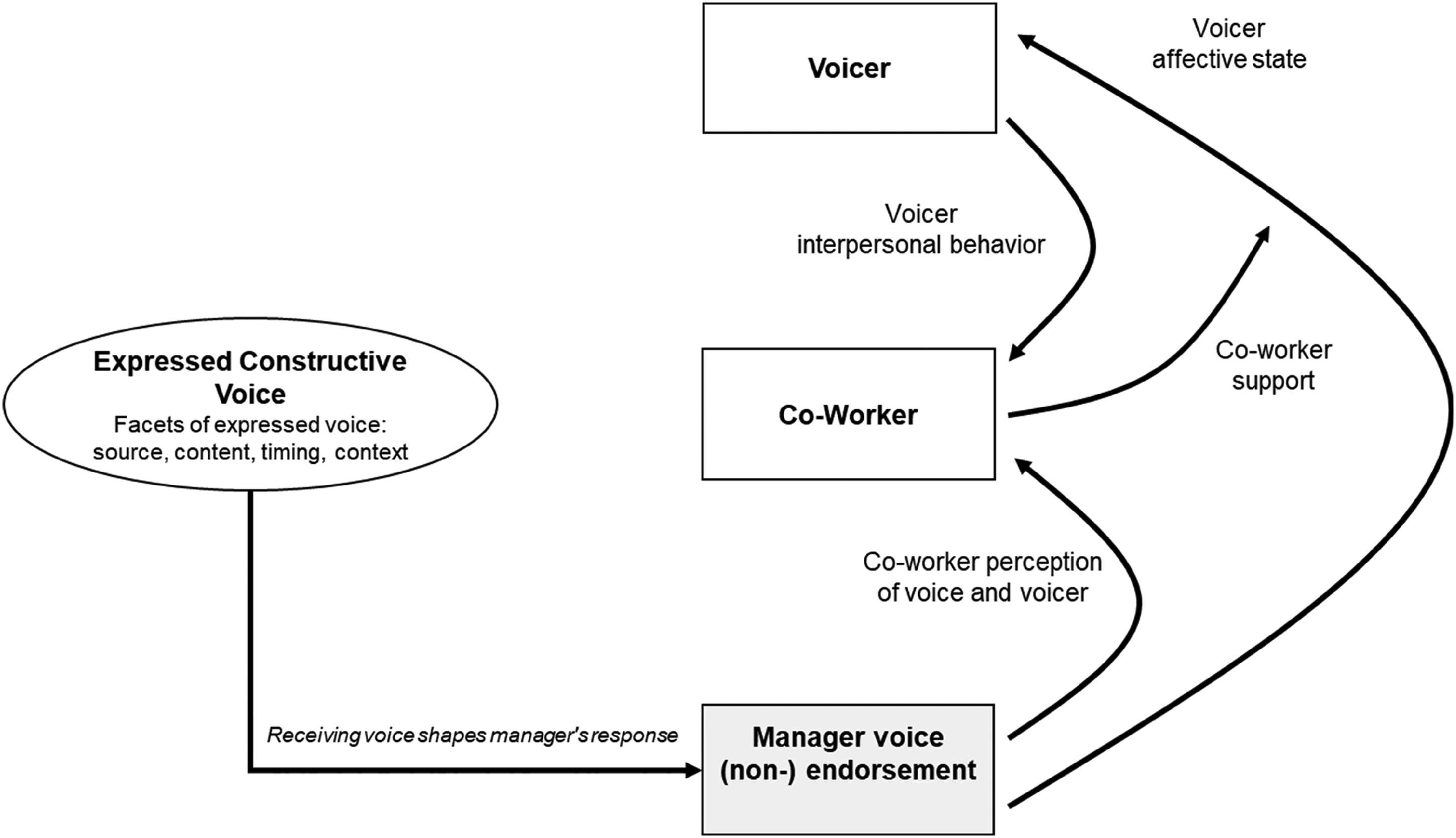
Manager voice endorsement expands voice echoes, shaping a multi-directional influence process.
Although manager voice endorsement was frequently used in the literature reviewed (e.g., Isaakyan et al., 2021; Lam et al., 2022; Schreurs et al., 2020), its measurement requires a critical reflection. As noted by Parke et al. (2022), the predominant measure by Burris (2012) assesses two different components, managers’ behavioral (e.g., idea implementation) and cognitive (e.g., perceived value) responses to voice (see Table 5). This mixes the levels at which managerial responses take place, and the issue pertains in later measures of voice endorsement (e.g., Fast et al., 2014; Schreurs et al., 2020). As a result, existing measures cannot separate managers’ cognitive evaluations of voice from their actual investment to implement voice, and become inseparable from other responses, such as managers’ perceived voice value (e.g., Burris et al., 2017; ‘The ideas are useful/have a lot of value for improving things around here’) or their perceived voice constructiveness (e.g., Whiting et al., 2012; ‘The voicer's comments were constructive/are likely to enhance the performance of the work team’). Another challenge is that, at the behavioral level, voice endorsement is not differentiated from related behavior. For example, the voice endorsement measure by Schreurs et al. (2020) assesses voice implementation but also voice solicitation. This gives rise to using different labels for the same measurement. For instance, Burris' (2012) measure has been used to assess managers’ idea support (Urbach & Fay, 2018, Study 3). Despite conceptual overlap between voice endorsement and idea support, using the same scales with different labels contributes to confusion regarding voice echoes.
Content analysis of voice endorsement measures.
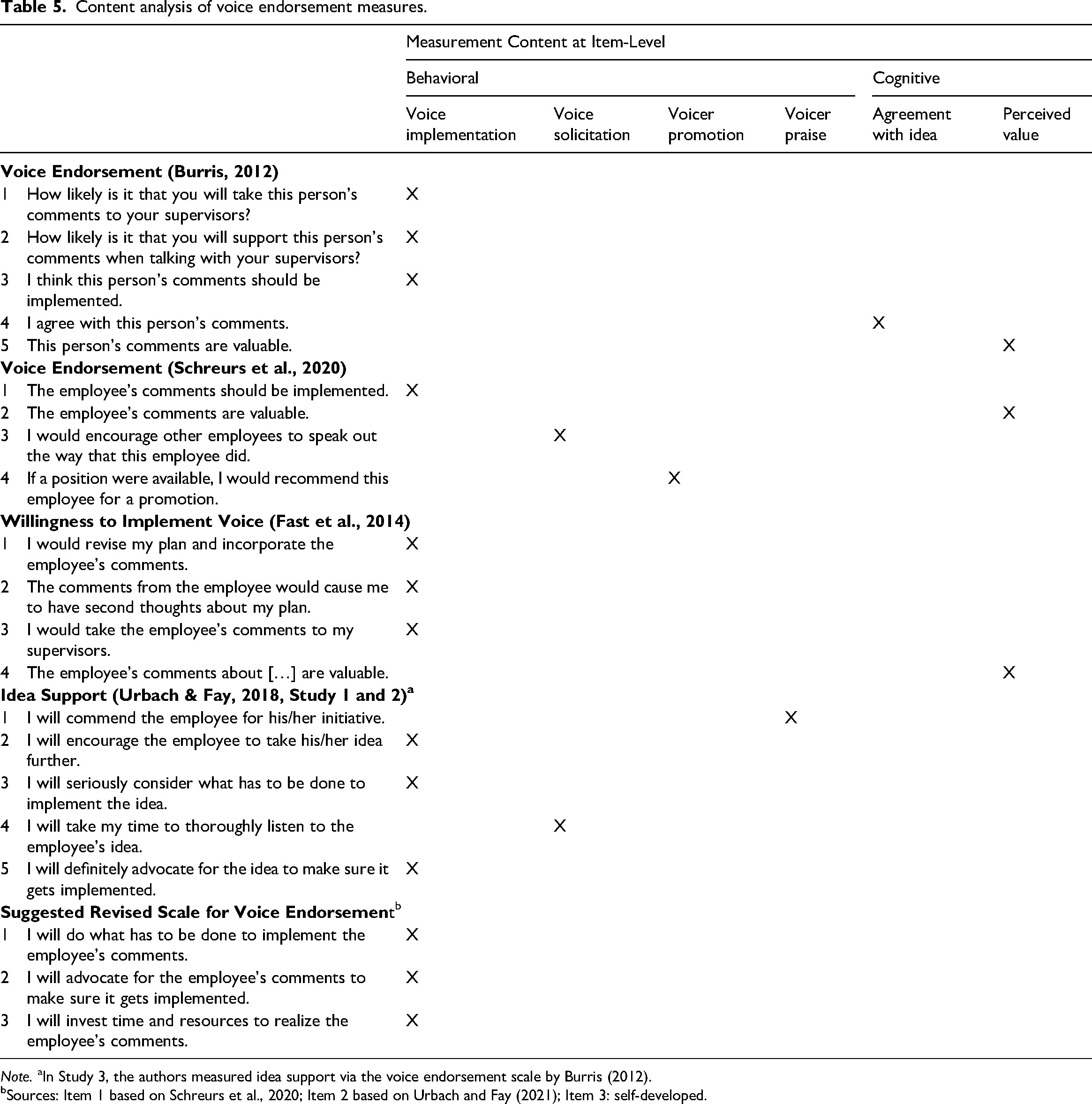
Note. aIn Study 3, the authors measured idea support via the voice endorsement scale by Burris (2012).
Sources: Item 1 based on Schreurs et al., 2020; Item 2 based on Urbach and Fay (2021); Item 3: self-developed.
One possible solution is to revise the scale in order to solely focus on managers’ behavioral idea implementation. In Table 5 we suggest a revised scale with the three items: ‘I will do what has to be done to implement the employee's comments’; ‘I will advocate for the employee's comments to make sure it gets implemented’; ‘I will invest time and resources to realize the employee's comments.’ Another way forward is to focus on manager's behavioral decisions, such as for example in Isaakyan et al. (2021) or Oc et al. (2019). Behavioral decisions have the advantage that they directly assess observable behavior rather than managers’ self-assessed behavioral intentions (Lonati et al., 2018).
Voice Recipients: Target and Observers
Further, an important differentiation can be made between voice recipients who are the targets of constructive voice (i.e., directly addressed with voice) and those who are observers (i.e., witness voice as a third person). With regards to voice targets, scholars agree that voice consequences are target-sensitive (e.g., Krefft et al., 2024; Liu et al., 2010; Morrison, 2011). However, various research did not explicitly specify the target of voice (e.g., co-worker or manager), or integrate it into their scale measurement. This adds unexplained variance to findings and limits the ability to draw a consistent comparison between co-workers and managers as voice targets. Additionally, a disconnect between theorizing and measurement that can be found in some studies limits the conclusions we can draw. For example, Whiting et al. (2012) theorized on managers’ perceptions of voice, yet instructed their (student) participants to think of themselves as recently hired employees. The experiments may thus have tapped into co-workers’ responses to voice, rather than managers. We strongly advise future research to explicate the target of voice in theorizing and measurement to build a more consistent understanding of voice echoes, its mechanisms and boundary conditions (for a positive exception see Burris et al., 2023). Since the existing voice scales are not framed around targets, appropriate scale adaptations will be needed to align measurement with theorizing (see the standards in Heggestad et al., 2019).
For observers, our review evinces positive voice echoes in the form of positive affective states and perceived resources. Only co-workers were studied as observers (i.e., co-workers who witness a colleague express voice to their manager), no study investigated managers as observers (i.e., managers who witness an employee express voice to a co-worker). Findings show that witnessing voice can encourage co-workers to subsequently express voice, a phenomenon called voice contagion (Ng et al., 2021). However, observing co-workers are not passive recipients of voice. The presence of co-workers notably shapes how voice echoes unfold. For example, managers’ cognitive and behavioral responses were different depending on whether voice was expressed privately or publicly (Isaakyan et al., 2021). At the same time, the studies reviewed are often not explicit about the social setting, that is who is present when voice is expressed. Explicitly incorporating the social setting is a critical consideration for future research (Table 3).
Through their behavioral response, observing co-workers further significantly influence how both the voicer and their message are perceived within the wider team. When co-workers amplify voice, these ideas are perceived as higher in quality and voicers seen as higher in social status. Notably, these effects equally apply to promotive and prohibitive voice content (Bain et al., 2021). Future research could expand the concept of voice contagion (Ng et al., 2021) and voice amplification (Bain et al., 2021) to interactions between co-workers and managers. For example, co-workers may amplify voice and endorse it further upwards. Likewise, contagion between co-workers and managers may contribute to ‘voice cancellation’ so that voice is discounted by a co-worker, which is further picked up by the manager, or vice versa.
Voice Echoes and Time
Finally, the findings on voice echoes support recent perspectives on voice as an ongoing and dynamic process between the voicer and recipient(s) over time (Kim et al., 2023; Satterstrom et al., 2021). Although the dominant perspective in the literature remains on single voice instances (experimental) or cross-sectional assessments (field research), research on voicers' cognitive and behavorial responses demonstrated that voice expressions are related to what happened before (e.g., previously expressed voice, responses by recipients) and what happens afterwards (e.g., subsequent voice intention). This emphasizes that voice is a social process that needs to be considered in the context of time, rather than a one-time event. Our findings highlight that voice and voice opportunities are co-produced (e.g., Fast et al., 2014; Guarana et al., 2017; Sherf et al., 2019) and the likelihood that voicers engage in subsequent voice depends on the responses they received (King et al., 2019; Wu et al., 2019). This aligns with previous research that used behavioral interaction coding to demonstrate that employees’ decision to subsequently express voice is highly dependent on contextual factors such as the listening behavior of managers (Meinecke et al., 2016) or their use of inclusive language (Weiss et al., 2018).
An important yet currently missing time element is the temporal context of an employee's voice history, that is how often and in which ways the employee previously expressed voice. One relevant question is on potential ceiling effects, such that those employees who frequently express voice may receive fewer positive responses than those who rarely voice. Findings by Parke et al. (2022) provide initial support for this idea by showing that strategic silence can increase the perceived quality of (strategically placed) voice. Similarly, Duan et al. (2024) showed that voice which violates interpersonal expectancies receives more managerial recognition. Building on this, future research should consider the personal voice profiles of employees (e.g., consistent voicers, strategic voicers, spontaneous voicers, never voicers) to better determine the temporal dimensions in voice echoes.
Further, it is important to note that the temporal emergence and manifestations of different voice repercussions are not yet well understood. Only a few studies have applied longitudinal designs and these studies have focused exclusively on voicers’ affective responses. These studies show that expressing (promotive) voice has both positive short-term (i.e., changes in affect and depletion the next day) and long-term consequences (i.e., changes in vigor, fatigue and job engagement over three months). However, it is not clear how responses at different levels (affective, cognitive, and behavioral) and by different recipients manifest differently over time. Some responses may be immediate (e.g., momentary threats by managers), whereas others may take weeks, months, or even years to manifest (e.g., career-related decisions by managers). We encourage future research to better determine how responses by recipients to voice change and develop over time. In particular, the conditions under which recipients remain with their initial response or change their response over time (see Satterstrom et al., 2021).
Practical Implications
Several implications for practice can be derived from our review. First, employees should carefully consider what and how they express their voice, rather than questioning whether they should voice their opinion at all (see also Maynes et al., 2024). The likelihood of positive outcomes is higher when voice contains suggestions for improvement (i.e., promotive content) that are well-reasoned, achievable, and focused on collective objectives. This means that it often requires considerable time and effort to prepare voice in order to express it in an effective way. For example, employees who note harmful issues at work can be advised to pair them with reasonable improvement-oriented suggestions in order to increase the likelihood of positive outcomes. Furthermore, employees need to be mindful that despite positive intentions, voice and voice endorsement can be perceived as threatening by their co-workers and managers. The likelihood of a threatening response with reverberating consequences for the voicer can be substantially reduced for employees who think carefully about the content, delivery and timing of their voice expression.
Second, we advise employees who witness voice to consider their active role in contributing to positive voice outcomes as amplifiers. By publicly endorsing co-workers’ voice (i.e., amplification; Bain et al., 2021), co-workers have an important role in facilitating positive responses to a voicer and their message. Similarly, managers can amplify the ideas raised by their employees, which can be an effective strategy for them to act as allies of minority employees (cf. Preston et al., 2024). Moreover, it is important for managers to mind that voice must not (reflexively) be coupled with a task assignment to the voicer (Bachrach et al., 2024; Newton et al., 2024).
Finally, at the organizational level, one implication of our findings is that organizational messaging that voice is valued is not sufficient and that positive outcomes require voicing employees to receive support. We advise organizations to train employees at all levels regarding best practices for delivering voice, in the criteria to use to evaluate and honor the quality of voice, and finally, in supporting voice that they witness in their teams.
Conclusion
We introduce the conceptual metaphor voice echoes to describe the consequences of voice as a social process that is shaped by the individual responses that voicers, co-workers, and managers show at different levels (affective, cognitive, behavioral) and which further shape how they respond to each other over time. Based on a rigorous systematic review, we demonstrate that voice echoes are shaped by the content of voice (e.g., promotive vs. prohibitive; voice quality), the recipients (i.e., co-workers and managers as targets and/or observer of voice), and temporal aspects (e.g., prior voice history). We thereby critically assess the state-of-the-research and, based on current shortcomings in theorizing and measuring, we provide recommendations for future research on the consequences of voice.
Footnotes
Acknowledgments
With deep gratitude, we sincerely thank Professor Elizabeth Morrison for her invaluable and encouraging support in the early stages of our work on this review.
Funding
The authors received no financial support for the research, authorship, and/or publication of this article.
