




Abstract
With organizational practices such as working from home, agile project management, and shared leadership, the world of work is becoming increasingly dynamic and flexible. Simultaneously, the workforce in most industrialized nations is getting older. We hypothesized that both an explicit and implicit stereotype exists that associates modern work practices (MWP) more strongly with younger workers than with older workers (i.e. modern-work-is-young stereotype). With a focus on other-stereotyping, we surveyed participants who identified as younger or middle-aged workers (N = 186). Based on the contact hypothesis, we assumed that contact to older coworkers and contact with MWP are negatively related to both explicit and implicit endorsement of the modern-work-is-young stereotype. Furthermore, we examined differences in résumé evaluations for a job involving MWP, presenting an older and a younger hypothetical applicant. The results indicate the existence of a moderate explicit as well as implicit modern-work-is-young stereotype. The proposed contact hypothesis held true for the explicit but not for the implicit modern-work-is-young stereotype. Lastly, the younger applicant received significantly more positive evaluations than the older applicant, and only the explicit modern-work-is-young stereotype predicted the extent of age discrimination. The results suggest that the explicit modern-work-is-young stereotype can harm older employees and hamper intergenerational collaboration. These findings are especially important in times of demographic change, when workforces are becoming increasingly age-heterogeneous and retaining older workers seems more important than ever.
Keywords
Even in the years before the unexpected outbreak of the COVID-19 pandemic, work in many fields has become more dynamic and flexible, especially for white-collar workers (Aroles et al., 2021a; Wessels et al., 2019). Trends such as the globalization, digitalization, and the rapid increase of knowledge have forced and continue to force many organizations to redesign work (Schermuly, 2019). In the context of these trends, modern work practices (MWP; e.g. Geurts et al., 2014; Kompier, 2006) have become a widely discussed term, both in the academic and nonacademic world. One of the best-known examples of MWP is working from home, which has become widespread due to the COVID-19 pandemic and is receiving increasing attention from researchers (see Special Issue by Kaiser et al., 2022). According to an annual survey in the German-speaking region, other prominent MWP are agile project management, agile leadership, the distribution of mobile technologies, and work time flexibility (Schermuly and Geissler, 2021).
In the midst of these changes in work design, the workforce itself is transforming on a structural level. Due to demographic change, the workforce in most industrialized nations is becoming older and more age-heterogeneous (Truxillo et al., 2015). According to the Organization for Economic Co-operation and Development, this demographic change will lead to a drastic reduction of the working-age population in many developed countries (OECD, 2019). In addition to this anticipated natural reduction in personnel, it is well-known that ageism—that is, “an alteration in feeling, belief, or behavior in response to an individual’s or group’s perceived chronological age” (Levy and Banaji, 2002: 50)—can push older workers out of the workplace. Older workers who feel discriminated against not only wish to retire earlier (Schermuly et al., 2014), but indeed are more likely to take early retirement (for a review, see Wilson et al., 2020). We assume that as the application of MWP in organizations increases, the risk of becoming a target of ageism in the workplace might even grow, because MWP are likely to be seen as inconsistent with characteristics commonly associated with older workers.
Research indicates that certain kinds of jobs are younger-typed (e.g. technology-related jobs), while others are older-typed (e.g. senior-level jobs; Reeves et al., 2021). However, little is known about age stereotypes concerning MWP (e.g. agile project management; shared leadership). Addressing this research gap, we look beyond specific jobs and pose the following question: How old are the workers people have in mind when thinking of MWP? Based on the idea of role incongruity (see Eagly and Diekman, 2005) in the present study, the roles of older workers and MWP, we hypothesize that a stereotype exists that associates MWP more strongly with younger workers than with older workers. We name this stereotype the modern-work-is-young stereotype—analogous to, for example, the science-is-male stereotype (e.g. Smyth and Nosek, 2015) or the think manager—think male stereotype (e.g. Schein et al., 1996)—and expect it to exist in an explicit and implicit form. Implicit age stereotypes are defined as “thoughts about the attributes and behaviors of the elderly that exist and operate without conscious awareness, intention, or control” (Levy and Banaji, 2002: 51). In contrast, explicit stereotypes reflect more conscious beliefs about attributes and behaviors of certain social groups (e.g. Greenwald and Banaji, 1995). In a meta-analysis by Greenwald et al. (2009), both forms of attitudes have been found to predict unique variances in important attitudinal, behavioral, and physiological outcomes. However, implicit measures were better at predicting socially sensitive outcomes (e.g. interracial behavior).
In the present study, we focus on the sensitive topic of ageism. Research indicates that being younger increases the risk of holding highly ageist attitudes (see Officer et al., 2020). At the same time, social categorization theory (Turner et al., 1987) and social identity theory (Tajfel and Turner, 1979) allow us to suggest that it is the age group one identifies with that influences the individual’s self-concept and intergroup behavior. We therefore surveyed workers who identified with the age groups of younger workers (<35 years) or middle-aged workers (between 35 and 50 years), investigating their attitudes toward older workers (⩾50 years) and MWP. 1 Drawing from the contact hypothesis (Allport, 1954), we then assume that both higher contact quantity and quality with older coworkers reduce the modern-work-is-young stereotype. Furthermore, we expect contact with MWP to also reduce the stereotype.
Lastly, despite the current debate about the prevalence and impact of age stereotypes on personnel decisions in real-work settings (for a discussion, see Special Issue 10/2022 of Work, Aging and Retirement), this study examines potential behavioral consequences of the modern-work-is-young stereotype. Murphy and DeNisi (2022: 1) sparked this debate by stating that “the available evidence provides little support for the proposition that age stereotypes substantially affect high-stakes decisions made about individuals in organizations.” The authors make the criticism that laboratory studies tend to overestimate the effect of age discrimination and that field studies that did observe age discrimination only found weak effects. However, there are plausible arguments for why even small age-related biases can negatively affect older workers through cumulative effects and why seemingly weak effects may not be weak at all when properly contextualized (see, e.g. Davenport et al., 2022). Furthermore, a recent meta-analysis on real-world hiring discrimination corroborates the idea that age discrimination is not a laboratory phenomenon: Within correspondence experiments, fictitious older workers were on average approximately 40% less likely to receive favorable responses when applying for real job vacancies (Lippens et al., 2023). Lastly, by investigating explicit and implicit stereotypes, we answer calls by Murphy and DeNisi (2022) to better address the complexity of age stereotypes by conducting more nuanced laboratory research.
Thus, drawing from prototype matching theory (Perry, 1994), we argue that findings regarding the existence of age discrimination in personnel selection (see, e.g. a meta-analysis by Lippens et al., 2023) hold true for jobs involving MWP. To test this assumption, we used a recruitment scenario in which an older and a younger worker applied for a job involving MWP, expecting the younger applicant to receive more positive evaluations than the older applicant. Furthermore, we tested whether the explicit and implicit modern-work-is-young stereotype predicted the extent of age discrimination in the recruitment scenario.
In summary, we aim to contribute to the literature by shedding light on a highly topical stereotype that may be emerging from two current trends in the organizational field: demographic changes and work design changes. We look at potential consequences of the modern-work-is-young stereotype, pointing out risks regarding personnel selection situations. In doing so, we directly link stereotype endorsement with evaluations of older and younger targets. This is of utmost importance because, so far, most studies in this field have merely inferred age discrimination by observing differences in personnel decisions based on applicant ages, rather than directly examining the potential influence of age stereotypes (see a recent call by Rudolph et al., 2022). Lastly, by investigating contact with older coworkers and contact with MWP, we aim to identify potential ways to reduce the modern-work-is-young stereotype. To derive and test the modern-work-is-young stereotype, we combined deductive and inductive reasoning: In the following sections, we first derive the modern-work-is-young stereotype theoretically. Then, we refine the content of the modern-work-is-young stereotype empirically with the help of a pilot study. Based on this pilot study, we also developed an Implicit Association Test (Greenwald et al., 1998) to measure the implicit modern-work-is-young stereotype. In the following section, we first briefly contrast modern and traditional work practices before developing and testing our hypotheses.
Theoretical background
Modern versus traditional work practices
Work was traditionally performed “on a fixed schedule—usually full-time—at the employer’s place of business, under the employer’s control, and with the mutual expectation of continued employment” (Kalleberg et al., 2000). This general understanding of work has its origins in the industrialization of the 18th and 19th centuries, which revolutionized the prevailing concept of work (Komlosy, 2014). From then on, the goal of work was no longer just to secure individual existences, but to increase capital. To this end, work was no longer carried out in people’s own households, workshops, or fields but in factories (Komlosy, 2014). A well-known example of traditional work design is Taylorism (or scientific management; Taylor, 1919), which relies heavily on standardization and strives for complete control of the job situation (Aitken, 1985).
Nowadays, work is often performed within less controlling, hierarchical, and bureaucratic structures (Aroles et al., 2019). MWP are often discussed as nonstandard work (Ashford et al., 2007), alternative work arrangements (Spreitzer et al., 2017), new ways of working (Kingma, 2019), and the new world of work (NWW; e.g. Schermuly, 2019; Wilks and Billsberry, 2007). Despite this multitude of terms, it can be said that all current MWP have in common the fact that they are mainly driven by trends such as the globalization, economic volatility, technological advances, and workers’ changing preferences (see, e.g. Kotera and Correa Vione, 2020; Messenger and Gschwind, 2016; Spreitzer et al., 2017). One might conclude that organizations are increasingly adopting MWP both to respond more flexibly to changing requirements and to better meet the needs of a more diverse workforce (Kotera and Correa Vione, 2020; Nijp et al., 2016).
According to Spreitzer et al. (2017), increased flexibility in the workplace can be divided into three categories: (a) flexibility in the employment relationship, (b) flexibility in the scheduling of work, and (c) flexibility in where work is performed. Flexibility in the employment relationship comprises alternative employment relationships, such as co-employment (work procured through recruitment agencies) and contract employment (on-demand work). Flexibility in the scheduling of work and in where work is performed can be summarized under the term “time-spatial flexibility” (Wessels et al., 2019). In line with this conceptualization, other researchers have defined MWP as a mixture of time- and spatial flexibility, referring to them as the “new ways of working” (e.g. Nijp et al., 2016).
We expand on this conceptualization of MWP by adding another dimension of flexibility that is concerned with how people collaborate. In recent years, many organizations have recognized that external organizational complexity must be addressed with internal organizational complexity (Schermuly, 2019). On the organizational level, this leads to increased “downward shifts in the distribution of formal or informal authority across hierarchical levels” (Lee and Edmondson, 2017: 2) in many organizations, as managers often lack the necessary expertise to solve organizational problems alone. One example of an MWP on the organizational level is Holacracy. Holacracy was introduced by Brian Robertson in 2007 and describes a decentralized management practice that grants decision-making authority to fluid “circles” (i.e. teams consisting of different roles) rather than individuals (Bernstein et al., 2016).
Another example for the attempt to decentralize power on the team level is agile project management, which was officially introduced by the Agile Manifesto in 2001 (Beck et al., 2001). In contrast to traditional frameworks, no rigid goals are defined at the beginning of agile projects. Instead, the project team breaks down the project’s goal into sub-goals, which are pursued within short-term iterations (Koch and Schermuly, 2021). Lastly, the attempt to decentralize power and make workplace interactions more flexible is also reflected in the way leadership research and practice have changed. The increasing interest in more democratic leadership styles such as shared leadership (e.g. Cox et al., 2003), empowering leadership (e.g. Kim et al., 2018), and servant leadership (Van Dierendonck and Nuijten, 2011) corroborates this notion.
In summary, when we speak of MWP, we refer to practices that were (a) introduced in the late 20th century or 21st century, (b) have gained prevalence in recent years, and (c) aim for temporal-spatial or collaborative flexibility. Criterion (b) deserves special attention, as we know that some practices are indeed not “new” (for a critical discussion, see Aroles et al., 2021b). For example, the emergence of mobile and flexible working practices dates back to the 1960s and 1970s (Van Meel, 2011). However, since such practices have gained prevalence in organizations only in recent years, we classify them as “modern” work practices. We therefore deliberately chose to use the term MWP instead of, for example, “new work practices” (or “new world of work,” “new ways of working”) as the latter terms do not necessarily imply the dimension of prevalence. Furthermore, we chose a term as broad as MWP because it can capture the variety of work practices that practitioners associate with the modern world of work. This is important when investigating stereotypes—that is, the “pictures” in people’s heads (Lippmann, 1922). Finally, we conceptualize traditional work practices as the counterpart to MWP (i.e. as long-established practices focusing on temporal-spatial or collaborative stability). In the following section, we examine how characteristics of MWP in conjunction with common older-worker stereotypes might lead to the modern-work-is-young stereotype.
The modern-work-is-young stereotype
Allport (1954: 191) defined stereotypes as “exaggerated belief[s] associated with a category” whose function is to rationalize one’s behavior related to that category. More neutrally, stereotypes can be defined as “the association of a social group concept with one or more (nonvalence) attribute concepts” (Greenwald et al., 2002). For example, science-is-male stereotypes hold that the science domain is more strongly associated with men than with women (Smyth and Nosek, 2015). Generally, stereotypes can be seen as cognitive schemas that people use to explain and predict other individuals’ behavior (Sibley and Osborne, 2015), and they have often been classified as the cognitive component of prejudice (Dovidio et al., 2000).
Eagly and Diekman (2005) expanded on Allport’s (1954) work, challenging his notion that prejudice necessarily involves a generalized antipathy toward the stereotyped group. They emphasized the social contextuality of stereotypes, arguing that prejudice emerges from a mismatch “between beliefs about the attributes typically possessed by members of a social group (i.e. their stereotype) and beliefs about the attributes that facilitate success in valued social roles” (Eagly and Diekman, 2005: 19). A theory that is in line with this incongruity framework is prototype matching theory (Perry, 1994). Having emerged in the field of recruitment, it is one of the few cognitive approaches to understanding the processes behind job applicant evaluation. In the proposed process, individuals are assumed to hold information about jobs and job incumbents, which they use—often regardless of whether the information is accurate—for applicant evaluation. Individuals in recruitment situations thus compare applicants to work-related person-in-situation prototypes (so-called person-in-job prototypes; Perry, 1994). Prototypes, in general, can be described as abstract sets of characteristics typically associated with members of a category. Person-in-situation prototypes, in turn, are defined as contextualized person categories (Cantor et al., 1982); for example, the category “Scrum master” (i.e. the servant-leader of a Scrum team; Schwaber and Sutherland, 2017) in the situation “sprint retrospective” (i.e. a Scrum meeting to reflect and create plans for improvement; Schwaber and Sutherland, 2017). We build upon prototype matching theory (Perry, 1994) to explain the emergence of the modern-work-is-young stereotype—that is, a stronger cognitive association between MWP and younger workers than between MWP and older workers. Applying this theoretical lens leads to the following first question: What attributes do people think are important for success within MWP?
Schermuly et al. (2019) examined what competencies are considered important for agile project work, as one organizational practice that is being widely applied in practice and strongly classified as an MWP by practitioners (Schermuly and Geissler, 2021). Schermuly et al. (2019) identified personal responsibility, user orientation, and willingness to learn and adapt as the most important competencies for thriving in agile project work. The regular implementation of new technologies is another MWP requiring a high amount of adaptability. Digital skills are thus considered important employability skills in the 21st century (Van Laar et al., 2017). Regarding collaborative flexibility, which we conceptualized as the second pillar of MWP, soft skills such as communication and reflectivity—especially in digital settings—seem paramount for thriving within MWP (see, e.g. Van Laar et al., 2020).
Given these characteristics of MWP, we believe it is likely that people perceive a role incongruence between older workers and MWP. For example, Scrum is an MWP that centers around continuous learning and rapid adaptation to change (Schwaber and Sutherland, 2017). If a Scrum workshop is held by an unknown trainer, participants might be surprised by an older trainer because they expected a young person. It could even be that the older Scrum trainer might not have gotten the job in the first place because of their age. On the other hand, a Scrum trainer might hold implicit stereotypes about their prospective participants, leading the trainer to make less eye contact with older participants. This might occur because older workers are seen as less motivated, less interested in learning, and more resistant to change (Ng and Feldman, 2012). Furthermore, they are viewed as less creative (Van Dalen et al., 2010), and they tend to receive lower evaluations of their interpersonal skills (Bal et al., 2011)—all qualities that are considered essential for MWP (see, e.g. Schermuly et al., 2019).
Although older-worker stereotypes are neither new nor specific to the modern workplace, we assume that their combination with stereotypes about MWP will lead people to cognitively associate MWP more strongly with younger workers than with older workers. For both explicit and implicit forms of stereotypes, we thus posit the following hypothesis:
Hypothesis 1: There is a stereotype that associates MWP more strongly with younger workers than with older workers (modern-work-is-young stereotype).
Contact hypothesis
Research suggests that age stereotypes become internalized across the lifespan (Levy, 2009), and that they are “socially supported, continually revived and hammered in, by our media of mass communication” (Allport, 1954: 200). They manifest daily in figures of speech such as “you can’t teach an old dog new tricks,” or when complimenting someone for not looking their age—without even noticing the ageist behavior. Research has corroborated the idea that age stereotypes can operate on an implicit and thus less tangible level (Levy and Banaji, 2002). Nevertheless, research has shown that stereotypes are changeable, both in their explicit and implicit forms (e.g. Aberson et al., 2004; Johnston and Hewstone, 1992).
One well-studied way to reduce stereotypes is to promote contact between groups (Pettigrew and Tropp, 2006). In the literature, there has been extensive debate about the relative importance of contact frequency and contact quality (see, e.g. Schwartz and Simmons, 2001). According to the original contact hypothesis (Allport, 1954), certain conditions must be met to ensure that contact effectively reduces stereotypes (e.g. cooperative interaction). However, meta-analytical evidence suggests a general positive effect of contact on prejudice reduction, turning Allport’s conditions into facilitating factors rather than essential prerequisites (Pettigrew and Tropp, 2006). One psychological mechanism for changing explicit stereotypes is stereotype disconfirmation, which occurs when information that is inconsistent with the stereotype is perceived. Stereotype-inconsistent behavior has the greatest potential to lead to stereotype change when it is exhibited by several typical members of the group, rather than being shown by only a few atypical members (Johnston and Hewstone, 1992). In line with this view, Linville et al. (1989: 187) concluded that “promoting differentiated thinking about group members may be a useful strategy for altering stereotypes and combating prejudice.” The likelihood of developing a differentiated view of a group, in turn, should grow with increasing intergroup contact (Stroessner and Mackie, 1993). Implicit stereotypes have also been found to be reduced by intergroup contact (e.g. Brannon and Walton, 2013) and, in particular, by exposure to stereotype-inconsistent exemplars (FitzGerald et al., 2019).
Based on these arguments, we hypothesize that workers identifying as younger or middle-aged workers who have more and higher quality contact with older coworkers receive more opportunities to experience counter-stereotypic situations with them. They might experience older coworkers working flexible hours, taking courses to become Scrum masters, or being as interested in the latest technological advancements as they are. Going beyond the original contact hypothesis (Allport, 1954), which focuses on intergroup contact, we further assume that contact with MWP also reduces the modern-work-is-young stereotype. We argue that this contact might offer individuals more opportunities to develop a differentiated view of MWP. This differentiated view might indeed reveal characteristics that are more strongly attributed to younger workers (e.g. the need to adapt quickly to new technologies). However, it also increases the possibility of disconfirming the stereotype that MWP only require “modern” competencies such as flexibility and willingness to learn. Working in an environment with MWP might, for example, lead to the realization that MWP are not all about creativity and willingness to change, but increased volatility and ambiguity in today’s businesses require emotionally stable workers, a characteristic that tends to increase with age (see, e.g. Carstensen et al., 2011). In line with this, a study by Schermuly et al. (2019) shows that successfully working with agile project management also requires “traditional” competencies such as teamwork and problem-solving skills. Based on this line of argument, we posit the following hypothesis for both the explicit and implicit modern-work-is-young stereotype:
Hypothesis 2: Workers who have (a) more contact with older coworkers, (b) higher quality contact with older coworkers, or (c) more contact with MWP hold weaker modern-work-is-young stereotypes.
MWP and age discrimination
Whereas stereotypes and prejudice reflect the cognitive and affective components of intergroup bias, discrimination is often conceptualized as the behavioral aspect (Sibley and Osborne, 2015). Discrimination partly results from an over-reliance on simple heuristics such as stereotypes (Perry, 1994), a process that is more likely to occur when individuals have few cognitive resources such as time or attention (e.g. Devine, 1989; Gilbert and Hixon, 1991). As noted by Perry (1994: 1434), “the conditions which encourage schematic or heuristic processing are often present in the selection process,” and age seems to be a commonly activated stereotype in this process. Age discrimination accounts for approximately 20% of all discrimination charges received by the U.S. Equal Employment Opportunity Commission (EEOC, 2022). Although often used in personnel selection, age is rarely a legitimate job requirement.
One possible explanation for why age is often used anyway in personnel selection can be derived from prototype matching theory (Perry, 1994), which we have introduced earlier. Regarding the proposed modern-work-is-young stereotype, we argue that being young is likely to be a characteristic commonly associated with the category “worker” within MWP. When someone evaluates applicants for a job involving MWP, we assume that they compare each applicant to a prototypically young incumbent. If two applicants are evaluated, an older and a younger one, the older applicant should thus receive lower evaluations—all other qualifications being equal. Empirical evidence supports the assumption that endorsement of older-worker stereotypes is more likely when individuals apply for age-incongruent jobs and that older applicants receive lower evaluations for younger-typed jobs than younger applicants (Perry and Bourhis, 1998; Perry et al., 1996). A meta-analysis by Finkelstein et al. (1995) also found that younger hypothetical applicants were rated more favorably than older hypothetical applicants when the job in question was younger-typed. We follow up on the study of age-incongruent jobs and pose the following hypothesis:
Hypothesis 3a: A younger applicant will receive significantly higher evaluations for a job involving MWP than an older applicant.
According to prototype matching theory (Perry, 1994), the characteristics of person-in-job prototypes are of varying degrees of centrality. A characteristic’s centrality is determined by its prevalence (in the present case, “young” for the category “worker” within MWP) and/or its importance to prototype membership (e.g. responding flexibly to changes in the work environment; see Perry, 1994). There are two further assumptions of prototype matching theory that are important at this point. First, it is assumed that more central characteristics are weighed more strongly in the evaluation process than less central characteristics. Second, with an increasing number of matches on central characteristics, an applicant’s evaluation should increase (Perry, 1994; Perry and Bourhis, 1998). Perry (1994: 1462) found partial support for these assumptions, concluding that “not all jobs are equally susceptible to bias.” Based on the assumption that the more central age is to a person-in-job prototype, the higher the risk of age bias (Perry and Bourhis, 1998), we argue that the more an individual associates MWP with younger workers, the greater their preference for the younger applicant relative to the older applicant will be. Thus, we postulate the following hypothesis:
Hypothesis 3b: The stronger the modern-work-is-young stereotype, the higher the younger applicant is evaluated relative to the older applicant.
Method
Pilot study
The pilot study had two goals. First, it served to identify the target stimuli to create an IAT (Greenwald et al., 1998) for measuring the implicit modern-work-is-young stereotype. Second, it aimed to empirically refine the content of the modern-work-is-young stereotype from the practitioner’s point of view. As already mentioned, Schermuly and Geissler (2021) conducted a survey in the German-speaking region in which they asked practitioners (employees, organizational representatives, and trainers) how strongly they rated various organizational practices as MWP. To identify the stimuli for the IAT’s attribute category “modern work” and to refine the content of the modern-work-is-young stereotype, we created a pool of 12 MWP. Most of these practices were drawn from the study by Schermuly and Geissler (2021) and represented practices that the participants most strongly rated as MWP (i.e. average ratings of 5 or more on a scale from 1 “not at all” to 7 “totally”). For the attribute category “traditional work,” we aimed to phrase the stimuli as parallel as possible to the stimuli for the modern work; for example, “shared leadership” for the modern work and “directive leadership” for the traditional work. Furthermore, we used the number of Google search results (in a browser’s private mode to avoid personalization) to estimate and balance the level of familiarity with the stimuli in the population. To prevent a potential bias in valence across categories (based on face validity, the stimuli for the modern work category seemed more positive than those for the traditional work), we added a few “neutralizing” stimuli, such as “constant availability” for the modern work category, and “fixed income” for the traditional work category.
For the categories “older workers” and “younger workers,” we followed Kornadt et al. (2016) by drawing older and younger names from lists of the most popular first names in Germany (between 1955 and 1960 for the older category and between 1990 and 1995 for the younger category). We chose 24 names for the pilot study (12 younger and 12 older names), balanced in gender and word length.
Participants in the pilot study (n = 58) were on average aged 35.93 years (SD = 14.41), and 70.7% self-identified as female. On a 7-point Likert scale ranging from 3 “very strongly with traditional work” to 3 “very strongly with modern work,” with 0 as the neutral point, they first indicated to what extent they associated the 24 work practices with traditional or modern work. Second, on a 7-point Likert scale ranging from 3 “very strongly with younger workers (<35 years)” to 3 “very strongly with older workers (⩾50 years),” with 0 as the neutral point, they reported to what extent they associated the 12 names with younger or older workers. Lastly, they indicated how positively or negatively they evaluated each stimulus (both for the work and name categories). After the data were analyzed, for each work category, the six stimuli that participants most strongly associated with the category were chosen. To avoid cognitive overload in the participants, we used only four names for each age category. For every category, we aimed at balancing the stimuli’s valence across corresponding categories. The final stimuli are displayed in Table 1.
Final stimuli per category for the IAT measuring the modern-work-is-young stereotype.
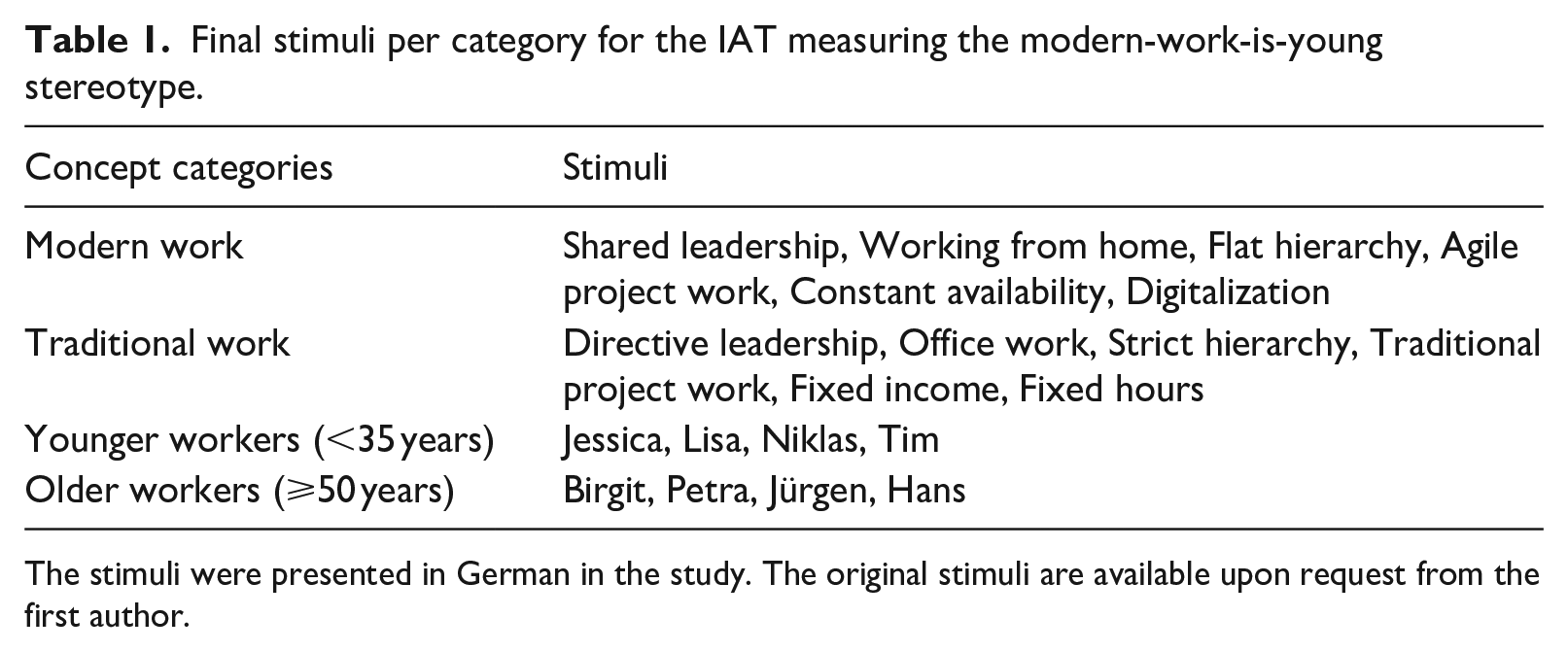
The stimuli were presented in German in the study. The original stimuli are available upon request from the first author.
Main study
Procedure
We implemented an online questionnaire on the platform Sosci Survey (Leiner, 2019). The questionnaire included the IAT. On the front page, the participants were informed that the goal of the study was to better understand the interplay between changes in the world of work (e.g. digitalization, flexibilization) and demographic change in the personnel. Furthermore, they were informed that, in addition to completing a questionnaire, they would participate in a reaction-time task and place themselves in a short scenario. After being given the opportunity to read the additional conditions of participation (e.g. voluntariness of participation, data privacy), participants gave their informed consent to the study by clicking “Continue.”
The participants first completed the IAT, which was preceded by a brief overview of the IAT stimuli (i.e. all names and work terms). Subsequently, they rated their overall contact with MWP as defined by the IAT stimuli. Then, the participants were introduced to the scenario and job description (see Materials below). On the next page, they were randomly presented with the résumé of either an older or a younger applicant and were requested to evaluate the applicant’s hireability. The participants were informed that by clicking “Next,” they would reach the other résumé and hireability items with no option to return to the first résumé. Subsequently, the participants indicated their explicit modern-work-is-young stereotype. Then, the participants provided information about their contact with older coworkers. Lastly, they provided demographic information and responded to social desirability items, a manipulation check, and questions about their seriousness of participation. In the manipulation check, the participants were asked to recall and indicate in years how old the two applicants were. Figure 1 depicts the procedure of the study, including the goal of the pilot study, the flow of the main study, and the hypotheses of the main study.
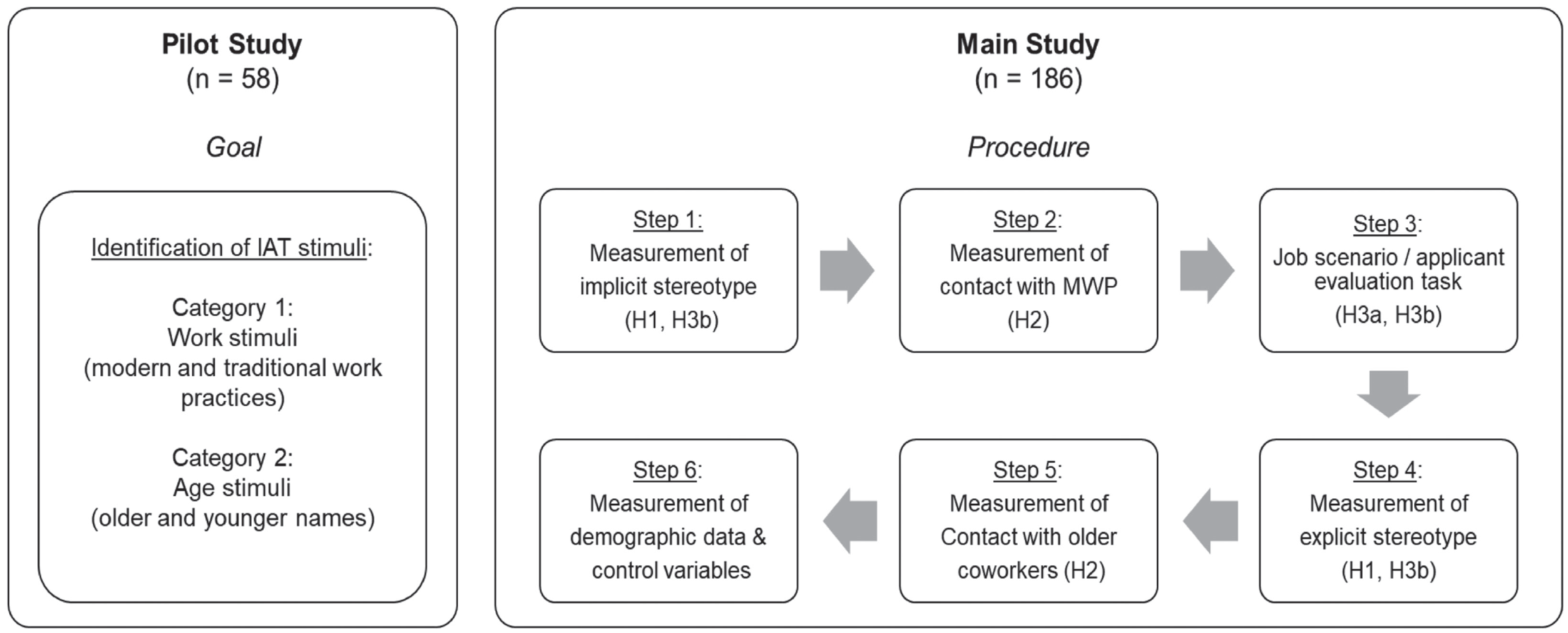
Flowchart depicting the procedure of the study and associated hypotheses.
Materials: Job description and résumés
For the hireability task, a description for a job involving MWP was developed including a short scenario. The participants were instructed to imagine working on a team that is facing an upcoming agile project to develop a new health app. They were then informed about the following three principles of agile project management: (1) The team has a high degree of self-organization and decision-making authority, (2) the team members work together as equals, (3) at the beginning of the project, there are no rigid goals—in short project intervals, sub-goals are regularly defined, evaluated and customer feedback is integrated (Koch and Schermuly, 2021). The participants were then instructed to imagine the following scenario: For this new agile project, you are looking for another team colleague with whom you will work together on the project. This person will be mainly responsible for the content and exercises in the health app. Imagine that you are the main person responsible for the application process. You have already received several applications. This morning, you received two more applications. Click “Next” to access the first applicant’s information and start the assessment.
Two short résumés were developed for hypothetical applicants who were equal regarding educational background and experience but differed in age. Based on the cutoffs used for defining older and younger workers (⩾50 years and <35 years, respectively), we chose the age of 54 years for the older applicant and the age of 30 years for the younger applicant to make the difference more obvious while ensuring equidistance to the cutoffs. The résumés included the name, profession, university, age, and relevant experience of the applicants. The two names were drawn from lists of the most popular first names in Germany for the respective years. To account for gender effects, we did not vary gender and presented two male applicants. No photographs were included to rule out similarity and sympathy effects. Table 2 compares the résumés of the hypothetical applicants.
Overview of the résumés of the older and the younger hypothetical applicant.
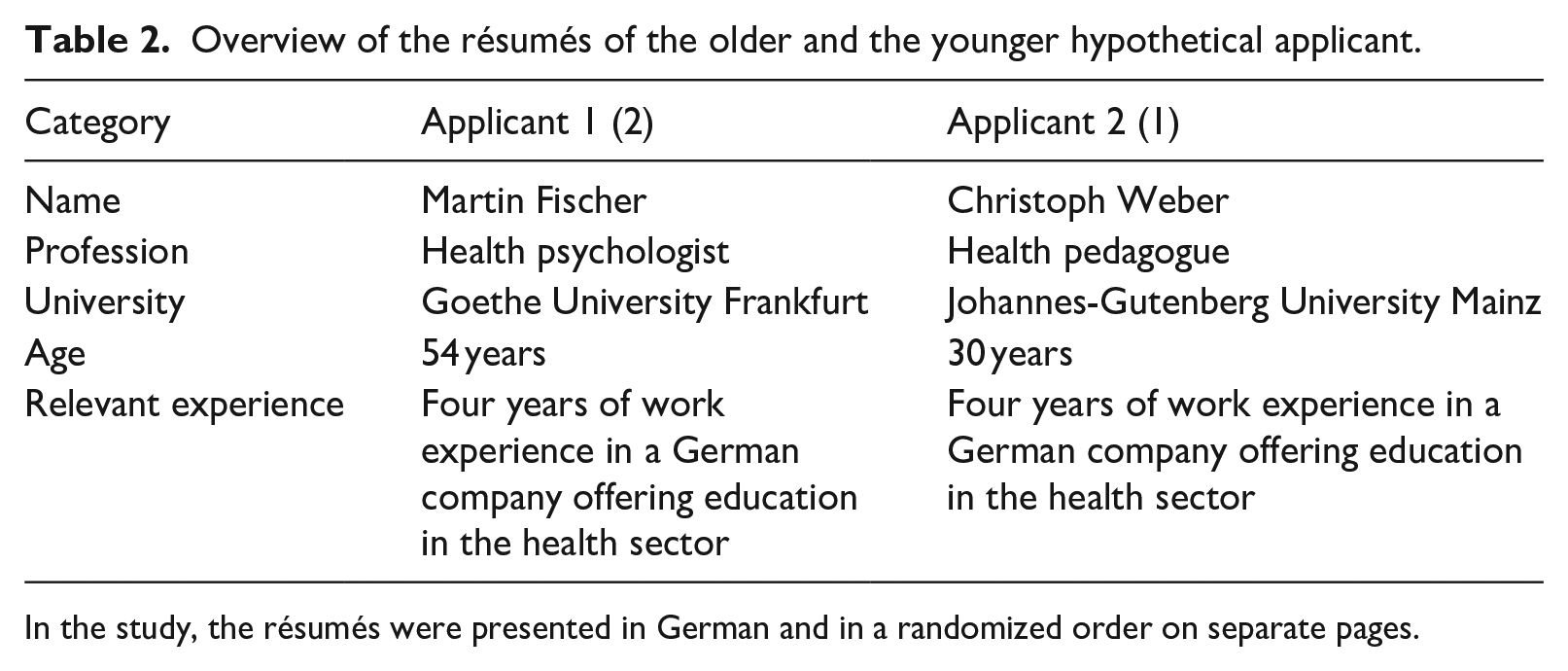
In the study, the résumés were presented in German and in a randomized order on separate pages.
Participants
A total of 232 workers from different organizations in Germany participated in the study. They were recruited via business platforms such as LinkedIn and with the help of students contacting acquaintances and relatives (for a discussion of such network sampling, see Demerouti and Rispens, 2014). To ensure data quality, we excluded 11 participants because they had relative speed index values of 2 or above (i.e. they were unreasonably fast in answering the survey; see Leiner, 2013) and another 11 participants because they reported working less than 10 hours. Fourteen participants were excluded because they failed the manipulation check: They remembered an age difference of less than 15 years; thus, age may not have become salient enough for them in the scenario. Finally, 10 participants were excluded because they identified with the age group of older workers. As mentioned in the Introduction, we focused on other-stereotyping and thus surveyed workers who identified as younger or middle-aged workers.
The final sample consisted of 186 participants. The participants’ chronological ages ranged from 18 to 61 years (M = 36.18, SD = 13.11); 57% of the participants identified with the age group of younger workers (<35 years) and 43% identified with the age group of middle-aged workers (between 35 and 50 years). 2 Fifty-seven percent of the sample self-identified as female. On average, the participants worked 33.21 hours per week (SD = 12.25) and had 10.3 years of work experience (SD = 10.93). Twenty-four percent of the sample reported currently working or having worked in a human resource (HR) position. Forty-eight percent reported having daily contact with older coworkers (⩾50 years), and 59% reported having daily contact with younger coworkers (<35 years).
Measures
Implicit modern-work-is-young stereotype
We used the IAT module of Sosci Survey (Leiner, 2019) to implement the modern-work-is-young IAT (see Table 1). It consisted of seven blocks, including five practice trials and two actual trials (see Greenwald et al., 2003). To account for order effects, two separate IATs were created: one in which the stereotype-congruent combination of categories (i.e. modern work and younger workers) was presented first and one in which the stereotype-incongruent combination was shown first. The participants were randomly assigned to one of the two IATs. Table 3 summarizes the procedure for the congruent IAT.
Procedure of the congruent trial of the modern-work-is-young IAT.
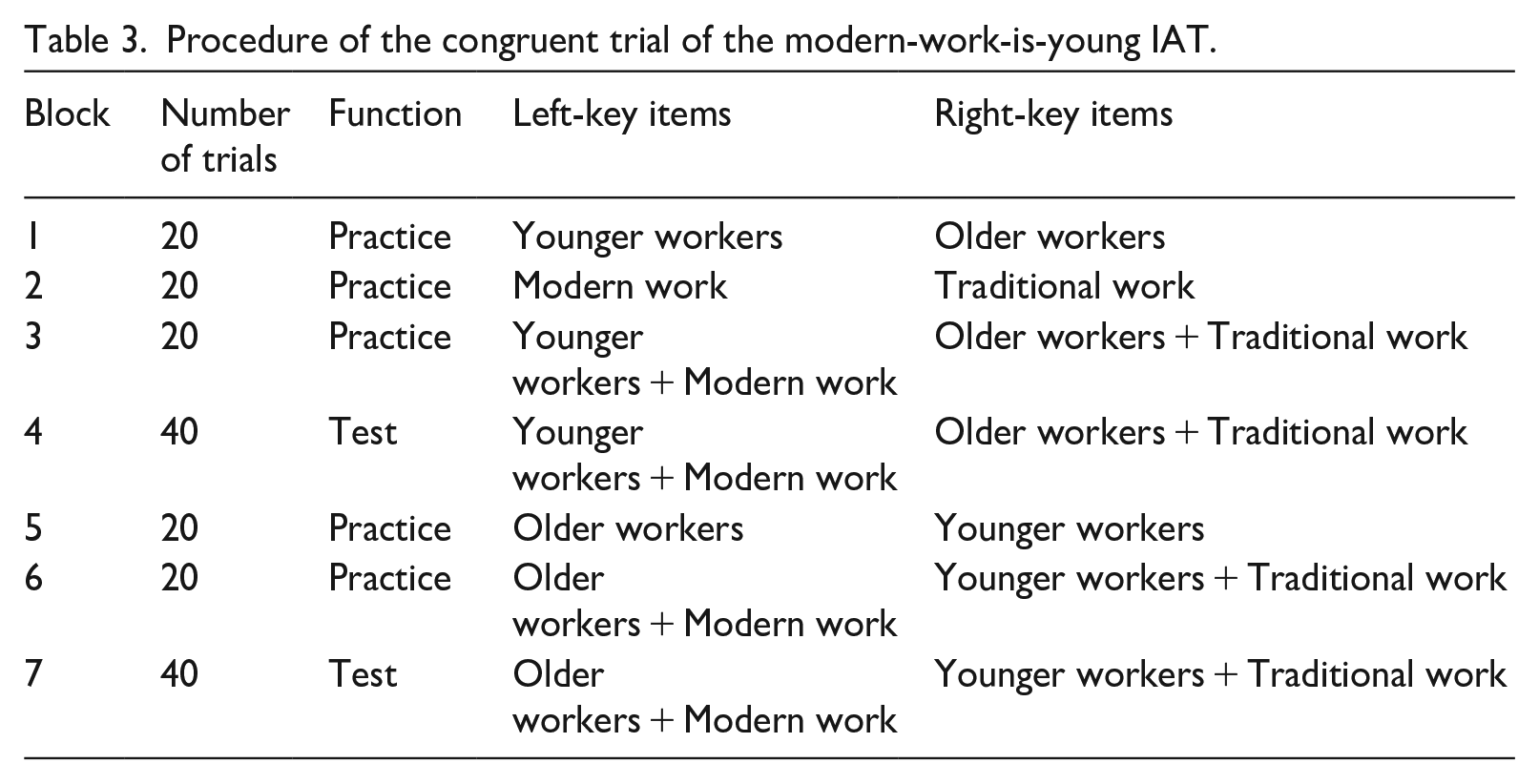
The stimuli were presented randomly and one by one in the middle of the computer screen with the categories in the upper left and right corners (e.g. younger workers on the left and modern work on the right). As preprogrammed in Sosci Survey (Leiner, 2019), the participants were instructed to press “E” or “I” on the keyboard for the left or right category, respectively, and to categorize the stimuli as quickly and accurately as possible. False categorizations were followed by a red “X” on the screen, which was resolved by pressing the other key.
The strength of the implicit modern-work-is-young stereotype (i.e. the association between modern work and younger workers or between traditional work and older workers) was reflected in the extent to which the stereotype-congruent trial (modern work/younger workers) was solved more quickly than the stereotype-incongruent trial (modern work/older workers). In statistical terms, this difference divided by the standard deviation of all response times for both conditions constituted the D score. Following Greenwald et al. (2003), the response times of the practice and test blocks 3, 4, 6, and 7 were used to calculate the D score, and data corrections were based on the response times of these blocks. Cases were invalid if the response times were faster than 300 ms in more than 10% of the responses; responses longer than 10 seconds were deleted from the respective score calculations (see Greenwald et al., 2003).
Explicit modern-work-is-young stereotype
The participants were presented with the work stimuli used for the modern-work-is-young IAT. They were then asked to evaluate how strongly they associated modern work, as defined by the stimuli, with younger workers (<35 years) or older workers (⩾50 years), from 3 “very strongly with older workers” to 3 “very strongly with younger workers,” with 0 as the neutral point. This item was recoded as ranging from 1 “very strongly with older workers” to 7 “very strongly with younger workers.”
Hireability
We chose three items selected by Zaniboni et al. (2019) to assess the participants’ evaluation of how hirable they perceived the applicants to be: (1) “My overall impression of this applicant is . . .” (from 1 “very unfavorable” to 6 “very favorable”); (2) “This applicant is suitable for this job” (from 1 “not at all” to 6 “completely”); and (3) “The likelihood that I would invite this person for an interview is . . .” (from 1 “very low” to 6 “very high”). Cronbach’s α was .90 for both the older and younger applicants’ hireability scores.
Contact quantity with older coworkers
Following Hassell and Perrewe (1995), we asked the participants to indicate on a scale (1 “monthly,” 2 “once a week,” 3 “several times a week,” and 4 “daily”) how often, on overage, they came into contact with older coworkers (⩾50 years) during work.
Contact quality with older coworkers
Following Fasbender et al. (2020), we used three items to assess the quality of contact with older coworkers (⩾50 years). On a Likert scale ranging from 1 “totally disagree” to 7 “totally agree,” the participants indicated how “positive,” “natural,” and “cooperative” their contact with older coworkers generally was (Cronbach’s α = .85).
Contact with MWP
The participants were instructed to look at the stimuli for the IAT’s work categories. They then evaluated how strongly they categorized their own work as pertaining to traditional versus modern work, on a scale ranging from 3 “very strongly to modern work” to 3 “very strongly to traditional work,” with 0 as the neutral point. We recoded this item so that higher values represented stronger contact with MWP.
Controls
The participants’ chronological age, work experience, HR experience, gender, and social desirability were included as control variables, as they might influence the evaluation of younger and older workers and/or alter the participants’ willingness to report ageism (see, e.g. Celejewski and Dion, 1998; Cherry et al., 2015; Perry, 1994). Social desirability was measured with the short version of the Social Desirability Scale by Lück and Timaeus (2014). The participants affirmed or denied four items, one of which was “I always say what I think.” A sum score was created reflecting the extent of social desirability. HR experience was measured by asking participants whether they currently work or have ever worked in a HR position.
Statistical analyses
All hypotheses were tested using the statistical software R (R Core Team, 2022). To test Hypothesis 1 (modern-work-is-young stereotype), we performed a one-sample t-test for each stereotype measure. To test Hypothesis 2 (contact hypothesis), we applied path modeling to include both dependent measures and all predictors at the same time. We used 5000 bootstrap samples for robustness of the standard error and a 95% confidence interval; missing values were accounted for by full-information maximum likelihood. Hypothesis 3a (hireability difference between applicants) was tested using a paired sample t-test. For Hypothesis 3b (relationship between modern-work-is-young stereotypes and discrimination), we calculated a difference score, subtracting the older applicant’s average hireability rating from the younger applicant’s average hireability. Thus, higher positive values reflected a stronger preference for the younger applicant. We applied a hierarchical linear regression, first entering the control variables (chronological age, work experience, gender, social desirability, and HR experience) and then explicit and implicit modern-work-is-young stereotypes at the same time. To test the robustness of our results, we followed recommendations by Becker et al. (2016) and also ran the analyses without control variables, which yielded unchanged effects.
Results
Preliminary analyses
We first tested whether the order of the IAT blocks (congruent/incongruent) influenced the IAT effect. In line with the literature (e.g. Kleissner and Jahn, 2020), the participants who first performed the stereotype-congruent block (modern work/younger workers) showed higher implicit modern-work-is-young stereotypes (MD score = 0.84; large effect) than participants who performed the non-congruent block first (MD score = 0.71; moderate effect), t(184) = −2.335, 95% CI [−0.23; −0.02], p = 0.021. According to Greenwald et al. (2003), D scores can be interpreted by applying the criteria for effect sizes of Cohen’s (1977) d measure. Thus, D scores of 0.20, 0.50, and 0.80 are considered small, medium, and large, respectively. Table 4 shows the means, standard deviations, and intercorrelations among the study variables. The explicit modern-work-is-young stereotype was negatively correlated with contact frequency and contact quality with older coworkers, chronological age, and work experience; it was positively correlated with age discrimination (i.e. preference for the younger applicant). The implicit modern-work-is-young stereotype was not significantly correlated with any other study variable. Thus, the explicit and implicit modern-work-is-young stereotypes were not correlated, which is consistent with past findings about the variable relationship between explicit and implicit attitudes (see Nosek, 2005). Furthermore, from the predictors of the modern-work-is-young stereotype, it appeared that contact frequency with older coworkers was negatively correlated with contact with MWP. We also address this finding in the Discussion section.
Means, standard deviations, and intercorrelations among study variables.
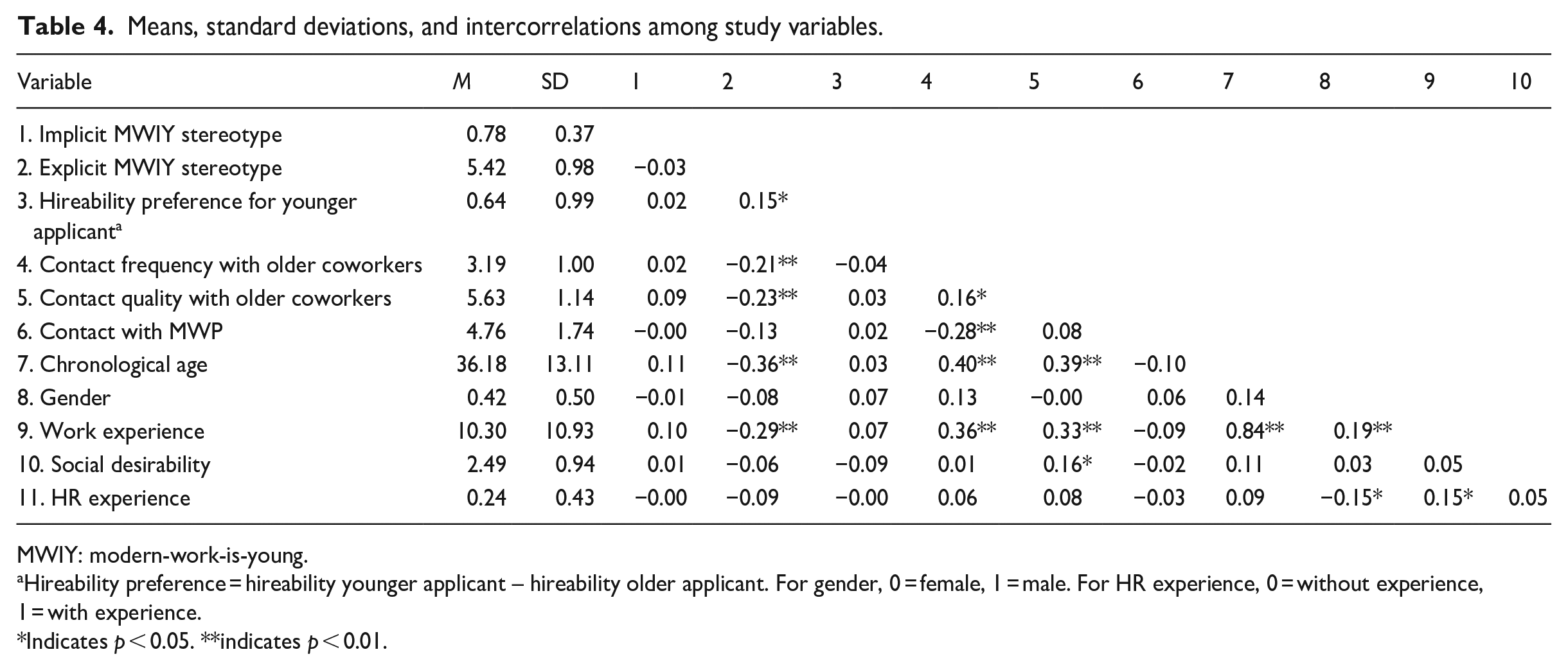
MWIY: modern-work-is-young.
Hireability preference = hireability younger applicant – hireability older applicant. For gender, 0 = female, 1 = male. For HR experience, 0 = without experience, 1 = with experience.
Indicates p < 0.05. **indicates p < 0.01.
Hypothesis testing
Hypothesis 1 assumed the existence of a stereotype associating MWP more strongly with younger workers than with older workers (modern-work-is-young stereotype). For the explicit stereotype, we tested the sample’s mean (M = 5.42, SD = 0.98) against the value of 4, representing the scale’s neutral point (i.e. equal categorization of MWP to younger and older workers). This test yielded a significant difference, t(185) = 19.663, 95% CI [5.28; 5.56], p < 0.001, indicating the existence of a modern-work-is-young stereotype. For the implicit stereotype, we tested the sample’s D score (M = 0.78, SD = 0.37) against 0, which also resulted in a significant difference, t(185) = 28.577, 95% CI [0.72; 0.83], p < 0.001. Our findings thus support Hypothesis 1.
Figure 2 presents the results for Hypothesis 2 both for the explicit and the implicit modern-work-is-young stereotype. The results for the explicit modern-work-is-young stereotype support Hypothesis 2. Workers who reported (a) more contact with older coworkers (β = −0.23, 95% CI [−0.38; −0.09], p = 0.002), higher quality contact with older coworkers (β = −0.18, 95% CI [−0.29; −0.03], p = 0.025), and (c) more contact with MWP (β = −0.18, 95% CI [−0.18; −0.03], p = 0.010) held weaker explicit modern-work-is-young stereotypes. However, the results for the implicit modern-work-is-young stereotype do not support Hypothesis 2: No significant relationships were observed between the implicit modern-work-is-young stereotype and (a) contact with older coworkers (β = −0.01, 95% CI [−0.05; 0.05], p = 0.911), (b) quality of contact with older coworkers (β = 0.09, 95% CI [−0.02; 0.08], p = 0.240), and (c) contact with MWP (β = −0.01, 95% CI [−0.04; 0.03], p = 0.862). The model explained 11% of the variance in the explicit modern-work-is-young stereotype and 0,8% of the variance in the implicit modern-work-is-young stereotype.
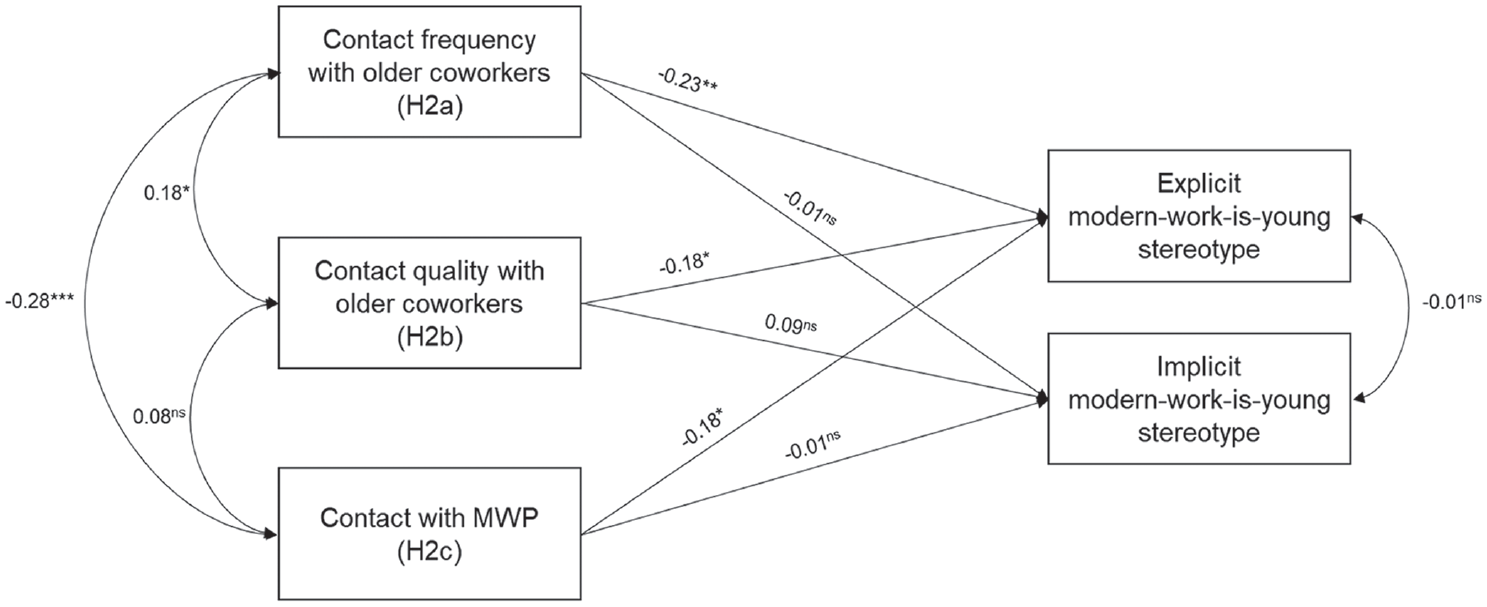
Path analysis model of associations between contact frequency with older coworkers, contact quality with older coworkers, contact with MWP, and the explicit and implicit modern-work-is-young stereotypes.
Hypothesis 3a posited that the younger applicant would receive significantly higher evaluations for a job involving MWP than the older applicant. The results support this hypothesis. There was a significant preference for the younger applicant in terms of hireability ratings (M = 4.51, SD = 0.96) compared to the older applicant (M = 3.87, SD = 1.15), t(185) = 8.825, 95% CI [0.50; 0.79], p < 0.001. The order of applicant presentation (younger or older applicant first) had no effect on the difference score between the two hireability ratings, t(184) = −0.168, 95% CI [−0.31; 0.26], p = 0.867. In Hypothesis 3b, we assumed that the explicit and implicit modern-work-is-young stereotypes would predict the extent of the preference for the younger applicant. The results of the hierarchical regression analysis are summarized in Table 5. The control variables entered in step 1 did not predict the preference for the younger applicant. From the main variables, only the explicit modern-work-is-young stereotype proved to be a significant predictor (β = 0.18, 95% CI [0.03; 0.34], p = 0.021). The final model explained 5% of the variance in the preference for the younger applicant.
Results of the hierarchical regression analysis predicting preference for the younger applicant with explicit and implicit modern-work-is-young stereotypes and five control variables.
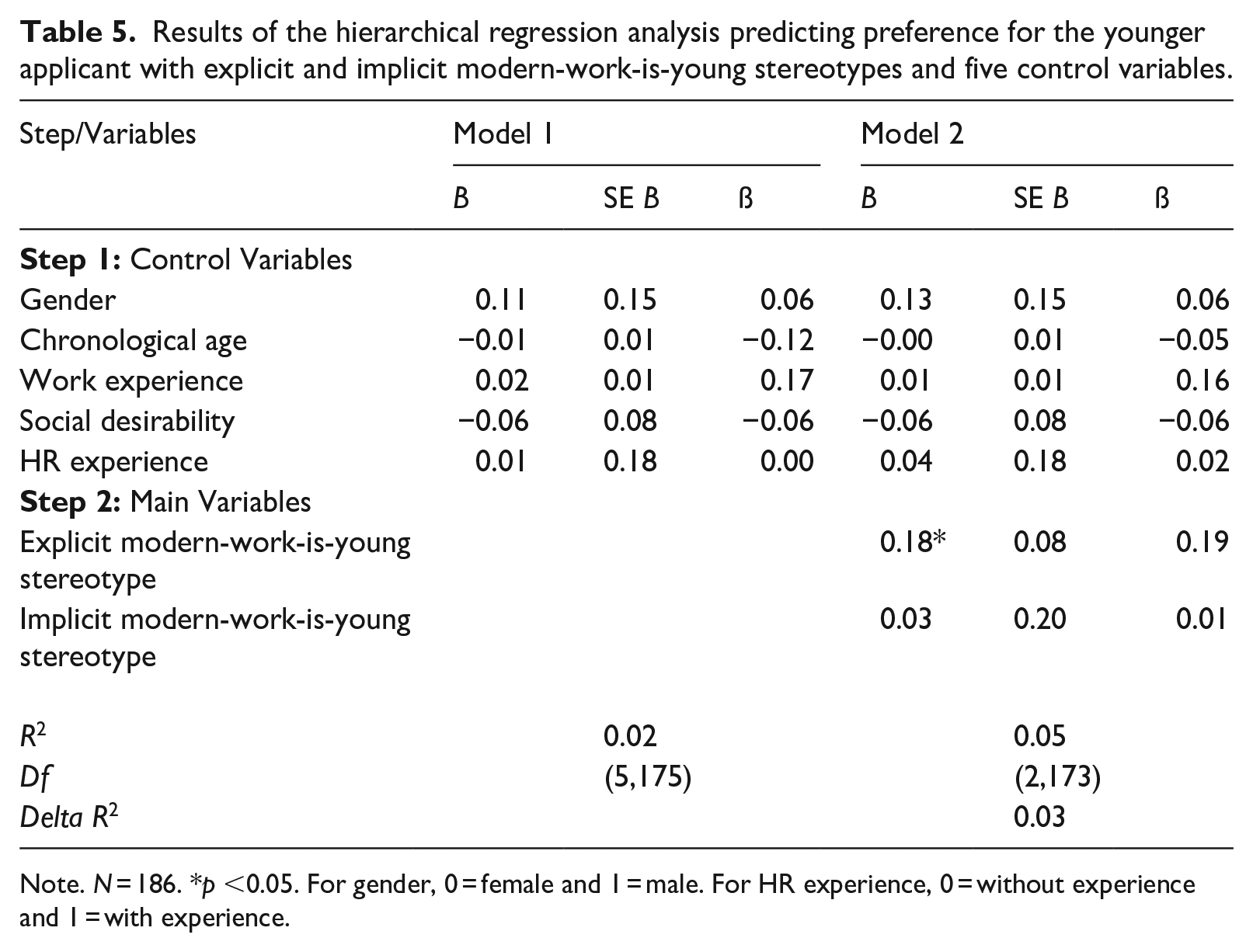
Note. N = 186. *p <0.05. For gender, 0 = female and 1 = male. For HR experience, 0 = without experience and 1 = with experience.
Discussion
As Eagly and Diekman (2005: 28) succinctly put it, “prejudice becomes an acknowledged social problem when a substantial number of group members aspire to incongruent social roles.” Organizations are increasingly adopting MWP to better respond to rapidly changing business environments. At the same time, in societies with declining birth rates and rising life expectancies, the share of older workers in the workforce is increasing. Thus, it is probably only a matter of time before significant numbers of older individuals encounter MWP. We hypothesized and empirically identified a modern-work-is-young stereotype (Hypothesis 1): At an explicit and implicit level, the participants associated MWP more strongly with younger workers than with older workers. The common thread regarding Hypotheses 2 and 3b was that only the explicit modern-work-is-young stereotype played a significant role. It appeared to be both more malleable through contact and influential in terms of age discrimination in the hiring scenario. Regarding Hypothesis 3a, we found support for a general preference for the younger applicant. In the following section, we interpret these results in view of existing theory and discuss possible implications for research and practice.
Theoretical implications
Allport (1954) focused more on generally devalued groups, defining prejudice as a generic antipathy. This definition is probably too restrictive, as most everyday prejudicial occurrences fall under the radar (see Eagly and Diekman, 2005). The results regarding Hypothesis 1 corroborate a more differentiated incongruity framework, which states that prejudice emerges from a mismatch between stereotypes against a social group (e.g. older workers) and the characteristics that people believe to be necessary to thrive in a specific social role (Eagly and Diekman, 2005). As we will discuss later, this contextual view of age stereotypes seems important, as it might help to explain why some studies have not found age discrimination in personnel decision situations (for a commentary on the importance of a contextualized view of age stereotypes, see Chang et al., 2022).
Regarding ways to reduce certain stereotypes, our findings corroborate Allport’s (1954) work. All three forms of contact were negatively related to the explicit modern-work-is-young stereotype. This finding even expands Allport’s (1954) contact hypothesis by adding contact with work practices—as opposed to contact with a social group—as another potential way to reduce stereotypes. This also speaks to the role incongruity model (Eagly and Diekman, 2005), which suggests that one of two ways to reduce mismatch is to build a more realistic picture of a specific role and its requirements. Thus, it seems that participants in the present study who had more contact with MWP held a more realistic picture of MWP and its incumbents. Moreover, the fact that contact frequency was negatively related to the explicit age-work stereotype adds to the discussion on the relative importance of contact frequency and contact quality (see, e.g. Pettigrew and Tropp, 2006; Schwartz and Simmons, 2001). Our finding suggests that—at least in this context—contact frequency alone helped to diminish the explicit modern-work-is-young stereotype, irrespective of contact quality.
Regarding the implicit modern-work-is-young stereotype, we did not find significant relationships with any of the three forms of contact. Although there is evidence that intergroup contact can reduce implicit stereotypes (e.g. Brannon and Walton, 2013), we can adduce plausible reasons why we did not find a negative relationship with the implicit modern-work-is-young stereotype in the present study. One possible reason for this missing relationship is immediacy. Most of the studies on interventions designed to reduce implicit stereotypes investigated short-term effects. In contrast, our study investigated average effects of contact with older coworkers. It thus could be that implicit modern-work-is-young stereotypes drop after immediate contact with an older coworker but subsequently bounce back to their original level. This idea seems to be in line with a recent longitudinal study by Vuletich and Payne (2019), which investigated interventions for reducing implicit racial bias across 18 university campuses. They found that campus means (i.e. average levels of implicit bias) returned to previous levels in the study’s follow-up measures, while individual scores fluctuated mostly randomly, suggesting that “implicit bias is highly transient at the individual level but stable for social contexts” (Vuletich and Payne, 2019: 860). Transferring this finding to our study, it might indicate that dyadic interactions are not enough to change the implicit modern-work-is-young stereotype. Instead, as suggested by Vuletich and Payne (2019), it would be necessary to remove environmental cues of bias in the organization to reduce the implicit modern-work-is-young stereotype. Regarding MWP, an overrepresentation of younger workers in the organization could be such a cue. Indeed, we observed a negative correlation between contact with older coworkers and contact with MWP, suggesting that fewer older workers worked in settings that included MWP. Another environmental cue triggering the modern-work-is-young stereotype might be ageist language and imagery in advertisements for jobs involving MWP and daily figures of speech. In this vein, future research might, for example, investigate the organizational age climate—employees’ perceptions of how positively older workers are viewed within the organization (Noack, 2009)—as a proxy for cues in the social context. Furthermore, future research might also investigate mechanisms of self-stereotyping (see Levy, 1996) or stereotype threat (see Steele et al., 2002) to explain the underrepresentation of older workers in work contexts that include MWP. One first step might be to manipulate advertisements for jobs involving MWP and explore the relative number of applications from older workers. In any case, altering explicit stereotypes seems to be a good starting point for changing implicit age stereotypes (see Levy and Banaji, 2002).
In Hypothesis 3a, we postulated that age discrimination would occur in the context of jobs involving MWP. The older applicant in the scenario received significantly lower evaluations than the younger applicant—irrespective of whether the older or younger applicant was evaluated first. As all other qualifications were held equal, it seems that the average participant used age as a criterion for applicant evaluation. In light of prototype matching theory (Perry, 1994), this may indicate that age constitutes a central feature of the average person-in-job prototype for a job involving MWP. Recent research by Fatfouta and Ghoniem (2022) did not find a significant overall effect of age on hireability ratings. In line with our study, the authors acknowledge that “there may be an industry effect, especially when [being] older and experienced might be a detriment (e.g. in technology jobs)” (Fatfouta and Ghoniem, 2022: 19). These findings support the notion that not all jobs and work practices are equally susceptible to age bias (Perry, 1994) and that selection decisions involving MWP are more likely to result in age discrimination. Future researchers may want to explicitly investigate the possibility that relational demography also influences applicant ratings. Relational demography can be defined as “the comparative similarity or dissimilarity in given demographic attributes of a superior and a subordinate or of the members of an interacting work team” (Tsui and O’Reilly, 1989). In most of the current work settings, the relational age norm still states that the supervisor of a work team will be older than the subordinates (Tsui et al., 2002). As MWP tend to focus on equal collaboration, this relational age norm might have negatively affected the evaluation of the older applicant. Some participants, for example, may have found it difficult to imagine the older applicant working in such a less hierarchical setting. In line with this argument, research findings indicate that, in status-incongruent settings—that is, when the supervisor is younger than their subordinate—, the greater the age difference, the lower the supervisors’ ratings of their subordinates (Van Der Heijden, 2018). As baby boomers retire and the nature of work becomes more technology- and knowledge-related, this status-incongruent situation becomes more likely (Tsui et al., 2002). Although many MWP do not include traditional supervisor–subordinate settings at all, findings on relational demography allow us to suggest that the increase of MWP might lead to an increase in age discrimination between members of a work team. This calls for further research in this area.
In Hypothesis 3b, we postulated that the explicit as well as implicit modern-work-is-young stereotype would be positively related to the extent of age discrimination (i.e. preference for the younger applicant). We found partial support for this hypothesis. The explicit modern-work-is-young stereotype proved to be a significant predictor. This finding could support the incongruity framework discussed above. Stronger perceived incongruity at the explicit level might have led to greater discrimination between the two applicants based on their age. This finding is particularly important because few studies to date have explicitly examined the relationship between age stereotypes and age discrimination (see Rudolph et al., 2022). Thus, findings regarding Hypothesis 3b help to address “the urgent need to sort out competing explanations for links between age and employment outcomes” (Murphy and DeNisi, 2022: 4). For instance, an older worker might be excluded from a training program not because of age stereotypes but because the older worker has struggled with training in the past (see Murphy and DeNisi, 2022). One of the other few studies helping to rule out competing explanations indicates that “both implicit and explicit age stereotypes may harm older job applicants’ hireability, but through different pathways” (Zaniboni et al., 2019: 1); however, in their experimental study, an age-neutral job was used.
In contrast to the study by Zaniboni et al. (2019), we did not find a significant relationship between the implicit modern-work-is-young stereotype and the extent of age discrimination. This difference might be explained by dual process models of the attitude–behavior relation, which suggest that explicit measures of attitudes are better predictors of more controlled (i.e. verbal) behaviors, whereas implicit measures of attitudes are better predictors of more spontaneous (i.e. nonverbal) behaviors (Asendorpf et al., 2002; Fazio, 1990). For future research, it would be worthwhile to investigate whether the implicit modern-work-is-young stereotype is able to predict more spontaneous behaviors in personnel-selection situations, such as speaking time or eye contact. It must also be noted, however, that—unlike in our study—implicit measures of attitudes have been found to be capable of predicting more controlled behaviors, such as voting behaviors (e.g. Friese et al., 2007). Thus, it is possible that the lack of an observed relationship between the implicit modern-work-is-young stereotype and the extent of age discrimination in the scenario was at least partly due to measurement issues. Future research should therefore try to replicate our study with a different implicit assessment or another set of stimuli for the IAT. For example, one idea would be to use pictures of older and younger people instead of names for the age categories, as research indicates differences in how pictures and words affect people’s evaluative associations (see, e.g. Carnevale et al., 2015). More specifically, although we chose names that were evaluated as neutral as possible in the pilot study, we could not control for the effects of previous experiences and familiarity with certain names.
Practical implications
Many organizations are starting to realize the need to implement MWP to address increasing environmental complexity. At the same time, employers and workers need to be aware of the mechanism individuals often use to cope with complexity, that is, cognitive shortcuts. Although we agree that “categorical thinking is a natural and inevitable tendency of the human mind” (Allport, 1954: 170), we see several ways that human resource development (HRD) professionals, supervisors, and employees can leverage our findings to minimize the risk of age discrimination in the modern workplace.
The first step for organizations applying MWP or organizations that consider applying MWP is to raise awareness of the modern-work-is-young stereotype and the need to deal with it. The fact that the average participant was not shy about revealing their explicit modern-work-is-young stereotype may indicate that they had little to no understanding of the prejudice und unjustness involved. Although we cannot rule out that the implicit modern-work-is-young stereotype plays a role in the real world, we can be more confident that the explicit modern-work-is-young stereotype has an actual effect. This could be seen as an advantage: As explicit stereotypes operate with conscious awareness, they are probably easier to change than implicit stereotypes (see Wilson et al., 2000). HRD professionals and supervisors could start to address the modern-work-is-young stereotype in customized training programs or the annual employee appraisal interviews. Informed by our findings, HRD professionals and supervisors might also foster contact between younger, middle-aged, and older coworkers to alter the explicit modern-work-is-young stereotype. In fact, combining both approaches might be the most promising way. In a meta-analysis on ageism interventions, Burnes et al. (2019) found that interventions that contained components of both education and intergenerational contact were particularly effective. For an optimal allocation of resources, our findings suggest focusing on workers who identify as younger (<35 years) or middle-aged workers (between 35 and 50 years) and who have little contact with MWP.
Lastly, our findings point to the importance of being particularly aware of the modern-work-is-young stereotype in personnel-selection situations involving MWP. This applies both to external and internal personnel decisions. For example, when a new agile team is to be formed, decision-makers should critically review their own modern-work-is-young stereotype to prevent discrimination against older employees in the process.
Limitations
Several concerns must be considered. One methodological limitation is the cross-sectional nature of the study. The lack of temporal separation between the measurement of the implicit modern-work-is-young stereotype and subsequent applicant evaluations might have primed and thus biased the evaluations of some participants. At least, we did not find a systematic relationship between levels of age discrimination and social desirability scores. The fact that we did observe a significant preference for the younger applicant—irrespective of the order of applicant presentation—further mitigates the concern that social desirability might have biased our results. Within this cross-sectional design, we intentionally administered the IAT before assessing the explicit stereotype because performing explicit measures before implicit measures may lead to implicit tasks being performed under greater conscious control (Bosson et al., 2000). Still, the cross-sectional nature of the study does not allow us to draw causal conclusions (see the endogeneity problem, e.g. Antonakis et al., 2014). For example, we cannot say whether contact with older coworkers led to less stereotype endorsement or whether less stereotype endorsement resulted in more contact with older coworkers. Another source of endogeneity is the omission of third variables. For instance, the personality trait of agreeableness could have influenced both stereotype endorsement (see Lin and Alvarez, 2020) and contact with older employees (see Turner et al., 2014), which could have confounded the presumed relationship between the latter two variables. Experimental studies that manipulate contact with older coworkers are warranted to substantiate our findings.
Another methodological limitation is that the participants evaluated hypothetical applicants (i.e. “paper people”; for a critical discussion, see Drury et al., 2022). The use of such vignette studies in research on personnel decisions has recently been debated as possibly overstating the real effects of age stereotypes (see, e.g. Murphy and DeNisi, 2022). One reason is that motivation promotes individuated processing in impression formation (Fiske and Neuberg, 1990), which reduces the risk of stereotype application. It is likely that the participants in the present study were not as motivated and involved in the task as they would have been in a real personnel-selection decision. However, research indicates that individuals respond similarly when rating hypothetical and actual applicants (Cleveland, 1991). The sample itself could be another limitation, as we did not investigate professional recruiters. This concern is mitigated by experimental research that found that business students and HR professionals discriminate against older applicants to a similar degree when evaluating résumés (Krings et al., 2011). Nevertheless, it might be fruitful for future research to replicate our findings with personnel professionals, as they may hold different person-in-job prototypes regarding MWP (see Perry, 1994). To further increase the generalizability of our findings, future research could also test our hypotheses within a field experiment. For example, researchers might send out résumés of fictitious applicants randomly varying in age to real employers with vacancies in MWP jobs and investigate employers’ callback rates (for an example of a correspondence experiment, see, Carlsson and Eriksson, 2019; for a meta-analysis, see Lippens et al., 2023).
Furthermore, measurement issues should also be considered. The explicit modern-work-is-young stereotype was assessed with a single item, which might have limited its reliability and potential to measure the construct in its full complexity. Although recent research supports the use of single items in psychological studies (see Allen et al., 2022), it might be worthwhile to replicate our study using a multiple-item assessment of the explicit modern-work-is-young stereotype. For example, a multidimensional scale could be developed using the stimuli of the modern-work-is-young IAT.
Lastly, we focused on workers who identified as younger workers (<35 years) or middle-aged workers (between 35 and 50 years). Future research could investigate workers who identify as older workers (⩾50 years) to shed light on potential self-stereotyping processes within this age group. Studying this sample seems important because the self-stereotype of being “too old for modern work” could contribute to older workers taking early retirement.
