




Abstract
Working time mismatches – and especially overemployment – continue to be a highly relevant topic in German legislation, business practice and in research. However, it has been rather neglected in empirical absenteeism research. Therefore, the aim of this study is to examine the relationship between contractual overemployment, that is, the difference between contractual and preferred working hours, and sickness absence in Germany. Furthermore, this study explores the moderating role of HR practices (flexible work arrangements and part-time employment) on this relationship. Therefore, I conduct two-level negative binomial regression analyses, using data from the German Socio-economic panel (GSOEP). In line with the JD-R model, results indicate that overemployment (especially overemployment of 6–10 hours compared to a work hour match) is positively related to sickness absence. However, the moderating role of flexible work arrangements, that is, the buffer effect of working time autonomy on this link cannot be confirmed. Moreover, the results suggest that part-time employment amplifies the relationship between overemployment (1–5 hours) and sickness absence for females only. This study highlights the need to move away from standardised work hour arrangements. Indeed, it is one of the first studies that emphasises the role of preference-based contractual working hours in reducing absenteeism, also and especially because standard HR practices do not mitigate overemployment-related absenteeism, but can in fact exacerbate it. Furthermore, this study contributes to theory and literature, by extending the JD-R model to overemployment.
Keywords
Introduction
In Germany, most employees work and agree to a standard full-time job, according to the still prevailing ‘ideal worker norm’ (Lott and Klenner, 2018; OECD, 2022) – in some cases, even if this is not desired. These discrepancies between actual/contractual and preferred working hours are discussed under terms such as work hour discrepancies (e.g. Wang and Reid, 2015; Zimmert and Weber, 2021), work hour/working time mismatches (e.g. Grund and Tilkes, 2023; Lepinteur, 2019; Reynolds and Johnson, 2012; Reynolds and McKinzie, 2019; Van Emmerik and Sanders, 2005) or work hour incongruence (e.g. Lee et al., 2015), and partly also under or within terms such as work/ employment status (in)congruence (e.g. Burke and Greenglass, 2000; Holtom et al., 2002; Loughlin and Murray, 2013), or schedule (mis)fit (e.g. Piszczek et al., 2021). Specifically, within the first set of terms, we distinguish between underemployment (the desire for more hours) and overemployment (the desire for fewer hours). However, I will focus on overemployment for the following reasons: First, overemployment and underemployment and their effects follow partly different logics and therefore should not be intermingled. Second, overemployment is much more widespread in Germany than underemployment (own calculations based on GSOEP v36, 2015–2019); third, it is associated mostly with more negative effects on health (e.g. Bartoll and Ramos, 2020; Matiaske et al., 2017; Otterbach et al., 2021); occasionally there are also stronger negative effects of underemployment (Kim et al., 2021) and job satisfaction (Frei and Grund, 2022) than underemployment. Thus, from a practical HR perspective, overemployment is more relevant than underemployment. Further, the issue of overemployment has recently gained renewed attention in Germany’s legislation: Thus, the right to permanent part-time work (TzBfG/ Act on Part-Time Work and Fixed-Term Employment Contracts), which was introduced in 2001 to combat overemployment, was supplemented in 2019 by the right to a temporary reduction of contractual working hours (§9a TzBfG). In research, a large body of work has focused on the negative link between overemployment and health (Bartoll and Ramos, 2020; Bell et al., 2012; De Moortel et al., 2018; Kim et al., 2021; Kuroda and Yamamoto, 2019; Lepinteur, 2019; Miranti and Li, 2020; Otterbach et al., 2021), satisfaction with health (Bell et al., 2012; Matiaske et al., 2017), life satisfaction (Angrave and Charlwood, 2015; Başlevent and Kirmanoğlu, 2014; Bell and Blanchflower, 2019) and job satisfaction (Angrave and Charlwood, 2015; Fabian and Breunig, 2019; Frei and Grund, 2022; Grund and Tilkes, 2023; Kuroda and Yamamoto, 2019; Lee et al., 2015; Pagan, 2017). Others have focused on various job-related outcomes of overemployment or work hour (in)congruence, such as commitment (Abrahamsen, 2010; Odle-Dusseau et al., 2012), turnover (intention) (Boheim and Taylor, 2004; Odle-Dusseau et al., 2012; Sturman and Walsh, 2014), retirement (intention) (Silver et al., 2019; Wöhrmann et al., 2020) or work-life conflict/balance (Brauner et al., 2020; Odle-Dusseau et al., 2012; Skinner and Pocock, 2008; Sturman and Walsh, 2014) – and have found mixed results.
However, to my best knowledge, there are only two peer-reviewed studies from Canada on the impact of work hour (in)congruence (including overemployment) on absence from work (Lee et al., 2015; Wang and Reid, 2015). Yet, these two studies – as well as previous research on the effects of working time discrepancies in general – have limitations. First, these two studies come to partially divergent conclusions. Second, paid absence is operationalised as paid sick leave and various other paid absences (e.g. paid vacation, paid educational leave) combined, mixing absences with different causes. This is problematic, since these different types of absence likely have entirely different rationales, which require different explanatory approaches. Thus, these authors did not present a theoretical approach specifically adapted to sickness absence. Further, from an HR perspective, it is surprising that the empirical research on the effects of work hour mismatch has to date focused on general absence from work or health status, but not explicitly on sickness absence. After all, sickness absences are frequent and hard to plan, and therefore impose enormous operational costs (Grinza and Rycx, 2020; Pimpertz, 2021). Thus, it should be an HR objective to know all suitable ways to reduce sickness absence. Third, these two studies and the majority of working hour mismatch research address actual overemployment (actual hours worked – including overtime – exceeding preferred hours) rather than contractual overemployment. Thus, the recent empirical research has scarcely dealt with the effects of a preference-based design of contractual working hours and, in particular, not with contractual overemployment as a possible instrument for reducing sickness absence. However, this could be worthwhile, for various reasons, for instance because contractual working hours – presumably, more than the actual working hours – are within the employer’s sphere of influence (further reasons are addressed in Section 3.2.2.). Fourth, these two studies refer to the Canadian context. The results cannot simply be transferred to other country contexts such as Germany, because both the levels of working time (discrepancies) and sickness absence are highly contextual (Costas et al., 2018), that is, they depend on country-specific (institutional) factors. Thus, besides factors such as the population’s health statuses, the composition of the labour force and social norms, the sickness absence level relates primarily to sick leave policies (Palme and Persson, 2020). These vary enormously across countries, for instance in terms of eligibility, duration or replacement rates (European Commission, 2016). In a global comparison – and especially compared to Canada – Germany has very generous sick leave policies (Pichler and Ziebarth, 2017): the employer continues to pay full wages for 6 weeks (Section 3 EFZG). Thus, the average sickness absence day count is relatively high compared to many other OECD countries, including Canada (OECD, 2021a). Finally, only a few studies have dealt with HR instruments that may moderate the effects of overemployment (e.g. De Moortel et al., 2018; Frei and Grund, 2022; Grund and Tilkes, 2023; Van Emmerik and Sanders, 2005), and none have addressed the link between overemployment and absence. Thus, from an employer’s perspective, it remains unclear whether it is justified to rely on standardised (rather than preference-based) working time arrangements, provided that suitable other HR instruments (e.g. flexible working hours, part-time arrangements) are applied.
Against the background of this state of research, I contribute to the literature in several ways. First, to my best knowledge, this is the first study to use representative, longitudinal data from the German Socio-Economic Panel (GSOEP) to examine the relationship between contractual overemployment and sickness absence for the German context. Second, I refer to the job demands-resources (JD-R) model (Bakker and Demerouti, 2007; Demerouti et al., 2001) and the work-family conflict approach (Greenhaus and Beutell, 1985) – two strain or time-oriented and thus more issue-specific approaches. I thereby extend the JD-R model to working time mismatches. Third, by examining for the first time the interactions between contractual overemployment and working time autonomy as well as employment status, I am able to expand the knowledge and derive implications for business practice on how HR policies may help reduce sickness absence. The remainder of this paper is structured as follows: In Section 2, I build on the JD-R model as the theoretical framework to then derive the hypotheses on the (interaction) effects of contractual overemployment on sickness absence. In Section 3, I describe the data and the analysis strategy; in Section 4, I present both descriptive results and results of the negative binomial multilevel analyses. I conclude by discussing the results in Section 5.
Theory, literature and hypotheses
Overemployment and sickness absence
To date, mainly social exchange theory (Blau, 1986), discrepancy theory (Lawler, 1973; Locke, 1969) and labour supply theory (Brown and Sessions, 1996) have been used to explain the relationship between working time mismatches and absenteeism. However, this is only partially suitable for the specific link between overemployment and sickness-related absenteeism, because the first two theories do not consider the direction of work hour mismatch (overemployment vs underemployment). However, considering this would be beneficial, as Wang and Reid (2015) as well as Lee et al. (2015) have shown that over- and underemployment have partly different effects on absenteeism. Further, the strain aspect was not explicitly incorporated. In contrast, labour supply theory (e.g. Brown and Sessions, 1996) addresses contractual overemployment, but again does not sufficiently consider the health aspect. To consider these aspects, in explaining the relationship between overemployment and sickness absence, I draw on the JD-R model (Bakker and Demerouti, 2007; Demerouti et al., 2001), which also provides an explanation for the moderating role of HR practices.
A basic premise of the JD-R model is that work conditions can be divided into job demands and job resources. ‘Job demands refer to those physical, psychological, social, or organizational aspects of the job that require sustained physical and/or psychological (. . .) effort and are therefore associated with certain physiological and/or psychological costs’ (Bakker et al., 2003b: 344). Job resources ‘refer to those (. . .) aspects of the job that (. . .) reduce job demands and the associated physiological and psychological costs (. . .)’. (Bakker et al., 2003b: 344). Examples of job resources are autonomy, task variety, or appreciation, while for instance noise, time pressure or work-family conflicts are regarded as job demands (Bakker and Demerouti, 2007; Demerouti et al., 2001; for an overview, see Schaufeli and Taris, 2014).
I also consider overemployment as a job demand, for two reasons: First, working more hours than desired may require sustained physical and/or psychological effort itself. Second, overemployment may be a source of work-family conflicts (Sturman and Walsh, 2014) – which, owing to the model’s flexibility, can be interpreted as a job demand – and has been in previous research (Bakker et al., 2005). The reasoning behind this is that employees’ time resources are scarce and must be divided between their private and job spheres. In the case of overemployment, more time than desired is devoted to the job domain. Thus, there may not be enough time to meet the demands of private life (e.g. care of children or dependents, education, hobbies, leisure time), especially if we assume that employees know their private demands best and therefore factor them into their desired working hours. A time-based and/or strain-based work-family conflict in the sense of Greenhaus and Beutell (1985) arises. This requires effort and therefore constitutes a job demand. According to the model, high job demands lead to job strain and reduced health (‘health impairment hypothesis’), which in turn lead to negative organisational outcomes – such as higher sickness absences (Bakker et al., 2003a, 2003b). Overall, there is strong empirical evidence both for the ‘health impairment process’ generally (for an overview, see Bakker and Demerouti, 2007) and specifically for the prediction of sickness absence as an organisational outcome of this process (Bakker et al., 2003a, 2003b). Further, studies have also clearly shown that work-home conflicts lead to longer absences (e.g. Demerouti et al., 2011). However, to my best knowledge, research on the JD-R model has not yet considered overemployment as a job demand. Outside the JD-R model framework, however, several studies found empirical evidence for the link between overemployment and poor mental health (Angrave and Charlwood, 2015; Bartoll and Ramos, 2020; Bell et al., 2012; De Moortel et al., 2018; Kim et al., 2021; Kuroda and Yamamoto, 2019; Miranti and Li, 2020; Otterbach et al., 2021), thereby basically supporting the ‘health impairment hypothesis’. Further, research provides clear evidence that poor employee health is in turn associated with longer sickness absences – and this effect is significantly greater for mental than for physical health (Bryan et al., 2021). However, as indicated above, there are only two studies on the direct link between overemployment and absence, which come to partly different results: Lee et al. (2015) showed that a full resolution of overemployment significantly reduces paid absence. In contrast, Wang and Reid (2015) could not prove a positive significant effect of overemployment on paid absence – but could for unpaid absence. Thus, they showed that for overemployed employees, the number of unpaid days of absence significantly increases with the number of hours discrepancy. These different results are possibly due to their different estimation strategies: The first study (Lee et al., 2015) is based on the ‘momentum approach’ (Chen et al., 2011) and examined the dynamic relationship between overemployment and sickness absence. In other words, they examined the relationship between the change in overemployment (i.e. the (partial) resolution of overemployment from t1 to t2) and the change in days absent (between t1 and t2). The latter study (Wang and Reid, 2015), on the other hand, did not use such a dynamic or longitudinal approach, but instead examined the link between the static levels of overemployment and sickness absence. Whether and to what extent these results can be applied to the relationship between contractual overemployment and sickness absence for the German context is the subject of the present study. Based on theoretical considerations and empirical findings, I argue as follows: Contractually overemployed employees are required to work more than desired. This burden of overemployment, as well as the associated work-family conflict, leads to psychological strain or health impairment, which in turn leads to longer sickness absences from work. Therefore, I hypothesise:
H1: Contractual overemployment positively relates to the duration of sickness absence.
Moderating role of working time autonomy
Working time autonomy – that is, a high degree of employee-side working time flexibility – is commonly conceptualised as a job resource (e.g. Bakker and Demerouti, 2017; Karasek, 1979; however, Conen, 2022 recently showed in a literature review, that working time autonomy may also operate as a job demand). In research on the determinants of absenteeism, various studies mostly agree that sick leave duration decreases with a higher degree of working time autonomy (Kottwitz et al., 2018; Nätti et al., 2015; Possenriede et al., 2014; see Shifrin and Michel, 2022 for a meta-analytic review on flexible work arrangements (=flextime and flexplace) and sickness absence; but see Albrecht et al., 2020 for mixed results on diagnose-specific sickness absence). However, in contrast, the empirical evidence for the buffer effect of working time autonomy, according to which time autonomy helps to cope with the effects of high job demands, is less consistent in the absenteeism context. Ala-Mursula et al. (2005) for instance have shown that working time autonomy buffers the positive effect of work stress on sickness absence, especially for women. In contrast, Kottwitz et al. (2018) as well as Nätti et al. (2015) found no significant moderating effect of working time autonomy on the link between time pressure and sickness absence. Surprisingly, to date the moderating role of working time autonomy has received little attention in research on working time mismatches. However, Grund and Tilkes (2023) recently showed, based on GSOEP data, that working time autonomy can buffer the negative impact of actual overemployment on job satisfaction. Further, the results of a qualitative interview study (Hiemer and Andresen, 2019) suggest that time autonomy can mitigate the negative effects of overemployment on psychological strain. In conclusion, I argue as follows: High working time autonomy should help employees to better cope with overemployment, because it creates scope for better meeting temporal job demands and for reconciling these with private demands. Thus, a high degree of time autonomy lessens employees’ strain, promotes their health and therefore leads to lower sickness absence. Hence, I hypothesise:
H2: The degree of an employee’s working time autonomy moderates the positive relationship between contractual overemployment and sickness absence such that the contractual overemployment relates less positively to sickness absence if working time autonomy is higher.
The moderating role of employment status
In Germany, part-time work is fairly widespread compared to other OECD countries. In 2019, 22% of the workforce was employed part-time (OECD total = 16.7%, EU = 14.9%, Canada = 19.1%) (OECD, 2022), mainly due to an extremely high part-time rate among women (Germany = 36.3%; OECD total = 25.3%; EU = 23.9%; Canada = 25.7%), since men’s part-time rate is roughly in line with the OECD average (OECD, 2022).
(Female) part-time work is widely used by families as a strategy to better balance work and private life by reducing work-life conflicts – and reducing work-life conflicts could in turn reduce sickness absence (e.g. Jacobsen and Fjeldbraaten, 2020). However, the results on the direct link between part-time employment and absenteeism are inconclusive (Bernstrøm and Houkes, 2018; Helgadóttir et al., 2019; Jacobsen and Fjeldbraaten, 2020). A recent systematic literature review (Bernstrøm and Houkes, 2018) showed no consistent picture for the association between an employee’s part-time status and sickness absence. However, among the studies that focused on absence duration (rather than frequency), the authors found slight evidence (6 out of 12 studies showed a significant negative effect) that it is longer for part-time employees. Recent findings of Jacobsen and Fjeldbraaten (2020), support these findings. In contrast, the four group-level studies (proportion of part-time work in the company, country, etc.) considered in the review uniformly showed that absenteeism is lower when the proportion of part-time workers is higher. Thus, overall, the results are very inconsistent and depend strongly on the operationalisations. Another explanation for the inconclusive results could be that the aspect of voluntariness of part-time work/fit of part-time scope was not (sufficiently) considered (only Jacobsen and Fjeldbraaten (2020) controlled for ‘wanting a lower work hour percentage’). However, this is reasonable, because not all part-time employees get their desired contractual working hours. On the one hand, there is involuntary part-time work, where employees work part-time even though they would like to work full-time (i.e. they are underemployed), which is relatively well researched and will not be considered further (but see e.g. Moortel et al. (2020) on the relationship between involuntary part-time and mental health; see Wang (2018) on the interaction of underemployment and the use of part-time work; see Burke and Greenglass (2000) on the relationship between involuntary part-time and various work outcomes). On the other hand, analyses of overemployed part-time workers are largely absent from the debates on work hour mismatches and employment status (in)congruence. To my best knowledge, only two studies have shed light on the interaction between overemployment and employment status: While Van Emmerik and Sanders (2005) concluded, that the negative relationship between overemployment and affective commitment is stronger for part-time workers, Frei and Grund (2022) found no significant interaction effect of overemployment and employment status on junior academics’ job satisfaction.
In the relationship between overemployment and absenteeism or health, employee part-time status has not yet been considered. However, this could be worthwhile, since part-time workers are likely to be particularly sensitive to overemployment. Because part-time employment is associated with various disadvantages. Part-time jobs are more often of lower quality than full-time ones (Moortel et al., 2020). Further, part-time work is associated with fewer career opportunities and lower pay (O’Dorchai et al., 2007; Russo and Hassink, 2005; Van Osch and Schaveling, 2020), and part-time employees may experience discrimination due to their violation of the ‘ideal worker norm’, although this is likely to affect men in particular. If employees choose to work part-time despite all these disadvantages, working hours seem to play a decisive role for these employees. Thus, overemployment is likely to be perceived as more straining for part-time workers than for full-time workers, and this in turn leads to longer sickness absences. I therefore hypothesise:
H3: Employment status moderates the positive relationship between contractual overemployment and sickness absence such that the contractual overemployment relates more positively to sickness absence for part-time than for full-time employees.
Methods
Data and sample
To empirically investigate the association between contractual overemployment and sickness absence from work I used the German Socio-Economic Panel (GSOEP), an annual survey of currently approximately 35,526 individuals from 19,032 households in Germany (for more detailed information, see Glemser et al., 2020; Goebel et al., 2019; Schröder et al., 2020). The GSOEP data is nationally representative, longitudinal and unbalanced. The panel provides among others detailed information on sociodemographic characteristics, current and past life situation, current occupational situation, health and illness, and attitudes and opinions (Glemser et al., 2020).
I used the waves from 2015 to 2019 1 (SOEP, 2021). Unfortunately, I could not use the latest wave, because working time preferences were collected from less than 4% of all original respondents for the year of interest: 2019. This results in a significantly higher mean, so including the latest wave would have introduced bias. Further, I started with the wave from 2015, because there is no information available on days worked per week in 2014; however, this information is necessary to ensure that the number of absence days refers to the same exposure period (number of working days), thus ensuring comparability of the number of absence days.
After deleting one case with four outliers, I restricted the analysis sample to the active work force (employees aged 18–65). I only considered employees who are in regular part-time/full-time employment. Self-employed persons and freelancers were not included, because they are assumed to have greater time autonomy and are generally not entitled to sick pay. Also, I restricted the sample to individuals with an employment contract and who are contractually employed between a minimum of 5 and a maximum of 60 hours per week. The reason is that more than 60 contracted working hours are implausible and legally questionable, even with contracted overtime and on-call duties. Further, I only considered individuals who prefer to work at least 5 hours per week and who actually work their contracted hours. The rationale behind this approach is that there should be a certain level of working hours to which personnel management measures (e.g. adjustment of working hours, flexibilisation of working time) can be applied. Following Dionne and Dostie (2007) as well as Wang and Reid (2015), cases with absences of more than 50 days per year were excluded, as they are presumably caused and more or less determined by overwhelming serious health problems rather than influenced by job-related variables as for instance overemployment. Following this reasoning, cases with absences of 6 weeks at a time and cases with hospitalisation totalling more than 6 weeks were also eliminated. Further, I only included cases that had information on exposure time (working days per week). Finally, the analyses focused on matched and overemployed individuals, excluding underemployed cases. This results in a final sample of 24,676 complete observations covering 11,714 individuals (5777 males and 5937 females) (see Table A1 in the Appendix).
Measures
Sickness absence
When measuring absenteeism, it is common to distinguish between absence frequency and duration (Bakker et al., 2003b; Wang and Reid, 2015). Absence frequency – as the number of absence spells, regardless of the duration of the individual spells – is associated with voluntary absence, for instance the unwillingness to attend to work owing to a lack of motivation (Bakker et al., 2003b). In contrast, absence duration (the total number of absence days in a given period, regardless of the number of spells) is associated with involuntary absences, for instance the inability to attend to work owing to sickness (Bakker et al., 2003b). Since I focus on strain-based absences due to illness, the use of absence durations is appropriate. Therefore, I measured sickness absence as the number of self-reported absence days due to sickness – including zero absence days. In the GSOEP, the number of absence days is collected retrospectively, that is, always referring to the previous year. Therefore, absence data were taken from t + 1, that is, the year following the survey year of interest (t). All other data – including overemployment – were obtained from t. This procedure is necessary to ensure that the absence and overemployment data refer to the same survey year (Laszlo and Lorenz, 2017). The specific question in the GSOEP is: ‘How many days were you unable to work in 20XX due to illness? Please state the total number of days, not just the numbers of days for which you had an official note from the doctor’. The advantage of this phrasing is that it also covers absences of <4 days for which the employee does not usually (Section 5 EFZG/Continuation of Remuneration Act) have to submit a medical certificate to the employer. Further, I focus exclusively on paid sickness leave by considering only absences during the 6-week period of sick pay (Section 3 EFZG).
Overemployment
Overemployment is the main independent variable of interest. With a few exceptions (De Moortel et al., 2018; Van Emmerik and Sanders, 2005 in their sensitivity analyses), overemployment is mostly operationalised as the difference between actual working hours and preferred working hours per week (e.g. Bartoll and Ramos, 2020; Hiemer and Andresen, 2020; Lee et al., 2015; Wang and Reid, 2015; Zimmert and Weber, 2021). This operationalisation is debatable, for three main reasons. First, self-reported actual working hours tend to be overestimated (Clarkberg and Moen, 2001; McDonald et al., 2006), as is overemployment. In contrast, contractual working hours are likely to be reported much more reliably. Second, this overemployment type is largely due to overtime (positive difference between contractual and actual working time; actual working hours: ‘And how many hours do you generally work per week, including any overtime?’). Thus, actual overemployment basically involves two different concepts (contractual overemployment and overtime). I argue for a separate consideration of these concepts, because they follow partly different logics (e.g. differences in emergence and resolution), resulting in possibly different implications for practice. Third, it is unclear whether and how the proportion of actual work hours that exceed contractual work hours (i.e. overtime) is compensated; thus, it can be both paid and unpaid. However, the question in the GSOEP on desired working hours considers wage compensation (‘If you could choose your own working hours, taking into account that your income would change according to the number of hours: How many hours would you want to work?’). In this context, I argue that the desired working time basically refers to the contractual working time (‘How many hours are agreed in your contract (excluding overtime)?’), since contractual working time adjustments are usually linked to wage adjustments. However, this is not necessarily true for actual working hours. Thus, I define overemployment as the number of contractually agreed hours that exceed the number of preferred hours per week. I consider overtime separately as a control (see below). Regarding the linearity of the relationship between overemployment and health or absenteeism, the research has come to divergent conclusions (Otterbach et al., 2021; Wang and Reid, 2015). Since checks with the data used in this study have shown that the assumption of a linear relationship between overemployment and sickness absence does not hold, I assume a nonlinear relationship between overemployment and absence. Thus, to measure overemployment, I created four categorical dummy variables according to Keene and Prokos’s (2007) tresholds: 0 hour mismatch = matched (base category), 1–5 hours overemployment, 6–10 hours overemployment and +10 hours overemployment.
Employment status
I measured employment status in full-time (⩾30 contractual hours per week) and part-time status (<30 contractual hours per week) (see e.g. Grund and Tilkes, 2023; OECD, 2021b; Pollmann-Schult and Reynolds, 2017; for a different threshold, see e.g. Abrahamsen, 2010; Otterbach et al., 2021). The variable was dummy coded (full-time employment as reference category).
Work hour autonomy
Work hour autonomy was measured by the following question ‘There are very different working arrangements nowadays. Which of the following applies to your work best?’ Possible response options are: (1) Fixed start and fixed end, (2) Business fixed, partly changing working hours per day, (3) Flexitime with working time account and a certain self-determination and (4) No formal regulation of working time, regulate working time myself. I interpret the first category (‘fixed start and end’) as the category with the lowest degree of working time autonomy, while category 4 (‘no formal regulation’) as the one with the highest degree of working time autonomy. In line with Lott and Chung (2016), I therefore use the first category as the reference category (but for an alternative coding scheme, see Grund and Tilkes, 2023; Seitz and Rigotti, 2018; Uglanova and Dettmers, 2018).
Controls
First, I controlled for individual characteristics such as self-rated health status (1 = very good to 5 = bad), age (squared in years) and educational level. The educational level was dummy-coded (primary and lower secondary education, higher secondary education, tertiary education, Bachelor or equivalent, Master or equivalent, Doctoral or equivalent), with primary and lower secondary education as reference category. Second, I controlled for household characteristics such as partnership status (0 = partner in the household, 1 = no partner in the household). To capture care duties and potential work-life conflicts, I controlled for age of youngest child in the household and I used the following categorical dummies: no children <16 years (base category), youngest child <7 years, youngest child 8–12 years, and youngest child 13–15 years. Third, I controlled for job characteristics such as overtime, company size, civil servant, employment contract type and log hourly wage. To measure overtime, I created four categorical dummy variables analogous to contractual overemployment (no overtime, 1–5 hours overtime, 6–10 hours overtime, and +10 hours overtime). To capture company size, I used the following categorical dummies: 1 to under 20 employees, 20 to under 100 employees, 100 to under 200 employees, 200 to under 2000 employees, 2000 and more employees, with 1 to under 20 employees as the base category. Civil servant (0 = civil servant, 1 = not a civil servant) and employment contract type (0 = permanent employment contract, 1 = fixed-term employment contract) were also dummy-coded. Finally, I controlled for survey year (in years) and I grand-mean-centred all continuous predictors. The centering is due to the applied multilevel approach, as I will describe below.
Analytical strategy
The outcome absence days is a count variable, since it can only take on non-negative and integer values (0, 1, 2, . . .) (e.g. Hilbe, 2014; Rabe-Hesketh and Skrondal, 2022). As is common for count data, the utilised absence data contain many zeros and are highly right-skewed. While a common way to deal with skewed data is a log transformation, it is not recommended for analysing count data (O’Hara and Kotze, 2010), thus applying standard linear regression methods is not appropriate. Instead, I ran negative binomial multilevel models with a random-intercept on subject level to analyse the relationship between overemployment and absence days. In addition to the skewed distribution of count data, this approach also accounts for (longitudinal) data dependence (Hilbe, 2011; Rabe-Hesketh and Skrondal, 2022). This is crucial, because in longitudinal data, the repeated measurements are usually clustered within subjects, that is, they correlate more strongly within individuals than between individuals (Hilbe, 2011). Regarding multilevel models, some researchers have raised concerns about a sufficient sample size (e.g. Maas and Hox, 2005). However, most researchers agree that a level 2 sample size (number of individuals) is crucial (e.g. Maas and Hox, 2005; Theall et al., 2011 ). Theall et al. (2011) even concluded that a large level 2 sample size (number of individuals) can compensate for a small level 1 sample size (number of observations per individual). Although the average number of within-individual observations is fairly small (males: 2.2; females: 2.1), a multilevel approach seems appropriate because the level 2 sample size was very large (5777 males and 5937 females). For adjusting the models, I proceeded as follows (see e.g. Garson, 2020; Rabe-Hesketh and Skrondal, 2022): After checking with the null model (model without any predictors) for and confirming data dependency (i.e. clusters within individuals), I checked whether poisson or negative binomial models could be used. Owing to an extreme overdispersion (variance > mean), the use of the much more flexible negative binomial multilevel model was indicated. I then computed a random-intercept model, that is, all predictors (including controls) were included. Therefore, I adjusted two models: (1) a model with all predictors except the interaction terms (full model) and (2) a full model extended by interaction terms (interaction model). The random-intercept negative binomial model without interaction terms showed the best fit to the data (see AIC and BIC). Further, I tested a random coefficient model; however, it failed to converge. Following common practice (e.g. De Moortel et al., 2017; Kim et al., 2021; Otterbach et al., 2021; Wunder and Heineck, 2013), I adjusted the models separately for males and females, because the number of actual, contractual and desired hours (Landivar, 2015; Müller et al., 2018; Sopp and Wagner, 2017; Wunder and Heineck, 2013) and days absent (Casini et al., 2013; Mastekaasa, 2020; Mastekaasa and Melsom, 2014) are strongly gendered. I weighted the data only for the descriptive statistics, but not for the multilevel analyses, since this requires separate weights for each level (Pfeffermann et al., 1998; West et al., 2015). To my best knowledge, the GSOEP only provides these for level 1 variable. Also, currently, there are no widely accepted goodness-of-fit measures to assess weighted multilevel models (UCLA, 2021). All multilevel analyses were done using the menbreg command in STATA/SE, version 16.0 (StataCorp, 2019).
A common problem of retrospectively collected absence data is missing values. A retrospective collection of absence data results in substantial missings, since unit-nonresponse in t + 1 leads to an item-nonresponse in t, if the individual participated in t. These missings are not completely at random (MCAR). To account for this multiple imputation by chained equations (MICE) can be used (e.g. White et al., 2011). However, researchers (Von Hippel, 2007; White et al., 2011) argue that imputed Y’s should be excluded from the analyses, since they ‘can add needless noise to the estimates’ (Von Hippel, 2007). In the present study, the multiple imputation model based on cases with observed Y’s showed the best fit (smaller standard error). However, since missing values of variables that were used to restrict the sample (e.g. overemployed and matched, not underemployed) were also imputed, the various estimation samples varied across imputations, so that the results may be biased. Therefore, I decided to use the complete case analysis and consider this a limitation of the study; however, I will report the results of the multiple imputation model restricted to observed absence data as a robustness check. I also checked the results’ robustness with individuals of any health status. That is, here I included observations with sick days >50, sick leave for >6 weeks at a time and hospitalisation periods >6 weeks.
Results
The descriptive statistics of the key variables are presented in Table 1. In the fully restricted estimation sample of matched and overemployed workers, about 59% report no mismatch. 2 About 24% of the respondents report an overemployment of 1–5 hours, 13% indicate being overemployed 6–10 hours and about 3% report being overemployed for +10 hours. Overemployment (including matched employees) totals on average 2.59 hours per week. Among the overemployed (excluding matched employees), this is inherently noticeably higher (males: 6.07 hours per week; females: 6.70 hours per week). Regarding absenteeism, 32% of the respondents report no absence days, corresponding to 68% reporting at least 1 day of absence. The average number of absence days in the fully restricted sample is 6.72 days per year. Before restricting the sample to individuals without serious health problems, the average sick leave days even amount to 11.84 days per year. Further, most of the respondents work a fixed schedule (40%) or flexitime (33%). Only about 9% have no formal regulations and thus have a high degree of working time autonomy. Finally, the vast majority of participants (88%) work full-time. Overall, the results show significant gender differences in all variables presented.
Descriptive statistics of key variables by gender.
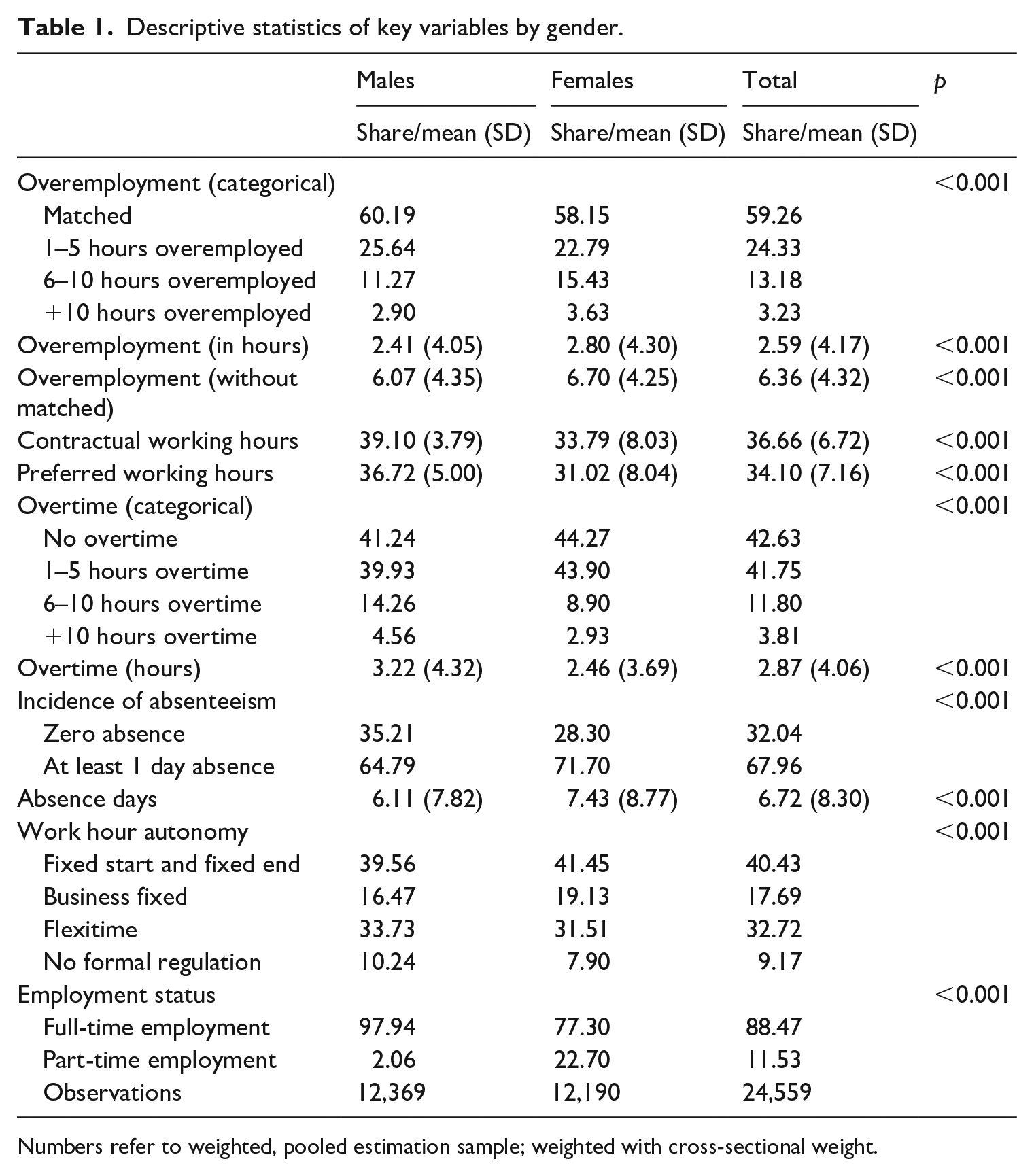
Numbers refer to weighted, pooled estimation sample; weighted with cross-sectional weight.
Table 2 shows the mean absences by the extent of overemployment. Initially, the average days of absence increase with the extent of overemployment for both genders, peaking at 6–10 hours of overemployment. These employees have on average 7.12 absence days for males and 8.64 for females. The mean difference between being matched and being overemployed 1–5 hours and 6–10 hours is significant for both genders. Notably, in both samples, the average number of absence days drops again, with overemployment +10 hours. Although no linear relationship can be assumed, the overall descriptive results suggest a relationship between overemployment and absenteeism (H1).
Absence days by overemployment categories.
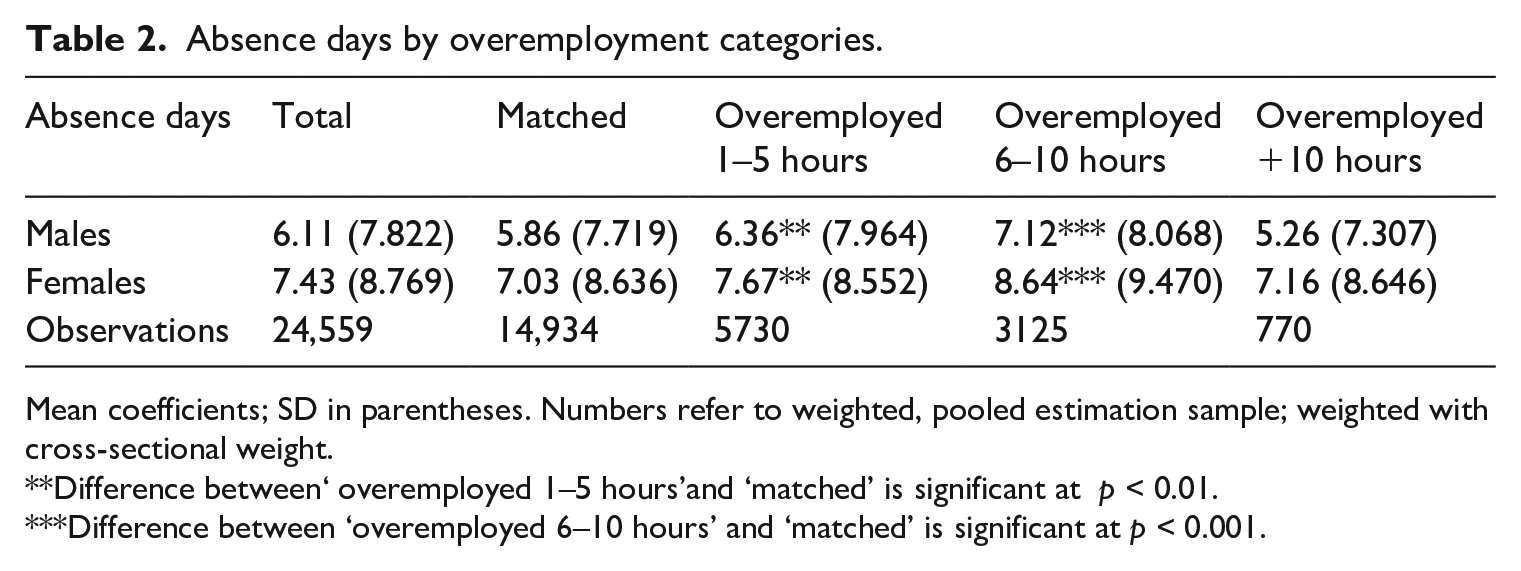
Mean coefficients; SD in parentheses. Numbers refer to weighted, pooled estimation sample; weighted with cross-sectional weight.
Difference between‘ overemployed 1–5 hours’and ‘matched’ is significant at p < 0.01.
Difference between ‘overemployed 6–10 hours’ and ‘matched’ is significant at p < 0.001.
Effect of contractual overemployment
Table 3 displays the negative binominal multilevel results, separated by gender. H1 specified that being overemployed relates positively to sickness absence. This hypothesis is supported in all models. Specifically, Model 1 shows that the absence day count increases by approximately 8% for males being 1–5 hours overemployed (IRR 3 = 1.077, SE = 0.038, p = 0.035, 95% CI = 1.005192–1.153898) and 24% for males 6–10 hours overemployed compared to matched males (IRR = 1.241, SE = 0.059, p = 0.000, 95% CI = 1.130488–1.362558). In the female sample (Model 3), the absence day count increases by approximately 11% for overemployed females (1 –5 hours) compared to matched females (IRR = 1.107, SE = 0.038, p = 0.003, 95% CI = 1.035017–1.183984) and about 17% for females with 6–10 hours overemployment compared to unconstrained females (IRR = 1.172, SE = 0.047, p = 0.000, 95% CI = 1.083254–1.267453). The effect of overemployment remains significant in the models with interaction terms (Model 2 and 4) only for the 6–10 hours overemployment category (males: IRR = 1.203, SE = 0.093, p = 0.016, 95% CI = 1.034714–1.399194; females: IRR = 1.200, SE = 0.079, p = 0.005, 95% CI = 1.055503–1.364114). However, according to the AIC and BIC, the model without interaction terms shows a better fit. Thus, H1 is supported.
Two-level negative binominal regression results – complete case analyses – main effects.
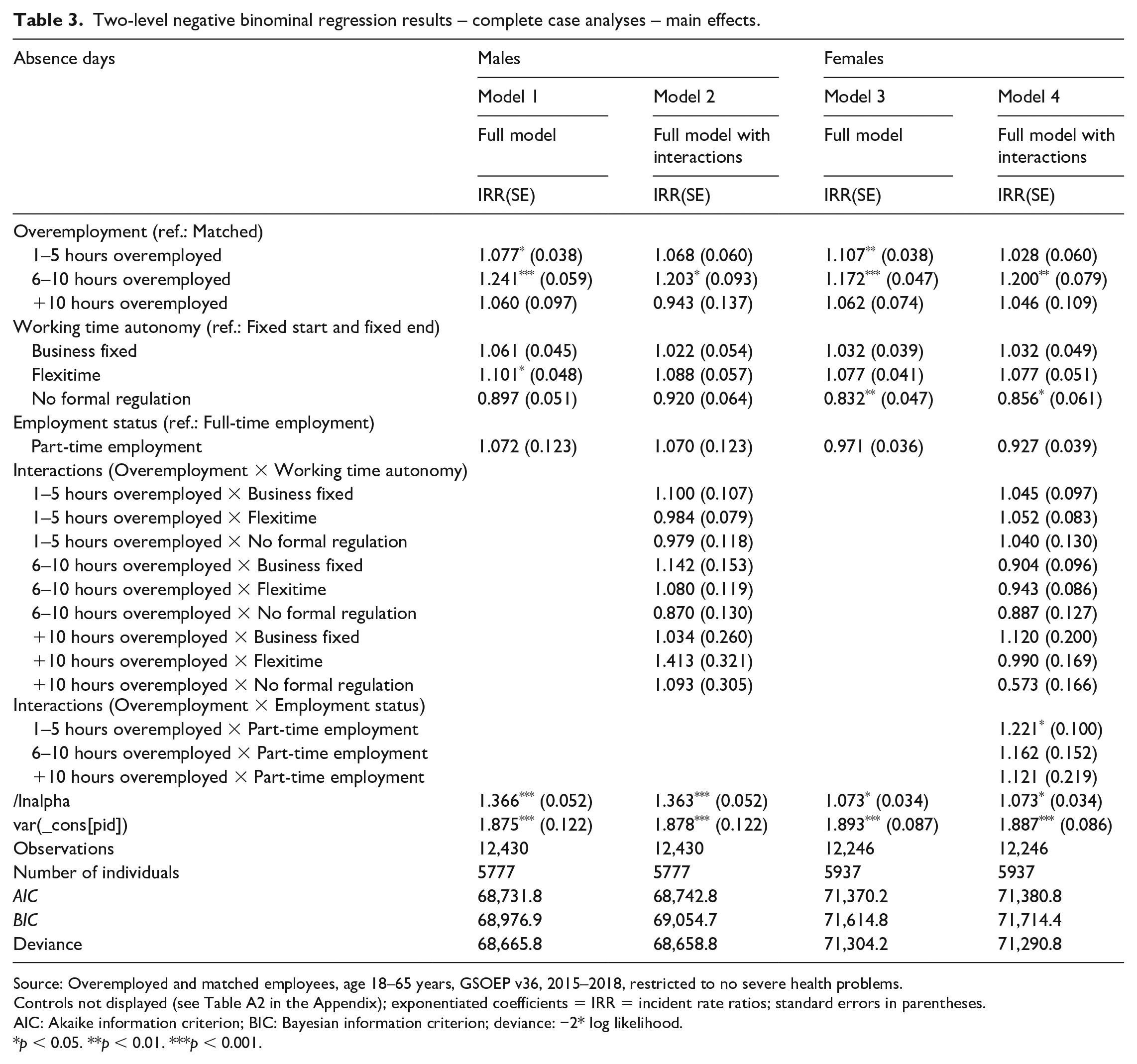
Source: Overemployed and matched employees, age 18–65 years, GSOEP v36, 2015–2018, restricted to no severe health problems.
Controls not displayed (see Table A2 in the Appendix); exponentiated coefficients = IRR = incident rate ratios; standard errors in parentheses.
AIC: Akaike information criterion; BIC: Bayesian information criterion; deviance: −2* log likelihood.
p < 0.05. **p < 0.01. ***p < 0.001.
Moderation effect of working time autonomy and employment status
H2 specified that a higher degree of working time autonomy will buffer the link between overemployment and sickness absence. As Models 2 and 4 show, the interaction between overemployment and working time autonomy is not significant; thus, H2 is not supported.
H3 predicted that the link between overemployment and absence would be stronger for part-time than for full-time workers. Indeed, part-time employment tends to amplify the link between overemployment and absenteeism. Thus, being overemployed 1–5 hours with concurrent part-time work is significant in the female sample (Model 4). Owing to the very low number of overemployed part-time working men, this interaction term could not be tested and has been omitted for males. H3 is therefore supported only for females.
Effects of remaining variables
For the other predictors, the following emerges. Working flexitime significantly increases the absence day count by approximately 10%, but for the males only (Model 1). In contrast, having ‘no formal regulation’ is associated with lower absenteeism and this is only significant in the female sample (Models 3 and 4). The days absent from work decrease significantly with overtime 6–10 hours (significant only for males) and with +10 hours (significant for both genders) and educational level (Table A2 in the Appendix). Sickness absence increases significantly with self-rated health status, no partner in household (significant for females), age of youngest child <7 years (significant for males), company size, civil servant status and survey year (Table A2 in the Appendix).
Robustness checks
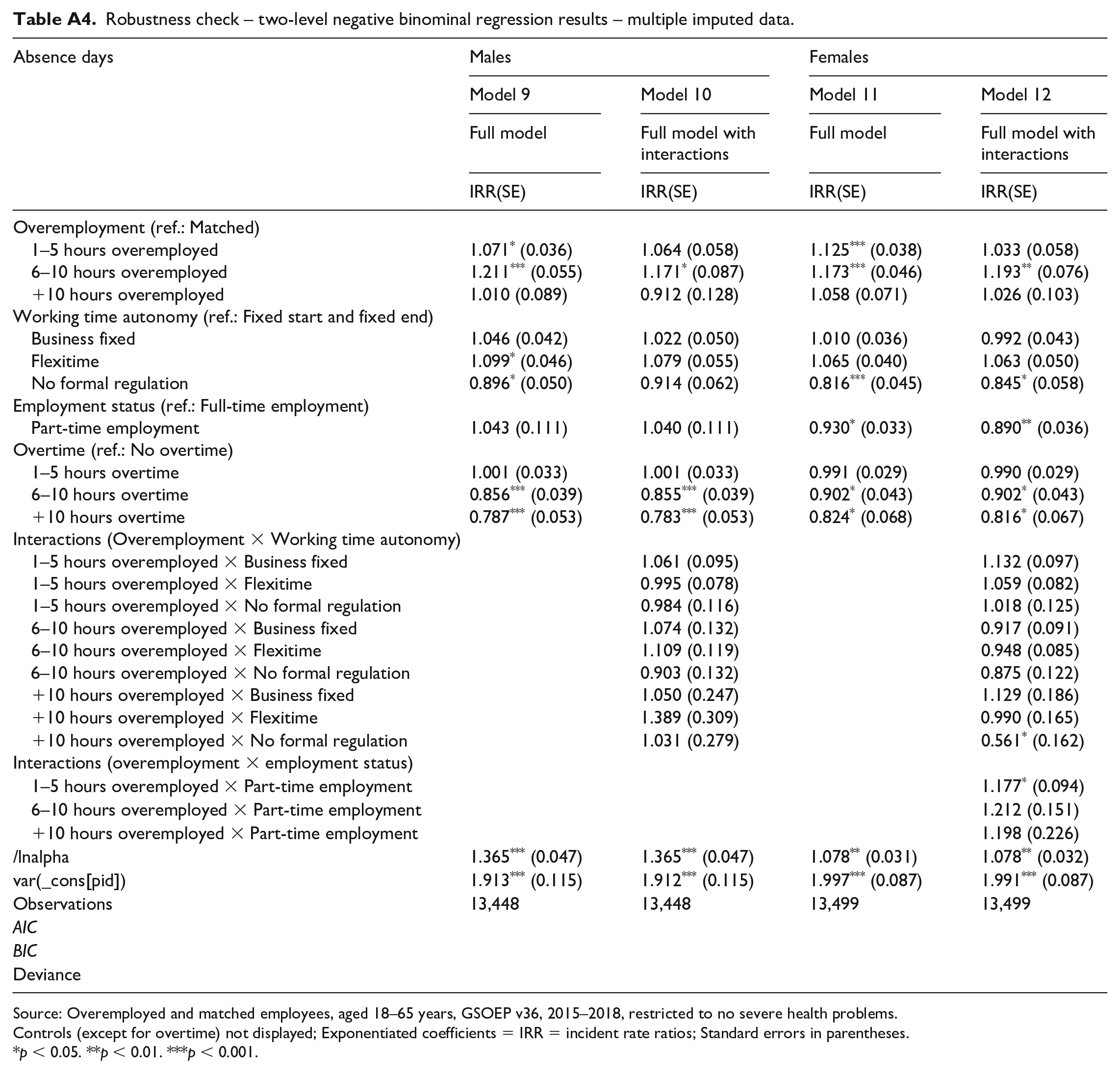
As robustness check, I additionally performed the analyses with individuals of any health status (Table A3, Models 5–8, Appendix) and with multiple imputed data (Table A4, Models 9–12, Appendix). The main effect of interest – the positive and significant link between overemployment (6–10 hours overemployment) and sick leave is confirmed in all models. Only the association between overemployment of 1-5 hours and absenteeism among men seems to be less stable (Model 5). However, overall the results are fairly robust and H1 is supported. Concerning the moderating role of working time autonomy, the robustness checks show isolated significant links between ‘flexitime x +10 hours overemployment’ and ‘no formal regulation x +10 hours overemployment’ and sickness absence (Models 6 and 12). However, there is predominantly also no significant moderation effect of working time autonomy; thus, H2 is rejected. In line with the main analyses, the significant moderating effect of part-time work among women with overemployment of 1–5 hours is confirmed in both models (Models 8 and 12). H3 is confirmed for females.
Discussion
While working time mismatches remain a highly relevant topic in German legislation, business practice, and in research (e.g. Frei and Grund, 2022; Girtz, 2021; Grund and Tilkes, 2023; Zimmert and Weber, 2021), they have been rather neglected in the empirical absenteeism research. Therefore, the aim of this study was to test the hypothesis of a positive relationship between contractual overemployment and sickness absence. Further, I tested the moderating role of working time autonomy and employment status on this relationship. I assumed that working time autonomy buffers the effect, while individual part-time status amplifies it.
In line with the JD-R model and Lee et al.’s (2015) findings, there is a positive significant effect of overemployment on paid sickness absence. Specifically, the results show that overemployment of 6–10 hours – compared to a work hour match – is positively significantly related to absence; this is true for both genders, and these results are fairly robust. The effect of being overemployed 1–5 hours compared to being matched is somewhat smaller and not quite as robust for males. This hints at a higher sensitivity among women towards overemployment. This can be interpreted against the background of gender role theory (Eagly, 1987), according to which women are still more involved in the family sphere. Owing to this strong involvement, even low overemployment could result in work-life conflicts and thus in stress and significantly longer sickness absences.
Regarding the (moderating) role of work hour autonomy, the following emerges: While only a very high degree of working time autonomy (‘no formal regulation’) reduces absenteeism (significant only for females) flexitime increases absenteeism (significant only for males). This result is surprising at first, but can be explained as follows. The likelihood that an employee has flexitime increases with the presence of a works council in the company (Zapf and Weber, 2017). The presence of a works council likely increases job security, which in turn reduces presenteeism or increase absenteeism. On the other hand, the likelihood of a working time arrangement with no formal regulation is higher when there is no works council and the employee holds a leadership position (Zapf and Weber, 2017). Shorter absences could then be explained by lower job security and a higher involvement owing to the leadership role. Even more important, however, working time autonomy does not buffer the link between overemployment and absenteeism regardless of gender. These results suggest that working time autonomy cannot always be considered a resource in the sense of the JD-R model, and is consistent with Conen’s (2022) findings. In the absenteeism research, the results on the buffer effect of working time autonomy are inconclusive, which could be due to the very different operationalisations of working time autonomy, or sample specifics. However, the present study’s findings are consistent with Kottwitz et al. (2018) as well as Nätti et al. (2015), showing that overemployment and working time autonomy are independently and partially counteractively related to absenteeism.
Employment status’s moderating role could only be tested for females, owing to very low numbers of overemployed part-time working males. The results in the female sample are in line with expectations and previous research (Van Emmerik and Sanders, 2005). Thus, the positive association between overemployment (1–5 hours) and absenteeism is significantly stronger for part-timers than for full-timers.
Further, there are interesting results among the controls. First, in line with previous research (Böckerman and Laukkanen, 2010) overtime is associated with less absenteeism (significant for both genders with +10 hours of overtime and for males with 6–10 hours of overtime). Thus, the relationship is negative and thus diametrically opposed to the link between contractual overemployment and absenteeism. This can be explained by the fact that employees who work overtime are also more likely to work sick (Böckerman and Laukkanen, 2010) to signal their productivity. Indeed, Frei and Grund (2020) showed that individuals’ career orientation is associated with more overtime hours. However, this argument should not apply to contractual overemployment. This result argues for decomposing actual overemployment into contractual overemployment and overtime, rather than mixing these two concepts, as has been done in most of the previous research.
Second, for women there is a positive link between ‘no partner in household’ and sickness absence. Against the background that about 25% of women (but only 8% of men) from ‘partner less’ households live together with children in a household (they are presumably single parents) (own calculations based on GSOEP v36, 2015–2019), this result seems plausible. Because single parents struggle to balance the demands of private and work life, which is likely to be very demanding and may lead to increased sickness absence.
Third, for men, there is a positive link between ‘youngest child <7 years in the household’ and sickness absence. For women, no corresponding significant link emerges. This result is in some ways surprising, since women usually have more childcare responsibilities and are thus exposed to stronger private demands, which in turn are expected to lead to longer sickness absences. However, my results also seem plausible from a gender role perspective if one assumes that men are still sanctioned more strongly by the work environment for taking on childcare duties owing to prevailing gender roles. By men calling in sick when a child is sick, a sanction can be avoided. Further, this result can also be explained by financial motives. Since men generally still contribute more to a household income than women, an absence due to a sick child would lead to higher wage deductions.
Fourth, there is a very strong and robust relationship between company size and absenteeism. This result is consistent with previous research (Dionne and Dostie, 2007; Laszlo and Lorenz, 2017; Mastekaasa, 2020) and can be explained by higher organisational commitment and employee involvement in smaller companies (Dionne and Dostie, 2007).
Theoretical contribution
The study findings contribute to the work hour mismatch and absenteeism literature in several ways: First, this is one of very few studies (Lee et al., 2015; Wang and Reid, 2015) to address the direct link between overemployment and absenteeism, and the very first to examine the direct link between contractual overemployment and sickness absence in the German context. This extends our understanding of the negative consequences of overemployment to the sickness absence aspect, which is very relevant not only from a scientific perspective, but also from an HR and a national economic perspective. Second, I contribute to the hitherto sparse body of research on the moderating roles of HR practices (part-time work and flexible working hours) in the context of working time mismatches (see e.g. De Moortel et al., 2018; Frei and Grund, 2022; Grund and Tilkes, 2023; Van Emmerik and Sanders, 2005; Wang, 2018). The results show that common and widespread HR practices are not able to buffer the negative consequences of overemployment, and may even intensify them. Third, this study extends the JD-R model to work hour mismatches by conceptualising overemployment as a job demand. The empirical research on work hour/status mismatches has to date predominantly referred to theories such as social exchange theory (Blau, 1986), discrepancy theory (Lawler, 1973; Locke, 1969), or labour supply theory (Brown and Sessions, 1996), which do not sufficiently consider the direction of mismatches and/or the strain aspect. However, these are important, because we already know that underemployment and overemployment have partly different consequences (Bell et al., 2012; De Moortel et al., 2018; Frei and Grund, 2022; Otterbach et al., 2021; Van Emmerik and Sanders, 2005), which points to the need for different underlying explanatory approaches. Further, especially regarding sickness-related absence, framing absence as the result of an exchange process is at the very least debatable. In this respect, this extension to the JD-R model allows us to understand the relationship between overemployment and sickness absence as a ‘health impairment process’. Finally, this study enhances our understanding of the overemployment concept. The results show that it may be worth decomposing actual overemployment into contractual overemployment and overtime, since these two concepts follow different logics and have partly different effects on sickness absence (see above). Further, it shows that contractual overemployment is not linearly related to absenteeism. For instance, I find that absenteeism peaks at overemployment of 6–10 hours, but declines again at +10 hours of overemployment (even below the level of overemployment 1–5 hours). This could be explained by a higher organisational commitment or career orientation with longer working hours, regardless of whether or not these are wanted. Not considering these aspects in the operationalisation of overemployment may explain conflicting results of previous studies (Lee et al., 2015; Wang and Reid, 2015).
Practical implications
The results illustrate, that organisations should pay more attention to employees’ working time preferences in order to minimise work hour mismatches and shorten costly sick leaves. Indeed, although the German Part-Time Work Act already provides instruments that enable employees to better realise their working time preferences, there are still work hour mismatches. In other words, the legal framework alone does not solve the problem of contractual overemployment. Companies could enable and promote preference-based contractual working hours instead of sticking to the standard full-time norm. This could be achieved by not exclusively advertising full-time positions. This signal of openness to preference-based work hours could encourage workers to disclose their preferences in the first place. This disclosure is crucial if one is to adjust contractual working hours to employees’ needs and not vice versa. To learn more about employees’ working time preferences, these could already be addressed in the recruitment interview and regularly in employee interviews; regularly because the occurrence of work hour mismatch pattern may vary with life stages (Schmidt et al., 2020) and because the resolution and creation of working time discrepancies are more closely associated with changes in preferred hours than changes in actual work hours (Reynolds and Aletraris, 2006). Thus, preferences may change. However, even if preferences are disclosed and there is organisational goodwill towards adjusting employees’ working hours, employee concerns or other operational barriers may prevent realisation. McDonald et al. (2006) for instance show that career concerns discourage female workers from pursuing their part-time preferences. It would be useful to identify such obstacles (e.g. through employee surveys) in order to then mitigate these through appropriate measures. For instance, career-related concerns could be allayed by role models. Further, the importance of preference-based contractual working hours as an instrument for reducing sickness absence is underlined by the fact that standard HR tools cannot mitigate the link between overemployment and sickness-related absenteeism or may even exacerbate it. After all, flexible working hours cannot counteract the link between overemployment and sickness-related absenteeism. Further, the interaction between overemployment and female part-time can actually increase sick leave. Thus, it is worth also consider the fit of working time volume in the context of part-time arrangements.
Limitations and future research
This study has limitations, which open fruitful avenues for future research. First, although the analyses are based on the GSOEP, a high-quality representative longitudinal dataset, the used data remains self-reported and the respondents are both the source of the exogenous and endogenous variables. This may lead to problems of common method variance (CMV) and endogeneity. To cure CMV, I applied common procedural design strategies (see e.g. Cooper et al., 2020): Temporal separation (overemployment was collected in t and absence data in t + 1) and psychological separation of measures (overemployment was not queried directly but calculated from preferred and actual working time; sickness absence as a health-related question and working time issues are positioned in different parts of the GSOEP). However, to rule out CMV, future research into sickness absence should also build on registry data. Further, the possibility of endogeneity owing to reversed causality cannot be ruled out with certainty. For instance, it could be that sick leave from the previous year increases the current overemployment level. Future research should therefore consider instrumental variable approaches to address this potential endogeneity problem. In addition to the general recall problem of self-reported data, there may be specific validity concerns relating to the preferred working hours or overemployment and absence data. Previous studies revealed that different datasets lead to different results regarding the extent of working time mismatches. There is some evidence that the nature and positioning of the question of the preferred working hours plays a crucial role here (Holst and Bringmann, 2017; Tobsch et al., 2018). Thus, it would be useful to replicate this study with a different national dataset. Further, regarding absences, notably, these data were not only self-reported but were also collected retrospectively. This time-lag could lead to incorrect recall, although Ferrie et al. (2005) findings suggest a fairly good match between retrospectively/self-reported and employers’ registry absence data. However, retrospectively collected GSOEP data lead to more missings, because unit-nonresponse in t + 1 leads to item-nonresponse in t. Against this background, too, I propose replicating this study with a registry dataset. Second, I focused on the direct relationship between overemployment and absenteeism, since I was interested in an HR perspective that allows for practical implications. The mediation process (the ‘health impairment process’) was not tested. Therefore, another worthwhile research project would be to examine the mediation processes between overemployment and absenteeism. In particular, it would be interesting to see whether the relationship is based on a ‘health impairment process’ or a ‘motivational process’ in the sense of the JD-R model. Third, the results refer to the context of German. Generalisability to other countries and cultures could be tested using a cross-national sample in a three-level design. Fourth, I could not control for whether there is a works council or whether the employee is a trade union member. Neither variable was part of the GSOEP in 2016–2018. However, since works councils for instance have a right of co-determination in working hours, I suggest considering this in future research on working hour mismatches. Finally, since to date we know little about workplace barriers to and enablers of preference-based contractual work hours, it may be worthwhile to explore them from the perspectives of HR, employee representatives and employees in a qualitative research design.
Footnotes
Appendix
Robustness check – two-level negative binominal regression results – multiple imputed data.
| Absence days | Males | Females | ||
|---|---|---|---|---|
| Model 9 | Model 10 | Model 11 | Model 12 | |
| Full model | Full model with interactions | Full model | Full model with interactions | |
| IRR(SE) | IRR(SE) | IRR(SE) | IRR(SE) | |
| Overemployment (ref.: Matched) | ||||
| 1–5 hours overemployed | 1.071 * (0.036) | 1.064 (0.058) | 1.125 *** (0.038) | 1.033 (0.058) |
| 6–10 hours overemployed | 1.211 *** (0.055) | 1.171 * (0.087) | 1.173 *** (0.046) | 1.193 ** (0.076) |
| +10 hours overemployed | 1.010 (0.089) | 0.912 (0.128) | 1.058 (0.071) | 1.026 (0.103) |
| Working time autonomy (ref.: Fixed start and fixed end) | ||||
| Business fixed | 1.046 (0.042) | 1.022 (0.050) | 1.010 (0.036) | 0.992 (0.043) |
| Flexitime | 1.099 * (0.046) | 1.079 (0.055) | 1.065 (0.040) | 1.063 (0.050) |
| No formal regulation | 0.896 * (0.050) | 0.914 (0.062) | 0.816 *** (0.045) | 0.845 * (0.058) |
| Employment status (ref.: Full-time employment) | ||||
| Part-time employment | 1.043 (0.111) | 1.040 (0.111) | 0.930 * (0.033) | 0.890 ** (0.036) |
| Overtime (ref.: No overtime) | ||||
| 1–5 hours overtime | 1.001 (0.033) | 1.001 (0.033) | 0.991 (0.029) | 0.990 (0.029) |
| 6–10 hours overtime | 0.856 *** (0.039) | 0.855 *** (0.039) | 0.902 * (0.043) | 0.902 * (0.043) |
| +10 hours overtime | 0.787 *** (0.053) | 0.783 *** (0.053) | 0.824 * (0.068) | 0.816 * (0.067) |
| Interactions (Overemployment × Working time autonomy) | ||||
| 1–5 hours overemployed × Business fixed | 1.061 (0.095) | 1.132 (0.097) | ||
| 1–5 hours overemployed × Flexitime | 0.995 (0.078) | 1.059 (0.082) | ||
| 1–5 hours overemployed × No formal regulation | 0.984 (0.116) | 1.018 (0.125) | ||
| 6–10 hours overemployed × Business fixed | 1.074 (0.132) | 0.917 (0.091) | ||
| 6–10 hours overemployed × Flexitime | 1.109 (0.119) | 0.948 (0.085) | ||
| 6–10 hours overemployed × No formal regulation | 0.903 (0.132) | 0.875 (0.122) | ||
| +10 hours overemployed × Business fixed | 1.050 (0.247) | 1.129 (0.186) | ||
| +10 hours overemployed × Flexitime | 1.389 (0.309) | 0.990 (0.165) | ||
| +10 hours overemployed × No formal regulation | 1.031 (0.279) | 0.561 * (0.162) | ||
| Interactions (overemployment × employment status) | ||||
| 1–5 hours overemployed × Part-time employment | 1.177 * (0.094) | |||
| 6–10 hours overemployed × Part-time employment | 1.212 (0.151) | |||
| +10 hours overemployed × Part-time employment | 1.198 (0.226) | |||
| /lnalpha | 1.365 *** (0.047) | 1.365 *** (0.047) | 1.078 ** (0.031) | 1.078 ** (0.032) |
| var(_cons[pid]) | 1.913 *** (0.115) | 1.912 *** (0.115) | 1.997 *** (0.087) | 1.991 *** (0.087) |
| Observations | 13,448 | 13,448 | 13,499 | 13,499 |
| AIC | ||||
| BIC | ||||
| Deviance | ||||
Source: Overemployed and matched employees, aged 18–65 years, GSOEP v36, 2015–2018, restricted to no severe health problems.
Controls (except for overtime) not displayed; Exponentiated coefficients = IRR = incident rate ratios; Standard errors in parentheses.
p < 0.05. **p < 0.01. ***p < 0.001.
Funding
The author(s) received no financial support for the research, authorship, and/or publication of this article.
