



Abstract
Using data from the German Socio-Economic Panel (SOEP), we analyse the incidence and worker-level consequences of on-call work, a work arrangement that allows employers to adjust their employees’ working times flexibly to the workload. We find that around 4%–5% of the workforce was employed in on-call work between 2014 and 2019. On-call workers are on average less educated, have lower tenure and more unemployment experience. They are also more often employed in marginal part-time jobs and smaller firms. On-call workers have a higher discrepancy between contractual and actual working hours and a higher probability of having no working hours stipulated in their contracts, which points towards less security regarding working hours and expected incomes. We also find evidence for lower wages and decreased subjective well-being along various dimensions but these results only apply to women and not to men.
JEL Classification:
J80, J28, J31
Introduction
In times of rapid digitalisation, globalisation, and structural change, it is frequently claimed that labour markets should allow for more flexibility in order to enable employers to better react to changing market conditions. In line with that, the shares of workers in regular full-time employment have decreased over the last decades whereas an upsurge of non-standard employment (e.g. fixed-term employment, temp work or part-time employment) is observable (e.g. OECD, 2019). For the European Union, Broughton et al. (2016b, 2016a) report that especially in the aftermath of the financial crisis, economic uncertainty has increased, which in turn comes along with more non-standard and insecure employment relationships. Relatedly, Mandl et al. (2015) and Mandl (2020) argue that some new and flexible forms of employment that have gained importance especially since around the year 2000 – although their effects on labour markets are very heterogeneous – partly lead to increased labour market segmentation and require more regulation and safety for employees.
On-call work is one type of non-standard employment that has received increasing attention in recent years (see, e.g. Biletta and Cerf, 2018 for the European Union). In the German case, on-call work refers to employment contracts, which allow employers to adjust their employees’ working times flexibly to the workload. 1 Such contracts usually include the amount of weekly working hours whereas they do not specify when the task is to be performed. In addition, the employer can exceed or fall short of the contractual working hours to some extent. Therefore, trade unions, for example, claim that on-call work often comes along with rather short contractual working hours and that actual working hours can considerably deviate from those specified in the working contract, which in turn leads to non-negligible income fluctuations and insecurity (e.g. Deutscher Gewerkschaftsbund, 2017). Hence, these types of working time arrangements allow employers to transfer substantial amounts of economic risk to their employees. The use of on-call work is further disclaimed by unions because of its potentially negative impact on workers’ economic situation and social security as well as on their social and family life due to highly restricted planning horizons (e.g. Deutscher Gewerkschaftsbund, 2016, 2017).
From the perspective of Human Resource Management, using flexible forms of employment such as on-call work can have several advantages (see, e.g. Fietze et al., 2014b; Tobsch et al., 2012): As mentioned above, on-call work allows employers to transfer economic risks to their employees. Moreover, if working times can be flexibly adjusted to the firm’s workload and demand, customers’ wishes and requirements can be satisfied more quickly, which in turn may increase their loyalty. It may further reduce costs, increase productivity, and improve a firm’s competitive position. On the other hand, if this kind of flexibility has detrimental effects on employees, such as lower satisfaction or increased stress levels, it may lead to higher fluctuation and more absence due to illness, which in turn induces additional costs for the firm. Hence, even though employers usually claim more flexible work arrangements (see, e.g. Absenger, 2019), the consequences can be ambiguous if employers demand too much flexibility from their employees.
Against this background, it is the aim of our paper to provide a comprehensive assessment of the incidence of on-call work in Germany. We further shed light on the consequences of on-call work in terms of working hours, compensation, and subjective well-being. So far, there is only a fistful of studies dealing with the impact of on-call work on workers (outlined in Section 2) and the evidence is ambiguous. Hence, more research is needed for a reliable assessment of on-call work. Besides our contribution to the scarce evidence about on-call work in particular, the insights of our study are also relevant for the literature on non-standard employment in general (e.g. Giesecke, 2009; Katz and Krueger, 2019) and the consequences of work schedule flexibility and instability (e.g. Henly and Lambert, 2014; Schneider and Harknett, 2019).
For our analyses, we use data from the German Socio-Economic Panel (SOEP), a yearly household panel survey comprising roughly 30,000 individuals living in 15,000 households. The data contain rich information on the respondents’ employment situation and family background, and from 2014 to 2019, on-call work can also be identified. Our results indicate that around 4% to 5% of the German workforce was employed in on-call work during that period. Descriptive evidence further shows that on-call workers are on average less educated, have lower tenure, have considerably more often experienced episodes of unemployment and are more likely to be employed in other forms of irregular work arrangements, especially in marginal part-time jobs. They are also more often found in smaller firms. Our results further indicate that on-call workers have a higher discrepancy between contractual and actual working hours and a higher probability of having no working hours stipulated in their contracts. We also find evidence for lower wages and decreased subjective well-being along various dimensions. The effect on wages and satisfaction appears to be driven by women, but not by men.
The paper is structured as follows: Some theoretical considerations and related empirical studies are outlined in Section 2. Section 3 describes the institutional background of on-call work in Germany and Section 4 presents the data and descriptive evidence. Sections 5 provides multivariate analyses of the consequences of on-call work for workers and Section 6 concludes.
Theoretical background and related literature
So far, the literature about on-call work has documented that this form of non-standard employment plays a non-negligible role in many countries, even though different legal frameworks and definitions make comparisons across countries difficult (see Biletta and Cerf, 2018 for a comprehensive discussion of this issue for the European Union). Former studies for Germany, for instance, report that approximately 5%–7% of all workers are employed in on-call jobs (e.g. Absenger, 2019; Absenger et al., 2014; Schult and Tobsch, 2012). For the Netherlands, Burri et al. (2018) report that the share of on-call workers increased by approximately one quarter from 2003 to 2016, lately amounting to around 7% of the working population. For New Zealand and Australia, Campbell (2018) finds that shares of on-call workers are recently rather stable, but comparably high in both countries amounting to 6% in New Zealand and roughly 14% in Australia.
With respect to the incidence among different groups of employers and employees, one would expect on-call work to be more prevalent among workers with a relatively weak position in the labour market or few market power and among firms that face relatively high fluctuations in demand. The extant empirical literature suggests that on-call work tends to be more likely among women, younger employees and lower educated individuals (see, e.g. Absenger, 2019 for Germany; Datta et al., 2019 for the UK; Burri et al., 2018 for the Netherlands; Campbell, 2018 for New Zealand and Australia; Henneberger et al., 2004 for Switzerland). On-call work further appears to be more common in smaller firms (e.g. Absenger, 2019; Schult and Tobsch, 2012 for Germany). Regarding sectoral affiliations, previous evidence suggests that on-call work is not concentrated in only a few sectors, but seems to be relatively widespread in many different sectors (e.g. Fietze et al., 2014b; Schult and Tobsch, 2012 for Germany).
Regarding the working hours of on-call workers compared to other employees, one could expect shorter contractual hours because – by construction – on-call work serves as flexibility buffer and by regulation (see Section 3 for more details), actual working hours can deviate from those specified in the working contract. Indeed, previous studies report that on-call workers are over-represented in marginal part-time jobs (e.g. Schult and Tobsch, 2012) and have shorter contractual working hours (Jaehrling and Kalina, 2020). 2 One can further assume that on-call workers are more likely to have contracts without stipulated working hours. Regarding actual working hours of on-call workers, one can hardly make any clear prediction (as this depends on the actual workload of the firm), but by construction, actual working hours can be expected to deviate more strongly from those specified in the working contract compared to workers without special working time arrangements.
Considering the effects of on-call work on individuals’ compensation (regular wages as well as bonus payments etc.), the theory of compensating wage differentials suggests that on-call workers should receive higher wages than workers in jobs with regular working time arrangements, ceteris paribus, because they need to be compensated for the higher flexibility required in such jobs. However, there are further reasons why wages might differ between on-call work and jobs without special working time arrangements, even for otherwise identical workers. Various studies highlight the role of firm-specific wage differentials due to monopsony power, collective wage bargaining, rent-sharing, or efficiency wages (e.g. Card et al., 2013; Hirsch and Mueller, 2020). If on-call work is, for example, more prevalent in firms without collective bargaining institutions (collective agreements, works councils) that pay overall lower wages to their employees, this will also result in lower wages in on-call jobs, even for identical workers. Another potential reason is that labour supply elasticities to firms might differ across workers, which in turn leads to variation in firms’ monopsony power (Manning, 2003). If on-call workers accept these kinds of jobs because they are less mobile, for example, and their labour supply to firms is therefore less elastic, firms will be able to pay lower wages to these workers. Hence, it is theoretically not clear in which direction wages in on-call work deviate from those in regular working time arrangements.
Empirical findings about the compensation of on-call workers render mixed results. De Graaf-Zijl (2012) finds evidence for compensating wage differentials for the Netherlands and Datta et al. (2019) state that wages and working hours of on-call workers in the UK are considerably lower compared to workers in regular employment. For Germany, Jaehrling and Kalina (2020) document a higher risk for low pay and consequently also a higher risk of poverty among on-call workers compared to regular workers. Henneberger et al. (2004) analyse on-call work in Switzerland and find no differences in wages between on-call workers and workers in regular employment. In their survey for the European Union, Biletta and Cerf (2018) report generally lower pay and less predictable income in on-call jobs.
Regarding the effects on non-monetary outcomes, it can be suspected that the high flexibility demanded from workers in on-call jobs (i.e. assigning work to employees on relatively short notice) may have detrimental effects on their well-being, including both physical health, which in turn may result in more days absent from work due to illness, and different dimensions of life satisfaction. According to the Work-Family-Border-Theory (Clark, 2000; for an overview see also Dettmers et al., 2016), on-call work may (partly) dissolve the border between work and family life or leisure. However, this boundary is important for employees to recover, which requires, inter alia, sufficient scope for planning leisure activities (Dettmers and Bamberg, 2013). Accordingly, extended availability and a potential or actual breach of this boundary have a negative impact. In addition, the blurring of family and professional obligations can lead to conflicts and increased stress levels. Therefore, it can be expected that on-call work is associated with lower levels of physical health and life satisfaction, including satisfaction with work, leisure, family life and health since all these dimensions are affected somehow and interrelated with each other. If on-call work further comes along with more (perceived) job insecurity, this might also have detrimental effects on life satisfaction (e.g. Griep et al., 2016).
Existing empirical evidence mainly finds that life satisfaction is lower in jobs that allow employers to adjust working times flexibly. In a cross-country study for 21 industrialised countries, Lyness et al. (2012) find that low levels of control regarding work schedules and working hours are associated with less job satisfaction and more work-family conflicts. Also, several studies for the US document negative impacts of increased work schedule flexibility. Henly and Lambert (2014) ascertain that unpredictable working times and hours in the US retail industry are associated with an increased probability of work-life conflicts. Schneider and Harknett (2019) show that instability in work schedules comes along with increased stress levels, worse sleep quality, and unhappiness. Dettmers et al. (2012, 2016) also document that flexible working hours are negatively associated with wellbeing and health issues. Mas and Pallais (2017) conduct a field experiment hiring employees for call centres in order to examine workers’ tastes for different working time arrangements. They find that applicants are reluctant in accepting jobs in which employers have discretion over working times so that they are willing to accept even 20% lower wages if they have full control over their working time schedules.
Previous studies further reveal that on-call workers are more likely to suffer from physical and mental illness because of the additional burdens and stress levels coming along with this type of work (see Absenger, 2019 for a short overview). Hence, one can expect that they are more often absent from work due to illness. Biletta and Cerf (2018) also report adverse working conditions in on-call jobs that may cause illness. The few previous studies dealing with the effects of on-call work on employees’ life satisfaction render mixed results. Whereas Henneberger et al. (2004) ascertain for Switzerland that on-call work does not come along with lower levels of satisfaction, Golden (2015) reports for the US that it is associated with greater work-family conflict. A case study for Germany by Bamberg et al. (2012) based on 31 observations in one single firm indicates that on-call work results in negative moods and decreased social and household activities. Finally, there is evidence showing that on-call workers are more likely to face lower levels of job security (Biletta and Cerf, 2018), which in turn may also induce lower levels of satisfaction and higher stress levels.
Institutional background
As stated above, on-call work (Arbeit auf Abruf) refers to jobs that allow employers to adjust their employees’ working times flexibly to the workload. Employer and employee usually agree upon a certain duration of working time, but without specifying when the work is to be performed. The main legal principles are regulated in the Part-Time and Fixed-Term Contracts Act (§12 TZBfG). 3 The law allows the employer to adjust the use of the labour force flexibly to the workload, for example, by allocating more staff (or working hours) to days with high customer numbers, even at short notice. In addition, the employer can exceed or fall short of the contractual working hours to some extent. One important difference to regular employment contracts is that employers are not fully obliged to pay their workers in case of underutilisation. Hence, on-call work enables employers to pass parts of the entrepreneurial risk to employees by adjusting working times and, hence, salaries accordingly.
Despite the increased flexibility coming along with on-call work for employers, German law provides a certain amount of security to employees. Until 2019, Jurisprudence (Federal Labour Court, BAG 5 AZR 535/04) claimed that actual working hours should not exceed (undercut) those specified in the working contract by more than 25% (20%). Since January 2019, this is also regulated by law. If weekly working hours are not stipulated in the employment contract (or a respective collective bargaining agreement, see below), 20 hours are assumed by law since January 2019. Before 2019, 10 hours were assumed. 4 In addition, employers must be careful not to fragment working hours too much. If there is no separate agreement, work must be taken up for at least 3 consecutive hours. Another protective regulation is that employees are formally obliged to show up for work only if the employer notifies them no later than 4 days in advance. However, it seems plausible that on-call workers mostly agree to show up for work, even at shorter periods of notice than specified by law or in collective agreements.
The regulations of on-call work are also embedded in the German system of industrial relations. 5 More specifically, this means that first, it is possible to deviate from the rules of the law within a collective agreement. This applies to the assumption of a weekly working time of 20 hours when there are no hours stipulated in the contract and the advance notice period of 4 days. In general, such deviations may even be to the disadvantage of the employees. Second, if a firm has a works council the employer must also inform the works council of his plans to introduce on-call work and consult with it on that matter. The Works Constitution Act (§87 BetrVG) states that works councils have a right of co-determination on the fundamental question of whether on-call work shall be introduced at the workplace or not. If the employer and the works council do not agree on the matter, a conciliation board can be called in to reach a compromise. However, the works council has no such rights in the drafting of individual contracts between the employer and employees once on-call work is generally introduced at the workplace. 6
Data and descriptive evidence
The German Socio-Economic Panel (SOEP) is a household panel survey that is conducted on a yearly basis since 1984. By now, the SOEP comprises roughly 30,000 individuals living in about 15,000 households. Its central questionnaires, the household and the individual questionnaire, are to be answered by all adult members of a household. The data contain rich information on the respondents and their families including employment histories, income, socio-demographics, and individual preferences and values. Because information on on-call work is included in the SOEP from 2014 to 2019, we use the corresponding waves in our empirical analysis. 7
To identify individuals working within special time arrangements, in each of the mentioned six waves, the SOEP asks the following question to all employed respondents: ‘Gehören zu Ihrer Arbeitszeitregelung besondere Formen wie Bereitschaftsdienst, Arbeit in Rufbereitschaft oder Arbeit auf Abruf?’. 8 The two items ‘Rufbereitschaft’ and ‘Bereitschaftsdienst’ refer to agreements upon working hours in addition to regular working times where the working task is generally accomplished within a fixed time frame. These additional time windows are, firstly, clearly defined (usually limited to a very short period like a weekend) and, secondly, often remunerated in addition to the regular wage. Thereby, the former two types of special work time arrangements differ substantially from ‘Arbeit auf Abruf’ (on-call work), which is considered in this paper. To identify on-call workers, we focus on individuals who state to be in on-call work (‘Arbeit auf Abruf’). The German term precisely reflects on-call work in that employment contracts do not specify when exactly the working task is to be accomplished.
All three types of special work time arrangements imply that employees can be demanded to take up work at more or less short notice. In principle, there may be jobs combining multiple special working time arrangements. Therefore, the SOEP allows individuals to indicate working in more than just one of the above-mentioned types of arrangements. In our main analysis, we consider everyone confirming his/her work time regulation to include ‘Arbeit auf Abruf’ to be an on-call worker. Observing individuals with multiple types of arrangements may cast doubt on whether these individuals are sure about the exact type of their working time arrangement. To rule out that such imprecisions affect the results of our main analysis, we run robustness tests with a narrower definition of on-call work including only those individuals that exclusively indicate ‘Arbeit auf Abruf’ to be part of their working time arrangement. In doing so, the number of observations in on-call work reduces by around 26%. This, however, does not affect the main insights of our study.
To get an impression about the recent incidence of on-call work in Germany, Figure 1 shows the share of on-call workers in all dependent employees from 2014 to 2019. It can be seen that about 4%–5% of workers were employed in on-call jobs in our period of observation, which is a non-negligible part of the German workforce. The incidence of on-call work appears to be slightly decreasing in recent years, though.
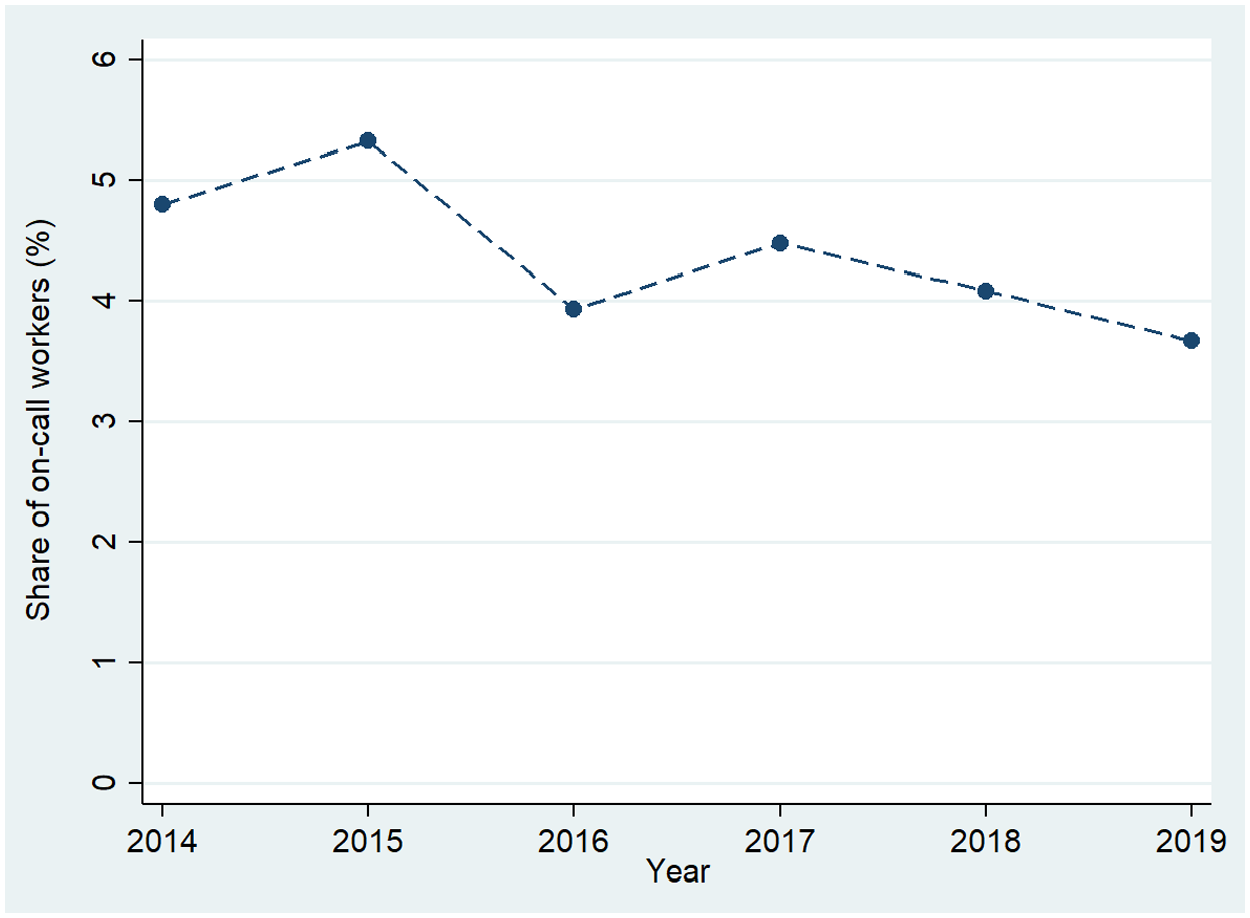
Share of on-call workers in all dependent employees over time.
In the empirical analysis, we compare on-call workers to all employed individuals who indicate that their contract does not contain any special working time arrangement (i.e. on-call service, emergency service or standby duty). As we do not want to consider working conditions in vocational training and jobs alongside school or university, we exclude from our sample all individuals that are currently in education or training. Our sample includes full-time as well as part-time and marginally employed individuals. Thus, it should be noted that the control group contains individuals without special work time arrangements as mentioned above but with non-standard employment contracts. The reason why we did not exclude these workers from the control group is that we are interested in the effect of on-call work and do not want to mix it up with the effects of other alternative work arrangements. In order not to lose a significant number of observations due to item non-response, we introduce dummies capturing missings on all of our control variables. This leaves us with a final sample containing 3428 observations in on-call work and 65,446 in jobs without any special working time arrangement. 9 Tables 1 and 2 show pooled weighted means of individual and job characteristics over the SOEP waves 2014–2019. 10
Worker characteristics (means).
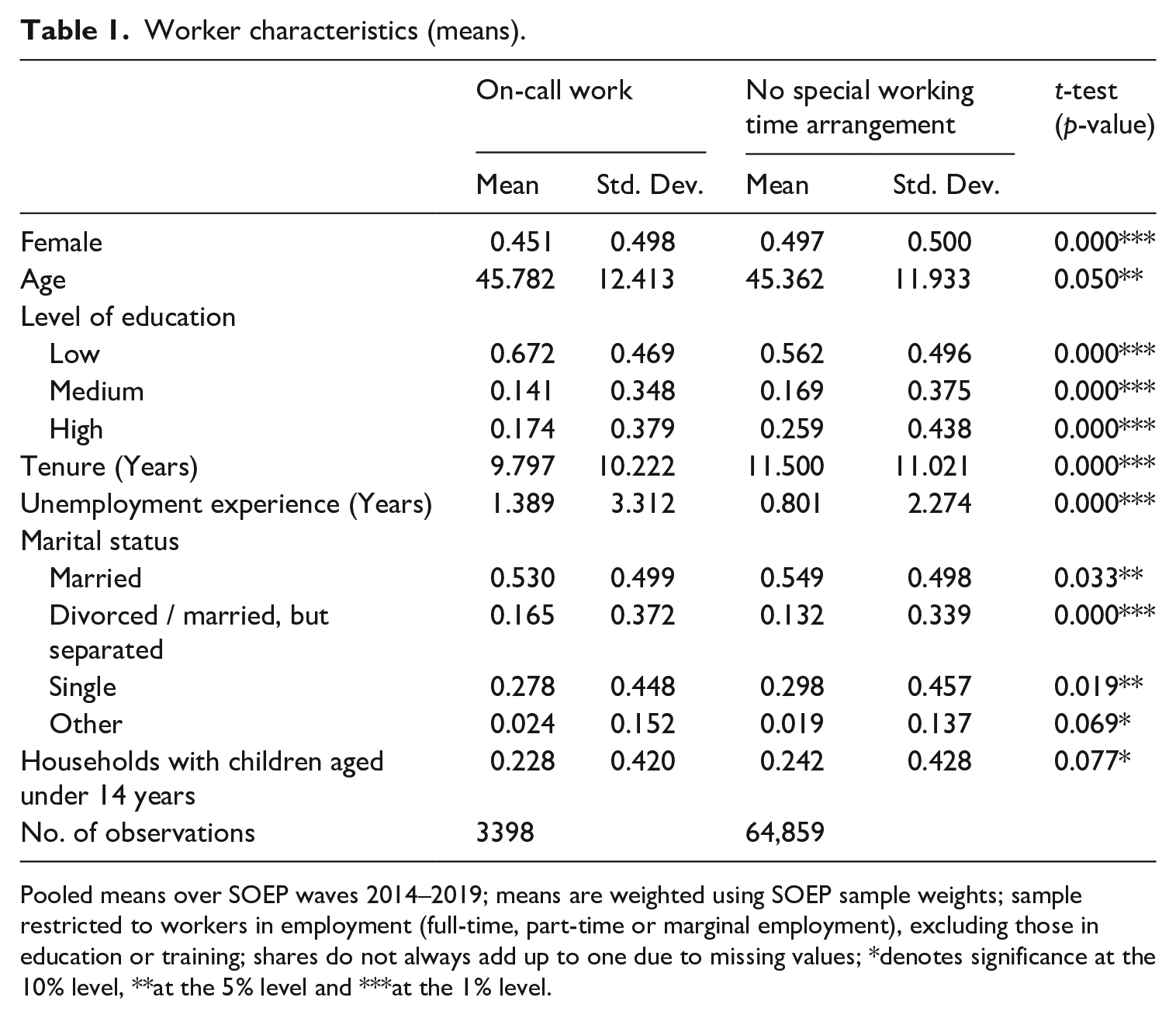
Pooled means over SOEP waves 2014–2019; means are weighted using SOEP sample weights; sample restricted to workers in employment (full-time, part-time or marginal employment), excluding those in education or training; shares do not always add up to one due to missing values; *denotes significance at the 10% level, **at the 5% level and ***at the 1% level.
Job and employer characteristics (means).
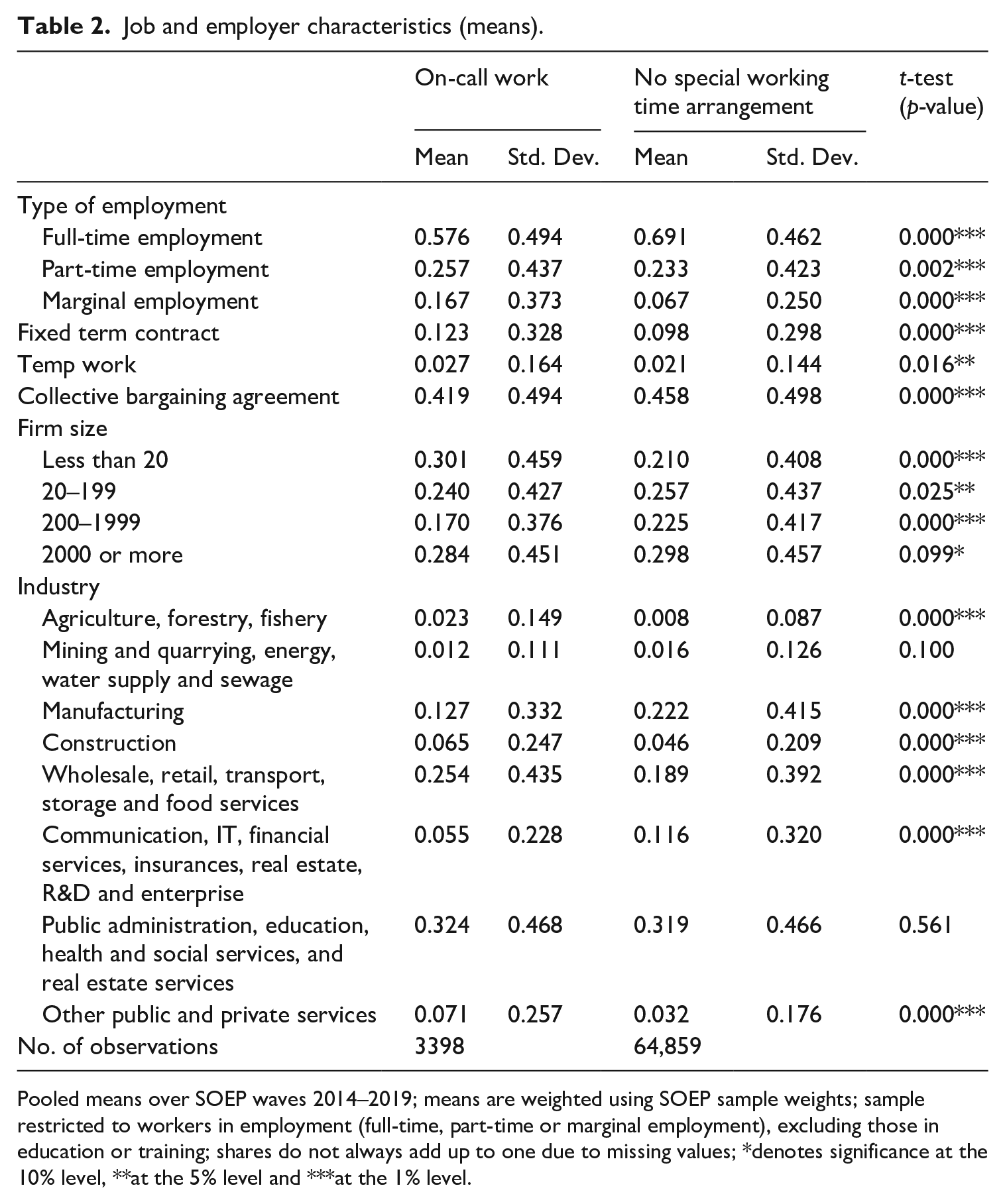
Pooled means over SOEP waves 2014–2019; means are weighted using SOEP sample weights; sample restricted to workers in employment (full-time, part-time or marginal employment), excluding those in education or training; shares do not always add up to one due to missing values; *denotes significance at the 10% level, **at the 5% level and ***at the 1% level.
The numbers in Table 1 indicate that on-call workers are on average less educated, have lower tenure and more unemployment experience than workers whose contracts do not contain special working time arrangements.
Table 2 shows means of job and employer characteristics for on-call workers and the comparison group. It can be seen that on-call workers are less likely to be employed in full-time jobs and more likely to be in part-time and especially marginal employment. They face fixed-term and temporary work more often and are less likely to be remunerated according to collective bargaining agreements. Furthermore, on-call workers are more frequently employed in small firms and the ‘wholesale, retail, transport, storage and food services’ sector. They are considerably less often found in the ‘manufacturing’ sector. 11
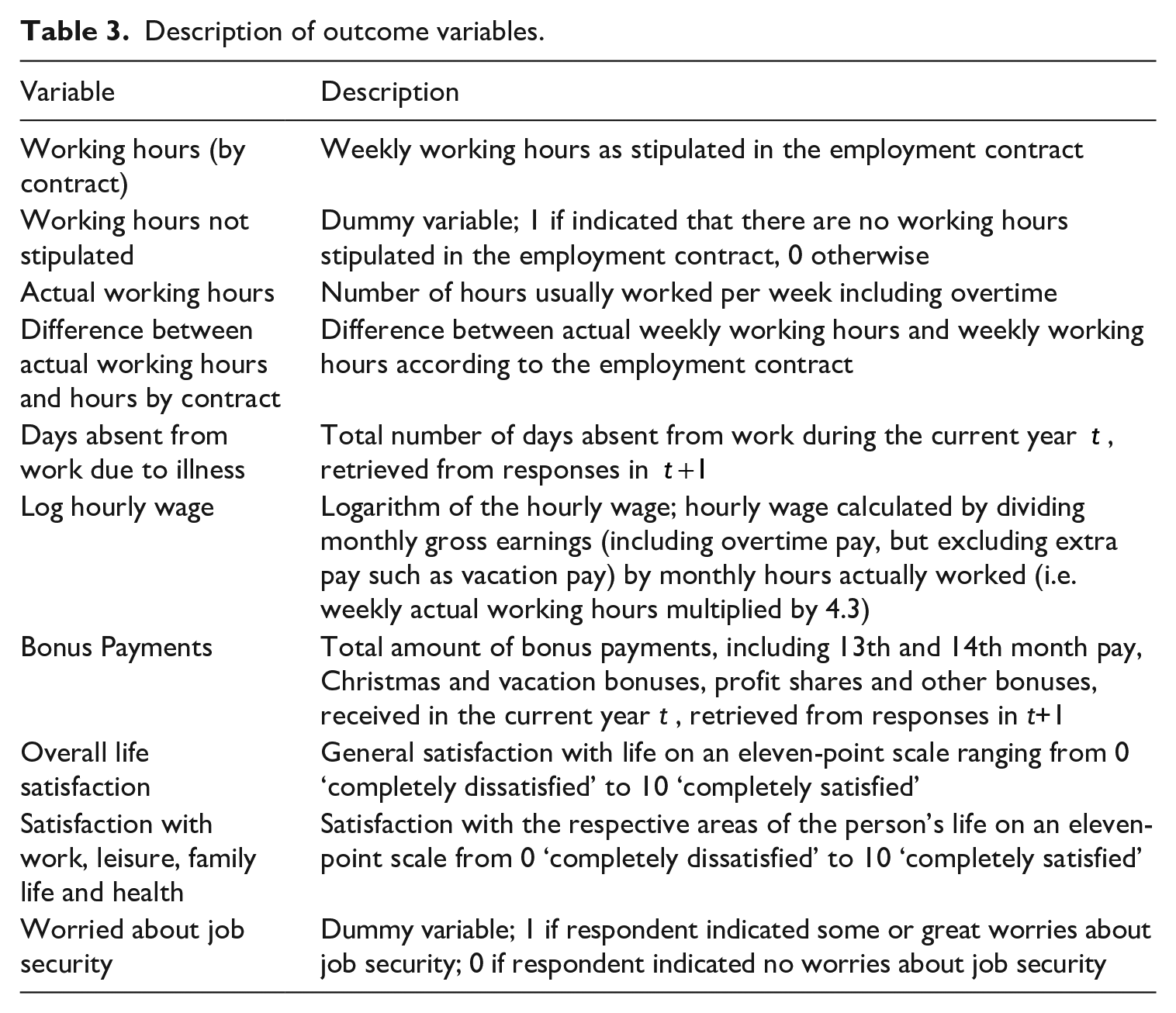
As this paper sheds light on the relationship between on-call work and labour market outcomes, affected workers’ overall life satisfaction and other domains of satisfaction and perceived job security, Table 3 provides an overview of these variables including short descriptions. Regarding working time, we consider three different measures: Contracted weekly working hours, a dummy variable for contracts without a specification of the number of working hours, and hours actually worked per week (including overtime). Moreover, we consider the discrepancy between actual and contractual working hours. 12 To see if on-call work has health effects displayed via absenteeism, we also consider days absent from work due to illness in our empirical analysis. We further investigate differences in pay. First, we check whether on-call workers receive higher (or lower) wages than workers in the comparison group. Hourly wages are calculated by dividing monthly gross earnings by actual monthly working hours. 13 Second, we also look at bonus payments (i.e. 13th and 14th month pay, Christmas and vacation bonuses, profit shares and other bonuses). As subjective outcomes we consider overall life satisfaction as well as satisfaction with work, leisure, family life and health. The different dimensions of satisfaction are measured on an eleven-point scale from 0 ‘very dissatisfied’ to 10 ‘very satisfied’. Furthermore, we check if on-call workers are more likely to be worried about their job security. To do this, we construct a dummy variable which takes on the value 1 if a respondent has stated to have some or great worries regarding the own job’s security.
Description of outcome variables.
The means of these outcomes for on-call workers and the comparison group are depicted in Table 4. According to their contract, on-call workers work only around 1.5 hours less per week than workers without special working time arrangements. However, the share of on-call workers without contractually stipulated working hours is more than three times that of workers in the comparison group. The difference in the number of hours actually worked amounts to less than an hour, indicating that on-call work does not come along with a much lower working time, but may be associated with less certainty regarding the actual number of hours worked. The latter is also reflected in the discrepancy between actual and contractual working hours, which is approximately 2 hours per week higher for on-call workers than for the comparison group. 14 The difference in absenteeism, indicating that on-call workers are on sick leave about 1 day more per year than workers in the control group, is statistically insignificant. Means of log hourly wages indicate that on-call workers have approximately 20% lower wages than workers without special working time regulations. The amount of bonus payments received per year is about 800 € less for on-call workers. Regarding the satisfaction measures, the figures in Table 4 suggest that on-call workers are less satisfied than workers in the comparison group on all dimensions. Furthermore, our descriptive statistics suggest that on-call workers are more likely to be worried about their job security.
Dependent variables (means).
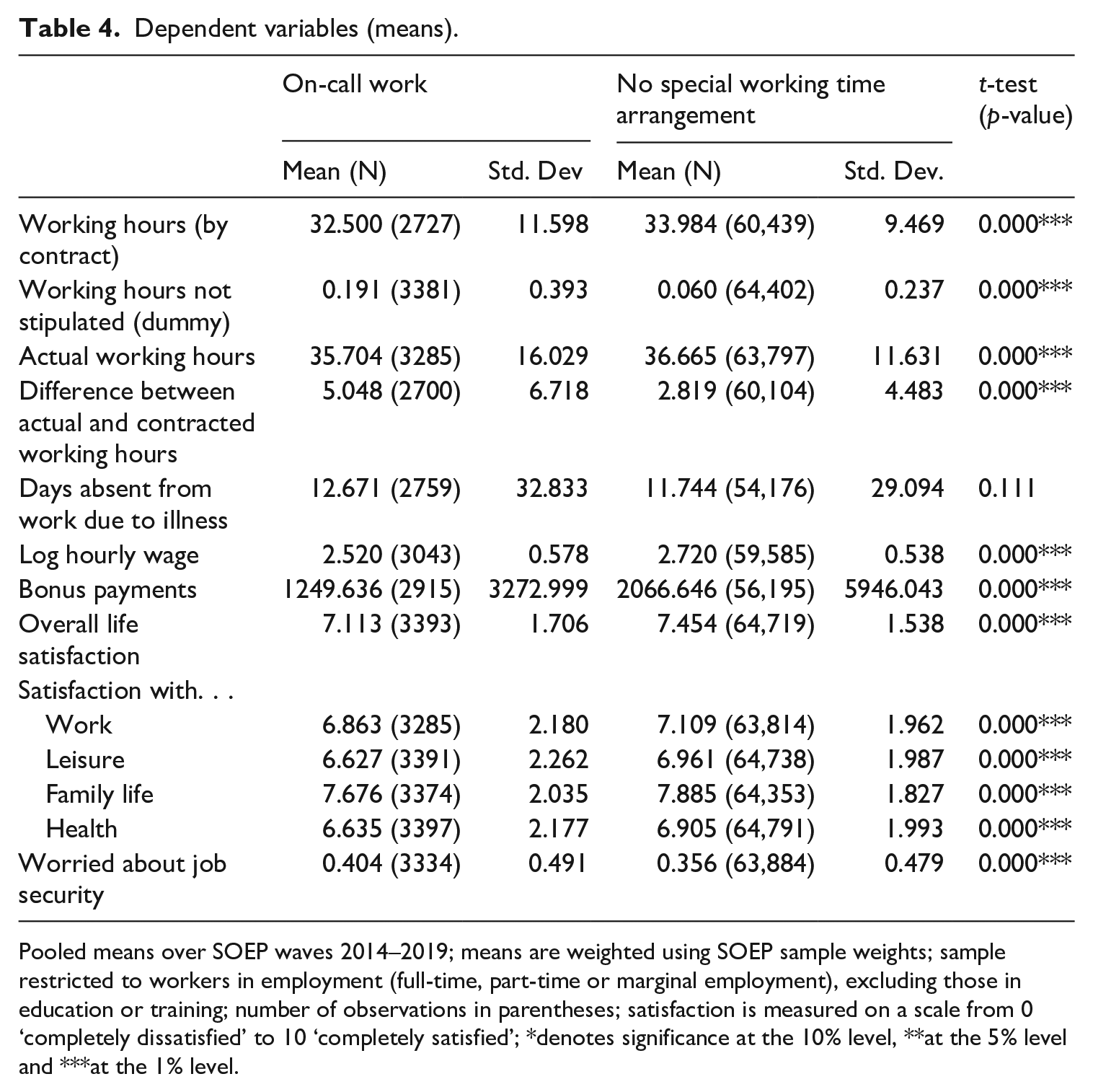
Pooled means over SOEP waves 2014–2019; means are weighted using SOEP sample weights; sample restricted to workers in employment (full-time, part-time or marginal employment), excluding those in education or training; number of observations in parentheses; satisfaction is measured on a scale from 0 ‘completely dissatisfied’ to 10 ‘completely satisfied’; *denotes significance at the 10% level, **at the 5% level and ***at the 1% level.
Econometric analysis
To analyse the consequences of on-call work on the affected workers’ working hours, absence from work, pay, and subjective well-being, we estimate linear fixed-effects models of the dependent variables described in Table 3. 15 These models can be represented by

where
In our worker-fixed effects framework, identification of our coefficient of interest
Our results are displayed in Tables 5 and 6, where we report our estimates of the coefficient of interest
Relationship between on-call work and different labour-market outcomes, fixed effects linear regressions.
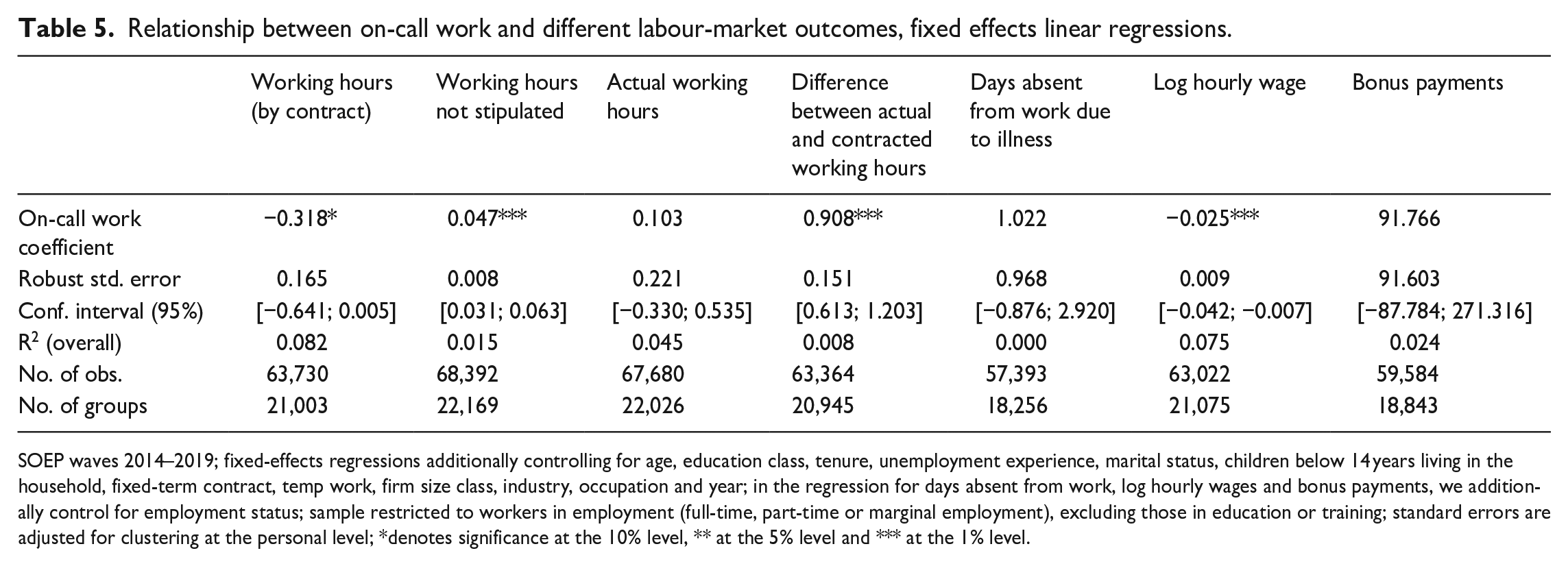
SOEP waves 2014–2019; fixed-effects regressions additionally controlling for age, education class, tenure, unemployment experience, marital status, children below 14 years living in the household, fixed-term contract, temp work, firm size class, industry, occupation and year; in the regression for days absent from work, log hourly wages and bonus payments, we additionally control for employment status; sample restricted to workers in employment (full-time, part-time or marginal employment), excluding those in education or training; standard errors are adjusted for clustering at the personal level; *denotes significance at the 10% level, ** at the 5% level and *** at the 1% level.
Relationship between on-call work and subjective well-being, fixed effects linear regressions.
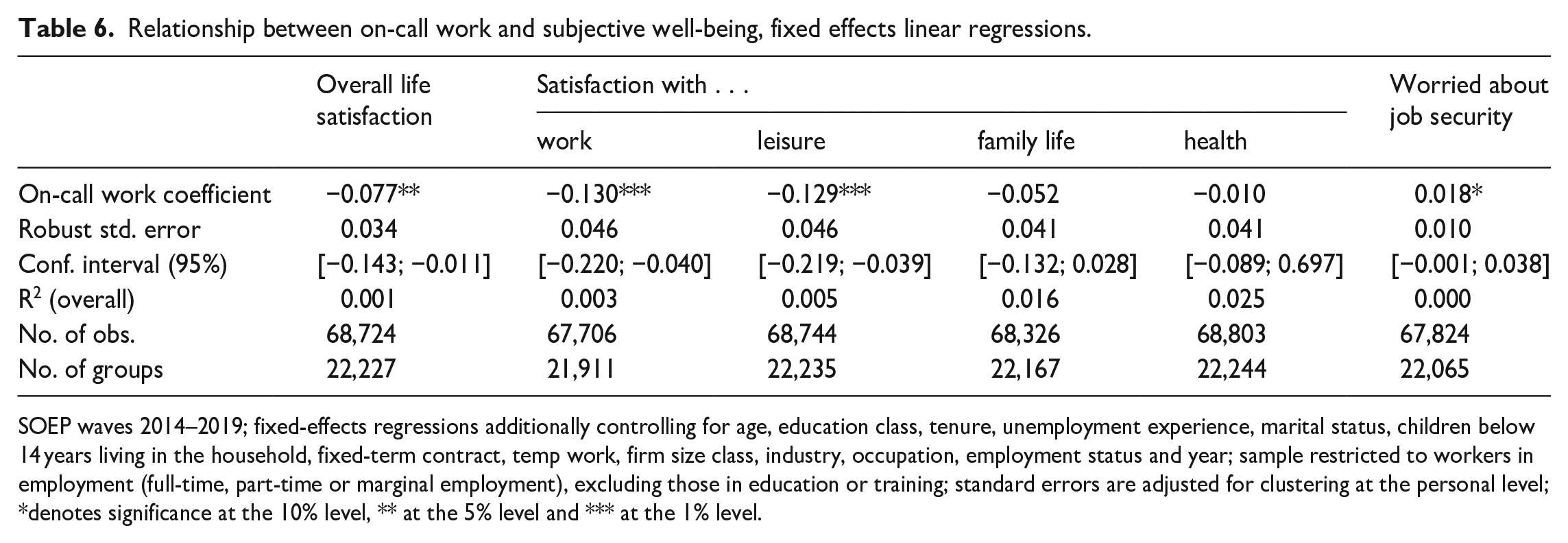
SOEP waves 2014–2019; fixed-effects regressions additionally controlling for age, education class, tenure, unemployment experience, marital status, children below 14 years living in the household, fixed-term contract, temp work, firm size class, industry, occupation, employment status and year; sample restricted to workers in employment (full-time, part-time or marginal employment), excluding those in education or training; standard errors are adjusted for clustering at the personal level; *denotes significance at the 10% level, ** at the 5% level and *** at the 1% level.
Table 6 shows results for different dimensions of subjective well-being. The figures reveal that on-call work is associated with lower levels of overall life satisfaction. Also, satisfaction with work and leisure is significantly reduced when a worker enters an on-call arrangement. For satisfaction with family life and satisfaction with health, we do not find a statistically significant effect of on-call work. Together with the insignificant effect of on-call work on absenteeism, the latter finding points towards the absence of strongly negative health consequences of on-call work. Finally, workers tend to be more worried about their own job security when they are in an on-call arrangement as compared to no special time arrangement.
In order to investigate potential channels behind the significant effects on life, work and leisure satisfaction, we run various regressions with additional control variables (results are available on request). To assess whether the negative effects of on-call work on subjective well-being are due to potentially lower earnings in on-call jobs, we include real gross monthly earnings as an additional control variable in these regressions. This causes the effect of on-call work on overall life satisfaction to be no longer statistically significant, suggesting that lower earnings may be an important channel through which on-call work affects overall life satisfaction. The effect of on-call work on work and leisure satisfaction also turns out to be smaller when gross monthly earnings are included, but remains significantly negative in both cases. Lower life, work and leisure satisfaction might also occur due to the larger discrepancy between contractual and actual working hours and, hence, the increased temporal flexibility demanded in these jobs. We take this into account by running our regressions additionally controlling for actual working hours and the dummy for no fixed contractual working hours or the discrepancy between actual and contractual working hours, respectively. The inclusion of these additional controls leaves our results largely unchanged. Again, the magnitude of the coefficient of interest is slightly lower in our regressions of life, work and leisure satisfaction. Yet, the coefficient continues to be significantly different from zero in all three cases. Thus, the negative effects of on-call work on overall life satisfaction may be attributed primarily to changes in monthly earnings, whereas the negative effect on work and leisure satisfaction can neither be explained by differences in income nor working hours. Hence, other characteristics of on-call jobs that are not captured in our data, such as the insecurity about when exactly the work will be demanded and the restricted planning horizons, likely drive these findings. At the same time, we cannot rule out that further unobserved factors that we are not able to control for matter as well.
To test the robustness of our results, we have estimated our models using alternative sample restrictions and outcome variables (results are available on request). First, we have run all our regression analyses excluding observations from the survey year 2019 in order to check if the regulatory changes mentioned in Section 3 significantly affected our results. Since those changes were mostly related to working hours one might primarily expect to see some changes in the link between on-call work and hours of work. In fact, we find that when observations from 2019 are excluded, the reduction in contracted working hours upon entering on-call work is no more significant. All other results, however, stay in line with our previous findings. Only the significance of the earlier found negative coefficients in the regressions of log hourly wages and work satisfaction have been reduced from the 1% to the 5% level. Second, we have calculated an alternative measure of log hourly wages using monthly hours worked according to the employment contract instead of actual monthly working hours. This measure does not appear to be significantly affected by on-call work. When overtime is not considered, wages thus do not appear to decline upon entry into on-call work. Third, we use the above-mentioned alternative indicator for on-call work, which is only one for workers who exclusively indicate this type of special working time arrangement. With the exception of actual working hours, all outcome variables are again affected in the same direction as the results from our baseline models suggest. Actual working hours are now shown to decrease upon entry into on-call work, but this effect remains statistically insignificant. Fourth, we check whether variation in the size and composition of the samples underlying each regression have an undue effect on our results. To do this, we have run our analyses on a sample of employed workers with non-missing information on all variables included in the regressions (except for contracted working hours and the difference between actual and contracted working hours) 20 . This enables us to look at the same sample for all outcomes except for the mentioned two. The sample restriction implies a relatively large reduction of our sample size (by up to 17,132 observations). Therefore, it is not very surprising to find a reduction in the statistical significance of some of our earlier results. Yet, for most of our coefficients of interest directions remain unchanged and their magnitudes are only slightly affected. Finally, we consider heterogeneous effects by age and gender. For workers aged above and below 35, point estimates indicate similar results, even though the statistical significance of several coefficients declines. When checking for gender differences, we find that men do not experience significant wage drops and declines in satisfaction with life or any of its domains when entering on-call work. For women, all results are in line with our previous results, the only exceptions being that contracted working hours as well as worries about job security are now only insignificantly affected by on-call work (see Tables A1 and A2 in the online appendix). These gender differences may be explained by women selecting themselves into firms, industries or occupations, that penalise on-call workers in terms of pay because of a smaller relevance of collective bargaining institutions. Similarly, switching to an on-call work arrangement may be associated with a stronger decrease in labour supply elasticities for women than for men, causing wage penalties for women. These wage drops may also be the main drivers of decreases in satisfaction with life, work and leisure. At the same time, lower wages may shield women from fearing a job loss. This does not apply to men, for whom no wage penalty for on-call work appears to exist. Therefore, men working in on-call arrangements may perceive their employer’s obvious need for flexibility at equal wages as a threat to their job security.
Conclusion
Over the last decades, a trend towards non-standard employment was visible in many developed economies. Such work arrangements are beneficial for employers as they allow for more flexibility, thus facilitating quicker reactions to changing market conditions. However, it raises concerns about detrimental effects on individuals employed in these types of jobs because the higher level of flexibility might come along with increased insecurity. Against this background, this paper has provided new evidence on the incidence and consequences of on-call work – one particular type of alternative flexible working time arrangement that has recently attracted increased attention – in Germany.
We find that around 4 to 5% of the German workforce was employed in on-call work between 2014 and 2019. On-call workers are on average less educated, have lower tenure, have considerably more often experienced episodes of unemployment and are more likely to be employed in other forms of irregular work arrangements, especially marginal part-time jobs. They are also more often found in smaller firms. As hypothesised based on its intended increase in employer flexibility, our results show that on-call work comes along with an increased probability to have no working hours stipulated in the contract. It also increases the difference between actual and contractual working hours. This suggests that on-call work is associated with less security regarding actual hours worked and thereby with the threat of potentially lower incomes. Similar to Datta et al. (2019), we find that wages in on-call jobs are significantly lower than wages received in regular working time arrangements, at least for women. This might indicate that there are wage penalties coming along with on-call work, which contradict the idea of a dominance of compensating wage differentials in response to the greater flexibility demanded from on-call workers. Instead, they might be explained by on-call workers being less likely to be covered by collective bargaining agreements, which is also confirmed by our descriptive statistics. Similarly, differential labour supply elasticities in presence of monopsonistic firms as well as efficiency wages may drive the result. However, it must be acknowledged that other time-varying unobservable factors that we are not able to control for might affect our results. If, for example, there is less scope for rent-sharing due to lower profits in firms that frequently employ on-call work arrangements, the ‘true’ effect of on-call work on wages might be overestimated in its magnitude. That said, our results show that on-call work comes along with negative monetary effects in terms of lower hourly wage rates and larger insecurity about actual working hours and, hence, expected income. The potentially detrimental effect of this insecurity (e.g. Griep et al., 2016) is also reflected in the considerably lower subjective well-being of (female) on-call workers and greater perceived job insecurity (among male workers), which is in line with the extant literature on the non-monetary impacts of on-call work (see Bamberg et al., 2012; Henly and Lambert, 2014; Lyness et al., 2012). Lower life, work and leisure satisfaction among women may be the outcome of the earlier hypothesised blurred line between work and leisure. They might as well reflect consequences from lower pay, however. This seems especially reasonable considering that there appears to be no effect of on-call work on the satisfaction with family life and no effect on the life, work and leisure satisfaction of men. Although we do not find evidence for negative health effects in terms of absenteeism, decreased subjective well-being and increased concerns about job security can, however, increase workers’ fluctuation, which is why it appears advisable for employers to utilise on-call work with caution.
Despite the negative effects of on-call work for individuals suggested by our results, it must be acknowledged that the use of on-call work in Germany is already more strongly regulated than in other countries and that these regulations have recently been tightened. For example, so-called ‘zero-hours contracts’ that are commonly used in other countries like the UK or Australia (Campbell, 2018; Datta et al., 2019) are formally prohibited and the legally assumed working time has even been raised from 10 to 20 hours in 2019. In light of this, an interesting question for future research is whether this regulatory tightening and other regulations has improved the situation of on-call workers in terms of their (in)security regarding working times and subjective well-being. At the same time, one must take into account that increased restrictions regarding the use of on-call work could have negative effects on labour demand, which is another interesting issue for future research. To conclude, our results partly confirm the concerns often put forward by trade unions, among others. Policy makers should therefore find a balance between regulations that improve the working conditions for on-call workers and sufficient flexibility for firms.
Supplemental Material
sj-docx-1-gjh-10.1177_23970022231181142 – Supplemental material for Employer calling: Incidence and worker-level effects of on-call work in Germany
Supplemental material, sj-docx-1-gjh-10.1177_23970022231181142 for Employer calling: Incidence and worker-level effects of on-call work in Germany by Melanie Borah, Daniel Fackler, Jens Stegmaier and Eva Weigt in German Journal of Human Resource Management
Footnotes
Acknowledgements
The authors thank Mario Bossler, Philipp Grunau, Stefanie Gundert, Steffen Müller, Christopher Osiander, Claus Schnabel, and two reviewers for helpful comments and suggestions.
Data availability statement
We use the German SOEP data which were generated at DIW Berlin. Codes to generate all relevant output supporting the findings of this study are available from the authors on request.
Funding
The author(s) received no financial support for the research, authorship, and/or publication of this article.

Supplemental material
Supplemental material for this article is available online.
Notes
References
Supplementary Material
Please find the following supplemental material available below.
For Open Access articles published under a Creative Commons License, all supplemental material carries the same license as the article it is associated with.
For non-Open Access articles published, all supplemental material carries a non-exclusive license, and permission requests for re-use of supplemental material or any part of supplemental material shall be sent directly to the copyright owner as specified in the copyright notice associated with the article.
