




Abstract
Due to growing demands, there is an increase in depression and burnout causing sickness absence and early retirement. Detecting depression and burnout at an early stage is a crucial task for leaders to allow for early support and prevent more severe illnesses. Within the health-oriented leadership concept, awareness is the ability to recognize followers’ warning signals as a potential health risk. Although it is widely accepted that awareness is a precondition to taking appropriate action, it is yet unclear to what extent leaders recognize the warning signals of followers and which factors facilitate or impede awareness. In an experimental study (N = 54) and a survey study (N = 215) we examined antecedents of awareness in followers and leaders: (a) clarity of displayed warning signals in followers, (b) leaders’ stressors, (c) leaders’ autonomy. Even under favorable conditions, only about half of the leaders recognized warning signals as a health risk. Leaders showed lower awareness during times of high stress and low autonomy and when followers displayed less clear warning signals. Autonomy moderated the effect of stress (workload) on awareness, but there was no buffering effect as expected. The findings deepen the theoretical understanding of awareness and suggest that leaders need to know how their awareness may be impeded. We provide practical recommendations for human resource management on how leaders’ awareness can be fostered.
Keywords
Depression and burnout increased continuously in the last years (Badura et al., 2020). The changes and growing demands of the modern working world are seen as one reason for this development. Depression is the most common mental disorder and has been recognized as one of the leading causes of disability worldwide in terms of “disability-adjusted life years” (DALY; Murray and Lopez, 1996). Whereas depression is a clearly defined clinical disorder (for criteria see International Classification of Diseases ICD-10), which is not necessarily work-related, burnout has no uniform definition (Demerouti et al., 2021). Usually, work- and organizational psychologists define burnout as a state of emotional exhaustion, depersonalization, and reduced personal accomplishments that develops as a consequence of a prolonged stress situation at work (Maslach et al., 2001; for a clinical perspective on burnout see van Dam, 2021). Although there is still an ongoing scholarly debate on differences between both concepts, depression and burnout have considerable similarities and overlapping symptoms (e.g. exhaustion, bad mood). Accordingly, clinicians even often use depression as a diagnosis for burnout (van Dam, 2021). Regardless of conceptual distinctiveness, both are associated with serious negative consequences such as long-lasting sickness absence, losses in productivity, and early retirement (Badura et al., 2020; Kessler, 2012; Salvagioni et al., 2017).
Detecting depression and burnout before they fully unfold can allow for early support and thereby prevent worsening or chronification (Evans-Lacko and Knapp, 2018; Follmer and Jones, 2018). Due to their coinciding symptoms, it is conceivable that depression and burnout have similar early warning signals (Martin et al., 2018). With the focus on early warning signals, we will consider depression and burnout together in this paper. First signs of depression and burnout can also become apparent in the workplace, where leaders play an important role in the health of their employees and function as an essential source for health promotion (Skakon et al., 2010; Wegge et al., 2014). Recent health-specific leadership approaches (Health-oriented leadership; HoL; Franke et al., 2014) explicitly emphasize the importance of awareness defined as the ability to observe and adequately assess warning signals of followers as a potential health risk. Leaders’ awareness is essential and an important precondition to taking appropriate health-promoting action (Dimoff and Kelloway, 2019).
However, awareness is a challenging task for leaders as signals are often unclear and ambiguous, especially when leaders are overwhelmed due to stress. Until now, research on leaders’ actual, genuine rather than self-assessed level of awareness and its antecedents is scarce. A deeper understanding is needed to assess the actual need for leadership development in this area, develop interventions to strengthen awareness, and advance the theory of healthy leadership as recommended by Rudolph et al. (2020). In the following, we will elaborate on these issues.
Although awareness is an important component of HoL, it is unclear to what extent leaders actually engage in awareness. So far, only leaders’ self-reported or followers’ reported data on leaders’ awareness exist but draw a contradictory picture. Whereas only 10% of leaders see themselves as having a poor awareness of employee health, from the perspective of followers, 40% of leaders are very little or not at all aware of followers’ early warning signals (Pundt and Felfe, 2017). On the side of the leaders, a blind spot may bias self-assessment upward and reflect willingness rather than the actual ability to detect warning signals. That is, leaders or followers may have either over- or underestimated leaders’ level of awareness (Vonderlin et al., 2020). With an experimental design, we will assess leaders’ level of awareness more objectively and demonstrate to what extent leaders perceive given cues.
Moreover, recognizing warning signals may be challenging for leaders for several reasons. Rudolph et al. (2020) propose a framework for “healthy leadership” including antecedents, moderators, and different outcomes (e.g. follower and leader well-being and distal work outcomes). They postulate that the effects of healthy leadership are incremental to established leadership constructs and work characteristics. The framework distinguishes antecedents on the leaders’ side (e.g. conscientiousness) and the contextual side (e.g. organizational health climate). However, empirical studies on antecedents are still limited or have just emerged (Klebe et al., 2022). Following Rudolph et al. (2020) we will investigate workload and autonomy as contextual antecedents particularly relevant to leadership behavior (Barling and Cloutier, 2017; Hambrick et al., 2005). As awareness requires leaders’ effort, attention, and time, leaders with stressors may lack these important resources resulting in lower awareness, whereas leaders with high autonomy may have more capacities for awareness. This assumption is in line with the job demands-resources model (JD-R; Bakker and Demerouti, 2007), emphasizing that demands and resources evoke health impairment and motivational processes. So far, their relevance for awareness has not been proven. Even more, autonomy may be especially important for awareness in demanding and stressful times and therefore buffer the negative effect of workload on awareness. Following the JD-R model (Bakker and Demerouti, 2007), it is yet an open question whether the buffering effect applies to awareness.
Awareness may also be challenging when followers display warning signals less clearly and consistently because they suffer from different symptoms or try to hide their mental health issues (Iacoviello et al., 2010; Ragins, 2008). While some warning signals may be easier to detect for leaders (e.g. persistent depressive mood), other warning signals (e.g. a decline in performance) are inconclusive and can be both a sign of poor motivation or a sign of an emerging mental health issue. It is unclear, whether certain signals (e.g. social, emotional) are easier to detect than others (Dimoff and Kelloway, 2019). Therefore, we will examine the meaning of the quality and clarity of the warning signal(s), which has not yet been considered but may be crucial for leaders’ awareness. By adding this follower variable, we extend the Rudolph et al. (2020) framework.
In our integrative approach with two studies, we aim to fill previous gaps and deepen the understanding of leaders’ awareness by assessing leaders’ level of awareness and examining antecedents on the contextual and follower side. Study 1 (experimental vignette study) manipulated (a) the clarity of displayed warning signals in followers and (b) leaders’ stress with an objective psychological stressor under controlled laboratory conditions. Study 2 (a cross-sectional survey study) aimed at confirming the relationship between leaders’ stressors (i.e. workload) on their awareness in the field. By taking the complexity of work situations—with combinations of demands and resources—into account, study 2 examined the role of leaders’ job autonomy and its potential buffering effect (see Figure 1).
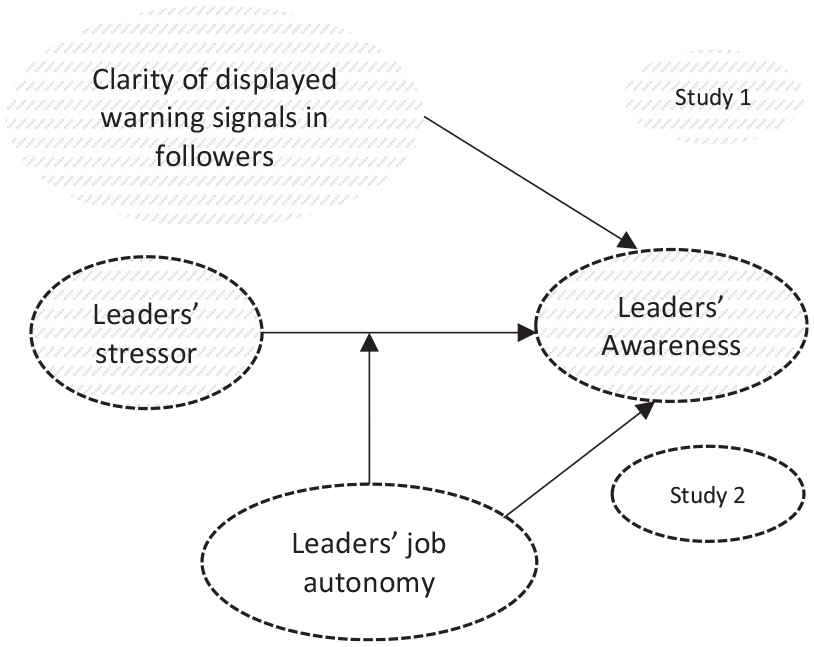
Research model.
The work presented here makes several theoretical and practical contributions. First, from a methodological perspective, the experimental design of study 1 reduces the risk of biases in the assessment of leaders’ self-rated awareness and uncovers the genuine level of awareness as we manipulated and controlled for the actually displayed warning signals. This design also allows causal conclusions for the effect of stressors on awareness. Study 2 adds external validity and allows a generalization into the field. Second, by analyzing antecedents of leaders’ awareness of emerging mental health issues, our work adds to the health-specific leadership literature (Franke et al., 2014) and the recent call for examining “contextual factors as antecedents” of healthy leadership (Rudolph et al., 2020: 18). Third, by exploring the effects of leaders’ stressors and their autonomy, we add leaders’ awareness as a novel outcome to the JD-R model (Bakker and Demerouti, 2007; Schaufeli and Taris, 2014). Fourth, as suggested by the JD-R, we investigate whether the buffering effect applies to awareness. Fifth, as leaders’ awareness is an important prerequisite for appropriate action and support (Franke et al., 2014; Kaluza et al., 2020b), the understanding of its antecedents is highly relevant for practitioners designing interventions that aim at strengthening leaders’ awareness and health-oriented behavior. Our findings provide suggestions for human resource management and leaders on how awareness of emerging mental health issues at work can be fostered.
Theories of health-oriented leadership
Previous research demonstrated the usefulness of health-specific leadership constructs. They explain unique variance in health outcomes above and beyond broader leadership concepts, for example, transformational leadership (Franke et al., 2014; Kaluza et al., 2021; Kranabetter and Niessen, 2017; Vincent-Höper and Stein, 2019), and differ from relations-oriented leadership behaviors (e.g. consideration) that address fulfillment of general follower needs but do not explicitly refer to health issues (Montano et al., 2017). In the health-oriented leadership concept, staff-care describes leaders’ concern for their followers’ health (Franke et al., 2014). Staff-care consists of (1) awareness, (2) value, and (3) behavior. Awareness describes leaders’ ability to observe warning signals of followers and adequately assess their health risks. Value reflects how much importance leaders attach to followers’ health and how much they feel responsible for creating healthy working conditions. Behavior compromises leaders’ health behaviors for maintaining, improving, or restoring employees’ health (e.g. optimizing task organization or working hours to reduce demands, supporting taking regular breaks, or participating in occupational health promotion programs). Research has shown that staff-care contributes to followers’ mental and physical health (Arnold and Rigotti, 2021; Bregenzer et al., 2019; Franke et al., 2014; Klug et al., 2019; Köppe et al., 2018; Santa Maria et al., 2019).
Acknowledging that followers differ with regard to stressors and reactions, awareness is an important precondition for appropriate leadership behavior (e.g. providing support, reducing workload, changing priorities, etc.; Franke et al., 2014; Kaluza et al., 2020b). Even if a leader is highly motivated to care for followers’ health, he or she may fail to take action, if they are not aware of followers’ needs. Moreover, awareness reflects interest and consideration, which is appreciated by followers, and therefore may have an independent positive impact, even if leaders are not able to take action. Proving the importance of awareness, research showed that awareness independently predicted followers’ irritation and health complaints after controlling for value and behavior (Franke et al., 2014), or transformational leadership behavior (Kranabetter and Niessen, 2017).
Thus, awareness plays a meaningful role in follower health, directly and indirectly via behavior, and therefore needs to be considered to capture the full scope of leadership influences (Franke et al., 2014; Kaluza et al., 2020b). To date, organizational scholars focus more on antecedents of overall health-oriented leadership or behavior (Klebe et al., 2022; Köppe et al., 2018; Turgut et al., 2020), rather than on how to foster awareness. As previous research on awareness used self-reported awareness by leaders, experimental studies are needed to uncover leaders’ genuine level of awareness. In this study, we address these issues by using a multimethod approach and by integrating and transferring existing theoretical and empirical work from different research disciplines (e.g. clinical, stress, and leadership) on possible antecedents of awareness.
Predicting leaders’ awareness
There may be relevant variables in followers and in leaders that make it easier or more difficult for leaders to perceive and detect followers’ warning signals as indicators of mental health issues.
Clarity of displayed warning signals in followers
Early warning signals start to unfold before the onset of a mental illness. This period is defined as the prodromal phase (Fava and Tossani, 2007). Previous research identified sleeping disorders, irritability, loss of appetite and interests, reduced level of energy and activity, sad mood, anxiety, and concentration problems as early symptoms predicting later depression or burnout (Fava and Tossani, 2007; Iacoviello et al., 2010; Maslach et al., 2001).
As warning signals may be ambiguous and many leaders express confusion about which signals “warrant concern and which may merely be indicative of someone who is having a bad day” (Dimoff and Kelloway, 2019: 296), leaders may have difficulties recognizing warning signals as a potential health risk. However, followers acknowledge that some leaders can recognize their displayed warning signals and consider a potential health risk. Supporting this notion, Martin et al. (2018) used a qualitative interview approach to find out how leaders became aware of employees’ emerging depression or burnout. The interviewed managers perceived changes in three main areas of employees’ workplace behavior: (1) performance (e.g. poor quality of work, failure to complete assigned work), (2) emotional state and social behavior (e.g. display of irritability, mood swings, tiredness, dealing inappropriately with colleagues), and (3) coping with the workplace environment (e.g. increases in absenteeism and lateness). Thus, we assume that leaders can recognize behavioral changes as warning signals, reflecting a potential health risk.
Individuals may differ with regard to the early symptoms they experience and display (Iacoviello et al., 2010; Ragins, 2008). Although employees may experience changes in multiple areas, they may display performance problems only as they hide their mood issues to maintain successful social relationships (Niedenthal et al., 2006). In the case of depression, it is known, that some people experience a low mood and a loss of pleasure but still experience moderate levels of functioning (e.g. performance at work; American Psychiatric Association, 2013). Building upon these thoughts and the study by Martin et al. (2018), we reason that there are at least three types of how employees may display early warning signals: (1) performance impairments only, (2) socioemotional impairments only, (3) or a combination of performance and socioemotional impairments. Given that all types may indicate upcoming health issues, it is important to know which type can be detected more easily and which type may be overlooked. There are several reasons why awareness of the different warning signals is more or less difficult.
In particular, it may be challenging for leaders to understand that a decreased performance may reflect an emerging mental health issue when they still perceive their employees to be in a good mood and socially integrated. Following Weiner’s (1985) attributional approach, leaders tend to attribute poor performance as internal, unstable, and controllable and therefore explain it as a lack of effort. If leaders attribute a decrease in performance to poor motivation, they may react with anger or pressure rather than with awareness and consideration (Martinko et al., 2007).
In contrast, when employees display socioemotional impairments while maintaining performance, employees’ behavior is less threatening to leaders’ goal attainment so leaders may be more benevolent and understanding. Therefore, they may rather perceive employees’ emotions and social interactions as less controllable and attribute deteriorating socioemotional changes to poor mental health (Martinko and Gardner, 1987).
When employees display deterioration in both areas, leaders perceive a stronger and more consistent signal that should facilitate awareness of an emerging mental health issue. More precisely, we reason that leaders perceive warning signs associated with mental health issues best, when employees display warning signals in more than one area, as behavioral changes become more alerting and noticeable.
In addition, in line with leader-member attribution theory (Martinko and Gardner, 1987; Weiner, 1985), we suppose that leaders rather tend to attribute a lack of effort when employees show poor performance but are still in a good mood and socially connected. In contrast, when employees show socioemotional problems but maintain their performance, leaders may feel less threatened and thus rather consider an emerging mental health issue to be the cause for employees’ behavioral changes.
Leaders’ stressors
The well-established job demands-resources model (Bakker and Demerouti, 2007) offers a theoretical framework for explaining how demands and resources in the workplace impact motivation, well-being, and performance. Moreover, the JD-R model postulates that resources may “reduce job demands and the associated physiological and psychological costs” (Bakker and Demerouti, 2007: 312). In the following, we will argue how demands and resources may influence leaders’ awareness.
According to the health impairment process by the JD-R model “chronic job demands (e.g. work overload, emotional demands) exhaust employees’ mental and physical resources and may therefore lead to the depletion of energy (i.e. a state of exhaustion)” (Bakker and Demerouti, 2007: 313). Leaders face high work demands, including time pressure and daily workload (Hambrick et al., 2005) and previous research demonstrated that high demands lead to strain and health impairments (Schaufeli and Taris, 2014).
The effect of work demands on awareness has not yet been examined and is not quite obvious. On the one hand, leaders’ demands may reduce their capacity to perceive warning signals. Under the influence of high demands, leaders may increase their effort and use strategy adjustments such as narrowing attention or increased selectivity (Bakker and Demerouti, 2007). In addition, higher levels of stress have been associated with lower levels of complex cognitive functioning, and a decreased likelihood of considering alternative solutions to problems as well as withdrawal and taking a team perspective (Arnsten, 1998; Driskell et al., 1999; Keinan, 1987). The experience of exhaustion and health problems may then diminish positive outcomes such as awareness. On the other hand, some scholars have indicated that there may also be reciprocal causation as the feeling of responsibility for others may act as a possible stressor (Kaluza et al., 2020a; Schaufeli and Taris, 2014). According to this view, it is conceivable that paying attention to warning signals may also require leaders’ additional resources (e.g. time), which may result in a higher workload. Therefore, as suggested in the meta-analysis by Kaluza et al. (2020a) “experimental designs are particularly needed to increase clarity regarding causality” (p. 17).
Generally, previous research supports the notion that demands may mitigate awareness. Stressed leaders lack the resources to exhibit constructive leadership resulting in lower levels of transformational leadership and staff-care behavior as well as higher levels of abusive supervision (Byrne et al., 2014; Harms et al., 2017; Kaluza et al., 2020a; Klebe et al., 2022).
Since the JD-R model and previous research demonstrated that demands negatively affect health-oriented leadership and cognitive functioning, we expect that highly stressed leaders do not have sufficient resources for awareness. Leaders who suffer from high workload and time pressure, have a lack of energy, cognitive and emotional capacities to function effectively in all their roles. Thus, they set new priorities to save time and accomplish their tasks. For example, they may strengthen their effort to overcome obstacles, and solve current problems to reach their goals (van Dam, 2021). In this case, they may pay less attention to their employees’ health status. Due to exhaustion, leaders may even want to withdraw from social interactions and experience recognizing warning signals as an additional stressful, time-consuming task.
Leaders’ job autonomy
The job demands-resources model (Bakker and Demerouti, 2007) also serves as a theoretical framework for explaining why leaders’ autonomy may affect their capacity to perceive warning signals in their employees. According to the motivational process by the JD-R model “job resources have motivational potential and lead to high work engagement, low cynicism, and excellent performance” (Bakker and Demerouti, 2007: 313). Meta-analyses have confirmed that workplace resources are related to both performance and well-being (Crawford et al., 2010; Nielsen et al., 2017). In turn, these outcomes are related to the experience of more positive emotions which in turn broadens one’s action repertoire and may also encourage awareness as suggested by the broaden-and-build theory (Fredrickson, 2004).
In line with the JD-R model, broaden-and-build theory, and previous research we expect that leaders’ autonomy may help to be effective and to be aware of employees’ health status. When leaders have more control, they may be better able to manage their time and be more likely to prioritize awareness of employees’ health besides their other tasks. If leaders save time, they can interact with their followers more often and thus have more opportunities to perceive followers’ warning signals. In addition, leaders with high autonomy may experience higher engagement, well-being, and positive emotions (e.g. interest, contentment), which in turn may broaden their thought-action repertoire (e.g. explore, take in new information, expand attention) and thereby facilitate awareness.
It is yet an open question whether autonomy buffers the negative effect of leaders’ stressors on their awareness. It is conceivable that job autonomy can buffer the negative effect of leaders’ workload on their awareness, which is in line with the JD-R interaction hypotheses (Bakker and Demerouti, 2007). Autonomy may help individuals in coping with their high demands, as they can decide when and how they want to respond to the demands, leading to lower strain and thus to more capacities for awareness.
While several studies support the JD-R interaction hypotheses (Bakker et al., 2005; Xanthopoulou et al., 2007), others find mixed support (Hu et al., 2011; Xu and Payne, 2020). We argue that autonomy (over tasks, schedule, time pacing) matches the specific requirement of the stressor (workload and time pressure) and may buffer the stressors’ negative effects on awareness (Karasek, 1979). If leaders can control their high job demands, they have more energy and time, so they still have enough capacity for awareness. They may save time or set different priorities, for example, decide to take a break from their work or have a conversation with followers. This is not only beneficial for their own health, but also allows them to stay in contact with their employees and perceive, how their employees are feeling. By taking a break or switching tasks, leaders may better recuperate from high workload and therefore reach their leadership goal of being aware of employees’ health status.
Study 1
In study 1, we tested the effects of displayed warning signals of followers (H1a-b) and leader stressor (H2) in an experimental vignette study. Participants were asked to take the role of a leader in a 2-day scenario and work on eight different management cases (projects presented as vignettes) and make management decisions. Each case also included information on followers’ health and participants were asked, if they perceive health issues (awareness). Leaders’ stress was induced by an objective psychological stressor.
Design
To test the effects of warning signals and leader stressors (IVs) on leaders’ awareness (DV), we systematically varied the clarity of displayed warning signals in followers (factor 1) and stressor (factor 2) resulting in a 4 (no signal vs performance only vs socioemotional only vs combination) × 2 (no stressor vs stressor) factorial design. Systematically varying the factors lead to a set of eight management cases that were presented to participants in a within-subject design. A within design ensures that effects can be attributed to the IVs as individual variables are controlled for.
Methods
Sample and procedure
All participants (N = 54) were military officers with working experience (M = 4.31 years; SD = 3.52), currently studying psychology at the bachelor’s or master’s level. It is part of their professional role that officers see themselves as leaders and that they have already actively dealt with leadership issues. Depending on their career path, some participants were already in former leadership positions (42.6% with leadership experience of M = 2.35 years; SD = 1.58). The mean age was 22.76 years (SD = 3.26, range 19–34 years) and 55.6% were male. We choose a homogeneous sample (same organization, similar job profile, young age, similar cognitive abilities, similar health status) to better control for confounding variables (e.g. organization, branches, age). We conducted the experiment as an online study at the university’s laboratory to control for other potential confounding variables (e.g. noise, private communication) and to increase the validity of stress induction by involving social evaluation by the experimenter.
First, participants were welcomed by the experimenter with standardized instructions and placed in a cubicle in the laboratory. Second, they started the study and initially read about the study’s content and procedure. Participants were told that the study’s purpose is about leadership and decision-making so that awareness of mental health was less salient. Third, participants were asked to imagine that they are a human resource manager who is responsible for the success of eight different projects and has to make several management decisions in preparation for the annual employee appraisals and own planned vacation absence. Each vignette consisted of information about the project, its progress, the responsible employee, and upcoming tasks. Fourth, after reading each vignette, participants had to answer a set of different questions and ratings concerning the success of the project, a project-specific purchase, the employee’s performance, and the need for an occupational health promotion intervention. After four of the eight projects, participants were told that their working day was over. Fifth, the second working day was announced and started with the Montreal Imaging Stress Task (MIST; Dedovic et al., 2005). To cover its aim to induce psychosocial stress, participants underwent the test under the guise of playing a numerical computer game for improving their mathematical skills and competing with leaders and colleagues from work. Participants underwent the MIST for a second time after finishing projects 5 and 6 to maintain a constant stress level before processing the last two projects 7 and 8. At the end of the research session, all participants were given written debriefing information about the cover story and the study’s real purpose. Avoiding the effects of the order of presentation, the projects were presented in a randomized sequence.
Materials
We induced stress in the second half of the experiment by applying the Montreal Imaging Stress Task (MIST; Dedovic et al., 2005) with the software Psychopy (Peirce et al., 2019). Under time pressure participants had to solve arithmetic tasks and by default, could only reach a result below the performance of their colleagues. The program adapted the difficulty and the time limit so that only 45%–50% could be solved correctly. A color bar showed participants a comparison between their low-performance rate and the higher performance rate of their colleagues. Additionally, to increase the social evaluative threat and to unsettle participants even more, at the end of the test, the experimenter noted their results and asked them if any technical problems had occurred while performing.
We developed the vignettes with experts from science and practice by integrating warning signals following Martin et al. (2018). We tested the vignettes for plausibility and face validity. The vignettes were similar in length and complexity of information (see Appendix B for a vignette example). All projects took place in the field of human resource management and their content varied slightly (e.g. planning career days, implementing a new HR software).
Warning signals were performance only (“Mr. Schulz did not fulfill his task until today and already made a lot of small mistakes the past few weeks, . . . he came too late to your meeting because he had a chat with colleagues”), socioemotional only (“. . . Mr. Kerner held back and did not even smile when you praised him, . . . one employee told you that he is increasingly socially distancing and wishes to be left alone”) or combination (“While checking the contracts of one of your employees you realized that some documents were missing and that Mr. Wegner also made several mistakes, . . . during your conversation you notice that his gestures were serious and he seemed restless, . . . one employee told you that he is not contributing to the team as he used to and that he withdraws from social activities”).
The vignettes were pretested to check whether the different types of warning signals were perceptible. All participants (N = 20) rated each employee (1) performance, (2) mood, and (3) social connectedness on a five-point scale (items see Appendix A). All ratings of the employee types were as expected indicating that manipulation was successful and that no versus existing deficits in the areas of performance, mood, and social connectedness are perceptible (see Table 1).
Mean values for performance, mood, and social connectedness ratings for the four employee types (pretest).
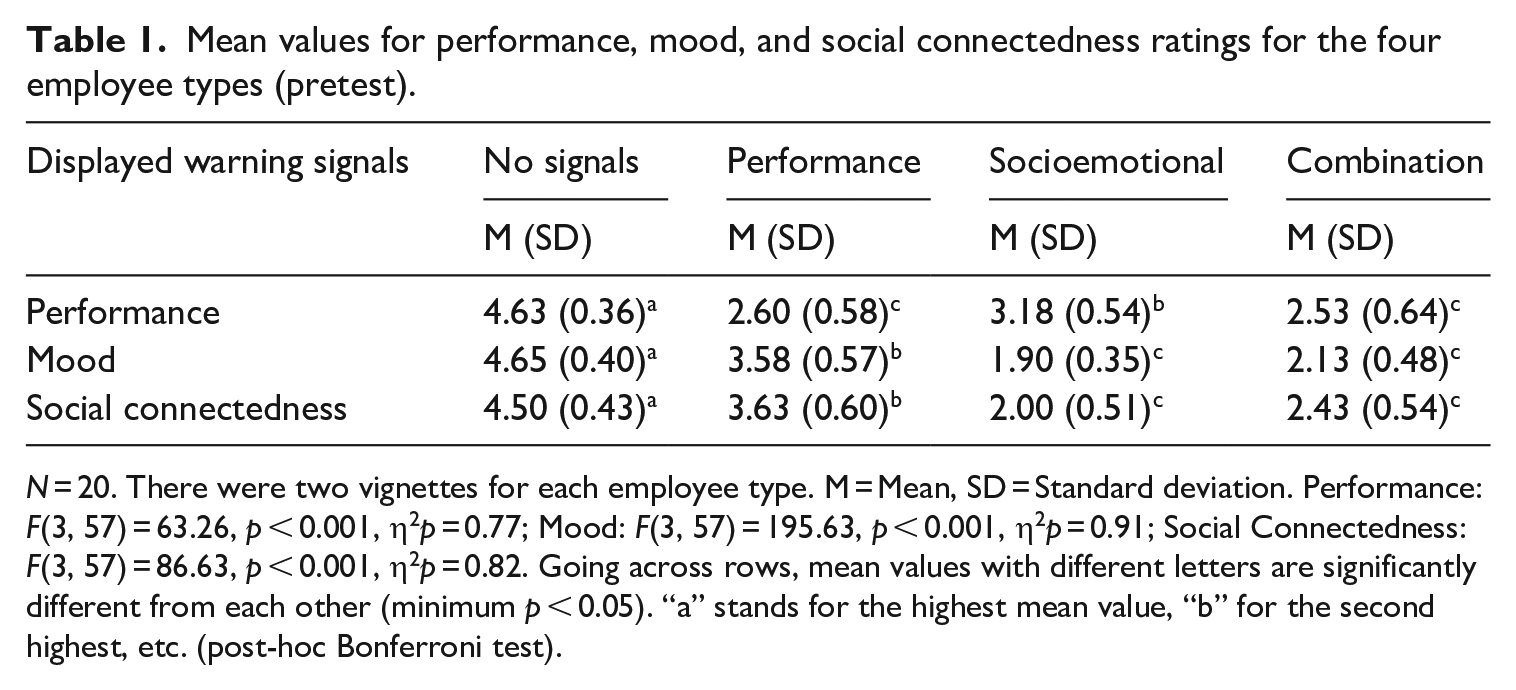
N = 20. There were two vignettes for each employee type. M = Mean, SD = Standard deviation. Performance: F(3, 57) = 63.26, p < 0.001, η2p = 0.77; Mood: F(3, 57) = 195.63, p < 0.001, η2p = 0.91; Social Connectedness: F(3, 57) = 86.63, p < 0.001, η2p = 0.82. Going across rows, mean values with different letters are significantly different from each other (minimum p < 0.05). “a” stands for the highest mean value, “b” for the second highest, etc. (post-hoc Bonferroni test).
Measures
We used two indicators to assess leaders’ awareness as the ability to detect warning signals and consider a potential health risk throughout the experiment. First, we assessed whether participants were able to consider the displayed warning signals as reflecting employees’ mental strain by using the fatigue subscale of the strain rating scales (Richter et al., 2002; a German instrument with the full name Beanspruchungsratings). Participants were asked to rate the three items (e.g. exhausted) plus a self-constructed added item (mentally strained) on a six-point scale ranging from 1 (not at all) to 6 (completely) for each responsible employee (“How do you evaluate Mr. . . . at the moment?”). The level of perceived fatigue indicates how much leaders are aware of their followers’ potential health issues. Cronbach’s α was 0.84. Second, we used a single item for assessing awareness of employees’ stress coaching needs to indicate that the leader takes warning signals seriously and that action is required. Participants had to rate the employee’s coaching needs on a five-point scale ranging from 1 (not at all) to 5 (very high) for each employee.
Before and after each MIST, a visual analog scale (VAS; e.g. Clamor et al., 2015; Lesage et al., 2012) was employed to assess subjectively perceived stress with the item “How stressed do you feel at the moment?” with a slide bar ranging from 0 to 100. Stress response was defined as the increase in stress from pre- to post-stressor assessment. In between the eight vignettes, four attention checks were included to check whether participants read the scenarios and questions carefully throughout the experiment. Sample questions were: “On which of the following tasks does Mr. Schulz work at the moment?” with three answering options. We defined an adequate level of attention by answering three of those four checks correctly.
Results
We first checked whether our manipulation of stress levels was successful. Paired t-tests showed that participants reported significantly higher stress levels after both stress inductions (Mpost1 = 42.82, SDpost1 = 29.64; Mpost2 = 40.09, SDpost2 = 28.92) than prior to stress induction (Mpre = 27.43, SDpre = 24.85; tpre-post1 = – 5.81, p < 0.001; tpre-post2 = –5.16, p < 0.001). No participants had to be excluded due to attention checks.
Table 2 presents the means and standard deviations of the clarity of displayed warning signals (no signals vs performance only vs socioemotional only vs combination) and stressor (no stressor vs stressor) for both awareness indicators (employees’ mental strain and coaching needs). H1a-c postulated that the clarity of displayed warning signals will influence awareness. H2 postulated that participants in the stressor condition show lower awareness compared to the no stressor condition. We conducted two-way RM ANOVAs and post hoc t-tests to test our hypotheses. We report the results of the two-way RM ANOVAs for the two awareness indicators (IVs) one by one.
Means and standard deviations for key variables by condition and percentage frequencies for low and high awareness of employees’ strain and coaching needs (Study 1).
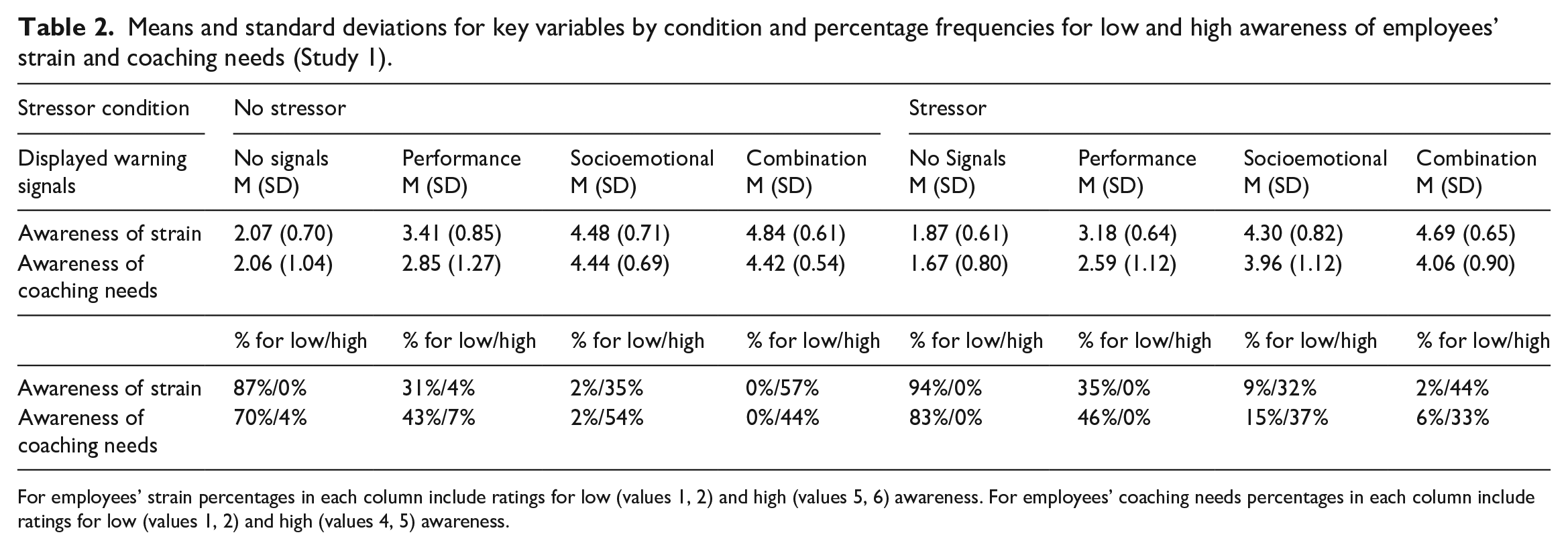
For employees’ strain percentages in each column include ratings for low (values 1, 2) and high (values 5, 6) awareness. For employees’ coaching needs percentages in each column include ratings for low (values 1, 2) and high (values 4, 5) awareness.
Awareness indicator 1: Awareness of employees’ mental strain
Effect of clarity of displayed warning signals in followers
The repeated-measures ANOVA showed a significant main effect of clarity of displayed warning signals on awareness, F (3, 159) = 310.72, p < 0.001, η2p = 0.85, indicating a large effect size. The main effect is shown graphically in Figure 2, and as expected in H1a, post-hoc t-tests revealed that leaders showed significantly higher awareness when employees displayed warning signals (Mperformance, socioemotional, combination = 3.30–4.76, SEperformance, socioemotional, combination = 0.06–0.09) compared to when employees displayed no signals (Mhealthy = 1.97, SE = 0.08). In addition, post-hoc t-tests revealed that leaders showed significantly higher awareness when employees displayed early warning signals in multiple areas (Mcombination = 4.76, SE = 0.06) compared to when employees displayed early warning signals in only one area (Mperformance = 3.30, SE = 0.09; Msocioemotional = 4.39, SE = 0.07, see Figure 2), supporting H1b. As expected in H1c, post-hoc t-tests revealed that leaders showed significantly higher awareness when employees displayed a socioemotional deterioration (Msocioemotional = 4.39, SE = 0.07) compared to when employees displayed a decrease in performance (Mperformance = 3.30, SE = 0.09, see Figure 2).
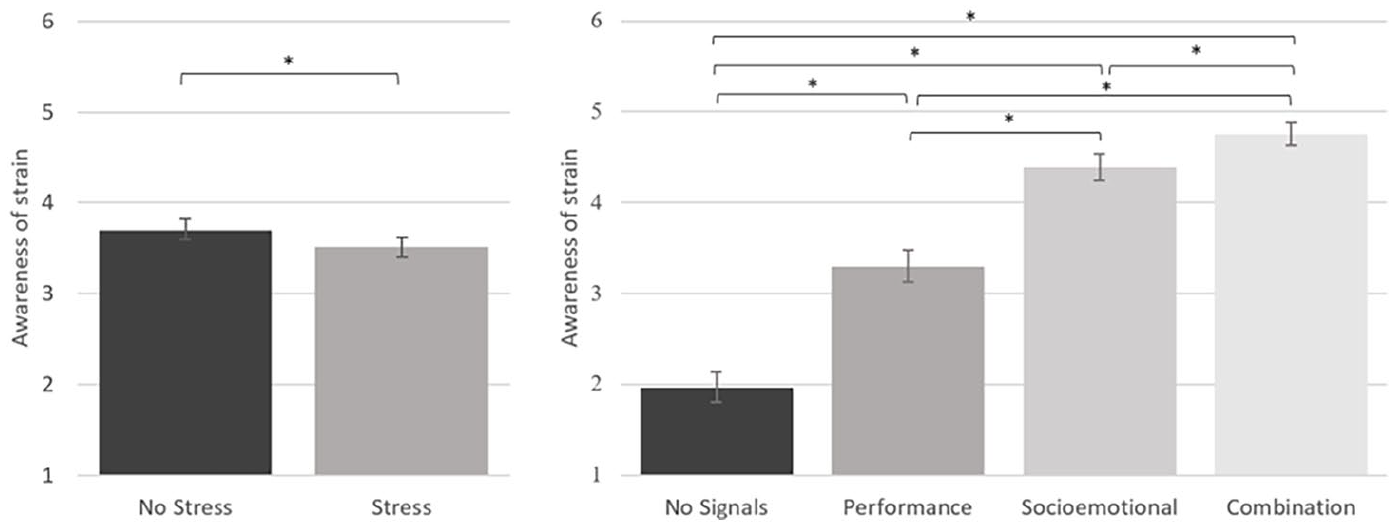
Main effects of stress condition (no stress vs stress) and clarity of displayed warning signals (no signals vs performance only vs socioemotional only vs combination) on awareness of strain (study 1).
Effect of leaders’ stress
The main effect of stress on awareness was significant, F (1, 53) = 11.36, p < 0.001, η2p = 0.18, indicating a large effect size. The main effect is shown graphically in Figure 2 and revealed that participants showed significantly higher awareness in the no stressor (M = 3.70, SE = 0.06) compared to the stressor condition (M = 3.51, SE = 0.05), supporting H2.
Additional analysis
There were no two-way interactions between the clarity of displayed warning signals and stressor conditions (F (3, 159) = 0.10, p = 0.96, η2p = 0.002).
The experimental design makes it possible to check the extent to which objective warning signals were actually perceived. Therefore, we estimated how many participants recognized employees’ strain by calculating percentages for low and high values of awareness by condition. As Table 2 shows, in the no stressor condition, 57% of participants recognized strain when a combination of socioemotional and performance signals was displayed, whereas in the stressor condition only 44% recognized strain. In contrast, when employees only displayed a deterioration in performance, 4% of participants in the no stressor condition recognized strain, whereas under high stress none of the participants perceived strain. As expected, with no signals, about 90% of participants recognized low strain in their employees in both stressor conditions.
Awareness indicator 2: Awareness of employees’ coaching needs
Effect of clarity of displayed warning signals in followers
The repeated-measures ANOVA showed a significant main effect of clarity of displayed warning signals on awareness, F (3, 159) = 137.81, p < 0.001, η2p = 0.72, indicating a large effect size. The main effect is shown graphically in Figure 3, and as expected in H1a, post-hoc t-tests revealed that leaders showed significantly higher awareness when employees displayed warning signals (Mperformance, socioemotional, combination = 2.72–4.24, SE = 0.08–0.14) compared to when employees displayed no signals (Mhealthy = 1.86, SE = 0.11). In addition, post-hoc t-tests revealed that leaders showed significantly higher awareness when employees displayed early warning signals in multiple areas (Mcombination = 4.24, SE = 0.08) compared to when employees displayed early warning signals in the performance area (Mperformance = 2.72, SE = 0.14), but as there was no difference between the combination area and the socioemotional area (Msocioemotional = 4.20, SE = 0.10, see Figure 3), we found partly support for H1b. As expected in H1c, post-hoc t-tests revealed that leaders showed significantly higher awareness when employees displayed a socioemotional deterioration (Msocioemotional = 4.20, SE = 0.10) compared to when employees displayed a decrease in performance (Mperformance = 2.72, SE = 0.14, see Figure 3).
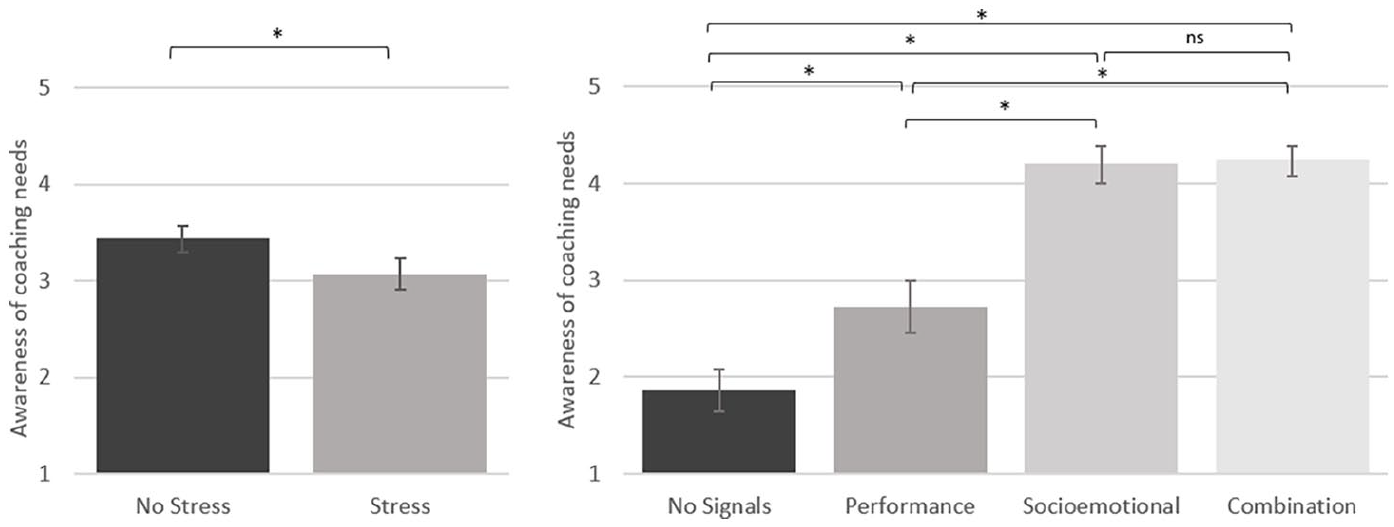
Main effects of stress condition (no stress vs stress) and clarity of displayed warning signals (no signals vs performance only vs socioemotional only vs combination) on awareness of coaching needs (Study 1).
Effect of leaders’ stress
The main effect of stress on awareness was significant, F (1, 53) = 25.60, p < 0.001, η2p = 0.33, indicating a large effect size. The main effect is shown graphically in Figure 3 and revealed that participants showed significantly higher awareness in the no stressor (M = 3.44, SE = 0.07) compared to the stressor condition (M = 3.07, SE = 0.08), supporting H2.
Additional analysis
There were no two-way interactions between the clarity of displayed warning signals and stressor conditions (F (3, 159) = 0.35, p = 0.79, η2p = 0.007).
Again, we calculated percentages for low and high values of awareness by condition to estimate how many participants recognized employees’ coaching needs. As Table 2 shows, in the no stressor condition, 44% of participants recognized employees’ coaching needs when a combination of socioemotional and performance signals was displayed, whereas in the stressor condition only 33% recognized the coaching needs. In contrast, when employees only displayed a deterioration in performance, 7% of participants in the no stressor condition recognized employees’ coaching needs, whereas under high stress none of the participants perceived the coaching needs. As expected, with no signals, about 70%–83% of participants recognized a low need for stress coaching in their employees in both stressor conditions.
Study 2
Study 2 served to replicate the negative effect of the stressor on leaders’ awareness in a field study with leaders to strengthen the external validity. In addition, study 2 examined the role of leaders’ autonomy and its potential buffering effect in the relationship between leaders’ stressor and their awareness, thereby taking the complexity of leaders’ working situations into account.
Methods
Sample and procedure
The study was conducted as an online survey. N = 215 leaders were recruited by a market research institute as part of a larger project. The majority of the participants (62.3%) were male. The mean age was 46.94 years (SD = 13.30, range 18–69 years). Around 39.5% reported having an academic degree and about 85.1% were permanently employed. Participants worked in different sectors, for example, metal and electrical industry (12.6%), health care (10.7%), or public administration (10.2%). Most of the leaders were responsible for up to 10 employees (63.7%).
Measures
We assessed workload as leader’s stressor with the work intensity scale of the Questionnaire for Psychosocial Risk Assessment at Work (Dettmers and Krause, 2020). Work intensity describes the amount of work in relation to the available time and was measured with four items (e.g. “To manage the amount of work, I have to work longer hours”). Cronbach’s α was 0.85.
Autonomy was assessed with the decision-making autonomy scale of the German Work Design Questionnaire with three items (e.g. “The job gives me a chance to use my personal initiative or judgment in carrying out the work”; Stegmann et al., 2010). Cronbach’s α was 0.92.
Awareness was assessed with the awareness subscale of the staff-care questionnaire of the Health-oriented Leadership instrument (Pundt and Felfe, 2017). For reasons of parsimony, we used a reduced subscale with four items (e.g. “I immediately notice when something is wrong with my followers’ health”). Cronbach’s α was 0.75. All measures were answered on a five-point Likert scale from 1 (not at all true) to 5 (completely true).
Results
We conducted moderation analyses (model 1) using the PROCESS macro to test H2, H3, and H4. Table 3 shows means, standard deviations, and correlations for all study variables.
Means, standard deviations, and correlations (Study 2).
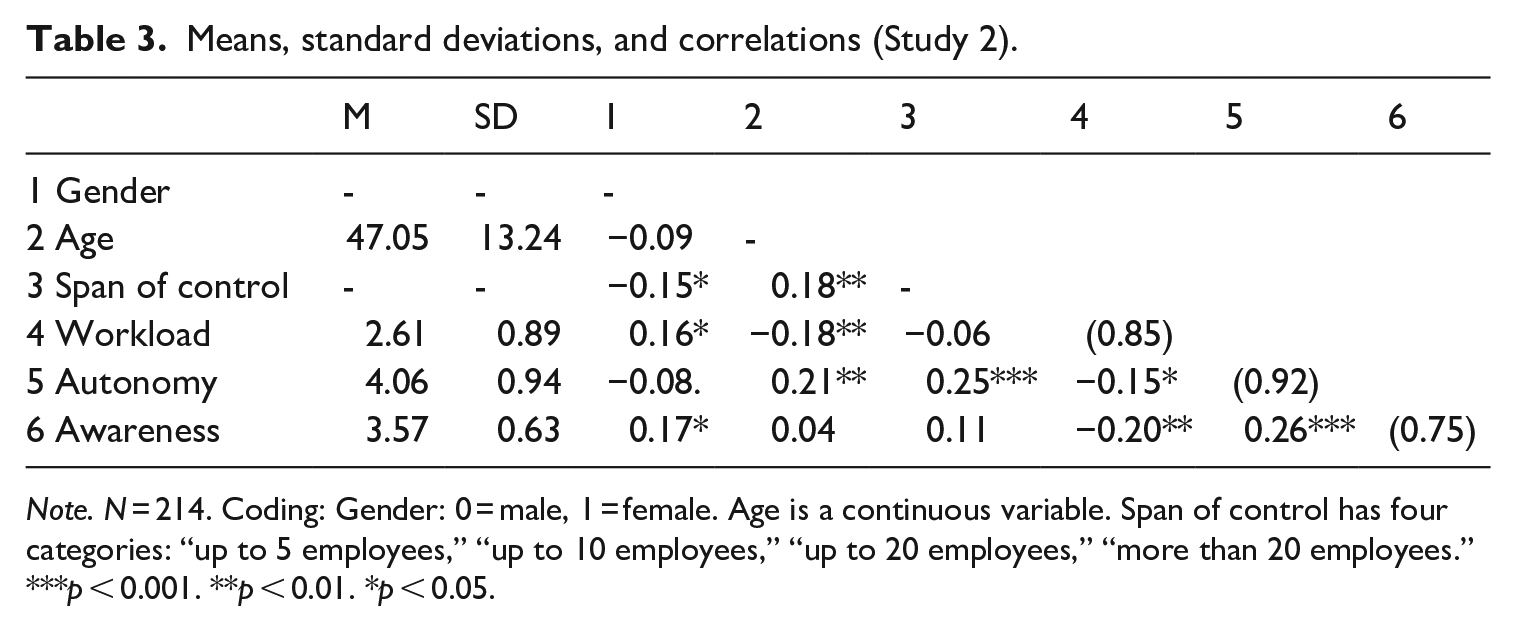
Note. N = 214. Coding: Gender: 0 = male, 1 = female. Age is a continuous variable. Span of control has four categories: “up to 5 employees,” “up to 10 employees,” “up to 20 employees,” “more than 20 employees.”
p < 0.001. **p < 0.01. *p < 0.05.
First, we expected that workload has a negative effect on awareness (H2). Along with our expectations, we found a negative main effect for workload (B = −0.11, SE = 0.05, t = −2.47, p < 0.05), supporting H2.
Second, we postulated that job autonomy has a positive effect on awareness (H3). In line with our expectations, we found a positive main effect for autonomy (B = 0.17, SE = 0.04, t = 3.81, p < 0.001)), confirming H3.
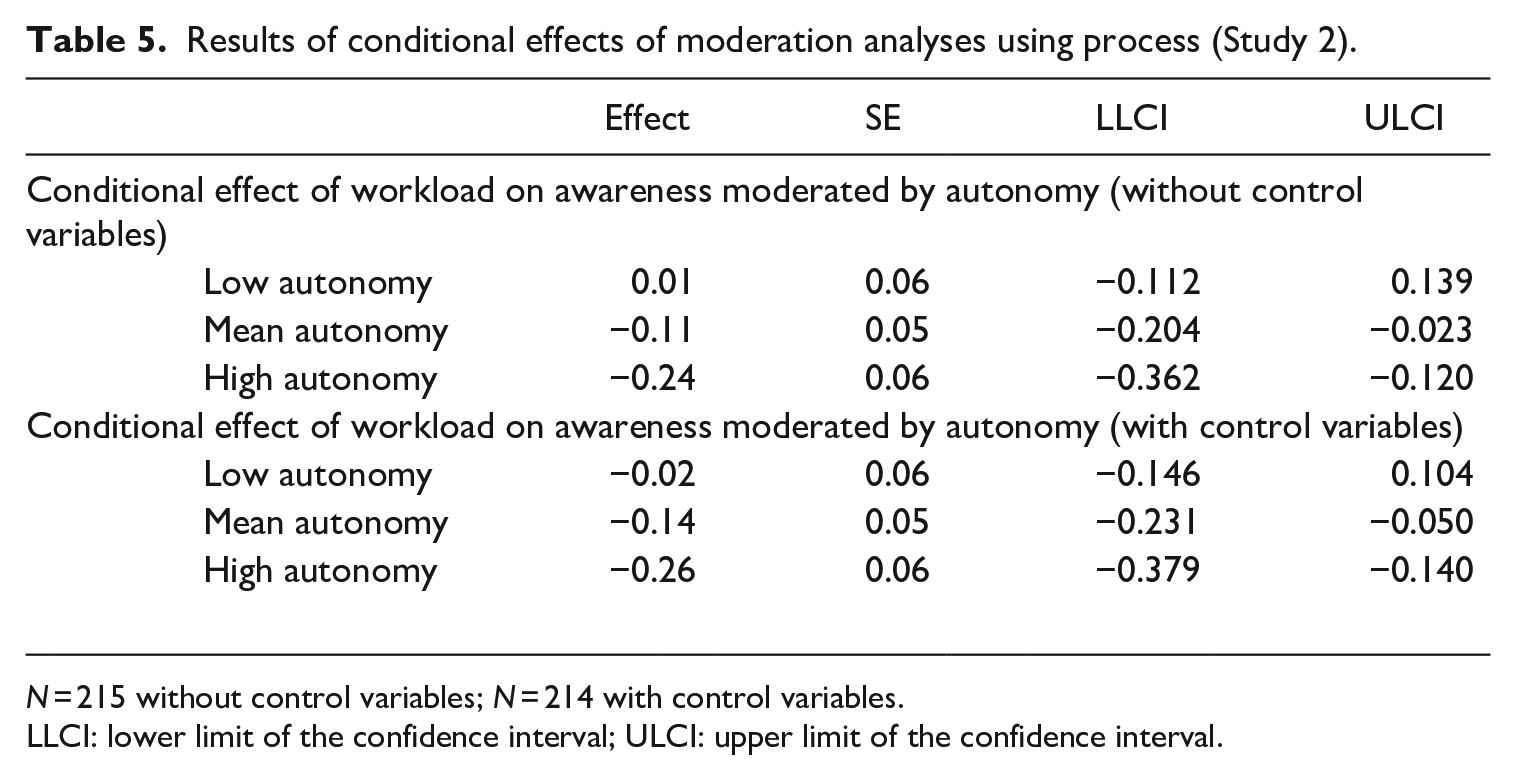
Third, H4 stated that the relationship between workload and awareness is weaker when job autonomy is high. Overall, the moderation model accounted for significant variance in awareness (R2 = 0.37). R2 significantly increased due to the interaction term (R2 change = 0.04, F(1, 211) = 9.00, p < 0.01). The significant interaction term revealed that autonomy interacted with workload (B = −0.14, SE = 0.05, t = −3.00, p < 0.01), but not in the expected direction (see Figure 4). The conditional direct effect was non-significant for low autonomy coeff. = 0.01 (SE = 0.06, t = 0.21, p = 0.83,95% CI [−0.11, 0.14]) but significant for high autonomy coeff. = −0.24 (SE = 0.06, t = −3.92, p < 0.001,95% CI [−0.36, −0.12). Lower workload helps increase staff-care awareness only when autonomy is high. With low autonomy, staff-care awareness remains at a lower level when workload changes (see Figure 4). Against our expectations, high autonomy did not buffer the negative effects of workload on awareness. H4 was not supported.
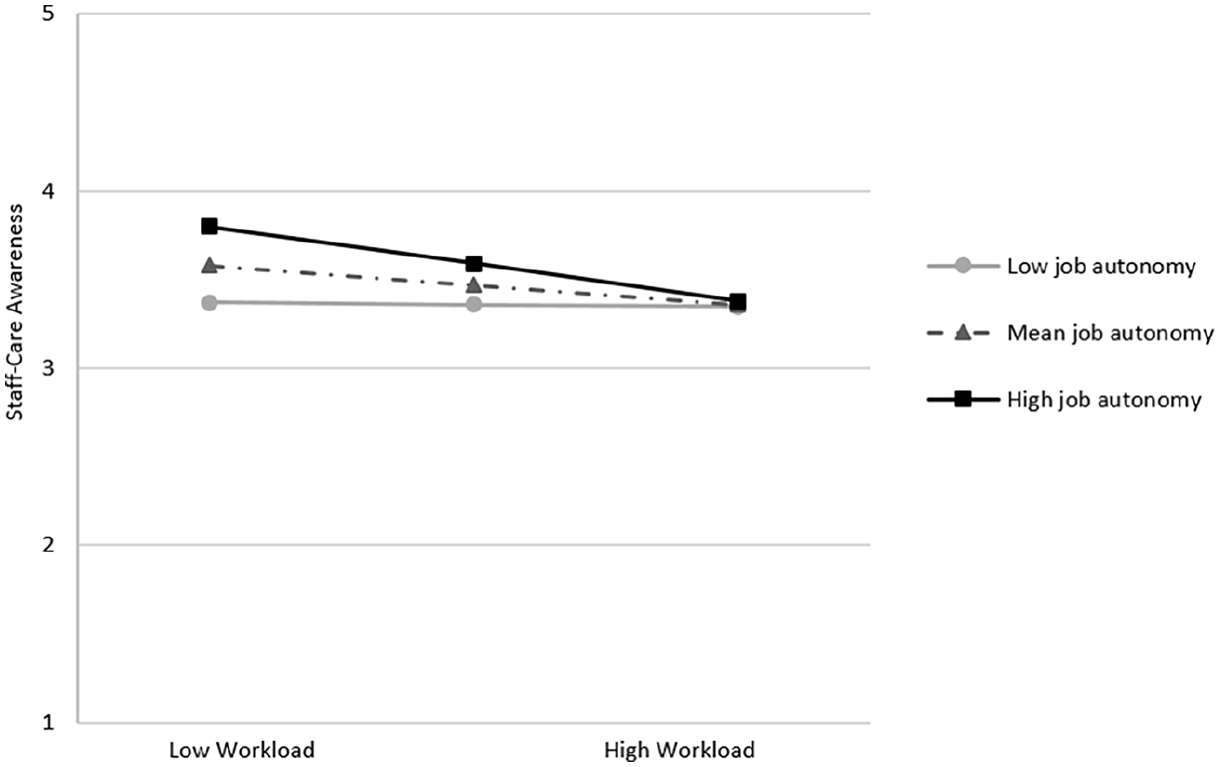
The conditional effect of workload on awareness probed at −1 SD, mean, and +1 SD for job autonomy (Study 2).
Additional analysis revealed similar coefficients when controlling for leaders’ gender, age, and span of control (see Tables 4 and 5). While there were no effects for age and span of control, there was a significant main effect for gender (B = 0.29, SE = 0.08, t = 3.47, p < 0.001).
Regression coefficients, standard errors, 95% confidence intervals, and a summary of the model (Study 2).
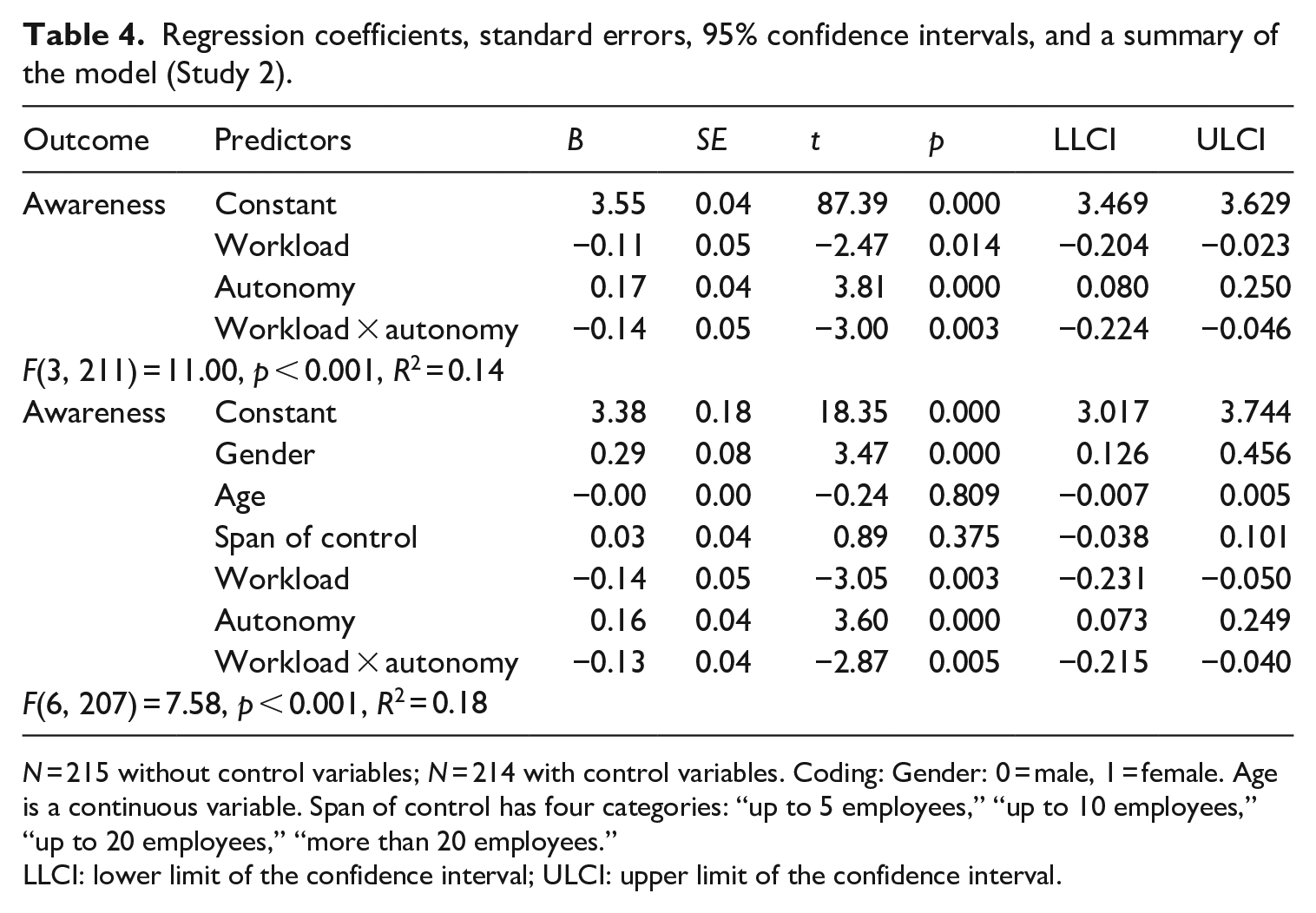
N = 215 without control variables; N = 214 with control variables. Coding: Gender: 0 = male, 1 = female. Age is a continuous variable. Span of control has four categories: “up to 5 employees,” “up to 10 employees,” “up to 20 employees,” “more than 20 employees.”
LLCI: lower limit of the confidence interval; ULCI: upper limit of the confidence interval.
Results of conditional effects of moderation analyses using process (Study 2).
N = 215 without control variables; N = 214 with control variables.
LLCI: lower limit of the confidence interval; ULCI: upper limit of the confidence interval.
Discussion
Due to growing demands and higher workload in the working context, early detection of emerging depression and burnout is crucial for early support and for lowering the risk of severe illness. Leaders’ awareness is defined as the ability to detect potential health issues and is a crucial component in the concept of health-oriented leadership. The purpose of this study was to expand our understanding of leaders’ awareness. More especially, we addressed the questions (1) to what extent leaders recognize warning signals as a potential health risk and (2) which factors facilitate or impede leaders’ awareness by examining the clarity of displayed warning signals in followers, leaders’ stressors, and leaders’ job autonomy as antecedents.
First, as most warning signals (e.g. followers’ “bad” performance) are inconclusive and can be a sign of someone who is “having a bad day” or a sign of an emerging mental health issue, it remained unclear, to what extent leaders consider potential health risks (Dimoff and Kelloway, 2019). The findings of our experimental study 1 provided evidence that leaders perceived a higher risk for an emerging mental health issue when employees displayed negative changes in the areas of performance, emotions, or social life compared to when employees displayed a good performance, a positive mood, and social connectedness. Leaders were able to differentiate between healthy followers and those who might be at risk. Besides the comparison of means, it is interesting to examine the percentage of those who reacted in terms of awareness. Our additional analysis showed that when there were no signals between 70%and 94% did not perceive the employee to be suffering from strain or in need of stress coaching in both stressor conditions—that is, they correctly perceived the employee as being healthy. When employees displayed signals, only 0%–57% perceive the employee to be suffering from strain or in need of stress coaching in both stressor conditions. This finding is in line with followers’ ratings of leaders’ awareness, who acknowledge that some leaders have high awareness but others do not sufficiently recognize warning signals (Pundt and Felfe, 2017). We expand previous findings on leaders’ self-report or followers’ reported data on leaders’ awareness (e.g. Kaluza et al., 2020b; Vonderlin et al., 2020), as we manipulated and controlled for the displayed warning signals and thereby reduced the risk of biases in the assessment of leaders’ awareness. The finding that leaders recognize warning signals of burnout and depression is also relevant to the recent discussion about presenteeism (Ruhle and Süß, 2020). Scholars have argued that mental health conditions are more prone to presenteeism as signals are ambiguous and not contagious like physical signals (e.g. coughing) so one might also question if leaders’ can be aware of warning signals at all. By showing that leaders are actually able to detect warning signals of burnout and depression, we offer fruitful ideas for researchers and practitioners aiming at reducing presenteeism. Although leaders’ awareness is one important component for prevention that may help in reducing negative consequences (e.g. chronification, presenteeism), awareness is just the precondition for seeking a conversation in the next step (e.g. what is the cause for the perceived changes?). In this conversation, employees frequently decide to conceal their problems due to fear of stigmatization (Ragins, 2008), which may hinder any further leader support. Initial findings indicate that employees are more willing to open up if they have health-oriented leaders (Pischel and Felfe, 2022).
Second, our results revealed that awareness varies depending on the clarity of the displayed signal type. That is, leaders did not perceive types of displayed signals as posing the same risk for a mental health issue. As expected, awareness was lowest when employees only displayed warning signals in the area of performance. This is important, as we may conclude that leaders do not recognize employees’ signs of diminished performance clearly as an indicator of an emerging mental health issue. Our additional analysis showed that only 0%–7% considered strain or coaching needs in both stressor conditions. In these cases, there is a considerable risk that important signs may be overlooked. In line with leader-member attribution theory, leaders may misinterpret the diminished performance of their employees as a lack of effort (Martinko and Gardner, 1987), which can have far-reaching consequences for leaders’ behaviors. Leaders, who attribute their employees’ poor performance to internal and controllable causes (a lack of effort), are more likely to become angry and hold their employees in low regard, in comparison to leaders who attribute poor performance to factors over which employees have no or less control (an emerging mental health issue). The latter are more likely to express sympathy and help (Martinko et al., 2007). This is a crucial finding because changes in performance are known to be relevant warning signals for mental health issues (Martin et al., 2018). If employees are suffering and leaders overlook or misinterpret those signs, the situation may escalate due to higher pressure and control.
As suggested, leaders are more aware of a potential mental health risk when employees display socioemotional signals. Our additional analysis revealed that a considerable percentage of leaders are aware of mental health issues (between 32%and 54% in both stressor conditions). That is, in the case of socioemotional changes, leaders may rather attribute changes to an emerging mental health issue. One reason may be that showing socioemotional signals while still performing well is less threatening for leaders, as they can still accomplish their goals (Martinko and Gardner, 1987). Leaders may even react with understanding and consideration. Another reason may be that mental health issues are more obvious when employees suffer from negative emotions.
In line with our reasoning, leaders’ awareness was highest when employees showed a combination of poor performance and socioemotional withdrawal. Our additional analysis showed that between 33%and 57% of leaders are aware of mental health issues in both stressor conditions. Combined signals make attribution to a potential mental health risk easier, as the signals are clearer and more consistent. When displayed together, bad performance can be attributed to socio-emotional problems. In sum, it is easier for leaders to perceive a health risk, if warning signals are consistent and clear but more challenging if ambiguous. Our study extends the existing Rudolph et al. (2020) framework by examining antecedents of awareness on followers’ side and showing that certain warning signals facilitate leaders to classify them as deteriorating mental health. It is a crucial finding that even under favorable conditions only about half of the participants perceive high strain and need for stress coaching. Interestingly, this amount of awareness is close to general follower ratings in the field suggesting that 40% of leaders show low awareness (Pundt and Felfe, 2017).
Third, even if employees display warning signals clearly, leaders’ awareness is supposed to depend on leaders’ current job characteristics (i.e. their time pressure, workload, and autonomy). Drawing upon theoretical reasoning and empirical findings, we hypothesized that leaders’ stressors impede awareness. In two studies, an experiment and a cross-sectional study, we found evidence that leaders suffering from stressors have more difficulties perceiving warning signals as a health risk. For example, in our experimental study, our additional analysis revealed that the percentage of participants recognizing employees’ coaching needs decreased from 54% (no stressor) to 37% (stressor) when employees displayed socioemotional signals. The JD-R model postulates that demands (i.e. time pressure, workload) exhaust resources and energy, which in turn affect various outcomes (Bakker and Demerouti, 2007). We found that time pressure and workload also diminish awareness as another important, so far neglected outcome variable. We expand previous findings and follow previous calls in the field of stress and leadership research to study newer leadership constructs (Harms et al., 2017). Our findings are in line with previous research on stress and leadership demonstrating that leaders’ strain is related to a decrease in health-oriented leadership behavior and overall health-oriented leadership (Klebe et al., 2022; Köppe et al., 2018). Whereas the evidence in study 2 is only cross-sectional and does not rule out alternative interpretations in terms of reversed causality (e.g. caring for followers results in higher demands; Kaluza et al., 2020a) or the influence of third variables, the experimental design of study 1 allows causal interpretation. In addition, study 2 adds external validity and allows for a generalization into the field. We consider it an additional confirmation of our findings that results remained stable after controlling for age, gender, and span of control. Overall, leaders experiencing high stress pose a risk for their employees, as they show less awareness and miss important opportunities to maintain followers’ health. This is a significant finding as the leadership role itself is often associated with high demands and stressors like time pressure and workload (Hambrick et al., 2005).
By taking the complexity of work situations—with combinations of demands and resources—into account, study 2 examined the role of leaders’ job autonomy and its potential buffering effect in the relationship between leaders’ stressors and awareness. In line with our theoretical reasoning and earlier empirical findings on the positive effects of resources (Crawford et al., 2010; Nielsen et al., 2017), we found that leaders with high job autonomy show higher awareness. More interestingly, contrary to our expectations and following the JD-R model (Bakker and Demerouti, 2007), we did not find support for the buffering effect of autonomy. This is a crucial finding as we may conclude that even resources like autonomy may not be able to enhance leaders’ awareness if leaders experience high time pressure and workload. At the same time, autonomy fosters leaders’ awareness in times of low workload. Without autonomy, awareness remains at a low level, even when workload is low (as depicted in Figure 4). One reason why there was no buffering effect could be that the interaction effect of the JD-R model targets strain as an outcome variable at the individual level, whereas awareness is located at the interpersonal level. More precisely, while leaders’ own health may benefit from higher autonomy in stressful times, this may be not enough to enhance the perception of warning signals and health risks in others (Klebe et al., 2022). Due to lower cognitive capacities (Bakker and Demerouti, 2007) and a higher self-focus (Driskell et al., 1999) high demanding situations may hardly allow leaders to perceive warning signals in their followers. We contribute to earlier findings by showing that there may be different moderating effects besides buffering.
Taken together, by investigating antecedents of leaders’ awareness, our work also adds to the health-specific leadership literature and expands the HoL model by exploring antecedences of awareness on the context and follower side (Franke et al., 2014; Rudolph et al., 2020).
Additional finding
Our results of study 2 revealed that female leaders show higher awareness. This is in line with earlier empirical findings that female leaders report higher confidence in effectively supporting employees with depression (e.g. Shann et al., 2014). There are different possibilities to explain our finding: females’ 1) advantage in emotion recognition (e.g. Hall, 1978 ) or (2) lowered perceived stigma toward mental health (e.g. Martin, 2010). Our finding is important as we may conclude that there is a higher possibility that male leaders put employees’ health at risk, as they are more likely to miss early warning signs.
Limitations and future research
Despite the benefits of our multi-method approach, each study has its limitations. First, experimental studies are often criticized for their lack of external validity (Aguinis and Bradley, 2014). Hence, we do not know, if participants’ ratings would be in line with their real behavior at work. However, experiments may examine causal effects and complement field research in order to draw conclusions from the laboratory to the real world and vice versa. Both of our studies found a negative impact of leaders’ stressors on leaders’ awareness strengthening their validity.
Second, our vignette study consisted of written material, leaving participants with more scope for imagination and interpretation of employees’ mental health status, thereby potentially biasing our results. We tried to overcome this problem by carefully creating the vignettes and by checking the manipulation of displayed warning signals in a pre-study. Future studies may use videos or role-plays instead of written vignettes as warning signals may become clearer and leave less room for interpretation. However, when using video material, several other factors (e.g. outer appearance) may influence participants’ reactions.
Third, due to the cross-sectional design of study 2, we cannot infer causal relationships between leaders’ workload, their autonomy, and awareness. Contrary to our model, we cannot exclude alternative directions, for example, that leaders, who show less awareness simply attribute to high workload or low autonomy or that high awareness is such a responsible and time-consuming task that it causes additional workload. However, reverse causation would contradict the causal effect of stress found in study 1 and is not logical for autonomy (high awareness leads to lower autonomy). In addition, we do believe that the current working conditions but not those from several weeks earlier influence awareness, as it is a task that needs attention and effort in the here and now. More precisely, our focus is on synchronous and not on lagged effects (Xu and Payne, 2020). Therefore, we argue that the interpretation of our cross-sectional findings is appropriate.
Fourth, as study 2 relied on a single source (leaders’ self-report), we cannot rule out that self-enhancing biases may have influenced our results (Brown, 1986). In particular, it is possible that leaders underrated their current level of workload or autonomy and overrated their awareness (Van Velsor et al., 1993). However, these biases will influence levels but not relationships. As single-source bias may have overestimated the relationships, future studies may obtain measures from independent sources, for example, from the followers’ perspective. As leaders’ workload and autonomy are best assessable by themselves and not all tasks may be visible to followers, it is appropriate to use self-reports. Concerning awareness, future studies may take the perspectives of leaders and followers on leaders’ awareness into account. Previous multisource approaches to health-oriented leadership found that supervisors’ self-ratings on the awareness dimension are not always related to their employees’ ratings (Vonderlin et al., 2020). Some researchers suggest that leaders whose self-ratings agree with the ratings of others are more self-aware than leaders whose self-ratings are not congruent with others’ ratings (Fleenor et al., 2010). Future studies may examine if the level of congruence between leaders’ self-ratings and employees’ ratings leads to different relations. However, ratings provided by employees should not necessarily be considered the genuine scores of leaders’ awareness, as employees may also be biased by their implicit leadership theories (e.g. romance of leadership; Meindl et al., 1985; Schyns et al., 2007). In addition, it is an advantage of our experimental study that awareness does not depend on subjective ratings, as warning signals were manipulated and thereby objectively controlled.
Fifth, in our study we focused on workload, time pressure, and autonomy, but may have neglected other relevant demands and resources of the working environment. Depending on the certain working context a leader works in (e.g. public administration vs health care), different demands and resources may prevail (e.g. technical disturbances vs emotional demands; career opportunities vs sense of meaning). However, independent of the working context, the leadership role itself is not only associated with a high workload, but also offers higher social status, access to social and organizational resources, and autonomy (Barling and Cloutier, 2017; Hambrick et al., 2005). In addition, not every stressor and resource may influence awareness (e.g. career opportunities, skill variety). Therefore, we argue that the selection of these two variables is appropriate. We consider it a strength of our study that we included time pressure/workload and autonomy and tried to take the complexity of work situations of leaders into account.
In addition, we did not include other leadership variables (e.g. attitudes, knowledge; Bryan et al., 2018; Martin et al., 2015), quality of the relationship between leaders and followers (Rudolph et al., 2020), and organizational factors such as health climate (Kaluza et al., 2020b; Turgut et al., 2020) or level of digitalization, which may also influence leaders’ awareness of employees’ mental health status. For example, against the background of the recent Corona crisis, future research should focus on leaders’ awareness in the digital working context in which leaders’ have fewer possibilities to observe and assess employees’ behaviors during work (Hertel et al., 2005). In remote research, work phenomena such as the professional isolation of employees are well known (Cooper and Kurland, 2002). When working from home, it may be even more difficult for leaders to show awareness and it remains an open question of how awareness can be fostered (Krick et al., in 2022).
The HoL concept emphasizes the shared responsibility of leaders and followers for health, and therefore, integrated self-care into the model—that is leaders’ and followers’ respective concern for their health in terms of self-leadership—alongside staff-care (Franke et al., 2014). Staff-care and leaders’ and followers’ self-care may be mutually beneficial and thus be connected in multiple ways. For example, leaders’ self-care may directly influence leaders’ awareness (e.g. when leaders know for themselves which personal warning signals merit attention, they are better able to look after their followers; Klug et al., 2022) or act as a moderator (e.g. buffer the negative effects of leaders’ workload on awareness). At the same time, followers’ self-care (e.g. noticing warning signals, speaking to others about problems, and asking for support) may also play a key role in leaders’ awareness. Therefore, future studies may also include leaders’ and followers’ self-care to get a more comprehensive picture of the antecedents of awareness.
In this paper, we focused on early warning signals of depression and burnout. Although there is broad similarity in symptoms, depression and burnout are considered distinct constructs (Koutsimani et al., 2019). Thus, it is possible that there also may be differences in warning signals. From a theoretical or clinical perspective, future research may consider specific warning signals that may differentiate between burnout and depression (e.g. sleep quality; Grossi et al., 2015). From a leadership perspective, we believe that it is less relevant for leaders to differentiate early warning signals for depression and burnout. Instead, leaders should be aware of early warning signals of emerging mental health issues in general so that they can recognize them and adjust their behavior accordingly.
Practical implications
Our study offers practical implications for human resource management. Based on the reported results we recommend specific interventions to foster leaders’ awareness. First, we recommend that organizations offer leadership training including a module on early warning signals and common mental disorders because only about half of the participants were able to recognize clear warning signals. Even more, not all signals are perceived as posing the same risk for a mental health issue.
Although lasting negative changes in employees’ performance, emotions, and social life are no guarantee for a potential mental health risk—that is they may still be a sign of a lack of motivation, conflicts at home, or other factors—leaders still need the knowledge that these changes may reflect deteriorating mental health in order to seek dialog to clarify the cause for the changes. If leaders have no idea that certain warning signals may reflect an emerging mental health issue, they may be more prone to ignore these signals in their followers or even take false action, for example, increase pressure. Especially, educating about typical areas of signals and that diminishing performance may warrant a warning sign of an emerging mental health issue seems to be important. Proving the importance of mental health training and health-oriented leadership interventions, a recent meta-analysis and a systematic review found evidence for improving leaders’ knowledge, attitudes, and self-reported behavior as well as employees’ mental health (Gayed et al., 2018; Stuber et al., 2021).
Second, as leaders can best apply health-oriented leadership styles if they hold healthy working conditions themselves (Turgut et al., 2020), organizations should be aware that leaders may overlook warning signals when under stress. More precisely, organizations should combat high time pressure and workload and enlarge leaders’ autonomy, since they are strongly related to their awareness.
Third, awareness of followers’ mental health is not a “one-way street” and sole responsibility of the leader. As we reasoned earlier, leaders’ awareness may also depend on followers’ willingness to disclose their warning signals (Pischel and Felfe, 2022). Thus, the practical recommendation for followers is to consider that only revealing their mental health problems to their leader may protect them from their leaders’ misinterpretation of signals (e.g. poor motivation) and allow for support.
Conclusion
This is the first study investigating antecedents of awareness combining experimental and correlational methods. We showed that leaders are able to perceive warning signals as a health risk, but that the level of awareness is contingent on three antecedents: clarity of displayed warning signals in followers, leaders’ stressors, and leaders’ autonomy. The results suggest that in order to foster early detection of employees’ emerging mental health issues, human resource management should aim at sensitizing leaders to typical warning signals of their employees, making them aware that they may overlook warning signals when under stress and creating healthy working conditions for leaders.
Footnotes
Appendix A: Items used in pre-test
Appendix B: Vignette example with an employee displaying a combination of warning signals (Performance and socioemotional changes)
17.06.2019, 4 pm
Hello!
After a short coffee break, you dedicate the rest of the day to Project 4.
Project start: 01.02.2019
The use of modern HR software solutions for personnel management has become a central topic for your department. Up to now, a multitude of folders, Excel spreadsheets, and individual digital tools without suitable interfaces still determine the everyday work of your HR department. This should now change with the help of a new HR software. In the future, administrative activities should be less time-consuming and there should be more room for creative HR work.
At the beginning of the project, you discussed and assigned the upcoming tasks to the team. You gave your employee Mr. Wegner a lot of responsibility in the project. You can see from his report that the following project tasks have already been completed:
Since the software had been implemented successfully, Mr. Wegner, who always works very conscientiously, has been assigned his next task—digitizing the existing forms and processes. You know that this is a challenging and time-consuming task. The week before last, you received feedback from him that he had completed the digitization of forms for all employees in your department. Just now, you had to check an employee’s contract, but you found that not all the documents were there and that there were also some errors. You talk to Mr. Wegner today. He apologizes and promises to check everything again and correct the errors. During the conversation, you notice that Mr. Wegner seems tense and exhausted and that his facial expression is serious. Shortly after the conversation, you leave your office and meet with another member of the project team. You talk to him briefly about the project and learn from him that he has noticed that Mr. Wegner has recently become less involved in the team and has also withdrawn from social activities.
Acknowledgements
We would like to thank Mark Killen and Lukas Erkens for their support in collecting the data in the first study.
Funding
The author(s) received no financial support for the research, authorship, and/or publication of this article.
