




Abstract
Although many scholars and practitioners have shown that work from home (WFH) leads to positive organizational outcomes, the COVID-19 outbreak’s consequences suggest important downsides associated with an increased extent of WFH. Utilizing theories of social identity and need to belong, this study aims to investigate the potential dark sides of an increased extent of WFH. In a moderated mediation model, we test how an increased extent of WFH affects feelings of isolation and further influences the employees’ organizational identification. Our study is based on data from an online survey of 382 employees in Germany. Results suggest that a higher extent of WFH during the COVID-19 lockdown leads to more social isolation and less organizational identification. Besides, our results show that task interdependence significantly moderates the correlation between an increased extent of WFH and social isolation. In such manner, our study contributes to the literature on potential counterproductive organizational effects caused by an increased necessity of WFH. Organizations must develop countermeasures to better integrate employees who WFH more intensely into organizational routines to decrease their feelings of social isolation and increase their organizational identification.
Keywords
Introduction
The COVID-19 pandemic changed the manner of working for many people. Since the first nationwide lockdown in March and April 2020, more than a third of the employees in Germany went on short-time work or have lost their jobs (Alipour et al., 2020). To minimize the spread of the virus and to reduce the risk of short-time work, many companies decided for a sudden change to work from home (WFH) (Alipour et al., 2020). According to a survey of German human resources (HR) managers, about 39% of the workforce worked from home occasionally or regularly before COVID-19. This has now, however, increased by more than 20% (Statista, 2020), which led to an unprecedented discussion about an increased extent of WFH and the effects on employees and organizations among researchers and practitioners.
Since companies such as Twitter want to offer their employees the possibility to work frequently or even always from home (Der Spiegel, 2020), there is a clear need to understand how an increased extent of WFH affects employees’ sense of belonging. Previous studies on voluntary and occasional WFH demonstrate advantages at the employee level due to flexibility and autonomy, and on the company level due to lower turnover intentions and reduced real estate costs (Bailey and Kurland, 2002; McCloskey and Igbaria, 1998). However, WFH as a frequently imposed way of working has not been the focus of the literature thus far. Exploring studies on virtual teams and virtual offices, scholars already identify the risk of increased isolation and the decrease of communication and work-life balance as key challenges in digital work settings (Allen et al., 2015; Zhang, 2016). Furthermore, employees who are physically separated not only from their colleagues but also from the whole organization are at risk to lose their organizational identification (Allen et al., 2003).
Especially with regard to the COVID-19 pandemic, primary studies demonstrate how the use of WFH has changed during the pandemic and examine factors (e.g. work independence, isolation) that might influence the switch toward more intensified remote work (Van Zoonen et al., 2021). This study therefore aims to identify potential dark sides of frequently imposed WFH due to the COVID-19 pandemic. To achieve this goal, the study examines how an increased extent of WFH impacts each employee along employee-related and organizational factors. We combine social identity theory and need-to-belong theory to answer the following research questions:
How does an increased extent of WFH influence the organizational identification of employees who work from home? Which role do social isolation, professional isolation, and task interdependence play in this relationship?
Whereas previous research predominantly focused on the intensity of WFH in terms of hours or days spent working from home (e.g. Allen et al., 2015; Green, 2019; Vander Elst et al., 2017), our study addresses the increased extent of WFH due to the COVID-19 lockdown in terms of the difference in percentage points between WFH before the pandemic and WFH during the pandemic. Throughout the paper, a higher or increased extent of WFH refers to a higher percentage of WFH during the time of the survey within the COVID-19 pandemic compared to pre-COVID-19 times. The increased extent of WFH does not refer to the amount or intensity of WFH, which is simply measured in hours or days spent working from home. A higher percentage stands for more interruptions of office hours compared to the pre-COVID-19 work environment, which makes the negative side effects of telework more likely (Bartel et al., 2012). This study therefore opens up a new perspective on the ongoing discussion about WFH in terms of the dynamic and intensified shift toward WFH and sensitizes for a well thought through decision if employees are asked to work from home more often than they were used to.
Furthermore, even though previous research has addressed the topics of isolation and less identification at work due to WFH, these previous studies follow different, if any, theoretical approaches. Whereas certain studies only focus on job characteristics without a clear reference to an underlying theory (e.g. Marshall et al., 2007) or by following a grounded theory approach to explain isolation at work (e.g. Cooper and Kurland, 2002), others refer to social identity research (e.g. Bartel et al., 2012), or need-to-belong theory (e.g. Wang et al., 2020) separately. However, individuals’ need to belong is directly linked to individuals’ fear to lose social connections and, thus, to lose the identification with the organization (Kane, 2014). To address this relation, we combine social identity theory and need-to-belong theory and thereby make a valuable contribution to the literature on WFH by explaining negative effects due to an increased extent of WFH. By combining both theories, we are also able to theoretically derive the relevance of task interdependence and work isolation for the relationship between an increased extent of WFH and organizational identification.
The results show how an increased extent of WFH influences organizational identification negatively. Social isolation further explains the relationship between WFH and organizational identification. This study contributes to the existing literature on WFH by pointing out how an increased extent of WFH triggered by COVID-19 affects employees’ isolation and their identification with the company. We highlight that a shift toward online communication decreases direct interactions between employees and therefore reduces the occasions that allow colleagues to build an overall identity, which is especially harmful to employees who have a profound need to develop a sense of belonging (Kane, 2014).
Theoretical background and hypotheses
Literature review on WFH
The origins of WFH research can be traced back to telework. In 1975, Jack Nilles is the first to use the term “telework” that describes the possibility of avoiding long distances to the workplace (Bailey and Kurland, 2002; Nilles, 1975). Telework is defined as work that takes place outside of the conventional workplace and where communication with others is achieved through telecommunications or computer-based technology (Bailey and Kurland, 2002; Nilles, 1994). Besides WFH, other means of teleworking included satellite and neighborhood workstations (Bailey and Kurland, 1999; Kurland and Egan, 1999).
Originally, organizations considered telework as an incentive to reduce real estate costs and to contribute to minimizing air pollution and traffic congestion (Bailey and Kurland, 2002). Various studies on telework identified increased productivity and job satisfaction at the employee level through greater flexibility and autonomy (Bailey and Kurland, 1999, 2002; Duxbury et al., 1998). Companies benefit from less employee turnover and a larger talent pool. The most common problems with telework include, however, the control of employees, separation of family and work, and isolation (Bailey and Kurland, 1999).
Thatcher and Zhu (2006), as well as Feldman and Gainey (1997), identified telework as a multidimensional approach. First, the place of work matters; second, the voluntary nature of telework is relevant; and third, the frequency of WFH influences its success. Many workers occasionally take advantage of the opportunity to work from home to avoid disturbances and interruptions at work. If this option is only used a few days a month, it does not significantly impact isolation or communication with colleagues (Bailey and Kurland, 2002; Belanger, 1999). Other results may be expected for those who work from home frequently, that is high-intensity teleworkers who work from home at least 3 days a week (Gajendran and Harrison, 2007).
Accordingly, specific occupational groups became high-intensity teleworkers due to the COVID-19 outbreak. The pandemic led to an immense shift toward working from home, as WFH was forced to become the new normal for those occupational groups that were able to rearrange their work routines such that they could work from their homes (Kramer and Kramer, 2020). Incidentally, previous research on teleworking already showed mixed results with regard to the effects of working from home on relevant outcome variables. One stream of literature identified positive effects in terms of more flexibility, more autonomy, and more work-life balance; other studies show that more teleworking leads to isolation, family interruptions, and a higher level of stress (Allen et al., 2003). We therefore utilize previous research on teleworking and WFH and apply the relevant underlying theoretical mechanisms to the new shift of an increased extent of WFH due to the COVID-19 outbreak.
The major difference between our study and previous studies is that we do not only consider the amount and intensity of WFH in terms of hours or days spent working from home: We consider the change in hours or days spent working from home due to the COVID-19 pandemic. Since previous research has convincingly investigated the positive as well as the negative effects of occasional WFH depending on a higher or lower intensity of working from home, our study sensitizes for the effect that not only the amount of WFH matters but also the difference in percentage points of WFH. Putting the actual amount worked from home to one side, a higher change in WFH during the pandemic compared to pre-COVID-19 times will show the same effects on relevant outcome variables.
Social identity theory and need-to-belong theory
The first underlying theory used in this study is the social identity theory, which explains effects on organizational identification. The origins of social identity theory are traced back to Tajfel and Turner in the 1970s and 1980s. The core statement is that people tend to classify themselves and others into different social categories, such as religion, age, or organizational affiliation (Tajfel, 1974; Tajfel and Turner, 1986). Thereby, social categorization, social identity, psychological distinctiveness, and social comparison describe the underlying concepts that influence the identification of individuals (Tajfel, 1974; Tajfel and Turner, 1979).
When discussing WFH and organizational identification, social identity theory explains why employees might lose their bond with the organization due to less direct interactions and a shift toward online communication (Wiesenfeld et al., 2001). At the same time, organizational identification is even more relevant in virtual settings to maintain positive behaviors within work groups (Wiesenfeld et al., 1999). Social identity theory is therefore used to explain how the amount of WFH influences determining outcomes (e.g. organizational identification) in previous studies (e.g. Allen et al., 2003; Wiesenfeld et al., 2001). Likewise, we use the social identity theory to explain how an increased extent of WFH affects organizational identification. We follow this approach because an increased extent of WFH—in terms of the difference in percentage points compared to previous work arrangements—reduces communication and face-to-face interactions with colleagues in the organization (Allen et al., 2003; Wang et al., 2020).
The feeling of belonging to an organization also describes the organizational identification of individuals (Wiesenfeld et al., 2001). Definitions of social and organizational identification therefore often include the term “belonging” used by Ashforth and Mael (1989), for example, which is why the need-to-belong theory is a relevant complement to the social identity theory. The need-to-belong theory plays a particularly important role with regard to isolation at home, which will be demonstrated later on (Wang et al., 2020). This theory therefore forms the second relevant theory for our hypotheses development.
The need-to-belong theory of Baumeister and Leary (1995) assumes that the desire to form at least a small number of interpersonal relationships is naturally present among humans. These relationships are important for mental, emotional, and physical well-being (Wang et al., 2020). The theory states that people want regular personal contact and interaction with other people and that they must establish an interpersonal bond or relationship that is characterized by stability, affective concern, and continuity for the foreseeable future (Baumeister and Leary, 1995).
The theory also plays an important role in the organizational context. Employees strive to connect with other colleagues to satisfy the need to form meaningful relationships (Wang et al., 2020). Isolated individuals feel less connected and less inclined to actively seek regular interactions with colleagues, which leads to a loss of belonging (Golden et al., 2008). When people worry about losing these connections and relationships, they feel anxious and lonely. Anxiety and depression can also be triggered by the feeling of not being accepted or included (Baumeister and Leary, 1995; Leary, 1990). Furthermore, employees with more interwoven tasks (high task interdependence) will feel less isolated (Golden and Veiga, 2005).
Social identity theory and the need-to-belong theory therefore complement each other. While the social identity theory describes the “social and psychological tie binding employees and the organization” (Wiesenfeld et al., 1999: 778), the need-to-belong theory directly addresses the relevance of personal connections within the organization (Baumeister and Leary, 1995). Furthermore, organizational belonging refers to “what it is like to be valued at work (. . .) and also valuing what it means to identify with work” (Belle et al., 2015). Individuals’ need to belong is directly linked to individuals’ fear to lose social connections and, thus, to lose the identification with the organization (Kane, 2014). This connection highlights why both theories should be used simultaneously, which becomes especially relevant in the context of the COVID-19 pandemic that has led employees to face an extraordinary work environment of less social and professional face-to-face interactions (Gao and Sai, 2020).
WFH and organizational identification
Organizational identification is a process in which the company’s and individual’s goals become increasingly integrated (Hall et al., 1970). The employees define themselves through the company to which they belong, making organizational affiliation an important part of their self-definition (Ashforth and Mael, 1989; Mael and Ashforth, 1992). Changes in the work setting, such as working from home more regularly, further influences employees’ organizational identification (Thatcher and Zhu, 2006).
At the same time, organizational identification is of enormous importance in companies with a higher degree of WFH. Organizational identification is viewed as an organizational glue that connects employees who work from home, and as a strong motivator to reconcile the interests of employees with the interests of the company (Thatcher and Zhu, 2006; Wiesenfeld et al., 1999). Wiesenfeld et al. (2001) name three predictors of organizational identification that are also important for WFH. These include the extent of contact between the individual and the organization, the visibility of organizational affiliation, and the attractiveness of organizational identity. When working from home, employees are less exposed to company-related rituals, symbols, and informal situations such as coffee breaks with colleagues. Instead, employees who work from home are more connected to identities in their own homes. Interactions at work and points of contact, however, usually help build or consolidate organizational identities, which, in turn, influence organizational identification. These may be absent while working from home (Thatcher and Zhu, 2006; Wiesenfeld et al., 2001).
According to social identity theory, people who work from home reduce their self-categorization as members of the organization due to the physical distance and the resulting lower visibility of their organizational belonging (Wiesenfeld et al., 2001). Employees who frequently work from home find it more difficult to develop a sense of identification and lack important contact with the company that serves to strengthen organizational identification (Bartel et al., 2012; Scott and Timmerman, 1999). The higher the extent of WFH is, the less the employees are exposed to organizational structures (Thatcher and Zhu, 2006). This weakens employees’ self-esteem and leads to more uncertainty about their self-identity. Furthermore, the self-categorization process at work whereby individuals seek groups with which they can identify is interrupted (Allen et al., 2003; Hogg and Terry, 2000). Instead, these employees are exposed to identities associated with their homes, such as family members, which leads to less affiliation with the work group. Identification with the company is thus weakened. In this study we therefore pick up the reasoning behind the negative correlation between the amount of WFH and organizational identification and apply this reasoning to an increased extent of WFH in comparison to previous work arrangements. Employees who are suddenly exposed to an increased extent of WFH lose structure in their everyday work routine. More frequent separation from the actual work unit, in turn, decreases employees’ organizational identification. This leads to the following hypothesis:
H1: An increased extent of WFH decreases employees’ organizational identification.
WFH and social and professional isolation
Whereas more autonomy and a better work-life balance are two examples why employees like to work from home occasionally (Wang et al., 2020), one of the biggest obstacles of WFH is the experience of isolation (Bailey and Kurland, 1999; Wang et al., 2020). Employees fear that physical separation leads to isolation as a result of a lack of support and interaction with other employees and supervisors (Marshall et al., 2007). Isolation is generally divided into two categories. Social isolation describes the fear that employees who work from home will miss the informal exchange that takes place with colleagues in the office or hallway (Kurland and Egan, 1999). Professional isolation includes the fear that when employees are out of sight they are also out of mind and therefore less likely to be considered for promotions and other rewards (Bailey and Kurland, 1999; Kurland and Egan, 1999).
New information technologies changed the style of working and at the same time these technological advances were the starting point of being able to work away from the company (e.g. WFH). Employees have access to work content on different (mobile) devices and are able to constantly stay connected with work issues (Thörel et al., 2021; Wang et al., 2020). At the same time, these new manners of communication do not provide the same level of information and social presence as face-to-face communication (Marshall et al., 2007). The feeling of isolation when working from home is therefore most likely to occur if (1) WFH happens often, (2) employees expect they will have to work from home for a long time, (3) employees have not been with the company long, and (4) employees hope to be promoted soon (Kurland and Cooper, 2002; Salomon and Salomon, 1984).
With an increased extent of WFH, employees have fewer social interactions with other colleagues. Thus, it is more difficult to strengthen relationships (Feldman and Gainey, 1997). This is also confirmed by Gajendran and Harrison (2007) who report lower quality relationships between high-intensity teleworkers and their colleagues. However, according to need-to-belong theory people need frequent and regular interactions with others. Otherwise, the lack of frequent and regular interactions has a negative impact on their well-being (Baumeister and Leary, 1995). Frequent WFH carries the risk that interactions between colleagues are weakened, and employees no longer feel connected. This results in social isolation. More than half of the participants in a previous study stated that social contact had decreased since they worked from home (Harris, 2003). If employees are rarely absent from the office, these effects are not severe (Bailey and Kurland, 2002). These findings are consistent with those of Kurland and Cooper (2002) concerning professional isolation. Employees only feel isolated and worried about being less visible for promotions if they often work from home. We therefore argue that an increasing extent of WFH compared to pre-COVID-19 times plays a decisive role. Employees who were asked to work from home more often than they were used to, are at the same time more often out of sight in terms of face-to-face communication and have less personal contact with their colleagues and supervisor. We therefore hypothesize:
H2: An increased extent of WFH increases (a) social isolation and (b) professional isolation.
Employees who work from home may lack meaningful relationships with other employees. The former ones tend to feel isolated more quickly and, thus, detached and less emotionally connected with the company (McCloskey and Igbaria, 2003; Wang et al., 2020). Higher isolation resulting from an increased level of WFH, in turn, leads to emotional separation from the company. This is associated with greater insecurity and lower self-esteem, which normally motivate social identity processes. These processes therefore weaken the connection with the company (Allen et al., 2003) and imply that feelings of organizational identification are negatively affected. Furthermore, higher social presence leads to higher organizational identification (Allen et al., 2015). However, feelings of social and professional isolation prevent relationship building and, thus, isolation at work reflects the opposite of social presence. Employees who experience social or professional isolation at work experience a detachment from the organization through less social interaction and less communication (Bartel et al., 2012), with social interaction and communication being two very important factors for the achievement of feelings of organizational identification (Fay and Kline, 2012). Social isolation and professional isolation therefore mediate the relationship between an increased extent of WFH and organizational identification, leading to the following hypotheses:
H3: The negative influence of an increased extent of WFH on organizational identification is mediated by (a) social isolation and (b) professional isolation.
WFH and task interdependence
Task interdependence describes the extent to which members of an organization must rely on each other to complete their work tasks (Kiggundu, 1981; Morgeson and Humphrey, 2006). Individuals with high task interdependence need to communicate and coordinate tasks more often with others within the organization, while those with lower task interdependence perform tasks more independently (Golden and Gajendran, 2019; Golden and Veiga, 2005). For employees who work from home, higher task interdependence means greater dependence on e-mail, telephone, and video conferencing, since they cannot communicate with others personally. Furthermore, high task interdependence is more challenging for these employees because details about tasks or processes, which are often communicated in informal, spontaneous conversations, are lost and therefore have to be obtained through more complex means (Golden and Gajendran, 2019).
However, higher task interdependence also implies that employees must interact and communicate frequently (Golden and Gajendran, 2019). Employees who communicate more often have more opportunities to regularly promote informal exchanges (Golden and Veiga, 2005) and experience a higher sense of belonging (Wang et al., 2020). New technological advances open up the possibility to meet face to face in the digital world such that employees who work from home are not forced to simply communicate via e-mail or telephone. If employees are asked to work from home more often than they were used to (i.e. increased extent of WFH), they will benefit from a higher task interdependence because they are not left alone during times of working from home. Higher task interdependence therefore creates a higher sense of belonging to the group and also to the work tasks, reducing the negative effects of an increased extent of WFH on feelings of isolation. We therefore hypothesize:
H4: Task interdependence moderates the relationship between an increased extent of WFH and (a) social isolation as well as (b) professional isolation such that high task interdependence weakens the positive influence.
Our conceptual model is shown in Figure 1.
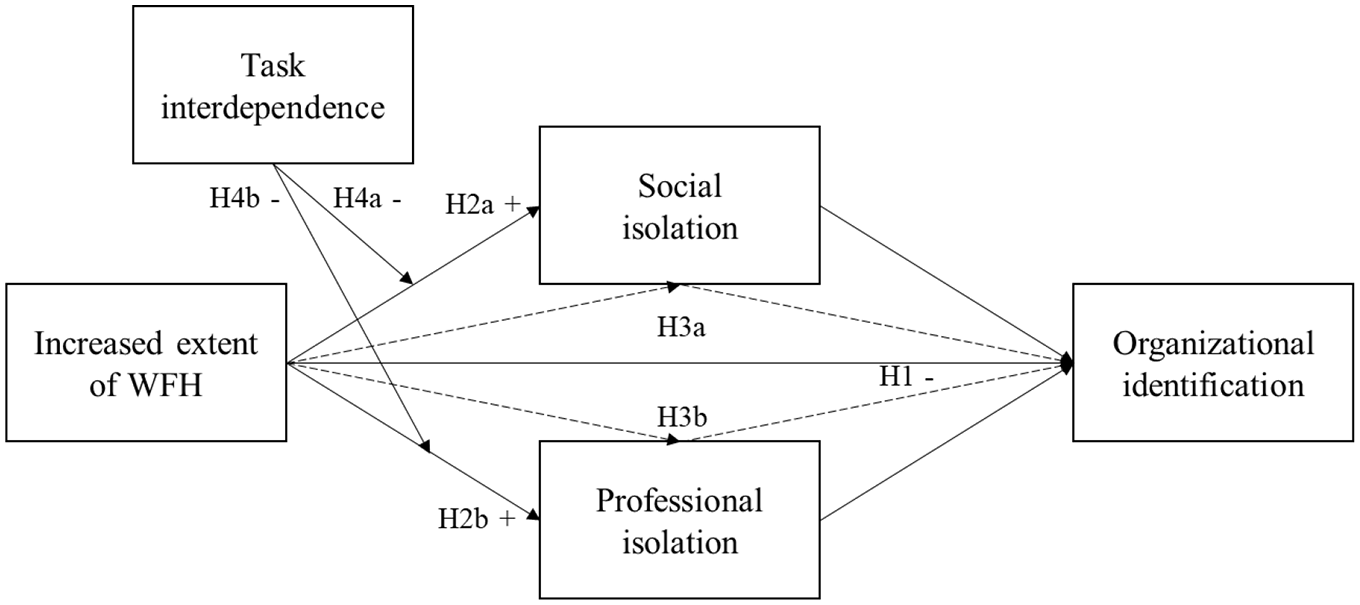
Conceptual research model.
Method
Measures
If not stated otherwise, all items were measured on a seven-point Likert scale.
The extent of WFH
We measure the extent of WFH for each employee based on the studies by Wiesenfeld et al. (1999) and Golden and Veiga (2005), and query the average amount that employees WFH in a working week, which is expressed as a percentage (from 0% to 100%). We asked the participants to indicate the extent of WFH concerning the time before COVID-19 and concerning the current time. The difference in percentage points between these two values became the relevant measure (= increased extent of WFH for each employee, expressed as a percentage).
Organizational identification
We follow Mael and Ashforth (1992) and measure organizational identification using six items. We modified the sentences slightly by changing the school context to a working context, replacing “name of school” with “my employer,” for example, “My employer’s successes are my successes.”
Social isolation
We refer to Marshall et al. (2007) who developed a measurement for social isolation as part of the Workplace Isolation Scale. The measurement consists of five items and describes how employees perceive isolation if the need for casual interactions and friendships is not fulfilled (e.g. “I have friends available to me at work”).
Professional isolation
Referring to the Workplace Isolation Scale again, we measure professional isolation using five items including, for example, “I am part of the company network.” In this instance, the measurement describes the perception of isolation from the company when the need for work-related support is not fulfilled (Marshall et al., 2007).
Task interdependence
This variable also consists of five items (e.g. “I work closely with others in doing my work”) and describes the mutual task interdependence of employees (Pearce and Gregersen, 1991).
Control variables
We included the following control variables for the analysis: age and gender because organizational identity can differ with regard to age and gender (Bailey and Kurland, 2002; Fritz and Van Knippenberg, 2017; Raghuram et al., 2001; Riketta, 2005); volume of employment since full-time employees tend to identify more strongly with the company than part-time employees (Rousseau, 1998); the personal preference with regard to WFH as a generational preference for WFH may exist (Wang et al., 2020); experience with WFH as working from home can be perceived as very positive in the beginning or at a low level (Golden and Veiga, 2005; Raghuram et al., 2001); job satisfaction as there is a tested correlation between the extent of WFH and job satisfaction as well as with organizational identification (Allen et al., 2003). Table A1 of the Appendix shows the measurement of all control variables.
Sample
Data collection took place from the end of August 2020 till the beginning of September 2020. Germany had just recovered from the so called first COVID-19 wave and started to prepare for a second COVID-19 wave of restrictions and lockdowns that was forecasted for the winter months. During August and September 2020 restrictions in terms of social distancing did not vanish, but were loosened. Following previous survey research designs, we followed a convenience sampling approach (e.g. Qiu and Dauth, 2022). The survey was spread via professional networks (e.g. LinkedIn) and also via the authors’ personal networks, targeting employed workers. As new WFH policies due to the COVID-19 pandemic affected a broad range of people in their everyday work routines, we addressed a broad range of possible participants via professional networks to collect representative data and to avoid possible selection effects. Data reduction was needed to eliminate biased estimates due to a small remaining risk of possibly fake participants. After data reduction, the final sample size contained 382 people from Germany. We excluded participants who were not currently in a work relationship (N = 25), who did not answer in a reasonable time (N = 5), and who did not pass the attention check question (N = 23). In such manner, we ensured high-quality answers. The demographic data shows that 57.33% of the sample are women and 42.67% are men. The average age is 33.92 years. Forty-two point nine three percent of the participants have been with their company for 1–4 years; therefore, it is just under a quarter for those who have been with their company for less than a year, and roughly a quarter for those who have been with their company for 5–10 years and more than 10 years. Well over half of the participants are permanent employees, 23.56% of them are in internships or student jobs, and 10.99% of them are in temporary employment.
Results
Model quality indicators
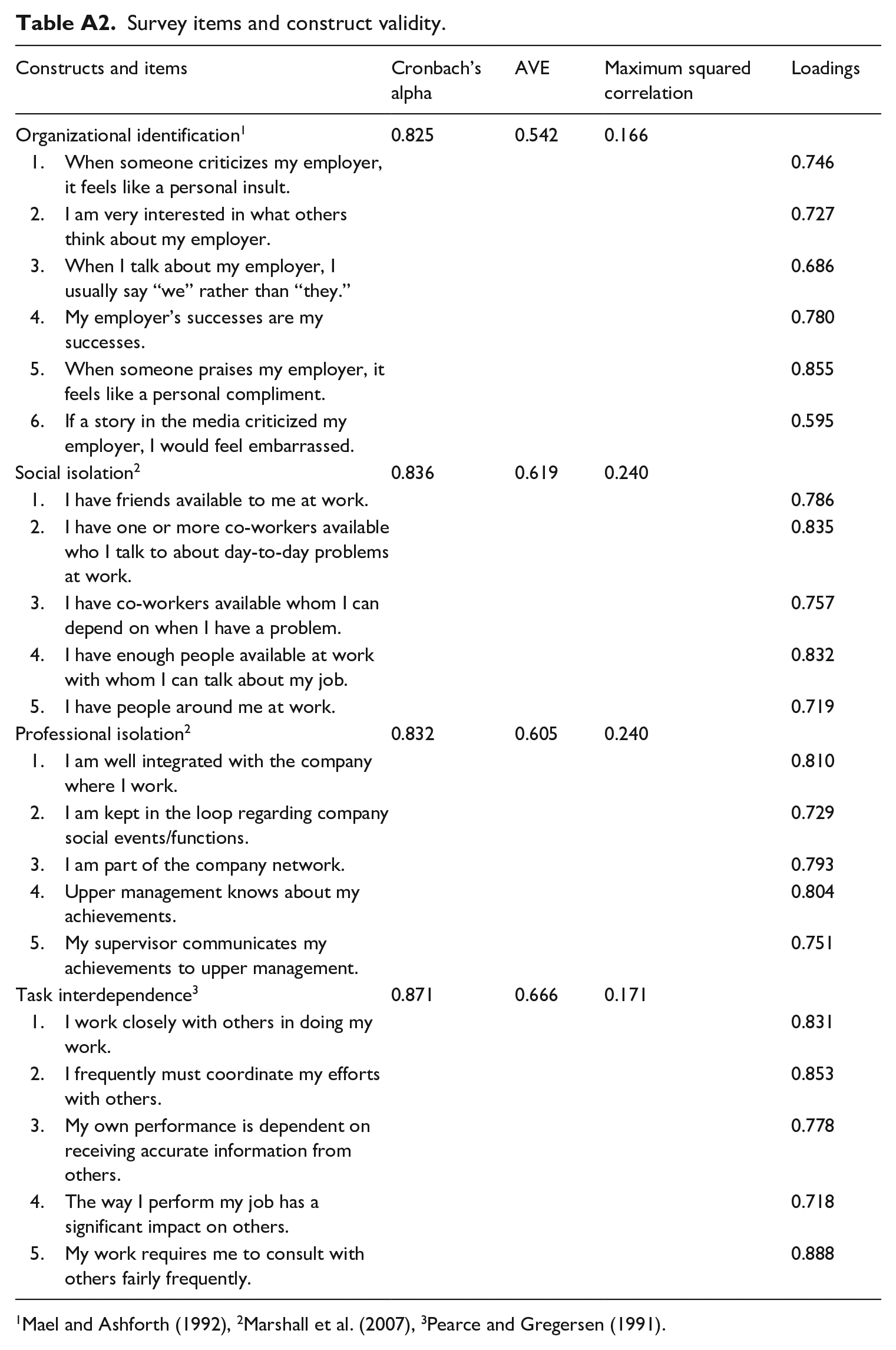
We checked for indicator and construct reliability as well as discriminant validity of our model (Hofeditz et al., 2017). Good indicator reliability is proven through factor loadings between 0.595 and 0.888 (Hulland, 1999). Satisfactory Cronbach’s alpha between 0.825 and 0.871 indicates construct reliability. Our model reveals robust discriminant validity, as the squared correlations per construct are smaller than their matching average variance extracted (AVE) and the AVE is higher than 0.5 (Hair et al., 2012, 2014). An overview of all criteria is presented in the appendix (Table A2). We furthermore set up a complex moderated mediation model to reduce common method variance ex post (Chang et al., 2010). With a total variance extracted of 35.12%, Harman’s single factor test also revealed that there is no problem with common method bias in our data (Podsakoff et al., 2003).
Descriptives
Table 1 shows the descriptive statistics of the variables, including the mean values and standard deviations as well as the correlation coefficients. At this point, Table 1 indicates that there is a negative correlation not only between social isolation and organizational identification (r = −0.348) but also between professional isolation and organizational identification (r = −0.480). The significant negative correlations between social isolation and task interdependence (r = −0.393) and between professional isolation and task interdependence (r = −0.457) already point in the direction of Hypothesis 4. Interestingly, there is only a significant positive correlation between social isolation (r = 0.290) (but not for professional isolation) and the increased extent of WFH.
Descriptive statistics: means, standard deviations, and correlations.
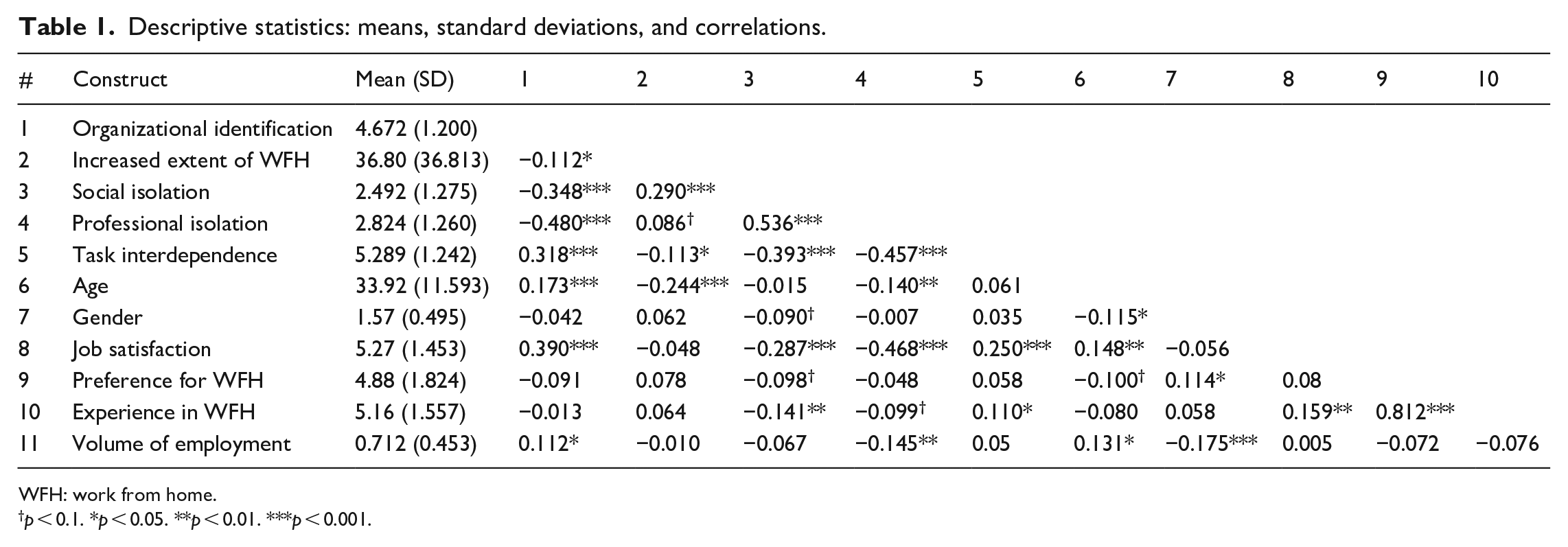
WFH: work from home.
Regression, mediation, and moderated mediation
We calculated multiple regression analyses to test and verify the hypothesized relationships. Results are shown in Table 2. The final Model 7 shows an R2 of 0.310, indicating high goodness of fit (Cohen, 1988). The first hypothesis stated that an increased extent of WFH has a negative influence on organizational identification. The regression results of Model 1 indicate a significant negative relationship between an increased extent of WFH and organizational identification (ß = −0.112; p = 0.028), supporting Hypothesis 1.
Results of regression analyses.
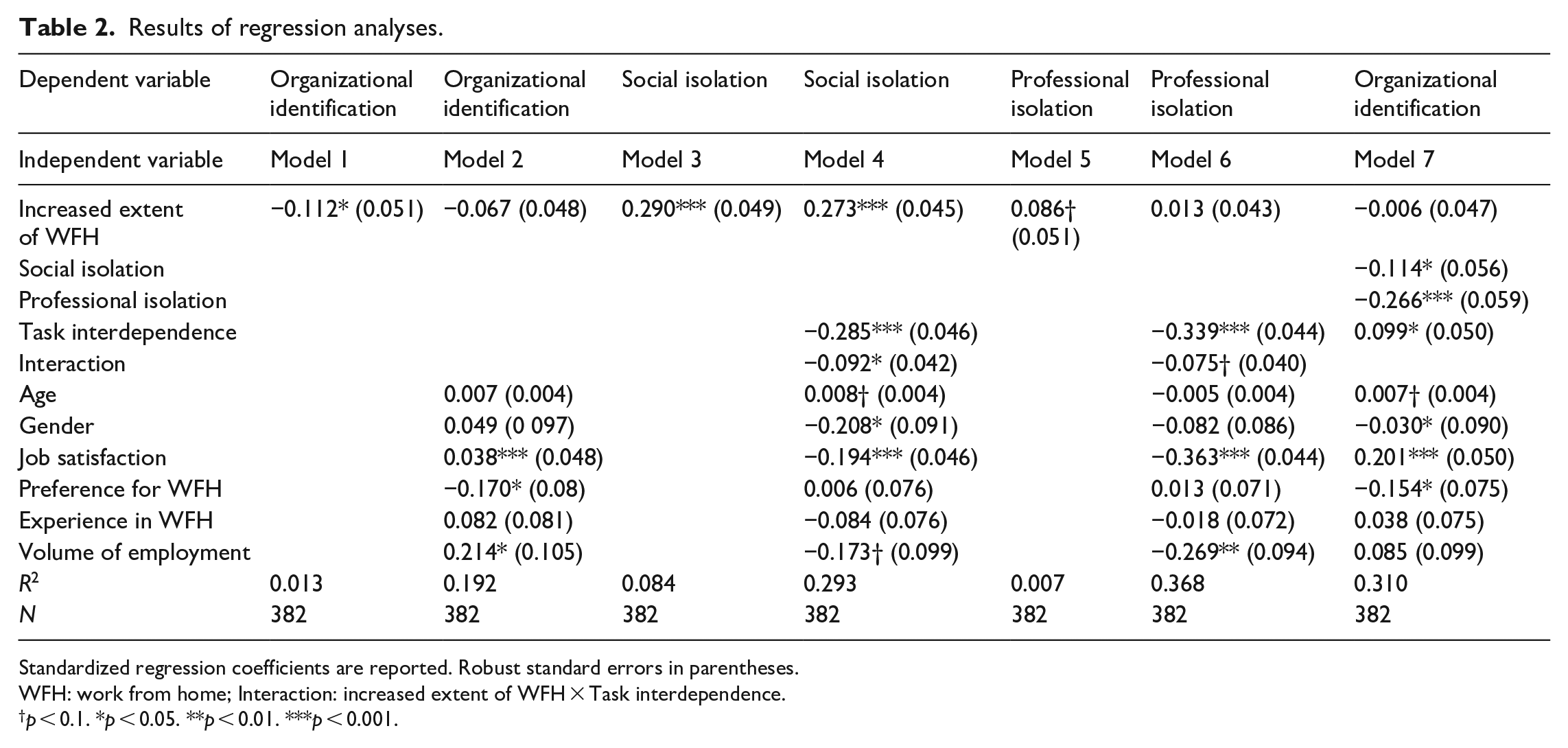
Standardized regression coefficients are reported. Robust standard errors in parentheses.
WFH: work from home; Interaction: increased extent of WFH × Task interdependence.
Hypothesis 2a assumes a positive effect of an increased extent of WFH on social isolation. Model 3 of Table 2 shows the regression result without control variables (ß = 0.290; p = 0.000) and Model 4 with control variables (ß = 0.273; p = 0.000), supporting Hypothesis 2a. In Hypothesis 2b, we expected that the increased extent of WFH would have a positive effect also on professional isolation. This relationship is insignificant without control variables (ß = 0.086; p = 0.095) and likewise insignificant with control variables (ß = 0.013; p = 0.764); therefore, we reject Hypothesis 2b.
Hypothesis 3 states that (a) social and (b) professional isolation explain the negative impact of an increased extent of WFH on organizational identification. Results are shown in Table 3. For social isolation, the indirect effect shows a significant influence (ß = −0.038; confidence interval: −0.077 | −0.001), supporting Hypothesis 3a. For professional isolation, the indirect effect is insignificant (ß = −0.026; confidence interval: −0.060 | 0.009). We therefore reject Hypothesis 3b. Since the total indirect effect stays significant (ß = −0.064; p = 0.020), and the direct effect of an increased extent of WFH on organizational identification becomes insignificant (ß = −0.009; p = 0.853), social isolation fully mediates the effect of an increased extent of WFH on organizational identification.
Results of the multiple mediation analysis.
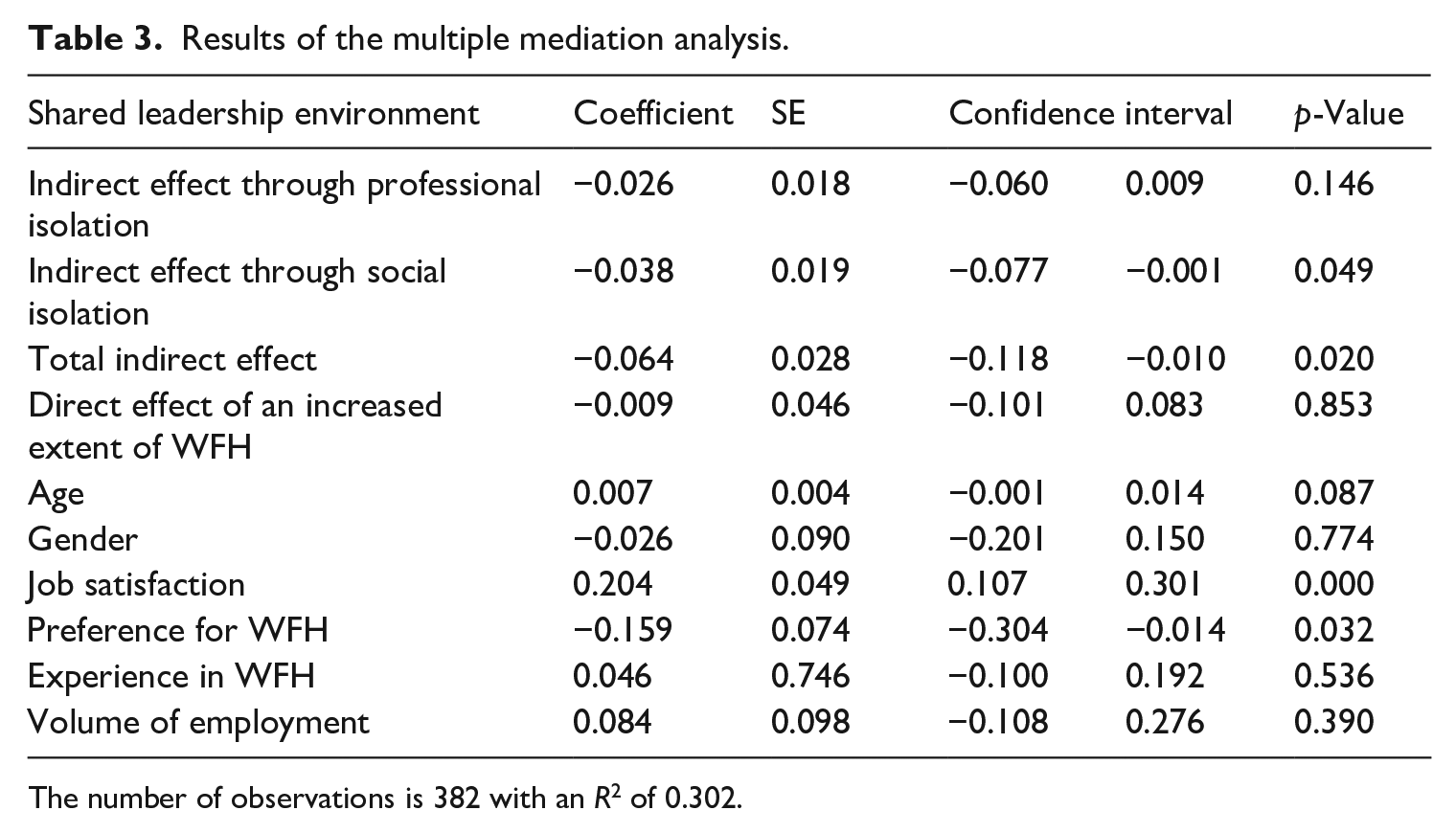
The number of observations is 382 with an R2 of 0.302.
The last hypothesis, Hypothesis 4, postulates that task interdependence moderates the relationship between the increased extent of WFH and (a) social as well as (b) professional isolation. The interaction of an increased extent of WFH and task interdependence has a significant influence on social isolation (ß = −0.092; p = 0.029), which is seen in Model 4 of Table 2 and in Figure 2. However, the interaction has a non-significant influence on professional isolation (Model 6: ß = −0.075; p = 0.060). Consequently, our data supports Hypothesis 4a and rejects Hypothesis 4b.
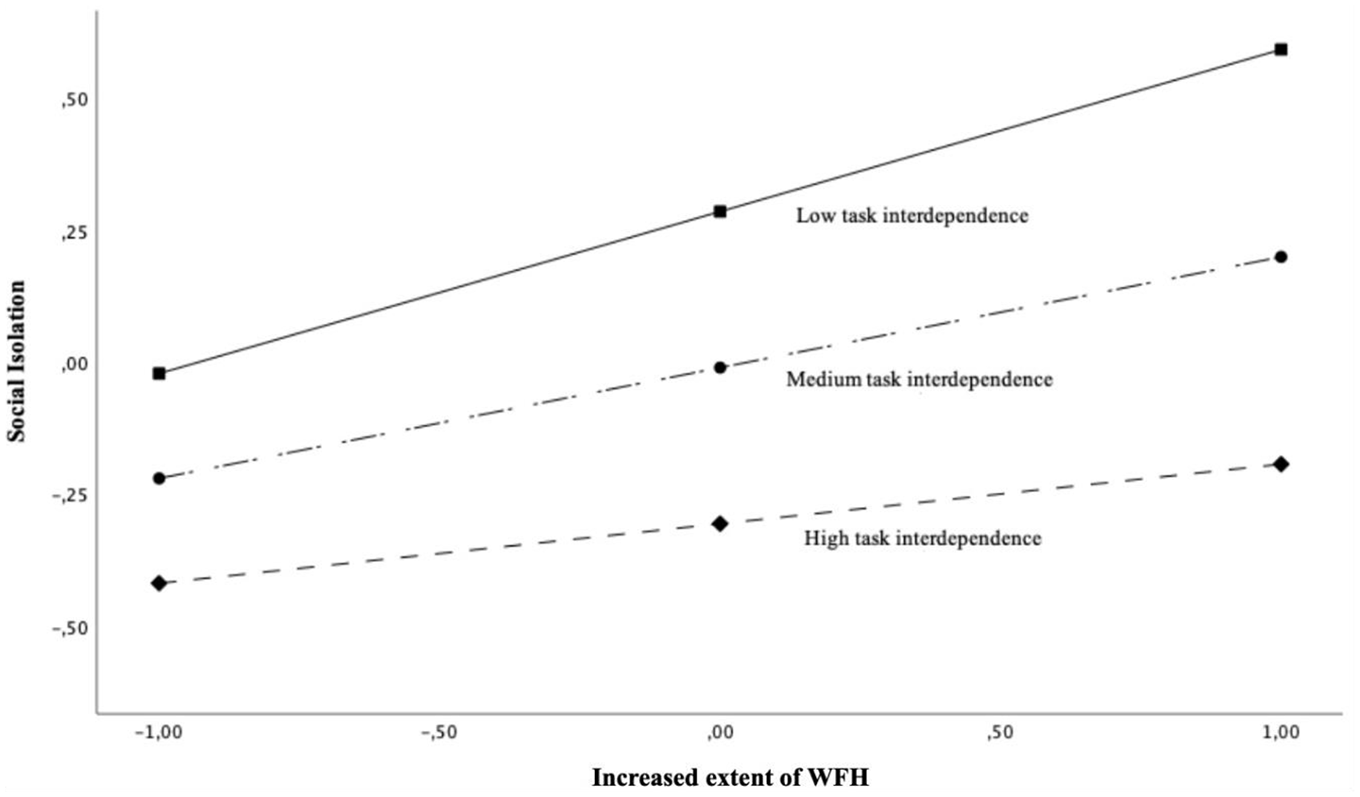
Interaction effect of task interdependence and an increased extent of WFH on social isolation.
Discussion
The results of this study show that an increased extent of WFH decreases employees’ organizational identification. This implies that with an increased extent of WFH and therefore less exposure to organizational identities, employees already feel less connected to the company. Adding to previous research, we show that a greater reliance on WFH during the pandemic compared to pre-COVID-19 times (putting the actual amount worked from home to one side) will show the same effects on the relevant outcome variables. The bond with the company is weakened by missing important rituals and structures at the office, as well as the regular exchange with colleagues, not taking place or taking place less frequently while working at home more often than before. According to social identity theory, frequent absences from the office weaken the sense of belonging (Tajfel, 1974; Wiesenfeld et al., 2001).
Concerning the problem of isolation, the results show that the increased extent of WFH increases social isolation. This means that although new technologies and communication channels exist, they may be primarily used for work-related purposes instead of informal communication. Furthermore, new technologies and communication channels do not have the same quality as face-to-face conversations to maintain a bond with colleagues. Moreover, social isolation or rather the individuals’ need for social interactions (Allen et al., 2003) can explain the negative relationship between an increased extent of WFH and organizational identification. According to social identity theory this implies that socially isolated employees who work from home more often than before strengthen relationships with other identities outside of the organization to reduce relational uncertainties and to fulfill their need for social interactions. This detaches them not only from their colleagues as a social group but also from the company, which decreases their bond (Allen et al., 2003).
Compared to social isolation, we did not find a significant relationship between an increased extent of WFH and professional isolation. We also did not find a significant mediation of an increased extent of WFH through professional isolation on organizational identification. This may be true, because when employees worked at home during COVID-19, their colleagues usually did the same and all colleagues were therefore visible in a similar form. In such manner, employees felt less excluded or disadvantaged in terms of perceived career opportunities (e.g. promotions and other rewards) (Bailey and Kurland, 1999; Kurland and Egan, 1999).
Furthermore, we show that task interdependence significantly negatively moderates the effect of an increased extent of WFH on social isolation such that it weakens the positive influence of an increased extent of WFH on social isolation. This implies that tasks that require a certain degree of coordination are suitable to reduce the negative feelings of social isolation that arise if employees have to work from home more often than they were used to. At the same time, the positive effects of task interdependence at work while working remotely from home have a natural turning point. If the interdependence becomes too high, work demands through more intensified online communication lead to less favorable work outcomes (Stark et al., 2014). Managers need to be aware of this relationship.
Theoretical implications
This study focuses on the increasing extent of WFH for each employee, which was triggered by the COVID-19 pandemic. The results of this study enrich the literature to a significant degree, showing that a positive change toward WFH, measured as an increased extent of WFH, decreases the organizational identification of employees. Concerning social identity theory, the results confirm the assumption that an increased extent of WFH makes corporate values and identities less visible. These employees thus feel less part of the company they work for (Tajfel, 1974; Tajfel and Turner, 1979; Wiesenfeld et al., 2001).
Furthermore, we are able to make two valuable theoretical contributions in terms of defining a clear theoretical foundation for studying relationships between an increased extent of WFH, isolation, and organizational identification. First, we demonstrate the need to combine social identity theory and need-to-belong theory because individuals’ need to belong is directly linked to individuals’ fear to lose social connections and, thus, to lose the identification with the organization (Kane, 2014). This observation becomes especially relevant in the context of the COVID-19 pandemic that has caused employees to face an extraordinary work environment of less social and professional face-to-face interactions (Gao and Sai, 2020). Second, we show that an increased extent of WFH follows the same reasoning as previous research: Previous research has predominantly studied the amount of WFH in terms of days or hours spent working from home but has neglected the effects of the change toward more WFH (i.e., an increased extent of WFH).
Accordingly, also the findings concerning the positive impact of an increased extent of WFH on social isolation are consistent with the findings of previous studies (Bailey and Kurland, 2002; Harris, 2003). The consideration of an increased extent of WFH is of great relevance for further research, due to not only the recent increase in using WFH more often than in pre-COVID-19 times but also due to the potential negative effects of working from home more often on employees’ well-being and employees’ feelings of belonging.
A contribution that has not yet been empirically proven is the mediation effect through social isolation, which illustrates the necessity of appropriately integrating employees into the company when WFH increases. Thus far, only constructs like autonomy, respect, work exhaustion, or work-family conflict have been investigated as mediators. Isolation of employees has rarely been studied (Bartel et al., 2012; Bentley et al., 2016; Gajendran and Harrison, 2007; Golden, 2006). Following need-to-belong theory, the results also show that when isolation is present, regular interactions with colleagues are less actively sought and, consequently, feelings of belonging are lost (Baumeister and Leary, 1995; Golden et al., 2008). We did not find a significant correlation between an increased extent of WFH and professional isolation; this outcome is also partly consistent with other studies (Gajendran and Harrison, 2007; McCloskey and Igbaria, 2003). This finding therefore suggests that a positive change toward WFH does not necessarily lead to fewer perceived career opportunities in the organization.
Task interdependence has already played an important role in the literature on virtual work, as task interdependence increases the effectiveness of virtual teams (Hertel et al., 2004). This study contributes to new insights into the relationship between WFH and isolation, depending on task interdependence. The results show that task interdependence reduces the negative influence of an increased extent of WFH on social isolation. Task interdependence thus becomes an important boundary condition to feelings of social isolation when working from home. This reasoning is consistent with Golden and Veiga’s (2005) study in which task interdependence moderates the relationship between the extent of WFH and job satisfaction.
Practical implications
To minimize social isolation at home, companies should take steps to better integrate these employees into their teams. Companies can achieve this through regular meetings where supervisors offer support and address personal issues (Wiesenfeld et al., 1999, 2001). Meetings are thus not only used for professional, work-related purposes but also to maintain the common bond. However, it is important to ensure that such meetings are held in a balanced setting such that they do not harm the benefits of WFH. Boundaries and expectations should therefore be agreed upon beforehand (Fonner and Roloff, 2012). If possible, employees who frequently work from home should also try to attend occasional face-to-face meetings or change the workplace now and then if they feel only partially involved (Morganson et al., 2010). If companies plan to integrate an increasing extent of WFH, it is also advisable to offer training to all employees and supervisors. Within these training sessions, all parties become prepared for virtual collaboration (Hill et al., 2003; Wiesenfeld et al., 2001).
The significant negative relationship between social isolation and organizational identification points further to the relevance of social support. From previous research we know that social support minimizes the social isolation of employees who work from home (Bentley et al., 2016). Social support has also a positive influence while working from home, for example, on job satisfaction and organizational identification. Accordingly, support from supervisors and colleagues is important to ensure that employees with an increased extent of WFH feel integrated and not left alone. This support is achieved through the appropriate type of communication, which, in addition to the technological equipment, is crucial for mutual exchange. Regular and open communication is particularly important to keep employees up to date (Cooper and Kurland, 2002; Wiesenfeld et al., 2001). Managers should make sure that they pay similar attention to employees who work at the office and those who work at home (Kaufman et al., 2020).
Employees who lose the identification with the organization at the same time lose the glue that connects them to the specific organization. If employees do not feel a sense of organizational connection anymore, they are prone to also become demotivated at work and unsatisfied with their job (Van Dick et al., 2004). Less organizational identification therefore leads to higher turnover intentions (Van Dick et al., 2004), which in turn negatively affect a lasting business success that depends partly on the retention of excellent employees. Especially if employees have to work from home more often, practitioners need to integrate strategies that sustain the employees’ identification with the organization. Exemplary strategies are: improving the reputation of the organization (Zhao et al., 2019); highlighting the unique culture of the organization (Van Dick et al., 2004); spreading the organization saga that reflects the organization’s identity (Cole and Bruch, 2006).
Ultimately, we assume that a high extent of WFH will not remain an exception in the future but will be a frequently used option. In the long term, companies could therefore have a workforce that works partly at the office and partly at home. This hybrid model requires an adapted corporate culture (e.g. Barbour et al., 2021; Cappelli, 2021; Der Spiegel, 2020). If companies do not adapt processes and structures, it can lead to two corporate cultures in which particularly employees who work from home feel increasingly isolated and dissatisfied, and the sense of community is lost. Instead, a common culture needs to be built that promotes social cooperation and provides stability and identity (Alexander et al., 2020). Hierarchies should be minimized to a certain extent without losing focus on defined structures and processes to simplify collaboration (Alexander et al., 2020). Furthermore, the relationship between managers and employees also changes by creating virtual social intimacy, which can happen through managers showing insights into their private lives by video conferencing out of their living rooms (Kaeppler, 2020; Kaufman et al., 2020). This creates trust and promotes similarity, which strengthens group membership.
Another decisive factor is whether WFH is voluntary or involuntary. Organizational identification and commitment are correspondingly higher when people decide for themselves whether they want to work at the office or at home (Thatcher and Zhu, 2006). In the current COVID-19 pandemic, the German government called upon companies to let their employees work from home if possible. At the time of the survey, we thus assumed that respondents were not yet free to decide where to work and therefore organizational identification was negatively affected. The decision for an (abrupt) change toward an increased extent of WFH should therefore be wisely made. For future extraordinary situations that require a sudden shift toward more WFH, and also for general decisions for an increased extent of WFH, the current study demonstrates that communication and connectivity between employees (i.e. colleagues) are crucial.
Limitations and future research
This study is subject to possible limitations and shows promising avenues for future research. We conducted a survey using cross-sectional data. If longitudinal data were to be used to observe how isolation and organizational identification change in the face of the increasing extent of WFH during COVID-19, it would be even more revealing for further discussions. Such causal relationships emerge over time and therefore cannot be certainly identified within a cross-sectional study (Bartel et al., 2012).
Our study took place within a time of an increased extent of WFH due to a global pandemic situation. Within the time of the survey, work was mostly carried out at home; however, meeting family, friends, or even traveling was allowed to a certain degree. We therefore expect that isolation measures of our study are not biased by participants’ private circumstances of feeling socially isolated due to lockdown restrictions. Further research, however, should extend our study and also investigate employees’ private situation in terms of feelings of isolation to determine a possible relation between the private context and the work context.
This survey with 382 participants from Germany represents a convenience sample from which we draw generalizable implications. To be able to make more specific recommendations based on our general results, further studies should deal with, for example, a specific business context or specific industries. Furthermore, studies should not only include German participants to allow transferability to other countries. This approach should be followed, because there may be differences in personal perceptions of isolation between different countries and cultures (Bailey and Kurland, 2002; Belle et al., 2015).
Future research should also consider personality as a possible important moderator. With the help of the Big Five personality factors, future studies should provide new insights into the relationship between personality, an increased extent of WFH, and isolation at work. For example, people with a high degree of openness to new experiences may be better suited to an increased extent of WFH than those with higher degrees of extraversion or agreeableness or low emotional stability (Feldman and Gainey, 1997; Golden, 2006; Wang et al., 2020). In future studies, the personality component may therefore lead to new insights with regard to the appropriate handling of different characters in terms of WFH.
Lastly, the role of job satisfaction in the discussion about WFH, feelings of isolation, and organizational identification provides room for future research. The current study uses job satisfaction as a control variable that demonstrates a highly significant effect on organizational identification. Furthermore, job satisfaction might at the same time be a relevant mediator in our proposed model. Since the discussion about job satisfaction’s effects is still in need of new insights, we encourage future research to follow Qiu and Dauth (2022) and determine job satisfaction’s effects through new perspectives within the virtual work context.
Conclusion
The study aimed to investigate how the increasing extent of WFH due to the COVID-19 pandemic influences the organizational identification of employees. We developed a research model based on social identity theory and need-to-belong theory. The results show that the increased extent of WFH decreases organizational identification and increases social isolation. Social isolation acts as a mediator, explaining the negative influence of an increased extent of WFH on organizational identification. In light of the underlying research questions, the results show that an increased extent of WFH lets downsides of WFH come to light. In line with the two theories used, employees who work from home more often than before (i.e. employees who experience an increased extent of WFH) identify less with the organization and thus search for people outside the company with whom they can interact regularly and thus identify more. The study hereby contributes to the research by delivering valuable insights regarding an increased extent of WFH since the outbreak of the COVID-19 pandemic.
Footnotes
Appendix
Survey items and construct validity.
| Constructs and items | Cronbach’s alpha | AVE | Maximum squared correlation | Loadings |
|---|---|---|---|---|
| Organizational identification 1 | 0.825 | 0.542 | 0.166 | |
| 1. When someone criticizes my employer, it feels like a personal insult. | 0.746 | |||
| 2. I am very interested in what others think about my employer. | 0.727 | |||
| 3. When I talk about my employer, I usually say “we” rather than “they.” | 0.686 | |||
| 4. My employer’s successes are my successes. | 0.780 | |||
| 5. When someone praises my employer, it feels like a personal compliment. | 0.855 | |||
| 6. If a story in the media criticized my employer, I would feel embarrassed. | 0.595 | |||
| Social isolation 2 | 0.836 | 0.619 | 0.240 | |
| 1. I have friends available to me at work. | 0.786 | |||
| 2. I have one or more co-workers available who I talk to about day-to-day problems at work. | 0.835 | |||
| 3. I have co-workers available whom I can depend on when I have a problem. | 0.757 | |||
| 4. I have enough people available at work with whom I can talk about my job. | 0.832 | |||
| 5. I have people around me at work. | 0.719 | |||
| Professional isolation 2 | 0.832 | 0.605 | 0.240 | |
| 1. I am well integrated with the company where I work. | 0.810 | |||
| 2. I am kept in the loop regarding company social events/functions. | 0.729 | |||
| 3. I am part of the company network. | 0.793 | |||
| 4. Upper management knows about my achievements. | 0.804 | |||
| 5. My supervisor communicates my achievements to upper management. | 0.751 | |||
| Task interdependence 3 | 0.871 | 0.666 | 0.171 | |
| 1. I work closely with others in doing my work. | 0.831 | |||
| 2. I frequently must coordinate my efforts with others. | 0.853 | |||
| 3. My own performance is dependent on receiving accurate information from others. | 0.778 | |||
| 4. The way I perform my job has a significant impact on others. | 0.718 | |||
| 5. My work requires me to consult with others fairly frequently. | 0.888 |
Funding
The author(s) received no financial support for the research, authorship, and/or publication of this article.
