



Abstract
In this study, we develop the concept of dirty work by identifying new ways in which it is coped with. Traditionally, studies of dirty work have focused on how physical, social, or moral dirtiness is downplayed or normalized by workers in often physically tough “manual” occupations. We consider psychological dirtiness in work that is “knowledge intensive” and where high occupational status shields the need to protect oneself from stigma associated with dirty work. Based on interviews with management consultants working in stressful jobs in elite professional service firms, we complement the emerging literature on coping with the experience of dirty work by identifying three self-tainting tactics that consultants draw on to accentuate, rather than normalize dirty work: explication, stressing ambiguity, and humor. The motives behind these taint accentuation tactics varied from criticizing the working conditions in the sector, to the opposite, stressing one’s abilities and commitment to potential clients and managers. Where dirty aspects of work have been more psychological, accentuation was used for impression management and as a form of critique. We conclude with a discussion of the wider implications for research and practice, especially in terms of how coping with dirty work is shaped by occupational context, the kind of dirtiness (physical or psychological, social or moral), and the interests of occupational audiences.
Keywords
Introduction
“A young consultant’s life is gruelling. A typical week starts before dawn on Monday, with a rush to the airport and a flight to wherever the client is based. A typical brain-for-hire can expect to stay in hotels at least three nights a week, gorging on minibar peanuts and glumly texting a distant lover. ‘It’s quite normal to spend a year living out of a suitcase’, sighs one London-based consultant. An ex-McKinseyite in New York adds that 15- to 18-hour weekdays are normal and six- to eight-hour Saturdays and Sundays common. It can be draining, she admits” (The Economist, May 11th, 2013).
Dirty work studies have typically looked at extreme work conditions like physical filth, health risks, and noxious work environments of traditional “blue-collar” occupations. Classic examples are garbage collecting (Hamilton et al., 2019) or slaughterhouse work (Ackroyd and Crowdy, 1990). In such studies, occupational stigma has been attached to the extreme and unattractive physical work conditions like the smell of garbage or working amidst the blood of dead animals. However, in his seminal research from 70 years ago, Hughes (1951, 1958) maintained that there is some dirty work in all occupations. Therefore, today’s “knowledge intensive” work should be no exception. Indeed, the extreme physical and in particular the mental demands of work in occupations such as banking (Michel, 2011), accounting (Morales and Lambert, 2013), and consulting are increasingly recognized as problematic (e.g. Alvesson and Einola, 2018; Blagoev et al., 2018; Costas and Kärreman, 2016; Stein, 2017). Indeed, consultants themselves highlight the physical and psychological stresses of their work (see Gill, 2015; Mühlhaus and Bouwmeester, 2016), the sacrifices of their work-life balance (Bouwmeester et al., 2021; Noury et al., 2017), and the consequences for their physical and mental health (O’Mahoney, 2007).
While not all demanding work, whether physically or psychologically, is tainted, we shall argue that the demands and mental health risks of these “gold collar” jobs lead to them being seen as dirty by the workers themselves. The “dirtiness” may not be as visible as actual, physical dirt, or the dangers as obvious as when a butcher is carrying a scar or missing a finger (Meara, 1974), but its dirtiness is experienced and shared. However, as Ashforth and Kreiner (2014) argue, not all dirty work carries the same strong stigma, as it can be socially protected by a “status shield.” Firefighting for instance, belongs to the list of dirty occupations given its noxious work conditions and the severe health risks (Tracy and Scott, 2006), but is also held in high esteem, with workers often respected for their courage, and hardly anyone will consider this profession stigmatized. Such esteem is, of course, also evident in some non-manual occupations. Indeed, working as a management consultant, especially in an elite professional service firm, is regarded as glamorous in many contexts, notably among business communities and MBA students (Alvesson and Robertson, 2006; Rivera, 2016). Nevertheless, we shall show that consultants and their close family portray the work as physically and psychologically extreme to an extent that it becomes dirty, and that it “wounds one’s dignity” (Hughes, 1951: 319).
How workers cope with such feelings around negative social judgments is an important theme within research on dirty work. For example, and again, building on Hughes (1951, 1958), recent studies have emphasized how, through various tactics, workers in dirty occupations try to play down or normalize the experience of the occupational stigma to protect their professional identity and self esteem (Ashforth et al., 2007, 2017). We seek to develop this research, by revealing how coping responses to an extreme work context can be different if stigma is shielded by status, as for high status workers, or if work related health issues are not always visible, as with stress or burnout. In such cases, self-esteem may be less under pressure even if the workers themselves feel their work is dirty. Therefore, we seek to address the question how management consultants in high status firms experience and cope with the dirty aspects of their work.
Our contribution to the dirty work literature is threefold. First, we add to previous work which identified how actors adopt various coping strategies to normalize or deny taint (see Ashforth and Kreiner, 2014; Ashforth et al., 2007; Dick, 2005; Hamilton et al., 2019; Tracy and Scott, 2006). In the context of a relatively high-status occupation, we found taint accentuation practices next to normalization. Accentuation practices give further impetus to the idea that a judgment of dirtiness is co-constructed by the workers themselves (see Goffman, 1963; Huey and Broll, 2015; Hughes, 1958; Meisenbach, 2010). Furthermore, we see indications of coping strategies varying with context, such as coping with health threats through accentuation (cf. Emerson and Pollner, 1976). In addition, we demonstrate that normalization is not the only way to manage professional identity. While normalizing when convincing family, friends, or junior consultants that work demands are just part of the deal, consultants accentuate when convincing a client or manager of their strong commitment and high performance. Therefore, what feels socially unacceptable for consultants themselves or their close relatives, is at the same time, commercially attractive to clients. In these specific social contexts, accentuation can contribute positively to professional identity construction, thus nuancing what earlier studies have concluded (cf. Ashforth et al., 2007; Morales and Lambert, 2013).
Second, we argue that the dominant conceptualization of occupational taint as comprising three (physical, social, and moral) types of taint is incomplete (see also McMurray and Ward, 2014; Rivera, 2015) in omitting psychological dimensions. In our illustrative case, we show how the extreme psychological demands and mental health effects in consulting trigger social constructions of dirtiness within the family context, among friends and colleagues and on social media. That consultants and their management also respond with normalization in particular contexts, is a further indication for the experience of psychological taint.
Third, by identifying a psychological dimension of occupational taint and associated accentuation strategies, we also offer a contribution to the consulting literature. Here, while there is recognition of the physical and psychological pressures of the work and of the social stigma associated with moral failures (Costas, 2013; Gill, 2015; Mühlhaus and Bouwmeester, 2016; Muhr et al., 2013; O’Mahoney, 2011; Stein, 2017; Sturdy, 2009), the psychologically dirty nature of consulting has been neglected. Indeed, dirtiness contrasts with the industry’s outward presentation of itself and of its career opportunities in websites and other forms of publicity as challenging, but heroic and glamorous (see also Kumra and Valsecchi, 2013). As we shall see, these occupational ideologies clash with consultants’ own perceptions, contending that “it is not like that.”
Dirty work, and the impact of status shields
The term “dirty work” was coined by Hughes (1951) as work that “may be simply physically disgusting. . .. a symbol of degradation, something that wounds one’s dignity” (p. 319, emphasis added). He was very clear in arguing that it “is found in all occupations” (Hughes, 1951), but since then, it has been typically associated with particular jobs, those where one might ask “how can you do it?” (Ashforth and Kreiner, 1999). Indeed, many dirty occupations are also stigmatized (Bosmans et al., 2016: 54), but the relationship between dirty work and stigma is complicated. Firstly, in some occupations, only particular aspects of the work might be experienced as degrading to the extent that it is not stigmatized overall (Kreiner et al., 2006; Meara, 1974). Secondly, unlike with some stigmatized groups in society (e.g. criminals), stigma in work does not always coincide with negative discrimination (cf. Link and Phelan, 2001). Rather, as noted above, dirty occupations can be protected by “shields” which vary according to job function—a “necessity shield” for garbage collectors or a “status shield” with animal researchers or firefighters (Ashforth and Kreiner, 2014: 84; Tracy and Scott, 2006: 18). However, it is also important to highlight the anthropological notion of how any social judgments, positive or negative, like taint, are context specific (Douglas, 1966). Mud for example, might be seen as desirable (as with a mud bath) or necessary (as a building material). Likewise, the job of butcher is more likely to be dirty for the vegetarian than for the chef. Equally, dirtiness can change over time, as we have seen with banking, once often seen in high regard, but since the financial crisis, morally stigmatized by many (Vaast and Levina, 2015). Similarly, class hierarchies can color stigma and taint such as downplaying unpleasant or unhealthy physical characteristics of “non-manual” work, much as the cognitive features of much manual labor were—there are now fewer dirty blue-collar jobs (Braverman, 1974; Lockwood, 1958). What all dirty jobs still share is that aspects of the work are socially evaluated as undesirable or degrading, and that workers may internalize such judgments.
Following Hughes (1951, 1958), research has developed the concept of dirty work by differentiating its form into moral, social, and physical taint. Morally tainted work is associated with practices considered by some as either of dubious virtue (e.g. a male/female stripper) or that are “deceptive, intrusive, confrontational, or that otherwise defy norms of civility” (Ashforth and Kreiner, 1999: 415), such as clairvoyants, used car sales people, gun store owners and sometimes including management consultants or bankers. Work can be socially tainted either because it seems to involve a servile relationship with a superior like shoe polisher, maid, or domestic worker (e.g. Anderson, 2000; Bosmans et al., 2016) or because it requires engagement with a highly stigmatized group in some cultural settings, as with people working in psychiatric institutions (e.g. Emerson and Pollner, 1976). Work can be physically tainted when it requires immediate exposure to objects, materials, or conditions considered dirty or abhorrent in particular social contexts, as experienced by slaughterhouse workers, butchers, or garbage collectors (e.g. Hamilton et al., 2019), or when performed under noxious or dangerous conditions (e.g. soldiers, miners, or firefighters). All these different kinds of taint can co-occur. For example, studies by O’Donnell et al. (2011) on abortion work and by Tyler (2011) on sex shop work highlight elements of physical, social, and moral taint combined. Aspects of the work that can be assessed as below standards of social acceptability are thus: physically tainted by criticizing health risks or physical dirtiness; socially tainted in criticizing the status position of a worker or of his/her clients; or morally tainted, criticizing the moral impact of an occupation.
Recently, new forms of taint have begun to emerge or be observed, with a psychological, or more specifically, emotional dimension, especially with the growing interest in emotional labor (McMurray and Ward, 2014). Rivera (2015) for example, has recognized emotional taint in some tasks of the US border patrol, when meeting refugees in difficulty. This shift in focus away from manual occupations and from moral, social, and physical forms of taint raises wider questions about other forms of work and taint. For the likes of consultants, lawyers and accountants, physical demands are reflected in a sedentary existence, “sick building syndrome” or frequent travel, but also high work pressure, extreme flexibility demands, and high levels of uncertainty. These conditions also pose health risks, analogous to those from traditional physical threats in manual labor associated with dirtiness (see Ashforth and Kreiner, 2014: 84). In consulting for instance, health risks are evidenced by high burnout rates and other stress-related diseases where psychological strain can turn into physiological conditions. These extreme work conditions are well documented in management research (Aghaz and Sheikh, 2016; Gill, 2015; Meriläinen et al., 2004; Muhr et al., 2013) and in health journals (Bouwmeester and Kok, 2018). They are also observed in the popular media such as Internet forums, novels, and TV series (see Kihn, 2012; Kumra and Valsecchi, 2013; Röggla, 2004) and complained about by practitioners in autobiographical accounts (O’Mahoney, 2007; Stein, 2017). Distinct from the criticism of consulting as sometimes unethical or morally tainted (Krehmeyer and Freeman, 2012; O’Mahoney, 2011), these accounts highlight the occupation as not only mentally draining, but also as wounding of consultants’ dignity. Psychological taint can thus be seen as analogous to physical taint in the sense that psychological functions of the body are harmed through the work to such an extent that it provokes a social judgment that the work is below standards of social acceptability in the eyes of insiders and/or outsiders.
Coping with dirty work: Beyond normalizing
Dirty jobs are typically assumed to threaten workers’ ability to maintain a positive social (e.g. occupational) identity and thereby to hamper job performance and commitment. Thus, workers and their managers may seek to lessen or “neutralize the impact or salience of the taint or of the attributes of the work that render it seemingly dirty” (Ashforth et al., 2007: 158). Four types of these “normalization tactics” have been identified. We briefly take each of these in turn. The first is referred to as occupational ideologies, which transform the meaning attributed to a dirty job by reframing, refocusing, or recalibrating it (Ashforth and Kreiner, 1999: 421–423). Reframing aims to transform the meaning attached to stigmatized professions by infusing the work with positive value or a “badge of honor.” For example, funeral directors highlight their role in helping people cope with their loss, rather than being identified with death or profiting from it (Thompson, 1991). Through recalibrating, the evaluative standards of dirty work can be adjusted. In garbage work for instance we can see a shift from garbage collection as simply dirty into a valuable means of recycling (Hamilton et al., 2019). With refocusing, the aim is to shift attention away from the stigmatized properties of an occupation. Tracy and Scott (2006) for example, refer to correctional officers who highlight their high salaries. The second type of normalizing is through the establishment of social buffers such as creating an in-group identity and insulating members from the pejorative views or identity threats of the out-group (Ashforth et al., 2007: 160). Stigmatized sex shop workers for example, sometimes hide their profession from family or friends (Tyler, 2011: 1489). The third form is through confronting, where the taint perceptions of the client or the public are challenged with the “reality” of an occupation (Ashforth et al., 2007: 161). For example, Bosmans et al. (2016: 58) show how domestic workers, who were stereotyped as poorly educated, demonstrated their qualifications. The fourth means of normalization identified in the literature is the use of various defensive tactics. Ashforth et al. (2007: 162–166) identify seven of these such as avoidance, black humor, acceptance (resignation), advantageous social comparison, condemning condemners, blaming others (clients), and distancing from work role in an effort to separate their personal identity from the stigmatized aspects of their professional identity.
In summary, the main practice identified in dirty work research has been that of playing down or reducing the experience of taint and the worker’s own perception of attributed stigma. Indeed, the very attempt to deny the feelings of such assigned work-related dirtiness “suggest(s) there is something out there to avoid” (Link and Phelan, 2001: 378; also Goffman, 1963: 16). We can thus define work dirtiness more generally as co-constructed social judgments shared by outsiders and/or insiders about negative physical, social, moral, or psychological aspects of the work, where neutralization or normalization attempts figure as an indicator of the insider experience of such social judgments. However, we have already noted how stigma can be shielded such that status loss or discrimination do not occur. In other words, when protected by status, one might wonder what actually remains of the salience of stigma, as status loss (one of its key attributes) is neutralized (cf. Link and Phelan, 2001). As a consequence, we can see how dirty work is not necessarily always associated with social stigma (cf. Ashforth, 2019) and imagine that the coping strategies of those in high-status occupations or those where low status is otherwise shielded might be different from those experiencing strong stigma.
Certainly, there are some indications or mentions in the literature of contexts where normalization was less evident. For example, Meisenbach (2010: 271) contends that constructing a stigma requires participation of both non-stigmatized and stigmatized individuals. Indeed, Hughes (1958: 50) in his early studies showed how janitors could be “bitterly frank about their physically dirty work” (also Bosmans et al., 2016: 57). Likewise, Goffman (1963: 45–47) noted that the learning process of recognizing that you carry a stigma always involves self-stigmatizing, together with the discovery of what is considered “normal” in society. This might apply to the experience of dirtiness of work as well, explaining why domestic workers or janitors can become self-derogative (Goffman, 1963: 18).
A second observation is that normalization might not always be the favored response. For instance, Huey and Broll (2015) report the case of criminal investigators who stressed the dirtiness in their work because they felt that the public image of their work, derived from romanticized TV crime dramas, needed revising. Likewise, Emerson and Pollner (1976: 253), wondered in their study of psychiatric emergency workers if rationalization [normalization] was the only response to taint, or if there was “a different order of solution [which] seeks to retain the integrity of the work”? Acknowledging or criticizing dirtiness can give a more honest picture of what work really entails, and it might be a first step needed for acting on particular triggers of taint. Rivera (2015: 220), in a study of U.S. border patrol agents, suggested that engagement with emotion and acting “friendlier or [more] compassionate” could be a more effective response than normalization, as they were criticized as being cold, distant, and emotionless. Given such observations or reflections in diverse studies, often in passing, we seek to question the persistent assumption that normalization is a worker’s default response to a dirty work experience. We do so by focusing on a group shielded by high status—management consultants in elite firms—and how they experience and cope with the overly demanding aspects of their work.
Methods
Research context—Consulting as dirty work
In response to an increasing number of observations in research on management consulting work, our original focus was on dirty work perceptions related to its physical demands. As noted earlier, these demands can include frequent traveling (Costas, 2013), performing repetitive computer tasks, and working long hours with conflicting deadlines that result in a challenging work-life balance (Noury et al., 2017) as well as psychological conditions of stress and burnout (Aghaz and Sheikh, 2016; Morrell and Simonetto, 1999), in a still male dominated setting (Gealy et al., 1979). Of course, a job being physically or psychologically tough, or individual complaints, do not necessarily mean that it is also dirty. Dirtiness is a social evaluation (Simpson et al., 2012) and indeed, there are indications of this in popular and social media, and not just in relation to its morally tainted position. For example, scathing remarks and critical jokes on the Internet and in the TV series House of Lies about consultants’ work-life balance (also Kihn, 2012) are common, along with published reflections of consultants revealing the work as not just demanding, but dirty. As an example, we examined a prominent consulting Internet forum (www.forum.top-consultant.com). While this source is, of course, partial, the many comments made about the negative impact of traveling and work unpredictability on social life indicate the same dirty aspects: “To put it bluntly, a lot of people leave consultancy because of unreasonable travel demands” (Entry, 2016) or: “Yes, you will lose a lot of friends in the process - if you hardly ever see them, it’s inevitable!” (Entry, 2008). However, it is important to highlight that we do not intend to claim that management consulting is a dirty occupation overall. Rather, we follow others (e.g. Baran et al., 2012; Kreiner et al., 2006) who consider certain aspects of work as tainted.
Data collection
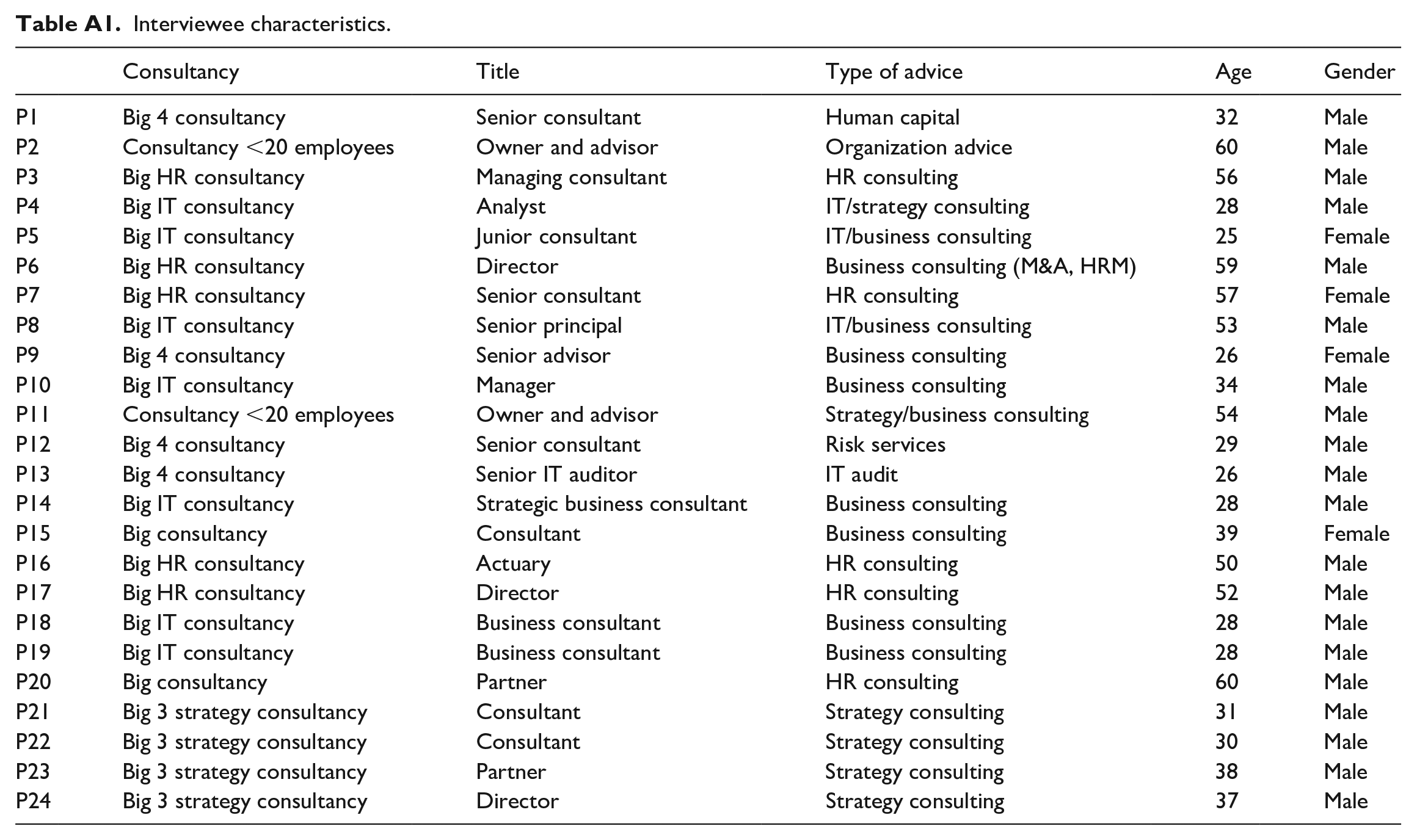
In keeping with previous studies on dirty work methodologically (e.g. Ashforth et al., 2007; Bosmans et al., 2016), we opted for a qualitative semi-structured interview study. We at first set out to study theoretically how consultants experienced their work and how they coped with the high demands of the occupation, which soon became a more specific focus on dirty aspects such as those socially constructed through the popular media (e.g. Internet jokes). Respondents were targeted through the authors’ network in the Netherlands (where consulting use is high), and subsequently through convenience and snowball sampling. To allow for some variation, they were selected from different levels of seniority (i.e. different job roles) and from strategy, business, IT, and HR consulting. A key aim was to focus on those working in elite and international firms where the status of consulting work is highest (Harvey et al., 2017) such that a closed quasi-professional labor market is said to exist within the wider and more diverse field of consulting (Kipping et al., 2019). Selected interviewees were from the “big 4” firms and the “top 3” strategy houses as well as leading IT consulting firms and some others, as summarized in Table A1, Appendix 1.
In recognition of the socially or co-produced nature of dirty work, we opened each interview by showing parts of two critical jokes and a meme (e.g. a compilation of pictures telling what consultants are believed to do) found on the Internet. They illustrated some dirty aspects of their work that are publicly criticized: the lack of sleep, working odd hours, working abroad, etc. (see Table 1).
Jokes to start the interviews.
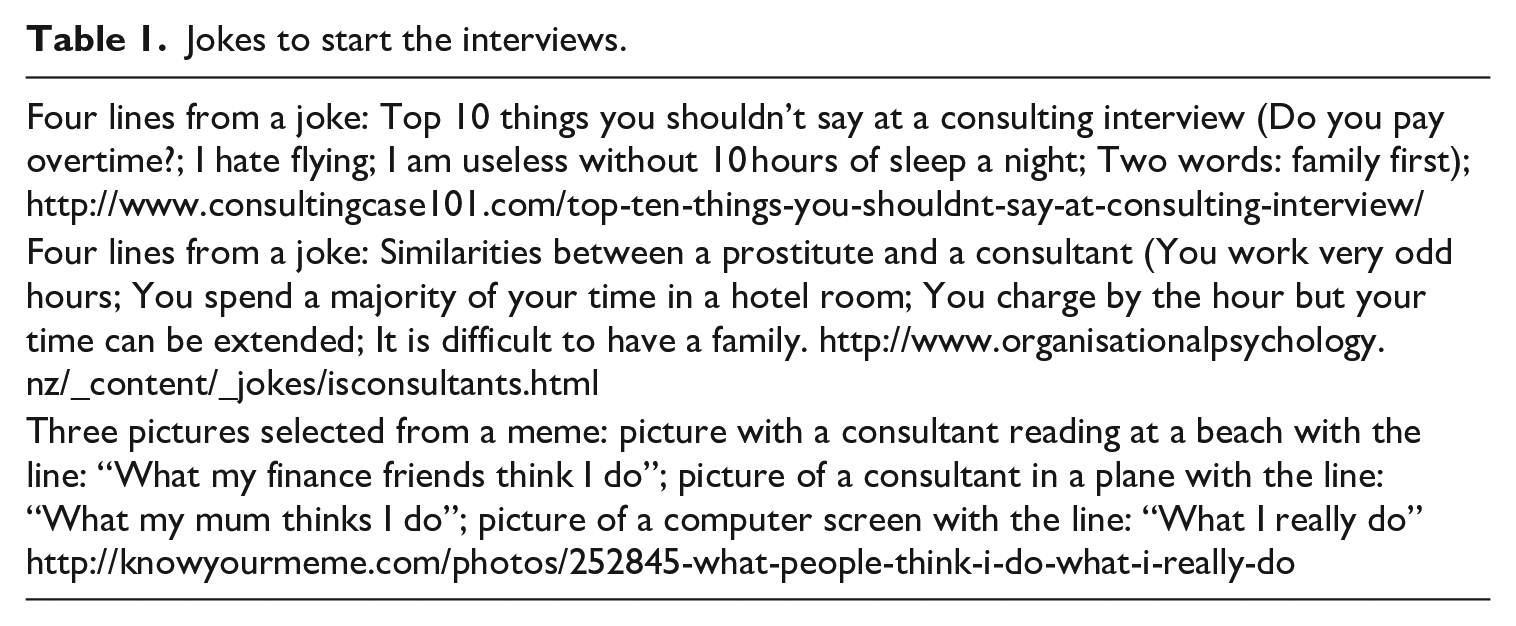
After giving respondents some time to look at the jokes and the meme, we asked them to reflect verbally on what they had observed. They were able to associate freely and sometimes recognized parts based on their own experiences, while other elements were denied as too extreme or not relevant to them. Interviewees were also invited to discuss and illustrate what responses and views they got from their immediate social environment (i.e. family, friends, colleagues) in relation to traveling, work hours and pressures, and any other experienced work threats and how they managed them. Initial responses often illustrated normalizing, but when making the question more personal: “what aspects make the work most taxing for you?” conversations could move in a different direction, including accentuation responses and explanatory reflections related to the work context.
Given that the use of jokes in research interviews is not conventional and may even be considered as a form of “leading” or distorting question, it is important to reflect on and explicate the research context further. Firstly, at a general level, all forms of question “lead” respondents in some way (Cicourel, 1964) and the use of prompts and directed questioning is not uncommon in order to provide research focus (Dohrenwend and Richardson, 1964). What is important is to make the nature of the prompting explicit and consistent (Alvesson, 2003). More specifically, and as already intimated, we used jokes as reflective of the socially constructed nature of dirty tasks rather than seeking to establish its objective or individually subjective existence. Furthermore, they served as an ice breaker from a source distant from the interviewer (the Internet), and similar devices have been used in organizational research addressing potentially sensitive, shameful, or emotional subjects (Sturdy, 2003). At the same time, we were careful to emphasize how respondents may or may not see relevance in the jokes and they were encouraged to make their own interpretations of them. For example, by sharing their memories of experiences as activated by the jokes, they could indicate which ones best illustrated their working life and which ones were either less relevant or not at all applicable (cf. Zaltman, 1997). Other contextual features were also important such as the fact that the interviewer, our second author, could position herself as a novice to the profession, making her a future insider more than a critical outsider as the other authors might have been. Finally, interviewees gave their informed consent, were offered anonymity and have all approved their own transcripts. The interviews had an average duration of 46 minutes, ranging from 23 to 77 minutes.
Data analysis
In keeping with an aim of theoretical development (Cornelissen and Durand, 2014), we started the study with an assumption that there might be parallels between well-known dirty work experiences related to illness and health risks in blue collar jobs and similar, yet unknown experiences related to health risks in white collar jobs. Accordingly, our initial focus in the interviews was on the experience of work dirtiness related to physical hardship, but in the responses the psychological element of hardship became a central theme.
Interview transcripts were coded iteratively by the first two authors using the qualitative software package Atlas.ti. Discussions took place in between rounds of coding to validate or correct interpretations and codes. Our approach was open and inductive in relation to emergent themes (e.g. psychological taint, accentuation tactics, and the given reasons for accentuation). Coding was more deductive and closed when applying existing labels to our data (e.g. normalization tactics) and abductive when integrating these findings. However, we started with an open-coding strategy (Corbin and Strauss, 1990) focusing on examples of physical taint experiences reported by consultants.
Following Hughes’s (1951) position on dirty work, we identified work stressors as tainted when there were indications of disgust, degradation, wounded dignity, or other negative social judgments toward the work. This dirtiness was also revealed when a consultant spoke about friends/relatives’ negative judgments regarding their job. For example, a quote of a consultant canceling an appointment with friends was coded as tainted, as he explained his friends jokingly “sent me derogatory pictures, giving me the middle finger” (Consultant 18). Dirtiness was also revealed when the consultants collectively indicated negativity toward a particular aspect of their work. When coding shared experiences of dirtiness, we soon discovered that the distinction between physical and psychological taint in consulting can be quite slight. We therefore decided to code physical taint as related to the body, such as negatively evaluated tiredness, body pains due to being trapped in cars or airplanes, or sleep deprivation due to working late that was discussed as socially undesirable. We coded psychological taint when feelings were negatively evaluated, such as loneliness, shame for not keeping promises, and forms of emotional instability. Clearly, these shared negative evaluations also highlight how taint is socially constructed.
Having identified the different forms of taint experienced, we then coded instances of how the taint experience was managed and coped with, starting with identifying the four normalizing tactics outlined in the dirty work literature as discussed earlier. For instance, the following quote was coded as a defensive tactic involving social comparison: “For consultants in other countries traveling is much worse” (Consultant 23, original emphasis). Here, the coping intent was seen as softening the experienced social judgment of dirtiness for oneself. However, and as we set out in detail below, we also found self-tainting responses, and coded these as “taint accentuating” tactics. Accentuation not merely describes taint, but tainted aspects are accentuated for a reason. Therefore we coded accentuation as coping attempts complementary to normalization tactics, and we coded the reported or implied motives related to accentuation (see below).
We found three main types of accentuation: taint explication, stressing ambiguities, and humorous accentuation. “Taint explication” was coded if we saw the exact opposite of a normalization tactic, like reverse social comparison by arguing others are better off, having the opposite effect of normalization. An example of a quote coded as “stressing ambiguities” is: “They give you a lease car and that is nice. But it is also an excuse to send you everywhere. So how much fun is it to get a lease car?” (Consultant 19). Typically, responses that included a “but” or “also” signaled two sides and stressed ambiguity, which differs from the idea of normalization. In the case of “humorous accentuation” the coded text contained words indicating consultants were smiling, joking, laughing, making fun, etc., together or with friends and family, and we found again explication and stressing ambiguity.
Based on the contrasting effects of normalizing and accentuation tactics, we then coded consultants’ motives relating to accentuation. This was done through the motives expressed directly by interviewees, the contexts and audiences they articulated, and by comparing how they were different from normalization motives reported in the literature. Figure 1 foreshadows our results and summarizes how all our codes and categories relate. In gray is presented what we mainly base on existing literature, in black what we add.
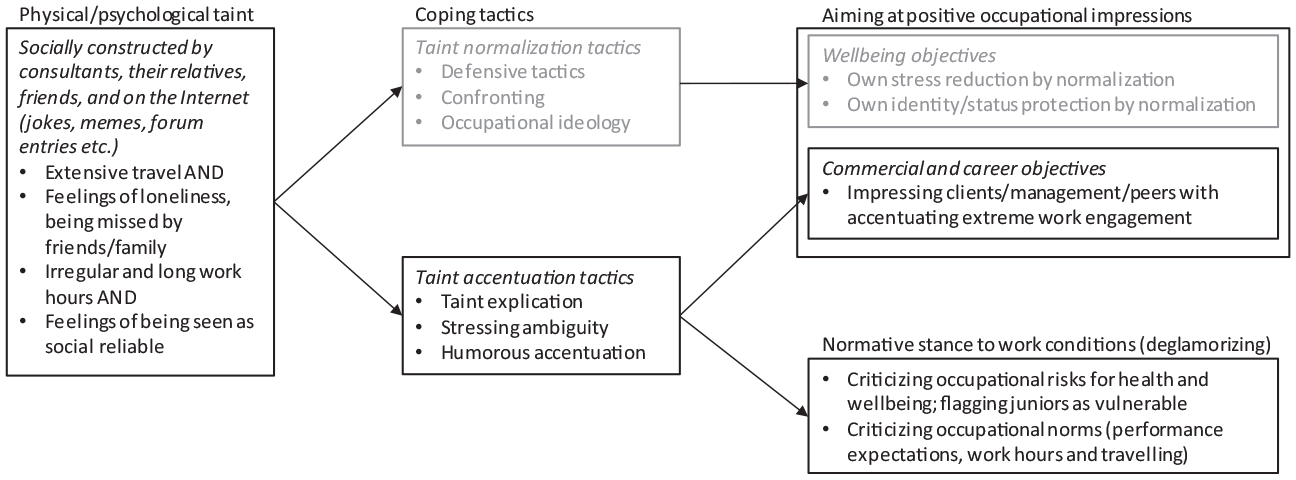
Reported occupational taint, coping tactics, and related aims.
Findings
Mapping the dirty elements of consulting work: Adding psychological taint
Our respondents set out what might, metaphorically, be considered as the noxious conditions of 21st century knowledge work. That is, consultants feel that extensive travel, long periods of absence from home, the irregularity of the job, and long work days are not just extreme, but also add “dirtiness” as they receive a negative social judgment. For instance, constant availability is considered a dirty aspect of the work of consultants: “As long as you are awake, you are supposed to be available for work. There is no longer a dividing line between work and personal time. This places a humongous pressure [on consultants]” (Consultant 3). Table 2 gives some more examples of critical judgments related to doing work far away, coded as “place,” next to the much criticized unpredictable work rhythms in consulting, which we coded as “time.”
Consulting as a physically and psychologically tainted profession.
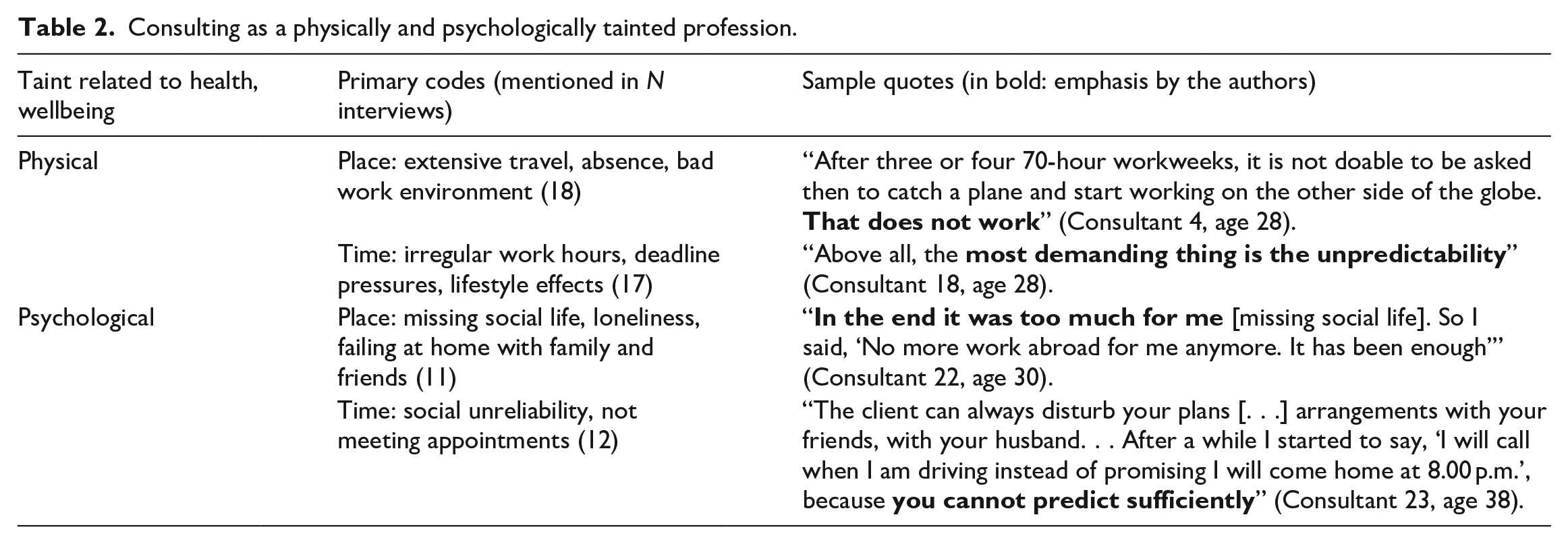
However, and for our study of particular importance, consultants point out the psychological implications of such challenges of constant and unpredictable travel: “the day that I heard my travel schedule had changed, I was very upset and irritable” (Consultant 4). The illustrated psychological pains also derive from being sent away from home, and feeling alone: “during the week you just miss your life at home” (Consultant 9). In addition, the demanded flexibility makes you unreliable as a friend and/or partner, which, again, is considered problematic for a consultant’s psyche: “What I consider tough is the social unreliability” (Consultant 23). Consultants say to disappoint friends and family by rescheduling appointments or not coming home for dinner, leading to feelings of shame. Other respondents labeled such aspects of the work repeatedly as “whorish” inspired by one of the jokes, and they illustrated the extreme client first orientation at consultancies (Consultant 16).
Consultants also indicate how their job is dirty in the eyes of significant others. One respondent admits that not coming home at 6 p.m. too often, was not appreciated: “If your partner does not know what a “request for proposal” means, that you lock yourself in the office with your colleagues and write things down on a brown paper, then your partner can imagine you are doing different things, because the thought “he should be home at 6 p.m.” will cross their mind. That was difficult and caused my divorce” (Consultant 8).
When we coded who constructed the work of consultants as dirty, we found that partners, family, friends, and colleagues were explicitly mentioned as being judgmental. However, interviewees co-constructed the dirtiness by indicating their understanding, agreement or empathy regarding such critical judgments of others. The tainted aspects of the work they mentioned indicate in particular that the work is psychologically stressful, and beyond norms of social acceptability. It invites the question: “how can you do it?” (Ashforth and Kreiner, 1999), and violating standards of social acceptability—“normality”—marks out dirty work more generally (Goffman, 1963; Hughes, 1958).
Coping with dirty work: Normalization tactics
As we have seen, research to date typically assumes that if employees experience their work as seen as dirty, they and their managers will try to minimize their feeling of shame and the related stress by normalizing what causes the social judgment of dirtiness. This normalization response both denies and yet proves the deeper experience of having a dirty job. In spite of a strong status shield in consulting, we still recognized many of the taint normalizing tactics outlined earlier, indicating that consultants continued to experience some sense of threat to their occupational identity (see also Table 3).
Taint normalization tactics, protecting professional identity and work characteristics.
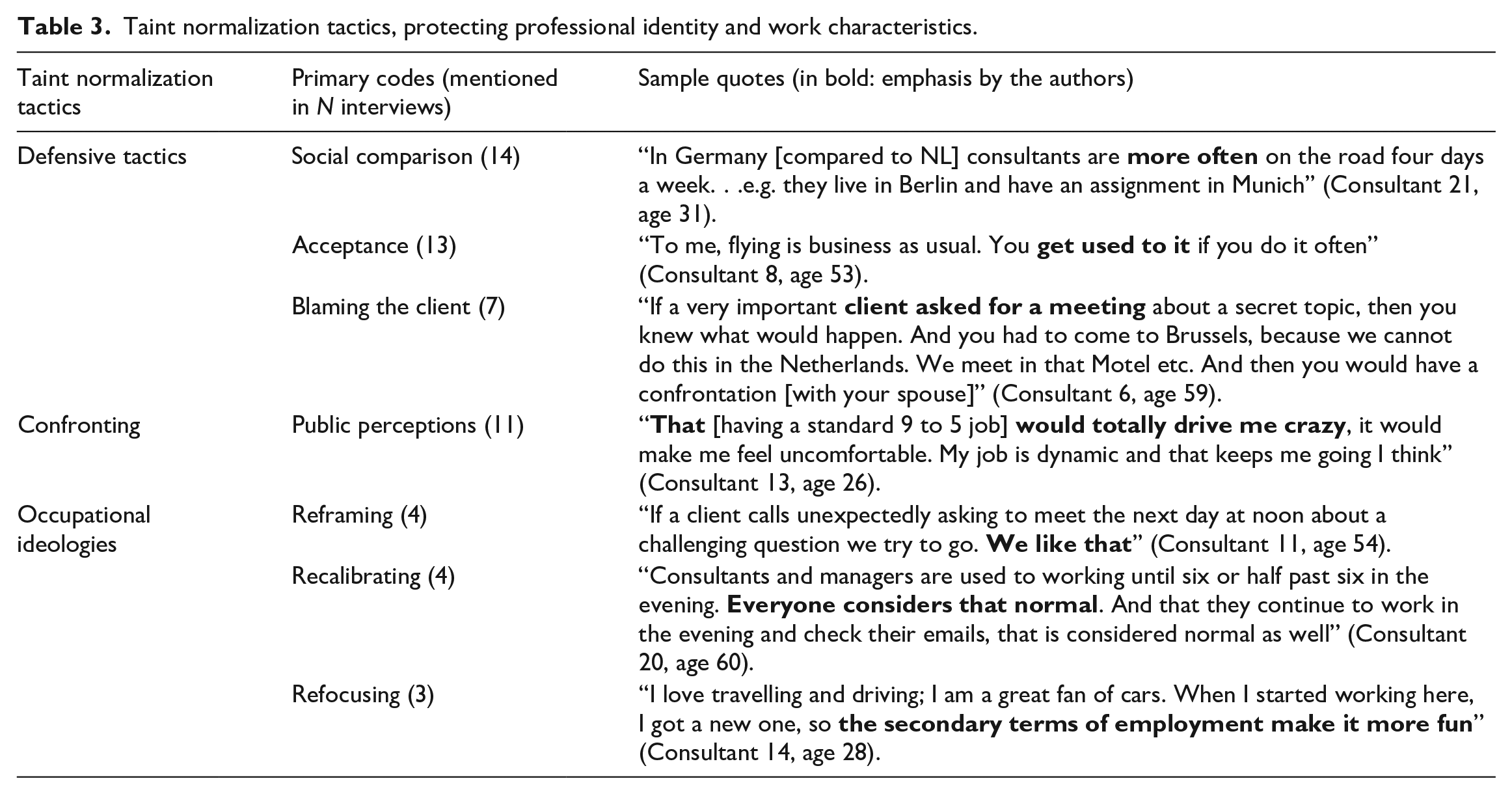
While we do not intend simply to replicate such findings, it is worth noting that these normalization responses serve to support Hughes (1951) claim that all occupations contain some form of dirty work and that this includes the high status, knowledge-intensive occupation of consulting. In addition, while some of the illustrative quotes normalize physically tainted aspects of the work, many others are directed toward psychological taint. For instance: “I have met people from [a top tier strategy firm] who couldn’t handle being away from Sunday until Friday evening or Saturday morning. Then, you were really unlucky!” (Consultant 11). Indicating that others in the sector were “really unlucky” is a form of social comparison. More specifically, given that being happy was considered the norm, the quote implies an identity threat that needs to be reduced. In the next example, the accusation of “being preoccupied” can also be read as a psychological problem that is normalized: “Yes, sometimes my girlfriend thinks I’m too occupied with my work, but to me it’s the standard. To me it’s normal. It has always been like that for both of us. So yes, it’s a part of our lives” (Consultant 19). Being seen as preoccupied implies something negative about one’s identity. The sense of taint as suggested by others is articulated before the normalization attempt. Indeed, without the experience of socially constructed dirtiness, there is no incentive to normalize being “too occupied with work” (see Ashforth et al., 2007; Goffman, 1963). Normalization aims at countering an identity threat, and the stress that comes with the threat. By having this purpose, normalization is a coping tactic for workers who feel their work is being perceived as dirty by outsiders.
Coping with dirty work: Accentuation tactics
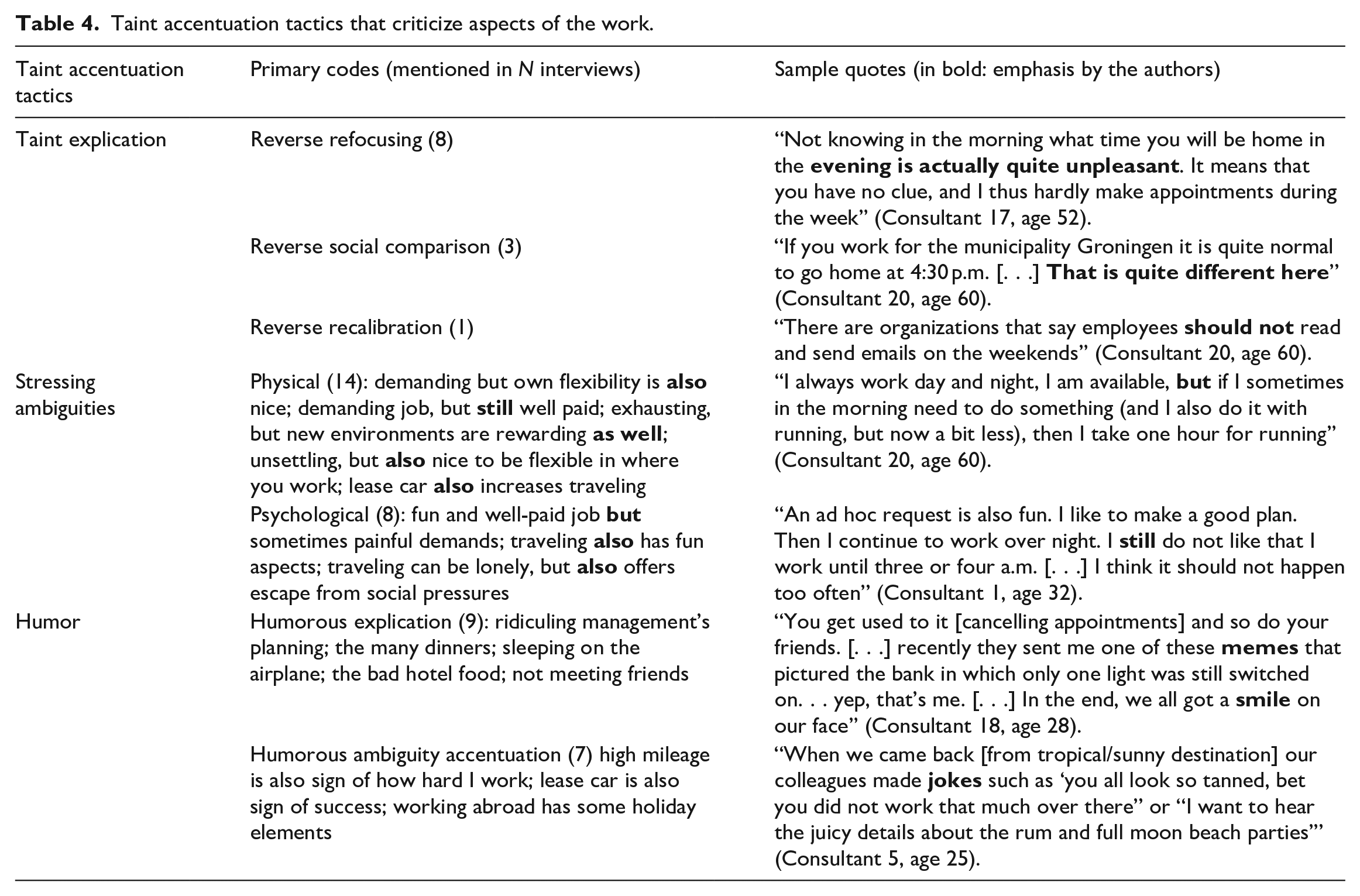
A key and surprising finding from our study was that consultants not only sought to normalize the dirty aspects of their work, but, just as often, also accentuated its physical and psychological dirtiness. This kind of response is underexplored in the dirty work literature, although incidentally indicated (i.e. Emerson and Pollner, 1976: 253; Hughes, 1958: 50). While normalization provides indirect evidence of dirty work, accentuation indicates that consultants intentionally co-construct physical and psychological taint. In other words, they openly acknowledge that the work has characteristics that cannot be deemed socially acceptable, which is a different way of coping. Either way, we identified three distinct accentuation tactics (see Table 4).
Taint accentuation tactics that criticize aspects of the work.
Taint explication
First, while coding the data for normalization tactics, we discovered that many consultants explicated taint in a way that is the exact opposite to normalization, for instance by “reverse refocusing” or “reverse social comparison.” Initially, such quotes seemed to be an anomaly, but over time it became clear that consultants often felt that their evaluative audiences (consultancy websites, their managers, outsiders, we as researchers) focused too much on the glamorous side of their job (see also Huey and Broll, 2015; Tracy and Scott, 2006). Taint explication is particularly visible in relation to the psychological dirtiness (e.g. the mental hardship of not being at home; staying in boring hotels in the middle of nowhere; and consultants’ social unreliability due to long and irregular work hours). For instance, through “reverse refocusing,” two respondents explicitly steer away from outsiders’ perceptions of glamor, by stressing the psychological dirtiness of the job: “Look, [during] the first weeks it [working abroad] is fun, but then, you just sleep in a hotel. It sounds glamorous, but it is not. You spend a lot of time travelling. Monday morning you fly to London. You have to leave early to arrive on time. Thursday evening you fly back, so you are home late. In fact, you are not at home. All social activities have to move to the weekend. It is just that—you are not at home” (Consultant 21). “I have discovered that working abroad is not as pleasant as most people think. So this picture on the beach is funny [points at the meme picture with a consultant reading on the beach], because it is not like that” (Consultant 5).
Similarly, not being able to keep promises to family and friends was considered quite unpleasant. One respondent expressed it as follows: “I feel sorry to disappoint someone, that is painful. [It is] not nice to feel the disappointment. You have to compensate later. And it does not motivate you to continue working the evening of the actual meeting” (Consultant 1).
Such examples stressing the pain and shame felt by consultants were aimed at correcting the overly positive job image in a way that is the exact opposite to the refocusing normalization tactic. In addition, consultants explicate taint by “reverse social comparison.” Instead of highlighting how other jobs are dirtier (as in defensive social comparison), consultants show how other jobs face less toughness, stress, or unpredictability: “I see how my girlfriend is working. I often think: she really has a relaxed job. It is an easy job, starting at 8:30 AM and leaving at 5:00 PM. And the job is done at five. Leaving the office means no more work. That really is a difference with consulting” (Consultant 19).
The dirtiness of consulting is accentuated by comparing it to how “relaxed” other jobs are. Table 4 shows more examples that illustrate the opposite of normalization, also one showing how work-life balance rules at other organizations get stricter. No work emails during the weekend as the new standard is an example of reverse recalibration, compared to constant availability.
With explication tactics, our respondents stressed psychologically dirty elements of their work that when shared, receive a negative social judgment: a job where you feel lonely abroad; the shame of disappointing friends; and being demotivated when working late because of not seeing your friends etc. Rather than normalizing such practices (cf. Ashforth et al., 2007; Bosmans et al., 2016; Meisenbach, 2010), our respondents questioned the normality of prevailing occupational ideologies. Perhaps it does make sense sometimes to deglamourize consultancy work and not over-identify with it (see also Cederström and Grassman, 2008: 42; Costas, 2013: 78; Kumra and Valsecchi, 2013). Indeed, the taint explication quotes indicate little fear of identity threats, but instead an impulse to stress that not all aspects of the work are socially acceptable, let alone glamorous. Such accentuation of dirtiness is not necessarily “maladaptive” or leading to a negative sense of self, as found in the context of domestic work (Bosmans et al., 2016: 57), but aligns more with observations by Huey and Broll (2015) who found that criminal investigators also deglamorized on purpose.
Stressing ambiguity
By highlighting ambiguities of their work, consultants recognized that it held both enjoyable and dirty components. This differs from the normalization tactics of confrontation, refocusing, or being defensive, as these typically only focus on positive features of the work and aim to neutralize the job’s downsides. Ambiguity claims however, by partly admitting taint, co-construct it as more nuanced than with taint explication. For instance, in case of extensive traveling: “I realize that I feel more relaxed abroad, with less daily hassles. A big difference of being abroad is that your friends are not physically present. You are not obliged to catch up with them. They know you are not available [. . .] However, travelling like this, being in so many places throughout the year is not good for your home situation” (Consultant 4).
Table 4 gives more examples that accentuate the dirtiness of departing from the “normal” or socially accepted expectations of work, while also acknowledging that there is something positive in these otherwise negative physical and psychological aspects of the work. While expressions of ambiguity have been noted in passing in at least one early study of dirty work (Emerson and Pollner, 1976), in our case, they provided some nuance to normalization, indicating that consultants face some more problems in their dirty work than simply identity threats.
Humor
The third tactic consultants drew on to accentuate the taint in their work was humor. As we have seen, prior research has looked at the normalizing qualities of gallows humor (cf. Ashforth et al., 2007). However, our analysis highlights humor aimed at dealing more openly with the painful, dirty aspects of the work (see also Bouwmeester, 2013; Tracy and Scott, 2006). For example, irony was felt to help in coping with the burden of traveling and irregular work: “Do you know where you sleep on Sunday? It was the running gag of the office that week. And now we finally know: in the airplane! [. . .] Yes, jokes like these are made especially at moments like these [when the circumstances are unpleasant]” (Consultant 5).
Consultants also found humor in ambiguities. For instance, they bragged about how many miles they drove: “Mileage becomes a sort of indication for how tough your job is. Sometimes we ask each other in a joking manner, how many kilometres your meter registers. . . ‘Look, mine says 60,000. I really have a tough job’ we say to each other. These jokes seem to come forth out of a macho culture, which prohibits you to admit how tough it really is. It is cool to say ‘I have worked so hard, since I had to drive these long distances’” (Consultant 19).
The first joke explicates the tough side of only knowing where you will sleep at the last minute and at a place that is far from comfortable. The second one stresses the ambiguity of toughness, which has a heroic element as well. Humor is thus both used for explicating taint and for highlighting ambiguity. Table 4 gives more illustrative quotes of humorous taint explication, and stressing ambiguity.
In contrast to other forms of accentuation, jokes are shared and thus contribute more to socially co-producing the dirtiness experienced by consultants. In this way, rather than using humor simply as a defensive tactic to reduce identity threats (cf. Ashforth et al., 2007), such humor can sustain or worsen a stigma (see also Dwyer, 1991; Thompson, 1991; Tracy and Scott, 2006). While dirty work often implies explicit identity threats, for consultants these threats are not always the most pressing problem. It is the work’s socially unacceptable features (very unpredictable work times and places, social unreliability, very long and late work hours, etc.) that also seem to bother them, as well as their social environment.
Motives for accentuation
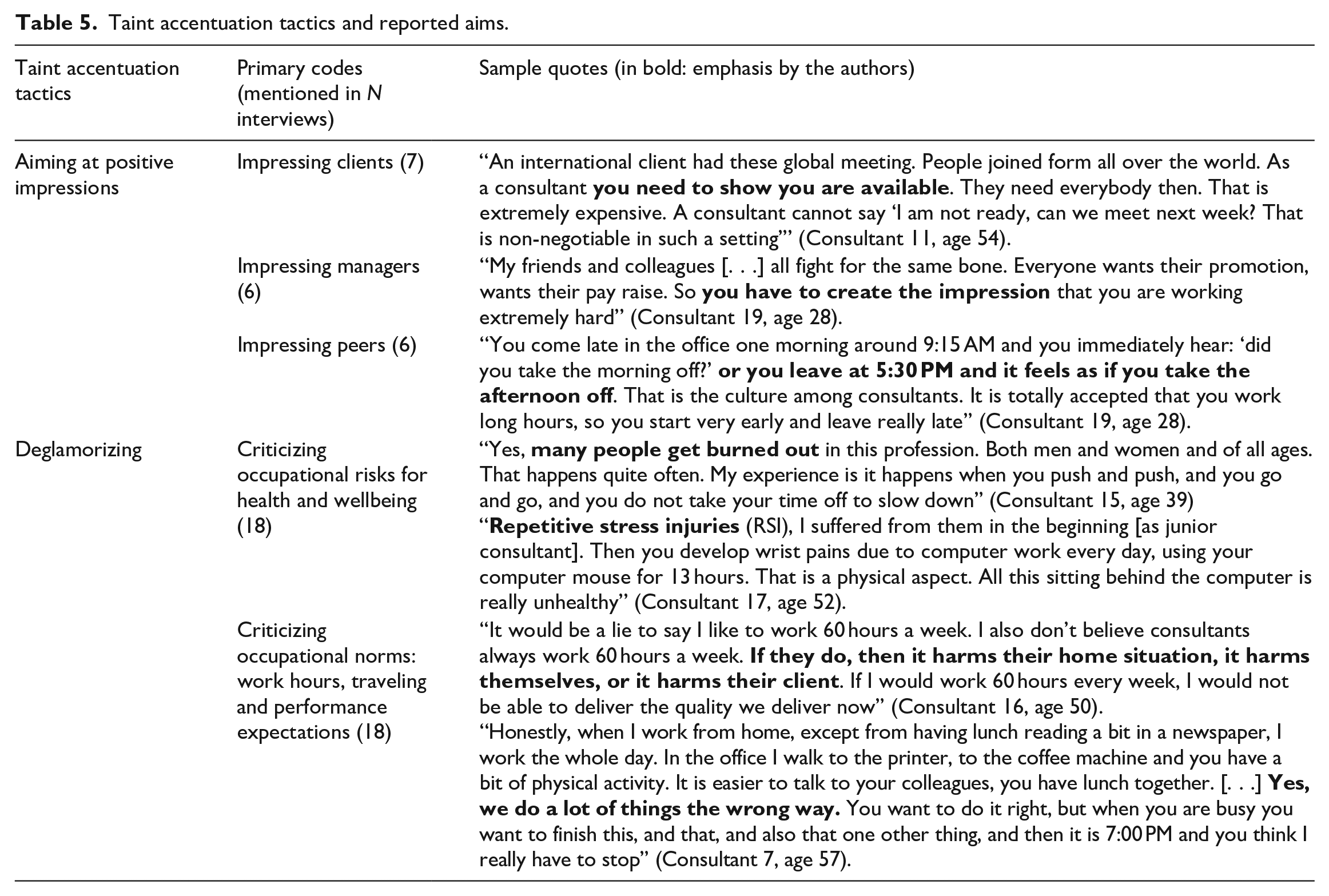
When exploring systematically how consultants explained their taint accentuation, we found two patterns. Quotes in Table 5 illustrate how accentuation can help to impress clients, managers, and peers by positive professional identity construction and showing that you are a very committed worker. This is different from, and complementary to normalization. However, more often, respondents used accentuation to criticize the high expectations that are cultivated in the sector; the psychological pressures put on consultants; and the health risks they faced. In those cases, consultants took a normative stance and deglamorized their work.
Taint accentuation tactics and reported aims.
Impressing clients, managers, and peers
Normalization aims at creating a more positive occupational impression by convincing outsiders the work is not dirty. However, outsiders are not a homogeneous group. Managers and clients especially can be impressed by what others, like friends of family, might see as dirty. Several consultants explained how accentuation can help to convince clients of their added value: “We need to sell ourselves. If the image was different, the client would not be impressed. We need the image of hardworking consultants, that we really sacrifice a lot to best help the client” (Consultant 14). “The first thing is to help the client. We cannot say: ‘sorry, we could not deliver, but the good news is that all our consultants went home at 5 PM’” (Consultant 17).
While family, friends, and consultants can see dirtiness in their very demanding work, for clients the same dirty aspects are exactly what they appreciate. Consultant managers have internalized this “client first” perspective: “If you talk about firms like KPMG, McKinsey, Bain, there is this mentality. That is, making money, an awful lot of money. Family first is not part of the deal. I have a good story for you. We got our first daughter. She was born in the weekend. Then one partner responded: “that is fantastic news, then you can start working on Monday.” He was serious about that. That is the mentality. This is how it is. That is why it is so difficult for women to make it, it is impossible. It is a rat race. It is extremely hard” (Consultant 2).
Since managers want to impress clients, impressing your own manager ultimately also benefits the client and the company. The career system at consultancies is oriented toward this commercial objective. And consultants reinforce this impression management among each other: “Yes, we make jokes if someone leaves at 8 PM. Then you ask if they take the afternoon off” (Consultant 18). You cannot lag behind in this peer competition. Demonstrating the exact behavior that makes the work dirty in the eyes of several outsider groups is needed to make your consultant career. That makes accentuation a tactic used with the purpose of constructing a professional identity of being hardworking and committed to the client.
Taking a normative stance
Impressing peers, managers, and clients is one use of accentuation indicated by consultants, but the more dominant use is criticizing. In the interviews, accentuation aims at criticizing work conditions such as travel time on top of work hours, the very long work hours, experiences of stress, and health consequences that go far beyond standards of social acceptability: “Well, then you are 26 and you have a burn out. What the f__k! That really is. . . Too much pressure has been put on someone to do more and more. Merely doing your projects is not enough to get your promotion. So then you boost each other to do more again, and in the end some get crazy and cannot handle it anymore. That is pretty sad. I do not know if this is specific for consulting, but I do know the sector has characteristics that really push performance” (Consultant 19).
The worst thing for consultants is the psychological pressure due to the nature of the work. Management, clients, and colleagues expect a lot: “Yes, consulting really is a tough job. Before you know it takes you over completely, and nothing else is left. [Interviewer: what exactly makes it tough?] It is the physical strain of always being available, and the travelling. But even more the complexity of the work. There is so much you have to consider. And there is politics, how to handle that part? It is all this together that requires a lot of mental resources. And commercial pressures are always there, to do what has been asked for, to do it fast, to do several projects in parallel. These psychological pressures are the worst part” (Consultant 20).
Next to criticizing health consequences such as burnout and stress, extensive traveling, sitting behind the computer too much, the occupational performance norms are also criticized in relation to the salaries: “If you make so many hours, say you work 80 hours, then you should earn twice as much as someone working 40 hours. But that is not the case. If you look at what these [early career] consultants earn, then they can better work behind the counter at a supermarket for 80 hours. Then they would earn more” (Consultant 1)
Therefore, when it comes to the work conditions, a vast majority of the consultants we interviewed took a strong stance. They criticized aspects like workhours, the pay, the intensity of the work, and the health consequences to make a point (see also Table 5).
Such harsh conditions do not apply to everyone. Things usually improve during the consulting career, certainly in terms of pay per hour. Still, burnout was flagged as too high a risk for all consultants. Interviewees emphasized how especially juniors could get in a very difficult position. They also mentioned huge differences in terms of expected work hours and work cultures between consultancies. In spite of such nuances, many consultants did not want to make their work conditions look normal. Instead of defending their occupational identity and making it look positive, the criticisms constructed dirtiness by referring to various social norms that were violated.
Normalization then, was not often seen as a useful coping response in this context. It is not the way to improve work conditions. Also for impressing clients and managers, accentuation seemed to realize identity effects better than normalization. However, audiences like junior colleagues, family, or friends sometimes needed to be convinced that working over the weekend or making long days is normal. Still, normalizing extreme working conditions had its limits. That is, when consultants felt their own or their colleagues’ health was at stake, when their family life was at risk, or when the work deal was not fair in terms of pay for performance. Therefore, occupational ideologies and other normalization responses seemed to be constrained by what employees considered to be “off limits.” In contrast to normalization as a form of legitimizing dirty work, accentuation was used for delegitimizing work conditions, thus implying a call or preference for change. Depending on the audience and context, accentuation was used for impression management as well.
Discussion and conclusion
In response to the question how management consultants in high status firms experience and cope with the dirty aspects of their work, two key findings emerged. The first is that alongside normalization responses such as those which are familiar in the literature, we identified their opposite in the form of three taint accentuation tactics: explication, stressing ambiguity, and humor. Whereas the motive for normalization tactics is found to be maintaining a positive occupational identity (Ashforth and Kreiner, 1999; Ashforth et al., 2007), with accentuation we find a different form of impression management, and more dominantly, a use as critique. While self-tainting has occasionally been noted (cf. Huey and Broll, 2015), it has not been fully explored in the dirty work literature as a coping tactic, and how it is used. Furthermore, the sole focus on normalization builds on the assumption that dirty work will carry so much stigma that it threatens a worker’s professional identity. However, we have seen how, for Hughes (1958) and others, wider social stigma is not a necessary component of dirty work, and stigma can be shielded by status (Ashforth and Kreiner, 2014; Tracy and Scott, 2006). In such cases, normalization might not even be needed to cope with dirty work, or it might not be the most useful response.
When comparing the contexts where consultants normalized and accentuated, we noticed that they normalized in order to neutralize negative identity judgments as assumed in the literature (e.g. when being seen as “unlucky” or “preoccupied” with work). However, when they accentuated (e.g. you just sleep in a hotel; work until three or four a.m.; feeling sorry about disappointing others), they most often referred to socially unacceptable threats to their health and well-being. In other words, consultants accentuated dirty aspects of their work when identity threats were not perceived as the main issue to cope with. They referred to health or wellbeing issues or threatened social relations. In addition, the deal with their employer in terms of pay versus demanded performance was criticized. Some critical accentuation responses have been found in other occupations with high status, but only incidentally. As noted earlier, Huey and Broll (2015) mentioned how criminal investigators felt the need to correct an overly romanticized image of their profession. They did this by drawing attention to the smell and feel of the crime scene. Likewise, Tracy and Scott (2006: 20) found that firefighters asserted that their work is mostly dirty and “less than 10% heroic.” Thus, our study extends these earlier findings by outlining the forms taint accentuation can take and further mapping its various motives and consequences. Thus, taint accentuation is not only useful for correcting an overly positive occupational image, it has wider applications like mitigating health risks, protecting family relations, and negotiating better work conditions. So far, the dirty work literature has ignored this use of accentuation as critique by putting all the emphasis on symbolic threats and normalization responses, with society at large as the main point of reference.
Alongside taking such a critical stance, consultants explained how they also used accentuation for creating positive impressions, just as with normalization. They accentuated dirty work features to impress clients and managers. They stressed their commitment to clients and their sacrifices in a way some even labeled as “whorish.” At the same time, in the context of servicing clients, accentuation of such dirty work features (working very long hours, being very flexible, very reliable, etc.) can add to building a professional identity desired by clients or managers. This positive use of accentuation is in stark contrast to earlier accounts of professional identity work related to dirtiness. Accountants for instance, have only been found to normalize—avoiding or reframing—their dirty occupational tasks like “number crunching” or “bean counting” (Morales and Lambert, 2013: 242).
To sum up this first contribution, accentuation tactics can create an image of not being normal, that is, as standing out. In the consulting case, this means stressing the extreme hours to secure client contracts or get a promotion. While such accentuation might be appreciated within the sector, outsiders like friends and family might wonder if the price in terms of health and wellbeing is not too high. Consultants themselves ask the same critical questions when reflecting with some distance. Moreover, the relative invisibility of effects of psychological health risks (compared to physical dirt or danger) might motivate consultants to internally stigmatize their own occupation as a way to address and reduce these invisible health risks. We may thus not only conclude that dirtiness is in the eyes of the beholder, but also that normalization is not the only functional response for workers who experience dirty work.
The second theoretical implication of our study is that we can now better conceptualize psychological taint. For some time, it was assumed that dirty work comprised solely physical, social, and moral taint (Ashforth et al., 2007). As noted earlier, this taxonomy has recently been criticized for ignoring the dirty aspects of emotional labor (McMurray and Ward, 2014; Rivera, 2015). This is useful, but our findings show that it does not fully capture the psychologically dirty nature of work experienced by increasing numbers of knowledge workers and their social environment. We argue that psychological taint is a broader concept, including the social recognition of the depletion of knowledge workers’ own mental resources due to their extreme working conditions (Hobfoll 1989; 2001). For consultants, psychological threats can damage their body much like the physical threats in dirty blue-collar work. The mental health risks become “dirty” when workers feel or imagine how family, friends, and colleagues view job-related outcomes like emotional instability and burnout as socially unacceptable and as “harming one’s dignity” (Hughes, 1951, 1958). Still, psychological taint is different from physical taint in the sense that its harm is less visible in damaging mental resources, instead of the musculoskeletal system, someone’s ears, lungs, etc. Physical taint also makes work often visibly dirty to outsiders, while psychological taint can need more accentuation to be acknowledged as dirty. Table 6 summarizes our contributions to the dirty work literature, based on our study of physical and psychological taint in consulting. In gray are the normalization responses based on our findings that correspond with previous studies on dirty work.
Audience related reasons for accentuation or normalization of work dirtiness.
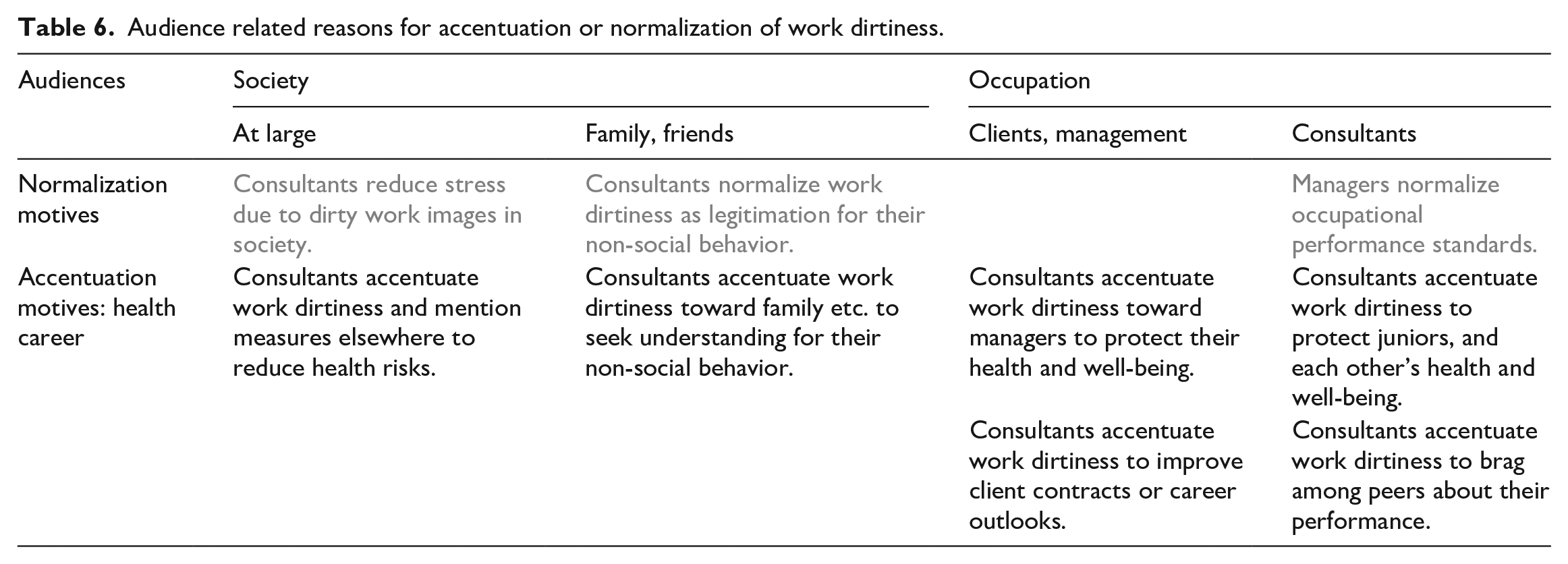
The demanding context of consulting work clearly shows how accentuation contributes to positive impression management that is distinct from normalization, but might also become widespread as a way to criticize and deglamorize. Accentuation thus, has different uses, not identified in the literature before. In addition, we see these different uses in relation to different audiences. By only considering society as a “macro audience” the diverse responses from close relatives, clients, or managers within an occupation are obscured.
The results suggest a wider significance for knowledge intensive work, and the consulting occupation in particular. Indeed, and thirdly, our findings contribute to the growing literature on management consultants. Hitherto, studies on stigma attached to consulting have focused on moral taint around unethical practices (Bouwmeester and Kok, 2018; Kumra and Valsecchi, 2013; O’Mahoney, 2007; Sturdy, 2009), and earlier on the difficult position of female consultants (Gealy et al., 1979). By contrast, we have drawn attention to an emergent, psychological form of dirtiness and stigma in the occupation, and to consultants’ self-tainting tactics. Taint accentuation can be used as a way to stand out within the sector to make a career, and to secure client contracts. It can also help criticizing and correcting of the overly positive, heroic, or “gold-collar” image constructed through the impression management practices of consultancies, especially in how consulting careers are portrayed externally (Kipping, 2011; Rivera, 2016).
In conclusion, our study, combined with its limitations, suggests important potential avenues for future research on taint and dirty work in particular. Firstly, in focusing on one occupation, we were unable to identify the extent and forms of psychological taint and its accentuation or normalization elsewhere, for example in other stressful occupations like soldiers, taxi-drivers, teachers, or middle managers. Likewise, how different forms of taint—moral, social, physical, emotional, and psychological—interrelate needs to be further explored. In particular, there is an opportunity to focus on the combination of moral taint, such as that arising from unethical managerial or client pressures, and psychological taint experienced by subordinate employees. Here too, there is scope to consider the role of different social actors or stakeholders in the co-production and perception of taint (see also Meisenbach, 2010; Rivera, 2015). Such stakeholders could be family, friends, colleagues, managers, clients, regulators, online communities, or the media (Bouwmeester and Stiekema, 2015; Huey and Broll, 2015; Stanley et al., 2014; Vaast and Levina, 2015). Thus, how, for example, is dirtiness formed interactively, over time and to what extent is it constructed or contested in power relations? Who takes initiative in the co-construction of dirty work perceptions, and is there a difference if mainly clients experience dirty risks, as with morally tainted bankers, or when an employee is experiencing the risks, leading to physical and psychological taint? Finally, and as intimated above, we need to consider further the reasons why self-tainting occurs and how this might vary by occupational context, type of taint, or audience. Self-tainting might be more difficult in case of moral taint. For example, whistleblowers often face great difficulties. Society may applaud, but their occupation (and organization) may not. The situation might also be challenging in the case of social taint. Here, again, parts of society may be supportive, as social taint draws attention to servile or repressive relations. Likewise, when studying accentuation responses, different audiences need to be considered. Occupational insider audiences like managers or colleagues might react differently from outsider audiences like family or friends. Nevertheless, by revealing how work may be felt to be psychologically tainted and how taint is actively constructed by the workers themselves in forms of accentuation, we have shed new light on dirty tasks, jobs, and experience in work and organizations.
Footnotes
Appendix 1
Interviewee characteristics.
| Consultancy | Title | Type of advice | Age | Gender | |
|---|---|---|---|---|---|
| P1 | Big 4 consultancy | Senior consultant | Human capital | 32 | Male |
| P2 | Consultancy <20 employees | Owner and advisor | Organization advice | 60 | Male |
| P3 | Big HR consultancy | Managing consultant | HR consulting | 56 | Male |
| P4 | Big IT consultancy | Analyst | IT/strategy consulting | 28 | Male |
| P5 | Big IT consultancy | Junior consultant | IT/business consulting | 25 | Female |
| P6 | Big HR consultancy | Director | Business consulting (M&A, HRM) | 59 | Male |
| P7 | Big HR consultancy | Senior consultant | HR consulting | 57 | Female |
| P8 | Big IT consultancy | Senior principal | IT/business consulting | 53 | Male |
| P9 | Big 4 consultancy | Senior advisor | Business consulting | 26 | Female |
| P10 | Big IT consultancy | Manager | Business consulting | 34 | Male |
| P11 | Consultancy <20 employees | Owner and advisor | Strategy/business consulting | 54 | Male |
| P12 | Big 4 consultancy | Senior consultant | Risk services | 29 | Male |
| P13 | Big 4 consultancy | Senior IT auditor | IT audit | 26 | Male |
| P14 | Big IT consultancy | Strategic business consultant | Business consulting | 28 | Male |
| P15 | Big consultancy | Consultant | Business consulting | 39 | Female |
| P16 | Big HR consultancy | Actuary | HR consulting | 50 | Male |
| P17 | Big HR consultancy | Director | HR consulting | 52 | Male |
| P18 | Big IT consultancy | Business consultant | Business consulting | 28 | Male |
| P19 | Big IT consultancy | Business consultant | Business consulting | 28 | Male |
| P20 | Big consultancy | Partner | HR consulting | 60 | Male |
| P21 | Big 3 strategy consultancy | Consultant | Strategy consulting | 31 | Male |
| P22 | Big 3 strategy consultancy | Consultant | Strategy consulting | 30 | Male |
| P23 | Big 3 strategy consultancy | Partner | Strategy consulting | 38 | Male |
| P24 | Big 3 strategy consultancy | Director | Strategy consulting | 37 | Male |
Funding
The author(s) received no financial support for the research, authorship, and/or publication of this article.
