



Abstract
The present study provides evidence for the important role of job crafting and self-undermining behaviors at work, two new concepts that were recently integrated into the well-known job demands-resources (JD-R) theory (Bakker and Demerouti, 2017). We investigate how these behaviors are associated with work engagement, emotional exhaustion, and work ability as a long-term indicator of employee’s well-being. Furthermore, we examine the moderating role of personal resources in the stress-strain process by comparing groups of employees representing the five types of job satisfaction defined by Bruggemann (1974). Data was collected in a cross-sectional study within a German DAX company’s manufacturing plant from 1145 blue- and white-collar workers. Results of structural equation modeling provided, as expected, support for an indirect effect of job demands and job resources on emotional exhaustion and work engagement through job crafting and self-undermining. Work ability, on the other hand, was mainly affected by emotional exhaustion, but not by work engagement. Most important, we found significant differences between path coefficients across the five types of job satisfaction indicating that these types represent important constellations of personal resources and job demands that should be considered both for analyzing stress at work and for offering tailored stress interventions in organizations.
Introduction
Work-related stress and strain are a major cost and risk factor for organizations (Hassard et al., 2018) and, as a consequence, efforts to increase safety, staff retention and employee’s health through improvement in job design are an integral part of modern HRM systems (e.g. Kröll et al., 2017). The job demands-resources (JD-R) theory (Demerouti et al., 2001) represents a prominent and empirically corroborated theoretical framework that can explain when, why, and how job characteristics lead to different forms of strain and how strain affects well-being, work motivation and health of employees. Due to its heuristic and flexible nature, the JD-R theory has gained high popularity among researchers and is currently recognized as one of the leading job stress models (Schaufeli and Taris, 2014). The JD-R theory has also stimulated 74 longitudinal studies so that Lesener et al. (2019) conducted a meta-analysis summarizing the existing evidence for the causal pathways proposed in this theory. The essential assumptions were confirmed as it was shown that (1) excessive job demands lead to burnout, (2) abundant job resources lead to work engagement, and (3) poor job resources contribute to burnout.
Importantly, Bakker and Demerouti (2017) recently published an extended version of their theory that offers a more dynamic view on the interplay between job demands and job resources at work by integrating employees as active agents of their work environment. More precisely, individuals are not passively exposed to their work conditions, but may engage in self-initiated actions to shape their work environment. The extended JD-R theory proposes two types of proactive employee behaviors, namely job crafting and self-undermining (Bakker and Demerouti, 2017). In addition to these concepts, personal resources are now considered to broaden the perspective on individual characteristics interfering with job demands and job resources. Even though the literature provides evidence for parts of the extended JD-R theory (e.g. Knecht et al., 2017; Rudolph et al., 2017), an extensive investigation of the propositions regarding the role of employees’ behaviors at work and personal resources is still lacking.
With this study, we aim to make at least the following three contributions: First, our study will provide empirical evidence for the propositions of the extended JD-R theory (Figure 1). Specifically, we will examine the role of employees’ job crafting and self-undermining behaviors in the dual process linking job characteristics with employees’ strain and motivation.
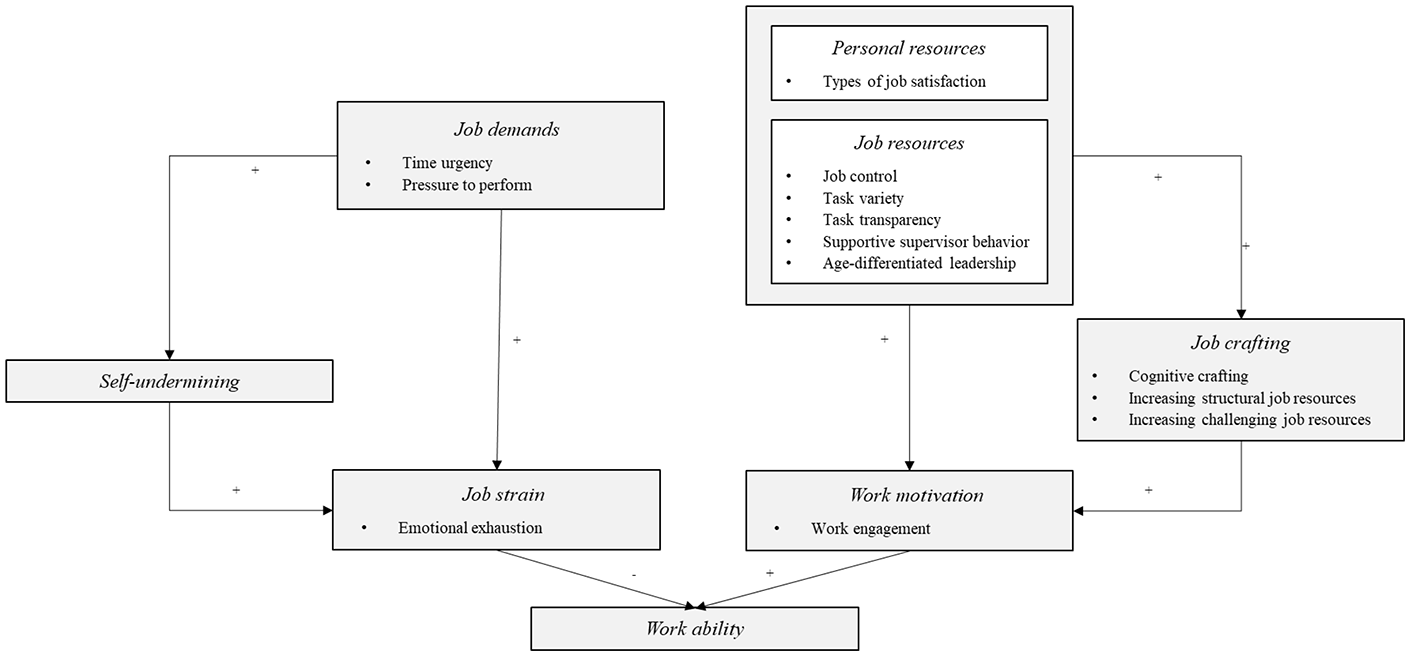
Model of extended JD-R theory, illustrating the variables investigated in this study.
Second, our study combines two streams of research by investigating how central variables of the JD-R theory are associated with work ability as “an individual’s ability to continue working in their jobs” (Brady et al., 2020: 639) that incorporates both individuals’ physical and mental functioning (Ilmarinen, 2009). In the light of an aging workforce and an impeding lack of skilled manpower, maintaining and promoting people’s work ability represents one of the core responsibilities of occupational health researchers and practitioners. In this regard, findings of a recent meta-analysis support the notion that the JD-R theory provides a suitable framework for this purpose (Brady et al., 2020).
Third, we will explore the moderating role of personal resources in the processes proposed by the extended JD-R theory. Personal resources are expected to be of great importance for self-regulating job-strain, for example, by facilitating further resource gains through job crafting and reducing the risk of health impairments (Bakker and De Vries, 2021). More specifically, we will compare the proposed relationships between different groups of employees representing the five types of job satisfaction defined by Bruggemann (1974). This model is well known in German speaking countries (e.g. Inauen et al., 2015; Schlett et al., 2018) and represents a qualitative, dynamic approach to the concept of job satisfaction that is based on several, stress related cognitive processes differing between persons. Having a certain type of job satisfaction, therefore, should have an impact on how employees perceive stressors and cope with stress and strain at work. We will argue in more detail below why the five types of job satisfaction represent important, rather stable differences in personal resources of employees. The selection of these five types of job satisfaction—namely fixated job dissatisfaction, constructive job dissatisfaction, resigned job satisfaction, stabilized job satisfaction, and progressive job satisfaction—is also motivated by the idea, that interventions intending to improve job design or stress management can benefit from insights regarding how these groups of employees differentially react to job characteristics, experience stress and strain at work, and also differ with respect to the two newly integrated self-initiated actions in the JD-R theory, namely job crafting and self-undermining behavior at work.
The job demands-resources theory
Introduced in the international literature 15 years ago, the JD-R theory has given rise to a vast amount of research on how various job aspects relate to employee’s well-being (Van den Broeck et al., 2013). As a main premise, the JD-R theory states that job characteristics can be categorized into job demands (e.g. workload, time pressure, and role conflict) and job resources (e.g. social support, job control, and task variety), which are uniquely linked to different processes (see Demerouti et al., 2001). While the health impairment process suggests that chronic job demands exhaust employee’s physical and mental resources and may therefore lead to the depletion of energy and to health complaints, the motivational process implies that job resources have a motivational potential and lead to high work engagement (Bakker et al., 2003; Demerouti and Bakker, 2011). Both processes, in turn, have been shown to unfold their impact on a broad set of individual and organizational outcomes such as organizational commitment, job performance, health complaints, absenteeism, and turnover intentions (e.g. Bakker and Bal, 2010; Bakker et al., 2003; De Beer et al., 2012). This dual process approach has been widely confirmed (Bakker et al., 2003; De Beer et al., 2012) especially when focusing on job strain in terms of burnout (e.g. Demerouti et al., 2001; Schaufeli et al., 2009). For this reason, we anticipate a replication of these relationships also in our study and we propose the first hypothesis:
H1a: Job demands are positively related to job strain.
H1b: Job resources are positively related to work motivation.
Proactive employee behaviors in terms of job crafting and self-undermining
Although the original JD-R theory strived for a holistic framework that reflects the impact of various job characteristics on employee’s well-being, it primarily took a top-down perspective of job design in organizations and did not consider any interplay between employees and their work contexts (Bakker and Demerouti, 2017). This is a limitation as some scholars have recently shown that there are both causal and reversed causal effects between job demands, job resources, and well-being (e.g. Lesener et al., 2019; Simbula et al., 2011; Xanthopoulou et al., 2009), also demonstrating that employees proactively change their work. Bakker and Demerouti (2017) payed tribute to this phenomenon by integrating the concepts of job crafting and self-undermining behaviors into the extended JD-R theory.
Self-undermining describes a health-impairing pattern of behavior through which employees who experience extensive job strain also perceive and create more job demands over time (Zapf et al., 1996), for example, by refraining from compensation leisure activities in favor of work. More specifically, employees engaging in self-undermining behavior seem to communicate poorly, make more mistakes and create more conflicts, which add up to the already high demands and makes self-undermining behavior fueling a vicious cycle of job demands and strain (Bakker and Demerouti, 2017). These propositions build on the conservation of resources theory, which states that individuals seek to create and maintain resources and may react with psychological stress when facing the threat or actual loss of resources (Hobfoll, 1989). Furthermore, individuals strive to invest their resources firstly to obtain further resources, thus causing a positive spiral of resource gain, and secondly to prevent potential resource losses—a process which might result in a negative loss spiral, when individuals generally lack resources (Hobfoll, 1989). Previous research provided strong support for this theoretical extension, showing that self-undermining behaviors are positively associated with burnout (Bakker and Wang, 2020; Knecht et al., 2017). In line with the extended JD-R theory, supposing that employees exposed to high levels of job demands create more demands over time, we suggest the following hypothesis:
H2: The positive relationship between job demands and job strain is mediated by self-undermining behaviors.
Job crafting behavior, on the other hand, refers to processes in which employees change their tasks, social relations at work, or the cognitions they have about aspects of their jobs in order to balance their job demands and job resources with their personal abilities and needs (Tims et al., 2012). This concept is based on the observation that employees do not only experience strain after being exposed to work environments designed by organizations, but might proactively change their work tasks in order to make their work more meaningful (Bakker and Demerouti, 2017). Bakker and Demerouti (2017) further proposed that employees who are motivated by their work are likely to use job crafting behaviors (e.g. investing in positive relationships to colleagues), which in turn lead to higher levels of job resources and personal resources and, thus, fuel even higher levels of work motivation. Referring to conservation of resources theory (Hobfoll, 1989), job resources can evoke a resource gain spiral through stimulating job crafting behaviors. Empirical evidence supports this proposition and indicates that job crafting behaviors are positively related to work engagement, organizational commitment, and job as well as contextual performance (see Cheng et al., 2016; Rudolph et al., 2017; Tims et al., 2012).
Therefore, we propose the following hypothesis:
H3: The positive relationship between job resources and work motivation is mediated by job crafting behaviors.
Work ability
Originally developed in the early 1980s in Finland, the concept of work ability addresses the question of how long employees are able to work and to what extent being able to work depends on the work content and on job demands (Ilmarinen, 2009). Previous research based on this concept has shown that work ability strongly depends on job characteristics as well as on employee’s health and functional capacities (Brady et al., 2020; Ilmarinen et al., 2005). Several longitudinal studies have further confirmed that work ability is positively related to job resources, the quality of employees’ work, and their age of retirement (see Feldt et al., 2009; Tuomi et al., 2001). Despite its association with these outcomes that emphasize the remarkable role of work ability as a long-term indicator of employee’s well-being and, furthermore, for their employability, this concept has been rather neglected in research on the JD-R theory, even though it has been found in one study that work engagement mediates the positive impact of job resources on work ability (see Airila et al., 2014). In an attempt to combine the promising research findings on work ability with the JD-R theory, this study puts the concept of job strain into a more temporal context and addresses work ability as an important long-term consequence of the processes proposed by the JD-R theory. We therefore propose the following hypotheses:
H4: Job demands are negatively related to work ability via job strain.
H5: Job resources are positively related to work ability via work motivation.
The conceptual model including all hypothesized direct and indirect effects is illustrated in Figure 2.
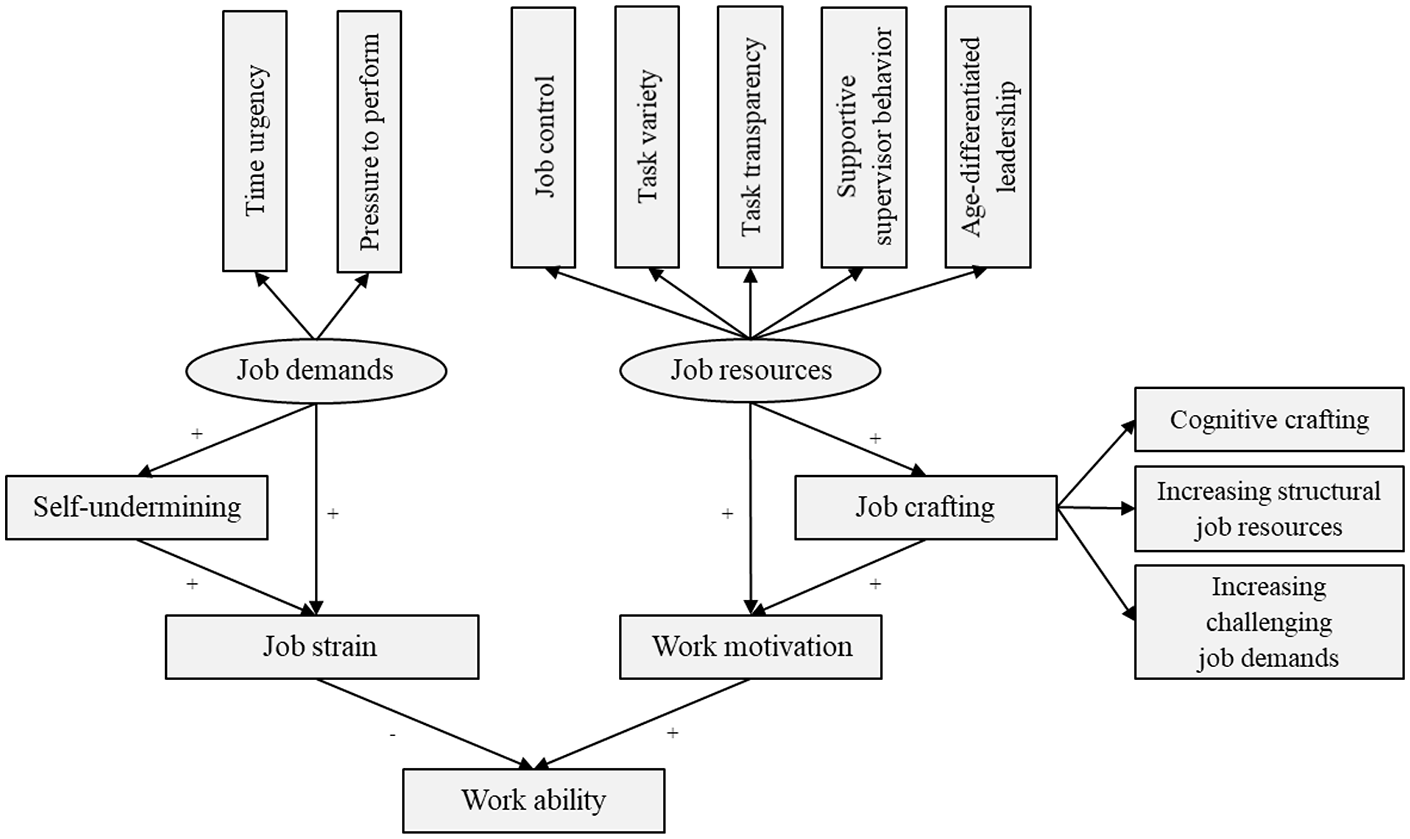
Conceptual model.
Types of job satisfaction as personal resources
According to Hobfoll et al. (2003: 632) personal resources refer to “aspects of the self that are generally linked to resiliency.” Prior research has, for example, analyzed optimism, self-efficacy, beliefs about high control over the environment or hardiness as personal resources (Sonnentag and Frese, 2006; Van den Heuvel et al., 2011). On the basis of this understanding, the extended JD-R theory proposes that personal resources (such as optimism, self-efficacy, and an internal locus of control) may have a direct positive effect on work engagement and buffer the undesirable impact of job demands on strain (Bakker and Demerouti, 2017). Moreover, Bakker and De Vries (2021) emphasize the role of personal resources for both adaptive (e.g. job crafting behaviors) and maladaptive regulation (e.g. self-undermining behaviors) of job strain. In line with this view, the present study investigates five different types of job satisfaction as a specific form of rather stable personal resources relevant for employees’ self-regulation at work. Individuals belonging to these five types show significant differences in the level of personal resources such as self-efficacy, optimism, and mindfulness (Schlett et al., 2018). In short, we propose that these types of job satisfaction can function as an important moderator variable. The theoretical conceptualization of types of job satisfaction was developed by Bruggemann (1974) and lays its focus on the qualitative nature of job satisfaction, generally stating that different types of job satisfaction develop over time from an interaction between personal and situational variables at work, and thus, highlighting the cognitive aspect of job satisfaction. More specifically, Bruggemann (1974) proposed that different types of job satisfaction evolve in the work context depending on (1) a global comparison of the actual work situation and the individual level of aspiration, (2) the subsequent maintenance or change of this level of aspiration, and (3) the exhibition of problem-solving behaviors to master a work situation in which the individual level of aspiration cannot be satisfied. Depending on the outcome of these processes, five types of job satisfaction were expected to result: fixated job dissatisfaction, constructive job dissatisfaction, resigned job satisfaction, stabilized job satisfaction, and progressive job satisfaction.
As may have become clear, the job satisfaction model by Bruggemann is more complex than common quantitative conceptualizations of job satisfaction and provides further information about a person and his or her individual coping history. In line with these assumptions, previous findings show that when entered together with a measure of quantitative job satisfaction in hierarchical regression analyses, the types of job satisfaction explain additional variance in work- and health-related outcomes (Kovacs et al., 2018).
According to Büssing (1992), constructive and fixated dissatisfied as well as resigned satisfied employees are characterized by a work situation that does not satisfy their individual level of aspiration. Whereas constructive dissatisfied employees, on the one hand, still strive to master this situation of perceived incongruence by exhibiting problem-solving behaviors on the basis of sufficient frustration tolerance, resigned satisfied employees cope with this situation by decreasing their level of aspiration to finally achieve a state of perceived job satisfaction. Fixated dissatisfied employees, on the other hand, do not cope with their job dissatisfaction and get stuck in their actual work situation. On the contrary, stabilized and progressive satisfied employees are characterized by a perceived congruence between the actual work situation and their level of aspiration. Whereas progressive satisfied employees typically intend to further improve the work situation and subsequently increase their level of aspiration in order to gain more resources in the future, stabilized satisfied employees just maintain their level of aspiration and do not intend to change their actual work situation further. Büssing (1991) expanded this approach by integrating perceived controllability as an additional variable into the Bruggemann model. Perceived controllability (e.g. in terms of locus of control) has been shown to be a crucial personal resource at the workplace (Ng et al., 2006). Büssing (1992) proposed that stabilized and progressive satisfied employees, as well as constructive dissatisfied employees are characterized by higher levels of perceived controllability as compared to the other types of job satisfaction.
Related to these theoretical considerations, Büssing et al. (1999) outlined that the global comparison between one’s work situation and the level of aspiration is strongly linked to motivational variables such as individual needs and personal expectations of work. Furthermore, a subsequent change in personal goal structures affects how employees respond to this comparison: Whereas progressive satisfied employees successively increase their aspirations to achieve an even higher level of job satisfaction, fixated dissatisfied employees, who maintain their aspirations, were shown to report no long-term goals for their present workplace (Büssing, 1992). Resigned satisfied employees, on the other hand, respond to the perceived incongruence between the actual work situation and their aspirations by exhibiting maladaptive coping styles insofar as they decrease their level of aspiration to reduce these discrepancies and finally achieve job satisfaction. Besides employee’s motivation, goals, and coping styles, these changes of individual aspirations additionally depend upon the perceived situational control and further personal resources. Fixated and constructive dissatisfied employees, for instance, seem to be affected from both their coping abilities to use the coping options as offered by the respective organization (e.g. job control and social support) and essential personal traits such as the individual locus of control, the desire for control, or self-efficacy (Büssing, 1992).
Schlett et al. (2018) provided evidence for the differences in personal resources between the five types of job satisfaction. Fixated dissatisfied employees reported the lowest levels of occupational self-efficacy, optimism, and mindfulness, whereas progressive satisfied employees showed the highest values. Constructive dissatisfied employees showed higher self-efficacy as well as optimism than fixated dissatisfied employees. Stabilized satisfied employees were more optimistic than resigned satisfied employees. In line with this conceptualization of five different job satisfaction types, current research has also confirmed that these five types can be found in representative samples of the working population over many years (e.g. about 40% of the 80% satisfied employees belong to the resigned satisfaction group). Moreover, Inauen et al. (2015) also found significant differences related to work engagement and health complaints.
Taken together, we expect that the five different types of job satisfaction can be integrated into the expanded JD-R theory as a promising approach to account for the role of personal resources of employees (e.g. reflecting rather stable differences in personal goals and coping styles at work) that have a diverging impact on the level of and relationships between job demands, job resources, proactive employee behaviors, and well-being. Insights about potential differences between these special groups of employees may be further valuable for organizations in order to explain why well-intentioned job design and stress management interventions lead to different outcomes in the workforce and may help to design more customized solutions. As prior studies have not analyzed such potential moderator effects of the five types of job satisfaction yet, we decided to use an explorative approach, investigating the following research question:
RQ: Do the mean levels and relationships of core variables in the JD-R theory differ between employees across the five types of job satisfaction? Which differences can be found?
Methods
Sample and procedures
The present study was part of a cross-sectional survey on employees’ well-being conducted in November and December 2017 at a German DAX company’s manufacturing plant. Survey packages were handed in to all employees, including a paper-and-pencil questionnaire and a pre-addressed return envelope. The questionnaire was accompanied by a cover letter explaining the main purpose of the study and assuring confidentiality and anonymity. Employees were kindly asked to fill out the questionnaire at their workplace either during their work or during their breaks. Participation was possible over a period of five weeks on a voluntary basis. Completed questionnaires could be handed in to the supervisor or could be sent to the human resources department using the enclosed return envelope.
Of the 3004 questionnaires that were distributed, 1145 have been returned, yielding an initial response rate of 38%. Following the procedure as recommended by Field (2013), outliers were trimmed in order to obtain a more robust statistic. Furthermore, since Little’s MCAR test did not support the hypothesized completely random occurrence of missing data (χ2 (2, 7773) = 30,878.36, p < 0.001) and a non-random occurrence appeared improbable given the abundance of variables in this survey, it was supposed that the missing data were missing at random. The full sample of 1145 respondents was therefore included in further analyses and missing values were estimated using the expectation maximization method as implemented in IBM SPSS Statistics 22.0, assuming its enhanced robustness due to the large sample (see Schafer, 1999). As this method is unable to estimate missing values for categorical variables, respondents with missing values in at least one of these variables were subsequently excluded by listwise deletion.
Thus, the final sample consisted of 1017 respondents and specifically comprised 860 men (85%) and 157 women (15%), working in 22 different organizational units. Their age ranged from 17 up to 65 years (retirement age) with an average of M = 41.46 (SD = 11.05). Regarding the occupational field, 45% of the sample held a predominantly operational position within production or field service (blue-collar), while 55% held a predominantly support position (white-collar). Furthermore, 14% of all respondents held a leadership position and 32% were working in shifts. In line with previous research on the robustness of the JD-R theory that suggest its generalizability across different occupational groups (e.g. Demerouti et al., 2001; Llorens et al., 2006), the whole sample containing blue-collar and white-collar workers was included in statistical analyses, also to contribute to the development of a generic framework.
Measures
To test the hypothesized relationships, scale scores were derived from the measures described in detail below. As the present study was part of a larger survey, shortened scales and reduced numbers of items were used whenever possible in order to avoid fatigue effects. Furthermore, reliability coefficients were checked using Cronbach’s alpha or Pearson correlation in cases of less than three items per scale. All scales except for job control (α = 0.66) had satisfactory alpha reliability coefficients that met the criterion of 0.70 (see Nunnally, 1978).
Job demands were operationalized by two items from the German Questionnaire for Subjective Assessment of Stress Factors at the Workplace (FEBA; Slesina, 2010). Based on this questionnaire that provides an extensive list of different job characteristics, two single items were selected in order to assess time urgency and pressure to perform (r = 0.39, p < 0.001). Participants were asked to indicate the extent to which the different job demands were experienced on a four-point frequency scale ranging from 1 (never) to 4 (very often).
Job resources were operationalized by two scales representing job control (three items, e.g. “This work allows making a lot of autonomous decisions.”, α = 0.66) and supportive supervisor behavior (five items, e.g. “My supervisor supports me in doing my work.”, α = 0.88; Udris and Rimann, 1999). Furthermore, two items of the task transparency scale (e.g. “This work allows me to assess the quality of my results.”, r = 0.45, p < 0.001) were taken from the Subjective Work Analysis (SAA; Udris and Rimann, 1999) and task variety was measured using the work content scale (three items, e.g. “My work is interesting and rich in variety.”, α = 0.86), that was derived from the German Diagnosis of Health-Promoting Work Questionnaire (DigA; Ducki, 2000). In addition, a shortened version of the German Age-differentiated Leadership Scale (FAF; Wegge et al., 2012) was used to take health-promoting leadership as a potential job resource into account (eight items, e.g. “My supervisor promotes a positive cooperation between younger and older employees.”, α = 0.92). All items measuring job resources were scored on a five-point Likert scale ranging from 1 (strongly disagree) to 5 (strongly agree).
Work motivation was examined using the German short version of the Utrecht Work Engagement Scale (UWES-3; Schaufeli et al., 2006, 2019), that comprises three items representing the three subscales of work engagement: vigor ( “At my work, I feel bursting with energy.”), dedication ( “I am enthusiastic about my job.”), and absorption ( “I am immersed in my work.”). These items were scored on a seven-point frequency scale ranging from 1 (never) to 7 (every day) and an overall score of work engagement was computed as the mean of all items (α = 0.87).
Job crafting behaviors were measured by combining the German versions of two different Job Crafting Scales that were originally developed by Tims et al. (2012) (translated into German by Lichtenthaler and Fischbach, 2016a) and Weseler and Niessen (2016). As regards the former, three items were derived from the subscales increasing structural job resources (two items, e.g. “I try to learn new things at work.”) and increasing challenging job demands (one item, “I regularly take on extra tasks even though I do not receive an extra salary for them.”). Referring to the latter, two further items were taken from the subscales cognitive crafting (two items, e.g. “I find personal meaning in my tasks and responsibilities at work.”). The rather rigorous selection of items is due to previous considerations on which types of job crafting behaviors could possibly be exhibited in the investigated workplaces at all. Based on Weseler and Niessen’s (2016) measure, participants were asked to indicate the extent to which they show different types of job crafting behaviors in order to make their job suiting better to them on a five-point Likert scale ranging from 1 (strongly disagree) to 5 (strongly agree). An overall score was computed as the mean of all items (α = 0.75).
Self-undermining behaviors were tapped using the 23-item scale that was recently developed and validated by Krause et al. (2015). In order to reduce respondent burden, five items were selected that showed the highest face validity and fitted the most to the specific work situations investigated in the present study (e.g. “In the last three months, how often have you refrained from compensation leisure activities in favor of your work?”). All items were scored on a five-point frequency scale ranging from 1 (never) to 5 (very often) and an overall score was computed as the mean of all items (α = 0.77).
Job strain was operationalized by the 5-item emotional exhaustion subscale that was derived from the German translation (Weiherl, 2007) of the Maslach Burnout Inventory-General Survey (MBI-GS; Schaufeli et al., 1996). A sample item is, e.g., “I feel burned out from my work.”. Cronbach’s alpha was α = 0.88.
Work Ability was measured with the German version (Hasselhorn and Freude, 2007) of one subscale taken from the Work Ability Index (WAI; Tuomi et al., 1998). This subscale refers to work ability in relation to both physical and mental demands of the job and comprises two items (r = 0.59, p < 0.001), which were scored on a five-point qualitative scale ranging from 1 (very bad) to 5 (very good). Following Tuomi et al. (1998), a general index was computed in which the individual score on work ability concerning physical demands was given more weight for blue-collar workers and the individual score on work ability concerning mental demands was given more weight for white-collar workers, respectively.
Types of job satisfaction were assessed using a single forced-choice item as offered by Ziegler and Schlett (2013). Five descriptions, each representing one type of job satisfaction, were provided and participants were asked to decide which description applied to them the most (e.g. “I’m satisfied with my job—I tell myself, it could be a lot worse.” for resigned satisfaction). Types of job satisfaction were included as a categorical variable in our analyses (1 = fixated job dissatisfaction, 2 = constructive job dissatisfaction, 3 = resigned job satisfaction, 4 = stabilized job satisfaction, and 5 = progressive job satisfaction).
Control variables were included to reduce the risk of finding spurious associations among the study variables. More specifically, gender, age, and leadership position were expected to covary with the study variables (e.g. see Inauen et al., 2015) and were therefore included as control variables.
Strategy of analyses
In the context of preliminary analyses, investigation of univariate normality revealed that the skewness and kurtosis of all scales and subscales were within the acceptable range (skewness < ±2 and kurtosis < ±7; see Curran et al., 1996). Furthermore, three multiple regression analyses for all job demands and job resources on (1) emotional exhaustion, (2) work engagement, and (3) work ability were performed and tolerance and variance inflation factors were calculated for all items and subscales to check for multicollinearity. Finally, multivariate normality of the study variables was checked by means of scatterplots and no common method variance was indicated by Harman’s single factor test (Podsakoff et al., 2003). Before testing the hypotheses, descriptive statistics including means, standard deviations, and correlation analyses were performed for all variables to obtain more basic insight into the data.
SEM techniques as implemented in IBM SPSS AMOS 22.0 were employed to test Hypotheses 1–5. Specifically, maximum likelihood estimation methods were used and the input for each analysis was the covariance matrix of the scale scores. While mediator and outcome variables were included in the models as manifest variables, we modelled latent variables for job demands and job resources, respectively. We chose an iterative procedure to build our proposed model and thus applied the following steps: In the first step, Hypothesis 1 was tested, proposing that job demands are primarily and positively related to emotional exhaustion, whereas job resources are primarily and positively related to work engagement. Two pathways were therefore specified from job demands to emotional exhaustion and from job resources to work engagement, respectively (M1). As stated by the original JD-R theory, job demands and job resources were further allowed to correlate (see Demerouti et al., 2001). Additionally, work engagement and emotional exhaustion were allowed to covary based on evidence indicating shared variance (Halbesleben, 2010). To verify the hypothesized dual process, a competing cross-linked model was subsequently examined in which two diagonal pathways, from job demands to work engagement and from job resources to emotional exhaustion, were additionally included (M2). In the second step, Hypotheses 2 and 3, addressing the mediating role of job crafting and self-undermining behaviors, were tested. Two further pathways were accordingly specified for the partial mediation model (M3), in which job demands predicted self-undermining behaviors that, in turn, predicted emotional exhaustion and in which job resources predicted job crafting behaviors that, in turn, predicted work engagement. Self-undermining and job crafting behaviors were allowed to correlate. In the third step, Hypotheses 4 and 5 regarding work ability were investigated by specifying pathways from emotional exhaustion to work ability as well as from work engagement to work ability (M4). Before starting the analyses, the whole sample was randomly divided into a calibration (S1; n = 508) and a validation sample (S2; n = 509) to enable a subsequent cross-validation of the final model.
Since several mediation effects were included in the proposed models, bootstrapping tests using maximum likelihood estimates and bias-corrected confidence intervals were performed with an alpha level of .05 and new samples were extracted with replacement from the original sample 2000 times, thus allowing to test the significance of all direct and indirect effects. As the different variables were entered into the analyses in three steps, the resulting nested models were compared to each other using the chi-square difference test as proposed by Jöreskog and Sörbom (1993). Moreover, the Akaike-Information-Criterion (AIC) and the Bayesian-Information-Criterion (BIC) were calculated for the purpose of model comparison. The goodness of fit of all models was further assessed by the χ2 goodness-of-fit statistic, the chi-square/df ratio (χ2/df), and the Root Mean Square Error of Approximation (RMSEA). Following the recommendation of Kenny et al. (2015) to use cut-off points for RMSEA very carefully as they strongly depend on sample size and the degrees of freedom, a less conservative classification as offered by MacCallum et al. (1996) was applied, with values up to .10 indicating a mediocre and values up to .08 indicating a good model fit. As the χ2 goodness-of-fit statistic is sensitive to sample size (the probability of rejecting the hypothesized model increases with sample size, Bentler, 1990), four relative goodness-of-fit indices were further computed, namely the Normed Fit Index (NFI), the Non-Normed Fit Index (NNFI), the Comparative Fit Index (CFI), and the Incremental Fit Index (IFI). Following Hoyle (1995), values of 0.90 or higher for these relative indices are indicative of a good fit.
After generating the final model using the aforementioned procedure, SEM techniques were used to explore the potentially diverging effects of job demands and job resources on emotional exhaustion and work engagement via job crafting and self-undermining behaviors across the five different types of job satisfaction as proposed by the research question. For this purpose, the final model was firstly subjected to multi-group analyses (MGA) to inspect whether it was invariant across the five groups representing the different types of job satisfaction. In the next step, we compared the single path coefficients. As it was not possible to compare the five groups simultaneously in AMOS, we compared the path coefficients step by step by comparing the paths of two groups at a time. The path coefficients are significantly different between groups if the fit of the constrained model is significantly different from the fit of the unconstrained model.
Results
Preliminary analyses
To verify the distinctiveness of our focal constructs and the psychometric validity of our measures, we also calculated a confirmatory factor analysis including the focal constructs represented by latent variables that were allowed to correlate. Moreover, we only allowed error covariances between items in two justified cases, that is, in order to account for the multidimensionality of the age-differentiated leadership scale and the sub-facets of the applied job crafting items. Model fit indices resulted in an acceptable fit taking into account the model complexity (χ2 (824) = 2752.165, p < 0.001, χ2/df = 3.340, RMSEA = 0.048, NFI = 0.892, NNFI = 0.909, CFI = 0.921, IFI = 0.922). Standardized factor loadings showed a mean of 0.723 (Mdn = 0.731, Minimum = 0.451, Maximum = 0.913).
The means, standard deviations, and correlations between all study variables as well as control variables are displayed in Table 1. As can be seen in this table, the pattern of correlations was in the expected direction with job demands, self-undermining behaviors, and emotional exhaustion being significantly and positively related to each other, thus representing the health impairment process (r = 0.35–0.64, p < 0.01). In a similar vein, job resources, job crafting behaviors, and work engagement were significantly and positively associated with each other, representing the motivational process (r = 0.27–0.54, p < 0.01). Furthermore, work ability was positively related to work engagement (r = 0.29, p < 0.01) and negatively associated with emotional exhaustion (r = −0.54, p < 0.01).
Means, standard deviations, and correlations between the study variables as well as control variables.
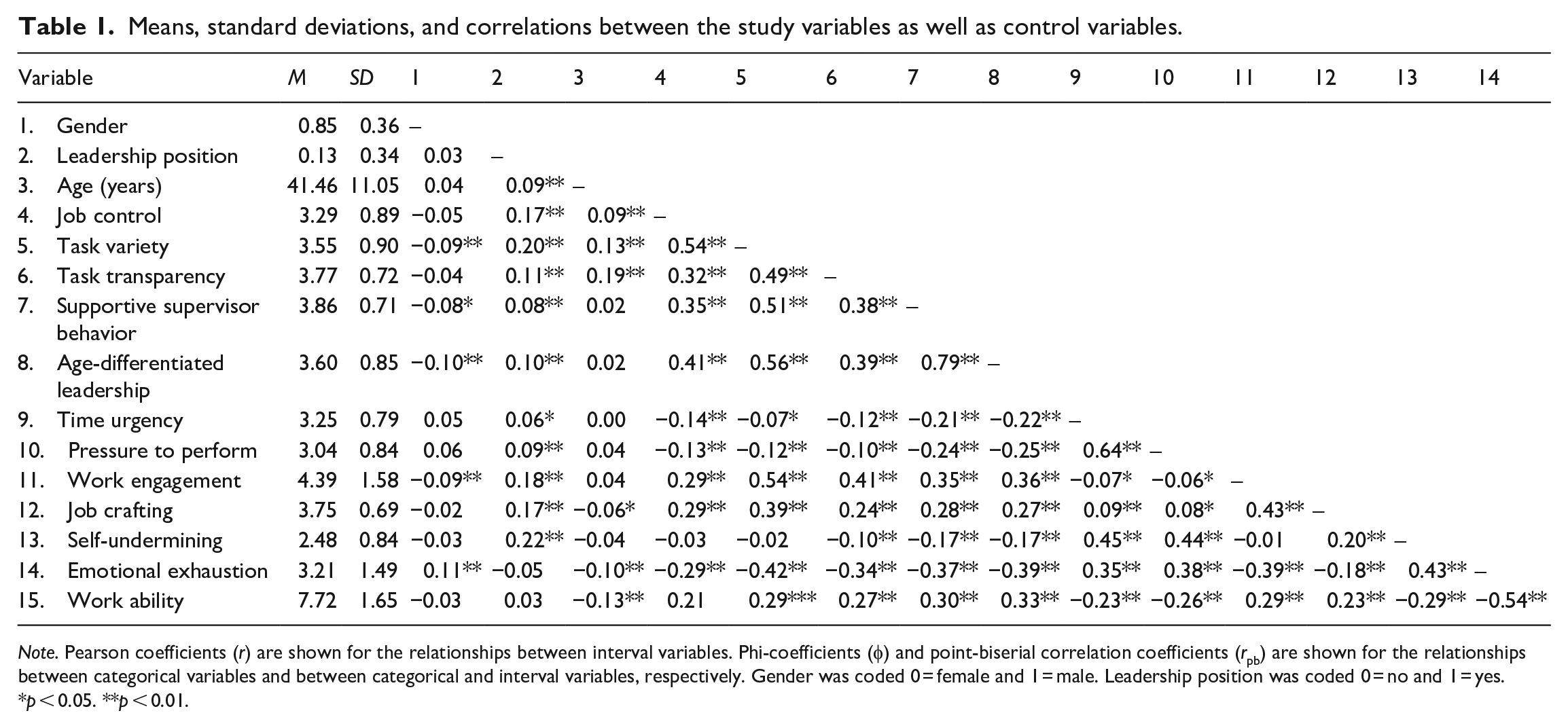
Note. Pearson coefficients (r) are shown for the relationships between interval variables. Phi-coefficients (φ) and point-biserial correlation coefficients (rpb) are shown for the relationships between categorical variables and between categorical and interval variables, respectively. Gender was coded 0 = female and 1 = male. Leadership position was coded 0 = no and 1 = yes.
p < 0.05. **p < 0.01.
Regarding the control variables, gender was positively related to emotional exhaustion (rpb = 0.11, p < 0.01) and negatively associated with job resources (rpb = −0.08 to −0.10, p < 0.05) and work engagement (rpb = −0.09, p < 0.01) indicating that male participants in our sample hat less advantageous work conditions then female participants. Additionally, leadership position was found to be positively correlated to job resources (rpb = 0.08–0.20, p < 0.01), job crafting behaviors (rpb = 0.17, p < 0.01), self-undermining behaviors (rpb = 0.22, p < 0.01), as well as work engagement (rpb = 0.18, p < 0.01), and negatively associated with job demands (rpb = −0.06 to −0.09, p < 0.05). Finally, age had a positive correlation with some job resources (r = 0.09–0.19, p < 0.01) and negative correlations with job crafting behaviors (r = −0.06, p < 0.05), emotional exhaustion (r = −0.10, p < 0.01), and work ability (r = −0.13, p < 0.01).
Table 2 and 3 present the means and standard deviations for the study variables computed separately for the five types of job satisfaction as well as their frequency and distribution. The results depicted in Table 2 point out that most respondents reported being resigned satisfied (n = 358). The highest proportion of persons holding a leadership position was found in the group of progressive satisfied (20.0 %), whereas the group of fixated dissatisfied showed the lowest percentage (6.5%). Similarly, the percentage of women in the group of progressive satisfied (19.4%) was the highest compared to the other types of job satisfaction. As can be seen in Table 3, respondents with constructive and fixated job dissatisfaction or resigned job satisfaction tended to report lower levels of job resources, work engagement, and work ability as well as higher levels of job demands, self-undermining behaviors, and emotional exhaustion compared to respondents with stabilized or progressive job satisfaction.
Numbers and percentages of reported types of job satisfaction.
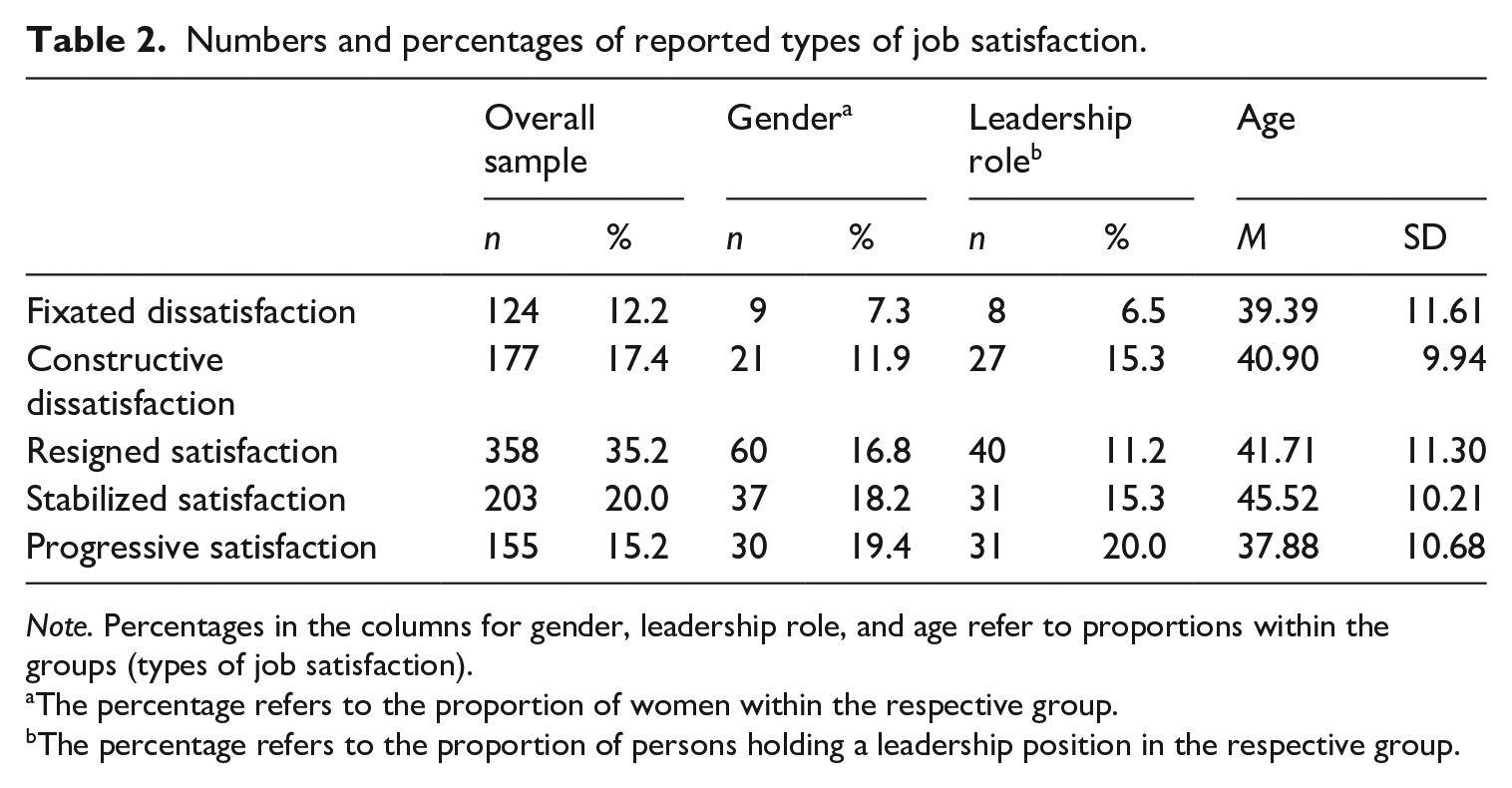
Note. Percentages in the columns for gender, leadership role, and age refer to proportions within the groups (types of job satisfaction).
The percentage refers to the proportion of women within the respective group.
The percentage refers to the proportion of persons holding a leadership position in the respective group.
Means and standard deviations of the study variables concerning the five types of job satisfaction.
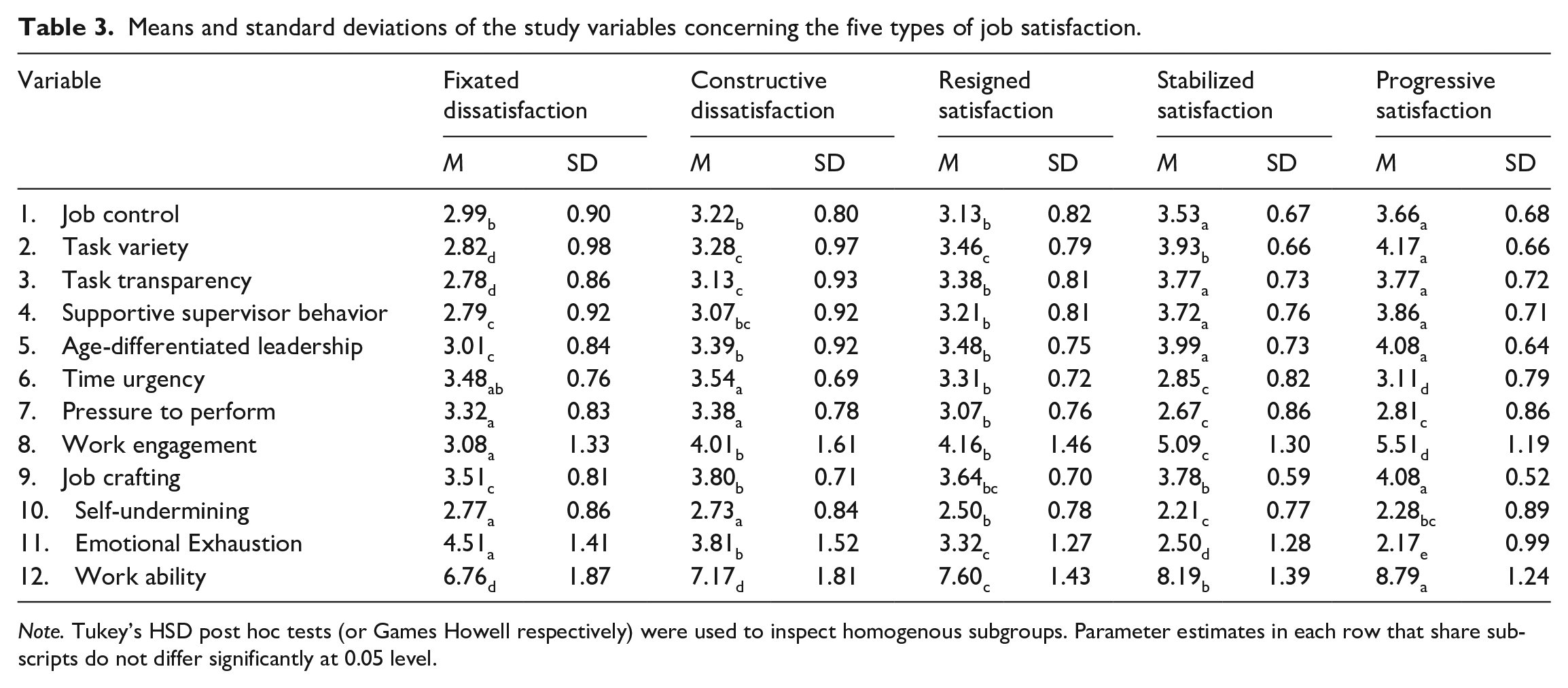
Note. Tukey’s HSD post hoc tests (or Games Howell respectively) were used to inspect homogenous subgroups. Parameter estimates in each row that share subscripts do not differ significantly at 0.05 level.
Examining the structural model
SEM analyses were employed to gain further insight into the relationships between job demands, job resources, and job crafting behaviors, emotional exhaustion, work engagement, and work ability. Note that the standardized path coefficients and their significance levels are reported below. Taking the previously computed correlations into account, gender, age, and leadership position were included in the models as controls. However, the inclusion of these variables did not significantly affect the structural relationships. The results are therefore reported without the consideration of control variables.
In the first step, the original JD-R model (M1) including the pathways from job demands to emotional exhaustion as well as from job resources to work engagement provided a poor fit to the data, with only NFI and CFI reaching acceptance (χ2(3) = 172.338, p < 0.001, χ2/df = 7.894, RMSEA = 0.108, NFI = 0.917, NNFI = 0.896, CFI = 0.928, IFI = 0.896). However, the competing cross-linked model (M2) that included two additional diagonal pathways from job demands to work engagement and from job resources to emotional exhaustion showed good fit indices (χ2(23) = 51.422, p < 0.001, χ2/df = 2.236, RMSEA = 0.049, NFI = 0.975, NNFI = 0.978, CFI = 0.986, IFI = 0.986) and yielded a significantly better fit to the data (Δχ2(2) = 120.966, p < 0.001, ΔAIC = 116.916, ΔBIC = 108.455) than M1. Further analyses were therefore based on this model. All relationships turned out to be statistically significant except for the relationship between job demands and work engagement (β = 0.02, p > 0.05). In line with expectations, job demands were positively related to emotional exhaustion (β = 0.337, p < 0.001) and job resources were positively related to work engagement (β = 0.649, p < 0.001). Additionally, job resources are negatively related to emotional exhaustion (β = −0.475, p < 0.001), however, with a smaller standardized path coefficient than in the association with work engagement. Thus, Hypothesis 1a, stating that job demands are positively related to job strain and Hypothesis 1b proposing a positive relationship between job resources and work motivation, were confirmed.
In the next step, the partial mediation model (M3) was examined by entering job crafting and self-undermining into the analysis (χ2 (37) = 99.519, p < 0.001, χ2/df = 2.690, RMSEA = 0.058, NFI = 0.960, NNFI = 0.962, CFI = 0.975, IFI = 0.975). Since a full mediation model (M4) provided significantly worse fit to the data, there was strong support for a partial mediation model (Δχ2 (2) = 146.205, p < 0.001, ΔAIC = 142.205, ΔBIC = 133.744). Bootstrapping tests revealed that all direct effects were statistically significant, except for the pathways running from job demands to work engagement (β = −0.03, p > 0.05). Most importantly, job demands had a positive indirect effect on emotional exhaustion (bootstrap estimate = 0.161, standard error = 0.024, 95% CI [0.117, 0.212], p < 0.001) through self-undermining behaviors, and job resources had a positive indirect effect on work engagement (bootstrap estimate = 0.078, standard error = 0.022, 95% CI [0.038, 0.124], p < 0.001) through job crafting behaviors. Thus, the results lend support for Hypotheses 2 and 3.
In the last step, the full model (M5a) with work ability was tested (χ2(46) = 138.020, p < 0.001, χ2/df = 3.000, RMSEA = 0.063, NFI = 0.950, NNFI = 0.951, CFI = 0.966, IFI = 0.966) and showed a good fit to the data. The full model is depicted in Figure 3. The final model was further tested against the null model (M0), which assumes that the present variables are uncorrelated (Byrne, 2010). In support of the final model, the chi-square difference test revealed that it fitted the data substantially better than the null model (Δχ2 (20) = 2744.484, p < 0.001). Bootstrapping tests revealed that all direct effects were statistically significant, except for the relationship between job demands and work engagement (β = −0.031, p > 0.05) as well as work engagement and work ability (β = 0.057, p > 0.05). However, emotional exhaustion and work ability were negatively and significantly related (β = −0.531, p > 0.001). We calculated several specific indirect effects to test hypotheses 4 and 5. Job demands had a negative indirect on work ability through a) emotional exhaustion (bootstrap estimate = −0.230, standard error = 0.070, 95% CI [−0.351, −0.120], p < 0.001) and b) through a serial mediation via self-undermining and emotional exhaustion (bootstrap estimate = −0.280, standard error = 0.036, 95% CI [−0.280, −0.161], p < 0.001). Thus, Hypothesis 4 was confirmed. However, the analyses did not support an indirect effect of job resources on work ability through work engagement. Therefore, Hypothesis 5 had to be rejected. However, we also checked for an indirect effect of job resources on work ability through emotional exhaustion turning out to be positive and significant (bootstrap estimate = 0.882, standard error = 0.123, 95% CI [0.688, 1.094], p < 0.001). Thus, even though Hypothesis 5 was not supported, these results provide evidence for a mediated association between job resources and work ability.
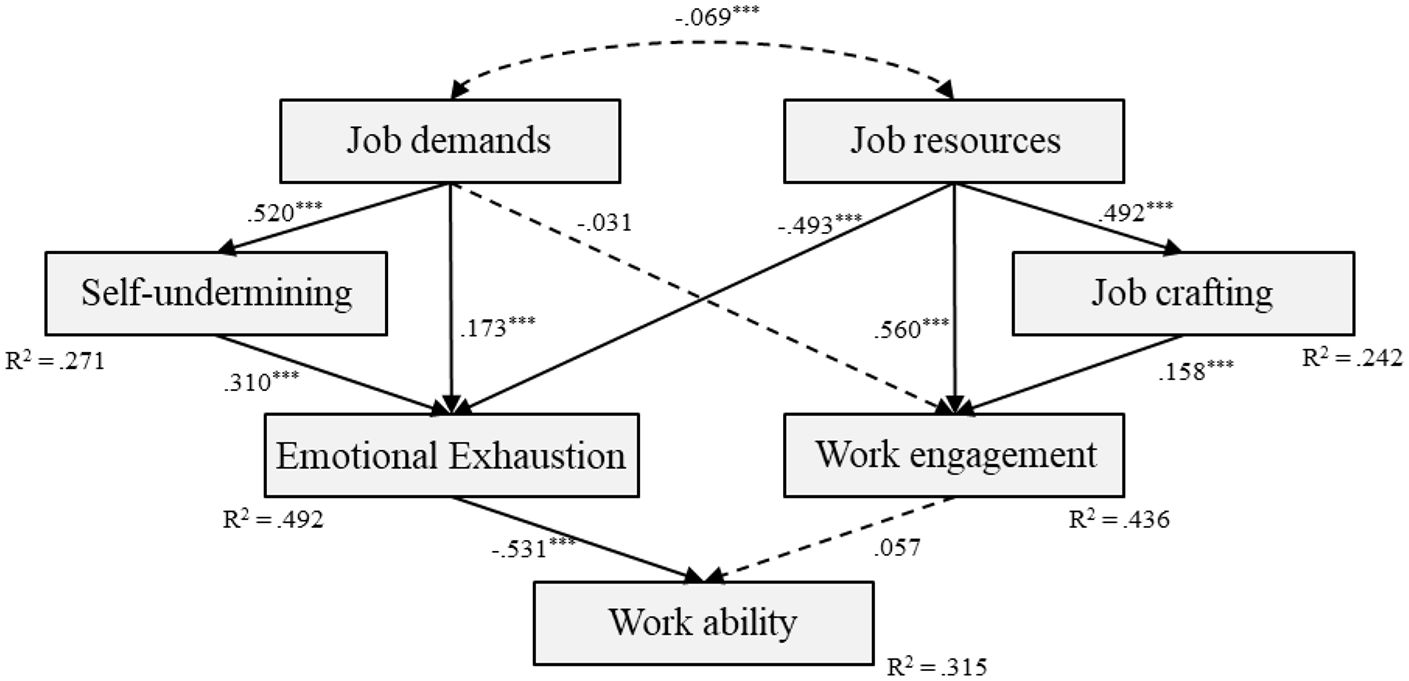
Path coefficients for the final model (M5a, calibration sample). Note that standardized path coefficients are shown.
In order to corroborate the evidence for the final model, MGA was subsequently performed to inspect whether it was invariant across the calibration (S1) and the validation sample (S2). For this purpose, a model in which the regression weights were constrained to be equal in both groups (M6a) was compared to a model in which the regression weights were not constrained (M6b). Results of the chi-square difference test turned out to be insignificant (Δχ2 (14) = 13.554, p > 0.05). Thus, the final model was invariant across the two sub-samples. Tested separately, the final model fit the data for the validation sample similarly well as the data for the calibration sample (M5b; χ2 (46) = 133.537, p < 0.001, χ2/df = 2.903, RMSEA = 0.061, NFI = 0.936, NNFI = 0.938, CFI = 0.957, IFI = 0.957). Fit indices for all proposed models and for the final model are shown in Table 4.
Model fit information for all proposed models and for the final model.
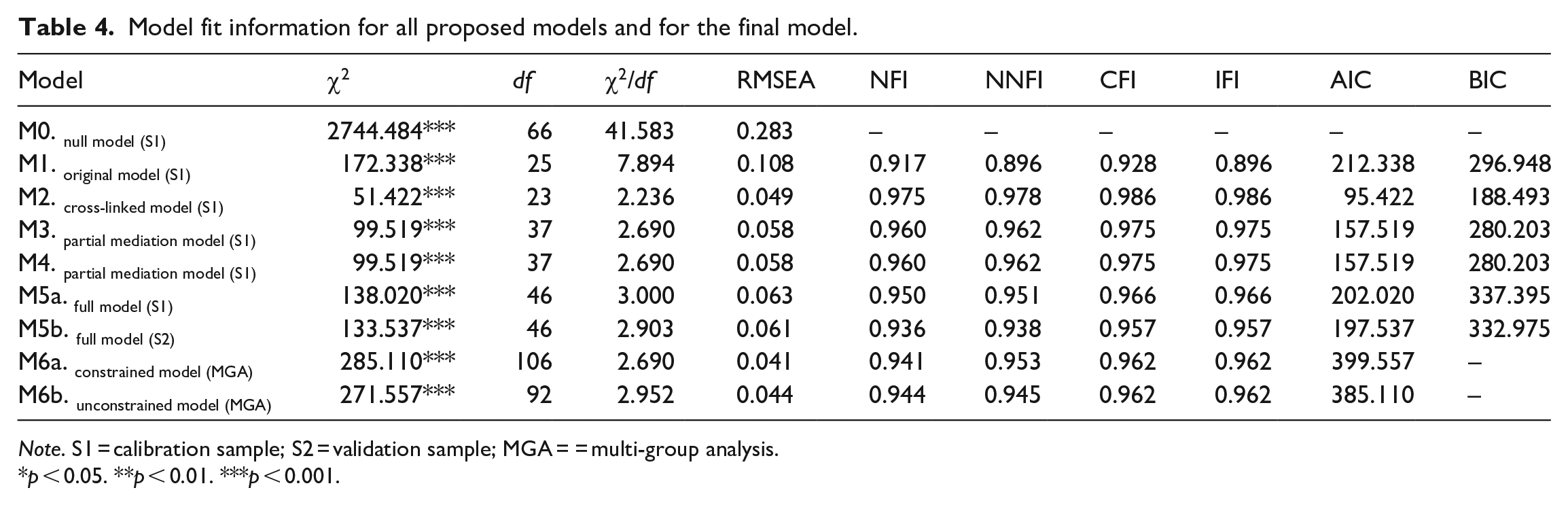
Note. S1 = calibration sample; S2 = validation sample; MGA = = multi-group analysis.
p < 0.05. **p < 0.01. ***p < 0.001.
Model fit information for the five types of job satisfaction.
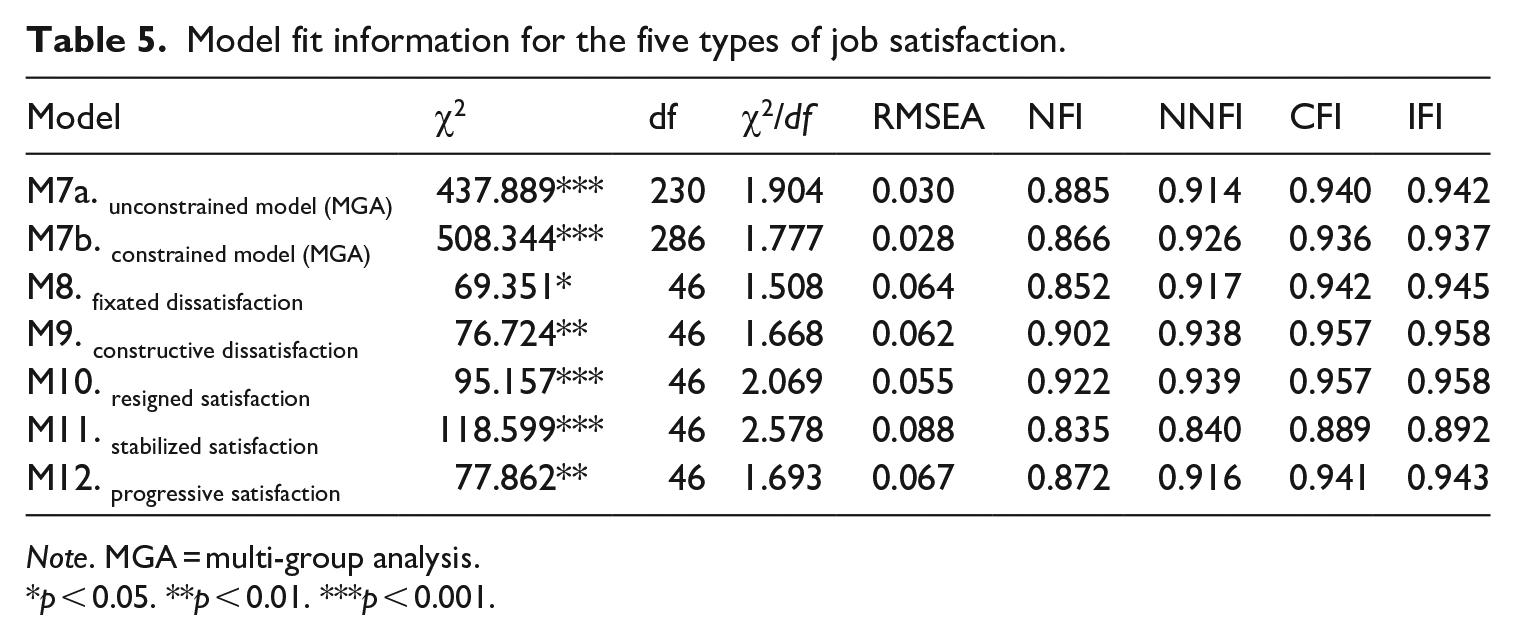
Note. MGA = multi-group analysis.
p < 0.05. **p < 0.01. ***p < 0.001.
Linking the job demands-resources theory to job satisfaction
Within the course of preliminary analyses, one-way between-subject analyses of variance (ANOVA) and subsequent Tukey’s HSD or Games-Howell post hoc tests were conducted to investigate the mean differences between types of job satisfaction concerning the focal study variables (Table 3). The results of the multiple comparisons between the five types of job satisfaction revealed that the levels of job resources were significantly higher for types of job satisfaction that are described to originate from a positive comparison of the work situation and the individual level of aspiration (i.e. progressive and stabilized job satisfaction). Similarly, the level of job demands is significantly higher for types of job satisfaction stemming from a respective negative comparison (i.e. fixated dissatisfaction, constructive dissatisfaction, and resigned satisfaction). The post hoc comparisons further revealed that representatives of the five types of job satisfaction also significantly differed from each other regarding their levels of emotional exhaustion, work engagement, job crafting behaviors, self-undermining, and work ability. Generally, the highest level of emotional exhaustion was found for respondents who reported fixated or constructive dissatisfaction, whereas the lowest level was found for respondents who reported stabilized or progressive satisfaction.
To examine whether the five types of job satisfaction can serve as a broad moderating variable, explorative SEM analyses were carried out in order to inspect how these types affect the various relationships within the extended JD-R model. Results of MGA and the following chi-square difference test showed that the final model (as tested in M5a and M5b) was invariant across the unconstrained model (M7a) and the model with constrained regression weights (M7b; Δχ2(56) = 70.454, p > 0.05). Tested separately, the different types of job satisfaction mostly resulted in an acceptable fit. However, the models for fixated dissatisfaction and progressive satisfaction showed a NFI value smaller than 0.90. Furthermore, the model fit indices for stabilized satisfaction did not reach an acceptable range. Fit indices for the respective models are shown in Table 5.
Fixated job dissatisfaction
The final model (M9) provided an acceptable fit to the data, except for the NFI value not corresponding to the criteria (χ2 (46) = 69.351, p < 0.05, χ2/df = 1.508, RMSEA = 0.064, NFI = 0.852, NNFI = 0.917, CFI = 0.942, IFI = 0.945). Bootstrapping tests revealed that all direct effects were statistically significant, except for the relationships between job demands and work engagement (β = 0.025, p > 0.05), between job crafting and work engagement (β = 0.117, p > 0.05), and between work engagement and work ability (β = −0.014, p > 0.05). Standardized path coefficients are depicted in Figure 4. Bootstrapping tests further revealed that both, job demands and job resources showed a significant indirect effect on work ability through emotional exhaustion (bootstrap estimate = −452, standard error = 0.278, 95% CI [−1.036, −0.120], p < 0.01 and bootstrap estimate = 0.582, standard error = 0.199, 95% CI [0.283, 1.101], p < 0.001, respectively).
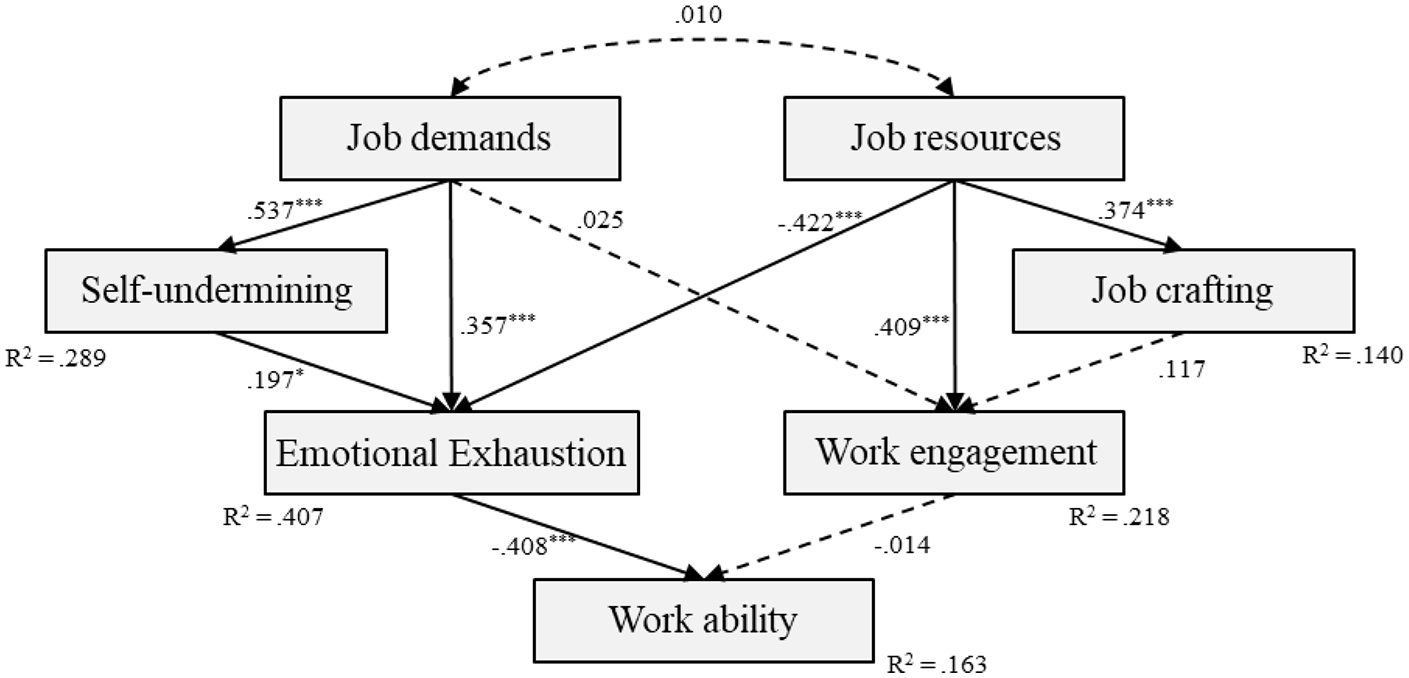
Path coefficients for fixated job dissatisfaction.
Constructive job dissatisfaction
The final model (M10) yielded an acceptable fit to the data (χ2 (46) = 76.724, p < 0.01, χ2/df = 1.668, RMSEA = 0.062, NFI = 0.902, NNFI = 0.938, CFI = 0.957, IFI = 0.957). Bootstrapping tests revealed that corresponding to the final model, all direct effects were statistically significant, except for the relationship between job demands and work engagement (β = −0.010, p > 0.05) and work engagement and work ability (β = 0.050, p > 0.05), see Figure 5. They further revealed that job demands had a positive indirect effect on emotional exhaustion (bootstrap estimate = 0.120, standard error = 0.037, 95% CI [0.063, 0.207], p < 0.01) through self-undermining, whereas job resources had a positive indirect effect on work engagement (bootstrap estimate = 0.106, standard error = 0.034, 95% CI [0.049, 0.188], p < 0.001) through job crafting. Furthermore, job demands had negative indirect effects on work ability a) through emotional exhaustion (bootstrap estimate = −0.342, standard error = 0.180, 95% CI [0.722, 0.061], p < 0.05) and (b) self-undermining and emotional exhaustion (bootstrap estimate = −0.201, standard error = .077, 95% CI [−0.400, −0.094], p < 0.01). Again, results also indicated an indirect effect between job resources and work ability via emotional exhaustion (bootstrap estimate = 0.922, standard error = 0.272, 95% CI [0.509, 1.579], p < 0.001).
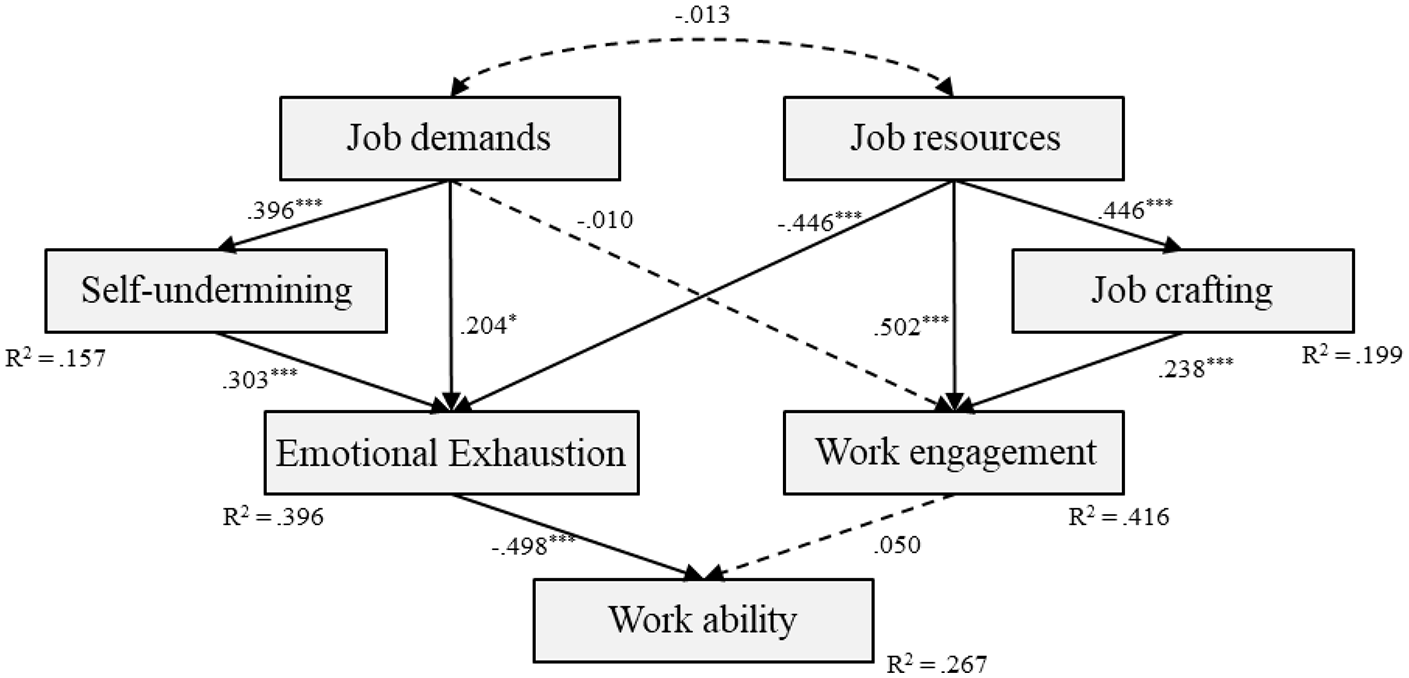
Path coefficients for constructive job dissatisfaction.
Resigned job satisfaction
The final model (M11) provided an acceptable fit to the data, with all of the fit indices reaching acceptance (χ2 (46) = 95.157, p < 0.001, χ2/df = 2.069, RMSEA = 0.055, NFI = 0.922, NNFI = 0.939, CFI = 0.957, IFI = 0.958). Bootstrapping tests confirmed that all path coefficients were statistically significant (Figure 6), except for the path between work engagement and work ability (β = 0.062, p > 0.05). They further revealed that job demands had a positive indirect effect on emotional exhaustion (bootstrap estimate = 0.114, standard error = 0.030, 95% CI [0.059, 0.178], p < 0.001) through self-undermining, whereas job resources had a positive indirect effect on work engagement (bootstrap estimate = 0.117, standard error = 0.030, 95% CI [0.065, 0.185], p < 0.001) through job crafting. Furthermore, job demands had a negative indirect effect on work ability through a) emotional exhaustion (bootstrap estimate = −0.240, standard error = 0.077, 95% CI [−0.404, −0.203], p < 0.001) and (b) emotional exhaustion and self-undermining (bootstrap estimate = −0.112, standard error = 0.034, 95% CI [−0.188, −0.053], p < 0.001). Results also indicated a significant positive indirect effect between job resources and work ability via emotional exhaustion (bootstrap estimate = 0.320, standard error = 0.077, 95% CI [0.181, 0.486], p < 0.001).
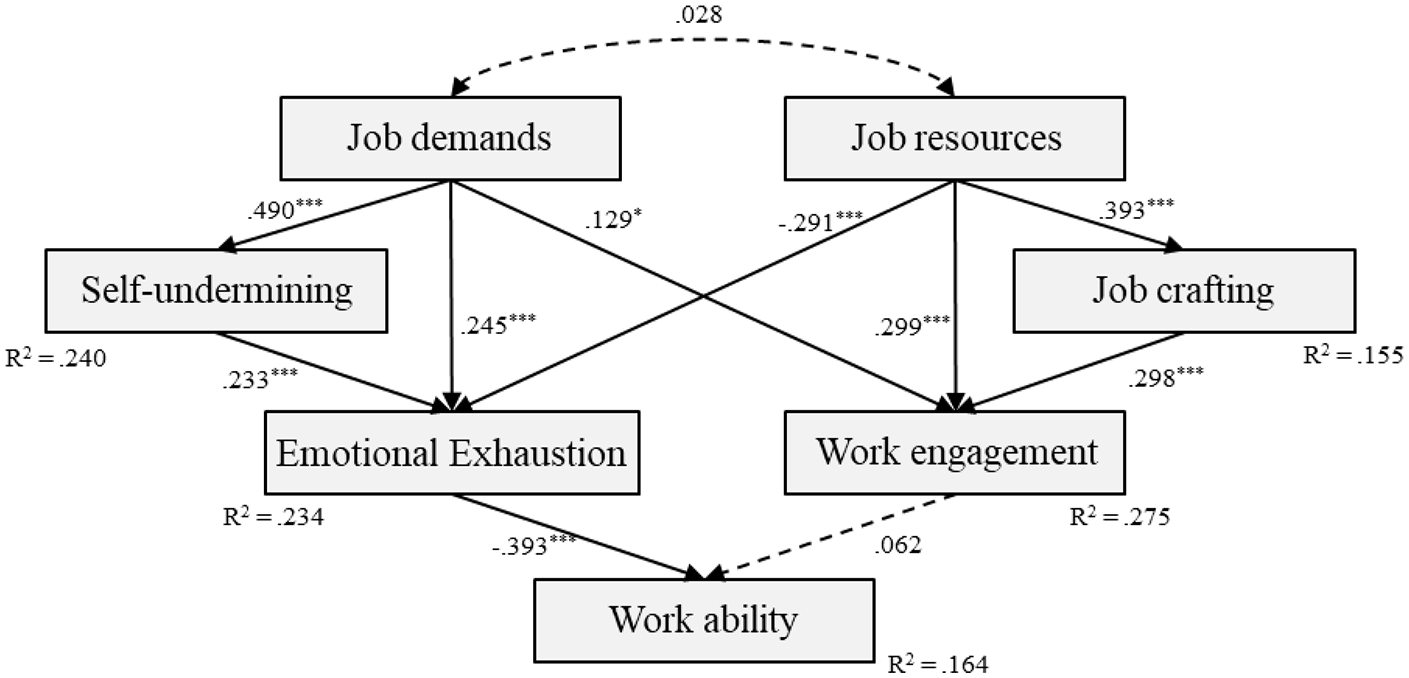
Path coefficients for resigned job satisfaction.
Stabilized job satisfaction
The final model (M12) yielded a poor fit to the data, with none of the fit indices meeting their corresponding criteria (χ2 (46) = 118.599, p < 0.001, χ2/df = 2.578, RMSEA = 0.088, NFI = 0.835, NNFI = 0.840, CFI = 0.889, IFI = 0.892). Bootstrapping tests revealed that all direct effects were statistically significant, except for the relationships between job demands and emotional exhaustion (β = 0.091, p > 0.05), between job crafting and work engagement (β = 0.099, p > 0.05), and between work engagement and work ability (β = −0.044, p > 0.05), see Figure 7. They further revealed that job demands had a positive indirect effect on emotional exhaustion (bootstrap estimate = 0.200, standard error = 0.050, 95% CI [0.117, 0.314], p < 0.001) through self-undermining. Moreover, job demands were indirectly related to work ability via self-undermining and emotional exhaustion (bootstrap estimate = −0.199, standard error = 0.067, 95% CI [−0.363, −0.103], p < 0.01). Job resources had an indirect effect on work ability through emotional exhaustion (bootstrap estimate = 0.563, standard error = 0.190, 95% CI [0.247, 0.985], p < 0.001).
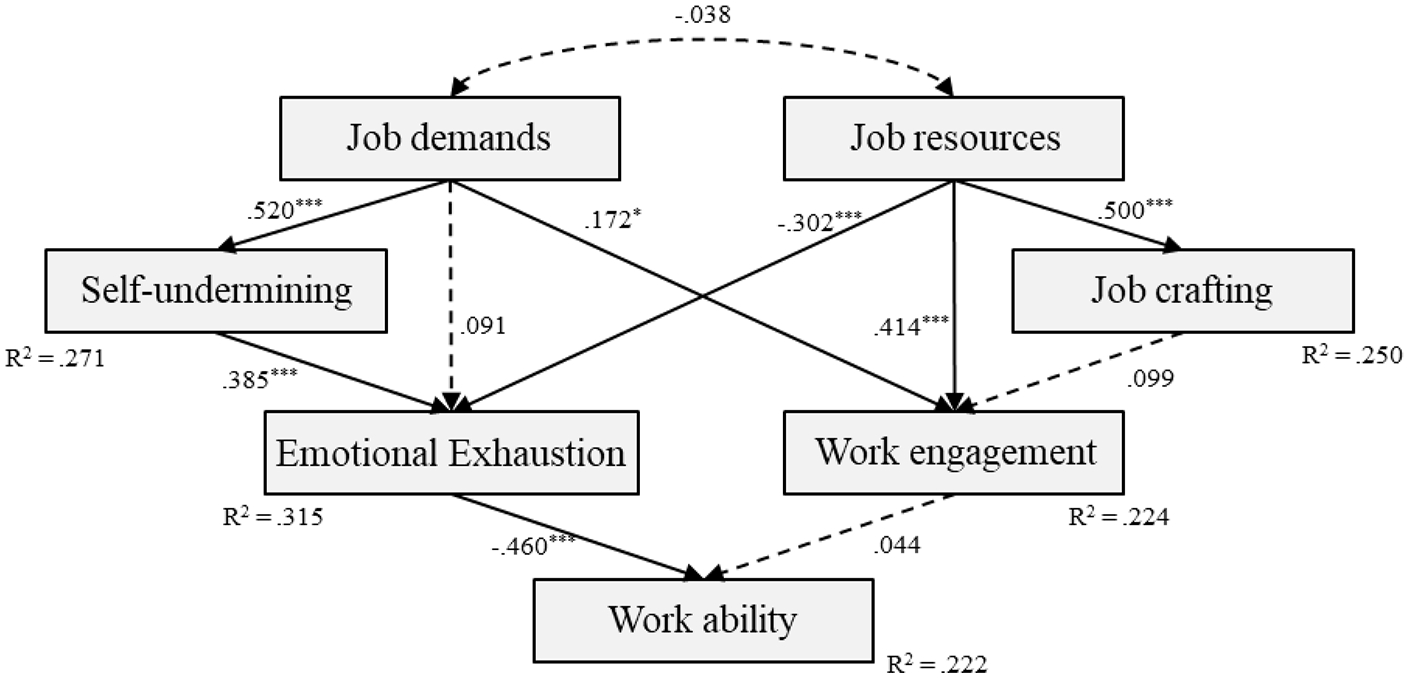
Path coefficients for stabilized job satisfaction.
Progressive job satisfaction
The final model provided an acceptable fit to the data, with most of the fit indices meeting their corresponding criteria (χ2 (46) = 77.682, p < 0.01, χ2/df = 1.693, RMSEA = 0.067, NFI = 0.872, NNFI = 0.916, CFI = 0.941, IFI = 0.943). Bootstrapping tests confirmed that four path coefficients of this model (M13) were not statistically significant (see Figure 8), that is, the association of job demands and emotional exhaustion and work engagement, respectively, as well as the relationships between job crafting and work engagement and work engagement and work ability. The bootstrapping tests further revealed that job demands had a positive indirect effect on emotional exhaustion (bootstrap estimate = 0.215, standard error = 0.055, 95% CI [0.111, 0.326], p < 0.001) through self-undermining. Furthermore, job demands had a negative indirect effect on work ability (bootstrap estimate = −0.153, standard error = 0.057, 95% CI [−0.302, −0.068], p < 0.001) through self-undermining and emotional exhaustion. Job resources also showed an indirect effect on work ability through emotional exhaustion (bootstrap estimate = 0.568, standard error = 0.270, 95% CI [0.212, 1.323], p < 0.001).
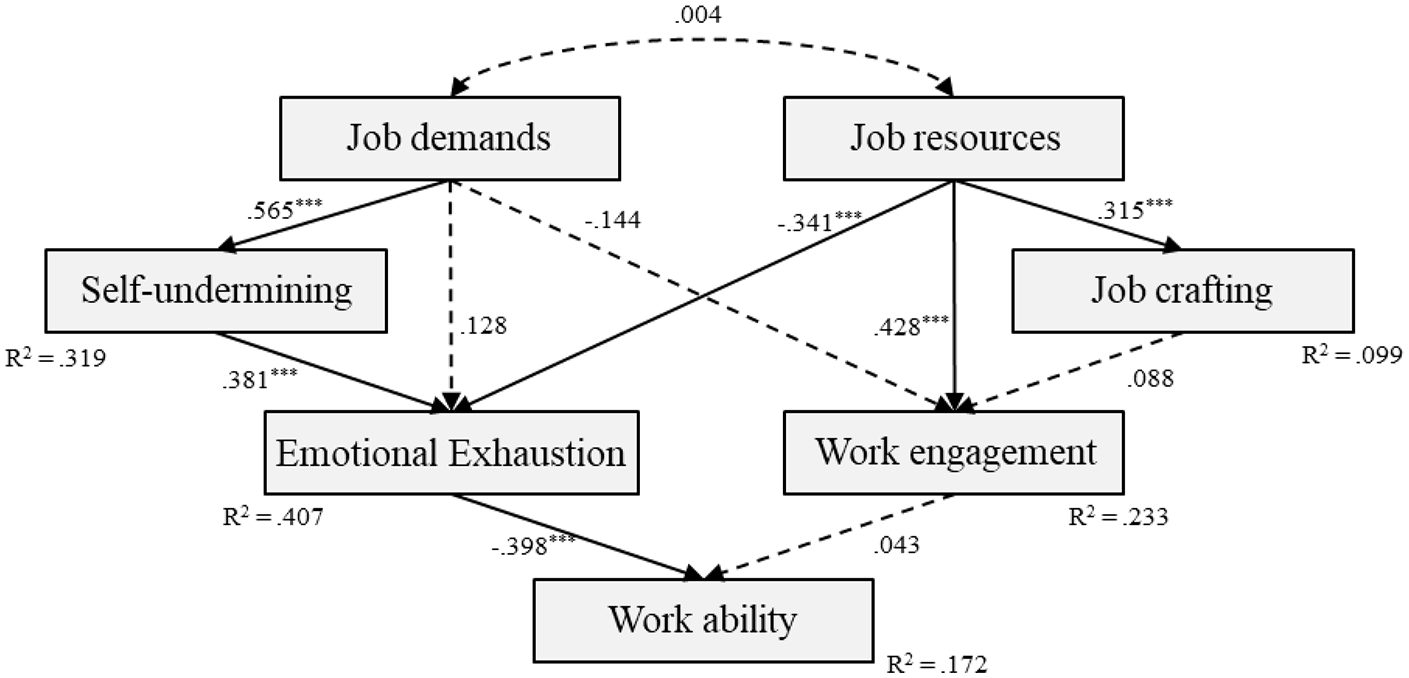
Path coefficients for progressive job satisfaction.
Testing differences between structural path coefficients
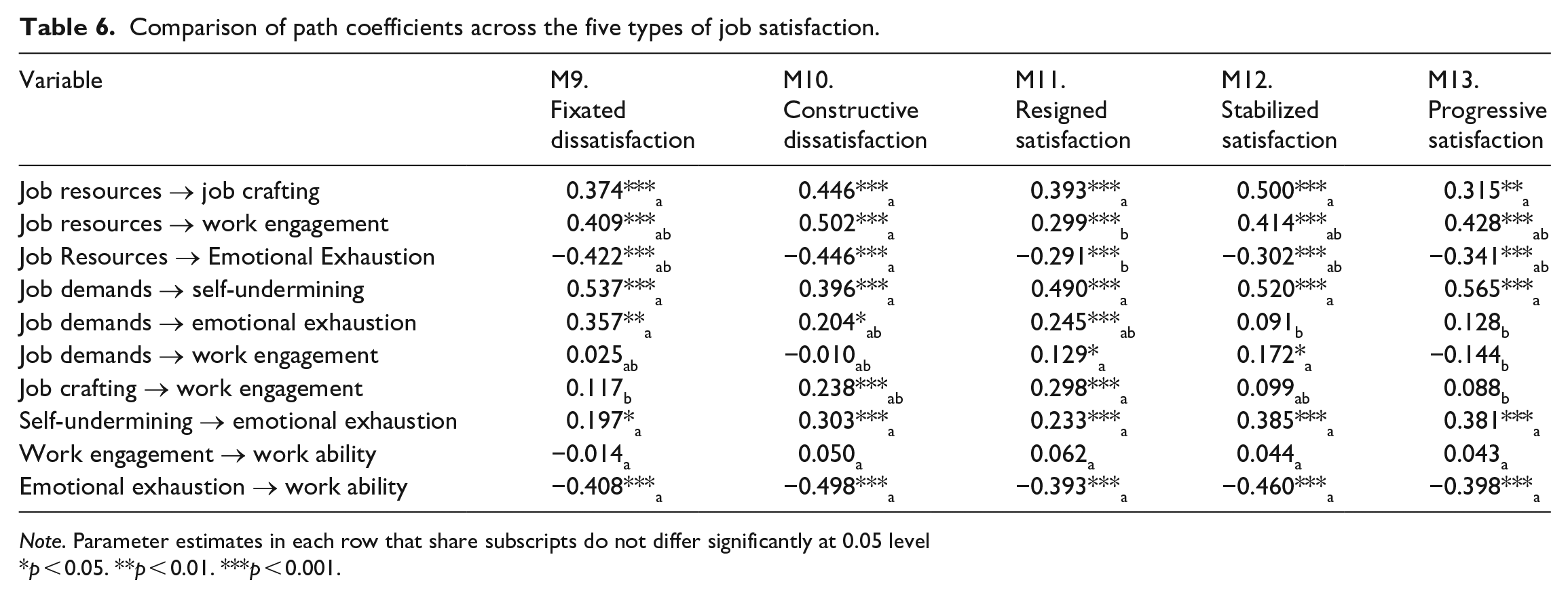
In a further step, we compared the path coefficients across all five groups in order to identify significant differences. The standardized path coefficients are provided in Table 6.
Comparison of path coefficients across the five types of job satisfaction.
Note. Parameter estimates in each row that share subscripts do not differ significantly at 0.05 level
p < 0.05. **p < 0.01. ***p < 0.001.
Results showed that some direct effects were universal and did not differ between groups, that is, the significant effects of job resources on job crafting behaviors, between job demands and self-undermining, between self-undermining and emotional exhaustion as well as the effect of emotional exhaustion on work ability. There was also an agreement among the groups as none of them showed a significant direct effect between work engagement and work ability.
However, results of the statistical tests to identify significant differences between path coefficients provided also evidence for differences between the five types of job satisfaction. First, the positive relationship between job resources and work engagement was positive across all groups, but significantly different between the groups of constructive job dissatisfaction and resigned satisfaction. The relationship was stronger for constructive dissatisfaction. Second, these two groups also differed with regard to the association between job resources and emotional exhaustion. Even though this relationship was significantly negative across all groups, the effect was stronger for the group of constructive dissatisfaction. Third, the relationship between job demands and emotional exhaustion was only significant for three of the five groups. However, there was only a significant difference between the group of fixated dissatisfaction and the two groups of stabilized and progressive job satisfaction. The relationship was positive and significant for fixated job dissatisfaction, but not significant for the other two groups. Fourth, the groups of resigned and stabilized satisfaction differed significantly from the group of progressive satisfaction with regard to the effect of job demands on work engagement. Finally, the relationship between job crafting and work engagement was significantly different between the group of resigned satisfaction and the two groups of fixated dissatisfaction and progressive job satisfaction.
To summarize, we found first empirical evidence that the relationships between the core components of the expanded JD-R model differ across groups of employees that represent the five types of job satisfaction.
Discussion
Theoretical contributions
At a general level, the present study substantially contributes to the continuing advancement of the JD-R theory by taking a closer look at the dynamic interplay between proactive employee behaviors and the dual process, while especially focusing on the association of these processes with work ability as a long-term consequence for employee’s well-being. Moreover, we addressed the important role of personal resources in the JD-R theory by exploring the impact of five types of job satisfaction on the relationships within the extended model.
Our results are in line with a vast amount of literature corroborating the key assumptions of the JD-R theory, that is, confirming the positive association of job resources with work motivation (here: work engagement) and the positive relationship between job demands and job strain operationalized as emotional exhaustion in our study (cf., Crawford et al., 2010; Lesener et al., 2019). Additionally, our data provided evidence for the cross-link between job resources and emotional exhaustion highlighting the buffer function of job resources. However, we could not find clear evidence for an association of job demands with work engagement. These findings are in line with previous research showing that job resources are also of relevance in the health-impairment process, whereas the influence of job demands on the motivational path is rather ambiguous (Lesener et al., 2019; Llorens et al., 2006; Schaufeli, 2017). A potential explanation is provided by Crawford et al. (2010) and their meta-analytical evidence demonstrating that the relationship between job demands and work engagement may be depending on the type of job demands (e.g. challenge vs. hindrance demands).
As hypothesized and therefore substantiating the assumptions of the extended JD-R theory (Bakker and Demerouti, 2017), job crafting behaviors were found to be partially mediating the positive relationship between job resources and work engagement, while self-undermining behaviors were found to be partially mediating the positive association of job demands with emotional exhaustion lending support for the assumed resource gain and loss spirals, respectively. Thus our findings support previous research highlighting that with regard to job design not only job characteristics are important for employees’ motivation and health at the workplace, but also their self-regulation behaviors when facing job demands and job resources (Lichtenthaler and Fischbach, 2019). Moreover, recent studies could show that job crafting and self-undermining behaviors have further crucial associations with, for example, job performance (Bakker and Wang, 2020), the motivation to continue working after reaching the official retirement age (Lichtenthaler and Fischbach, 2016b), and motivation as well as adaptivity in the face of organizational change (Petrou et al., 2016).
Additionally, this study advances our understanding of the JD-R theory by linking it to the concept of work ability. Although emotional exhaustion was negatively related to work ability as proposed, the results did not reveal the expected positive association with work engagement. However, our investigations of the indirect effects in our final model showed that job resources contribute to work ability by reducing emotional exhaustion. These findings suggest that work ability may be conceived as primarily linked to the health impairment process without being affected by the motivational processes. In contrast, previous research reported a significant positive relationship between work ability and work engagement (Airila et al., 2012, 2014) Therefore, this link warrants attention in further research focusing on work ability as a long term indicator of well-being and employability, for example, by addressing potential mediators and moderators in this relationship.
Furthermore, the present study makes a unique contribution to the further extension of the JD-R theory by linking its core components to the five types of job satisfaction. There are several indications that these types can serve as an important bundle of stable personal resources, since specific relationships are characteristic for only some types and the magnitude of the investigated relationships slightly differs depending on the type of job satisfaction. Stabilized and progressive satisfied employees, for example, did not reveal a significant relationship between job demands and emotional exhaustion. Path-wise group comparisons showed that these two groups are significantly different from fixated dissatisfied employees. These results illustrate the profound satisfaction stemming from the perceived congruence between the actual work situation and the level of aspiration (Bruggemann, 1974; Büssing, 1991). A notion that is also supported by the literature on person-environment fit (Kristof-Brown et al., 2005). Resigned and stabilized satisfied employees were the only groups showing a significant link between job demands and work engagement. Interestingly, this relationship turned out to be positive for these groups and was significantly different from the progressive satisfied employees. Thus, resigned and stabilized satisfied employees may be more inclined to perceive job demands as challenges rather than hindrances (Lepine et al., 2005; Podsakoff et al., 2007).
However, our findings also confirmed most of the paths to be significant across all groups representing the five types of job satisfaction. This finding supports the propositions underlying the JD-R theory and emphasizes the value of this theory as an essential overarching framework for research and practice.
Investigations of the indirect effects across the models for all five types of job satisfaction also confirmed most of the effects, but also revealed several specific differences. Constructive dissatisfied and resigned satisfied employees were, for example, the only groups providing support for an indirect effect of job resources on work engagement via job crafting behaviors. Bruggemann (1974) described that constructive dissatisfied employees try to escape a working environment that does not fit their aspirations by proactive problem-solving behaviors. In contrast, resigned satisfied employees, are expected to reduce their level of aspirations to cope with the person-environment misfit. In this regard, it may be interesting to have a differential look at different kinds of job crafting. We measured job crafting based on different facets of job crafting, that is, cognitive crafting, increasing structural job resources, and increasing challenging job resources. Thus, we assume that different kinds of job crafting may be relevant for constructive dissatisfied and resigned satisfied employees. According to the model by Bruggemann, resigned satisfied employees may be rather engaged in cognitive crafting that refers to cognitively reframing their jobs in order to make them more meaningful (Weseler and Niessen, 2016). This assumption would also explain why employees that actually perceive a misfit between their aspirations and work still report being satisfied. For fixated dissatisfied employees, we could not find an indirect effect of job demands on emotional exhaustion via self-undermining behaviors. This finding is in line with the model by Bruggemann as fixated job dissatisfaction will not engage in proactive problem-solving behaviors or defense mechanisms when facing a person-environment misfit. Instead, these persons get stuck in their situation and are especially prone to a pathological health development (Büssing, 1992).
Taken together, these findings point out that both the (extended) health impairment process as well as the (extended) motivational process might depend to a certain extent on groups of employees with specific characteristics, that is, having certain personal resources and coping strategies, as is presumed by the JD-R theory.
Finally, this study reveals that not only the interrelations but also the levels of the core components of the extended JD-R theory and work ability significantly differ across the five types of job satisfaction. Differences between the groups with regard to job demands, work engagement, and emotional exhaustion as an indicator of mental health are consistent with previous research (cf. Schlett et al., 2018). Additionally, our findings provide interesting insights into differentiated self-regulation mechanisms. Progressive satisfied employees, for example, were found to have the highest level of job crafting while showing a low level of self-undermining behaviors. The model by Bruggemann does not assume proactive behaviors from this group but describes that due to their elevated aspirations, these employees may feel a kind of “creative dissatisfaction” (Büssing et al., 1999). We assume that progressive satisfied employees’ ambitious goals and optimism in combination with their increased level of perceived controllability mobilize job crafting behaviors in order to positively change the work, increase the available resources, and achieve an even higher level of job satisfaction in the future. Fixated dissatisfied employees, on the other hand, showed the highest level of self-undermining and the lowest level of job crafting behaviors. This finding is also interesting as we could not find a significant indirect effect from job demands on emotional exhaustion via self-undermining behaviors. Thus, these behaviors may represent a rather stable set of behaviors that fixated dissatisfied employees show regardless of their current work situations. Their poor motivation to change the dissatisfying work situation in combination with a decreased level of perceived controllability and a lack of long-term goals for their work (see Büssing, 1992) may be closely related to the low levels of personal resources that have been reported lately (Schlett et al., 2018). These examples of progressive satisfied and fixated dissatisfied employees point out that the five types of job satisfaction show differentiated patterns not only of personal resources, but also of positive and negative forms of work-related proactivity in a wider sense.
Practical implications
Considering organizations’ objectives to maintain and promote health, motivation and employability of employees, our results substantiate the importance of continuous interventions on the organizational, individual, and task level that are aimed at decreasing job demands while increasing job resources at work. With regard to job crafting behaviors which enable employees to fit their jobs to their preferences and needs on the one hand, and to their personal knowledge, skills, and abilities on the other hand (Demerouti, 2014), the results put emphasis on the special need for the development and implementation of interventions that promote job crafting behaviors at work. Those interventions can be realized either in the context of job design since previous research has shown that supportive supervision and work discretion have a positive impact on individual and collaborative job crafting behaviors (see Leana et al., 2009), or by providing individual job crafting training as elaborated by Van den Heuvel et al. (2015), including workshops, weekly crafting logbooks, and reflection meetings. Self-undermining behaviors, on the other hand, are perceived as a proactive coping reaction that helps employees to achieve the given work goals instead of abandoning them and is primarily shown when faced with high work demands or managerial practices that build on employee’s autonomy and self-regulation (Dettmers et al., 2016). Accordingly, Knecht et al. (2017) recommend managers to reduce detrimental work conditions (e.g. goal spirals) that might arise under indirect control. Instead, work goals should be negotiable, adjustable, and appreciated when they were successfully achieved.
In light of current findings indicating that the different types of job satisfaction provide personal resources that interact with the core components in the JD-R theory, there is a compelling need for future interventions to take these different types into account. In line with Inauen et al. (2015), the findings reported in the present study suggest that the levels of job demands, job resources, work engagement, emotional exhaustion, proactive employee behaviors, and work ability differ across the five types of job satisfaction. In order to provide effective interventions, they should accordingly be tailored to the specific target groups, for example, with regard to employees’ participation in health service programs (fixated dissatisfied employees had the highest level of emotional exhaustion and the lowest level of work ability), promotion of job crafting behaviors (fixated dissatisfied employees showed the lowest levels of job crafting behaviors), and health-oriented job design (fixated dissatisfied, and constructive dissatisfied employees had remarkable high levels of job demands).
Moreover, the multiple relationships between these components were shown to vary across the different types of job satisfaction, too. For instance, a positive impact of job crafting behaviors on work engagement could only be found for constructive dissatisfied and resigned satisfied employees. Thus, human resource practices should therefore focus on the special need for job crafting interventions in work teams with a high level of constructive dissatisfaction or resigned satisfaction.
Limitations and future research
Although the present study provides further evidence for the need of a more dynamic view on the JD-R theory, it has some limitations that warrant attention. First, this study was based on a cross-sectional design which makes it impossible to draw any conclusion about causality due to temporal ambiguity. However, although the results contribute to other research suggesting causal relationships between job demands, job resources, proactive employee behaviors, and well-being (e.g. Knecht et al., 2017), some longitudinal studies have recently indicated that these relationships might be reversed or reciprocal in nature (e.g. Simbula et al., 2011; Xanthopoulou et al., 2009). What is more, a recent study applying meta-analytic SEM techniques based on longitudinal studies also confirmed that the model with reciprocal assumptions between job characteristics and well-being fitted the data much better compared to the standard model (with pathways from job characteristics to well-being) and reversed model (with pathways from well-being to job characteristics; Lesener et al., 2019). Future research conducting a prospective and longitudinal design with an adequate amount of waves for data collection is therefore needed to capture the various causal relationships.
Second, since the data from this study were entirely derived from self-report questionnaires, it is possible that the observed relationships among the variables were inflated by common method variance (P. M. Podsakoff et al., 2003). We conducted Harman’s single factor test to assess the risk of common method variance. However, this approach has been a target of criticism (e.g. Aguirre-Urreta and Hu, 2019). There are recommendations on other post hoc statistical approaches to address a potential common method bias, for example, in the context of this study and the underlying data the single-common-method-factor approach (P. M. Podsakoff et al., 2003) would have been feasible. The use of this alternative technique is strongly discouraged and, unfortunately, at present there is no highly reliable gold standard (Richardson et al., 2009). Thus, future studies should therefore carefully implement means to prevent the risk of common method variance, for example, by precautionary base their measures on multiple sources, including objective measures (e.g. productivity and sickness absence) and ratings from observers, supervisors, or colleagues.
Third, although the sample was comprised of both blue- and white-collar workers in nearly equal shares, this study was conducted at a single German organization and mainly included male employees, thus limiting the generalizability of the findings with regard to other organizations, specific occupations, or the German working population.
Fourth, as the present study was part of a larger survey, shortened scales and reduced numbers of items were used to assess the variables of interest without taking the risk of high respondent burden. Future studies faced with fewer restrictions should include longer scales to contribute to sufficient reliability as well as to a more substantial representation of the underlying concepts. Moreover, due to the limited sample size per type of job satisfaction and the model complexity of our measurement model, we could not provide a valid test of measurement invariance across the five groups. Additionally, since this study exclusively focused on different types of job satisfaction as a potential moderating personal resource within the dual process and did not take conventional concepts such as self-efficacy, neuroticism, or the differentiation between coping styles (e.g. problem- vs. emotion-focused or cognitive vs. behavioral coping) into account, further research is still needed that investigates a broader range of variables and their potentially mediating or moderating effects.
Fifth, this study examined the role of individual proactive employee behaviors. However, some scholars went one step further and inspected the exhibition of collaborative job crafting behaviors in work teams, showing that they unfold a positive impact on individual and team performance through work engagement (e.g. Leana et al., 2009; McClelland et al., 2014). We therefore suggest that future research should take also this new perspective into account by investigating the dynamic interplay between collaborative proactive employee behaviors and their effects on both individual and team-level job strain, work engagement, and well-being.
