




Abstract
This article extends the discussion of the predictors of job crafting to include small- and medium-sized enterprises (SMEs) working in an information and communication technologies (ICT)-based mobile and multilocational manner. Based on a survey (N = 412) conducted in 43 Finnish SMEs, the job and personal resources-related predictors of approach and avoidance types of job crafting were analysed. From job resources, co-working, multilocality, the resources in the physical work environment, useful ICT and social support predicted the approach types of job crafting. Intrinsic motivation, relatedness and feeling competent as personal resources activated the approach types of job crafting. Drawing on background variables, being a younger firm activated job crafting. Avoidance type of job crafting was predicted positively by the resources in the physical work environment. This article suggests that knowledge about the predictors of job crafting encourages SMEs to activate this practice among its personnel.
Keywords
Introduction
Job crafting refers to proactive behaviour where employees customise their job demands and resources (Tims and Bakker, 2010; Tims et al., 2012), and adjust their working practice and, as proposed in this article, adjust their work environment to suit their tasks and individual preferences. According to previous research, job crafting not only increases individual well-being and motivation at work (Hakanen et al., 2017) but is also crucial for organisational flexibility and effectiveness (Lee and Lee, 2018; Tims et al., 2015). More specifically, when crafting their jobs, employees can influence the scope and nature of their tasks or the extent and nature of their social relationships at work (Petrou et al., 2012; Tims and Bakker, 2010; Tims et al., 2012). By enabling and encouraging job crafting, organisations can empower employees to redesign their jobs (Demerouti, 2014; Kim and Beehr, 2019) and thereby, attain several positive outcomes such as work engagement (Bakker et al., 2012, 2016; Demerouti et al., 2015; Harju et al., 2016; Vogt et al., 2016), person-job fit (Lu et al., 2014; Tims et al., 2016), organisational commitment (Ghitulescu, 2007), as well as increased job performance and satisfaction (Leana et al., 2009; Tims et al., 2013a, 2013b).
While earlier research has concentrated on the consequences of job crafting and been able to identify both situational and individual predictors of job crafting (Demerouti, 2014), we still know little about the factors that enable or inhibit this activity in small- and medium-sized enterprises (SMEs), although the opportunity for job crafting is particularly important in this context. For example, professional development opportunities are often limited (Galabova and McKie, 2013; Hubner and Baum, 2018) and therefore, increasing challenging demands is particularly important for often overqualified employees in SMEs to maintain their work motivation and performance (Maden-Eyiusta and Alten, 2021). In addition, in SMEs scarce resources are primarily allocated to ensuring organisational survival rather than internal development efforts (Hillary, 2017) and professional development opportunities are often limited (Galabova and McKie, 2013; Hubner and Baum, 2018). Employees also face significant challenges in managing the work-life interface as they typically hold multiple roles in the organisation due to labour shortages (Guest, 2002; Malik et al., 2010). Moreover, following the general flexibility paradigm (Korunka, 2021; Ramsdal and Skorstad, 2009), individual autonomy to craft a job can be viewed as an organisational resource that enables SMEs to respond to unexpected occurrences in their environment. Thus, by enhancing the conditions for job crafting and thereby, the autonomy of their employees, SMEs can improve their resilience to cope in complex environments (Laloux, 2014).
In the context of SMEs, flexibility and resilience have been primarily discussed as an organisation’s capacity to respond to changes in its operative environment at the level of organisational operations and strategy (Harries et al., 2018; Herbane, 2019; Levy and Powell, 1998; Sullivan-Taylor and Branicki, 2011) or from the perspective of entrepreneurs (Corner et al., 2017). Overall, the SME literature has scarcely addressed the employee perspective (Harney and Alkhalaf, 2021). Therefore, although the data in our study considers all the personnel of SMEs, we particularly seek to add to the limited evidence pertaining to SME employee perspectives. Drawing on the job demands-resources (JD-R) model (Demerouti et al., 2001), this study examines how the job resources and personal resources available in the operational environment of information and communication technologies (ICT)-based mobile and multilocational work of SMEs predict the generally discussed types of job crafting, that is, increasing structural and social job resources, increasing challenging job demands and decreasing hindering job demands (Tims et al., 2012) in Finnish SMEs. Understanding this allows us to identify and develop ways in which autonomous job crafting could be further facilitated in SMEs for their benefit.
Our other contribution is related to new ways of working (Eurofound, 2015). Just like in other organisations, in SMEs the core premises of work have changed significantly due to developments in ICT, and this process has been further accelerated by the recent pandemic (Klein and Todesco, 2021). The shift to ICT-enabled mobile and multilocational work has not only changed job demands and resources but also prompted employees to adopt a more autonomous role in fitting their ways of working to their tasks and personal needs and abilities (Vartiainen, 2021; Wessels et al., 2019). When working in an ICT-based mobile and multilocational manner, the operational environment of work expands and creates new transient demands and resources (Koroma et al., 2014; Vartiainen, 2021; Vartiainen and Hyrkkänen, 2010). This requires both employers and employees to adopt and apply new competences to manage, and benefit from, the expanded operational context for work. When employees, for example, are working remotely so, no longer under the control or guidance of superiors or peers, they have the responsibility to modify their physical, virtual and social workspaces to fit with the different tasks and with their personal resources.
Some recent theoretical initiatives (Wessels et al., 2019) endorse the idea of including the features of new ways of working, such as time and spatial dimensions of work, as targets of employee-driven job crafting. We contribute to this discussion by suggesting a new type of job crafting, that is, increasing workplace resources, which has not been previously acknowledged as a form of job crafting. This job crafting type refers to the modification of the physical working environment by adjusting working conditions such as ergonomics and lighting or by changing the location of work to suit the execution of the particular task. Increasing workplace resources is a particularly topical form of job crafting as work has become more remote and multilocational, adding to the complexity of working contexts and employee needs to adapt to and impact these changing conditions.
Theoretical background
Different types and emphasis of job crafting
Several authors have addressed partly similar, partly different aspects of job crafting. Most dimension-level operational definitions focus on the content of job crafting, that is, what job property is crafted, and on the form of job crafting, that is, how this property is crafted (Hu et al., 2020). Crafting the content of a job involves making changes to it and examining the social resources or demands at work, for example. Considering how to craft, researchers use the terms increasing and decreasing (Petrou et al., 2012; Tims et al., 2012), expansion and reduction (contradiction) (Bruning and Campion, 2018; Costantini et al., 2019), promotion and prevention (Lichtenthaler and Fischbach, 2019) or approaching and avoiding (Bruning and Campion, 2018).
What is crafted? From the content viewpoint of job crafting, there are two distinct theoretical perspectives. One is provided by the original theory from Wrzesniewski and Dutton (2001), and the other is the job demands and resources perspective by Tims et al. (2012). Wrzesniewski and Dutton (2001) identified three aspects of job crafting: tasks, relations and cognitions. In task crafting, the target is the content of work, for example, minimising impoverished aspects of the job and maximising the enriching job content. Relational job crafting concerns the social domain of work and refers to alterations with whom one interacts and the quality of interaction with others at work – be it co-workers, superiors or customers. Cognitive job crafting involves changes in how an individual employee perceives and makes sense of a job. Bruning and Campion (2018) defined the approach of Wrzesniewski and Dutton (2001) as role-based job crafting. This focuses on intrinsic motivation to enrich work identity by altering the scope of a job, that is, changing the boundaries of the task, relational and cognitive domains of work (Bruning and Campion, 2018; Wrzesniewski and Dutton, 2001; Zhang and Parker, 2019).
The other approach is characterised as the resource-based perspective (Bruning and Campion, 2018). Based on the JD-R model (Bakker et al., 2003; Demerouti et al., 2001), this perspective explains the different ways individuals change their jobs to increase resources and reduce demands to minimise the person–job misfit. Employees engage in job crafting to change what is required of them in their work by managing resources and thus, making work more meaningful, engaging and satisfying (Tims et al., 2012, 2013a, 2013b).
How is a job crafted? The aforementioned resource-based perspective of job crafting also explains how individuals seek resources to manage job demands by either increasing or decreasing them. Tims et al. (2012) suggested four independent types of job crafting behaviour: increasing structural job resources (e.g. requesting more autonomy), increasing social job resources (e.g. asking for feedback), increasing challenging job demands (e.g. voluntarily taking new responsibilities) and decreasing hindering job demands (e.g. reducing cognitive and emotional demands, avoiding contact with emotionally demanding clients). The two types of job demands, hindering or challenging, are further distinguished based on their relationship with employee well-being (LePine et al., 2005). Hindering job demands are associated with lower well-being and performance whilst challenging job demands contribute to positive outcomes, for example, better skills and personal growth.
The concepts of approach and avoidance crafting integrate the above-mentioned role- and resource-based research streams of job crafting; thus, both roles and resources can be crafted by approaching or avoiding types of behaviour (Bruning and Campion, 2018). Approach crafting consists of active efforts towards problem solving and improvement-focused goals, such as seeking opportunities to learn and challenging oneself. The resource-based perspective aligns with the job crafting dimensions of increasing resources and seeking more challenging job demands (Bipp and Demerouti, 2015; Bruning and Campion, 2018; Zhang and Parker, 2019). Avoidance crafting focuses on reducing the parts of work that are stressful, such as avoiding difficult situations or making mentally demanding tasks easier to perform (Bipp and Demerouti, 2015; Bruning and Campion, 2018; Zhang and Parker, 2019). According to Bruning and Campion (2018), avoidance is related to avoidant and prevention-oriented traits (Bipp and Demerouti, 2015; Petrou and Xanthopoulou, 2020), and from the resource-based perspective, it reflects attempts to reduce hindering job demands (Fong et al., 2020; Mäkikangas, 2018; Zhang and Parker, 2019).
This study follows the resource-based perspective of job crafting using the conceptualisations of approach and avoidance crafting; this concurs with Tims et al. (2012) by focusing on job demands and resource crafting. This involves the four job crafting behaviours and captures the main ways in which individuals craft their work. In this study, approach crafting consists of increasing job resources (both structural and social, see Tims et al., 2012) and seeking more challenging job demands. Avoidance crafting entails decreasing hindering job demands (Lazazzara et al., 2020; Mäkikangas, 2018; Petrou and Xanthopoulou, 2020). As this study focuses on SMEs operating in an ICT-based mobile and multilocational manner (Eurofound, 2015), a new job crafting element was added to approach crafting entity: increasing workplace resources. New ways of working lead to new work-related demands arising from expanding the operational environments of work. Individuals need to cope with these demands by crafting their resources, for example, by adding competences to quickly set up work spaces wherever, or whenever, or developing their ability to consciously choose the best place for a certain task. Wessels et al. (2019) also highlighted the need to extend job crafting to include time-spatial job crafting for when employees make active changes to their working hours, place and location of work.
What predicts job crafting?
There have been several meta-analyses and syntheses collating and clustering the antecedents of job crafting (Lazazzara et al., 2020; Rudolph et al., 2017; Zhang and Parker, 2019). Despite the differing perspectives, the main categorisation of job crafting antecedents originates from distinguishing individual characteristics from work- and organisation-related situational or contextual factors (Bakker et al., 2012; Demerouti, 2014; Lazazzara et al., 2020; Rudolph et al., 2017; Zhang and Parker, 2019). In this study, based on the JD-R model, we focus on two main categories as antecedents of job crafting: First, job resources as situational predictors with emphasis on ICT-based mobile and multilocational work of SMEs and second, personal resources as individual-related predictors. Job resources are those physical, social or organisational aspects that reduce job demands and the associated physiological and psychological costs (Schaufeli and Bakker, 2004). As job resources, we consider general ICT-based mobile and multilocation work-related resources, for example, an option to select where, when and how to work and immediate work environment-related resources, for example, resources in the physical environment, the usefulness of ICT tools, the possibility to control working time and social support. Personal resources in the JD-R model are linked to an individual’s sense of their ability to successfully control, and have an impact upon, their environment (Hobfoll et al., 2003). For personal resources in this study, we consider the basic work-related needs and the level of motivation based on self-determination theory (Deci and Ryan, 2000).
In the following sections, we discuss the previous findings of the predictors of job crafting related to categories of situational or contextual job resources and personal resources. Based on these arguments, we propose hypotheses for testing.
Situational job resources as predictors of job crafting
According to Demerouti (2014), situational predictors emerge from work and organisation-related issues and the social relations of work. Lazazzara et al. (2020) use the synonymous term ‘contextual conditions’ and relate it to factors of job design and organisational climate, both of which can either support and stimulate or constrain job crafting. Previous research identifies this kind of work and organisational predictors to be: decision latitude (Leana et al., 2009), job autonomy (Rudolph et al., 2017; Wrzesniewski and Dutton, 2001), discretion to craft a job (Leana et al., 2009), task complexity (Ghitulescu, 2007), job challenges (Berg et al., 2010), workload (Rudolph et al., 2017), readiness to change (Lyons, 2008), organisation change (Kira et al., 2010), a new situation at work (Kira et al., 2012) and trust in leaders (Kim and Beehr, 2019).
The situational predictors of job crafting also include social relations at work. For example, Bakker et al. (2016) found that when employees craft their work environment by seeking support or feedback, or by trying to learn new things at work, their colleagues are likely to craft their environment in a similar manner. Additionally, Bizzi (2017) explored the effect of others on an individual’s job crafting. A contact’s task autonomy and feedback from a job had a stimulating effect on individual crafting. Related to the discussion of contextual characteristics as motives of job crafting, Lazazzara et al. (2020) use the concept of ‘organisational climate’. Organisational climates with high social support, openness, a proactivity-oriented organisational culture and shared organisational identity stimulate job crafting (Lazazzara et al., 2020).
Recently, along with the expanded discussion of the role- and resource-based job crafting and the approach and avoidance types of job crafting, analyses of the antecedents of such have also become more detailed. For example, Rudolph et al. (2017) undertook a meta-analysis focusing particularly on resource-based job crafting with the factors identified by Tims et al. (2012). Of the job characteristics, job autonomy and workload were positively related to overall job crafting except decreasing hindering job demands.
Along with these situational predictors, there is a need to consider the growing complexity of working environments given modern working modes. A wide range of challenges, as well as new resources emerge from swiftly changing work contexts and modern working modes such as ICT-based mobile and multilocational work. The concept of an ICT-based mobile multilocational worker refers to those employees who frequently move spatially, use different locations for work and communicate with others via electronic tools so are both physically and virtually mobile (Eurofound, 2020; Halford, 2005; Gareis et al., 2006). This kind of work contains complex combinations of physical, virtual, social and cultural spaces; these act as platforms for emerging new job demands and resources (Hyrkkänen and Vartiainen, 2007; Koroma et al., 2014; Vartiainen, 2014, 2021; Vartiainen and Hyrkkänen, 2010). These combinations form the operational environment of ICT-based mobile and multilocational work. It incorporates demands that require employees to respond actively using their own personal resources and those available in the work environment. Thus, the general and immediate operational environment-related resources of ICT-based mobile and multilocational work should be explored when assessing those job resources that stimulate job crafting in SMEs.
Based on the premise of the job demand and resources model, and findings from previous job crafting studies indicating that situational job resources stimulate job crafting, it is hypothesised that there are job resource factors in the context of SMEs working in an ICT-based mobile and multilocational manner that predict job crafting. Therefore, we state:
H1: Job resources available in the operational environment of SMEs working in an ICT-based mobile and multilocational manner predict the use of five types of job crafting.
Personal resources as predictors of job crafting
Along with the situational predictors, job crafting has been linked to the personal resources of employees. As a part of the JD-R model, personal resources refer to beliefs about how much control individuals have over their environment (Bakker and Demerouti, 2017). Many individual characteristics, such as a proactive personality (Demerouti, 2014; Slemp and Vella-Brodrick, 2013), promotion focus (Petrou, 2013) and psychological capital (Kim and Beehr, 2018) have been found to be positively related to job crafting. Also, job-engaged individuals have been shown to have surplus resources they are able and willing to invest in job crafting to gain new resources (Hakanen et al., 2018). Conversely, ‘burnout’ inhibits job crafting as employees are not able to craft their jobs to incorporate more resources (Hakanen et al., 2018).
The meta-analysis by Rudolph et al. (2017), focusing particularly on resource-based job crafting, clusters the personality factors related to overall job crafting as: agreeability, conscientiousness, extraversion, openness to experience, a proactive personality, general self-efficacy and having a promotion- and prevention-regulatory focus. From different job crafting types (Tims et al., 2012), all – except decreasing hindering job demands – were positively associated with a proactive personality, general self-efficacy and a promotion focus.
However, previous studies show there is generally little information, particularly for SMEs, on the effects of factors based on the self-determination theory on job crafting. Self-determination theory however, indicates that fulfilling basic psychological needs drives employees to activate changes in their work to achieve psychological growth, optimal functioning and well-being (Gagné and Deci, 2005; Ryan and Deci, 2020). Bindl et al. (2019), Slemp and Wella-Brodrick (2014) have shown that basic psychological needs, that is, autonomy (the need to decide by oneself which activities to complete), competence (the need to effectively bring about desired effects and outcomes) and relatedness needs (the need to feel close and connected to significant others) are related to job crafting. From these three, the feeling of job autonomy stimulates job crafting as it signals to employees that they have the freedom and opportunity to take initiative changes (Bindl and Parker, 2011; Petrou et al., 2012; Sekiguchi et al., 2017; Slemp et al., 2015). Competence for example, allows individuals to adapt to complex and changing environments (Deci and Ryan, 2000). Relatedness as the desire to be connected to others, to love and care and to feel loved and cared for in the workplace context refers to a feeling of mutual respect, caring and a mutual reliance on others (Deci et al., 2001).
As personal resources accentuate beliefs about how much control individuals have over their environment (Bakker and Demerouti, 2017), we draw upon self-determination theory (Deci and Ryan, 2000) to assess autonomy, competence and relatedness needs (Van den Broeck et al., 2010) and intrinsic motivation (Gagné et al., 2015) as the personal resources related predictors of job crafting. Evidence regarding the importance of fulfilling these core needs leads us to theorise that autonomy, competence and relatedness needs and intrinsic motivation as personal resources, activate the processes of job crafting and are an essential source for job crafting in ICT-based mobile and multilocational working SMEs. Therefore, we state:
H2: Autonomy, competence and relatedness needs and intrinsic motivation as personal resources predict the use of five types of job crafting in the context of ICT-based mobile and multilocational work in SMEs.
Method
Procedure and participants
The study was conducted as a part of a large Finnish industry–academia collaboration project aiming to develop the leadership, well-being, human resources and operational resilience of SMEs. Data was collected from ICT-based mobile and multilocational 43 micro enterprises and SMEs who had indicated that they would participate in the project workshops. The enterprises represented various fields of industries distributed geographically across Finland. The number of employees varied from fewer than 10 to 250. A total of 412 respondents answered a web-based questionnaire. Most (58%) firms had 10–49 employees. The age of the employees varied from 19 to 69 years. The most common age groups of employees were 30–39 years (36%), 40–49 years (23%) and 20–29 years (20%). The majority were men (55%), and their tenure in the firm was less than 10 years (84%). Of the respondents, 29% were in a leadership position and 22% were also firm owners. Average working hours were 37.5 per week. The respondents worked on average in three places during the week spending most of their time at the employer’s premises (62%).
Measures
The questionnaire was based on the JD-R model (Bakker, 2011; Bakker and Demerouti, 2007, 2017). In addition to background variables, the questionnaire consists of six parts that focused on job demands, job resources, personal resources (Deci and Ryan, 2000), activeness in job crafting (Tims et al., 2012), the level of work engagement (Schaufeli et al., 2019) and team performance (Gonzalez-Roma et al., 2009; Mäkikangas et al., 2016). This study focuses on the role of specific job and personal resources as predictors of the five types of job crafting in SMEs.
Independent variables
General ICT-based mobile and multilocational work-related job resources were measured with two variables: ‘co-working time’ and ‘multilocality’. Co-working was measured by asking ‘How is your normal working week divided into working alone and in cooperation with others?’ The share of ‘working alone’, ‘virtually connected’ and ‘face-to-face’ were structured so that the sum totals 100%. Multilocality was measured by asking ‘How many hours on average do you work at the locations below during a typical week?’ showing the list of location types based on the definition of the locations and the use of multilocation workplaces by Hyrkkänen and Vartiainen (2005, 2007) and Koroma et al. (2014). The number of workplaces used was calculated based on frequencies of working per week in ‘co-working spaces’, ‘employer’s premises’, ‘customer’s premises’, ‘public premises’, ‘means of transportation’, ‘home’ or in ‘other’ places.
The immediate work environment related job resources were measured with four independent sum variables: the physical environment, usefulness and perceived ease of ICT use, social support and working time flexibility.
- Resources in the physical environment were measured with specific questions for the purpose of the SME study. The scale consisted of five items measuring the resources in a respondent’s physical environment (e.g. ‘I have the opportunity to select the location of my work’ and ‘I can influence my working conditions, e.g. ergonomics and lighting’). The Cronbach’s α reliability for the sum score was 0.75.
- The usefulness and perceived ease of ICT use was measured as a virtual resource with questions from Venkatesh et al. (2003), consistiing of six items measuring two factors of ICT use, that is, usefulness (e.g. ‘I would find the system useful in my job’) and perceived ease of use (e.g. ‘Learning to use information and communications technology is easy for me’). The Cronbach’s α reliability for the sum score was 0.86.
- Social support as a job resource was measured with questions from the General Nordic Questionnaire for Psychological and Social Factors at Work (Lindström et al., 2000). The scale consists of nine items measuring support from co-workers (e.g. ‘I can get support and help with my work from my co-workers’), superiors (e.g. ‘I can get support and help with my work from my immediate superior’) and family and friends (e.g. ‘I can talk with my friends about my work-related problems’). The Cronbach’s α reliability for the sum score was 0.84.
- Working time flexibility was measured using specific questions for the purpose of the SME study. The scale consisted of four items measuring working time autonomy (e.g. ‘I can set my own work pace’ and ‘I can set my own working hours (flexitime)’). The Cronbach’s α reliability for the sum score was 0.81.
Responses were given on a five-point scale with the explanations 1 = Never, 3 = Sometimes, 5 = Always/Constantly in the questions related to the usage of physical environment, social support and working time flexibility. The scale used for the usefulness and ease of ICT use was also from 1 to 5 but with the rubric 1 = Totally disagree, 3 = Neither agree nor disagree, 5 = Totally agree.
Personal resources were measured with four variables related to basic work needs and intrinsic motivation based on the self-determination theory (Deci and Ryan, 2000).
- Autonomy, competence and relatedness as personal resources were measured with the Work-Related Basic Need Satisfaction Scale (Van den Broeck et al., 2010). The scale consists of nine items measuring: autonomy (three items, e.g. ‘I feel free to do my job the way I think it could best be done’, Cronbach’s α 0.78), competence (three items, e.g. ‘I feel competent at my job’, Cronbach’s α 0.87) and relatedness (three items, e.g. ‘I feel connected with other people at my job’, Cronbach’s α 0.76).
- Intrinsic motivation was measured with two questions from the Multidimensional Work Motivation Scale (Gagné et al., 2015): ‘I have fun doing my job’ and ‘What I do in my work is exciting’. The Cronbach’s α reliability for the sum score was 0.86.
Responses to the questions related to autonomy, competence and relatedness were given on a five-point scale with the rubric 1 = Not at all, 3 = Some and 5 = Totally. Scale in the intrinsic motivation questions was 1 to 5 with explanations 1 = Totally disagree, 3 = Neither agree nor disagree and 5 = Totally agree.
In addition, from the background variables, firm age (obtained from the Finnish Trade Register) was used as a potential predictor as it also had one to one connection with the dependent job crafting variables.
Dependent variables
Four of the five job crafting types were from the Job Crafting Scale (Tims et al., 2012), that is, ‘Increasing structural job resources’, ‘Increasing social job resources’, ‘Increasing challenging job demands’ and ‘Decreasing hindering job demands’. The fifth type was a self-formulated scale for the purpose of this study, that is, ‘Increasing workplace resources’.
- Increasing structural job resources was measured with six items referring to job crafting, leading to proactively mobilising job resources such as opportunities for development, autonomy or skill variety (e.g. ‘I develop my working methods’ and ‘I try to have an active influence on what my duties are’). The Cronbach’s α reliability for the sum score was 0.78.
- Increasing social job resources was measured with three items referring to seeking social support, supervisory coaching, or performance feedback (e.g. ‘I actively seek feedback on the results of my work’). The Cronbach’s α reliability for the sum score was 0.67.
- Increasing challenging job demands was measured with four items referring to ways when a person aims at personal growth and achievement by enriching job content (e.g. ‘At my job, I am among the first ones to learn and try out new things’). The Cronbach’s α reliability for the sum score was 0.76.
- Decreasing hindering job demands was measured with three items referring to ways in which employees could organise work to alleviate perceived work pressures (e.g. ‘I try to make sure that my work is not mentally too demanding’). The Cronbach’s α reliability for the sum score was 0.41.
- Increasing workplace resources was measured with three items referring to ways an employee crafted the working environment (e.g. ‘I arrange my working conditions so that working is fluent’). The Cronbach’s α reliability for the sum score was 0.66.
Responses in all the job crafting questions were given on a five-point scale with explanations 1 = Never, 3 = Sometimes and 5 = Very often.
Data analysis
The data was analysed statistically with IBM SPSS Statistic versions 24 and 25 (IBM Corp.). Sum variables were structured according to the questionnaire’s subcategories (job and personal resources, job crafting in five subcategories, work engagement and team job performance). The Cronbach’s α coefficient was used to check the internal consistency of the sum variables. Frequencies, percentages and descriptive statistics were used to describe the distribution both in the sum variables and in the items. Differences between independent background variable groups were tested with Mann–Whitney and Kruskall–Wallis tests. Associations between numerical variables were calculated using Spearman (rs) and Pearson (r) correlations. Statistical significance was set at p < 0.05.
The data analysis proceeded in two steps. First, the one-to-one connections and correlations between the background variables, independent variables and dependent variables were calculated (Table 1). Second, a multiple linear regression analysis using a stepwise method was implemented to determine the actual predictors of each dependent variable (Table 2). As the general structure of job crafting and its antecedents and consequences have been widely studied, guided by the JD-R model, we focused on the precise factors as predictors of the five types of job crafting. Therefore, we ended up with multiple linear regression analysis adequate and reasonable for attaining valid answers to the research questions and hypotheses. Also, both the dependent and the independent variables were numerical and therefore, this analysis was suitable. When building the regression model, all background and independent variables in the survey were first included in the analysis. As the regression analysis showed that some of the variables (such as autonomy or working time flexibility) were not statistically significant explainers in multiple analysis (although they had a bivariate correlation to the dependent), these items were omitted from the final analysis. The final model includes the statistically significant predictors of the five dependent variables.
Descriptive statistics, correlations and reliabilities of study variables (N = 403).
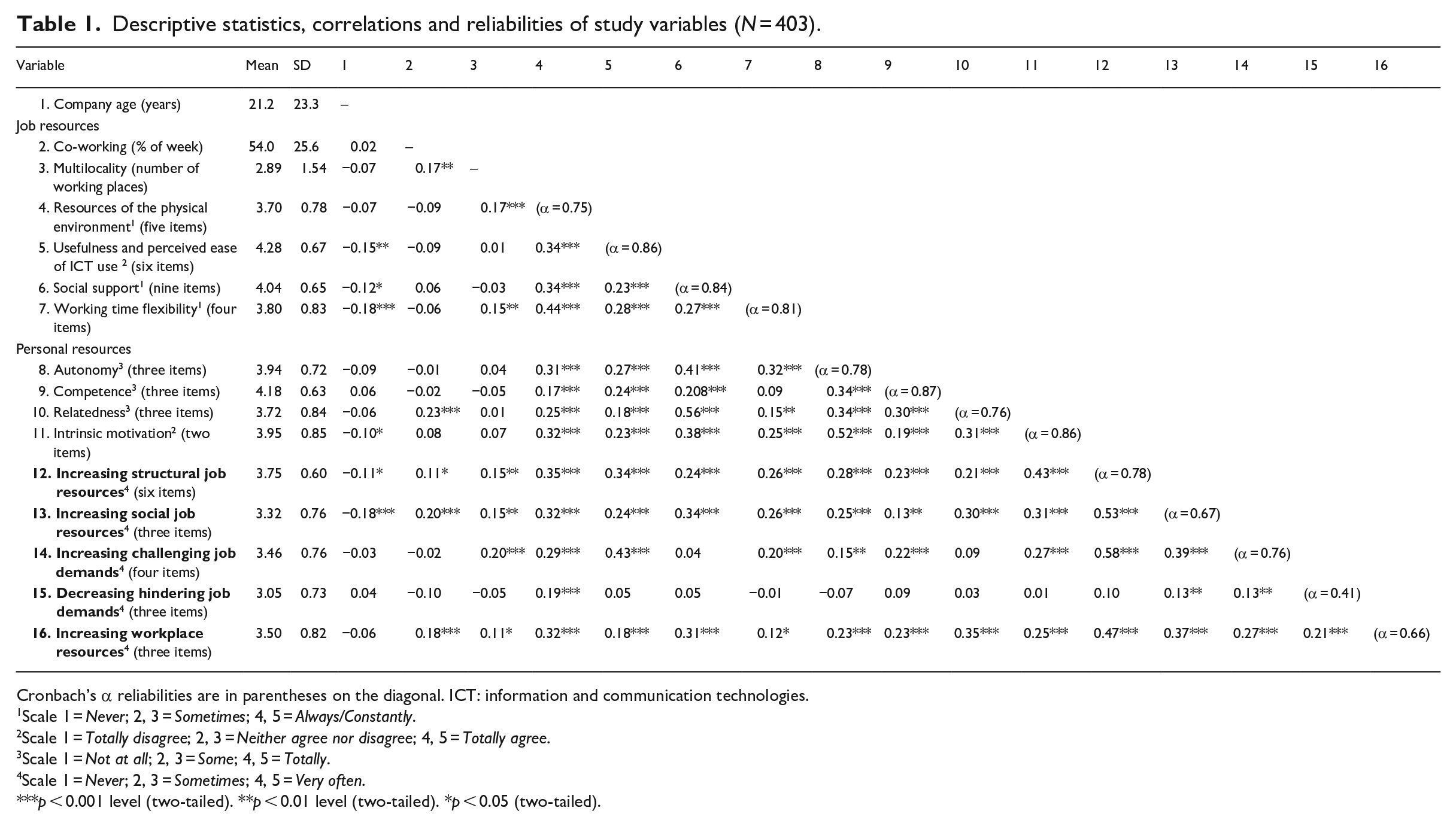
Cronbach’s α reliabilities are in parentheses on the diagonal. ICT: information and communication technologies.
Scale 1 = Never; 2, 3 = Sometimes; 4, 5 = Always/Constantly.
Scale 1 = Totally disagree; 2, 3 = Neither agree nor disagree; 4, 5 = Totally agree.
Scale 1 = Not at all; 2, 3 = Some; 4, 5 = Totally.
Scale 1 = Never; 2, 3 = Sometimes; 4, 5 = Very often.
p < 0.001 level (two-tailed). **p < 0.01 level (two-tailed). *p < 0.05 (two-tailed).
Predictors for different job crafting behaviours: Multiple linear regression analysis.
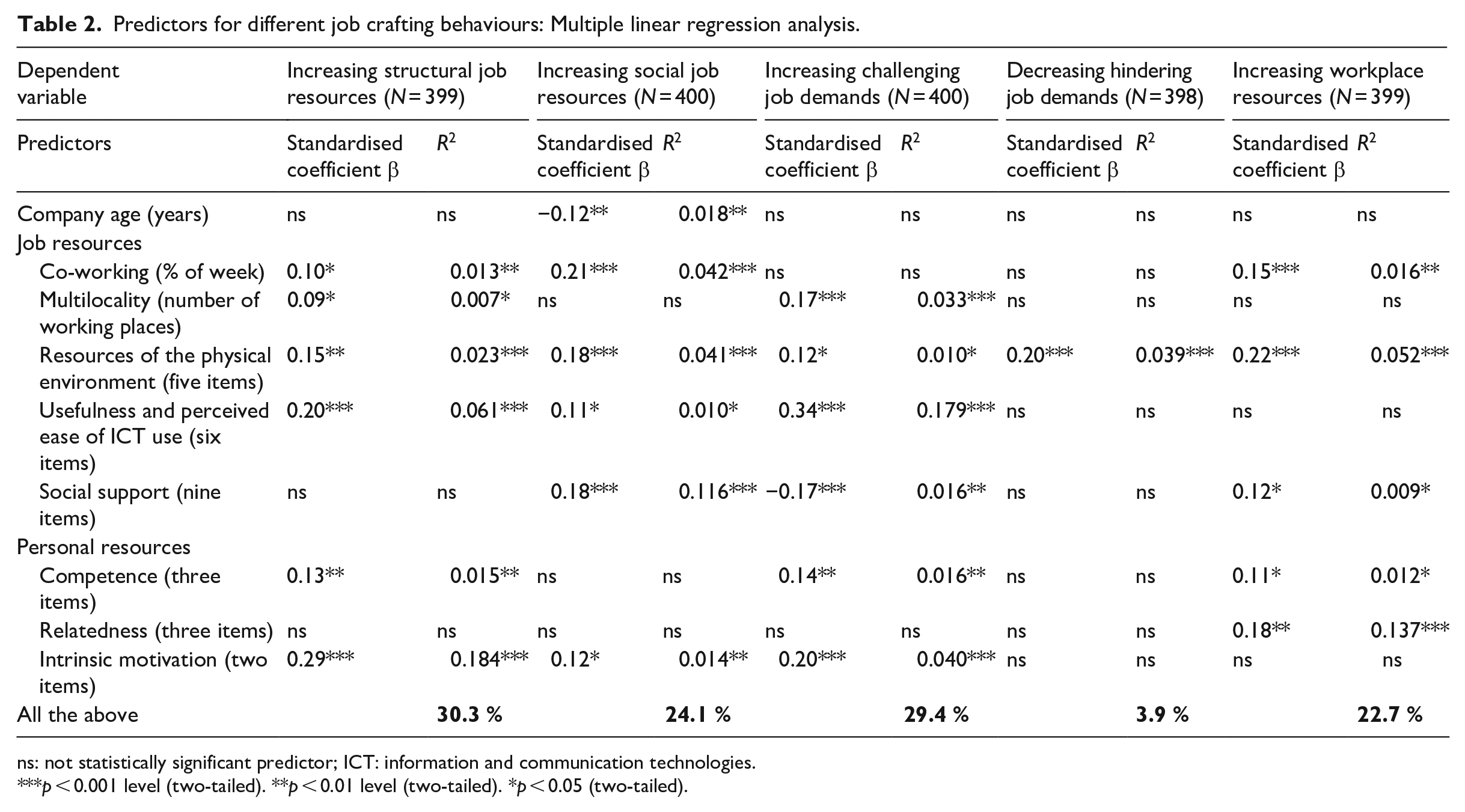
ns: not statistically significant predictor; ICT: information and communication technologies.
p < 0.001 level (two-tailed). **p < 0.01 level (two-tailed). *p < 0.05 (two-tailed).
Results
Means, variances and correlations between the numerical independent and dependent variables are presented in Table 1 and the results of the final multiple linear regression analysis are shown in Table 2. The ages of the firms varied considerably – being 21 years on average.
The general ICT-based mobile and multilocational job resources, that is, co-working time and multilocality, showed that the respondents largely worked alone (46%); 32% worked with others in a physical context and 22% worked virtually. The respondents were multilocational, working on average in three different places during the week. Of these different workplaces, employer’s premises were used most (62%) followed by home (14%), customer premises (12%) and other places (12%, i.e. co-working space, public place, means of transportation and summer house).
The means of the four immediate work environment resources categories ranged from 3.70 to 4.28. The ‘Usefulness and the perceived ease of ICT use’ scores were the highest, meaning that the respondents felt that they had appropriate ICT tools and applications for working and could easily learn how to use them. The scores for personal resources ranged from 3.72 to 4.18. The respondents felt that they had autonomy in selecting their working style, that they were competent and socially related at work and were intrinsically motivated. The highest score for personal resources was the ‘Competence’ variable. The bivariate correlations between these numerical independent and the dependent job crafting variables are also shown in Table 1.
The overall means of five types of job crafting ranged from 3.05 to 3.75. Jobs were crafted ‘often’ by increasing structural resources, challenging job demands and workplace resources, whereas social resources were increased and hindering job demands were decreased only ‘sometimes’.
In the regression model, the background variable firm-age had a statistically significant negative impact only on job crafting by increasing social job resources. Employees in younger firms were more active in seeking social support, supervisory coaching or performance feedback than those in older firms.
According to the regression analysis of the general ICT-based mobile and multilocational work related job resources, the percentage of weekly co-working time predicted positively three types of job crafting (Table 2): the more co-working involved, the more the job was crafted by increasing structural, social and workplace job resources. Multilocality significantly predicted the activity in increasing challenging job demands. It also had a minor influence on increasing structural job resources. The more places an employee works from, the more actively they increase challenging work demands and structural job resources.
From the immediate work environment resources, all except the factor of working time flexibility were directly related to and explained the variance of job crafting factors. Therefore, the factor of working time flexibility was omitted from the final regression analysis model.
Related to the immediate work environment job resources, the factor of resources in the physical environment was the strongest predictor of job crafting (Table 2). From the five types of job crafting, the following four are strongly statistically significant: increasing structural, social and workplace resources and decreasing hindering job demands. This offers a weaker explanation for job crafting by increasing challenging job demands. The more resources an employee has in the physical work environment, the more active they are in increasing structural, social and workplace related job resources, increasing challenging job demands and decreasing hindering job demands.
Also, usefulness and perceived ease of ICT use as a job resource predicted job crafting statistically significantly by increasing structural job resources and challenging job demands, and to a lesser extent job crafting by increasing social job resources. The more useful and easy-to-use ICT tools and applications the SMEs have, the more actively employees seek to increase their structural job resources, for example, by developing their working methods, and increasing their social job resources, for example, by actively seeking feedback. This also encourages employees to try to find more challenging job demands.
Social support as a job resource predicted employees increasing their social job resources; it also had a minor impact on job crafting by increasing workplace resources. However, social support was somewhat negatively related to job crafting by increasing challenging job demands. The more social support that was available, the higher the frequency of job crafting as employees had greater access to social and workplace resources. At the same time, the availability of social support reduced attempts to find more challenging job demands.
According to these findings, hypothesis 1 was partially supported, as resources in the physical environment predicted all five types of job crafting and the other factors in the regression model predicted from one to three types of job crafting.
Three of the four personal resources excluding the feeling of autonomy were directly related to, and predicted, some of the five types of job crafting. Intrinsic motivation significantly predicted the activity in increasing structural job resources and increasing challenging job demands, as well as, to a slight extent, the activity of increasing social job resources. If an employee believes that the origin of their work motivation arises from interesting and exciting work itself, the more active they become in increasing structural job resources, for example, formulating working goals, increasing social resources, for example, by asking for feedback from colleagues and increasing challenging job demands, for example, by taking on new challenges. Competence predicted three types of job crafting: increasing the structural and workplace job resources and increasing challenging job demands. The more competent an employee feels, the more actively they increase structural and workplace job resources and seek more challenging job demands. Relatedness significantly predicted only one type of job crafting: increasing workplace resources. If an employee feels part of a group, the more likely they are to take advantage of multilocational working, for example, by selecting the workplace according to the demands of tasks.
Hypothesis 2 was partially supported, as the personal resources factors of the regression model predicted some types of job crafting. Both intrinsic motivation and competence were predictors for three types of job crafting. Relatedness predicted only the job crafting behaviour of increasing workplace resources.
When each job crafting type is examined in relation to all the explanatory variables in the regression model, the total set of predictors and their coefficient determination can be outlined as follows (Table 2). Increasing structural job resources (as an approach type of job crafting) was explained by the following job resources: co-working, multilocality, resources in the physical work environment and usefulness and the perceived ease of ICT use. In addition, of personal resources, intrinsic work motivation and competence explained this type of job crafting. A regression model explained 30.3% of the variance of increasing structural resources.
Increasing challenging job demands (as an approach type of job crafting) was predicted by multilocality, resources in the physical work environment, usefulness and perceived ease of ICT use and social support as job resource factors and by intrinsic motivation and competence, as personal resource factors. This regression model explained 29.4% of the variance of increasing challenging job demands.
Increasing social job resources (as an approach type of job crafting) was negatively predicted by the age of the firm as a background variable. In young firms, employees are more actively increasing their social resources; this reduces with the age of the firm. The following job resources had a positive influence on the activity of this type of job crafting: co-working, resources in the physical work environment, usefulness and perceived ease of ICT use and social support. From personal resources, intrinsic motivation was a predictor for this type of job crafting. This regression model explained 24.1% of the variance concerning increasing social job resources.
The new, operational environment-related job crafting type, increasing workplace resources (as an approach type of job crafting) was predicted by co-working, resources in the physical work environment and social support as job resources and relatedness and competence as personal resources. This regression model explained 22.7% of the variance of increasing workplace resources.
Job crafting by decreasing hindering job demands (as an avoidance type of job crafting), that is, by trying to ensure that work is not mentally over demanding was predicted by the availability of resources in the physical environment. This regression model predicted only 3.9% of the variance of decreasing hindering job demands.
Discussion
Theoretical implications
This study confirms the role of both job and personal resources in explaining active job crafting by employees, in this case, among SME employees. According to the JD-R model (Bakker and Demerouti, 2017; Bruning and Campion, 2018; Tummers and Bakker), resource-based job crafting incorporates a positive self-reinforcing path increasing work engagement and work performance (Tims et al., 2012, 2013a, 2013b). Based on this, firms are considering how to promote this kind of employee-driven activity. We contribute to the discussion on the predictors of job crafting in SMEs working in an ICT-based mobile and multilocational manner by analysing specific job and personal resources. First, we show that all five types of job crafting were applied in this context. Second, we identified general mobile and multilocational work and immediate work environment-related job resources that activated the four approach types of job crafting in SMEs. From the general job resources, it was co-working and multilocality and from the immediate work environment, job resources, the resources in the physical environment, useful ICT and social support that positively predict the approach types of job crafting. In addition, intrinsic motivation, relatedness and feeling competent as personal resources play a crucial role.
Avoidance type of job crafting is measured with one variable, that of hindering damaging job demands. Our evidence shows that our respondents were crafting their jobs in this manner. However, the regression model which considers job and personal resources as predictors of this type of job crafting had a limited explanatory power: only the factor of the physical work environment predicted this type of job crafting. Avoidance type of job crafting has gained a negative connotation as some earlier variable-centred studies have addressed contradictory results, whether decreasing hindering job demands is linked to low job engagement or not (Bakker et al., 2016; Brenninkmeijer and Hekkert-Koning, 2015; de Beer and Tims, 2016; Demerouti et al., 2015; Mäkikangas, 2018; Petrou et al., 2012; Rudolph et al., 2017; Tims et al., 2012). This discrepancy has been explained by evidence suggesting that employees usually simultaneously apply combinations of job crafting strategies and thus, decreasing hindering job demands is less detrimental to work engagement when used with other job crafting strategies (Mäkikangas, 2018). Furthermore, Harju et al. (2021) showed that decreasing hindering job demands acts like a double-edged sword: when it is used for protection against stress, it may oversimplify the job in a manner that reduces well-being.
The only factor that predicted all types of approach crafting as well as avoidance crafting was the resources of the physical work environment. This is a signal of the multifaceted role of work environment resources: while the resources of the physical work environment stimulate the approach types of job crafting, they also offer possibilities to protect against stressors, for example, by selecting the location where work can be undertaken with minimal disturbance (see Koroma et al., 2014).
Our other theoretical contribution is to stimulate the debate on the need to expand the target of job crafting to cover the operational environment of work. Evidence (Lazauskaite-Zabielske et al., 2021; Wessels et al., 2019) supports the idea of including features of new ways of working, such as time and spatial dimensions of work, as targets for employee-driven job crafting. Aligned with such suggestions, Roskams and Haynes (2019) presented the concept of environmental crafting, where individuals add a sense of coherence by improving the workplace environment, that is, by minimising demands and increasing resources. This study suggests increasing workplace resources as the fifth type of job crafting related to ICT-based mobile and multilocational work. In ICT-based mobile and multilocational work, employees confront multiple embedded locations which may involve hindrance demands such as problems concerning incompatible and limited working space, interruptions, limited privacy, ergonomic concerns and technological problems (Crawford et al., 2010; Koroma et al., 2014). They must reduce these demands and the associated costs with job resources. Our evidence showed that co-working, resources in the physical work environment and social support as job resources, and relatedness and competence as personal resources, were elements which activated the job crafting process directed towards increasing workplace job resources.
Managerial implications
Job crafting is a relevant concept for SMEs who wish their employees to be autonomous and self-directed, to perform well and to be engaged. Even though job crafting is employee-driven, managers should nevertheless, ensure that employees have the necessary resources to craft their jobs in a sustainable way. In addition, leaders and owners of small enterprises often do similar tasks as their employees so job crafting is a concern for all. Further, at a time with the demand for flexible working is increasing (Korunka, 2021) and employees are increasingly expected to find proactive ways to meet organisational objectives, managers should, more than ever, rely on and enhance the initiatives employees take to craft their jobs. By identifying predictors of job crafting, we suggest ways to encourage self-initiated and proactive job crafting in SMEs. We show that employees performing ICT-based mobile and multilocational work in SMEs are crafting their jobs and in this context and there are job and personal resources that stimulate both approach and avoidance types of crafting. Thus, by affording attention to job resources in the generic ICT-based and multilocational work context and immediate work environment plus, ensuring the availability of personal resources, SMEs can activate job crafting among employees and thereby, support employee proactivity and autonomy. This strengthens the internal capacity of SMEs to cope in complex environments.
Our evidence suggests that managers should promote the approach types of job crafting, consisting of active efforts towards problem-solving and improvement-focused goals as they unequivocally benefit both employee work engagement (Federici et al., 2021; Harju et al., 2016; Tims et al., 2015) and performance (Dubbelt et al., 2019; Van Wingerden et al., 2017). In approach crafting, employees are increasing their use of resources and seeking more challenging job demands (Bruning and Campion, 2018; Fong et al., 2020; Lazazzara et al., 2020; Petrou and Xanthopoulou, 2020; Petrou et al., 2015) and so, as we suggest, increasing their workplace resources.
For activating resource-based approach crafting, SME managers are encouraged to pay attention to co-working time in ICT-based mobile and multilocational work. Co-working stimulates employees to increase their structural, social and workplace resources. It is also necessary to pay attention to the immediate work environment as job resources are embedded in physical premises, ICT tools and the social environment which empower employees to craft their job by increasing resources, be they structural, social or workplace related. Among personal resources, intrinsic motivation, competence and relatedness were sources of approach types of job crafting. This refers to the need for effective leadership practices. From the background variables, the younger firms activated job crafting by increasing social job resources, for example, feedback from supervisors and peers. Although research on the consequences of firm age is extensive, the question of why this is the case with job crafting, remains to be answered. Could it be, for example, due to lack of experience and routines with the simultaneous need to be innovative in young firms? (Coad et al., 2018) Regardless, managers should be aware of this need and encourage employees to ask questions, get feedback and thus, learn.
Making one’s work more challenging includes the approach type of job crafting. Employees enrich their work by performing tasks with new content and responsibilities involving themselves in new tasks that require adopting new knowledge, making complex decisions or taking on new responsibilities (Harju et al., 2021; Petrou et al., 2015). In SMEs working in an ICT-based mobile and multilocational manner, the multilocality itself, along with the resources in the immediate working environment, stimulate this kind of job crafting. Acknowledging the notion that increasing the complexity of work creates new opportunities to learn (Nurmi and Hinds, 2016; Parker, 2014) and makes one’s work more interesting and meaningful (Berg et al., 2013; Gagné and Deci, 2005), it is evident that working in multiple sites with functional physical facilities, appropriate ICT-tools and social support creates more possibilities to enrich work. However, as Harju et al. (2021) noted, there is a double-edged sword effect when enriching work as it may increase job demands. While it is possible to benefit from increasing job complexity, it simultaneously enlarges job demands and thus, increases workload and may create negative consequences. As such, particularly with employees working in an ICT-based multilocational manner, it is essential to pay attention to the competences of individual employees in regulating their own behaviour in these complex environments (Kubicek et al., 2021; Sjöblom, 2020) when they increase challenging job demands. Perhaps that is why our results demonstrate that competence, along with intrinsic motivation as a personal resource, predicted the tendency to increase challenging job demands. In flexible work, employees should feel competent and intrinsically motivated to plan, structure and coordinate their working time, places, work tasks and performance (Kubicek et al., 2021).
As avoidance crafting has been linked, for example, to lower engagement (Petrou et al., 2012, 2018) and negative attitudes (Petrou et al., 2015) the first thought may be that its promotion cannot be recommended. However, this kind of behaviour may enable employees to overcome hindrance demands and thus, improve their well-being (Hobfoll et al., 2018). In ICT-based multilocational work, the possibility to work in different locations such as in one’s own office, at home, in other organisational premises, in means of transport or even in leisure premises provides a wide range of resources, but it also has disadvantages such as incompatible and limited working space, interruptions, limited privacy, ergonomic concerns and technological problems (Crawford et al., 2010; Koroma et al., 2014; Vartiainen 2021). By way of avoidance crafting, one can be distance oneself from such hindering job demands and allow stressors to pass. Even though this kind of behaviour may temporarily diminish the stressful aspects of the job, it is also shown that avoidance crafting does not decrease the hindrance demands and effectively address the source of stress (Harju et al., 2021). Bai et al. (2021) also demonstrated that the current resource state of an employee determines their adoption of approach versus avoidance crafting. Job complexity leads to avoidance crafting only when energy is depleted whilst being applied to approach crafting. With all this in mind, offering a rich and multidimensional physical working environment that allows occasional decreases in job hindering demands and helps to permanently combat work obstacles with approach types of job crafting is important in ICT-based mobile and multilocational work.
Making work more challenging includes the approach type of job crafting. Employees enrich work by performing tasks with new content and responsibilities. They are willing to take on new tasks that require new knowledge, making complex decisions or taking additional responsibilities (Harju et al., 2021; Petrou et al., 2015). Indeed, for SMEs operating in an ICT-based mobile and multilocational manner, the multilocality itself, along with the resources in the immediate working environment, stimulate this kind of job crafting. Acknowledging the notion that increasing the complexity of work creates new opportunities to learn (Nurmi and Hinds, 2016; Parker, 2014) and makes work more interesting and meaningful (Berg et al., 2013; Gagné and Deci, 2005), it is feasible that working in multiple places with functional physical facilities, properly working ICT-tools and social support creates more possibilities to enrich one’s work. However, Harju et al. (2021) note the double-edged sword effect of enriching work by increasing challenging job demands. While it is possible to benefit from added job complexity, this simultaneously enlarges job demands and thus, can increase workload and may have negative consequences. Thus, especially with employees working in an ICT-based multilocational manner, it is essential to pay attention to the competences of individual employees in regulating their own behaviour in such complex environments (Kubicek et al., 2021; Sjöblom, 2020) if they expand challenging job demands. Perhaps that is why the results showed that competence, along with intrinsic motivation as a personal resource, predicted the tendency to increase challenging job demands. In flexible work, employees should feel competent and intrinsically motivated to plan, structure and coordinate their working time, places, work tasks and performance (Kubicek et al., 2021).
As avoidance crafting has been linked, for example, to lower engagement (Petrou et al., 2012, 2018) and negative attitudes (Petrou et al., 2015) the first thought may be that its promotion cannot be recommended. However, this kind of behaviour may enable employees to overcome hindrance demands and thus, improve their well-being (Hobfoll et al., 2018). In ICT-based multilocational work, with this in mind, offering a rich and multidimensional physical working environment that allows occasional and decreasing hindering job demands
Limitations and future research
This study has limitations important to bear in mind when interpreting the findings. Because of the exploratory nature of this study in the context of SMEs working in an ICT-based mobile and multilocational manner, there was a need to develop and use some new factors and variables for measuring job resources. These were independent variables measuring the usage of the workplace, that is, the possibility of selecting the appropriate workplace for the task at hand and the usefulness of ICT, for example, efficacy and learnability of ICT tools and applications. Although these were essential elements in the evaluation of the current workplace resources, the lack of validated measures can undermine the construct validity of the evaluation. However, questions concerning other variables measuring job resources, that is, time control and social support from co-workers, superiors and family, were based on previously used and tested parts of the General Nordic Questionnaire for Psychological and Social Factors at Work (Lindström et al., 2000) and on the questionnaire used by Venkatesh et al. (2003). This limitation serves as a starting point for wider consideration of developing the validity of measures of ICT-based mobile and multilocational work environment-related factors as evaluating working conditions with regard to facilities and useful ICT tools are essential for developing the practices of SMEs.
For measuring approach and avoidance crafting, we used the common conceptualisations of job crafting (Rudolph et al., 2017; Tims et al., 2012). However, it should be noted that there are also other and broader conceptualisations available (Bruning and Campion, 2018; Zhang & Parker, 2019). As this study is based on the resource-based perspective of job crafting (Bruning and Campion, 2018; Tims et al., 2012, 2013a), it produces knowledge that encouraged individuals to seek resources and manage work demands. With a change of perspective to role-based job crafting (Bruning and Campion, 2018; Wrzesniewski and Dutton, 2001; Zhang and Parker, 2019) where the focus is on enriching job design, predictors of job crafting remain unexplored.
We introduce a new job crafting factor of increasing workplace resources and justify it with evidence arising from research exploring new ways of working (Koroma et al., 2014; Vartiainen, 2021; Vartiainen and Hyrkkänen, 2010). In constructing a new concept related to previous job crafting research, it is important to ensure that it captures employee efforts to change their jobs in a valid manner. Therefore, it is essential that future research implements a rigorous validating process where the content of this construct is assessed in relation to other approach types of job crafting and expected consequences. However, the intention to report these preliminary findings related to increasing workplace resources concurs with Lazauskaite-Zabielske et al. (2021) and Roskams and Haynes (2019) and raises the importance of considering the working environment as an essential part of work. In new ways of working, extended work environments provide employees with flexibility (Meyer et al., 2021) and motivational profit (Ryan and Deci, 2020), but may also cause drawbacks. In ICT-based mobile and multilocational work, controlling these embedded work environments is an integral part of work and thus, also a target of job crafting. More scientific discussion and examination are needed to explain the relationship between these phenomena.
Our approach assumes job crafting as positive behaviour by employees. However, it is also suggested that both approach and avoidance crafting may also contain potential threats for employee well-being when considering the issue from the perspective of workload and complexity (Harju et al., 2021). The well-being of those concerned may be endangered if approach crafting not only increases the complexity of work but also the workload, and if avoidance crafting not only reduces the workload but also the complexity of work. With ICT-based mobile and multilocational work of SMEs, this is a noteworthy issue important to address in further research.
We aimed to explore the resource and job context of SMEs working in ICT-based mobile and multilocational manner as predictors of job crafting. All respondents, regardless of their role in the enterprise, were working in this way and therefore, when building the regression model all responses were included in the analysis. In the questionnaire, the leadership position was explored by using only a dichotomous variable (yes/no). During the steps of the analysis, it was removed as it did not improve the overall model fit. The use of the dichotomous variable to assess respondent leadership roles is a weakness in this study. Future work should consider how to more accurately assess the role of respondents in the firm so that it can be used as a control variable.
Conclusion
This article indicates that multilocality and co-working as general job resources of ICT-based mobile and multilocational work and the resources in the physical environment, the availability of ICT and social support as immediate work environment-related job resources enhance approach types of job crafting in SMEs. Relatedness, feeling competent and intrinsic motivation as personal resources enhance approach types of job crafting in SMEs. We argue that a new type of job crafting, that is, increasing workplace resources, may complement pre-existing ones as this type of job crafting considers new ways of working such as ICT-based mobile multilocational work. The dynamic context of SMEs and ICT-based mobile multilocational work encourages employees to balance job demands with resources.
Footnotes
Declaration of conflicting interests
The author(s) declared no potential conflicts of interest with respect to the research, authorship, and/or publication of this article.
Funding
The author(s) disclosed receipt of the following financial support for the research, authorship, and/or publication of this article: The research project was financed by the European Social Fund awarded by the Finnish Ministry of Social Affairs and Health.
