




Abstract
While inter-organizational coordination among firms in networks has become a widespread phenomenon and the governance of inter-organizational networks has garnered considerable attention in the management literature, the repercussions of the network form for managing and organizing work remain a considerable gap in the literature. Building on Gittell’s concept of relational coordination, we explore the inter-organizational work collaboration in four German airports’ ground handling operations. By zooming-in on ramp agents’ boundary spanning work role, our comparative study illustrates whether and how a collaboration in inter-organizational work processes is brought about in practice. Our findings reveal the various practices ramp agents deploy in order to handle the tensions emerging from divergent organizational jurisdictions and the requirements for collaboration. We also illuminate how the field-level context influences inter-organizational collaboration by setting conditions such as workload and time restrictions in distributed service delivery.
Keywords
Introduction
Our study aims for a better understanding of the network form’s repercussions on managing workforces. During the last decades, inter-organizational networks have proliferated across industries and management research has made considerable progress in understanding the “network form,” for example, regarding firms’ motives and goals in strategic alliances, network governance, or inter-firm knowledge sharing and learning (Dyer and Nobeoka, 2000; Giudicci et al., 2018; Powell et al., 1996; Provan and Kenis, 2008; Sydow et al., 2016). However, in the literature, less attention has been paid to the repercussions of the network form on managing workforces (for exceptions see Kinnie et al., 2005; Marchington et al., 2005; Rubery et al., 2003; Swart and Kinnie, 2014; Wirth, 2010). This is a somewhat curious neglect of the work-level in the study of inter-organizational arrangements, because a proper understanding of how work is organized across organizational boundaries contributes to a better understanding of how inter-organizational collaboration is enacted in practice.
Contributing to filling this research gap, in this paper, we aim to increase the understanding of whether and how workforces in multi-employer settings are managed across organizational boundaries and what challenges arise from inter-organizational cooperation for the collaboration among employees from different organizations. To understand this inter-organizational work organization, we build on the ideas of the nested theory of structuration (Perlow et al., 2004) and explore the practices of collaboration, using Gittell’s (2000) idea of a “relational coordination” as a guiding orientation. In short, we ask: How do central agents manage collaboration among employees in service delivery if these come from various network participating organizations?
Empirically, we engage with the ramp agents who manage the inter-organizational collaboration on the ground through monitoring, controlling, and integrating the overall service delivery process of ground handling at airports. In our qualitative and explorative studies of ground handling services in three German airports, we zoom-in (Nicolini, 2012) into the inter-organizational context on the ramp agents’ work role as operational boundary spanners (Aldrich and Herker, 1977; Langan-Fox and Cooper, 2014). From the ramp agents’ perspective, boundary spanning means to “orchestrate” (Bartelings et al., 2017) the various work tasks in a peculiar “front-line service” (Bélanger and Edwards, 2013). Ramp agents do so within a context of Service Delivery Networks (SDN), that is “network[s] consisting of [at least 3] service providers, their suppliers as well as complementary companies and the respective competitors who are responsible for the provision of a service from the customer perspective” (Tax et al., 2013: 454, 457). In other words, to ensure a proper service sequence under considerable time pressure, the work of different service providers needs to be integrated without the ramp agent having hierarchical authority over the single providers’ workers.
Situated in a “quasi“ team setting of inter-organizational work collaboration, the ramp agent is assigned operational responsibility for coordinating and controlling the process through dispatching all relevant information (e.g. fuel quantities, crew requests and boarding times) and resources (e.g. loading capacities, flight plans, and aircraft stairs). At the same time, the inter-organizational context of the work process implies resource dependencies and strong limits to hierarchical decision-making as well as tensions between work-related collaboration and formal contractual relationships between the participating firms.
Our findings suggest that managing the inter-organizational work process requires relationship building and communicating (Gittell, 2000), indeed, but we identify additional practices in handling the tensions between organizational jurisdictions and collaboration in distributed service delivery. These additional practices are: (1) identifying with the relational work role, (2) modifying routines and anticipating emergencies, (3) problem-solving through co-working, and (4) filtering and buffering information. We conclude from these findings that the wider range of practices is to be considered if the quality of collaboration in networked work processes is to be understood properly. Moreover, our cases reveal to what extent inter-organizational collaboration in the work process may be dominated by contexts such as field-level changes conditioning inter-organizational coordination.
Inter-organizational collaboration in networked service delivery
Relational coordination by network forms of organizations has been observed in a widespread range of various service sectors and manufacturing industries (e.g. Sydow et al., 2016). These networks are usually considered as resting on inter-organizational cooperation between firms as corporate actors to achieve strategic advantages unreachable for the single participating organization on its own (e.g. Dyer and Singh, 1998). From a perspective of the organization of work, however, within network settings work is performed within multi-employer work arrangements on the shop floor (Rubery et al., 2002, 2003), that is natural persons collaborating with each other across organizational boundaries.
In what follows, we explain how the inter-organizational organization of work is related, and actually, underpins and materializes, what is usually studied as the governance arrangements for coordinating firms in inter-organizational networks. On the workplace level, the daily challenges of inter-organizational cooperation are felt most urgently, because the inter-organizational business relations need to be translated into a practice of work collaboration across organizational boundaries. For theorizing this connection, we adopt a practice-based view (e.g. Nicolini, 2012). For us, practices are recurrent actions whose reproduction is made more likely by routines, rules and procedures (Giddens, 1984). Hence, we argue that a proper understanding of how the collaboration in inter-organizational work settings is brought about requires engaging with how it is enacted in practice and how it is embedded in contexts, such as the inter-organizational network and the field-level institutions.
Service delivery networks as multi-employer work arrangements
Service delivery in and through networks gives rise to co-configuration in service production, that is joint value creation (Lusch, 2011; Vargo and Akaka, 2012; Wieland et al., 2016), where not one single firm is responsible for the service exchange, but actors from various organizations are involved (e.g. Bruhn et al., 2010; Maas and Graf, 2004). In contrast with a traditional view of division of labor as coordinated via market processes in a traditional goods exchange, joint value creation across organizations in service production complicates the measurement of the output quantity and quality, as well as the assignment of prices to activities (Tax et al., 2013). At the same time and in contrast with classic hierarchy, the management of collaboration is subject to network-specific challenges as different contributions from collaborators need to be reintegrated in situ and time without a hierarchical authority (e.g. Mintzberg, 1983). Here, we are concerned with the latter issue of collaboration within an inter-organizational setting (I Business relations in Figure 1). In other words, we concentrate on the work organization (II Multi-employer work arrangements in Figure 1) within the multi-dimensional “provider-contractor-customer”-relationships in service networks (Choi and Wu, 2009; Shipilov and Li, 2012).
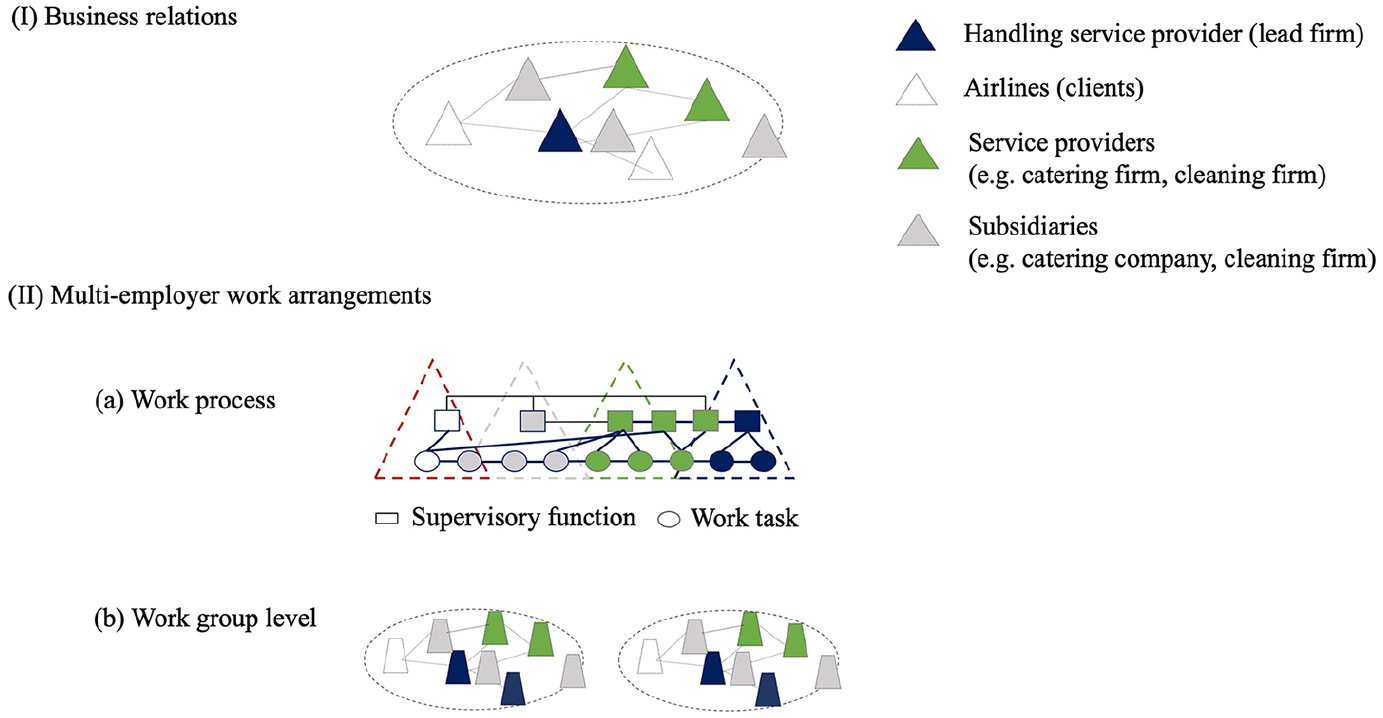
Inter-organizational service delivery.
Seen from a work organization perspective, SDN can be conceived as being multi-employer work arrangements (Marchington et al., 2005; Tax et al., 2013). Like in regular service operations, fitting a bundle of service activities into a proper sequence delivering the overall service needs an understanding of the process stages before and after the respective sequence as well as the necessary manpower, resources and auxiliary services for its proper timely execution (Svensson et al., 2010). However, in SDN, services are rendered through co-configuration where workers of various network participants are collaborating across organizational boundaries (Faßauer and Geithner, 2016). Here, the multitude of independent service providers involved as employers can be expected to amplify the complexities in integrating work activities of the networked work process (Dekker, 2004; Sydow and Windeler, 1998).
Multi-employer work arrangements fundamentally alter the bilateral employment relationship, because they directly involve the (corporate) client(s) in the work performance (e.g. Cappelli and Keller, 2013; Havard et al., 2009; Marchington et al., 2005). This sort of customer involvement—usually dominated by corporate relations between clients and service providers rather than end consumers (for the latter see Gabriel et al., 2015; Korczynski and Ott, 2005)—implies a type of front-line service work (Bélanger and Edwards, 2013; Frenkel et al., 1999) in which the corporate client directly influences working and employment conditions in the work process. The emergent multi-employer work arrangements include various forms from temporary agency work to a myriad of sub-contracting arrangements (Cappelli and Keller, 2013). These arrangements can be bound locally to one site as in multi-employer sites (Marchington et al., 2005) like shopping malls or airports, but might also be detached from spatial locations as in many professional service projects (cf. Lundin et al., 2015). Multi-employer work arrangements have been documented for various occupations, from jobs in the low wage sector (Weil, 2019) to the professions and cultural production (Grimshaw and Miozzo, 2009; Haunschild, 2003; Kinnie et al., 2005). For SDN, multi-employer work arrangements cut across sectoral boundaries stretching over upstream or downstream activities (Choi and Wu, 2009; Shipilov and Li, 2012), thereby blending the HR policies of the different firms involved in client- service provider(s)-customer arrangements (Marchington et al., 2011; Rubery et al., 2002).
Managing inter-organizational collaboration
As a genuine form of managing workforces, multi-employer work arrangements are not captured adequately by concentrating solely on the core firm’s decisions on how to manage permanent employees and the various types of externalized workers (Lepak and Snell, 1999; Pfeffer and Baron, 1988). We understand the work group as its own network embedded in the inter-organizational network and requiring collaboration across organizational boundaries. To disentangle these work-related complexities in inter-organizational collaboration, we concentrate on the work group level and build on Gittell and colleagues’ view of “relational coordination” (e.g. Gittell, 2016).
Within the broader array of sociologically inspired organization studies, relational coordination as a concept is rather close to a practice-based view, where practices are forged by both, action and contextualizing structures (Perlow et al., 2004). In recent developments in organization theory such as strategy-as-practice (Vaara and Whittington, 2012) or institutional work (Lawrence et al., 2009), this view has been issued to overcome older dichotomies in the structure-agency dilemma. Whether these are entirely resolved is still open to debate, of course (e.g. Zilber, 2013), but for our purposes this view allows us to approach organizational and field-level contexts and action simultaneously. This can be exemplified by the Perlow et al. (2004) study. The authors conducted a multilevel exploration of software-engineering teams to examine the patterns of interaction that arise within work groups and the role of organizational and institutional factors in shaping these patterns. First, they found a fit between institutional and organizational structures and patterns of work group interaction. Second, they found that this fit did not occur due to managerial choice regarding organizational practices, but rather through processes of mutual influence of structures and interaction. From these insights, they derived a nested theory of structuration where work practices are situated in contexts that explain how individual action and patterns of interaction mutually reinforce each other and are part of mutually reinforcing relationships with elements of the inter-organizational and the institutional contexts (Perlow et al., 2004).
Relational coordination in SDN
If work teams in SDN are regularly inter-organizational in nature, that is the execution of work tasks and the fulfilment of intermediate goals need to be coordinated across boundaries of organizational jurisdictions, formal instruments are no longer appropriate for handling the uncertainty in a service process with amplified dependencies. According to Gittell (2000), such networked work processes require a special form of coordination that is highly relational in nature and defined as “a mutually reinforcing process of communicating and relating for the purpose of task integration” (Gittell, 2000).
With her emphasis on the relational aspect of coordination, Gittell highlights the fact that co-workers’ relationships and communication patterns are highly relevant for coordinating work effectively and thus crucially important for task integration in highly interdependent, uncertain and time-constrained work settings (Gittell et al., 2010). Thereby, relational coordination connects with earlier findings pointing into the direction that inter-organizational collaboration requires certain practices of work organization. For example, the literature on communication and social relations in work teams, especially the one on distributed or virtual teams, has engaged with issues such as how distances between spatially separated team members might be bridged for the duration of a project through information transfer cycles (e.g. Maznevski and Chudoba, 2000) and appropriate communication (e.g. Cramton, 2002), and how communication in personal networks differs between work groups (e.g. Gant et al., 2002) and may influence the effectiveness of virtual teams (e.g. Ahuja and Carley, 1999). What distinguishes Gittell’s contribution from these other contributions is that she explicitly situates relational coordination in network settings and takes a holistic view that combines three relational dynamics in managing work (Gittell, 2016): (1) relational coproduction (which concerns the involvement of clients in the work process), (2) relational coordination (which concerns the co-workers including team leaders and supervisors), and (3) relational leadership (which concerns interventions in the management-worker relationship). With respect to these relational dynamics, the core of relational coordination aims at managing relationships in defining a set of common goals, a common knowledge and rules for mutual respect in the workplace. From these elements, co-workers develop a collective work identity that is in support of effective coordination of work processes through mutual adjustment. According to Gittell (2000), such relationships shape the communication through which coordination occurs, for better or for worse. Figure 2 illustrates the mutually reinforcing dynamics among the dimensions of relational coordination. Depending on the quality of the relationships with respect to the above-mentioned relational dimensions, and the associated quality of communication, group dynamics support or disturb the collaboration among co-workers thereby facilitating or impeding inter-organizational coordination.
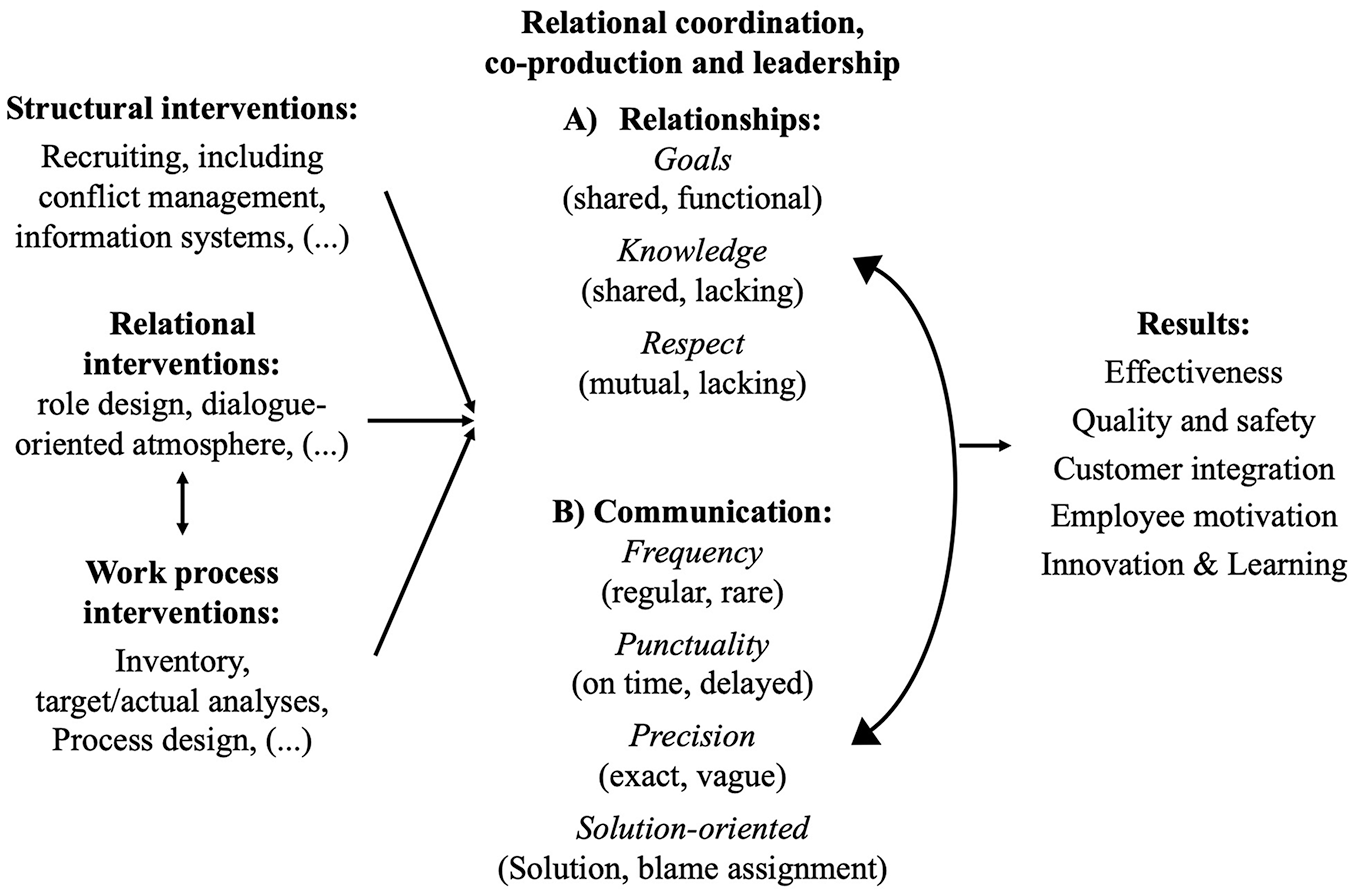
Relational coordination (Gittell, 2000, 2002, 2016).
White spots in relational coordination
Although Gittell’s model enables the investigation of intra- and inter-organizational work settings and is thus highly suitable for analyzing work in SDN (Gittell, 2000), the concept of relational coordination has some weaknesses with respect to a holistic understanding of inter-organizational collaboration. Here, we concentrate on two highly interrelated white spots in the concept: First, and apart from communicating better and nurturing relationships (“relational intervention”, Figure 2), Gittell does not explicitly specify the practices managers and workers, team managers or boundary spanners can deploy to shape the quality of inter-organizational collaboration. Where the work process stretches across organizational boundaries, that is the administrative jurisdictions of client, supplier, and focal firms, the “team members” engage in the same work process but are not members of the same organization. Situated in such varying employer-client-supplier-relationships, structural intervention and work process intervention to manage work performance are difficult to accomplish. For example, inter-organizational work settings bring about phenomena such as multiple commitment, multiple subordination, and control relations as well as working and employment conditions diverging between the employing organizations involved (Frenkel et al., 1999; George, 2003; Liden et al., 2003; Rubery et al., 2002). Structurally, managers of different units may apply different practices, for example the policies of subsidiaries wholly owned and controlled by a lead firm may differ from those of entities that are legally independent, that is equity joint venture or contractual partnerships of two or more (parent) companies. Subcontracting to suppliers is likely to increase this heterogeneity in the networked work process even further (Fisher et al., 2010).
Second, Gittell and colleagues acknowledge the influence of contexts, inter-organizational and otherwise, in which the work in networks is situated. For example, Perlow et al. (2004) theorize inter-organizational work practices as being situated in various contexts, that is individual work action and patterns of interaction are influenced by workplace level, inter-organizational and institutional contexts. Nevertheless, exactly the situations where these contexts may recursively influence the viability of single practices of relational coordination are not well covered (Giddens, 1984). For example, in networked front-line service operations, field-level and network-specific contexts may shape relevant aspects of the work situation through setting time and cost pressures or the employment status and qualifications of co-workers, thereby reducing the feasibility of rather time-consuming relational interventions such as face-to-face assessments and coaching. Hence, it becomes an empirical question to what extent relational coordination is practiced in specific networked work settings situated in idiosyncratic inter-organizational and field contexts.
Inter-organizational collaboration in ground handling service work
Research setting
The ground handling process
Ground handling services, which include ramp agents, are central part of the aviation industry’s value chain and as such responsible for the ground handling of aircraft, that is all incurring services during the ground time of an aircraft in preparation for its next take-off (Baier, 2015; BDF, 2017). This includes fuelling, cleaning, catering, airside operations, security services, as well as the handling and transportation of passengers, baggage, cargo, and mail (airliners.de, 2017; Schlegel, 2010; ver.di, 2017; Wilke et al., 2016). From a service delivery view of a passenger flight, ground handling has repercussions well beyond the mere turnaround sequence of the aircraft by influencing travel times, delays and the overall passenger experience of the journey in terms of quality, reliability, and safety. Hence, compared to other service operations, ground handling is rather highly regulated as there are numerous safety and handling requirements as well as process standards. Recent developments also pinpoint the salience for understanding ground handling as a networked services process as flight delays, cancellations and strikes are making headlines in the German media (Der Tagesspiegel, 2017; Fahrun, 2017; Handelsblatt, 2017).
At first sight, within a steady growth in air traffic, ground handling is a standardized process that occurs several hundred times a day on an average German airport. At Frankfurt Airport alone, 1,285 landings and take-offs were prepared by ground handling every day in 2017 (Statistisches Bundesamt, 2018). However, on a closer look, ground handling is a rather complex service process involving several service providers as well as including service sequences and simultaneous processes provided by distinct workers on the aircraft, thus requiring high degrees of cooperation between the service providers involved (Gittell, 2000; Svensson et al., 2010).
In addition, the ground handling of aircraft takes place within a limited time frame. These ground times are key variables for airlines’ flight operations and are kept as short as possible. Usually, they vary between 25 and 120 minutes depending on the aircraft type (e.g. Airbus 320 vs Boing 707) and destination (long-haul vs short-haul). As postponement caused by delay is usually not feasible without major repercussions in overall airport operations, the services in the process are delivered under high pressure. This pressure poses challenges for employees, especially with regard to uncertainties in the handling process, which entails difficulties in planning, scheduling, and preparing the precise tasks necessary in the work process (e.g. Faraj and Xiao, 2006).
Industry restructuring
For decades, the German aviation industry has recorded sustained strong growth due to the worldwide increase in air traffic as a result of the globalization of economic relations and the global increase in tourism (Wilke et al., 2016). In 2016, the German airspace recorded over three million flight movements amounting to an increase of 2.6% over the previous year: 220 million passengers and 4.5 million tons of freight were transported, that is 45 million passengers more than 10 years ago (ADV, 2017; ver.di, 2017). However, the German air transport industry has been undergoing deep structural changes since the 1996 EU Directive 96/67/EC on the liberalization and deregulation of European air transport. Since the ensuing establishment of low-cost airlines in Germany and the abolition of the German monopoly of the ground handling services, ground handling service providers are not only subject to increasing price pressure due to competition for handling orders that has arisen between them, but are also affected by the airlines’ low willingness to pay for handling services. This is the result of fierce competition for passengers, with airlines trying to keep ticket prices as low as possible. In their attempt to pass on this cost pressure to ground handlers, they contribute to consequently keeping handling charges low as well (Wilke et al., 2016). As around 70% of the cost in the labor-intensive ground handling services are attributable to payroll (ADV, 2017), airports followed a common strategy shift towards sub-contracting these services to third-party providers. This resulted in the strong organizational fragmentation of the handling process observed today (Casey et al., 2011; Wilke et al., 2016). With respect to business relations, ground handling services are contracted by airlines with one handling service provider, but usually, at least four to five subsidiaries are involved.
The inter-organizational work setting
Accordingly, at the work level, ground handling is provided in a networked work process in which co-configuration by employees, working for the different service companies, takes place (see Figure 1). As a work process, ground handling is characterized by special time constraints, task interdependence and uncertainty, customer involvement, and the fact that it affords a bundle of (partial) services which have to be combined in networked service delivery through a multitude of employers. Despite the numerous safety and handling requirements as well as process standards, there are numerous idiosyncrasies involved that make the ground handling work process risky and uncertain, for example weather conditions, delayed carriers, late coming passengers, lost suitcases and breakdowns of technical equipment. These uncertainties require an ongoing collection of information for job planning as well as fast decision making. In this context, the strict standards in ground handling do not necessarily facilitate the ramp agents’ work, but limit their scope of action in reacting towards unforeseen incidents at their own discretion. Similarly, the customers’ involvement, that is airlines, further contributes to variety as the process flow and scope differs according to the varying handling requirements and preferences of the airlines (see below). Additionally, ground handling has become a multi-provider service comprising a multitude of services which must be rendered in a certain sequence due to the interdependencies between the single tasks. Depending on aircraft category, these inter-organizational work groups consists of small teams of two to four co-workers who fulfil the following work roles: ramp agent, loading group (consisting of a loading group leader and two loaders), the load control responsible for load planning, the boarding, catering and cleaning personnel, a tanker driver as well as employees who move the handling equipment such as stair drivers. Further services like water and toilet service, fire brigade, wheelchair service as well as paramedics and mechanics can be added during the handling process if required. Moreover, there are employees who work in the background, but are not directly involved in the local work process like check-in personnel, federal police or freight and postal companies.
Data collection
To answer the question of how ramp agents manage collaboration between employees in the networked service process of ground handling if these come from various network participating organizations, a qualitative approach to data collection on networks was pursued (Flick, 2006; Halinen and Törnross, 2005). Since ground handling has not been approached with a focus on mapping the boundary spanning work role of ramp agents, the aim of this study is exploratory in kind and affords openness for theory building from the qualitative data collection (Eisenhardt and Graebner, 2007). A qualitative approach is suited because it helps to better understand and describe social reality, that is social action, interaction and communication between the individuals to be investigated (Flick et al., 2000). Thus, the application of qualitative research makes it possible to provide a comprehensive picture of the networked work process of ground handling.
As our main data source for analysis, a total of 39 interviews were used. Of these, 22 interviews with ramp agents served as the primary source for analysis. Ramp agents are key informants on the networked work process, because they fulfil a coordinating boundary spanning role at the service interface. Due to their privileged insight into the overall process, they are highly suitable for exploring the practices in inter-organizational collaboration. The other 17 interviews were with actors of the airports, further examining what the ramp agents had reported. Further, the 39 interviews are embedded in a larger interview series on inter-organizational aspects of HRM in airports in which an additional 87 context interviews with key informants from other airport managing bodies, ground handling service providers, airlines, employer associations, and unions were collected. Moreover, observation data from several participating observations in the ground handling process in each of the investigated airports were collected through site visits as part of the data collection process (see Table 1 for a dataset overview and Supplemental Appendix 1 for an interview overview).
Case-related interview overview.
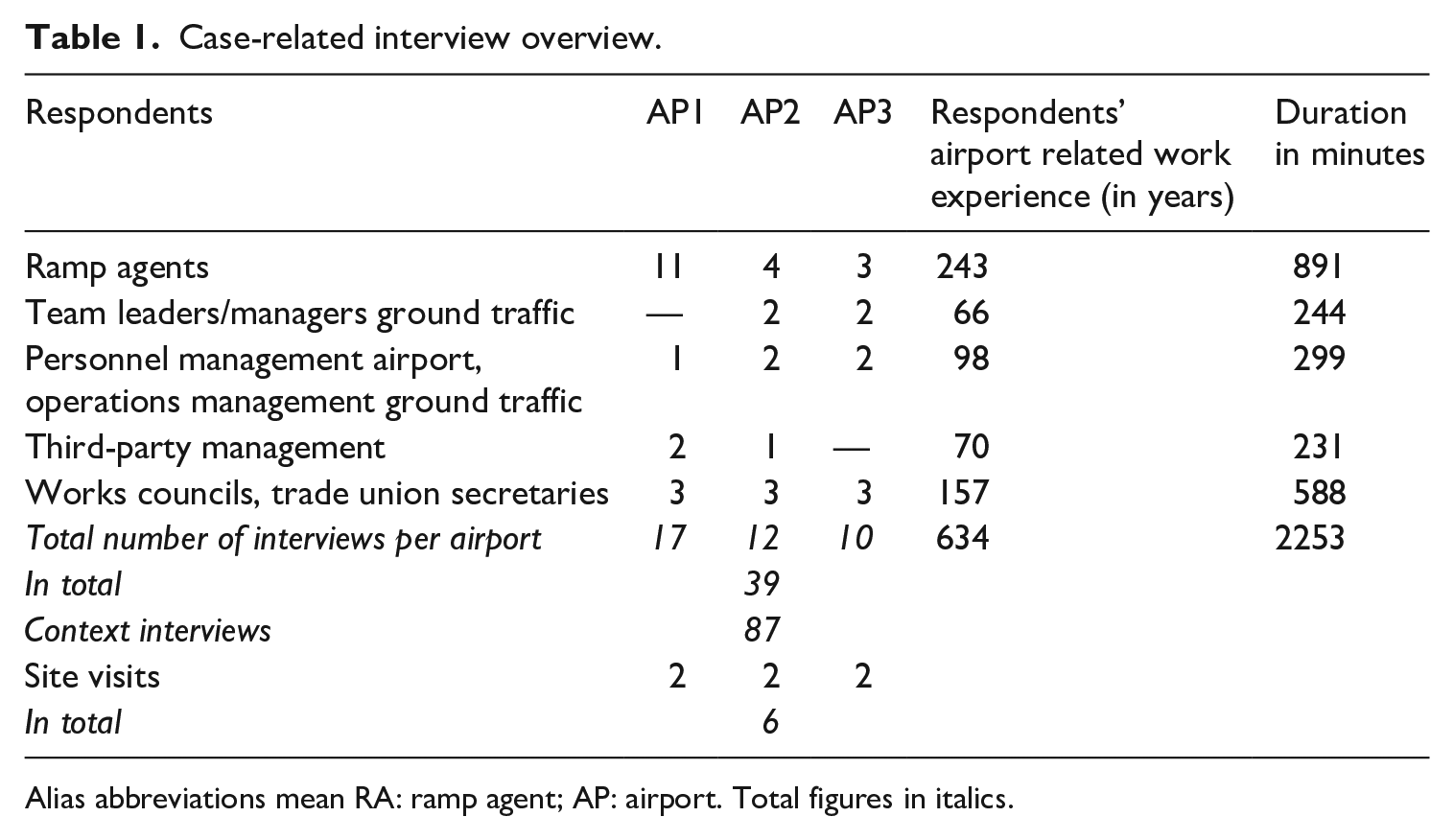
Alias abbreviations mean RA: ramp agent; AP: airport. Total figures in italics.
The 22 ramp agent interviews were conducted at three major German airports: Airport 1 as a regional airport (AP1) in North-East German, Airport 2 (AP2) as a major hub airport in the South-West of Germany and Airport 3 (AP3) as major cargo airport located in East Germany. These airports represent the variety of German airports in terms of type (international hub, large regional airport, cargo hub) as well as in terms of the geographical within Germany (East, West). AP1 is the busiest airport in this region. It is a medium-sized commercial airport with many point-to-point connections and a base for low-cost carriers. In 2016, it carried about 33 million passengers, 48,000 tons of freight and recorded 283,000 aircraft movements, that is take-offs and landings - all handled by ground handling work groups. AP2 is an international and the largest German air traffic hub. The same year, it carried about 60 million passengers, 2,11 million tons of freight and recorded 462,885 aircraft movements. With almost 81,000 employees in around 450 companies is AP2 also the largest local workplace in Germany. In contrast, AP3 is a medium-sized commercial airport and international cargo hub. It is one of the top 5 cargo hubs in the EU and carried 2,2 million passengers and 64,492 tons of freight in 2016.
Data analysis
For answering the exploratory research question, we used a qualitative content analysis based on Mayring (2015) as the method of evaluating interviews related to social practice. The content analysis focuses on the systematic analysis of texts with the help of a category system derived from an iterative process between prior theoretical knowledge as well as the empirical statements obtained. In this process, we started with statements reflecting practices of Gittell’s model of relational coordination, that is the frequency, accuracy, timeliness and problem-solving orientation of communication as well as statements regarding respect, shared work goals, and knowledge in the work group. We used these statements to assess qualitatively how the dimensions of relational coordination were realized in the work setting under investigation. In a second step, additional categories were derived from those statements we could not sort into the model of relational coordination, but which are of relevance for our research (Michel, 2007). This holds for the ramp agents’ statements identifying additional practices not mentioned in the model of relational coordination. Similarly, we identified statements that link the practices of inter-organizational collaboration to industry developments in aviation more generally which we grouped as the context of ground handling service delivery in each of the three airports. In a last step, we compared these findings across the airports using the category scheme derived (s. Figure 3) (Yin, 2018).
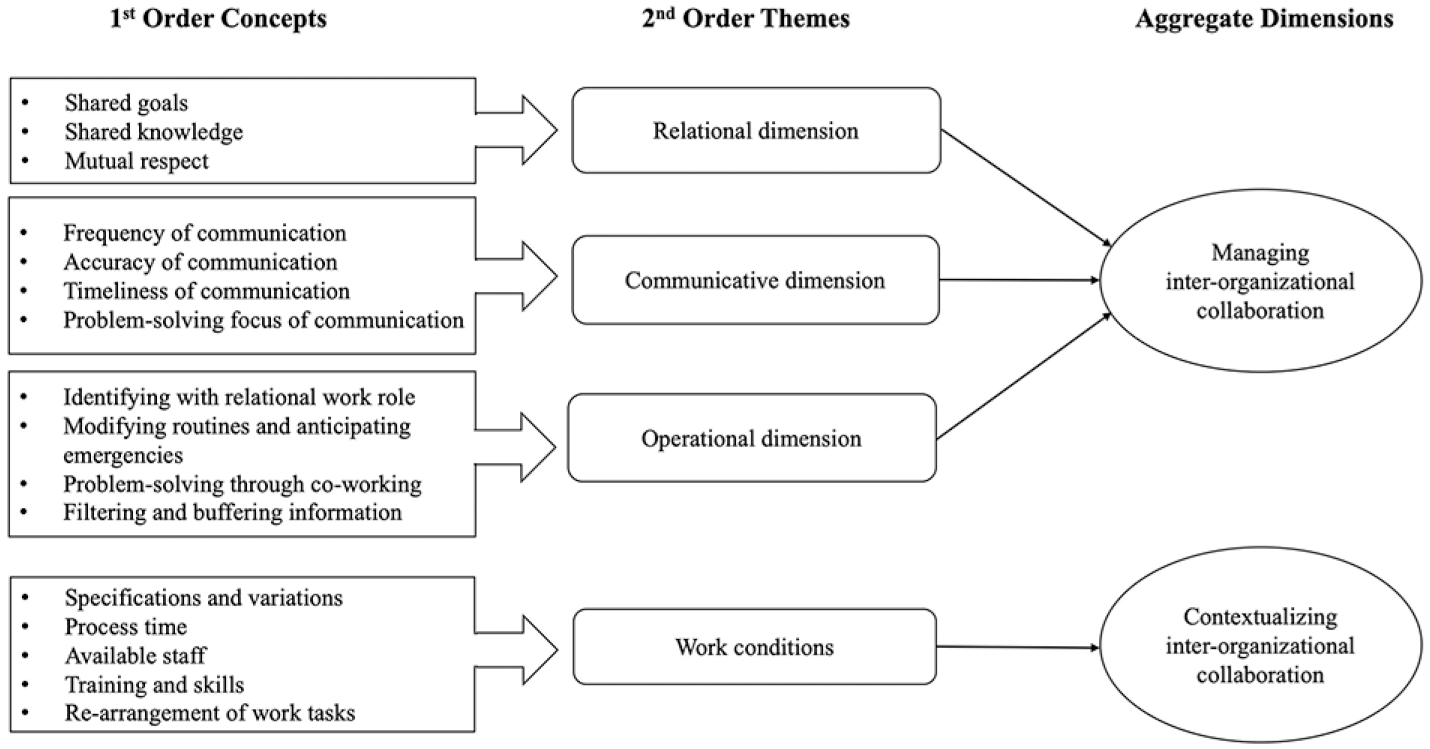
Data structure.
Empirical findings
For better comprehensibility, we organized our empirical findings along our coding scheme provided in Supplemental Appendix 2. Accordingly, our findings section is structured in two parts as shown in Figure 3: Three dimensions of managing inter-organizational collaboration at the work level (relational, communicative, and operational) of which the first two are related and inspired by Gittell. The third operational dimension was identified through the ramp agents’ reports on their practices. Similarly, the working conditions are taken from the contextualizing information on the inter-organizational work process given by our interviewees.
Managing inter-organizational collaboration
The inter-organizational interdependence in ground handling requires coordination of a structured kind, as well as an ad-hoc communication during the work process. Here, the ramp agent who is involved in every handling operation is the one responsible for coordinating, controlling and monitoring the overall process as well as for finding and solving problems occurring during ground handling: We are responsible for ensuring that all service providers who work around the aircraft do their job properly. We are responsible for structuring and organizing the ground handling process before and during the ground handling so that the aircraft is ready for departure at the specified departure time. (AP2-CO2)
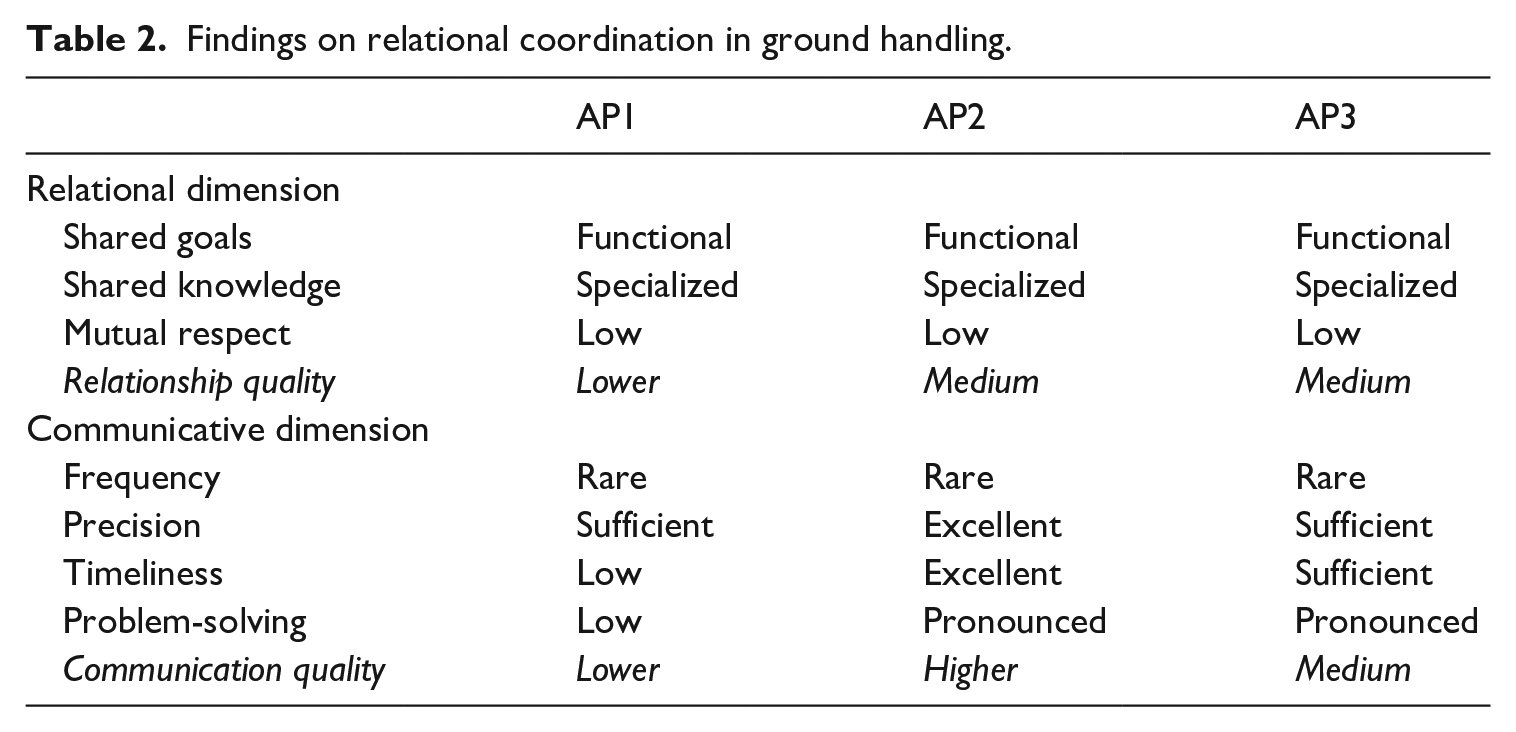
However, ramp agents do not have the hierarchical position to improve the process itself by independently changing process flows based on their efficiency considerations or to neglect handling specifications due to strict security and handling requirements. Accordingly, the basic ramp agent actions are comparable at all airports surveyed. Importantly, we observed that the ramp agents’ work is influenced by communication and relationships patterns which, following Gittell’s model of relational coordination, hinder or facilitate an effective coordination of the work process. Table 2 summarizes the relationship and communication quality we identified in our fieldwork in three airports based on the ramp agents’ interview data. At AP1, ground handling is characterized by low-quality relationships and communication, whereas at AP2 and AP3, these aspects of relational coordination are of a comparatively higher quality, but still rather low. Hence, despite a highly networked, inter-organizationally distributed work process, none of the airports achieve a consistently high-quality relational coordination according to the criteria of relationship or communication quality.
Findings on relational coordination in ground handling.
The relational dimension
Shared goals
It could be observed that the organization of work at the network level has a strong influence on the formation of common goals at the work level. The service partners involved determine their responsibilities at the company level. Accordingly, work groups work in accordance with their own company’s regulations. Often these processes and competencies are not coordinated with each other, leading to ambiguities regarding the areas of responsibility of the individual work roles and eventually to difficulties in process synchronization. This can be attributed to the restructured work situation. In the past, one or two dispatchers at the company level coordinated the ground handling process within the company. Today, by splitting the service process between different companies, several service providers are involved, each with its own coordinators, resulting in confusing information flows. Finally, networking at the company level and poor timing and technical coordination between the network companies have led to the creation of many interfaces and confusing work processes, eventually complicating the process of punctual ground handling. As a consequence, ramp agents are often forced to question the process and the responsibilities of the involved companies. Relating thereto, it is stated that, generally, each work group only feels responsible for its own tasks pursuing functional goals: “Now, the right hand doesn’t know what the left hand is doing. And nobody cares, as long as his job gets done. Before that, work was hand in hand” (AP1-RA2).
Shared knowledge and mutual respect
Due to their role as coordinator and boundary spanner, ramp agents are familiar with the co-workers’ work roles and their contribution to the overall process. In contrast, as nowadays more emphasis is placed on the fulfilment of one’s own task, while the co-workers’ tasks are not of personal interest, the work groups’ knowledge about the ramp agents’ work role is superficial and limited to their basic function of coordinating the process at all examined airports. Consequently, co-workers lack awareness of their own work role within the overarching process, including the relation to the other parties involved. This is strongly interrelated with a lack of mutual respect. Ramp agents no longer feel respected in their role to the same extent as before when the process was less fragmented than it is today. However, it is not surprising that there is no corresponding respect for the ramp agents’ work role as only those who are aware of the single work group’s contribution to the process, can recognize and respect it: “The fact that the ramp agent is there to recognize problems beforehand and solve them [. . .] is something very few people know and reward” (AP2-RA2).
The communicative dimension
Frequency and timeliness of communication
Communication is the most important part of the ramp agent’s job. At best, ramp agents both collect information from co-workers and are regularly provided with information from them. When most co-workers still came from the same company this two-way, proactive communication was the rule. Now, the frequency of communication with the ramp agents is rather low. They are usually only contacted when problems occur and then often when it is already too late to counteract. Thus, the ramp agents’ attention is all the more in demand as it is now their responsibility to actively and frequently approach co-workers to obtain relevant information. A practical example is the boarding procedure where the boarding personnel should confer with the ramp agent to coordinate and clear the boarding time based on the completion of previous activities like aircraft cleaning and fuelling. Often, they do not consult and are only mindful of their own company’s boarding instructions without keeping the whole process in mind. Difficulties in process synchronization and ultimately dissatisfaction of passengers who have to wait (in a bus) in front of the aircraft for the handling process to be completed are the consequence. As a precaution, the ramp agents interviewed have come to terms with this by taking an active role themselves, approaching work groups rather than relying on timely information.
All ramp agents surveyed suffer from a lack of timely information transfer with outsourced functions. For example, changes in loading that deviate from the loading plan must be coordinated between ramp agent and load control, making communication difficult and time-consuming as with most airlines, outsourced units can no longer be reached by telephone, but only via chat.
Accuracy of communication
Depending on the workplace environment, communication difficulties naturally result from the background noise on the apron. Furthermore, splitting the process leads to communication chains in which every additional interface is a possible source of error and adds to complexity, causing additional effort in coordination and communication for ramp agents: “You have to ask five people who have to react faster than one person before” (AP1-RA4). Especially with services relocated abroad, communication is generally hampered by language and comprehension problems.
Problem-solving focus on communication
Though ramp agents are responsible for solving problems on their area of work, they sometimes need co-workers’ support. As they are not authorized to give instructions to employees of other companies, they have to rely on co-workers’ helpfulness, which is often not given. “Stereotyped thinking [. . .]: your area, my area” (AP1-RA9) has led to a situation where it has become the rule to take care only of one’s own task (fulfilment): “Now, some people say: You’re not the boss of me!” (AP1-RA8). Both the lack of shared goals and respect for the ramp agents’ work role contribute to the loss of “this common thinking or thinking along, what is good for the other, what can I quickly take over” (AP1-RA2) as also the following quotation exemplifies: If you have four or five companies on one plane, it’s like everybody’s doing his own. In the past, when everything was in one hand, people would grab hold when they needed it [. . .] Now, if there is no one else around and a staircase has to be pulled up, I ask the loaders ‘Would you help me to pull up the stairs?’ and they say ‘No, it’s not our job.’. Well, I mean they're right, but it makes the whole job harder, you know? And [. . .] no one from the [responsible] company is there either. (AP1-RA6)
Overall, considering the communication patterns described above, the communication quality is rather low at all examined airports. A final quote summarizes most ramp agents’ predominant view and again illustrates the connection between communication and relations in the coordination of work as pointed out by Gittell (2000): If you know the people, everything is a lot easier. Because communication works even better when you know each other because you know how people work out there. [. . .]. If you don’t know them [. . .] you pay more attention and you have to keep an eye on them [. . .] [because] you don’t know how they perform. (AP2-RA4)
The operational dimension
The data analysis has clearly shown that the work of ramp agents and the success of ground handling is not only influenced by the effectiveness of relational coordination as identified by Gittell, but also by context conditions. Despite the working conditions and challenges described above, air traffic in Germany does not collapse. So, how do ramp agents manage to coordinate ground handling operations against this background? We could observe that coordinating and managing relationally in network settings also includes a couple of practices that go beyond the type of relationships and communication proposed by Gittell and that ramp agents may vary in carrying out these activities. Overall, ramp agents report on what we call an ‘active approach’ as a key to effective ground handling operations despite the overall work situation. Active ramp agents know that their own practices support on-time ground handling through preventing emergencies: “For an effective work process [you] must be active and not reactive [. . .] If you are active, you have solved the problem before the problem even exists” (AP1-RA7).
In detail, we identify four practices characterizing such an active approach in our interview data: (1) identifying with a relational work role in the SDN, (2) anticipating emergencies and modifying routines, (3) problem-solving through co-working, and (4) filtering and buffering information.
Identifying with relational work role
Despite the missing hierarchical power and formal space for individual work design in the ramp agents’ work role, the ramp agents’ individual work organization may differ. We see from the data that with increasing work experience, ramp agents develop their own practices to deal with the relational, communicative and contextual problems described: “Everyone works differently” (AP1-RA6), “the procedure is the same, but everyone prioritizes other things” (AP1-RA7). The extent to which ramp agents have an active approach depends on education—“Some can do things much faster and the other needs a little longer. That’s a matter of training” (AP1-RA7)—and experience: “Once you burn your fingers, you rarely burn your fingers with this problem, again” (AP2-RA1). Thus, it is usually the experienced ramp agents who identify strongly with their work role thus pursuing an active approach whereas particularly new ramp agents have a hard time immediately developing such work methods due to a lack of knowledge and experience.
Modifying routines and anticipating emergencies
The ramp agent is “a kind of manager on the ground” (AP1-RA6) whose goal is to make sure “that everything happens as safely as possible in the given time” (AP1-RA2). Active ramp agents develop an approach that enables them to fulfil their goal and to best manage and counteract daily problems. They are characterized by thinking ahead, working with foresight and actively designing processes or modifying predefined procedures in order to be able to act in advance of possible problems: “We go out there and specifically search for problems in order to solve them in advance before they arise” (AP2-RA2). This modification of predefined processes is particularly interesting against the background that ramp agents formally do not have the hierarchical power to intervene in the process. Thus, they formally place themselves partly outside the rules. Here, again, the challenge and paradox of working in networks becomes clear: since there is no hierarchy in networks per se, and not everything in the work process is done on instructions, some situations sometimes require reflection on and modification of the processes. In our case, conducted by active ramp agents, because “if you would always only work the way you learned at some point, this strict one: ‘Ok, first I do that, then this’, then every aircraft would go out too late. Instead, you improvise” (AP1-RA4). In contrast, reactive ramp agents “just work to rule” (AP1-RA5).
Problem-solving through co-working
Active ramp agents are characterized by helpfulness going so far as taking over co-workers’ tasks if necessary. Through their active monitoring they constantly try to anticipate when and where help might be needed, then actively approaching the work group in need. Again, this is noteworthy against the background that they are officially not allowed to do so due to the formal separation of the various legally independent service providers. To give an example, one ramp agent reported that he could not push away the passenger boarding bridge what should actually be prepared by the loading group leader: “The [loading group leader] sat there reading the newspaper while I stood there like a fool until I looked down and saw this. So, I went down there myself, turned off the power and moved the bridge, but we really had a delay” (AP1-RA1).
Filtering and buffering information
This practice is indicative of the fact that ramp agents act as mediators who filter information and mitigate stressful situations in the process. A practical example is the exchange with the captain in the case of delay. Here, a situation familiar to those who have ever waited for departure is when the taxiing steps to disembark passengers into the aircraft must be moved away after the doors are closed. Passengers and captain look out of the window seeing workers apparently idly standing around instead of taking action. Understandably, this causes incomprehension and dissatisfaction among those who do not know about the work situation outside on the apron. There, the responsible work group is not on site, but the other workers are not allowed to do the job. Here, it is the ramp agents’ job to justify the situation and eventually any delay to the captain who usually is unaware of the networked work process in ground handling: “At that moment, as a ramp agent you have nothing to laugh about, you got a problem, you got a real problem. That’s why as a ramp agent you’re the lightning rod for people who don’t understand – the crews or the airline” (AP1-RA9).
Contextualizing inter-organizational collaboration
During the interview analysis, we noticed that our respondents made strong claims that the effectiveness of collaboration in the work process is, besides the field-level conditions of competition and cost pressures in ground handling, subject to further context conditions contributing to a stressful work situation. As these context conditions are not explicitly the concern of Gittell’s concept of relational coordination which emphasizes the relationships and communication between work group members, we discuss our findings on the context, derived from the empirical data evaluation, in more detail, below.
Specifications and variations
The handling specifications that have to be observed in the turnaround process of aircraft are determined by each airline in accordance with global standards determined by airport authorities, the Luftfahrt-Bundesamt (LBA) and airline associations like the International Air Transport Association (IATA) that support aviation with global safety standards thereby specifying the minimum handling requirements (IATA, 2017). Airlines must refer to these standards, but may extend them with their own regulations as long as the minimum regulations of the umbrella association are not violated. Ramp agents perceive many airline handling requirements as unnecessary modalities disturbing the process flow: “It depends on what specifications the airline has, what the airline wants. If the airline wants us to load the cargo first, we load the cargo first. [. . .] and accordingly, we must always adapt our handling procedures” (AP2-RA3). The knowledge burden at the airports varies depending on the number of airlines a handler serves and is aggravated by the fact that airlines change their specifications on a weekly to monthly basis. At AP2, the burden is greatest with 35 airlines that have to be serviced by ramp agents: “It’s [. . .] too much. We handle so many different types of aircraft, you can’t compare that with AP1. The knowledge behind it, what you need to make it work, is immense” (AP2-RA1). The different specifications are also accompanied by various, generally three to four, airline-specific electronic handling systems that ramp agents have to master, further disrupting the workflow.
Process time
Ground handling is a process that rarely runs smoothly. It is “the rule to deal with problems or imponderables” (AP1-RA8). “50, 60% [. . .] of the planes leave a little later because passengers are missing, [because of] outreach, ground traffic [. . .]” (AP2-RA4), other uncertainties or human error. Regardless, the handling process itself has become challenging because of unrealistic ever shorter ground times set by the airlines without planning for contingencies leaving no buffers for unforeseen situations and problems. “That’s how the business works” (AP1-RA9): Normally, the ramp agents should have enough time to get familiar with the matters to be handled such as freight, dangerous goods or animals. But high work volumes and short ground times rarely give them the opportunity to prepare for individual handlings, because they “are only under time pressure” (AP1-RA11). For ramp agents, the illustrated work situation ultimately results in long working hours, few breaks and an ongoing daily workload under which not only the punctuality and safety of the work process but also the psyche of the ramp agents suffers: “Because of this short ground time, you jump most of the time from one flight to the next. You haven’t finished the first one yet, the second one is already there” (AP2-RA1).
Available staff
Ground handling is a very labor-intensive segment in the aviation field. Currently, ground handling service providers try to keep labor costs as low as possible, because airlines want to spend as little money as possible for handling services as “they are usually no longer concerned that they get high quality [and] good staff - it has to be cheap” (AP3-RA1). This way “the competitive pressure [. . .] is maintained to the maximum extent possible” (AP1-CO1). As a result of the attempt to minimize labor costs, ground handling is characterized by staff savings and general staff shortage. On the other hand, in competition for handling orders, ground handling service providers try to take on as many orders as possible from different airlines regardless of whether they can handle this volume of work with the existing staff: Time is money, so you can handle more and more within a short time. [. . .] Nobody is interested in your person anymore. How you cope with it or whether you are under stress [is of no interest]. [. . .] You are actually [. . .] a number. [. . .] And if the number doesn’t work then another one comes along (AP1-RA11).
However, ramp agents are poorly paid “having to work better and better for less money” (AP2-RA1). At the same time, there are many temporary workers in ground personnel who earn even less than the salaried employees and are therefore dissatisfied: “That’s pretty hard. This mortification to be second-class employees [. . .] this permeates the whole company” (AP1-CO1). Also, students and pupil trainees are frequently used for the purpose of cost savings and placed on the aircraft as full-fledged employees. The situation described ultimately results in immense fluctuation at all examined airports: We [have] become a flow heater [. . .]: [People] come in, are warmed up and spit out again. [The companies] are not interested in people [. . .]. You get the feeling from time to time that they only want young people – two, three years burned and then out. And then the next young people are allowed to come (AP1-RA7).
Training and skills
Cost savings made in training, which is the responsibility of the respective handling service provider since the ramp agent profession is not a classic training profession, have led to a reduction in training duration and quality deterioration over time. The development that “you can’t find any people [. . .] who meet your requirements from 10 years ago” (AP1-RA10) must be viewed critically in the highly safety-relevant area of ground handling where profound knowledge builds the essential basis for action.
Re-arrangement of work tasks
The cost-related outsourcing of ramp agent tasks like load planning to various low-wage countries has reduced the ramp agents’ scope of tasks. However, outsourcing does not make the ramp agents’ work any easier but entails additional communication and coordination efforts thereby limiting the autonomous capacity for action. Where they for example used to make changes in aircraft loading on their own responsibility, they now have to coordinate every adjustment with the outsourced department, which increases the workload and the risk of a delayed handling process. However, where in the past only a single company was responsible for ground handling, there is now a network of several contractual partners involved forming an SDN and causing “a giant mess” (AP1-RA1) on the handling side because of further subcontracting and outsourcing.
Overall, during the interviews, it became clear that the ramp agents’ work situation has deteriorated increasingly since the beginning of market liberalization two decades ago (see also Casey et al., 2011). In a situation where “less and less personnel that is increasingly inadequately trained, have to take on more and more security-related tasks. In less and less time. For less and less money” (ver.di, 2017), from the ramp agents’ point of view the work situation hits rock bottom: “The job isn’t bad, but the way it is, it’s just disastrous” (AP1-RA9). As those who are directly affected and who have to deal with the resulting consequences as well as the contradictory requirements in their daily work, all ramp agents surveyed have expressed a lack of understanding of the networking policy and the context conditions. They are expected to deliver faster and faster in an ever-shorter time but are also increasingly burdened by outsourcing and resulting communication and coordination interfaces. These expectations are hard to meet. Additionally, the ramp agents’ coordination function is made virtually impossible as they are responsible for the ground handling’s success but get no formal authority on the organizational level to issue instructions to the employees of other companies which regularly leads to downtimes, delays in ground time and ultimately delayed departures: “We lose time, nerves and the company loses productivity and the passengers are disappointed” (AP1-RA7). Consequently, not only does working in an inter-organizational work process poses challenges for ramp agents, but also the field-level developments set constraints on working conditions for dealing with these challenges.
Conclusion and discussion
In our study, we aimed to examine how ramp agents manage collaboration among employees from various network participating organizations using the example of ground handling in German airports. As a starting point, we introduced Gittell’s concept of relational coordination (2000) which states that uncertain, highly dependent and time-constrained work processes require high-quality relational coordination to be effectively managed. Such work processes are characterized by shared goals, shared knowledge and mutual respect as well as a corresponding quality of communication between the co-workers in the process. Using Gittell’s approach as an exploratory heuristic for our qualitative fieldwork, we applied Gittell’s scheme to our setting in order to assess the quality of coordination at the single airports. Although we found differences, the relationship and communication quality were rather low at all examined airports (see Table 2). We interpret these findings as providing only limited evidence for a high-quality form of relational coordination. Evaluated qualitatively against the benchmark of high-quality relational coordination, the management of collaboration falls short of what could be expected at all airports given the nature of ground handling operations.
Our explorative study further reveals that the ramp agents’ daily work at all airports is to a considerable extent subject to similar field-level context conditions. Ramp agents report these as constraints for their efforts in managing inter-organizational collaboration, that is in building high-quality relationships and a corresponding high-quality communication with co-workers in Gittell’s terms. However, these conditions had a different impact on relationship and communication quality at the airports (see Table 2). We trace these differences back to the network-specific contexts, for example training investments were reported to be higher at AP2 and AP3 than on AP1. Theoretically, this finding pinpoints a nested theory of structuration (Perlow et al., 2004) which claims a mutually reinforcing relationship between the institutional context and actions mediated by inter-organizational interaction.
In addition, and despite the lack of a high-quality relational coordination, it seems astonishing at first sight that the ground handling operations at all the airports function relatively well technically. How can this be the case, if relatively poor relationships and insufficient communication point in a different direction? Here, we identify four additional operational practices ramp agents deploy in their boundary work to deal with the challenges of the networked work process. Ramp agents (1) identify with the relational work role, (2) modify routines and anticipate emergencies, (3) solve problems through co-working, as well as (4) filter and buffer information. By using these practices, we argue ramp agents compensate for the lack of high-quality relational coordination.
Cautiously, we conclude from these findings that Gittell’s model has an explanatory power for the quality of inter-organizational work processes but lacks two important dimensions that should not be neglected as additional influences. First, the capacity of boundary spanners to devise other practices than relationship building and communicating for making inter-organizational collaboration effective on the work process level. Second, the context in which co-workers are nested which has important implications for the inter-organizational collaboration on the level of work. Hence, in our interpretation, we move from viewing the management of inter-organizational collaboration as relational coordination towards an even more practice-based model that is also sensitive to the enactment of field-level and inter-organizational contexts through additional practices around structuring operational work activities. Coming back to our question, we conclude that collaboration among employees coming from various network participating organizations is managed by boundary spanners who invent practices for making inter-organizational collaboration happen, especially in those settings where a hierarchical authority and a network-oriented management approach are simultaneously absent.
Limitations
Like all studies, ours is subject to a couple of restrictions. Overall, all interviewees were very open in their responses. Nevertheless, the interviews analyzed in this paper may contain some bias. First, while the interviews at AP1 were conducted with single persons privately, the data collected at AP2 and AP 3 are subject to potential influence. Although individual interviews were assured, at least one additional ramp agent, as well as one supervisor attended the interviews as well, which could have negatively influenced the respondents’ answers due to concerns about social desirability. However, by deploying triangulation with secondary data and contextualizing interviews within the broader fieldwork we think we are justified in using these interviews for our exploratory purpose about relational work organization. In future research, more case studies may check for the plausibility of our findings in divergent settings. Also, an extension towards an even more fine-grained comparative approach for testing single statements may assist in resolving these issues. Second, the data collected in this paper mainly reflect the subjective perceptions of the selected ramp agents. Inclusion of the other work group members as well as additional service providers would allow for a more holistic assessment of the networked work process in ground handling operations by achieving a more detailed and more diverse picture. Nevertheless, given the comparison of the work settings studied here, we are quite confident to have captured at least a relevant part of the work experience in each setting to explore the practices of relational work organization. And finally, we are not the only ones who have looked at relationships and collaboration in this particular work setting. For example, in an explorative study on factors impacting collaboration in project networks in the construction industry, Fulford and Standing (2014) examine processes that underpin the relationships in the construction organizations, similar to what we did in our explorative study on the networked work process of ground handling. Also similar to our research setting, the construction industry is rather complex, characterized by fragmentation, a lack of standardized practices and poor information standards all together impeding efficiency gains. Here, they also recognize the importance of high-quality relationships between construction workers necessary to create project networks characterized by trust and shared values for successful collaboration (Fulford and Standing, 2014).
Practical implications
Given our findings and their limitations, how can our study assist in improving the networked work process, also in other service work settings (say in hospitals Litwin et al., 2017)? If we are to accept the ambitions championed by Gittell’s relational coordination to contribute to effectiveness, several suggestions can be derived from our findings bearing the potential to assist firms and workers in improving the networked work process in practice. First, on the work level, we see a couple of issues around delegating decision authority to boundary spanning roles. This also includes the authority to modify routines as our findings suggest that flexibility in the process only becomes possible when being able to adapt routines to the corresponding work situation and its conditions. Relatedly, organizations should consider a more sensitized approach in the management training for these positions. Further, this also requires a clear definition of responsibilities in the process as well as a proper assignment of responsibilities, for example by assigning fixed contact persons for clearly defined issues. Combined with a reduction of interfaces, that is limiting the inter-organizational separation of tasks, this should assist in alleviating some of the tensions described above. Second, on the level of network management, our results indicate that effective collaboration in a networked work process requires partners to create organizational structures supporting the collaborative efforts of employees, in particular those of the boundary spanners. Third, on the level of the context conditions, we identify necessary investments in training and adequate working equipment as further aspects with some room for improvement. Overall, especially after “20 years of [. . .] deregulation and downward wage spiral” (AP1-CO1) in ground handling operations, the working conditions and standards in the field seem to be a major stumbling block for realizing relational coordination of an adequate quality. We conclude from this finding that the field’s major players could benefit from improving the field’s standards. Whether recent efforts by the German trade union ver.di and the employer association to conclude an industry-wide collective agreement in ground handling will be successful is too early to tell (ver.di Fachbereich Verkehr, 2017), but taking wages out of a downward spiral of deteriorating remuneration would be a beneficial development from the viewpoint of improving the collaboration in the work process itself.
Future research
Focusing not only on the network level, but also on the work group level and the contexts allow us to fully appreciate the complexity of networks and the repercussions of the network form for managing the inter-organizational work organization. A detailed consideration of context will allow researchers to gain a more practice-based understanding of the boundary conditions of inter-organizational collaboration also with an eye on other questions. For example, concerned with the socio-demographics of work group diversity, Joshi and Roh (2007) have also recognized the importance of context for work groups’ performance. Following on Joshi and Roh’s (2007) conclusion that there is a need to extend current approaches to work group diversity by paying more attention to contexts such as industry, occupation, and team (Joshi and Roh, 2009), we suggest to examine the inter-organizational context of work group diversity more closely. This also includes considerations about how work group level diversity is constrained or enabled through inter-organizational phenomena. Likewise, we see a potential for future research on managing inter-organizational collaboration in elaborating the connections to existing research in leadership studies. For example, Leader-Member-Exchange (LMX) theory may benefit from reflecting on the inter-organizational character of many (service) work settings as intervening in the influence of leadership quality on team performance (e.g. Lee et al., 2019; Martin et al., 2018). Especially, further investigation into non-dyadic relationships in multi-employer arrangements would be a fruitful area for understanding better the additional requirements in leader-contributors exchanges (Gittell and Weiss, 2004; Marchington et al., 2005; Swart and Kinnie, 2014). For example, on our case, we observe how ramp agents enact a work role lacking formal authority to manage collaboration in operations in various ways. But then, what are the sources of legitimacy of these deliberate enactments? Reflecting on the network setting, hence, brings along a new view on older questions about how participatory, empowering, and democratic leadership styles from below are put into practice and where their limits are (e.g. Bolden, 2011; Katz and Kahn, 1966).
In conclusion, a practice-based lens on inter-organizational collaboration opens the view for how the organizations involved may create and implement the prerequisites for effective relational work organization, grounding network management and inter-organizational cooperation. At the same time, a practice-based view is aware of the fact that organizational structures can never replace collaboration by those in charge of operations on site. This finding may extend to other situations in which the networked service work is characterized by uncertainty, dependencies, and time constraints. How to develop and nurture an adequate network culture for relational work organization might be another topic for further investigation (for a contribution going in this direction see Jolink and Dankbaar, 2010) as to what the benefits of network-oriented HRM might be in utilizing network complementarities and establish compatibility in the network (e.g. Marchington et al., 2011; Swart and Kinnie, 2014).
Supplemental Material
sj-pdf-1-gjh-10.1177_2397002220978114 – Supplemental material for “You are not my boss!”: Managing inter-organizational collaboration in German ground handling operations
Supplemental material, sj-pdf-1-gjh-10.1177_2397002220978114 for “You are not my boss!”: Managing inter-organizational collaboration in German ground handling operations by Dominique Ziehe and Markus Helfen in German Journal of Human Resource Management: Zeitschrift für Personalforschung
Footnotes
Acknowledgements
The authors express their gratitude for the respondents’ willingness to participate in the field interviews. In addition, the second author acknowledges support by a research grant from the Hans Böckler Stiftung, Grant/Award Number: 2014-741-2 for the contextualizing part of this study’s field work.
Funding
The author(s) received no financial support for the research, authorship, and/or publication of this article.

Supplemental material
Supplemental material for this article is available online.
References
Supplementary Material
Please find the following supplemental material available below.
For Open Access articles published under a Creative Commons License, all supplemental material carries the same license as the article it is associated with.
For non-Open Access articles published, all supplemental material carries a non-exclusive license, and permission requests for re-use of supplemental material or any part of supplemental material shall be sent directly to the copyright owner as specified in the copyright notice associated with the article.
