




Abstract
Background
An increasing proportion of physicians are women, yet they still face challenges with career advancement. In 2014, the European Stroke Organisation established the goal of increasing the number and participation of women within the society using a Top Down and Bottom Up approach. The ‘Women’s Initiative for Stroke in Europe’ was created the same year by a group of women active within the organisation. We aimed to assess the current status of women in European Stroke Organisation, and to explore the change in sex differences after the introduction of focused approaches to address disparities in 2014.
Methods
Using organisational records, we collected data on sex differences in core activities from 2008 up to 2017 including membership, participation in conferences, courses and in the official journal of the society, and positions of seniority and leadership. We estimated sex distribution differences in each of the activities from 2014 to date.
Results
In 2017, the proportion of female members was 40%, while 24% of fellows, 22% of the executive board and 19% of the editorial board in the official journal of the society were women. From 2014 to 2017, there was a significant increase in the proportion of female members (p = 0.0002) and in women participating in the annual conference as faculty (p = 0.001). There was no significant change in the sex distribution among the faculty members in junior educational activities (≤27%) or fellows.
Interpretation
In 2017, the proportion of women holding positions of seniority and leadership is still significantly lower to the proportion of women attending educational activities. Transparent data on sex distribution will assist implementing tailored programmes to achieve progress against sex-based barriers.
Keywords
Background
Already in 2009, about 75% of health graduates in EU member states were women, and from 2015 most of the European countries reported that they had more women than men among physicians. 1 Yet, there is still an unbalanced horizontal segregation, exemplified by a vast majority of male surgeons, and female gynaecologists, paediatricians and general physicians, 2 and a vertical segregation, with a disproportionately low number of women occupying senior positions in medicine.3,4 Postgraduate training in medicine is characterised by challenges in work–life balance, particularly for women with children entering specialist training,5–7 ultimately leading to fewer women than men completing specialist training, working full-time or taking leadership positions.2,4–6
In stroke medicine physicians deal with critically ill patients in an acute setting and need to make quick decisions on high-risk treatments such as intravenous thrombolysis and endovascular treatment, and training in stroke medicine takes several years. 8 The glass-ceiling and leaking pipeline with regard to professional women is well known, not only in stroke medicine but also in other Science, Technology, Engineering and Math careers.4,7,9–11 Efforts are needed to both encourage women into stroke specialist training and to ensure retention, and support advancement.9,11
The European Stroke Organisation (ESO), a pan-European society of stroke researchers, physicians, national and regional stroke societies, was founded in December 2007 with the aim to reduce the burden of stroke. Since 2014, ESO has specifically focused on increasing the number of women in the society and at the annual conference using a Top Down and Bottom Up approach. The same year, the first female president was elected and the ‘Women’s Initiative for Stroke in Europe’ (WISE) was founded by 30 women active in the ESO (https://eso-stroke.org/wise-women-initiative-stroke-europe/). One of the declared goals of the president elect was to include more women and rising stars in leading positions of ESO and to increase their visibility by active promotion on the organisation’s social media channels (Top Down Approach), while the WISE-group built up a network promoting women actively in the scientific society (Bottom Up Approach), both strategies defined by those leading the interventions.
In this paper, we report the status on the representation of women within ESO in 2017, and aimed to explore the change in sex differences in ESO from 2014 onwards.
Methods
We collected data from core activities within the organisation from 2014 to 2017 and calculated the number of women and men among members, fellows, junior members, committees including the executive committee, board of directors and council of fellows. Furthermore, we assessed the sex distribution among convenors, speakers and first authors of abstracts at the European Stroke Organisation Conference (ESOC) (first arranged in 2015) as well as the editorial board, peer-reviewers and first, last and overall authors of articles in the European Stroke Journal (established in 2016).
The ESO summer and winter schools are aimed at young stroke physicians and researchers, whereas the European Stroke Science Workshop is a biannual workshop on cutting-edge clinical and research aspects of stroke inviting a limited number of stroke opinion leaders. We compared the number of women and men among faculty and participants in these activities.
The Action Plan for Stroke in Europe 2018–2030 is a collaborative project with the patient organisation Stroke Alliance for Europe (Stroke Action Plan, https://eso-stroke.org/action-plan-stroke-europe-2018-2030/). Seven domains have been selected and each domain group reviewed current evidence, set targets and identified prioritised areas of research. We assessed the sex distribution of the members of the individual domain groups, the core working group and steering committee.
Data sources
Data on membership, composition of committees, participants at ESO stroke summer and winter schools and the European Stroke Science Workshop were collected from organisational records. Two authors (DAS, ECS) manually screened all papers published in the European Stroke Journal (from the first published paper in 2016 to the end of 2017), the composition of the editorial board and peer reviewers through data from the European Stroke Journal. Sex was abstracted from lists of names by inspecting first names. If sex was not apparent from simple inspection of the name, the Internet was searched for a picture of the individual. If a picture was not found, name websites were queried as to the sex usually associated with the name. Whenever necessary, colleagues who knew the individual personally were asked directly to identify sex.
Statistical analysis
By constructing contingency tables, the number of women and men in core activities were compared using the Chi 2 statistic to assess the difference from 2014, when the Top Down and Bottom Up approach was introduced, to 2017. Since the European Stroke Science Workshop only is held biannually, data from 2013 was compared with data from 2017. The first ESOC was arranged in 2015 and was compared with the latest data (2017 for abstracts and 2018 for invited speakers and convenors). Statistical analyses were performed using Excel for Mac 2011 version 14.7.2. p < 0.05 was used to reject the null hypothesis.
Results
Membership and committees
Between 2014 and 2017, the proportion of women among ESO members increased from 31% (210/672) to 40% (563/1420) (p = 0.0002). Total number of members doubled in the same period making direct comparisons difficult. Figure 1 shows the proportion of women members in Europe in 2017. Among the 47 countries represented, 38 countries (81%) had more than 30% women among their ESO members.
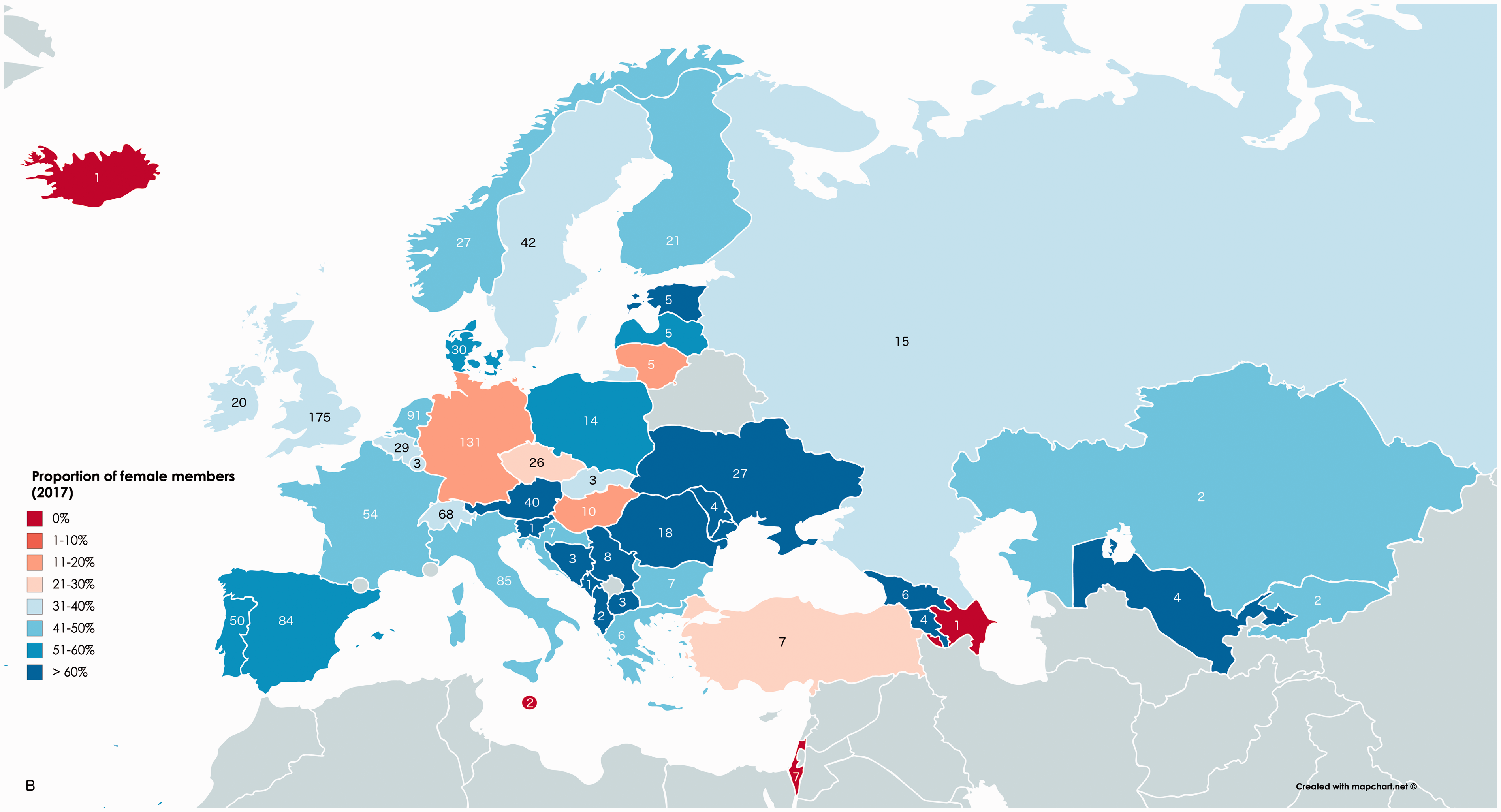
Map showing the proportion of female members in the European Stroke Organisation in 2017 by country. Proportions of women are shown by colour codes, and the numbers represent total number of members (men and women) per country. All numbers are provided in the online Supplementary Table 1.
In 2014, when women constituted 31% of ESO membership, 10% (1/10) of the ESO executive committee members, 20% (2/10) on the Board of Directors and 19% (23/124) of the fellows were women. Only one committee out of 10 was chaired by women (Education committee). In 2017, when women constituted 40% of ESO membership, there were two women on the executive committee (18%, the president and vice-president), 26% (4/15) among of the Board of Directors and 26% women (67/260) were fellow members of the society in 2017 (Figure 2).
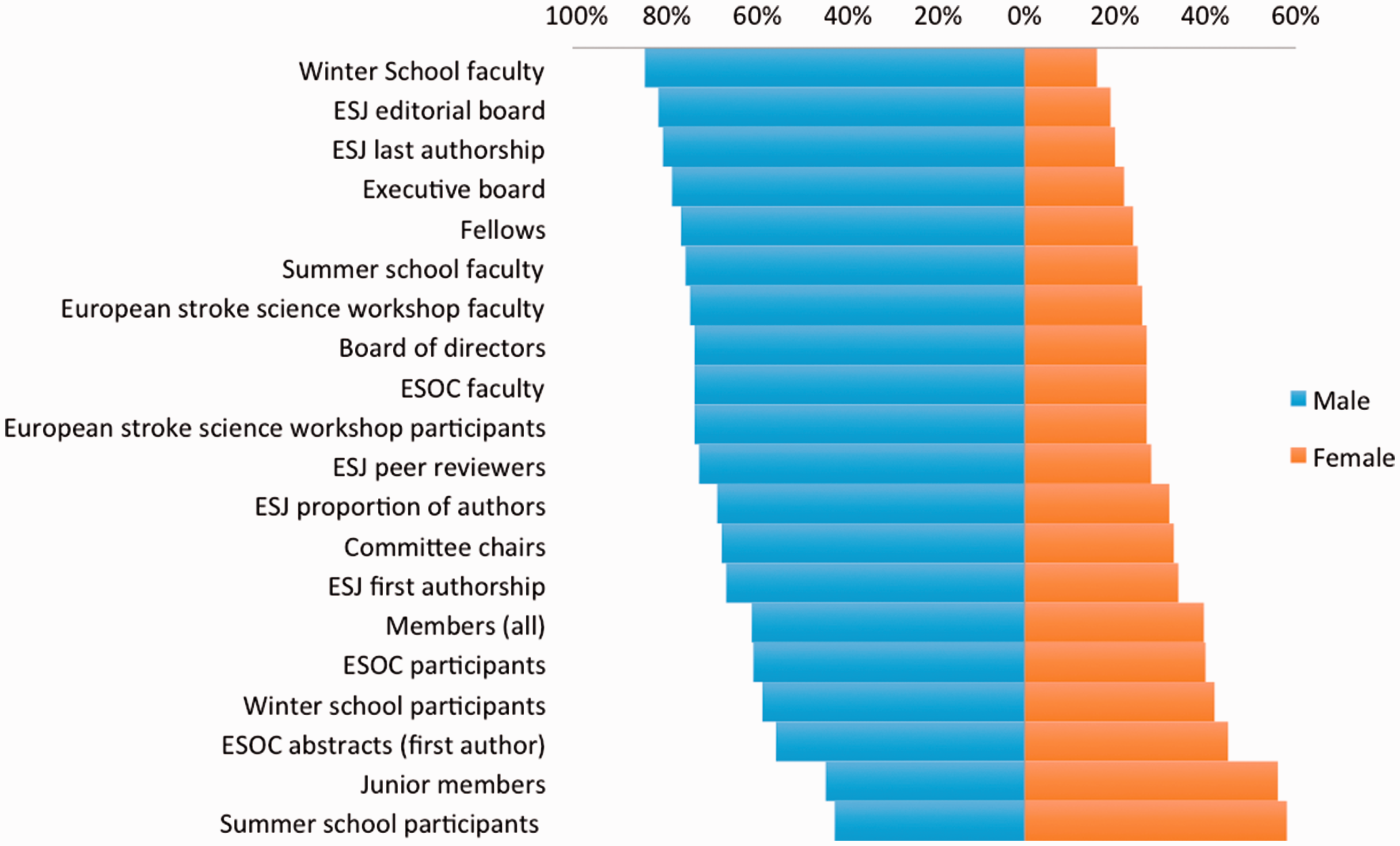
Sex distribution on European Stroke Organisation (ESO) activities in 2017. ESJ: European Stroke Journal; ESOC: European Stroke Organisation Conference.
Amongst the 18 committees within the organisation, six currently have women as chairs (33%) (p = 0.18). Women are underrepresented in 12 of the 18 committees (proportion of women ranging from 10 to 40%), whereas men are underrepresented in three committees (proportion of men ranging from 38.5 to 40%). Only the Young Stroke Physicians and Researchers Committee has a consistent representation of women greater than 40% for the last five years, whereas the Trials Network Committee, Guidelines Committee and Industry Roundtable Committee have never had more than 25% women.
European Stroke Organisation Conference and European Stroke Journal
Women in the ESOC faculty have significantly increased from the first ESOC in 2015, with 21% women (55/257), to 40% women (123/311) in 2018 (p = 0.001). Of submitted abstracts, the proportion of women as first authors was similar in 2015 and 2017 (44% women (520/1166) and 45% women (596/1326), respectively). Attendance of women at the European Stroke Science Workshop did not increase significantly from 2013 to 2017 (19.3% women (21/109) vs. 27.4% women (34/124), p = 0.14)). Women speakers increased from 3% (1/32) in 2013 to 24% (8/33) in 2017, p = 0.07. Of the 802 authors of the 85 articles published in the European Stroke Journal (2016–2017), 28% (228/802) were women. Particularly, women were first authors in 34% (29/85) and last authors in 20% (17/85) of the articles. As of the end of 2017, there were 19% (16/84) women on the editorial board (established in 2016), and 28% (45/163) of the peer reviewers were women.
Junior activities
From 2014 to 2017, there was a significant increase in women among junior members (≤35 years) (49% (94/194) vs. 56% (219/394), p = 0.002), and in 2017 there were more women than men. In 2014, women made up 40% of Young Stroke Physicians and Researchers Committee, which was representative of the actual composition of the junior members. Numbers of women attending the ESO Summer School have been stable above 50%: 60% (21/35) in 2014 and 58% (29/50) in 2017, p = 0.93, whereas the proportion of women in the faculty of the Stroke Summer School in 2017 was 27% (10/36), compared to 12% (4/34) in 2014, p = 0.17. Among attendees at the ESO Winter School, 32% (12/38) were women in 2014 and 42% (27/64) in 2017, p = 0.47. There has been no change in the distribution of the faculty at the winter school from 2014 to 2017 (10% (3/32) vs. 16% (5/32), p = 0.50).
Action Plan for Stroke in Europe
Among the seven domain groups of the Action Plan for Stroke in Europe, three have women chairs (43%). Overall, women comprise 42% (28/67) of group members across the seven domains. There is equal distribution of men and women in the six-person Core Working Group and in the 10-person Steering Committee.
Discussion
The proportion of women in the total ESO membership and in leadership positions has increased, including improvement in the proportion of female members according to country. Although more women have achieved influential positions, such as the president and vice-president, faculty of the ESOC and in the Action Plan for Stroke in Europe committee, most senior activities (including the ESJ editorial board, faculty of the summer and winter school and the European Stroke Science Workshop) had less than 35% women in 2017. Men more often outnumbered women in impactful committees such as the executive committee and the clinical guideline committee, whereas activities aimed at the next generation, such as junior membership and participants of educational programmes, had more women than men.
The Top Down and Bottom Up approach was a likely contributing factor to the increase in women. As part of the Top Down approach, the Executive Committee supervised nominations for committees and board members with a specific focus on gender equality. Regarding the annual ESOC, the conference planning group actively searched to include women as invited speakers and convenors, without introducing gender quota in the scientific programme. Furthermore, seeking future leaders and talents, both women and men, through ESO activities, by scouting at conferences and high-impact publications has identified people who are likely to take on leadership positions. The ultimate goal is to include and embrace women early in their career by encouraging them to invest in science and the organisation.
WISE has been crucial for the Bottom Up approach by increasing visibility of women, including naming of qualified candidates and mentioning the need to include women. Moreover, frequent contact sharing experiences, papers on the topic and face-to-face meetings have improved the visibility of competent women within the organisation. Senior members act as role models, making it easier to propose female candidates for open leadership positions. Additional benefits include a sense of community where there is a support system encouraging women to take on roles they previously might not have accepted. This has created a platform for qualified women with a sense of self-efficacy (‘We can do it’) and positive expectation (‘We shall benefit from it’) in the group.12,13 In September 2017, WISE published the first position paper on stroke in women research in a high-ranked journal. 14
Despite improvements, underrepresentation of women in core activities is still an issue. An obvious contributing factor to the lower number of women in leading roles is that the pool of senior women in the field is smaller than the pool of senior men making equal numbers at this time unrealistic. In addition, potential candidates are often found within personal networks and these usually do not include early career candidates where probably the pool of women would be larger as compared to senior or mid-career candidates. 15 Another explanation is implicit or unconscious gender bias.16,17 A common attitude in merit-based science is that if you ‘want the best’ you cannot consider gender issues. This argument is persuasive but flawed by the fact that implicit gender associations bias review of female applications. 18 The ‘at least one women’ stays at just one – or two – women in activities perceived as the most influential. Evidence-based responses include gender-blind reviews of applications, fostering gender-inclusive working environments, female networking aiming to deal with professionals’ barriers as well as initiatives supporting work–life balance. 13
In order to overcome these biases within ESO, WISE organised the first ‘Women in Stroke Leadership Workshop’ where implicit and unconscious gender bias is was the agenda. This is the first part of a larger initiative including a planned structured three-day leadership course. ESO has also included WISE as main priority in its strategic plan for 2018–2020 (https://eso-stroke.org/about-eso/eso-strategic-plan/). This will encourage women to explore different career strategies by having more role models present. Changing early career perspectives and tools (in men and women alike) will influence organisational cultures and the stroke community to achieve progress against gender-based barriers.
One explanation for the high representation of women in activities for the young is in line with the feminisation of medicine, defined by how the enrolment of more women than men in medical school is consequently leading to major shifts in the gender composition of the physician workforce in many countries. 19 Still, early career is also the time when most women establish a family. In the United Kingdom, 10.7% of all trainee doctors work less than full-time, of these 91.2% are female and most applications to work less than full-time are related to childcare responsibilities. 20 If you work less than full-time, focus will be on finishing your training, leaving little time for academic and organisational work. It remains to be seen, if over time, the increasing number of competent women will reduce implicit or unconscious gender bias, as suggested by a European Union report. 21
We had full access to all the organisational records from 2007, which is the main strength of our report. Furthermore, the described changes occurred after the interventions to change status quo, increasing the probability of the observed changes not being findings by chance; however, only a longer observation period can confirm this statement. As the structure of ESO is comparable to the structure of most academic medical organisations, we assume that they possess generalisability. The number of women in the core activities may not represent all women in stroke science in Europe, however, since ESO attracts the top stroke scientists in Europe, the numbers should be representative. Finally, analysis by country was not possible, given the lack of data, which is also a limitation.
Because it is unconscious, implicit bias cannot be called out in the same way that explicit bias can; thus, organisations need to identify if and how gender biases take place and they need to implement institutional practices and policies to prevent this bias from having an influence. By systematically mapping the number of women in the European Stroke Organisation, we introduced transparency and showed areas where improvement is still needed. More women are involved in core activities in ESO, likely due to the outspoken focus to make change and the applied strategies including using both Top Down and Bottom Up approaches. Structured leadership training for women represents the next step taken to promote continuing inclusion of women in ESO. Changing early career perspectives and tools (in men and women alike) will hopefully continue to influence our organisational culture to achieve progress against gender-based barriers.
Supplemental Material
Supplemental material for Women in the European Stroke Organisation: One, two, many… – A Top Down and Bottom Up approach
Supplemental Material for Women in the European Stroke Organisation: One, two, many… – A Top Down and Bottom Up approach by Else Charlotte Sandset, Diana Aguiar de Sousa, Hanne Christensen, Charlotte Cordonnier, Urs Fischer, Mira Katan, Christine Kremer, Aleksandra Pavlovic, Nikola Sprigg, H Bart van der Worp, Marialuisa Zedde and Valeria Caso in European Stroke Journal
Footnotes
Declaration of Conflicting Interests
The author(s) declared the following potential conflicts of interest with respect to the research, authorship, and/or publication of this article: All authors are active ESO members. ECS is the chair of the young stroke physicians and researchers committee and a member for the public relations committee. DAS and MK are members of the YSPR committee. HC is the chair of the council of fellows. CC is the vice-president, UF is the secretary general, CK is the chair of WISE, AP is the previous chair of WISE and a member of the dementia committee, NS is a member of the board of directors, HBW the president elect, VC the president and MZ the chair of the public relations committee.
Funding
The author(s) received no financial support for the research, authorship, and/or publication of this article.
Ethical approval
Not applicable.
Informed consent
Not applicable.
Guarantor
Not applicable.
Contributorship
ECS and DAS collected the data. ECS, DAS, HC and VC wrote the first draft of the manuscript. All authors contributed to planning, interpretation and critically revised the manuscript.
Acknowledgement
Not applicable.
References
Supplementary Material
Please find the following supplemental material available below.
For Open Access articles published under a Creative Commons License, all supplemental material carries the same license as the article it is associated with.
For non-Open Access articles published, all supplemental material carries a non-exclusive license, and permission requests for re-use of supplemental material or any part of supplemental material shall be sent directly to the copyright owner as specified in the copyright notice associated with the article.
