




Abstract
Background and Purpose:
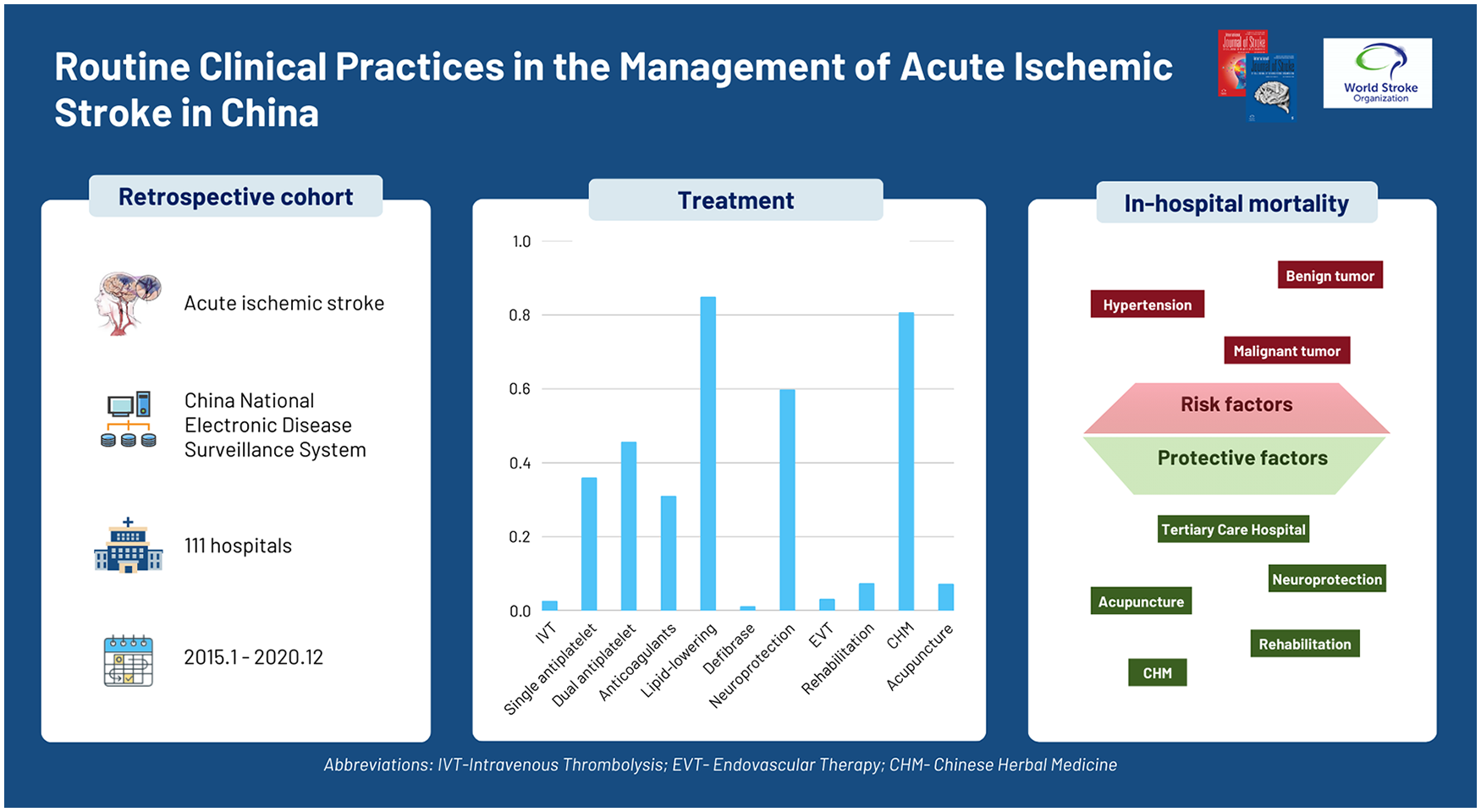
Despite stroke center advancements in China, real-world adherence to acute care protocols of ischemic stroke remains understudied. We aimed to systematically investigate the clinical characteristics and in-hospital treatment of acute ischemic stroke (AIS) patients, and explore their association with prognosis.
Methods:
We developed a nationwide cohort of AIS using data from the China National Electronic Disease Surveillance System. Patients were identified from the first discharge diagnosis. Comorbidities and prescription names were standardized by natural language processing and manual verification. Stepwise Cox regression models with fixed and time-dependent covariates explored the possible association between treatments and in-hospital mortality.
Results:
This cohort included 14,046 patients with AIS from 111 hospitals between 2015 and 2020. Only a small proportion of patients received intravenous thrombolysis (2.76%) or endovascular interventional therapy (3.23%). Neuroprotective agents were used by 59.90% of patients, and dual antiplatelet therapy by 45.77%. Most patients (80.79%) received traditional Chinese medicine, including Chinese patent medicines (79.04%), Chinese herbal medicine slices (10.95%), and acupuncture (7.35%). Rehabilitation services were provided to 7.48% of patients. Cox regression analysis showed that neuroprotective agents (hazard ratio (HR) = 0.73, 95% confidence interval (CI) = 0.61−0.88), Chinese patent medicine (circulate blood and transform stasis: 0.49, 0.41-0.59; clear heat and remove toxins: 0.71, 0.52−0.98), Chinese herbal medicine slices (0.28, 0.17−0.44), acupuncture (0.58, 0.41−0.84), and rehabilitation therapies (0.95, 0.93−0.97) were potentially associated with reduced in-hospital mortality risk.
Conclusions:
Our findings showed relatively low utilization rates of thrombolytic (2.76%) and interventional therapies (3.23%) in China, highlighting the urgent need to improve access to these evidence-based reperfusion strategies. The use of neuroprotective agents, Chinese herbal medicine, acupuncture, and rehabilitation might be associated with reduced in-hospital mortality in AIS patients; however, future high-quality prospective studies are still warranted to confirm the clinical effects of these treatments.
Keywords
Get full access to this article
View all access options for this article.
References
Supplementary Material
Please find the following supplemental material available below.
For Open Access articles published under a Creative Commons License, all supplemental material carries the same license as the article it is associated with.
For non-Open Access articles published, all supplemental material carries a non-exclusive license, and permission requests for re-use of supplemental material or any part of supplemental material shall be sent directly to the copyright owner as specified in the copyright notice associated with the article.
