




Abstract
Background and Aims
A literature review of both Eastern and Western literature regarding families of children with autism spectrum disorder (ASD) revealed limited empirical research that examines ASD in China. Furthermore, most research in this area comes from a deficit model and there is a lack of research that comes from a strengths background. No previous study in China has looked at the positive contributions of children with ASD to their families. The present study came from a strengths-based perspective and aimed to develop a new questionnaire to evaluate the positive contributions made to families by children who have ASD in China and are raised by their respective families. It considered the severity level of the children's disorder and the impact this had on the parents. Besides examining the children's impairment levels, the study also examined positive contributions and their relationship with socio-demographic elements such as family income and employment status of the parents, which also seem to be related to the positive contributions experienced by the parents.
Methods
First, based on the literature review, an initial qualitative interview protocol was developed and administered to 10 parents of children with ASD. Then, based on the analyses of the interviews, a quantitative questionnaire was developed to assess the positive contributions of children with ASD to their families. The questionnaire was then administered to 156 parents of children with ASD. The internal structure of the questionnaire was analyzed by factor analysis. The questionnaire's reliability and validity were also examined. The data were then analyzed with multiple correlation comparisons and an independent sample T-test.
Results
Six factors emerged for families of children with ASD. The results showed that the cumulative explanatory variance of the six dimensions of the questionnaire was 65.42%. The Cronbach’s coefficient of each dimension was between 0.7 and 0.9, and the combined Cronbach’s coefficient of the total questionnaire was 0.945. This study found that the overall average positive contribution to families by children with ASD was 3.32, which is at a medium level, and all six dimensions were at a medium-to-high level. This study also found that the family's monthly income contributed to the overall positive contribution, intimacy and happiness, and gaining more special knowledge through experience dimensions. Furthermore, it was found that moderate severity of ASD, high income, and parental employment were all associated with more positive contributions.
Conclusion
This new questionnaire appears to have good reliability and validity and seems suitable for assessing the positive contributions to families by children with ASD in China.
Implications
The present study may be helpful for the parents of children with ASD and will likely help them focus on the strengths of their children rather than their shortcomings. The study might also benefit counselors and researchers who would be able to use the new questionnaire to evaluate the positive contributions made to families by children who have ASD.
In recent years, China has been vigorously developing special education, and many sectors of society have also begun to pay more attention to special education (Deng et al., 2001; Deng & Zhu, 2016; Ellsworth & Zhang, 2007). The family plays a very important role in the life and education of children with special educational needs (SEN) (Hu et al., 2012; Lo, 2008; Wang & Hu, 2014). However, for families with SEN, parents often experience a range of uncomfortable emotions associated with their children's diagnosis as they undergo the long-term adaptation and acceptance processes (Karst & Van Hecke, 2012; Nealy et al., 2012). Furthermore, they bear stress from multiple arenas (e.g., additional costs for education and rehabilitation) (Befkadu et al., 2022; Efstratopoulou et al., 2022; Padden & James, 2017; Pastor-Cerezuela et al., 2021). Therefore, some scholars have started from a deficit perspective and hence examined the stressors that a child with autism spectrum disorder (ASD) has on the family (Che & Lei, 2013; Hartley et al., 2010; Isenhour, 2010; Karst & Van Hecke, 2012; Li et al., 2011; Meleady et al., 2020). For instance, Karst and Van Hecke (2012) found that there is increased stress and lower levels of well-being and physical health for families of children with ASD. Another example is that parents of children with ASD tend to have more frequent and intense marital problems than parents of typically developing children (Hartley et al., 2010).
Also, the decreased social support received by the parents and negative perception of their children's condition adds to the stress experienced by the parents of children with ASD (Meleady et al., 2020). On the other hand, benefit finding also known as positive contributions correlated with greater partner satisfaction for both mothers and fathers; an individual's benefit finding predicted their relationship satisfaction as well as their partner's (Ekas et al., 2015; Schlebusch & Dada, 2018). According to Wong et al. (2016), positive perceptions were negatively correlated with parent-reported psychological distress. Positive perceptions were also positively correlated with parent-reported self-compassion (Wong et al., 2016). Parental stress considerably decreased when the parents displayed an understanding for the positive contributions made by their children with ASD. Therefore, although some previous ASD researchers have taken deficit approaches, others have considered strengths-based approaches. Exploring positive contributions contributes to the latter and more research is needed in this area.
More factors seem to be related to positive contributions. Perceptions of the severity of a child's disorder can contribute to parents’ positive or negative experiences of their children with ASD (Beurkens et al., 2013; Che & Lei, 2013; García-López et al., 2021; Karst & Van Hecke, 2012; Schlebusch et al., 2017). For example, severity of the child's condition along with psychological distress (García-López et al., 2021) and parental competency (Mathew et al., 2019) can influence parental perceptions of the child's positive impact with parental perceptions of the child becoming more negative as ASD severity increases. However, there is some evidence that the negative perception might be a result of ASD severity covarying with parent self-rated psychological factors such as coping mechanisms and perception of their own parenting ability. This is supported by longitudinal research findings that the relationship between earlier parenting stress and later child emotional and behavioral problems was mediated by parental self-efficacy to set limits for their child's behavior (Osborne et al., 2008). This too results in a negative association: the more stress or anxiety the parents have, the more negative they perceive their child's condition to be. To further explain parental distress, parental psychopathology may be a contributing factor. If the parents suffer from psychopathology, the more severe they perceive their children's problems to be, the less likely they are to engage in positive parenting behaviors that would support the child's emotional and behavioral functioning (Yorke et al., 2018). Another study found that disorder severity influenced interactions between parents and children with ASD but not perceived relationship quality (Beurkens et al., 2013). Yet another study found severity to be significantly negatively related to the family's quality of life: the more severe the children's problems, the more parental quality of life was negatively affected (Schlebusch et al., 2017). A father's positive perception of the severity of their child's condition can also influence the mental health of the spouse, enabling the mother's mental health to improve and thereby be able to focus on more positive child related outcomes (Ekas et al., 2015; Potter, 2016; as cited in Meleady, 2020). To elaborate, parents’ perception of their ability to parent effectively could be acting as a mediator to the relationship between the child's problems and parent psychological distress variables. Coping factors like family support tend to play significant roles in improving parental perception regarding severity; this positively influences the mother's mental health who is usually responsible for taking care of the child, especially in Asian cultures (Shorey et al., 2019; Zeng et al., 2020).
Furthermore, various socio-demographic factors such as income, education level, ethnicity, and race seem to be related to ASD, including whether it is diagnosed or not (Nowell et al., 2015). Income/socioeconomic status of families with children with ASD has been found to positively correlate with family quality of life, adaptive functioning, competency, and mental health (Ha et al., 2011; Mathew et al., 2019; Schlebusch et al., 2017). Another related factor, parental employment, has also been found to positively influence the well-being of parents of children with ASD (Ha et al., 2011). Socio-demographic factors might also contribute to positive contributions (Schlebusch et al., 2017). Therefore, it seems important to also explore the relationship of severity of the disorder and socio-demographic factors such as income and parental employment with positive contributions of children with ASD.
Problem statement
Studies have pointed out that the biggest source of stress for parents of children with ASD is the children themselves (Befkadu et al., 2022; Efstratopoulou et al., 2022; Hassan & Inam, 2013; Padden & James, 2017; Pastor-Cerezuela et al., 2021), including factors such as the children's communication, cognition, behavior problems, and long-term high treatment costs. These specific stressors tend to bring continuous and long-term challenges for the entire family (Karst & Van Hecke, 2012; Nealy et al., 2012). In the relevant research of families facing these stressors, scholars often come from a deficit perspective revealing the difficulties and distress that children with ASD bring to their families. Isenhour (2010) suggested that children with ASD can be perceived as having a negative impact on the family. For example, parents of children with ASD have significantly higher stress than those of children who do not have ASD (Che & Lei, 2013; Li et al., 2011) and even higher than parents of other disabled children (Peng et al., 2010). Parents of children with ASD are more prone to depression, marital crisis (Myers et al., 2009), social isolation, and other problems (Dunn et al., 2001). Therefore, raising children with ASD may have a profound impact on the structure and function of the entire family and the way family members interact (King et al., 2006; Lee et al., 2008), which may continue to weaken family functioning (Ni & Su, 2012) and contribute to family dysfunction and family crises (Abidin, 1992). The results of these studies reveal some of the negative perceptions that parents of children with ASD have about their children and also reveals the persistent existence of discrimination and negative experiences that children with ASD's families face in some social contexts (Davis & Watson, 2001; Mak & Cheung, 2008).
However, there are also studies that show that children with ASD do not only bring “stigma” to the family, but they also can have a positive impact on the family (Behr et al., 1992; Epley et al., 2011; Eskow et al., 2011; Hock et al., 2012; Isenhour, 2010; King et al., 2011; Luse, 2012; Montes & Halterman, 2007; Trute et al., 2012; Yang & Zeng, 2014; Zhao & Liu, 2017). For example, a study by Montes and Halterman (2007) found that the intimacy between mothers and their children with ASD is higher than the national average of the United States. The systematic review by Meleady et al. (2020) revealed that, although there are undeniable challenges associated with parenting a child with ASD for many, parents can also experience growth, benefits, and positive contributions as a result of unique caregiving experiences. Raising a child with ASD might encourage couples to establish a closer relationship after facing challenges (Hock et al., 2012; Zhao & Liu, 2017), thus making the family more harmonious. At the same time, in the process of raising special needs children, mothers might experience comfortable emotions that can offset and reduce the negative effects of long-term stress on health and interpersonal relationships (Trute et al., 2012). Family cohesion is also a strong predictor of the parent's mental health who is responsible for raising a child with ASD (Altiere & von Kluge, 2009; Greeff & Van der Walt, 2010). The caregivers of these special needs children may also mature when they experience negative pressure. Resilience is another important outcome often found in parents who have children with ASD (Zhao et al., 2021). Parents might become more knowledgeable, more confident, more resilient, and more independent; their social relationships might expand, and their nurturing skills might improve (Luse, 2012; Zhao et al., 2021).
It can be seen that when families of children with ASD face the same stressors, the results can vary. The most fundamental reason might lie in the usually negative perception that parents of children with ASD have of their children. Parents’ positive perceptions of children with ASD can enable them to respond positively, ultimately transforming “deficiencies” into “strengths” and enhancing the happiness of the whole family. For example, Isenhour's (2010) research has shown that a father's positive perception of children with ASD can promote the parent–child relationship. Doing cognitive reconstruction with the parents of children with ASD can generate positive beliefs and the ability to cope actively with stress (Yang & Zeng, 2014). Therefore, families with special needs children not only experience negative affect and experiences, but they also feel positive affect and positive empowerment associated with their children (Behr et al., 1992). Therefore, children with special needs can make positive contributions to the family (Epley et al., 2011; Eskow et al., 2011; King et al., 2011). As can be seen, children with ASD can also contribute positively to the family, and such positive contributions tend to lead to decreased symptoms of parental distress such as stress, anxiety, and depression (Bekhet et al., 2012; Ilias et al., 2018; Peer & Hillman, 2014).
Current study's rationale
There is current research from outside of China that has studied the construct of positive contributions to the family by special needs children. For example, the Early Childhood Outcomes Center (ECO) in the United States of America assesses the positive family contributions of preschool children with disabilities (such as ASD, intellectual disability, and so on) who participate in early intervention programs. According to them, the positive contribution construct has three indicators: positive social emotions, acquisition and use of knowledge and skills, and use of appreciative behavior (Early Childhood Outcomes Center, 2010). Some scholars have proposed additional factors. For example, Epley et al. (2011) believe that there are five aspects to the positive contributions of families with children with disabilities: family members (1) understand the children's rights and advocate for those rights; (2) understand the children's “strengths, abilities, and special needs”; (3) help children with learning and development; (4) have their own support system; and, (5) obtain desired services and activities in the community (p. 202).
In the quantitative research on positive contributions of families, scholars often use the Positive Contributions Scale (PCS). Behr et al. (1992) used grounded theory to develop the PCS and it has been used to collect information on the positive contributions of children with disabilities to their families. The scale consists of the following nine dimensions: Source of Happiness and Love; Family Strength; Personal Growth and Maturity; Pride and Cooperation; Learning through Experience with Special Problems in Life (p. 11); Understanding Life's Purposes; Awareness of Future Issues; Expanded Social Network; and Career or Job Growth (p. 13). The PCS is answered on a 4-point Likert scale ranging from strongly disagree to strongly agree. The reliability of each dimension of the scale is between 0.56 (unacceptable reliability; DeVellis & Thorpe, 2021) and 0.86 (very good reliability; DeVellis & Thorpe, 2021), and the split-half reliability is 0.77 (Behr et al., 1992). Since scales tend to be chosen based on the overall reliability of the scale rather than the reliability of each dimension, this scale seems appropriate given it had respectable split-half reliability (DeVellis & Thorpe, 2021). García-López et al. (2016) used the PCS to investigate 76 parents of children with ASD in Spain. The results showed that the positive contribution to the family is an important determinant of adaptation (such as managing stress, anxiety, and depression for improved psychological well-being).
At present, there are few studies on the positive contributions of special needs children to families within China. Only Tian et al. (2018) conducted a survey that included 204 parents of preschool children with intellectual disabilities and found that the overall level of positive contributions to families of preschool children with intellectual disabilities is relatively high. This study found that positive contributions generated positive cognition, thereby improving positive family functioning and quality of life. The “Family Positive Contribution Questionnaire for Preschool Children with Intellectual Disabilities” used in this study was adapted from the PCS. This assessment tool has 39 five-point items (ranging from strongly disagree to strongly agree) that cover the following eight dimensions: (1) active life and work, (2) love and responsibility, (3) value and meaning, (4) intimacy and happiness, (5) rationality and justice, (6) social expansion, (7) willingness to give, and (8) coping ability. These dimensions together explain 61.889% of the variance. Each dimension had a Cronbach’s α coefficient of between 0.7 and 0.8, while the Cronbach’s α coefficient of the complete questionnaire was 0.944 (Tian et al., 2018). Generally, the higher the Cronbach’s α, the better a scale's internal consistency is (Cronbach, 1951); hence, this complete scale has very good internal consistency.
In summary, measures from the United States are rigorous and have sound psychometric properties, but the actual context that families with children with ASD in China face is somewhat different (such as the cultural and societal milieu). As such, differences exist between the countries in important domains such as acceptance of children with ASD and awareness of the rights for families of children with ASD. Given such different contexts, international assessment tools should not be directly applied in the Chinese context. Although the positive contributions of children with intellectual disabilities have been researched at a limited capacity, studies about the positive contributions of children with ASD are lacking. Children with ASD tend to differ from children with intellectual disabilities. Children with ASD have their own unique characteristics such as long-term, persistent, and highly heterogeneous symptoms. Hence, their positive contributions to the family may differ from other children with intellectual disabilities as the influencing factors may vary. Therefore, the PCS used with children with intellectual disabilities may not be fully applicable to the measurement of positive contributions of children with ASD. In order to improve the adaptability of families of children with ASD, we believe that it is necessary to develop a culturally relevant instrument suitable for measuring the positive family contributions of children with ASD in China. Such an instrument should consider the relationships between positive contributions to families with socio-demographic factors (such as parental employment status and household income) and the severity of the children's disorder. This scale might serve the following purposes: (1) it might be used to better understand the status of positive contributions to families of children with ASD; and (2) it might contribute to discovering avenues to improve positive contributions that could lead to family adaptation and enhanced quality of life. Therefore, this study examined the parents of children with ASD using a combination of theoretical constructs and interviews to explore positive contributions of children with ASD to their families. This was done to design a culturally appropriate questionnaire to help measure the positive contributions of children with ASD to their families.
Methods
Preliminary construction of the qualitative interview protocol
The theoretical framework of the interview had the following three aspects:
Definition
The Early Childhood Outcomes Center (ECO, 2010) believes that “positive contributions from families with children with disabilities” refers to the beneficial output of families with children with disabilities after receiving services, that is, the family's positive contributions. Positive Contributions has also been defined as “perceiving that the family member with a disability is a source of positive contributions” (Behr et al., 1992, p. 5) to the family. This is related to the positive perception that the family members without ASD can have of the children with ASD. Families can generate positive behaviors and create a positive family environment, likely contributing to a better atmosphere for children with ASD to develop in. This can be a positive and dynamic interactive process.
Difficulties faced by families of children with ASD in China
Prior research done by Chinese scholars is rooted in a deficit view of ASD, showing that families of children with ASD are anxious, oversensitive, withdrawn, couples are in crisis, and families face social isolation (Yixin et al., 2010) and lack information (Lin et al., 2007; Lu & Gao, 2005). The current study asked about difficulties the parents faced in relation to raising children with ASD but also sought to highlight the positive contributions of such children. Asking current participants about difficulties served two purposes: (1) to build rapport with the participants and (2) to gain understanding of challenges the families faced and if any positive contributions came out of overcoming such challenges. Indeed, participants ended up sharing various difficulties that they faced both when answering the question about difficulties and other interview questions, but they also shared positive contributions related to such difficulties.
Relevant dimensions of positive contributions to families by children with disabilities
The PCS (Behr et al., 1992) provides a conceptual framework based on cognitive adaptation theory, while the theoretical framework of the scale is based on family stress theory and dual family stress theory. The questionnaire uses a 1–4 Likert-like scale with 1 representing strongly disagree and 4 representing strongly agree (Behr et al., 1992).
Participant selection criteria for initial interviews
When recruiting parents for the initial interviews, we had the following criteria: (1) The parent had to have the time to participate and provide informed consent; (2) they had to have at least one child diagnosed with ASD who was under 12 years of age at the time of the interview; and (3) we wanted to recruit at minimum one mother and one father from each of the two regions of interest, Chongqing and Guangdong. Chongqing is located inland in the southwest of China; Guangdong is located in the south of China closer to the sea. The two regions are relatively far apart (approximately 15 h by car) and have geographical and cultural differences.
Interview design, implementation, and analysis
The current researchers constructed a semi-structured interview protocol related to positive contributions by children with ASD to their families. The interview included 28 open-ended questions that included many aspects related to raising a child with ASD including the family's lifestyle, work/income, mental and physical health, access to resources, education, challenges, leisure activities, relationship with child, neighbors, public spaces, social support, problem solving, motivation to maintain a positive attitude, goals, meaning, happiness, success, and coping. While the questions did not directly ask about positive contributions, we hoped that the parents would naturally bring up positive contributions during a broad discussion about their child. Indeed, many positive contributions were mentioned by parents during the interviews. Below are some example questions from the interview. How have you been working on developing a closer relationship with your child? What makes your daily activities meaningful to you? What aspects of being at home contribute to your happiness? In what ways are you better equipped to deal with your child's problems? What does “family is worth paying for” mean to you, and how do you prioritize it?
The first author, who is a first language Chinese speaker, conducted face-to-face interviews in Mandarin with five parents of children with ASD in Chongqing City and five more parents in Guangdong Province. Each interview took approximately 45 min to an hour. After conducting the interviews, the first author reviewed all the data and conducted thematic analysis by grouping the similar themes into groups by using a noun or a sentence to label each theme. The following themes emerged regarding parents’ positive attitudes towards their children: (1) gaining more knowledge about children with SEN (definition of autism, behavioral performance, behavior modification, diet, sleep problems, and other related knowledge); (2) faster route to self-growth (improvements in cognition, emotions, and abilities); (3) harder work (be more serious about work, improve work ability, and perseverance); (4) easier to satisfy (changes in personal psychological traits, such as more patience, friendliness, etc.); (5) more harmonious relationship between husband and wife (family members respect and tolerate each other; the family atmosphere is friendly and harmonious such as believing that the other spouse can help when they need help; playing with the children after finishing work; doing housework; taking the children out to play on the weekends, etc.), (6) the future of the children considered more (which ordinary school can accept the child with ASD; what should the child do when the parents are gone; bought a fund for the child, hoping that the child will have money to ensure his or her life after the death of his or her parents); (7) live every day well (be able to live every day; respect life; and participate in religious activities); (8) and communicate more with their family and other parents (parent needs the help of other members of the family; talk to the family about the child and hope that they will provide support).
The background information of the parents who participated in the initial interviews can be found in Table 1.
Basic demographics (N=10).

Construction of the quantitative questionnaire
Based on the literature and qualitative interview results, the new “Questionnaire for Positive Contributions to Families of Children with ASD” was developed. The 76-item questionnaire consisted of the following nine dimensions: (1) Learning more special knowledge through experience refers to how the parents obtain information on how to raise children with ASD and where to get help with that; (2) Happiness and accomplishment refer to the well-being and feelings of success that parents feel about raising their children; (3) Increasing family intimacy refers to fostering an interdependent sense of closeness, support, and understanding within the family unit; (4) Understanding the purpose of life means that family members find life meaningful through acts of helping others or making a positive impact on other people; (5) Awareness about future issues refers to taking into consideration the child's future life; (6) Rationality and justice mean that parents use more logical thinking in decision-making and are fairer and more respectful of their child's rights and dignities; (7) Social expansion refers to the expansion of parents’ social relationships with other families who have children with ASD; (8) Diligent work means that parents exert a steady and reliable effort over time; (9) Pride and cooperation refer to being proud of their child and acts of collaborating with other family members for the sake of the child. The questionnaire used a 1–5 Likert-like scale (instead of a 1–4 scale)—because the internal consistency of the five-point scale method is better than four-point scale (Wu, 2003)—with 1 representing strongly disagree and 5 representing strongly agree.
Research participants and selection criteria for the quantitative study
The participants of this study were 156 parents of children with ASD from Chongqing City and Guangdong Province. Because the sample population is relatively concentrated, the purposeful random sampling method was utilized to obtain the research participants because this allowed us to purposefully choose parents from the different special education institutions and schools in the two targeted districts who had children with ASD. It was random because every parent with children with ASD within those institutions had an equal chance of participating. The research participants came from families from different socioeconomic statuses with income ranging from below four thousand RMB ($550) to over eight thousand RMB ($1100) per month. Their children also represented different levels of diagnosis severity ranging from mild to severe. The sample is fairly representative and typical in terms of family economic status and degree of children's disabilities. See Table 2 for the basic demographic information about the parents and children in the study.
Basic participant demographics (N=156).

Data collection
First, special education institutions and schools were searched for in Chongqing City and Guangdong Province. Second, the people in charge at the institutions and schools were contacted and consent obtained. Consent was obtained at 16 special education institutions (providing non-compulsory education) and ordinary schools (providing compulsory education) in both Chongqing City and Guangdong Province. Then, the first author went in-person to those institutions and schools to collect the data. Relevant institutional personnel introduced the purpose of the study to parents and notified them to arrive at the school office or activity room 30 min prior to the data collection start time. The first author then briefed the parents about the purpose of the study, confidentiality, the instructions for filling out the questionnaire, and made it clear to participants that participation was voluntary.
It took parents approximately 7–10 min to complete the questionnaire. In filling out the questionnaire, there were a small number of parents or guardians who were not literate enough. After obtaining their consent, the researcher used oral explanations and inquiries to complete the corresponding questions. During the questionnaire collection process, if skipped questions were discovered, the researcher immediately asked the parents to complete them. However, there were also some questionnaires that were missing data that were not discovered in time resulting in the elimination of questionnaires. Of the 183 questionnaires returned, 27 were eliminated due to inconsistent or missing responses. A total of 156 valid questionnaires (34 in Chongqing City and 122 in Guangdong Province) were obtained.
Results
Structure of the questionnaire
Project analysis
The critical ratio (CR) and the correlation between each item and the total score of the questionnaire items were used to test the discrimination of the items for appropriateness to retain in the final questionnaire utilizing the following standards. The CR value can help distinguish the high and low groups based on the total questionnaire score and then find the average of the differences between each item in those groups (Wu, 2003). Using the CR of extreme values, the cutoff is usually set to 3.00; this means that if the t statistic of the difference between the high and low groups of items is less than 3.00, then a particular item's discrimination is poor and researchers should consider deleting it (Wu, 2010). Because there were many questions in this survey, we set the CR to be ≥ 3.5. If the correlation coefficient between an item and the total score is less than 0.400, it means that the homogeneity of the item and the overall scale is not high, so it is best to delete it (Wu, 2010); therefore, we set the correlation between each item and the total score cutoff to be ≥ .400. If the value of the corrected item total correlation is less than 0.400, it means that the homogeneity of the psychological or latent traits to be measured by the item and the other items is not high (Wu, 2010); therefore, we also set the corrected total correlation of items to be ≥ .400. Commonality refers to the sum of the squares of the loadings of each variable on each common factor. From the size of the commonality, the degree of relationship between the original variable and the common factor can be judged (Wu, 2003). The higher the commonality, the greater the importance of the item (Wu, 2003). Factor loading is the correlation between the original variables and the common factors extracted during factor analysis (Wu, 2003). The higher the loading, the greater the importance of the item is to this common factor. If the commonality value is lower than 0.2 and the factor loading is less than 0.45, it means that the relationship between the item and the common factor is not strong. In such a case, the item should be considered for deletion (Wu, 2010). Therefore, we set the commonality cut off to be ≥.200 and the factor loading cutoff to be ≥.450. There were 76 questions in the preliminary questionnaire. According to the above standards, 22 questions were deleted at this stage, and 54 questions were retained.
Exploratory factor analysis
The Kaiser–Meyer–Olkin (KMO) test is a measure of whether data is suitable for factor analysis. A value above 0.8 indicates that it is suitable (Kaiser, 1974). The KMO value of the current questionnaire was 0.889, and the p-value was <.05, indicating that there are common factors among the items in the questionnaire, and factor analysis could be carried out. When performing factor analysis, the principal component analysis method and the orthogonal rotation method were used to converge at a maximum iteration of 100; the reference factor eigenvalue was greater than 1, each dimension contained at least 3 items, the measure of sampling adequacy value was greater than 0.5 (a value of less than 0.5 indicates factor analysis not suitable (Wu, 2010)), and the item commonality was greater than 0.2. Six factors were extracted out of a total of 30 items, and the cumulative contribution rate was 65.42% (see Table 3). Factor 1 (intimacy and happiness) refers to a harmonious family atmosphere and harmonious parent–child relationship. Factor 2 (diligent work) refers to parents being motivated and working actively. Factor 3 (rationality and justice) refers to parents being more rational and fairer. Factor 4 (social expansion) refers to the social circle of parents and family being extended. Factor 5 (value and meaning) refers to the value and significance of children with ASD to their families. And factor 6 (gaining more special knowledge through experience) refers to family members’ increase in knowledge about children with disabilities in general or children with ASD specifically. A total of 24 additional items that did not load on the above factors were deleted at this stage, leaving a total of 30 items.
Analysis results of positive contribution factors in families of children with ASD.

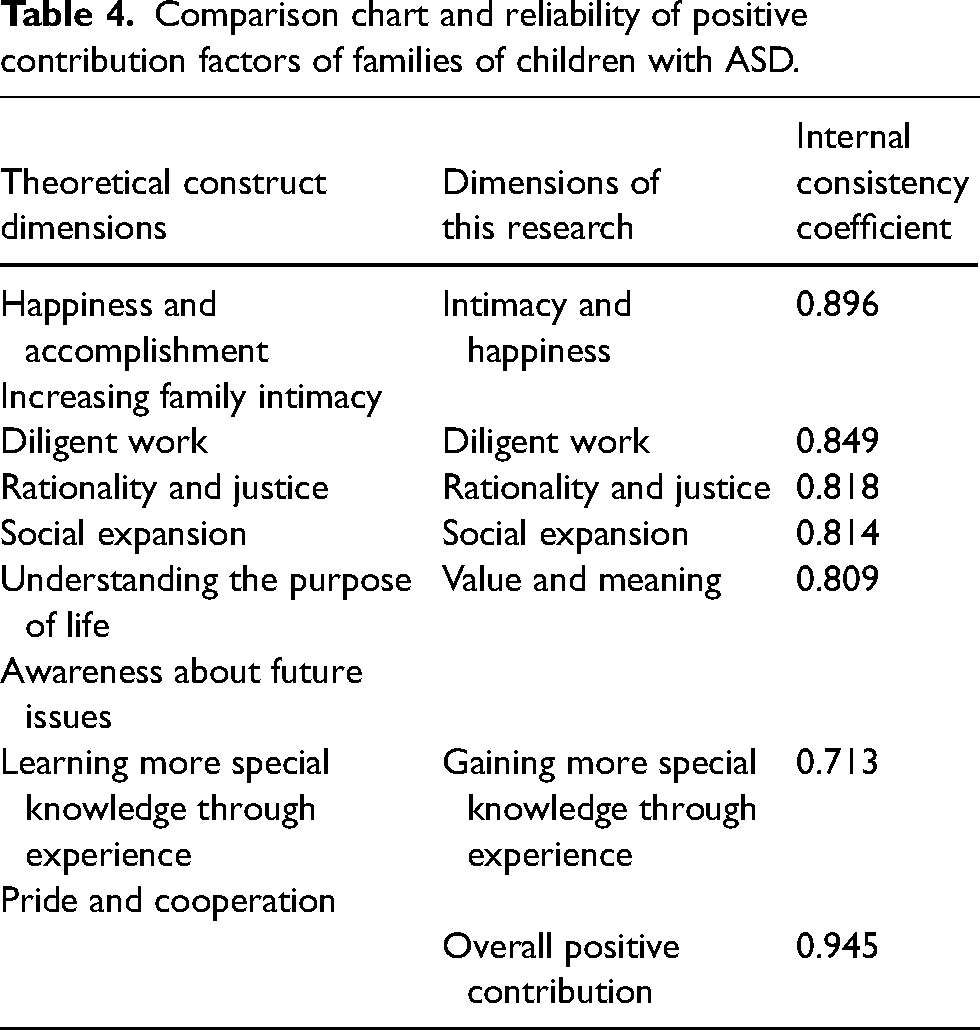
In sum, on the basis of project analysis, exploratory factor analysis was carried out, and the structure of the questionnaire was further adjusted. Thirty items were retained, which constituted the final questionnaire. As a result, the number of dimensions were reduced from 9 to 6 (see Table 4) leaving the following: intimacy and happiness, diligent work, rationality and justice, social expansion, value and meaning, and gaining more special knowledge through experience.
Comparison chart and reliability of positive contribution factors of families of children with ASD.
Reliability and validity of the questionnaire
Reliability analysis
As shown in Table 4, the total Cronbach’s alpha coefficient of this questionnaire was 0.945, which indicates high reliability. The Cronbach’s alpha coefficient of each dimension was between 0.7 and 0.9, indicating that the questionnaire and its dimensions have good reliability.
Validity analysis
This study used Pearson's correlation coefficient to test the relationship between each dimension and the overall positive contribution. It can be seen from Table 5 that the correlation coefficient of each dimension of the questionnaire is between 0.40 and 0.7, which are moderate correlations. The correlation between the dimensions of the questionnaire and the total score of the questionnaire was higher than the correlation between the dimensions, and the correlations between the dimensions were all significant (p < .01). In general, the questionnaire has good structural validity.
Correlation coefficients of various dimensions and total scores of positive contribution to families of children with ASD (N=156).

Note. * indicates a significant correlation at the 0.05 level; ** indicates a significant correlation at the 0.01 level.
As can be seen, the correlations between each dimension and the total scores of positive contributions are all 0.65 or higher and statistically significant. In summary, it can be considered that the questionnaire developed by this study has good reliability and validity, appears to reflect the positive contributions of children with ASD in China, and can be used as an effective evaluation tool for the positive contributions to families of children with ASD.
The overall status of positive contributions to families by children with ASD
Table 5 shows that the overall level of positive contribution to families of children with ASD is at a medium level, and the scores are between uncertain and agreement. The gaining more specific knowledge through experience dimension scored the highest.
Factors associated with positive contributions to families by children with ASD
Monthly household income
To evaluate the relationship between the different positive contributions and household income, the data was analyzed using multiple correlations. As shown in Table 6, significant mean differences were found in the overall positive contribution, intimacy and happiness, and gaining more special knowledge through experience dimensions based on the reported family monthly income. Multiple comparisons found that the scores in the above dimensions for households with a family income of more than RMB 8,000 ($1100) were significantly higher than those of households with a monthly income of less than RMB 4,000 ($550) or between RMB 4,000 ($550) and 8,000 ($1100).
Mean differences between family monthly income for positive contributions (N=156).

Note. *p < .05; **p< .01; ***p< .001.
Children's disorder severity
According to the related standard (China Disabled Persons’ Federation, 1995), the degree of ASD has three levels. Severe ASD (level 1) means that three or more of the five scores are rated at 2 points; moderate ASD (level 2) refers to one or two of the five scores are rated as 2 points; mild ASD (level 3) refers to two or more of the five scores are rated as 1 point. Scores are given on the following five social functioning assessment items: personal self-care ability, family life function performance, care and responsibility for family, occupational ability, and social activity ability (0 points = normal or mildly abnormal; 1 point = functional defect; 2 points = serious functional defect) (China Disabled Persons’ Federation, 1995).
To evaluate the relationship between the different positive contributions and the children's disorder severity, the data was analyzed using multiple correlations. As shown in Table 7, the degree of impairment showed significant differences in the overall positive contribution of children with ASD, intimacy and happiness, rationality and justice, social expansion, and gaining more special knowledge through experience dimensions. After multiple comparisons, it was found that families of children with moderate ASD had significantly higher scores on the above dimensions than families of children with severe ASD.
Mean differences between severity of child's disorder and positive contributions (N=156).

Parents’ employment status
There were only two types of parents’ employment status (namely employed and unemployed), so an independent sample T-test was used for analyzing this data. It can be seen from Table 8 that there were significant mean differences between employed and unemployed parents in terms of the overall positive contribution, intimacy and happiness, value and meaning, gaining more special knowledge through experience, and diligent work dimensions. Working parents’ scores in the above dimensions were significantly higher than those of unemployed parents.
Parents’ employment status mean differences regarding positive contributions of children with ASD (N=156).

Discussion
The structure of positive contributions of children with ASD to their families scale
The results of the factor analysis of the scale used in the current study (see Table 4) revealed some similarities and differences with previous research. First, one dimension found previously (Behr et al. (1992), pride and cooperation, was not found in the factor analysis so that was dropped from the PCS. Some of the positive contribution dimensions were found to be similar in the current study to the theoretical dimensions found in previous research (Behr et al., 1992). These were diligent work, rationality and justice, and social expansion. In previous research, it has been found that social support is a very important factor for the mental well-being of parents who have children with ASD. According to Chen et al. (2020), the perception of having social support played a significant role in improving the depressed mood of parents. On the other hand, other positive contribution dimensions in the current study did not completely match previous theory. The theoretical dimensions happiness and accomplishment and increasing family intimacy were collapsed into the single dimension intimacy and happiness in the current study. Next, similarly, the theoretical dimensions learning more special knowledge through experience and pride and cooperation were merged into the new dimension gaining more special knowledge through experience. Lastly, the understanding the purpose of life and awareness about future issues dimensions from previous research were collapsed into a single dimension—value and meaning—in the current study. This study's variable, value and meaning, might be similar to the meaning in life variable studied by Tsibidaki (2021) who found that, among families with SEN members, high levels of meaning in life helped to reduce mental stress.
The literature (Behr et al., 1992) put forward the dimension of pride and cooperation, which is used to show that the family is proud of the honor the child has obtained and the cooperation with other family members. However, this dimension did not emerge as its own dimension in the current study. During factor analysis, the items were reorganized, and a series of new dimensions were formed. Some of the items on this pride and cooperation dimension were dropped during factor analysis, while others merged with the other dimension learning more special knowledge through experience to become the new dimension gaining more special knowledge through experience. This may be due to the following reasons: (1) Negative knowledge of children: Children with ASD tend to not always meet their parents’ academic expectations (Bush et al., 2017). At the same time, Chinese society does not tend to accept children with ASD (Li & Qi, 2023). Others often dislike or reprimand the behaviors that children with ASD cannot control, such as turning around or touching other people's hair. These cultural influences reinforce the negative views of parents towards their children. (2) Attribution: During the interview, the first author learned that the majority of mothers expressed their own beliefs or the whole family's belief that giving birth to a child with ASD is the mother's fault which is in line with Kanner's previous “refrigerator mother” theory (Harris, 2018). Although subsequent research has hence disproven Kanner's theory showing that the pathogenesis of ASD is more likely to be caused by biological factors rather than maternal factors (Langan, 2011), the mothers still likely experience self-blame and guilt. The current results can be compared to a study conducted by Decroocq et al. (2020) which found that the positive subjective experiences of the parents and the interventions that add to their knowledge of their child's condition improved their mental well-being.
Moreover, the intimacy and happiness dimension in the current study was derived from the happiness and accomplishment and increasing family intimacy dimensions from the PCS based on prior theory (Behr et al., 1992) and the results of the interview portion of the current study. The sense of happiness and accomplishment refers to the happiness and affirmation felt by family members; increase in family intimacy refers to the interdependence and support between family members. Both of these show the relationships and feelings between family members. Exploratory factor analysis showed indeed that intimacy and happiness likely refer to the relationships and feelings between family members. Therefore, both of these theoretical dimensions (happiness and accomplishment and increasing family intimacy) were combined in the single dimension intimacy and happiness in the current study. This shows that Chinese people tend to attach great importance to family relationships. The findings support previous research which place a strong emphasis on the quality of social support received and perceived, especially in the Asian context. In collectivist societies, it is important that parents receive family and communal support to enhance their well-being (Cuzzocrea et al., 2015; Drogomyretska et al., 2020; Hassall et al., 2005). Indeed, social support has been found to strongly contribute to well-being and parental positive perceptions (Drogomyretska et al., 2020; Ren et al., 2020). While the current dimension does seem to be related to social support, directly examining social support was beyond the scope of the current study.
Furthermore, the value and meaning dimension in the current study is derived from the understanding the purpose of life and the awareness about future issues dimensions found in the literature (Behr et al., 1992). Understanding the purpose of life means that family members experience a sense of meaning, direction and satisfaction and raising awareness about future issues means thinking more about the future of the child. Both of them reflect the meaning of life and future planning of family members in regard to the child with ASD, which embodies the valuing of children with ASD. Through exploratory factor analysis, the results show that value and meaning can better refer to the value and meaning children with ASD have for their Chinese families. The reason may be related to Chinese people's current “utilitarian” thinking (Xiaoming, 2017). Most participants believed that their child is valuable and meaningful.
Status of positive contributions to families by children with ASD
This study found that the overall average positive contribution to families by children with ASD is 3.32 out of 5, which is at a medium level, and all dimensions are at a medium-to-high level. The possible reasons are as follows: First, the Chinese government has recently increased support of children with ASD. For example, the “Colorful Dream Action Plan for Rehabilitation and Assistance for Disabled Children” (China Disabled Persons’ Federation, 2011) is a rehabilitation and assistance project for children with ASD from low-income families. Therefore, the material, professional, and economic support from the government, schools, rehabilitation institutions, relatives, and friends seems to have somewhat changed the previously existing negative perceptions of families with children with ASD, relieved the pressure on parents, and promoted the formation of positive contributions to the family. Secondly, the parents of children with ASD who voluntarily participated in this study may have a better positive perception of children with ASD. The results of this research are consistent with Tian et al.'s (2018) conclusions.
Factors associated with positive contributions to families by children with ASD
Family monthly income
This study found that the family's monthly income level was related to the overall positive contribution, intimacy and happiness, and gaining more special knowledge through experience dimensions. The scores in the current sample of households with a household income of more than 8,000 RMB ($1100) on the above dimensions were significantly higher than those of households with a monthly income of less than RMB 4,000 ($550) and between RMB 4,000 ($550) and 8,000 ($1100). The possible reasons are as follows: First, family income reflects differences in family resources (Matthews & Gallo, 2011). Due to the long-term and continuous nature of ASD, it requires the family to bear more related costs than families with children without ASD (Picardi et al., 2018). Therefore, the family's monthly income will likely affect the positive contribution to the family of children with ASD. Secondly, families with higher economic status will likely learn more about relevant information and receive more social support. Therefore, the higher the monthly family income, the more special knowledge and support the parents will likely receive, the closer the family members will be. The current results make sense given the financial burden these families shoulder due to having a child who has ASD (Picardi et al., 2018). Furthermore, parents of special needs children's income levels are significant predictors of state anxiety in parents (Ren et al., 2020). The current results were in line with the previous research done by Ha et al. (2011) which also emphasized the importance of socio-demographic variables such as parental employment and income levels for parental well-being.
Disorder severity
This study found that the degree of impairment showed significant differences in the overall positive contribution to families by children with ASD, intimacy and happiness, rationality and justice, social expansion, and gaining more special knowledge through experience dimensions. The scores of families with moderately disabled children in the above dimensions were significantly higher than those of families with severely disabled children. While previous research also indicated that disorder severity can affect child–parent interactions (Beurkens et al., 2013; Che & Lei, 2013; García-López et al., 2021; Karst & Van Hecke, 2012; Schlebusch et al., 2017), the current findings are different from another study that revealed that behavior problems were not significantly associated with paternal or maternal positive gain (Jones et al., 2014). One possible reason for the current findings might be as follows: the more severe the disorder, the less effective any kind of intervention designed to improve the child's functioning tends to be. Since general improvements are less likely with more severely disabled children, this very likely aggravates the parents’ negative cognitions of their children. Parents of children with ASD tend to experience higher levels of psychological pressure than those of typically developing children (Che & Lei, 2013). At the same time, because one of the core characteristics of ASD is disordered communication—and the more severe the impairment, the worse the communication ability will be which will likely make the parent–child interaction more dysfunctional—which in turn likely reduces the parents’ positive perceptions of the child.
Parental employment
This study found significantly different scores between employed and unemployed parents on the overall positive contribution, intimacy and happiness, value and meaning, gaining more special knowledge through experience, and diligent work dimensions. Working parents had significantly higher scores on these dimensions than unemployed parents. This is similar to previous research (Ha et al., 2011). The possible reasons are as follows: Families with children with ASD often need a family member to give up work and become a full-time caregiver because of the need to support the child. When caring for a child with ASD, because of the children's various problems, the parents may have doubts about their own value and meaningfulness. At the same time, they are likely to have almost no leisure time. The accumulated negative emotions might be suppressed, which can affect the family relationships. Therefore, unemployed parents of children with ASD might have significantly lower positive perceptions of their children with ASD than those who are employed. The above possible explanations for the results of the present study corroborate results of previous research: Positive contributions help reduce parental stress levels and contribute to better coping with daily struggles. Benefit finding has previously been found to positively correlate with parents’ reported positive affect and negatively correlate with their reported negative affect (Lovell et al., 2016).
Research limitations and future research directions
This study's participants were parents of families with children with ASD, but only one parent, either the mother or the father, participated in filling out the questionnaire. Therefore, it is recommended that future research be conducted on the whole family as a unit to collect relevant data on other family members. At the same time, there were a limited number of participants in this study; it is recommended to increase the number of participants. Furthermore, while this study contributes to the multicultural literature by examining a rarely studied population, the results are not necessarily generalizable to other populations. It is recommended that this study be replicated in many other locations in China and other countries.
Clinical implications
The results of the present study might help parents understand their children who have ASD better. The research also might help reduce the long-term stress parents experience in terms of deteriorating physical and mental health, possibly reducing depression and anxiety. The results might also help parents and caregivers of these special needs children to cope better when they experience negative pressure. They might become more knowledgeable, more confident, and more independent; consequently, the research might help change the negative perception parents have of children with ASD. This might enable them to respond positively and hopefully also help them shift from a deficit to a strengths-based perspective. This might lead to building happiness and stronger bonds between family members. The present research might also help psychologists to address the mental health issues of the parents in a more competent manner. Schools might also benefit from the present research by being able to use the new questionnaire to evaluate the positive contributions made to families by children who have ASD.
Summary
A mixed methods study was conducted taking a strengths-based approach to designing a questionnaire that can evaluate the positive contributions of children with ASD to their families. The questionnaire and its dimensions show good reliability and good structural validity. The questionnaire appears to reflect the positive contributions of children with ASD in China and can likely be used as an effective evaluation tool for the positive contributions to families of children with ASD. Research limitations and future directions were touched upon along with clinical implications.
Footnotes
Author contributions
All authors have significantly contributed, read, and approved the attached draft.
Declaration of conflicting interests
The authors declared no potential conflicts of interest with respect to the research, authorship, and/or publication of this article.
Funding
The authors disclosed receipt of the following financial support for the research, authorship, and/or publication of this article: The work was supported by the “Applied Technology Quality Improvement Rehabilitation of Children with Special Needs Scholarship Training Project” of Guizhou University of Engineering Science (JK202106) and Guizhou Provincial Department of Education 2022 Golden Course “Physiology and Pathology of Children with Special Needs.”
Ethical statement
All procedures followed were in accordance with the ethical standards on human experimentation normally followed in China and with the Helsinki Declaration of 1975. The current studies were reviewed and approved by faculty in the College of Education Science, Chongqing Normal University. The human participants provided their informed consent to participate in the study. The completion of these studies was for partial fulfillment of graduation requirements for a master's degree in special education by the first author.
