




Abstract
Background and aims
Although autism spectrum disorder (ASD) has not traditionally been associated with morphosyntactic impairments, some children with ASD manifest significant difficulties in this domain. Sentence Repetition (SRep) tasks are highly reliable tools for detecting morphosyntactic impairment in different languages and across various populations, including children with ASD. This study is among the first to evaluate morphosyntactic abilities of Palestinian-Arabic (PA) speaking children using a PA SRep task.
Methods
A total of 142 PA-speaking children, aged 5-11, participated in the study: 75 children with typical language development (TLD) and 67 children with ASD. The PA SRep task targeted morphosyntactic structures of varying complexity (simple subject-verb-object [SVO] sentences, biclausal sentences, wh-questions, relative clauses). Children’s accuracy scores were assessed across these structures and error patterns encompassing morphosyntactic and pragmatic aspects were analyzed.
Results
Two subgroups of ASD emerged: 43% showed age-appropriate language skills (ASD + NL) pairing up with TLD peers, while 57% showed signs of morphosyntactic impairment (ASD + LI). Children in both groups exhibited a higher frequency of morphosyntactic errors than pragmatic ones. Children with ASD + LI showed difficulties with producing complex morphosyntactic structures, such as relative clauses and object wh-questions. Error analysis revealed that children in the ASD + LI group produced sentence fragments and simplified constructions when complex structures were targeted.
Conclusions
The current study extends the cross-linguistic evidence of the heterogeneity of morphosyntactic profiles in children with ASD to Arabic-speaking children. Error analysis indicates that poor morphosyntax, rather than pragmatics, challenges children's performance on the SRep task.
Implications
Our results emphasize the importance of comprehensive language assessment in children with ASD and underscore the need for tailored intervention plans targeting impaired morphosyntactic structures in some children with ASD.
Introduction
Autism spectrum disorder (ASD) is characterized by impairments in social interactions, social communication, and repetitive and stereotyped behavior patterns (DSM-V; APA, 2013). Children with ASD show a high heterogeneity of language profiles, ranging from minimally verbal to fluent speech. Among those children who attain fluent language skills, two main subgroups have been documented: (a) children with ASD who show age-appropriate morphosyntactic skills (ASD + NL) and (b) children with ASD who show impairment in morphosyntax (ASD + LI). 1 Moreover, children with ASD present impairments in pragmatic aspects of language regardless of their ASD severity, structural language abilities, age and nonverbal IQ (for a detailed review see Schaeffer et al., 2023).
Although there is increasing research interest in the acquisition of linguistic skills in children with and without ASD who speak different spoken Arabic vernaculars, research in this area is still rather limited (but see Abd El-Raziq et al., 2023; Al-Hasan & Marinis, 2021 for Saudi-Arabic; Kissine et al., 2019 for Tunisian-Arabic; Shaalan et al., 2021 for Emirati-Arabic). The current study investigates morphosyntactic skills in Palestinian-Arabic (PA) speaking children with and without ASD, residing in Israel, using a PA Sentence Repetition (SRep) task. SRep tasks have been shown to provide reliable and valuable information regarding children’s morphosyntactic skills (see a seminal paper by Conti-Ramsden et al., 2001), and they demonstrate high sensitivity and specificity for diagnosing language impairments in different languages (for an overview see Rujas et al., 2021), including Arabic (e.g., Al-Hasan & Marinis, 2021; Shaalan, 2010; Taha et al., 2021). Furthermore, SRep has been shown to be effective in detecting subgroups within children diagnosed with ASD (e.g., ASD + NL vs. ASD + LI). In addition, SRep error pattern analysis sheds light on the loci of the morphosyntactic difficulties (for an overview of error patterns across languages see Antonijevic-Elliott & Meir, 2023).
The consistent cross-linguistic gaps in performance on SRep tasks between clinical and nonclinical groups, on the one hand; and the ability of these tasks to target complex morphosyntactic structures difficult to elicit in spontaneous speech, on the other (e.g., Klem et al., 2015; Polišenská et al., 2015; Riches, 2012), make SRep tasks highly valuable in evaluating morphosyntactic skills. The current study uses a PA SRep task to test morphosyntactic impairments in PA-speaking children with ASD and to document the loci of this impairment based on an analysis of errors.
Morphosyntactic skills in children with ASD: Quantitative and qualitative evidence from SRep tasks
When conducting group-level comparisons, previous studies have consistently shown that children with ASD underperform their TLD peers on SRep tasks. This gap has been observed across a wide range of languages and age groups, as detailed in an overview of 14 studies (see the Supplemental materials, S1). The reviewed studies included monolingual and bilingual children with ASD across wide age ranges from early childhood to adolescence (4–18) in different languages, including English, Hebrew, French, Russian, Danish, Dutch, Arabic (e.g., Al-Hasan & Marinis, 2021; Arutiunian et al., 2021; Botting & Conti-Ramsden, 2003; Brynskov et al., 2017; Georgiou & Spanoudis, 2021; Harper-Hill et al., 2013; Loucas et al., 2008; Meir & Novogrodsky, 2020; Riches et al., 2010; Schaeffer, 2016; Silleresi et al., 2018; Sukenik & Friedmann, 2018; Taylor et al., 2014; Whitehouse et al., 2008).
However, previous studies highlight a heterogeneity of morphosyntactic abilities in verbal children with ASD: some children with ASD show morphosyntactic skills similar to their TLD peers (ASD + NL), while others present with morphosyntactic impairments (ASD + LI) (e.g., Durrleman & Delage, 2016; Kjelgaard & Tager-Flusberg, 2001; Meir & Novogrodsky, 2020; Tager-Flusberg, 2006). The existence of morphosyntactic impairment in children with ASD + LI has raised the question of the extent to which their linguistic profile resembles that of children with Developmental Language Disorder (DLD), whose condition encompasses difficulties in language learning, comprehension, and usage without attribution to other factors like hearing impairment, autism, or limited language exposure (Bishop et al., 2017). Children with ASD + LI and children with DLD might show not only quantitative similarities reflected in low scores in SRep but also qualitative similarities as reflected in shared error patterns across the two groups (e.g., Lindgren et al., 2009; Meir & Novogrodsky, 2020; Tager-Flusberg, 2015).
SRep error pattern analysis provides valuable insights into the mechanisms that tax morphosyntactic performance in children (Marinis & Armon-Lotem, 2015). Examining the error patterns of children with ASD + LI revealed that this particular subgroup of autistic children shows considerable difficulty with the acquisition of complex morphosyntactic structures. Yet, it remains unclear whether these difficulties are comparable to those observed in children with TLD or children with DLD. For example, Meir and Novogrodsky (2020) demonstrated that children with ASD + LI, both monolingual and Russian-Hebrew bilingual, aged 4–9, exhibited morphosyntactic impairments that were comparable to those reported in the literature for children with DLD. For instance, children with ASD + LI produced sentence fragments and showed simplification of complex structures, that is, they repeated object wh-questions using simple subject-verb-object (SVO) structures or subject wh-questions. Similarly, Sukenik (2023) revealed that Hebrew-speaking children with ASD, aged 8–18, like children with TLD, aged 8–11, made no pragmatic errors when producing relative clauses in a definition task; they understood the semantic and pragmatic meaning of the target word as well as the task demands. However, children with ASD produced many pronoun errors and fragmented sentences, patterns not seen among children in the TLD group, yet documented in Hebrew-speaking children of younger ages.
Nonetheless, there is some evidence indicating that lower SRep performance in children with ASD is caused by pragmatic errors rather than morphosyntactic ones. For example, Sukenik and Friedmann (2018) compared SRep performance in monolingual Hebrew-speaking children with ASD, children with DLD, and children with TLD, aged 8–18 years. The SRep task targeted simple SVO, verb-subject-object (VSO), sentences with embedding, and sentences with movement: object relative, topicalization (OVS), object wh-question, subject wh-question. The authors reported that Hebrew-speaking children with ASD produced a variety of errors which seemed pragmatic in nature, such as perseveration errors, information addition, and answering a question instead of repeating a question. Conversely, children with DLD primarily exhibited structural errors, such as the production of subject relative clauses instead of object relative clauses. Similarly, Sukenik et al. (2021) reported that children with ASD speaking Hebrew and French produced more pragmatic errors in a question elicitation task designed to assess the production of subject and object wh-questions. These pragmatic error patterns included inappropriate responses, such as hidden object answers, yes/no questions, responses ignoring the event or the participant. Importantly, these error patterns were not observed in children with DLD. Given these contradictory findings, more research investigating the source of difficulties in children with ASD is warranted, focusing on morphosyntactic and pragmatic errors.
Morphosyntactic skills among Arabic-speaking children with typical and atypical language development
The current study was devised to contribute to the literature on the morphosyntactic skills of Arabic-speaking children with and without ASD. The Arabic language has unique features which have the potential to contribute new insights into the manifestations of language impairments in children with ASD as well as their underlying mechanisms. In this section, we focus on these unique features.
Arabic is a typical case of diglossia, where spoken Arabic dialects exist alongside the Modern Standard Arabic variety to serve different and complementary sets of social functions (Ferguson, 1959) and express various pragmatic needs (Albirini, 2015). Modern StandardArabic and spoken Arabic dialects differ structurally across all language domains, including phonology, morphology, syntax, and lexicon (Joubran-Awadie & Shalhoub-Awwad, 2023; Saiegh-Haddad & Henkin-Roitfarb, 2014). This linguistic distance has been shown to impede the acquisition of Modern Standard Arabic lexical, morphological, and literacy skills (Saiegh-Haddad, 2018; Saiegh-Haddad & Schiff, 2016; Schiff & Saiegh-Haddad, 2018) as well as phonologicalmemory and awareness (Saiegh-Haddad, 2003, 2007; Saiegh-Haddad & Ghawi-Dakwar, 2017). For a detailed review, see Saiegh-Haddad (2022).
Spoken Arabic, a hypernym used to refer to all spoken Arabic dialects, is used for everyday speech by all native speakers and is acquired naturally as a mother tongue. In contrast, Modern Standard Arabic is the language of conventional reading/writing and of formal functions, and is the only variety that has a standard written form. As the language of literacy, Modern Standard Arabic is learned primarily at school, initially together with reading instruction and later as the only language of the written text across the curriculum. Modern Standard Arabic skills grow with schooling and with grade-level exposure to the language (Saiegh-Haddad et al., 2020; Schiff & Saiegh-Haddad, 2018), yet this variety never becomes the dominant language of speakers.
Palestinian Arabic (PA, the spoken Arabic variety investigated in the current study), like other varieties of Arabic, is morphologically rich. Almost all content words in Arabic are bi-morphemic and are constructed via the nonlinear concatenation of two derivational morphemes: a consonantal root, which encodes the semantic family of the word (Holes, 2004) or a core meaning, and a templatic word pattern, which denotes grammatical information (e.g., part of speech) as well as the phonological-prosodic structure of the word (Saiegh-Haddad & Henkin-Roitfarb, 2014). Inflectional morphology involves linear affixation (such as number and gender marking) but also nonlinear procedures (such as broken plurals and temporal verbal patterns). Hence, there is no clear ‘division of labor’ between templatic and affixal morphemes with respect to whether their function is inflectional or derivational (Rakhlin et al., 2021). The morphological structure of Arabic also comprises a predominant system of clitics, which are grammatically independent but phonologically dependent on another word or phrase (e.g., /bi-bayti-hi/ ‘in his house’) (Saiegh-Haddad & Henkin-Roitfarb, 2014).
Even though there is a growing interest in the acquisition of morphosyntactic skills in Arabic, a recent scoping review investigating the use of SRep tasks as a measure of language skills in children with typical and atypical development detected only a small number of research studies conducted on the acquisition of Arabic, namely only 6 out of 125 reviewed studies (Rujas et al., 2021). In general, the results from these six studies show lower SRep performance in children with DLD compared to their TLD peers. With respect to linguistic complexity, there is accumulating evidence in support of difficulties with complex sentences, such as sentences with passives, clitic left dislocation, object wh-questions, subject and object relative clauses, sentences with coordination, complements, subordination, and conditionals (Gulf-Arabic: Rakhlin et al., 2021; PA: Taha et al., 2021). For instance, Shaalan (2010) showed that Qatari Arabic-speaking children with DLD, aged 4;10–8;11, scored significantly lower than their age- and language-matched TLD peers when repeating subject relative clauses, implying that subject relative clauses might be challenging for Arabic-speaking children with DLD. In the same way, Saiegh-Haddad et al. (2019) tested PA-speaking children with DLD (aged 5;6–6;6) using a PA-LITMUS SRep task and showed that children with DLD showed reduced performance compared to their peers with TLD on complex structures, such as subject and object wh-questions, subject and object relative clauses. A recent study of SRep in Saudi-Arabic speaking children with ASD (ASD + NL and ASD + LI) showed different performance patterns in the ASD subgroups compared to their TLD peers, revealing particular difficulties with subject and object relative clauses in the ASD + LI subgroup (Al-Hassan & Marinis, 2021).
A qualitative analysis of the errors in SRep tasks sheds light on the underlying mechanisms of the difficulties observed. Taha et al. (2021), who tested PA-speaking children aged 4;0–6;10 with and without DLD, showed that object wh-question words and object relative pronouns were frequently omitted in children with DLD, resulting in a simpler morphosyntactic structure. Furthermore, omission errors were also observed in function words, such as the coordinator /w/ ‘and’, the conditional /iza/ ‘if’, the demonstrative /ha:d/ ‘this’, the relative pronoun /illi:/ ‘that’, and the wh-words such as /mi:n/ ‘who’ and /ani/u/ ‘which’. It should be noted that such omissions cannot be solely related to the lack of phonological salience of these function words, as some of these functional elements are bi-syllabic like /illi:/ ‘that’ while others contain long vowels like /mi:n/ ‘who’. Overall, both groups made similar morphosyntactic errors, primarily characterized by the omission and substitutions of grammatical affixes, as well as the omission of function words.
The current study
The current study was devised to investigate morphosyntactic skills in PA-speaking children with and without ASD. For this purpose, a PA SRep which included various morphosyntactic structures was administered to all children. Four research questions were addressed as follows.
Method
Participants
A total of 146 PA-speaking children with ASD and TLD, aged 5–11 years, were initially recruited for the study. Children resided in six towns and cities from the same region (namely Muθallaθ ‘Triangle’ area in Israel) and were raised in monolingual Arabic-speaking families. They all attended PA-speaking kindergartens and schools in which the language of instruction is only Arabic. In these schools, Hebrew is introduced as an additional language only in the third grade. 2 No child came from mixed Arab-Jewish cities, and therefore no child was exposed to Hebrew in the immediate environment. The final sample included 142 children (ASD and TLD), with four children being excluded (3 with ASD and 1 with TLD) due to technical reasons. All children in the sample had normal hearing and no neurological difficulties.
Demographic information was obtained through a parental questionnaire. For children with TLD, the questionnaire encompassed details such as age, the number of siblings in the family, birth order, socioeconomic status determined by the mother's level of education, and any history of diagnosed developmental disorders (e.g., LI, ASD, hearing impairment, and/or attention deficit hyperactivity disorder) or previous speech-language therapy. For children with ASD, the parental questionnaire delved further into medical history information, including the age of diagnosis, details about the evaluations conducted, ongoing treatments, and the type of educational placement (special education or mainstream). Additionally, the questionnaire inquired about parents’ intervention plans, such as behavioral plans and parental guidance. We also assessed children’s nonverbal IQ using the Raven's Colored Progressive Matrices (Raven, 1998) in order to obtain a better indication of cognitive abilities of children with and without ASD. Table 1 presents the demographic data for the participants per group.
Background information of the participants per group (TLD vs. ASD).

Note. ADOS-2 = Autism Diagnostic Observation Schedule; ASD = autism spectrum disorder; M = mean; Min=minimum; Max=maximum; n.a.=not applicable; SD = standard deviations; SES=socioeconomic status; TLD = typically developing children.
Independent t-tests were administered to compare the two groups (TLD vs. ASD) on the background variables, corrected values of degree of freedom (df) were applied when the normality assumption was violated as per Shapiro-Wilk test of normality. The results showed that the two groups (TLD vs. ASD) did not differ significantly in age. There were significant group differences in nonverbal IQ, with TLD children scoring higher. Similarly, there were significant group differences in the socioeconomic status (SES) as measured by the mother’s education in years, with TLD children coming from homes with a higher SES compared to their ASD peers (see Table 1).
PA-LITMUS SRep task
A PA-LITMUS SRep task (Saiegh-Haddad et al., 2019) was developed following the conventions of the LITMUS-SRep task (Marinis & Armon-Lotem, 2015). The SRep task was administered in PA, the vernacular spoken by the children in the sample. It included 36 sentences targeting several morphosyntactic structures of varying length (3–7 words) and complexity. It included complex structures reported to be difficult for children with DLD and ASD: relative clauses and wh-questions in children with DLD (e.g, Friedmann & Novogrodsky, 2004; Friedmann & Novogrodsky, 2011; Stavrakaki, 2006, Taha et al., 2021) and with ASD (Al-Hasan & Marinis, 2021; Durrleman & Delage, 2016; Meir & Novogrodsky, 2020). Sentences were grouped into seven structures: simple SVO sentences, simple SVO sentence with negation, biclausal sentences (coordination, temporal, and conditional), subject/object wh-questions, and subject/object relative clauses (see Table 2).
Examples of stimuli used in the SRep task per structure (for the entire task, see Supplemental materials, S2).

Note. In Arabic, the “l” of the definite article (il) undergoes assimilation (i.e., not pronounced) when it precedes certain letters called Sun Letters. This assimilation leads to the doubling of the sun letter, marked by a /shaddah/. An illustration of this phenomenon is seen in the word /bi
Coding method
First, each child’s response was coded based on five categories: target, morphosyntactic error, pragmatic error, dual morphosyntactic and pragmatic errors, and no response (see Table 3). Morphosyntactic errors comprised any response that included a change in the targeted structure. We noted pragmatic errors following a study by Sukenik and Friedmann (2018), wherein a repeated sentence included pronoun reversal, answering questions, asking questions, associations/unrelated, and adding information. Dual errors of both morphosyntactic and pragmatic nature were also noted (see examples in Table 3). Children were not penalized for lexical substitutions (e.g., uncle/man, soup/food, cooked/made).
The coding scheme of the sentence repetition performance.
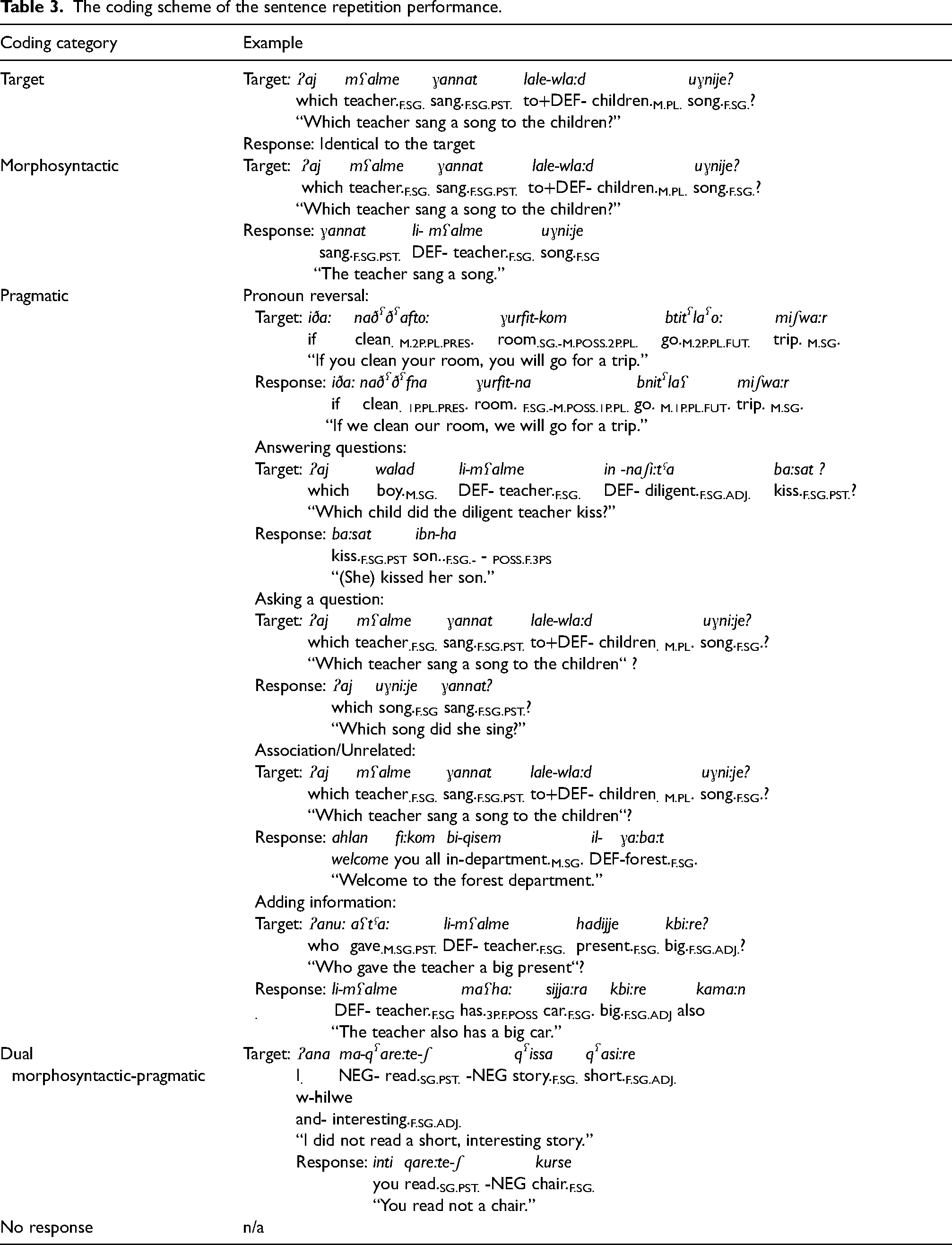
Second, to better understand the characteristics of morphosyntactic difficulties in children with ASD, we focused on their performance across the targeted morphosyntactic structures, and applied a detailed error analysis to sentences which received a score of zero for morphosyntactic accuracy. The error pattern analysis was based on the coding schemes applied in previous studies (e.g., Meir et al., 2016; Meir & Novogrodsky, 2020; Taha et al., 2021; see Table 4). A detailed inventory of error patterns can be retrieved from S3, in the Supplemental materials.
Morphosyntactic error patterns for each targeted structure.

Procedure
Written/electronic parental consent was obtained for all children prior to participating in the study. Each parent/caregiver completed a short background questionnaire. Additionally, children were requested to provide oral and written assent by circling a smiley face or by drawing their unique “signature” or writing their name. Testing was conducted in PA and was performed by the first author, who is a qualified SLP and native speaker of the PA vernacular spoken by the children in the current study. Each participant was tested individually, in a quiet room, in the preschool/school/language therapy clinic, or at a child's home. The current study is part of a larger project aiming to document the linguistic and cognitive abilities of PA-speaking children with ASD. Children participated in 1–4 sessions of 20–80 min, depending on their level of cooperation.
The data were collected under COVID-19 restrictions during 2020–2021. Therefore, some children were tested using traditional face-to-face assessment, while others were tested via Zoom (see Table 1). Children's responses were audio-recorded for later offline transcription and coding. The study was approved by Bar-Ilan University and the Chief Scientist of the Israel Ministry of Education. Raw data and materials for this study can be retrieved from https://osf.io/brksv/?view_only = 5ce5655420c54a7f85604282d5cdcc24.
Results
Before reporting our findings, it is noteworthy that the SRep task showed a compliance rate of 100% in both groups. All 142 participants (67 with ASD and 75 with TLD) understood the instructions and completed the task. Data analysis was carried out using R software (Version 4.0.3; R Core Team, 2020). A detailed description of the data analysis is provided when presenting the results for each question.
Quantitative performance on the SRep task in children with and without ASD
Our first research question focused on the quantitative morphosyntactic performance of children with and without ASD on the SRep task. Figure 1 illustrates the target performance in the TLD and ASD groups across different ages. Children with TLD showed a near-ceiling performance, whereas the performance of children with ASD varied greatly, and this variation was present across all ages.
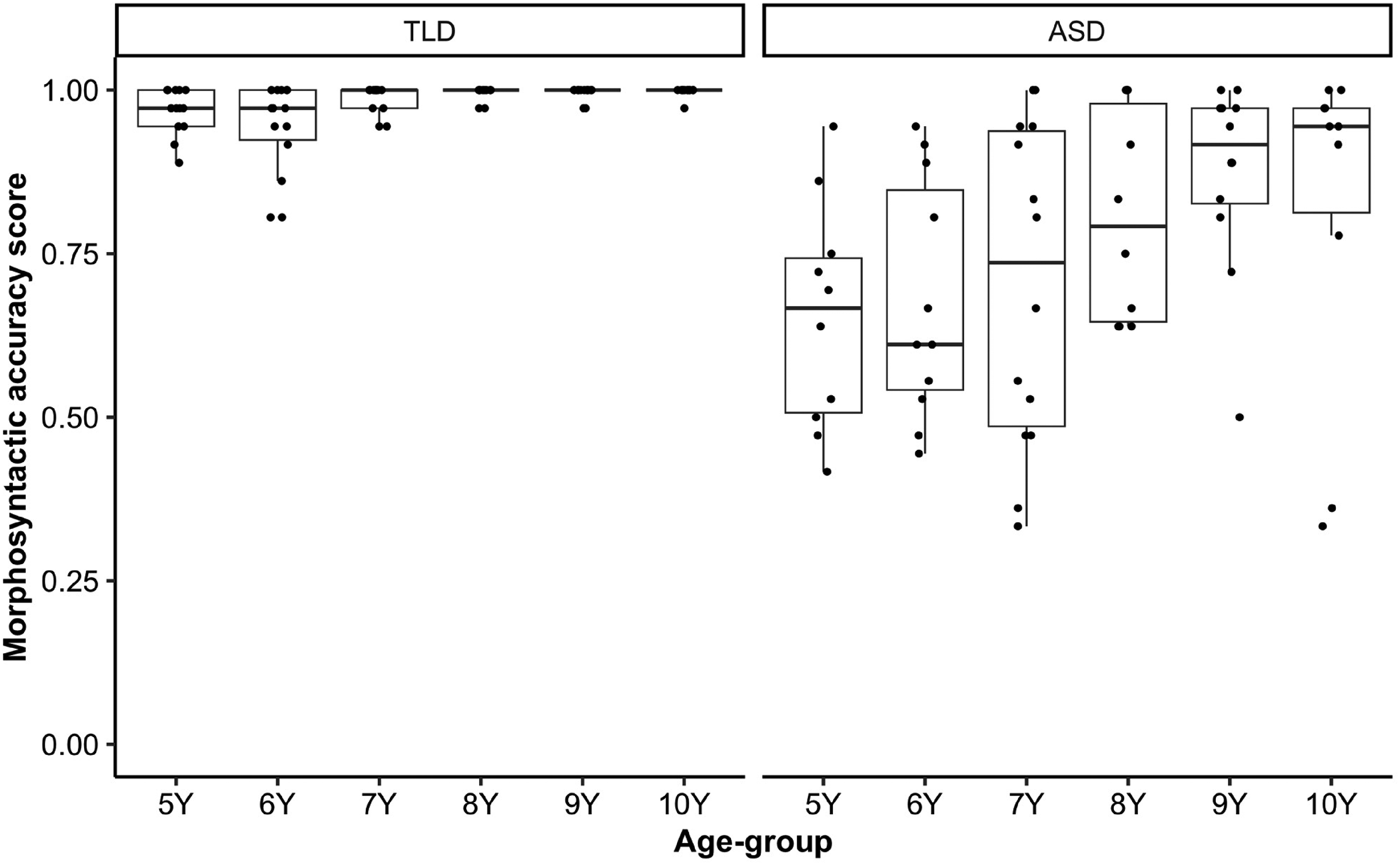
Target performance on the SRep task by clinical-group (TLD vs. ASD) and age-group. ASD=autism spectrum disorder; TLD = typically developing children.
Subsequently, we aimed to identify the children with ASD who had age-appropriate morphosyntax and those who showed impaired morphosyntax. For this purpose, we conducted a one-way analysis of variance (ANOVA) with age group (6 levels: 5YR, 6YR, 7YR, 8YR, 9R, 10YR) as the independent variable to evaluate the performance in the TLD group and to generate tentative norms. The results indicated a significant effect of age group in the TLD performance (F (5, 2694) = 11.58, p < .001, η2 = 0.02). Pairwise comparisons showed no significant differences between the 5YR and 6YR groups (p > .05), nor between the older age groups, such as 7YR, 8YR, 9YR, and 10YR (p > .05). However, differences were detected between 5YR and 9YR and 5YR and 10YR (p < .05), as well as between 6YR and all the older age groups (p < .001). For detailed results see S5, in the Supplemental materials.
Therefore, separate cut-off points were generated for the younger and older groups (0.69 and 0.90, correspondingly) based on the TLD mean score (see S4 in the Supplemental materials for SRep means [SD] by age across the groups). Next, following previous studies (e.g., Manenti et al., 2023; Tomblin et al., 1996), we applied the empirically generated SRep cut-off points to the performance of the ASD group using a cut-off 3 of −1.25 standard deviations (SD) below the age-appropriate TLD mean score, although it should be noted that in the current TLD sample, the scores were skewed toward ceiling (the younger group: skewness = −1.57; the older group: skewness = −2.25).
Table 5 summarizes the performance of the ASD group (see Table 5). Two subgroups emerged within the ASD group: (a) children with ASD who performed within the TLD range, reflecting age-appropriate morphosyntactic skills (43%, ASD + NL) and (b) children with ASD who showed signs of being at-risk for impaired morphosyntactic skills (57%, ASD + LI). Our subsequent analyses referred to three groups of children: TLD, ASD + NL and ASD + LI (see S6, in the Supplemental materials, for background information comparisons for ASD subgroups).
Morphosyntactic performance in the ASD group (n = 67), divided into ASD + NL vs. ASD + LI, based on the cut-off points analysis.

Note. ASD = autism spectrum disorder; ASD + LI = ASD + at-risk for impaired morphosyntax; ASD + NL = ASD + age-appropriate morphosyntax; SD = standard deviations; TLD = typically developing children.
The distribution of morphosyntactic versus pragmatic errors in children with TLD and ASD (ASD + NL, ASD + LI)
To answer our second research question, we evaluated whether the nontarget performance in children across the three groups (TLD, ASD + NL, and ASD + LI) was related to morphosyntax or pragmatics. Table 6 illustrates the distribution of target and nontarget responses in the SRep task across the three groups. A Chi-square test was conducted to investigate differences in the distribution of nontarget responses considering four error type (morphosyntactic, pragmatic, dual morphosyntactic and pragmatic, and no response) across the three groups (TLD, ASD + NL, and ASD + LI). No differences were found (X2 (6) = 1, p = .08). Children in all the groups tended to produce a greater frequency of morphosyntactic errors. Pragmatic errors constituted only a very small portion of the errors leading to nontarget performance in the SRep task.
The distribution of nontarget responses in children with TLD, ASD + NL, and ASD + LI.
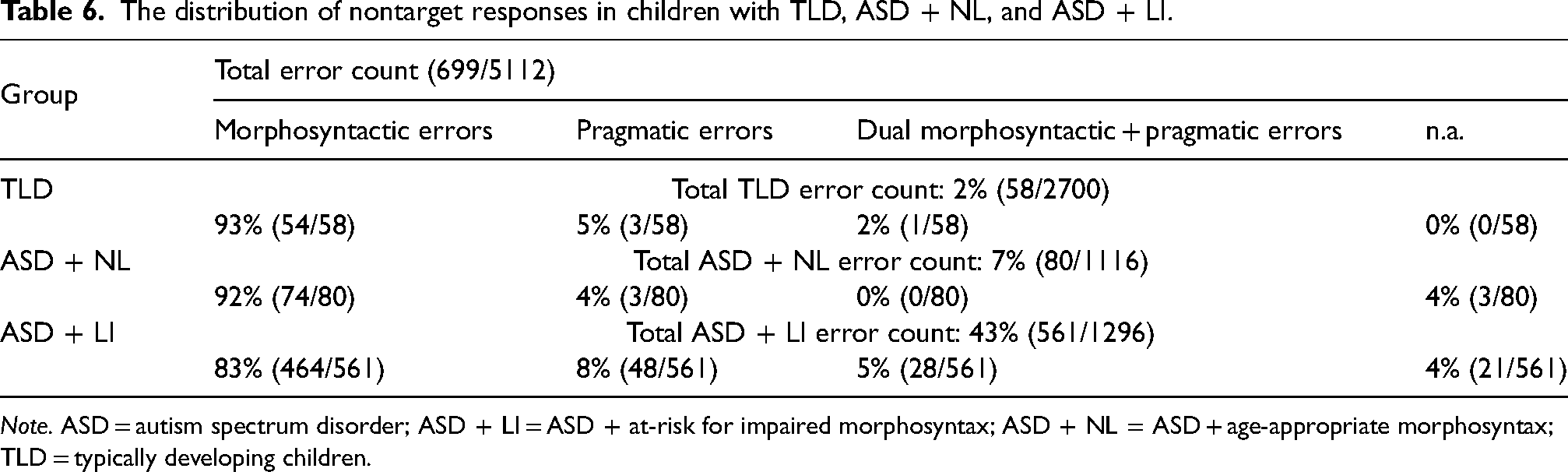
Note. ASD = autism spectrum disorder; ASD + LI = ASD + at-risk for impaired morphosyntax; ASD + NL = ASD + age-appropriate morphosyntax; TLD = typically developing children.
Effects of morphosyntactic complexity on SRep performance in children with TLD and ASD (ASD + NL and ASD + LI)
To answer our third research question concerning the effect of morphosyntactic complexity on the SRep performance, we implemented a stepwise-step-up procedure for building the mixed-effects logistic regression model. First, we generated a baseline model, and then we fitted a baseline mixed-effect model, that is, a ‘null model’ with crossed random intercept for participant-code only. Next, we compared the models, if the latter model had a significantly better fit to the data, the inclusion of random effects structures was warranted, and we loaded item-number, and testing-mode (face-to-face vs. teleassessment). The final model included random effects only if they improved the models’ fit.
Fixed variables were contrast-coded and entered as predictors. In our first step, we included background variables, such as: age, SES, nonverbal IQ. Then, we included sentence length to control for the differences in length across the stimuli. Next, we added the interaction between the clinical-group (3 levels: TLD, ASD + NL, and ASD + LI) and structure [7 levels: SVO, negation, biclausal sentences, subject which/who-question (subj-wh), object which/who-question (obj-wh), subject relative clause (subj-rel), and object relative clause (obj-rel) as an index of morphosyntactic complexity]. Fitted models were compared in terms of Akaike Information Criterion (AIC) and Bayes Information Criterion (BIC), with reduced AIC and BIC values indicating a better model fit. This was supplemented by Likelihood ratio tests conducted to determine if the inclusion of a predictor significantly improved the model fit. We report results from the highest-level model that converged (Barr et al., 2013). We also present results from pairwise post hoc comparisons with Tukey-adjusted significance levels.
The final model for SRep (see Table 7) included age, clinical-group and the sentence length (in words), and clinical-group*structure as fixed effects. In terms of background variables, the results showed an effect of age, meaning that as children grew older they became more accurate in producing the target morphosyntactic structure. No effects of SES and nonverbal IQ were observed. A main effect of clinical-group was observed: children with ASD + NL and TLD tended to repeat sentences more accurately than their peers with ASD + LI (p < .001). With respect to linguistic factors, there was an effect of length and an effect of morphosyntactic structure on the accuracy of producing the target structure (p = .01).
The final model for the SRep performance.
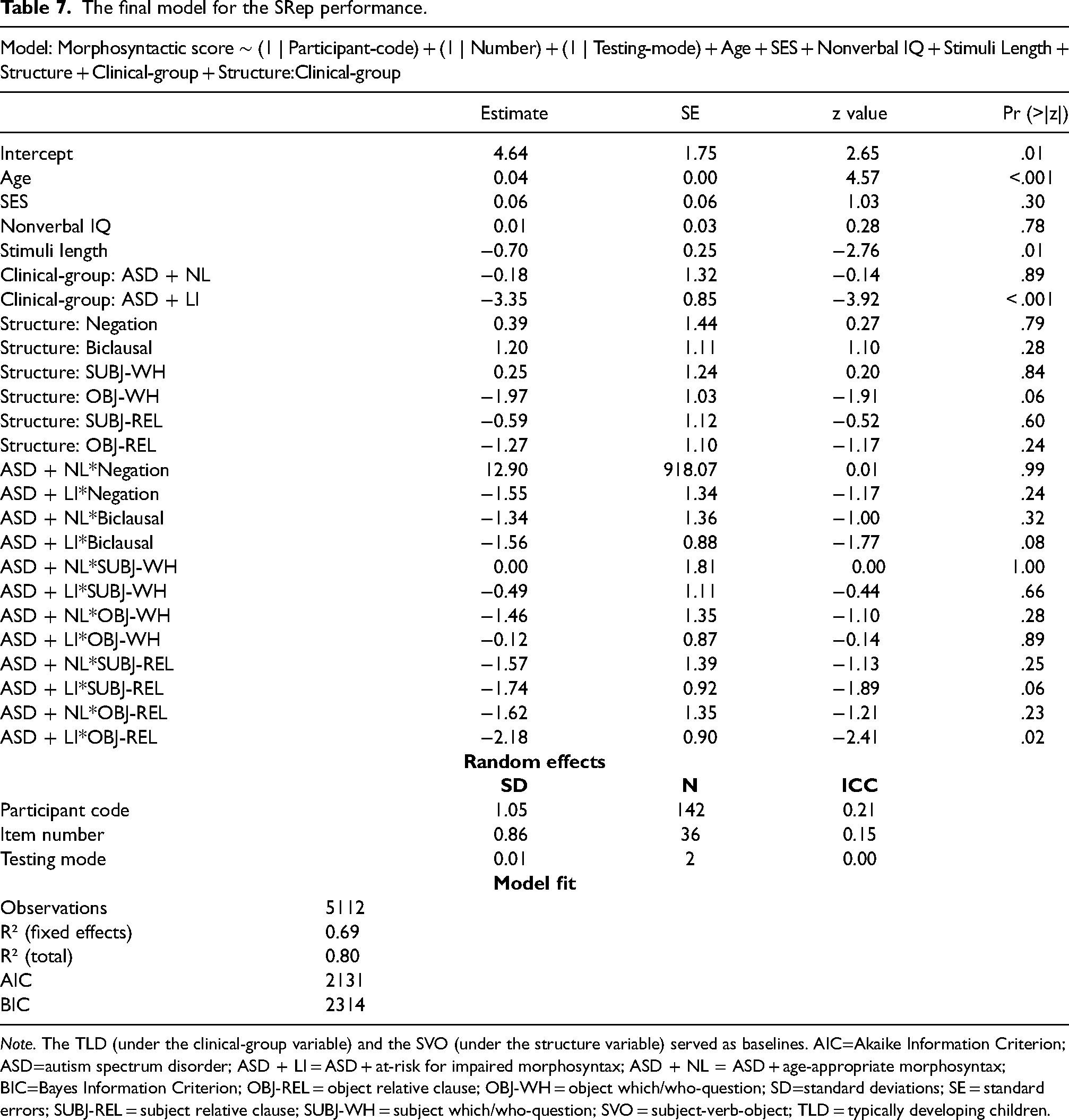
Note. The TLD (under the clinical-group variable) and the SVO (under the structure variable) served as baselines. AIC=Akaike Information Criterion; ASD=autism spectrum disorder; ASD + LI = ASD + at-risk for impaired morphosyntax; ASD + NL = ASD + age-appropriate morphosyntax; BIC=Bayes Information Criterion; OBJ-REL = object relative clause; OBJ-WH = object which/who-question; SD=standard deviations; SE = standard errors; SUBJ-REL = subject relative clause; SUBJ-WH = subject which/who-question; SVO = subject-verb-object; TLD = typically developing children.
The clinical-group*structure interaction is visualized in Figure 2. The follow-up analysis on the clinical-group*structure interaction (see Supplemental materials S7 for all the pairwise comparisons) showed significant differences between ASD + LI and TLD in all the morphosyntactic structures (p < .001). Differences between ASD + NL and TLD groups were observed only in relative object clauses (B = 1.80, SE = 0.46, Z = 3.88, p = .02). Moreover, children with ASD + NL showed significantly higher scores compared to ASD + LI in all the structures except for SVO (B = 3.16, SE = 1.12, Z = 2.82, p = .36), negation (B = 17.62, SE = 908.46, Z = 0.02, p = 1.00), subject wh-question (B = 3.65, SE = 1.10, Z = 3.31, p = .11). These results indicate a more considerable heterogeneity within the ASD group. Even children with ASD + NL are more likely to be challenged by complex morphosyntactic structure, particularly difficulties in object relative clause sentences, while children with ASD + LI show broader morphosyntactic difficulties, including challenges in simpler structures.

Predicted probabilities of the morphosyntactic score per structure across the clinical-groups.
Morphosyntactic error patterns in children with TLD and ASD (ASD + NL, ASD + LI)
To address our fourth research questions, we conducted a detailed morphosyntactic error pattern analysis in the three groups to evaluate differences in the underlying mechanisms of morphosyntactic difficulties across the groups.
Table 8 lists only error patterns for which significant differences across the three groups emerged (for the complete results comparing error pattern distributions see S8 in the Supplemental materials). A nonparametric Kruskal–Wallis was performed to explore group differences (TLD vs. ASD + NL vs. ASD + LI) in the distribution of error patterns per the targeted structure. The Dunn test was conducted as a follow up on the significant differences.
Morphosyntactic error pattern distribution across the clinical-groups.

Note. ASD=autism spectrum disorder; ASD + LI = ASD + at-risk for impaired morphosyntax; ASD + NL = ASD + age-appropriate morphosyntax; OBJ-REL = object relative clause; OBJ-WH = object which/who-question; SUBJ-REL = subject relative clause; SUBJ-WH = subject which/who-question; SVO = subject-verb-object; TLD = typically developing children.
As presented in Table 8 children with ASD + LI produced significantly more sentence fragments (i.e., single-word sentences, sentences with subject/verb omissions) and simple sentences than children with ASD + NL and TLD. Children with ASD + LI simplified the targeted complex structures and produced sentence fragments when subject wh-questions (see 1(a)) and object relative clauses (see 2(a)) were targeted, while children with ASD + NL and TLD produced object wh-question (1(b)) and subject relative clauses (2(b)), respectively.

Discussion
To the best of our knowledge, the current study is the first to provide a comprehensive description of morphosyntactic skills of PA-speaking children with ASD compared to children with TLD using SRep. Studies in this area within the context of the Arabic language are scarce, and our goal was to contribute to the cross-linguistic literature on the loci of morphosyntactic difficulties in Arabic-speaking children with ASD.
Morphosyntactic impairments in children with ASD
The first question we addressed pertained to the variability of morphosyntactic abilities within the ASD group; specifically, we aimed to distinguish two subgroups of children with ASD: those with ASD and normal morphosyntactic development (ASD + NL) and those with ASD and morphosyntactic impairment (ASD + LI). Consistent with prior research, our study identified these two distinct morphosyntactic profiles within the group of children with ASD, with 43% of our ASD child population qualifying as ASD + NL and 57% as ASD + LI (Al-Hasan & Marinis, 2021; Kjelgaard & Tager-Flusberg, 2001; Meir & Novogrodsky, 2020; Riches et al., 2010; Schaeffer et al., 2023; Silleresi et al., 2018). This finding implies that structural language impairment is not an inherent characteristic of the ASD language phenotype. Some children with ASD can develop age-appropriate morphosyntactic skills, as evident by the performance levels of the ASD + NL group (43%), whose performance was similar to children with TLD. At the same time, morphosyntactic impairment remains a significant challenge for a considerable portion of children with ASD + LI (57%), with their performance levels significantly below those of children with TLD.
It is noteworthy that nonverbal IQ is reported to be linked to morphosyntactic difficulties in children with ASD. For example, Kjelgaard and Tager-Flusberg (2001) tested children who varied in levels of nonverbal IQ and reported that the majority of them (76%) performed in the language-impaired range. In the same vein, Arutiunian et al. (2021) reported a particularly high incidence of impaired and/or borderline syntactic impairment (92%) in a sample of 71 Russian-speaking children with ASD (aged 7–11) with varying levels of nonverbal IQ. In our study, 57% of children with ASD showed morphosyntactic impairments, yet the results showed that nonverbal IQ did not predict the SRep performance. Thus, the findings imply that morphosyntactic impairment in children with ASD is not limited to those with lower-than-average nonverbal IQ (e.g., Silleresi et al., 2018), yet it might be present in children with ASD who show even age-appropriate nonverbal IQ as well.
The distribution of morphosyntactic versus pragmatic errors in children with TLD and ASD (ASD + NL and ASD + LI)
The second research question investigated the potential sources of nontarget performance on the SRep task in children across three groups (TLD, ASD + NL, and ASD + LI), namely whether nontarget performance is morphosyntactic or pragmatic in nature. Our results showed that all groups exhibited similar distributions of error types, with no significant group differences in the prevalence of morphosyntactic versus pragmatic errors. Specifically, all groups (TLD, ASD + NL, and ASD + LI) showed a higher prevalence of morphosyntactic errors (93%, 92%, and 83%, respectively) compared to pragmatic errors (5%, 4%, and 8%, respectively). On the one hand, these findings align with previous research suggesting that SRep tasks primarily assess morphosyntactic skills across clinical populations, including children with ASD (for an overview, see Rujas et al., 2021). On the other hand, these findings contrast with those reported by Sukenik and Friedmann (2018) indicating a predominantly pragmatic nature of errors on SRep tasks. Our results imply that although children with ASD + LI tend to produce a larger number of errors compared to the other groups, similar underlying mechanisms seem to be taxing their SRep performance.
Morphosyntactic complexity on SRep performance in children with TLD compared to ASD (ASD + NL and ASD + LI)
The third research question we addressed in this study relates to the role of morphosyntactic complexity on SRep performance among PA-speaking children across the three groups (TLD, ASD + NL, and ASD + LI). We investigated this question by comparing performance in repetition of sentences that varied in morphosyntactic complexity while controlling for background factors including age, SES, nonverbal IQ, and for stimuli length. To date, the effect of morphosyntactic complexity has been widely documented in children with DLD, whose core phenotype appears to be related to difficulties with structural language skills (e.g., Rujas et al., 2021; Schwob et al., 2021). Yet, little is known about the role of linguistic factors in morphosyntactic difficulties in children with ASD, and much less in Arabic-speaking children with ASD. The results of the study reiterate previous findings demonstrating a robust effect of complexity on sentence repetition. The unique morphosyntactic features of the Arabic language enabled us to test a variety of complex constructions such as wh-questions and relative clauses some of which depend on function words appended to stem words as clitics, such as /o/ ‘it’ in /xajjatˤat-o/ ‘knitted it’. The results showed that, in line with other languages, PA-speaking children with TLD, as well as their peers with ASD with age-appropriate morphosyntactic skills (ASD + NL) seem to have mastered all targeted structures, including complex morphosyntactic structures, by the age of 5–6, with performance reaching near-ceiling levels from age 6 onward, as reported in earlier research (Berman, 1985; Friedmann & Novogrodsky, 2011; Omar, 1973).
Although children with ASD + NL performed comparably to their peers with TLD across most structures, they faced challenges with sentences that included object relative clauses. This finding is noteworthy as it suggests that even children with ASD + NL may have difficulties with complex sentences (Sukenik, 2023). Given the influence of age uncovered in our study, it is plausible that young children in the ASD + NL group face difficulties when attempting to produce object relative clauses, as demonstrated in Friedmann & Novogrodsky (2011), showing that children with TLD aged 9–10 tend to produce relative clauses at higher rates compared to younger children.
Our results show that PA-speaking children with ASD + LI across different age-groups show a pattern of aggravated morphosyntactic difficulty replicating previous research (Kjelgaard & Tager-Flusberg, 2001; Silleresi et al., 2018; Sukenik & Friedmann, 2018). Specifically, object relatives and object wh-questions were found to be particularly challenging, compared to subject relatives and subject wh-questions, replicating the results of previous cross-linguistic research (DLD: Meir et al., 2016; Taha et al., 2021; ASD + LI: Meir & Novogrodsky, 2020; Riches et al., 2010; Sukenik & Friedmann, 2018). It is interesting to note that Arabic-speaking children with ASD + LI showed problems not only with object relative clauses but also with subject relative clauses in accordance with previous evidence from children with ASD and DLD speaking other varieties of spoken Arabic (ASD: Al-Hassan & Marinis, 2021; DLD: Shaalan, 2010). These findings are not surprising as the production and comprehension of these morphosyntactic structures involve syntactic movement (Friedmann & Novogrodsky, 2008), along with sentences with clausal embedding (e.g., sentences with conditionals) in various languages (Al-Hasan & Marinis, 2021; Riches et al., 2010; Silleresi et al., 2018).
The obtained results for the SRep task showed that children with ASD + LI seem to present profound difficulties with morphosyntax, particularly with complex structures, in line with previous studies conducted in other languages. Overall, the results demonstrate that the SRep task offers a fine-grain picture of morphosyntactic abilities of ASD, allowing us to subgroup them based on their morphosyntactic abilities, distinguishing between those with age-appropriate morphosyntactic abilities and those with additional morphosyntactic impairment.
Morphosyntactic error patterns in children with TLD and ASD (ASD + LI, ASD + NL)
In addition to quantitative analysis, the current study employed error analysis in order to uncover the underlying mechanisms of the morphosyntactic impairments observed in PA-speaking children with and without ASD.
As discussed in the previous subsection, the ASD + LI group exhibited a significantly higher proportion of errors compared to the ASD + NL and TLD groups across the targeted complex structures. The error analysis showed that the ASD + LI group frequently produced sentence fragments and simple sentences instead of complex sentences. This observation aligns with earlier reports in other languages, such as Hebrew (ASD: Meir & Novogrodsky, 2020; Sukenik, 2023), Russian (DLD: Meir et al., 2016), and also with earlier reports for Arabic (DLD: Taha et al., 2021), which indicated that this error type of fragmented structure was exclusively produced in the PA-speaking children sample with DLD but not in children with TLD. Fragmented structure might point to impaired working memory; however, it might also suggest impaired morphosyntactic representation (see debate in Marshall (2020) commenting on the effects of short-term and working memory in the comprehension and production of complex syntax).
Moreover, a tendency to replace object relative structures with simpler sentences was observed among children with ASD + LI, mostly as a result of function word omission. This error pattern was previously reported for PA-speaking children with DLD (Taha et al., 2021). Furthermore, object clitic pronouns, object wh-questions, and object relative pronouns were likely to be omitted, which resulted in simpler morphosyntactic structures. These omissions cannot be solely related to the phonological salience of these function words, as the relative pronoun /illi:/ ‘that’ is bi-syllabic and contains a long vowel. So, the repetition of structures involving syntactic movement as fragmented structures, and simplifying structures as well, indicates poor morphosyntactic representations of these structures in long-term memory of children with ASD + LI (Frizelle et al., 2017). In contrast, children with TLD and ASD + NL tended to produce subject relative clauses instead of object relative clauses, which is consistent with former evidence across different clinical-groups, suggesting that ASD + NL children resemble their TLD peers in making typical errors and in acquiring complex morphosyntactic structures (DLD: Sukenik & Friedmann, 2018; ASD: Meir & Novogrodsky, 2020; Sukenik & Friedmann, 2018; hearing impairment: Friedmann & Szterman, 2011).
To sum up, the current study extends existing evidence from different languages consistently showing that children with ASD + LI exhibit profound difficulties in morphosyntax, and a particular challenge with complex morphosyntactic structures such as wh-questions and relative clauses (Al-Hasan & Marinis 2021; Riches et al., 2010; Silleresi et al., 2018).
Limitations and future research
Although the study has provided important insights into morphosyntactic skills of Arabic-speaking children, the study has some limitations that should be acknowledged. First, for the findings of this study to be applicable to a broader population, a larger sample size is required to effectively generalize and validate our findings. In the current study, SRep scores in the TLD group exhibited a notable skewness toward the ceiling, which might have affected the derived cut-off points. Therefore, caution is warranted when drawing conclusions, as the distribution of the TLD group may not align with the assumptions of standard assessments. Exploring alternative approaches or adjusting existing measures to better accommodate non-normally distributed populations is needed. Future research is needed to develop PA SRep norms for children of different ages. Second, a large-scale population of children with ASD, speakers of other dialects of Arabic living in other regions, is necessary to confirm the external validity of the findings reported in this study and to assess the suitability of the SRep task for identifying morphosyntactic impairment in children with ASD. Moreover, in order to provide more conclusive insights into the overlap between children with DLD and children with ASD who have additional morphosyntactic impairment (i.e., ASD + LI), cross-disorder studies in Arabic are required, including performance comparison and analysis of error patterns. Finally, cross-syndrome comparisons including children with DLD will help generate appropriate cut-off points and evaluate diagnostic accuracy (sensitivity and specificity) of the PA SRep task used in the current study.
Conclusions and clinical implications
The current study is among the first to evaluate morphosyntactic skills of PA-speaking children using a PA SRep task. From a theoretical perspective, this study contributes to the scarce literature on morphosyntactic impairment in Arabic-speaking children with ASD, confirming morphosyntactic differences within the ASD group and distinguishing between children with and without additional morphosyntactic impairment (ASD + LI, ASD + NL).
From a clinical perspective, our study holds important implications for identifying morphosyntactic impairments in PA-speaking children with ASD and for gaining insights into the potential mechanisms that might influence morphosyntactic skills in ASD. First, clinicians should be aware that a child with ASD might demonstrate morphosyntactic impairments regardless his/her level of nonverbal IQ and ASD severity. Second, the large proportion of children with ASD + LI who struggle with producing various morphosyntactic structures, as indicated by their lower scores and error patterns, underscores the importance of incorporating fine-grained analyses of language skills into ASD assessment batteries. Consequently, this approach will lead to the development of tailored treatment plans that effectively target the impaired aspects of morphosyntactic skills in addition to addressing other linguistic and social-communicative difficulties.
Supplemental Material
sj-doc-1-dli-10.1177_23969415241234649 - Supplemental material for Morphosyntactic skills in Arabic-speaking children with autism spectrum disorder: Evidence from error patterns in the sentence repetition task
Supplemental material, sj-doc-1-dli-10.1177_23969415241234649 for Morphosyntactic skills in Arabic-speaking children with autism spectrum disorder: Evidence from error patterns in the sentence repetition task by Muna Abd El-Raziq, Natalia Meir and Elinor Saiegh-Haddad in Autism & Developmental Language Impairments
Footnotes
Acknowledgements
The authors are sincerely grateful to the children and their parents for their invaluable participation in this study. They also extend their appreciation to the teachers and other educators whose crucial assistance greatly aided in recruiting the participants.
Declaration of conflicting interests
The authors declared no potential conflicts of interest with respect to the research, authorship, and/or publication of this article.
Funding
The authors disclosed receipt of the following financial support for the research, authorship, and/or publication of this article: This work was supported by the The National Institute for Psychobiology in Israel (NIPI). Exploring the use of dual language assessment for bilingual children with ASD: Implications for diagnosis and treatment.

Supplemental material
Supplemental material for this article is available online.
Notes
References
Supplementary Material
Please find the following supplemental material available below.
For Open Access articles published under a Creative Commons License, all supplemental material carries the same license as the article it is associated with.
For non-Open Access articles published, all supplemental material carries a non-exclusive license, and permission requests for re-use of supplemental material or any part of supplemental material shall be sent directly to the copyright owner as specified in the copyright notice associated with the article.
