




Abstract
Background & aims
Youth with developmental language disorder (DLD) are at risk of experiencing challenges during their job search. It is thus crucial to promote efficient job search behaviors in terms of effort, intensity, and self-regulation. Based on self-determination theory (SDT), we verified the role of autonomous and controlled motivations in enhancing these behaviors.
Methods
Study 1 included 37 young adults with DLD who have finished school, and Study 2 included 52 youth with DLD transitioning from school to work. They completed a questionnaire examining their job search behaviors and their motivation toward their job search.
Results
Autonomous motivation positively predicted job search effort, intensity, and self-regulation. Small to moderate relations were observed in Study 1, and moderate to strong ones in Study 2. Controlled motivation was unrelated to the three behaviors.
Conclusions
In line with SDT, autonomous motivation is an important foundation for positive job search behaviors among youth with DLD.
Implications
Supporting the development of autonomous motivation is thus encouraged in transition services for this population.
As leaders across the world are committed to a more inclusive future (Biden, 2021; European Union, 2018; Treasury Board of Canada Secretariat, 2020), there is a more pressing need than ever to foster equal employment opportunities for people with disabilities. Although the USA and Canada put forward laws that guarantee equal job opportunities for people with disabilities, accessing employment has been a long-enduring challenge for this population, who is consistently at risk of discrimination (Tompa et al., 2020). This study focuses on the job search process of young people with developmental language disorder (DLD) (McGregor, 2020; Norbury et al., 2016) during their school-to-work transition where additional barriers can be faced (Fundación ONCE & ILO Global Business and Disability Network, 2019; OECD, 2011; Tompa et al., 2020).
Individuals with DLD have persistent language difficulties regarding expression or comprehension that significantly influence their everyday functioning. Although these difficulties do not originate from a biomedical condition (e.g., autism spectrum disorder, intellectual disability; Bishop et al., 2017), they affect various language dimensions such as syntax, semantics, or pragmatics. Students with DLD thus experience trouble in learning to read and write that may limit their academic progress. As evidenced in a recent systematic review (Dubois et al., 2020), although young adults with DLD reach employment rates and report levels of job satisfaction that are similar to those of their peers without DLD, transitioning to the workforce may be difficult. Indeed, at age 19, they have twice the chance to be NEET (not in education, employment or training) compared to their peers without DLD (Conti-Ramsden & Durkin, 2012). They also report longer periods of unemployment, with a mean length of unemployment of 48 months, compared to 10.2 months for their peers without DLD (Conti-Ramsden et al., 2018). Challenges also occur when they reach the labor market. More precisely, maintaining their job can be difficult (Whitehouse et al., 2009), and they occupy jobs that are less skilled and more often part-time (Conti-Ramsden et al., 2018; Johnson et al., 2010).
Job search process
Although the job search process is an important phase of the school-to-work transition, we know very little about it for youth with DLD. It is only recently that Conti-Ramsden et al. (2018) examined the job search of youth with DLD (N = 84; 67% men – 33% women; mean age of 24.4 years) compared to their peers without DLD (N = 88; 56% men – 44% women; mean age of 24.1 years). It appears that youth with DLD search for a job differently than their peers without DLD, and that they evaluate their experience as more challenging. For example, they report using a CV less frequently (83% versus 94%), as well as attending less an assessment center (14% versus 36%) and giving less telephone interviews (28% versus 45%). Interviews and attending an assessment center are perceived as being more difficult. Considering these findings, authors underline the importance of preparing youth with DLD for job applications. This finding obtained in a UK sample also seems relevant in Canada, where youth with communication disabilities, aged between 15 and 24 years old, report having difficulty accessing job information and getting an interview (Lindsay, 2011). Job search thus appears as a major challenge for youth with DLD.
Job search can be conceptualized as a “purposive, volitional pattern of action that begins with the identification and commitment to pursuing an employment goal. The employment goal, in turn, activates search behavior designed to bring about the goal (Kanfer et al., 2001, p.838).” In this study, we thus focus on the use of efficient job search behaviors, an important predictor of successfully finding a job (Kanfer et al., 2001). Indeed, during their job search process, job seekers perform various activities aimed toward accessing employment. Job search behaviors are a part of it, and they are positively associated to job search outcomes such as employment status, job search duration, and number of job offers (Kanfer et al., 2001). To help define and distinguish these behaviors, they can be divided into two dimensions: 1) effort and intensity, and 2) content and direction (Van Hoye, 2014). For the first dimension, which corresponds to the quantitative component of the job search, effort refers to the amount of energy and time devoted to the job search in general whereas intensity refers to the frequency with which job seekers engage in different job search activities, such as sending CVs or engaging in networking, during a given period. Both aspects relate significantly and positively to employment, as evidenced in a meta-analysis by Kanfer et al. (2001). The second dimension, namely content and direction, take into account that, aside from how much effort and intensity are invested in the job search, not all job seekers use the same methods and outcomes may vary according to these. It thus refers to the job search quality, notably using self-regulation activities (Turban et al., 2009). Self-regulation activities relate to goal pursuit, such as setting a goal, defining a plan, and monitoring progress in the job search process. Like effort and intensity, they are also associated with positive outcomes such as the number of resumes submitted and first interviews, as well as reemployment (Koen et al., 2016; Turban et al., 2009). Effectively supporting job seekers thus implies supporting both the quantitative (effort and intensity) and the qualitative (self-regulation) components of their job search (Van Hoye, 2014).
Self-determination theory
Considering the significant employment outcomes associated to job search behaviors, it is important to consider what the antecedents are to help better support youth with DLD. In Kanfer et al. meta-analysis (2001), authors underline that examining the dynamic nature of the job search is essential to advance the field. As such, exploring the role of motivation appears as a promising avenue considering that job search is a self-regulated process, during which many difficult moments and challenges can be experienced by job seekers (Van Hooft et al., 2013; Wanberg et al., 2012).
A central theory in the study of motivation is self-determination theory (SDT). An important line of research focuses on SDT as a framework to understand job search behaviors. SDT focuses on what drives people's behavior toward the actualization of their potential (Ryan & Deci, 2017). For this natural tendency to occur, three basic psychological needs must be satisfied, the needs for competence (the feeling of being effective at a task), relatedness (having positive relationships with significant others), and autonomy (experiencing choices in initiation, maintenance, and regulation of behaviors). When these basic psychological needs are satisfied, people display autonomous motivation when engaging in an activity where they do so because they enjoy, value, or give importance to it. Indeed, autonomous motivation encompasses intrinsic motivation (engage in an activity for the enjoyment and pleasure associated to it), integrated regulation (engage in an activity because it is coherent with people's values, needs, and interests), and identified regulation (engage in an activity because it is important to do it). However, when these basic psychological needs are frustrated, they experience controlled motivation, meaning that their actions are controlled by inner or outer forces (guilt, rewards). This type of motivation includes introjected (engage in an activity to avoid guilt or to feel proud) and external regulations (engage in an activity to receive a reward or to avoid punishment). While autonomous motivation is associated with positive outcomes (performance, persistence, well-being), controlled motivation is associated with negative ones like ill-being (Howard et al., 2021).
The relevance of SDT to study DLD and job search is supported by some empirical work. Regarding DLD, a recent study by Haerens et al. (2021) indicates that when speech-language pathologists support the autonomy need of clients with communication disorders, among which some have language disorders, greater autonomous motivation toward treatment is reported by the clients. In the job search domain, a cross-sectional study with 285 graduating secondary school students from technical and vocational classes suggests that autonomous motivation is associated to students’ intentions to engage in a job search after their high school (Soenens & Vansteenkiste, 2005). Indeed, based on previous correlational research, motivation appears as an important antecedent of job search behaviors. First, autonomous motivation predicts a diversity of positive job search behaviors. It is associated with the job search intensity and self-regulation activities of unemployed adults (Koen et al., 2016; N = 172, 54% men – 46% women, mean age of 39.3 years). Similar results were obtained with a sample of 149 university students transitioning to the job market (44% male – 56% female), in which autonomous motivation positively predicts self-regulation (da Motta Veiga & Gabriel, 2016). Also, in a sample of 254 beneficiaries of a welfare employment program (39% male – 61% female), autonomous motivation is associated with the job search intensity (Vansteenkiste et al., 2004, 2005). In contrast, previous results indicate that controlled motivation negatively predicts the use of self-regulation (da Motta Veiga & Gabriel, 2016). As expected by SDT, positive associations are thus reported between autonomous motivation and the effective job search behaviors in terms of quantity and quality, while negative associations are observed between controlled motivation and the quality of the job search.
While the importance of motivations and job search behaviors has been demonstrated in various samples, there is a dearth of knowledge in this domain when it comes to youth with disabilities in general, including youth with DLD. Considering that supporting the job search process and enhancing job-seeking skills are recommended practices in the disability field (Timmons et al., 2010), and that the importance of supporting youth with DLD during this crucial phase of the school-to-work transition has been underlined in previous research (Conti-Ramsden et al., 2018), it is essential that we document how these job search behaviors can be fostered through motivation as conceptualized in SDT. Indeed, examining how motivation can support volitional actions such as the job search process has been evidenced as a promising, yet underexplored, research avenue for youth with disabilities (Shogren et al., 2017, 2019).
The present study
We conducted two studies to examine the association between job search motivation and job search behaviors. We examined the two following research questions: (1) Does job search autonomous motivation predict the job search behaviors of effort, intensity, and self-regulation? and (2) Does job search controlled motivation predict the job search behaviors of effort, intensity, and self-regulation? In the first study, we recruited a small sample of young adults with DLD who were no longer engaged in education to examine the job search behaviors they had adopted at the end of their studies. To strengthen the conclusions of the first study, in the second one, we aimed to recruit a larger sample and thus focused on schools, where it is easier to reach youth with DLD. We recruited students with DLD who were finishing their studies and looked more specifically at their intentions to engage in each job search behavior after the end of their studies. We controlled for gender and education based on previous research with young adults with DLD (e.g., Conti-Ramsden et al. (2018) and Johnson et al. (2010) match participants from DLD and control groups on age and gender) and job search research (e.g., age associated to job search motivation in Koen et al., 2016; gender associated to job search in Soenens & Vansteenkiste, 2005). In both studies, based on SDT and on previous results obtained with different samples, we had two hypotheses: (1) job search autonomous motivation would be positively associated to the job search effort, intensity, and self-regulation, and (2) job search controlled motivation would be negatively associated to these behaviors.
Study 1
Method
Sample and procedure
In Quebec (Canada), young adults with DLD rarely receive services in public facilities once they leave school system, which makes it harder to reach them. Nevertheless, our sample size is similar to that of previous cross-sectional studies (e.g., N = 21 in Poll et al., 2015; N = 39 in McGregor et al., 2017). We recruited 37 young adults with DLD (aged 19-33, M = 25.19) who had finished their studies in the previous five years, with most of the sample having completed their studies less than three years before. This age range aligns with the conceptualization of young adulthood in Quebec (Nanhou & Desrosiers, 2019). In the sample, 46% percent were females, 78% Caucasian, and 62% had completed post-secondary studies. Many participants self-reported one or more co-occurring disorders, the most frequent being attention deficit hyperactivity disorder (ADHD) (N = 11) and learning disorder (N = 11). We recruited participants through various organizations and services related to DLD across the province between November 2017 and November 2019. Young adults who were interested in participating in the study contacted the first author, a certified speech-language pathologist. Although the DLD diagnosis had already been verified by the collaborating organizations for program eligibility, the speech-language pathologist confirmed it with a short questionnaire addressing their history of language and school services (i.e., the year of diagnosis, professionals who confirmed the diagnosis, exact label of the diagnosis, and description of speech and language pathology services received in the past). This professional also validated that participants had no history of intellectual disability, autism spectrum disorder, cerebral palsy syndrome, or hearing impairment.
Because various organizations were involved in the recruitment, the project received ethical approval from eight different research ethics committees. The research ethics committee's approval from the authors’ university was first obtained for recruitment through DLD organizations. Additional specific approvals were, however, necessary to recruit participants in the health system and in colleges’ disability services.
A questionnaire was specifically developed for this study. It documented demographic variables and included various validated scales related to motivation and job search. The participants answered the questionnaire online or, if they requested it, on the phone with the first author who read the questions aloud (seven participants chose to do so). To validate that the questionnaire was easily understood by the participants, we pretested it with eight adolescents with DLD, aged between 16 and 18 years old. Slight changes were made after this pretest to make the questionnaire clearer and more accessible to youth with DLD, notably by adding examples and clarifying some words and formulations.
Measures
Job Search Motivations
We used the French version of The Career Decision-Making Autonomy Scale (Guay, 2005), which measures external (i.e., because somebody else wants me to do it or because I would get something from somebody if I do it – rewards, praise, approval), introjected (i.e., because I would feel guilty and anxious if I do not perform this activity), and identified (i.e., because I believe that this activity is important) regulations, and intrinsic motivation (i.e., because I liked it and I had pleasure doing it) toward activities related to career decision-making. It has previously been validated with young adults and the internal consistency, as indicated by the Cronbach alpha, was good (α between .91 and .95; Guay, 2005).
In this study, we slightly adapted the initial version. Instead of measuring eight activities related to career decision-making with the four items measuring each type of motivation (32 items in total), we applied the four motivation items to six frequent job search methods the participants might have used in their job search at the end of their studies (Van Hoye & Saks, 2008): looking at job ads, visiting job sites, networking, contacting agencies, contacting employers, and submitting job applications (e.g., Why did you look at job ads?). Participants did not necessarily answer all 24 items; they only rated the four motivation items associated to a job search method if they indicated that they had used it at the end of their studies. Participants answered on a 5-point Likert-scale, ranging from 1 (not agree at all) to 5 (completely agree). We computed one score for controlled motivation by averaging the 12 items measuring external and introjected regulations (α = .89 in Study 1) and one for autonomous motivation by averaging the 12 items measuring identified regulation and intrinsic motivation (α = .93 in Study 1). Each score was calculated when participants had answered at least four of the 12 items.
Job Search Behaviors
We measured three different variables for job search behaviors: job search effort, intensity, and self-regulation. All questionnaires were translated into French by a certified translator, and then translated again into English to validate the French items. Mean scores were calculated for each behavior if participants had answered at least half of the items.
Job search effort was assessed with a 4-item questionnaire (e.g., gave best effort to find a new job) developed by Blau (1993, α between.74 and.76) and used in other studies (e.g., Saks, 2006; α = .91). Participants answered on a 5-point Likert scale as in the original scale, but we used the same wording as in the motivation questionnaire of this study to facilitate participants’ understanding. The internal consistency was also adequate in our study (α = .88).
Job search intensity was assessed with a 17-item questionnaire developed by Van Hoye and Saks (2008). The scale has six factors corresponding to the six job search methods used in the motivation questionnaire (α between .64 and .92 in Van Hoye & Saks, 2008). Based on previous research measuring this variable (Vansteenkiste et al., 2004, 2005), participants had to indicate how frequently they used different job search methods in the first three months of their job search (e.g., looked at job ads in newspapers or journals, looked for job postings on the internet, asked people you know about possible job leads) on a 5-point Likert scale ranging from 1 (Never) to 5 (Very often – 10 times or more). Because of the small sample, the six factors were combined in a single mean score. The internal consistency remained excellent in our study (total α = .90).
Job search self-regulation was measured with a 6-item questionnaire developed by Turban et al. (2009, α = .82). As for the job search intensity, participants had to indicate how frequently they engaged in each activity (e.g., Set personal goals guiding job search activities) during the first three months of their job search on the same 5-point Likert scale. Internal consistency was also adequate in our study (α = .88).
Statistical analyses
A two-tailed statistical significance level of p = .05 was used, but coefficients above .20, which indicate a small to moderate size effect, were also interpreted due to the small sample. This choice aligns with the latest recommendations regarding what is known as new statistics (Cumming & Calin-Jageman, 2017) or the statistics reform (Kline, 2013). The same analyses were used twice, first to examine the predictive role of autonomous motivation (research question 1) and then of controlled motivation (research question 2). We ran three series of regression, namely one for each job search behavior. Each addressed the predictive role of participants’ job search motivation at the end of their studies on the job search behaviors they intended to use. The regressions were run twice in Mplus (version 8.2; Muthén & Muthén, 1998–2017), once without imputation and once using multiple imputation to consider missing data (Cheema, 2014). With this method, multiple data sets are generated based on Bayesian analysis and the set of possible values is used to replace missing values (Rubin, 1987; Schafer, 1997). In this study, twenty imputed files were generated. Missing rates varied between 0% and 8.11%. The robust maximum likelihood (MLR) estimator was selected because some variables were not normally distributed.
Results
Means, standard deviations, and correlations are available in Table 1. Participants’ mean level of autonomous motivation toward their job search was slightly higher than the reported mean level of controlled motivation. Even though none of the correlations between motivations and job strategies reached significance, many coefficients were above.20. It was the case for all correlations between autonomous motivation and job search behaviors. In addition, correlations between both types of motivations and the job search behaviors were in the expected direction. Autonomous motivation was positively correlated with job search behaviors while controlled motivation was negatively correlated, although the correlations were small.
Means,n standard deviations, and correlations of regression variables in study 1.

Categories include 1 = male; 2 = female.
Categories include 1 = no post-secondary studies; 2 = post-secondary studies.
* p <.05; ** p <.01.
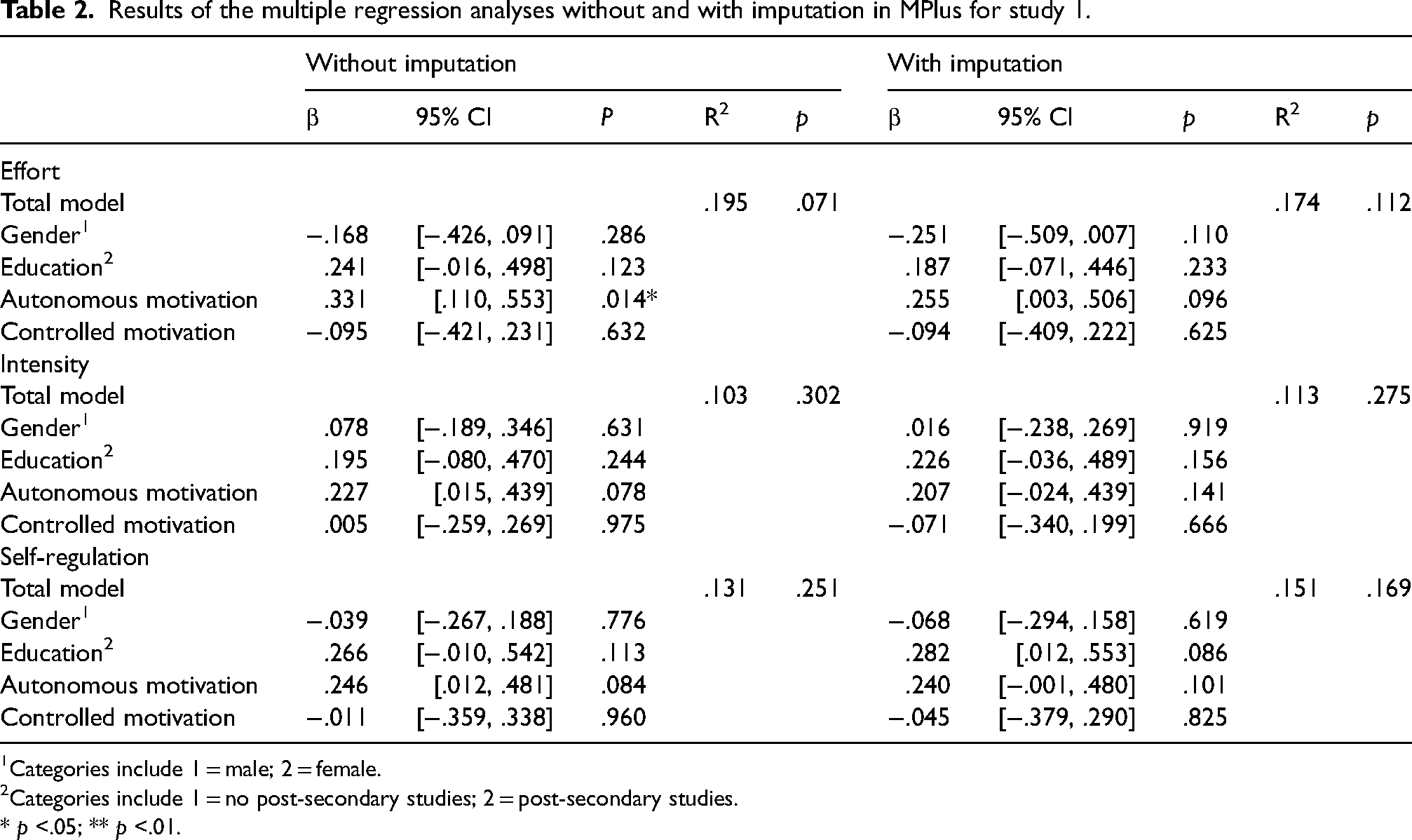
Results of the regression models without (N between 32 and 34) and with imputation in MPlus are displayed in Table 2 (first and third column). Because they evidence similar results, we only interpret the imputed results. Many positive coefficients over .20 were obtained for autonomous motivation. More precisely, autonomous motivation had a small predictive role for intensity and self-regulation, and a small to moderate predictive role regarding the display of effort during a job search. In other words, youth who reported being more autonomously motivated toward their job search engaged in their job search with more effort and intensity, and higher self-regulation. Participants with post-secondary studies also reported using these behaviors more (small to moderate effect) than participants that did not have this level of education. Controlled motivation was unrelated to all job search strategies. Finally, females reported engaging fewer efforts than men in their job search (small to moderate effect).
Results of the multiple regression analyses without and with imputation in MPlus for study 1.
Categories include 1 = male; 2 = female.
Categories include 1 = no post-secondary studies; 2 = post-secondary studies.
* p <.05; ** p <.01.
Study 2
Method
Sample and procedure
A total of 52 French-speaking students, aged between 15 and 21 years (M = 17.77), participated in this study. Because DLD remains relatively unknown and is a hidden disability (McGregor, 2020), recruitment remains an important challenge and this sample size is considered rather significant with this population. In the sample, 41% were female and 89% were Caucasian. They were all in a work-study program for students who experience severe learning challenges, the Work-Oriented Training Path (WOTP). This path is part of the Quebec Education Program for secondary students (Ministère de l’Éducation, du Loisir et du Sport, 2008), and it is designed for students who, at age 15, experience severe learning challenges. It is divided into two programs, the Prework Training (PT) and the Training for a Semiskilled Trade (TST). The PT, which lasts three years, is for students who have not achieved the objectives of elementary school in French and Mathematics. As for the TST, which lasts one year, it is for students who have achieved the objectives of elementary school in French and Mathematics, but not those of Secondary Cycle one despite their age. In this sample, 66% were in the PT program and 33% were in the TST program. All participants were at the end of their program and were about to engage in a job search process.
We used a specific procedure to validate the DLD diagnosis of each participant. At least one of the following conditions had to be met. First, because participants consented to share their Individualized Education Program (IEP), the speech-language pathologist verified if there was a mention of DLD in this document. Second, in the IEP, she verified if participants were identified by the administrative code attributed to students with severe DLD in the Quebec school system. Third, students who self-reported a DLD in their questionnaire were contacted by the speech-language pathologist, who confirmed their diagnosis with the same questions as in Study 1. About half of the participants (49%) self-reported one or more disorders other than DLD, namely learning disorder (N = 18), dyslexia (N = 8), and ADHD (N = 7).
Data was collected in classrooms in May and June 2017. Teachers presented the research to their class using a video produced by the first author and they read the consent form aloud. Students who wished to participate could then sign the consent form. Electronic versions of the questionnaire were made available if necessary (e.g., reading difficulties) for the use of text-to-speech devices.
Measures
Job Search Motivations and Behaviors
We used the same scales as is Study 1, with the difference that participants had to answer according to their current perceptions regarding their upcoming job search at the end of their studies and the behaviors they intended to use. The internal consistency was adequate in Study 2 for controlled (α = .94) and autonomous motivation (α = .92). It was also adequate for job search effort (α = .76), intensity (total α = .91), and self-regulation (α = .91). For job search intensity and self-regulation, participants were asked to indicate how frequently they intended to engage in each activity for the first three months of their future job search.
Statistical analyses
We computed the same analyses as in Study 1. Missing rates varied between 7.69% and 25.00%.
Results
Regression analyses
Means, standard deviations, and correlations are available in Table 3. Similarly to what was observed in Study 1, autonomous motivation mean scores were higher than those of controlled motivation. Regarding correlations, as expected, autonomous motivation correlated positively and significantly with the intention to display effort and intensity, and to use self-regulation activities. Small to moderate positive correlations were also obtained between controlled motivation and the intention to display intensity and adopt self-regulation activities.
Means, standard deviations, and correlations of regression variables in study 2.

Categories include 1 = male; 2 = female.
Categories include 1 = Prework Training program; 2 = Training for a Semiskilled Trade program.
* p <.05; ** p <.01.
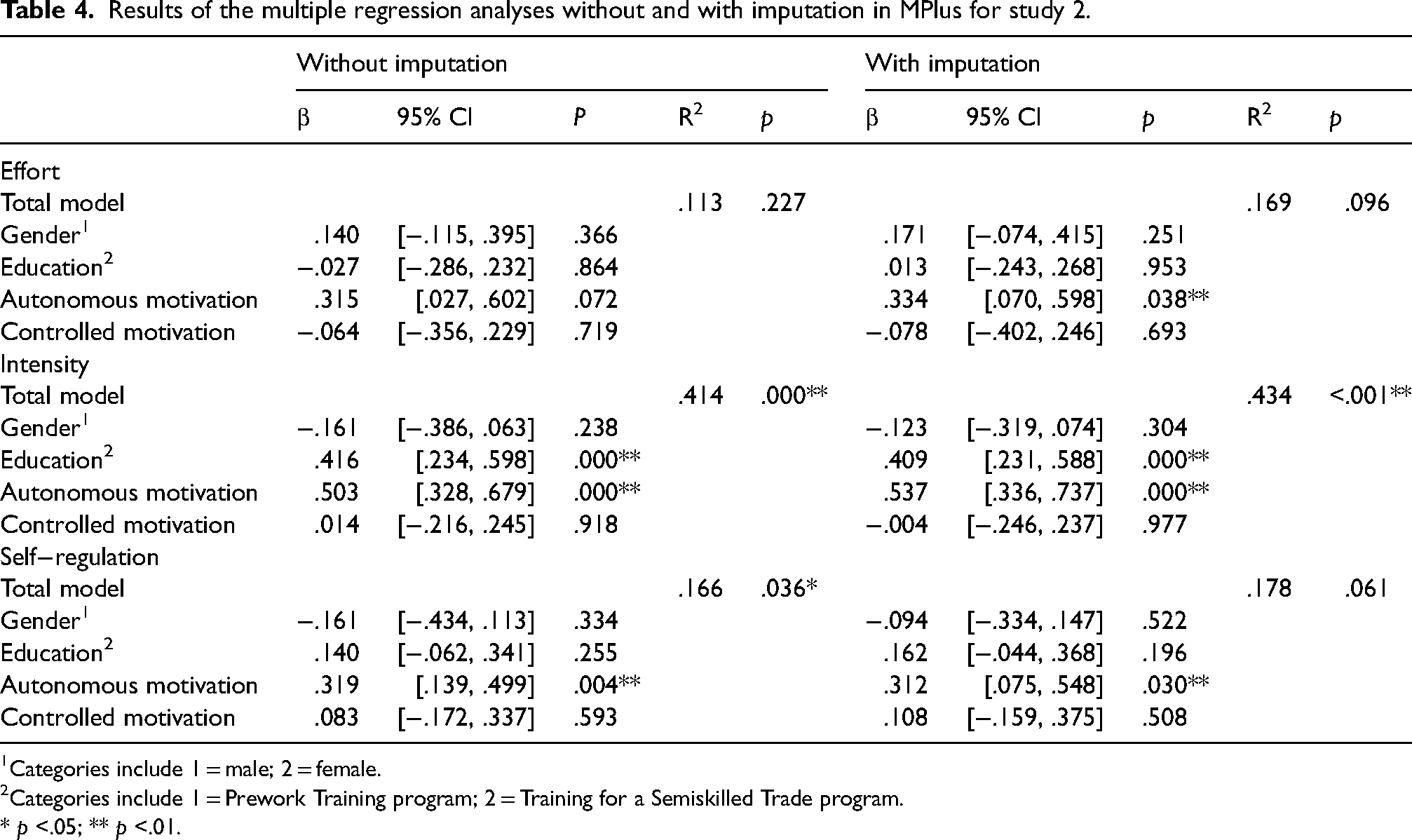
Results of the regression models without (N between 38 and 39) and with imputation in MPlus are displayed in Table 4 For the same reason as in Study 1, only the imputed results are interpreted. When examining more closely the role of motivations, significant results indicate that autonomous motivation strongly predicted the intended intensity, and moderately predicted the intended efforts as well as self-regulation. This means that youth who felt more autonomously motivated toward their upcoming job search had the intention of engaging in it with more effort, intensity, and self-regulation. Similarly to Study 1, controlled motivation was unrelated to all behaviors. Finally, regarding control variables, students in the TST program tended to report a higher intention to engage with intensity in their future job search.
Results of the multiple regression analyses without and with imputation in MPlus for study 2.
Categories include 1 = male; 2 = female.
Categories include 1 = Prework Training program; 2 = Training for a Semiskilled Trade program.
* p <.05; ** p <.01.
Discussion
The goal of this research was to examine whether youth with DLD who engage in their job search for autonomous reasons put greater effort and intensity and regulate themselves better. The role of controlled motivation was also examined. To this end, we propose that autonomous motivation (engaging in behavior out of enjoyment or because of its importance) is positively associated to job search behaviors (hypothesis 1), but that controlled motivation (engaging in behavior out of external or internal pressures) is negatively associated to them (hypothesis 2). Only hypothesis 1 was supported, with autonomous motivation predicting the job search behaviors adopted by youth with DLD in Study 1 and the intended job search behaviors of students with DLD in Study 2.
Both studies evidenced a positive association between autonomous motivation and the three job search behaviors. Small to moderate associations were obtained in the first study, and these associations were confirmed in the second study, with more important effects ranging from moderate to strong. These results are in line with those of previous studies. For example, autonomous motivation toward job search has been identified as significantly and positively associated to job search effort (da Motta Veiga & Gabriel, 2016), intensity (Koen et al., 2016; Vansteenkiste et al., 2004), and self-regulation (da Motta Veiga & Gabriel, 2016; Koen et al., 2016). However, this study is the first to highlight that autonomous motivation is an important antecedent of better job search behaviors among youth with DLD, namely in terms of quantity (i.e., effort and intensity), but also in terms of quality (i.e., self-regulation; Van Hooft et al., 2013). Although these results are novel to the field of DLD and offer significant clinical implications that will be discussed further, they align well with other studies conducted among typically developing students (Howard et al., 2021).
This study thus expands the slowly growing body of literature supporting the positive association of autonomous motivation with outcomes in populations with disabilities. It appears that the energy and vitality that are generally associated with autonomous motivation (Ryan & Deci, 2008) may translate into the job search behaviors youth with DLD adopt or intend to adopt. Therefore, those who are autonomously motivated are more inclined to invest effort in their job search, and do so with a higher intensity level, while adopting self-regulation strategies to keep track of their progress. This finding supports the theoretical proposition by Shogren et al. (2017) that autonomous motivation is an important foundation of volitional actions for youth with disabilities. Indeed, for youth with DLD, enhanced autonomous motivation translates into more effortful, intensive, and self-regulated job search.
Although we hypothesized that controlled motivation would be negatively associated to the positive job search behaviors, it was not the case. Indeed, controlled motivation toward job search had a negligible contribution to the job search effort, intensity, and self-regulation. A closer look to previous studies can help us understand this finding. More precisely, both in Koen et al. (2016) and Vansteenkiste et al. (2004, 2005) studies, controlled motivation was not associated to the job search intensity, and it also was not associated to the job search self-regulation in Koen et al. (2016). These authors suggested that in the job search domain, controlled motivation does not play either a positive or a negative role in explaining the behaviors people adopt. This absence of association between controlled motivation and positive outcomes was also observed in other studies. For instance, external regulation, one of the two types of controlled motivation, was also unrelated to adaptive outcomes in the Howard et al. (2021) meta-analysis, and controlled motivations (including external and introjected regulations) were weak predictors in general. Therefore, even if youth with disabilities may report higher levels of controlled than intrinsic motivation (Shogren et al., 2019), it might not have a significant negative impact on adaptive outcomes.
Koen et al. (2016) suggest that a most detrimental form of motivation during the job search process would be amotivation, which fosters inefficient job search behaviors (i.e., haphazard strategy) and negatively predicts self-regulation. This particularly damaging role of amotivation was also evidenced in the meta-analysis by Howard et al. (2021), who obtained negative associations with various positive outcomes (e.g., achievement) and positive associations with various negative outcomes (e.g., self-esteem). Examining amotivation could thus be a promising avenue in future research and help understand the specific role of each motivation types for youth with DLD.
Limitations and directions for future studies
This study examined an under-researched domain (i.e., job search among youth with DLD) while applying a central motivation theory that appears relevant for this population. The findings were also corroborated in two different samples. Nevertheless, various limits must be underlined to improve future research in this field. The first and most important limit is the small sample. Indeed, despite all our efforts, future studies should aim to include more participants. This would support both the statistical power and the generalizability of the results. The second limit is that measures are all self-reported, which can artificially inflate the common variance between the variables (Podsakoff et al., 2003). Future studies could also document the perceptions of parents, teachers, and friends, although it remains central in research projects with populations with disabilities to collect their thoughts and perceptions (Scott & Havercamp, 2018). A third limit refers to some bias inherent to the volunteer sample and the methodology (Malone et al., 2014). More precisely, participants could have been more autonomously motivated because of their interest in the study and may thus not represent accurately the population of youth with DLD in Quebec. Social desirability bias may also have slightly increased the autonomous motivation scores, and maybe more for some participants of Study 1 who answered the questionnaire on the phone. Also, because of the retrospective design of Study 1, response accuracy may have been influenced by recall bias, especially for participants who had finished their studies several years earlier. One last limit is that two variables that could have been interesting were not examined, namely amotivation and an outcome variable of job search strategies, such as the number of job offers or employment. Looking at the role of amotivation could have brought a wider perspective, while studying the association between job search behaviors and job search outcomes would have enhanced our understanding of the importance of these behaviors for youth with DLD.
Implications
A first important theoretical implication is the generalizability of SDT to populations with disabilities, especially for hidden disabilities such as DLD. Although beginning to receive some support for other hidden disabilities such as autism (e.g., Chen et al., 2015), or intellectual disability (e.g., Frielink et al., 2018, 2021), the studies are still very scarce compared to the vast SDT literature in other contexts and populations. Considering the growing importance of the inclusion of people with disabilities, studies applying SDT to this field are crucial to enable the development of optimal environments in which people with disabilities will flourish. As evidence mounts regarding the important role of autonomous motivation, we must ensure that people with disabilities do not continue to evolve in controlling environments as it was too often the case in the past decades (Wehmeyer & Shogren, 2017).
This study also has important clinical implications for professionals working with youth with DLD who want to enter the job market. As mentioned in the introduction, a central element of the transition to work for youth with disabilities is the career preparation training, including developing effective job-seeking skills (Timmons et al., 2010). The need to support youth with DLD in their job search was also highlighted (Conti-Ramsden et al., 2018). However, very little is known regarding the optimal way of supporting such a development. Our results indicate that one possibility for career counselors and professionals working with these young people could be to foster an autonomous motivation toward job search. Although how to support motivation is outside the scope of this study, it appears that, in accordance with SDT, supporting the basic psychological needs of autonomy, relatedness, and competence, could also be a promising avenue for people with disabilities. In previous studies, an emphasis has been placed on supporting autonomy, which implies acknowledging others’ feelings, offering them choices, and giving a rationale for a task, especially the unpleasant ones (Deci & Ryan, 2016). For instance, adults with mild intellectual disability who engage in a problem-solving task in an autonomy-supportive condition reported perceiving the task as more useful and were more engaged in it (Emond Pelletier & Joussemet, 2017). In a study more closely related to DLD, the autonomy support provided by speech-language pathologists for their clients was associated with higher levels of autonomous motivation toward their treatment (Haerens et al., 2021). Being empathetic to the client's situation and perspective, giving a rationale for the exercises and the goal to which they are related, giving opportunities for the clients to experiment by themselves, and offering choices regarding the course of therapy were all important autonomy-supportive behaviors endorsed by the speech-language pathologists. Career counselors could thus be encouraged to adopt such supportive behaviors when they work with youth with DLD in developing effective job search behaviors.
Conclusion
In conclusion, this study supports the importance of autonomous motivation in fostering effective job search behaviors for youth with DLD, thus adding to the evidence of the generalizability of SDT to populations with disabilities. Indeed, autonomous motivation was associated with the job search intensity, effort, and self-regulation in both studies. Professionals and career counselors are encouraged to adopt supportive behaviors in order to enhance the autonomous motivation of youth with DLD during the career preparation training.
Footnotes
Declaration of conflicting interests
The author(s) declared no potential conflicts of interest with respect to the research, authorship, and/or publication of this article.
Funding
The author(s) disclosed receipt of the following financial support for the research, authorship, and/or publication of this article: This work was supported by the Social Sciences and Humanities Research Council of Canada, Canada Research Chair on Motivation and Academic Success.
