




Abstract
Background and aims
Children with developmental language disorder (DLD) often perform below their typically developing peers on verbal memory tasks. However, the picture is less clear on visual memory tasks. Research has generally shown that visual memory can be facilitated by verbal representations, but few studies have been conducted using visual materials that are not easy to verbalize. Therefore, we attempted to construct non-verbalizable stimuli to investigate the impact of working memory capacity.
Method and results
We manipulated verbalizability in visual span tasks and tested whether minimizing verbalizability could help reduce visual recall performance differences across children with and without developmental language disorder. Visuals that could be easily verbalized or not were selected based on a pretest with non-developmental language disorder young adults. We tested groups of children with developmental language disorder (N = 23) and their typically developing peers (N = 65) using these high and low verbalizable classes of visual stimuli. The memory span of the children with developmental language disorder varied across the different stimulus conditions, but critically, although their storage capacity for visual information was virtually unimpaired, the children with developmental language disorder still had difficulty in recalling verbalizable images with simple drawings. Also, recalling complex (galaxy) images with low verbalizability proved difficult in both groups of children. An item-based analysis on correctly recalled items showed that higher levels of verbalizability enhanced visual recall in the typically developing children to a greater extent than the children with developmental language disorder.
Introduction
Children with developmental language disorder (DLD) have difficulties in acquiring and using language compared to their age matched peers (Bishop et al., 2016; Leonard, 2014). Research has shown that language difficulty in DLD is observed to be intertwined with memory deficits (e.g., Archibald et al., 2011). Working memory (WM) conceptualizes a cognitive system that renders storage and processing of information possible, while short-term memory (STM) is generally defined as the storage capacity of information for a temporary duration (Baddeley, 1992). According to Baddeley and Hitch’s (1974) model, memory system can be supported by both the visuospatial sketchpad and the phonological loop. With the help of the phonological loop, memory recall can be facilitated by linguistic/verbal representations. In particular, rehearsing and verbal encoding are two potential verbal processes that can facilitate storage in memory (Baddeley, 2003). In the present study, we adopt the view supported by more recent studies (e.g., Unsworth & Engle, 2007) that STM and WM are separate conceptual constructs measured by different types of span tasks, but which measure largely the same basic underlying processes, such as maintenance and rehearsal.
Children with DLD have often been shown to perform below their typically developing (TD) peers on verbal memory tasks requiring immediate recall (e.g., Alloway & Archibald, 2008; Archibald & Gathercole, 2006a; Gathercole & Baddeley, 1990; Montgomery et al., 2019), and in particular when the task implicates the phonological storage (Archibald & Harder Griebeling, 2016). However, the picture is less clear regarding whether visual memory is impacted in DLD. While one group of researchers has advocated that visual storage and processing capacity is typical in DLD (see e.g., Alloway & Archibald, 2008; Archibald & Gathercole, 2006b; Henry et al., 2012; Riccio et al., 2007; Van Daal et al., 2008) particularly in adolescence (Arslan et al., 2020), others have shown the reverse (e.g., Bavin et al., 2005; Hoffman & Gillam, 2004; Marton, 2008). It is important that limitations in visuospatial memory in DLD are further examined because non-verbal skills in children with DLD are often assessed by using visuospatial tasks. One important issue, however, is that non-DLD school-age children (aged 7–8) and adolescents (aged 13-14) might present a verbal advantage over children with DLD in non-verbal intelligence tasks (Miller & Gilbert, 2008), and in visual WM tasks (for instance, by utilizing color labels as lexicalization strategies; see Alt, 2013). Also, importantly, TD children seem to benefit from the “wordlikeness effect” of non-words in comparison to children with DLD in non-word repetition tasks, which is often taken as one indicator of phonological WM (see Estes et al., 2007; Munson et al., 2005 for reviews). Therefore, a working hypothesis is that children with DLD might be unable to utilize strategies to verbally encode stimulus material to a larger extent as compared to TD children, which would explain some of these findings that visual memory is found to be impaired in DLD. However, to test such a claim one needs to devise a recall tasks where verbal encoding in visual materials is systematically manipulated. This is addressed in the present study using a visual serial recall task where the visuals are manipulated for different verbal encoding conditions. These novel materials allow us to test whether the ability to recall visual materials can be enhanced by verbal encoding (henceforth, verbalizability) in unimpaired adults and children with and without DLD.
Visual WM in DLD
The presence of visual WM impairments in children with DLD has been subject to disagreement among authors. A number of studies have reported that children with DLD show virtually typical performance in visuospatial recall tasks compared to their TD peers, despite their particular difficulty with verbal WM tasks (Alloway & Archibald, 2008; Archibald & Gathercole, 2006a, 2006b; Henry et al., 2012; Lum et al., 2012; Petruccelli et al., 2012; Riccio et al., 2007; Van Daal et al., 2008). 1 Using simple span tasks to investigate groups of 7- to 12-year-olds with and without DLD, Archibald and Gathercole (2006a, 2006b) reported that the children with DLD performed within the range of their TD peers in visuospatial span tasks requiring both forward and backward recall. There has been additional evidence for this observation across different age groups of children with DLD (see Alloway & Archibald, 2008, for 6- to 11-year-olds and Van Daal et al., 2008, for 5-year-olds experiencing DLD). These findings seem to be consistent with the idea that memory impairments in DLD are selective to the verbal domain (see, for instance, Gathercole & Baddeley, 1990). It is crucial to note that large individual differences were reported in some studies: although overall group scores for visuospatial memory was found to be within TD ranges, a considerable number of children (i.e., almost half) with DLD still showed deficits (see e.g., Archibald & Gathercole, 2006a).
In contrast, another set of studies has reported significant group differences between children with DLD and their TD peers, providing evidence that children with DLD tend to perform below their TD peers in span tasks requiring visuospatial recall (Akshoomoff et al., 2006; Alt, 2013; Bavin et al., 2005; Hick et al., 2005; Hoffman & Gillam, 2004; Leclercq et al., 2012; Marton, 2008; Nickisch & Von Kries, 2009; see also Vugs et al., 2013 for a review). A study reported by Hick et al. (2005) used pattern recall and block construction tasks in a longitudinal design to test the impact of DLD on three-year-olds’ visuospatial memory. The authors reported that children with DLD performed below their TD peers on both tasks. Akshoomoff et al. (2006) examined groups of children with DLD (aged 6–12 years) using complex visuospatial tasks (i.e., hierarchical form memory and complex figure tasks). The authors found that children with DLD underperformed compared to their TD peers, suggesting that individuals with DLD experience difficulty with visuospatial processing. Bavin et al. (2005) used a series of visuospatial WM tasks (including pattern recognition memory, spatial recognition, and Corsi blocks tasks) and showed that young children with DLD (aged 4–5.5 years) had relatively reduced visuospatial memory. Hoffman and Gillam (2004) found similar findings in relatively older children with DLD (aged 8–11 years). Marton (2008) investigated visuospatial abilities in groups of 5- to 7-year-olds and 8- to 11-year-olds experiencing DLD using space visualization, position in space, and design copying tasks. They reported that children with DLD in both age groups performed more poorly than age-appropriate TD groups.
Recent findings have shown that visuospatial difficulty in DLD is not necessarily a unitary impairment. Arslan et al. (2020) showed that visuospatial storage capacity (as measured by the Corsi blocks task in forward recall) was typical, while more complex processing capacity (as measured by the Corsi blocks task in backward recall) was impaired in children with DLD aged 7 to 11 years. The absence of processing difficulties in adolescents experiencing DLD (Arslan et al., 2020) suggested that visuospatial WM difficulties in DLD could reflect delays in cognitive developmental trajectory (see also Hick et al., 2005 for a similar argumentation). Furthermore, Botting et al. (2013) used a block recall and picture sequence tasks task to examine 6- to 12-year-olds with and without DLD and found no significant group differences for the block recall task. However, the authors reported that the children with DLD performed more poorly in recalling the picture sequences compared to their TD peers. According to Botting et al. (2013), lower performance in picture sequence tasks was associated with the fact that this task requires the involvement of verbal encoding to a large extent; hence, performance was constrained by the presence of verbal impairments. Although modulation by less efficient verbal skills in DLD cannot be ruled out, the meta-analysis by Vugs et al. (2013) showed that visuospatial impairments exist before the age of seven, a stage of development where verbal encoding may be unstable, casting doubt on the idea verbal inefficiency underlies visuospatial impairments.
Summarizing the present state-of-the-art research on visuospatial memory in individuals with DLD, there appears to be no consensus between the above viewpoints that showed no clear impairment in visuospatial recall and those showing significant group differences between the two groups of children. However, emerging findings have indicated that children with DLD can perform poorly on visuospatial recall tasks when these visual tasks required verbal encoding (see Botting et al., 2013). However, one important gap in the literature is that only few studies have directly tested whether children with DLD may not be able to benefit from verbalization strategies in visuospatial tasks compared to their TD peers by manipulating the degree of verbal encoding in visual stimulus materials. This is the topic of the current study.
The current study
The aim of the current study was twofold. The first aim was to construct a visual span task in which the degree of verbal encoding was manipulated. This was addressed in Experiment 1 in which we attempted to construct visual stimulus materials that had relatively higher and lower levels of verbal encoding. To this end, we conducted a pretest to evaluate the degree to which visual stimuli could be verbally encoded. In Experiment 1, a task with the new materials was administered to a group of French-speaking unimpaired young adults (N = 40). Seeking to manipulate verbal encoding in visual processing, we avoided using articulation suppression, as lower performance in tasks that require articulation suppression does not always clearly reflect elimination of verbal encoding strategies (c.f. Emerson & Miyake, 2003, who show that articulation suppression can also affect executive processes). Furthermore, the use of articulatory suppression would go against our second aim (see below) in examining children with DLD, as this would lead to unavoidable biases between TD and DLD groups.
A second aim of the current paper was to uncover whether children experiencing DLD performed comparably to their TD peers in visual recall for materials with a lower level of verbalizability. If visual recall in children with DLD is constrained by a difficulty in verbal encoding, as discussed by Botting et al. (2013) and Arslan et al. (2020), then we should observe no group difference between DLD and TD groups with visual stimuli with low verbalizability compared to visual stimuli with relatively more verbalizability. This possibility was addressed in Experiment 2.
Experiment 1
The first experiment investigated whether and to what extent the degree of verbalizability of the visual stimuli can influence the WM span of unimpaired adults. To this end, we selected several categories of visual material, and we ran a fluency task to detect whether pictures could be rapidly verbally recoded on average. We experimented in adults instead of children to increase the probability of retrieving words in long-term memory, but we did not expect the performance in children to correspond to that in adults. We only expected larger differential amounts of verbalizability across stimulus classes in adults to select our material.
Participants
A total of 40 native French speakers studying at the Université de Franche-Comté participated in this study (Mage = 20.2, standard deviation (SD) = 1.9). Prior to the experiment, the participants were asked to complete a confidential questionnaire regarding their demographic background and mental health, but no particular neuropsychological screening was carried out. All participants had normal or corrected-to-normal vision, and none of them reported any history of developmental language impairment or mental or neuropsychological conditions that may interfere with their language and/or memory. The participants received course credits in psychology in return to their participation.
Materials
The experimental materials comprised 180 grayscale 108 × 108 pixel visual images divided into four conditions (n = 45 per condition). The number 45 was chosen to allow the simple span tasks to range from 1 item to 9 items (∑91 = 45). Figure 1 displays the 45 pictures of each of the four conditions.

Entire set of the visual stimuli used in Experiment 2, organized by bank and by verbalizability.
The first two conditions contained simple black–white drawings taken from the Battery for Efficient Memory (BEM, Signoret, 1991): (i) verbalizable BEM images (BEM-V) that could easily be associated with verbal information due either to their remote resemblance to Latin character letters or to meaningful symbols and thus were more likely to be recalled based on verbal cues and (ii) non-verbalizable BEM images (BEM-NV) that did not resemble any meaningful symbol and hence were more likely to be recalled based on visual cues rather than verbal. The other two conditions, by contrast, contained images of astronomical objects, including galaxies and nebulae, retrieved from the National Aeronautics and Space Administration’s (NASA) Jet Propulsion Lab public repository 2 at the California Institute of Technology.These two conditions contained (iii) verbalizable images of astronomical objects (GAL-V) that looked like everyday objects (e.g., an eye or a horse) and thus were rather likely to be recalled based on semantic association, (iv) and finally, non-verbalizable images of astronomical objects (GAL-NV) that had less similar appearance to any everyday object and consequently bore a lower likelihood to be recalled based on any semantic association. The following section describes how these two categories were selected among four categories and then split according to their average verbalizability in a pretest involving other participants.
Pre-evaluation of the verbalizability of visual stimuli
Our stimulus materials were evaluated using a semantic fluency task to identify the semantic associations evoked by the visual stimuli, providing us with a measure of the degree of verbalizability in these visual images. A total of 88 French native speakers studying at the Université de Franche-Comté participated (mean age = 21) and were different from the 40 participants described above.
We expected a large variance in verbalizability from the BEM, at is it obvious that some visuals can prime semantic associations. Three other categories were chosen to explore lower levels of verbalizability: galaxies (GAL), mountains (MNT), and fractals (FRA). A block design was used here, that is, a participant saw all 90 items from the BEM, GAL, MNT, and FRA conditions. Each image (grayscale, 108 × 108 pixel) was displayed on a computer screen for 5000 milliseconds in a random order, one image per trial. The participants were instructed to generate as many words associated with the images as possible that came to their minds. The participants were discouraged from generating words directly relevant to the actual content of the images (e.g., “drawing,” “galaxy”). This allowed us to elicit a broader range of more useful semantic associations within the allotted time (useful, in the sense that rehearsing “galaxy, galaxy, galaxy” would not be useful in the span task). The total number of words produced within 5000 milliseconds and the onset time of each word generated were recorded (for this entire pretest, the same experimenter pressed a key whenever a word was produced).
Figure 2 demonstrates a scatterplot of the average reaction time of the words produced for each stimulus as a function of the average number of different words produced during the 5000 milliseconds, and Table 1 shows a summary of findings from the pretest. The scatterplot displayed 4 × 90 = 360 dots, with each corresponding to one image for which performance was aggregated across participants. The FRA and MNT categories were discarded because they produced intermediate levels of verbalizability (see Table 1).
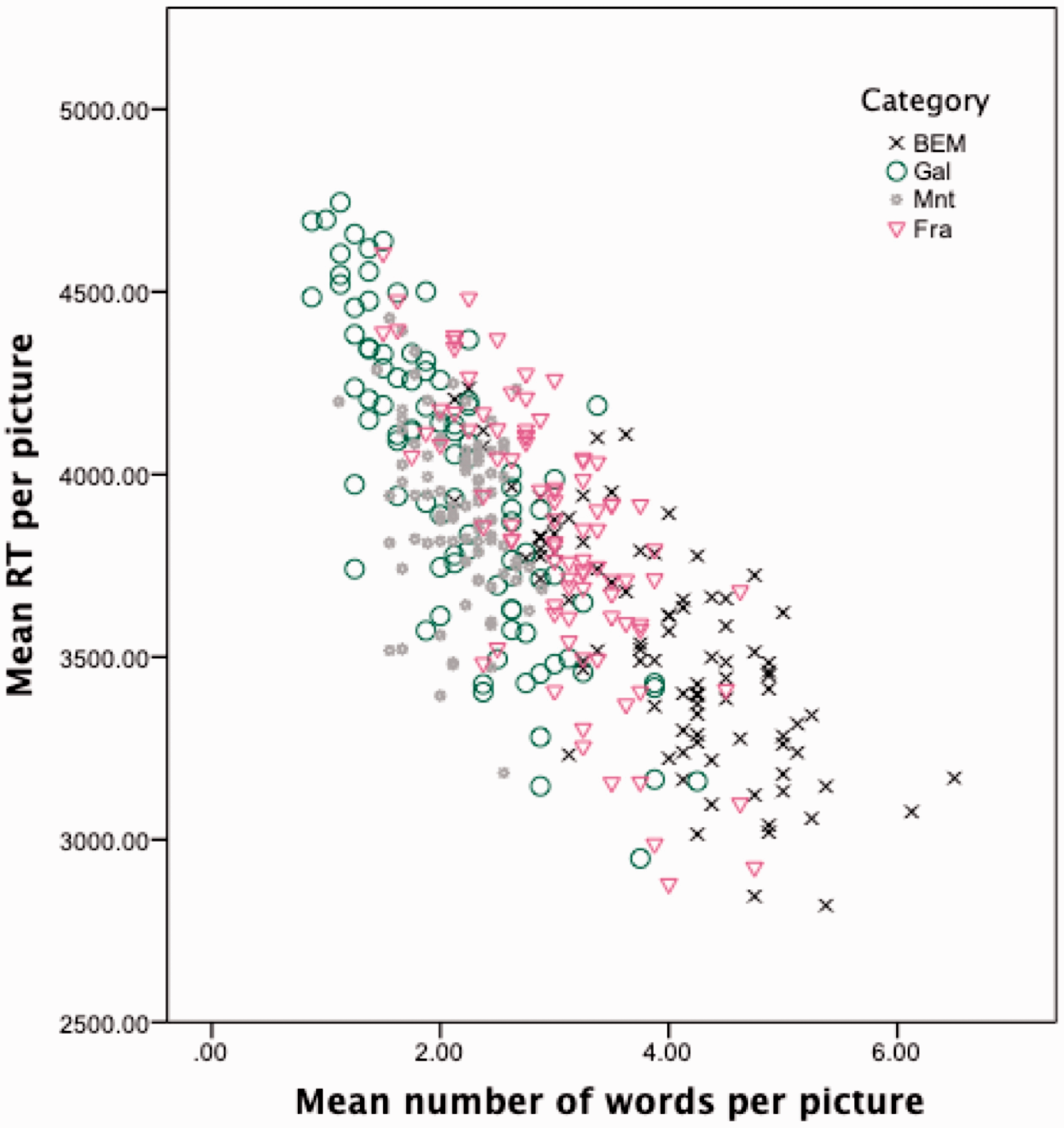
Scatterplot of the average reaction time of the words generated for a given stimulus as afunction of the average number of different words produced during the 5000-millisecond display of the stimulus. Each dot represents the performance for one image aggregated across the participants. BEM: images of Battery for Efficient Memory; RT: response times.
Average number of words produced and corresponding RTs when participants were prompted with single stimulus images for 5 seconds as a function of the category of the stimulus images.

Note: The composite score (zcomp) is obtained from RTWords and NWords. BEM: images from the Battery for Efficient Memory; GAL: images of galaxies; MNT: images of mountains; FRA: images of fractals; SD: standard deviation; RT: response times.
The following analysis was therefore restricted to the two categories that produced the most extreme verbalizability scores (i.e., BEM and GAL) to test whether they could be clearly discriminated based on verbalization. On average, participants produced 4.0 words for the BEM images (SD = 0.9) and 2.1 words for the GAL images (SD = 1.7). The average time to the word onsets was 3528 milliseconds (SD = 317) for the BEM images and 3987 milliseconds (SD = 417) for the GAL images. A set of linear regression analyses computed with the BEM data (R2 = .58) and GAL data (R2 = .66) showed a clear relation between these average RTs and average word production. A z score was therefore computed based on these two dependent variables, assuming that images with the lowest number of words and the longest RTs contain content that are less likely to be verbalized. This composite “verbalizability” score, zcomp, was calculated by subtracting zRT from zNwords for each image. The composite scores of the GAL category were found to be significantly different from those of the BEM category (t(178) = 12.1, p < .001) as well as the raw RTs (t(178) = 8.3, p < .001) and the raw absolute number of words produced (t(178) = 15.1, p < .001). The entire set of 90 images in each of the BEM and GAL categories were ranked based on their verbalizability zcomp score. The 45 images with the highest scores were categorized as verbalizable (V), and the other 45 images with the lowest scores were categorized as non-verbalizable (NV).
Procedure
The span task was programmed using Visual Basic 6.0 and individually presented to each participant on a laptop computer. Each trial for the span task had two phases: (i) The study phase where a series of visual stimuli were pre-sent one at a time at the center of the computer display for 2000 milliseconds each with an inter-stimulus interval of 500 milliseconds. The participants were instructed to study the visual stimuli carefully during the study phase as they would need to recall the order of their presentation immediately afterwards. (ii) The recall phase in which all of the stimuli displayed in the study phase was presented in a new visual display using a random spatial arrangement. In the recall phase, the participants were asked to reconstruct the order of the presented images by clicking on them (using a mouse or the trackpad depending on the participant’s preference) in the order that they had seen them during the study phase, consequently, the task required as minimally verbal response as possible. A blank response (i.e., I don’t remember) was not a possible response choice, and hence, the participants were instructed that they should respond as best as they could remember. The recall display included the images from the study phase only. Figure 3 shows an illustration of the timeline within one trial.
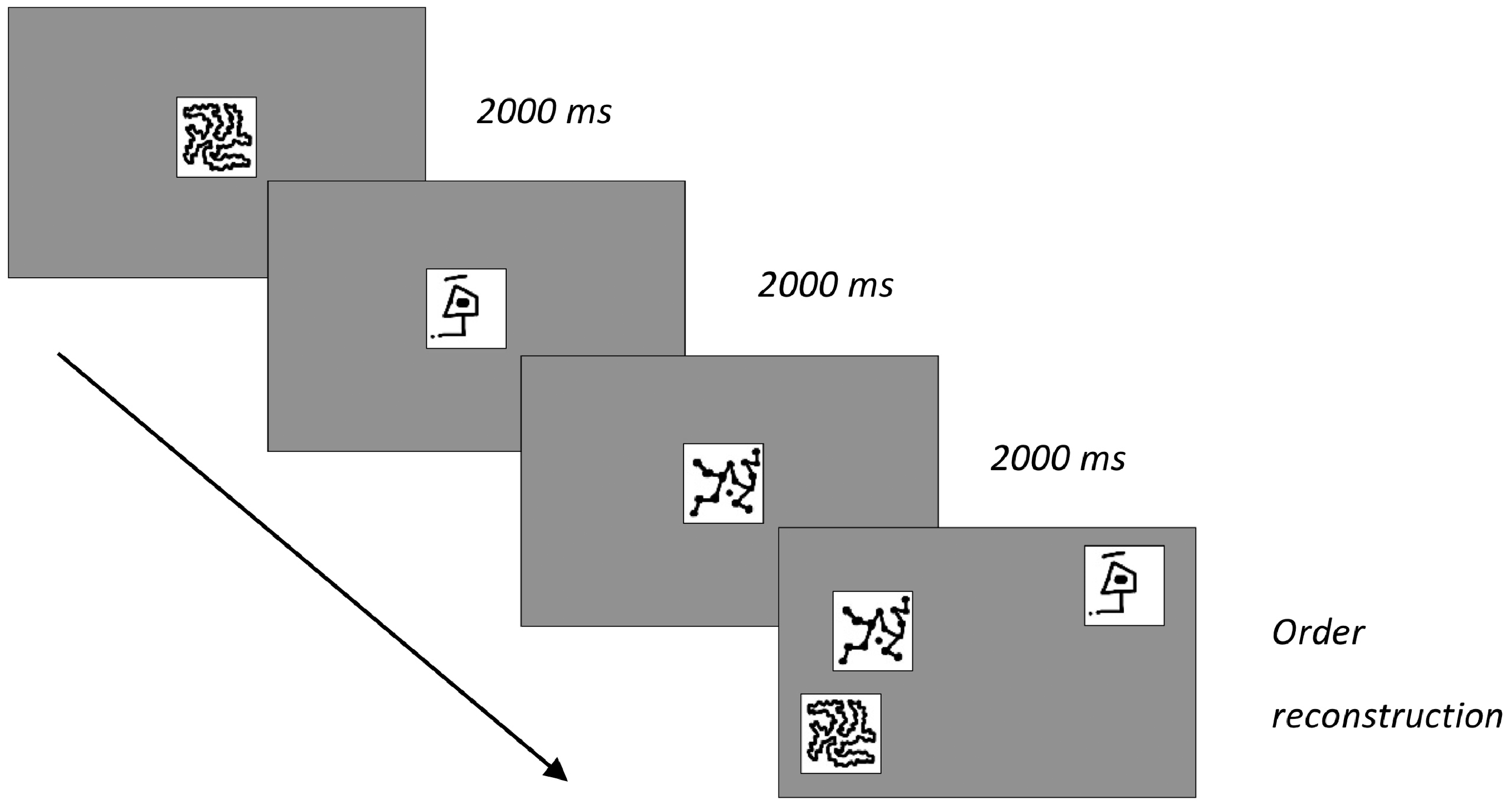
Timeline of the span task used in Experiment 1 and Experiment 2 (inter-stimulus interval = 500 milliseconds).
A within-subjects block design was utilized in this experiment, that is, all participants saw every condition but in separate blocks. The participants saw only one of the BEM-V, BEM-NV, GAL-V, and GAL-NV stimulus categories in each block. The number of visual images to be studied in one trial varied from 1 to 9, and the list length increased sequentially (i.e., trial with one image, then with two images, and so on), to give participants ample opportunity to adapt to the task. We used one trial per condition per length in order to limit the duration of the experiment and to make sure the participants fully engage in the task at hand within a single session. The order of these blocks was counterbalanced across the participants. In each of the four conditions, the 45 images described above were used to create nine trials where participants saw each image only once throughout the experiment.
We recorded the span for each participant in each condition, corresponding to the highest number of images successfully recalled in the correct order. A trial was scored “accurate” when all the images presented in the study phase were correctly recalled, following the so-called all-or-nothing method (Conway et al., 2005). Any trial with recall errors was scored as inaccurate. Here, we basically needed only to rank the conditions based on their global difficulty, not precisely study the performance (for instance, analyze the data based on the given position of an item), so a partial-credit scoring system was not necessary to refine our analysis. The data were analyzed with the linear mixed-effects regression models in R using the lme4 package (Bates et al., 2015). The participants were included as random intercepts.
Results and discussion
Figure 4 shows the mean span per condition. The adult participants recalled the images in the BEM-V condition with a mean span of 5.95 (SD = 1.12), while they recalled the images in the BEM-NV condition with a span of 5.15 (SD = 1.06). Furthermore, the participants’ memory performance tended to be poorer in the GAL conditions with a mean span of 4.68 (SD = 1.10) for the GAL-V condition and of 4.15 (SD = 1.02) for the GAL-NV condition. Table 2 exhibits outputs from a linear mixed-effects regression model, showing significant fixed effects of picture type and verbalizability without an interaction between the two factors. This indicted that our adult participants performed better in recalling the order of the visual stimuli in the BEM than GAL conditions and that they performed better in recalling the verbalizable conditions (i.e., both BEM-V and GAL-V) than the non-verbalizable conditions.

Mean span observed in Experiment 1 as a function of picture type and verbalizability. Error bars represent ±1 SE. SE: standard error; BEM: images of Battery for Efficient Memory; ADU: adult participants; GAL: images of galaxies.
Statistical outputs from the linear mixed-effects regression models for the adult participants.

SE: standard error.
The results from Experiment 1 constituted clear evidence that visual WM capacity in unimpaired adults was sensitive to visual characteristics, providing converging support to the previous literature that found that WM capacity was influenced by stimulus type (Alvarez & Cavanagh, 2004; Mathy & Friedman, 2020). In particular, potential effects of stimulus type on memory were addressed in studies that examined whether using visual strategies or clues influences verbal memory (see e.g., Mayer & Sims, 1994; Sadoski & Paivio, 2013). We provided further evidence that the presence of verbal cues in visual material (i.e., level of verbalizability) can enhance visual order recall in unimpaired adults, with a difference of almost two items between the two extreme performances, which represent an increase of (5.95 − 4.15)/4.15 = 43%.
In particular, we found that order recall for verbalizable visuals was significantly higher than for visuals that contain relatively less verbalizable cues across both simple drawings and more complex galaxy images. During a visual serial recall task, a group of unimpaired adults tested in this study were able to use the available (although probabilistic) meaningful verbal cues, probably either in forms of semantic associations with everyday objects or through verbal information with which the visual representation can be encoded in the memory (e.g., a picture of galactic nebula that looks like a horse head). From another perspective, the absence of verbalizable cues in the stimulus material negatively influenced visual order recall, which placed the least verbalizable image at the top of the scale of difficulty regarding the storing of visual information. Additionally, we found the GAL visual stimuli to be recalled slightly less effectively than simple drawings (i.e., BEM), suggesting that visual complexity may have also played a role in visual order recall (for visual complexity accounts, see Alvarez & Cavanagh, 2004; Brady & Tenenbaum, 2013). If visual complexity is taken as a factor that can cause lower memory performance, one possible link with the verbal factor is that it may be more difficult to make semantic associations between images and words when the picture is more complex.
Experiment 2
Experiment 2 investigated whether and to what extent visual WM difficulties were present in a group of children with DLD (aged 7–14) compared to an age-appropriate group of TD children using the visual serial recall task described in Experiment 1.
Participants
The participants included 23 native French-speaking children experiencing expressive DLD (18 boys; Mage = 10.32, min = 7.08, max = 14.83, SD = 1.75). All of these children with DLD were attending a special education class (21 in elementary mainstream school and 2 in middle school). The diagnoses of DLD were verified by an experienced psychologist based on two standardized language tests for the French language for children, Bilan Informatisé de Langage Oral au cycle 2 (Khomsi et al., 2007) and Nouvelles Epreuves pour l’Examen du Langage (Chevrie-Muller & Plaza, 2001). The children exhibited stable oral language production deficits below −1.25 SD according to the Leonard (2014) criteria. Their intellectual quotient performance was within the normal standards (ranging from 70 to 90) as measured with the Wechsler Intelligence Scale III (Wechsler, 1996).Therefore, the DLD diagnosis met the criteria of a language disorder as defined in the communication disorder category within the neurodevelopmental disorder chapter of the Diagnostic and Statistical Manual of Mental Disorders (DSM-5; American Psychiatric Association, 2013) and in line with the European classification criteria (see 315.39 in international classification of diseases, version 9; https://www.icd10data.com/Convert/315.39).The children with DLD did not have any further neurological, sensory, relational, or educational disability. In addition, we recruited 65 TD children (27 boys; Mage = 9.02, min = 6.25, max = 11.25, SD = 1.37), who were attending mainstream public schools and matched with the children with DLD on chronological age. They confirmed not to have any developmental difficulties. We attempted to recruit at least two TD children matched on age with each child with DLD in order to obtain a more reliable baseline measurement. The TD children were referred by their school teachers and did not undergo a formal testing for (a)typical development (French pupils who face communication and learning difficulties are generally oriented in special education after advice of a school psychologist, so it can be assumed that the development of our TD participants was typical).
Materials and procedure
The materials and procedures were identical to those reported in Experiment 1.
Results
Table 3 displays the mean span length obtained in our visual serial recall task in the children with and without DLD, and Table 4 presents output from a linear mixed-effects regression. The children with DLD achieved a span length of 3.21 (SD = 1.12) for BEM-V, 3.56 (SD = 0.89) for BEM-NV, 2.95 (SD = 2.95) for GAL-V, and 2.47 (SD = 0.79) for GAL-NV conditions, while TD children’s span length was 4.03 (SD = 1.14) for BEM-V, 3.63 (SD = 1.07) for BEM-NV, 3.21 (SD = 0.97) for GAL-V, and 2.87 (SD = 0.85) for GAL-NV conditions. We found significant fixed effects of picture type (BEM vs. GAL) and age and significant interaction effects between group and verbalizability, between picture type and verbalizability, and a three-way interaction between group, picture type, and verbalizability. An initial inspection of the data suggested that the children with DLD did not necessarily have overall impairments in visual order recall, as no fixed effect of group was significant, but that they performed more poorly than the TDs in the BEM-V than in the GAL-V condition (see Figure 5).
Mean span length and standard deviations of the children with DLD and their TD peers.

DLD: developmental language disorder; TD: typically developing; BEM-NV: non-verbalizable images from the Battery for Efficient Memory; GAL-NV: non-verbalizable images of galaxies; BEM-V: verbalizable images from the Battery for Efficient Memory; GAL-V: verbalizable images of galaxies; SD: standard deviation.
Outputs from the mixed-effects regression model computed with span data from the DLD and TD children.

SE: standard error.

Mean spans observed in Experiment 2, as a function of picture type (BEM vs. GAL), verbalizability and group (DLD vs. TD). Error bars are ±1 SE. SE: standard error; BEM: images of Battery for Efficient Memory; GAL: images of galaxies; DLD: developmental language disorder; TD: typically developing.
Having obtained a three-way interaction between verbalizability, picture type and group, we computed a set of post hoc tests to examine the nature of the condition and group differences. A set of between-group comparisons, using the Tukey test, indicated that the DLD group performed more poorly than the TD group in responding to the visual serial recall task in the GAL-NV condition (ß = 0.668, standard error (SE) = 0.206, z = 3.237, p = .0012) and in the BEM-V condition (ß = 1.227, SE = 0.271, z = 4.515, p < .001). We did not find significant group differences, however, in either the group responses in the GAL-V condition (ß = 0.422, SE = 0.240, z = 1.758, p = .078) or in the BEM-NV condition (ß = 0.368, SE = 0.256, z = 1.433, p = .152).
The children with DLD performed better in the GAL-V condition than in the GAL-NV condition (ß = 0.478, SE = 0.240, z = 1.99, p = .046). However, there were no significant differences in memory performance between BEM-V and BEM-NV conditions in the children with DLD (ß = −0.347, SE = 0.240, z = −1.447, p = .148). The TD children, by contrast, recalled verbalizable images with higher span length in both the GAL (ß = 0.338, SE = 0.120, z = 2.805, p = .005) and the BEM conditions (ß = 0.400, SE = 0.162, z = 2.464, p = .013). Furthermore, the children with DLD had a longer visual span in the BEM-NV condition than in the GAL-NV condition (ß = −1.087, SE = 0.234, z = −4.635, p < .001), while showing no differences between the GAL-V and BEM-V conditions (ß = −0.260, SE = 0.245, z = −1.064, p = .287). By contrast, the TD children had better recall performance with BEM images in both verbalizable and non-verbalizable contrasts (GAL-V vs. BEM-V: ß = −0.815, SE = 0.146, z = −5.55, p < .001; GAL-NV vs. BEM-NV: ß = −0.753, SE = 0.147, z = −5.123, p < .001).
We further pursued an item-by-item analysis to unveil whether the children with and without DLD benefited from verbalizability encoded in the visual stimuli during visual recall. Figure 6 demonstrates the fitted regression lines for both the groups’ correctly recalled items by verbalizability z-scores. The linear regression model outputs indicated significant effects of gradient verbalizability z-scores (ß = 0.02, SE = 0.002, t = 10.71, p < .001), group (ß = 0.077, SE = 0.009, t = 8.88, p < .001). This suggests that TD children performed better in visual recall as verbalizability of visual stimuli increased; the children with DLD, by contrast, benefited less from verbailizability encoded in visual stimuli.
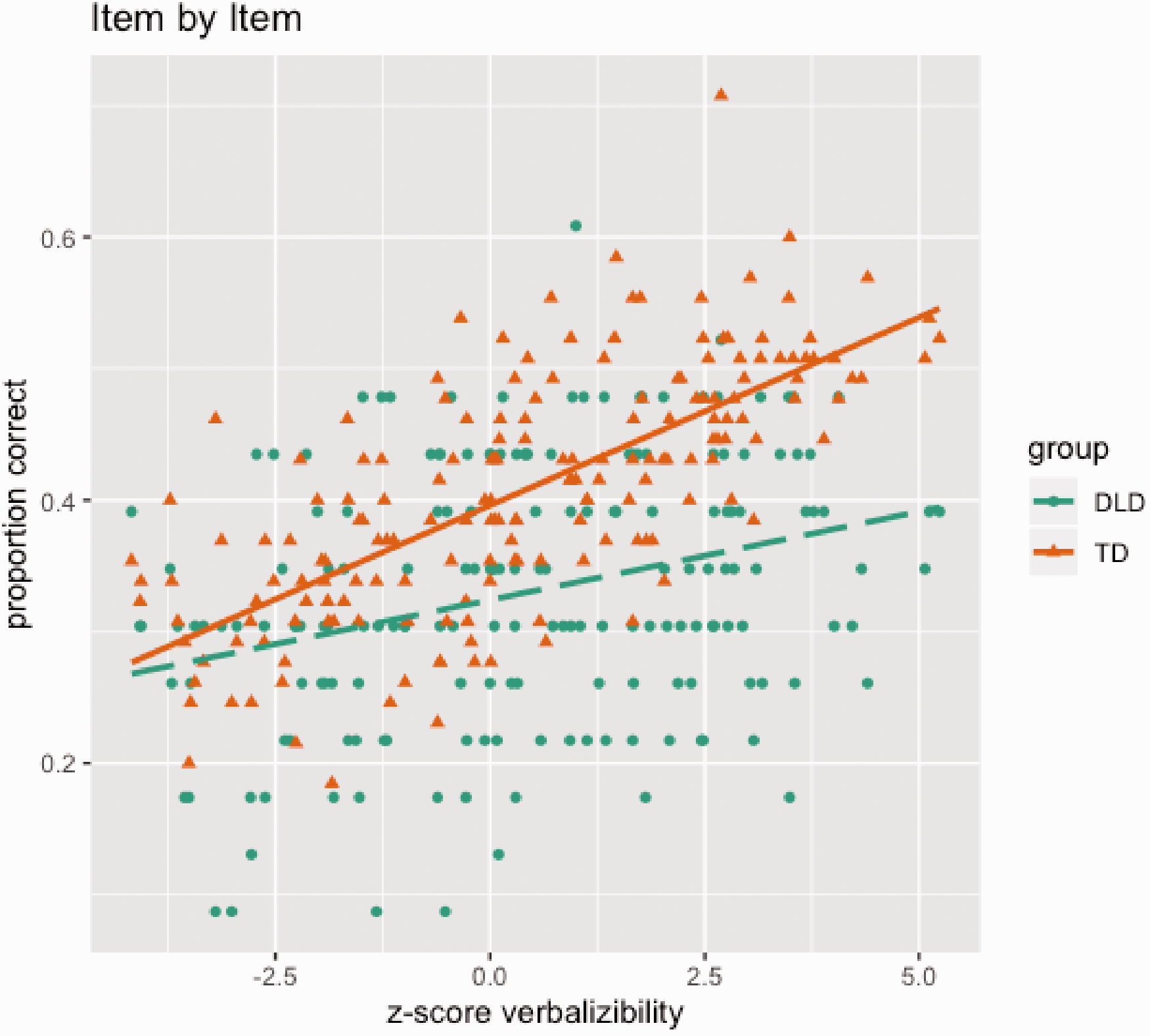
Scatterplot displaying fitted regression lines per group proportion of correctly recalled items by verbalizability z score of these items. DLD: developmental language disorder; TD: typically developing.
Discussion
The aim of Experiment 2 was to reveal whether and to what extent visual WM capacity was affected in children with DLD. For this purpose, we used a visual serial recall task with an assortment of visual stimuli in which we manipulated the degree of verbalizability. Based on the lack of main effect of group, this study provided evidence that the overall storage capacity for visual information was unimpaired in our group of children with DLD, supporting the view that visual STM is not affected in DLD (see e.g., Alloway & Archibald, 2008; Archibald & Gathercole, 2006a, 2006b; Henry et al., 2012; Lum et al., 2012; Petruccelli et al., 2012; Riccio et al., 2007; Van Daal et al., 2008). However, our findings suggested that the invulnerability of the visual domain in DLD is not straightforward, as we provided evidence that the group of children with DLD performed less efficiently in the visual recall task compared to the TD group for the least verbalizable images of galaxies and the most verbalizable pictorial images (respectively, the GAL-NV and BEM-V conditions). The children with DLD, nevertheless, performed within their TD peers’ ranges in the GAL-V and BEM-NV conditions. It is thus conceivable that the difficulty with storing visual information in those with DLD is not a unitary problem, and these difficulties are modulated by stimulus characteristics and task demands, as reported by Botting et al. (2013) and Arslan et al. (2020).
Our prediction was that when visual images had low verbalizability, children with DLD might perform comparable to their TD peers. In response to this prediction, our findings indicated a positive outcome as when visual stimuli encoded lower verbalizability both the children groups performed similarly. However, this verbalizability effect seems to influence the children’s performance differentially across conditions. The verbalizability effect was less apparent in the DLD group’s recall performance for rather less complex visual objects (i.e., in the BEM condition) as compared to the TD group. That is, no group differences were observed in the BEM-NV condition while the TD group improved in the BEM-V condition. Also, recall that there was no significant difference between the BEM conditions in the DLD group. However, both the groups performed better in the GAL-V condition than in the GAL-NV condition, suggesting that they were able to benefit from verbalizability of the galaxy images to certain extents, albeit less so in the DLD group. Put differently, both the groups had a higher span in recalling verbalizable galaxy images than their non-verbalizable counterparts, whereas the DLD group did not show such an effect for the BEM images. In accounting for these findings, we cannot rule out the possibility that the visual complexity may have modulated recall performance. Considering the inherent complexity of the galaxy images as compared to the BEM images, verbal encoding may have been overridden by visual complexity. Although visual complexity seems to influence visual recall, it alone would not be enough to explain our findings. If visual complexity put further constraints on visual recall in DLD, we would have expected the DLD children to perform more poorly in the GAL-V condition than in the BEM-V condition. However, this is not what we have found, and furthermore, the underlying deficit seems to be verbal. We therefore favor a second possibility that higher verbalizability leads to an advantage in TD children’s visual span performance, a benefit which is less likely to be available to the children with DLD. This is in fact supported by our item-based analysis on correctly recalled items. Verbalizable visual stimuli proved rather memorable for the TD children due most probably to verbal encoding strategies utilized, which the children with DLD seem to have benefited less from (see Figure 6).
General discussion
This study had two aims. Our first aim was to reveal whether and how unimpaired young adults’ span length could be affected by relatively higher vs. lower levels of verbal encoding in a visual serial recall task. Our second aim was to uncover the extent to which children experiencing DLD were able to use verbalization strategies in a visual serial recall task compared to their TD peers. These aims were addressed across two experiments. Findings from Experiment 1 showed that young adults were influenced by a lower amount of verbalizability in our visual stimulus material in a visual serial recall task. Lowering verbalizability was achieved by selecting two distinguishable categories of visual material from a broader pool of materials on a verbalizability continuum. To enumerate, the visual stimuli bearing lower amounts of verbal encoding produced a decreased span in comparison to the visual stimuli bearing higher amounts of visual encoding. In Experiment 2, we found evidence that although overall visual storage appeared to be virtually typical in the children with DLD, visual memory was modulated by verbalizability of the visual stimuli, supporting earlier studies that considered this possibility (Arslan et al., 2020; Botting et al., 2013).
Visual WM in DLD
As mentioned, studies testing visual (or visuospatial) storage and processing skills in children with DLD have shown mixed results. 3 Following Gathercole and Baddeley (1990), who proposed that memory impairments in DLD are selective to the verbal domain, we expected that children with DLD would perform comparably to their TD peers in the visual serial recall task. At first sight, our findings appear to support this account in that we did not find an overall group difference across the groups of children under examination in this study. This would be in line with a number of studies that observed unimpaired visual storage capacity in those with DLD (see Alloway & Archibald, 2008; Archibald & Gathercole, 2006a, 2006b; Henry et al., 2012; Lum et al., 2012; Petruccelli et al., 2012; Riccio et al., 2007; Van Daal et al., 2008).
Assuming visual storage capacity to be invulnerable in DLD, we might have observed no group differences across all of our conditions in the visual serial recall task. However, this was not the case. We found that the children with DLD performed more poorly in two specific conditions (GAL-NV and BEM-V) than the group of age-matched TD children. One moderate difference between the two groups was observed for the least verbalizable images of galaxies (GAL-NV). Assuming that these images are quite complex and abstract, these findings therefore cast doubts on the idea that short-term storage impairments are solely limited to the verbal domain in children with DLD. However, it should be noted that the TD children overall obtained reduced span length in recalling images in the GAL-NV condition with almost half the size of that of the adult participants (2.87 vs. 4.15) reported in Experiment 1. Therefore, it is conceivable that children seem to have difficulty in general with visually complex images enabling low level of verbal encoding. However, our results showed that for images that were not too complex large differences can be observed between different populations depending on the verbalization strategies that can be adopted by participants. This result might indicate that the children with DLD encountered difficulty in verbally mediating visual images to recall.
As opposed to the accounts on the invulnerability of the visual domain, numerous studies have reported that children with DLD may in fact show difficulty in visual memory skills (see Akshoomoff et al., 2006; Alt, 2013; Bavin et al., 2005; Hick et al., 2005; Hoffman & Gillam, 2004; Leclercq et al., 2012; Marton, 2008; Nickisch & Von Kries, 2009). However, our findings cannot be fully accounted for by this framework of studies, since the nature of visual memory difficulty in children with DLD appeared to be selective to verbalizable visual stimuli especially when the visual stimuli is not overly complex. Therefore, we are unable to confirm the presence of a global visual memory shortage in children with DLD.
Alternatively, a strong possibility is that the reduced visual memory shortage in DLD is (at least partially) caused by difficulty in the verbal domain. This is based on the fact that stimulus material in visual recall tasks is often verbally encoded in individuals without any neurodevelopmental inabilities (see the dual-coding theory of Paivio, 1971). However, children experiencing a language disability may not be able to recruit verbalization strategies, or may be inefficient in verbally mediating visual information to the same extent as their age-appropriate peers would, hence leading to poor verbalization of visual stimuli. This line of reasoning was supported by our findings that the span of children with DLD severely declined in comparison to the TD children when the stimuli were both simple and verbalizable (i.e., in our BEM-V condition), meaning that their visual span did not benefit from verbalization strategies as the visual span of the TD children did. A clear indication that both the child and adult unimpaired participants used verbalization strategies during visual recall can be drawn from the fact that they showed an elevated performance in the verbalizable conditions in comparison to the non-verbalizable conditions, which was not observed in the children with DLD. These findings are fully reconcilable with Botting et al. (2013), who argued that groups of children with DLD had poor performance in visual tasks that contained forms of verbalizable elements. Nonetheless, this dissociative pattern was not visible when more complex visual material (i.e., in our GAL-V condition) was used.
A difficulty in visual storage modulated by the amount of verbal encoding is also consistent with the fact that children experiencing language difficulties often show reduced verbal fluency in relation to their executive functions (see, e.g., Henry et al., 2015). Verbalizability in our visual material was measured by the number and speed of produced verbal associations obtained with a semantic fluency task (see above). Therefore, it is not surprising that the visual stimuli for which groups of unimpaired individuals produced the largest number of verbal associations were more difficult in our group of children with DLD to encode and recall. Our findings also support Vugs et al. (2013) who showed that children with DLD perform below TD children in both their abilities to store and process visuospatial information, implying that WM difficulty in those with DLD extended to non-verbal domains. However, the authors caution against a strong explanation that impairments in the visuospatial domain are modulated by inefficient verbal encoding based on evidence that visuospatial impairments also exist in children younger than seven years old, when the development of verbal encoding is not complete in young children. We are unable to contemplate on such a possibility since the children recruited under our study here were seven years old and older, warranting further investigation on even younger children in this issue.
A limitation that we would like to acknowledge is that, although our visual materials were carefully selected based on verbalizability measures, it should be noted that these measures were based on speed and number of lexical/semantic associations made in a group of adult participants. The reason behind our choice of recruiting adult participants was to obtain a verbalizability scale after the acquisition of lexical processes reached their end state. Verbal encoding is obviously less stable in children than adults (Gathercole & Hitch, 1993) and hence, it would be strenuous to obtain an overall verbalizability score for children, given that verbal encoding differs across age groups. An anonymous reviewer pointed out that given the wide age range of children recruited in this study, one might expect that verbal encoding skills differ across the 7-to 14-year-old range since vocabulary grows concurrently. We added age as a fixed factor in our mixed-effects regression model in order to account for effects of age, which was significant with a positive estimate (ß = 0.33, t = 4.76, see Table 4) suggesting that older participants achieved greater span. However, whether global language development, including vocabulary growth, mediates the relationship between visual span and verbal encoding skills needs to be further investigated. A second potential limitation is that potential factors influencing lexical/psycholinguistic features of verbalizability (i.e., frequency, age of acquisition) and visual features, such as complexity, were left uncontrolled for. Our results informed our understanding that unimpaired adults and TD children seem to benefit from verbal encoding strategies to facilitate retention of visual information. We know this was the case from some spontaneous comments from participants, but a more direct measurement of verbalization strategies (i.e., a post-experimental questionnaire) remains to be addressed in a future study.
Clinical implications and conclusions
Based on the findings of this study, we conclude that measuring visual storage and processing capacity in clinical populations who experience forms of DLD is sensitive to verbal encoding borne out in visual stimuli. In clinical practice, non-verbal WM skills are often assessed by visuospatial tasks that require recall of the order of simple visual stimuli or objects. However, we recommend to clinicians that a high number of verbal cues encoded in visual stimuli may mistakenly lead to misdiagnoses of children with DLD as having non-verbal impairments, and that assessment of non-verbal (i.e., visual) skills with clinical relevance in children can easily be confounded with verbalization strategies.
Footnotes
Acknowledgements
The authors are grateful to Aline Willemin for her assistance in data collection and to our participants with DLD and their parents for their patience and understanding. The authors also thank Michel Boutonné, inspector of the national education system for the schooling of disabled students, for providing them with the opportunity to meet the children at their schools.
Declaration of conflicting interests
The author(s) declared no potential conflicts of interest with respect to the research, authorship, and/or publication of this article.
Funding
The author(s) disclosed receipt of the following financial support for the research, authorship, and/or publication of this article: This research was supported by grants from the Agence Nationale de la Recherche, a research grant awarded to Fabien Mathy (ANR-17-CE28-0013-01), and a young researcher award granted to Seçkin Arslan as a part of the Initiative of Excellence scheme (ANR-15-IDEX-01).
