




Abstract
Background & aims
The purpose of this study is to summarize characteristics of language regression—a phenomenon most commonly associated with autism spectrum disorder, outline language theories of early word learning, and use them to propose theoretical bases to language regression.
Method
Using a systematic review of the current literature in language regression and a purposive sampling of language theories, hypotheses for the cause of language regression are discussed.
Results
The following hypotheses were developed based on the reviewed theories of word learning: (a) Initial first words were not true words, but instead were protowords; (b) fast mapped forms never progressed to truly learned words; (c) initial first words were echoed productions of heard words; (d) the described regression is actually a maintenance of previous developmental levels with increasing chronological age.
Conclusions
It is possible that individuals with autism spectrum disorder are not “losing” words, but instead are not progressing in their ability to learn and use new words. Early word learning in typically developing children is seemingly similar to early development in individuals with autism spectrum disorder; however, the ability to expand from early “intermediate words” to expansive vocabularies, word combinations, and morphological variations is impeded. Clinical implications for evaluation of word “loss” and treatments are discussed.
Keywords
Approximately 1 in 68 individuals are diagnosed with autism spectrum disorder (ASD), one of several neurodevelopmental disorders impacting early development (Christensen et al., 2016). ASD is characterized by an early onset of persistent difficulties in the pragmatic use of language, restricted and/or repetitive behaviors, and impairments in daily functioning. These difficulties are not better explained by intellectual disability (American Psychiatric Association, 2013). One of the more prominent, yet lesser understood, phenomena that occurs in ASD is language regression. The goal of this article is to review the characteristics of ASD; explore the features associated with language regression in ASD; and propose possible explanations for the cause of language “loss” in ASD.
Characteristics of ASD
The communication skills of individuals with ASD can vary across a spectrum of severity, ranging from skills that are within normal limits to severely deviant (Kjelgaard & Tager-Flusberg, 2001). In addition to differences in receptive and expressive language skills, individuals with ASD also display deficits in social pragmatic language skills (Dawson et al., 2004). Early observable characteristics of ASD include decreased performance in several areas of social pragmatic skills, including joint attention, imitating actions, early play skills, and orienting to both social and non-social cues, such as communicative bids, calling their name, environmental noises, and affect changes (Dawson et al., 2004; Toth, Munson, Meltzoff, & Dawson, 2006). The deficits in joint attention have been found to be predictive of later diagnosis of ASD, as well as developmental trajectories in language, communication, and social pragmatic skills (Toth et al., 2006).
Early pragmatic skills of interest in word learning that are deviant in ASD include social orientation and joint attention. Social orientation describes the ability for an individual to attend to social stimuli in their environment—altering their current state in order to do so (Dawson et al., 2004). Joint attention refers to the mutual attention for a shared referent in the environment (Dawson et al., 2004). Both social orientation and joint attention include multiple modalities of sensory input (i.e. auditory and/or visual input; Rossano, Carpenter, & Tomasello, 2012).
As described by Sterponi and Shankey (2014), one of the most salient characteristics that is commonly associated with ASD is the phenomena of echolalia, or “the repetition of the speech of others” (p. 275). Echolalia can be characterized as immediate, occurring adjacent to a spoken message, or delayed, occurring without an immediate stimulus preceding it. The authors noted that there is much debate on the social context of these behaviors, with some researchers arguing for social use of learned scripts in individuals with ASD to communicate wants and needs within their daily environment. It has also been hypothesized that echolalia can be observed to have both communicative and non-communicative intent, such as self-regulation of sensory input and behaviors.
Research has been conducted in the overall trajectory of autism symptoms, receptive and expressive language skills, and development in individuals with ASD (Lord, Luyster, Guthrie, & Pickles, 2012). Lord et al. (2012) noted that individuals who presented with some symptomology of ASD as per the Autism Diagnostic Inventory (Le Couteur, 2003) also presented with decreased social affect and impaired receptive or expressive language skills. In some individuals who eventually went on to receive an ASD diagnosis, overall standardized language scores were reported to decrease; however, there was not a loss of skills but a lack of progress (Lord et al., 2012). As part of the developmental trajectory of ASD, individuals may experience an increasing gap between their performance and that of their typically developing peers that becomes more apparent as individuals with ASD do not progress at a normal rate (Lord et al., 2012).
Language regression
Regression, specifically language regression, is a phenomenon that is widely associated with ASD and is not regularly observed in other developmental delays (Lord, Shulman, & DiLavore, 2004). The term regression refers to the loss of previously used or developed skills. Regression can be characterized by the loss of skills in motor, social, and language domains (Brereton, 2012). Language regression is typically the most highly reported variation of regression in ASD and is reported in approximately 20–45% of individuals with ASD (Backes, Zanon, & Bosa, 2013; Meilleur & Fombonne, 2009).
In order to review the current research in the field of language regression as it relates to ASD, a systematically conducted scoping review was completed following the PRISMA guidelines to obtain relevant publications (Liberati et al., 2009).
Inclusion and exclusion criteria
For inclusion, studies had to meet the following criteria: (a) participants must be diagnosed with ASD; (b) the study included information regarding individuals who are reported to have regressed in their language skills through experimental design, qualitative reports from caregivers, or review of previous data; (c) the study was published in a peer-reviewed scholarly journal; and (d) the study was either published or translated into English.
Studies that were excluded are characterized as: (a) not specifically relating to individuals with ASD; (b) magazine or non-peer reviewed publications; (c) publications that were not related to language skills; (d) publications that focused only on Landau-Kleffner syndrome.
Search strategy
To compile relevant publications, the use of electronic databases including EBSCO (Academic Search Complete), PsychInfo, PubMed, and Linguistics and Language Behavior Abstracts was completed. Search terms were initially entered and refined based on results to maximize return. Search terms utilized were: “autis*” and “language regression” across search engines. The search term “autis*” acted as a wild card search term to include variations of autism and autistic. Because this review was focused on reviewing previous research in language regression to guide the formation of hypotheses, no additional search terms were used.
The initial database search was conducted in February 2018. This search resulted in 111 publications that were screened by title for relevance. Publications related to ASD and language regression were retained for further review, and records pertaining to other unrelated topics were excluded (n = 77). The remaining 34 articles were reviewed at the full-text level. Upon completion of the search, 12 studies were identified for inclusion. These studies are described in Table 1. A general summary of the main findings is presented in Table 2.
Summary Table
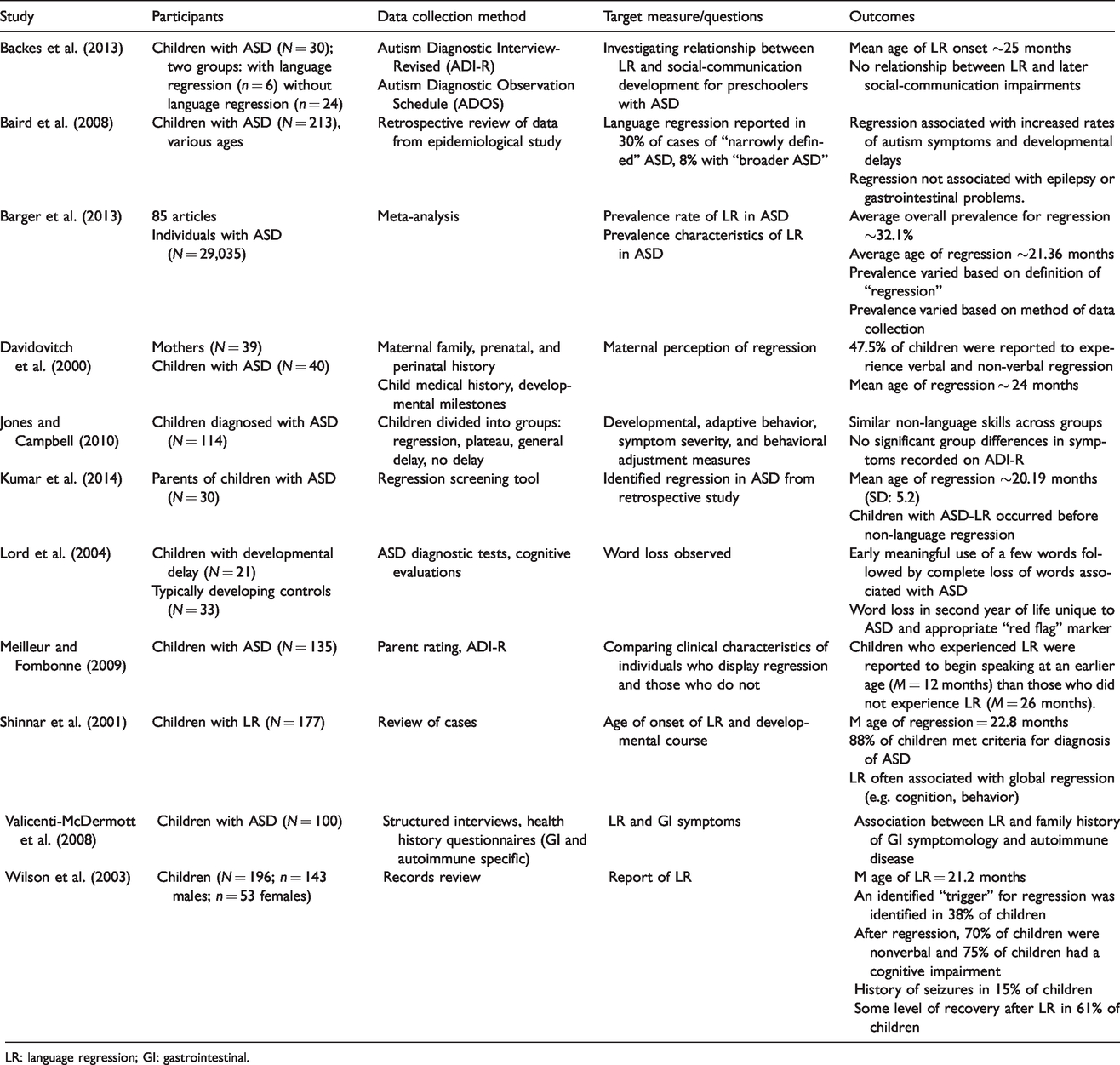
LR: language regression; GI: gastrointestinal.
Summary of Main Findings

PMH: prior medical history; ADOS: Autism Diagnostic Observation Scale; ADI-R: Autism Diagnostic Interview-Revised.
Review of current literature
Language regression can be described through clinical results of testing, parent reports, and observational protocols. The specific characteristics of language regression are variable between individuals with ASD, as well as the age of onset for word loss, recovery, and co-morbid conditions (Baird et al., 2008; Shinnar et al., 2001; Wilson, Djukic, Shinnar, Dharmani, & Rapin, 2003).
The age of onset for language regression reported by parents ranged from 19 to 25 months (Backes et al., 2013; Barger, Campbell, & McDonough, 2013; Kumar, Karmakar, & Mohanan, 2014) with the earliest reported age of “first words” before regression reported to be at 12 months of age (Meilleur & Fombonne, 2009). Upon review of the current studies, it was found that the approximate time until the child is referred to a professional for diagnosis or treatment is approximately three years from when regression was first noted (Wilson et al., 2003). Within Wilson et al.’s sample (2003), approximately 60% of parents reported some sort of improvement in their children after regression, although only 1% of the sampled parents reported a full recovery of lost skills over an average of approximately 30 months.
According to parent interviews, in approximately 38% of cases of individuals with ASD who have experienced language regression, a parent recalled a “trigger” before loss (Wilson et al., 2003). These reported triggers included seizures, illness, and trauma (either physical or emotional; Wilson et al., 2003). In studies by Baird et al. (2008) and Valicenti-McDermott, McVicar, Cohen, Wershil, and Shinnar (2008), family history of autoimmune and gastrointestinal symptoms was investigated as “triggers” or causal relationships. It was noted that individuals with ASD who did regress displayed an increase in irregular bowel movements and family history of autoimmune diseases, including celiac and irritable bowel syndromes (Baird et al., 2008; Valicenti-McDermott et al., 2008).
Furthermore, a common characteristic noted in individuals with ASD who regressed was a greater degree of deviance from typical development and severity of autistic traits (Baird et al., 2008). Wilson et al. (2003) concluded that language regression in ASD was typically not an isolated phenomenon, but also occurred in conjunction with a “global autistic regression”, where social skills, play, and sleep are also noted to regress.
Language theory
To propose possible hypotheses for why language regression or lack of progress in learning words is observed in children with ASD, language theory should be considered. By reviewing several theories of language development and word learning, it may be possible to contrast what occurs in typical development with the development of individuals with complex communication needs. One of the hallmark differences observed in individuals with ASD is a decrease in joint attention and attention to social cues (Dawson et al., 2004). To further elucidate the difficulties in word learning, retention, or extension, the primary theoretical foci related to word learning in individuals with ASD are: social-pragmatic theory, associative theory, usage-based theory, constraint-based learning (fast mapping and mutual exclusivity), as well as the phenomena of protowords and echolalia.
The foundation of the social-pragmatic theory of word learning is the social nature of children learning language (Tomasello, 2000). This theory of language development does not rely on particular inherited structures within the child, nor does it rely on external factors the child encounters (Tomasello, 2000). Instead, the social-pragmatic theory grounds word learning in the socialization of the child to learn and understand new words through joint attention (Baldwin & Moses, 2001). Through joint attention and learning distinctive contexts that impact word meanings and how words are used (e.g., requesting needed items in play or commenting to gain attention in the home), children are able to extrapolate words and word meanings (Baldwin & Moses, 2001; Tomasello, 2000). Bloom (2000) discusses theory of mind and its use in learning new words. Theory of mind refers to the ability to consider the cognitive processes and beliefs of others (Baron-Cohen, 2000). Specifically, this social and cognitive skill of theory of mind is used in the process of learning the meaning of new words spoken by communication partners by relating their words to their thoughts and intentions (Bloom, 2000).
The associative perspective on word learning accounts for the rapid rate of new word acquisition in childhood. Smith (2000) discusses the associationist concept of pairing a spoken word to a cue within an object—such as shape or size. The spoken word to this referent is then rapidly learned through the child’s attention to the specific, familiar cue. This is of interest when looking at word learning in individuals with ASD since joint attention is an area that is often impaired. Within this theory, joint attention is deemed as a crucial skill to communicating, as the child needs to attend to the communication partner and the referent and the associated symbol (i.e. word).
In the usage-based theory of word learning, Lieven (2014) depicts language (i.e. word) learning to be specific to what children receive as input and what goal they are trying to achieve. Initially, children are learning “chunks” of information, explicit to the prosody and intonation of the input they receive (Lieven, 2014). Over repeated exposures, Nelson (2009) argues that word meaning is learned through repeated use and social cues or rules from the community. Without this generalization to a broader context of word use, the meaning of the word will be narrowly defined and limited in use (Nelson, 2009). This usage-based view of word learning is based on the social nature of language (Lieven, 2014). Similar to the social-pragmatic and associative theories of word learning, joint attention to the communication partner is vital, allowing individuals to identify social cues related to the language input they are receiving.
Bloom (2000) discusses the idea of fast mapping in young children and their ability to apply this to word learning. According to the concept of fast mapping, an initial encounter with a word leads the child to learn some characteristic about the object or referent related to the encountered word that will allow them to be able to apply this word across future contexts (Carey, 1978). The concept of mutual exclusivity is also associated with fast mapping, where children will attribute new/novel words to objects or actions for which they do not already know a name. It is this inclination in children as young as 15 months of age that aids in the rapid learning of new words in typical development (Markman, Wasow, & Hansen, 2003).
Initial words in early development are typically characterized as protowords, or not fully words (Hoff, 2013). These early protowords have phonological components similar to adult words; however, they do not occur in exclusive and consistent contexts (Hoff, 2013). Laakso, Helasvuo, and Savinainen-Makkonen (2010) suggested that initial protowords in conjunction with gestures allow parents to link meaning and further develop word use and understanding. It is important to note that joint attention plays a significant role in the development of true words from protowords following Laakso et al.’s (2010) hypothesis because of the need for a gaze shift to the referent and the communication partner.
Echolalia, as discussed earlier, is the repetition of another’s spoken words or utterances (Sterponi & Shankey, 2014). In typical development, young children will often imitate the spoken words of their communication partners. Baddeley, Gathercole, and Papagno (1998) discussed the use of the phonological loop in young children when learning new words and its role in storing this new information in the child’s short-term memory. Through the imitation of a communication partner’s speech, along with the joint attention to the paired referent or communicative context, these imitated words can be transferred to long-term memory. The formation of long-term memory constructs leads to the true learning of new words based on this hypothesis.
Discussion
The cause of language regression is still unknown. Based on the reviewed theories and phenomena related to word learning, the relative importance of joint attention and awareness of social cues can be illustrated. Because of the consistent deficit in joint attention and social cue awareness in individuals with ASD, there are several hypotheses that may aid in explaining language regression. For the purposes of this theoretical article, hypotheses presented will be specific to those individuals with gradual language regression onset. The proposed hypotheses are as follows: (a) Initial first words were not true words, but instead were protowords; (b) fast mapped words were never applied outside narrow contexts and without increased use never progressed to truly learned words; (c) initial first words were echoed productions of heard words, but not maintained and transferred to becoming learned words; (d) the described regression is actually a maintenance of previous developmental levels with increasing chronological age, widening the gap between norms and present functioning. These hypotheses are not mutually exclusive and serve as theoretical proposals for explaining language regression.
Protowords
Protowords are the earliest speech-like productions in young children (Laakso et al., 2010). Protowords consist of strings of early repeated speech sounds without clear symbolic pairing. Because protowords are not fully symbolic, the communication partner bears a greater burden to pair meaning to protowords by following the child’s gaze and actions. For example, a child may produce the form /ʌm/ while sitting near their parent. The mother may reply with a paired response of “That’s right, mama! You want mommy!” and proceed to point to themselves while speaking before picking up or interacting with the child. In typical development, this pairing of gaze and mapping of intention scaffolds the transition to true word use. It is possible that, due to limited joint attention and shared engagement in children with ASD, these protowords did not form a symbolic representation. Without the paired symbolic representation and scaffolding to true word production, the child with ASD may discontinue producing these early protowords. In this instance, it is hypothesized that this ceased protoword production is what is observed as regression or “word loss”.
Consistent with this hypothesis were the findings by Meilleur and Fombonne (2009), where individuals who experienced language regression were reported to begin “speaking” at an earlier age (i.e. around 12 months). It is possible that these earliest reported words for individuals who later “lost” language were, in fact, protowords. These protowords may not have been expanded to symbolic use due to the joint attention skills of the individual.
Fast mapping
In early development, it has been consistently shown that children are able to “fast map” new words (Carey, 1978). Fast mapping is characterized by the ability of young children to identify new words presented to them after only minimal exposure and recalling them at a later time (Bloom, 2000). This surface level recognition of words upon initial exposure does not necessarily lead to true word learning. One possibility regarding regression is that this surface learning did not transfer to memory to become part of the child’s lexicon. Bloom (2000) discusses some semantic blurring of early words, that is to say that they are bound to the context in which they are used. Additionally, there is a cognitive load associated with moving from familiarity with a new word to “knowing” this new word. In the case of language regression, it is possible that fast mapped words were never applied outside the narrow contexts in which they were first presented. Furthermore, without increased use by the child and the parent across contexts, perhaps these fast mapped early “words” were never consolidated into truly learned words. Nelson (2009) suggests that the increased use of a word will solidify the understanding of the meaning. Additionally, as part of the usage-based theory of word learning, Lieven (2014) suggests that the social consequences of words drives their use; therefore, increasing the likelihood of a child using these words. If these early fast mapped words are not continually used it is possible that the meaning or concept of the word was never formed, leading to the perceived “regression”.
Furthermore, in a study by Bion, Borovsky, and Fernald (2013), it was found that children will reliably fast-map new words around the age of 18-months but do not consistently retain the new fast-mapped vocabulary over time. Children began to recall and show preference for novel words exposed in fast-mapping paradigms around 24 months of age and solidify their recall and disambiguation of new information by 30 months of age. Interestingly, these differences in when children would be expected to recall new vocabulary that may have been fast-mapped is consistent with the age when language regression is noted. This further supports the hypothesis that “lost” words were fast-mapped and not truly learned words.
Echolalia
The phenomenon of echolalia is consistently noted in individuals with ASD. It is possible that early “words” were simply immediate echoes of a communication partner’s speech. Baldwin and Moses (2001) discuss social understanding and its importance in word learning. This social understanding stems from triadic joint attention between a child, communication partner, and the object or action of focus. The presented hypothesis of early “words” as echolalia is based in the idea that individuals with ASD display impaired joint attention and social connectivity. Perhaps, early words were echoed by the child; however, because of decreased joint attention to the referent, the child never paired the meaning of the word to the object or action. For example, a communication partner may state “doggy” within a sentence while looking at a dog. The young child with ASD may echo “doggy” but is not attending to the referent and is insensitive to the social reinforcement from the communication partner to pair the word to its meaning.
In a study by Jones and Campbell (2010), it was found that non-language and Autism Diagnostic Interview-Revised skills did not significantly differ across those individuals who did experience language regression, did not experience language regression, and those who plateaued in development. It may be possible that echolalic productions, a common phenom across individuals with ASD, was a significant factor in the perceived earlier language skills of those individuals who experienced regression.
Maintenance vs. regression
As mentioned earlier, studies have displayed maintenance of earlier skills over increasing chronological age without progression of skills in individuals with ASD (Lord et al., 2012). Based on these findings, it is proposed that earlier skills, such as protowords may be maintained, but as the individuals with ASD grow older, the disparity between their skills and developmental norms increases. With this disparity, it appears that individuals with ASD are “worsening” or regressing, but in fact are maintaining without progressing. For example, if a child initially communicates by unconventional means, such as grunting to gain attention, this may not be a large deviation early in development (i.e. before the first birthday). As the child ages, however, this behavior becomes more aberrant and deviates from developmental norms. It is possible that these differences become more apparent and may be perceived as regressing. As reported by Ozonoff et al. (2010, 2018), social behaviors, such as eye gaze and joint attention, do seem to regress over time in individuals with ASD. It is possible that these social behaviors that were initially perceived as intentional communicative acts (i.e. eye gaze) subside, drawing attention to the limited communication skills of individuals with ASD.
As reported in a large prospective study conducted by Landa, Gross, Stuart, and Faherty (2013), typically developing individuals displayed sizeable improvements in both their receptive and expressive language skills around their second birthday, while individuals who were diagnosed with ASD did not. These participants were evaluated using the Mullen Scales of Early Learning (Mullen, 1995), in which the examiner selects starting and ending points dependent on the child’s age and test performance (i.e. basals and ceilings). While there were decreases in raw scores between timepoints for some individuals with ASD in this study, this change does not necessarily mean they were worsening in areas in which they were previously successful; instead, testing may have been initiated and discontinued at different points in testing—therefore targeting different questions. To determine true loss, one would need to look item by item across timepoints to better determine whether these changes are in fact a true loss or more of an “illusory” regression.
A common pattern across the reviewed retrospective studies of language regression in ASD is parent recall of regression onset around the second birthday—a time when typically developing children begin combining words. Furthermore, it has been reported that joint attention skills are significantly decreased in individuals with ASD at 24 months compared to their typically developing peers (Naber et al., 2008)—around the same time of parent reports for regression of skills. In addition to the increasing gap between typically developing peers’ scores and the maintained scores of individuals with ASD, these missed developmental milestones in both language and joint attention may serve as a catalyst for parent reports. While this does not account for cases of actual discontinued use of words, it does aid in accounting for the trend of onset near the second birthday. Consistent with this hypothesis were the findings by Davidovitch, Glick, Holtzman, Tirosh, and Safir (2000) and Shinnar et al. (2001), where language regression was reported around the second birthday (i.e. approximately 22 to 24 months).
Clinical implications
Based on the proposed hypotheses for language regression, there are several clinical implications that should be highlighted. Specifically, the way in which clinicians test language and screen for language regression, as well as clinical treatment of language regression in ASD, is considered.
Evaluation
As reported by Wilson et al. (2003), the average time to referral is typically around three years from regression onset. This is to say that these individuals have “lost” their words up to three years before they undergo evaluation by an appropriate medical or clinical professional. The current battery of tests requires parents to recall specific information about their child’s ability to understand and produce specific words and gestures. For example, the Language Use Inventory asks parents to identify all modes of communication and their social use of these modes, including the perceived intent and specific language skills (i.e. sentence use, question asking and responding, etc.; ONeill, 2009). It is possible that the large span of time until referral may make it difficult for parents to accurately identify specific communicative intents of early “words” or the specific contexts they were used within.
Other measures that are commonly used include the McArthur Bates Communication Development Inventory (Ireton, 1992) and the Communication and Symbolic Behavior Scale (CSBS) Infant-Toddler Checklist or Developmental Profile (Wetherby & Prizant, 2003). These early language assessments utilize parent report and recall of current skills, as well as previously used skills. It is possible that the objective recall from parents may be dampened by time and the ability to operationally define these early words may be difficult. Furthermore, these assessments are often completed through questionnaire forms, placing the burden of interpreting and responding to prompts on the parents.
Proposed testing measures
Based on the limitations presented in these currently used assessments, the following recommendations are proposed: (a) retrospective studies using home video and social media and (b) interactive interviews with trained professionals to probe specific contexts and forms of early “words”.
Osterling and Dawson (1994) conducted a retrospective study of home videos for the diagnosis of ASD, with accurate predictions from videos in 91% of individuals. Researchers assessed home videos from first birthdays regarding social skills, affection, and communication skills. Based on these promising findings, a proposed method is to look at early home videos of first words and use social media postings as a timeline of first words and contexts they were used in. Based on the review of these videos and postings, trained professionals would then probe specific questions surrounding the context of the words’ use, the frequency of use, and the consistency of form. Additional information can be gained through successive videos that document change in context, form, and frequency.
An additional proposed method of evaluation of early words and language regression is the use of trained professionals interviewing parents to assist in the development of an operational definition of early “words”. By following the questions in an evaluation measure such as the CSBS, trained professionals would be able to further probe regarding the form of early words that were used, the frequency of their use, and the contexts in which they were used. By providing an operational definition that clearly defines the antecedent, the form of the behavior, and what consequences occurred might provide additional information regarding the true nature of “word loss”.
Treatment
As noted by Wilson et al. (2003), approximately 60% of individuals with ASD who experience language regression do show some improvement in language skills, or “recovery”. Within the sample in this study, only 1% fully regained all regressed skills. If the proposed causes of language regression based on language theory are true, it may be more effective to focus interventions on language stimulation and the transition to symbolic communication, instead of attempting to regain earlier “words” that are no longer observed. In Romski et al.’s (2010) study, individuals who were non-speaking and did not have a consistent means of symbolic communication showed great benefits from the implementation of augmentative and alternative communication (AAC) supports. Individuals who were provided treatment with AAC, whether the focus of intervention be input from AAC or output using AAC, showed larger gains in communication—both spoken and augmented—than the speech only condition (Romski et al., 2010). Further research is needed in the use of AAC for individuals with ASD who have experienced language regression.
In addition to the provision of AAC supports, providing early services through early intervention and family focused goal setting is recommended (Moes & Frea, 2000). One intervention that focuses on one-on-one, play-based services provided in any natural setting for individuals with ASD is the Denver Model (Rogers, Hall, Osaki, Reaven, & Herbison, 2000), while the More Than Words program focuses on parent mediated services in daily activities (Sussman, 1999). These programs provide language rich environments in social interactions to support the development of language skills and the social use of communication and language (Rogers et al., 2000; Sussman, 1999).
Both of these proposed treatment recommendations are founded in the improvement of joint attention and social use of language. Light and McNaughton (2014) discussed four communicative competencies for individuals who utilize AAC, one of which was social competence. Additionally, the provision of services in an early intervention, play-based model focuses on the joint attention to shared references and social cues—further expanding the joint attention skills of individuals with ASD.
Future directions
There is still much to be learned regarding language regression and the cause in individuals with ASD. The proposed evaluation measures should be researched and compared to current means to determine if (a) first words were actually true words, (b) the proposed methods do in fact provide important information for medical professionals and clinical staff, and (c) the proposed methods provide more accurate and detailed information than previous methods. Additional future research in the use of prospective studies in clinical settings should be considered. For example, the use of home videos and social media postings during well-visits with pediatricians, or regular monitoring of vocabulary by early intervention speech-language pathologists in home, and daycare settings for siblings of individuals with ASD.
Conclusions
Based on theories of early language development and word learning, it is possible that individuals with ASD are not “losing” words, but instead are not progressing in their ability to learn and use new words. Looking at typical language development, early word learning in typically developing children is seemingly similar to early development in individuals with ASD; however, the ability to expand from early “intermediate words” (i.e. through fast mapping, use of protowords, or echolalia) to expansive vocabularies, word combinations, and morphological variations is impeded.
Clinically, there is a consistent separation between theory and practice. The use of language theory to guide diagnostic decisions and clinical practice proves to be beneficial, especially when looking at early language development. With consistent advancements in technology, the use of theory should not be disregarded in decision making and guiding clinical practice. When there is lack of evidence for evidence-based practice, we should turn to theory to help with decision making and guide important research questions to better meet the needs of the individuals we serve.
Footnotes
Acknowledgments
An earlier draft of the paper was prepared as part of the requirements for a doctoral course. I would like to thank to Dr Carol Miller for guidance and comments on earlier drafts and revisions of this manuscript.
Declaration of conflicting interests
The author(s) declared no potential conflicts of interest with respect to the research, authorship, and/or publication of this article.
Funding
The author(s) disclosed receipt of the following financial support for the research, authorship, and/or publication of this article: Kaitlyn was supported by the Penn State AAC Doctoral Leadership Grant from the U.S. Department of Education (grant #H325D170024).
