




Abstract
Background
In 2015, a father took his 14-year-old son who is on the autism spectrum on a six-month journey aimed to develop his son’s social-communication and independent living skills. The duo travelled across 10 countries, meeting people and practising these skills. This study examined their goals, motivations for, and outcomes of the journey.
Method
We used intrinsic case study methodology with mixed methods, including interviews with parents and professionals; analyses of filmed interactions between the son, his father and strangers during the journey; and descriptive analysis of parent-reported changes in their son’s participation at home, school and in the community using the Participation and Environment Measure – Children and Youth.
Results
Qualitative analysis of the interviews with parents and professionals revealed a set of insightful goals and motivations, focusing on creating an optimal environment for the son’s development. Parents reported increases in their son’s social-communication and independent living skills, but also unexpected changes in his perspective and self-belief. The former findings were consistent with those arising from video analysis, whereby social-pragmatic skills critical to good conversations (staying on topic, body position, eye contact) all increased over the course of the journey, while abrupt topic changes and conversational prompts reduced. Participation and inclusion across home, school and community settings all increased over the same period.
Conclusion
While this study makes no claims regarding causation, the findings indicate that the journey was associated with positive changes for the son and his parents, leading to greater expectations for, and progress towards, independence following the journey. Implications of the findings for supporting young people on the autism spectrum in regular community settings are discussed.
The teenage years present a tremendous opportunity for young people to rapidly develop their knowledge and skills, and grow in their understanding of the world and independence. However, for many adolescents, including those on the autism spectrum, these years can be challenging as the complexity of social interactions and expectations increase (Duncan & Klinger, 2010; Gates, Kang, & Lerner, 2017). Social-communication difficulties and restricted and/or repetitive interests and behaviours, along with commonly reported anxiety, often create barriers to frequent, inclusive, and broad participation across a range of activities at home, school and in the community for adolescents on the spectrum (McConnell, 2002; Rao, Beidel, & Murray, 2008). In turn, motivation to develop, as well as opportunities to seek and practise new skills may diminish, thus establishing a negative cyclical process (Chang et al., 2014). Despite widespread awareness of these issues amongst persons on the spectrum, families, clinicians and researchers, only a relatively small proportion of research activity has been directed towards understanding and supporting adolescents on the spectrum and their families (Laugeson, Gantman, Kapp, Orenski, & Ellingsen, 2015; Levy & Perry, 2011).
Efforts to enhance social-communication and independent living skills in young people on the spectrum have focused predominantly on engineering the environment and the development of social skills interventions. For instance, structured teaching is commonly used in education settings in an attempt to support executive functioning (e.g., organisation and planning skills), and hence participation in classroom activities, amongst students on the spectrum, through environmental arrangement and the use of visual schedules and work systems (Howley, 2015). Concurrently, a variety of social skills interventions have been developed to teach children and adolescents knowledge and skills that are considered important to engaging in effective social interaction from a neurotypical standpoint, such as maintaining eye contact, taking another person’s perspective, sharing turns in a conversation and maintaining conversational topics. These interventions typically employ a range of empirically supported behavioural strategies including modelling, rehearsal, prompting and prompt fading, and reinforcement, and are most commonly delivered in a group-based format, and include clinician-delivered (e.g., Lopata et al., 2010), peer-mediated (e.g., Corbett et al., 2016), and caregiver-assisted (e.g., Laugeson et al., 2015) approaches. Structured teaching and social skills interventions were classified as having emerging and established evidence respectively in the most recent National Standards Report review (National Autism Center, 2015).
Although a range of evidence-based interventions to support social-communication and independent living skills have been developed, there may be challenges to their application and generalisation of outcomes in the community. For instance, although structuring the physical environment of the classroom is possible using structured teaching, applying this approach is not a feasible proposition across all environments adolescents encounter. With regard to generalising outcomes, the findings of a recent meta-analysis (Gates et al., 2017) indicate that adolescents who received group-based social skills interventions across 19 randomised controlled trials learned the social skills taught to them, but did not always enact the skills in everyday situations. Furthermore, reported large aggregate effects for outcomes across these studies based on personal report by adolescents on the spectrum contrasted with only small effects identified based on parent report, and no effects in the case of teacher report. Gates et al. (2017) are amongst others (e.g., Bellini, Peters, Benner, & Hopf, 2007; Parsons, Cordier, Munro, Joosten, & Speyer, 2017; Rao et al., 2008) to call for greater accommodation of factors (e.g., practise in multiple contexts, parent/caregiver involvement, sufficient intensity) that otherwise likely negatively impact on the generalisation of intervention outcomes.
The fact that challenges may exist in applying and generalising the outcomes of interventions designed to support social-communication and independent living skills is not surprising, given the recognised research to practice to gap in the field of autism as well as other related developmental disabilities (e.g., Greenwood & Abbott, 2001; Guldberg, 2017). Common challenges include resource constraints, geographical isolation and ensuring that interventions align positively with culturally based differences in child rearing and educational practices (Dingfelder & Mandell, 2011). Yet other factors – or put simply reasons why these interventions may never be totally sufficient – are in fact more complex and arise out of the additional unique circumstances, characteristics, goals and beliefs that parents and teenagers on the spectrum bring to the question of how best to build a broad, enjoyable and interesting life for themselves and their family. Occasionally, these factors come to the fore when parents and teenagers adopt unconventional approaches to achieve these objectives, and in doing so provide insights that may help to shape more conventional intervention programmes.
In this article, we present a case study examining one family’s unconventional approach to supporting growth in social-communication and independent living skills in their adolescent son on the autism spectrum. Our aim was to examine the parents’ goals and motivations for embarking on the journey, as well as the outcomes. Our proposition was that the journey would be associated with positive changes in the young person’s social-communication and independent living skills. Specifically, and focusing on observable social-communication skills, we anticipated increases in eye contact, socially appropriate body position, and topic maintenance, alongside reductions in abrupt topic changes and the need for parent support during interactions with the father and strangers over the course of the journey. It is important to note that identifying propositions in case study research assists in framing the exploratory analysis of multiple sources of information (Yin, 2009), as opposed to representing a testable hypothesis as part of an empirical study. We did not have a proposition regarding the parents’ goals and motivations, which were also the focus of exploratory analyses.
Origins of the case study
On 22 May 2014, the first author received an email from two parents – James and Benison – titled ‘possible N1 project.’ In research, n-of-1 refers to a collection of study designs involving the close examination of outcomes for one, or a small number of, individuals. Consistent with case study methodology of combining multiple data sources in presenting the case (Creswell, 2007), an excerpt of the email is provided below: I am a GP in Sydney with a special interest in autism … I am wondering whether you or the team would be interested in being involved with a N1 study with my son, Sam, who is 13 years old. I am doing a planned intervention spanning 12 months, starting January 2015 … I am purposefully exposing Sam to as high a level as possible of a ‘dynamic environment' by the two of us backpacking through Africa. Through the year, I will be progressively getting Sam to take control of the traveling requirements and responsibilities in a supervised but increasingly un-scaffolded fashion … While we are acutely aware that what we are planning is non-evidence based, and also that there are inherent risks in taking a teenager with a disability backpacking through the developing world, we feel it is worth a shot. We also feel that we should be attempting some measurement (if possible) of the process.
Methods
Ethical approval
The study was approved by the Griffith University Human Ethics Committee (AHS50/14). Sam, James, Benison and two professionals (Alice and Katherine) all provided written statements expressing their preference for their real names to be used in this article. In addition, all participants were provided with a copy of the manuscript and supported it being submitted for publication.
Design
An intrinsic case study design with mixed methods was used to address the research aim (Creswell, 2007; Yin, 2009). Sam and his parents together constituted the case, given their relationship and activities together would be directly tied to possible changes in Sam’s social-communication and independent living skills.
Participants
At study commencement, Sam was 14 years old and was attending a mainstream high school, after transitioning from a special education programme during primary school. Sam was diagnosed as being on the autism spectrum at age three and received a range of early intervention programmes and supports through his preschool years. At the time of the study, based on the Vineland Adaptive Behavior Scales – 2nd Edition (parent form; Sparrow, Cicchetti, & Balla, 2005), Sam was experiencing significant challenges in receptive, expressive, and written communication, social interaction and daily living skills.
James and Benison described Sam as ‘contradictory’ given his strengths in areas such as mathematics, where he was amongst the top group of students in his class, but also substantial challenges in social-communication skills. They described how there was ‘never a dull moment’ with Sam lacking a ‘social filter’ which was ‘… at times charming and at other time terrifying.’ James and Benison noted that they found it hard to know what he was thinking about the journey they were proposing. James explained: It’s really hard to see what perspective he has on things – like people have often asked me what does he think about going to Africa and I don’t know. My standard answer has been we could be going to Burwood Plaza …
James was a general practitioner of 15–20 years, senior clinical lecturer at The University of Sydney, and father to Sam and two other boys. He was a published research author, had contributed to clinical guidelines in the field of autism, and regularly authored for news organisations and child and family related community sites. James ran a large private practice that reportedly placed substantial demands on his time. Benison was mother to Sam and two other boys, and worked as a pharmacist prior to becoming trained as a medical writer. She co-authored The Complete Autism Handbook (O'Reilly & Wicks, 2016) and regularly published freelance articles for news organisations and child and family related community sites. Benison made the journey to Africa possible by remaining in Australia throughout where she had family and work responsibilities.
Two allied health professionals also participated in the study by completing interviews with the first author prior to Sam and James’ journey regarding what they perceived were the goals, motivations and possible outcomes of the journey. They were a speech pathologist (Alice) and psychologist (Katherine) who had worked with Sam in private practice settings for approximately one and four years respectively prior to the journey. They were both experienced in working with children and adolescents on the autism spectrum and their families.
The journey
Sam and James departed Australia in March 2015, landing in Cape Town. Over the course of six months, they travelled through South Africa, Lesotho, Namibia, Botswana, Zimbabwe, Zambia, Malawi, Uganda, Kenya and Tanzania. In most cases, the duo stayed for 1–3 days at a particular location prior to moving to the next using public transport or organised group travel. Accommodation comprised mostly hostels, small hotels and organised camping and both accommodation and daily activities were selected to maximise the opportunities to interact with other travellers, guests and hospitality staff.
James established a routine set of activities aimed at promoting Sam’s development of social-communication and daily living skills. These included Sam taking increasing responsibility for daily activities such as ordering food at restaurants and helping to plan the next phase of the journey. James also taught Sam to play chess, they practised boxing and completed school work together, and they participated in group activities (e.g., tours). The duo also had regular debriefing sessions in which they reflected on events that had occurred, including the success (or otherwise) of Sam’s interactions (e.g., ordering food at restaurants) and conversations with fellow travellers and local people. A detailed account of activities and reflections on the journey was published as an online blog (available at http://www.samandjames.life).
Data collection and analysis
We used three complementary sources of information to examine the goals, motivations and outcomes of the journey for Sam and his family.
Qualitative interviews and analysis
The first author completed a series of semi-structured interviews with James and Benison, as well as separate interviews with Sam’s speech pathologist and psychologist, prior to the journey. Using the same semi-structured interview guide across all participants, he explored their perspectives regarding (a) goals and motivation for the journey (e.g., ‘What do you think James and Benison might be hoping to achieve with this trip?’ ‘Why this trip to Africa? Why not just do it at home somehow?’), (b) potential opportunities (e.g., ‘What opportunities does this trip provide?’), (c) possible risks and challenges (e.g., ‘Is there an argument to say things are just starting to happen [for Sam] … why upset the applecart and go overseas?’) and (d) potential outcomes (e.g., ‘How will you know if its worked?’). He completed an interview with Benison after three months, and a further interview with James and Benison at the completion of the journey. For these interviews, questions focused on perceived outcomes (e.g., ‘Have you noticed any differences in the way that others interact with Sam?’) and the relevance of their experience in their own lives and those of other families raising children on the spectrum (e.g., ‘What are the lessons, or ingredients, or things that you might be able to take and translate to just a more normal life’). The speech pathologist and psychologist were not contacted for follow-up interview following the journey as they were not providing services to the family.
Interview data were analysed using a descriptive framework, according to the methods outlined by Yin (2009) which combines focused analysis of the topics of interests (i.e., goals, motivations and perceived outcomes) with identification of patterns across these components. With respect to outcomes, Pattern matching was applied to compare James’ and Benison’s views with the study proposition regarding changes in Sam’s social-communication and independent living skills. The first author led the analysis of all transcripts and recordings, with the remaining authors reviewing the findings with respect to original transcripts. Any differences in opinions regarding interpretation of the data were resolved through discussion. Member checking was completed wherein the findings were shared with those who participated in the interviews, and their feedback regarding the credibility of the findings was sought. Only minor changes (e.g., clarity of expression, removal of grammatical errors in their statements) were requested and made accordingly.
Yin’s (2009) four principles for conducting case study research were adhered to, through (a) collecting and analysing multiple and all available sources of data, (b) considering alternative explanations and interpretations for the study findings, (c) identifying the most significant aspects of the study findings and (d) acknowledging and applying our existing knowledge to conducting the study and interpreting the findings. With respect to the latter, the first and fourth authors were both experienced researchers and clinicians in the field of autism and language disorders, as well as in qualitative research methods. The second and third authors were recent graduated speech pathologists, working in clinical practice. All authors are strong advocates for the right of all persons with disability to have access to the same opportunities in life as their peers without disability. Prior to this study, the emphasis of their work in this area was on the development and evaluation of more traditional evidence-based interventions, such as those used in schools and clinical settings.
Video observations and analysis
While the qualitative study examined James and Benison’s perceptions of outcomes of the journey, we examined video recordings of Sam during interactions with James and with strangers to provide an objective measure. We asked James to record weekly 5–10 minute video interactions involving himself and Sam reflecting during the journey, as well as Sam initiating conversations with strangers (e.g., fellow travellers, local people) as opportunities arose. A total of 19 videos of Sam and James reflecting were recorded from April to September. A further 62 videos of Sam interacting with strangers were recorded over the same time-period, in three main contexts: Sam having informal conversations with strangers, Sam ordering food at restaurants, and Sam and James checking-in to accommodation. Of these videos, those involving Sam in conversation with strangers were selected for analysis, given they provided the most consistent context in which to measure any possible changes in skills over time. In contrast, the nature of interactions in the restaurant ordering and check-in contexts were highly dependent on the context (e.g., protocol for ordering at each location) and communication partner expectations (e.g., speaking to James instead of Sam). In total, 15 videos of Sam and James and 15 videos of Sam talking with strangers, selected on the basis that they occurred within the same week as each other, were selected for behavioural analyses of possible changes in Sam’s social-communication skills over time. Recordings were made using a portable video camera and returned to the first author via post at regular intervals. We provided James with a set of open-ended questions that he could use to encourage conversation between himself and Sam, such as ‘what was the most interesting thing that happened this week?’ For conversations with strangers, we asked James to encourage Sam to simply ‘have a chat’ with the people they met. On each occasion, James gained verbal consent from the communication partner for the conversation to be video recorded for use in the research study and possible use in a documentary.
The 15 recordings of James and Sam reflecting were a mean length of 5 minutes and 37 seconds (range = 3:28–8:46), while those of Sam talking with strangers were a mean length of 5 minutes and 69 seconds (range = 3:03–11:29). We used 15 second interval coding of up to the first 7 minutes of each video to identify the proportion of intervals in each video in which the following target behaviours were observed: (a) Sam maintaining the topic of conversation, (b) Sam abruptly changing the topic of conversation, (c) Sam looking to the communication partner on at least one occasion, (d) Sam adopting socially appropriate body posture and orientation towards the communication partner and (e) James providing audible suggestions to continue the conversation. The operational definitions for each behaviour are provided in Appendix 1. These behaviours were selected on the basis that they are (a) considered important for conversation in the participants’ culture, (b) are well documented to be challenging for many people on the spectrum, (c) can be captured using video recording and (d) would be less prone to the influence of the communication partners’ cultural and language diversity than language-based measures based on conversational analysis. However, it is acknowledged explicitly that given the value placed on the skills examined is culturally driven, individuals on the spectrum may have different views regarding their importance (Pellicano & Stears, 2011). Accordingly, James and Benison were not told what the focus of the video analysis would be and were not provided with instructions by the research team regarding skills to target during the journey, to avoid the possibility that the research would influence the manner in which they saw fit as a family to promote Sam’s social-communication skills, taking into account his personal preferences.
The videos of Sam and James talking were coded by the third author, with the videos presented in a random order. That said, Sam’s and James’ observable changes in physical appearance (e.g., length of hair) and their reflections within videos on past experiences meant that absolute blinding to order was not possible. The videos of Sam and strangers were coded a research assistant (speech pathologist), again presented in a random order. The first author completed independent inter-rater reliability for 26% of videos in each set. Interclass correlations (ICCs) and their 95% confidence intervals (CIs) were calculated using SPSS statistics software version 22 based on absolute agreement, a single-measurement rating, and using a two-way mixed effects model and reported and interpreted according to the guidelines presented by Koo and Li (2016) for poor (values less than 0.5), moderate (0.5–0.75), good (0.75–0.90) and excellent (values greater than 0.90) reliability. All ratings were moderate or above, with a mean ICC value of .76 across videos and ranging from 0.518 (95% CI = .263–.699) to .952 (95% CI = .933–.966).
Participation
James was asked to complete the Participation and Environment Measure – Children and Youth (PEM-CY; Coster et al., 2011) at three time points (5 months prior to departure, at departure and upon return) to measure the possible changes in Sam’s participation and environmental factors over the course of the journey. The PEM-CY asks respondents to indicate (a) how often the child participates in a set of activities (8-item scale ranging from daily to never, and with a different set for home, school, and in the community), (b) how involved the child is when doing these activities (5-item rating scale ranging from very involved to minimally involved) and (c) whether the respondent desires a change in these activities (6-item scale examining frequency and level of involvement). The respondent is also asked to comment on environmental factors (e.g., cognitive demands, sensory demands, support available, strategies used) that may influence participation.
In order to allow comparison of data across time points, the following method was used to calculate a score for Sam’s frequency and level of involvement in activities at each time point. Frequency of involvement was calculated by taking the rating for each activity (e.g., score of 0 for ‘never’ compared to 7 for ‘daily’) and adding them in a cumulative fashion. Two activities related to engaging in computer games and television were excluded as both of these were viewed by Sam’s parents as undesirable and thus changes in these would distort the overall ratings. Sam’s involvement in activities was measured by summing the ratings for each activity (e.g., 1 for ‘minimally involved’ compared to 5 for ‘very involved’) to give an overall score, where higher scores reflected greater levels of involvement. Again, ratings for engaging with computers and television were excluded as greater involvement was seen viewed as undesirable. James’ view regarding the extent to which he would like to see change in the activities listed (both frequency and involvement) was measured by summing the totals for each response.
Findings
Interview findings
Applying the descriptive framework, participants’ views regarding goals, motivations, and possible and perceived outcomes were explored. Here, analysis of these views is presented, using the participants own words where possible (Chiovitti & Piran, 2003).
Goals and motivations
Consistent with the initial email contact, interviews with James and Benison prior to the journey revealed a strong desire to create an opportunity for Sam to rapidly develop his social-communication and independent living skills. James explained that they wanted to: ‘Expose him to as dynamic an environment as possible: unpredictability, uncertainty and by doing that, to increase his adaptive skills.’ ‘We will also be doing other activities to increase corpus callosum traffic, to increase, in theory, increase the ability for neuroplasticity to come through.’ ‘… from what I understand, their hope was to give Sam the opportunity to develop his independence … across the board with communication, with adaptive living skills, and really … get him to the point where he can function independently in everyday life.’ (Alice) ‘In relation to the goals of the trip, I think the huge component is around the brain development and the age that he's at … I think adolescence is also a period where there's that window of opportunity for brain development.’ (Katherine) ‘Well I think the biggest opportunity that I can see is for generalisation of the skills that he's been working on so intensively for so many years in a clinical context. I see that as a big challenge in therapy, that generalisation of skills. What Sam may do perfectly in a session he may struggle with say at school or anywhere in his everyday context.’ ‘I think there is an opportunity …. with the amount of time they're spending together, for there to be a more … reciprocal relationship, in that there's more opportunity for just social conversation rather than conversation that's routine …’ ‘As I said earlier, I saw some changes in him towards the end of last year where there was, I guess, a bit more maturity in him, more curiosity about the environment, in sessions was more inquisitive of how things work rather than me just telling him … If he was younger … I don't know if the outcomes would be as great – but I think now would be a really great time for James to be doing this with Sam while Sam's starting to mature.’
Perceived risks
Despite apparent agreement regarding possible benefits of the journey, there was also consensus that it would bring with it a number of risks. Seemingly at the forefront of people’s minds, were health and safety, as James expressed: ‘There’s obviously the obvious risks of safety, car accidents, diseases … The car accidents is the one that concerns us most by far …’ (James)
These appeared to be closely followed by concerns regarding separation, as well as concerns Sam’s communication may be misinterpreted: ‘What happens if they get separated?’ (Benison) ‘There is also the issue of, if Sam does say something or do something that is culturally inappropriate over there it might be much more awkward in terms of laws and how people react.’ (James) ‘You know it used to be, a generation ago, it was lock them up in an institution and protect them from themselves … And so we’ve really turned it around in autism … now it is like “push them, push them” …’ ‘The trend all last year was positive … his teachers universally said he was much better at the end of the year.’ (Benison) ‘I’ve got in my head that developmental curve, and I know it’s going to flatten out and stop one day, and that point I want as high on the Y axis as I can. So yes he is improving, but are we at the right trajectory? And this is the time to do it.’ (James) ‘If everything is going along well at school and slowly improving and Sam's enjoying it and then to take him out, yes, I can see how there could be some concerns around that.’ ‘But I think there is this fear of exposing individuals with autism to change, I guess because of what we know about autism, but in my experience, I feel that presenting challenges can be quite beneficial.’
Perceived outcomes
Benison was interviewed mid-way through the journey, and James and Benison together at the end of the journey, to explore their perceptions of outcomes. Mid-way, Benison reported that the journey was progressing but that it was challenging for both Sam and James. ‘Obviously he's been challenged the whole way, but he's also had lots of good times on the way. I suspect it's [the challenges arising] from probably mainly computers, access to IT [one of Sam’s passions]. I think that's probably – and his games, is probably the main reason, is his biggest pull even more than me, that's a reality.’
However, Benison also explained that feedback from James regarding perceived changes in Sam’s skills had been positive: ‘It's interesting. He has had two people – or at least two people – who had seen him earlier and then seen him later commenting that Sam had made progress, but it's hard when you're with him all the time to know. His perception is he has, especially around conversation skills, talking to strangers and things like that … Because we're both scientists, we always doubt. Whether that's the case or whether you're wanting to see something and so you see it. That's why you do the research I suppose.’ ‘So certainly a broadening of his skill base, his resilience as Benison said, his prolonged reciprocal conversation, his worldliness and sophistication and his self-belief. I think the last one is the most important one for me. That he thinks about himself abstractly whereas – that's a real teenage thing I think as well – that sense of self.’ (James) Well, I think it's hard to sort of fully dismiss observable bias [regarding their own impressions] … but given that, we've had probably half a dozen different sources of feedback saying Sam's seems – I got one this morning from one of his teachers … He said, by the way, Sam is a lot more interactive and everything in class now. He seems to be a lot different. I didn't ask him, he just told me spontaneously.
Reflections
In discussing the journey and perceived outcomes, James and Benison reflected on how their goals, motivations, approach and outcomes might fit with the experiences of others raising, and supporting, adolescents on the autism spectrum. A repeated message to emerge was the importance of having high expectations: ‘… People tend to forget … and assume a lack of competence whereas we should always try to assume competence.’ (Benison) ‘The running assumption is normal, then work around that’ (James) ‘Building resilience I think is the big thing and may be [the way to achieve the] most profound change in them …’ (James) ‘I have a friend … And she says “life is mainstream” and so you can adjust the environment to suit the person with autism and for some people it may be necessary, even if its initially, but what happens then when they become adults, you know, you’ve got all these structures in place to make their life easier, and you’re accommodating them all the time, what happens down the track … You might need them early on, but to reduce them to the extent that they’re out there on their own because that’s the world they have to live in.’ ‘I think I overshot – I think it would be my main message for other parents that I think I bit off too much. We could have easily have come a cropper … There were big risks and they were risks that were bigger than travelling with a 14 year old without autism by quite a long way. So I don't think you need to do that … I think the exposure that I put Sam through was a very big dose. I mean Africa delivered what we wanted which was uncertainty and space. I don't think you need to do that. I think you can do this in a much more controlled manner. I think the family trip around Australia for example or … pushing yourself to say look let's give him a paper run, let's get him to join this club and participate, the Scouts or whatever it is. Let's give him responsibilities and tasks that you may fail at that are not necessarily likely to result in some great danger. Let's send him to the corner shop.’
Video observation findings
Video coding revealed a general pattern of positive change in Sam’s social-communication over the course of the journey, both in conversations with James as well as with strangers. Figure 1 presents the mean rates of behaviours for the first five and final five recordings of Sam and James. Modest gains were observed in topic maintenance, looking to James, and social body position, as well as a reduction in abrupt topic changes. However, as illustrated in Figure 2, there was nevertheless substantial variability over time, including a 60% fluctuation in topic maintenance for the final three recordings.
Start–end comparison of Sam’s social-communication skills during interactions with his father. Changes over time in Sam’s social-communication skills during interactions with his father.

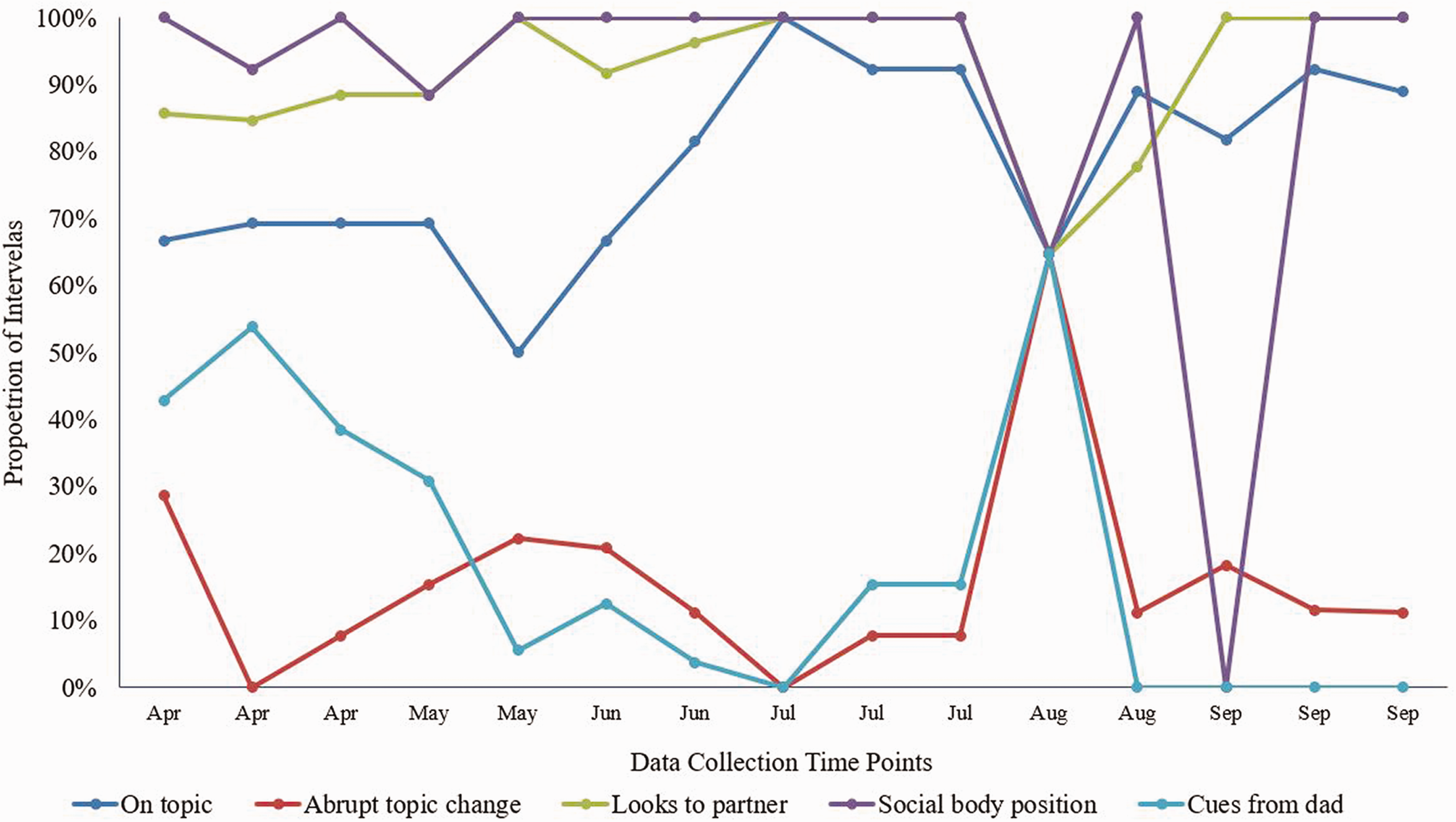
A broadly similar pattern was observed in relation to conversations with strangers, with the key difference being a reduction in ‘social body position’ when comparing the first and final five recordings (see Figure 3). Again, as illustrated in Figure 4, there was substantial variability over time, most clearly evidenced by the first session in August, at which point abrupt topic changes and cues from James increased substantially. Indeed, the reduction in ‘social body position’ observed in the start–end comparison (see Figure 3) was accounted for by the first recording in September during which Sam spoke with and made eye contact with the communication partner, but had his body oriented away.
Start–end comparison of Sam’s social-communication skills during interactions with strangers. Changes over time in Sam’s social-communication skills during interactions with strangers.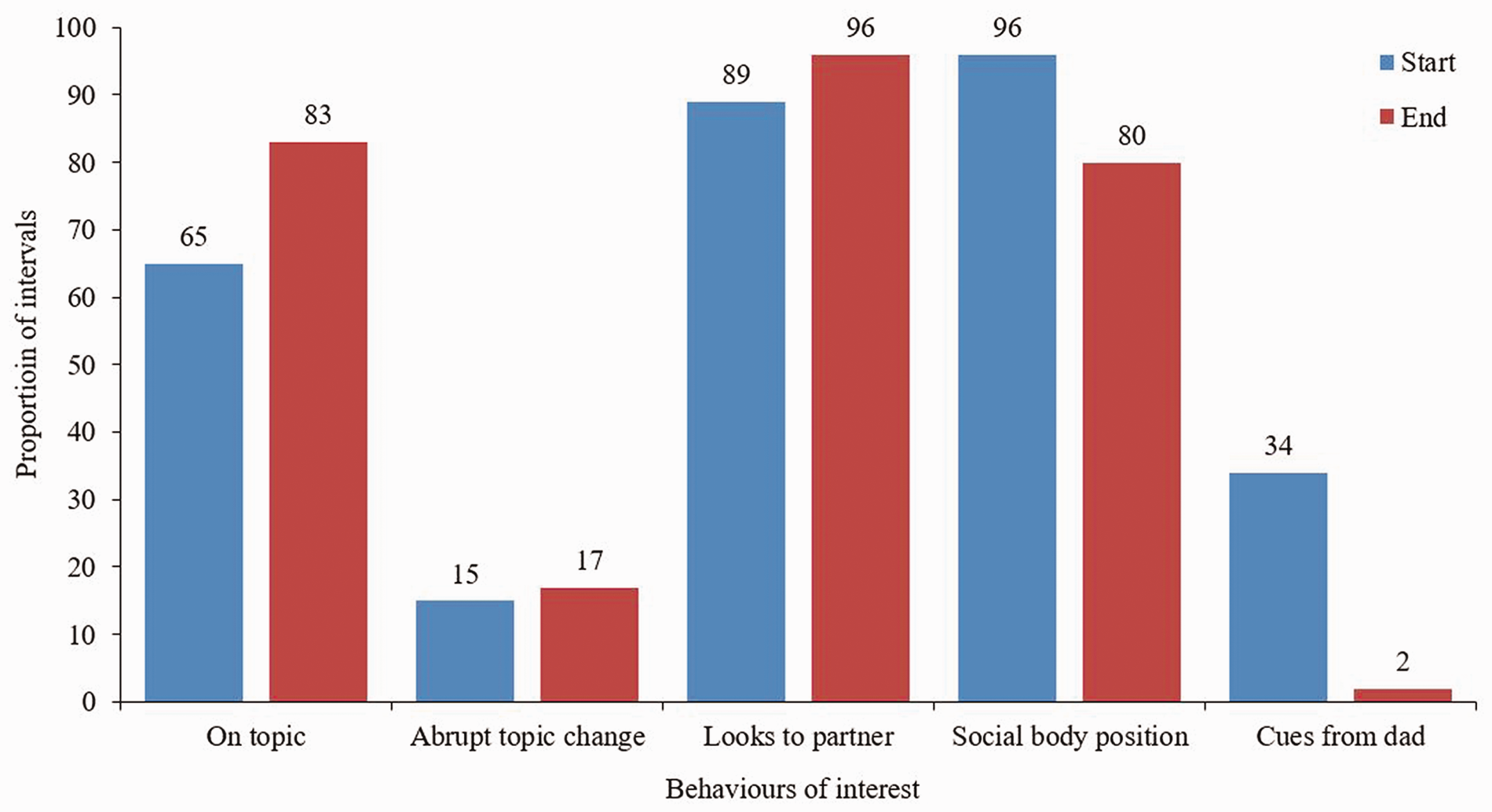
Participation findings
The results of the PEM-CY revealed positive changes in Sam’s participation at home, school and in the community over the course of the study.
At home
Responses to PEM-CY question regarding strategies for helping Sam participate successful in activities at home at three time points.

PEM-CY: Participation and Environment Measure – Children and Youth.
Time 1: 5 months prior to journey, Time 2: prior to journey, Time 3: post-journey.

Changes in Sam’s participation as measured using the PEM-CY five months prior to departure (Time 1), at departure (Time 2) and upon return (Time 3).
At school
Sam’s participation at school also increased, with activity scores rising from 10 and 8 prior to the journey, to 15 post-journey. This was accounted for by a shift in socialising with peers outside of school from ‘never’ to ‘daily,’ as a result of peer relationships Sam had forged with peers online. Similarly, his level of involvement rose from scores of 6 and 3, to a score of eight post-journey. Notably, while he was routinely seeing peers outside of class following the journey, his level of involvement was minimal to begin with. There was substantial change in two environmental factors at school that impacted participation, with ‘sensory qualities’ and ‘social demands’ in the school environment each rated the maximum ‘usually makes harder’ on both occasions prior to the journey, shifting to ‘not an issue’ post-journey. There were no marked differences with regard to strategies used to support Sam’s participation at school over the course of the study, with consistent themes of wanting to work in collaboration with the school to support Sam and pushing him to develop new skills.
In the community
Sam’s participation in activities in the community increased relatively consistently between each of the three time points, rising from 23 five months prior, to 30, and then 41. Increases were spread across activities including both organised and unstructured physical activities, classes and lessons and community events rather than being focused in just one area. Sam’s involvement also increased, from scores of 19 and 18 prior to the journey, to 27 post with increases again spread across activities. There were positive changes in several environmental factors in the community impacting participation including ‘sensory qualities’ which shifted from ‘sometimes helps/sometimes makes harder’ immediately prior to ‘not an issue’ post-journey, as well as ‘cognitive demands’ and ‘social demands’ which shifted from ‘usually makes harder’ to ‘sometimes helps/sometimes makes harder’ post-journey.
Discussion
The aim of this case study was to explore the goals, motivations and outcomes of an unconventional approach to support growth in social-communication and independent living skills in a young person on the autism spectrum. The aim was not to answer the question of whether this approach ‘worked,’ but rather to identify what can be learned from the case that might be useful for other families. Returning to Yin’s (2009) guidelines for conducting high quality case studies, here we consider ‘the most significant aspects of the study findings’ and ‘consider alternative explanations and interpretations.’
All parents and other caregivers have a unique opportunity to positively shape their children’s lives, but face myriad decisions regarding how best to do this. For parents of children on the autism spectrum, making these decisions may be complicated by competing advice on how to help children thrive, including whether to tailor the environment to the child or the child to the environment. James and Benison’s decision to make the environment as unpredictable as possible may appear, on the surface, to be consistent with the latter. However, the qualitative analyses revealed a more nuanced approach, whereby the challenges presented to Sam by the inherently dynamic environment were balanced by the intuitive scaffolding and support from James, which appeared to reduce over the course of the journey. Thus, the findings of the case study do not appear to support one approach or the other in the extreme (i.e., adapt the environment versus adapt to the environment), but rather illustrate the potential benefits of bringing the two together synergistically.
At the heart of the decision to embark on the journey appeared to be a set of goals and motivations with a universal quality. For instance, James’ and Benison’s goal to help Sam develop social-communication and independent living skills mirrors the aims of social skills programmes developed for adolescents on the spectrum (e.g., Corbett et al., 2016; Laugeson, Frankel, Gantman, Dillon, & Mogil, 2012; Lopata et al., 2010). Similarly, the motivation to create a context in which James could spend a large amount of uninterrupted time with Sam, free from work distractions, reflects the general assumption that parental involvement in their children’s lives, particularly in the teenage years, is mutually beneficial (Milkie, Nomaguchi, & Denny, 2015). This case demonstrates how acute and strong these motivations were in James and Benison, and thus suggests they may be equally strong in other parents of young people on the spectrum. Accordingly, this insight should act to remind service providers, parents’ employers and others who have influence on family life of the importance of helping parents create space to be with their children and of the need for timely, effective, accessible interventions and supports to help them foster these skills in their children during the adolescent years.
Regarding outcomes, the data indicate that the journey was associated with a number of positive outcomes for Sam and his family, with no reported negative consequences. Accordingly, the proposition that Sam’s social-communication and independent living skills would increase, appears to have been generally supported. However, it is important to note that the video observation and analyses revealed substantial variability in the target behaviours over time, including a reduction in ‘social body position’ when comparing the first and final five recordings with strangers, implying fluctuating skills that may have resulted from both personal and contextual factors. The cause of changes – whether they were due to the journey, maturation, or many other factors – cannot be determined within the non-experimental design. It is possible that the same or greater pattern of gains may have been made, had Sam continued in his regular education. It is also noteworthy that the strategies James appeared to employ during the journey – including giving instructions, modelling, rehearsal, providing feedback, prompting and prompt fading, natural reinforcement and practising skills with multiple people across different contexts – are all evidence-based behavioural strategies shown to support the development and generalisation of skills (Schreibman et al., 2015). James and Benison credited early intervention with teaching them these skills, which clearly have ongoing relevance, and can be applied similarly by other parents in everyday contexts.
Again, it is also acknowledged that changes in social-communication skills (e.g., eye contact, body position) are viewed as positive from neurotypical standpoint, but may be viewed differently by Sam and others on the autism spectrum (Pellicano & Stears, 2011). With these issue in mind, it is the somewhat unexpected findings, such as James describing Sam’s new ‘worldliness and sophistication and his self-belief,’ that arguably warrant the most attention. McConachie et al. (2015), in their review of outcome measures in ASD research, highlighted the need in intervention research to move beyond simply measuring skills and abilities targeted, to instead focus on socially valid outcomes reflecting meaningful, life-changing developments, that are relevant to individuals on the spectrum and their families. The findings of this case appear to support this need, whereby social-communication and independent living skills programmes must not only evaluate the new skills taught, but the differences in the person’s life as a result of their acquisition.
In reflecting on the influences James and Benison perceived the journey had on Sam and their family more broadly, they consistently contextualised the outcomes within a broader life journey. For instance, James perceived the approach taken as an extension of what he and Benison had been taught to do in early intervention, to ‘push them, push them’ to expand skills and independence. Benison asked ‘what happens down the track?’ if Sam and other young people do not learn to adapt in the world. In this way, the findings illustrate the fact that each intervention, irrespective of scale and nature, represents one journey in a life filled with many. Further, the findings appear to highlight the benefits of having a strong underlying philosophy regarding expectations, to ensure a coherent approach in working towards identified end goals. This finding has clear relevance to parents of children on the spectrum more broadly, who may experiment with a range of interventions (Grant, Rodger, & Hoffmann, 2016). Specifically, the finding suggests that in addition to ensuring that each is evidence-based, a second important ingredient for success is likely the extent to which the different interventions are theoretically and philosophically aligned with parents’ views and beliefs.
Limitations
The findings need to be interpreted in the context of what a case study can and cannot provide. We reiterate this was a study designed to yield insights and was not an empirical evaluation. Clearly, there would be multiple examples of inherent risks for bias if the study had been undertaken in an effort to achieve the latter, such as the use of self-report measures and video coding by members of the study team. In contrast, a case study approach involves the researchers being part of the process of exploring the issues, and is strengthened by the use of multiple sources of data with the research team central in identifying significant aspects of the case. Nevertheless, within the data collected and approach taken, a limitation of the study was our capacity to complete linguistic analyses of the data, in ways that would yield meaningful findings. For instance, although attempted, we quickly discovered that doing so for videos involving Sam speaking with strangers was not possible due to language barriers that would make common analyses such as number of turns taken highly unreliable, as the number of turns was heavily influenced by the language skills of the partner, not just Sam. Thus, we focused on social-pragmatic aspects of communication in terms of staying on topic, abrupt topic changes, eye contact and body position and we have taken a conservative approach in interpreting these findings. Studies aimed at determining the outcomes of social-communication skills training should be designed in ways that are suitable for comprehensive analyses.
A further limitation in considering the findings of the study, and in our view the most substantial, is that we did not capture Sam’s goals, his motivations and his views on the outcomes and implications of the journey. Although Sam has ultimately shared these insights through other media, including a televised documentary and interviews, they would have enriched the current case study. The conversations between Sam and James could have potentially provided a context for us to examine these insights, however, this was not discussed or agreed with Sam and James in advance of the recordings being made and would have in any case relied on us as authors making inferences regarding Sam’s views based on the conversations, as opposed to asking him directly. There are numerous examples of research demonstrating the importance of asking for, and learning from, the views and experiences of individuals on the spectrum (e.g., Brede, Remington, Kenny, Warren, & Pellicano, 2017; DePape & Lindsay, 2015; Trembath, Germano, Johanson, & Dissanayake, 2012). Case study methodology is well suited to capturing the voices of all relevant stakeholders and future studies of this kind should include those individuals with lived experience.
Conclusion
In reflecting on the journey, James explained that ‘I think I overshot’ and that ‘there were big risks and they were risks that were bigger than travelling with a 14 year old without autism by quite a long way.’ He explained that the same types of opportunities and challenges could be created for young people in their everyday life, where risks are easier to manage. These sentiments arguably capture the essence of this journey. That is, based on the findings, our impression is that this is not, and never was, a story about a journey in Africa, but rather the journey young people take to independence, and the great impact parents can have in helping to create, and navigate, the multiple smaller risks in life required to get there. James and Benison were not advocating for parents to undertake a similar journey with their children – a position we as authors share – but rather to consider the lessons, and approaches that may be applied in everyday life in raising children on the spectrum.
Footnotes
Acknowledgements
The authors thank Sam, James and Benison for sharing their journey, and Alice and Katherine for participating in interviews. Identifying information has been included with their permission.
Declaration of conflicting interests
The authors declared no potential conflicts of interest with respect to the research, authorship, and/or publication of this article.
Funding
The authors disclosed receipt of the following financial support for the research, authorship, and/or publication of this article: Rachel Bala and Joanne Tamblyn were supported by Griffith University, School of Allied Health Sciences summer internship scholarships. David Trembath was supported by a National Health and Medical Research Council Early Career Fellowship (GNT107181).