




Abstract
Background and aims
The development of Executive Function in Autism Spectrum Disorder has been investigated using mainly performance-based executive function measures. Less is known about the development of everyday executive function skills. The present study aimed to identify the developmental patterns of everyday executive function of children and adolescents with autism spectrum disorder compared to neurotypical controls. The association between executive function and adaptive skills was also investigated.
Methods
The present study used a cross-sectional developmental trajectory approach and data were collected from 57 children and adolescents with autism spectrum disorder, matched to 63 controls of the same age (7–15 years).
Results
Results showed age-related performance declines in most everyday executive function domains (e.g. inhibition, working memory, planning) in autism spectrum disorder, whereas for executive function emotional control and shift, non-significant differences emerged across age in autism spectrum disorder. Everyday executive function predicted adaptive skills over and above age and IQ, in participants overall.
Conclusions and implications
These results suggest that several everyday executive function problems increase in adolescence in autism spectrum disorder and that these everyday executive function developmental patterns deviate to a great extent from those of typical development. Shedding more light on the developmental course of all types of executive function processes as well as their association with crucial social outcomes in autism spectrum disorder could contribute to a better theoretical understanding of the heterogeneity of the neurocognitive development in autism spectrum disorder.
Introduction
Autism Spectrum Disorder (ASD) is a multifaceted neurodevelopmental disorder that significantly impairs children's social interactions, verbal and nonverbal communication, and behaviours (Diagnostic and Statistical Manual of Mental Disorders – DSM-5, American Psychiatric Association, 2013). The executive dysfunction theory of ASD, according to which several autism manifestations may arise from disruptions in Executive Function (EF) (Damasio & Maurer, 1978; Pennington & Ozonoff, 1996), has received increased attention as EF deficits have been demonstrated consistently in several ASD samples (Demetriou et al., 2017). EF refers to a set of high-order and goal-directed cognitive skills, closely associated to the prefrontal cortex, coordinating problem solving and social behaviour (Best & Miller, 2010). Although a plethora of studies have reported EF deficits across the lifespan in ASD (Corbett, Constantine, Hendren, Rocke, & Ozonoff, 2009; for reviews see Hill, 2004; Russo et al., 2007) children and adolescents with ASD seem to evolve in their EF abilities (Christ, Kester, Bodner, & Miles, 2011; Happé, Booth, Charlton, & Hughes, 2006; Pellicano, 2010) or sometimes present intact EF profiles (Hill & Bird, 2006; Towgood, Meuwese, Gilbert, Turner, & Burgess, 2009). Thus, the development of EF in ASD seems to present significant heterogeneity, highlighting the importance of assessing the development of different EF domains more in depth, not only at the level of performance-based aspects but also of everyday EF rating scales.
Due to the increasing attention EF has received while being investigated from a cognitive psychological perspective, researchers have developed ecologically valid, commonly called every day measures in order to assess EF abilities in real world contexts. To date only a few scales have been designed to tap everyday EF difficulties including ratings such as the Childhood Executive Functioning Inventory (CHEXI; Thorell & Nyberg, 2008), the Dysexecutive Questionnaire for Children (DEX-C; Emslie, Wilson, Burden, Nimmo-Smith, & Wilson, 2003) and the Child Behavior Questionnaire (CBQ; Rothbart, Ahadi, Hershey, & Fisher, 2001). Furthermore, the Behavior Rating Inventory of Executive Function (BRIEF) is a valid and reliable measure of EF performance in everyday settings (i.e. classroom) (e.g. Kenworthy, Yerys, Anthony, & Wallace, 2008; Mahone et al., 2002; Mangeot, Armstrong, Colvin, Yeates, & Taylor, 2002; Nadebaum, Anderson, & Catroppa, 2007; Toplak, Bucciarelli, Jain, & Tannock, 2008) and widely used in clinical research as it has been found to share a strong relationship with several other teacher/parent-report behaviour ratings in clinical populations in general (e.g. Child Behavior Checklist – Parent version; Achenbach, 1991 or the Diagnostic Interview for Children and Adolescents; Reich, 2000). Previous evidence has indicated that children and adolescents with ASD present impairments on the BRIEF items, as rated by their teachers or parents (Chan et al., 2009; Endedijk, Denessen, & Hendriks, 2011; Kalbfleisch & Loughan, 2012; Yerys et al., 2009; Zandt, Prior, & Kyrios, 2007). Moreover, several studies have shown that deficits on the BRIEF Behavioural Index (including the EF aspects of inhibition, shift, and emotional control) were correlated with impairments in communication and restricted-repetitive behaviours of individuals within the spectrum (Kenworthy, Black, Harrison, Della Rosa, & Wallace, 2009), in line with relevant established associations between performance-based EF measures and ASD symptoms (e.g. cognitive flexibility with repetitive behaviours) (Yerys et al., 2009). However, it should be noted that there have been very low or even non-significant correlations between BRIEF and performance-based tasks of EF (i.e. Anderson, Anderson, Northam, Jacobs, & Mikiewicz, 2002; Bodnar, Pralune, Cutting, Denckla, & Mahone, 2007; Mahone et al., 2002). This evidence raises questions about the nature of those two seemingly similar measures and appears to indicate that performance-based tests and rating scales may tap different constructs of the multifaceted EF system (McAuley, Chen, Goos, Schachar, & Crosbie, 2010; Toplak et al., 2008).
More specifically, starting from an operationalisation perspective, performance-based and rating measures of EF differ in the basis of administration and scoring. Performance-based measures are administered in standardised conditions while presentation is carefully controlled in order for each participant to experience the task the same way. Performance is also assessed not only at the level of accuracy, but also response time or speeding responding under a specific time frame. The rating scales of EF on the other hand capture either the teachers’ or parents/caregivers’ report of the level of competence of examinees in complex, every day, problem-solving situations (Roth, Isquith, & Gioia, 2005). It could be thus assumed that rating scales measure mainly behaviours (i.e. goal pursuit) that are related to the EF processes, rather than the EF processes (i.e. efficiency in cognitive abilities) per se, as assessed by performance-based EF. Toplak, West, and Stanovich (2013, p. 137) conclude that despite the fact that both types of measures are meant to capture the same underlying cognitive construct, ‘a basic principle of convergent validity in science is that different operational measures of the same construct should correlate highly’. It could be thus argued that performance-based measures and ratings of EF may indeed measure different cognitive skills which however separately contribute to clinical phenotypes (i.e. ASD). The fact that EF rating scales perhaps measure different cognitive constructs – to neuropsychological tests – should not mean that their validity is questioned. It seems that despite the weak correlations between performance-based EF and everyday EF ratings, the autism phenotype is linked to EF measured by both neuropsychological tests and reported problems in everyday life (everyday EF). In fact everyday EF ratings may show a greater capacity to predict clinical symptoms related to developmental disorders (e.g. ADHD, ASD) (Miranda, Colomer, Mercader, Fernández, & Presentación, 2015). Considering thus that performance-based and rating scales may index different level of cognitive analysis and that the behavioural outcomes measured by ratings such as the BRIEF occur in social contexts and relate to individuals’ everyday lives, it would be important to study these EF behavioural manifestations from a developmental perspective in order to shed more light on the heterogeneity of the developmental profiles of children and adolescents with ASD. More importantly, according to Kenworthy et al.’s (2008) proposition, which questions the ecological validity of the performance-based measures, the manifestations of EF problems in everyday life are present even in cases of intact developmental EF profiles as measured by performance laboratory measures.
In typical development EF structure appears to become more differentiated with age (Miyake et al., 2000; Wu et al., 2011), as it is proposed to be unitary through early to mid-childhood (i.e. one-factor EF model fits best the data) while diversity (abilities specific to each EF presenting different developmental profiles) emerges later in development (Best, Miller, & Jones, 2009; Kouklari, Tsermentseli, & Monks, 2017). It would be crucial thus to focus on specific and more specialised domains of EF rather than the broad construct of EF as a whole. The comparison of different trajectories of several EF components could reveal new patterns and mechanisms of development as it may identify a cognitive model derived from in-detail, fractionated brain-based profiles of development. In ASD the most dominant to date theoretical accounts regarding the development of EF suggest that the developmental patterns followed in ASD could be: (a) delayed relative to the typical one (Christ et al., 2011), (b) deviant from typical development (Ozonoff & McEvoy, 1994) or (c) delayed in childhood and deviant in adulthood (Luna, Doll, Hegedus, Minshew, & Sweeney, 2007). However this evidence derives mainly from studies that have utilised performance-based EF measures such as Digit Span, Tower of London, Go/No-Go tasks (e.g. Kouklari et al., 2017) and there is very limited knowledge about the everyday EF developmental pathway across childhood and adolescence in ASD. The present study thus aims to investigate the developmental profiles of EF in children and adolescents with ASD, as rated by the everyday life observations of their teachers within the classroom. Teachers are valuable sources of information as they spend a substantial amount of time with children. They are external to peer groups and observe their students' behaviour in a variety of school activities (Cheah, Nelson, & Rubin, 2001). Researchers tend to use teachers' ratings as they are able to provide valid information about children's behaviour (Coie & Dodge, 1988). It should be noted at this point that early research on multiple informants in child and adolescent psychopathology (see Smith, 2007 for a review) generally suggested that for older children the child is often the best informant, followed by parent and then teacher reports. However, recent studies (Dekker, Ziermans, Spruijt, & Swaab, 2017; Miranda et al., 2015) using the BRIEF rating scales supported the reverse pattern. These studies included both parent and teacher-report BRIEF EF ratings in order to examine the relative impact of these different EF ratings on social outcomes and indicated that it is the teacher EF ratings along with performance-based EF that have a complementary role in outcome variables (parent-report EF ratings explained significantly less or not at all variance).
The investigation of the development of everyday EF using ecologically valid tools became a reality only in recent years. Huizinga and Smidts (2010) were among the first to investigate the age-related differences in everyday EF in a large sample of typically developing children (5–18 years), using the BRIEF-P (parent version) rating scale (raw subscale scores). Results showed that children and adolescents (n = 847) presented differentiated developmental patterns in the main four EF domains of BRIEF: working memory and shift presented developmental improvements only before adolescence (<11 years) while inhibition appeared to develop until young adulthood (18 years). No age-related changes were found in terms of planning. The evidence of the extended development of inhibition (as measured by the BRIEF), was in line with findings from studies with performance-based EF measures, whereas the reported developmental patterns of working memory, shift, and planning abilities appeared to be different relative to the ones derived from direct EF assessment (van den Bergh, Scheeren, Begeer, Koot, & Geurts, 2014). More specifically, developmental gains of planning and working memory as tapped by EF laboratory measures seem to be present not only in childhood but adolescence too (for a review see Best & Miller, 2010; Kouklari et al., 2017), suggesting that parent-report rating scales and performance-based tasks of EF may actually follow differentiated pathways in typical development.
Relevant examinations of everyday EF developmental trends in ASD are rather limited. Rosenthal et al. (2013) compared the standardised (T) scores of selective BRIEF-P subscales (working memory, inhibition, shift, and planning) of four age groups (5- to 7-; 8- to 10-; 11- to 13-; and 14- to 18-year-olds) in ASD. Their results showed that working memory performance in ASD was poorer in older participants (14–18 years) compared to the younger ones (6–7 years) implying that deficits in working memory increase in adolescents with ASD as reported by parents. No age-related improvements were found in the remaining subscales. Similar to Huizinga and Smidts (2010), van den Bergh et al. (2014) used selective raw BRIEF-P EF subscale scores (inhibition, shift, working memory, and planning) of children and adolescents with ASD (6–18 years) reporting that inhibition presented age-related improvements while planning deficits were more evident in older participants compared to the younger ones. No age-related improvements were found in working memory and shift of children and adolescents with ASD. Everyday EF in ASD may not improve at the same rate as performance-based EF tasks in childhood and adolescence in ASD. It should be noted that Rosenthal et al.'s (2013) study provided evidence regarding the relative EF impairment of participants with ASD compared to a typical age norm as age-related T-scores were employed. Thus, their findings cannot be easily related to results of Huizinga and Smidts (2010) or van den Bergh et al. (2014).
EF and adaptive skills
Adaptive skills are important skills children have to develop in order to be independently functioning. Adaptive skills refer to the ability to perform everyday tasks and activities through the translation of cognitive potential into everyday skills (Pugliese et al., 2015; Sparrow & Cicchetti, 1984). Everyday skills that are considered to tap adaptive behaviours are effective communicative skills, engagement with the community as well as the development of social relations (Klin et al., 2007). The Vineland Adaptive Behaviour Scales (VABS, Sparrow, Balla, & Cicchetti, 1984; VABS-II, Sparrow, Cicchetti, & Balla, 2005) are the most widely used measure of such adaptive behaviour in childhood and adolescence in ASD and focus mainly on communication, socialisation and daily living skills. With regard to the developmental course of adaptive skills in ASD, several cross-sectional studies have found that mainly adaptive communication and socialisation but daily living skills too (to a smaller extent) present age-related losses from childhood to adolescence in ASD (Duncan & Bishop, 2013; Kanne et al., 2011; Klin et al., 2007; Pugliese et al., 2015).
EF has been found to be strongly related to adaptive skills. Gilotty, Kenworthy, Sirian, Black, and Wagner (2002) showed that selective BRIEF EF subscales (initiation, working memory, planning, organisation, and self-monitoring) were significant predictors of adaptive communication and socialisation in young people with ASD. Moreover, Pugliese et al. (2015) also showed that some of the BRIEF EF subscales (e.g. shift, working memory, organisation, planning) significantly predicted adaptive communication, daily living and socialisation, over and above demographic variables and IQ in youth with ASD. Considering the fact that there are reports of age-related changes in the developmental course of EF in ASD (e.g. van den Bergh et al., 2014), it would be crucial to account for EF when predicting adaptive skills across age in ASD.
Current objectives
The first aim of the present study was to investigate the developmental profiles of everyday EF domains in children and adolescents with ASD (7–15 years) compared to matched neurotypical controls. For this purpose, following Huizinga and Smidts (2010) and van den Bergh et al. (2014), we used raw scores instead of T-scores. All previous studies have only used the traditional EF domains of inhibition, planning, shift, and working memory of BRIEF or the composite Index scores: Behavioural Rating Index (BRI) and Metacognition Index (MI) which consider various different EF domains as united composite scores. Thus, the present study focused on all eight distinct EF domains of the BRIEF (inhibition, shift, emotional control, initiate, working memory, planning, organisation, and monitor), in an attempt to shed more light on the multifaceted developmental profiles of everyday EF abilities. Due to mixed results from the aforementioned previous developmental studies using the BRIEF scale (e.g. Rosenthal et al., 2013; van den Bergh et al., 2014), specific predictions cannot be made.
The second aim of the present study was to examine the association between teacher-report BRIEF EF ratings and adaptive skills in participants overall. Based on evidence presented above (Gilotty et al., 2002; Pugliese et al., 2015), it was hypothesised that adaptive skills would mainly show age-related declines in ASD and that BRIEF EF domains would also relate to adaptive skills in ASD and typical development.
Methods
Participants
Fifty-seven children and adolescents (57) with an official diagnosis of ASD (50 males) (M = 10.40 years, SD = 2.35) and sixty-three (63) controls (M = 10.03 years, SD = 2.11) (50 males) aged between 7 and 15 years old were recruited from mainstream and special education schools to participate in the present study. All ASD participants were highly cognitively able, held a clinical diagnosis by a qualified clinician (i.e., paediatrician, speech and language therapist or specialist psychologist) using DSM-IV or DSM-5 criteria (American Psychiatric Association, 1994, 2013) and qualified for a ‘broad ASD’ on the Autism Diagnostic Interview/Autism Diagnostic Interview-Revised (ADI/ADI-R; Le Couteur et al., 1989; Lord, Rutter, & Le Couteur, 1994) and/or the Autism Diagnostic Observation Schedule (ADOS; Lord, Rutter, DiLavore, & Risi, 2000), in accordance to National Institute for Health and Clinical Excellence (NICE, 2011) guidelines. ‘Broad ASD’ criteria includes meeting the ADI-R cut off for ASD in the social domain and at least one other domain or meeting the ADOS ASD cut off for the combined social and communication score. They were also in receipt of an Education, Health and Care Plan (EHCP), formerly known as Statement of Special Educational Needs, a legal document that details the child's needs and services that the local authority has a duty to provide, which specified ASD as their primary need. All clinical records were inspected and any individual lacking detailed information about the official source of diagnosis was excluded from the study. Additional exclusion criteria for the ASD group included the presence of a diagnosed psychiatric illness, comorbid conditions (i.e. ADHD, or seizures) and Full Scale Intelligence Quotient (FSIQ) below 70 as determined by the abbreviated version of the Wechsler Intelligence scales (WASI) (two subtests: vocabulary and matrix reasoning; Wechsler, 1999). The WASI is a widely used measure of intelligence, extensively used in studies of children with and without ASD with high reliability (average reliability r = .96, test–retest reliability r = .88) (Minshew, Turner, & Goldstein, 2005). Typically developing participants were required to have no diagnosis, and no family history of ASD, other mental health disorders, ADHD, dyslexia or learning disability. Participants were matched for chronological age (t (118) = −.91, p = .36) and IQ (ASD group: Mean (SD) = 94.89 (14.51); Controls: Mean (SD) = 99.68 (14.64), t (118) = 1.8, p = .08). Participants spanned a wide range of socioeconomic status (SES) groups; however the majority were of White British origin and average SES for England. After written consent was obtained from school principals, teachers were asked to complete the behavioural scales described in the following section. Ethical approval for the study was obtained and all participants’ parents/carers gave written informed consent (consistent with the Declaration of Helsinki) in compliance to the University of Greenwich Research Ethics Committee.
Measures
EF: Behavior Rating Inventory of Executive Function – Teacher Report (BRIEF-TR)
In order to assess the everyday EF abilities of participants, teaching staff (teachers and teaching assistants) completed the BRIEF-TR for each child in their class participating in the study (Gioia, Isquith, Guy, & Kenworthy, 2000). The BRIEF measures two broad areas of EF: behavioural regulation, the ability to shift and modulate emotions and behaviour via appropriate inhibitory control; and metacognition, the ability to cognitively self-manage tasks and monitor performance. This scale offers the advantage of sampling multiple EF processes (inhibition, shifting, emotional control, initiation, working memory, planning, organisation, and monitor) across a wide age range (5–18 years). Teaching staff rated how true each statement describing children's behaviour over the past six months was. Numbers that corresponded to each rating (i.e., 1 for Never, 2 for Sometimes, and 3 for Often) were then summed for each scale, obtaining a raw score. Raw scores can be converted into T scores separately for boys and girls. Higher scores indicate poorer performance. The items that were selected for inclusion in the BRIEF have been determined based on inter-rater reliability correlations as well as item-total correlations that had the highest probability of being informative for clinicians (Isquith, Gioia, & PAR Staff, 2008). The BRIEF has been indeed found to have good reliability, with high test–retest reliability (rs ≈ .88 for teachers, .82 for parents), moderate correlations between parent and teacher ratings (rs ≈ .32–.34) and high internal consistency (Cronbach's alphas ≈ .80–.98). Evidence regarding the convergent and divergent aspects of the BRIEF's validity derives from its association with other behavioural functioning measures (Isquith et al., 2008). The BRIEF has demonstrated significant utility in research contexts as it has been found to differentiate clinical and nonclinical populations such as for example identifying children with and without ADHD (Jarratt, Riccio, & Siekierski, 2010; McCandless & O'Laughlin, 2007; Sullivan & Riccio, 2007).
Adaptive skills: Vineland Adaptive Behavior Scales (VABS-T)
Teaching staff also completed the Adaptive Behavior Scale of the VABS-T (Sparrow et al., 2005) for each child from their class who participated in the study. The VABS measures adaptive behavioural skills in socialisation, communication, and daily living of individuals. Raw scores were summed to create composite scores for each one of the three subdomains. Teachers rated how true each statement was on a Likert scale, with ‘0’ meaning ‘never’, ‘1’ meaning ‘sometimes or partially’, and ‘2’ meaning ‘usually’. Standard scores can be obtained for each domain. Higher scores suggest better adaptive skills. The VABS has been found to have a good internal consistency (α = .80s to .90s) and test re-test reliability (r = .88) (Sparrow et al., 2005) and has been widely used to measure adaptive skills in ASD across childhood (e.g., Cederlund, Hagberg, Billstedt, Gillberg, & Gillberg, 2008; Gilotty et al., 2002; Kenworthy, Case, Harms, Martin, & Wallace, 2010; Paul et al., 2004).
Statistical analysis
Statistical analyses were performed using the Statistical Package for the Social Science Version 23. Variables were checked for normality and homogeneity assumptions of parametric tests. No outliers were found (inspection of histograms and boxplots). Average group differences for every EF aspect of BRIEF and Vineland skills were assessed by running a series of ANOVAs. In order to protect against inflated Type I error rates given the multiple comparisons, a Bonferroni correction was applied, and only p values below .005 were considered significant for that analysis. A cross-sectional developmental trajectories approach (Thomas et al., 2009) was used in order to investigate whether the developmental profiles demonstrated in ASD overlap or deviate from those of neurotypical controls. More specifically, it involves constructing functions of task performance and age (Thomas et al., 2009). The chronological age of participants is used as a basis to compare the cross-sectional developmental changes in the trajectories of tasks such as EF across typically and atypically developing groups. Conceptually, the trajectories approach is similar to standard Analyses of Variance (ANOVA). However, in this approach, instead of testing the difference between group means, the difference between the slope and intercept of the lines used to depict the developmental trajectory in each group across age is evaluated (Henry et al., 2013; Thomas et al., 2009; Thurman, McDuffie, Kover, Hagerman, & Abbeduto, 2015). This approach can identify important development-related information such as early onsets or deviant/slower rates of development. The main effect of group (ASD or control), main effect of predictor (chronological age) and the interactions between group and age were investigated. Pearson's correlations were run to assess the preliminary association between EF aspects of BRIEF and adaptive skills within the whole sample. Finally, the extent to which these EF scores would show a unique contribution to adaptive skills above and beyond ASD diagnosis and control variables (FSIQ and age) was investigated by performing hierarchical regression analysis in the whole sample. Control variables (age & FSIQ) and ASD diagnosis were entered in Block 1 and EF aspects of BRIEF were entered in Block 2.
Results
Everyday EF (BRIEF) impairments in ASD
Means and SDs of BRIEF EF aspects and Vineland adaptive skills for ASD and control groups.

BRIEF: Behavior Rating Inventory of Executive Function.
Note. All scores are the raw test scores. Lower scores indicate better performance for EF skills. ***p < .001.
Cross-sectional developmental trajectories of everyday EF
Inhibition
The intercept of the trajectory was evaluated at the lowest age of overlap between the two groups (i.e. 7 years of age) and the within-group trajectory slopes. The intercepts of inhibition were not significantly different between the two groups (F (1, 119) = .24, p = .62, partial η2 = .002), at the lowest age of overlap. Regarding the rate of developmental change, chronological age was not a significant predictor of inhibition scores (F (1, 119) = .31, p=.58, partial η2 = .003). However, it was found that there was a significant Group × Age interaction (F (1, 119) = 12.58, p = .001, partial η2 = .1). Figure 1 shows that for the control group, inhibition scores improved with age while for the ASD group there was a significant trend for inhibition to worsen with chronological age.
Trajectory of everyday inhibition relative to age for controls and ASD participants.
Shift
The intercept of the trajectory was evaluated at the lowest age of overlap between the two groups (i.e. 7 years of age) and the within-group trajectory slopes. The intercepts of shift were not significantly different between the two groups (F (1, 119) = 7.53, p = .007, partial η2 = .06), at the lowest age of overlap. Regarding the rate of developmental change, neither chronological age (F (1, 119) = 1.77, p = .19, partial η2 = .02) nor the Group × Chronological Age interaction (F (1, 119) = 1.52, p = .22, partial η2 = .01) were found significant. Figure 2 shows that both groups presented non-significant age-related differences across younger and older participants.
Trajectory of everyday shift relative to age for controls and ASD participants.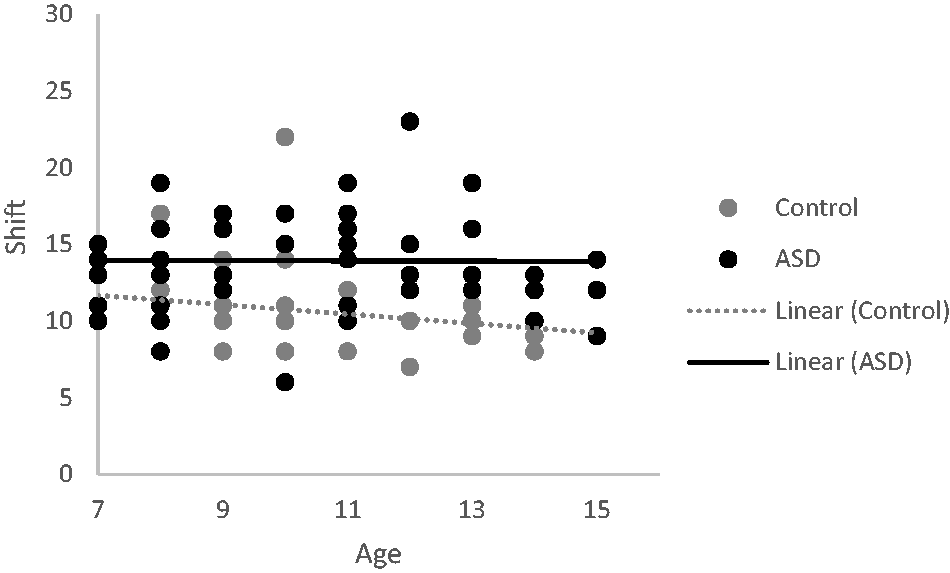
Emotional control
The intercept of the trajectory was evaluated at the lowest age of overlap between the two groups (i.e. 7 years of age) and the within-group trajectory slopes. The intercepts of emotional control were significantly different between the two groups (F (1, 119) = 11.91, p = .001, partial η2 = .09) at the lowest age of overlap. Regarding the rate of developmental change, neither chronological age (F (1, 119) = 2.46, p = .12, partial η2 = .02) nor the Group × Chronological Age interaction (F (1, 119) = 1.12, p = .29, partial η2 = .01) were found significant. Figure 3 shows that there were non-significant age-related changes for either group.
Trajectory of everyday emotional control relative to age for controls and ASD participants.
Initiate
The intercept of the trajectory was evaluated at the lowest age of overlap between the two groups (i.e. 7 years of age) and the within-group trajectory slopes. The intercepts of initiate were not significantly different between the two groups (F (1, 119) = 3.64, p = .06, partial η2 = .03) at the lowest age of overlap. Regarding the rate of developmental change, chronological age (F (1, 119) = .18, p = .67, partial η2 = .002) was not a significant predictor overall but the Group × Chronological Age interaction (F (1, 119) = 12.87, p < .001, partial η2 = .1) was found significant. Figure 4 shows that for the control group, performance on initiate improved, while for the ASD group it got worse with age.
Trajectory of everyday initiate relative to age for controls and ASD participants.
Working memory
The intercept of the trajectory was evaluated at the lowest age of overlap between the two groups (i.e. 7 years of age) and the within-group trajectory slopes. The intercepts of working memory were significantly different between the two groups (F (1, 119) = 8.59, p = .004, partial η2 = .07) at the lowest age of overlap. Regarding the rate of developmental change, chronological age was not a significant predictor of the working memory scores (F (1, 119) = .47, p = .5, partial η2 = .004), but it was found that there was a significant Group × Chronological Age interaction (F (1, 119) = 10.49, p = .002, partial η2 = .08). Figure 5 shows that for the control group, working memory scores improved with age while for the ASD group there was a significant trend for working memory to worsen with chronological age.
Trajectory of everyday working memory relative to age for controls and ASD participants.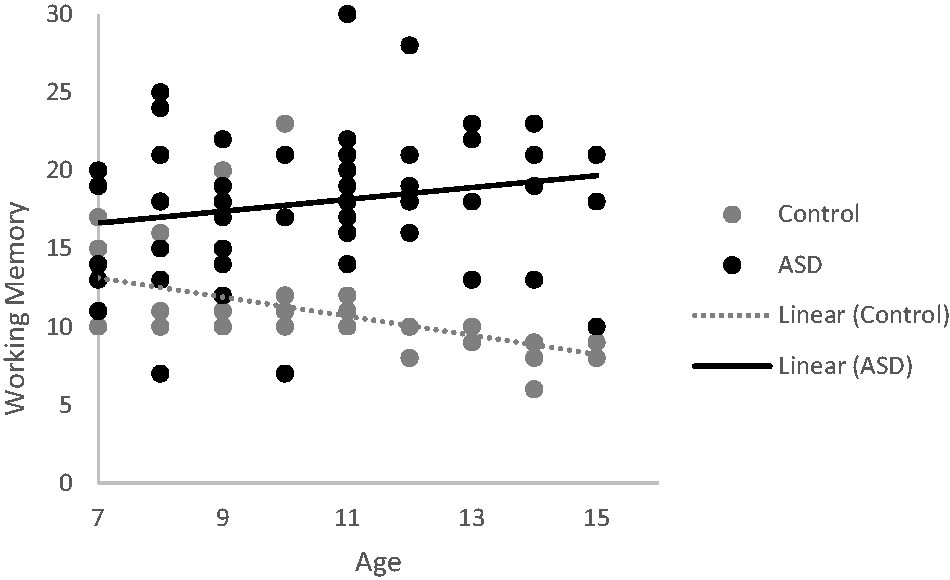
Planning
The intercept of the trajectory was evaluated at the lowest age of overlap between the two groups (i.e. 7 years of age) and the within-group trajectory slopes. The intercepts of planning were not significantly different between the two groups (F (1, 119) = 3.35, p = .07, partial η2 = .03) at the lowest age of overlap. Regarding the rate of developmental change, chronological age was not a significant predictor of planning scores (F (1, 119) = 1.09, p = .29, partial η2 = .01). However, it was found that there was a significant Group × Chronological Age interaction (F (1, 119) = 10.05, p = .002, partial η2 = .08). Figure 6 shows that for the control group, planning scores improved with age while for the ASD group there was a significant trend for planning to worsen with chronological age.
Trajectory of everyday planning relative to age for controls and ASD participants.
Organisation
The intercept of the trajectory was evaluated at the lowest age of overlap between the two groups (i.e. 7 years of age) and the within-group trajectory slopes. The intercepts of organisation were significantly different between the two groups (F (1, 119) = 9.03, p = .003, partial η2 = .07) at the lowest age of overlap. Regarding the rate of developmental change, chronological age (F (1, 119) = .22, p = .64, partial η2 = .002) was not a significant predictor overall but the Group × Chronological Age interaction (F (1, 119) = 17.81, p < .001, partial η2 = .13) was found significant. Figure 7 shows that for the control group, performance on organisation improved, while for the ASD group it got worse with age.
Trajectory of everyday organisation relative to age for controls and ASD participants.
Monitor
The intercept of the trajectory was evaluated at the lowest age of overlap between the two groups (i.e. 7 years of age) and the within-group trajectory slopes. The intercepts of monitor were not significantly different between the two groups (F (1, 119) = .41, p = .53, partial η2 = .003) at the lowest age of overlap. Regarding the rate of developmental change, chronological age (F (1, 119) = .07, p = .79, partial η2 = .001) was not a significant predictor overall, but the Group × Chronological Age interaction (F (1, 119) = 19.97, p < .001, partial η2 = .15) was found significant. Figure 8 shows that for the control group, performance on monitor improved, while for the ASD group it got worse with age.
Trajectory of everyday monitor relative to age for controls and ASD participants.
Cross-sectional developmental trajectories of adaptive skills
Average group differences were investigated by conducting ANOVAs for each Vineland subdomain. Significant group differences were found between the two groups performances on: Communication (F (1, 119) = 97.93, p < .001, η2 = .45), Daily living (F (1, 119) = 140.11, p < .001, η2 = .54), and Socialisation (F (1, 119) = 98.03, p < .001, η2 = .45) (see Table 1 for Means and SDs).
Communication
The intercept of the trajectory was evaluated at the lowest age of overlap between the two groups (i.e. 7 years of age) and the within-group trajectory slopes. The intercepts of communication were significantly different between the two groups (F (1, 119) = 27.97, p < .001, partial η2 = .2) at the lowest age of overlap. Regarding the rate of developmental change, chronological age (F (1, 119) = 10.97, p = .001, partial η2 = .09) was a significant predictor overall but the Group × Chronological Age interaction (F (1, 119) = .21, p = .65, partial η2 = .002) was not found significant. Figure 9 shows that for both groups performance on communication got worse with age.
Trajectory of adaptive communication relative to age for controls and ASD participants.
Daily living
The intercept of the trajectory was evaluated at the lowest age of overlap between the two groups (i.e. 7 years of age) and the within-group trajectory slopes. The intercepts of daily living were significantly different between the two groups (F (1, 119) = 54.78, p < .001, partial η2 = .32) at the lowest age of overlap. Regarding the rate of developmental change, neither chronological age (F (1, 119) = 2.7, p = .11, partial η2 = .023) nor the Group × Chronological Age interaction (F (1, 119) = .79, p = .37, partial η2 = .007) were found significant. Figure 10 shows that performance on daily living presented non-significant age-related changes for either group.
Trajectory of adaptive daily living relative to age for controls and ASD participants.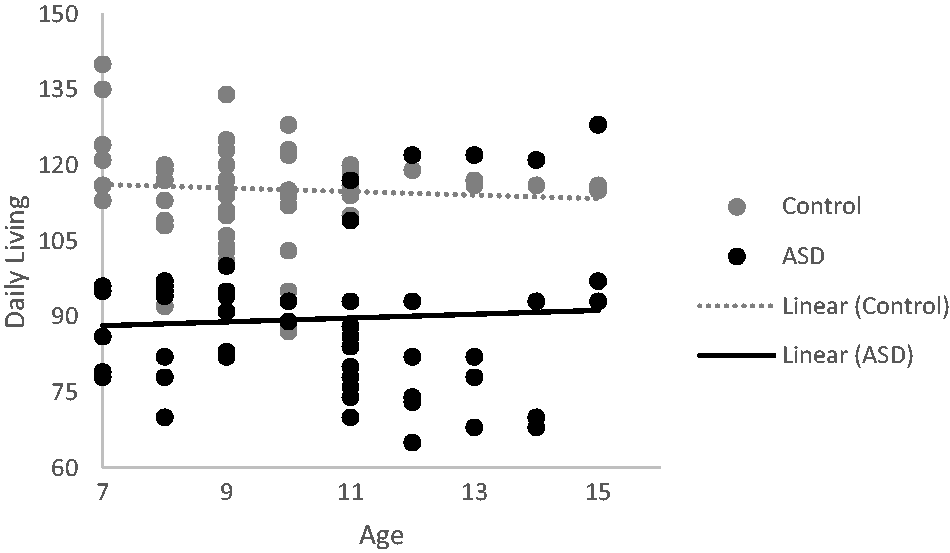
Socialisation
The intercept of the trajectory was evaluated at the lowest age of overlap between the two groups (i.e. 7 years of age) and the within-group trajectory slopes. The intercepts of socialisation were significantly different between the two groups (F (1, 119) = 39.55, p < .001, partial η2 = .25) at the lowest age of overlap. Regarding the rate of developmental change, neither chronological age (F (1, 119) = .65, p = .42, partial η2 = .006) nor the Group × Chronological Age interaction (F (1, 119) = .63, p = .43, partial η2 = .005) were found significant. Figure 11 shows that performance on socialisation presented non-significant age-related changes for either group.
Trajectory of adaptive socialisation relative to age for controls and ASD participants.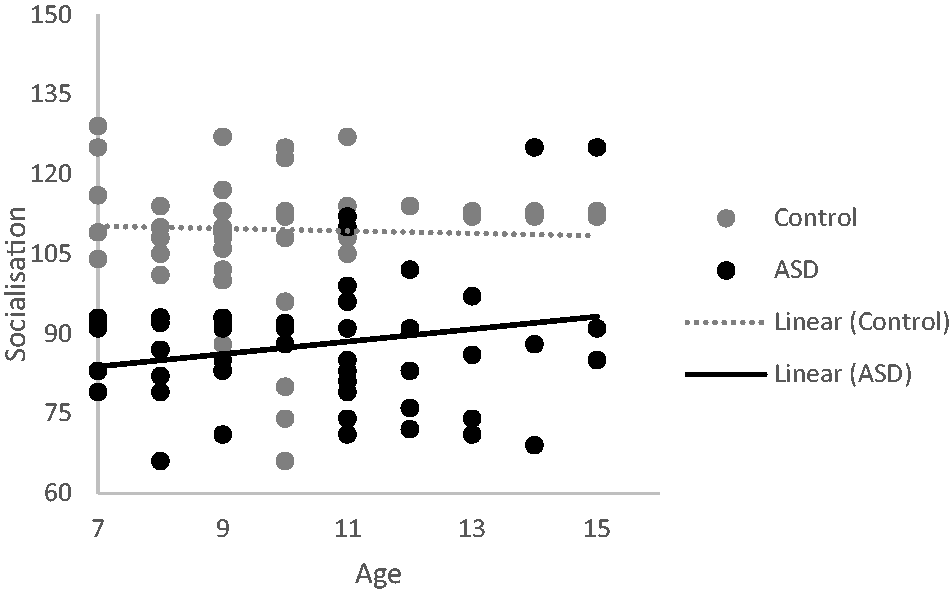
Associations between the cross-sectional developmental trajectories of adaptive skills and everyday EF
Correlations between everyday EF (BRIEF) and adaptive skills (VABS).

BRIEF: Behavior Rating Inventory of Executive Function; VABS: Vineland Adaptive Behavior Scales.
p < .001.
The relation between everyday EF and adaptive skills was further investigated by running three hierarchical multiple regression analyses to examine whether EF significantly predicted adaptive skills independent of ASD diagnosis and over and above control variables (age & FSIQ) in the whole sample. Dependent variables were communication, daily living, and socialisation.
Results show that the first block introducing age, IQ and ASD contributed significantly to the variance of communication, F (3, 116) = 54. 13, p < .001, explaining 58.3% of the variance. For EF aspects entered in block 2, the total variance explained rose to 74.4%, representing a significant increase of 16.1% (F (8, 108) = 8.43, p < .001) additional variance explained. Communication scores were significantly predicted by everyday emotional control (p = .001) and everyday initiate (p = .004) skills in participants overall.
Regarding daily living, control variables and ASD explained 57.8% of the variance in daily living scores (F (3, 116) = 55.29, p < .001). For EF variables entered in block 2, the total variance explained rose to 65.2%, representing a significant increase of 7.4% (F (8, 108) = 4.08, p < .001) additional variance explained. Daily Living scores were significantly predicted by everyday emotional control (p = .004) ability in participants overall.
In terms of socialisation, control variables and ASD explained 44.6% of the variance in socialisation scores (F (3, 116) = 35.39, p < .001). For EF variables entered in block 2, no significant (at the 0.005 alpha level) additional variance was explained (F (8, 108) = 2.9, p = .006).
Discussion
The present study employed a cross-sectional developmental trajectory approach in order to investigate the developmental profiles of everyday EF of children and adolescents with ASD compared to matched typically developing peers across age, as reported by their teachers. Moreover, the relation between everyday EF and adaptive skills was examined. Age-related declines were found in several everyday EF domains (inhibition, initiate, working memory, planning, organisation, and monitor) in ASD but not for EF emotional control and shift that presented non-significant changes with age. These results suggest that several everyday EF problems in ASD (especially the ones related to the Metacognition Index) become more evident in adolescence, after the transition from primary to secondary education. It also seems that the everyday EF developmental patterns in ASD deviate to a great extent from those of neurotypical controls. Finally, it was found that adaptive skills presented mainly a steady pattern of deficits across development in ASD. Adaptive skills were associated to everyday EF over and above age, IQ, and diagnosis, in children and adolescents overall.
Developmental profiles of everyday EF
For the three EF aspects of the Behavioural Regulation Index (BRI; inhibition, shift, and emotional control), inhibition presented age-related declines compared to the significant improvements of controls while performance on emotional control and shift was not altered across age in the ASD group similar to typical development. However the fact that ASD participants presented lower performance (deficits) across age and never reached the neurotypicals' level (strictly speaking for this specific age range of course) partially suggests a deviant pattern for these skills in ASD. The developmental declines in inhibition scores in the ASD group contradict previous studies (using the BRIEF) that showed either developmental gains (van den Bergh et al., 2014) or lack of improvements (Rosenthal et al., 2013) across younger and older participants in ASD. One possible explanation for such discrepancies could be the significant IQ superiority of the older ASD participants in those studies compared to the present study (difference more than 10 points in mean IQ performance). Such lower levels of general cognitive ability of our adolescents may have accounted for the report of increasing inhibition problems across age in ASD in the present study, as our older participants may have been less able to effectively deal with the more advanced cognitive inhibitory loads of secondary education. Generally, potential discrepancies between present results and findings from previous research could be also attributed to differences in raters as Rosenthal et al. (2013) and van den Bergh et al. (2014) for example addressed the parent-report version and not the teacher-report one of the present study. With respect to shift, the lack of significant age-related changes in the present study is in line with both Rosenthal et al. (2013) and van den Bergh et al.'s (2014) studies, and suggests that if shift problems are among the core deficits for ASD as proposed (Craig et al., 2016), there is at least a non-significant pattern of increasing problems across childhood and adolescence. Finally, the lack of age-related differences in the third domain of the BRI Index, emotional control shows that reported problems in the ability to modulate emotions remain stable across childhood and adolescence in ASD.
In terms of the everyday EF domains of the Metacognition Index (planning, working memory, initiate, organisation, and monitoring), results showed that all domains presented age-related declines in ASD which also suggests deviant trajectories to controls who exhibited performance improvements (again strictly speaking for this specific age range). The significant age-related performance declines in working memory are in line with Rosenthal et al. (2013) who found that older participants with ASD showed increased parent-report problems in working memory. It could be assumed that the developmental pattern of everyday working memory in children and adolescents with ASD differs from that of typical development, and may present an increase in deficits with age. Declines in planning performance in ASD are in line with van den Bergh's (2014) study showing that adolescents (12–14 years) had more planning problems compared to younger children (9–11 years) in ASD. Age declines in all metacognitive domains suggest that children with ASD are more vulnerable to changes in the demands of their environment, with their EF problems increasing during adolescence in contrast to typically developing peers that mainly present developmental gains. This could be explained in the basis of the more advanced demands of the school environment for children entering adolescence. Adolescents with ASD are expected to start handling their school workload more independently and present enhanced abilities of initiation, organisation/planning or self-monitoring on everyday tasks compared to younger children, which may subsequently lead to increased demands from their environment. Unfortunately, as ASD is diagnosed at a rate of 4:1 in males to females, the present sample was heavily weighted towards males without allowing a sex differences analysis. The present results should be cautiously interpreted and future studies should expand their sample sizes to include more females, especially after considering recent evidence suggesting sex differences in brain connectivity in ASD, with frontal lobe (centre of EF) abnormalities in males but not females (e.g. Zeestraten et al., 2017).
Developmental profiles of adaptive skills and associations with EF
The present study sought to investigate the relationship between the cross-sectional developmental trajectories of everyday EF measures and adaptive skills in children and adolescents overall. Firstly, results from the analysis of developmental profiles showed that ASD participants presented declines – similar to the control group – in communication across age while for daily living and socialisation both ASD and typical development groups demonstrated non-significant differences across age. It should be noted however that the ASD group indicated a lower performance at the age of onset (7 years) for all adaptive skills which remained present across our specific age range without reaching the levels of neurotypicals (partially suggesting deviant trajectories). The age-related declines in communication in controls were a striking finding as one would expect communicative skills to exhibit a significant growth over the transition from childhood to adolescence in typical development (e.g. Wallace et al., 2017). Considering that general adaptive skills-including communication – were assessed by teacher report scales, a possible explanation could be that the teacher–child communication decreases in early and later adolescence as children move towards independence due to decreasing adolescent disclosure, and increasing secrecy (e.g. Keijsers & Poulin, 2013). Thus teachers' responses for the older participants may reflect such changes in the quality–quantity of communication between them. With respect to the ASD group, the pattern of findings with declines and/or persisting deficits in adaptive skills in ASD across age is in line with previous evidence suggesting there are points in the development of these skills in which growth may plateau or decline with age in ASD (Fisch, Simensen, & Schroer, 2002; Pugliese et al., 2015). Moreover, the performance losses in adaptive skills in adolescence in ASD is not surprising considering the robust significant relationship adaptive behaviour shares with deficits in EF as shown in previous studies (e.g. Gilotty et al., 2002; Pugliese et al., 2015).
Our results also showed that selective everyday EF skills contributed to adaptive behaviour (i.e. communication and daily living scores) over and above age, IQ and ASD diagnosis in participants overall. Breaking down further into specific everyday EF domains, it was found that adaptive communication was predicted (over and above age, IQ, and diagnosis) by emotional control and initiation in participants overall. Day and Smith (2013) suggest that inner talk, a significant aspect of communication and language development (e.g. Martinez, Calbet, & Feigenbaum, 2011) is significantly associated to emotion control skills. Emotion control and emotion understanding are generally suggested to play a crucial role in social communicative (Eisenberg, Sadovsky, & Spinrad, 2005; Gross, Richards, & John, 2006) and expressive/receptive verbal skills (Cutting & Dunn, 1999; De Rosnay & Harris, 2002) across childhood, as the ability to modulate and inhibit one's emotions during conversations enables them to better express themselves or take other people's perspectives into consideration. The association between adaptive communication and initiation is more difficult to comment on as there has been limited attention in this area of EF in ASD and typical development. This may be partially explained due to the objective difficulty of assessing the ability of initiating an activity (‘self-starting’) within a structured lab setting. As the relevant BRIEF items of initiation measure mainly aspects of generativity in problem solving, the relation between initiation and communication could suggest that participants with better initiation skills may present less social communicative difficulties (i.e. difficulty in initiating, terminating, or facilitating a conversation).
Adaptive daily living (including mainly academic and school community skills) was predicted (over and above age, IQ, and diagnosis) only by emotional control, highlighting again the importance of this ability in children's social and academic success. Robust emotional control is thought to be related to school and academic success through behavioural control within the classroom (Graziano, Reavis, Keane, & Calkins, 2007). The present findings thus suggest that emotional control skills relate to children's wider learning and productivity in the classroom.
The lack of significant predictive relations between EF and the third adaptive skill, socialisation (over and above age, IQ, and diagnosis), contradicted previous findings of studies with young children suggesting that emerging EF skills may facilitate children's social competence (for a review see Riggs, Jahromi, Razza, Dillworth-Bart, & Mueller, 2006). A potential explanation could be attributed to the limited sample size as there might have been a lack of statistical power. However it should be noted that this lack of association between EF and adaptive social functioning may reflect more serious conceptual issues. It is likely that performance on this Vineland subscale may be linked to a broader range of cognitive and other abilities such as theory of mind (ToM; the ability to infer mental/emotional states) (Fombonne, Siddons, Achard, Frith, & Happé, 1994). Indeed, there is previous evidence suggesting that ToM is significantly associated to social skills including socially-competent peer interaction and play, and interpersonal problem-solving (Capage & Watson, 2001; Jenkins & Astington, 2000; Watson, Nixon, Wilson, & Capage, 1999). Despite mixed findings on the significance of this relationship (Badenes, Estevan, & Bacete, 2000), it is thought that children obtain better ToM skills across development which are then reflected into more effective social interactions (Hughes, 1998). Taken this evidence together, one could argue that there may be a potential indirect association between EF and social skills through ToM. As the present study failed to include a ToM measure, such assumptions should be treated with caution and be validated in future longitudinal studies. It should be highlighted again that the aforementioned associations refer to the whole sample of participants overall. The present study failed to include interactions due to limited sample size as generally interactions are notoriously underpowered for observational data (i.e., usually non-significant in all but very big samples); thus, a more rigorous examination of any EF × ASD interaction in order to investigate whether the relationships between everyday EF and adaptive skills are potentially different or not in children and adolescents with ASD relative to typical development would require a larger sample size.
The present study employed a cross-sectional developmental trajectory approach to explore the developmental trajectories of everyday EF (as reported by teachers) of children and adolescents with ASD compared to controls. Results showed that several everyday EF problems increase in adolescence in ASD and deviate from typical development. Everyday EF were also found to be significant predictors of selective adaptive skills in children and adolescents overall. The present findings should be interpreted cautiously as the between-group developmental differences found using the cross-sectional approaches need to be validated in future longitudinal studies. Besides, the developmental trajectory approach can only be used in linear developmental patterns of performance. Moreover, the lack of a validated screening tool to support the provided clinical ASD diagnosis was another significant limitation. Future studies should also expand investigations between EF and social communication to include several other measures of language as EF deficits have been linked to language impairment (e.g. Henry, Messer, & Nash, 2012). The ASD sample size was also relatively small and may not represent the broader ASD population; therefore, results may have been affected by the lack of statistical power, weakening the findings and conclusions. The participants included here ranged from 7 to 15 years old and attended school in the UK; thus, as school systems differ across countries, it remains to be explored whether these findings can be attributed to younger and older participants of various backgrounds or subgroups of ASD placed in different educational settings.
Conclusions
In conclusion, the present study showed that EF is a complex, non-unitary construct tapping several multiple and distinct cognitive processes that may follow different developmental patterns. Shedding more light on the developmental course of all types of EF processes as well as their association with crucial social outcomes could contribute to a better theoretical understanding of the heterogeneity of the neurocognitive development in ASD and typical development. A multilevel approach of EF assessment by addressing not only performance-based EF but also everyday ratings seems necessary, and would be more informative than capturing only the variance of one or another type of measure. Children's assessment models should view development within children's natural environment and address simultaneously two levels of assessment: high-order neuropsychological EF aspects as tapped by performance-based measures and everyday behavioural manifestations measured by rating scales. Performance-based EF measures combined together with rating scales like the BRIEF either in research or educational assessments, could serve as a valuable source of information for screening cognitive difficulties of developmental disorders by providing a more complete and ecological profile of the strengths and limitations of children.
Footnotes
Acknowledgements
The authors are grateful for the Vice-Chancellor PhD Scholarship from the University of Greenwich. The authors would like to acknowledge their gratitude to the participating schools and teachers.
Ethical approval
All procedures performed in studies involving human participants were in accordance with the ethical standards of the institutional and/or national research committee and with the 1964 Helsinki declaration and its later amendments or comparable ethical standards.
Declaration of conflicting interests
The author(s) declared no potential conflicts of interest with respect to the research, authorship, and/or publication of this article.
Funding
The author(s) received no financial support for the research, authorship, and/or publication of this article.
Informed consent
Informed consent was obtained from all individual participants included in the study.