




Abstract
Background and aims
All children have the right to receive an education and to be included in school. Yet young people on the autism spectrum, who are already vulnerable to poor health and social outcomes, are at increased risk of school exclusion. The current study sought to understand the key factors surrounding the school exclusion experiences of a group of autistic students with particularly complex needs, and their subsequent re-integration into education.
Method
We interviewed nine intellectually able students (eight male, one female; M age = 13.3 years), all with a diagnosis of autism and the majority with a history of demand avoidant behaviour. We also interviewed their parents and teaching staff about the students’ past and current school experiences. All students were currently being educated within an ‘Inclusive Learning Hub’, specially designed to re-integrate excluded, autistic students back into school, which was situated within a larger autism special school.
Results
Young people and their parents gave overwhelmingly negative accounts of the students’ previous school experiences. Children’s perceived unmet needs, as well as inappropriate approaches by previous school staff in dealing with children’s difficulties, were felt to cause decline in children’s mental health and behaviour and, ultimately, led to their exclusion from school. Four key factors for successful reintegration into school were identified, including (i) making substantial adjustments to the physical environment, (ii) promoting strong staff–student relationships, (iii) understanding students’ specific needs, and (iv) targeted efforts towards improving students’ wellbeing.
Conclusion
The culmination – and escalation – of challenges students experienced in the students’ previous placements could suggest that the educational journey to exclusion from school is an inevitable consequence for at least some autistic children, including those with particularly complex behaviour, as sampled here. Yet, our study encouragingly showed that this was not necessarily the case. All the young people we spoke to reported being happy, safe and secure in their current placement, and re-engaged with school life. Outstanding issues remain, however, with regard to children’s reportedly slow academic progress and difficulties generalising the positive behaviour shown in school across home and community contexts.
Implications
More remains to be done to ensure that autistic children and young people’s progress at school is also mirrored in other settings. Future research also needs to develop more preventative approaches to avoid exclusion from school, including efforts towards improving education professionals’ knowledge and awareness of autism, and effective ways of responding to these students’ needs.
Children and young people diagnosed with an autism spectrum condition (ASC 1 ) often face difficulties as they interact with and experience the world around them (American Psychiatric Association, 2013). Many also have additional challenges with their learning and behaviour and are at an increased risk of developing mental health problems (Simonoff et al., 2008) – all of which has serious consequences for their futures. As they enter adulthood, autistic 2 people are less likely to be employed than non-autistic people, many have problems in their social lives, and continue to struggle with their health and material wellbeing (Henninger & Lounds-Taylor, 2012; Howlin, Goode, Hutton, & Rutter, 2004; Howlin, Moss, Savage, & Rutter, 2013).
Among all these difficulties, young autistic people also appear to be at greater risk of exclusion from school – an issue often raised by parents and teachers. The scale of this issue is more formally suggested by studies of school exclusion that have focused on children with special educational needs and disability (SEND) more broadly. Yet there is strikingly little research on the experiences of school exclusion for autistic children specifically. The current study therefore sought to understand (1) the key factors both surrounding the exclusion experiences of a group of autistic students with particularly complex needs, and (2) their subsequent re-integration into education.
Excluded from school
School exclusion can take many forms. In England, the term refers to formal exclusion, where students are either excluded for a short period (fixed-term exclusion) or excluded from school altogether (permanent exclusion) because of their behaviour. Once permanently excluded, the local education authority of any compulsory school-age child has a duty to ensure that s/he receives full-time education within some alternative, short-term provision (e.g. pupil referral units [PRUs] 3 ).
Formal exclusions from school occur disproportionately among young people, mainly boys, from poor families in disadvantaged areas (Lloyd, Stead, & Kendrick, 2003) and those with SEND. Indeed, government statistics in England indicate that children with SEND (with or without a statement of SEND or an Education, Health and Care [EHC] plan 4 ) accounted for just over half of all permanent and fixed-period exclusions in 2014/2015 (Department for Education [DfE], 2016) – despite the fact that statutory guidance places a duty on schools to avoid permanently excluding pupils with an EHC plan (DfE, 2015).
Survey data from parent-advocacy organisations highlight the potential scale of the problem for autistic pupils specifically. Of the 980 parents surveyed by the UK charity, the National Autistic Society (Moore, 2016), nearly one in five reported that their child had received at least one fixed-term school exclusion, and one in 20 had been permanently excluded. Even more alarmingly, one-third of parents reported that their child had been informally excluded at least once, that is missing school without it being recorded as a fixed-term or permanent exclusion (see also Ambitious about Autism, 2014; Barnard, Prior, & Potter, 2000; Batten & Daly, 2006). These informal – and illegal – school exclusions include encouraging children to move schools or to be educated at home, excluding them from school trips/events, and sending pupils with SEND home for any period, including when their carer/teaching assistant is unavailable, without recording it as a fixed-term exclusion (Atkinson, 2013).
It is possible, of course, that parents whose children have experienced school exclusion might be more inclined to share their experience and respond to these surveys. Yet, these estimates have been corroborated by a report from the Office for National Statistics (Green, McGinnity, Meltzer, Ford, & Goodman, 2005), which demonstrated that, although autistic children were no more likely to miss school due to illness than other children, 27% of autistic children had been excluded at least once, with 23% having experienced recurrent exclusion, compared to 4% exclusion across all (non-autistic) children.
Together, these data indicate that autistic children and young people are at an increased risk of being excluded from school. Little is known, however, about what underpins this increased risk. It is possible that school exclusion – at least for a significant minority of autistic children and young people – is an inevitable response to difficulties dealing with the increasingly complex demands of school life. It is well known that the social milieu becomes progressively more complex as children make their way through school, and this may be exacerbated by the mounting demands placed on students’ academic progress. These demands are likely to cause considerable difficulties for students on the autism spectrum in particular, many of whom have significant problems with making and keeping friends (Bauminger & Kasari, 2000; Calder, Hill, & Pellicano, 2013; Rotheram-Fuller, Kasari, Chamberlain, & Locke, 2010), dealing with conflict (both with friends [Sedgewick, Hill, Yates, Pickering, & Pellicano, 2016] and children who are not their friends [e.g. Humphrey & Hebron, 2015]), organising their own learning (Keen, Webster, & Ridley, 2016), managing their behaviour and emotions (Ashburner, Ziviani, & Rodger, 2010; Berkovits, Eisenhower, & Blacher, 2017) and responding to often-overwhelming sensory environments (Ashburner, Ziviani, & Rodger, 2008; Pellicano, 2013).
These challenges are further compounded, however, by the prevailing suggestion that autistic children are more ‘difficult’ to include effectively than those with other SEND (House of Commons Education and Skills Committee, 2006), as well as reports from mainstream teachers, who do not feel that they have the necessary training to support their autistic students (L. Crane, A. Remington, L. Kenny, & E. Pellicano, in preparation; McGregor & Campbell, 2001; NASUWT, 2013; Robertson, Chamberlain, & Kasari, 2003). In this context, it is perhaps unsurprising that parents often report little confidence in mainstream schools’ capacity to include their autistic children and to respond to their specific needs, especially as they transition from primary to secondary education (Makin, Hill, & Pellicano, 2017; McNerney, Hill, & Pellicano, 2015; Tissot, 2011).
Collectively, autistic children’s intrinsic characteristics, the increasingly demanding nature of the school context, and the difficulties teachers and school staff appear to have in supporting these young people may therefore place them at heightened risk of being marginalised in school – and, ultimately, of being excluded from school. Indeed, these are precisely the issues identified in one of the only studies to have specifically examined the school exclusion experiences of young autistic people. Sproston, Sedgewick, and Crane (2017) found that, for a group of autistic girls, challenges with the school environment (including sensory issues, relationships with peers and general pressures of mainstream classrooms), tensions in relationships with staff and peers, and a perceived lack of understanding of the girls’ needs were considered to be the key factors influencing their pathways to school exclusion, according to the girls themselves and their parents.
The current study sought to build on Sproston et al.’s (2017) work with a group of young autistic people, mainly boys, who had been previously excluded from school, but had been reintegrated into an ‘Inclusion Learning Hub’ (hereafter, ‘the Hub’) situated within a large independent special school in the North of England, run by the UK charity, the National Autistic Society. The Hub was established to cater for the needs of autistic children with especially complex behaviour, with the explicit aim of creating an environment that increases the likelihood that they can access education. The Hub has two teaching areas with class sizes no greater than eight students. Each student has their own individual classroom and a minimum of one-to-one support at all times. Some students are expected to eventually re-integrate over time either into the main special school or to a mainstream setting, while others remain in the Hub for the rest of their schooling.
Most children who access the Hub have previously experienced school exclusion or have been without formal education for considerable periods of time, and have particular difficulties settling in a classroom environment. Generally, they do not have additional intellectual difficulties but often have other, co-occurring diagnoses that may affect their ability to access learning, including Extreme ‘Pathological’ Demand Avoidance (EDA), a term used by some British researchers and clinicians (Newson, Le Maréchal, & David, 2003) to describe children who show an obsessive resistance to complying with everyday requests, a tendency to use strategic behaviour (e.g. excuses, distraction techniques) to avoid complying, and an obsessive need for control (see O’Nions, Christie, Gould, Viding, & Happe, 2014).
The aims of the current study were twofold. First, we aimed to understand the factors that precipitated exclusion from school for this group of young autistic people with particularly complex needs. Second, we sought to elucidate the necessary prerequisites of inclusion in education, that is to understand which factors needed to be in place for these young people to be successfully reintegrated in school. To address these aims, we used questionnaires and semi-structured interviews with the young people, their parents and teachers in their current placement to examine their previous educational experiences, the perceived causes and consequences of having been excluded from school and the factors critical to their re-integration back into education.
Method
Participants
Participant details.
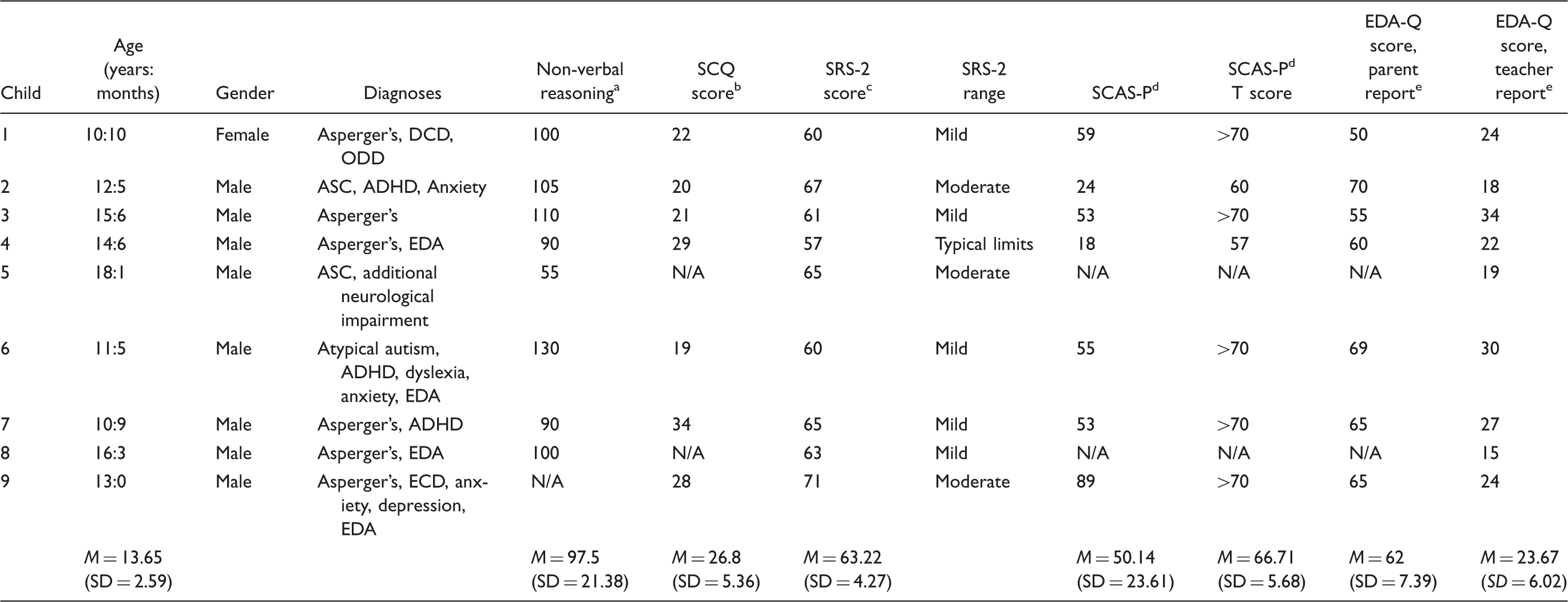
ADHD: attention deficit/hyperactivity disorder; ASC: autism spectrum condition; DCD: developmental coordination disorder; ODD: oppositional defiant disorder; EDA: extreme demand avoidance.
As measured by the Raven’s Standard Progressive Matrices (Raven et al., 1992). Standard scores are reported here (M = 100, SD = 15).
SCQ: Social Communication Questionnaire (Rutter et al., 2003), as rated by parents. Higher scores reflect greater autistic symptomatology.
SRS-2: Social Responsiveness Scale (Constantino & Gruber, 2012), as rated by teachers. T scores are reported here. Higher scores indicate greater autistic features. Note that the SCQ provides information about retrospective autism features while the SRS-2 scores reflect current autistic symptoms.
SCAS-P: Spence Children’s Anxiety Scale – Parent version. Higher scores reflect greater levels of anxiety.
EDA-Q: Extreme Demand Avoidance – Questionnaire (O’Nions et al., 2014). Cut-off scores of 50 for children aged 5–11 years, and of 45 for young people aged 12–17, are indicative of a profile consistent with what is conceptualized as EDA.
Of the nine young people who took part, eight had co-occurring diagnoses of developmental and/or neurological conditions (see Table 1). The young people mostly achieved non-verbal reasoning scores within at least the average range (M = 97.5, SD = 21.38, range = 55–130) on the Raven’s Standard Progressive Matrices (Raven, Raven, & Court, 1992). There is, however, often a mismatch between cognitive ability and day-to-day functional skills for those on the autism spectrum with at least average IQ (Klin et al., 2007) and so we refer to this sample as cognitively or intellectually able, in lieu of the widely used, but nevertheless misleading, term ‘high-functioning’ (see Kenny et al., 2016, for discussion). The exception to this was one male student who performed in the ‘extremely low’ range, although this estimate must be treated with caution given his high anxiety levels during test administration.
Seven parents (all mothers) took part (two parents decided not to be involved; see below) and 19 (4 male, 15 female) of the 21 members of teaching staff at the Hub agreed to be interviewed, including one senior teacher, two teachers, two senior teaching assistants (TA) and 14 TAs. Teaching staff had been working in the Hub for an average of five years (M years = 4.94, SD = 4.06). Staff members’ experience of working in autism education also varied considerably. Some teachers had previously worked in other parts of the main school, some reported that they have been in the Hub since it opened in 2004, and others had joined more recently (with no previously experience of autism).
Procedure
We administered a range of questionnaires to provide a thorough description of children’s cognitive and behavioural profiles.
Current autistic features
Children’s autistic features were measured using the Social Responsiveness Scale-2 (SRS-2) (Constantino & Gruber, 2012), a 65-item questionnaire, completed by teachers, which assesses social and behavioural difficulties associated with autism. On each item, teachers are asked to rate the child’s behaviour over the past 6 months on a 4-point scale ranging from 1 (‘not true’) to 4 (‘almost always true’). Participants’ T scores are reported in Table 1; higher scores indicate greater severity of symptoms. T-scores of 76 or above are strongly associated with a clinical diagnosis of ASC; T-scores of 66–75 indicate moderate deficiencies in reciprocal social behaviour; T-scores of 60–65 indicate mild to moderate deficits in social interaction; and T-scores of <60 are considered to be within ‘typical limits’. The SRS-2 has excellent reliability (Cronbach’s alpha = 0.95) and strong predictive validity. Internal consistency for the current sample was high (α = 0.83).
Trait anxiety
The 38-item Spence Child Anxiety Scale for Parents (SCAS-P) (Spence, 1999) was used to measure children’s trait anxiety. Parents rate the frequency of anxiety-related behaviours (e.g. “my child is scared of the dark”) on a 4-point scale ranging from 0 (‘never’) to 3 (‘always’). This scale has been shown to have good psychometric properties, including excellent internal consistency (Cronbach’s alpha = 0.89) (Nauta et al., 2004). Scores across all items are summed to yield a total score (maximum score = 114); higher scores reflect greater levels of anxiety. Internal consistency for the current sample was excellent (α = 0.95).
Extreme demand avoidance
The extreme demand avoidance questionnaire (EDA-Q) (O’Nions et al., 2014) was completed by parents and teachers to index students’ level of demand avoidance. This 26-item questionnaire asks respondents to indicate how much a statement (e.g. ‘obsessively resists and avoids ordinary demands’) applies to the child using a 4-point rating scale, ranging from 1 (‘not true’) to 4 (‘very true’) (maximum score = 78). The validation study indicated that the parent-completed EDA-Q has strong psychometric properties and good discriminatory power to differentiate children with identified or suspected PDA from those with ASC, conduct problems, or both, and typical children (O’Nions et al., 2014). Cut-off scores of 50 for children aged 5–11 years, and of 45 for young people aged 12–17, are recommended to maximize sensitivity and specificity of detecting EDA. Internal consistency for the current sample was moderate for the teacher-reported (α = 0.50), and good for the parent-reported (α = 0.74) EDA-Q.
Previous educational experiences
Eight questions were asked about each child’s previous educational placements (derived from Gore-Langton & Frederickson’s, 2015, Educational Experience Questionnaire [EE-Q]), to gain a systematic record of children’s educational history. Questions probed for details about the type of educational placement provision, any exclusions, and the reason for placements ending.
Interviews
Semi-structured interviews were conducted with children, parents and teachers. The majority of questions were open-ended, but the style was individually adapted to meet the needs of individual participants. Prompts and follow-up questions were used to elicit further responses, where necessary.
Interviews with the young people lasted between 10 and 47 minutes (M = 28 minutes), and were designed to elicited their opinions on their relationships with peers and teachers, as well as their learning experience at their previous and current schools. We used visual supports in the form of choice cards with students, which also gave them the opportunity to control the interview process. These covered different topics of conversation, including, for example procedures and rules in the Hub or their relationship to other people. Each choice card covered one topic and provided a simple illustration with a written prompt, for example ‘how things are run’ or ‘other people in the Hub’. Parent interviews were conducted either face-to-face (n = 1) or over the phone (n = 6) and lasted between 35 and 52 minutes (M = 40 min). They covered their children’s school histories and their perceptions of their child’s experiences at their previous placement (including potential reasons for placement breakdown and effects on the family) and current placement. Teacher interviews were conducted individually and face-to-face at school, lasting between 20 and 63 min (M = 31 min). The interviews focused on the strategies they use to reintegrate these children into school life and engage them in educational and social activities.
All interviews were digitally recorded with participants’ prior consent, except for one student, who did not wish to be recorded. In this case, detailed notes were taken. Interviews were transcribed verbatim and entered into NVivo 11 (2015). The data for each group (children, parents, teachers) were analysed separately using thematic analysis following Braun and Clarke (2006). We adopted an inductive approach, providing descriptive overviews of the key features of the semantic content of data within an essentialist framework. The authors met several times to agree the codes, review the results, resolve discrepancies and decide on the final themes and subthemes. To preserve participants’ anonymity, all students are referred to as male and individual quotations are left unattributed.
General procedure
Ethical approval for this study was approved by the University’s Research Ethics Committee (REC 739). Children’s parents gave their written informed consent for their own and their child’s participation – with three exceptions. One mother agreed to take part but did not wish for her child to be approached; another mother agreed for her child to be approached, but did not want to take part herself; and one student over the age of 18 consented for himself.
Students were interviewed individually at school. Extensive efforts were made to build rapport and develop trust with the students throughout the research, including seeing them for multiple sessions over one school term. Child consent was therefore viewed as a ‘continuous process’ (Lloyd, Gatherer, & Kalsy, 2006) and children’s willingness to engage was consistently monitored within and across sessions. For four students, sessions were conducted in the presence of the students’ TAs, reflecting the students’ choice.
Results
Results from questionnaires: Young people’s behavioural characteristics
Table 1 shows scores for the young people’s current autistic features, trait anxiety and levels of EDA (note that not all participants completed all measures; see table for details). Teachers rated three children on the SRS-2 within the ‘moderate’ range and five children within the ‘mild’ range, indicating clinically significant difficulties in everyday social interactions. Only one child was rated as having social responsiveness ‘within normal limits’, albeit just below the ‘mild’ cut off. Of the parents who completed the SCAS-P (n = 6), most children obtained SCAS-P T scores within the range suggestive of elevated anxiety levels, with 5 of the 6 children scoring at least one SD above the mean normative scores. On the EDA-Q, all parents reported their children to present with a profile consistent with what is conceptualized as EDA, with all children scoring above the age-appropriate cut-off scores. This pattern was not evident, however, for teacher report: none of the teachers rated children as having clinically significant EDA.
Results from questionnaires: Past educational placements
Data from the EE-Q showed that all parents stated that their children had experienced at least one fixed-term formal exclusion. Two children had experienced two exclusions, two had experienced 5 or more and one had received over 50. Parents also reported instances of informal (illegal) exclusions: two parents were occasionally asked to remove their child from at least one school placement (‘to only bring [my child] into school for half-day’) while three parents said their child had ‘often’ been unofficially excluded.
All children began their education in a mainstream setting. By their second placement, two children remained in a mainstream setting, one attended a specialist autism base within a mainstream school, one attended a PRU, and one attended a specialist provision for children with ADHD. Several children had experienced periods of being educated at home (for up to 2 years), and one child moved regularly between mainstream and home education. Only two of the children’s transitions into their current placement were due to family circumstances (e.g. the family moved house) or a standard transition point (e.g. primary to secondary). The remaining children experienced significant upheavals, including one child who had attended six different school placements prior to his current placement. Most placements had reportedly broken down due to the child’s educational needs not being met, while others were due to a permanent exclusion or a ‘managed move’ to another school as an alternative to permanent exclusion.
Results from children and parents’ semi-structured interviews: Previous school experiences
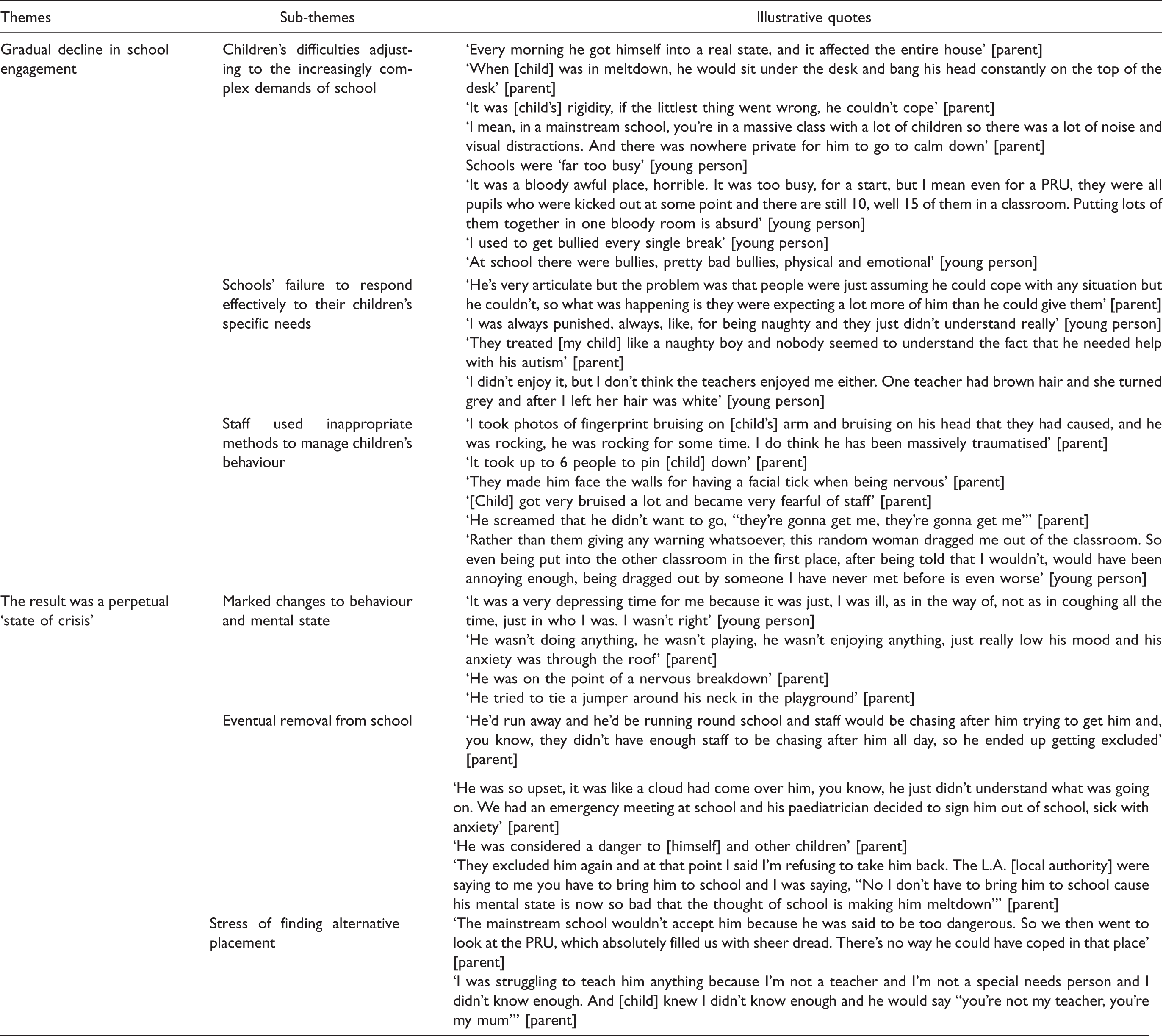
Themes and sub-themes identified from child and parent interviews on their pre-exclusion experiences.
Gradual decline in school engagement
Although some parents described how their child initially enjoyed school, with the first years of primary school providing ‘continuity’, ‘limited pressure’ and ‘really good relationships’ with teachers, all encountered considerable difficulties as their children’s school careers progressed. Some children began to refuse to engage in schoolwork and many refused to attend school, which caused much stress at home. The young people also had overwhelmingly negative recollections of their previous schools, noting that they ‘hated it’ and that their schools were ‘awful’, ‘boring’, and ‘absolutely shit’.
Parents also reported an escalation in behaviours that challenged others. One mother described how her child had ‘barricaded himself in rooms with other children, set off fire alarms’ and destroyed school property, resulting in the school ‘calling the police on him’. Another mother stated that her child’s anxiety led to instances of self-injury. Although children recognised that they behaviour was often challenging in nature, they did not acknowledge the impact of their behaviour on others. Several parents, however, recognised that their children’s ‘meltdowns’ had impacted negatively on other children’s school experiences, either ‘triggering them off’ or intimidating them.
This decline in school engagement was attributed to two key factors: (1) children’s difficulties adjusting to school and (2) the schools’ failure to respond to their children’s needs. Parents noted their children’s increasing difficulties coping with change, particularly in unstructured situations (e.g. playtime) and transition periods, as well as difficulties coping with the sensory environment. Parents also spoke of their children’s communication difficulties, particularly how they ‘take everything literally’, which made it difficult to understand teachers’ instructions and expectations. Young people recounted having few friends, with people not ‘liking me very much’, and repeated conflicts with non-autistic peers. Others spoke of the difficulties in being around other children all the time. One mother explained how her child’s meltdowns often resulted from the exhaustion of constantly trying ‘to work out cognitively what he doesn’t understand, all day every day’, while another described how being bullied every day ‘wound up’ her child and sent him ‘straight into a meltdown’.
Parents also felt that their schools were ‘constantly letting [child] down’. They stressed how they had to ‘fight’ to get their children’s difficulties recognised by schools and to gain access to appropriate support. Young people also noted specifically that they did not get on well with staff in their previous school(s) and that they felt staff were ‘unfair’, ‘unhelpful’ and inconsistent in their approach (‘They said they wouldn’t do that, and then they did do that, and then I went completely apeshit’ [young person]). Parents and young people felt that the invisibility of autism and other conditions (e.g. EDA) often underpinned this lack of recognition of their needs. Several parents also described how their child’s difficulty with accessing school was due to a lack of understanding of their children’s EDA-related behaviours, explaining that the demands placed on the child ‘caused distress and massive anxiety’.
Parents and young people also reported inappropriate methods by previous school staff, including several allegations of emotional and physical abuse. One mother stated, ‘all [the teacher] did was scream all day, shouting [at my child]’ and that the teacher ‘ripped up his handwriting because it wasn’t neat enough’, resulting in her child feeling ‘humiliated and useless’. Parents also voiced serious concerns about the amount of physical restraint used with their child, which they felt had detrimental consequences on their children’s mental health.
The result was a perpetual ‘state of crisis’
Parents repeatedly explained how these experiences had ensured that their children were ‘terribly wound up’ and in a ‘state of crisis’. One mother noted her child pulled his hair and had ‘very small bald patches, that were down to him being so stressed’. Several parents reported that their children began to show self-injurious behaviours, including ‘banging his head’ during a meltdown, self-harming, and even attempts to take their own lives. One parent summed it up: ‘we were convinced that all he needed was the right schooling, the right placement and the right therapy because we saw lots of potential in [child], but he was so stressed. He was in a crisis state all the time’.
With the exception of one child, all children were eventually excluded from their schools. Of the few children who agreed to talk about the reason for their exclusion, they stated they ‘could never stay in one place’, ‘liked to be in control’, or were excluded for ‘being violent’. Parents stated that children were excluded mainly as a result of behavioural reasons. One mother described that, within a 3-month period, her son had been excluded 24 times, which she felt had damaging consequences to his mental health.
Parents reported feeling desperate to find a suitable placement for their child and emphasised the time and effort it took to do so. Several parents objected to their child’s repeated exclusions and negative school experiences by opting to keep their children at home. But home-schooling also presented significant challenges, including inadequate support, with the little support they did receive ‘only wind[ing] [child] up more’.
Results from children, parents and teachers’ semi-structured interviews: Experiences following re-integration into school
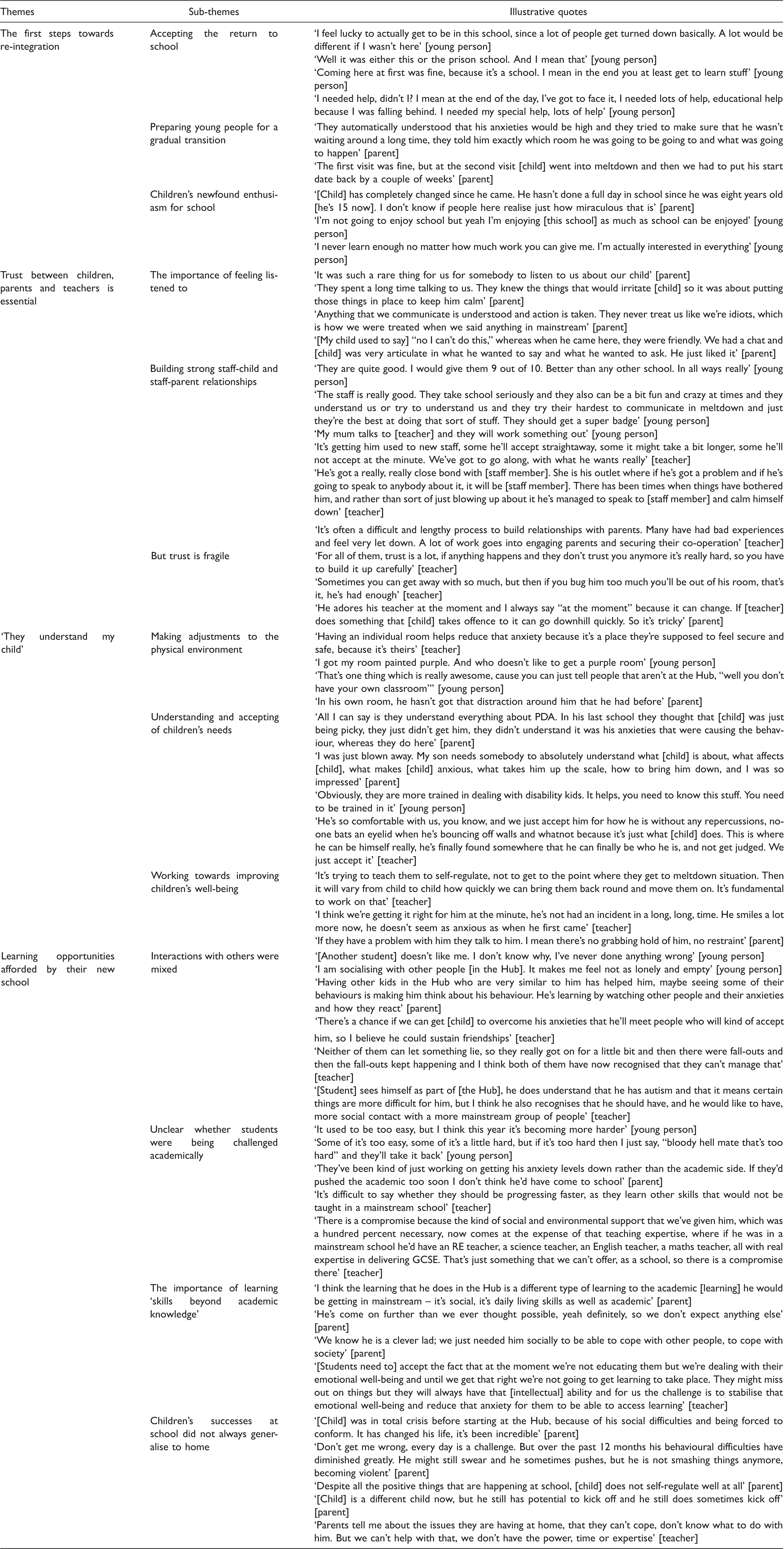
Themes and sub-themes identified from child, parent and teacher interviews on their post-exclusion experiences.
The first steps towards re-integration
Many children had not accessed education and were out of school for a significant length of time before their current placement. At the time of the current study, most students had been attending the Hub for at least one year. One student had been there for six years. Children were aware that their placement at the Hub was often ‘the only school that was left’. While some children seemed to have been indifferent about the prospect of attending the Hub, others appeared to have accepted the need to return to school.
Given the children’s often-distressing experiences in their previous educational placements, their transition into the Hub was a key part of their re-integration process. Parents explained how teaching staff made significant efforts to prepare children for the transition, so they knew what to expect when they started. Such efforts did not mean, however, that re-integration was straightforward. For many students, the transition process appeared to be quite a gentle process, in which the time and days a week the student spent in school gradually increased: ‘every child attends full-time eventually, it’s just at their own pace’ [teacher]. Staff explained that their primary goal was ‘to make them feel less anxious’.
Following the transition, children’s levels of school attendance improved considerably. Most of the students attended school full-time, with few absences. Teachers confirmed that, over the course of this study (13 weeks), young people missed school on few occasions (maximum six days for one child). Importantly, many parents noted their child’s newfound willingness to ‘actually go to school’, stating that he ‘hasn’t refused which is pretty amazing’. Children were also positive about going to school and learning, with many stating that they ‘want to learn’, although others were more ambivalent. Staff emphasised that engaging children, ‘offering them a wow-factor’, was critical to overcoming their initial resistance to coming to school.
Trust was essential for getting young people back into school
Young people, parents and staff agreed that strong, trusting relationships between teachers and students were essential: ‘The relationship that you develop with a child is absolutely paramount’ [teacher]. To do this, staff reported taking great care to ensure that both parents and pupils felt listened to right from the start and that, importantly, the school took their concerns on board. Encouragingly, both parents and young people felt that their views were taken seriously.
With regards to staff–student relationships, staff reported that each student was carefully matched to the adults supporting them, based on mutual interests and personalities. This strategy seemed to be successful: although a few students mentioned that there are certain members of staff they ‘just wouldn’t really work with’, students generally felt positive about the Hub staff, stating that ‘they all make you feel welcome and happy’, that ‘they are quite good’, and that ‘they should get a super badge’. Staff highlighted that the students felt reassured that they were trusted by staff, which made it easier to seek help when they need it: ‘you just tell staff and they’ll try and sort something out’ [young person]. While all informants felt that consistency and familiarity with staff was helpful for the children, teachers nevertheless noted the fragility of students’ trust in them and how difficult it can be to repair once broken.
‘They understand my child’
Staff reported making extensive efforts to accommodate children’s individual needs and preferences, which included making substantial adjustments to the physical environment (‘removing anything that could potentially tip them over the edge’ [teacher]). Students were given their own, personalised classrooms. Having their own classroom was important to the young people (‘it’s nice and quiet’), gave them a secure space to ‘be themselves’ [teacher], and helped to manage children’s sensory differences. Indeed, staff commented about students ‘not being able to cope’ without their own room.
Parents were extremely encouraged about teachers’ efforts to understand their children’s specific needs and accept them, including their children’s EDA. Teachers emphasised that not being judged for their behaviour in the Hub was like a ‘safety blanket’ for students, which they felt had a positive impact on their mental health. Staff also highlighted the importance of continuously monitoring and working towards improving children’s wellbeing, which also meant responding well to children’s behaviours regarded as challenging. Parents noted the staff’s ability to handle critical situations – much better and ‘a lot calmer’ than the staff in students’ previous placements. Some students also showed awareness and respect for teachers’ expertise, stating that staff are ‘professionally trained’.
Learning opportunities afforded by their new school
Making considerable adjustments to the physical environment, fostering strong relationships with students and parents, and having staff who were competent and accepting of the students were felt to contribute towards promoting children’s mental and emotional well-being, which staff felt was a necessary precursor to enhancing their learning, especially their social and academic skills.
Parents noted the challenges their children faced with friends and peer relationships. Teachers agreed, stating that while most students expressed a desire for friendship, ‘they just don’t know how to do it properly’. Parents felt that being around other students ‘like them’ was a positive influence on their children’s self-perception and social abilities, although teachers noted that being around students with similar difficulties could increase the likelihood of tension between them. Indeed, while some young people felt that students in the Hub were ‘quite nice to hang out with’ and ‘incredibly funny’, others reported them as ‘a bit nutty’, ‘get[ting] on my nerves’ and ‘messed up people’. One child explained that he tried to make “good friends” but that this is ‘a bit harder’ with some, ‘but that’s obviously not them themselves, it’s obviously their condition’. To circumvent these difficulties, staff described how students’ engagement with others was ‘child-led’, with teachers facilitating social contact with their peers when the students expressed an interest in socialising with others. Despite attempts to engage children socially, some staff nevertheless felt that the Hub was lacking in an ‘appropriate’ peer group, particularly for the students with ‘fairly good social skills’.
It was unclear whether students were being sufficiently challenged academically. Most parents noted that while they felt their children were ‘very, very clever’ and ‘bright’, their children’s previous refusal to engage in any schoolwork had set them back considerably, which meant that students’ initial academic progress at the Hub had been slow. Indeed, although some students felt they ‘don’t really learn much’, that sometimes staff ‘don’t really push it that much’, they also felt they would ‘not necessarily’ learn more if they were pushed harder. In addition to difficulties with engaging children academically, both parents and teachers reported that it was ‘difficult to judge children’s progress’, because their engagement was so varied and that they can often ‘do more than they show’. While staff were perceived to be well-equipped to support emotional regulation and moderate the demands placed upon the child, teachers, parents and even students noted that staff can sometimes struggle to provide teaching expertise, especially for the older children who require more advanced subject knowledge.
Parents made it clear, however, that their children’s academic progress was not their top priority. Instead, they highlighted the need to build children’s emotional resilience so that they could access learning, suggesting that it takes time to ‘repair the damage’ of their previous experience and ‘build up the foundations’ for learning. They also stressed the importance of children’s independence, their ability to ‘cope and self-regulate’ and to ‘understand their condition’, over academic achievement – and teachers agreed. In this regard, parents noted considerable changes in their children’s behaviour since transition to the Hub. For some students, this progress was gradual, while for others, it had been more dramatic.
While parents celebrated their children’s successes they, nevertheless, acknowledged that their children were still not ‘coping perfectly’. Although students were ‘emotionally in a much better place’ [teacher], some were unable ‘to deal with his emotions very well at all’ [parent]. Although parents had also witnessed improvements at home (‘he’s just very different to live with’), with their behaviours being ‘a lot more manageable’, they also stated that home life can still be stressful. Parents also described times when their children were ‘more stressed’ and ‘more difficult’, which tended to be ‘when he is away from school’, ‘during holidays’, and when unexpected issues arose. Teachers also commented that their ability to support students’ home life was often limited, with some issues shared by parents to be beyond their influence.
Discussion
This study focused on some of the most vulnerable autistic children and young people – those previously excluded from education, whose needs were considered by their teachers and parents to be especially complex and who were reported to often have multiple co-occurring conditions. Indeed, our own assessment of these children’s cognitive and behavioural profile showed that many had clinically significant levels of anxiety and behaviours reminiscent of EDA, at least as reported by their parents. Participants reported overwhelmingly negative experiences of their own and their children’s previous educational placements. Children’s perceived unmet needs and the use of inappropriate approaches by school staff in dealing with children’s difficulties were felt to cause a decline in children’s mental health and behaviour, which resulted in both formal and informal exclusions, placement breakdowns and, ultimately, permanent exclusions.
The factors precipitating exclusion for these young people are consistent with the few existing studies on this issue. Sproston et al. (2017) reported that the heightened sensory demands of mainstream school environments, conflictual staff–child and peer–child relationships, limited understanding of young people’s specific needs, and either unhelpful or non-existent support from their previous schools were all perceived to be attributable to their eventual exclusion from school. These are precisely the factors we identified herein: parents and young people strongly asserted that inappropriate school environments, and a lack of staff recognition and understanding of children’s individual needs were key causes of their and their children’s escalating behavioural problems and their inability to access mainstream education (see also Pirrie, Macleod, Cullen, & McCluskey, 2011). They further noted that the invisibility of their own or their child’s condition was especially problematic, where genuine difficulties were misconstrued as behavioural problems ‘because they look “normal”’ (cf. Kenny et al., 2016). It is possible, of course, that these difficulties were manifestations of other co-occurring conditions, rather than arising from autism per se – difficulties that might have been caused, or even caused by, children’s negative educational experiences.
Although our participants acknowledged that the young people’s behaviour was particularly challenging at times, they also stressed that staff in previous schools had used inappropriate and ineffective approaches to deal with such behaviour, citing several instances of what could be described as emotional and physical abuse. Caution is warranted regarding these reports given that they are (a) retrospective in nature, and therefore potentially subject to recollection biases, and (b) derived from the perspectives of parents and young people only, not the schools involved. Notwithstanding, the current reports are consistent with studies showing that students with SEND, especially those on the autism spectrum (Westling, 2010), are more likely to experience physical restraint and/or seclusion as a result of their behaviour (Hibbard & Desch, 2007; Ryan & Peterson, 2004).
While physical restraint may be lawfully used to prevent harm to oneself or to others (when implemented in a way that maintains the safety and dignity of all concerned) (DfE, 2013), researchers have highlighted that such restraint often results from a failure to use effective, preventative techniques to manage behaviour that challenges (e.g. Scheuermann & Hall, 2015). Consistent with this suggestion, studies have demonstrated that many teachers feel ill-equipped to deal with autistic students’ challenging behaviour (e.g., Westling, 2010) and difficulties regulating their emotions (e.g., Humphrey & Symes, 2013), which can lead to them using reactive rather than proactive approaches (Lindsay, Proulx, Scott, & Thomson, 2014). Efforts to reduce exclusion in autistic children and young people with particularly complex behaviour must seek to develop school-wide, proactive plans and improve staff confidence to address students’ challenging behaviour (see Westling, 2010). Such approaches are likely to be implemented more effectively when schools collaborate with parents (Soto-Chodiman, Pooley, & Taylor, 2012) and with the young people themselves.
The former challenges reported herein by the young autistic people and their parents are deeply worrying. Failure to include children in school is likely to have serious consequences on children and young people’s behaviour and psychological wellbeing (Goodall, 2015), as clearly attested by our participants. Both parents and young people spoke of their or their children’s increasing anxiety, depression and even suicidal ideation, and the substantial impact their children’s pervious educational experiences had on parental mental health and family life, consistent with reports of school exclusion of children with other SEND (Parker, Paget, Ford, & Gwernan-Jones, 2016; Pirrie et al., 2011). But the potential effects of exclusion on long-term outcomes are even more far-reaching. It is well established that the economic and social costs of school exclusion are high, with many excluded young people having a greater risk of not being in education, employment or training in early adulthood, having mental health problems, being involved in crime, or even being homeless (Berridge, Brodie, Pitts, Porteous, & Tarling, 2001; Coles et al., 2002; Daniels et al., 2003; Whear et al., 2014). This is especially concerning for young autistic people and adults, who are already at increased risk of developing mental health problems (e.g., Simonoff et al., 2008), and of having suicidal thoughts and suicidal plans or attempts (Cassidy et al., 2014; Hirvikoski et al., 2016), suggesting that these young people may be doubly disadvantaged and, ultimately, disenfranchised in this regard.
The culmination – and escalation – of these challenges as school progresses could suggest that the educational journey to exclusion is an inevitable consequence for at least some autistic children, including those with particularly complex behaviour, as sampled here. But our study, encouragingly, showed that this was not necessarily the case. All the young people reported being happy, safe and secure in their current placement, the Hub. Parents and teachers also reported compelling changes in the children’s emotional well-being and behaviour, as well as a newfound enthusiasm for school, as manifested by the young people’s school attendance. Our interviews with parents, teachers and the young people identified four key features necessary for students’ successful reintegration into school, including (i) making substantial adjustments to the physical environment, (ii) promoting strong, trusting staff–student relationships, (iii) ensuring that staff members understand and accept these students’ needs, and (iv) targeted efforts towards improving students’ wellbeing. These features closely align with those identified in reports from previously excluded autistic girls (Sproston et al., 2017) and children with other SEND (McCluskey, Riddell, Weedon, & Fordyce, 2016; McGregor, Mills, te Riele, & Hayes, 2015) on their successful reintegration into school – all of which stress that such success involved developing strong connections with their students, being willing to listen to students’ views, and being more attentive to their unique needs. Indeed, these features are commonly highlighted by researchers as good practice in autism education (Charman et al., 2011; Dillon, Underwood, & Freemantle, 2014; Parsons et al., 2011).
The often-extreme accommodations made by Hub staff, including the individual classrooms, and their exceedingly flexible approach to children’s education are unlikely to be matched by regular, mainstream schools, not least because it is prohibitively expensive. It is unclear whether children’s experience at their previous schools would have been different, if these establishments had been able to provide similar resources and expertise. Nevertheless, having teachers and professionals who are aware of these students’ varying needs and who feel confident in responding to them appropriately should be a realistic goal. Existing research suggests that teacher knowledge about autism is limited, with many believing that they lack the training to provide appropriate support to autistic pupils, particularly within mainstream classrooms (e.g. Lindsay et al., 2014; McGregor & Campbell, 2001; Robertson et al., 2003; Soto-Chodiman et al., 2012). Given that teachers’ prior knowledge of autism is related to more positive attitudes towards inclusion (L. Crane, A. Remington, L. Kenny, & E. Pellicano, in preparation; Robertson et al., 2003), efforts should be directed towards improving education professionals’ knowledge and awareness of autism, and effective ways of responding to these students’ needs. This situation is set to improve, at least in England, with autism becoming a mandatory training subject for trainee teachers in 2018. Such training might also help to overcome a key barrier in the successful inclusion of autistic children and young people: the prevailing perception that young people’s difficulties are firmly rooted within the child (House of Commons Education and Skills Select Committee, 2006), rather than a consequence of the culture and practices of schools themselves (see McGregor et al., 2015; Runswick-Cole, 2011, for discussion).
Yet, in the absence of training, there are key ways in which schools should seek to promote inclusion of autistic students. All of our informants highlighted that the quality of relationships between staff and students, and staff and parents, were essential to reducing their anxiety, improving their confidence and, ultimately, getting them back into school. Many existing studies on exclusion (e.g., McCluskey et al., 2011; McGregor & Mills, 2012; Pirrie et al., 2011; Sproston et al., 2017) have also emphasised that students become re-engaged with school when school staff take the time to get to know their students – their capabilities and potential disabilities – and develop strong relationships with them. Indeed, Daniels et al. (2003: 134) noted that ‘what mattered more [than the nature of the provision] were the degrees of skill and commitment shown by staff in any site of provision’. It should not be beyond educational authorities, teachers and school staff to adopt this relational approach (see Cottam, 2011), providing supportive, respectful and nurturing learning environments. This is especially relevant within the context of current policy frameworks, which emphasise the importance of involving young people with SEND, including those on the autism spectrum, in the educational decisions that ultimately affect them (DfE, 2014).
The flexible, supportive environment offered by the Hub may not have come without its costs, however. The extent of young people’s academic progress, from the perspectives of all informants, was far from clear. Similar to previous studies (Byrne, 2013; Makin et al., 2017; McNerney et al., 2015), parents reported prioritising non-academic skills (emotional resilience, life skills) – the so-called ‘hidden curriculum’ – over academic progress. This focus is perhaps unsurprising given that difficulties with social issues and everyday adaptive functions are common in young autistic people (APA, 2013; Klin et al., 2007) and the extremely negative experiences in their previous mainstream placements. Nevertheless, the limited focus on academic progress is in striking contrast to the results of studies focused on reintegrating children with other SEND (largely with social, behavioural and emotional difficulties) in alternative provisions. For example, McGregor et al. (2015) reported that the teachers in their case study schools were striving ‘to ensure that high expectations and intellectual rigour permeate the work being given to the students’ (p. 621). It is therefore possible that, in developing the Hub’s supportive school environment, high aspirations for these cognitively able young autistic people might have been lost.
Even if this is not the case, more remains to be done to ensure that children and young people’s progress in self-regulation at school is also mirrored in other settings. Parents reported that, while they felt their children’s ability to regulate their behaviour had improved, they continued to have difficulties at home, which resulted in stressful family lives. This disparity in children’s behaviour between home and school contexts was also evident in parent and teacher reports on the children’s demand avoidant behaviour. While parents reported elevated levels of demand avoidant behaviour on the EDA-Q, presumably observed at home, teachers did not. Caution is warranted when interpreting these results, however, given the relatively low internal consistency of teachers’ responses. Nevertheless, the apparent difference between young people’s behaviour at home and in school could be explained partly by the nature of challenges they face in the two different contexts, with parents reporting that more unexpected issues arise at home that the children are not necessarily confronted with in school (e.g. interactions with siblings, important life events like the death of a grandparent), and partly by the fact that parents are unlikely to be able to replicate the structure and security of the Hub environment. Yet, it could also mean that the young people are failing to generalise across contexts – an issue that is notoriously challenging to address (Hwang & Hughes, 2000). Such a possibility is concerning in this instance, as it is unclear whether the apparently positive strategies and approaches adopted by the Hub are effective in promoting children’s self-regulation, and therefore for ensuring young people’s success in post-Hub settings.
This study has several limitations. First, the autistic children and young people sampled here had often been excluded multiple times and had unusually high levels of need (including additional co-occurring difficulties), which could potentially limit the generalisability of the results. The parity in findings across our study and several existing studies in autistic (Sproston et al., 2017) and non-autistic children and young people (e.g. Parker et al., 2016; Pirrie et al., 2011), however, warrants confidence in these findings. Second, in light of the retrospective nature of parent and young people’s reports, it is difficult to determine whether their current, complex needs (or at least their needs upon entry to the Hub) were either a cause or a consequence (or both) of their often-harrowing school experiences. Longitudinal studies tracking the experiences of young autistic people who are ‘at risk’ of exclusion may help to determine the source of this issue – and potentially identify the preventative strategies employed by some schools to ensure that children at risk of exclusion are successfully included in school. Finally, although comparisons with existing studies of exclusion in children with other SEND suggest that the factors critical to re-integration into school are similar to the ones identified here (e.g. McCluskey et al., 2011; McGregor et al., 2012; Pirrie et al., 2011), the absence of a comparison group of young people with other SEND who also experienced exclusion prevents us from making firm conclusions in this regard. It therefore remains unknown whether the nature of exclusion for young people on the autism spectrum is unique in some way(s).
Conclusion
Since the Warnock Report (Warnock, 1978), the aim of education policy has been to include children – including autistic children – within mainstream provision at the child’s local neighbourhood school (Department for Education and Skills, 2001). Indeed, section 33 of the Children and Families Act 2014 places a duty on the local authority to ensure that a child or young person with an EHC plan is educated in a mainstream setting. The parents and young people in our study reported that inclusion simply did not work in their previous schools; children ‘hated it’, often refused to attend school and increasingly showed behaviour that challenged teachers and school staff, which ultimately led to extreme anxiety, self-harm, emotional and physical torment, and disengagement from education. Here, we showed that one particular alternative provision, the Hub, managed to turn this around, at least in the young people sampled here. The Hub staff accommodated the young people’s diverse learning needs and personal challenges by offering flexible, supportive and respective environments – for them and their parents – ultimately, re-engaging them in their learning. These findings clearly demonstrate that these young people are not ‘ineducable’. Efforts must be directed towards understanding the most effective preventative approaches of keeping these young people included in mainstream schools and, ultimately, ensuring that they lead flourishing lives.
Footnotes
Declaration of Conflicting Interests
The author(s) declared no potential conflicts of interest with respect to the research, authorship, and/or publication of this article.
Funding
The author(s) received no financial support for the research, authorship, and/or publication of this article.