




Abstract
Background and aims
This qualitative study was conducted to obtain information regarding education professionals’ (i.e., classroom teachers’ and speech-language pathologists’) perspectives about tablet technology use in classrooms of children with Autism Spectrum Disorder (CWASD).
Methods
Seventeen education professionals from a special day school for CWASD participated in one of four focus groups that provided information and insight regarding the context in which tablets are being used, challenges in implementing tablets, and perspectives on how tablets can be used most effectively.
Results
Four interrelated themes emerged from the data including the participants’ perspectives related to: (a) the distinct uses of tablets; (b) challenges and challenging behavior associated with tablet use; (c) causal factors of the challenges; and (d) the value of tablets, and the continued desire and dedication to using the tablets;
Conclusions and implications
The results from this study suggest that education professionals have unique and insightful opinions related to tablets. There appears to be gaps between the current research base on tablet use in CWASD and “real world” practice, suggesting that further research is needed in the implementation of tablets in classrooms of CWASD.
Introduction
The use of tablets in the school-aged population has surged in recent years. The specific features of tablets, including low cost, portability, mobility, accessibility, size, ease of recording, and wireless internet access have facilitated the widespread implementation of technology in the classroom (Neely, Rispoli, Camargo, Davis, & Boles, 2013; O’Malley, Lewis, & Donehower, 2013; Stockall & Dennis, 2014).
Children with special needs form a subgroup of the school-age population that may receive additional benefits from the use of tablet technology in the classroom. Children with autism spectrum disorder (CWASD), in particular, may benefit from tablets to compensate for limited verbal communication abilities, facilitate literacy development, increase overall academic performance, and decrease challenging behavior (Bölte, Golan, Goodwin, & Zwaigenbaum, 2010; Knight, McKissick, & Saunders, 2013; Neely et al., 2013; Pennington, 2010). Tablets appear to be particularly appealing to parents of CWASD also. Clark, Austin, and Craike (2015) found that parents have high uptake of tablet technology and that 38% of the parents reported their CWASD were using tablets for 1 to 2 hours per day. The website affiliated with Autism Speaks, a leading advocacy and science organization dedicated to autism, provides a list of approximately 648 applications, or apps, for CWASD (Autism Speaks, 2015) suggesting significant interest in this area.
Despite this widespread use of tablets in CWASD, research that describes how tablets are used and the effectiveness of tablets and apps is, by comparison, somewhat limited (Knight et al., 2013; Pennington, 2010), and there are some data that suggest that tablets may present some challenges (King, Thomeczek, Voreis, & Scott, 2013). In the King, Thomeczek, Voreis, and Scott (2013) study, the authors analyzed naturalistic observations of CWASD using tablets in the classroom in an effort to better understand how CWASD were using tablets and applications in the classroom and to explore how education professionals were involved with tablet use. This study provided important information regarding the uses of tablets and aps, but the views of tablet use from the education professionals was not a component of the study. The purpose of this current research project was to delve deeper into tablet use with CWASD in the classroom, specifically based on the opinions and insights of the education professionals who are working with these children and this technology every day.
Literature review
Benefits of tablet use in CWASD
Research in tablet use in CWASD has suggested that tablets are currently being used effectively in a variety of distinct manners and for a variety of distinct functions (e.g., Kagohara et al., 2013; King et al., 2013). These effective uses of tablets can be broadly categorized within three functions: (a) the tablet serving as a means/tool to deliver instructional video (video-based modeling; VBM), (b) the tablet functioning as a speech-generating augmentative and alternative communication (AAC) system, and (c) the tablet, in conjunction with various applications, serving as a means to facilitate learning of academic content.
Video-based modeling
Various types of VBM (e.g., video-modeling with another person as a model, and video self-modeling) have been identified as evidenced-based intervention for CWASD (Mason, Ganz, Parker, Burke, & Camargo, 2012; Shukla-Mehta, Miller, & Callahan, 2010). In a systematic review of iPod and iPad use in individuals with developmental disabilities (Kagohara et al., 2013), 40% of the articles (six of fifteen) included in the review involved the use of this technology for VBM. Research suggests using tablets as a source of VBM in various academic contexts can successfully teach children and young adults with ASD to check spelling (Kagohara, Sigafoos, Achmadi, O’Reilly, & Lancioni, 2012), improve functional math skills (Burton, Anderson, Prater, & Dyches, 2013), increase independent task completion (Burke et al., 2013; O’Malley et al., 2013), and increase the number of utterances produced in play dialogues (Murdock, Ganz, & Crittendon, 2013).
Augmentative and alternative communication
AAC is an effective intervention option in CWASD to supplement natural speech or provide an alternative means of communication for children who do not have the ability to speak with their natural voice (see Ganz et al., 2012 for review). Tablets have had a significant impact on AAC access for CWASD (Shane et al., 2012) specifically by providing a low-cost alternative to dedicated Speech Generating Devices (SGDs). A dedicated SGD can cost up to approximately $7,000 while a tablet with an AAC application may only cost approximately $1,000. Additionally, when compared to dedicated AAC, tablets and apps provide AAC options that are smaller; have more natural sounding voices; have longer battery life; are more portable, available, and accepted; and have greater functionality (McLeod, 2011; McNaughton & Light, 2013).
A consensus of research has indicated that tablet-based AAC systems have positive effects on the communication skills and other behaviors of CWASD (Alzrayer, Banda, & Koul, 2014; Gevarter et al., 2016; Lorah, Parnell, Whitby, & Hantula, 2015; Sennott & Mason, 2015; Waddington et al., 2014). The King et al.’s (2013) study indicated that an AAC app on a tablet, combined with the presence of a communication partner, led to successful AAC use by the participants 81% of the time. Some research has even suggested that some CWASD prefer the tablet-based AAC system as opposed to other forms of AAC (e.g., Flores et al., 2012; Lorah et al., 2013, 2015; van der Meer et al., 2012). Teachers have also expressed a preference for tablets over non-electronic system such as pictures in communication books and boards due to ease of use, reduced preparation time and materials, and increases in children’s communication speed with the tablet versus pictures (Flores et al., 2012).
Academic content
King et al. (2013) found that the CWASD participants spent 51% of their time with a tablet in an app that was intended to support an academic area (e.g., reading, writing, math, vocabulary, language, fine motor skills, comprehension, etc.). Survey and interview data from Johnson (2013) found that all responses to a question about the types of activities for which children with special needs (described as children with intellectual disabilities, autism, visual impairment, and cerebral palsy) used a tablet were related to the core curriculum areas of literacy and math. Compared to the research on the use of tablets for video modeling and AAC, however, there is less research that supports the effectiveness of tablets and apps to teach academic content, particularly in regard to whether or not the tablet app can effectively teach a skill. For example, Neely, Rispoli, Camargo, Davis, and Boles (2013) suggested that academic work on a tablet might decrease challenging behavior and increase academic engagement, but the researchers did not investigate whether or not the tablet and app increased mastery of the academic content presented. O’Malley, Lewis, and Donehower (2013) investigated the effectiveness of an app, Matching Game-My First Numbers, used to teach number recognition and understanding of numerals. The researchers’ findings suggested that there was no difference in math skills during baseline compared to the treatment condition but that individual trends suggested that five of the seven students maintained or increased math skills during the study. Lee et al. (2015) showed that for one participant, vocabulary learning increased when using tablet-based instruction as opposed to therapist-based instruction. Price (2011) suggested that reading comprehension increased for the participants who used tablets when reading interactive e-books.
Challenges and considerations
The research presented has suggested that technology can, and does, have a positive impact on learning and functioning in CWASD. In spite of this, some researchers have also suggested there may be potential challenges when using this technology. For example, researchers have found that the overuse of technology, in general, may lead to increased aggressive behavior (Anderson & Dill, 2000; Ko, Yen, Liu, Huang, & Yen, 2009), decreased academic performance (Anderson & Dill, 2000), disturbed and unhealthy sleep patterns (Van den Bulck, 2004), and increased bullying (Smith et al., 2008). In addition, a small amount of research has focused more specifically on the potential challenges of technology use with CWASD.
Repetitive and stereotypical behavior
The actual characteristics of ASD may, inadvertently, foster a challenging interaction with technology. One of the diagnostic criteria for ASD includes the presence of restricted and repetitive patterns of behavior (American Psychiatric Association, 2013). Ramdoss et al. (2011) suggested that technology use may intensify these existing problems in CWASD by increasing certain stereotypical behaviors. Watt, Wetherby, Barber, and Morgan (2008) operationally defined repetitive and stereotypical behavior (RSB) as tapping an object and swiping an object. Both tapping and swiping, however, are gestures necessary to navigate touch screen tablets. Certain apps may also promote these RSBs. The Doodle Buddy app, for example, requires repetitive finger tapping to “stamp” the screen, thereby facilitating this specific RSB. King et al. (2013) discussed RSBs in their observational study of tablet use in CWASD, suggesting that RSBs were present and undesired during tablet use.
App violation
The second possible challenge when working with tablets was highlighted in King et al. (2013). These authors conducted an observational study to describe how CWASD were using tablets in the classroom. One particularly interesting and relevant finding from that study showed that even when CWASD were in an app, they were not always using the app for its intended function. These authors refer to this as “app violation”, which they define as use of an app “… in a manner that was substantially inconsistent with its intended function; in other words, the described purpose of the app could not be achieved” (p. 6). Overall, participants violated the intended function of the app 31% of the time; specifically, AAC apps were violated 42% of the time, academic apps 29%, and game apps 14%. These results indicated that violation of app function is not uncommon and may be interfering with the successful use of tablets with CWASD.
Tablet use
The final potential challenge identified in the research is related to the actual use of tablets in educational settings. King et al. (2013) found that it was important for educational professionals to be directly involved with CWASD as they used tablets. During each instance of tablet use, the authors considered app violation and fulfillment when an educational professional was ‘present’ vs. when the participant was ‘independent’ in using the tablet. The researchers found a positive impact on fulfillment of app use when the professional was present. The presence of an educational professional led to an increase in fulfillment in AAC apps from 35% to 81%, in academic apps from 63% to 83%, and in game apps from 72% to 100%. This suggests that it is potentially important for teachers to be able to provide one-on-one assistance to CWASD in order to ensure that app use is appropriate and effective.
In addition, O’Malley et al. (2013) conducted a study investigating the effects of using tablets as an academic intervention in a classroom with CWASD. As part of the study, they administered surveys to the parents and teachers of the children participating in the intervention about access to and use of technology. Three primary challenges were revealed in the study. The researchers indicated that the teachers needed a high level of technical support during the intervention, suggesting that utilizing iPads in classroom instruction could require additional teacher training and support staff. Parents reported that students rarely accessed technology for educational purposes in the home, and when they did, they required moderate to high levels of assistance. Finally, more time and effort were required by teachers to oversee and maintain the tablets than was expected (O’Malley et al., 2013). Thus, the demands placed on teachers and parents when using tablets with CWASD may be potential barriers to effective use of this technology.
A growing body of research has provided valuable information about specific ways tablets can successfully be used with CWASD and about some general factors that might have an impact on their effectiveness. Many of the published studies utilized small sample sizes, provided limited information about the methodology utilized in the study, and provided limited information regarding the specific characteristics of the CWASD (e.g., severity). As a result, it is difficult to generalize the findings of these studies broadly. In general, tablets have been shown to have the potential to be effectively used for VBM, AAC, and teaching academic content. However, we know little about how tablets are actually being used with CWASD in the classroom and clinic, and even less about how the professionals working with CWASD perceive the advantages and challenges of this technology.
Purpose of the study
The purpose of this study was to expand on the findings of the King et al. (2013) study by obtaining information regarding education professionals’ (i.e. classroom teachers and speech-language pathologists) perspectives on tablet technology use in classrooms of CWASD. The review of the literature suggested that CWASD are using tablets successfully in classroom settings for a variety of purposes, but also raised some concerns about possible challenges for both students and education professional when using tablets in the classroom. Further research was needed to explore uses of tablets, identify potential challenges, and generate possible solutions to the challenges associated with tablet use in CWASD to ensure successful use of this technology in the classroom.
Method
Participants
Seventeen education professionals (i.e., thirteen teachers and four speech-language pathologists) participated in the study. All participants were employed in a special day school for CWASD in midwestern United States and had experience using technology, and specifically tablets, in the classroom. Because this study was an extended examination of the King et al. (2013) study, the same special day school was selected. This school is a state board of education certified program that offers year-round education and services to students between the ages of 3 and 21 with ASD. CWASD are often placed in the special day school when the school in the district in which they live is not able to meet their specific education requirements. Typically, these CWASD are severely impacted by their ASD. Most of the CWASD who attend the special day school are minimally verbal or have limited functional communication skills, in addition to having significant impairments in many areas of functioning. The program houses 15 classrooms across two campuses, with one campus serving elementary students and the other serving adolescents. Each child at the school has an Individualized Education Program to meet specific academic, social, communication, and behavior needs.
Demographic Information of participants.
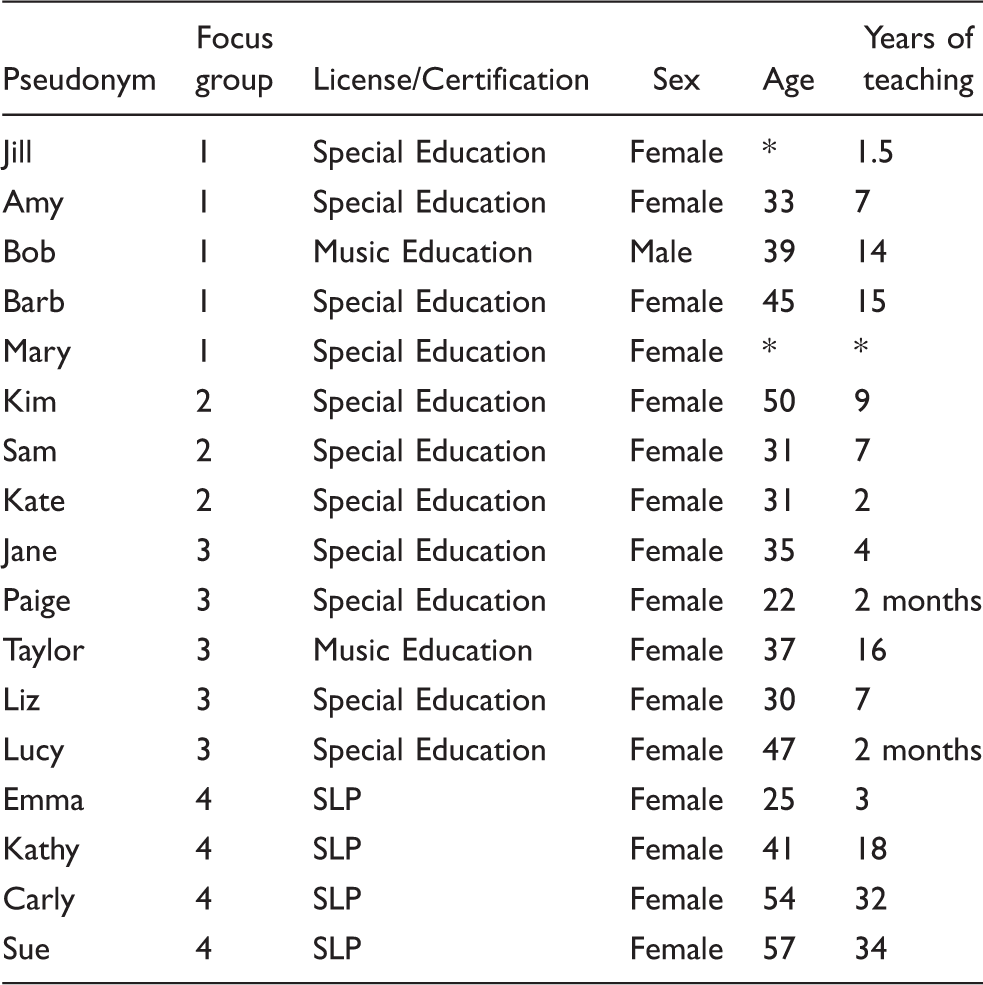
SLP: speech-language pathologist; *: participant did not disclose.
Setting
Focus group meeting took place in designated meeting rooms at the two campuses of the special day school. The meetings lasted between 60 and 90 minutes and were video and audio recorded for data analysis purposes only. Researchers used two video recorders placed in the corner of the room facing the participants, and an audio recorder placed in the middle of the table. Participants sat around a large table in the building’s conference room. The first and third authors served as co-facilitators (i.e., shared equally in the facilitation of the focus group interviews) and sat across the table from the participants.
Procedures
The focus group interview technique was utilized in this study. “Focus group research … implies an assumption that individuals have their own personal ideas, opinions and understandings; and the task of the researcher is to access or elicit such ideas, opinions and understandings” (Wilkinson, 1998). This methodology aligned most closely with the purpose of the study, specifically allowing access to the participants’ own language and also allowing for dynamic group interaction to stimulate discussion among the group participants (Asbury, 1995; Wilkinson, 1998).
Pre-focus group meeting procedures
Because this current study builds on the findings of the King et al. (2013) study, prior to participating in the focus group meetings, participants were given a paper copy of the journal article (King et al., 2013). The purpose of this was three-fold: (a) to provide insight to the findings from the initial research study, (b) to prime the participants’ to think deeply about multiple areas related to table use, and (c) to familiarize participants with the concept of app violation. Because only one participant indicated having read the article, the main points from the journal article were briefly summarized prior to beginning the focus group meeting and the term app violation was specifically described to all focus group meetings by the first author.
Focus group meetings
The facilitators initially posed four questions that were designed to elicit and guide responses regarding issues related to tablet use in the classroom with CWASD. The four guiding questions were: (a) What are the positive outcomes associated with tablet use? (b) What are potential negatives or pitfalls regarding tablet use in CWASD? (c) What contributes to successful tablet use in CWASD? and (d) What has been your experience with app violation? The facilitators emphasized that these questions were simply the guiding questions, and participants could freely speak about any other topics related to tablet use. Throughout the focus groups, the role of the facilitators mainly consisted of asking clarification, follow-up, or continuation questions, as well as asking the participants to provide specific examples.
Data analysis
Procedures
The data were analyzed using a thematic analysis method. An inductive approach was used, meaning that the themes were determined by the data collected rather than from preexisting categories. Thematic analysis specifically allowed the researchers to identify, analyze, and report patterns, or themes, within the data and then to organize and describe the data in detail (Braun & Clark, 2006). The thematic analysis procedure described in Braun and Clark (2006) was used.
In the first phase, researchers used video recordings of each focus group meeting to complete data transcription. Each meeting was transcribed verbatim, which allowed for the researchers to become familiar with the data. During the second phase, the researchers developed codes using an open coding process (Strauss & Corbin, 1990) with two steps. First, the verbatim transcription was broken into discrete units of information (i.e., discrete topics or ideas). A participant’s contribution to the discussion typically consisted of a number of sentences. These sentences could have contained only one discrete unit of information (i.e., one topic or idea), or multiple discrete units of information. Second, each discrete unit of information was abridged, such that the main essence of the information was captured in an approximately 10-word phrase. After the coding process was completed, the researchers used characteristics of the coded data to develop themes that were representative of the data set. These final themes, and eventually sub-themes, were developed after continuous revision and reorganization of the themes in an attempt to capture the greatest amount of information in the most meaningful manner from the data set. The first and second authors worked independently and eventually collaboratively to achieve consensus on the final set of themes and sub-themes.
Results
Four themes emerged from the participants’ comments during the focus groups. These themes are best considered as interrelated components of a complex picture of tablet use in CWASD rather than discrete categories of information. It is the relationship among themes, rather than the themes themselves, that most authentically presented the participants’ perceptions of tablet use. These interrelated themes are depicted in Figure 1. Each of these four themes is described and illustrated below using direct comments from the participants. Fillers have been removed from comments to facilitate ease of reading.
The four interrelated themes that emerged from the focus group data.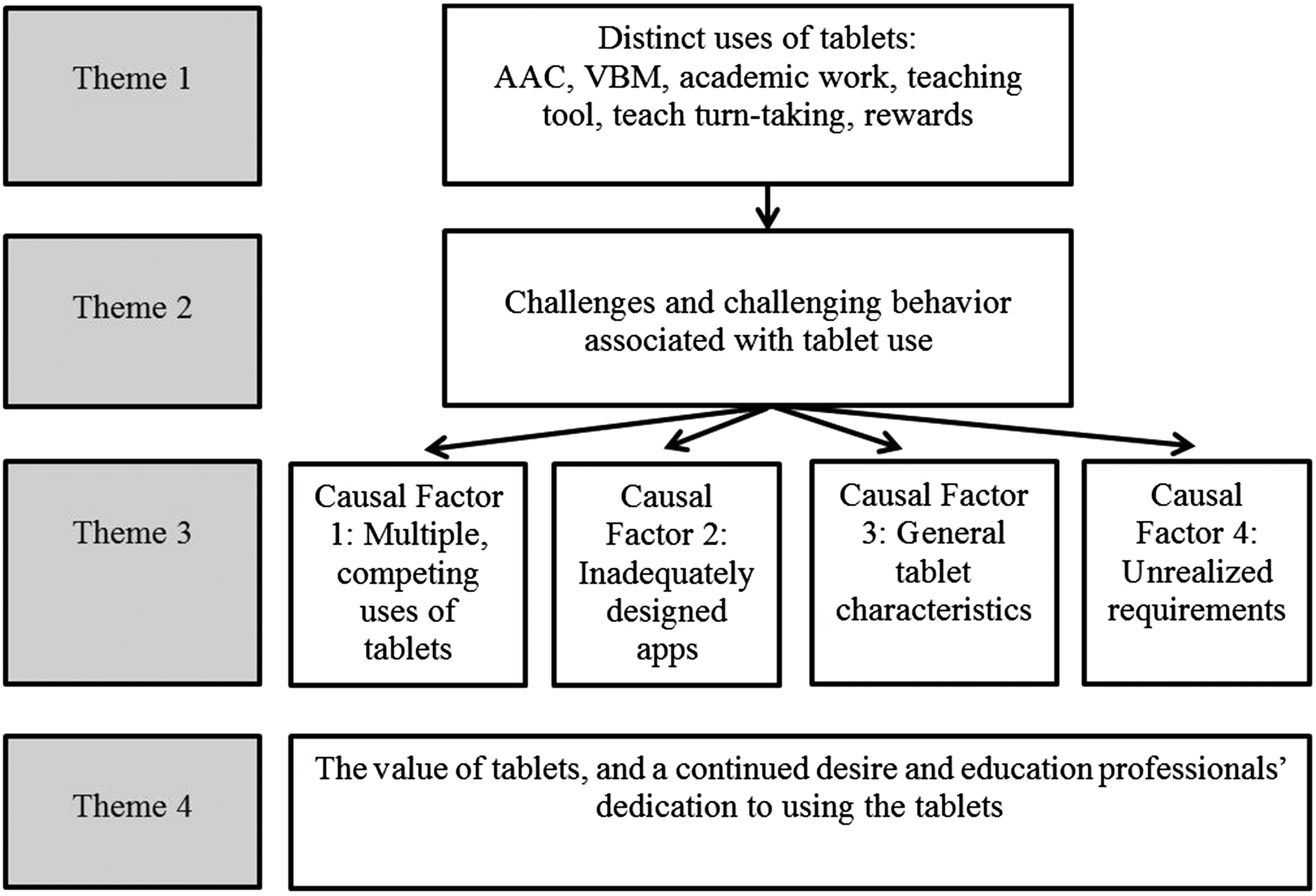
Theme 1: Distinct uses of tablets
A description of the way tablets were being used in the classroom provided the overall context for understanding the complexity of tablet use in CWASD. When taken together, the participants’ comments related to tablet use revealed that they were being used for six purposes: AAC, VBM, as a support for academic work (e.g., CWASD using a tracing app to practice handwriting skills), as a teaching tool for the education professionals (e.g., education professional using the tablet to show a map in a geography lesson), as a way to teach turn-taking skills (e.g., CWASD appropriately requesting a turn with the tablet when a peer is using it), and as a reward (e.g., time on tablet for good behavior). Barb: … we have students … that have them as a speech generating device … Carly: … We use it only for video modeling. I video tape them role playing and then we watch it. Barb: … touch a letter they pronounce it or pick a sound of a letter or basic phonics … but I’ve found even with, I’m doing some hand over hand with the tracing … if it’s incorrect, it’s not going to go on to that next letter unless it’s traced correctly … Paige: … we did a song called ‘I am the Earth’ today because it was Earth Day, and then they had to draw something that they saw in the video or if they want to draw an image they can go to Google Images and look up images Paige: … they have to take turns because it’s working on that social skill … Kate: … and I’ve noticed when they are using it as a reward …
Theme 2: Challenges and challenging behavior associated with tablet use
Across all the participants’ comments in all four focus groups, there was a pervasive view that, for the most part, the tablets presented some specific challenges. These challenges were present to varying degrees and extents in all of the tablet uses described in Theme 1. Sam’s comment below provided example of the multiple ways in which tablets can be challenging. There were similar overall concerns expressed throughout the focus groups about tablet use in classrooms with CWASD. Sam: … well in my three years here I’ve worked with every single age that we … see, I’ve seen where we have some students who have absolutely zero interest in any, anything to do with the iPad. Then we have ones where, with your rocket ship example, they just want the end surprise, or like you said to disappear. They’re not getting the actual goal of whatever that app is for, the academic part of it. And then we have our little braniacs who can manipulate it into doing something that’s not really intended for and getting into other stuff … And then we have our kiddos, our older kiddos, who really kind of have no interest in much of the apps. It’s more just being able to play a video game …”
In addition to the overall theme that tablets posed challenges, participants indicated that the tablets themselves caused a number of challenging behaviors in the CWASD. The education professionals identified 12 different challenging behaviors, including perseveration on getting to use the tablet, arguing/fighting over the tablet, app violation, self-simulating behavior, aggression toward staff, aggression toward the tablet, using the tablet to self-injure, social isolation during tablet use, repetitively entering and exiting an app, escaping tasks until tablet use is a choice, using the internet to get to inappropriate websites, and perseveration on YouTube. Examples of comments related to these behaviors follow: Lucy: I use it in the afternoon and that’s it. I don’t use it during the daytime for reward or choice time. Some kids don’t like to give it up … Taylor: … like today that we didn’t even give it to her because she comes in in the morning and screams because she wants it. Emma: … but with the iPads our kids get so zoned in and it becomes isolation … that social isolation is really concerning. Paige: … they’re just so focused on seeing their reflection in it, or banging it on the desk …
Theme 3: Causal factors of the challenges
The participants’ comments revealed insightful perspectives about why the challenges presented in Theme 2 exist. These reasons formed the four sub-themes of Theme 3.
Multiple, competing uses of tablets
From the perspectives of the participants, the fact that tablets were used for a variety of purposes contributed to their ineffectiveness and promoted challenging behavior. The participants identified three sets of competing or incompatible uses, including (a) home versus school use; (b) academic work versus reward; and (c) AAC versus every other use. Jill: … at home they may not have to share and they don’t understand the difference between at home I don’t have to share but at school I do. Emma: I would say that the majority of the younger elementary students who are exposed to the iPad as a reinforcement first, absolutely refuse to use it as a communication because they have huge behaviors when we put them in it. Sam: … with the other kiddos that actually have a speech generating device and that’s not a tablet, it is two completely different entities to them. This is how I talk; this is how I play. So, for our other kiddos to have just one tablet where it’s all combined, it’s really confusing and … it really gets jumbled when they’re trying to talk to you while they’re having fun … Kate: … if he’s watching something or listening to something that he wants to talk to you about he has to close out of that and go back to the speech app to get your attention and then it’s kind of lost.
Inadequately designed apps
Participants made a variety of unique and insightful comments about app characteristics that contributed to challenges, problem behavior, and app violation: Paige: … if you choose the wrong one, it explodes … so he purposefully … he does the wrong ones to make them explode. Amy: … fail proof apps is what I call it, where it’s not going to let you automatically touch the wrong answer and basically get rewarded. Carly: … it doesn’t reinforce soon enough, so they lose interest really fast. Sue: … even though the iPad is giving them directions, it’s not giving them visual directions, and they’re not understanding … what it is they’re supposed to do. Amy: … some of our students are sensory sound sensitive, and if they get a loud buzz … then it could cause behaviors. Jill: … I have found difficulty finding academic apps that are at our kids’ level. Jane: … On the tracing app … for ‘A’ there’s a little ant and he’s holding an apple and if you hit the ant, he like stumbles all around and the apple squishes him … he just sits there and hits the apple, hits the apple, hits the apple, hits the apple.
General tablet characteristics
Participants stated that the characteristics of the device itself contributed to the challenges of using tablets in the classroom that can potentially lead to challenging behaviors. Amy: … and when you do ask him to use it … he has a hard time pushing the little button to open it. [Jill]: … probably adding to why he doesn’t like want to use it that much. Emma: … sometimes the durability of all of them, that’s a big frustration … because our kids can be so aggressive. Barb: … if I’m reading a story from the iPad with the kids … they have to huddle together … it’s small. Barb: … before school is out … his device was dead. So he couldn’t play a game or have a voice.
Unrealized requirements
The participants suggested that successful tablet use requires that (a) the education professional has the expertise and availability to use the device to support learning with individual students, (b) the CWASD wants to use the device for its intended purpose and has the ability to do so, and (c) the purpose for which the app is being used is appropriate for the CWASD. The comments below highlight various ways in which these requirements might not be realized, and how they might lead to ineffective use or challenging behavior: Paige: … I think we have to really understand what the apps do before we can present it … Sam: … if you’re paying attention to them they’re usually doing better … if you walk away, is typically when they’re going to umm, mess around in other areas. Taylor: … It has to be guided and hand over hand. Right, there is only one of me. Barb: … today I had an IEP meeting about a young man who could give a flip flam about technology. That is, that’s not his thing. I don’t care what you put on there. Jill: … I have found difficulty finding academic apps that are at our kids’ level. Jill: … we have to make him use his device. He will point, and make gestures, and do everything he can to get us to understand what he wants, except for actually using his device. So, we have to make him use it. Sue: If there’s anything that some of these kids want to do, communication would be at the very bottom of the list
Theme 4: Value, continued desire, and dedication to using the tablets
Despite the numerous challenges that were identified by the participants, the participants’ comments revealed an overall optimism about tablet use. They were aware of the incredible motivation tablets provided for CWASD and realized their potential across several areas. Their comments indicated how they value the tablets, and their dedication to figuring out how to reduce some of the challenges identified and use tablets more effectively: Jill: … it does provide something that we wouldn’t be able to do otherwise. Emma: … it’s more fun on the iPad, obviously, than it is just looking at the book. Kate: … it’s kind of an easy way to sneak in a goal … they like the iPad so they don’t realize hey I’m actually doing work and meeting a goal. Sam: … I’m always amazed how some of our kiddos are non-verbal, can barely write their name, yet they can type in anything that they’re looking for and find it. Paige: Even our completely non-verbal kids are so good at going through menus and finding what they want. It’s just like, where did this come from? Sam: And it’s more affordable … because you’re looking at like $500 compared to $7000 … parents can almost take that on their own than having to go through 6 months of paperwork and fighting with your insurance … Paige: … but it really does help them with the social skills. They have to take turns, and then if one kid has the iPad we end up with other kids around them watching what they’re doing … or like doing things together …
Discussion
The purpose of this study was to extend some of the findings from the King et al. (2013) study by obtaining information regarding education professionals’ (i.e. classroom teachers’ and speech-language pathologists’) perspectives on tablet technology use in classrooms of CWASD. The results of this focus group study contribute unique and insightful information to the current literature and suggest a variety of directions for future research.
The overall finding of this study was best expressed by Barb, one of the participants in our first focus group meeting. She said of tablet technology, “It’s a blessing and a curse.” To date, as was indicated in the literature review, a significant amount of research suggests that tablets can positively impact educational practice with CWASD. Consistent with this, virtually all study participants indicated that they genuinely valued tablets and were very aware of their potential for aiding many of the CWASD in their classrooms. Nonetheless, the participants focused to a somewhat surprising degree in their groups on the challenges associated with tablet use and their commitment to determining ways to overcome those challenges. These results suggest that a potential disconnect exists between research outcomes and outcomes in this “real-world” setting and, further, that it is important—both for education professionals working with CWASD and for researchers attempting to provide a base of research on effective tablet use in CWASD—to bring this potential disconnect into the conversation.
In this discussion, the challenges of tablet use revealed by the education professionals are discussed within the context of the current research base in an effort to explore potential reasons for this disconnect and to highlight areas of future research that are needed in order to resolve it.
Research–practice gap
The nature of tablet use
A number of important differences exist in the conditions under which tablets and apps are utilized in research studies and in the classrooms described by the education professionals in the focus groups. The first involves the focused use of tablets. Not surprisingly, many studies reviewed here examined clearly specified dependent variables within the context of one specific app (e.g., color matching with Little Matchups app in Neely et al., 2013; picture pointing with See.Touch.Learn app in Lee et al., 2015). Many studies also situated tablet and app use within an established and structured intervention approach (e.g., Kagohara et al., 2012; Sennott & Mason, 2015). In these studies, the tablet or app was part of a larger, controlled program. In contrast, education professionals in this study were attempting to integrate tablets into the standard instructional methods that they were already using. In addition, as exemplified in Theme 1, they were using a variety of apps for a variety of purposes, often even simultaneously (e.g., using tablets for AAC and rewards at the same time), and were focused on general student behaviors such as engagement, cooperation, and participation.
Second, research studies that have shown positive outcomes associated with tablet use by CWASD (e.g., Gevarter et al., 2016; Neely et al., 2013) involved child tablet use in a one-on-one setting with an adult in which the adult guided the child’s use of the device and the app. Focus group participants, in contrast, described tablet use in a whole-class setting, with children working somewhat independently with the tablet. No instances of opportunities to work one-on-one with CWASD and tablets were reported. This difference in use is potentially extremely important given the finding from the King et al. (2013) study that when children used tablets in the absence of an education professional, app violation increased in all areas of use.
Finally, participants in the focus group indicated that tablets were being used in their classrooms in ways that have not been explored previously in the literature. Of the six uses identified by participants, and described Theme 1 of this study, two of the uses (tablet use as a reward and tablet use to teach turn-taking) involved using the tablet merely as a desired object (potentially no different from any other desired object) rather than as a learning or communication tool. It is possible that a different set of practices would need to be explored and implemented when tablets are being used in the manner.
The characteristics of CWASD in the studies
Another potentially important difference between previous research findings and the findings of the current study involves the level of severity of the CWASD who are using the tablets. The education professionals in this study work with a subset of CWASD, specifically children with severe impairments, whose ASD significantly impacts many areas of functioning. Findings from research studies where participants with ASD were in general education classrooms (e.g., Neely et al., 2013), as opposed to a self-contained special day school for CWASD, may have limited applicability to children with more severe forms of ASD. For example, the challenging behaviors associated with tablet use reported by the participants in this study will possibly not be present to the same extent as in other studies where participants have milder forms of ASD.
Reducing the challenges: Implications for needed research
The ideas discussed above suggest that it may be difficult for education professionals using tablets with CWASD to find an evidence base to guide their use of this technology in a whole classroom setting with a low education professional-to-student ratio and with children at different levels of severity. The participants themselves presented several suggestions or ideas for potentially eliminating or reducing many of the challenges they noted. Due to the paucity of empirical research in this area, however, it is unclear whether these possible solutions would yield better outcomes. The participants’ suggestions and ideas are presented below along with research needed to support their possible effectiveness.
App development
The education professionals were very specific regarding the qualities of an app that they felt were flaws in design and that likely contributed to app violation; these included “rewards” for incorrect answers, no differential feedback for correct versus incorrect answers, no immediate feedback, and loud noises. The professionals also described some characteristics that they felt were essential in an effective app. These included visual rewards, visual displays to aid in monitoring progress, and a competition component to encourage correct answers. There is a critical need for app developers to work closely with researchers and education professionals to analyze and determine the precise characteristics of effective apps and to incorporate them into app development. For example, Shane et al. (2012) outlines the importance of visual representation of language for CWASD which should be considered when developing apps for this population.
App selection
There is limited information in the literature that can be used to help guide education professionals in selecting the most appropriate and effective apps to use in the classroom. More and Travers (2012) provide a potentially useful framework to evaluate educational apps. Similarly, Ennis-Cole, Wada, and Chen (2015) propose the development of an app recommendation system, specifically for CWASD. Unfortunately, there is no empirically validated method available that can be used to help education professionals in selecting the most appropriate apps.
Tablet as dedicated SGD
Study participants were in overwhelming agreement that if a tablet was going to be used as AAC, it should, in essence, become a dedicated SGD and should not be used for other purposes. The participants commonly and consistently stated that when a CWASD is using another app on the tablet and needs to communicate, the child is required to exit the current app and find the AAC app. Many times by this point, the communication opportunity is lost. The suggestion of using two tablets, with one to be used as a dedicated SGD, is a sorely needed area of research. There are certainly costs that must be considered when making this type of recommendation, and without data showing that this does in fact increase communication in CWASD, this recommendation must be made with caution.
Training
The participants consistently commented on the need for additional training on table use. They indicated that they would benefit from training on a variety of topics, ranging from general tablet operations to use of tablets and apps in academic lessons. As tablets are relatively new technology, it is imperative that school administrators understand both the importance of training and the most effective ways of transmitting information about new technology to education professional working with CWASD. Although a detailed discussion of professional development for education professionals is a broad topic outside the overall scope of this paper, Kopcha (2012), for example, used situated professional development that included mentoring to support uptake of technology use by teachers. On-going mentoring, as opposed to stand-along workshops or trainings, might have particular benefit when considering tablet use in CWASD. The effectiveness of various types of professional development in this area is a needed area of research.
Limitations
Data obtained through this study provided unique information regarding education professionals’ perspectives of tablet use in CWASD; however there were several limitations that should be considered when interpreting the findings. Most notably, focus groups were composed of education professionals from one individual school. The professionals may have had similar ideas or comments based on the standard practices of the school or standard practice in the geographical area. The researchers did not specifically evaluate the level of expertise, or perceived expertise, of the educational professionals in regard to tablet use. In addition, as was previously discussed, the CWASD attending this particular school all present with severe to profound autism. These finding may not be valid when considering tablet use in children with mild impairments due to ASD. Finally, researchers also did not communicate with parents regarding their perspectives on tablet use. Parents likely have unique perspectives that also need consideration.
Conclusions
Findings from this study suggest that tablets are being used for a variety of purposes in CWASD, but there may be a variety of challenges associated with their use. Exploring these challenges from the perspective of the education professionals who work with these CWASD every day is a necessary and critical component to ensure effective use of tablets and maximize outcomes in CWASD.
Footnotes
Declaration of conflicting interests
The author(s) declared no potential conflicts of interest with respect to the research, authorship, and/or publication of this article.
Funding
The author(s) disclosed receipt of the following financial support for the research, authorship, and/or publication of this article: in part by the Southern Illinois University Edwardsville Research and Projects Advisory Board. This research represents the third author’s master’s thesis in the Department of Special Education and Communication Disorders at Southern Illinois University Edwardsville.