




Abstract
This article explores the role of intention-centred value preference in shaping pathways of realisation for individuals and organisations. The author argues that a focus on instrumentality, success and happiness is often at odds with more selfless forms of value realisation, and that this tension can derail value actors from their intended paths. The author defines value as the worthiness of a matter characterised by the hopefulness of the concerned actor(s) and emphasises the importance of understanding the phenomena of novelty, continuity and discontinuity in relation to value dynamics. Value dynamics encompass the processes of value creation, protection and destruction, and require careful assessment through qualitative and quantitative means to determine the state of optimism realisation and value congruence. Value congruence refers to the alignment of assumptions, actions and achievements concerning the value. To address the dynamic nature of value, the author presents a comprehensive conceptual framework consisting of nine principal pathways built on the principle of reciprocity across value actors, functions and realisations. This framework works under the premise that value does not remain static but keeps changing. It offers a practical framework for promoting value congruence in individuals and organisations.
Keywords
Introduction
Coping with the pathways of value dynamics is essential for superior value realisation. The pathways consist of value assumptions, actions and achievements (AAA). Value actions of the actors—individual, organisation and the environment—involve value creation, value protection and value destruction. Novelty, continuity and discontinuity are the results referred to as achievements/outcomes of the value actions.
This article contends that value dynamics should be viewed as a collective process encompassing value creation, protection and destruction. Current practices of monetary value accounting and/or accounting for intangibles (Canibano et al., 2000) can reflect a sole status of either value creation, protection or destruction. In fact, as illustrated in this article, one value action is affecting the other two value actions. Moreover, the monetary and non-monetary ‘value’ keeps changing. The changes are linking the AAA of its actors. Therefore, a comfortable congruence of the AAA is necessary for ensuring effectiveness in every process.
Matchmaking of the actors’ assumptions and actions with the corresponding outcomes ensures congruence in the pathways. Value of intangibles, such as patents, designs, trademarks and copyrights as well as commitments and convictions, is critical for accounting in the pathways. For instance, employees, customers and multiple stakeholders of organisations expect fair value and seek opportunities that align with their abilities and interests.
Value realisation depends on optimism and/or requirement of the actors. Their optimism needs to be figured out collectively. Failing to secure collective commitment of the actors, unrealistic claims such as commercially and/or politically correct statements emerge, which are posing critical challenges to the value realisation.
As an instance, a commercial organisation claims that customer satisfaction is its satisfaction. Similarly, a political organisation manifests for the people. In fact, the commercial organisation turns out differently when it anticipates a potential loss in its claims. And a political party does not deliver promised value to ordinary people leaving its fellow members afar. One can see similar claims in religion, philanthropy, government, police, military and many others. That is why accounting of the pathways is urgent to ensure that organisations deliver value to their stakeholders without making false claims.
Scope of the Paper
The actors’ assumptions/requirements determine the scope of value realisation. The scope refers to the extent of realisation, while the area of realisation varies along the continuum from before birth to after death of the actors. These areas may include health and hygiene, work and career, events and festivals, etiquette and manners, traditions and rituals, time and situation, learning and wisdom, food and taste, survival and shelter, rescue and relief, collaboration and compromise, family and friends, community and society, language and religion, leisure and pleasure, anger and fear, costs and benefits, success and failure, birth and death, physical and metaphysical world and many others.
Problem Statement
Self-centric value preference is an emerging challenge in the value dynamics. There is a lack of comprehension about value pathways. For instance, individuals may feel content with their perceived achievements or success, yet they often fail to assess the extent of value erosion/destruction while achieving success. The costs associated with such value destruction tend to be significantly overlooked.
Objectives
The objective of this article is to propose: (a) A framework of value dynamics; and (b) An assessment method that ensures congruence of AAA.
Rationale
The current practices of value accounting and/or accounting for intangibles can only reflect a sole status of either value creation, protection or destruction. In fact, one value action is affecting the other two value actions. The effects are inherent with the actor’s AAA. The proposed framework and assessment method are innovative tools, and one can gain a deeper understanding about value creation, protection and destruction that are instrumental in shaping the value dynamics.
The framework consists of past, present and future in the form of AAA. For instance, there are assumptions/forecasts/standards on which the plans are prepared, decisions/actions are taken as specified in the plan, and the outputs/outcomes are considered as achievements. In the absence of this framework, the assessment of planning effectiveness is incomplete, as the individual and institutions involved in the plan either take credit or play blame game.
Understanding the Value Dynamics
There is an assumption that value equates both the seller and buyer or consultant and client in an exchange process, that is, parity of exchange (Hoag & Cooper, 2006). In such cases, when a buyer gets a pen from a seller by paying a price of D25, then there is parity because the seller and buyers are getting an equal value of D25. In fact, it does not value equality. The value of the pen is in its use for the buyer, and the value of D25 is also with its use for the seller.
The principle of transpositional reciprocity governs the concept of value. To illustrate this point, consider the relationship between an employer and an employee. The employer’s perception of the employee’s worth translates into compensation and benefits. Similarly, the value of a cell phone is transposed when it is acquired by a user. The seller values the usefulness of the money received, while the user values the utility of the device. This transposition of value from money to usefulness results in variations in value realisation.
An organisation’s intended purpose is also reflecting its value. The assumptions as well as likes and dislikes of the organisation’s key executives are shaping the organisation’s value. The mission statement, vision and goals are commonly standing for the values of an organisation (Hoag & Cooper, 2006). What an organisation wishes to do and/or not to do at a particular point of time is indicating its value.
Similarly, in the commercial world, value is associated with particular goods and/or services. It is a transposition of choices/expectations of the parties involved in transactions. What one expects from a particular transaction can also refer to a value. Value is a feeling that a product or service is worthy to its customer; and a feeling of benefits and services over the payment made (Mahajan, 2016).
The corporate world often advocates ‘finance’ as the ‘value’ and considers its shareholders to be the superior one (Martin et al., 2009). Shareholders are owners, and obviously they want to see a higher value of their shares and dividend. And the capital market seems like a battlefield for value testing. In this context, the basic assumption suggests for higher the share price, better the value delivery of the corporation.
The delivery of value in commercial transactions is typically quantified in monetary terms. Intangible assets, such as goodwill and location advantages, are similarly transposed into monetary units. The concept of corporate social responsibility (CSR) is also evaluated in monetary terms, with companies measuring the extent to which they need to invest in CSR activities. In this way, the pursuit of value delivery is closely tied to financial metrics, reflecting the pervasive influence of monetary considerations in modern commerce.
However, consumers may be willing to pay more for a product if they perceive it to be of higher quality, but they may be less willing to pay a premium for the same product if they are shopping on a budget. This highlights the importance of understanding the context in which value is perceived and how it can influence purchasing decisions (Court et al., 2009).
The value of a brand is closely tied to its image and reputation as well. If the brand’s reputation is tarnished, its perceived value can quickly decline. This illustrates how the perception of value is not only subjective but also influenced by external/environmental factors (Herrstrom & Thorslund, 2020).
Moreover, the events, festivals and seasons are adding value to the product itself. For example, the value of a conference batch is higher during the conference, the value of a Christmas tree is higher during the Christmas period, and the value of a jacket is higher during the winter.
The Framework
The article proposes an original and novel framework of value dynamics (see Figure 1). The framework offers a comprehensive and nuanced approach to measuring and accounting of the value actors’ AAA, which is missing in the entire literature.
Value Dynamics Framework.
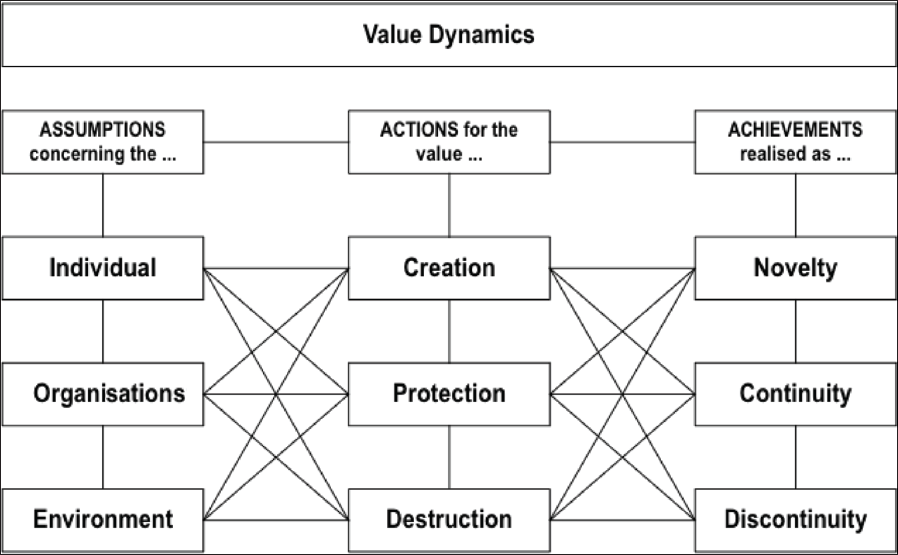
The pathways are rooted into the AAA of three key value actors—individual (Cunningham et al., 2018; Glenn, 2004), organisation (Geus, 2008; Pech & Oakley, 2005) and environment (Esty & Winston, 2009; Pfeffer & Salancik, 1978). Each actor’s value action opens three distinct pathways, and the three actors generate a total of nine pathways. Similarly, when two value actors collaborate in value actions, they also create an additional nine pathways. Lastly, when all three actors are involved, another nine pathways emerge. In sum, there exists a grand total of 27 potential pathways for realisation within this framework. This article briefly illustrates the nine pathways and leaves the rest for further investigations.
To fully understand a value, it is crucial to consider the assumptions made and actions taken for optimism realisation. These assumptions include, but are not limited to, the standards, forecasts, perceptions of quality, expectations of success and conditions of self and non-self-satisfaction. The actions consist of the efforts paid, time spent, assumption of authority and responsibility and all doing and/or not doing for achieving the intended purpose.
The core principle of the value dynamics framework is the ‘principle of reciprocal interdependence’, which emphasises the mutual interdependence among the value actors in a value network. Value of a product is not limited to its core benefits but extends to the entire product experience. For instance, when a customer buys a jacket, they not only benefit from its warmth but also from its design, colour, prestige and sense of style. Similarly, the jacket seller not only benefits financially but also from gaining a loyal customer, promoting their products and brand and enhancing their reputation.
The principle of reciprocity is particularly laudable when there is complementary interdependence within a product. For example, the value of a smartphone cannot be separated from the contributions of the actors involved in hardware, software and services. The distributional impact of the closing price of a smartphone is significant, as the price paid by the customer is distributed across the value network actors involved in producing and delivering the smartphone to the market.
Value dynamics generated pathways are challenging in optimism realisation because people are immune to change (Kegan & Laskow Lahey, 2009). People tend to be reluctant to adapt the novel value because of their habit, security, economic reasons and fear of the unknown. The only early adapters go for the novel change (Rogers, 2003) or those who are better able to break their immunity to change would be more effective in their optimism realisation.
Pathway 1: Value Creation for Novelty
This pathway leads to a novelty, and the novelty is distinctly different than the usual. For example, during the mid-1980s, Ranaji, a resident of Kathmandu, replaced an old window, known as Aakhi Jhyaal, with a new one. This simple act created a novel value for him by enhancing the aesthetic appeal of his home. The new window not only served a functional purpose but also added a unique charm to his living space.
Pathway 2: Value Creation for Continuity
Value creation is not only about novelty and innovation, but also about sustainability and continuity. Ranaji sold his ancestral Aakhi Jhyaal for D60,000 and replaced it with a new window costing only D25,000. This not only ensured the continuity of having windows in his home but also provided him with surplus money to continue/maintain his Mustang car.
Pathway 3: Value Creation for Discontinuity
Creation does not always mean novelty. Ranaji’s value action was not only for novelty and continuity but also for discontinuity. His action discontinued about a century-old wooden Aakhi Jhyaal and a higher maintenance cost of it.
Pathway 4: Value Protection for Novelty
This pathway protects existing value for creating novel value. For instance, by preserving the natural value of a river, we can create novel experiences such as river rafting. Similarly, protecting the value of relationships and the environment enables new partnerships and products.
Pathway 5: Protection for Continuity
We protect the value of our environment and relationships to give continuity to the existing value. By protecting our natural environment, we aim to maintain clean air, water, and natural resources over time. This is crucial not only for the present, but also for future generations to come.
Pathway 6: Value Protection for Discontinuity
It is intriguing to consider the value protection action for discontinuity. Take annuities, for instance: Buyers often choose full value protection, hoping to secure discontinuity for themselves or their loved ones. Yet the value of the annuity will ultimately discontinue with the buyer’s demise. People deliberately safeguard their religious and spiritual values in anticipation of a better discontinuity when their time in this world comes to an end.
Pathway 7: Value Destruction for Novelty
This path is more suitable for value conversion and replacement. For example, people destroy the value of wheat for the value of its flour. Nature also destroys different settings and finds new settings. Disasters such as earthquake, hurricane, tornados are not only damaging the existing values, but they are also insisting and opening avenues for novelties. For instance, the Gorkha earthquake of 7.6 in Richter scale destroyed hundreds and thousands of homes in 2015, but the destruction resulted with hundreds and thousands of earthquake-resistant homes (Bhattarai, 2020).
Pathway 8: Value Destruction for Continuity
Value destruction is a path people take when they encounter obstacles that prevent them from maintaining the existing value. During the 1990s, The New Era, a secretarial services provider firm in Kathmandu destroyed and replaced their monochrome monitors and computers without hard disks to continue their services.
Pathway 9: Value Destruction for Discontinuity
People often try to discard, forget or unlearn things that they no longer need. Shailaja, resident of Kathmandu, decided to let go of her video cassette recorder and got rid of it. People often destroy or remove things because they believe that those items are no longer useful to them.
Congruence Assessment Method
The AAA approach (Bhattarai, 2020) is a method for analysing and measuring value congruence that recognises the significance of the pathways. It comprises three components: Assumption (A), action (A) and achievement (A). Assumptions are the beliefs that form the foundation for value actions, which refer to tasks and decisions directed towards creating, protecting or destructing values. Achievements refer to the results and impacts of value actions, which can take the form of novelty, continuity or discontinuity. An adapter of the framework determines criteria and assigns weight to the criteria specific to the AAA. Congruence measurements can be customised and measured on nominal, ordinal and ratio scales. The level of congruence indicates its strength, that is, a higher level indicates better realisation. By using this approach, adapters can develop a better understanding of the value dynamics and improve their decision-making and strategy development.
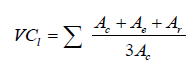
where
Analysis
Value analysis encompasses various dimensions, including areas, actors, actions and outcomes. Ethics and intentions are crucial factors affecting the analysis process, as it plays a significant role in determining the value of an action or outcome. Ethical concerns depend on the context and actors involved, such as societal norms conflicting with the ethics of thieves. Society’s values and ethics often come into play when evaluating value actions and outcomes. Even within a sociocultural setting, ethical value preferences can differ, as shown by the varying attitudes of European societies towards Syrian and Ukrainian refugees. Therefore, acknowledging the complexities of ethics is essential in the value analysis process, as it significantly impacts the perception of value and its outcomes.
Value Dynamics
Value system consists of different components, and the components are dependent and keep changing, and make a value system dynamic (Seligman & Katz, 1996). The value dynamics (see Figure 2) is the interplay between value actors, value actions and value outcomes. The concept of value cannot be examined in isolation as it is contextual. Value denotes worth and excellence (Oliver, 2002), but its dynamism denotes a process rather than property.
Value Dynamics.
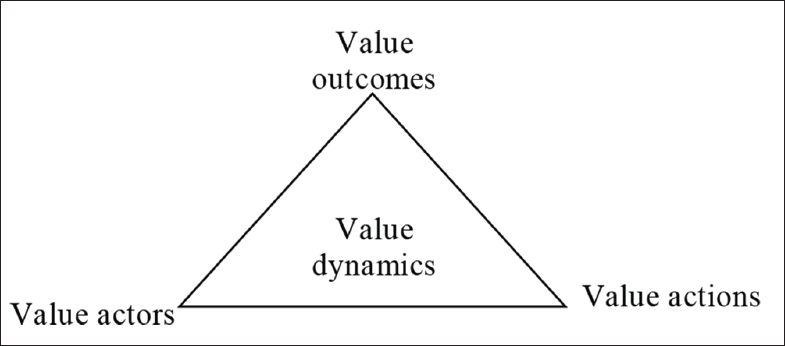
The process forms an ecosystem of an individual, organisation/institution and environment (Peltoniemi & Vuori, 2004). The property cannot be equated with financial worth alone. For instance, a medical doctor’s fee cannot capture the real value of their service. The value that a doctor brings to a hospital and its patients is not fully quantifiable by their compensation. It is important to recognise the complexities of value in different contexts, including the nuances of people’s contributions in well-being, reputation, loyalty and cooperation. Therefore, a holistic understanding of value dynamics is essential in the analysis and measurement of value creation.
Value Actors
The triad (see Figure 3) of value actors involves the interplay between the individual, organisation and the environment. The triadic inter-relationship of value actors includes the individual, organisation and environment. The environment consists of natural, physical and social elements that shape the circumstances within which value actions must be taken. These elements constitute a system that shapes the outcome of value actions and serves as actors in the value creation, protection or destruction process. It is essential to recognise the interplay between these forces in shaping the environmental elements and the corresponding demands placed on value actions. Contextual factors often exist as externalities that impact the value preferences of individuals and organisations.
Value Actors.
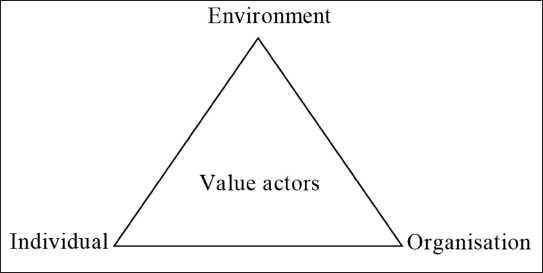
From the beginning of an individual’s life, factors such as parental situation, social context physical condition, and working climate can significantly influence their values. An individual or organisation’s freedom to choose their own pathways is often constrained by external factors, but by acknowledging and understanding the role of external factors, individuals and organisations can make more informed decisions that align with their values and objectives. Understanding this complex system is critical for better appreciation of the importance of considering the broader context in which value is created, protected or destroyed, and for adapting actions accordingly.
Value Actions
The triadic inter-relationship of value actions is depicted in Figure 4, which includes value creation, protection and destruction. Value actions refer to the behaviour of value actors, which can intentionally or unintentionally create, protect or destroy a particular value. Every value action consists of three integral parts: Novelty, continuity and discontinuity. The creation, protection or destruction of any value is not an isolated event, but rather a complex process that involves multiple interconnected value actions. Thus, understanding the interplay between value actions and their integral parts is crucial for individuals and organisations to appreciate the dynamic and multifaceted nature of value.
Value Actions.
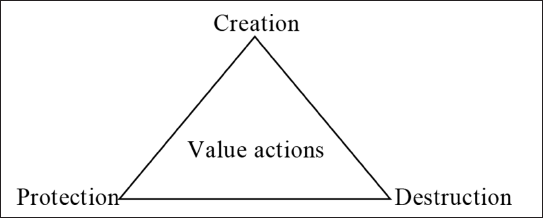
The value of a thing is determined by the reason for its realisation. For example, a new cell phone may be seen as valuable due to its novelty, while an established cell phone user may see it as value continuity. On the other hand, the value of copper-wired landline phones may become less useful due to the advent of cell phones, leading to value discontinuity. Individual and societal factors, as well as the specific context, influence the realisation of value. By understanding these factors, individuals and organisations can evaluate the value of things and make informed decisions that align with their goals and objectives.
The introduction of advanced technologies such as artificial intelligence, machine learning and robotics raises concerns about the impact on human labour and the potential for value actions. For example, deploying robots to serve coffee in a restaurant can create value by offering a novel experience to the customers, protecting/continuing the business by reducing costs but may come at the cost of destroying the value of a natural person serving the coffee. Therefore, it is important to strive for a balance between value creation, protection and destruction. This requires careful consideration of ethical and societal implications and a willingness to adapt and innovate in response to changing circumstances.
Value Outcomes
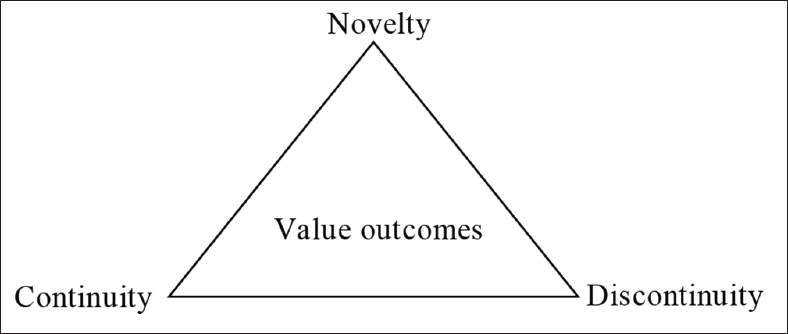
The ‘value outcomes’ depicted in Figure 5 form a triadic relationship of novelty, continuity and discontinuity. These outcomes are interconnected, and one cannot exist without the others. The important factor is who or what the value is novel, continuous or discontinuous for. There is a grey area between novelty and discontinuity, as exemplified by the transition from typewriters to personal computers. This grey area consists of situations where two or all the three value outcomes are present.
Value Outcomes.
Discussion
Technological advances have dramatically altered the values and interactions even within families and communities. During the early 1970s in villages, gathering with family and community members was highly valued as it was the only way to share news, views and cultural knowledge. However, with the introduction of new technologies like radios, televisions and smartphones, family members began to isolate themselves, leading to a decline in family interactions and cultural exchange. Today, there are very few interactions within families and almost no exchange of cultural knowledge or values due to the widespread use of computers, mobile phones, the internet and social media.
Circumstances can impact the value that we assign to things or actions. Factors such as scarcity, imbalances and hardships influence our perception of value. As an example, a small bottle of orange juice may not be highly valued under normal circumstances, but if we are stuck in traffic without food or water for extended hours, the juice becomes much more valuable. Additionally, the value of the juice is preserved until its expiry date, after which its value is destroyed.
Value can be present in every action or object, even in situations that may seem unpleasant. The author witnessed two boys happily eating leftover foods from a garbage container that had been discarded by a catering company. Although throwing away the food could be seen as destroying value, it also created value in terms of hygiene at the company. For the boys, the discarded food became valuable as a source of sustenance.
Similarly, a single action can simultaneously create, protect and destroy values. For example, when a typical Muslim becomes a Christian, they can be a role model and create value for other Muslims who are unhappy with the Muslim culture and tradition; the same action becomes contributory to protect the value of Christianity and becomes destructive for the followers of Muslims.
In the same line, the military operations in recent years, including wars in Afghanistan, Syria, the Middle East and Ukraine, have claimed conflicting values. However, it is unclear whose values are being prioritised—is it for the ordinary citizens, the environment or the power players involved in the conflicts?!
In fact, the military operations can simultaneously create, protect and destroy values, benefiting weapon suppliers and the winning side while damaging the losing side. However, it is difficult to measure the exact value of the losses and damages caused by such operations, as if anyone tries to record such value, it becomes nearly impossible to capture the value of all kinds.
The pursuit of wealth and luxury can conflict with others’ values, such as compromising on the needs of multiple actors in a value network. Accepting bribes for personal gain can harm the values of others and damage the ethical environment of an organisation, even if it creates value for the bribe-giver and receiver.
The availability and accessibility of goods and services are important for value realisation. The author shares personal experience of owning a typewriter, colour television, video cassette recorder, video camera, microcomputer and mobile phone services. The arrival of these items brought a sense of achievement and prestige and made better entertainment and communication.
On top of all, change is a constant force that brings shifts in values over time. These shifts not only reflect material possessions but also reflect changes in people’s thoughts and feelings. Take the case of Machindra, who never trusted radios for years after a weather forecast, he had heard on the radio turned out to be incorrect in the mid-1980s. However, his views changed in 2010 when he gained new knowledge and started to understand the process of radio transmissions. Similarly, till the end of 2000s, many people in villages were seeking help from shamans when they fell ill instead of going to hospitals. But now, people have shifted their values and prefer seeking medical treatment in hospitals. As changes continue, shifts happen in value dynamics.
Limitations and Future Directions
Yadav (2010) notes conceptual papers offer valuable insights and perspectives that can stimulate further research and innovation in the field. Moreover, as Parncutt (2022) suggests, the primary focus of a conceptual paper is not to provide an exhaustive review of existing literature, but rather to present new ideas and contributions that can advance the field.
As a conceptual paper, this work offers a unique perspective on the framework and assessment method that is not bound by the constraints of empirical data. While further research is needed to fully assess and quantify the AAA related to this framework; therefore, this article lays the foundation for such research to take place.
Conclusion
Value is dynamic because its paths are contextual, relative, reciprocal and transpositional evolving with the assumptions, actions and outcomes of the actors. Moreover, optimism bias affects the value assumptions and actions, and the actors interact and adjust the outcomes with their underlying assumptions and actions. The reconciliations and interactions within the elements of the framework are shaping the ongoing evolution of value dynamics.
Value realisation exists along a continuum, which ranges from unintentional to intentional. When value is intentionally realised, it brings pleasure and satisfaction. In contrast, an unintentional realisation results in discomfort or pain. Actors involved in the process of value realisation seek and embrace pleasurable outcomes. Sometimes, unexpected realisations may lead to unexpected benefits or positive outcomes. By understanding the full spectrum of value realisation, one can work towards creating positive outcomes while minimising the negative consequences.
Similarly, the process of value creation should not solely focus on novelty but also account for continuity and discontinuity. Value protection should not merely aim to maintain continuity, but also incorporate elements of novelty and discontinuity. Additionally, value destruction should not be solely associated with discontinuity, but must also recognise the potential for both novelty and continuity.
Therefore, it is crucial to adopt a holistic approach towards value realisation, considering the value congruence, and striving towards a balance between novelty, continuity and discontinuity in all our endeavours. This will create and maintain sustainable value systems, driving progress and growth in personal and professional lives.
Footnotes
Declaration of Conflicting Interests
The author declared no potential conflicts of interest with respect to the research, authorship and/or publication of this article.
Funding
The author received no financial support for the research, authorship and/or publication of this article.
