




Abstract
The Government of India has given special emphasis to develop entrepreneurship in the rural population and especially among the marginalised groups in recent times. This article attempts to understand the working of the programme in one of the Blocks of Karnal district in Haryana. This is a qualitative empirical study conducted in the Gharaunda Block of Karnal District, Haryana, in December 2021. The in-depth study is based on a collection of field data and observations documenting the success stories of rural entrepreneurs. Through this article, the authors analysed the functioning, success and challenges of the Start-up Village Entrepreneurship Programme implementation process. The study adopted triangulation data analysis method and recording oral history to document rural entrepreneurs’ stories, including the life story approach, to evaluate the programme. The study was conducted in the four villages of the Gharaunda Block. These rural entrepreneurs are from marginal sections of society, that is, the Scheduled Caste and Other Backward Caste sections. It is worth noting that all the selected entrepreneurs come from marginalised communities and happen to be women. In this article, the authors address the current gap by presenting a policy-relevant framework for conceptualising rural entrepreneurship. The study provides insights into the impact of the programme on rural entrepreneurship and offers input to address the challenges based on the fieldwork.
Introduction
The concept of rural entrepreneurs is now being considered a little more seriously by policymakers. The liberalisation process has impacted the rural economy in a big way paving way for both new avenues of economic activities with challenges. In this light, entrepreneurship has emerged as an important area in India. It has given way for entry of the rural population into new areas of influence. The marginalised sections of the society face more challenges in the light of closing down of the traditional modes of income. The Government of India started Start-up Village Entrepreneurship Programme (SVEP) to help the rural people in an effective manner to help the marginalised sections. This study looks at the impact of the programme and the challenges on the marginalised sections of the society after its introduction. An egalitarian society could only be an achievable dream if it gave more consideration to its roadblocks, for example, rural poverty and inequality. Social scientists and policymakers need to focus on this large rural population via a cutting-edge model of entrepreneurship that generates income.
The positive relationship between entrepreneurial activity and economic growth, prosperity and wealth creation has long been noted (Baumol, 1996; Schumpeter, 2003). According to Schumpeter, innovation can take five different forms: (a) recognising a new good/quality; (b) a new method/process; (c) a new market; (d) a new source of supply; and (e) a new way of organising the firm/production. In studying the impact of entrepreneurs, the Global Entrepreneurship Monitor (Herrington, 2016) observed that entrepreneurs of all kinds are essential, but they have different impacts on their societies. They defined that the key to economic development and growth in job creation is a mix of industries and levels of innovation. They defined entrepreneurial activities as essential to the growth and welfare of society. Thus, a rural entrepreneurial ecosystem should be developed with the support of numerous stakeholders, such as governments, Non-governmental Organisations (NGOs), researchers and individuals. Rural poverty is a significant challenge even after 75 years of independence because the majority of rural population still depend on agriculture. A well-known management consultant (Prahalad, 2005) first used the term ‘Future at the Bottom of the Pyramid (BOP)’ to eradicate poverty through profits. Prahalad emphasised the problem of rural poverty that multinational corporations (MNCs) need to solve. Rural poverty and income inequality are still unaddressed dimensions that need to be addressed by MNCs. Even today, MNCs’ access to the vastly diverse rural population remains a pipe dream. The Indian rural market has such a broad horizon that penetration of products and services is exclusively achievable via indigenous rural entrepreneurs. The rural entrepreneurs need to come from the same society where they are prepared to serve. An in-depth case study could enable policymakers to know the problems and prospects of small enterprises and eventually prove insightful for revising public policy programmes (Barkley, 2006). For the growth of entrepreneurs in rural areas, access to knowledge, market linkages and suitable and adequate financing are needed (Henderson, 2002). Rural entrepreneurship is mainly seen as part of agricultural livelihood by the state and must be seen as the core area of entrepreneurship (Dabson, 2001). Dabson emphasised entrepreneurship as an approach to tackle deep-rooted economic problems in low-income communities and distressed regions within rural America.
Review of Literature
Brooks et al. (2018) found that providing a mentor to a young enterprise in Kenya does boost revenues in the short term, but the benefit wears off over time. Valdivia (2014) highlights how individualised coaching or mentoring training provided sustained impacts to the entrepreneurs. A training programme enhanced women’s confidence in their capacity to start their enterprises and their likelihood of succeeding (Botha et al., 2006). SVEP has been introduced with the aim of fostering entrepreneurship in rural areas. In the post-reform period, the data reveal a glass wall against dalit occupational mobility, transforming caste-type roles or low-end service trades into more profitable ones or self-employment (Das, 2013). The new dalit entrepreneurs faced two significant problems related to the mobilisation of finance and finding a structure/shop where the enterprise could be set up (Jodhka, 2010). In such a context, setting up a business, however small the stall, the salon, or the service, may be taken as a social assertion, as is considered in entering an elite institution and profession. Several studies have examined the impact of SVEP on rural entrepreneurs. For instance, Dixit and Debashish (2023) conducted a longitudinal study assessing the growth and sustainability of businesses supported through SVEP. Their findings suggested a positive correlation between participation in the programme and the growth of rural enterprises. Similarly, Pandey (2023) conducted a study analysing the economic empowerment of entrepreneurs in rural areas through SVEP interventions. This research highlighted improvements in income generation and financial independence among female participants. It was observed that the role of capacity-building training and mentoring interventions at the Block Resource Centre (BRC) level is significant in creating entrepreneurial practices among existing and new entrepreneurs.
Research Gap
The lack of conceptual articles undermines the theoretical contribution. The overemphasis on macro-level indicators ignored the potential of rural entrepreneurs, especially among the marginal communities. The unavailability of specific literature on rural entrepreneurship focusing on the upliftment of marginal sections hinders the policy-relevant discussion of opportunities in a market economy. The unexplored space of rural entrepreneurship needs to be revisited by policymakers. The potential ability of women to flourish as an entrepreneur was ignored in various research studies and not given due weightage in the main course of discussion. The present research highlights that only resource-rich entrepreneurs become successful and in a way create an unequal foot-holding for women entrepreneurs. Our study tries to develop a strong theoretical foundation for rural entrepreneurship. The study highlights the impact and challenges of rural entrepreneurship, which was not reflected in earlier studies.
Significance of the Study
SVEP, a non-farm sub-scheme named Deendayal Antyodaya Yojana under the National Rural Livelihood Mission (DAY-NRLM) has been an important attempt to develop entrepreneurship among the marginalised sections at the village level. The total number of rural enterprises existing and pre-existing under SVEP in the Gharaunda Block is 1190, which is relatively higher in terms of, the Block being underdeveloped as per government of India’s economic indicators. The significant share within this is of service enterprises which are 658, preceding trading at 246, followed by manufacturing at 153, and mixed enterprises comprise 133. Entrepreneurship has emerged as a key driver of economic growth and development, particularly in rural areas where traditional livelihoods often face challenges. In this context, initiatives like the SVEP have been instrumental in fostering entrepreneurial ventures and catalysing local economies. However, to maximise the impact of such programmes, it is crucial to understand their overall effectiveness and their specific implications for various sectors within rural entrepreneurship. This study focuses on analysing the impact and challenges of the SVEP implementation process, with a particular emphasis on entrepreneurship development in four key sectors: spice, pottery units, Light Emitting Diode (LED) bulbs and sweets. We have selected four rural women entrepreneurs working on spice, pottery units, LED bulbs and sweets, respectively representing successful and unsuccessful cases. The selection of spice, pottery units, LED bulbs and sweets as focal points for the study stems from their significance within the rural entrepreneurial landscape and their potential for socio-economic impact in Haryana state. First, spices constitute a vital component of agricultural production in many rural areas, offering opportunities for value addition and market diversification. The spice industry provides avenues for small-scale entrepreneurship and contributes to agricultural sustainability and rural livelihoods. Second, pottery units represent a traditional craft industry prevalent in many rural regions, embodying cultural heritage while also serving as a source of income for local artisans. By studying pottery entrepreneurship, insights can be gained into the preservation of traditional crafts and the integration of modern business practices. Third, LED bulbs align with contemporary trends in sustainable technology and energy efficiency. Promoting Entrepreneurship in LED bulb manufacturing not only supports local economic development but also contributes to environmental sustainability by reducing energy consumption. Lastly, sweets production signifies the food processing sector, which holds immense potential for rural entrepreneurship. By examining entrepreneurship in sweets manufacturing, the study explores avenues for value addition to agricultural produce, job creation and economic empowerment within the food processing industry. Overall, the selection of spice, pottery units, LED bulbs and sweets as focus areas for the study reflects their diversity, economic significance and potential for fostering rural entrepreneurship and development.
The SVEP
The DAY-NRLM has been centrally sponsored and implemented scheme since May 2016. The main objective of the mission is to eliminate rural poverty through an innovative implementation strategy involving four core components: (a) social mobilisation and community institution building; (b) financial inclusion; (c) livelihood promotion; and (d) convergence and social development. SVEP is a budget-announced scheme and was approved by the Ministry of Rural Development, Government of India, on 6 May 2015, as a sub-scheme under the DAY-NRLM and the guidelines issued on 15 June 2015.
Through the programme, rural entrepreneurs are supposed to get technical support so that enterprises (both existing and newly promoted) will be profitable by addressing the ecosystem, namely, (a) a missing knowledge ecosystem, (b) a missing incubation ecosystem; and (c) a missing financial ecosystem. The SVEP is implemented via Project Implementing Agencies (PIAs) including State Rural Livelihood Mission (SRLM), higher level SHG federations and NGO with a good track record of promoting rural livelihood.
SVEP in Gharaunda Block
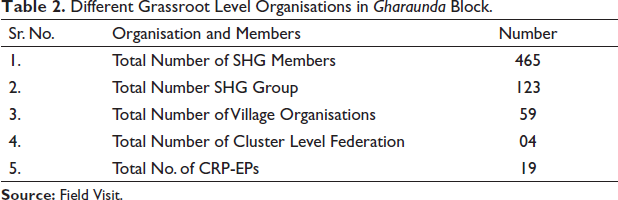
The SVEP programme has a four-tier structure, from cluster-level federation to village organisation (VO) to self-help group, and finally to beneficiary members. This four-tier structure gives an implementation roadmap for SVEP to BRC. The total number of SHG members in Gharaunda Block is 465, community resource persons-enterprise promotion is 19, cluster level federations (CLFs) are 4, VOs are 59, and SHGs are 123.
Block Resource Center—Gharaunda
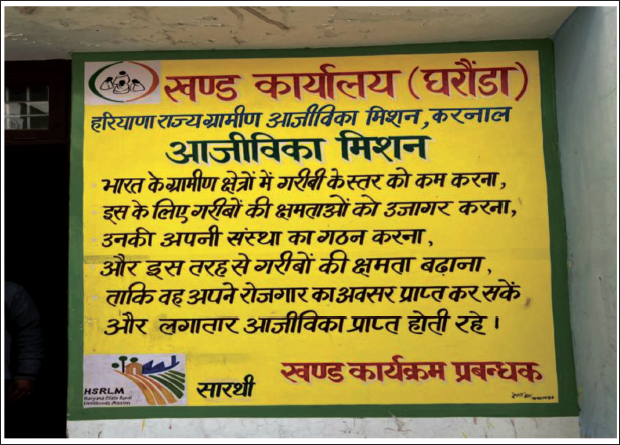
Figure 1 depicts the SVEP vision in Hindi, with a poster outside the Block resource centre, it means ‘To overcome the poverty from the rural part of India, capacity build-up for poor, set-up their enterprises and to enhance the capability of poor so that they can create their sustainable employment and livelihood’.
While Women are considered the prime beneficiaries under SVEP, we find a chain of multilevel women integration that empowers the spirit of women entrepreneurship in Gharaunda Block. The Block contains the duplex women’s leadership. At the Block level, during our interaction at the Block office of Haryana SSRLM (HSRLM), we were accompanied by Ms. Kavita (Block Programme Coordinator, HSRLM), Ms. Selja (Mentor Kudumbashree), and Ojaswini (YP Kudumbashree). At the field level, all CRPs of the Gharaunda Block are women: Sarita Sharma, Khumdari Bersa, Kavita Rani, Neelam Devi, Sonia, Rimple Sharma, Lajwanti, Saroj Devi and Neepa in the Gharaunda Block of Karnal district.
Research Questions
Broadly the study tries to respond to the following two research questions:
What is the impact of the SVEP on the entrepreneurs coming from marginalised groups? Which are the challenges in implementing the SVEP to strengthen rural economy?
Methodology
The study was conducted in two different stages: in the first the research team spent one week in December 2021 to study the SVEP at the Gharaunda BRC in Karnal district and in the second stage, the team remained in touch with the officials at the BRC to compliment the data gathered and know the challenges faces in the light of the observations during the field visit. In the first stage, at the BRC headquarters, the team spent one day interacting with the programme manager, programme coordinator, Block mentor and young professional. Once collecting some important basic data was completed at the BRC headquarters, we travelled to the four villages of the Gharaunda Block for another five days, speaking to community resource personnel, SHG members, VO members, CLF members and village entrepreneurs using the detailed questionnaires for CRP-EPs, conducting formal and informal interviews with village entrepreneurs. Group discussions were conducted at the residences of village entrepreneurs, marketplaces and village congregation areas (Panchayat Bhavan). This study focused on in-depth interviews with the first-generation enterprise builders of village entrepreneurs.
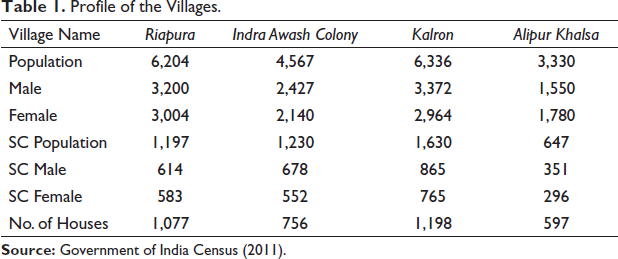
The study chose the non-probability sampling technique, that is, purposive sampling, because the authors established contact with them and developed a rapport with them. There was a formal interaction meeting scheduled at the BRC. It enabled the authors to transcribe and assess their stories, responses and actions over the research study period. The full-length interviews were documented. To minimise the ‘selected recall bias’, the interviews were conducted using field and contextual notes. It was a discussion among the researchers, respondents (entrepreneurs) and their family members. The sample of four villages was selected after interacting with CRP-EPs of the Gharaunda Block. The village profile in Table 1 depicts the demographic details of the sample villages.
Profile of the Villages.
Different Grassroot Level Organisations in Gharaunda Block.
The profile of the village is the microscopic representation of true socio-economic grassroot conditions. The social interaction of the people can be understood through village profile. The caste and gender-based demographic data mentioned in Table 1 supports the adequate eligibility for social sector schemes from Government of India. The rationale to represent the demographic profile of the sample villages is to reduce the research bias because from Table 1 we can observe the enough representation of marginalised and women.
The significant objective of the programme is to develop the local level CRP-EP that supports the entrepreneurs in setting up their enterprises. The second significant area that needs to focus on is promoting the BRC in allocated SVEP Blocks, which supervises and manages the community resource persons, assesses loan applications and works as an archive of enterprise-related information in the allocated Block. The BRC is vital for promoting a sustainable revenue model to work effectively and efficiently. The Table 2 shows that the Gharaunda Block is very diverse regarding the formation of SHGs, VO and CLFs, etc. The total number of SHG members is 465 in the 123 various SHG groups. We also find a robust network of VOs, which is 59.
Field Description and Observations
The purpose of this article is to strengthen the focus on rural entrepreneurship and to augment the academic interest while at the same time developing its theoretical foundation. The study adopted a life-story approach to analyse the respondent’s views. This study contributes further to the literature by using rural entrepreneurs’ stories and oral history. The research study focused on the significant challenges and constraints of rural entrepreneurship. The beneficiaries were resource-poor and lacked technical skills. The four villages visited were scattered and situated in the relatively remote part of the Gharaunda Block of Karnal district.
This section introduces the respondents’ entrepreneurial journey stories, actions, operating practices and life philosophies. The storytellers are Barkha, Pinky, Jyoti and Poonam Devi. At the time of the interview, they were between 25 and 50 years old.
Home-packed Spice Unit Run by Barkha
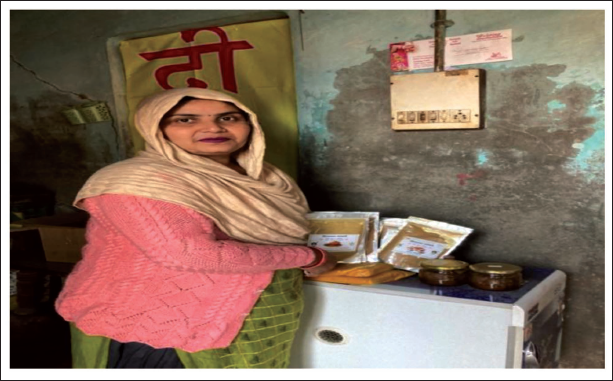
We first interacted with Barkha (Figure 2), a community resource person-enterprise promotion whose role is to give handholding support to new and existing entrepreneurs. She is also a rural entrepreneur, a known face in her community. She had single-handedly managed a spice unit in her Raipura village in the Gharaunda Block. She shared her experience by telling that the spices unit had improved her life, and she hopes soon to transform her small unit into a spices manufacturing unit. She had started the home-packed spice unit enterprise three years ago. She plans to diversify the merchandise with the SVEP mentor’s support, eventually increasing their output and the variety of spices they sell.
Barkha said, ‘We have not been seeing much profit yet, but I am sure we will soon. I am now able to single-handedly meet the financial needs of my son’s education and other necessities of home’. Being the family’s sole earner, she now earns ₹10,000–₹15,000 per month, also, the earning depends upon the seasons.
However, the peak season period gave her earnings of over ₹25,000 per month, which provides sustainability and scalability for the enterprise. She had opened a bank account to secure her children’s higher education. She reiterated that it had been a humble beginning, but now earnings are more than expenses. She had been procuring raw materials from the Delhi NCR region, relatively near to her village. The Government of Haryana has initiated various business models emphasising rural product marketing. One of those HSRLM has facilitated VOs and SHGs to strengthen village entrepreneurs. Barkha is one of them who has been selling her spices in Kurukshetra Mela and Yamuna Food Court. The SVEP Programme Manager works as a liaison between state functionaries and rural entrepreneurs.
Mela is a time of fun, hospitality and celebration in the villages and towns. The natural flair can be sensed in the villages; accordingly, many marketing experts frame the marketing strategy, which gives a glimpse of the rural life. If one visits rural India, then one can feel the soul of India. Melas typically take place at the end of the harvest season, which is an integral part of village culture. Mela is an event of cultural amalgamation and exchange where people from different sections of society enjoy and assemble. Since ancient times, melas have been regarded as a significant element of social interaction.
Barkha is a part of Chandni SHG, comprising 20 women members of Raipura village. The spice unit that Barkha Rana has developed under Chandni SHG of Raipura village and is sustainable and scalable for further ventures with the provision of more product categories. She has penetrated the local market with homemade spices; the name Siyaram Masale has denoted the religious and ethnic belief system of the village. She has been using a catchy tagline on her Jira masala, for example, Lassi or raite ka swad, roasted jeera powder ke saath (The taste of Lassi and raita with roasted cumin powder)’. She has not been formally educated, but her marketing tactics are way forward compared to some branded fast moving consumer goods companies. The coriander powder, which has the brand name Siyaram Masale, attracts the customer through the catchy tagline Jaisi naam mein pavitrata, vaise hi masala mein shuddhatha (The purity in the name reflects in the purity of the spice.). The tagline on the spices is informative and seems to create attraction for customers.
The spice product features cover the MRP, manufacturing/expiry date, processed and marketed by the Food Safety and Standards Authority of India, etc., on the packet. These are some excellent marketing practices that attract customers. The product packet contains the symbol of homemade manufacturing and 100% pure marking. The rural markets are heterogeneous in India, so the multinational organisation require a lots of homework to convince the customer to reach into the village markets remotely. In rural areas, spices and grains are sold in loose packets, which is the predominant concept of selling in rural markets. Here, Barkha has her own packing machine that packs the various spices into a tight, air-free condition that protects the spices’ quality and aroma. The quality of spices can be checked by their colour and aroma level. Barkha uses air-free, tight packaging techniques, protecting the spices’ quality and aroma from being loose in any weather. The business acumen we see in Barkha is immense in a small, remote village where a patriarchal belief system still prevails in the dominant male society.
LED Bulb Manufacturing Unit Run by Pinky
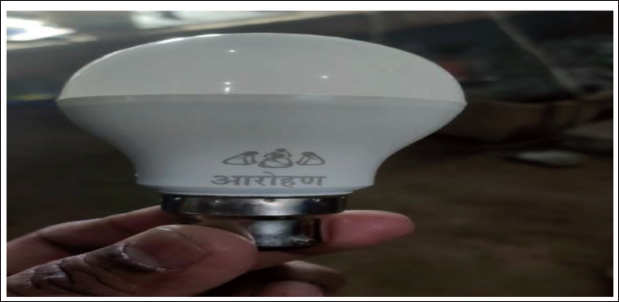
Our next stop has been Kalron Village at Pinky’s residence, an SVEP beneficiary. The husband-and-wife duo jointly manage the electrical repair shop; her husband is an electrician at a nearby hospital. Pinky is a self-motivated woman who has been assembling LED bulbs for three years. She has exported the LED bulbs to Delhi, Haryana and Punjab. Pinky, a successful housewife who now stands by her husband in every difficulty of life, worked on the LED bulb assembly at home. The brand name of their bulb assembled by her is Aarohan (Figure 3). The Government of Haryana also procured in bulk from Pinky. The District Collector procured 70,000 bulbs for various self-government organisations from Pinky.
The husband-wife duo is ingeniously trained, which we saw while preparing a bulb. It had hardly taken 3 minutes to prepare one bulb. They prepared 300–400 bulbs per day and during peak season, it reached up to 500–600 bulbs per day. They procured the raw materials from the nearby Delhi-NCR region. The raw materials comprise circuits, LED, bulb glass, etc. Due to the availability of raw materials in nearby areas, the sustainability and scalability of rural entrepreneurs need to be improved, which is a challenging part of the business’s survival. Most LED bulbs are Chinese manufactured. The Government of India is celebrating the 75th years of independence with an Atmanirbhar Bharat drive across the country, framed by the policy of the indigenously sustained country. This policy impacts Pinky’s LED bulb manufacturing unit. They are bound to use indigenous raw materials, which are costly and unavailable in the nearby Delhi-NCR region. The cost of transporting goods is also increasing daily, ultimately squeezing their profit margin. The duo are interested in scaling up their enterprise on a larger scale.
Pottery Unit Run by Joyti
Pottery is one of the oldest arts in India and has flourished since ancient times. After independence in the village, the rural artisans were mostly engaged in pottery-making businesses. Though it is on a small scale at the village level, if proper handholding and capacity training were imparted to these pottery entrepreneurs, they could change the business dynamics quickly.
Our third of the day by the research team was spent in Alipur Khalsa village, where we found the most exemplary home-based pottery unit developed and managed by a woman named Jyoti (Figure 4). Pottery making is her family’s ancestral business, though she has acquired some modern techniques and designs. The product category of her pottery includes teacups, lamps and decorative items made from Mud/Clay.
Jyoti has reiterated that the pottery business lifted her family out of poverty. Now she stands with her family in every difficult situation and helps with this income. Deepawali being the primary religious festival season in India, Jyoti said that during the Deepawali season, the demand is high and there is a need to work in advance for two to three months to fulfil customers’ demands. There are four people working together during peak season to manage the supply.
Recently, GoI under the Ministry of Micro, Small and Medium Enterprises, announced guidelines for a special scheme to assist pottery wheels, granulators and clay blungers. It covers wheel pottery training for traditional artisans, training for pottery and training for non-pottery artisans in SHG.
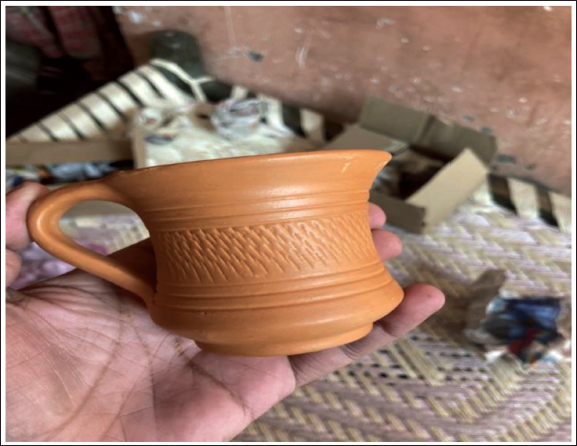
The case of Jyoti needs to be understood from the point of view of the women’s entrepreneurship model. We observed leadership qualities in her. She lives in a patriarchal male-dominant family where women need permission to come out of the home. During our visit, she single-handedly managed the whole pottery unit. The pottery unit requires a formidable space, but Jyoti manages in the limited space of her area of residence. The members sat on the terrace, mixed the mud and soaked the clay. Soaking the pots at a specific temperature ensures that the required processes have been completed. Jyoti had been utilising the steps of the ladder for arranging the pots. Despite Jyoti’s congested space, she manages to arrange the articles of pottery most safely despite breakable character of pottery. This is like a display manager managing a single inch of space in a hypermarket.
Pottery is a generally considered substantial and traditional Indian culture that often represents ancient history. India is known more for its craft than other countries on the trade route; pottery is among the first in all arts. Its subtle beauty and elegant features have made pottery a modern form of Indian chattel and utility, not just history.
Traditional Sweet Shop by Poonam Devi
The sweet-making segment has long been unorganised and is proving challenging for brands to make a mark in India. Primarily because the category has a very popular nuance that these brands are actively trying to capture. Can you guess what? It is the habit of tasting; how often did you walk up to a store for mithai and leave without the mithai-wala helping you get the product’s taste? This is precisely why brands are struggling to expand here in a big way.
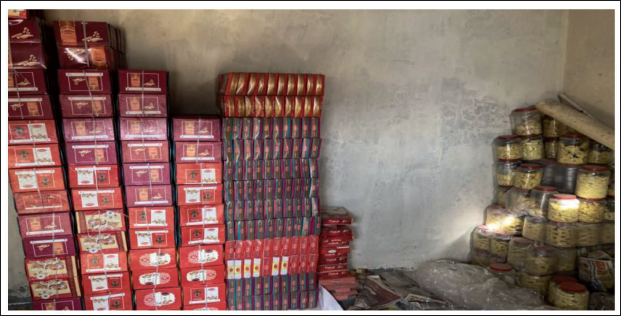
Saheb Singh and Poonam Devi, residents of Indira Aawas colony in Raipura village, are husband-wife duo owners of a traditional sweet shop, breaking the caste barrier and gender biases. Both come from the most vulnerable communities, that is, Scheduled Caste (SC), still they managed and developed the traditional sweet shop. The age-old traditional village communities accept them as successful entrepreneurs. They employ a minimum of 8–10 labourers in their shop. Figure 5 depicts the boxes and other materials in the sweet packing unit.
The Indian village setup gives ample spaces to villagers for their homes, for example, porches. The duo are taking advantage of a spacious home for their venture. They developed two locations for their venture. The small factory is on the front side of the home’s open space, where the machinery is assembled to prepare sweets. For better visibility, the finished goods, that is, sweets, are demonstrated in the roadside shop. The merchandise in their shop includes Sonpapadi, Peppermint, Petha, etc.
Still, the MNC’s confectionery brands did not reach the deep-rooted Indian rural markets. The taste and flavour still need to be suitable for the tastes of rural people. At the same time, traditional sweets, such as peppermint, chocolates, etc., are treated as school-time snacks and part of childhood memories.
The husband-wife duo elaborated on their experience, saying that the unstable price of raw materials hampers their profit margin. Nowadays, the traditional sweet market faces stiff competition from other wholesalers who produce in bulk. They understood that, in the long run, they might have to switch over from the present enterprises because of a lack of resources. They got the help and moral support they needed to start this business, but they are not in the mood to stretch it out in the long run. The demand-driven market did not sustain itself in rural areas. The lack of demand creates a premature closure of enterprises, for example, traditional sweets. As researchers, we observed that people in villages usually prefer homemade sweets, so they are less inclined towards the kind of sweets that shopkeepers produce.
Discussion
Impact of SVEP in the Study Area
The authors evaluated the overall performance indicators of SVEP while interacting with rural entrepreneurs, SHGs members and various stakeholders. The genesis of SVEP is to develop the sustainable scalable and inclusive rural entrepreneurs for livelihood and income generation. The SVEP has had a long-term impact on rural entrepreneurs.
Sustainable Rural Entrepreneurship
Sustainability is the most significant issue for rural entrepreneurs and SVEP seems amicably handling them. The SVEP is majorly focussed on the sustainability dimension of the rural enterprises because if the rural enterprises do not sustain and scale up, then there is the risk of premature dissolution. Scalability and sustainability are interconnected; one cannot stand without the other. The rural enterprises could sustain themselves if they needed to scale their products and services. The research study found that the capacity built-up training provided at the BRC level is an entrepreneurship skill enhancer for new and existing entrepreneurs. The BRC provides valuable input on the management and organisation of enterprises. The study found that SVEP considers low-income women’s practical and strategic needs in the enterprise by intensifying their people management and primary business skills. In addition, the state implementing agency HSRLM provides a stall at the rural market exhibition to rural entrepreneurs for their products and services. The exhibition demonstrates the products of rural entrepreneurs, which enlarge their marketing skills. The training programme develops ‘business minds’ in low-income entrepreneurs running small businesses. The training programme not only supports aspiring and practicing entrepreneurs but also provides knowledge and skills. The business training enables the entrepreneurs’ vision development, enhancing their critical thinking in daily decision-making. This might create a conducive environment for the motivation of entrepreneurs. The availability of mobile-based online learning applications supports virtual and offline working. Nowadays, technology and innovation are the two main pillars of success in entrepreneurship. The Indian rural entrepreneurs face the biggest hurdle of premature closure and it is sufficiently handled by SVEP.
Scalable Rural Entrepreneurship
We observed during the in-depth interviews with rural entrepreneurs and CRP-EPs that the markets for such products are local village markets where the demand is based on the local population. We also observed that rural entrepreneurs are risk-averse, which blocks their ability to diversify their products and service segments. The rural entrepreneurs need to have strategic intent and better aspirations regarding the future scalability of enterprises. We observed that during the capacity building training SVEP transforms the laymen into a business mind people. The role of CRP-EPs in inculcation of strategic intent is commanding.
The nature of the rural market is a minimal, primarily homogenous population with the same likeability. The extensive study discovered that women participants frequently needed essential business and financial knowledge, expertise and education. We observed from different stakeholders that SVEP gives them exposure to big markets. The process of setting-up of the enterprises requires resources in terms of finance, a robust network and technical and production skills. We observed that the four-tier structure of SVEP starting from CLF to VO to SHG and finally to beneficiary members continuously handholding the entrepreneurs for expansion of their enterprises. Providing proper organisational support to enterprises enhances the efficiency and quality of operations (Bloom et al., 2010). The business and innovation management services provided by SVEP impact the entry and performance of rural entrepreneurs. The capacity-building training provided by a mentor and programme manager uplifts the lives of all the stakeholders. The respondents affirmed that there are no worries about school fees or medical emergencies due to constant income from enterprises. The enterprises give them enough income to survive and increase their purchasing power. We found during the study that there is a strong foothold of women in terms of SVEP beneficiaries, entrepreneurs and CRP-EPs.
This study makes several contributions to the existing body of knowledge on the SVEP and its implications for rural entrepreneurship, particularly for marginalised sections of society. First, by synthesising findings from multiple case studies, it provides a comprehensive overview of the impact of SVEP on rural entrepreneurs, shedding light on the programme’s effectiveness in fostering enterprise development and economic growth in rural areas. The field observation of LED Bulb Manufacturing Unit run by Pinky is the finest example in our study which might be scalable to a greater extent. The husband–wife duo are gathering the resources from different areas to expand the business and product categories. The study found that SVEP is fostering the rural livelihood and inculcate income-generation enterprises for the local rural youth.
Social Inclusion
The third dimension specifically addressed by SVEP is social inclusion. SVEP has a significant impact on rural society. Indian rural society is caste-ridden and caste-centric. SVEP creates an inclusive society by contracting the social division, especially in villages where the most stakeholders are SC, Scheduled Tribes (ST), Other Backward Caste (OBC) and women. SVEP provides a platform where all sections of society may come together. The programme also increases interaction in the society, which holistically communicates their social issues. Moreover, by specifically focusing on the experiences of marginalised communities within the programme, the study highlights the differential outcomes and challenges faced by these groups, contributing to a more nuanced understanding of the intersectionality between entrepreneurship development and social inclusion. The research team observed that the standard of living of the stakeholders improved due to SVEP. It gave them the dignity of life and self-respect in society. The study observed that most entrepreneurs are socially and economically backward, but the SVEP improves their standard of living and social acceptance in the village. Overall, this article may serve as a valuable resource for policymakers, practitioners and researchers interested in enhancing the effectiveness of entrepreneurship programmes like SVEP and promoting inclusive economic development in rural areas. Swain and Wallentin (2007) contend that women’s empowerment arises when they challenge established societal norms and dogmatic mindsets. They discovered that women participating in microfinance programmes in India were more likely to resist negative preconceptions, social attitudes and cultural conventions that constrained their capacity to develop and make decisions. SVEP adheres to the market-driven social transformation of marginalised communities.
Challenges in the Implementation of SVEP
The implementation of the grassroots-level village programme always becomes a challenge because SVEP works as a network resource in providing an opportunity to marginalised communities. Apart from structural challenges, the invisible social challenges in the market economy need to be considered for a formidable solution. The primary stakeholders of the SVEP are marginalised sections, SCs and OBCs in our case. The post-reforms of 1991 neglect the unequal progress of marginalised communities. Market-based business policy has dominated and advantage to the privileged sections of society. The development planning eludes the marginalised sections in their policy, however, the SVEP mainly focuses on the marginalised.
SVEP has two major challenges
The observations from the field with the interaction of SVEP beneficiaries and state machinery may broadly be divided into two major challenges. These challenges have been discussed in details below.
Structural Challenges
Though the Indian Constitution provides specific safeguards to the marginalised sections of the society and treats caste as a source of disadvantage while our observation during the study found that caste affects the enabling access to productive resources, markets, technical skills and specialists hindering the economic transformation of the marginalised rural. The research study was carried out in Haryana, a state with considerable feudal tendencies and caste discrimination. The social categories of entrepreneur’s face challenges in a rural caste-centric society. The rural entrepreneurs elaborate that the modern market economy is required to be caste free.
Dalit entrepreneurs take money from banks or other government departments under special schemes, but the money given under such schemes is too meagre to help them start or run a viable business (Jodhka, 2010). We observed that the lack of finance and their inability to raise money to expand their business proved a significant obstacle in developing rural entrepreneurship. We found in our study that the entrepreneurs from the marginalised section of the society hardly have financial resources to sustain and expand the business enterprises. They are resource poor in terms of social resources, for example, lack of education & skill and physical resources, for example, finance. Second, the lack of foresight about the scope of business and social resources stagnate the progress of rural entrepreneurs in general and marginalised in particular.
Technical Challenges
The project implementing agency works as the custodian of rural entrepreneurship. In a rapidly changing environment, incompetent PIAs create weak enforcement and corrupt entrepreneurial behaviour. The PIAs regulate individual firm behaviour, reduce uncertainty and risk (Smallbone, 2012), help create trust and reduce transaction costs associated with new business creation by defining acceptable and unacceptable behaviour. The PIAs can improve the performance of entrepreneurs through proper skill development, hand-holding support, strengthening extension services and building competencies. At the institutional level, a national system of entrepreneurship perspective is required that emphasises the integration of individual-level and system-level factors (Acs, 2014). It was determined that the institution plays four vital roles, namely, (a) regulatory, (b) normative, (c) cognitive and (d) conducive (Schillo et al., 2016). The enforcement mechanisms may lead to variations in the quantity and quality of entrepreneurship. The PIA requires a feasibility survey to determine the needs of entrepreneurs and get a judgement about their capabilities. The PIAs need to make a streamlined process for the loan application, timely recovery, selection and rejection of loan applications.
Conclusion
The policy of liberalisation, globalisation and privatisation initiated in 1991 emphasises the free-market economy to reduce poverty. The World Resource Institute, a think tank, advocates ‘development through enterprise’ fuelled by profit, and looks at the underprivileged as products and customers. Prahalad (2005) advocates that selling to the poor at the BOP can be profitable, which can eradicate dire poverty in rural areas.
The BOP proposition has been considered the most significant remedy among senior executives in the corporate world, and the same is true in academics. Many MNCs have undertaken BOP initiatives, while some business schools have set up BOP centres. The libertarian approach in the free-market economy assumes that the poor are capable and wilfully participate in eradicating poverty. Prahalad (2005) explicitly urges people to acknowledge the poor as ‘resilient and creative entrepreneurs and value-conscious consumers’. However, ignoring the socio-economic structure of the rural economy of India. It was an argument that, emphatically focused on the market-based private sector, the Bottom of the Pyramid proposition distracts the government from fulfilling its conventional and accepted duties, including infrastructure, public health, safety and basic education (Karnani, 2009). However, India needs to develop a livelihood policy to support the rural poor in their dreams of becoming entrepreneurs. There would have to be special emphasis and focus on developing marginalised sections of the rural population.
The study sheds more light on ‘rural entrepreneurship’ and argues that a rural entrepreneur may differ from ‘urban entrepreneur’ and its conceptualisations. If we understand the social setup of villages and rural entrepreneurs’ practices against all odds, we would be in an advanced position as academics to conceptualise and theorise ‘rural entrepreneurship’. There are indications for policymakers in India about the public domain discussion of rural entrepreneurs, which would allow the initiation of policies that support and strengthen the growth of rural enterprises and rural entrepreneurs. Moreover, this study contributes to an emerging and flourishing literature on ‘rural entrepreneurship’, augmenting our understanding of rural entrepreneurs by detailing their practices, strategies and policies that are advisable and convenient for small and rural enterprises.
The two primary expected outcomes projected while announcing the programme in 2016 are still far from achievement: (a) An increased understanding of business by entrepreneurs in rural areas; and (b) A trained cadre of CRP-EPs in the local area to support the rural entrepreneurs. Despite the various odds faced by SC and OBC rural entrepreneurs, the SVEP seems to be a promising programme. The only prerequisite is to address the challenges faced by these entrants in the business market, which requires both handholding and a non-discriminatory atmosphere to become successful entrepreneurs.
Footnotes
Acknowledgement
We gratefully acknowledge the Mahatma Gandhi National Council of Rural Education, Hyderabad (MGNCRE), Ministry of Human Resource Development, Government of India and HSRLM, Haryana for funding the project. The permission to conduct research in the selected location was obtained from the Director of Research at Jawaharlal Nehru University, New Delhi.
Declaration of Conflicting Interests
The authors declared no potential conflicts of interest concerning this article’s research, authorship and publication.
Funding
The authors disclosed receipt of the following financial support for the research, authorship, and/or publication of this article: The authors acknowledge the Mahatma Gandhi National Council of Rural Education, Hyderabad (MGNCRE), Ministry of Human Resource Development, Government of India and HSRLM, Haryana for funding the project.
