




Abstract
This paper examines the trajectory of policy changes and increasing significance of the private sector with regard to higher education in India. The phenomenon of privatisation of higher education, its forms and patterns in India, is discussed in this paper. The concept of education privatisation, its pattern and trend are discussed using evidence from secondary data. It is argued that privatisation in the education sector differs from the concept of privatisation in general due to the fact that this process can take place without the transfer of ownership from the public to the private sector.
The Indian version of education privatisation may be characterised as a by-product of response to the economic crisis that happened in the late eighties, which shifted the overall policy towards privatisation due to the adoption of neoliberal policies in the aftermath of the 1991 crisis. It has progressed gradually over the three decades post-1991 and consequently converging towards the international consensus. Notably, the shift towards privatisation is witnessed both in policymaking and by the judiciary, which further confirms that education privatisation in India cannot be classified as an abrupt move under the pressure of simply an economic crisis.
The private sector has been dominant in stand-alone institutions and deemed universities in the initial phase. The increasing presence of the private sector in universities is the most recent phenomenon. However, government’s commitment towards financing higher education is an instrumental factor in determining the size of the private sector. Thus, the prime reason behind privatisation is largely a policy choice, either proactive measures towards education privatisation or low priority given to the expansion of higher education in the government sector.
Introduction
The subject of privatisation has been intensely debated almost everywhere. The rise of privatisation goes back to the early twentieth century. The period from 1900 to 1975 is characterised by the rise of the socialist ideology due to the rise of communism in the Soviet Union, followed by China and other countries. The governments in many countries in Europe assumed a greater economic role after the fall of the capitalist system due to the repeated wars and great depression. Thus, the idea of public ownership gained currency during this period. This trend was reversed in three decades with the rise of the doctrine of ‘Laissez Faire’. The key factor leading to this shift was the crisis faced by public enterprises from 1970s. These enterprises were supposed to produce high quality products or services and earn revenue for the government but eventually they themselves started becoming a burden due to mounting losses and high dependence on government subsidies. The very idea of government ownership was being questioned due to the failure of these government-owned enterprises. As a result, a major role of the private sector is sought to cure the underlying crisis in the economy by reducing fiscal deficits, subsidies and costs of debt servicing. Further, various safety nets were advocated to correct the limitations of the free market. Another important development during the last two decades is the emergence of the concept of public–private partnership.
Following the transition in the economy, every sector underwent changes in the mode of financing. One of the important sectors in this regard remains education, which has been traditionally considered the government’s responsibility due to the publicness in its nature. However, this sector too could not withhold the ideological shift in economic planning. On a similar line, education privatisation has been prevalent in every country across the world, though at a varying degree.
In this backdrop, this paper examines the forms of privatisation of higher education in India. The study is primarily based on the secondary data from the All India Survey on Higher Education (AISHE) for the year 2011–2012 and 2019–2020 and National Sample Survey, 2017–2018 to analyse the changing pattern of higher education in India. In this paper, we have examined the changing nature of higher education in India.
The economic planning in India adopted a mixture of a democratic political state associated with capitalism and a positive interventionist state associated with socialist principles soon after independence in 1947. It was envisaged that both the public and the private sectors play an important role in the development of a country (Sapat, 1998). Although private sectors were given importance during the beginning of the planning, there was a profound emphasis on the role of the state, which controlled all aspects of the economy. Consequently, the public sector grew remarkably during 1951 and 1991. The number of establishments increased from merely 5 to 246 during this period with a corresponding increase in investment from ₹ 290 million to ₹ 1.13 trillion. The number of workers reached 2.3 million by 1993 (Ibid.). As a result, the public sector enterprises gradually occupied a commanding height of the Indian economy, resulting in a License Raj in the country (Goulding, 1997; Hardgrave & Kochanek, 1993).
This approach, however, pushed the economy into a serious crisis. The bureaucratic complexities created due to license Raj led to massive procedural and administrative delays and shortages, increases in project costs, corruption and bribery. An attempt for liberalisation was made in 1970s but it was discredited later. It was the late 1980s when steps towards liberalisation were initiated but it was disrupted due to political instability and a worsening economic situation. In 1991, the liberalisation comprising adoption of a new industrial policy, trade reforms, foreign direct investment and public sector reform was radically adopted under the pressure of a mounting macroeconomic crisis.
The key elements of this reform package included the adoption of a new industrial policy, trade reforms, foreign direct investment and public sector reform. As a result, measures for abolishing industrial licensing, removing asset limits, easing location requirements for industries were adopted for the industrial sector. On consumer goods, direct import controls on consumer goods were abolished, license was also abolished on almost all capital goods and raw materials, import duties and customs duties were drastically reduced, the economy was opened for opening the economy to goods and services from other countries, and restrictions on foreign firms were relaxed notably, foreign investors were allowed to invest in any sector except for plantations and agriculture, eleven out of the eight reserved sector for the public sector were opened to the private sector ownership (Joshi & Little, 1994; Panagriya, 1996). On a similar line education policy was also revisited to fine tune the education sector with a new economic model. The mobilisation of resources by the educational institutions, entry of the private sector and foreign in the provision of higher education, and considering education as a good for trade are major initiatives undertaken post-reform period. However, the reform in this sector was not that easy due to the inherent publicness of education as a good. Thus, it took almost three decades to formally adopt an unambiguous approach towards the privatisation of higher education as is observed from the National Education Policy, 2020.
In this backdrop, it is important to examine the trajectory of policy changes and increasing significance of the private sector with regard to higher education in India. This paper analyses the phenomenon of privatisation of higher education, its forms and patterns in India. In doing so, it begins from the conceptual discussion of education privatisation followed by the discussion of technicalities of higher education as a good and transition of education policy in India. Finally, the trend and pattern of privatisation of higher education is discussed using evidence from the secondary data.
Defining Education Privatisation
Privatisation is a process whereby the private sector participates in a range of activities that have hitherto been reserved for the state. This involves the process of the transfer of public money, assets or resources from the public sector to the private sector. It also includes provision of services by the private sector, which are exclusively provided by the public sector. Further, it can also include changes in the structures through which money is spent by the public sector (Fitz & Beers, 2002).
However, education privatisation notably differs from privatisation in general. The transfer of ownership does not necessarily happen in this case, unlike in other sectors. The privatisation in this sector takes place through a rapid rise in privately owned institutions, changing mode of funding with students paying the larger part of the fee through various sources. The reason for privatisation may be a relatively higher demand for education than the capacity of the existing structure or a proactive measure by the government with rising demand for education.
The privatisation of education may be distinguished in two main types, namely, privatisation of public education or exogenous privatisation involving opening up of public education services to the private sector on the principle of profit maximisation and privatisation in public education, or endogenous privatisation by transforming the public sector on the line of businesses tantamount to the private sector (Ball & Youdell, 2008).
So far causes of privatisation are concerned, it has been explained by two well-established theories. First, the external factors are considered as the main driver of privatisation, which includes the role of international organisation as well. It regards globalisation promoted by the capitalist world economy as the main driver of privatisation. It considers that the current educational changes are attributed to the global political economy. The international financial organisations play an instrumental role in this regard (Dale, 2000; Robertson, 2005). Another viewpoint on privatisation focuses on the cultural aspect of global education in a culturally embedded model of the modern-state. It argues that the evolution of common policies is attributed to the dissemination of the values of Western modernity and hence privatisation is one of these aspects (Meyer et al., 1997).
Nevertheless, the phenomenon of privatisation cannot be interpreted by a singular approach. The reasons behind it are complex and hence should be studied with nuanced evidence. Academically, the argument on privatisation of education revolves around the debate about the public and private nature of it based on technical considerations. However, the policy discourse very often remains devoid of academic consensus. In a developing country like India, the justification for privatisation is very often provided on the pragmatic ground arising due to the scarcity of funds.
Higher Education: Public or Private Good?
The shift in financing of higher education has been preceded by an ideological shift in the understanding of higher education as a good. The treatment of education as a public or private good has a policy implication. The subsidised higher education is defended on the ground of its public nature. The theoretical foundation for this classification has been provided by Samuelson (1954) who argued that public goods are those goods which are non-excludable and non-rivalrous. If a good is considered a public good, then it should be available to all without any consideration of affordability, that is, nobody can be prevented simply due to their inability to pay for it. According to the principle of non-excludability, the supply of such services does not depend on one’s affordability. Further, the nature of public goods is such that their availability does not reduce due to consumption by others. Thus, the rivalry in consumption is absent altogether. In such cases, the marginalistic principle of neoclassical economics does not provide an optimal solution. In fact, the difficulties in identifying the end beneficiaries make charging for costs challenging. Thus, the provision of public goods is considered to be the sole responsibility of the government, which can finance them from the public exchequer, indicating that the whole society should bear the cost of provision of such goods.
In a nutshell, the public provisioning of public goods is justified on the ground of the positive externalities wherein the benefit of such goods is not confined to the person who is consuming them, rather it encompasses the larger society. So far as higher education is concerned, there are mixed opinions on its nature. The strict application of principles of the neoclassical framework devoid of higher education of its public nature. It is argued that there are possibilities of making consumption of higher education excludable and, thus, it is private in nature. Further, expenditure on education is a form of investment in human capital, which yields private return to individuals getting it (Becker, 1964; Mincer, 1958; Schultz, 1960). Thus, charging a fee is justified.
On the contrary, it is suggested that identification of the beneficiaries and benefits of higher education is a challenging task due to positive externalities associated with it. Therefore, it is difficult to classify higher education as a pure public good. The externalities also take the form of improvement in health, income distribution, strengthening democracy, rapid adoption of new technologies, etc. Given the mixed characteristics of higher education, some regard it as a quasi-public good (Tilak, 2005). Further, it has been classified as a private good with externalities (Musgrave & Musgrave, 1989), and a publicly supplied private good (Stiglitz, 1999). Knowledge is a type of product whose fixed cost is very high, but the cost incurred in producing an extra unit is very low. Thus, the prime concern remains that the fixed cost should be met somehow. Stiglitz (1999) argues that scientific knowledge is intrinsically a public good as the creation of new knowledge is often very expensive, but everyone can benefit once it is created. The reason for restricting access to knowledge emerges from the need to reimburse the cost incurred for its creation at the very outset (Williams, 2016). Some justify public provision of education as ‘rights based or entitlement approach’. It is argued that education is a basic need and hence everybody is entitled to it for expanding their capabilities and overcoming human deprivation (Dreze & Sen, 1998; Haq, 1995; Saito, 2003) Therefore, it has to be made affordable irrespective of who is supplying it.
Shifting Policies in India
Notwithstanding the academic understanding of the nature of higher education, the shift in education policy in India has largely been attributed to contemporary political and economic realities. The process of privatisation in India is not that old phenomenon. During the initial decades of planning, the state owned the responsibility for provision of education, including higher education. The Kothari Commission Report has put emphasis on the government’s provisioning of higher education. The focus of the commission was on developing a uniform education system for national development. The commission suggested measures for increasing enrolment for the nation to become a democratic and socialistic society. It recommended providing effective general education for every child for not less than seven years and expanding the lower secondary education to the maximum possible extent as a step towards universalisation of school education. The commission emphasised the provision of secondary and university education to those willing and qualified to receive the same subject to the demand for trained manpower, essential standards and providing financial assistance to economically backward sections. In this regard, the role of the government received a central focus in this document. The commission had a vision of a tuition-free education system in the country. It suggested the provision of tuition-free higher secondary and university education for all needy and deserving students. It also recommended scholarships to undergraduate and postgraduate students. It also suggested provision of loan scholarship as a supplementary to the scholarship programme.
However, the idea of privatisation has never been stranger to the Indian education policy. The private sector coexisted side-by-side with the government sector in the provision of technical education. Notwithstanding this, publicly funded institutions occupied a dominant share in the erstwhile higher education system, thereby relegating the private sector to a negligible size. The All India Council for Technical Education (AICTE), established in 1946 as an advisory body, later gained the power to sanction and revoke licenses to private colleges. In the 1970s and 1980s, the government gradually shifted from the conventional policy and started promoting higher education more through self-financing private commercial players along with simultaneous reduction in the role of government and philanthropic private-(aided) education institutions (Thorat & Khan, 2018). Since the eighties, the AICTE has played an important role in the rise of for-profit colleges, largely driven by the influx of information technology.
On a similar line, policies have started drifting towards privatisation since the eighties. The focus was on making the higher education system self-supporting. The justification for the self-financed private sector originated with the constraints on public financing of higher education, and later in the commercial potential of self-financing programmes of study in public universities and private state universities. While the seventh plan (1985–1990) emphasised the need to make the higher education system self-supporting (Planning Commission, 1985), the eighth plan placed emphasis on cost-effectiveness (Planning Commission, 1992). The National Education Policy, 1986 and Programme of Action, 1992 also encouraged institutions to generate their own funds, which encouraged a move towards self-financing courses in higher education institutions.
The National Policy on Education, 1986 and Programme of Action, 1992 focused on raising resources from the private sector for financing higher education. This shift in policy was observed in two respects. First, it considered the returns from education, particularly vocational education. Second, it encouraged institutions to generate their own fund. The ninth plan stressed responding to the emerging global scenario which is consistent with the policy of globalisation. This strategic shift is reflected in funding commitment as well. In fact, the ninth plan stressed improving internal resource generation.
The ninth plan was more unambiguous in observing that allocating resources to primary education. In continuity with the new economic policy, a clear shift towards privatisation has been witnessed in the decade of the nineties due to a series of recommendations for privatisation through different committees and commissions. The shift towards privatisation was advocated by various committees and commissions. The Private Universities Bill was introduced in Rajya Sabha in 1995, though it is yet to be implemented. In 1997, the government classified higher education as a non-merit good in the Central Government Subsidies in India (Tilak, 2004). The controversial Birla-Ambani Committee regarded higher education as a profitable investment opportunity (Prime Ministers’ Council on Trade and Industry Government of India, 2000). The government of India in its report on subsidies of 2004 further reiterated the privatisation of higher education by treating it as Merit-II good and primary education as Merit-I good (Ministry of Finance, 2004). The National Knowledge Commission Report 2006–2009 also regarded higher education as a private good (National Knowledge Commission, 2009). Several states have passed private university bills in their assemblies. This has led to the proliferation of private universities in these states.
The shift towards privatisation reached at culmination during the eleventh and twelfth plan period. The eleventh plan strongly favoured an increased role of private unaided institution for higher education. It targeted half of the increased enrolment in private institutions during the eleventh five-year plan (2007–2012). The institutions were also encouraged to mobilise resources from private sources. It suggested reducing the gap in the operating cost between technical and medical education and general education. Therefore, it recommended raising fees in these institutions. Students’ loans were also recommended in this regard. The twelfth five-year plan unambiguously recognised the increasing presence of profit-making institutions in the areas with higher shortages (Planning Commission, 2013). The National Policy on Education, 2020 formally recognised the presence of the private sector in the provision of higher education by declaring that both types of institution, viz public and private, would fall into similar regulations. Further, it recognised the role of the private sector in expanding access to higher education.
The ideological shift in the judiciary is witnessed by the successive judgments, which provided the private sector legal recognition in mainstream policymaking as well. Private institutions have power of admission and fixation of fees because of the justifications provided by some of the important judgments. However, this shift has happened roughly during the period after the economic reform. One may observe a contrasting position of the judiciary at some points in time when policy discourse was passing through the transition phase. For example, the verdict in Mohini Jain vs Karnataka State 1992 (Supreme Court of India, 1992) restraint was put on capital fee in private educational institutions on the ground of commercialisation of education which may violate the rights of the student under the purview of article 14. Similarly, the ruling in the case of State of AP v J/B Education Society (1998) held that permission from the state government is necessary for establishing technical institutions. However, the pro-private sector position has been taken in many rulings of the judiciary.
From time to time, private sector institutions have challenged the restriction on freedom with respect to admission and charging of fees. The judiciary generally facilitated more freedom for the private sector. In the ruling of Unni Krishnan vs Andhra Pradesh, 1993 (Supreme Court of India, 1993), the judiciary favoured the freedom of private educational institutions in charging fees. Further, this ruling held that the state had no monopoly on establishing educational institutions. Similarly, the deemed universities have also been granted autonomy, as is observed by the Supreme Court (1999) citing the Priti Srivastava case. In the Islamic Academy of Education vs State of Karnataka and others in August 2003 (Supreme Court of India, 2003), the Supreme Court reiterated that institutions have the freedom to fix their own fee structure and to generate surplus for the betterment and growth of that educational institution. The private unaided colleges were provided with exception in the matter of reservation and hence have been given full autonomy in their admission policy by the Supreme Court of India (2005) in P.A. Inamadar & Ors V. States of Maharashtra & Ors (August 2005) case. Thus, a clear shift in favour of recognising the privatisation of higher education with power and freedom with respect to admission and fess, with some limits, is observed in the rulings of the Supreme Court.
Growing Dominance of Private Sector in Indian Higher Education: Forms and Pattern
Broadly, higher education is provided by universities, colleges and stand-alone institutions. University or university-level institutions are those institutions that are entitled to award degrees under some Act of Parliament or State Legislature. The universities may be further divided into central and state universities. The deemed to be universities are another group of universities under the purview of both central and state governments which can also offer degrees. Further, open universities are also managed by both central and state governments. Similarly, colleges are another category of higher educational institutions. These are not empowered to provide a degree in their own name and therefore are affiliated/recognised with universities. Stand-alone institutions are another type of higher education institutions that are not affiliated with universities. They run diploma-level programmes but are not empowered to provide degrees. It includes technical institutes such as polytechnics recognised by AICTE/State Directorate of Technical Education, postgraduate diploma in management (PGDM) institutes recognised by AICTE, teacher training institutes such as district institute of education and training recognised by National Council for Teacher Education, nursing institutes recognised by Indian Nursing Council/State Nursing Council, institutes directly under the control of various Central Ministries, paramedical institutes as recognised by Paramedical Council and hotel management & catering institutes recognised by National Council for Hotel Management & Catering Technology (AISHE, 2019–2020).
The penetration of the private sector is evident in all forms of higher educational institutions, though at a varying degree. The general phenomenon witnessed from the trend is that private self-financed higher education is expanding at the cost of government and government-aided institutions in all the three spheres (Khan, 2022; Thorat & Khan, 2018; Tilak, 2004), namely, universities, deemed universities, colleges, stand-alone institutions and other degree awarding institutions, which also include open learning and distance education.
Besides, there are self-financing courses or degrees offered in public universities and colleges, particularly in the State universities and colleges. Thus, the system of higher education in the private sector is evolving parallel to the government system comprising privately deemed universities, private state universities, private colleges and similar degree awarding institutions, private open learning and distance education institutions, and self-finance courses/degrees in government institutions. The private colleges are of aided and unaided types. Aided colleges receive substantial amount of aid from the government, while unaided colleges depend fully on fees mobilised from students. They are free to determine their fee structure. However, the government colleges are fully sponsored by the government and hence the fee structure is also regulated by the government.
The empirical evidence from all sources confirms an increasing share of the private sector. The national sample survey on education shows that the share of private unaided institutions has increased from 7.1% in 1995 to 22.6% in 2007–2008, 33% in 2014 and 30.1% in 2017–2018. The share of students in government institutions declined from 57% in 1995 to 47% in 2007–2008, and further down to 45% in 2017–2018. Similarly, the share of private-aided institutions declined from 36% in 1995 to 29% in 2007–2008, 25% in 2014, and further down to 24% in 2017–2018. The figure based on the AISHE indicates that the share of private unaided institutions has increased from 33.7% to 41.1% during 2011–2012 and 2019–2020.
Universities
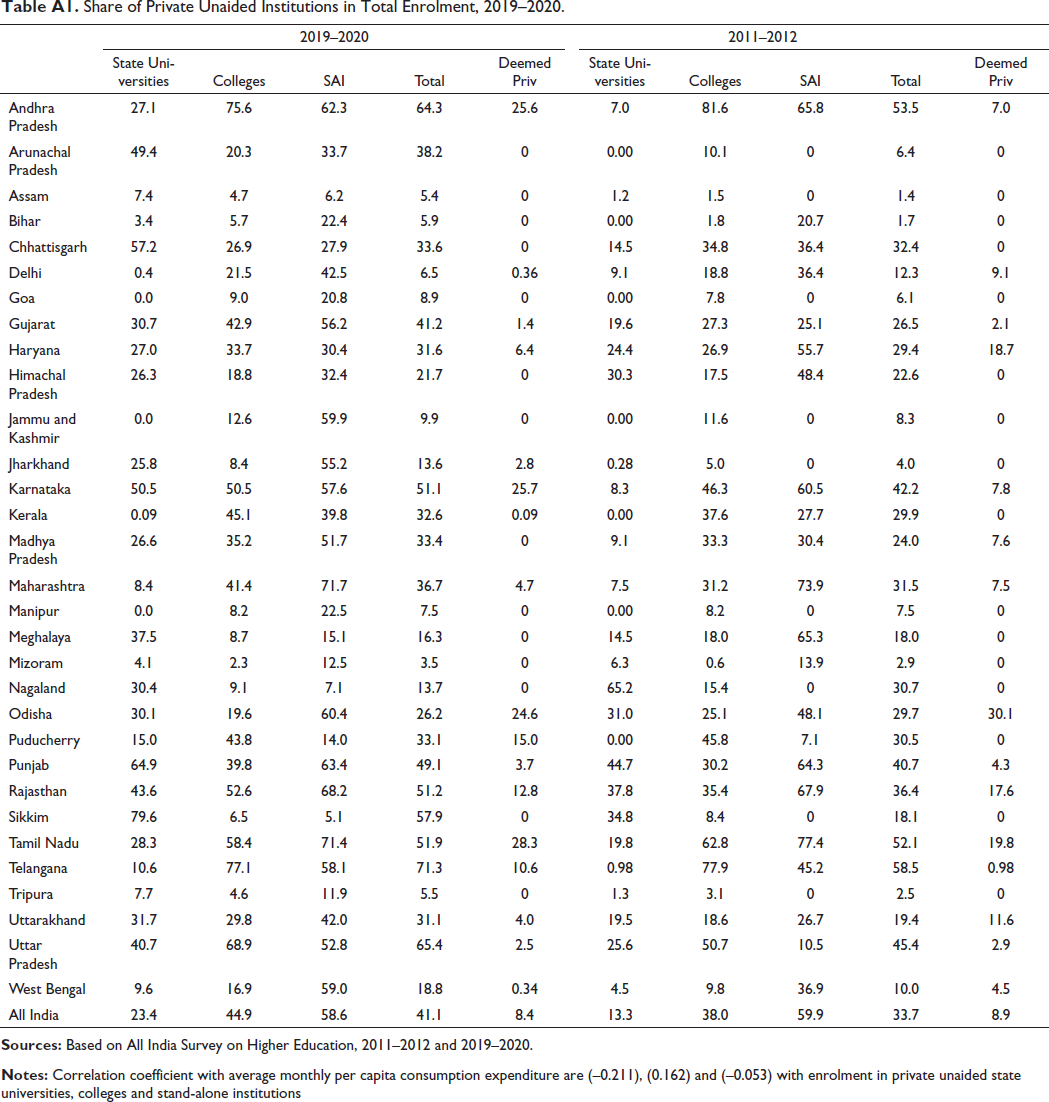
As per the AISHE, 2019–2020 data, a total of 408 universities out of 1,043 are private universities. This comprises 39.1% of the total universities in India. Over the passage of time, the shift towards private unaided institutions (Tilak, 2005) is evident from the AISHE by the Ministry of Education, which indicates an increase in the share of private universities from 28.6% in 2011–2012 to 40% in 2018–2019. In 2011–2012, nearly 13.3% of the total enrolment took place in state private universities. The share of enrolment in unaided state universities has increased to 23.4% (Table A1).
Colleges
The share of private self-financing colleges has increased from 57% in 2011–2012 to 65% in 2019–2020. However, the incidence of privatisation is far higher at the college level than at the university level. In 2019–2020, out of the total 39,955 colleges, 26,054 are private unaided colleges. The extent of privatisation in terms of enrolment is also relatively higher at the college level than that of universities. Out of total enrolment of 27.2 million at the college level, nearly 12.2 million students are enrolled in private unaided institutions, which comprises 44.9% of the total enrolment (Table A1).
Stand-alone Institutions
There are a total of 10,011 stand-alone institutions (9,090 have responded). They are mainly run by the private sector (75.47%); private unaided—66.04% and private aided—9.43%. Thus, only 24.53% of institutions are in the government sector, indicating a dominant share of the private sector in these types of institutions. The high rate of privatisation in this type of institution is attributed to the type of education provided by it. These institutions cannot provide degrees on their own. Therefore, the majority of them run diploma courses which are of short duration. Thus, these courses require a low capital base in such types of institutions, which results in a higher presence of the private sector, as is evident from the data. It is to be noted that the share of private unaided institutions in stand-alone institutions is lower than enrolment than that in terms of a number of institutions indicating low-sized private unaided institutions. The share of private unaided institutions is 58.6% in 2019–2020. Notably, this share has roughly remained the same during 2011 and 2020. It was 59.9% in 2011–2012 (Table A1).
Deemed to Be Universities
Another major route towards privatisation has been through deemed universities. These universities also comprise the highest share of private unaided institutions among universities, both in terms of number of institutions and enrolment of students. There are a total of 80 deemed universities so far. In terms of enrolment, deemed universities comprised 8.9% of the total enrolment at universities in 2011–2012. This share has remained the same in 2019–2020.
In 2011–2012, 85 out of 128 deemed universities were private unaided, comprising 66.4% of the total deemed universities. The share of private deemed universities has remained the same. In 2019–2020, 80 out of 121 deemed universities were private, comprising 66.1% of the total deemed universities. In enrolment, the share of the private sector is remarkably high. In 2019–2020, they comprise 88.31% of the total enrolment in deemed universities. It was 78.1% in 2011–2012.
In a nutshell, it is observed that the share of unaided institutions was already high in stand-alone institutions while pace of privatisation is higher at college and university levels. In fact, the private sector has recently begun to catch the pace of privatisation.
Regional Pattern
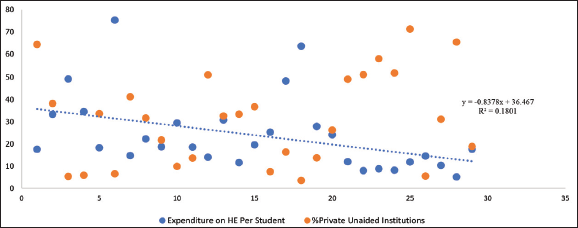
The analysis based on AISHE, 2019–2020 data, nearly 41% of the total enrolment takes place in private unaided institutions at all India level. The share of the private sector varies widely across states. It is highest in Telangana and lowest in Mizoram. Broadly, we can divide the states in four categories based on the share of private unaided institutions in total enrolment in all types of institutions taken together. The states with the lowest incidence of privatisation comprise both types of states. The states with the lowest privatisation are Mizoram, Assam, Tripura, Bihar, Delhi, Manipur and Goa (Figure 1a). However, the states of Punjab, Karnataka, Rajasthan, Tamil Nadu, Sikkim, Andhra Pradesh, Uttar Pradesh and Telangana belong to the category of the states with rates of privatisation (Figure 1d).
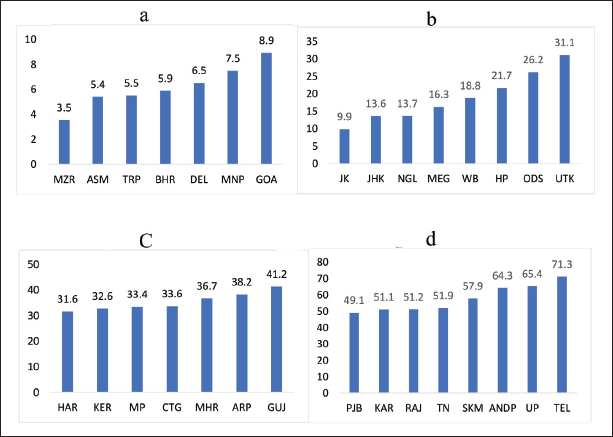
Table 1 shows the change in the share of enrolment in private unaided in different types of higher education institutions. The changing share of enrolment in unaided state universities shows that there is no clear association between the economic condition of the state and the share of private unaided institutions in total enrolment at state universities. In fact, the increase in the share of private unaided state universities is higher in less developed states. The high extent of privatisation in less developed states probably reflects the lower coverage of government-financed state universities in these states. On the other hand, the share of unaided institutions has reduced in Delhi, Himachal Pradesh, and Odisha and has changed negligibly in the states of Jammu & Kashmir, Kerala and Maharashtra. On the other extreme, the increase has been highest in Andhra Pradesh, Punjab, Jharkhand, Karnataka and Chhattisgarh. The correlation between the share of unaided state universities in total enrolment and per capita monthly consumption expenditure is negligibly low, indicating no association between privatisation at the university level and the economic condition of the state.
Change in Share (%) of Private Unaided State Universities in Enrolment in Higher Education during 2011–2020.
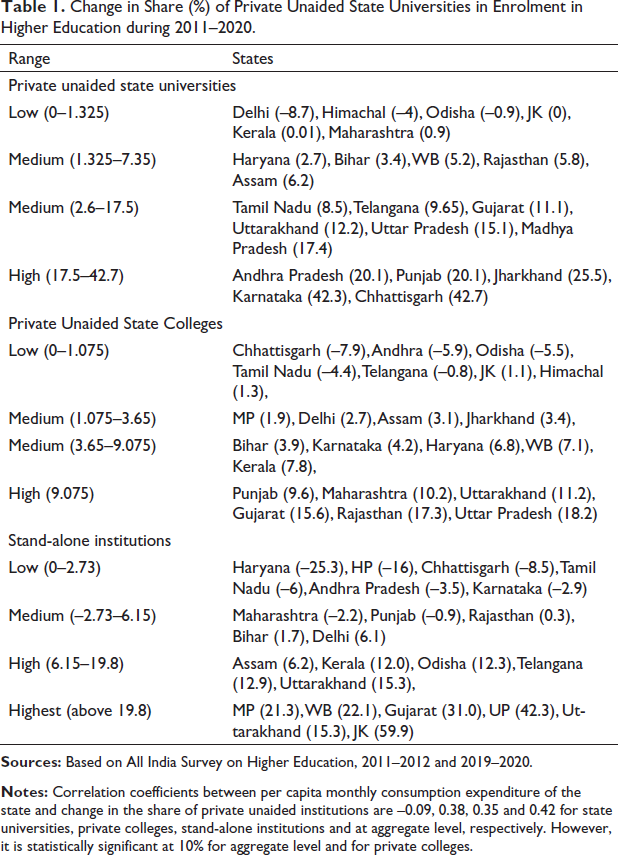
Table 1 also shows the change in the share of enrolment in private unaided colleges as a percentage of total enrolment in colleges. The change is negligible in Chhattisgarh, Andhra Pradesh, Odisha, Tamil Nadu, Telangana, Jammu & Kashmir and Himachal Pradesh, while a substantial increase in the share of enrolment in private unaided colleges is observed in Punjab, Maharashtra, Uttarakhand, Gujarat, Rajasthan and Uttar Pradesh. This is to note that the correlation coefficient between the per capita monthly consumption expenditure and the change in the share of private unaided colleges is positive and statistically significant. This indicates that the increase in the share of private unaided colleges is higher in economically better off states.
The change in enrolment in private unaided institutions in total enrolment in stand-alone institutions is negligibly low in Haryana, Himachal Pradesh, Chhattisgarh, Tamil Nadu, Andhra Pradesh and Karnataka. However, the increase has been highest in most of the backward states viz Madhya Pradesh, West Bengal, Uttar Pradesh and Uttarakhand. The increase has been higher in Gujarat and Jammu & Kashmir also. No significant association is found between privatisation in stand-alone institutions and the economic condition of the states.
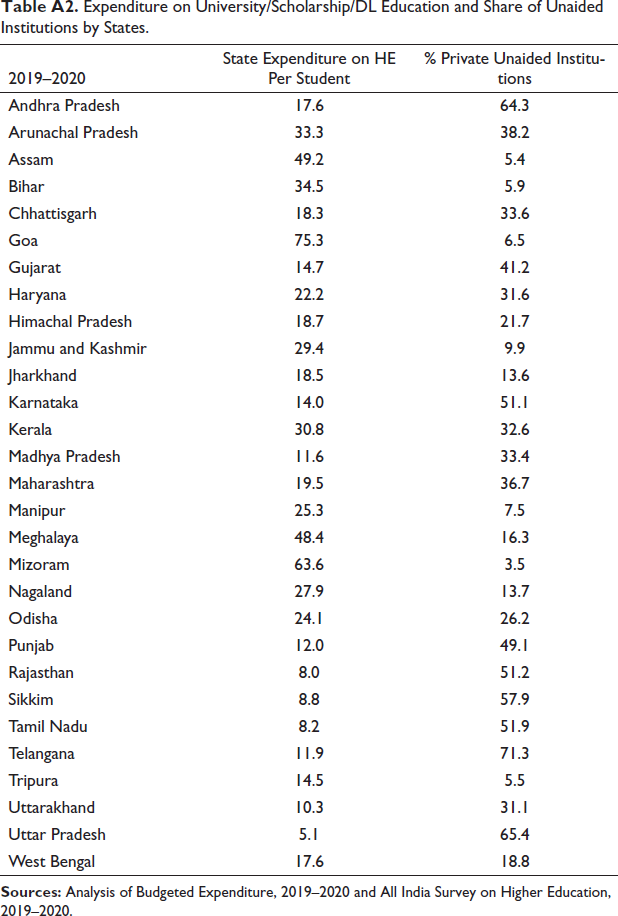
The fact that withdrawal of the government from funding higher education is a reason for privatisation is evident from data also (Table 2). The share of private unaided institutions is higher in states with lower spending on university education. In the states of Punjab, Telangana, Madhya Pradesh, Uttarakhand, Sikkim, Tamil Nadu, Rajasthan and Uttar Pradesh, the per-student expenditure on the university is lowest, while these states belong to the group where the extent of privatisation is highest. In Goa, Mizoram, Assam, Meghalaya, Bihar, Arunachal and Kerala, student spending is the highest while the extent of privatisation is lowest. The combination of expenditure and privatisation lies in the middle in the remaining states.
States by per Student Expenditure on University/Scholarship/DL Education and Percentage Share of Unaided Institutions in Total Enrolment, 2019–2020.
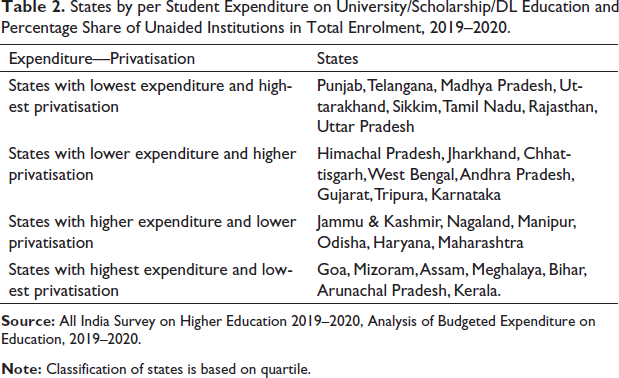
The relationship between per student expenditure on higher education and the percentage of students enrolled in private unaided institutions along with the corresponding regression line and equation is shown in Figure 2. The relationship between per student expenditure on higher education and the percentage of students enrolled in unaided institutions is negative. This indicates that lower financial commitment by the state government is one of the important reasons for a higher rate of privatisation at the state level.
Conclusion
This paper examined the trajectory of policy changes and increasing significance of the private sector with regard to higher education in India. The phenomenon of privatisation of higher education, its forms and patterns in India, is also discussed. Along with the concept of education privatisation, the pattern and trend of privatisation of higher education are discussed using evidence from secondary data. It is argued that privatisation in the education sector differs from the concept of privatisation in general due to the fact that this process can take place without the transfer of ownership from the public to the private sector.
The Indian version of education privatisation may be characterised as a by-product of response to the economic crisis that happened in the late eighties, which shifted the overall policy towards privatisation due to the adoption of neoliberal policies in the aftermath of the 1991 crisis. Though the prevailing economic condition has been a major force behind the move towards privatisation, the role of external factors cannot be ignored. The neoliberal reform is one of the major events which turned the policies in the country forever under the pressure of international organisation. However, the momentum in this direction cannot be boiled down to this particular phase of policymaking. The pro-privatisation approach has never been reversed. Moreover, it has progressed gradually over the three decades post-1991 despite economic performance improving substantially. Because of this, the education policy in India has been converging towards the international consensus.
Notably, the shift towards privatisation has been witnessed both in policymaking and by the judiciary, which further confirms that education privatisation in India cannot be classified as an abrupt move under the pressure of simply an economic crisis. The tilt towards privatisation is evident from the National Education Policy, 1986 and Programme of Action, 1992, which talked about raising resources from the private sector. This move has reached at culmination in the National Education Policy, 2020, wherein the role of the private sector is recognised for expanding higher education. Interestingly, the judiciary has also given legal recognition to the presence of the for-profit private sector in many of its rulings. The private sector has been provided autonomy in the matter of admission, fees and reservation, thereby, validating a complete autonomy of the private sector in its decision-making process.
The empirical evidence, thus, gathered in the analysis shows that the policy shift is being translated into the rising share of the private sector in the provisioning of higher education. The analysis shows that self-financed higher education is the only form of higher education that is growing gradually, while the share of government and aided institutions is decreasing over time. However, this growth has not been uniform by types of institutions and regions.
Though the private sector is expanding in all three spheres, namely, deemed universities, state universities, colleges and institutes of national importance, its presence has been highly prevalent in institutions offering short-duration courses, followed by colleges and universities, respectively. The private sector has been dominant in stand-alone institutions and deemed universities in the initial phase. The increasing presence of the private sector in universities is the most recent phenomenon. Thus, the private sector is evolving as a replica of the government sector in all forms of educational institutions. Interestingly, the extent of privatisation varies widely across states. There are a number of states where the incidence of privatisation is high despite poor economic conditions. The government’s expenditure on higher education explains privatisation at the state level. The share of the private sector is lower in states with higher expenditure on higher education than those with relatively lower expenditure on higher education. Thus, the prime reason behind privatisation is largely a policy choice, either proactive measures towards education privatisation or low priority given to the expansion of higher education in the government sector.
Appendix
Share of Private Unaided Institutions in Total Enrolment, 2019–2020.
Expenditure on University/Scholarship/DL Education and Share of Unaided Institutions by States.
Footnotes
Declaration of Conflicting Interests
The authors declared no potential conflicts of interest with respect to the research, authorship and/or publication of this article.
Funding
The article is based on some of the research findings of the study entitled ‘Political Economy of Privatization of Higher Education in India: Implications of Equity and Quality’ undertaken by Indian Institute of Dalit Studies, New Delhi and funded by Rosa Luxemburg Stiftung, South Asia.
