



Abstract
This article explores Citizen Entrepreneurship (CE) as a powerful tool for addressing global challenges through local action, particularly in the context of the COVID-19 pandemic. Focusing on the #WirvsVirus project in Germany, the study analyzes the theoretical underpinnings, practical applications, and future implications of CE. Key elements such as collective efficacy, proximity, and user-producer identities are discussed, offering a comprehensive framework for understanding CE’s role in fostering social innovation and community resilience.
Introduction
The COVID-19 pandemic has brought about an unprecedented global crisis that has impacted every aspect of society. It highlighted the interconnectivity of our world and the need for coordinated global action (Guan et al., 2020). At the same time, it revealed unique ways in which global issues have a local resonance, affecting communities in distinct and intricate ways (Centers for Disease Control and Prevention, 2021). Addressing these complex problems requires innovative and collaborative solutions beyond traditional top-down approaches (Mitra et al., 2020). Citizen entrepreneurship has emerged as a new and promising approach to tackle issues by empowering citizens to take action in their local communities (Mitra et al., 2020).
This article will provide a comprehensive overview of citizen entrepreneurship, exploring its theoretical underpinnings, practical applications and future implications. With a particular focus on the impact of the COVID-19 pandemic, this article will demonstrate how citizen entrepreneurship can provide a new way of using an entrepreneurial approach to address and resolve global challenges.
Addressing Global Problems with Entrepreneurial Approaches
Despite being a long-standing strategy, the traditional top-down approach to addressing complex global problems has limitations. Typically, a centralised authority or group makes decisions and implements policies to address an issue, often with little local context and involvement of those directly impacted (Dacin et al., 2010). As a result, the top-down approach has struggled to adapt to the dynamic and intricate nature of the problems faced in today’s society (Mitra et al., 2020).
In contrast, entrepreneurial approaches are distinguished by their bottom-up approach, where individuals, communities and organisations actively develop solutions to address complex problems (Mitra et al., 2020). By prioritising innovation, creativity and adaptability, this approach effectively addresses the local consequences of global issues, especially when these entrepreneurial strategies are developed and integrated within local contexts (Foster & Handy, 2009). Furthermore, involving those directly impacted by the problems leads to a more comprehensive and inclusive approach to problem-solving (Mitra et al., 2020).
The recent COVID-19 pandemic highlighted the limitations of the top-down approach, as it required rapid and widespread adaptation to new and complex problems that significantly impacted global health and local economies (Jalloh et al., 2021). Countries that relied solely on the top-down approach to manage the pandemic often struggled to respond effectively. Conversely, those with more entrepreneurial approaches could mobilise community resources and develop innovative solutions to problems such as shortages of personal protective equipment, vaccine distribution and contact tracing (Jalloh, 2021).
Germany is a notable example of a country that has employed an entrepreneurial approach to combat the COVID-19 pandemic (BMG, 2020). The development of the BioNTech-Pfizer vaccine, one of the most effective COVID-19 vaccines, was made possible by collaboration between a small biotech company, BioNTech and a large pharmaceutical company, Pfizer. The German government supported this partnership by granting BioNTech 375 million euros to expand its manufacturing capacity (BMG, 2020). Germany’s success in developing innovative solutions to combat the COVID-19 pandemic demonstrates the potential of entrepreneurial approaches to address global problems. Prioritising local contexts and involving those directly impacted by the problem, such as citizens, in entrepreneurial projects have proven effective in adapting to the dynamic and complex challenges of today’s society.
Citizen Entrepreneurship: A New Way Forward
Definition of Citizen Entrepreneurship
Citizen entrepreneurship (CE) has emerged as a promising approach to tackling complex global problems, drawing increasing attention in recent years. Mitra et al. (2020) define CE as the active participation of citizens in entrepreneurship to address economic and social issues at the local level. The core of CE lies in the engagement and involvement of citizens in creating and developing new ventures that address critical issues. This approach features citizen-led initiatives and community-driven innovation, which generate positive social and economic impact. By mobilising community resources, fostering collaborative partnerships and leveraging technological innovation, CE becomes a powerful force for social and economic transformation.
CE can also facilitate social cohesion and community empowerment (Foster & Handy, 2009). Through promoting citizen-led endeavours and community-driven creation, CE can foster trust and solidarity among community members, strengthening social networks. As a result, communities become more resilient and better equipped to respond to future challenges. Furthermore, CE presents opportunities for individuals to contribute to their communities’ development and address local challenges more sustainably and equitably. Thus, CE’s citizen-led and community-driven approach to addressing global challenges presents a promising avenue for bridging the gap between traditional top-down approaches and local needs and perspectives.
Theoretical Background and Conceptual Underpinnings
CE draws upon earlier theoretical frameworks and is grounded in three key concepts: innovation as a public good (Schumpeter, 1927, 1930, 1931), goods as commons (Ostrom, 1965, 2014) and capabilities of citizens (Foster and Handy, 2009).
Innovation is a fundamental driver of economic growth and development, as highlighted by Schumpeter’s (1934) theory of economic development. By introducing new technologies, products, and services, innovation generates economic value and enhances people’s well-being. In today’s fast-paced global economy, treating innovation as a public good is particularly relevant because the ability to innovate and adapt offers a significant competitive advantage. Innovation can create new knowledge, generate jobs, and increase productivity, delivering substantial public benefits. CE is pivotal in this process, as it empowers individuals to actively participate in entrepreneurial activities that drive innovation. By harnessing the collective creativity and resources of citizens, CE fosters the development of innovative solutions that address both local and global challenges, ensuring that the benefits of innovation are widely shared as a public good. As such, innovation can provide significant public benefits by creating new knowledge, generating jobs and increasing productivity. Therefore, CE, which empowers citizens and promotes entrepreneurial activity, can be a critical driver of innovation as a public good, particularly in addressing local and global problems.
Similarly, Ostrom (1965) emphasised the importance of collective action in addressing social dilemmas and proposed a framework for managing common-pool resources. These resources are vulnerable to overuse and depletion when access is unrestricted or when users act in their own self-interest. To prevent this ‘tragedy of the commons,’ a collective management system, led by the resource users themselves, is necessary. This concept of managing goods as commons is a key theoretical foundation for citizen entrepreneurship. CE harnesses communal responsibility and collaboration to tackle issues related to shared resources. By empowering individuals and communities to work together, CE fosters the creation of innovative solutions to major challenges like climate change, poverty, and unemployment, while also ensuring the sustainable use of shared resources. Foster and Handy (2009) argued that entrepreneurship should be viewed as a collaborative endeavour that relies on mobilising the unique capabilities of individuals and communities. Local communities often have specialised knowledge, resources, and networks that can be effectively harnessed to address specific challenges. CE capitalises on this collaborative potential by providing a platform where citizens can collectively pool their resources and expertise to develop innovative solutions to local problems. This approach is effective because it combines individual initiative with collective action, uniting diverse talents and perspective. CE, consequently, provides a means for citizens to collaborate, mobilise resources and create innovative solutions to these challenges. The importance of capabilities in driving entrepreneurial activities highlights the critical role that individual and collective action, resource availability and deployment and institutional support play in facilitating CE as a means of addressing critical issues in the economy and society.
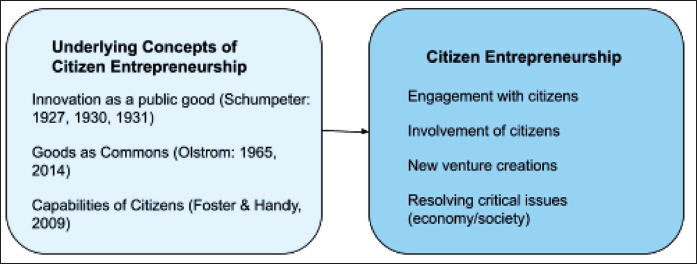
Together, these concepts—innovation as a public good, goods as commons, and citizen capabilities— build the conceptual basis for CE and set the engagement and involvement of citizens, new venture creations and resolving critical issues in the economy and society as its main pillars.
Figure 1 illustrates the foundational concepts of Citizen Entrepreneurship (CE) as derived from the theories of Schumpeter (1927, 1930, 1931), Ostrom (1965, 2014), and Foster & Handy (2009), highlighting their influence on the understanding of CE.
Analysing CE Projects
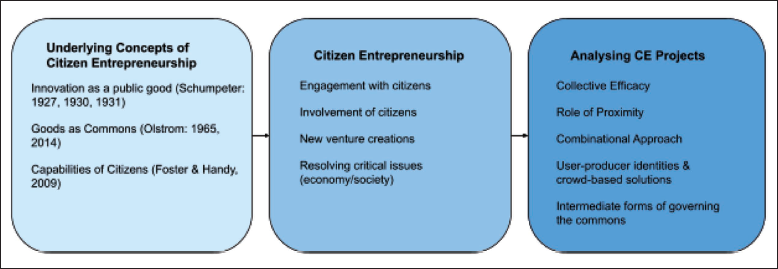
To further examine the potential of CE in addressing societal challenges, it is crucial to analyse the key elements that contribute to successful CE projects. Mitra et al. (2020) offer a framework for understanding the characteristics of CE projects, based on the concepts of collective efficacy, proximity, combinational approach, user–producer identities and intermediate forms of governing the commons and collective efficacy. These concepts are grounded in the foundational theories of innovation as a public good (Schumpeter, 1927, 1930, 1931), goods as commons (Ostrom, 1965, 2014), and the capabilities of citizens (Foster & Handy, 2009) as previously discussed.
Proximity (innovation) plays a critical role in CE projects as it refers to the ability to experience the CE and its outcomes directly. Proximity can be regional, cognitive, or social and allows participants to better understand of the challenges faced and the potential solutions available, thereby aiding innovation (Schumpeter, 1927, 1930, 1931). This proximity also allows for better collaboration and communication among participants.
The combinational approach (capabilities) involves pooling different opportunities and resources among citizens to solve a problem. This approach encourages collaboration among participants with diverse skill sets and backgrounds, resulting in more creative and effective solutions (Foster & Handy, 2009).
User–producer identities and crowd-based solutions (capabilities) recognise the multi-stakeholder roles of citizens in CE projects. Participants are not just passive users but are also producers of solutions based on their diverse interests and experiences (Foster & Handy, 2009). This allows for a more democratic and inclusive process, resulting in solutions that better address the needs of the community.
Intermediate forms of governing the commons (commons) refer to the democratic ownership and governance structure of the commons. This approach ensures that all stakeholders have a say in the management and administration of the resources, resulting in a more equitable and sustainable use of resources.
Collective efficacy (commons) refers to the shared confidence and belief in the ability to achieve common goals. In CE projects, this is reflected in the collective decision-making processes that govern the management of shared resources, ensuring that all participants are invested in the outcomes (Ostrom, 1965, 2014). Collective efficacy is vital for the effective administration and sustainable management of these resources.
To analyse the success of CE projects, it is essential to utilise a framework that considers the combination of these factors. By evaluating these five factors, we can gain a better understanding of the complex interactions that occur within CE projects and have a tool to compare seemingly diverse projects. This understanding can help project managers to identify potential barriers to success and develop strategies to overcome them. Ultimately, utilising this framework can help to increase the chances of success for CE projects and improve their overall impact.
Figure 2 expands on Figure 1, showing how the framework for evaluating CE projects is derived from foundational CE theories. It highlights key elements—collective efficacy, proximity, combinational approach, user–producer identities, and intermediate forms of governing the commons —based on Mitra et al. (2020), and links these to the theories of Schumpeter (1927, 1930, 1931), Ostrom (1965, 2014), and Foster & Handy (2009), forming a comprehensive framework for analysing CE project success.
Citizen Entrepreneurship in Action: The #WirvsVirus Project
Numerous examples of successful CE projects exist, each demonstrating the potential of this approach to addressing social and economic challenges at the local level. The #WirvsVirus project, launched in response to the COVID-19 pandemic in Germany, is one such example. The project was initiated by Tech4Germany and patronised by the German Federal Chancellery, with support from numerous funding and implementation partners. The primary aim of the project was to harness the creative potential of civil society and jointly develop solutions to urgent problems with public administration.
The project utilised a CE approach, encouraging individuals to submit innovative ideas and projects to tackle various aspects of the crisis, including healthcare, education and economic recovery. Over 28,000 participating citizens engaged with each other and received guidance from mentors and experts on the project’s online platform, further ideating and implementing their ideas. Citizens were actively involved and integrated with the development of the project by forming teams and developing solutions collaboratively using a hackathon approach. The hackathon brought together citizens from different fields to work on various pandemic-related challenges and involved experts from politics, business and science who provided demand-oriented support to the participants.
The project’s research design and methods emphasised the importance of citizen participation and engagement, ensuring that citizens were actively involved in the development and implementation of solutions. The hackathon format, mentoring sessions and engagement grants incentivised citizens to submit their ideas and work collaboratively with others. Additionally, weekly sprints and access to resources, infrastructure and implementation partners were provided to participants to develop their solutions.
Application of the Theoretical Framework to #WirvsVirus CE Project
The #WirvsVirus project can be analysed through the theoretical conceptualisation and analytical framework by Mitra et al. (2020), which defines CE as the active participation of citizens in entrepreneurship to address economic and social issues at the local level. As a clear example of CE, the project invited citizens from diverse backgrounds to create and share innovative solutions to address challenges posed by the pandemic (innovation as a public good). Moreover, the project used goods as commons, creating a joint platform for the development of entrepreneurial solutions and leveraging collective intelligence to generate products and services quickly. This approach facilitated access to information and enabled broad participation, showcasing the power of CE in strengthening collective capabilities and empowering citizens to tackle the pandemic.
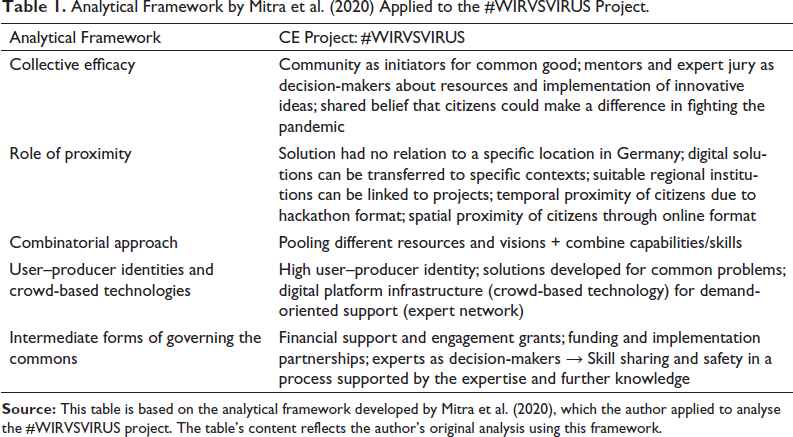
#WirVsVirus owes its success to various drivers which can be analysed by its use of collective efficacy, proximity, combinational approach, user–producer identities and intermediate forms of governing the commons (full analysis, see Table 1).
Analytical Framework by Mitra et al. (2020) Applied to the #WIRVSVIRUS Project.
The collective efficacy displayed throughout the event was driven by the participants’ shared belief that they could make a difference in fighting the pandemic. This belief was reinforced by the organisers who provided a platform that allowed individuals to contribute their skills and expertise towards a common goal. The high level of engagement displayed by participants was evident in the number of ideas generated and the quality of solutions developed.
Table 1 summarises the key elements of the analytical framework used to evaluate the #WIRVSVIRUS project, including collective efficacy, the role of proximity, a combinatorial approach, user–producer identities, crowd-based technologies, and intermediate forms of governing the commons. It illustrates how community-initiated initiatives, resource pooling, digital platforms, and expert-driven governance contributed to the project’s success in addressing societal challenges during the pandemic.
The online format of #WirVsVirus facilitated social proximity by bringing together individuals from various parts of Germany to collaborate towards a common goal. In addition, the hackathon was organised during the pandemic, which made temporal proximity crucial. The event’s virtual nature also allowed for spatial proximity, as participants could join from their homes or workplaces.
Another critical driver was the combinational approach, which enabled the cross-fertilisation of ideas. Participants from diverse backgrounds and expertise such as healthcare professionals, engineers, data scientists and entrepreneurs worked together towards developing innovative solutions.
#WirVsVirus was aimed at developing solutions tailored to common problems, which resulted in a high user–producer identity. Solution finding was facilitated by the digital platform infrastructure and crowd-based technology facilitated solution finding and enabled demand-oriented support from the expert network.
The ‘organisers’ intermediate forms of governing the commons’ also played a critical role in the success of #WirVsVirus. They provided a platform that enabled participants to collaborate towards a common goal while maintaining autonomy. Participants were free to choose the projects they wanted to work on and the organisers provided support and guidance to facilitate the development of solutions but decided which solutions to implement in the end.
Overall, #WirVsVirus serves as a model for future hackathons and collaborative initiatives that seek to address complex challenges. The collective efficacy, proximity, combinational approach, user–producer identities and intermediate forms of governing the commons all played a critical role in the success of the event.
Limitations and Implications of CE
CE has emerged as a promising approach for promoting economic and social development, empowering communities and addressing complex social and environmental challenges. However, several limitations to this construct need to be considered to maximise its potential benefits.
One of the key limitations of CE is the potential for power imbalances and conflicts of interest. When entrepreneurial citizens collaborate with larger organisations or government entities, there is a risk that their interests and priorities may not align. This can create tension and potentially undermine the effectiveness of the partnership. Additionally, the power dynamics between stakeholders may marginalise certain groups, particularly those lacking resources or representation. To address this limitation, CE projects should prioritise diverse community engagement and participation and ensure that all community members have a meaningful say in project design and implementation.
Another limitation is the potential for resource constraints. Due to limited funding and resources, citizen entrepreneurs may face challenges in implementing large-scale solutions, particularly in addressing complex social and environmental issues that require significant resources and expertise. Additionally, resource availability can vary significantly across different communities, leading to unequal opportunities for citizen entrepreneurs. The lack of stable funding and institutional support further adds to the difficulty of sustaining CE projects over the long term. There is a risk that CE projects may become unsustainable over time as they often rely on the efforts of dedicated individuals who may eventually move on to other projects or priorities. Therefore, to ensure long-term success, CE projects should focus on building capacities within the community, such as developing skills and knowledge, to enable them to continue leading and sustaining the project even after external support ends.
A final limitation of CE is that the projects may be isolated from wider policy or systemic change. While CE initiatives can potentially create a positive impact at the local level, they may not be able to tackle underlying structural issues that contribute to social and economic inequalities. The inability of CE to tackle systemic issues can lead to the replication of the same problems in other areas and result in limited long-term impact. To overcome this limitation, CE initiatives should collaborate with policymakers and advocate for systemic changes that address the root causes of social and economic issues. This can lead to more effective and sustainable solutions that have a broader societal impact.
Despite these limitations, CE remains a promising approach for addressing complex social and environmental challenges. By acknowledging these limitations and taking steps to address them, CE can be harnessed as a powerful tool for positive change.
Summary
CE is a burgeoning field that offers great promise for promoting innovation, empowering citizens and building sustainable communities. As a form of grassroots economic and social development, CE enables citizens to take an active role in addressing complex social and environmental issues that traditional approaches have failed to adequately address. By engaging with communities, fostering collaboration and developing innovative solutions to local problems, citizen entrepreneurs can drive positive change and create more equitable and sustainable outcomes.
The COVID-19 pandemic highlighted the importance of CE in addressing complex social and economic issues at the local level. The pandemic brought to the forefront of the need for innovative solutions to combat the virus’s spread and mitigate its impact on communities. Citizen entrepreneurs rose to the occasion, using their skills, knowledge and resources to develop creative solutions that addressed critical needs, such as providing personal protective equipment, developing contact tracing apps and creating community support networks.
Citizen entrepreneurship was also instrumental in promoting social cohesion during the pandemic. By engaging with communities and fostering collaboration in projects like #WirvsVirus, citizen entrepreneurs helped to build a sense of belonging and shared purpose, despite the physical distancing measures in place. These initiatives provided opportunities for individuals to come together and make a meaningful contribution to their communities, helping to mitigate the negative effects of social isolation and loneliness.
In the future, CE projects can potentially drive new ways of thinking about economic and social development in local regions. As more citizens engage in these projects, they will develop a greater sense of ownership and responsibility for their communities, leading to more sustainable and effective solutions. Furthermore, these projects can serve as models for other communities and promote a more participatory and inclusive approach to development.
Despite its potential, CE also faces several limitations that must addressed. These include resource constraints, limited scalability and potential disconnection from broader policy and systemic change. To overcome these challenges, CE projects need to be carefully planned and executed to ensure long-term sustainability and impact.
In conclusion, CE offers an exciting and promising approach to economic and social development that deserves further exploration and support. By engaging with communities, fostering collaboration and developing innovative solutions, citizen entrepreneurs can drive positive change and create more equitable and sustainable outcomes. It is a powerful tool that empowers citizens, builds sustainable communities, and drives innovation to address global problems.
Footnotes
Declaration of Conflicting Interests
The authors declared no potential conflicts of interest with respect to the research, authorship and/or publication of this article.
Funding
The authors received no financial support for the research, authorship and/or publication of this article.