



Abstract
The COVID-19 crisis has underlined the need for accelerated innovation to rapidly help business solve social problems. These problems require access to capabilities and knowledge that no single organization or existing supply chain possesses. Drawing on the experience of the open innovation and rapid-scale-up achieved by the VentilatorChallengeUK to address a shortage of ventilators required by patients seriously ill with COVID-19, this article develops a framework for accelerated innovation and delivery that crosses traditional industry boundaries. It offers a series of important lessons for how open innovation, exaptation, and ecosystem strategies—backed by a set of enabling initiatives—can be used to solve multi-faceted social and business problems at speed.
The VCUK case provides potentially valuable lessons, not only about how innovation and delivery can be dramatically accelerated, but also insights into how complex social and business challenges can be tackled. An increasing number of challenges can only be tackled with access to sets of capabilities and knowledge that exceed those available within any one organization, existing supply chain, or single technology. These include challenges of social innovation that have usually been seen as the sole domain of non-profit organizations, 6 such as the delivery of medical care in conflict zones by the Italian charity Emergency or the use of data analytics by the City of Birmingham to help prevent child abuse. 7 Their traditional skills and resources are unlikely to be sufficient to cope if not complemented by access to a broader range of capabilities and experience from within the business sector. 8 Likewise, governments around the world are now struggling with issues of poverty, inequality, climate, and demographic change. Businesses are also now facing many challenges and opportunities, such as pressure from customers and investors to improve their sustainability and reduce their environmental and social impacts (or to make a positive contribution to these problems) that share similar characteristics. As we demonstrate below, solutions are likely to require access to a diverse set of capabilities and experience beyond those available from existing suppliers and partners, which can be brought together to innovate, often under time pressure. 9
Key to the success of VCUK was its combination of an open-innovation mindset, technology “exaptation,” 10 and strategies to rapidly catalyze the development of a diverse ecosystem of partners with both the capabilities and incentives to co-invest and co-innovate. This novel conceptualization of strategies was then realized with the help of a shared sense of purpose and flexible processes spanning design through to manufacturing.
VentilatorChallengeUK: A Case Study in Accelerated Innovation and Delivery
In early March 2020, the U.K. government issued instructions for people to “stay at home, protect the NHS, save lives.” 11 This stark message recognized that medical capacity was never designed to cope with the tsunami of demand that COVID-19 threatened to unleash. In particular, ventilator demand was forecast to outstrip available supply capacity by a hundred-fold. A parallel message went out to U.K. industry requesting it to marshal list resources to overcome the shortfall. A target was set to procure 30,000 12 mechanical ventilators by the end of June 2020, and an open innovation challenge was made to manufacturers. A design specification was created for a Rapidly Manufactured Ventilator System (RMVS) 13 and expressions of interest were invited to deliver to this specification. Among several groups that sought to take up the challenge, the most successful was VCUK, which ultimately delivered 13,437 units over the next few months, helping to ensure sufficient capacity at the peak of the pandemic. A timeline of key events in the VCUK is shown in Figure 1. In what follows, we explore these events through the prism of a business ecosystem, 14 which was formed, rapidly expanded, and then unwound after achieving its purpose. This points to the fact that, rather than being the result of a pre-planned strategy, the success of VCUK arose from guided emergence, learning, and evolution among a diverse set of partners, each bringing distinctive capabilities and their own motivations to the achievement of a shared goal.
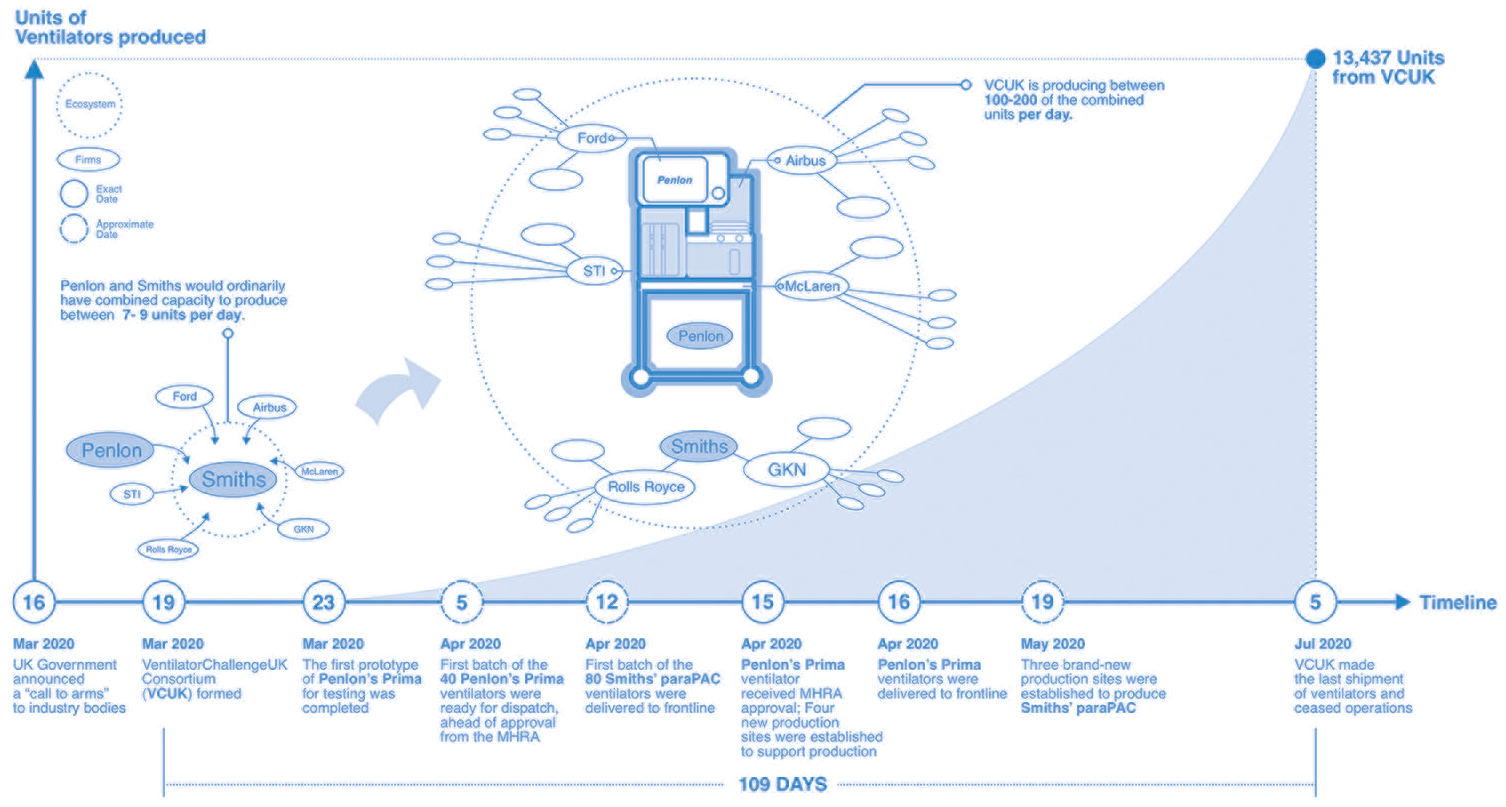
A timeline of key events in the VentilatorChallengeUK project, based on sources described in the Appendix.
Birth of the VCUK Ecosystem
The U.K. government’s call to arms led to the birth of the ecosystem. Following a call on March 16, in which the challenge was laid out and the RMVS specification was presented, “there was this deafening silence when the companies thought yeah, we’d like to do something, but what?”
15
Coordination was required and this responsibility was taken up by Dick Elsy, Chief Executive of the High Value Manufacturing Catapult (HVMC). This is the largest advanced manufacturing research institute in Europe, positioned as a bridge between business and academia, aiming to promote the scale-up and adoption of new technology across U.K. manufacturing sectors.
16
HVMC’s existing collaborative network made Dick Elsy a logical choice to lead the consortium, and his immediate task was to establish the ecosystem. As he recalled: I made a few calls that evening and the next day and we set the consortium up . . . in terms of selection of the initial companies, these were people who I knew would be prepared to take a corporate risk because we didn’t know whether we could deliver this stuff in the first place for sure and also a personal risk because you’re putting yourself into the spotlight on a national challenge, so the predominant selection criteria for those initially approached were those.
The risks involved, financial as well as reputational, dictated the initial ecosystem membership, which largely drew on established personal and professional connections. These were mostly large firms, with available capacity and the capabilities required. The requirement for rapid development (and the postponement of motorsport competitions), for example, made McLaren, a Formula One team, a potentially valuable member. 17 The requirements for manufacturing scale, flexibility, and quality, meanwhile, meant that aerospace firms, including Airbus, GKN aerospace, and Rolls-Royce, were valuable potential partners. To deliver scale in production and assembly, access to electronics and medical device manufacturing capacity from Surface Technology International (STI) was also valuable, while the involvement of Ford could provide the mass production capabilities honed over more than one hundred years since its founding.
While this group of firms had extensive innovation and manufacturing capabilities in the context of their own industries, they had no experience in making or developing mechanical ventilators. Indeed, experts expressed doubts over what they viewed as questionable innovations: “3D printing or cobbling together MacGyver-style contraptions” 18 rather than scaling up existing production. VCUK essentially adopted both approaches. The largest producer of ventilators in the United Kingdom—Smiths Medical, sought to scale up production of its existing devices with support from VCUK. In parallel, Penlon was able to create a new design with the help of VCUK that would meet the specification based on the repurposing of an existing anesthesia device.
With two devices to develop and manufacture, the ecosystem was divided into two parallel programs. One program, led by Smiths (with support from GKN and Rolls-Royce), focused on scaling up production of Smiths’s existing paraPAC products. Meanwhile the other program, led by Ford and Penlon (with support from Airbus, McLaren, and STI), faced the challenge of gaining approval from the Medicines and Healthcare products Regulatory Agency (MHRA) for Penlon’s new Prima design. MHRA approval can normally take up to 24 months to achieve, but with support from Siemens Healthineers, VCUK achieved approval in 21 days.
Ecosystem Expansion
With the core members of the ecosystem established, expansion progressed rapidly as capabilities were identified and partners invited to supply them. During the expansion phase, securing the parts supply was a fundamental challenge. A ventilator would normally consist of around 700 individual components, many of which are either produced in very low volumes, or in the case of older designs, no longer in regular production. For example, after the U.K. government placed an order for Smiths’s paraPAC ventilators, the challenge of obtaining vital test boxes (used to calibrate the correct operation of the ventilator) became clear. These had to be made as “one-offs” using old technologies and were not in regular production. To solve this problem, McLaren’s engineers managed to reverse engineer the test box and finally deliver 144 test boxes of 13 different types. In addition, nearly half of the components had to be sourced from all over the world. McLaren was also chosen to establish and oversee a global supply chain, given the experience of its Formula One team in managing their supply chain in a timely and precise manner through a complex global network. The U.K. Government also became an important ally in this ecosystem. Where supplies had to be drawn from vulnerable or inaccessible locations, the government could use its overseas missions to help obtain the parts from those countries. Working together with the partners, over 11 million parts were therefore successfully procured within the first few weeks of VCUK’s operations.
This logistical challenge of getting those parts from around the world to the United Kingdom was addressed by encouraging DHL into the ecosystem. The requirement to manage the required payments, meanwhile, led to the accounting firm Deloitte being invited into the ecosystem.
Given the normally low capacity of ventilator production, low volume of spare parts, and the sudden increase in demand from across the world, some components required new production lines to be established. These included out-of-production parts that needed to be reproduced—a task familiar to aerospace manufacturers that often have to reproduce legacy parts to repair out-of-production aircraft. As new partners were added, the ecosystem’s design and manufacturing capability was enhanced by the initial members drawing on their existing partners and suppliers. AE Aerospace, for example, was invited to join the VCUK ecosystem 19 as a result of its existing relationship with Rolls-Royce, and it turned its flexible manufacturing capabilities to the production of ventilator components. This required a scale-up of its normal production volumes to deliver thousands of components, despite having no prior involvement in the medical sector.
While assembling such a network of partners might sound simple, a phone call to a friend was not sufficient, given the technical and legal complexity of such an open innovation program. Over 100 new suppliers needed to join Penlon’s supply chain, for example, and each was approved through site visits, audits, and assessments to ensure that quality management standards would be met. This included auditing the manufacturing facilities of ecosystem members such as Airbus, McLaren, and Ford. In addition, non-disclosure agreements were needed to facilitate sharing of intellectual property between the partners, while the U.K. government supported insurance against possible accidental infringement of third-party patents or safety risks. While these risks were concerning, the expertise within the ecosystem and the rigor of its processes helped to ensure they were mitigated.
Scaling Up Production
The speed of development and the scale of production achieved by VCUK are noteworthy. Typical development times were reduced from years to weeks, while the volumes produced in 12 weeks were approximately equivalent to 20 years of normal volumes. Moreover, the final cost to the taxpayer of Penlon ventilators produced through VCUK was lower than the average paid to procure ventilators from existing suppliers. 20 This is all the more remarkable considering that new production lines had to be set up in multiple locations, and around 3,500 people needed to be trained during a lockdown that restricted movement and contact.
In fact, training enough people from different firms and in the parallel factories proved to be another big challenge that VCUK had to overcome. As Dick Elsy explained, not only did we have to train people in a very short space of time but of course we had the COVID crisis . . . the normal process would be to get people in the classroom and talk them through the process, get them a line of sight to see how it’s done with the process sheets and work through it all . . . we couldn’t do that so we had to develop an entire remote training strategy.
To overcome this problem, VCUK managed to deploy new technologies in the workplace—including Virtual Reality (VR) and Augmented Reality (AR)—for training with a willingness to take the technological risks. Tackling this training challenge involved bringing new partners into the ecosystem. Microsoft helped to supply VR devices to allow training at a distance, while Thales applied its AR capability to lead assembly operator and clinical operator training. 21 These partners also used their capabilities in so-called “digital twin” technology to create virtual replicas of physical factories to aid in designing and implementing layouts.
The ecosystem required people at all levels to work in self-directed teams, make decisions rapidly, and apply all of the digital technologies available to them to maximum effect. As Graham Hoare, Chairman at Ford of Britain, illustrated, we were solving problems, critical problems in 22 hours on a 24/7 basis at any one point we had 140 problems that we were managing and those problems were hitting us about every 14 minutes . . . one of the best examples of that I saw was with the Siemens team where they involved their apprentices [to solve a needle adjustment problem in the Airbus process] . . . the apprentices came in and created a digital twin of the manufacturing facility for the parts, solved the problem in the digital world, 3D printed the solution, tested it in production, and then found a way of automating it as well.
Unwinding the Ecosystem
Having produced over 13,000 ventilators for the NHS, VCUK ceased operations after its last shipment of finished ventilators on July 5, 2020. Within less than four months, VCUK had managed to support the scale-up of production for Smiths’s ventilators while helping to bring a new idea from Penlon to life. The ecosystem delivered on clinicians’ and politicians’ requirements, established and repurposed seven manufacturing facilities to accelerate production, set up a new supply chain sourcing over 42 million parts from 22 countries, and trained around 3,500 front-line assembly teams ensuring speedy delivery with adherence to the regulatory standards. Dick Elsy said, What VCUK has achieved in the space of twelve weeks is nothing short of incredible, creating and producing an approved product and setting up production facilities on this scale would normally take years . . . Together, we have helped ensure the NHS has always had access to the number of ventilators it needs, and we’re pleased to have also contributed to building a resilient stock should ventilators be required in the UK in the future. This coalition of the very best of this country’s people and capability across different sectors has truly showcased the strength of the manufacturing industry in the UK.
While the Penlon and Smiths’s ventilators supported by VCUK were successfully delivered, the majority of other ventilator projects never reached the production stage. The urgency of the task made accelerated innovation a necessity, so finding existing technologies that could be repurposed was the only feasible approach. The complexity of the devices demanded collaboration and limited which potential contributors could address requirements. The uncertainty of treating a new disease meant that RMVS specifications changed as clinical best practices emerged and required volumes were updated as infection rates fluctuated. Although parallel ventilator projects were initially supported, some became unsuitable as requirements changed, if they would face supply challenges due to global competition, or when it became clear they would not achieve regulatory approval in time. 22 For example, the “BlueSky” ventilator project (formerly “Remora”) developed by a group of Formula One teams and Darwood IP, focused on a method that emerged as less suitable for treating COVID-19 symptoms. Meanwhile, Dyson’s “CoVent” project faltered due to the lead time required for adequate testing and the rapidly changed specifications and approvals demanded by regulators in a timely manner. By contrast, an important reason behind the accelerated MHRA approval of the ventilators developed from the VCUK was the early involvement of medical technology professionals from Siemens Healthineers into the design and development process, which provided excellent expertise in medical device development and rich experience of obtaining approval from regulators. Challenges that derailed other projects were recognized early and addressed by opening up—expanding the ecosystem to ensure the required capabilities could be accessed.
Lessons from VentilatorChallengeUK as an Open Innovation Ecosystem
One of the important lessons from the success of VCUK is that effective innovation and delivery can be accelerated by deploying multiple, non-traditional strategies together. In this case, the first of these was an open-innovation mindset. The second was technology exaptation, rather than simply adaptation. The third was ecosystem strategy, backed by leadership that goes beyond command and control.
Open-Innovation Mindset
Almost two decades of research on open innovation have helped businesses understand its benefits and the best practices for achieving them. It is now clear that approaches to innovation that promote the exchange of knowledge with external parties (including customers, suppliers, research institutions, and others) play a crucial role in enabling the world’s most successful businesses to bring ideas to market rapidly and profitably. 23
The goal of VCUK provides a good example of the kind of problem and opportunity that is increasingly common in both social and business innovation today, where the magnitude, complexity, and diversity of capabilities required exceeds the capacity of any company, government, or non-profit organization to tackle alone. An open innovation mindset, drawing on a wide variety of different technologies and resources of both not-for-profit and commercial businesses, is necessary. 24 As Henry Chesbrough (who first developed the concept) argued, opening up the innovation process mobilizes knowledge from many different places, accelerating learning. Open innovation is, therefore, a powerful extra-organizational concept for addressing problems that transcend the capabilities within the existing boundaries of the firm. 25 Openness unleashes a volunteer army of researchers working in their own facilities, across different time zones and different countries. 26 Openness leverages both human capital and the physical capital (such as plant and equipment) already in place to launch rapid testing of possible solutions. 27
Harnessing Exaptation
To speed up the innovation process, however, it can also be useful to give consideration to exaptation. Technological innovation is usually understood as a process of slow evolution, where a technology is adapted over time to suit a particular purpose. The evolution of technologies from hammers to jet engines has been mapped in this way, from a common starting point to a range of specialized technologies adapted to specific purposes. 28 Such a process is markedly different from the accelerated innovation seen in VCUK. The concept of exaptation, which involves the exploitation of latent functionality, played an important role. Exaptation is commonly observed in nature. Examples include feathers that originally evolved to keep a creature warm, but later helped subsequent generations to innovate the power of flight. 29 Innovation examples include the process whereby the unintended side effects of treatments for tuberculosis led to the first anti-depressants or the accidental discovery that radar components generate heat, which led to the microwave oven. 30 VCUK’s use of exaptation is far from unique in the Covid-19 crisis where Remdesivir, an antiviral drug, and Hydroxychloroquine, a malaria treatment, were examined as treatments for seriously ill patients. Likewise, the crisis saw the repurposing of existing design capabilities and manufacturing technologies to produce products such as hand sanitizer and personal protective equipment. 31
In some cases, innovation through exaptation requires the separation of specific modules from an existing technology, some of which can then be repurposed to solve a different challenge. This modular exaptation often results in the creation of new markets, can lead to disruptive innovation in existing ecosystems, and even lead to the creation of a new ecosystem. 32 Compared with traditional innovation processes, exaptation offers significant advantages in terms of greater speed, lower cost, and lower risk (due to proven performance in the original application). 33 In the case of VCUK, we saw exaptation play an important role in successful innovation and delivery, including the repurposing of design, manufacturing, 3D printing, AI, VI, supply chain coordination, and mass-production technologies from the motorsports, automotive, aerospace, electronics, and logistics industries.
Ecosystem Strategy
From an organizational perspective, the VCUK initiative clearly transcends a single corporate hierarchy. But nor is it a supply chain, because most of the organizations involved were not linked in a set of linear relations. Unlike a classic supply chain, there wasn’t a focal firm 34 that dictated the value proposition, the precise roles, deliverables, and performance standards to be met by participants. Instead, VCUK was a business ecosystem of the type originally defined by James Moore as “a network of organizations and individuals that co-evolve their capabilities and roles and align their investments so as to create additional value and/or improve efficiency.” 35
Unlike a rigid supply chain, such an ecosystem involves a set of symbiotic relationships in a complex adaptive system that is not centrally controlled but has emergent properties that respond to both individual and collective incentives and build on self-organization throughout the system. The structure, sitting on the spectrum between a bureaucratic hierarchy and an impersonal market, is a network that unites innovators and complementors around a shared value proposition to which they all contribute. 36
This kind of ecosystem, where partners can collaborate through loosely coordinated development and experimentation, can absorb uncertainty more effectively than traditional hierarchies or even subcontracting relationships, where deliverables have to be precisely specified in advance and structures are more difficult to reconfigure. Key characteristics include interdependence, networks, self-interest, and joint value creation. 37 These characteristics are evident in the case of VCUK, where there is an interdependence between firms drawn from a variety of industries who formed a new network while maintaining affiliation to their existing ones. The firms also balanced self-interest with collective interest, in large part through inside-out and outside-in open innovation—sharing knowledge and resources for joint value creation while receiving knowledge and resources in return.
It is also notable, however, that the VCUK ecosystem did not arise entirely as a self-organizing network. Instead, its formation and development were led by the HVMC. But rather than taking the form of traditional command and control, this leadership focused on providing a roadmap for the evolution of the ecosystem, facilitating knowledge sharing, and creating the right incentives for partners and interfaces between them. The key role for this distinctive approach to leadership in enabling an ecosystem to take shape, grow, and deliver has been observed across many different industries, from news media and semiconductor design through to jet engines and computer-aided design. 38
Another important role of the ecosystem leader involves managing the tensions between partners that have been observed in business ecosystems across contexts as diverse as semiconductors, entertainment, and personal computers have revealed the tensions between firms. 39 Such tensions arise from the need to co-operate to achieve shared objectives while each pursues its own goals—which, in turn, can create competition between partners. 40 An investigation of the 3D printing ecosystem, for example, found that tensions arose as the partners who initiated the ecosystem began to face competition from new participants they invited to join in support of the ecosystem’s value creation objectives. 41 In the case of VCUK, these potential tensions were quickly overcome. One reason may be the way that the ecosystem was formed and expanded. A common objective rather than independent strategic interests brought the firms together. Since few of these firms were already operating in the area of medical devices, their entry was driven by the benefits of complementarity. The new revenue streams that would be opened up by joining the ecosystem, therefore, could not have been accessed without the cooperation of partners. The speed with which VCUK formed, developed, and was unwound—before commercial opportunities could be developed that might have resulted in competition—may have been another factor.
We also see in the VCUK case that for the ecosystem to work effectively, each of the partner organizations may need to adapt their existing structures to interface effectively with external parties. This often means establishing a dedicated partnership team staffed with people who are able to make new types of decisions, such as which knowledge should be shared to promote the health of the ecosystem or what has to be kept proprietary to maintain an individual partner’s power and profitability. New technologies such as VR and AR also played an important role in rapidly providing the retraining staff within each of the partners needed to deliver on the value-creation potential of VCUK.
Enabling Accelerated Innovation within an Ecosystem
While the VCUK case demonstrates key strategies for accelerated innovation—an open innovation mindset, technology exaptation, and ecosystem strategy—it also points to the need for a number of preconditions and initiatives that are also required to enable the potential to be realized. These are summarized in Table 1.
A Strategic Framework for Accelerated Innovation.
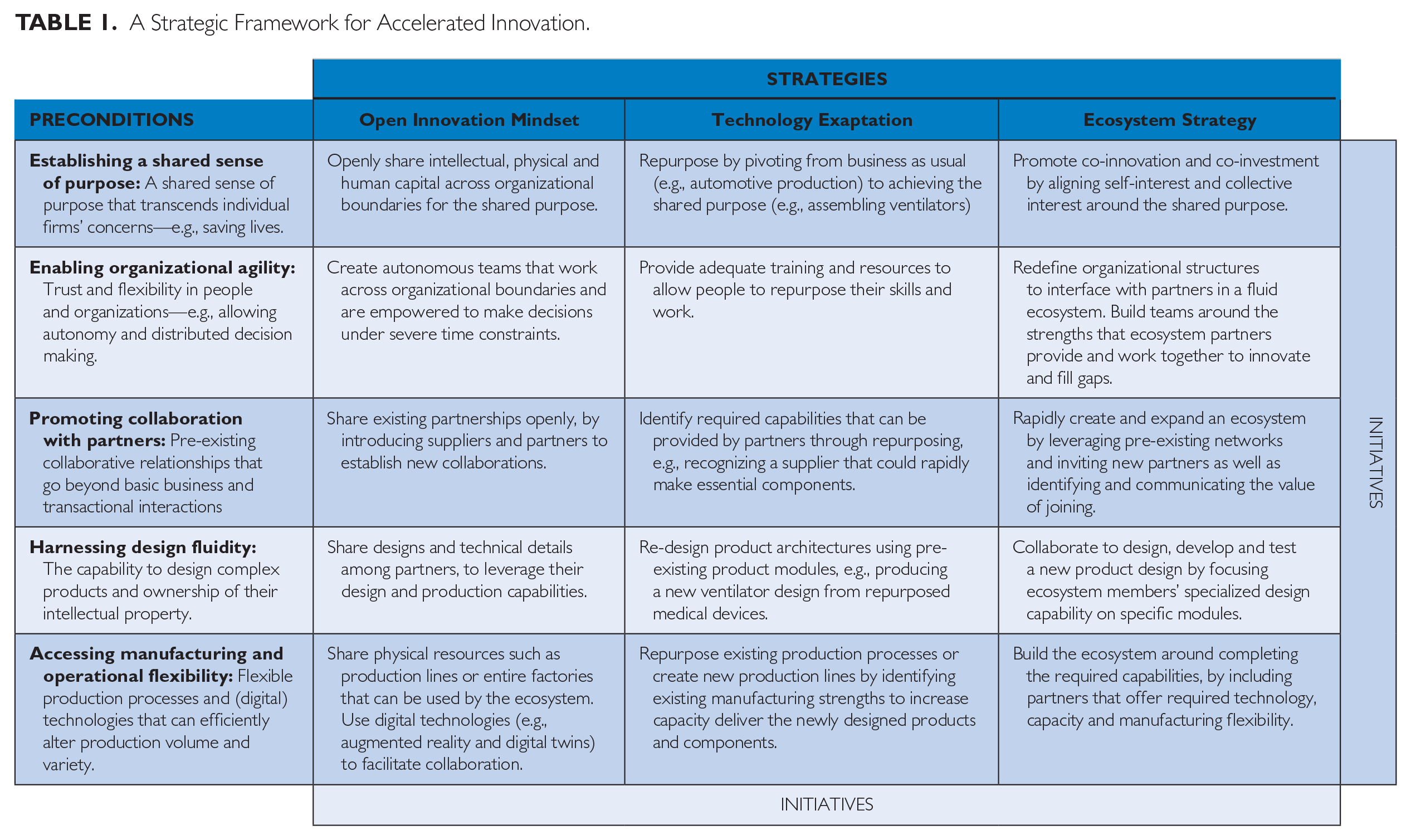
The preconditions that need to be established and the initiatives that can achieve a successful result are illustrated below.
Establishing a Shared Mission
The unique circumstances of the COVID-19 pandemic created an existential crisis, and one that was unusual in being both global in impact and sudden in onset. 42 Framing the pandemic as a life-or-death challenge affecting everyone equally has the power to unite everyone behind a common mission. The use of war metaphors in this context is telling. For example, the U.K. government issued a “call to arms” (not simply a tender) and offered “air cover” (officially “product and intellectual property indemnity”) for VCUK. 43 It placed firms on a “war footing” and inspired a collective effort with a single-minded goal that is unusual outside of wartime.
The Second World War holds a prominent place in the British psyche, reinforced by 2020 marking the 75th anniversary of its end. In particular, the period between late May and the end of October 1940 includes historical precedents for open innovation in response to a crisis. The Little Ships of Dunkirk, over 800 private boats, sailed from England to help in the evacuation of troops from Dunkirk in northern France. This was followed by the Blitz, the nightly air raids on British cities and industrial infrastructure, and the Battle of Britain, in which the Royal Air Force combated the attempted invasion. This battle was won in large part due to the scale-up in production of aircraft, most famously the Supermarine Spitfire, which was produced in a distributed network of repurposed factories, including car plants. A Dunkirk spirit was invoked to describe the COVID-19 response—recalling the open sharing of boats used in a humanitarian effort in 1940. 44 And a Blitz spirit recalls the sacrifices by the general population as well as giving a precedent for repurposing private assets to aid the war effort. Although not entirely accurate, the myth that the Spitfire, a masterpiece of British engineering, won the war could be used to inspire a new myth that the Penlon ventilator would win the battle against COVID-19.
We believe that having a shared mission that transcends the concerns of individual organizations was central to the success of VCUK. 45 The question for managers is then whether it takes an existential crisis to achieve the same results? Obviously, war, plague, and other such disruptions are not desirable to most organizations, nor are nationalization or government control of private industry. What alternatives can be used to drive the kind of open sharing of resources that VCUK achieved across a newly formed ecosystem? We suggest two important tools: grand challenges and myths.
A grand challenge, such as climate change or an aging population, can be harnessed to offer a mission that goes beyond the specific concerns of individual organizations or the people within them. Framing a problem in a way that makes it equally relevant to all involved makes the potential value that can be created by an ecosystem clear, which in turn encourages open innovation. What makes these challenges effective is that they are clear and focused, as well as complex and pressing. A powerful example is President Kennedy’s announcement in 1961 of the mission to send an American to the moon (and back) by the end of the decade. In the context of the U.S./USSR space race, this was a clear and shared mission that an ecosystem could seek to achieve.
Another related approach involves the use of a myth that communicates a strategy clearly and focuses attention on its delivery. Organizations use myths and other stories to preserve and convey culture, to change culture, and to instill desired behavior among their staff. Myths are stories that help individuals make sense of their work, their roles in organizations, and the traditions that they belong to. 46 3M, for example, relies on the mythical development of the “post-it” to communicate and preserve a clear innovation culture. Similarly, Apple’s co-founder, Steve Jobs relied on a carefully crafted myth of triumph over adversity. 47 Organizations can create a common purpose, therefore, either by presenting the task as a grand challenge or by promulgating a myth that frames their activity as a way to replicate a triumph of the past.
Enabling Organizational Agility
Accelerated innovation using open innovation, technology exaptation, and ecosystem strategies depends on people and, in particular, their openness to new ideas, unfamiliar technologies, and unorthodox processes. 48 In the VCUK case, people at all levels were required to be very flexible, to apply their knowledge and experience to an unfamiliar challenge. They were required to be agile, in the sense that self-organizing teams were empowered to make decisions quickly. While agile methods are increasingly popular, agility can be stressful for those involved and even harmful for innovation. 49 What these teams achieved in VCUK was enabled by minimizing bureaucracy and reducing processes that would have otherwise slowed down their work. Such processes may be essential when there are doubts that people will do the right thing. 50 In the VCUK case, the shared mission that united everyone—the idea that every ventilator could save a life—ensured that doing the right thing came naturally. Other companies wishing to apply these lessons may have to work harder to refine their processes to enable similar results.
Promoting Collaboration with Partners
The question of how to promote collaboration within ecosystems involving diverse partners has concerned academics for almost three decades. Normally these relationships evolve slowly over time. The case of VCUK, therefore, is particularly instructive because the entire lifecycle of the VCUK ecosystem spanned only a few months, and the key events happened from one day to the next. Yet even this ecosystem did not appear overnight. The birth of the ecosystem was deliberate, with the lead partners identifying and inviting the most suitable firms to address the shared mission. Pre-existing relationships played an important role in dealing with the extreme time pressure by enabling existing trust and understanding among firms to be leveraged to promote efficient collaborations. Personal relationships connecting many of the potential partners also enabled a diverse range of organizations to be invited into the VCUK ecosystem, despite coming from different industries.
Just as in a biological ecosystem, diversity enables responses to unexpected events in innovative and non-linear ways. When trees have survived fires, for example, some of them evolve fire-resistant seeds, which means that they can cope with future fires in a different way to ecosystems that have not faced such a challenge in the past. The diversity of partners in the VCUK ecosystem, such that each group of ecosystem members brought their own distinctive experience and strengths, meant that complementary technologies, ideas, and ways of working from across different industries could be combined to fuel innovation.
Harnessing Design Fluidity
VCUK delivered a new product in record time, and this would not have been possible without the capability to design and redesign products in a rapid and fluid way. An organization’s design capability can be viewed as its collective design expertise applied to create or change the value propositions of a product it creates. In order to contribute maximally to accelerated innovation, design capabilities need to have the fluidity to enable them to be applied from different perspectives. These perspectives include the design and redesign of an existing product (as we saw in the design of Penlon’s ventilators, which were based on the company’s existing anesthesia device). Another perspective is reverse design and engineering (as was the case in the redesign of the test boxes for Smith’s ventilators). Designers may bring to the task a specialized perspective that is related to their experience in how to deliver a particular type of functionality. The choice of McLaren to bring their experience in creating products capable of meeting tough crash to trolley design for Penlon’s ventilators is a good example.
One of the reasons for VCUK’s success was its ability to attract partners into the ecosystem that brought both deep design expertise and the fluidity to apply it from different angles. Their expertise was openly shared and combined to help achieve their mission through a collective design process. The results they achieved suggest that accelerated innovation based on exaptation will be more effective if it can draw on a strong and fluid design capability. This includes people with the design skills and knowledge required to understand exaptation, and the tools and technologies that can support them.
Realizing delivery of a new design resulting from accelerated innovation, even where this is based on repurposing and redesign of an existing product, then generally requires access to a final tool: operational flexibility. This reflects the lack of suitable established manufacturing lines for what is inevitably a new product.
Accessing Manufacturing and Operational Flexibility
The concept of open innovation focuses on an exchange of knowledge, in the form of ideas, designs, and intellectual property. But the case of VCUK reminds us that the services of physical assets, as well as intellectual property, are also required for a new ecosystem to deliver. Purposeful sharing of physical resources across organizational boundaries is likely to be required. To support the delivery of an innovation at speed, manufacturing flexibility is also a necessary ingredient. Flexibility refers to a manufacturing system’s ability to respond quickly to changes with minimal losses in time, effort, cost, and performance. This includes the ability to introduce new products, or switch production between products on demand.
Even with a shared purpose motivating the ecosystem partners, the nature of physical resources and their ownership generally make openness and sharing much more difficult than for information. A shared design can be simultaneously used by the receiver and the sharer, unlike a manufacturing line. Knowledge is also much more fungible than manufacturing capacity, which is traditionally designed to produce a specific set of products efficiently. To deliver the benefits of accelerated innovation, therefore, the flexibility enabled by the application of new technologies from Computer-Numerically-Controlled machining to VR, digital twins and 3D printing will almost inevitably need to play a key role. These technologies allow manufacturing facilities to be repurposed, enabling excess capacity to be shared to rapidly expand volumes or build entirely new production lines for new products quickly. 3D printing, for example, enables such flexibility by allowing manufacturing without a need for dedicated tooling. Just as people and partnerships that are flexible can facilitate accelerated innovation in open ecosystems, the VCUK case highlights the value of flexible manufacturing resources as an important ingredient.
Conclusion
Companies across more and more industries, from cars and consumer goods to retailing and banking, are seeing their time-honored ways of making money under threat. New technologies, rapidly changing customer needs, and challengers and competitors are disrupting their comfortable business models. Likewise, many social problems—from inequality to climate change, where traditional solutions have proven inadequate and which governments have largely failed to decisively address—present similar challenges. The need to deliver accelerated innovation is therefore becoming essential in both the business and public sectors. The ventilator challenge successfully achieved accelerated innovation, large-scale production, and delivery of a new ventilator design to address the explosion of patients seriously ill with COVID-19. Innovation can be accelerated by combining three strategies: an open innovation mindset; exaptation of existing technologies, people, and partnerships; and strategies to catalyze the emergence of a diverse ecosystem of varied partners who bring different capabilities, knowledge, and experience to address this kind of challenge. A series of preconditions need to be created to underpin accelerated innovation. We have outlined the kinds of initiatives that we hope will enable managers to establish these preconditions by establishing a shared sense of purpose, enabling organizational agility, promoting collaboration with partners, harnessing design fluidity, and accessing manufacturing and operational flexibility.
Footnotes
Appendix
Notes
Author Biographies
Wei Liu is a Senior Lecturer specializing in design and innovation at King’s College London and a Fellow of the Royal Society of Arts (
Ahmad Beltagui is a Senior Lecturer in Operations Management and a member of the Advanced Services Group at Aston Business School (
Songhe Ye is a researcher of Innovation Management at Institute for Manufacturing, University of Cambridge (
Peter Williamson is a Professor of International Management at Cambridge Judge Business School and a Fellow of Jesus College Cambridge (