




Abstract
India is a vast country with diverse cultures and crafts. The artisan in this country forms the base of the Indian industry. From the clothes we wear to lifestyle products we use; the artisans play a vital role in our lives. This article talks about the influence of COVID-19 on the Chanderi artisans’ community and how the community survived through pandemic using various digital platforms. The artisans’ behaviour of adapting the new technology for not only selling their products but also to gain knowledge is the core concept of this article.
Introduction
Indian handlooms have been an intrinsic element of our heritage. India is a country with diverse crafts and traditions. Every nook and corner of the country has one craft practised as their culture in their day-to-day life. People practising these crafts are called artisans and belong to both male and female genders. The craft of India is divided into two segments: handloom and handicraft. Textiles produced on looms are tagged under the handloom industry while anything done on textiles like embroidery and printing on carpets, along with handcrafted items made of different materials are tagged under the handicraft industry. Artisan’s skill is an income generator of India’s non-farming rural population. Indian handcrafted products have a great demand in national and international markets due to artisans’ skill and their indigenous unique methods used in creating these products.
As per the India Brand Equity Foundation (IBEF) report 2022, with 2.377 million looms, the handloom industry is the largest cottage sector in the nation. With almost 3 million people employed in related and direct operations, it is also the second-largest employer in the rural area. A total of 3,522,512 handloom workers are employed nationwide according to the handloom census 2019–2020. Women make up the majority of the workforce in this sector, accounting for 72.29% of all handloom employees. As per the Invest India report 2022, India’s domestic clothing and textile sector generates 7%of the country’s enriched products manufacturing and contributes 2%to GDP, and in 2020–2021, textile, garment and handicraft exports made 11.4% of all Indian exports (IBEF, 2022b).
More than 7 million people have their income source generated from the handicraft sector in India. The country produces articles made up of wood, metal and various other materials under handicrafts. As per the IBEF report 2022, over 56%of all the craftsmen in India’s handicraft sector are women, making up the majority of the workforce. There are almost 35,000 goods available in the nation’s 744 handicraft clusters, which employ roughly 212,000 craftspeople. There are several significant clusters including Surat, Varanasi, Bareilly, Agra, Chennai, Hyderabad, Mumbai and Lucknow (IBEF, 2022a). There is a good market potential in Indian rural areas and small towns with industrial facilities.
These indigenous crafts and their knowledge have their own unique selling points (USPs) and uniqueness. However, due to globalisation and market competitiveness with digitisation and fast production, the master craftsmen’s/artisans’ socio-economic status started to deteriorate, leading to disinterest in younger generations to continue the craft. The influence of COVID-19 on customers globally has significantly altered both their demand and behaviour. Numerous Indian buyers were interested in purchasing any handmade or textile products offline after touching and feeling them with their hands up till the year 2019–2020. The COVID-19 epidemic caused a shift in purchasing behaviour from offline to online. With the pandemic’s effects, consumer behaviour shifted, and social isolation became the new norm in Indian society.
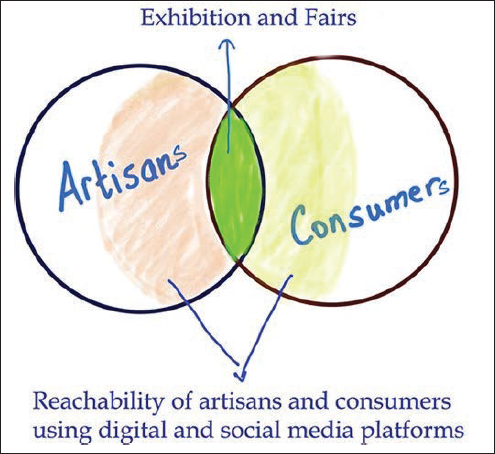
Many industries were hit by the pandemic from textile to automobile due to changes in the lifestyle of the Indian consumers. This led to a huge shift in the selling behaviour of the craft sector as well. Before COVID-19, the artisans were having various platforms to display and sell the craft products through exhibitions, haats and specially designed textile fairs such as Export Promotion Council for Handicrafts, Handloom Export Promotion Council, National Handloom Development Corporation and so on in the metro cities. These were successful platforms for artisans as they also got the opportunity to narrate the stories behind products directly to the customers. Getting feedback on colour stories, fabrics and textures, directly from customers, was a big learning for artisans in exhibitions. Now the impact of COVID-19 on the buying behaviour of consumers has raised many challenges for the craft sector. The COVID-19 pandemic led to consumer buying behaviour to be comparative, easy-going, sourcing from home preferring a comfortable lifestyle. The consumers started exploring different social media platforms looking for new designs and shopping online. The Indian consumer moved from traditional brick-and-mortar stores to online omnichannel marketing systems leading all kinds of entrepreneurs to venture into the digital world.
Literature of Review
Due to the COVID-19 epidemic, businesses are more susceptible to crises. This affected both the corporate sector and the lives of Indians. Local government organisations in India responded right away before the outbreak started. Due to the crisis that resulted in business closures and losses, quarantine measures were put in place to guarantee both the community’s business and its protection (Shinozaki & Rao, 2021).
There have been many studies done by research to analyse the impact of COVID-19 on small-scale industries of India. The study done by Yadav et al. (2020) explained the importance of technology, archived data and online training centres for the benefit of the craft sector in India. The study talked about the impact of COVID-19 pandemic on handmade carpets and Shazar stones.
For product positioning in the market, appropriate media is required. An effective and appropriate media can make a positive impact on the consumer and boost the sale of the product and services. Social media, such as Facebook, Twitter (now X), Instagram, WhatsApp and so on, is one among the many which is used to promote a product effectively. Few of these platforms have networking facilities and instant messaging services (Correa et al., 2010).
In principle, digital communication channels are a mode of communication that allows people to interact with one another through the use of information technology-enabled platforms like Facebook, Instagram and Twitter (Singh et al, 2022). This is a platform where a buyer and a seller can connect, send and receive messages regarding any product or service. The use of such a platform requires smartphones, a technology-savvy approach and a good internet connection.
Ghosal and Prasad (2019) elaborated that due to the increase in digitisation and advancement in technology, online platforms are suitable for the enhancement of the craft sector. The online platform provides higher customer reach and awareness about the traditional crafts, better time management with more marketing flexibility (as it saves time in running from one place to another) and better wages to the artisans leading to the strengthening of the rural economy and boosting artisans’ motivation.
Drummond et al. (2018) stated that social media platforms and their usage are rapidly expanding, especially among varied business owners and artisans (Arsa & Widiastini, 2018). There has been research about how and why artists operate social media platforms (Holdgaard & Klastrup, 2014; Klawitter & Hargittai, 2020; Salo et al., 2013; Wright & Rubin, 2017). Using social platforms, artisans must gain knowledge about how to use and gain profit from their regular social media activities. There are many things to learn by an artisan while using social and digital platforms which includes how to use various social media platforms to create marketing strategy in sync with social media, way of interaction with their audience, how to broad base target customer and increase customer loyalty and retention, how to increase their proficiency with using various pertinent programmes and software, among many other things (Dana & Salamzadeh, 2021).
Chanderi Cluster
One of the oldest economic groups in the communities that exist today in diverse nations is the artist community. (Chappe & Lawson Jaramillo, 2020). Emerging economies are paying more attention to art-based potential business owners and are making efforts to support them through initiatives like training, financial support, hosting regional and international exhibits and the like. There is evidence of these actions in many different nations. For instance, innovations done in Russia or India, where artisans are included as key players in their programmes (Bettiol et al., 2018; McCarthy et al., 2014). Enhancing the market opportunities for artisans in India (Singh-Nagpal & Sebastian, 2021), providing better support in terms of raw materials in Latin America (Horwitz, 2013; Guerrero & Santamaría-Velasco, 2020; West et al., 2008) and providing education to the artisans for their success (Nelson et al., 2016) are some of the key examples of the efforts taken for the artisans in the emerging countries.
This study is done on Chanderi weaving cluster from Chanderi town of Madhya Pradesh. In Ashoknagar District (Madhya Pradesh), the town of Chanderi is a significant historical location. To the southwest of the Betwa River, hills surround it. The town of Chanderi is ideally situated on the boundary between Malwa and Bundelkhand.
Chanderi silk is made using a traditional hand-weaving technique that has been practised in Madhya Pradesh (India) since the 13th century. The sarees made for Indian nobles and monarchy were particularly popular due to this fabric’s breezy feel, lightweight and elaborate embroidery. Chanderi is renowned for its sheerness and clarity. This cluster has been weaving the Chanderi fabrics and sarees from generation to generation. The fabric is made up of cotton and silk yarns and is woven on handloom with simple to intricate borders.
Hand spun cotton warps and wefts were originally used to weave Chanderi sarees. It was spun as fine as 300 counts. Chanderi weavers found Japanese silk after the Industrial Revolution in the 1930s and started using it as a warp substitute in cotton Chanderi sarees. There are studies which have talked about Chanderi cluster’s movement towards digital and social platforms for the betterment of the cluster.
Research Gap
The artisans practising Indian traditional crafts are residing in small villages or suburbs of big cities. COVID-19 brought complete stagnation to the artisan’s communities as the physical opportunities went to nil during the complete lockdown in the country. However, with social distancing, came digital closeness, everything from information to marketing was available to all with just one click of a button. The advancement of technology and the introduction of smartphones in each and every house of India has opened a new shopping platform for consumers. There is immense research on the organised sector of the Indian industry; however, there is an empirical research on the impact of digital media on Chanderi cluster.
This paper focuses on the use of digital media as a platform for artisans to expand their marketing reachability and a new method of shopping for consumers by sitting in their houses. The study also addresses the difficulties encountered by the artisans regarding this shift. The article shows how digital platforms created awareness among artisans and also became a common platform for craftsmen and consumers to connect together. Based on the above details and changing scenario, the use of digital platforms was not only undertaken by the consumers during the pandemic hit but also experimented and explored by the artisans. This article specifically taps the influence on Chanderi clusters and their interaction using digital platforms as an impact due to COVID-19.
Objectives
To document the impact of COVID-19 on the artisans of Chanderi cluster through the available resources.
To study the role of digital platforms/mediums for artisans in terms of their product development and marketing.
To comprehend the influence of digital media in enhancement of their knowledge and skill.
To draw the advantages and disadvantages of social digital platforms for the artisan.
Methodology
Data Gathering Procedure
The researchers employed a mixed-methods approach in data collection, using both primary and secondary sources.
For primary data collection, the researchers used interview guides to conduct interviews with artisans in the Chanderi cluster. These interviews provided firsthand insights into the impact of COVID-19 on artisans’ lives and work. The responses obtained from the artisans were then organised and analysed using software which could include qualitative analysis software or spreadsheet programs for data management and analysis. The use of interview guides ensured that relevant questions were asked consistently to all participants, allowing for a standardised approach in data collection. This helps in ensuring data reliability and comparability between different artisans.
In addition to primary data, the researchers also gathered secondary testament from online published scholarly papers, journals and academic archives. These secondary sources provided additional context and insights into the strategies employed by artisans during the COVID-19 pandemic. By reviewing existing literature, the researchers could identify common themes, best practices and innovative approaches adopted by artisans in similar contexts.
By combining primary data collected through interviews and secondary evidence from scholarly sources, the researchers obtained a comprehensive understanding of the impact of COVID-19 on artisans in the Chanderi cluster and the strategies employed by them during the pandemic. This mixed-method application resulted in the possibility of data triangulation from varied sources, enhancing the validity and reliability of the study findings.
Sample Design
The paper followed a mixed method for research design, having both qualitative and quantitative research methodology for gaining in depth knowledge about the artisan’s experience and involvement in using digital media for their craft.
The quantitative research method with a purposive sampling technique was adopted. A Snowball sampling technique was used to reach the artisans. A sample size of 30 artisans from the Chanderi weaving cluster was taken practising Indian traditional craft. The artisans were selected based on their experience of the weaving profession in the cluster from minimum 2 years to more than 25 years of experience to measure the involvement of these artisans on social platforms across the width of experienced and budding weavers.
Research Instrument
An interview guide was administered in their local language for getting the response and data collection through telephone from the shortlisted sample of artisans. The interview guide had open-ended questions for the artisans for mapping their experience quotient.
The utilisation of statistical means and equations in analysing the rationale, purposes, and exit approach of artisans is a common approach in research studies. These methods allow researchers to draw conclusions based on data analysis. In this particular study, the researchers employed descriptive statistics, specifically frequency count and percentage distribution, to analyse the collected data.
Frequency count is a statistical technique that involves tallying the number of occurrences of specific variables or categories within a dataset. By counting the frequency of certain responses or behaviours, researchers can identify patterns and trends. This technique helps provide a quantitative understanding of the data.
Percentage distribution, on the other hand, involves calculating the proportion or percentage of each category or response within the dataset. It allows researchers to determine the relative importance or prevalence of different variables. This method helps provide a comprehensive overview of the distribution of data and can aid in comparing different categories or groups.
In addition to these statistical techniques, the researchers also mentioned the use of content analysis for data analysis. Content analysis is a qualitative design implied to analyse textual or visual data. It involves systematically categorising and interpreting the content of the data to identify recurring themes, patterns or meanings. By employing content analysis, an in-depth comprehension for the scholars of qualitative aspects of the data, such as the reasons and causes behind certain behaviours or decisions are analysed.
By combining descriptive statistics and content analysis, the researchers in this study were able to analyse both the quantitative and qualitative aspects of the data, allowing for a comprehensive examination of the rationale, purposes and exit approach of artisans.
Ethical Consideration
The study was done with proper ethical practices. Permission from the respondents was acquired for their participation before administering the interview guide. Confidentiality and anonymity were maintained throughout the research process. It ensured that there was no social, physical or emotional harm done to anyone during the study.
Results and Discussions
The artists were chosen based on their years of expertise, accolades and participation in the local market. In terms of shifting selling patterns and a significant impact on COVID-19, the interactions with artists during interview schedules revealed a range of results. According to data, 25% of the weavers who were contacted had experience spanning more than 15 years while the remaining weavers had been engaged in traditional weaving for at least 10 years. Most artists learned their trade from their dads and grandfathers, continuing a long-standing family tradition.
Influence of COVID-19
New Gram Desk published on 2 June 2020 states,
In tough times, it is difficult for weavers to sell their products and sustain their craft during these difficult times. Showcasing their work online can be immensely helpful. One needs to understand that the lockdown has had a severe impact on artisans as it has severely affected their sales and production.
There were many platforms like WeaverStory and many more were developed for artisans when they were badly affected during the lockdown. These platforms gave wavers opportunities to sell their products and earn their livelihood. Nishant Malhotra, WeaverStory Co-founder, stated in one of his interviews that the weavers are given separate spaces to display their products for the first time when they are introduced on their platform.
Digital Empowerment Foundation (DEF) COVID-19 ground report also stated that the Chanderi cluster is facing concerns of drowning business and less demand leading to the shutting down of many looms and increase in unemployment.
Weavers work in two formats, either they work with cooperative societies, or they have their own business which they handle independently. Still, quite a large number of weavers work under middlemen or small enterprises. One such Chanderi weaver, Mukesh, shared his views that the demand of Chanderi fabrics and sarees comes more from cities such as Hyderabad and Delhi. The pandemic led to the closure of shops in these cities. Now, after the pandemic, the stores started opening once again; however, the demand for sarees went down drastically. Leading to his financial loss and accumulation of sarees worth ₹1 million in his warehouse.
In this regard, Chanderiyaan’s DEF project has trained weavers to go digital in the Chanderi cluster for enhancing their traditional weaving skills. The master weaver creates the designs using software and transmits copies of them to less experienced or novice craftspeople for production. The change to digital design tools was made possible by the epidemic that caused a hiatus in community meetings. Master artisans started the custom of creating the master copy of the design and sharing it with all working artisans in order to check the transmission of COVID-19 and follow the regulations given by government authorities. So, overall, the project introduced digital platforms to the Chanderi artisans for their ease and benefit after being hit by COVID-19.
Usage of Digital Platform for Marketing
Almost 85% of the sample chosen for the study acknowledged that they use digital media in their craft work, some for inspiration, some for selecting colour schemes and others for selling the finished products on online marketplaces. The data also shows that while the majority of craftsmen only began utilising the digital platform in the last few years, notably following the impact of COVID-19 (Sudalaimuthu, 2007). Chanderiyaan, the Digital Design Resource Centre set up in the Chanderi cluster by DEF in collaboration with the Ministry of Communication and Information Technology resulted in the creation of a digital repository containing more than 20,000 designs, which served as a resource for all the regional weavers involved in the creation of the design libraries.
The findings also reveal a trend in how craftsmen develop digital skills: whereas 30% of weavers learned how to utilise digital platforms via their children and friends, 70% of them did so on their own through experimentation and learning from errors. More than 80% of the sample agreed to use digital media to market and sell their goods with WhatsApp and Instagram pages being the most widely used. Facebook takes second place among options for weavers. The result was in concurrence with the statement, ‘I have personally collected video narratives of all these youths about how they fought COVID-19 and the pandemic lockdown and used digital tools to continue their traditional business of weaving’ Muzzafar Ansari.
Impact of Digital Software on Designing of Products
The research findings indicate that a significant portion, 40%, of weavers in the Chanderi cluster utilise internet channels to gain awareness of market trends and patterns. This suggests that these weavers are leveraging digital platforms to stay informed about current market demands, consumer preferences and emerging design trends. By utilising online resources, the weavers can adapt their designs and production processes to align with market needs.
Furthermore, the research highlights that some artists are using digital software, such as Paint and CorelDRAW, to design motifs, patterns and layouts for sarees and dupattas. This utilisation of digital tools allows for more efficient and streamlined design processes compared to manual designing methods. The use of computer systems accelerates the overall design process, enabling weavers to create designs more quickly and effectively. By utilising online resources, the weavers can adapt their designs and production processes to align with market needs which is represented in Figure 1.
Chanderi Artisans and Their Digital Resources.
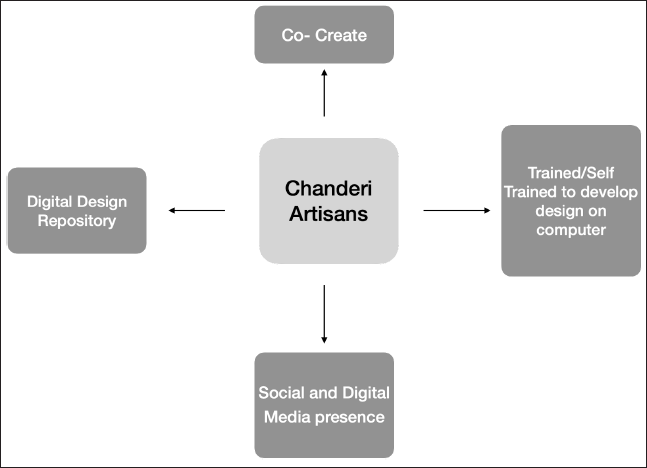
The findings also emphasise the use of social and digital platforms for mapping trends and market dynamics. This aligns with the study conducted by Dana and Salamzadeh (2021), indicating consistency with previous research. By utilising social media platforms and other digital channels, artisans can gather information on market trends, consumer preferences and competitors’ activities. This knowledge helps them make informed decisions regarding product development, marketing strategies and identifying potential market opportunities.
The weavers’ consensus regarding the advantages of digital media designing over manual designing further supports the idea that digital tools enhance efficiency and simplicity. The use of computer systems speeds up the design process and streamlines the overall workflow, enabling weavers to produce designs more effectively.
Overall, the research findings suggest that the adoption of digital tools, internet channels and social media platforms among weavers in the Chanderi cluster has positively impacted their ability to stay updated with market trends, create designs efficiently and make informed business decisions.
Content Writing and Photographs
Craftspeople have a variety of attitudes about photography and content writing about their items on online platforms. Many weavers learned how to write about their products and what to write by listening to their family, friends and co-workers. Weavers have learnt how to describe their sarees on online platforms as they are well versed with the designs, raw materials and techniques used.
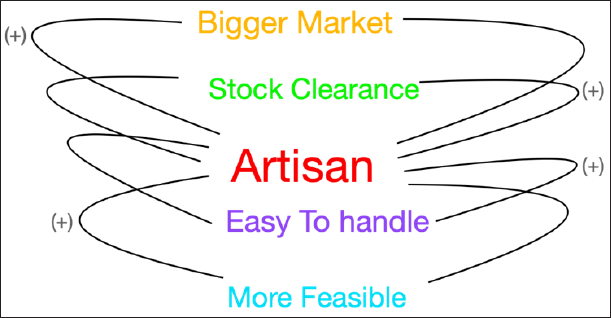
However, almost all the weavers were not well versed with photography skills, they still cannot click good images of their products. Few statements were like ‘As it is my traditional craft and work, so I know what to tell about the sarees’. Absolutely! Stories have a significant impact on building a direct connection between artisans and consumers. When artisans share the stories behind their products, it adds a layer of meaning and heritage that goes beyond the material value. Consumers value the product not only for its physical attributes but also for the cultural, historical and artistic significance embedded in the narrative. The Benefits of Using Digital Platforms for the Chanderi Cluster Weaver is well illustrated in Figure 2 alongwith the interaction of artisans and consumers as illustrated in Figure 3.
The Benefits of Using Digital Platforms for the Chanderi Cluster Weaver.
The Increase in the Reachability of the Artisans to the Consumers and Vice Versa Using the Social and Digital Platforms.
By communicating the stories behind their craft, artisans evoke emotions and create a sense of authenticity and uniqueness. Consumers feel a personal connection to the artisans and their cultural heritage, which can instil a sense of pride in owning such products. This emotional connection and sense of pride often lead consumers to place a higher value on the product, both from an emotional and monetary perspective.
Through storytelling, artisans can convey the rich history, traditional techniques and cultural significance associated with their craft. This storytelling approach helps consumers appreciate the craftsmanship, skills and dedication involved in creating the product. It enhances the perceived value of the product, making it more than just a commodity but a cherished piece of heritage. Furthermore, stories create a narrative around the product, making it more memorable and compelling to consumers. People are often drawn to products with narratives that resonate with their values, aspirations or personal stories. By sharing their own stories, artisans can capture the attention and interest of consumers who seek meaningful and authentic experiences through their purchases.
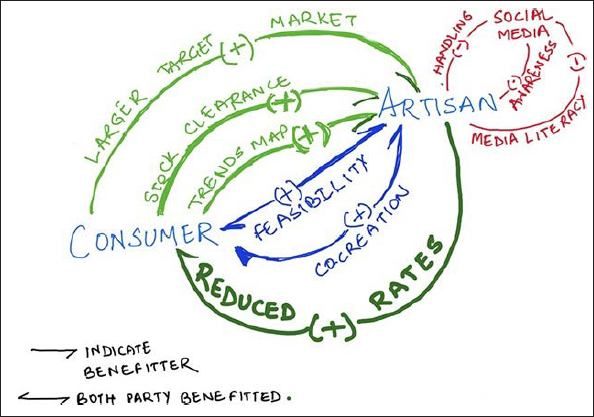
Overall, storytelling plays a crucial role in enhancing the value and desirability of artisanal products. It establishes a direct connection between artisans and consumers, creates a sense of pride and heritage and elevates the product’s worth beyond its material attributes. Diagrammatic representation of benefiters and scope of further imrovements have been described in Figure 4 for better understanding.
Diagrammatic Representation of Benefiters and Scope of Further Improvements.
Benefits of Digital Media for Weavers
The statement received a variety of enthusiastic responses. The majority of the weavers concurred that using digital media is an easy and quick way to accomplish goals in marketing or design. The following are some of the weavers’ comments:
‘It makes the work easier and more profitable with less trouble and is less time’ [Kam mahnet aur kam samay me jyada ka munafa ho jata hai].
‘There is less hustle on digital platforms [bhaga dori kaam hoti hai]’.
Among the 87% of weavers who felt that marketing is successful using digital platforms, one weaver said, ‘Online platforms are good since it is bustle free and all the work can be done from home’.
In reference to marketing, 4% weavers complained about not being able to do sales online while they still prefer the old traditional method of selling products physically in shops, haats and Melas.
As per one of the weavers, ‘Although it is less time consuming digitally, I prefer to do it in person. There is less risk in physical business as you get the money instantly. As I am the sole earning person in my family, I don’t want to take any risk’.
Dana and Salamzadeh (2021) study also supported the above result by stating that the artisans use social media platforms to show their creativity, improve their social presence, co-create and sell their products hassle-free.
The artists began communicating with potential customers via digital platforms such as WhatsApp, emails and Instagram to share images of the goods they had created. They were presented on these sites by their offspring or another known individual even if they did not have their own profiles. A father wanted to introduce his son to the internet world and educate him how to sell sarees outside Chanderi city. About 2%–3% of weavers did not use online platforms for selling their wares since they were unsure about sales on these platforms. The use of social and digital media platforms for increasing the business and creating brand image by the artisans has also been practised in India earlier (Singh-Nagpal & Sebastian, 2021), being hassle-free and less compelling like running a company (Dana & Salamzadeh, 2021).
As stated in Dana and Salamzadeh (2021) study, communication with their followers is another reason why artists and creative entrepreneurs use social media. This would enable them to hear from and consult with them regarding the crucial concerns for prospective buyers. Such communications could be automatic or manual since numerous pieces of software could make them possible. A huge percentage of Chanderi artisans said that connecting the customers digitally also gives them a chance to know the preferences in colours and designs. Sometimes customers ask for some colours, have choices of borders, design and colours, patterns which gives them an idea of today’s markets and customers’ mind. Also, it opens up a new direction to work in future. There was a two-way quick The flow of information through these digital platforms. They got into the mode of understanding design and product requirements defined by the clients as the directions were provided to them in the form of digital files by the clients. A remarkable inclination towards the usage of technology in order to receive quick responses was observed in artisans. Earlier artisans were not comfortable using these digital platforms before COVID-19 hit. The situation of complete lockdown led to an increase in the usage of technology as stated in (Drummond et al., 2018), thus ignorance and lethargy towards using digital devices were reduced.
Conclusion
The technology somehow bridged the gap in the thought process of the elderly traditional artisans and their younger generations with a contemporary mindset. The elderly artisans started learning basic tools and technology from their younger generations, understanding the market scenario. The younger artisans with a participatory approach got involved with traditional practices with a sense of worth and contribution from their end with a contemporary skill set. By getting exposure through social media, some of the artisans got into new design and product development based on the trends and celebrity influences. Unknowingly they got into the mode of documenting their designs and products to have a data bank which can be presented to a prospective client.
Overall, through digital and social media platforms, the cluster was exposed to new styles, fashions and consumers. Consumers’ immediate feedback on their approach and designs provided them with information on what to do and how to improve the viability of their products. A new connection between the consumer and the artisans was established by the digital platform, which preserved craft and artisanship.
The practice of using digital platforms led to design and product development in desired quantities rather than stocking them as per the tentative probability of getting selected by the customers. They also marketed their old stocks through the digital platforms in reduced price range by applying self-taught marketing strategies.
Moving ahead in this direction can pave the path for more expansion for the artisans and their craft which can lead to innovations in craft for its better future and sustainability as per the new emerging trends by preserving its fundamental and traditional features and USP.
Footnotes
Declaration of Conflict of Interests
The authors declared no potential conflicts of interest with respect to the research, authorship and/or publication of this article.
Funding
The authors received no financial support for the research, authorship and/or publication of this article.