




Abstract
Abstract
Entrepreneurship is an engine for economic development worldwide (Kelley, Singer, & Herrington 2016). For developing economies, the importance of entrepreneurship is associated with increased productivity and reduction in the rising unemployment rates, particularly among the youths. Consequently, several models and support programmes have been designed to facilitate successful entrepreneurial activities amongst youth. The article discusses the business acceleration model of the Global Business Labs (GBL) which is replicated in Botswana, Namibia and Uganda based on a Swedish model, between 2012 and 2015 but failed in Mozambique and Zambia. Using a multiple case study method, this article presents the results of a cross-country case analysis of the GBL programme with a view to understand the emergence of a business accelerator. Despite replication of the programme in respect of concepts, materials and operational systems, the cases reveal variations in operational experiences and acceleration performance across the five countries. Using the emergence theory, the article highlights these differences. The major contribution of the study to theory, in determining how business accelerators come into being, includes the duality of intentions and exchange between key stakeholders and the resource burst as a triggering mechanism in developing countries. The study further informs development of a model for successful business acceleration launch and subsequent performance for developing economies.
Introduction
The importance of entrepreneurship, and mainly new venture creation, is associated with increased productivity and reduction in the rising unemployment rates, particularly among the youths in Sub-Sahara where they are twice likely to be unemployed (Ahaibwe & Mbowa, 2014). Consequently, countries around the globe have committed to promote entrepreneurship at the national levels. Recently, educational institutions have been challenged to take an active role in inculcating the entrepreneurial spirit amongst the youth.
Besides entrepreneurship education programmes, tertiary education providers have started taking a keen interest in exploring models and support programmes that could facilitate successful entrepreneurial activities and start-up of new ventures by students and alumni. Because adequate support to start-up firms is important for commercialisation and economic growth (Komi et al., 2015), the universities involvement in start-up support is critical if they are to play an active and significant role in entrepreneurship promotion. Such support has, over the years, been offered through universities engagement in various business incubation environments (BIEs).
The term BIEs is used loosely to embrace ‘all organizations that support start-up and early stage companies through provision of facilities, mentoring and coaching, training, networking and seed capital financing’ (Mazzarol, 2015). The loose definition of incubation environments is consistent with the National Business Incubation Association (NBIA)’s practice where its membership cuts across business incubators, start-up accelerators, co-working and makerspace or hackerspace entities (Mazzarol, 2015). From this array of forms, the interest of this article deliberates on business start-up accelerators. As a result, the concept of business accelerator is viewed in this article as a type of business incubator whose emphasis is to facilitate speedy development, and commercialisation and exit of start-ups (Bhatli et al., 2015).
The success or lack thereof of BIEs in promoting entrepreneurship abounds in the literature. On one hand, the literature that support the emergence of BIEs suggest that BIEs are a successful and most effective way of promoting entrepreneurship (Adegbite, 2001; Chandra & Chao, 2015; Grimald & Grandi, 2005; Mas-Verdu, Ribeiro-Soriano, & Roig-Tierno, 2015). They provide a wide range of services and professional advice to incubating start-ups for purposes of accelerating their growth. In so doing, they minimise the risks of failure which is associated with start-ups (Dubihlela & Van Schaikwyk, 2014; Grimald & Grandi, 2005; Schwartz, 2013). They nurture new businesses to economic growth (Chandra & Chao, 2015) and facilitate for start-up companies to leave incubation when they are financially independent (Mas-Verdu et al., 2015). They provide professional and resource support and services (Dubihlela & Van Schaikwyk, 2014).
On the other hand, some theorists suggest that BIEs may not be that successful in promoting start-up and growth of new ventures (Lahti, 2014). Recent evidence suggests that whilst BIEs have the objective of developing and accelerating companies to success, some companies have succeeded without the support from business incubation and those that were supported failed to succeed (Mas-Verdu et al., 2015).
Whereas much is known generally about business incubation in developed countries, the phenomenon of business incubation is new in the developing countries (Adegbite, 2001; Chandra & Chao, 2015). Equally indistinct is the role of accelerators in abetting growth of star-ups to success (Bhatli et al., 2015). In addition, there is a great deal of concern about the validity of existing industry research (Amezcua, 2010). Previous research has typically compared differences in performance between incubated and non-incubated firms, rather than differences between individual BIEs and their performance effects (Barbero et al., 2012). This research takes a different approach. Despite a fair amount of research in the area of BIE organisation, management and BIE’s potential effect on the local economy, little or no research have tried to explain how business accelerators come into existence, especially in a Sub-Saharan context.
In this study, we also analyse the efficacy of BIEs with particular reference to business acceleration to close the gap of lack of research on business acceleration from a developing country’s perspective. The article shares the experiences of promotion of entrepreneurship through a business acceleration model. It presents the results of a cross-country case analysis of the Global Business Labs (GBL) programme with a view to highlight the emergence of business accelerators across Botswana, Namibia, Mozambique, Uganda and Zambia as well as differences in acceleration of performance across time.
The article structure is as follows. First, the introduction puts business acceleration within the BIE landscape. Second, the background section presents a background to BIEs in general and specifically the GBL business acceleration model. Third, an objective section provides a purpose for the study. Fourth, a brief review of the literature contextualises the article within the organisational emergence field. Fifth, the methods used for data collection and the framework model are presented. Sixth, the findings are presented and lastly, the results of the study are discussed and conclusions thereof drawn.
Background to the Business Incubation Environments
The business incubation concept has been around for over 50 decades. Following closure of the 850,000 square feet Massey Fergusson manufacturing plant building in Batavia (New York), Joseph Mancuso bought the building with a view to lease it out to a big tenant (Adkins, 2009; Aerts, Matthyssens, & Vandenbempt, 2007; Hackett & Dilts, 2004; Phipps, 2002). However, failure to find a big tenant presented him with the opportunity to find multiple small tenants for the building thus resulting in the Batavia Industrial Centre (Aerts et al., 2007; Phipps, 2002; Stevens, 2004).
The Batavia Industrial Centre became the first business incubation model (Aerts et al., 2007; Hackett & Dilts, 2004; Stevens, 2004). The model has since evolved from management of workshops and industrial estates, to provision of work spaces and business centres (Centre for Strategy and Evaluation Services, 2002; Colombo & Delmastro, 2002). Similarly, the forms of business incubation have evolved over time from multipurpose, to specialised, technology incubators, incubators without walls and sector-specific incubators (Centre for Strategy and Evaluation Services, 2002; Colombo & Delmastro, 2002), and business acceleration (Bhatli et al., 2015; Mazzarol, 2015). To date, BIE has become one of the most widely diffused forms of entrepreneurial support (Knopp, 2012). The large and expanding number of BIEs worldwide reflects a strong prevailing belief in their positive effects.
In short, an incubator is physically locating your business in one central work space with many other start-up companies. In many cases, the start-ups in these incubators can all be venture funded by the same investor group. There is sometimes a time limit but often not. The mentorship is typically provided by proven entrepreneurial investors, and by shared learnings of other start-up CEO peers (Dempwolf, Auer, & D’Ippolito, 2014).
A start-up accelerator is very similar but has some distinct differences. The time in the space is typically limited to a 3–12 month period, basically intended to jump-start a business and then kick them out of the nest. The idea is that the time in the accelerator should largely improve the chances of raising venture capital from a third party entity on the back end, after graduating from the programme. Mentorship could be coming from 100 entrepreneurs that are affiliated with the accelerator (many of which are proven CEOs, or investors looking for their next opportunity or simply helping the local start-up community).
In addition, current research reviews indicate a strong belief in the validity of the business incubation/acceleration concept through research done mostly on American incubators, and through either looking at established processes, stakeholders, networks, or trying to measuring success through output such as growth of incubator companies after graduating and so on. Limited amount of research is devoted to other cultural contexts such as developing countries and to the actual start-up process of an accelerator. Our aim in this study is therefore to investigate how three business accelerators came into existence in three different developing or semi-developed countries Botswana, Namibia and Uganda and why the same could not happen in both Mozambique and Zambia.
Objectives
The purpose of this article is to share the experiences of promoting entrepreneurship, within university environments, through a business acceleration model. The article highlights the salient factors that influence the start of business accelerators in developing countries and factors that could influence the adoption of entrepreneurship development programmes from developed countries to developing economies. In addition, it highlights the antecedents for successful business acceleration. Furthermore, the article seeks to explain differences in acceleration performance across Botswana, Namibia and Uganda. The study is expected to develop a model for successful business acceleration and as such inform business acceleration practice. First, we provide a brief literature review to provide an understanding of business acceleration.
Literature Review
The Concept of Business Acceleration
The question of whether business accelerators are incubators is an ongoing debate (van Huijgevoort, 2012). Traditionally, research has divided business incubators into four types: with walls, without walls (also called virtual incubators), international incubators and accelerators. This typology distinguishes between business incubation models, even though research has yet to provide a clear definition of an accelerator or international business incubator or to provide any empirical evaluation of these two models (Lewis, Harper-Anderson, & Molnar, 2011). Answering this question enables us to validate the GBL model. Hence, we start by placing business acceleration within the BIEs. First, we examine the concepts of business incubation and business acceleration. Then, we highlight the difference between a business incubator and a business accelerator.
Countries have now realised that for entrepreneurship to have an impact on the economy, the focus has to move from quantity of start-ups to quality start-ups (Frick, 2016; Fritsch & Schroeter, 2009; Guzman & Stern, 2016). This is due to the contribution that could be made by few innovative fast growth companies in terms of job creation and innovation, as opposed to encouraging creation of many slow growth companies whose contribution to the economy is marginal (Frick, 2016; Guzman & Stern, 2016). Consequently, government programmes all over the world have started programmes to encourage generation of new ventures with high growth potential (Fritsch & Schroeter, 2009). They have engendered favourable conditions to assist start-up and growth of new ventures (Sternberg & Wennekers, 2005; Turner, 1998).
Business incubation has previously been recognised as a tool for local economic development and entrepreneurship (Aernoudt, 2004; Isabelle & Westerlund, 2016). However, the business incubation role has since advanced from local economic development to a national mandate of promoting start-up and growth of new ventures with high growth potential, which could impact on national economic growth (Acs and Stough, 2008; Fritsch & Schroeter, 2009).
Furthermore, BIEs are associated with economic development because they play an entrepreneurial role (Ganamotse, 2013). Ganamotse posits that the entrepreneurial role played by BIEs is that of facilitating resource mobilisation by the resource constrained new ventures that have high growth potential. She argues that incubators enable the entrepreneurs to focus on the entrepreneurial task of identification of opportunities and mobilisation of resources to take up such opportunities to develop and grow their new ventures.
Several authors (Bergek & Norrman, 2008; Hughes, Ireland, & Morgan, 2007; Lofsten & Lindelof, 2001) explain the role of BIEs from the value addition perspective. In their examination of value creation by business incubators, Hughes et al. (2007) conclude that BIEs add value to new ventures. According to them, incubation environments facilitate the new ventures resource-seeking and knowledge-pooling activities through networking and collaboration activities of new ventures within the business incubators. Added to these, Bergek and Norrman (2008) posit that BIEs add value by with the external environment. They mediate for information, knowledge and expertise between incubatees and external factors such as potential customers, partners, employees, university researchers and financiers (Bergek & Norrman, 2008). Furthermore, BIEs add value by enhancing performance of new ventures (Lofsten & Lindelof, 2001). Findings from the Godisa Incubators of South Africa revealed eight key ingredients to successful incubation inclusive of availability of funding, competent and motivated management, and networking (Buys & Mbewana, 2007).
Business incubation is a localised process followed by certain types of organisations (incubators, accelerators and science parks) (Ganamotse, 2013). However, the differences between business accelerators and business incubators are not clear in the literature (Bliemel et al., 2016). Whilst several studies view business incubators as growth accelerators (Centre for Strategy and Evaluation Services, 2002; NBIA, n.d.), other studies suggest that there are differences between business accelerators and business incubators (Bhatli et al., 2015; Dempwolf et al., 2014; Bliemel et al., 2016; van Huijgevoort, 2012).
The concept of business incubation has evolved over time and has generally been grouped according to how it developed over time into three generations (Bliemel et al., 2016). According to Bliemel et al., (2016), the first, second and third generation incubators emerged around the 1980s, 1990s and early 2000s respectively. Business acceleration programmes have been placed within the third generation of business incubators (Isabelle and Westerlund, 2016; Regmi, Ahmed, & Quinn, 2015; van Huijgevoort, 2012). Third generation business incubators, which emerged in the late 2000, emphasise access to knowledge and resources through networks and internal cooperation amongst the firms within the business accelerator (Bliemel & Flores, 2015; Bliemel et al., 2016). This, according to Bliemel et al. (2016), is in contrast to the first generation business incubators, which emphasise real assets and second generation incubators, which emphasise on technology businesses, respectively. Business accelerators are more profit seeking in nature (Isabelle & Westerlund, 2016).
The idea behind business acceleration is to enable the new ventures to grow quickly. Business accelerators do not nurture but support and inject resources to new ventures that have high growth potential (Hannon, 2004). Thus, the key features that define a business accelerator are take-up of equity, emphasis on teams, defined short periods within which the companies could stay in the programme, provision of intensive coaching and business advisory services, competitive application process, access to potential investors and the requisite networks as well as work space (van Huijgevoort, 2012). Such inputs determine the extent to which new ventures could develop and grow (Ganamotse, 2013).
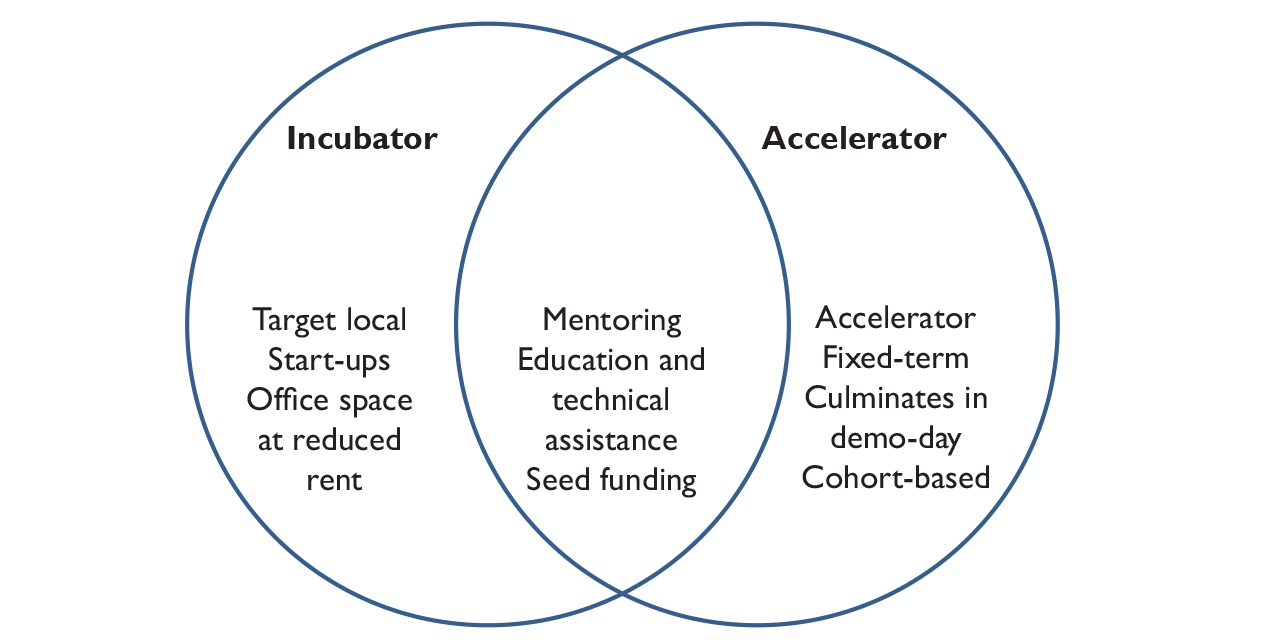
Several other authors, for instance, (Bhatli et al., 2015; Bliemel & Flores, 2015; Bliemel et al., 2016; Fishback et al., 2007; Hoffman & Radojevich-Kelley, 2012; Isabelle & Westerlund, 2016) highlight the similarities and differences between business incubators and business accelerators. Whilst most incubators are not-for-profit organisations which do not invest in start-ups but charge a nominal fee for services, business accelerators are mainly for profit organisations which take equity stake in start-up companies. Incubators provide start-ups with office space and target local start-ups whilst accelerators provide much more than space. These are succinctly summarised in Figure 1 below.
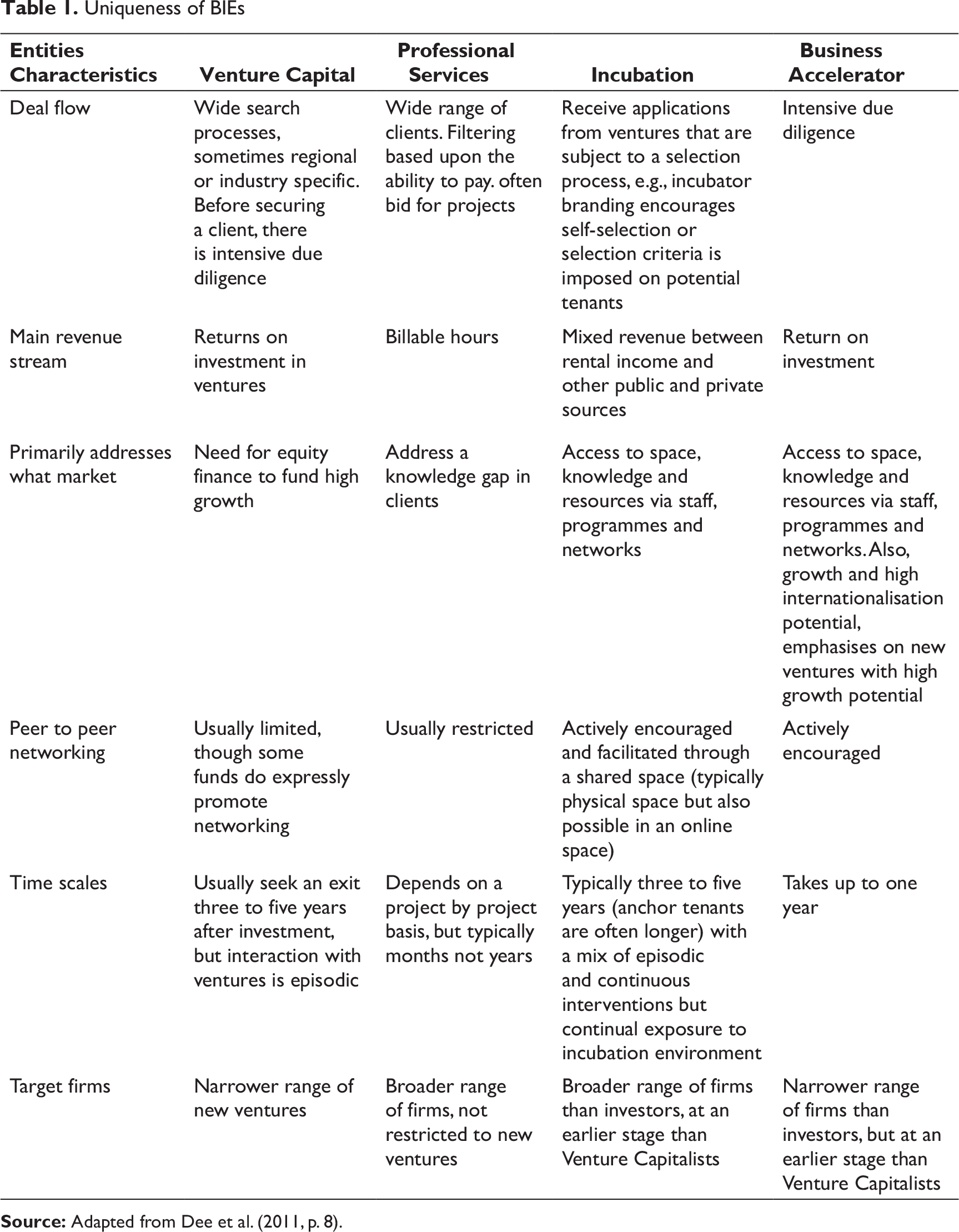
Uniqueness of BIEs
The Theory of Emergence
Despite extensive literature on established incubators/accelerators, little or no research is found that explains how new incubators come into existence and how they develop across time. For us to understand this, we use an analogy from entrepreneurship research – the notion of “emergence”. Emergence provides theoretical underpinning for entrepreneurship (Fuller et al., 2008; Litchtensteiln, 2016). It has been employed to study entrepreneurship from different contexts such as bricolage, legitimizing behavior and trust building, the role of identity creation for entrepreneurship, effectuation and causation mechanisms, and opportunity recognition (Fuller et al., 2008: 4-5). Particularly, the concept of emergence facilitates an understanding of how new ventures are created (Litchtensteiln, 2016).
Emergence can be defined as the “process that generates an outcome” – an “emergent order’ which could either be in the form of an organization, a new venture, a new company or system/innovation (Litchtensteiln, 2016). We apply this concept to explain emergence of business accelerators in emerging economies. This is due to the fact that the concept of emergence can be used to capture how novel structures come into being and new order is created and as such a powerful concept for the complexity theory (Fuller et al., 2007; Goldstein, 1999).
Complexity theory has previously been employed to explain entrepreneurship because of the multiple dimensions from which the phenomenon of entrepreneurship could be understood (Cohen and Munoz, 2015; Fuller and Warren, 2006; Fuller et al., 2008; Fuller et al., 2007). Venture creation or rather emergence, (Gartner, 1993; Lichtenstein et al., 2006), is in itself a complex process (Lichtenstein et al., 2006).
The complexity theory can better explain notion of emergence because “emergence produces an outcome which behaves differently from the sum of its parts” (Fuller et al., 2008: 3). Because emergence produces diverse emergent outcomes, it increases the capacity of the system, thus enabling agents to interact and adapt to new order of successful entrepreneurial outcomes (Litchtensteiln, 2016). However, there is lack of evidence on the use of the complexity theory to examine emergence in the business acceleration context. We use the complexity theory as a tool to understand emergence of business accelerators using the multiple case studies.
There is presently paucity of research on how business accelerators emerge. Notwithstanding, there is ample guidance on the essential elements for starting a business incubator at an international level, for instance from the UKBI (Read and Pieters, 2002) and NBIA. At the developing country level, the World Bank provides support for development of incubators in developing countries through Infodev. However, there is no guidance on how to start a business accelerator, particularly for developing countries. This is in spite of the now compelling evidence with regards to differences between business accelerators and business incubators. This led us to the following overall research questions:
How do new business accelerators come into existence? What factors influence the business accelerator start-up process in developing countries, and especially in Africa? Do these factors influence subsequent business acceleration performance?
Methodology
Selection of Cases
The five case countries were selected on the basis that they were earmarked to start acceleration programmes at the same time, using the same processes. Also, the five countries have similar characteristics in terms of economic development. The three developing countries are faced with high unemployment and to some extent the high levels of poverty among low income groups.
Research Design
Due to the above mentioned scarcity of research, we chose an explorative research design in the form of a cross-case study, based on the collection of in-depth data from persons involved in the process from inception across time. This is considered an appropriate method for research of start-up processes of business accelerators, given the need of producing novel insights, which is difficult to achieve via the more commonly used quantitative approaches (Politis, 2008). More specifically, the case-study approach is considered appropriate when addressing ‘why’ and ‘how’ questions (Yin, 2003), and facilitates analysis when patterns are sought (Patton, 2002). Accordingly, we secured access to three cases and conducted a review of meeting documents, process documents, internal reviews and reports as well as the researchers, own experience from the process. Reports to donors and GBL and company records were reviewed. These were supported by accounts made by the GBL country managers and coaches from the three countries with a view to provide a better understanding of the implementation and performance of GBL across the three countries. Given the exploratory nature of the study, cases with certain similarities but also with a degree of variation were selected, enabling a broad analysis and the possibility of identifying themes and patterns (Eisenhardt, 1989; Yin, 2003).
The total amount of empirical material gathered was substantial, and consequently, the process of analysing it was of vital importance. The first step in the process of analysing the material, including the extensive contextual data, was to develop a country-specific file with information about GBL in each country. It includes all written materials and process description. Each country manager and one business developer was then involved in the process of identifying critical incidents in the process. These we then summarised into propositions and compared across the three countries.
Each project was coded by the local researcher and one international researcher working independently to allow for different interpretations. Each researcher looked for patterns (Patton, 2002), first within and then across cases. In the next step, identified patterns were discussed in workshops attended by all four researchers, and the cross-case analysis was carried out (see Chetty, 1996). Using graphical representations of different themes, we searched for potential links between our themes (e.g., Miles & Huberman, 1994). Throughout the process, there were extensive iterations between the analysis of the empirical findings and the existing literature.
Case Studies
Introduction to the Case of Global Business Labs
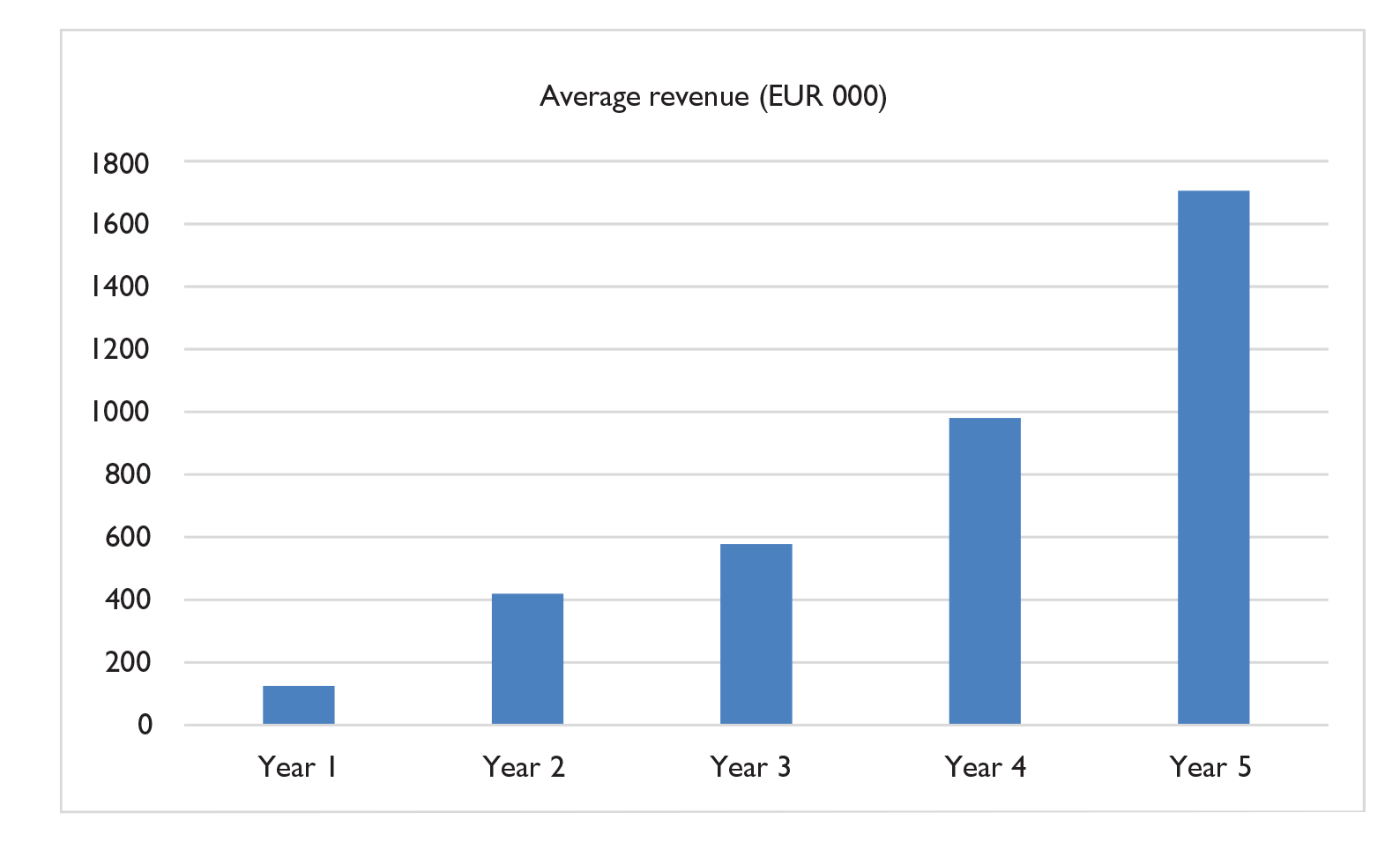
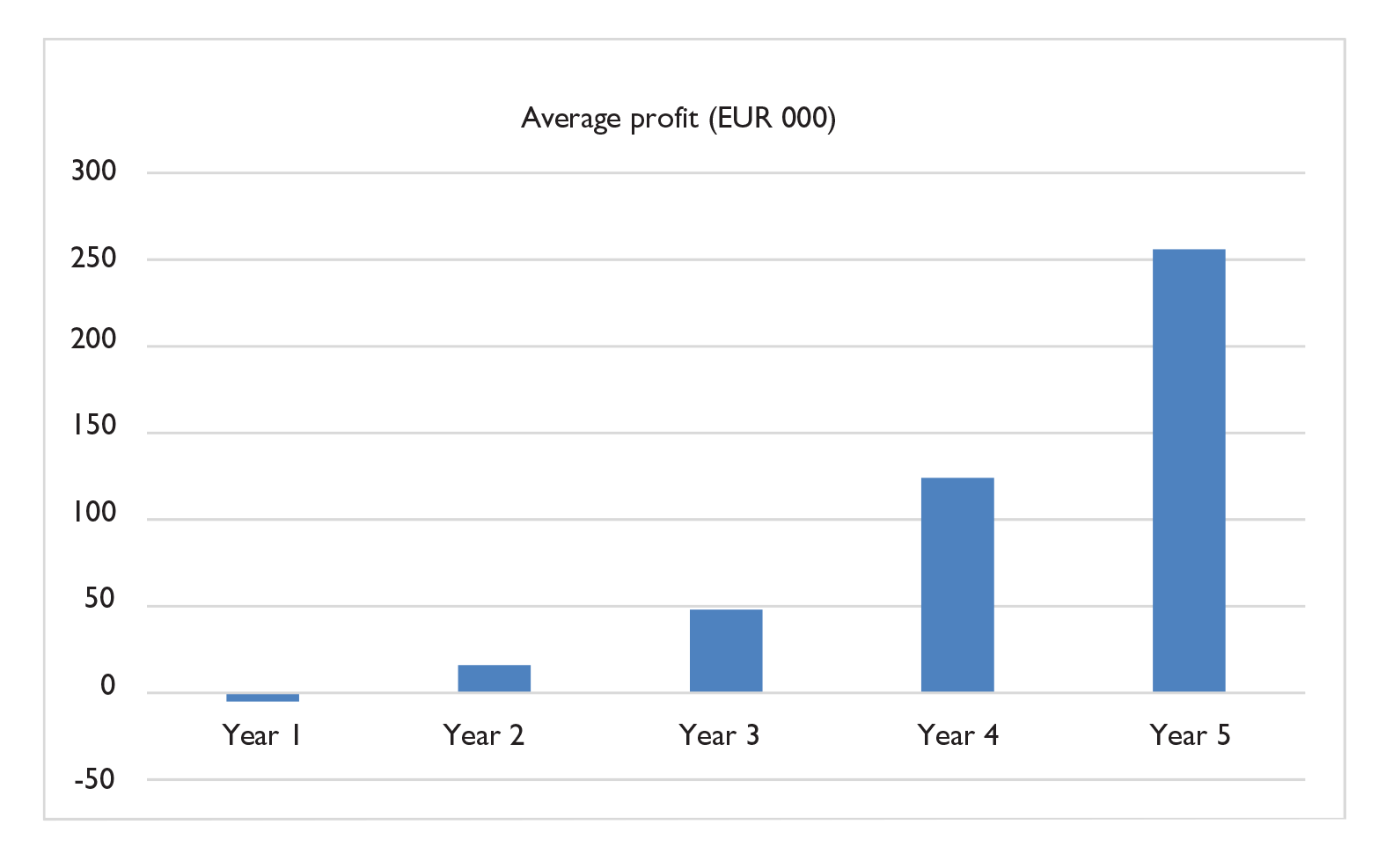
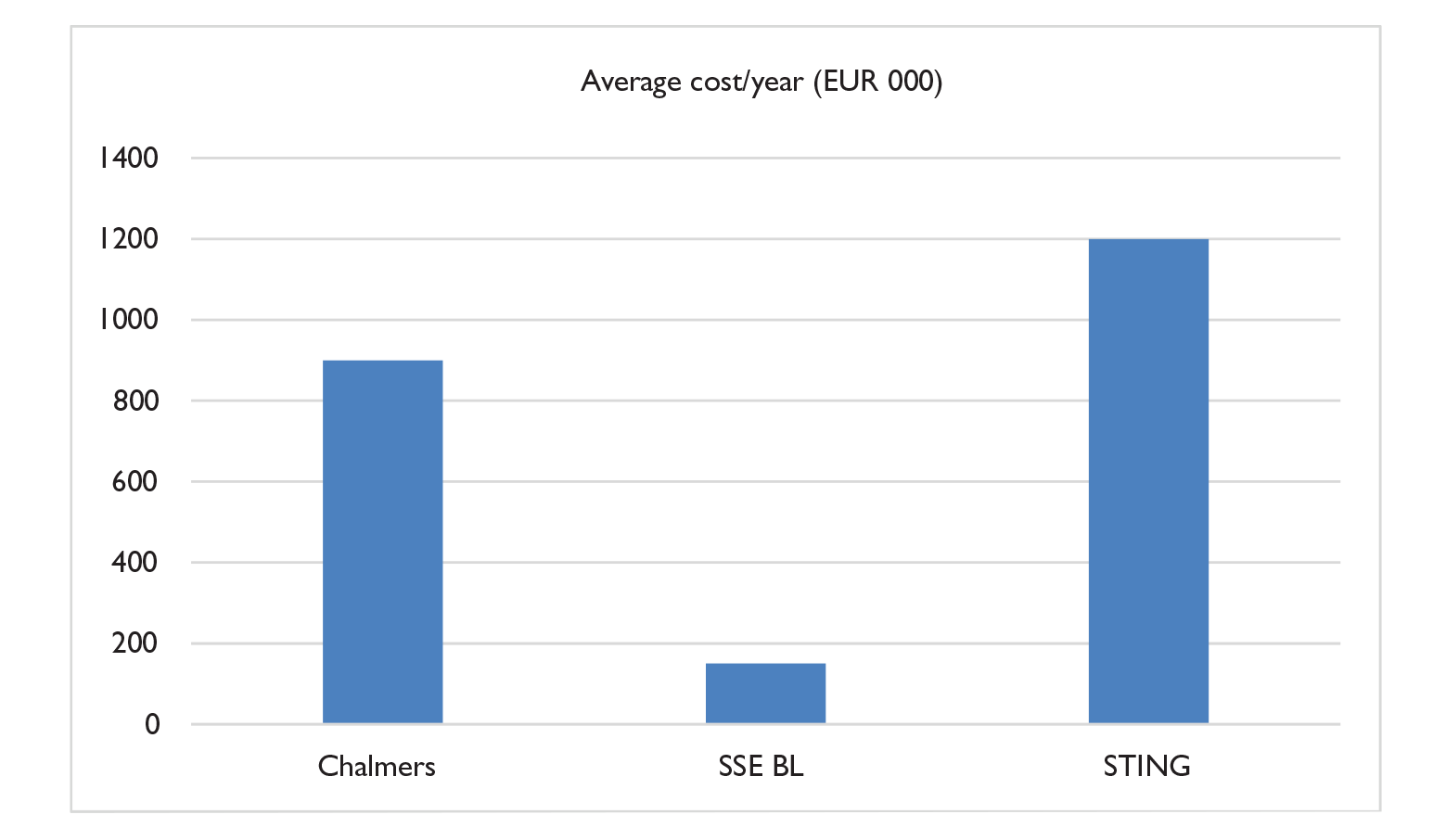
The intention to start GBL originated from a phone call to the founder of GBL in the early spring of 2011. A former student to the founder worked for the Swedish Trade Council in Botswana and was arranging an ICT conference. The founder was asked to participate in the conference and to bring a couple of ICT start-ups to Botswana. The founder at this time was responsible for Stockholm School of Economics Business Lab (SSEBL) which was fairly successful considering survival and growth in their start-ups over a five-year period especially in comparison to other Swedish Incubators as shown in the graphs below (Figures 2-4). This was also the essence of the presentation together with potential benefits for the university, aspiring entrepreneurs, faculty and the local economy which were considered critical stakeholders to the model. The idea with the business lab is that each stakeholder will both own the concept and benefit from it. Modelled as an NGO, the aim of the GBL is to grow and provide structure and learn. The university benefits through dividends from the projects, international faculty development, creating jobs for students and increasing the participation in the local economy. Partners, who provide pro bono business services to lab companies, would have better access to potential employees and also educate potential clients in the business lab on their processes and products. Aspiring entrepreneurs will benefit through space, network, knowledge and resources.
Background to the Country Cases
The local labs, located in University of Botswana, University of Namibia and Makerere University in Botswana, Namibia and Uganda, respectively, were established under the umbrella of Global Business Labs International (GBLI). As could be seen in the findings below, attempts to open labs in Mozambique and Zambia were not successful. Particularly, the labs are located within a faculty of business or a business school in the respective universities. It was anticipated that business schools would have a pool of potential lab candidates who understand business concepts and therefore are better able to identify business opportunities.
The GBL project seeks to create a global network of business labs where companies can efficiently enter several different markets simultaneously at low costs. The idea was to help innovative, high growth potential new ventures (not necessarily high-tech) to grow quickly both locally and internationally. Such companies are expected to contribute to poverty reduction through the creation of jobs and wealth.
GBL is a lab, which accords budding entrepreneurs a place for experimentation and testing of ideas. Thus, entrepreneurs are not penalised for failure. Rather, they are encouraged to identify and solve customers’ problems and continuously generate sales with a view to meet their milestones and achieve results. Failure to solve customer problems and find alternative ways of doing things could result with discontinuation from the acceleration process. GBL facilitates the entrepreneurial process through provision of business coaching, business advisory services and conducive working environment for the new companies accepted into the lab.
The GBL model is anchored on four pillars: proximity to academic institutions, competitive selection, business focus and self-sustainability. Proximity to academic institutions provides the GBL with a deal flow of applicants comprising students and staff as well as access to expertise and experience from academic staff. The universities also contribute physical space to labs as well as 10–20 per cent of the time of members of staff who serve in business labs as Business Coaches and Managers, respectively. This partnership has helped to reduce costs of operations for the labs not only by providing space but also by providing access to the Internet and telecommunication services. The universities will benefit in three main ways; First, it will benefit through students creating successful firms, which in turn could not only lead to both economic development in general but also an increase in value for prospective students and potentially also better ranking. Second, the university is part owner of the concept and will receive dividends from successful start-ups. Third, faculty could benefit both in terms of guest lectures from the entrepreneur’s community, but with stories for cases and providing practical training that could also be used in the day-to-day teaching at the university.
The competitive selection process is designed to test the commitment of the entrepreneur at an early stage and focuses more on evaluating the team rather than the business idea. After the GBL is satisfied that the potential lab candidates are ready, the team is brought before a panel made up of multiple stakeholders that include entrepreneurs, financiers and GBL partners among others, to pitch their ideas. This ensures only quality ideas as per the GBL guidelines go through the process and are eventually hosted in the lab. GBL’s model promotes simple businesses that solve everyday problems. The emphasis is mainly on the commitment of the team and their business skills as opposed to the business idea. One of the team members has to have a business education background to enable the companies to overcome simple stumbling blocks that many start-ups face, for example, how to write a business plan, understanding the economics of the business, basic accounting and so on. Also, the lab companies are driven to make sales from the time they enter the lab and consequently reduce time to market and start-up costs. The initial investment required to get the companies up and running is mainly the time and work put in by the entrepreneurs themselves.
Furthermore, GBL seeks to develop self-sustainable companies that could stand on their own throughout the acceleration period and beyond. It is not uncommon for businesses under business acceleration/incubation to become over dependent on the provided support. Other than the infrastructure, coaching and business advisory services, GBL provides very little support to the lab companies ensuring transition when they leave the lab. Because GBL does not handhold the lab companies, but facilitates for the companies to attain fast growth, GBL refers to its operations as business ‘acceleration’ as opposed to ‘incubation’. This philosophy ensures a smooth transition when companies leave the labs.
Findings
The Swedish International Development Cooperation Agency (SIDA) funding for Botswana and Namibia covered 18 months of the start-up process, while Uganda was funded for three years. So, within three months, a team of three Swedish nationals, one country manager and two business developers, were recruited, trained and deployed to the three countries. The country managers were contracted for a period of one year and the business developers for a period of six months. The idea was to set up the structure, train the local manager and then hand over a functional business lab within a year. All three labs were launched in early 2013 and accepted the first projects into the lab in March 2013. The process leading to this was different in each country and the experiences were equally different across the countries. GBL had nothing at the outset, no routines, no boundaries, no systems, inexperienced management to some extent and our main partner in each country was the major state-owned university.
During the initial six months of operations, each country manager experienced their challenges. These are documented below for each individual country.
The Case of Namibia
The Republic of Namibia is a vast, sparsely populated country with a population of 2,520,189. This comprises 1,252,450 (49.7%) male and 1,267,739 (50.3%) female. Unemployment in Namibia is still alarmingly high, standing at about 52 per cent (Namibia Statistics Agency, 2016). The current labour market situation in Namibia is characterised by people willing and able to work, but cannot find jobs. Hence, the government realises the need for incubation hubs to accelerate ideas to scalable operations for entrepreneurs by bringing all the stakeholders and resources an entrepreneur requires under one single roof. The mandate of such incubation hubs is to nurture domestic entrepreneurship, foster innovation and produce economic growth through new markets, new products and new services. This will rapidly generate more jobs and solve the problem of unemployment and also contribute to the economy’s gross domestic product (GDP). With these, incubator hubs are likely to expand as most youths are looking to start self-employment. Nonetheless, a recent report in a government newspaper revealed that Namibia is projected to be the region’s financial hub since the country has all the elements needed to be a financial hub in the sub region (Heita, 2016). The Government of Namibia views entrepreneurship as the panacea to the currently unemployment problem.
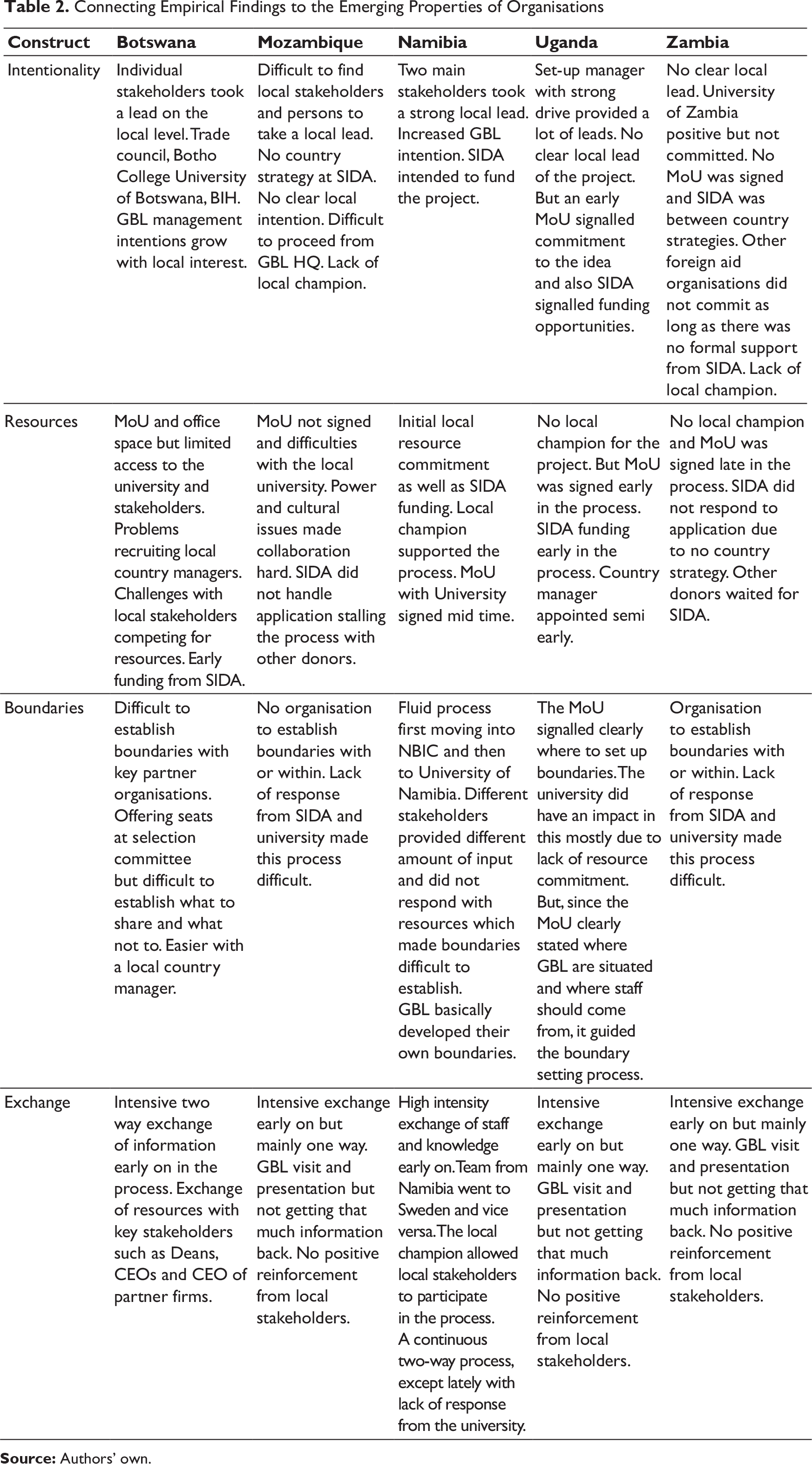
There is one other incubator in Namibia, the National Business and Innovation Centre (NBIC), was the first partner to GBL in Namibia. The NBIC collaborated with GBL but also provided both resources such as office space and networks. The geographical position of the lab was in an area close to Polytechnic of Namibia (now transformed into Namibia Science and Technology University) and approximately 30 km from University of Namibia. This was both good and bad; we got a good buy in to the project but we were also on the ‘outside’. GBL wanted to become a natural part of the university. In the beginning, a Memorandum of Understanding (MoU) was signed with NBIC and a lot of knowledge exchange took place. Four persons from Namibia were invited to training and knowledge development in Stockholm. Two persons were on the selection committee from NBIC, and the idea was that NBIC recruited innovative start-ups with tech platforms while GBL recruited scalable businesses with fast-to-market approaches. So, there was no intention for any competition. However, over time, it appeared that NBIC felt that GBL competed with them and when the MoU was to be renewed, it was not. Also, from a GBL point of view, it was not an efficient location since it was outside the day-to-day activities of local students. Instead, the country manager secured a MoU with the University of Namibia, which included, free space, up to 20 per cent of a full-time faculty appointed as a country manager, and up to 20 per cent of a full-time faculty coaches. The facilities are now functional and the new country manager was trained by the first Swedish set-up manager and through regular networking with the head quarters (HQ) in Stockholm. Table 1 relates this process to the theoretical framework and Table 2 reports outcomes from the process across time.
The Case of Botswana
Botswana, is a development success story. A small, landlocked country with a population of about 2.3 million in a semi-desert environment, Botswana was one of the poorest countries in Africa with a per capita GDP of about $70 at independence from Britain in 1966 (Malema, 2012; The World Bank, 2016). Before independence, the economic mainstay of the country was agriculture, which accounted for 43 per cent of GDP (Malema, 2012). Thanks to the discovery of diamonds, which accounts for 40 per cent of the GDP, Botswana has progressed from the ranks of a poorest country to an upper-middle-income country. Over the years, the country’s economic growth has averaged 8 per cent. However, the country faces challenges of high youth unemployment rates particularly amongst the university graduates. The government’s commitment to educating the youth, where government expenditure on education is among the highest in the world at around 9.63 per cent of GDP (The World Bank, 2016), has meant that most graduate youth are not absorbed in formal employment. As a result, the country is challenged to provide the youth with alternative careers. As a result, the importance of players such as GBL in the entrepreneurial landscape cannot be over emphasised.
The set-up manager in Botswana was a bit older and more experienced compared to Namibia and Uganda. The process in Botswana followed that in Namibia with a great interest from the beginning. GBL signed a MoU with Botswana Innovation Hub (BIH), where it was agreed that BIH would participate in training, give access to office space for the GBL team and also be part of the selection committee. At the same time, BIH started to question the value of the MoU with them. They felt that GBL was competing with them and not being open with them. This was despite the fact that one person from BIH was on the selection board of GBL. This led to a number of crisis meetings where the founders had to fly down and back up the set-up manager in discussions about the collaboration with BIH. The entire process was very bureaucratic and was hard to follow. Neither BIH nor GBL was able to find and select good cases, so there was really nothing to compete about. In addition, BIH was well funded as compared to GBL. The MoU between GBL and BIH was eventually withdrawn.
Following the withdrawal of the GBL–BIH MoU, the local manager was assisted by the Swedish Trade Council, which had its main office in Gaborone. As a result, the founder of GBL signed an 18 months MoU with the University of Botswana from mid-2012 to February 2014 to meet the requirements of SIDA. The signed MoU gave GBL access to office space, an appointed country manager and two coaches paid by the university, given that GBL were able to fund the start-up costs. However, until November 2013, the Swedish country manager was not able to recruit a local country manager. It was only in January 2014 that a local country manager was eventually assigned but at this point, the MoU was about to lapse. The eventual lapse of the MoU restricted GBL in its marketing activities on campus. However, the process continued and the university dedicated space and also assigned a coach to the lab despite the absence of a MoU.
The Case of Uganda
Uganda, officially the Republic of Uganda, is a landlocked country in East Africa. It takes its name from the Buganda kingdom, which encompasses a large portion of the south of the country, including the capital Kampala. Since 1894, the area was ruled as a protectorate by the British, who established administrative law across the territory. Uganda gained independence from Britain on 9 October 1962. Today Uganda is a democratic country with its current leader President Yoweri Kaguta Museveni elected for the fifth term. Uganda is among the fastest growing economies, thanks to ‘trade, investment and development cooperation with emerging economies such as Brazil, China and India’ (Njoroge, 2013). Uganda has the highest youngest population second to Nigeria (Ahaibwe & Mbowa, 2014). Uganda is among the fastest growing population in the world with annual population growth rate of 3.2 per cent. Its current population is 37,823,253 million people with 17.9 million (females) 51 per cent of population and 16.9 million (male) 49 per cent of population (Uganda Bureau of Statistics, 2016). This population is expected to rise to 46.7 by the year 2025 (Uganda Bureau of Statistics, 2016). Uganda’s youth unemployment is among the highest in the world with the national youth unemployment rate of 4.7 per cent (Ahaibwe & Mbowa, 2014; The World Bank (2009) reported unemployment among the youth between the ages 15–24 years at 83 per cent, youth unemployment rate at 32.2 per cent. In spite of many universities, more than 32 in number, those coming out of the universities also end up being unemployed. Degree holders’ unemployment is 36 per cent. This is attributed to the disconnect between the kind of education given and the vocational skills required to start their own jobs. Moreover, many universities are concentrated in urban centres. This has increased youth urban areas unemployment to 40 per cent while reducing rural youth unemployment to 1.7 per cent. There are a number of incubators in Uganda, most of which are based in Kampala. Their concentration is mostly in agribusiness, technology and social enterprises. Most people who seek support from the incubators are young people aged between 25–32 years. Males are dominant in the technology incubators while females are dominant in the social enterprise and agribusiness incubators. In rural areas, there are incubators which solely focus on social enterprise and agribusiness. They are mostly in the Western region (Mbarara, Masaka and Kabale). All are funded by external programmes (foreign donors) but they try to generate their own internal revenue to survive. Moreover 40 per cent of the time, the incubator managers are seeking funding for running their programmes.
The first GBL team was headed by a female set-up manager with two business developers. Early on, this team was matched by a local country manager and two local business developers. The local country manager was assigned by Makerere University.
Comparing Emergence of the Business Accelerators Across the Three Countries—Botswana, Namibia and Uganda
The case of Uganda is clearly different from both Botswana and Namibia. It is a developing country with a massive size, both in geography and in its population. The challenges are many, both in terms of infrastructure such as access to the Internet and transportation and in terms of human capital with variation in the educational system. In Uganda, the MoU was signed immediately. The MoU included office space and students access to, printing, computers and faculty resources from the university side and funding and knowledge from the GBL side. During the early stages, it was clear that the university did not deliver on their part of the MoU. Office space was allocated but no computers, no faculty salaries, no coaches and so on. A lot of time was spent with outreach at campus trying to convince students to start their own ventures. At the same time, the set-up manager closed the partner programme and created a strong selection committee with local business persons and representatives from local stakeholders.
In Namibia, the MoU with NBIC was not renewed and the lab had to relocate to the University of Namibia, where a new MoU was eventually signed. While in Botswana, the MoU has not been signed to date.
The signing of the MoU implied that the labs could access resources pledged by the universities. Thus, delays in signing of the MoUs posed the challenge of accessing resources from both the universities and GBLI. Not only that, unnecessary costs were incurred.
For instance, it took more than eight months for the local country manager in Namibia to resume her duties. Costs were incurred in sending two faculty ambassadors for training in Sweden, only to have them drop out of the programme. In Botswana, not signing the MoU impacted on the legitimacy of the programme in the university. The project continued operations in the facility that was allocated under the first MoU and the country manager and the coach offered their services. However, it became difficult to access other university resources. For example, it was not possible to get permission to carryout onsite marketing activities. Subsequently, the Botswana GBL operated from a make shift office while Uganda and Namibia were allocated incubation spaces. As a result, a number of good business ideas in Botswana were lost to competitor incubation environments and private investors.
The cases further point to difficulties in accessing uniform revenue streams across the three countries. First, due to the high economic rankings of Botswana and Namibia compared to Uganda, it has not been possible to access funding from uniform sources. This has resulted in adequate resourcing of the Ugandan lab, which continued to benefit from SIDA whilst the Botswana and Namibian labs could only access short-term funding from alternative sources from Southern Africa Innovation Support (SAIS). Botswana and Namibia labs struggled financially for over a year when the short-term SAIS funding ended. In fact, the funding availed to Uganda catered for a country manager’s allowance from GBL in addition to the university salary. As a result, the Uganda country manager could have been more motivated than his Namibian and Botswana counterparts. Such an imbalance in resourcing could explain differences in implementation and outcome across the three countries as highlighted later in the text.
Furthermore, the anticipated revenue stream from the equity stake has also not borne fruit, which suggests optimistic project planning. So far, none of the companies has paid dividends. As a result, the availed donor funding period was not adequate to see the project through.
It proved difficult for the Botswana lab to access additional funding to run the offices; stationery, funding for events and workshops, refreshments, transport from GBLI when the MoU expired. This was due to the fact that GBLI read the delays to sign the MoU as lack of commitment on the side of the university. As a result, GBLI threatened to pull out of Botswana. The threats to pull out from Botswana further complicated the relationship, created a divide between management of the two partners and left the GBL project in Botswana operating with a minimal budget and skeletal staff.
In the meanwhile, GBL Namibia got capital injection from the GBL director following the lapse of the SAIS programme funding period, but such was not extended to Botswana. Nonetheless, the lab in Botswana continued operations, albeit with minimal performance.
Connecting Empirical Findings to the Emerging Properties of Organisations
Business Acceleration Performance
GBL developed key performance indicators (see Table 3), which focus on both the performance of the lab companies and the acceleration process. The performance indicators enable for tracking the rate lab companies’ growth as well as inform the decisions pertaining to how best a business accelerator could help the companies to grow.
Performance of the Three Labs from April 2013 to August 2015
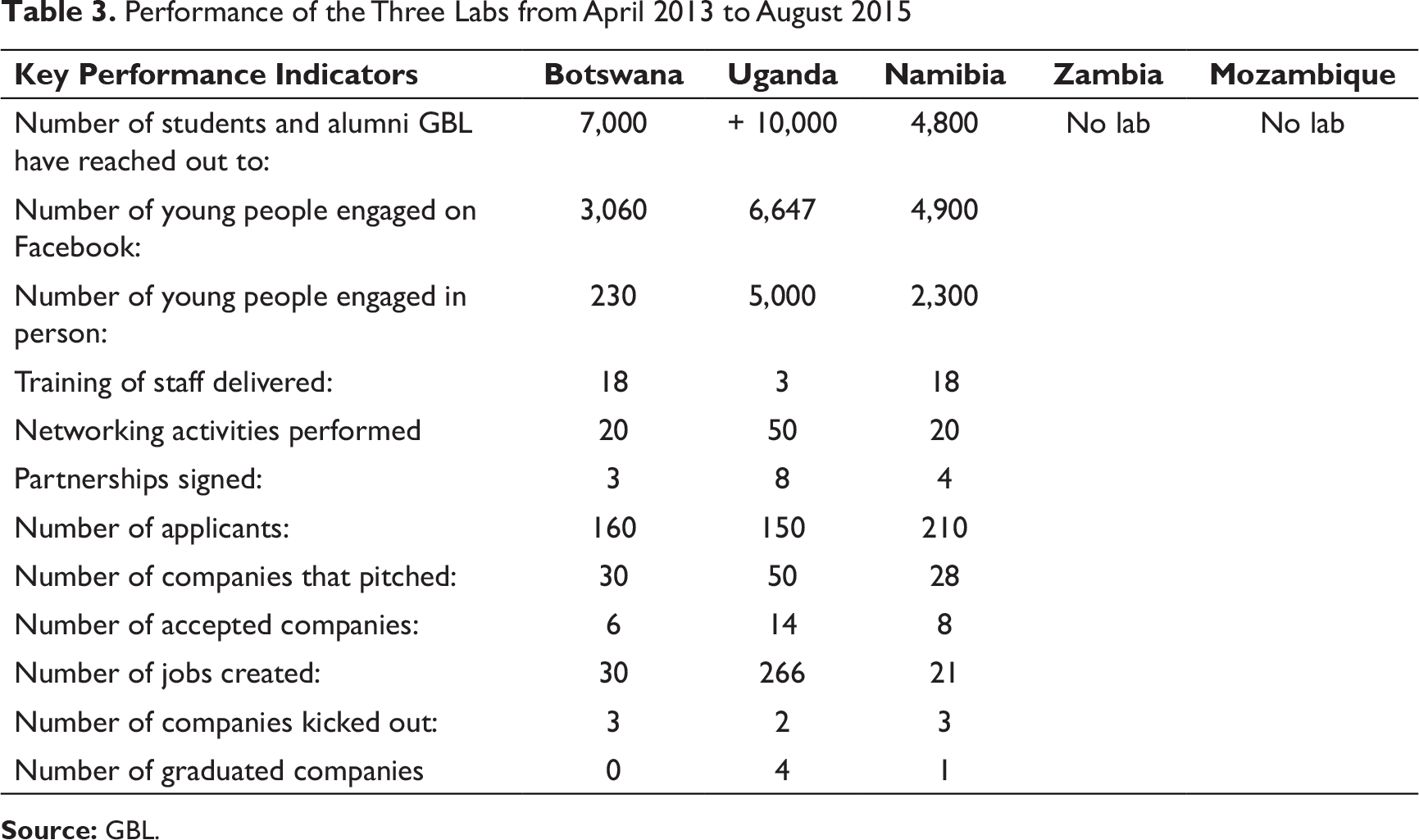
As highlighted in Table 3 above, there is evidence that Uganda records the lowest number of applicants while Namibia records the highest, with at least 30 per cent more than both countries. However, it Uganda records the highest number of companies that pitched. To put things into perspective, one in three companies that applied pitched in Uganda versus one in five and one in seven companies in Botswana and Namibia, respectively. Taking it further, Uganda and Namibia compare well achieving a rate one in three companies that pitched being accepted in the lab as opposed to one in five companies in Botswana. These statistics suggests a number of possibilities in terms of explaining the varying observations including quality of ideas pitched, leniency or stringency of selection panels and strength of lab support systems in general among other factors, considering proportion of companies kicked out and graduated relative to companies that were accepted. In which case, Uganda still outperforms the other two countries. The major explanation is found in the quantity of the brut market. In Uganda, GBL reached out to over 10,000 potential entrepreneurs, with over 5,000 engaged in person. That in itself increased competition and though that process potentially quality in the applications.
Propositions
The literature review presented in the beginning of the article put forward the notion that the emerging organisations pass through different stages of intentionality, resources, boundary and exchange. Our idea in this article was to study whether this theory is applicable to business accelerators start-ups and its effect on the local economies. Comparing the three countries, it is evident that they all pass through the four stages. As stated above, despite this, the actual birth of organisations did only happen in three out of five countries. No lab was established in Mozambique and Zambia.
Katz and Gartner (1988) illustrate four major properties of organisations (including those organisations in the process of creation): intentionality, resources, boundaries and exchange. These properties, which have both structural (resources and boundaries) and process (intentionality and exchange) characteristics, are the minimum attributes necessary for identifying the existence of an organisation. Also, these properties are reflected across organisation theories, especially across systems-oriented theories. Our case study gives support for four different stages. It also gives support for an implicit order among them. Katz and Gartner (1988) do not order the sequence and give no advice if any of the stages are more important and/or have other implications for emerging organisations.
As described in the case, intentions seem to surpass the other stages in our process. If there was no intention from the founders to actually start GBL, there will not be a GBL. In addition, Katz and Gartner (1988, p. 431) also stated that ‘We see organizational intentionality as a label describing an agent’s seeking information that can be applied toward achieving the goal of creating a new organization’. This is evident in our study. For example, during the ICT conference in Botswana, it was evident that a range of stakeholders had the intention to start an incubator of some kind, which reinforced the intention of the founders of GBL. Comparing this with GBL in Mozambique and Zambia, it is clear that at this stage there is no difference between the five countries, since the intention to start did not materialise in these two countries. Nonetheless, there was a clear double-sided intention from both the founders and the local stakeholders to start GBL in each county. Katz and Gartner (1988) discuss this in terms of ‘agent’s seeking information that can be applied toward the goal of creating a new organization’ (p. 431). Our exploratory investigation reveals that the formation of an organisation is not in the hands of one agent. It is a reciprocal process where intentions need to come from both the founding agent and local stakeholders. The more relevant those stakeholders are, the more likely it is that the organisation will come into existence. In view of the above, we present the following propositions:
Proposition 1a: Intentions to start an organisation are dependent on the exchange of information between different intentional stakeholders in the start-up environment.
Proposition 1b: More relevant stakeholders will have a larger impact on the organising effort.
Second, the differences in process across the five countries seem to be associated with the extent of GBL integration with the key stakeholders at the local level and the resources that were committed to each country. On one hand, Botswana, Namibia and Uganda all received funding from SIDA early on. That provided bait for local stakeholders to participate and it also provided monetary resources for GBL to actually start the process of organising the local labs. In all three cases, this also led to a substantial increase in human capital in each country due to new recruitments. In Zambia and Mozambique, on the other hand, SIDA was not responding positively or negatively which to some extent led to a vacuum where other stakeholders in the aid community would not commit to support Botswana and Namibia since they waited for the Swedish organisation to make the first move. This leads us to the second proposition:
Proposition 2: Financial resource chocks early in the emerging process negatively impacts the speed of organisation formation and formalisation.
Third, boundary spanning activities. Boundaries are defined as barrier conditions between the venture and its environment (Katz & Kahn, 1978) and exchange as cycles of transactions (Katz & Gartner, 1988). These transactions can be across the boundary with individuals, other organisations and the environment (Singh, Tucker, & House, 1986). Exchange is viewed as more dynamic and volatile compared to the other properties because of the cyclic nature of the exchange process and the need for the exchange to benefit the venture—once established exchange cannot stop without the venture facing eventual dissolution (Katz & Gartner, 1988). We can see that boundary spanning activities and boundaries in themselves have an impact on the emerging organisation. The boundaries of GBL are still fluid in the established countries. But, the main result from our study is also related to the transactions that take place across boundaries. The more boundary spanning activities that are executed, the easier it is to establish actual boundaries between the organisation and its environment. This leads us to our third proposition:
Proposition 3a: More boundary spanning activities leads to more distinct boundaries of the emerging organisation.
Proposition 3b: More exchange of intentions, resources and boundary spanning activities will influence the organising process.
Forth, the four properties of an emerging organisation are not independent from each other and are not sequential. They are continuous and continue to influence the emerging as well as the established organisation over time. As soon as there is a change in any aspect of the emerging organisation, it will change the dynamics within the four. Changing the managing director or country manager means that intentions will change; some of the boundaries will change, exchange and resources will change and the earlier in the process, the more significant will the change be. This leads us to our fourth proposition:
Proposition 4: The emerging properties are dependent on key stakeholders, so called champions, and if they are exchanged during the process properties will also change.
Fifth, the differences could point to degree of stringency in the selection process as well as the level and quality of the services provided across the labs. Even though uniform procedures were followed by all the labs, management competencies of the lab managers and the members of the selection committees differ (Ganamotse, 2013; Lalkaka, 2005). In addition, the Botswana case underscores the importance of managing relationships for successful implementation of programmes, more especially for externally generated projects.
If we look at the final aspect of the case, it is clear that there is a difference between the labs. It appears good relationship management could explain Uganda's performance, which to some extent seems to drive competition and increase quality among the cases. It is also explained by the differences in access to students where the Uganda Lab could reach out to a larger target group faster and thus inspire and change their mindset earlier. Therefore, leading us to the fifth proposition:
Proposition 5: The outcome of the emerging business accelerator process is dependent on access to the target group and size of the target group.
Discussion
This study seeks to understand how new business accelerators come into existence and which phases they go through and their effect on the local economy. The emerging property framework proposed by Katz and Gartner (1988) provide a viable platform to study emerging business accelerators. Our case analysis gives support to the framework. It also opens up a more dynamic view on the emerging organisation supporting Weick’s (1979) notion of enactment and dual intentions. Comparing the three cases where the business accelerators were created with Mozambique and Zambia, it is evident that intentionality needs to be reinforced by the stakeholders around the focal organisation. Our theoretical contribution includes the duality of intentions and exchange between key stakeholders and the resource burst as a triggering mechanism in the creation of business accelerators in developing countries.
It is our hope that these cases will inform policy and stakeholders on issues that lead to successful establishment of business accelerators. Particularly, the findings will benefit the universities as they seek to equip their students with skills required to become successful entrepreneurs. The study has also shown the need for universities to embrace programmes that could benefit students in terms of upskilling them in an effort to address the current unemployment problem. To international organisations, the GBL case has demonstrated the need to take into consideration the levels of economic development of target countries when designing their interventions. In addition, the case highlights the importance of cultural diversity when doing business across borders.
The cases also have demonstrated to international organisations the need for parity in resource allocation, particularly for replicated projects, such as the ones considered in this study. The donor community could also draw from the study the need to consider funding periods for projects with which results could be visible.
Considering the output from the three business labs in operations, it is hard to claim success since this is not a randomised trial. However, if we compare with our baseline, which in our case is 0 it is evident that GBL contributes to the local economy. GBL reached out to over 20,000 youth in the three operating business labs creating over 400 jobs, training of faculty, inspiration and local economic development.
Concluding Observations
The purpose of this article is to draw from the experiences of the GBL cases some salient points on the antecedents for the development and creation of new business acceleration organisations. Our research opens the dyadic nature of the organisation creation process in developing countries. The success of this programme in the three countries, though varied, has demonstrated that the economic level of the country matters for business acceleration. Furthermore, the cases highlight that the GBL project has the potential to inject the entrepreneurial drive amongst the youth. It is a tool that universities could use to ensure that their students develop entrepreneurial employability skills as beneficiaries not only create employment for themselves but for others, particularly students and alumni.
From the review of these cases, the following critical success factors for replication of business acceleration programmes have emerged. First, there is a need to provide resources for the projects for a longer period. The initial funding period for the GBL projects, particularly Namibia and Botswana was too short. Furthermore, the funding period for the cases under consideration ended before the projects could attain the planned sustainability. The cases also demonstrate that the model can only work efficiently when the labs are integrated within the fabrics of the universities and the community at an earlier stage and are well resourced. Due diligence process should continue even after the new ventures are accepted for acceleration.
Acknowldgement
This document is an output from the research initiative ‘Private Enterprise Development in Low-Income Countries’ (PEDL), a programme funded jointly by the Centre for Economic Policy Research (CEPR) and the Department for International Development (DFID), contract reference PEDL_LOA_4352.
The views expressed are not necessarily those of CEPR or DFID.”