



Abstract
There are 15 research career development awards from the NIH, but 70% of funding is allocated to just four awards: K01, K08, K23, and K99. We analyzed K01, K08, K23, and K25 mentored career development awardees and quantified if they received subsequent independent research project grants such as an R01 or an R01-equivalent award (R01+) within 5 years of the K award end date. All data were from NIH RePORTER and limited to clinical departments. All K01, K08, K23, and K25 researchers (n = 7711) were identified through a search from NIH Fiscal Year (FY) 2007 to FY 2021. NIH datafiles for FY 2007 to FY 2021 were aggregated to generate a master datafile of all R01+ awards (n= 552,396). Each R01+ award was then linked to the corresponding K awardee previously identified through the K awards search. There was a gradual increase in R01+ success rates as time from the end of the K award increased; however, 5 years after the K award end date, less than half of the awardees had an R01+ as contact PI. Therefore, should a K awardee remain in academia, a substantial percentage may require institutional support and/or pursue funding in roles other than contact PI on an NIH grant in order to support their research programs. These findings may be useful to junior investigators as they plan their K grant applications and to clinical departments as they evaluate K awardees for independent research positions.
Introduction
There are 15 research career development awards (ie, K awards) from the NIH, but 70% of funding is allocated to just four awards: K01, K08, K23, and K99. 1 While these K award mechanisms differ slightly in duration, eligibility, and research scope, their overall purpose is to provide protected time and resources to early career scientists so that they can develop an independent research program supported by larger federal research project grants.2,3 In this study, we sought to evaluate if there are differences in success rates between K01, K08, K23, or K25 awardees in clinical departments for receiving an R01 or R01-equivalent award (R01+) of at least $250,000 within 1, 3, or 5 years of the K award end date.
The 4 selected K awards in this study are all mentored career development awards that last 3 to 5 years and cover partial salary support as well as research costs such as travel, supplies, and equipment. Despite these overarching similarities, there are programmatic differences between the award types: K01 awards are primarily for PhD scientists who completed a postdoc and are seeking mentored career development in biomedical, behavioral, or clinical sciences; K08 awards are for individuals with clinical doctoral degrees (MD, DVM, DDS, etc) to secure protected research time who are planning careers in biomedical and behavioral translational research; K23 awards support individuals with health professional doctoral degrees (MD, DO, DDS, etc) in the conduct of patient-oriented research; while K25 awards support researchers with PhDs in quantitative/engineering disciplines (eg, engineering, computer science, economics) as they apply their expertise toward answering questions of health and disease.
Despite these programmatic differences, all mentored K awards are designed to provide researchers with PhD and/or MD degrees additional mentored research training so they may flourish as independent investigators. Since the K awardees in this study included individuals with clinical doctoral degrees, our analysis focused exclusively on clinical departments. Given that R01+ awards are a benchmark by which successful research programs are measured, we sought to understand the relationship between mentored career development awards and subsequent R01+ award funding. This connection from mentored award to independent research program grant may be valuable to junior investigators in deciding among K grant mechanisms, and to leaders in academic medical centers who seek to recruit and retain early career biomedical scientists with the greatest chance for future independent research funding.2,4
Methods
All award data were collected from NIH RePORTER and limited to all clinical departments (ACDs) as categorized by the Blue Ridge Institute for Medical Research. 5 R01+ awards include: DP1, DP2, DP5, R01, R37, R56, RF1, RL1, U01, and R35 as determined by the NIH. Given the unique biphasic structure of the K99/R00 award mechanism, our analyses focused on monophasic mentored career development awards (K01, K08, K23, and K25; Table 1).1,2,4 All K01, K08, K23, and K25 researchers (n = 7711) were identified through a K awards search from NIH Fiscal Year (FY) 2007 to FY 2021 across ACD. NIH annual datafiles for FY 2007 to FY 2021 were aggregated to generate a master datafile of all R01+ awards (n = 552,396).
Description of the Four Mentored Research Career Development Awards Examined in This Study.

Each R01+ award was then linked to the corresponding K awardee previously identified through the K awards search. R01+ awards were included in the analyses if the annual total cost was greater than $250,000 and the start date was less than or equal to 1, 3, or 5 years after the K award end date. A K awardee was only included if their K award end date plus 1, 3, or 5 years was before the start of FY 2022. All award amounts were adjusted for inflation by converting to FY 2023 dollars. 6
The data were aggregated, sorted, and analyzed using Microsoft Excel for Microsoft 365 MSO (Version 2208, Microsoft Corporation, Redmond, WA). Standard functions and formulas were used including counts, sums, standard deviations, and charts. To assess the statistical significance of differences with categorical variables, differences in success rates between groups were assessed using Pearson's chi-square test of independence applied to contingency tables. Expected frequencies were calculated from marginal totals. Analyses were performed in Microsoft Excel with a significant threshold of P > 0.05. Since this was a search of a public online database, no institutional review board approval was needed.
Results
Of the four selected K mechanisms, K08 and K23 grants compose 73% of awards, with the K25 mechanism just 2% of awards (Figure 1). Despite substantial differences in the number of awards, there are no significant differences across the 4 award mechanisms in the percent of K awardees with subsequent R01+ awards 1 year (χ2 = 6.28; P = 0.0986) or 3 years (χ2 = 4.71; P = 0.194) after K award end date (Figure 2). However, K25 awardees were comparatively less successful than K01, K08, or K23 awardees in making the transition to R01+ funding as a PI 5 years after K award end date (χ2 = 8.50; P = 0.0367). Furthermore, there are no significant differences between PI degree type (PhD vs MD) and subsequent R01+ awards 1 year (χ2 = 1.58; P = 0.208), 3 years (χ2 = 0.00074; P = 0.978), or 5 years (χ2 = 0.184; P = 0.668) after K award end date (Figure 3).

Distribution of K01, K08, K23, and K25 Awards from FY2007 to FY2021.
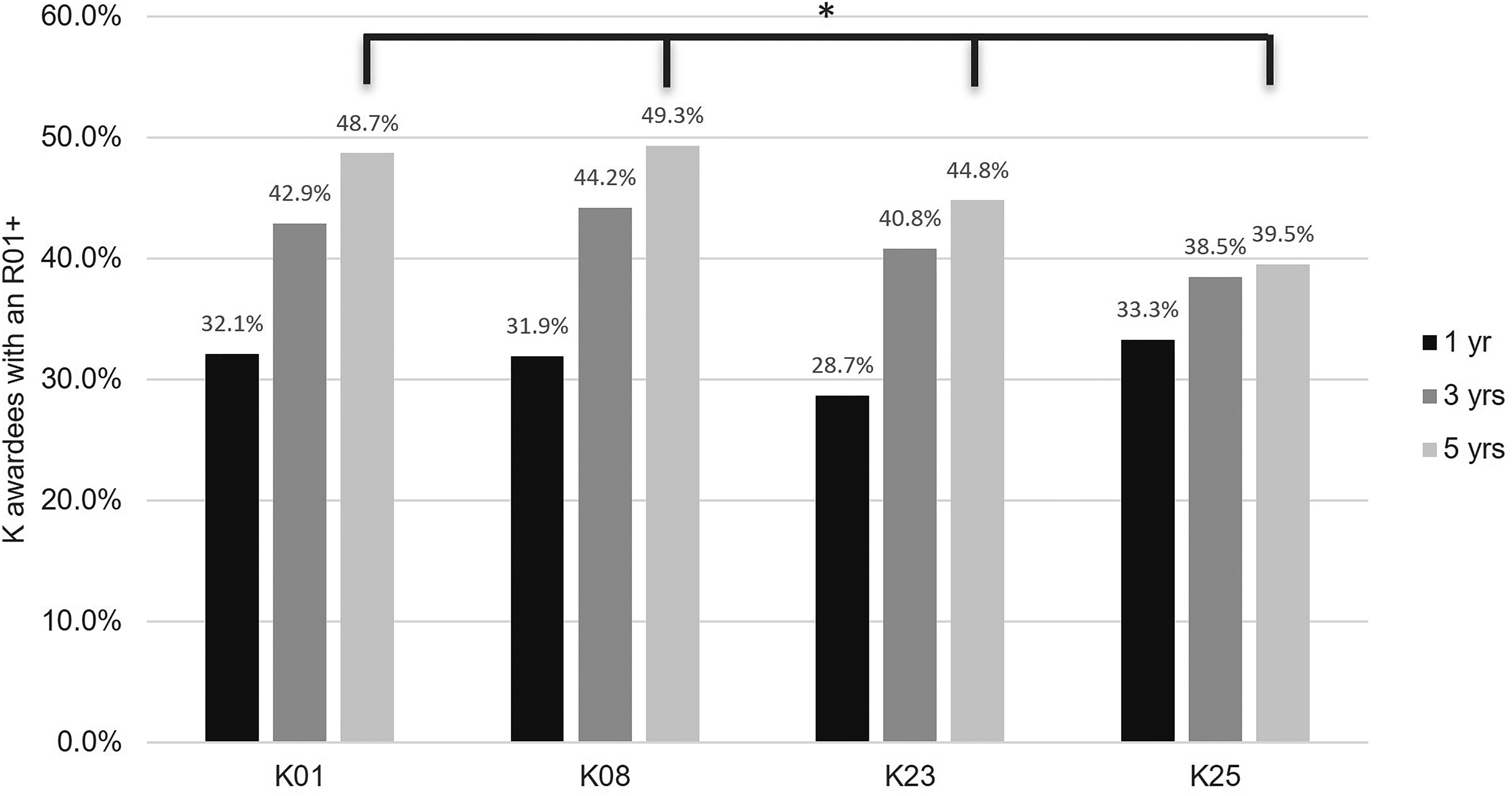
Percent of K01, K08, K23, and K25 Awardees from FY2007 to FY2021 with a ≥$250,000 R01+Award Within 1, 3, or 5 Years of the K Award End Date. * P < 0.05.

Percent of K01, K08, K23, and K25 Awardees From FY2007 to FY2021 With a ≥$250,000 R01+Award Within 1, 3, or 5 Years of the K Award End Date, Grouped by Terminal Degree.
There is a gradual increase in the percent of K awardees who receive R01+ awards 1, 3, and 5 years after the end of their respective K grants. For example, 31.9% of K08 awardees received an R01+ 1 year after the end of their K grant; this increased to 44.2% after 3 years, and 49.3% after 5 years.
Discussion
Our findings may be useful to junior investigators as they plan their K grant applications, and to clinical departments as they evaluate K awardees for independent research positions. While there are slight differences in success rates between the different K awards, overall, there is relative consistency with respect to timing of future R01+ funding. Assuming the K awardees remain as academic faculty and continue to pursue NIH funding, less than half will obtain an R01+ as contact PI within 5 years. This implies that a substantial percentage of junior faculty who have already obtained NIH funding through K awards may require institutional support and/or pursuit of funding in roles other than contact PI on an NIH grant.
There have been several studies assessing K to R transition rates, primarily focusing on a specific clinical department and/or including characteristics such as gender. For example, the rate of successful K-to-R transition was 50% in orthopedic surgery, 7 and 48% in cardiothoracic and vascular surgery with a median conversion to an R grant of 5.0 years after the start of the K grant. 8 However, only 32% of awardees in departments of surgery received an R01 with a mean of 5.5 years after their K awards, 9 while 22% of researchers in obstetrics and gynecology were successful at obtaining an R01, with a mean of 6.8 years from K award to R01 acquisition. 10 Interestingly, the likelihood of R01 attainment plateaued in obstetrics and gynecology after more than 12 years passed from when a recipient received their K award. 10 In a surgical specialty such as ophthalmology, the R01 achievement rate by K08 or K23 awardees who received their grants between 1996 and 2000 was higher at 61%, 11 but an extended follow-up study showed that only 13% of K awardees from 2001 to 2005 obtained an R01 grant. Similar to orthopedics, the time to R01 or U10 also plateaued, but at 14 years after the start of the K award. 12 These studies may be useful to individual departments and specific clinical specialties, while our study offers a more current and comprehensive analysis since it focuses on K awards to ACDs.
Since many studies looking at K to R transition rates rely on publicly available data such as NIH RePORTER which only shows funded grants, it is not possible to predict if those receiving a K award are more successful in receiving subsequent NIH grants compared with those who did not receive a K award but still obtained future NIH funding. However, a recent study in which the authors accessed the NIH's Information for Management, Planning, and Coordination II administrative database, showed that K01, K08, and K23 awardees were approximately 1.5 times more likely to receive an R01-equivalent or research project grant (RPG) than unfunded K applicants, even though the K awardees received their first R01 or RPG later. Notably, K awardees also had a higher likelihood of a second R01 or RPG.12,13
There are several limitations to this study. We did not consider other K-type career awards or non-clinical departments. Since we relied exclusively on a large dataset mined from NIH RePORTER, it was not possible to include information such as gender, age, specialty, and frequency of unsuccessful grant submissions. Additionally, while we focus on a researcher's ability to achieve an R01+ award as contact PI, we fully recognize that this metric does not necessarily capture other mechanisms of research support outside of the NIH that may enable the development of an impactful, independent research program. Finally, though the receipt of initial R01+ funding is an important outcome after a K-award, our study does not provide insights into long-term awardee funding outcomes.
Footnotes

Ethical Considerations
Since this was a search of a public online database, no institutional review board approval was needed.
Consent to Participate
Since this was a search of a public online database, no institutional review board approval was needed and therefore consent to participate is not applicable.
Consent for Publication
Not applicable
Author’s Contribution
DMM contributed to conceptualization, data curation, formal analysis, investigation, visualization, writing—original draft, and writing—review and editing. KMG contributed to conceptualization, formal analysis, investigation, validation, visualization, writing—original draft, and writing—review and editing. PL contributed to conceptualization, resources, visualization, writing—original draft, and writing—review and editing. AVE contributed to conceptualization, investigation, visualization, and writing—original draft. EC contributed to conceptualization, investigation, and writing—original draft. AG contributed to conceptualization, project administration, resources, supervision, writing—original draft, and writing—review and editing.
Funding
The authors received no financial support for the research, authorship, and/or publication of this article.
Declaration of Conflicting Interests
The authors declared no potential conflicts of interest with respect to the research, authorship, and/or publication of this article.
Data Availability
All data are available upon request to the corresponding author.