



Abstract
Background
Around the world, the presence of international medical graduates (IMGs) continues to grow. However, IMGs in Japan may face challenges in developing history-taking and physical examination (H&P) skills in Japanese. Although virtual reality (VR) offers potential for experiential, self-paced, and repeatable learning, its application to H&P skills among IMGs is underexamined. Here, we explored the effectiveness of VR-based education in fostering H&P skills among IMGs in Japan.
Methods
We conducted a feasible one-group pretest-posttest study with IMGs enrolled in the International Medical Practitioners Education Program in Japan. From August to September 2025, the participants undertook a 1-month VR-based program using “VR for Objective Structured Clinical Examination.” Assessments were conducted pre- and post-intervention. The questionnaire included: (1) the Japanese version of the Usefulness, Satisfaction, and Ease of Use Questionnaire-Lite (J-USE-Lite; post) (2) confidence in H&P skills and motivation to learn them in Japanese (pre and post), and (3) free-text questions exploring perceived learning outcomes and culture-specific insights (pre and post). Quantitative data were analyzed using descriptive statistics and paired t-tests, while qualitative data were analyzed by inductive content analysis.
Results
The first 15 individuals who applied to participate in this study were enrolled. Mean J-USE-Lite score was 5.13/7. We found notable positive trends in confidence in H&P skills and motivation to learn them in Japanese. In qualitative analysis, while the pre-intervention questionnaire indicated challenges for IMGs in developing H&P skills in Japanese, the post-intervention questionnaire suggested perceived gains in H&P skill acquisition and culture-specific learning, such as patient-centered considerations.
Conclusions
A 1-month, VR-based education program demonstrated good usability and appeared to enhance confidence and motivation to learn H&P skills among IMGs. Immersive and repeatable VR experiences may support practical skill acquisition and adaptation to Japan's clinical and cultural context. Confirmation in larger samples from diverse backgrounds using objective performance measures is warranted.
Keywords
Background
Effective history-taking and physical examinations (H&P) are fundamental to the practice of medicine and essential to the timely and accurate diagnosis of patients.1–3 The literature suggests that history-taking contributes to clinical diagnosis in 70%–90% cases.3–5 Despite rapid advances in contemporary technology, physical examination also remains vital due to its diagnostic contribution as well as positive effect on patient care and cost reduction.6–8 Thus, acquisition of these fundamental clinical skills is major focus in medical education across the world.
In the current era of globalization, international medical graduates (IMGs) play an important role in medicine. 9 IMGs are defined as individuals who obtained their primary medical qualification outside the country in which they are currently based. 10 In the U.S. and Canada, IMGs make up approximately a quarter of all currently practicing physicians,11,12 and account for approximately 20% of all licensed physicians in the UK 13 In Japan, although there has been lack of diversity in the physician population, the number of IMGs has recently gradually increased. The Ministry of Health, Labour and Welfare reports that approximately 100–200 IMGs per year pass the Japanese Medical License Examination, accounting for approximately 1%–2% of the total. 14 Despite the growing presence of IMGs, they are likely to encounter a unique set of challenges during their training phase, including language barriers, social isolation, and difficulty in comprehending the healthcare system of a foreign country.15–17 Additionally, they may face challenges in the acquisition of medical skills. Indeed, a U.S. study indicated significant deficiencies at multiple skill levels in IMGs at the beginning of residency programs compared to U.S. medical graduates. 18 Given the importance of H&P, effective education of these basic clinical skills for IMGs is of high priority.
Recently, virtual reality (VR) has emerged as an innovative educational technology in medical education. VR refers to an educational tool that employs computer technology to generate a three-dimensional image or environment that can be perceived as either realistic or tangible. 19 The efficacy of VR in facilitating learning is attributable to its capacity to engender complete immersion in a dynamic, interactive environment that closely resembles to the real environment. 20 A substantial body of literature has now provided positive evidence for the value of VR in medical education, such as greater learning satisfaction and self-efficacy and better clinical procedural skills.21–23
Conversely, the impact of VR training on basic clinical skills, including H&P, for IMGs remains to be investigated. Nevertheless, we anticipate that VR training will be advantageous for IMGs for two reasons. First, VR-based education is likely to ensure psychological safety: while IMGs in Japan may experience psychological discomfort in unfamiliar Japanese clinical environments, VR-based education has the potential to provide IMGs with a psychologically safe learning environment. Second, VR scenarios are repeatable. In Japan, transition from an “observatory” to a “participatory” clinical clerkship has been continually advocated since the 2000s, but progress is limited, with even medical students from Japanese medical schools having only limited experience of a “participatory” clinical clerkship.24,25 Consequently, IMGs face limited opportunities to perform basic clinical skills on patients in Japanese clinical settings. The repeatable nature of VR-based education would therefore be advantageous for IMGs.
Here, we explored the feasibility and perceived impact of a VR-based education program for nurturing H&P skills among IMGs in Japan. We anticipated that our findings would aid the development of evidence-based approaches to the education of IMGs in Japan and beyond.
Methods
Study Setting, Design, and Participants
This mixed-methods study was conducted from August to September 2025. IMGs who participated in the International Medical Practitioners Education Program fiscal year 2025 (IMPEM FY2025) hosted by the Department of General Medicine, Juntendo University Faculty of Medicine were recruited. The IMPEM was developed in 2020 with the aim of providing IMGs with the necessary knowledge to pass the Japanese national medical license examination and to facilitate their integration into the clinical environment in Japan. Immediately after the initiation of the IMPEM FY2025 in August 2025, the program participants were contacted via email and informed that the first fifteen individuals would be eligible to participate in the study due to limitations on the number of devices available to us. The timing of this study allowed us to capture data on the difficulties IMGs face in providing medical care in Japanese at the start of their preparations for the Japanese Medical License Examination, and to assess whether these difficulties were improved through this VR training. As described earlier, all IMPEM FY2025 participants were eligible for this study. Participants were excluded from the study if they had had experienced difficulties using VR tools and/or completing online questionnaire due to VR sickness or other issues.
On the first day of the VR training period, the study participants received orientation on the study and the VR device from the research staff. After the orientation, they could use it whenever they liked for the 1-month period, including at home. In this study, we adopted “the VR for Objective Structured Clinical Examination (OSCE)” as the VR educational tool for the development of H&P skills of IMGs. “The VR for OSCE” was co-developed by Jolly Good Co., Ltd., and Juntendo University (HM, YN, and TN). The system consists of pre-recorded 3D 360-degree stereoscopic video scenarios that are delivered via a head-mounted display. All study participants were provided with a Meta Quest 3 headset, and the application runs on a stand-alone device without requiring connection to an external computer. Users are immersed in a 360-degree experience to learn H&P skills in Japanese (Figure 1). Scenarios include Japanese-language subtitles synchronized with the audio.
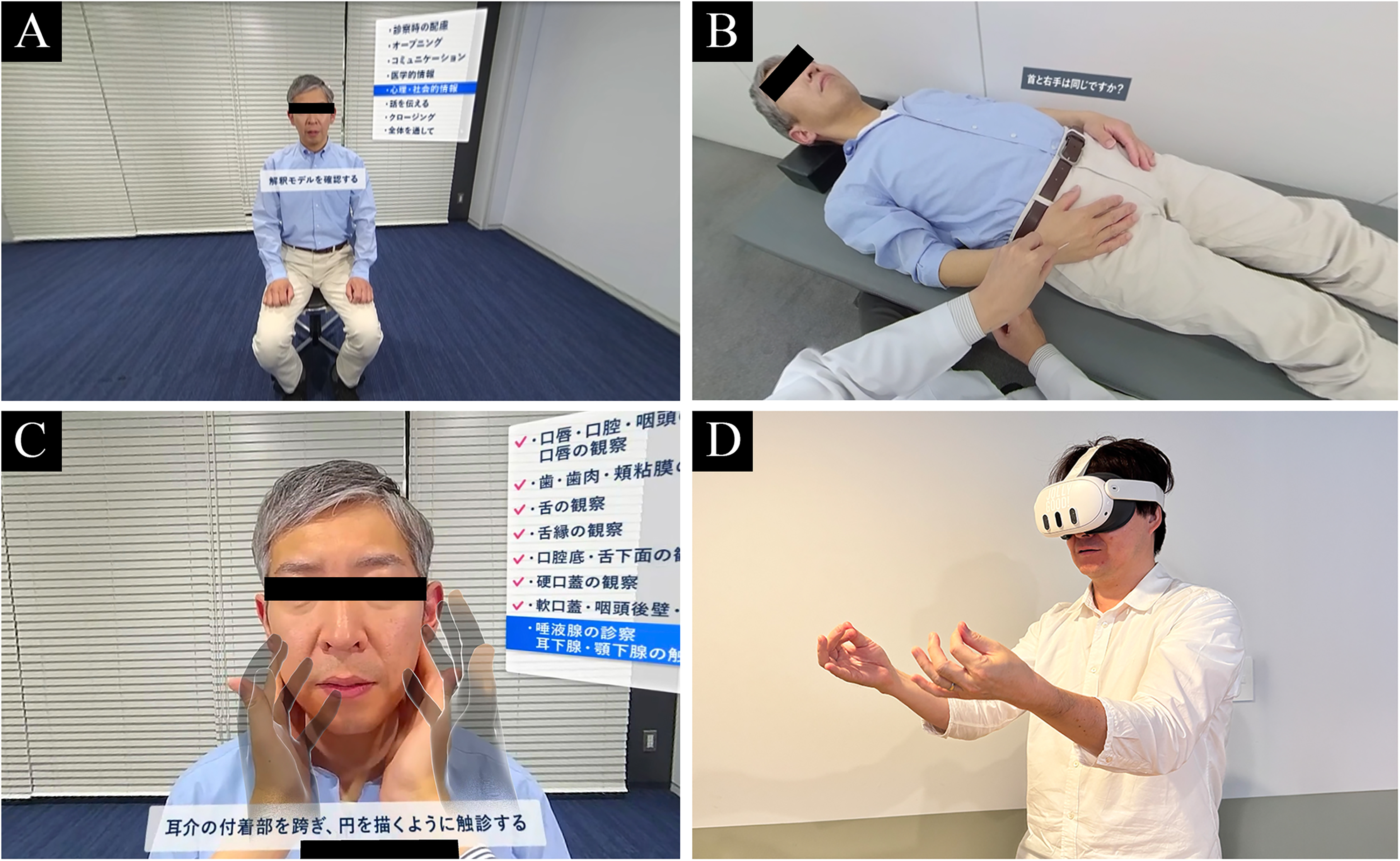
Virtual reality in use. A) History-taking scenario. B) Physical examination scenario. C) Using the hand-tracking function in the physical examination scenario. D) User wearing a virtual reality headset.
The tool incorporates hand-tracking technology which enables users to interact with VR experiences in a more natural and immersive manner, with complete awareness of their hand's position (Figure 1). This function is intended to enhance a sense of presence; however, it should be noted that users are not able to manipulate virtual objects or perform interactive procedural actions, and no haptic or force-feedback devices are used. Consequently, the hand-tracking feature is limited to the visual representation of hand position.
The tool comprises 20 scenarios, each with a duration of approximately 5 to 15 min. The primary objective of this tool is to train non-clinical-year medical students in Japanese medical schools to pass the nationally standardized OSCE, which was implemented by the Common Achievement Testing Organization. We speculated that the realistic and immersive experience of the flow of medical treatment in Japanese would make it particularly effective for IMGs.
Measures
Referring to previous studies,26–29 we developed a self-administered questionnaire and distributed it to the study participants before and after the VR training period (Supplementary file 1). The questionnaire was web-based and used SurveyMonkey, an online survey platform, and consisted of both closed-ended and open-ended questions.
The pre-survey incorporated sociodemographic questions, including age, gender, nationality, race or ethnicity, and the alma mater medical school. The survey also asked about prior experience of training with VR tools.
The post survey included the Japanese version of the Usefulness, Satisfaction, and Ease of Use Questionnaire-Lite (J-USE-Lite). The USE has good reliability and validity and has been internationally used to assess the metrics of usability. 30 However, given that it consists of 30 items, Shanklin et al developed a shorter version with 15 items, the USE-Lite, in the U.S. in 2022. 31 The psychometric properties of this version have been closely examined. 31 The items are classified into four dimensions: usefulness (Q1-4), ease of use (Q5-9), ease of learning (Q10-12), and satisfaction (Q13-15). Each item is answered on a seven-point Likert scale, ranging from 1 (strongly disagree) to 7 (strongly agree), with higher scores indicating greater subjective usability. In the present study, after obtaining permission from the original authors, we translated the USE-Lite into Japanese in accordance with a cross-cultural adaptation guideline. 32 The translation procedure included forward translation, synthesis, back-translation, expert review, feedback from the original authors, and pretesting. 32 In our dataset, the value of Cronbach's alpha was 0.96 for all 15 items. The alpha values for the dimensions of usefulness, ease of use, ease of learning, and satisfaction were 0.95, 0.94, 0.90, and 0.89, respectively. These values were all above 0.70, indicating the good internal consistency reliability of the scale. 33
The study participants were asked about their confidence in H&P in Japanese before and after the VR training period. Answers were given on a five-point Likert scale: 1 = Unable to perform it, 2 = Perform it with much help, 3 = Perform it with some help, 4 = Perform it with minimal help, and 5 = Perform it easily and with fluidity. The participants were also asked to rate their motivations to learn basic clinical skills in Japanese on a global rating scale ranging from 0 (lowest) to 10 (highest) before and after the VR training period. The global rating scale was developed with reference to previous studies.27,34–36 We used the global rating scale because motivation is a multifaceted concept, and the scale allows us to better capture these subtle nuances.27,34–36
Both the pre- and post-intervention survey included free-text questions. The pre-intervention questionnaire included an open-ended question about feelings regarding H&P in Japanese at the timing of study participation. The objective of this inquiry was to broadly explore the sentiments and reflections of the study participants regarding these basic clinical skills in Japanese. The post-intervention questionnaire also incorporated open-ended questions to elicit the participants’ perceived learning outcomes and culture-specific insights.
Data Analysis
The responses to items regarding participant profile and the J-USE-Lite were analyzed by descriptive statistics. Pre-post analysis regarding confidence in H&P and motivation to learn basic clinical skills in Japanese was performed using the paired t-test. For all analyses, a p-value of less than 0.05 was considered statistically significant. All quantitative data analysis was performed using SPSS version 30.0.0.0 (IBM Corp).
Responses to the open-ended questions were analyzed by inductive content analysis. 37 Referring to previous studies,38,39 we performed the inductive content analysis as follows: first, the first author iteratively read the responses to familiarize himself with them. Second, he generated initial codes. Third, all authors repeatedly discussed and reviewed the codes, and reached a consensus. The content analysis was performed using Microsoft Excel version 16.100.1.
Ethical Considerations
Ethical approval for this study was received from the Ethics Committee of Juntendo University Faculty of Medicine (No. E25-0120). The study participants provided written consent to participate.
Results
Of the 129 IMPEM FY2025 participants, the first 15 individuals who applied to participate in the study were enrolled, all of whom provided written informed consent. Table 1 summarizes the profile of the study participants. Most were women (8, 53.3%), aged 25–29 years (7, 46.7%), Japanese nationals (9, 60.0%), and of Asian race or ethnicity (13, 86.7%). Eight participants (53.3%) graduated from a medical school outside of Asia, including Europe (6, 40.0%), North America (1, 6.7%), and South America (1, 6.7%). Fourteen (93.3%) had no prior experience of VR-based medical education.
Participants’ Characteristics.

Multiple answers allowed
Table 2 shows the descriptive statistics of the J-USE-Lite in our dataset. Item-level responses are provided in Supplementary file 2. The mean score of the J-USE-Lite was 5.13. The highest mean domain score was 5.62 for ease of learning.
Descriptive Statistics of the J-USE-Lite.

Abbreviation: J-USE-Lite, the Japanese version of the Usefulness, Satisfaction, and Ease of Use Questionnaire-Lite
Pre-post analysis of confidence in H&P skills and motivation to learn them in Japanese is shown in Table 3. A paired t-test indicated a significant improvement in confidence in physical examination skills in Japanese improvement (pre: 3.40 (0.83) versus post: 4.13 (1.06), p = 0.03). Positive but non-significant trends were observed for confidence in history-taking (pre: 3.73 (0.80) versus post: 4.27 (0.96), p = 0.09) and for motivation towards learning basic clinical skills in Japanese (pre: 8.33 (1.76) versus post: 8.40 (1.88), p = 0.85).
Pre-Post Analysis of Confidence in H&P Skills and Motivation Towards Basic Clinical Skills Learning in Japanese.

Abbreviations: H&P, history-taking and physical examination; SD, standard deviation
Table 4 shows the results of the content analysis of responses to the free-text questions in the pre- and post-education questionnaires. Ten individuals provided responses to the pre-intervention free-text question regarding H&P in Japanese. The following two themes emerged: “gap in the medical curriculum and clinical customs” (5, 50%) and “practical challenges in H&P skills” (5, 50%). In the post-intervention questionnaire, 13 participants commented on the impact of the VR-based education on learning H&P skills in Japanese. The most emergent theme was “acquisition of H&P skills” (10, 76.9%), within which a sub-theme of “practical learning.” (4, 30.8%) captured reports of practical skills in Japanese healthcare settings. The second-most emergent theme was “psychological and emotional effect” (3, 23.1%). Ten participants answered the question on aspects of patient interaction and culture unique to working in Japanese medical settings, identified as new learning points through the VR-based education. Eight (80.0%) recognized the importance of “patient-centered consideration,” including attitudinal, linguistic, and physical consideration. Two (20.0%) obtained “insights into clinical process and learning.”
The Results of Inductive Content Analysis of the Responses to Free-Text Questions.

Abbreviations: H&P, history-taking and physical examination; VR, virtual reality
The percentages were calculated using a denominator of 10 (the number of the total codes).
The percentages were calculated using a denominator of 13 (the number of the total codes).
The percentages were calculated using a denominator of 10 (the number of the total codes).
Discussion
In this study, we explored the feasibility and perceived impact of VR-based education in supporting IMGs in Japan to develop H&P skills. We found three noteworthy findings. First, the VR tool used in this study had acceptable usability for IMGs in Japan. Second, the pre-post analysis suggested that there were notable positive trends in confidence in H&P skills and motivation to learn basic clinical skills in Japanese. Specifically, self-reported confidence in physical examination skills statistically significantly improved. Third, in qualitative analysis, although the pre-intervention questionnaire indicated the difficulty of IMGs in developing H&P skills in Japanese, the post-intervention questionnaire indicated perceived gains in H&P skill acquisition and culture-specific learning, such as patient-centered considerations. The findings of this study suggest that VR can function as a helpful adjunct for IMGs who face linguistic and cultural barriers in Japanese clinical settings, particularly as a learner-acceptable tool for adaptation support.
We found that the usability of the educational VR-based tool, as evaluated by the J-USE-Lite, was generally favorable in this study. Overall mean score was 5.13 out of 7, suggesting acceptable perceived usability. Among the domains, mean score was highest for ease of learning (5.62/7), indicating that respondents found the system intuitive and straightforward to operate. These findings are noteworthy given that usability is crucial in utilizing technology and learning in medical education, 40 albeit that no formal cutoff values for the USE-Lite and its translated versions have been established. The high ease of learning score suggests that the VR tool may be feasible for integration into training programs for learners from diverse linguistic and cultural background. This interpretation is consistent with the Technology Acceptance Model, which indicates that perceived ease of use is a key determinant of technology acceptance, alongside perceived usefulness. 41 In this model, systems that are perceived as easy to use are more likely to be accepted and utilized, potentially reducing barriers to adoption and facilitating engagement in this context. Future studies could further validate our findings by examining the interpretability and benchmarking of the J-USE-Lite against other usability instruments (eg, System Usability Scale 42 ).
In this study, self-reported confidence in performing physical examinations improved after VR-based education. The results align with previous studies indicating that immersive VR experiences may support experiential learning, which can translate into improved self-efficacy and confidence.43,44 This finding, however, should be interpreted as reflecting perceived learning rather than demonstrated clinical competence, as no objective performance assessment was conducted. Confidence in history-taking showed an upward but non-significant trend, which appears to reflect language-related challenges rather than a lack of educational effect; this is consistent with literature suggesting that clinical communication remains one of the most substantial barriers for IMGs.45–47 In the VR system used in this study, although Japanese subtitles were provided, no translation or multilingual support was available, which may have limited its impact on confidence in history-taking. Additionally, motivation to learn H&P skills in Japanese demonstrated a slight but positive change, in line with literature suggesting that exposure to VR-based learning may enhance learner's motivation and engagement towards learning.48,49 Thus, our findings suggest that VR can provide a supportive learning experience that promotes confidence and sustains motivation for H&P learning among IMGs, while it remains to be determined whether such perceptions translate into objectively measurable skill improvement.
In our study, the qualitative analyses complemented the quantitative results by clarifying the specific challenges faced by IMGs and how VR may address them. Pre-intervention responses underscored two recurrent barriers: “gap in the medical curriculum and clinical customs” and “practical challenges in H&P skills.” While consistent with the literature, 50 these barriers may be amplified by Japan's unique medical education system, examination customs, and monoethnic culture.51,52 The post-intervention findings further expanded on culture-specific learning: participants emphasized patient-centered considerations (attitudinal, linguistic, and physical) and reported new insights into clinical process and learning strategies in Japanese settings. Additionally, the finding that participants perceived “acquisition of H&P skills” as the key outcome, with “practical learning” emerging as a sub-theme, reinforced the view that immersive VR facilitates active engagement and bridges the gap between theoretical knowledge and practical application. 53 Importantly, these qualitative findings should be understood as reflecting learners’ perceptions rather than objective evidence of competence gain. Thus, the qualitative insights derived from this study suggest that VR-based education may help learners become familiar with practical aspects of clinical skills and develop cultural awareness, both of which are crucial for successful clinical adaptation in Japanese clinical settings among IMGs.
The present study had some potential limitations. First, the sample size was small due to the limited number of devices available to us at a single center. The study's design, which exclusively included the first 15 applicants, may have resulted in the selection of participants who were particularly motivated or proficient in technology. Individuals with IMGs who exhibited lower levels of learning motivation and/or technological proficiency were less likely to engage in the study. Caution should thus be exercised when generalizing the results. Future studies should include more IMGs across Japan. Second, the majority of participants in this study were Japanese-national IMGs. While these individuals met the formal definition of IMGs, they were likely to experience fewer cultural and/or linguistic barriers in Japanese clinical contexts than foreign-national IMGs. This demographic skew may limit the applicability of our findings to IMGs facing pronounced cultural adaptation and language barriers. Instead, our results would primarily capture the educational impact of the VR tool for learners who possess substantial cultural familiarity with Japan but have received their undergraduate medical education abroad. Given the challenges that IMGs who are foreign nationals are likely to face in Japan's clinical environment compared to those who are Japanese nationals, future studies should prioritize their inclusion in the participant pool. Third, because no similar studies have appeared in Japan, the reliability and validity of the questionnaire employed in this study have not been examined. We therefore developed it with reference to previous studies. Additionally, we developed the J-USE-Lite in accordance with a cross-cultural adaptation guideline. Fourth, the one-group pretest–posttest design without a comparison group limits causal inference. Observed changes thus cannot be attributed solely to the VR-based educational initiatives. Fifth, the study was based solely on self-reported data; we could not objectively assess H&P skills in this study. Self-reported confidence does not always correlate with clinical competence. Accordingly, in future research, H&P skills before and after the VR-based education should be evaluated using objective tools, including OSCEs. Sixth, we did not calculate the sample size in advance. We believe that this study can be employed in effect size estimation for future studies.
Despite these potential limitations, our study has important implications. The findings suggest that VR-based education may serve as a supplementary educational approach for supporting IMGs preparing for clinical practice in Japan. The favorable usability profile indicates that the VR tool used in the study can be implemented with minimal technical burden and is well accepted by learners from diverse backgrounds. Given that IMGs frequently have limited opportunities to develop H&P skills on patients in Japanese clinical environments, VR-based education, which is repeatable and self-paced, can offer useful clinical opportunities for practice and familiarization. Additionally, this education may support IMGs’ awareness Japan's distinct medical practices and clinical culture.
Conclusion
This study assessed the perceived impact of a VR-based education program in supporting IMGs in Japan to develop H&P skills. The VR tool showed acceptable usability, particularly in terms of ease of learning, suggesting that it can be utilized with minimal barriers. A pre-post analysis revealed a significant improvement in self-reported confidence in physical examination and non-significant upward trends in history-taking and learning motivation, while qualitative findings suggested perceived gains in practical skill acquisition and cultural awareness. Taken together, these findings suggest that VR-based education may serve as a helpful adjunct for IMGs and would be a feasible and learner-acceptable approach to nurturing fundamental clinical competencies and supporting adaptation for IMGs in Japanese clinical environments. However, given the small sample size and the reliance on subjective outcomes without objective performance assessment, these findings should be interpreted cautiously. Future studies using larger samples from diverse backgrounds (particularly IMGs who are foreign nationals) and objective performance measures are needed to establish the extent of educational benefit.
Supplemental Material
sj-pdf-1-mde-10.1177_23821205261443614 - Supplemental material for Perceived Impact of Virtual Reality-Based Education for History-Taking and Physical Examination Skills among International Medical Graduates in Japan: A Feasible One-Group Pretest-Posttest Study
Supplemental material, sj-pdf-1-mde-10.1177_23821205261443614 for Perceived Impact of Virtual Reality-Based Education for History-Taking and Physical Examination Skills among International Medical Graduates in Japan: A Feasible One-Group Pretest-Posttest Study by Hirohisa Fujikawa, Hirotake Mori, Kayo Kondo, Yuji Nishizaki, Yuichiro Yano and Toshio Naito in Journal of Medical Education and Curricular Development
Supplemental Material
sj-pdf-2-mde-10.1177_23821205261443614 - Supplemental material for Perceived Impact of Virtual Reality-Based Education for History-Taking and Physical Examination Skills among International Medical Graduates in Japan: A Feasible One-Group Pretest-Posttest Study
Supplemental material, sj-pdf-2-mde-10.1177_23821205261443614 for Perceived Impact of Virtual Reality-Based Education for History-Taking and Physical Examination Skills among International Medical Graduates in Japan: A Feasible One-Group Pretest-Posttest Study by Hirohisa Fujikawa, Hirotake Mori, Kayo Kondo, Yuji Nishizaki, Yuichiro Yano and Toshio Naito in Journal of Medical Education and Curricular Development
Footnotes
Acknowledgments
The authors would like to express their appreciation to the study participants. The authors also would like to acknowledge ChatGPT-5 and ChatGPT-5.2 from OpenAI for their valuable assistance in refining the academic writing.

Authors’ Contributions
HF conceived the study with input from HM, KK, YN, YY, and TN. The scale translation was primarily conducted by HF and KK. All authors subsequently reviewed the scale and confirmed it. HF conducted the data analysis, which was reviewed by HM, KK, YN YY, and TN. HF drafted the manuscript. Finally, all authors discussed, proofread, and approved the final version of the manuscript.
Ethics Considerations
We conducted this study in accordance with the Declaration of Helsinki and relevant guidelines. The Ethics Committee of Juntendo University Faculty of Medicine approved this study (No. E25-0120).
Consent to Participate
All study participants read a description of the study and provided written informed consent.
Funding
This work was funded by Creating training hubs for advanced medical personnel (supporting the fostering of doctors with advanced clinical and research capabilities) by the Ministry of Education, Culture, Sports, Science, and Technology (grant number: N/A).
Declaration of Conflicting Interests
The authors declared no potential conflicts of interest with respect to the research, authorship, and/or publication of this article.
Data Availability Statement
The datasets generated and analyzed in this study can be made available upon reasonable request.
Supplemental Material
Supplemental material for this article is available online.
References
Supplementary Material
Please find the following supplemental material available below.
For Open Access articles published under a Creative Commons License, all supplemental material carries the same license as the article it is associated with.
For non-Open Access articles published, all supplemental material carries a non-exclusive license, and permission requests for re-use of supplemental material or any part of supplemental material shall be sent directly to the copyright owner as specified in the copyright notice associated with the article.
