



Abstract
Background
Although curricular research training is a critical component of undergraduate medical education, the potential added value of extracurricular research activities remains inadequately investigated. This cross-sectional online survey-based study investigates the impact of combining curricular and extracurricular research training versus curricular training alone on undergraduate medical students’ confidence in their research skills, aiming to identify more effective approaches.
Methods
A cross-sectional study using the Students’ Confidence in Basic Research Skills Questionnaire was conducted. This newly developed instrument comprises 14 items, each rated on a 5-point Likert scale. Content validity was established by a panel of experts in medical education and research assessment. Pilot testing preceded data collection. Snowball sampling was used to collect responses from 633 clinical-phase students at five of seven medical schools in Palestine. Data were analyzed using descriptive statistics, independent t-tests, general linear model (GLM), and binary logistic regression.
Results
Students who received combined training (n = 394) reported higher mean confidence scores than those receiving curricular training alone (n = 239) (40.1 vs 32.9, p < 0.001); however, both groups scored below the benchmark for adequate confidence. In the GLM, extracurricular training, prior research involvement, and prior publication were independently associated with higher confidence, while fifth-year students reported lower scores than sixth-year students. Gender was not significantly associated. In the sensitivity analysis, prior publication emerged as the only independent factor associated with adequate confidence (aOR = 3.87, 95% CI [1.13, 13.2], p = 0.031).
Conclusion
Combining curricular and extracurricular research training was associated with higher confidence in research skills, yet overall confidence remained suboptimal. Experiential engagement—particularly completing and publishing research—appears central to developing high-level confidence. These findings underscore the need for integrated, practice-oriented research training that enables authentic participation across the full research process, especially in resource-limited educational settings.
Introduction
The integration of research training into undergraduate medical education has gained increasing importance with the global shift toward evidence-based medicine.1–4 Research literacy is now regarded as a core competency for all physicians—not only academic clinicians—due to the rising complexity of clinical decision-making, which demands the ability to critically appraise and apply scientific evidence.5–7 As a result, effective training in medical research methodology has become essential within undergraduate medical curricula.
Globally, medical schools have incorporated research components into their programs, typically including instruction in research methodology, biostatistics, and supervised projects. 8 However, emerging literature suggests that formal curricular training alone may not sufficiently equip students with the confidence or skills required to conduct independent research.9,10 Contributing factors include inadequate mentorship, lack of institutional support, and limited emotional encouragement. 11 Despite structured training, many students report feeling underprepared to engage in research or contribute meaningfully to scientific work. 12
In the Middle East, several studies echo these concerns. For instance, a multi-center study in Saudi Arabia identified academic workload as a key barrier to student research involvement. 13 Similarly, in the United Arab Emirates, while students generally expressed positive attitudes toward research, gaps in practical experience, difficulties navigating literature sources, and a lack of methodological education were reported. 14 Time constraints and limited funding were also frequently cited as obstacles. 15
In response to these limitations, extracurricular research initiatives have emerged as valuable supplements to formal curricula. 16 Recent studies show that structured extracurricular programs—such as peer mentorship, journal clubs, and independent research opportunities—can enhance research competencies and foster long-term engagement. 17 However, access to these opportunities varies widely across regions. In many low- and middle-income countries, such as Palestine, limited institutional resources often hinder the effectiveness of formal research training. 18 In these contexts, extracurricular initiatives may serve as the primary avenue for gaining practical research experience. Moreover, cultural and institutional constraints can affect students’ participation in these opportunities, emphasizing the need to evaluate research training within its local context. 18
In Palestine, medical students gain research exposure through both curricular and extracurricular pathways. While curricular training is mandatory and structured, extracurricular training often occurs through student-led initiatives or faculty-supported programs. 19 Notably, extracurricular research training in Palestine is unstandardized, with wide variation in duration, structure, and intensity. They take the form of informal workshops organized by non-governmental organizations or student research societies, as well as peer-led events. Despite their shared goal of enhancing research competence, the relative effectiveness of these two approaches remains unclear.
This study aims to assess the impact of combining curricular and extracurricular research training compared to curricular training alone on undergraduate medical students’ confidence in research skills. In educational research, confidence in skills is often conceptualized as a form of self-efficacy, which Bandura defines as individuals’ beliefs in their capability to perform specific tasks successfully. 20 While self-efficacy differs from objectively measured confidence, 21 it is strongly associated with motivation, persistence, and future engagement in complex activities, such as research. Therefore, self-reported confidence in basic research skills serves as a meaningful educational outcome and a practical indicator of students’ perceived readiness to engage in research. Given the resource limitations and evolving educational landscape in Palestine and similar settings, 19 understanding the influence of training modalities on students’ confidence can inform the development of more comprehensive and context-appropriate research education strategies.
Materials and Methods
Study design and setting
A survey-based, cross-sectional study design was used to explore the impact of combined curricular and extracurricular research training, compared with curricular research training alone, on the confidence of undergraduate clinical-phase medical students in their research competencies. The study population included undergraduate medical students in their clinical training phase at all of the medical schools in the West Bank of Palestine (n = 5), who had already completed their curricular research training. Medical schools in the Gaza Strip were excluded from this study due to the disruption of medical education as a result of the conflict during the time of the study.
Study sample and recruitment of the participants
From around 5000 medical students across medical schools in the West Bank, a total of 633 medical students participated in this study. The participants were recruited using a snowball sampling technique, which facilitated participants’ recruitment by overcoming the lack of a centralized database of medical students at these schools. When participating, students were asked to share the survey with their peers, which facilitated the dissemination of the survey across medical schools in the West Bank (five out of the total seven medical schools in the country). Using this method enabled us to efficiently collect an adequate and institutionally diverse sample, despite restricted direct access to students. However, the use of a snowball sampling technique may have introduced a selection bias, where students with a research interest may be more likely to fill out the survey, and therefore, they may have been overrepresented. The inclusion criteria included: (1) being medical students in the clinical phase of training, and (2) having completed their curricular research training. Participants who were unable to meet these criteria were excluded from the study. The study sample size was calculated using the following formula: n = N * x/((N − 1) E2 + x), where N represents the total population size, and x is derived from the Z-score of 1.96 (for a 95% confidence level). The minimum recommended sample size was estimated to be 357 students, given an estimated population size (N) of 5000 students, a margin of error (E) of 5%, and a response distribution of 50%. The fact that the final sample exceeded the minimum recommended sample size may have helped minimize the limitations of non-probability sampling and enhance the study's generalizability.
Survey construct, validation, and data collection
Data were collected via an anonymous online survey created in Google Forms, with responses saved in Google Spreadsheets. The research team collected the data from February 2025 to March 2025. The survey consisted of a total of 20 questions, organized into two sections: (1) sociodemographic characteristics and prior research experience of the students (6 questions), and (2) students’ self-reported confidence in research skills (14 questions). The second section of the survey included the Students’ Confidence in Basic Research Skills (SCBRS) questionnaire, which was newly developed to capture confidence in core research competencies relevant to undergraduate medical education. 22 Item generation was guided by the Association for Medical Education in Europe guide on developing research skills in medical students, which outlines fundamental competencies across the research process, including study design, data collection, analysis, interpretation, and dissemination. 23 Based on this framework, the research team drafted an initial pool of items representing these domains, resulting in a 14-item instrument, with each item rated on a 5-point Likert scale ranging from “not at all confident” (1) to “extremely confident” (5) (Supplemental Materials 1).
The questionnaire was written in English as the official teaching language in Palestinian medical schools. To establish content validity and ensure clarity, relevance, and alignment with educational objectives, the draft questionnaire was reviewed by a panel of experts in medical education, research methodology, and undergraduate research training. Revisions were made based on their feedback to refine the wording and scope of the item. The instrument subsequently underwent pilot testing with 40 medical students who met the study eligibility criteria. Feedback from the pilot phase informed minor modifications to item phrasing and survey flow, and pilot responses were excluded from the final analysis.
The internal consistency of the SCBRS in the main study sample was excellent (Cronbach's α = .969), indicating a high degree of reliability. However, beyond expert review and internal consistency assessment, formal psychometric validation procedures—such as exploratory or confirmatory factor analysis—were not conducted. Accordingly, the SCBRS should be regarded as a newly developed instrument with preliminary evidence of reliability and content validity. The present study contributes initial empirical support for its use, while further validation in independent cohorts is warranted to establish its construct validity and dimensional structure.
Study variables
The study assessed several sociodemographic variables, including gender, academic year, and university affiliation. Additionally, students’ prior research experience was evaluated as a possible contributing factor. The primary outcome measure of the study was the SCBRS Score, ranging from 14 to 70, which was computed from 14 Likert-scale items rated from 1 (not at all confident) to 5 (extremely confident). 22 For descriptive and analytic purposes, a score of 56 (corresponding to 80% of the maximum possible score) was used to indicate “adequate” confidence in basic research skills. Although no standardized cut-offs exist for this newly developed scale, the 80% threshold was selected based on conventions commonly applied in educational research and knowledge–attitude–practice studies, where Bloom's criteria are frequently used to classify high levels of attainment or mastery. Within this framework, scores of 80% or higher are typically interpreted as reflecting a high or satisfactory level of achievement. This benchmark was adopted to represent a stringent and educationally meaningful level of confidence expected of medical students preparing to engage in scholarly activity. However, this cut-off is pragmatic rather than empirically derived and should be interpreted with caution.
Data analysis
Data analysis was performed using SPSS Version 27.0. Descriptive statistics, including frequencies, percentages, means, and standard deviations, were calculated to summarize the participants’ sociodemographic characteristics and main study variables. Independent samples t-tests were used to compare mean confidence scores between students who received both extracurricular and curricular research training and those who received only curricular training. Differences in SCBRS scores across universities were examined using one-way analysis of variance (ANOVA). Because no statistically significant between-university differences were observed, university affiliation was not retained as a covariate in the multivariable models in order to preserve model parsimony. Furthermore, a multivariable General linear model (GLM) with the total SCBRS score as the continuous dependent variable was used to identify the factors independently associated with the SCBRS score, adjusting for variables such as gender, year of study, research experience, and type of research training received. A multivariable binary logistic regression model with the adequate confidence state (threshold ≥80%) as the dichotomous dependent variable was used in a sensitivity analysis of the GLM results. Statistical significance was set at a p < .05.
Ethical consideration
This study adhered to the principles outlined in the Declaration of Helsinki. Ethical approval was granted by the Institutional Review Board of the Arab American University of Palestine, Ramallah Campus, under the approval code R-2025/A/14/N. At the beginning of the online survey, participants were provided with an information sheet detailing the purpose of the study, followed by an informed consent form. Participation was entirely voluntary, and students were assured they could withdraw from the study or exit the survey at any point without any consequences. To ensure confidentiality, no personal-identifying information was collected at any stage of the study.
Results
Sociodemographic characteristics
A total of 633 undergraduate medical students from all the medical schools in Palestine participated in the study. The majority of participants were fourth-year students (52.8%), followed by fifth-year (25.8%) and sixth-year students (21.5%). The students were distributed across five universities, with A University (25%) and B University (24.2%) representing the largest proportions. Regarding the type of research training, 394 (62.2%) students received both extracurricular and curricular research training, while 239 (37.8%) students received curricular training alone. Additionally, 59.2% had worked on a research project previously, but only 25.8% had published any research articles (Table 1).
Sociodemographic Characteristics of the Participants.

Comparison of confidence in research skills
The combined training group reported a significantly higher total confidence score (40.1 ± 8.92) compared to the curricular-only group (32.9 ± 10.12, p < .001), though both remained below the confidence threshold (≥56 out of 70) (Figure 1). No statistically significant differences in mean SCBRS scores were observed across universities (one-way ANOVA, p > .05). Across all assessed research skills, students who received both curricular and extracurricular training demonstrated significantly higher confidence (p < .001). Notable differences included higher mean scores in selecting study design (2.97 vs 2.34), data collection methods (2.96 vs 2.40), data analysis (2.73 vs 2.18), manuscript writing and submission (2.78 vs 2.19), and using software for data analysis and referencing (2.71 vs 2.15) (Table 2).

Mean Students’ Confidence in Basic Research Skills in relation to the study groups. The combined training group reported a higher total confidence score compared to the curricular-only group (40.1 ± 8.92 vs 32.9 ± 10.12, p < .001); however, both remained below the pre-set confidence threshold (≥56 out of 70).
Comparison of Students’ Confidence in Applying Basic Research Skills between the extracurricular and curricular research training versus the curricular research training alone groups.

Note. Bold p-values indicate statistically significant (p < .05).
Multivariate regression analysis
The multivariable GLM with the total SCBRS score as the continuous dependent variable showed that extracurricular factors were the strongest drivers of research self-confidence. Specifically, participation in extracurricular research training emerged as the strongest factor independently associated with the total SCBRS (ηp2 = .055, p < .001). Students lacking extracurricular training score an average of 4.90 points lower than their trained peers (95% CI [−6.50, −3.31]). Furthermore, scholarly output and active engagement were significantly associated with the SCBRS score; students who had not published research articles scored 3.49 points lower (95% CI [−5.37, −1.61], p < .001), and those who had never worked on a research project scored 2.07 points lower (95% CI [−3.87, −0.27], p = .024) than those with such experience.
Regarding the academic year, fifth-year students reported significantly lower confidence than sixth-year students (B = −2.68, 95% CI [−4.86, −0.51], p = .016), whereas no significant difference was observed for fourth-year students (p = .161). Notably, when accounting for research training and experience, gender did not reach statistical significance (B = 1.46, p = .061) (Table 3; Figure 2). A sensitivity analysis using multivariable binary logistic regression (threshold ≥80%) corroborated these findings, identifying that
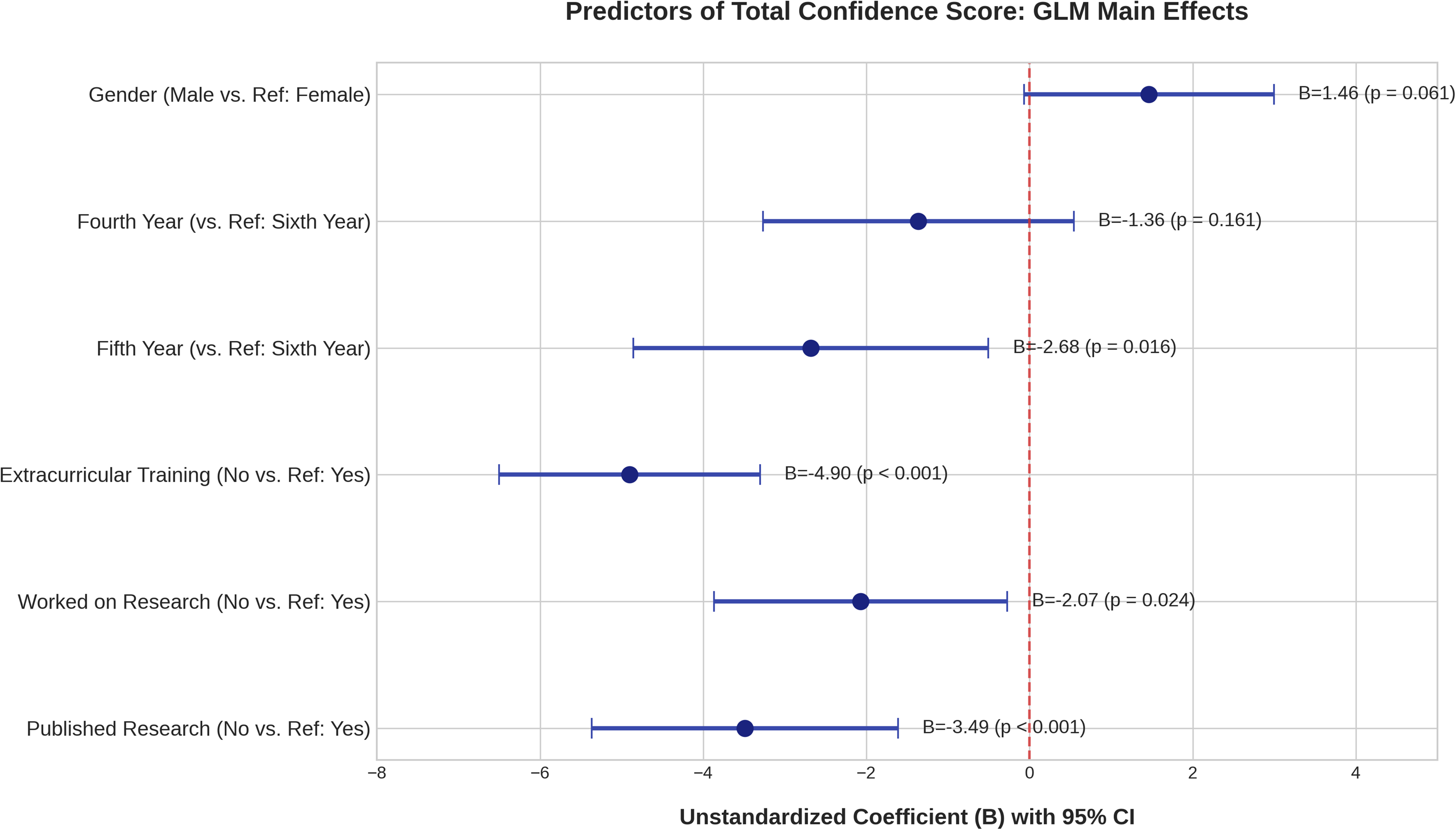
Forest plot of predictors for SCBRS. This forest plot illustrates the results of the multivariable general linear model (main effects only), displaying the unstandardized B coefficients and their corresponding 95% CI for each predictor of the total SCBRS score. The vertical dashed line at zero represents the null effect. Points to the left of the line indicate a negative association with confidence scores, while points to the right indicate a positive association. Error bars represent the 95% CI. Statistically significant predictors (p < .05) are identified where the confidence interval does not cross the null line, most notably for extracurricular training, publication history, and research participation. B, unstandardized coefficient; CI, confidence interval; SCBRS, Students’ Confidence in Basic Research Skills.

Forest plot of adjusted odds ratios for predicting the adequate students’ confidence in research skills. This forest plot displays the results of a multivariable binary logistic regression analysis used as a sensitivity analysis. The model evaluates the factors associated with achieving “adequate” research confidence, defined as a SCBRS score of ≥80% (≥56 points). Data are presented as aOR with 95% CIs. The vertical dashed line at 1.0 represents the null effect; markers to the right of this line indicate increased odds of achieving adequate confidence. Error bars represent the 95% CI. As shown, prior publication of research articles remains the most associated factor with achieving adequate confidence in research skills (aOR = 3.87, p = .031). aOR, adjusted odds ratio; CI, confidence interval; SCBRS, Students’ Confidence in Basic Research Skills.
Multivariable general linear model of factors associated with total confidence scores in basic research skills.

Note. General linear model (main effects only). Model Fit: R2 = .195 (adjusted R2 = .187). SE, standard error. Significant values (p < .05) are in bold.
Multivariate binary regression model for students’ confidence state in their research skills.

aOR, adjusted odds ratio; aP-value, Adjusted p-value; CI, confidence interval; SE, standard error.
* Statistically Significant.
Discussion
This study assessed the impact of combining curricular and extracurricular research training compared to curricular training alone on Palestinian medical students’ confidence in research skills. The results show that students who engaged in both forms of training reported significantly higher confidence across all assessed research skills. However, confidence levels in both groups remained below the threshold for adequate confidence, highlighting important limitations in current research training strategies.
The consistently low confidence levels observed in both training groups should be understood within the broader educational and socio-political context of Palestine and other resource-limited settings. Medical education in these environments is shaped by structural barriers, such as limited access to research infrastructure, shortages of qualified mentors, insufficient funding, and competing academic and clinical responsibilities. Furthermore, political instability and movement restrictions disrupt educational continuity and collaboration. In this context, extracurricular research activities often represent the primary means for students to gain practical research experience. However, these initiatives are frequently informal, under-resourced, and reliant on individual motivation rather than institutional support. As a result, even students participating in both curricular and extracurricular training may lack sustained, mentored opportunities to complete comprehensive research projects, which likely contributes to the persistently low confidence levels observed. These findings highlight the need for context-sensitive educational strategies in Palestine and similar settings, where research training must be intentionally structured, adequately supported, and safeguarded from systemic disruptions to ensure that both curricular and extracurricular pathways provide meaningful, confidence-building scholarly experiences.
Combined training is associated with higher confidence but remains insufficient
Students who received both curricular and extracurricular research training demonstrated significantly higher overall confidence scores than those who received curricular training alone. This finding reinforces concerns raised in previous studies about the limited effectiveness of curricular research training when delivered in isolation. For example, Hren et al and Burgoyne et al found that while students appreciated the importance of research, curricular training alone often failed to translate into practical competence or confidence.5,24
Extracurricular research training has been widely recognized as a valuable supplement to the formal curriculum. Nazha et al reported improved student perceptions of research following peer-led extracurricular courses, 25 while Amgad et al and Wang et al highlighted improved competencies and research productivity among students involved in extracurricular research.9,26 Similarly, structured, needs-based extracurricular programs have been shown to significantly boost research skills and self-efficacy.27,28 A recent case-control study in Syria also confirmed that peer-led, extended extracurricular workshops led to greater gains in research knowledge and outcomes than curricular training alone. 29 These findings support the integration of structured extracurricular opportunities to bridge the practical training gaps in current medical curricula.
Despite the positive impact of combined training, both groups fell short of the adequate confidence threshold, indicating broader systemic challenges. In Palestine, limited mentorship, lack of standardization in extracurricular activities, and resource constraints may restrict the effectiveness of both curricular and extracurricular training. Moreover, the absence of practical, hands-on components in many programs could further undermine students’ ability to build real-world research competence.
Specific skill areas—such as study design, data collection, data analysis, and manuscript preparation—showed significantly higher confidence levels in the combined training group. This highlights the importance of integrating practical training elements into the core curriculum. It also suggests that well-structured extracurricular experiences can provide critical reinforcement for essential research competencies. Standardizing these extracurricular programs and enhancing mentorship support would likely improve their effectiveness and better prepare students for future research engagement.30,31 Although institutional culture and curricular emphasis could theoretically influence students’ research confidence, no significant differences in SCBRS scores were observed across the participating universities. These findings indicate a relatively uniform educational experience in research training across the sampled institutions and reduce the likelihood that the observed associations between training modality and confidence were confounded by university-specific factors.
Factors associated with students’ confidence in research
Analysis within a multivariable framework indicates that students’ confidence in research skills is a multifactorial construct shaped primarily by experiential rather than demographic factors. The GLM shows that engagement in extracurricular research training, prior involvement in research projects, and prior publication experience each independently contribute to higher confidence levels. These findings suggest that confidence develops cumulatively through repeated and increasingly authentic exposure to the research process, rather than through curricular instruction alone.
Of these factors, extracurricular training exerts the strongest influence on overall confidence, supporting the view that learning environments beyond formal coursework provide essential opportunities for skill consolidation. These settings typically offer mentorship, peer interaction, and iterative practice, which are challenging to replicate within time-constrained curricula. Additionally, hands-on participation in research projects facilitates the transition from passive recipients of methodological knowledge to active contributors, thereby encouraging a sense of ownership and competence.
Notably, publication experience occupies a distinctive position within this continuum. While multiple forms of research exposure are associated with incrementally elevated confidence across the full score range, publication emerged in the sensitivity analysis as the sole determinant of “adequate” confidence, as defined by the stringent 80% benchmark. This divergence between the continuous and dichotomized models suggests that publication represents a threshold experience: it does not merely raise quantitative confidence, but also qualitatively distinguishes students who perceive themselves as genuinely prepared for independent scholarly engagement. In this sense, the convergence of the two analytic approaches supports the interpretive validity of the 80% benchmark as a pragmatic discriminator of high-level research readiness rather than as a purely statistical construct. The main conclusions were not materially altered under dichotomization.
Publishing may offer a powerful confidence boost by validating students’ capabilities and enhancing their academic identity. This is supported by studies such as those by Chang and Ramnanan et al, and Hanafi et al, which found that students who had published research expressed higher confidence and stronger future interest in research.29,32 These findings suggest that full-cycle research experiences—from planning to publication—are particularly impactful in developing research self-efficacy.
While other studies have noted demographic factors associated with confidence, such as gender,5,33 our findings did not support those associations. Instead, they align more closely with research emphasizing intrinsic motivation and meaningful engagement. Ommering et al, for example, found that curiosity and internal drive were stronger predictors of research involvement than academic background. 34 This reinforces the idea that motivation and opportunity—not just exposure—are critical to building confidence in research.
Confidence in research skills versus competency
Although confidence represents a significant educational outcome, its interpretation requires caution. Self-reported confidence does not necessarily reflect objective research competence, as a previous study has shown a divergence between perceived ability and actual performance. 21 In the present study, the SCBRS assesses students’ perceived preparedness rather than directly measuring research skills. Furthermore, confidence is shaped by individual factors not fully captured in the dataset, including intrinsic motivation, personal interest in research, and prior informal exposure to scholarly work. These unmeasured variables may help explain why some students report higher confidence despite receiving similar formal training.
Recommendation
The findings of this study highlight the need for curricular reform to enhance the effectiveness of research training in undergraduate medical education. Medical schools are encouraged to adopt an integrated approach that combines formal curricular instruction with structured extracurricular initiatives. Peer-led research courses, dedicated mentorship programs, and hands-on workshops are particularly recommended to bridge the gap between theoretical knowledge and practical research experience. To ensure quality and consistency, extracurricular training programs should be formally supervised, accredited, and aligned with curricular objectives. Implementing such a combined training strategy is especially beneficial in resource-limited settings, such as Palestine, where it can help address existing gaps and strengthen students’ research competencies. These initiatives should be designed to support students throughout the full research process—from study design to manuscript submission—to foster confidence and promote sustained academic engagement. Future research should explore the impact of combined training through randomized studies and assess its long-term effects on research performance after graduation.
Subsequent research should move beyond binary classifications of “curricular” and “extracurricular” training to examine the specific educational components that most effectively foster research confidence. Specifically, studies should quantify the intensity and nature of student engagement, including the duration of research involvement, hours dedicated to active projects, quality of mentorship, and participation in various phases of the research process, such as study design, data analysis, and manuscript preparation. Clarifying these elements will allow educators to determine which aspects of training are most influential and to develop targeted, evidence-based interventions that enhance research education within undergraduate medical curricula, particularly in resource-limited settings.
Limitations
This study has some limitations. The nature of the cross-sectional design limits the ability to determine a causal relationship regarding the effect of training modality on research confidence. However, it suggests an association between the training modality and confidence. Depending on the self-reported questionnaire, there is a potential for social desirability bias, where students tend to report answers that they believe are socially acceptable. Moreover, the focus on Palestinian medical schools may restrict the generalizability of these findings to other educational or geographic settings. Additionally, the use of a snowball sampling technique might have caused a selection bias, as participants are more likely to recruit peers with similar research interests, which potentially affects the results. To minimize this effect, multiple entry points were used, and respondents were encouraged to invite colleagues from different institutions. Additionally, the recruitment of an adequate sample size representing most of the medical schools in Palestine potentially minimized the effect of using a snowball sampling technique. Moreover, the exclusion of medical schools from Gaza is also a limitation; however, we expect that the results would not have changed significantly, as curricular and extracurricular training in these institutions is similar to that in the West Bank, and therefore, student experiences would not greatly differ. Furthermore, factors such as intrinsic motivation and the heterogeneous nature of the extracurricular research training were not fully accounted for and might have influenced the outcomes. The varying nature of the extracurricular training limited our ability to quantify or stratify these activities by intensity or quality. Finally, given the limited validation process for the questionnaire used, a full psychometric analysis, such as a confirmatory factor analysis, of this newly developed tool with preliminary validation remains necessary for its use in future research.
Conclusion
Combining curricular and extracurricular research training is associated with significantly higher students’ confidence in research skills compared to curricular research training alone. This study demonstrated that students who received curricular and extracurricular research training reported higher confidence in essential research skills, such as choosing the appropriate study design, data collection, analysis, and manuscript preparation, compared to those who received only curricular training. Extracurricular opportunities, particularly when peer-led and hands-on, are associated with greater knowledge, motivation, and ongoing research engagement. Although overall confidence levels remained below the threshold, the clear advantage of integrated training highlights the need for practical experiences to complement theoretical instruction and better prepare future physicians for evidence-based practice. An educational interventional study using a randomized trial to compare the effectiveness of combined curricular and extracurricular research training with curricular research training alone is recommended to provide higher-quality evidence. Future studies should quantify the intensity and nature of students’ engagement, including the duration of research involvement, hours spent on active projects, the quality of mentorship, and participation across different phases of the research process to enable educators to identify which aspects of training are most impactful and to design targeted, evidence-based interventions that optimize research education in undergraduate medical curricula, especially in resource-limited settings.
Supplemental Material
sj-docx-1-mde-10.1177_23821205261424381 - Supplemental material for The Impact of Extracurricular Research Training on Palestinian Medical Students’ Confidence in Their Research Skills
Supplemental material, sj-docx-1-mde-10.1177_23821205261424381 for The Impact of Extracurricular Research Training on Palestinian Medical Students’ Confidence in Their Research Skills by Ahmad Rjoub, Motaz Daraghma, Yazan Dumaidi, Mohammad A Nour, Dalya Abusnaina, Tareq Fiqyat, Hamza A Abdul-Hafez, Fadi Zaben and Malik Zaben in Journal of Medical Education and Curricular Development
Supplemental Material
sj-docx-2-mde-10.1177_23821205261424381 - Supplemental material for The Impact of Extracurricular Research Training on Palestinian Medical Students’ Confidence in Their Research Skills
Supplemental material, sj-docx-2-mde-10.1177_23821205261424381 for The Impact of Extracurricular Research Training on Palestinian Medical Students’ Confidence in Their Research Skills by Ahmad Rjoub, Motaz Daraghma, Yazan Dumaidi, Mohammad A Nour, Dalya Abusnaina, Tareq Fiqyat, Hamza A Abdul-Hafez, Fadi Zaben and Malik Zaben in Journal of Medical Education and Curricular Development
Footnotes

Ethical Consideration
This study adhered to the principles outlined in the Declaration of Helsinki. Ethical approval was granted by the Institutional Review Board of the Arab American University of Palestine, Ramallah Campus, under the approval code R-2025/A/14/N. At the beginning of the online survey, participants were provided with an information sheet detailing the purpose of the study, followed by an informed consent form. Participation was entirely voluntary, and students were assured they could withdraw from the study or exit the survey at any point without any consequences. To ensure confidentiality, no personal-identifying information was collected at any stage of the study.
Consent to Participate
Enrolled participants were provided with an information sheet detailing the purpose of the study and the nature of their participation. The first page of the online survey contained the written consent form. They consented to participate in this study electronically by answering a multiple-choice question that specified whether they understood the information sheet and agreed to participate voluntarily in this study. This method was deemed valid by the Institutional Review Board. Participation was entirely voluntary, and students were assured they could withdraw from the study or exit the survey at any point without any consequences. To ensure confidentiality, no personal-identifying information was collected at any stage of the study.
Authors’ Contributions
Ahmad Rjoub contributed to the conception and design of the work, the acquisition, analysis, and interpretation of data, drafting the manuscript, and critically revising it for important intellectual content. Motaz Daraghma, Yazan Dumaidi, and Mohammad A Nour contributed to the conception and design of the work, the acquisition of data, and drafting the manuscript. Dalya Abusnaina, Tareq Fiqyat, and Hamza A. Abdul-Hafez contributed to the acquisition of data and drafting the manuscript. Fadi Zaben and Malik Zaben contributed to the conception and design of the work, the analysis and interpretation of data, drafting the manuscript, and critically revising it for important intellectual content. All authors have read and approved the final manuscript. Furthermore, they provided final approval of the version to be published and agreed to be accountable for all aspects of the work.
Funding
The authors received no financial support for the research, authorship, and/or publication of this article.
Declaration of Conflicting Interests
The authors declared no potential conflicts of interest with respect to the research, authorship, and/or publication of this article.
Data Availability
The data sets generated and analyzed during the current study are available from the corresponding author upon reasonable request.
Supplemental Material
Supplemental material for this article is available online.
References
Supplementary Material
Please find the following supplemental material available below.
For Open Access articles published under a Creative Commons License, all supplemental material carries the same license as the article it is associated with.
For non-Open Access articles published, all supplemental material carries a non-exclusive license, and permission requests for re-use of supplemental material or any part of supplemental material shall be sent directly to the copyright owner as specified in the copyright notice associated with the article.
