




Abstract
This study explored how university students in North America acquired the ability to express their career-related competencies in the context of a pre-professional career education program. We examined the intersection of happenstance learning theory (HLT) and experiential learning theory (ELT) to facilitate significant experiences that inspired students and helped them connect with a profession. Through qualitative interviews with 19 students, we discovered three key insights. First, catalyzing experiences improved competency articulation, as planned experiences provided opportunities for pivotal educational moments and unexpected events that inspired and motivated students. Second, catalyzing experiences sparked action and transformative insights, enhancing students’ career readiness and ability to act on future opportunities. Third, transformation through catalytic experiences occurred through reflection, consolidating the significance of experiences and their personal career narratives. We discuss the practical implications of our findings for program leaders, including creating planned career-related experiences and guiding students toward effective competency articulation.
Keywords
Introduction
Important aims of university education include students developing and clarifying their professional goals and opportunities for graduation. Many argue that the competencies developed via university education are more valuable than the degree (e.g., Finch et al., 2013). Recognizing this, university funding in Canada, Australia, and the United Kingdom is partly contingent upon student competency development (Bridgstock, 2009). At the same time, employers often lament that students do not possess the required competencies for a successful transition to full-time employment, implying the existence of a skills gap that university education has yet to address (e.g., NACE, 2019; Stuckey and Munro, 2013). In contrast, others argue that students possess the competencies but lack the ability to effectively recognize and articulate these competencies (Strachan, 2016). Student competency identification and articulation have received limited research attention and may be a critical leverage point for reducing the perceived skills gap (Goodwin et al., 2019).
To address these challenges, university career education (CE) programs tackle competencies increasingly directly (N.A., 2023). Career practitioners 1 have traditionally brought these ideas to life through the practices of CE, such as helping with resumes, mentoring programs, interview preparation, and other activities that help students develop the knowledge and skills to succeed in specific professions. Arranging a diverse array of such CE activities encourages integrated learning and reflection and can be a promising approach to helping students (Finley, 2019). Yet, linking those activities with more hands-on, experiential, or applied learning may only deliver increased benefits with careful attention to the newly created interactions (Heinrich and Green, 2020). The emergence of holistic CE programs shows promise for advancing articulation (NACE, 2019). It includes a suite of resume writing and interview preparation coordinated with job shadowing, mentoring, volunteering, networking with industry professionals, guest speakers, and even internships. Holistic CE programs offer several advantages over traditional CE, such as greater focus on transferable skills, providing experiential learning opportunities, offering comprehensive support and guidance, recognizing that not all students move through career education at the same pace, and developing students’ adaptability and readiness for a dynamic labor market.
One of the most essential aims of CE is developing students’ career readiness. Career readiness refers to the knowledge, skills, and abilities that help people effectively navigate career paths and includes goal orientation, clarity of purpose, objectives, confidence, risk-taking, and learning from mistakes (Lent, 2013). CE activities advance career readiness when students develop and refine skills, articulate competencies, and later translate their knowledge, skills, and abilities for potential employers (Jackson and Bridgestock, 2021). CE activities contribute to student success when combined with program-level activities like reflections. Reflections are critical to authentic learning and agency, leading to competency articulation and skills translation (Moon, 2013). Regular assessment cycles, in turn, are a vital component of determining how CE activities work together to deliver a holistic set of learning and development outcomes. Because of the novelty and complexity of bundled CE programming, holistic CE programs have less visibility in assessment and program evaluation scholarship and fewer known patterns for practitioners to follow, adapt, and refine.
At the same time, CE professionals are trained educators who use theories and experience to plan and implement programs in applied ways while relying on evidence-driven conceptual and theoretical frameworks. Both theoretical and applied layers are important to achieve desired student outcomes. Experiential learning offers a family of theories relying on a basic premise:

Yet, educators must choose from dozens of potentially appropriate theories applied to various CE activities derived from different educational paradigms (experience, reflection, volunteering, etc). Each choice must be intentionally arranged or remixed for optimal performance (Heinrich and Green, 2020). Such a process requires an intentional assessment and program evaluation effort over time to ensure the delivery of intended outcomes.
An essential consideration for mixing experiential learning theories is understanding the underlying paradigm or assumptions and how several approaches might work together. Process theories of learning (see Engeström and Sannino, 2012) help describe steps and phases of learning that alternate between experience, reflection, knowledge, and application. Many of these approaches are understood as social constructivist theories, where students make meaning with educators, their experience, and their reflections. Kolb’s experiential learning cycle (1984) is an excellent example of a process theory used for training. While CE has training and practice applications, other aspects of career education require more personal exploration (Moon, 2013) or, for example, a justice orientation to non-profit work and learning where other theories can be helpful. Fenwick (2001) argued for the inclusion of multiple kinds of experiential learning theories–including feminist, Indigenous, and reflective, that more explicitly include a broader array of cognitive, affective, and social learning paradigms. By considering broad learning paradigms, educators begin to meet principles of equity, diversity, and inclusion, too (Vande Zande, et al., 2022).
This research contributes to career education scholarship by investigating when, how, and why students develop competency articulation skills during a multi-stage, holistic, pre-professional, co-curricular career education activity called Plus Programs. We explored where students begin and continue to articulate their skills. At the same time, we reviewed how a campus made specific plans to apply theory to practice to benefit learners, programs, and, ultimately, employers. We contribute to theoretical perspectives by observing how experiential learning theory (ELT) and happenstance learning theory (HLT) can and do work together to help program leaders make critical choices about their CE programs. By exploring how HLT and ELT intersect through catalyst moments within a CE program, our research contributes by extending and enriching both academic theories. We theoretically link the planned/unplanned experiences described by HLT with the accumulation of experiences, reflections, and actions consistent with the experiential learning cycle. In this context, we extend prior research by illustrating the significance of catalyzing experiences in prompting action, transformative insight, and competency articulation. Our findings also have practical implications because these catalytic experiences, when integrated into CE programs, contribute to students’ career readiness. We explore qualitative data from students in a holistic career education experience to better understand the interactions of multiple activities and locate catalyst moments where students integrate their knowledge, skills, abilities, and purpose.
Research Model and Literature Review
Figure 1 illustrates our research model, which describes the reciprocal paths by which we expect co-curricular career education to influence student competency articulation. Conceptual Framework for the Plus Program, Experiential Learning theories, and Outcomes.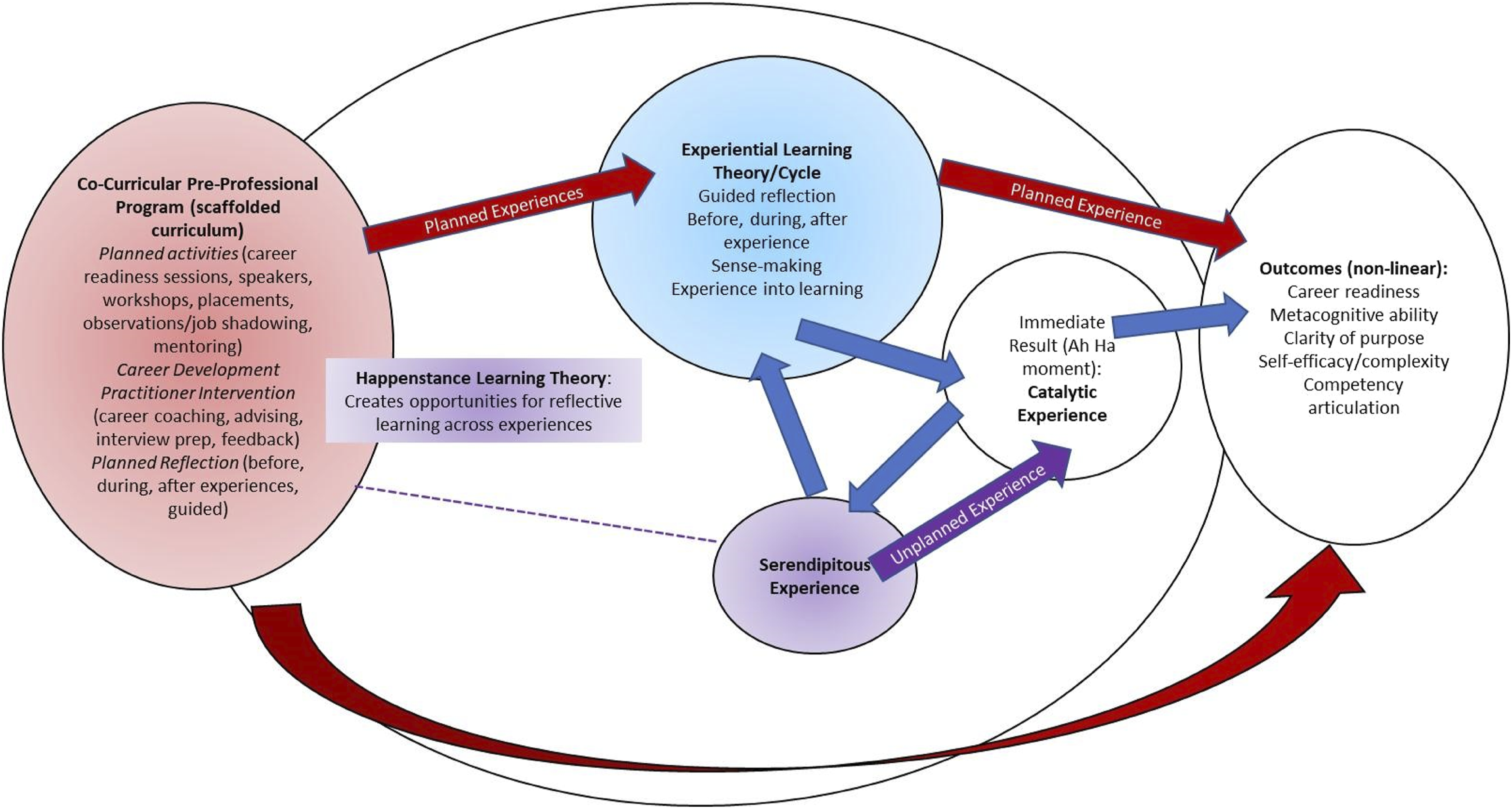
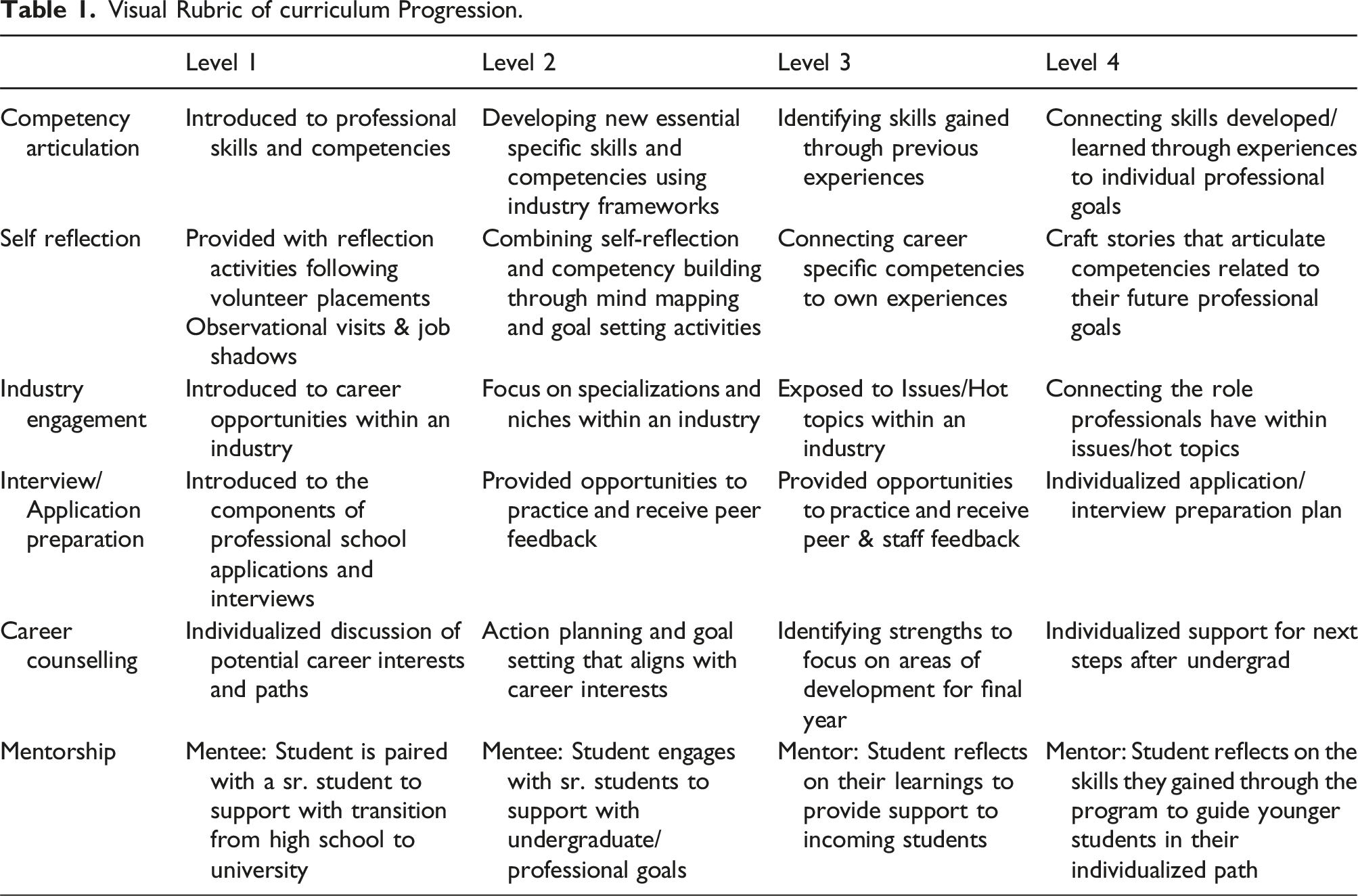
Visual Rubric of curriculum Progression.
Participant characteristics.
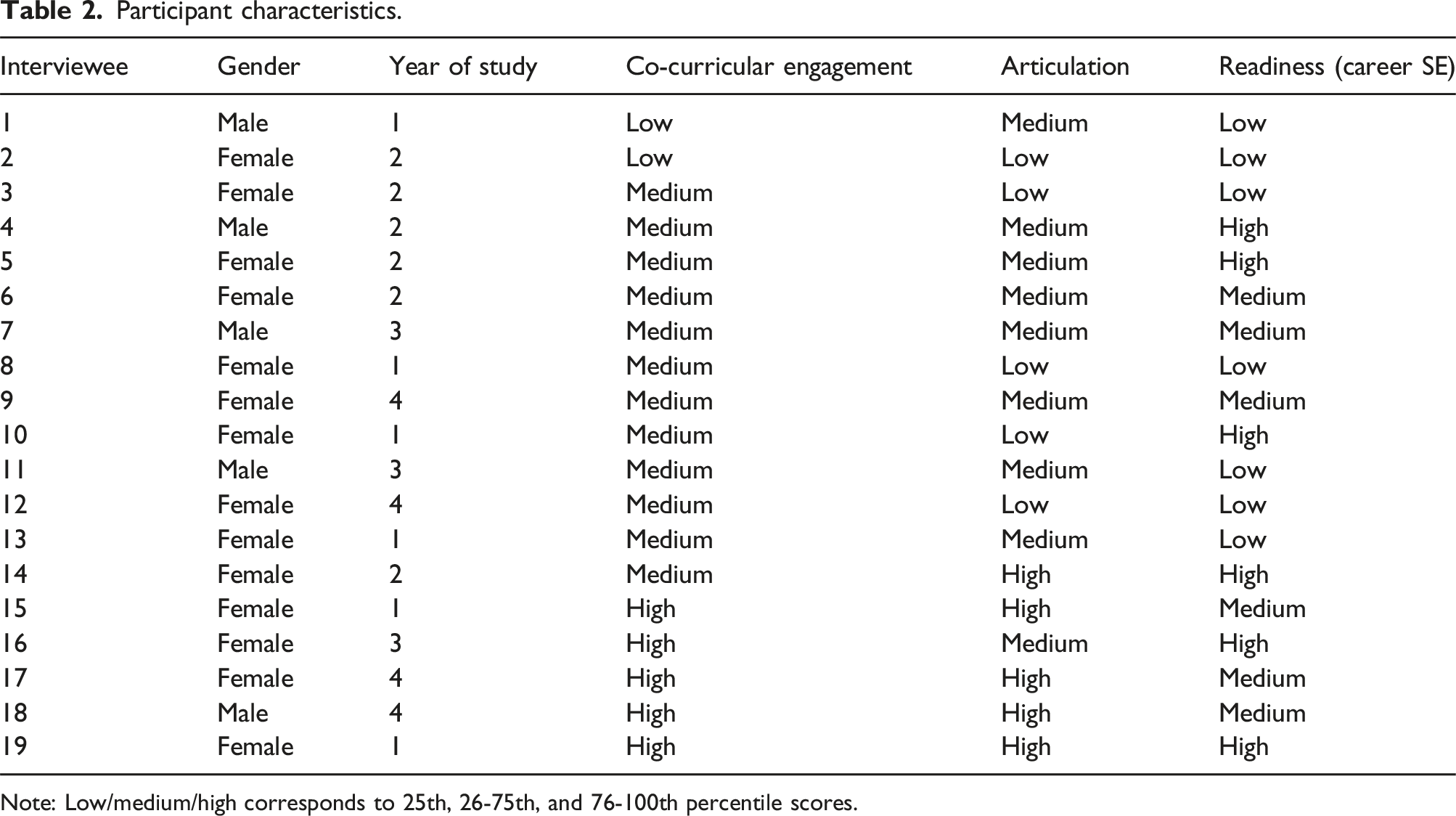
Note: Low/medium/high corresponds to 25th, 26-75th, and 76-100th percentile scores.
“Plus” co-curricular programs
The Plus Programs at the university where we conducted this research are competitive, co-curricular experiential programs. Offers of admission are based on grades, community engagement, and readiness for professional development programming. Students must re-apply to the program annually and are expected to maintain high academic standing and actively participate in all program requirements. Med and Law Plus are 4-year programs that prepare students for careers in specific industries by exploring various occupations, competency recognition and development, and skill-building opportunities. Students participate in a planned, scaffolded curriculum alongside their undergraduate degree, which consists of intentional self reflection and the following components:
Professional speaker series
Students are provided with opportunities to network and learn about career opportunities through weekly guest speaker presentations. A wide range of industry leaders share their career and education paths with students and offer insights into their profession. The professional speaker series helps build students’ career readiness, particularly learning orientation, as students research different careers through lived professional experience. Identifying what they like and dislike helps students formulate their unique career paths. An essential part of this component is connecting the experiences to the learning mindset by reflecting on the speakers at the end of each semester as a group in a focus group style discussion and individually in program advising appointments facilitated by career educators.
Professional development workshops
Interactive training, certifications, and skill development opportunities are provided to equip students with the essential development needed to succeed in their careers. The workshops help build students’ career readiness, particularly their developmental efficacy and self-complexity. Using both the university and professional competency frameworks (e.g., CanMEDS), students are allowed to reflect on their strengths and further develop their skill sets.
Volunteer placements
Through partnerships with local organizations and agencies, students are provided with volunteer placement opportunities allowing them to gain 50+ hours of experience per academic year. The volunteer placements help build students’ career readiness, in particular, developing and refining their skills via providing experiential learning opportunities. Completing the learning objectives and midpoint and end-of-placement reflections allows students to identify competencies they utilized and developed during their placement.
Observational visits and job shadowing
Observational visits and job shadowing provide an experiential “day in the life,” allowing students to observe the skills and core competencies required for various careers. This helps build readiness via an experiential learning opportunity. In addition, it includes required reflection of learnings after completing job shadows and debrief reflections on observational visits, where students take vital learnings and connect these experiences to either the professional speaker series or professional development workshops.
Individualized program advising
Under the guidance of career practitioners, students engage in meetings to discuss their individual goals and establish action-oriented career plans annually. This helps build readiness, particularly knowledge translation, the early stage of competency articulation. Through guided reflection, students discuss career goals, the skills, and competencies identified for that profession and connect them to their personal experiences.
Mentorship
The program offers mentorship support in two ways: as incoming students transition from high school to University and senior-level students transition from University to their next step. Senior-level students reflect on and share their experiences to offer guidance to new first-year students through a formal mentorship pairing. Program Alumni informally offer their insight and support to students interested in pursuing their field. This helps build career readiness through experiential learning. Incoming students reflect on a needs assessment to determine how their mentor can support them.
Application and interview preparation
Beginning in the first year and continuing throughout the program, the career professionals support application and interview preparation by providing students with direct feedback and creating opportunities to learn interview techniques, allowing them to gain a competitive edge. This helps build students’ career readiness via knowledge translation. This captures the later stages of competency articulation, as the user application requirements (e.g., personal statements, autobiographical sketch), career practitioners guide students through reflection on experiences presented to them in the program and connecting it to the application. The interview preparation helps build readiness via questions designed to demonstrate required competencies and help students practice articulation through stories.
Although students participate in all of the above components annually, they each have different experiences and make connections to their career goals in their own way. The scaffolded curriculum provides students with various activities and allows them to discover and articulate their skills and competencies as they progress through the levels of the program (see Table 1). In Level 1, students are introduced to various careers and professional development workshops. In Level 2, focus areas become more specialized and tailored to essential competencies required to succeed in the industry. To gain a broader understanding of their field of choice, students engage in programming focusing on issues and topics led by industry professionals in Level 3. These conversations continue into their 4th year with a shift in focus on preparing them for their next steps, including more interview and application preparation.
The program aims to give students a competitive edge for a career in a specific industry. As of this writing, the Med Plus program is in its 24th year and has a 92.3% success rate of students entering the next step of their pursuit, which includes professional school training, graduate-level studies, or industry-related employment. With its success, the Career Education Department created the Law Plus program, which is now in its fourth year, expecting its first cohort of graduates.
Career readiness and career education
Beginning as the vocational guidance movement with Frank Parsons at the turn of the twentieth century, career development has transitioned from a system of job placements (matching skills and values with specific occupations) to a series of holistic frameworks focused on relationship building, skill development, and experience (Lent, 2013). The original role of career practitioners was to help eliminate or reduce the role of chance in a client’s career. Now, instead of matchmakers, the role of career practitioners often includes education: facilitating clients’ learning of knowledge, skills, abilities, and attributes and helping them navigate an evolving work environment, embracing unpredictability as an opportunity for learning and development (Mitchell et al., 1999). This broadens the outcome of career counseling beyond a job “match” to include the development of a set of capabilities (cognitive, behavioral, social, and emotional) that allow clients to claim agency over the shape and direction of their career (Lent, 2013). Lent labels this outcome in career development and education as “career-life preparedness” (career readiness), defined as “a healthy state of vigilance regarding threats to one’s career well-being as well as alertness to resources and opportunities on which one can capitalize'' (Lent, 2013: 7). This outcome of career readiness also includes the supported development of “proactive strategies to manage barriers, build supports, and otherwise advocate for one’s career-life future” (Lent, 2013: 7). This shift towards agency and career readiness reflects a changing labor market where jobs are being created or rendered obsolete at a rate that vastly outpaces previous generations (Walker-Donnelly et al., 2019). In the post-secondary education environment, this necessitates a shift in career education towards skill and competency development, skills translation and articulation, and expanded opportunities for experiential, work-integrated learning (WIL).
Current career development theories recognize the learner as a “whole person” and embrace the “total constellation of psychological, sociological, educational, physical, economic, and chance factors that combine to influence the nature and significance of work in the total lifespan of any given individual” (NCDA, 2003). The culmination of these factors shifts how people make career decisions, thus expanding the domain of career education. Several prevailing career development theories guide practitioners’ interactions with learners, some of which are highlighted here. Savickas’ career construction theory (2005, 2013) views careers as socially constructed, where individuals create a career and give meaning to it by making choices that express their self-concept (Walker-Donnelly et al., 2019). Hansen’s integrative life planning theory (2001, 2002) is a holistic worldview of how people incorporate and view work concerning other roles (Walker-Donnelly et al., 2019). Schlossberg’s transition theory (1984) consists of three phases, approaching transitions, taking stock of resources, and taking charge, encouraging reflection as part of navigating transitions (Walker-Donnelly et al., 2019). While these current theories have utility for career educators, planned happenstance leaves more room for non-sequential events to co-inform career development.
Krumboltz’s theory of planned happenstance
Happenstance learning theory (HLT) extends the idea of career counseling to include generating and transforming unplanned events into opportunities for learning and development (Krumboltz, 2009). The theory attempts to explain how and why people follow different career paths and describes how career practitioners can facilitate this process (Krumboltz, 2009). It includes two concepts: (a) exploration generates chance opportunities for increasing quality of life, and (b) skills enable people to seize opportunities (Mitchell et al., 1999). Career educators help learners develop specific skills to recognize, use, and create chance as career opportunities: “Curiosity: exploring new learning opportunities; Persistence: exerting effort despite setbacks; Flexibility: changing attitudes and circumstances; Optimism: viewing new opportunities as possible and attainable, and Risk Taking: taking action in the face of uncertain outcomes” (Mitchel et al., 1999: 118). While chance plays a role in all career journeys, it is essential to note that career success in planned happenstance is not about luck but the ability to take advantage of unplanned events (Walker-Donnelly et al., 2019).
Learners are not passive participants in these experiences; they can and should generate events independently and maximize existing events and resources to improve their learning (Mitchell et al., 1999). Learners are socialized in an environment with countless unpredictable events that provide learning opportunities, and Krumboltz (2009) suggests that human behavior is a product of this learning process. By navigating this process, the learner acquires and develops skills, interests, knowledge, beliefs, preferences, sensitivities, emotions, and further actions (Krumboltz, 2009). The role of the career educator is to encourage learners to create, recognize, and incorporate chance events into their career journey and to help them withstand and thrive in ambiguity by developing an exploratory attitude (Mitchell et al., 1999).
Career-focused co-curricular programs in post-secondary environments, like Med and Law Plus, leverage the “planned” and the “happenstance” elements of Krumboltz’s theory. Program design and the scaffolding of learning outcomes is intentional (planned); however, students are also provided opportunities to create their key learning moments and are coached on embracing the value of navigating - and benefiting from - unpredictable events. These programs are effective because they help learners engage with structured (planned) career-readiness interventions and seek out learning opportunities everywhere. The program design and the role of the career practitioner help learners to expect, seek out, and successfully navigate “happenstance” experiences.
Kolb’s experiential learning theory
HLT describes the significance of skill development and continuous learning but does not describe active learning or skill development. Therefore, HLT would benefit from greater integration with experiential learning theories such as Kolb’s (1984) experiential learning model. Kolb’s experiential learning cycle is one of the most widely used models in education. The model is grounded in a constructivist and developmental learning perspective, implying that learners are the constructors of their own knowledge; they gain knowledge by interacting with their environment (Vygotsky, 1978 in Mughal and Zafar, 2011). Learning occurs when the individual reflects on their experiences, described by Kolb (1984: 38) as “the process whereby knowledge is created through the transformation of experience”.
Experience forms only one of Kolb’s four stages of experiential learning: • Concrete Experience – students actively engage in an experience. • Reflective Observation – students reflect on the experience, identifying any connections, inconsistencies, or alignment between the experience and prior knowledge. • Abstract Conceptualization – through reflection, students generate new understandings/ideas or modify their existing conceptualization of an idea/concept in order to draw conclusions and make hypotheses. • Active Experimentation – students plan and test their conclusions/hypotheses by applying their knowledge to new experiences.
Learners can enter the cycle at any stage; however, all stages must be addressed to ensure meaningful learning has occurred. A learner needs abilities that align with the four stages of Kolb’s model to be effective. They must be open to new experiences (Concrete Experience), be able to reflect on their experience from multiple perspectives (Reflective Observation), integrate their observations into sound theories (Abstract Conceptualization), and they must be able to use these theories to make decisions and solve problems (Active Experimentation) (Morris, 2020). Kolb’s theory was developed in organizational training environments with particular expectations for learners. When adapting to university environments, the learning cycles described by Kolb tend to compress and stretch in time based on the context (Heinrich and Green, 2020). By conceptually linking Kolb’s ELT (1984) with Krumbholtz’s HLT (2009), practitioners have tools for longer and shorter-range planning, implementation, and assessment.
In the design of co-curricular programs like Med and Law Plus, a structured plan, or curriculum, is developed to introduce learners to crucial learning moments and provide structured opportunities for guided reflection. The “planned” elements, with the support of the career practitioner, allow the learner to move through all stages of Kolb’s cycle, thus maximizing their learning and allowing reflection before, during, and after their experience, similar to Bruner’s (1966) spiral curriculum. Kolb’s model is useful within a co-curricular setting as it facilitates student learning and sense-making in student centered ways in the program implementation, student self-assessment, and external feedback on elements of career readiness. Intentionally embedding Kolb’s model gives learners a structure to help create meaning from their experiences and to align their learning from each planned or unplanned career experience with their career goals.
Career readiness through HLT, ELT, and career education
Career education in the post-secondary environment, and the field of career development more broadly, has seen a shift from a direct alignment of skills to specific occupations (job search and placement) towards non-linear career exploration based on knowledge and skills gained through experience and targeted reflection with a focus on career readiness. Learning can be generated through both structured (planned) experiences and experiences that are organic or unexpected (unplanned), as evidenced by Krumboltz’s HLT. It is often the role of the career practitioner to not only guide learners to find or create unexpected experiences; they may also be required to support a learner with knowledge transfer, to help extract and interpret their experiences, often through feedback or prompted reflection (Mughal and Zafar, 2011). The Plus Program model of co-curricular programming provides a schedule of planned experiences and supports learners as they navigate knowledge transfer and make meaning out of their experiences and skill development. The experience itself (planned or unplanned) plays a vital role in Kolb’s ELT cycle; however, the cycle will not be complete and deep learning will not occur without meaningful reflection before, during, and after the experience. Reflecting before an experience prepares the learner to get the most out of the situation. Reflection during an experience allows the learner to navigate the experience successfully and with intention. Reflection after the experience helps the learner examine their assumptions, knowledge, and understanding and how they have changed now that the experience has occurred.
This research explores HLT in conjunction with Kolb’s ELT in the context of a career education program to understand how and when students come to articulate their competencies. We were also interested in which skills were articulated as career and professional skills began to co-mingle by design.
Methods
This is an instrumental case study of a co-curricular, competitive-entry, four-year, career education activity known as the Plus Program. The Plus Programs are Law Plus and Med Plus. Robert Stake (2005) demonstrates how an instrumental case study allows researchers to observe a participant’s lived experience or concern. We selected the instrumental case study design because we sought to investigate how pre-professional students engaged in a series of career development activities, punctuated by reflection, and later made meaning of these experiences for their careers. The data focuses on the relationship of competency articulation to the Plus Programs, including planning, education delivery, assessment, and student outcomes.
Data collection
Using both purposive and convenience sampling, nineteen participants agreed to participate in 30 minute interviews about how their experiences led them toward competency articulation. Participants were recruited from a pool of participants who had completed a program evaluation study (n = 125, half of all Plus Program participants). The program evaluation study assessed engagement with different co-curricular activities, career readiness (i.e., career exploration and decision making self-efficacy), demographic characteristics, and competency articulation skill. Our sampling approach was purposive because, with their permission, we examined students’ responses from the program evaluation study and aimed to find interviewees based on high and low articulation skill. Participants who were in the top and bottom quartiles of articulation skill were invited to participate in the interview in exchange for a $15 gift card. The sample identified was a convenience sample based on voluntary responses to an interview invitation.
Interviews were conducted by five different members of a research team using an interview script for consistency. Interviews were recorded with consent. With participant permission, demographic information was available for all 19 participants. Interview questions are available in the Appendix. This study received approval from the University’s research ethics board, and all protocols were followed to ensure the confidentiality and security of data.
Five members of a research team coded interview data. A qualitative, interpretivist constant comparison method (Creswell, 1998) was used to identify prominent themes and data. Reflecting our research focus on the timing of articulation, the constant comparison method allowed researchers to compare multiple student approaches to the idea of articulation. Further, researchers retained the ability to observe reiterations of the same experience as essential and nuanced. An initial coding exercise was conducted to determine interrater agreement on data and meaning. Five researchers read through sample data to determine interrater agreement. The five researchers identified six likely influences on articulation and ideas for deeper analysis. One researcher coded all the data on the six likely influences. From the codes, the research team identified three major themes: Catalyzing instances for articulation, moments that inspired action, and instances of reflection were recalled to inform articulation. Three different researchers conducted three rounds of code-checking to confirm the frequency and trustworthiness of each theme. In the context of an interview, participants sometimes reflected on a single experience to draw meaning and responses to the inquiry.
Findings
We observed patterns of behaviors from across our interview population. Most students in the program made the connections from planned experiences, sequenced individually, to a catalyzing moment (aka “Ah Ha!” moment), followed by a reflection on how many previous steps fit together in a more clearly articulated and purposeful statement of their career development narrative.
Catalyzing experiences
First, we observed the presence of catalysts (connection, inspiration) that later led to increased articulation, consistent with Moon’s (2013) findings on reflective practice.
For example, Interviewee #5 stated: I think of like a few, but I think one of like if we're talking like one really significant for me is like maybe like a light bulb moment with like a direction for career path is when we had like a specific speaker came in and it was like a dentist and he was just kind of talking about his day-to-day life. What kind of led him to that career. And I just remember being so in awe and like what he was saying and like, it really resonated with me and made me think twice about the career and that, like, wow. This is something I could see myself doing and led me to look more into in the future.
Here we see the student describe a lightbulb moment of connection, insight, and the emotion of awe, where the student connected the presenter’s speech to their own career future, as a result of being actively engaged and participating in the planned speaker session. And Interviewee #19 reflected on a catalyst experience leading to making a connection: I think it was kind of a gradual experience during the entire process, but I would say the more kind of critical times where after the appointments, we and the physiotherapist, did a little debrief of kind of what happened and I got to ask questions maybe about how they analyzed, for example, the gait of the patient and kind of how that has a chain reaction on other aspects of their health and that kind of tied in with other aspects, such as social determinants of health and that kind of gave me a more well-rounded approach to how healthcare professionals seek to help patients rather than just focusing on one area of concern. …I was able to not only connect it with how physiotherapists care for patients, but I could make mental connections with maybe my optometrist, other healthcare professionals that I'm familiar with.
In this quote, Interviewee #19 experiences a catalytic moment during a debrief session with a physiotherapist, where the student receives a broader perspective related to patient care and social health determinants. This allowed the student to make connections to different healthcare professions. While Interviewee #11 recalled this instance: Ohh to be blunt, it was last year so I was probably sitting in my bed with my camera off and then I found it quite interesting so I probably rushed over to my desk, brushed my hair and turned my camera on and asked a couple of questions…. I remember asking a lot of specific questions …but I remember kind of my effort to engage with the speaker and kind of draw it out. A lot of the questions I had…encouraged me to follow up afterwards, which thus made this kind of that ‘ah ha’ moment.
This quote shows a catalyzing insight for an initially disengaged student who transitioned to active engagement, asking specific questions, and ultimately experiencing an “ah ha” moment. In each of these instances, the student recalled how a series of events led them to a specific moment of insight and action.
Action moments
In the next phase, participants transformed their understanding of a previous experience through the lens of the catalyst experience. These instances of transformation are where HLT and ELT come together in a visible way.
Interviewee #5 shared this reflection on her catalyst experience: This is something I wouldn't expect to find out about myself and to like it led me to realize that I've made some pretty deep decision making skills like since then to obviously decipher like ohh this is a career. I think it was like I think it's how I still remember [] exactly [] how I felt in that moment to this day, even though it was last year. And that I was very, very happy in that moment. I don't know. I was like telling it. I like all my friends and family like Oh my goodness like this just happened. Like, this is so amazing. I just like, remember telling everybody. And I still remember it to this day and kind of like what happened and what the dentist said. So yeah, it's really something that just sticks with me and I think it's really that makes it kind of important.
Here, Interviewee #5 unexpectedly discovered a new career interest, leading to a realization of personal decision-making skills. This realization was associated with very positive emotions and vividly remembering the industry professional’s comment even a year later, indicating its lasting importance in the student’s personal and professional development. Interviewee #14 shared this reflection on the catalyst moment: And…going through the interview. I [realized] just how much these actually helped me prepare and be ready to know exactly how to approach these types of questions and what they're looking for in these types of questions.
The quote highlights how the student’s involvement in the planned one-on-one advising and interviewing preparation helped them realize its significance. Interviewee #16 offered this reflection on her catalyst moment: I guess being able to reflect back on it is like reflective practice that we have to do in the Plus Program. And just knowing that …it was like the combination of all these skills that I've had and all these relationships that I've had brought into this one big event for…a good purpose. I guess it took me to…a critical moment….
Interviewee #16’s participation in the co-curricular program led to a transformative insight, where they recognized the value of reflective practice, understood how their skills and relationships contributed to key events, and realized the importance of critical moments.
Reflections
Finally, we saw how experiences, reflections, and applications (i.e., interview/job shadow) accumulated leading to a catalyzed and focused reflection. Either an opportunity for articulation or identity awareness was present at this stage of the learning cycle. This finding is consistent with holistic and integrated curriculum designs (see Maki, 2023).
Interviewee #5 noted when she felt an identity shift: …What he was saying…it really resonated with me and made me think twice about the career and that, like, wow. This is something I could see myself doing and led me to...look more into in the future.
This quote from Interviewee #5 exemplifies how accumulated experiences, reflections, and applications culminated in a catalyzed and focused reflection in response to a professional speaker. The interviewee experienced an identity shift upon encountering insights during the process, prompting a deeper consideration of a potential career path. Interviewee #11 indicated a renewed sense of purpose in his questions for a speaker with whom he felt a connection: …I remember asking a lot of specific questions…but I remember kind of my effort to engage with the speaker [and] kind of draw it out.
This quote from Interviewee #11 illustrates how engaging with a speaker and asking specific questions led to a catalyzed and focused reflection. The interviewee's renewed sense of purpose in questioning demonstrates an opportunity for articulation. Following multiple interview preparation experiences, Interviewee #14 reflected on understanding the purpose of both the training and the interview process: I really [realized] just how much these actually helped me prepare and be ready to know exactly how to approach these types of questions…
Interviewee #14 realized the purpose of the training and interview process in preparing them to approach interview questions effectively, indicating an opportunity for articulation. Catalyzing experiences, moments of action, and ongoing reflection were signals of articulation and other elements of career readiness that help us see the nuances of multiple theories working together in a program plan.
Discussion
A critical part of the university education process is learning and articulating career-relevant competencies. The present research contributes to our understanding of how university students learn to articulate their competencies and how co-curricular career education programs can be designed to facilitate this learning. Specifically, we focused on the intersection of happenstance learning theory (HLT) and experiential learning theory (ELT) for creating catalyst moments – moments of inspiration or connection between a student and a profession – within a career education program. We observed catalytic learning experiences resulting from the career education program as described and we discuss those observations and theoretical implications here.
Our interviews revealed three main findings related to the intersection of HLT and ELT. First, we observed catalyzing experiences, which led to increased articulation. Examples included when a student was inspired or motivated. Consistent with HLT, as part of the program design, the experiences were planned and designed in both linear and non-linear ways to create opportunities for critical educational moments and chance or catalytic events. Our findings support that these specific catalyst moments were followed by improved competency articulation. Consistent with Krumboltz’s (2009) HLT, the catalyst moments (e.g., particular moments of insight during speaker presentations or debriefing sessions) were often unexpected but helped students connect their planned experiences and personal career development narratives. HLT was visible during the catalyst moments as students began to take advantage of unexpected events. Catalysts served as a frame of reference for students to transform their understanding of a previous experience. This transformation led to articulation or identity awareness opportunities, consistent with HLT’s focus on being prepared to take advantage of chance events. This finding appears to affirm/confirm HLT’s utility in career education for critical outcomes such as articulation and professional identity development as described in CE frameworks (see Lent, 2013).
Second, students reported action moments, where catalyzing experiences prompted action or transformative insight. The accumulation of experiences and reflections predicated action. Action moments further increase a student’s career readiness and ability to recognize and act on future opportunities, whereby students can anticipate and benefit from future catalytic experiences. This accumulation-action-reflection is consistent with Kolb’s ELT (1984). Students’ accumulated experiences, reflections, and applications also led to an additional focused reflection and articulation of career identity awareness. Accumulated experiences mirror Bruner’s (1966) spiraling curriculum in which concepts are repeated over time with greater complexity, leading to discovery. Accumulated experiences, reflections, and discovery are key elements in the practice of EL (Kolb et al., 2014). The presence of multiple layers of reflection also supports Moon’s (2013) reflection framework. Students in this study built competencies while engaging with program components leading to self-confidence in career decision-making and actions.
Third, our findings suggest that the transformation via the catalyst moments occurred through reflection, indicating the interplay between the action orientation of HLT and the learning orientation of ELT. Consistent with ELT, students reported the importance of reflection in solidifying the meaning of their experience and transformative insight for their career narratives. Students reflected again on their experiences through the lens of the catalyst experience, transforming understanding into actionable decisions. Reflection was both central to learning to articulate and allowed students to recognize and draw deeper insights from subtler educational experiences. The students’ post-catalyst reflections suggest a sense of purpose, understanding, and identity regarding their chosen career paths.
This finding adds texture to Kolb’s ELT suggesting nuance in student experiences in two ways. First, Kolb’s ELT describes a 4-part cycle: Experience-Reflection-Abstract Conceptualization-Application. However, students in our study reflect on experiences by locating its antecedent in the curriculum rather than locating the experience in their own lives. Second, students accumulated experiences, reflected, and accumulated more experience before a catalyst moment occurred suggesting competency growth before deeper insight is present. And once the catalyst moment occurred, the reflection quality grew more frequent and more nuanced. The catalyst, in sum, transformed accumulated experiences into several layers of nuanced meaning for different parts of career development, identity, and articulation skills. Planning for and providing opportunities for meaningful, but varied reflection before, during, and after the experience was therefore crucial for learning and articulation in the Plus Program, consistent with several experiential education theories.
Practical implications
Our findings suggest that the Plus Program model is a practical approach for providing students with planned learning experiences and an understanding of career readiness to make meaning out of their experiences and skill development. This research contributes practically by illustrating how multiple career theories can work together to help program leaders make essential choices about their career education programs. Through an HLT lens, the present findings suggest that career educators should provide opportunities to engage in planned experiences that catalyze moments of insight and action. Integrating ELT, these experiences should be designed and include reflection to allow students to transform their understanding of prior experiences through the catalytic moment and subsequent action. Integrating Happenstance Learning Theory and Experiential Learning Theory in career education programs can be a practical approach for students to develop competency articulation skills.
These findings can also support the role of the career educator in advising students. For example, Following Krumboltz’s tenet that all assessments should stimulate learning, understanding that a student may or may not have had a catalyst moment would guide the conversation of actioning the next steps in their journey (Krumboltz, 2009). Knowing when, how, and why students develop competency articulation skills through the interactions of combined theories (HLT/ELT) and catalyst moments, career educators can also guide reflective conversations with the student to assess career readiness and their decision-making confidence. This would lead to more individualized support in preparing students for their next steps after their undergraduate studies (e.g., reflecting on their catalyst moment in interview preparation or application writing or guiding a student in an appropriate direction to create a catalyst moment).
Limitations and future research
The current research aimed to describe a phenomenon and build a theory, yet future research is needed to test and replicate our findings. We interviewed students in pre-medical and pre-law programs at a mid-sized university in North America. Students in other programs might have different experiences, and future research might include students from a wider variety of programs to determine if these findings are universal. Still, we expect our results to guide effective practice because of the applicability of HLT and ELT, their logical linkages in the skill of reflection, and additional insights into the moments of learning that led to articulation.
Future applications of experiential learning theories
The presence and awareness of HLT by CE practitioners led to a willingness to assess outcomes in a non-linear way allowing the students’ particular journey through experiences to guide the assessment thereof in the research interview. At the same time, using Kolb’s theory to understand reflective learning showed a pattern of students responding to catalyst experiences by demonstrating the desired outcome of articulation. As a curriculum plan, this approach would benefit from further scrutiny in other CE contexts and on different campuses. Because many campuses offer CE, finding similar pre professional programs is within reach.
Future research could consider how combined ELT and HLT in career programming can connect marginalized and minoritized students to professional programs. Integrating a diverse array of experiential learning theories, including feminist (Michelson, 1996), critical (Fenwick, 2001), ecological (Goralnik and Nelson, 2014), and Indigenous (Clandinin and Connelly, 2004) approaches, CE teams could develop more individual and, therefore more inclusive and nuanced paths through career education. Educators are, in turn, empowered to develop new variations of inclusive practices and opportunities through tailored assessment of skills and catalytic, action, and reflection moments. One promising approach is through integrating targeted, technology-based metacognitive prompts (e.g., Kanar and Bouckenooghe, 2021) into CE. Such technology-based prompts can be distributed flexibly, capitalizing on planned and unplanned experiences, while targeting different parts of the experiential learning cycle. Still, future research must simultaneously consider student motivations to engage with CE initiatives (Kanar and Bouckenooghe, 2022).
The present research results provide a road map for career educators to integrate multiple theories into a program to facilitate catalytic moments and observe where and when students articulate their career competencies effectively. Recognizing catalyst moments can lead to path analysis research about how learners in non-linear co-curricular programs recognize, develop, and articulate competencies.
Footnotes
Acknowledgements
The authors wish to thank Marisa Brown, Pauline Dawson, Daniela Gatti, Cara Krezek, and Lisa McGinn for their support and encouragement of this research project.
Declaration of conflicting interests
The author(s) declared no potential conflicts of interest with respect to the research, authorship, and/or publication of this article.
Funding
The author(s) disclosed receipt of the following financial support for the research, authorship, and/or publication of this article: This research was funded by a Brock University Explore Grant.
