



Abstract
Open educational resources (OER) offer significant benefits in higher education; however, creation and dissemination can involve complex copyright challenges. Reusing previously published content, even one's own work, can be legally complicated given publishing contracts and copyright restrictions. Challenges can be mitigated by developing content using an OER lens in the early development phase and recruiting an interprofessional team of experts, including librarians, lawyers, educational and information technologists, and instructional designers, to help navigate scholarly communication issues. Key lessons reported include using educational theory and instructional design principles to outline content, understanding copyright laws, and carefully considering licensing from the outset of OER development. By sharing their experience, the authors aim to assist health professions educators to more effectively create and distribute OER while avoiding potential legal and distribution obstacles.
Introduction
Open educational resources (OER) were first introduced over 20 years ago, and in recent years, their adoption and use have increased exponentially. 1 There are numerous benefits to OER, including affordability for students, the ability to be customized or tailored to a specific course or curriculum, and altruistic reasons such as giving back to the profession and sharing with others. 1 Early barriers to adoption are steadily being removed due to increased technological capabilities and advocacy, such as addressing accessibility concerns or increased institutional support. 1
The growing body of literature on OER adoption in health sciences education coincides with their increased usage, as faculty awareness of the benefits spreads. In addition to alleviating student financial burden and reducing barriers to higher education, studies have shown OER to increase learner engagement, with similar or improved learning outcomes compared to commercial resources.2,3 OER as a pedagogical tool contributes to significant learning while strengthening the faculty's own teaching and course planning process. 4 Faculty benefits are reported to include increased individual and organizational recognition, student recruitment, altruism, and a united community of practice. 5 In the health science disciplines, there is a unique value in publishing OER for the greater good in support of optimizing patient outcomes. Without institutional incentives, faculty struggle to find time to participate in OER creation.4,6
The barriers and concerns regarding OER adoption in the health science subject areas are not significantly different from those in other disciplines. Faculty concerns largely focus on intellectual property rights, copyright, and fair use. Barriers include competing priorities, a lack of time, and a lack of confidence in identifying or adapting existing high-quality OER.5–8 These concerns are complex and multifaceted, further complicated by the fact that faculty creating OER are often not expertly trained in scholarly communications or copyright. 6 Despite recognition of these barriers, few studies have examined how misunderstandings of intellectual property and copyright law specifically impact OER creation in health sciences education. Furthermore, faculty understanding regarding the sharing and reusing limitations of their own previously published works, specifically from an OER perspective, is unclear.
Many institutions and professional organizations are encouraging faculty development of OER by providing funding, dedicated time, and support staff. Educational materials are typically created to support curricula at the departmental or institutional level; however, there is an opportunity to improve higher education at a national level by licensing our instructional content to be shared openly. While faculty may be eager to develop OER, evidence shows that they may not have a full understanding of scholarly communications issues, such as copyright, author's rights, and open licensing, that can impact their ability to create, use, and distribute widely.6,7,9 This applies not only to reusing others’ work, but also one's own. It is essential to understand publishing agreements, open access licenses, and copyright law, as well as their impact on materials used in OER content development.
This report aims to share lessons learned from an institution's experience in creating curriculum content with the goal of sharing with other institutions. Our objective is to outline considerations and complexities of copyright and ownership, including intricacies of reusing one's own published work, explain the limits of fair use, and highlight resources to consult and ensure compliance in health professions education. Faculty across all disciplines may benefit from understanding legal considerations on OER to optimize collaboration and sharing of materials.
Case Study
As a component of curriculum innovation, faculty from the University of North Carolina at Chapel Hill's Adams School of Dentistry developed a series of educational modules and authentic assessments 10 focused on critical appraisal of the literature across major clinical questions and study types including diagnostic test accuracy (cross-sectional studies), harm/etiology (cohort studies), and therapy (randomized controlled trials and systematic reviews). Modules were created using Rise Articulate, 11 that can be imported directly into learning management systems.
Each module explained foundational Evidence-Based Dentistry (EBD) concepts, an essential component for meeting accreditation standards, 12 in a step-by-step manner and included a mix of text, multimedia, and knowledge checks. Content and examples within the modules largely came from the author's previously published work and textbooks, as an expert in EBD, or from seminal research articles. Beyond use in the curricula, the goal was altruistic: to share these modules freely and openly with other dental schools, and to serve as a leader in the field for EBD instruction.
In the fall of 2022, a librarian was added to the EBD team to create modules on earlier steps of the EBD process, ask and acquire, introducing students to these concepts before learning critical appraisal. The librarian reviewed the appraisal modules to ensure content in the newly created ask and acquire modules was complementary and scaffolded appropriately. Upon review, the librarian identified that content used for instructional purposes had been repurposed from previously published content without publisher permission and, knowing the team had plans to share with others outside the institution, informed the team of copyright laws and the inability to share them broadly. Some of this content was published by a team member, and assumed that it could be reused. The challenge included existing external sources from prominent dental researchers as part of the work.
The librarian then provided education sessions for the team on copyright, open access, and open licensing, and began the process of attempting to clear permissions and obtain the rights to reuse previously published content. While most publishers have been agreeable to internal reuse or adaptation of this previously published content, all have been unable to provide permission to share externally at no cost. Cost estimates from Copyright Clearance Center for permission to reuse this content externally are exorbitant and not feasible for the institution to pay.
While the intention was to share this work broadly with other dental schools, we are unable to do so due to copyright issues that were unforeseen by the creators when this work began. These issues were identified after adding a librarian to the team, who had foundational knowledge in scholarly communications and copyright. As a result, modules were limited to adoption internally at the authors’ institution with publisher permissions. This learning experience highlighted the importance and value of interprofessional partnership through relying on the unique perspective and expertise of those in other disciplines, working toward a common goal.
The EBD team is investigating opportunities for funding to remake these modules, reusing openly licensed material, and incorporating experts in copyright, scholarly communications, and open educational resource creation from the beginning of the OER development process. The team is passionate about communicating challenges encountered to other faculty so they may learn from our experience, and better advocate as it pertains to publishing rights and sharing their own work.
Lessons Learned
Our experience aligns with previous research identifying copyright and intellectual property misunderstandings as barriers to OER adoption,6,13,14 but extends this work by providing practical examples on how these misconceptions manifest during actual OER development. This case study adds to the literature by describing how copyright laws affect one's reuse of their own work, not just that of others. Additionally, we provide information on how faculty engaging with traditional publishing models can be better informed and advocate for their rights to use their own work.
Lessons learned from this experience can be grouped into three major categories, including instructional design, content creation, and licensing (Table 1). Due to the competing faculty demands on time and lack of confidence regarding copyright and intellectual property concerns, these barriers of resources, motivation, and opportunity continue to create challenges.5,6,8,15 Laying the foundation for a successful OER starts with backwards design techniques used to guide faculty through the process of thinking critically about course outcomes, specific learning objectives, and authentic assessment strategies to determine desired learning results and acceptable evidence of content mastery. If faculty take the time to consider how they want to communicate key concepts and develop digitally accessible materials aligned with learning outcomes, while keeping the end goal of sharing openly in mind, it will help ensure the OER is created with an open lens from the onset, rather than attempting to go back retroactively to convert existing materials that were not designed with open educational practices (OEP) in mind. The ability to share should be a major consideration of all individual content items included in an OER, whether it is one's own published work or someone else's. Just because OER is created for educational purposes or is a culmination of one's own scholarship does not necessarily mean it can be reused openly. Unforeseen copyright issues with text, images, videos, or any other type of media in an OER prohibit the work from being shared freely.
Tips for Open Educational Resources (OER) Curriculum Development.
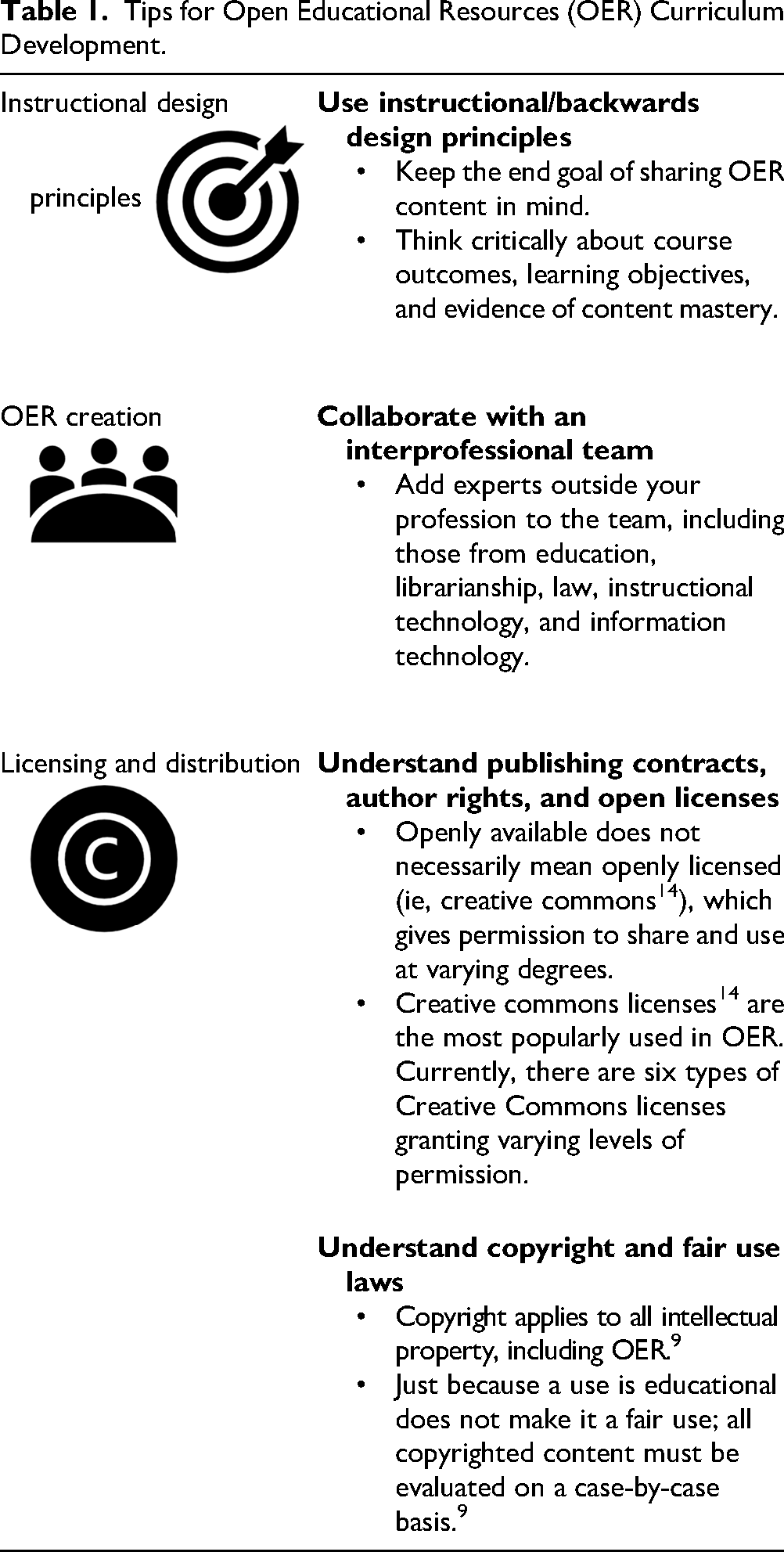
Collaboration with an interprofessional team of instructional designers, educational and information technologists, and librarians with the unique subject matter expertise in open education, academic legal/copyright, and scholarly communications is essential for successful OER development. Every OER project may require a unique combination of individuals, but it is key for OER teams to be made up of a heterogeneous group of people with different roles and experiences.8,15 To ensure success, team members’ responsibilities and expectations should be clear and frequently communicated, and up-to-date documentation should be maintained to track project progress and inform future OER projects. Having a diverse team of subject matter experts can help ensure a high-quality, well-designed OER that is compliant with copyright laws and appropriately licensed to be shared openly.5,8,9,15
It is the OER authors’ responsibility to ensure all materials are free from copyright infringement. Faculty understanding of publishing contracts, authors’ rights, and open licenses were key lessons learned in our experience. For example, some faculty may have transferred their author rights to a publisher and not realize that prevents them from reusing their own work in another format. Additionally, there is universal confusion about the concept of “open access” and how that does not necessarily mean the material is openly licensed for users to use however they please. Creative Commons licenses are the most widely recognized option for granting authors a standardized way to specify the permissions for how their scholarly or creative works can be reused under copyright law, and inform the reuser of exactly what they can and cannot do with your work. 16 There are currently 6 different Creative Commons license types granting varying levels of permissions, and once a license is applied, it cannot be revoked. 16 Lastly, the “fair use” concept has evolved over the past 25 years and enables the creation of innovative OER, granting educators flexibility to meet the needs of students and the course pedagogical goals, but not all educational uses qualify as “fair,” and the principles of transformative use and contextual appropriateness guide our decisions to incorporate copyrighted content into an OER. 9 This is evidence of another benefit to utilizing a collaborative interdisciplinary team approach to OER creation, as the relationships forged with experts across campus can assist with publisher negotiations and addendums helping faculty retain their rights before signing author agreements, helping authors avoid accidental infringement on third-party copyrights, and advising on best practices for applying Creative Commons licenses to OER.5,9,17
Discussion
Technological advances and increased institutional support have mitigated early barriers to OER adoption and creation regarding accessibility, distribution, and dedicated resources like time and money; however, the lack of knowledge and confidence in adhering to copyright law is still a major concern facing faculty after nearly two decades. Just as many health sciences educators are not formally trained to teach, but rather to practice in their discipline or field of expertise, they are also not trained in the intricacies of copyright and fair use laws. The literature on faculty understanding of copyright and intellectual property focuses on two main areas: faculty knowledge and perception of copyright laws and ownership of educational materials (faculty vs institution).
A survey of health science educators found that there is no single barrier to OER use, and that there are multiple, interconnected challenges. 6 Barriers ultimately stem from a lack of time, which goes beyond the lack of capacity to find or create OER; faculty struggle to understand and comply with the complexity of copyright laws. 6 Without formal instruction or dedicated time and resources to devote to understanding these complex issues, faculty may unknowingly be violating these laws and potentially putting themselves and their institutions at risk.
Results from faculty at North American dental schools surveyed on their knowledge and attitudes of copyright issues indicated that most felt somewhat comfortable or somewhat uncomfortable with their own understanding of copyright law, with many reporting using material created by others at varying degrees of confidence in their teaching materials. 18 Half of respondents reported they disagreed or strongly disagreed that their colleagues consistently complied with copyright and fair use laws in their teaching resources. 18 The majority of survey respondents correctly answered false to the statement “ownership of copyright always remains with the creator of the work,” and while this finding is encouraging, the small sample size is not representative of the entirety of dental or health science educators, and more research is needed to gauge faculty understanding of copyright and fair use with OER. 18 Along those lines, a multi-institutional survey on faculty knowledge regarding copyright, fair use, and other related concepts regarding print and electronic materials for teaching and research purposes found that most faculty had limited knowledge of copyright law, with almost 88% having no recent formal instruction on copyright laws. 19 Using hypothetical questions pertaining to copyright and fair use, one of the survey questions focused on pretending a faculty member is writing a book and wants to reuse a chart that was previously published in a journal article. 19 Most survey respondents selected the correct option, indicating that they understood the need to contact the publisher to gain permission to reuse; however, this example is specific to reusing others' work and lacks the nuance and complexity we present in this case of reusing one's own published works. From the available research, it is unclear if faculty have different beliefs about the copyright implications of reusing their own work that has been previously published, compared to reusing the previously published work of others. Due to a lack of opportunities to participate in formal copyright and intellectual property law training, faculty may be entirely unaware of the fact that, with traditional publishing models, authors often sign their rights over to the publisher, meaning they are no longer allowed to use their created content freely as they wish.
Literature focusing on faculty's intellectual property and copyright concerns often centers on the concept of ownership—specifically, who owns the content created for instructional purposes—faculty or their institutions. 20 Case studies regarding institutional practices highlight the complexities and ambiguities of copyright law regarding ownership.13,20 While technological advances have enhanced the delivery of OER, they have also increased the ambiguity of ownership due to institutional investment and development of formal contracts surrounding content creation. 20 While there is no universal consensus on ownership between faculty or employer, many institutions assume full ownership, and it is the faculty's responsibility to investigate these policies and advocate for themselves while negotiating publishing and licensing contracts. 20
Emerging research should focus on faculty's rights to incorporate their own previously published content in OER development. Practically, this is an area that acutely impacts faculty creation of OER, as they often may be incorporating and adapting pieces of their own work that were previously published elsewhere. Traditional academic publishing models and similar scholarly ventures, such as continuing education presentations, invited or honorary speaker engagements, institutional or open repository submissions, and more, may acutely impact faculty's ability to create and license OER. The principles of developing openly licensed education materials are not universally understood or accepted; while publishing practices differ from traditional models, a basic understanding of copyright and fair use principles is vital for anyone engaging with OER.21,22 Even for the most well-meaning educators with altruistic intentions, individual and institutional reputation is at stake, along with financial and legal consequences, if these core competencies are not at the forefront of OER adoption.
This case study contributes to the literature by providing evidence of how health sciences faculty's misunderstandings of intellectual property and copyright law surrounding their own published works can derail OER projects, even when institutional support exists. While prior studies have noted these barriers broadly, our work offers a detailed account of the imperativeness of understanding and advocating for one's rights as an author and highlights the need for early involvement of scholarly communication experts.
Conclusion
The many educational benefits of OER are evident, including affordability and accessibility, customization, and altruism. OER development takes a great deal of time and effort, and the ability to reuse and share content, both one's own and others', within OER can be complex, particularly for teaching faculty without formal training in scholarly communications. The pursuit of OEP is commendable and important in a world of limited resources and bandwidth. Faculty interest in revolutionizing academia by creating OER is encouraged once there is a shared understanding of the potential challenges and an interprofessional support team in place. OER cannot be utilized to its full intention or potential if it is not actually open. This practical example shows the importance of faculty grasping how copyright and publishing licenses affect content they may wish to reuse or share openly, and the consequences that can arise from not consulting a team of subject matter experts early in the process. Interprofessional collaboration may mitigate unforeseen issues in OER creation and sharing by having others consider implications from their unique expertise. Experts from fields, including librarianship, law, education, instructional design, and instructional technology, would be valuable collaborators to partner with before initiating an OER project.
Footnotes
ORCID iDs

Author Contributions
Conceptualization: EPJ, RBQ, and CA.
Data curation: not applicable.
Methodology/formal analysis/validation: not applicable.
Project administration: EPJ.
Funding acquisition: not applicable.
Writing—original draft: EPJ and CA.
Writing—review and editing: EPJ, RBQ, JWL, RA, AR, AC-L, and CA.
Funding
The authors received no financial support for the research, authorship, and/or publication of this article.
Declaration of Conflicting Interests
The authors declared no potential conflicts of interest with respect to the research, authorship, and/or publication of this article.