



Abstract
Former publisher Alex Holzman weighs the pros and cons of open access via a review of Peter Suber’s Open Access.
Open Access By Peter Suber MIT Press, 2012 230 pages
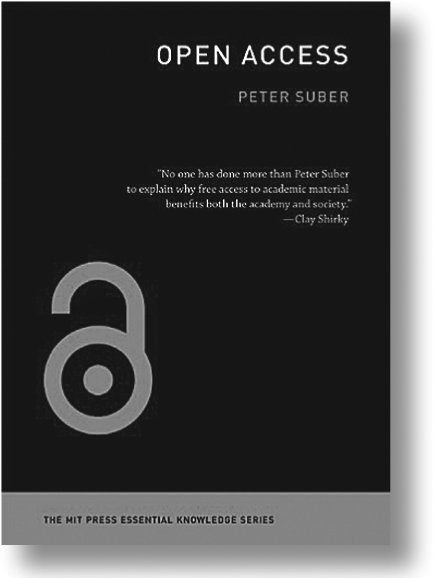
The open access (OA) debate begins with the assumption that both individuals and society as a whole benefit when research is available at no direct cost to anyone who wants to review it. Whether or not one accepts that assumption—and there are arguments against it—the idea is in many ways compelling. Shouldn’t a patient have the right to read about every aspect of an illness he or she is facing? Shouldn’t climate scientists have access to every possible bit of research about our ecosystem? Doesn’t the same go for legislators, regulators, and even just concerned citizens?
Despite its seemingly simple core premise, OA raises a dizzying array of issues: copyright questions; price and cost questions involving authors, faculty, students, publishers, librarians, granting agencies, learned societies, university presses, university administrators, and at least two branches of the federal government; questions about the scope of data to be covered (books? datasets? illustrations?); and the meaning and conduct of peer review. OA even comes in a rainbow of colors and flavors, including green, gold, hybrid, and libre. Simplicity, it seems, has been the first casualty of this movement.
It is encouraging therefore to see Peter Suber’s incredibly helpful, yet blissfully short primer on the subject. In plain language, richly documented for those who wish to read further, Suber presents the main OA issues in easily digestible form. (Suber references himself a bit too frequently for my taste, but given his pioneering role in the movement, it’s understandable.) And true to the OA movement, the e-book is downloadable free of charge.
Simplicity can at times be deceptive, however. Suber is an affirmed OA advocate, and too often ideology seeps into what might appear to be straightforward presentation of the issues. It is a tribute to his skill at presenting an issue plainly that we sometimes have to remind ourselves that the book is very much an advocacy brief. Even when recognizing arguments against this or that aspect of the enterprise, he often introduces them solely for the purpose of knocking them down. I had to read carefully to separate the impartial scholar from the advocate.
Would an open access world really be heaven? Or would some scholars have no place to publish?
Suber’s description of the varieties of OA exemplifies both traits. He provides the clearest description of “gold OA” (which he defines as OA through journals, regardless of the journal’s business model) and “green OA” (which he defines as OA through repositories) that I have read. He masterfully details the nuances of who pays for gold OA and how and when to use “embargos” (publishing work OA after a defined period of time, during which it is only available for a fee) in green OA, as well as the hybrid OA forms that include journals with some OA articles and some subscription only articles. Even though I’ve been reading about and discussing open access for around fifteen years, I came away with a clearer idea of the subtleties of OA than ever before.
As Suber describes it, “libre OA” is both free of charge and free of at least some copyright and licensing restrictions. As Suber says: “don’t leave users with no more freedom than fair use. Don’t leave them uncertain about what they may and may not do. Don’t make conscientious users choose between the delay of seeking permission and the risk of proceeding without it. Don’t increase the pressure to make users less conscientious. Don’t make them pay for permission. Don’t make them err on the side of nonuse. Make your work as usable and useful as it can possibly be.”
Really? Why does Suber presume his reader is an author? Why, after a fair—if opinionated—presentation, conclude by addressing only one aspect (ease of use in subsequent articles by other researchers) of an extremely complex copyright situation without consideration of possible deleterious effects of libre OA? (To be fair, a nuanced advocacy discussion of copyright is presented in a later chapter.) Nevertheless, a careful reader will be able to separate ideology and advocacy from the primer, which remains an excellent place for anyone to learn about OA for the first time, to renew one’s knowledge, or to see OA’s issues put together in an interesting, clear way.
As a former publisher for a major university press, I cannot help but respond to the ideological aspect of the book. Let’s stipulate for a moment that all things being equal, it is a better thing to offer information at no charge to the user than not. This is not uncontroversial—should corporations have the same free access that individuals do? But for our purposes here, let’s leave it alone and move to the first part of the stipulation: Are all things equal? More pointedly, can we be sure that free information will always reach a greater audience than information for which there is an end-user charge?
The true cost of open access remains uncertain.
Consider for a moment gold OA, where payment for the cost of publication (leave aside the needs of publishers to earn a surplus or profit so as to enable improvements in service or a return to investors) falls to the author. Suber discusses this in his chapter on the economics of OA, but seems more or less to shrug, saying grants or the author’s institution or some publisher programs to subsidize poorer authors can cover the problem. I wish I shared his optimism.
Even government funding for STEM (science, technology, engineering, and medicine) research is pretty iffy about specific funds to underwrite publication. Funding to the humanities and social sciences, besides being exponentially smaller, almost never covers publication costs. Federal regulations and proposed legislation such as the National Science Foundation Public Access Initiative and the move in the Federal appropriations bill of 2014 to require agencies funding more than $100 million in research to develop open access policies that would mandate OA currently emphasize a form of green OA, which substitutes embargoes of varying length for author charges. So—would libre or gold OA world really be heaven? Wouldn’t some scholars be left with no way to publish? Is it better to leave these scholars unpublished than to have readers who can’t access an existing piece of published scholarship? If so, why?
Such an author could always self-publish on her website or, if institutionally affiliated, in that institution’s institutional repository, if such a repository exists. But what is the role of professional marketing in the dissemination of scholarship? To what extent does marketing raise awareness of a specific article or journal? How can books and articles find their readers without the help of marketing? Does open access always trump what professional marketing achieves? Put another way, how does the level of discoverability in a well-marketed journal compare to that of an institutional repository?
Self-publishing, with or without paid publicity, also raises the thorny issue of peer review. Suber’s excellent discussion puts to rest once and for all the canard that open access publishing is not peer reviewed. How that urban legend started remains a mystery. The vast majority of open access material is peer reviewed, and in my experience it’s pretty easy to discover if it hasn’t been. But an author without funds to afford OA publication would also have to self-obtain peer review, which sounds dicey, even oxymoronic: it could easily be manipulated to the author’s advantage, corrupting the very principle of impartiality at the core of the practice. Her institutional repository or academic department might obtain the peer review, but that also raises bias questions.
Many OA advocates are looking at alternative forms of peer review, including post-publication review. My concern with that particular solution is an old one: with so much information available on the web, how do any of us sift out the good stuff from the bad? Certain fields are small enough to allow posting to an entire community, but that’s not a universal solution by any means and surely doesn’t work for the social sciences and humanities.
My final concern with Suber’s strong advocacy of opening up access to all things scholarly involves university presses, which are threatened by the simultaneous shrinkage in sales and demands for break-even publishing from their university administrations. The former is to some extent (to what extent remains uncertain) due to copies of electronic monographs being sold to libraries, then becoming available free of charge to all members of that library’s wider university community, thereby cutting off in particular paperback (or electronic) sales to students required to read them in courses. If what used to be income from sales of hundreds, sometimes even thousands of books, is reduced to the equivalent of one or a few copies of a book, many university presses will simply cease to exist.
Is this such a bad thing? I’d argue yes, on two counts. First, university presses are the primary outlets for humanities and social science scholarship and at the moment there is no obvious alternative place for those scholars to go. Much of their work is book-length and “first copy cost” (i.e., the money a publisher spends from first consideration of a book to printing of the first copy or creation of the first electronic file) of an average book-length study has been estimated to be anywhere from $10,000 to $50,000. Even the lower estimate would be an awful lot for an individual professor (especially an assistant professor) to raise. Their home universities might provide the funding—it’s a reasonable investment in a young scholar—but where would they get the money? In a fantasy world, it could come from library budgets no longer burdened by monograph purchases, but they represent only a very small part of library acquisitions budgets, the vast majority of which go to journal subscriptions from a handful of publishing giants.
And that brings us to sharp disparities in spending for scholarly publication. Far, far more is concentrated in STEM journals than anywhere else—I’d estimate 60 to 70 percent—and the lion’s share of that is going to commercial journal publishers and a couple of notorious learned societies. University presses could mobilize their considerable publishing expertise to help solve the humanities/social science resource shortages created by the disproportionate expense of STEM materials, a shortage caused in part by commercial publishers’ primary loyalty to shareholders at the expense of the scholarly community. The problem cannot be eliminated in the near future, but university presses working with faculty, libraries, and administrators could help control STEM costs while promoting open access in affordable ways that sustain a healthy scholarly communications ecosystem.
Peter Suber has written a terrific primer on open access and I’d be truly delighted if large numbers of university workers, from administrators to adjuncts, read it. But I worry that the kind of pure OA that he and other advocates envision is not remotely possible in the near future, and that anything less than total success will result in genuine damage to what should be our shared goal: disseminating scholarship to the entire community at the lowest possible price. The true cost of open access remains uncertain.