



Abstract
Introduction
The robotic surgery and procedures are increasing worldwide. It is unknown whether medical students are well prepared for their future exposure to such technology.
Objectives
This study aimed to explore the knowledge and attitude of medical students from Saudi Arabia (SA) towards the robotic surgery.
Methods
We performed a cross-sectional survey of medical students at different colleges of medicine in SA. A web-based self-administered questionnaire using google forms was completed over a 2-month period starting on June 2021. Comparison between those with and without background about robotic surgery was performed.
Results
A total of 239 medical students from both governmental (46%) and private colleges (54%) responded to the questionnaire. 51.9% were interested in the surgical field and 37.7% considered themselves tech-savvy persons. Only (22.6%) had previous background about robotic surgery mainly from internet. Many (63.2%) showed positive attitude towards robotic surgery and expected that using robots will improve surgical outcomes. 48.5% of the students expected that patients in SA will not accept the robotic surgeries. Some (51.1%) concerned that robots could replace the surgeons and could make them less professional. Many believed that SA should invest and expand the robotic surgeries (69.1%). Students with background in robotic surgery had significantly younger median age (p < 0.030), earlier academic years (p < 0.001), higher GPA (p < 0.025), and more tech-savvy personality (p < 0.000) compared to those without background.
Conclusion
Most medical students are unaware of robotic surgery, but they have positive attitude with some concerns. Young students who consider themselves tech-savvy persons are in a better position, but they access their knowledge from internet rather than from their medical education. Medical curricula and residency training program should take these findings into consideration for preparing the future surgeons in SA.
Introduction
Robotic surgery has grown widely and expanded in almost all fields of surgery as one of the most innovative developments in the field of surgery 1 . Robotic surgery is a minimally invasive procedure with an improved visualization. Its benefits include smaller incision, fewer postoperative complications, shorter duration of hospitalization, and better healing compared to conventional surgery 2 .
Undergraduate medical education should integrate basic knowledge to robotic simulation into surgical curricula and provide training opportunities, if possible, to ensure greater understanding of robotic technology and its specific applications or limitations among students 3 . In one report from UK, medical students reflected on their experience after receiving a limited 40 min sessions training on a da Vinci robotic console. The main outcome was their ability to better inform patients about robotic procedures 4 . In a randomized trial, the skill acquisition of laparoscopic- and robot-based task training among medical students was compared. Students showed equal performance in laparoscopic simulation tasks, but better performance of robotic-trained students in robotic skills testing 5 . Moglia et al (2018) developed a proficiency-based training program for medical undergraduates based on surgical simulation for direct manual laparoscopic surgery (DMLS) and robotically assisted laparoscopic surgery (RALS). Five medical students were trained, and didactic component was evaluated after training by questionnaire. The five medical students reached the 60% threshold on the questionnaire-based didactic component 6 .
The magnificent increase of robotic surgery over the decade has made huge steps in the development of training curriculum to prepare the new generation for the operating room. A survey from 2013 reported that 60% residents did not receive any training nor education before entering their first robotic case. 7
Operating robotic surgery systems are available in a limited number of countries in the Middle East, including Saudi Arabia (SA). The robotic surgery was launched in Saudi Arabia in April 2003. Currently, there are 10 da Vinci robots and over 35 surgeons, and 2 major institutions SA. However, few cases were operated on in SA 8 , probably due to hesitance of physicians to refer high volume surgery cases to the robotic centers. Therefore, improving knowledge and attitude of medical students towards robotic surgery is warranted for improving the performance of the future residents. This study aimed to explore the knowledge, attitude, and underlying factors of medical students from SA towards the robotic surgery.
Methods
A cross sectional study using questionnaire through the period June to July 2021 were conducted after ethical approval from ISNC IRRB during research summer school 2021 (protocol identification number 007SRC31052021). The participants were selected using non-probability convenient sampling technique. The minimal sample size according to alpha 5%, and beta 20%, and 5 degrees of freedom was 227. Inclusion criteria included medical students studying at Saudi Arabia of any gender, nationality, academic year including interns, from private or governmental colleges. Students with incomplete data or had a previous certificate in computer science were excluded. The questionnaire was an online google form in English. The questionnaire was previously constructed and used by other researchers 9 and was modified to suit our objectives. It included sociodemographic, knowledge (4 questions), attitude sections (6 questions). The questionnaire was sent out via social media to undergraduate medical students at different Saudi universities. The consent for voluntary participation was obtained from all participants after declaring the study objectives in the first part of the questionnaire. Respondent anonymity and confidentiality were guaranteed by design.
Statistical Analysis
Data were collected, coded, and entered in the Statistical Package for Social Sciences version 22 (SPSS Inc., Chicago, IL, USA). Descriptive statistics were carried out for all variables. Quantitative variables were expressed as median, and Inter Quartile Range (IQR) and qualitative variables were expressed as frequency and percentages. The students were divided into 2 groups with or without previous background in robotic surgery. Comparison between both groups was performed Chi-squared test for categorical variables or non-parametric test for continuous variables with abnormal distribution. A two-sided P-value <0.05 was considered statistically significant.
Results
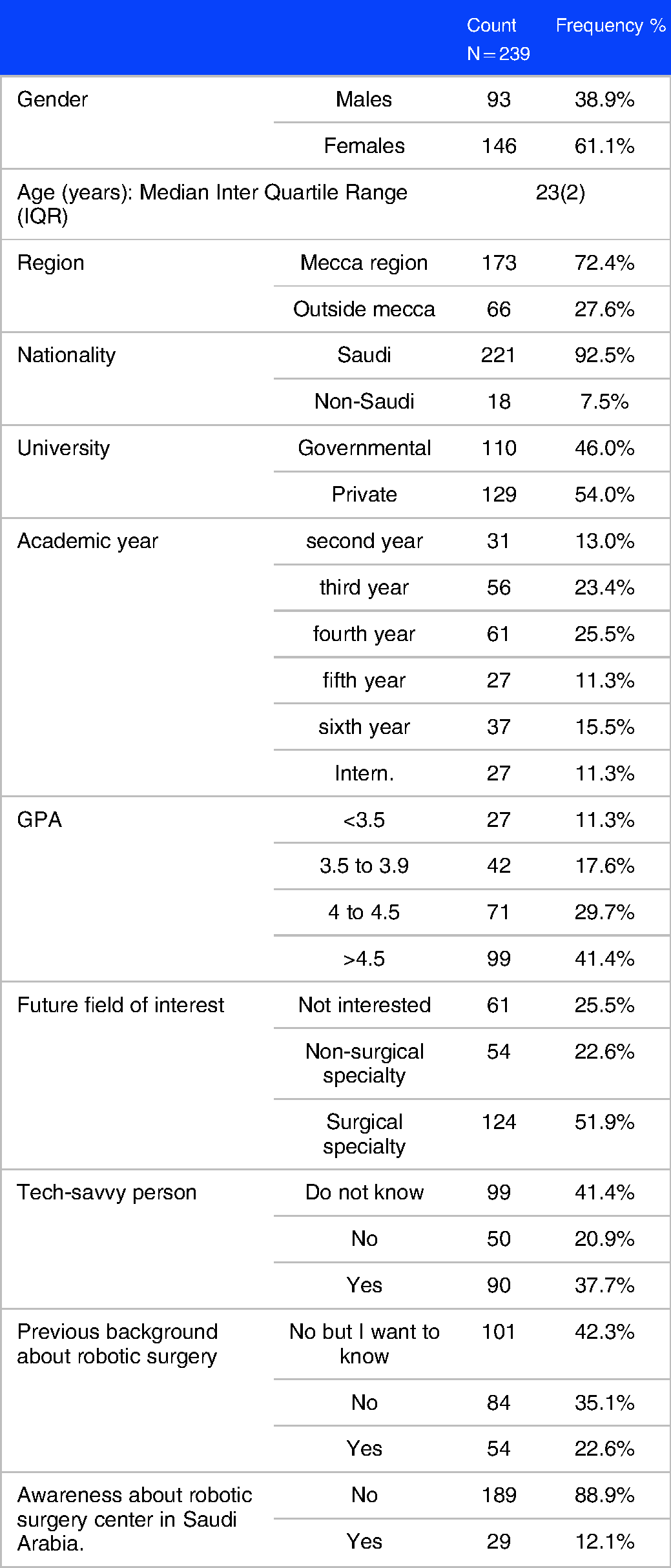
Over a 2 months period from June to July 2021, a total of 239 medical students from both governmental (46%) and private colleges (54%) responded to the online questionnaire. Of these, (61%) were female and (38.9%) were male and the median age was 23 years ranging from 20 to 28 years. They were from different academic years mainly the third (23.4%) and fourth (25.5%) years with a median GPA of 4 to 4.5 (29.7%). More than half (51.9%) were interested in the surgical field. Almost two-thirds (37.7%) considered themselves as tech-savvy persons (Table 1). Most students reported no prior exposure to robotic surgery information (77.4%) with some of them (42.3%) expressed their wishes to know. Less than a quarter (22.6%) admitted having a previous background about robotic surgery. Only (12.1%) knew about the availability of robotic surgery center in the kingdom (Table 1).
Characteristic data of the participating medical students.
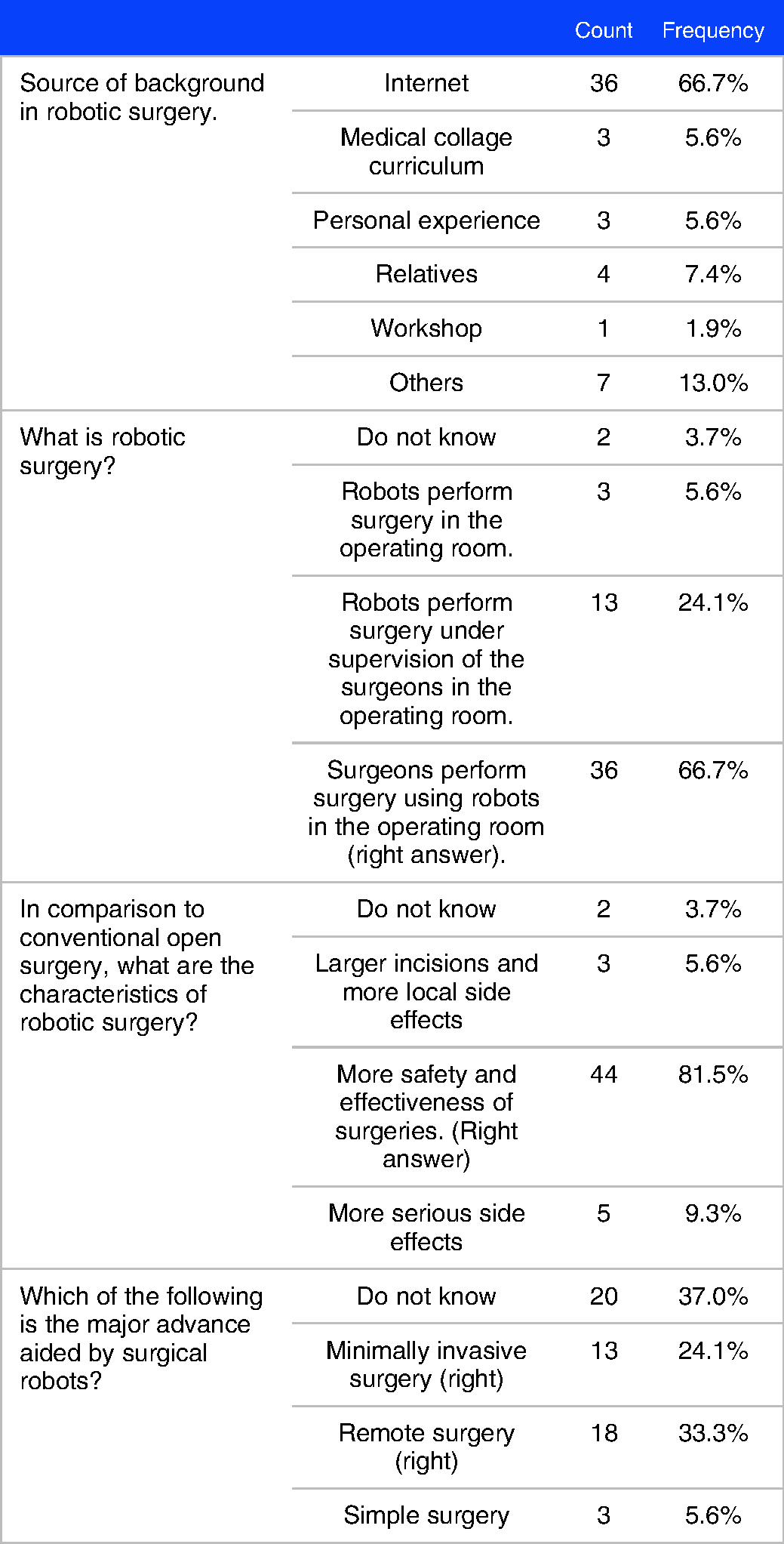
The main source of knowledge was from the internet (66.7%), while medical curricula represented only 5.6% of the sources. Among students who had previous background, 66.7% defined robotic surgery correctly, and 81.5% were aware about its characteristics but only 33.3% could acknowledge the major advances aided by surgical robots (Table 2). (63.2%) of the students showed a positive attitude accepting robotic surgery, 67.8% of them expected that using robots will improve surgical outcomes. Almost half of the students (48.5%) expected that patients in Saudi Arabia will not accept it. Some participants (51.1%) were concerned that robots could replace the surgeons in the future, (59.8%) of them think that this could make surgeons weak and reluctant with less professionalism and experience. However, many believed that Saudi Arabia should invest and expand the robotic surgeries (69.1%) (Table 3).
Medical students’ knowledge about robotic surgery.
Medical students’ attitude towards robotic surgery.

Students with background had significantly younger median age (p < 0.030), earlier academic years (p < 0.001), higher GPA (p < 0.025), and more tech-savvy personality (p < 0.000) compared to those without background of robotic surgery (Table 4).
Comparison between students with and without background in robotic surgery.

Discussion
While only a quarter of our medical students had a previous background of robotic surgery, many of them showed a positive attitude and a high expectation towards this technology in SA. Still, they had some concerns especially for patients’ acceptance and losing jobs and professionalism to the robots.
Among those with previous background, still they had knowledge gaps especially for the major advances aided by surgical robots. These findings could be explained by the absence of strong surgical curricula at their medical schools as the internet was the principal source of their knowledge. On the other hand, culture in SA could explain their view about the difficult acceptance of robotic surgery by the patients 10 . Nevertheless, most of the students showed acceptance and expectation of better surgical outcome and agreed that SA should invest and expand on robotic surgery. In a systematic review of the literature 11 , acceptance of robots by health care workers was influenced by their perceived needs, previous exposure and experiences, age, education, views and expectations, and lastly cultural background.
The medical students, as other health care workers, were worried that introduction of robots in the surgical field might be disruptive for their profession 12 . Their concerns might influence their choices for future subspecialities. Therefore, it could be of interest to specifically examine if those more concerns would avoid joining the surgical field. In the meaning of expectancy-value theory, an attitude (A) toward an object (O) can be expressed in a function of beliefs (B) toward this object and the evaluations (E) of these expectations 13 .
In this study, young age students with high GPA, who considered themselves as tech-savvy showed higher knowledge concerning robotic surgery (Table 4). It is expected that young age students are more open to emerging technologies. In line with our findings, a survey among physicians and therapists reported similar predominance.
Learning environment at surgical rotations, simulation training, and traditional curricula can dramatically affect the undergraduate students’ career decisions 14 . Unfortunately, one study 15 found insufficient training using a structured robotic training curriculum and another 16 reported on failure of robotic operating room to have a motivating learning environment for medical students.
Taking together, it is essential for our medical students to have curricular and extracurricular learning opportunities around the clinical, technical, and ethical implications of robots in medical practice. Curricular components at medical schools in SA should be targeted to address the students’ need to know the core knowledge and concepts underlying robots without going deep into the technical details. They have to identify when it is appropriate to refer a given patient for robotic surgery. A multidisciplinary, integrated approach to learning will serve to facilitate reaching this goal. Some colleges17,18 offered preclinical and clinical curricular and extracurricular courses to train their medical students to allow convergence between artificial intelligence and medicine. Satava et al (2020) demonstrated better performance of those trained following the fundamentals of robotic surgery skills (FRS) compared with controls. They suggest implementation of robotic in training programs before surgeons apply these skills clinically 19 .
While surgery needs a specific innate aptitude for manipulative skills and psychomotor abilities, the selection of surgical trainees is mainly based on academic achievements and subjective interviews with no implication of predilection testing for the psychomotor, and manual manipulative skills. Moglia et al (2018). studied 155 medical students to quantify the size of individuals with high, average, and low level of innate psychomotor skills. About83.2% of the participants was found to have average aptitude for surgery. Out of nine top performers, five had experienced both video gaming and musical instrument playing, but Spearman correlation was non-significant. They concluded that exercises on a virtual simulator can be considered to complement the selection process to identify those with low innate aptitude for surgery and advise them to consider specialization in other medical specialties 20 .
This study has several limitations. First, our study included medical students from different colleges from both governmental and private sectors in SA, still generalization is limited by the absence of randomization. Moreover, it may not be possible to extrapolate our results from SA to other countries in the Middle East because of difference in the training curricula and the availability of robotic surgery.
Conclusion
Most medical students were unaware of robotic surgery, but they showed positive attitude and high expectations. Still, they were concerned by patients’ acceptance and losing jobs and careers. Young students who consider themselves tech-savvy persons are in a better position, but they access their knowledge from internet rather than from their medical education. There is a need to continue our work by addressing the attitude of postgraduate students and residents to explore their specific views and concerns and how training will affect their career and professionalism. Meanwhile, there is a need for providing a more effective curricula with incorporation of orientation and simulation in a motivating learning environments, to prepare our students to take part in the leadership of robotic surgery in the kingdom.
Footnotes
Ethical Approval
Not applicable, because this article does not contain any studies with human or animal subjects.
Informed Consent
Not applicable, because this article does not contain any studies with human or animal subjects.
Trial Registration
Not applicable, because this article does not contain any clinical trials.
