



Abstract
Objectives
The primary objective of the study was to analyze the extent of ChatGPT usage and students’ attitudes about ChatGPT. The secondary objective is to examine the potential underlying structure of students’ perceptions about this AI tool in academic settings. Additionally, the focus on students studying in Serbian and English may shed light on the cultural and linguistic influence of technology implementation in educational settings.
Methods
This descriptive study investigated how medical students perceive the application of ChatGPT in educational settings using a 3-part questionnaire: a demographic section collecting participants’ overall experience and perceptions of ChatGPT, and a section collecting students’ attitudes toward artificial intelligence who did not use ChatGPT.
Results
In the survey, there were 1212 students (1037 students in the Serbian and 175 students in the English language). Almost four-fifths of students have heard of ChatGPT (79.4%), but less than half of students have used ChatGPT (42.2%). Principal component analysis revealed 4 components: Positive Perception and Usefulness, Negative Impacts and Risks, ChatGPT Usability and Improvement, and Interaction and Communication Challenges items.
Discussion
A positive attitude was prevalent in our population; however, students were also aware of the limitations of ChatGPT, which were recognized as potential academic dishonesty and a risk of job loss. There were significant differences in students’ agreement with various statements across 3 components among students studying Serbian and English, implying a possible role of linguistic barriers in AI responses. Therefore, using ChatGPT to promote education and healthcare should be done ethically and responsibly, considering the possible improvements in AI tools and the risks and issues they raise.
Keywords
Introduction
Artificial intelligence (AI) represents a multidisciplinary field that merges computer science and linguistics, intending to develop machines capable of executing tasks that typically necessitate human intelligence. 1 OpenAI's GPT models, which power ChatGPT, are large language models (LLMs) that generate responses by recognizing patterns and simulating human conversation. These patterns are encoded in a deep-learning neural network modeled after the human brain's cortex. 2 Tasks encompass learning, adapting, reasoning, comprehending abstract concepts, and responding to complex human attributes such as attention, emotion, and creativity. 3
There are both optimistic and pessimistic perspectives regarding the impact of AI on everyday life. The pessimistic view posits that AI may eventually replace human labor across various sectors, potentially leading to job displacement and reduced human involvement. In contrast, the optimistic perspective suggests that individuals who embrace and adapt to AI technologies are more likely to benefit from future advancements and opportunities arising from its integration, 4 such as improved ability to convey and express research concepts and findings through tools like ChatGPT, which may ultimately accelerate the publication process by making research outputs more accessible. 5
This inevitable transformation of education, among other activities, requires that educators and students understand the principles, capabilities, and limitations of LLMs. A recent systematic review has summarized the numerous potential impacts of AI on medical education, serving as a learning aid, producing clinical scripts for diseases, and improving students’ diagnostic and clinical skills in various areas of medical education. 6 LLMs provide subject-specific resources, streamline grading, offer feedback, and assist in plagiarism detection. It is becoming evident that more information and AI-based training for doctors and medical students are needed as the field of AI in healthcare gains pace. 7
Students have expressed notable curiosity and enthusiasm about using ChatGPT in medical education.8–10 They generally held positive attitudes towards AI, acknowledging its potential to enhance clinical decision-making, improve diagnostic accuracy, and optimize patient care. Recent studies indicate that students view AI tools as beneficial for improving study efficiency, supporting clinical reasoning, and fostering active engagement in education.11,12 Most participants agreed that AI is essential in medicine, 13 while the majority believed AI would drive significant advancements and found it exciting for dentistry and medicine. 14 The latest study revealed generally favorable attitudes among medical students toward AI, perceiving this tool as effective and credible. 15
However, it is also reported 16 that medical students exhibit limited knowledge of AI concepts, with significant gaps in their understanding of technical details, such as algorithms, machine learning, and AI applications in healthcare. First studies revealed, as expected, that only a third of students knew the fundamentals of AI, including machine learning and deep learning. 17 The results showed that while Pakistani physicians and medical students have a basic understanding of AI, they are not aware of its real-world applications in healthcare. 14 Additionally, four-fifths of the population had not read any scholarly materials on AI or machine learning. At the same time, Al Ahmari et al discovered that the majority of participants lacked a basic understanding of AI principles and its applications in dentistry.14,18 However, concerns were noted regarding the potential for AI to replace human healthcare professionals, the ethical implications, and data security. These mixed perceptions of AI align with broader concerns about the limitations of AI tools such as ChatGPT.16,19
Simultaneously, growing exposure to AI has raised concerns among students about ethical and professional implications, including concerns about data protection, excessive dependence on AI systems, and the possible decline of independent analytical skills. 12 These concerns suggest the need to better understand how students reconcile excitement about AI's capabilities with awareness of its limitations in educational environments. The observed discrepancy between positive attitudes and insufficient knowledge highlights the importance of integrating structured AI literacy initiatives into medical education. 20 Introducing dedicated teaching modules on AI principles and responsible use could enhance students’ ability to engage critically with generative tools such as ChatGPT. Such efforts would not only promote informed and ethical application of AI but also equip future healthcare professionals to adopt these technologies more effectively in both clinical and academic contexts. 20
With this background in mind, the primary objective of the study is to assess medical students’ attitudes towards ChatGPT, as the most frequently used AI tool. The secondary objective is to examine the potential underlying structure of students’ perceptions about this AI tool in academic settings. Additionally, focusing on students who are studying in Serbian and English might shed light on the cultural and linguistic influences on the implementation of technology in educational settings.
Materials and Methods
Study Design
This descriptive study investigated how medical students perceive the application of an AI chatbot (ChatGPT) in medical education. For this purpose, a web-based questionnaire was developed for this study. The initial section collected demographic data from participants, including age, gender, study year, and study group. The subsequent section self-assessed participants’ overall experience and perceptions regarding the use of an AI system in medical practice. For this purpose, we used a previously published survey. 21 Responses in this section were recorded using a 5-point Likert scale: strongly agree, agree, neutral, disagree, and strongly disagree. In some statistical analyses and graphical presentations, the “strongly agree” and “agree” categories were combined, while the “disagree” and “strongly disagree” categories were combined.
The third part of the questionnaire was used to assess students’ perceptions of those who did not use ChatGPT. The questionnaire was distributed via QR codes and links to facilitate easy access for students. A simple Serbian translation (without complete cultural adaptation) was used in the survey. The Serbian version was tested in a pilot study among 20 Serbian medical students to assess item clarity, linguistic consistency, and contextual relevance. Based on students’ feedback, minor adjustments were made.
Participant Recruitment
The study was conducted at the Faculty of Medicine, where 2 groups of participants were recruited. The first group comprised students studying in Serbian (from the first to sixth study year and PhD students), and the second group consisted of medical students studying in English (from the first to sixth study year).
Statistical Analysis
Responses were documented in Google Sheets for subsequent analysis and review. Data were presented as mean values ± standard deviations and as counts and percentages. Student perceptions were compared between groups studying in Serbian and those studying in English. The internal consistency of the questionnaire was checked using Cronbach's α. The internal consistency of the questionnaire for students who used ChatGPT is good, with a Cronbach's alpha of 0.887. Principal component analysis (PCA) with varimax rotation was performed on the dataset to explore the component structure underlying the instrument. Before conducting PCA, we assessed the suitability of the data using the Kaiser-Meyer-Olkin (KMO) measure and Bartlett's test of sphericity. The number of components was determined based on eigenvalues greater than 1 (Kaiser's criterion) and visually based on the scree plot. Items with factor loadings ≥0.40 were considered significant contributors to a component. The agreement between groups was compared using the chi-squared test. The null hypothesis was tested at a significance level of P < .05. All statistical analyses were conducted using the R programming language. 22
Results
In the survey, there were 1212 students (341 men and 871 women). The mean age of the population is 21.67 ± 2.84 years (minimum 18 years, maximum 47 years). The study included 1037 students in the Serbian language and 175 students in the English language (Figure 1, Supplementary Table 1). Almost four-fifths of students have heard of ChatGPT (79.4%), but fewer than half have used it (42.2%). There were significant differences in responses to these 2 questions between students who studied in Serbian and English (P < .001 for both).

Demographic characteristics of the study population.
In PCA analysis, the KMO value was 0.914, indicating excellent sampling adequacy. Bartlett's test was statistically significant (P < .001), confirming that the correlations among items were sufficiently large to justify PCA. According to Kaiser's criterion (eigenvalues > 1), a model of 4 components represented the best combination of model fit (R2 = 60.1%, ie, explained variance) and parsimoniousness (4 components) in principal component analysis. The component loadings are presented in Table 1. The Positive Perception and Usefulness items are loaded on the first principal component. The Negative Impacts and Risks items are loaded on the second principal component. The items loaded on the third component addressed ChatGPT Usability and Improvement Needs. The fourth component included items of Interaction and Communication Challenges.
Principal Component Analysis in Students’ Population Sample.

Varimax rotation.
Figure 2 graphically presents the attitudes of the total population towards ChatGPT. There were significant differences in the following statements between students studying in Serbian and English: “I am amazed by the capabilities of ChatGPT” (P = .001), “ChatGPT is a helpful and effective technology for learning” (P = .010), “ChatGPT is good as a complementary learning resource” (P = .001), “Asking follow-up questions helps ChatGPT find the correct answer” (P < .001), “ChatGPT is an effective and useful learning tool in the medical sciences” (P < .001), “ChatGPT is interesting” (P < .001), “ChatGPT provides good explanations” (P < .001), “ChatGPT answers are well structured” (P = .023), “I think the quality of ChatGPT will improve soon” (P = .007), “ChatGPT is easy to use” (P < .001), “ChatGPT will open the door for manipulation and malicious use” (P = .002), “I feel quite uncertain about the impact of ChatGPT and how it will change our life” (P = .018)(Figure 3, Supplementary Table 2).

Students’ perception with statements related to ChatGPT in population.

Students’ agreement with statements related to ChatGPT (NS = nonsignificant).
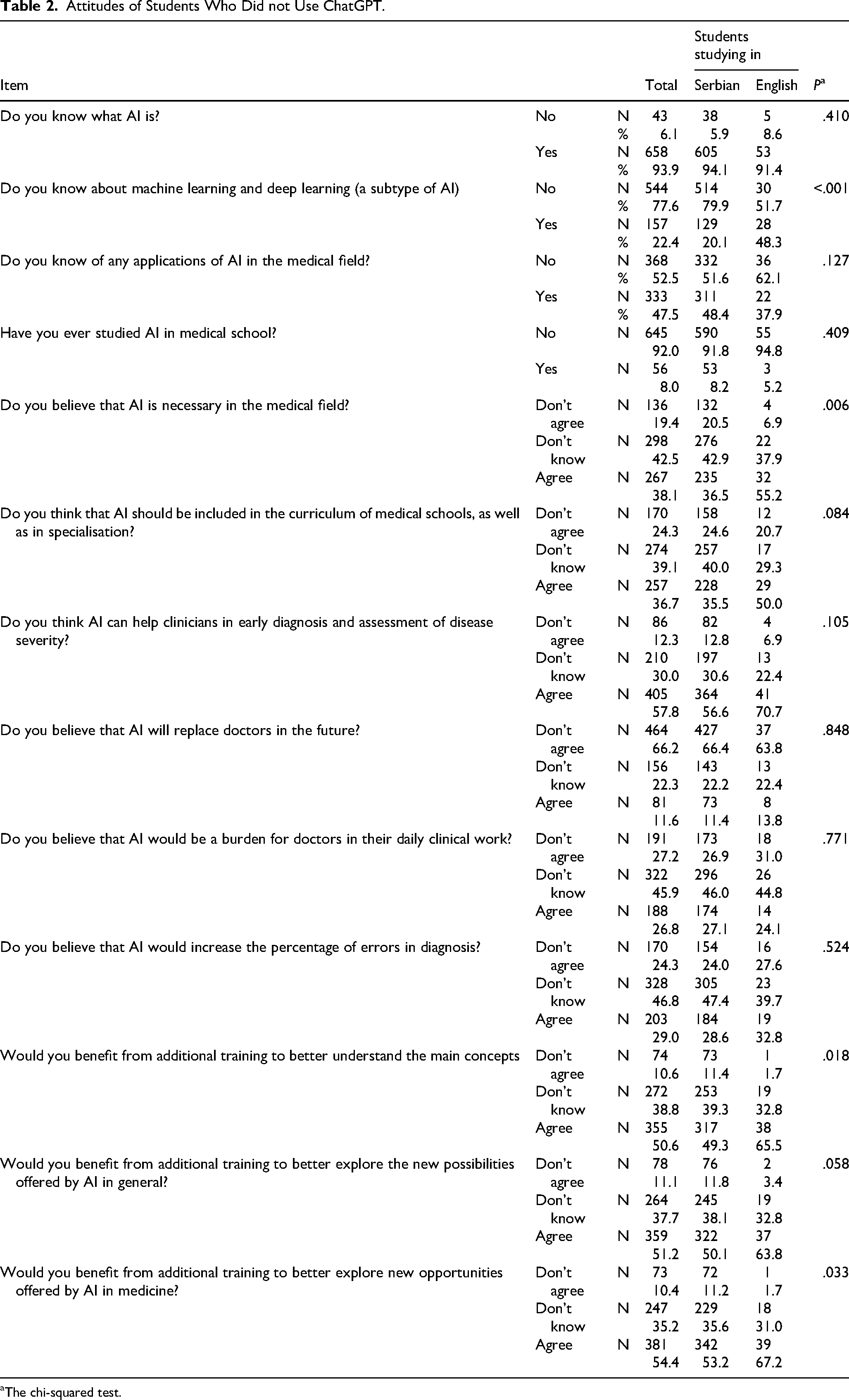
Among students who had not used ChatGPT, 93.9% reported being aware of AI. Additionally, 47.5% recognized its applications in the medical field, while 22.4% were familiar with machine learning and deep learning. However, only 8.0% had studied AI in medical school (Table 2). Regarding AI's role in medicine, 38.1% of students believed that AI is essential in the medical field, while 36.7% supported its inclusion in medical school curricula and specialization programs. More than half of students (57.8%) agreed that AI could assist clinicians in early diagnosis and assess disease severity. However, 11.6% were frightened that AI might eventually replace doctors, 26.8% considered it a potential burden in daily clinical practice, and 29.0% believed it could increase the rate of diagnostic errors. Regarding AI education, 50.6% of students expressed interest in additional training to understand fundamental AI concepts better. Approximately half of the subpopulation (51.2%) sought training to explore broader AI applications, and 54.4% expressed interest in further exploring the potential of AI in the medical field.
Attitudes of Students Who Did not Use ChatGPT.
The chi-squared test.
The perceptions about knowledge about machine learning and deep learning (20.1% vs 48.3%, P < .001), the AI necessity in the medical field (36.5% vs 55.2%, P = .006), awareness of the benefit from additional training to better understand the main concepts (49.3 vs 65.5, P = .018), awareness benefit from additional training to better explore new opportunities offered by AI in medicine (53.2% vs 67.2%, P = .033) are significantly different between students studying in Serbian and in English.
Discussion
The rapid development of AI and LLMs, particularly ChatGPT, has sparked considerable interest in their application in education, research, and healthcare. These tools assist students by enhancing writing, research, and critical thinking while also raising important questions about academic integrity, scientific accuracy, and ethical use.5,23,24 Given these advancements, it is not surprising that students’ awareness of ChatGPT has increased.
Approximately 1 year after ChatGPT's release, almost four-fifths of our students have heard of it (79.4%), but less than half have used it (42.2%). These results align with broader research on AI awareness and adoption among students. The study by Delello et al reported that 98.2% of respondents were somewhat familiar with AI
The use of ChatGPT in our study was approximately double that of the Arabian students, 27 but our survey was conducted 6 months later. More than four-fifths of the total student population (85.5%) agree that ChatGPT answers are accurate, and they are optimistic about ChatGPT (82.2%). They express a feeling of being motivated to use ChatGPT more (78.3%), probably because it allows them to study more efficiently (77.5%), and it is better than other search engines like Google (74.4%); additionally, ChatGPT makes a human-like impression (69.50%). However, according to students’ opinions, working with ChatGPT still requires human intelligence (70.1%).
Subsequently, the principal component analysis revealed 4 components. The first component, Positive Perception and Usefulness, included positive experiences and attitudes toward ChatGPT, capturing the students’ view of it as a beneficial and effective tool. PCA findings suggested that students’ positive experiences and attitudes primarily stem from their perception that ChatGPT is an effective and useful learning tool in the medical sciences, as well as the experience of studying more efficiently with ChatGPT. Students’ high motivation to use ChatGPT (78.3%) and their belief that it improves study efficiency (77.5%) may derive from the tool's novelty, accessibility, and perceived time-saving potential. Similar findings have been reported in several studies, where students described ChatGPT as a convenient and engaging learning companion that enhances motivation and active participation.28–31 This study highlights that generative AI tools increase task motivation in higher education by offering immediate feedback and reducing cognitive workload, 28 while other studies observed that students appreciate ChatGPT's role in improving confidence, focus, and enjoyment during learning tasks.29,30
The second component, Negative Impacts and Risks, pertains to concerns such as the potential for academic dishonesty, manipulation, adverse effects on learning, and worries about job security, emphasizing the students’ perception of the potentially harmful effects of ChatGPT. The items with the highest loadings—and therefore likely the greatest impact—in the second component are students’ sensitivity to ChatGPT opening the door for manipulation and malicious use, as well as concerns that ChatGPT will threaten people's jobs. The concern that AI, particularly ChatGPT, may replace doctors or threaten jobs in the future was examined across students who used and did not use ChatGPT. Interestingly, students who used ChatGPT were significantly more likely to believe that AI would replace jobs (51.3% in Serbian, 47.9% in English) than those who did not (11.4% in Serbian, 13.8% in English)
Applying the theory of planned behavior to a longitudinal study revealed that a favorable attitude towards unethical use, and perceived social acceptance, might strongly contribute to academic cheating. These findings have important implications that awareness of potential ChatGPT academic misuse is not sufficient to reduce academic dishonesty, suggesting that educational institutions should focus not only on the technical flaws of AI tools but also on reshaping the attitudinal and normative landscape.32–34 Even in institutions where some policies exist, they are often vague or inadequately communicated, which is why further recommendations emphasize the need for education, assessment redesign, and technological safeguards. Instead, other factors, such as prior exposure to AI discussions, educational background, and general attitudes toward technology, may also play a role
The third component, ChatGPT usability and Improvement, is the combination of items that indicate ChatGPT is easy to use, yet also not perfect and in need of further improvement, as well as the necessity of human intelligence in its operation, reflecting a dual perspective—acknowledging both the ease of use and the areas that require enhancement. Students’ perception of ChatGPT's importance as a learning tool probably influences their intention to use it frequently. Those who find it valuable are more likely to use it regularly. In the third component, the highest 2 loadings are for items: “ChatGPT is not perfect and needs to be improved” and “to work with ChatGPT, you still need human intelligence,” implying students’ awareness of ChatGPT's drawbacks and prioritizing human intelligence, likely in the context of the educator role. Similar insights are reported in a year-long study in the classroom, 39 highlighting the educator's importance in modern classrooms as a motivator and provider of students` personal needs.
The fourth component, Interaction and Communication challenges, highlighted issues such as the need for prior knowledge when using ChatGPT, occasional misunderstandings, and awkwardness in formulating questions, underscoring communication and interaction challenges between users and the system. All students shared similar attitudes about the items in this component. A high percentage of students (81.0%) indicated that background AI knowledge is essential, along with items from the last component, aligns with research indicating that limited AI literacy and the absence of structured institutional guidance may hinder students’ effective and critical engagement with these tools. The solution lies in developing clear institutional policies that define acceptable AI use, promoting AI literacy among students and staff, and revising assessment methods to emphasize originality and critical thinking.35,40,41
In the first 3 components, our study revealed significant differences in students’ perceptions of the various statements mentioned above. Significant differences between Serbian- and English-studying students suggest that language-related factors potentially influence perceptions of ChatGPT. Students studying in English are more “amazed” and generally found the tool easier to use, more accurate, and more beneficial, while students studying in Serbian reported greater uncertainty and lower perceived usefulness. The comprehension and reliability of AI-generated content for non-native speakers might be affected by this imbalance. Previous research has shown that non-English users often face misinterpretations, less coherent responses, and reduced contextual accuracy, which may explain why students studying in Serbian found ChatGPT less helpful. 39 42–46 The study highlights the dominance of English in AI training data, leading to disparities in AI performance across different languages. The disparity raises concerns about the inclusivity of AI technologies and their potential to perpetuate existing linguistic inequalities. Dave et al emphasize the importance of developing AI systems that cater to a diverse linguistic landscape to ensure global equitable access and benefits. 47 Additionally, AI biases against non-standard dialects and a lack of clear explanations can further limit effectiveness for non-English users. These barriers highlight the need for better AI adaptation for diverse linguistic backgrounds to ensure equitable learning experiences.42,48 Moreover, recently reported limited exposure to formal discussions on AI ethics may further explain why Serbian-speaking students express less concern about academic integrity. 48 Students studying in English are significantly more concerned that ChatGPT will make academic cheating easier, ultimately leaving students feeling uncertain about its impact and how it will change their lives. Medical students in non-English schools had fewer opportunities to participate in ethical discussions about AI, resulting in a decreased concern regarding AI's impact on academic integrity. 49 Given the present circumstances, students studying in Serbian are likely to be less frequently exposed to organized debates on AI ethics, which could lead them to overlook the possible abuse of technology.
In the subpopulation of students who did not use ChatGPT in our research, the study found a significant association between their self-assessment of AI knowledge and their conviction about the importance of AI in education and the medical field. Precisely, our study documented that students who did not use ChatGPT demonstrated significantly lower awareness of AI applications, machine learning and deep learning, and AI education in medical school. They were also less likely to recognize the need for AI training (49.3% vs 65.5%), the role of AI in medicine (38.1% vs 55.2%), or its integration into medical curricula (36.7% vs 50.0%). These findings underscore the need for structured AI education to bridge knowledge gaps and ensure readiness for AI-integrated clinical practice. 19 In our study, half of the students studying in English supported the integration of AI into curricula, compared to less than one-third of students studying in Serbian. A systematic review emphasized the importance of incorporating AI education into undergraduate medical programs to prepare aspiring doctors and students for utilizing AI in healthcare. 49
Students who previously used ChatGPT were more likely to acknowledge AI's role in education.17,45 Since AI applications are now being utilized in medical education, students studying in English are more likely to be exposed to AI-integrated learning environments. According to research, students who receive early AI training are more confident and receptive to AI-assisted learning resources. 2 Similarly, Blease et al found that students who had prior exposure to AI in clinical settings were more likely to perceive AI as a beneficial and reliable tool. 46
Nowadays, when numerous studies have consistently demonstrated that AI tools in medical education are an expanding pedagogical necessity rather than a fleeting novelty. 50 Therefore, institutions should act in 2 directions. Firstly, universities have to acquire an introductory knowledge of AI through foundational training sessions or seminars, progressing to more advanced sessions as their familiarity with the subject increases. To improve teaching, university-level training is essential because it equips teachers with the skills necessary for utilizing AI.
Secondly, curricular materials need to be updated, and AI tools need to be implemented. Without overwhelming students, a curriculum can be enhanced by gradually incorporating AI into existing modules, such as clinical reasoning or research methods. It is documented that even short courses can improve AI literacy. 11 It is crucial to have institutional support, including access to AI tools and adherence to ethical standards. Resource constraints must be addressed in strategies to guarantee equitable AI adoption.51,52 To effectively incorporate AI into medical education, curricula must include foundational AI literacy, ethical considerations, and practical applications in clinical settings. These implementations can enrich pedagogical approaches and improve knowledge acquisition in medical education. 53
There are several limitations of the study that have to be considered when attempting to interpret the findings. As the study focused primarily on ChatGPT, findings may not fully represent perceptions of or experiences with other LLMs (Gemini, Copilot, Falcon LLM, etc). However, evidence that ChatGPT is the most frequent LLM implies that insights about ChatGPT might be generalizable. 31 The cross-sectional design of the study may limit the ability to explore temporal changes in ChatGPT usage and students’ perceptions. Therefore, there is a chance that the ChatGPT usage has increased, and students` perceptions have changed in the meantime. Second, the study analyzed participants` self-reported data, which can cause selection bias due to under- or over-estimation of ChatGPT usage and perceptions towards chatbots. Additionally, there might be selection bias due to voluntary participation in the study. However, our relatively large sample suggests that our observations, in general, are valid. Third, possible linguistic barriers in AI responses should be interpreted cautiously due to the lack of assessment of English language skills among students studying in Serbian. This potential measurement bias may not be crucial, as we assume that students studying medicine in English regularly use the English language in their communication and education. Fourth, the study recruited participants from only one institution. Further investigations should be designed as multicentric studies.
Conclusion
Our findings indicate that nearly half of the students have experience with ChatGPT. Based on principal component analysis, a positive attitude toward ChatGPT is dominant among our student population. However, they are also aware of its limitations, which are recognized as academic dishonesty, manipulation, malicious use, and the threat of job loss. This perception is accompanied by the belief that although this tool is easy to use, it will be further improved soon. There are significant differences in students’ agreement on various statements in the first 3 components among students studying in Serbian and English, implying a possible role of linguistic barriers in AI responses. Our findings suggest another practical implication: ChatGPT might boost students’ confidence and motivation in a modern classroom, but in an atmosphere guided by educators and comprehensive regulations.
Supplemental Material
sj-docx-1-mde-10.1177_23821205251409530 - Supplemental material for Exploring Medical Students’ Perceptions Regarding ChatGPT and AI Studying at the University of Niš: A Study on Usage, Attitudes, and Linguistic Influence—Single-Centered Study in Serbia—A Paradoxical Ally?
Supplemental material, sj-docx-1-mde-10.1177_23821205251409530 for Exploring Medical Students’ Perceptions Regarding ChatGPT and AI Studying at the University of Niš: A Study on Usage, Attitudes, and Linguistic Influence—Single-Centered Study in Serbia—A Paradoxical Ally? by Aleksandra Ignjatović, Marija Anđelković Apostolović, Lazar Stevanović, Pavle Radovanović, Sidharth, Marija Topalović and Tamara Filipović in Journal of Medical Education and Curricular Development
Supplemental Material
sj-xlsx-2-mde-10.1177_23821205251409530 - Supplemental material for Exploring Medical Students’ Perceptions Regarding ChatGPT and AI Studying at the University of Niš: A Study on Usage, Attitudes, and Linguistic Influence—Single-Centered Study in Serbia—A Paradoxical Ally?
Supplemental material, sj-xlsx-2-mde-10.1177_23821205251409530 for Exploring Medical Students’ Perceptions Regarding ChatGPT and AI Studying at the University of Niš: A Study on Usage, Attitudes, and Linguistic Influence—Single-Centered Study in Serbia—A Paradoxical Ally? by Aleksandra Ignjatović, Marija Anđelković Apostolović, Lazar Stevanović, Pavle Radovanović, Sidharth, Marija Topalović and Tamara Filipović in Journal of Medical Education and Curricular Development
Supplemental Material
sj-docx-3-mde-10.1177_23821205251409530 - Supplemental material for Exploring Medical Students’ Perceptions Regarding ChatGPT and AI Studying at the University of Niš: A Study on Usage, Attitudes, and Linguistic Influence—Single-Centered Study in Serbia—A Paradoxical Ally?
Supplemental material, sj-docx-3-mde-10.1177_23821205251409530 for Exploring Medical Students’ Perceptions Regarding ChatGPT and AI Studying at the University of Niš: A Study on Usage, Attitudes, and Linguistic Influence—Single-Centered Study in Serbia—A Paradoxical Ally? by Aleksandra Ignjatović, Marija Anđelković Apostolović, Lazar Stevanović, Pavle Radovanović, Sidharth, Marija Topalović and Tamara Filipović in Journal of Medical Education and Curricular Development
Footnotes
Acknowledgments
The authors would like to thank all the students who took the time to participate in the study, answer questions in the interview, and fill out the questionnaires. We thank Dr Hristina Jovanović for her assistance with data collection.
Author's Contribution
Aleksandra Ignjatović conceived the study design and contributed to drafting the manuscript. Lazar Stevanović co-drafted the manuscript and authored the original draft together with Aleksandra Ignjatović. Pavle Radovanović, Sidarth, and Aleksandra Ignjatović carried out the analysis. Marija Anđelković Apostolović, Marija Topalović, and Tamara Filipović contributed to drafting and revised the manuscript. All authors read and approved the final manuscript.
ORCID iDs

Ethical Approval and Informed Consent Statements
The requirement for written informed consent was waived by the Ethics Committee. All participants gave verbally informed consent. This research received ethical approval from the Institutional Review Board at the Faculty of Medicine, University of Niš (No. 12-11272/2-7).
Funding
The authors disclosed receipt of the following financial support for the research, authorship, and/or publication of this article: This study was supported by a research grant from the Serbian Ministry of Science and Technological Development—project number 451-03-137/2025-03/200113.
Declaration of Conflicting Interests
The authors declared no potential conflicts of interest with respect to the research, authorship, and/or publication of this article.
Data Availability Statement
Data is available upon request from the corresponding author.
Supplemental Material
Supplemental material for this article is available online.
References
Supplementary Material
Please find the following supplemental material available below.
For Open Access articles published under a Creative Commons License, all supplemental material carries the same license as the article it is associated with.
For non-Open Access articles published, all supplemental material carries a non-exclusive license, and permission requests for re-use of supplemental material or any part of supplemental material shall be sent directly to the copyright owner as specified in the copyright notice associated with the article.
