



Abstract
Objectives
Medical students face a vast amount of information to learn and apply in clinical practice. Thus, they need effective strategies to manage and retain this knowledge. We aim to examine the study behaviors and social factors that distinguish high-achieving medical students.
Methods
A cross-sectional design was used to investigate the study habits during the exam preparation period and social factors of 598 medical student from Damascus University, during the year 2022, focusing on differences between high-achieving and non-high-achieving students. Data were collected using a self-administered paper-based questionnaire randomly distributed across multiple classes. Logistic regression was employed to examine the factors differentiating high-achieving from non-high-achieving students.
Results
Financial status, employment, parents’ educational level, study duration during the exam preparation period, sleep duration during the exam period, and some other factors had no relationship with being a high-achieving student. While other factors were positively associated, including having a doctor in the family (OR = 1.583, 95% CI: 1.000, 2.505, P = .05) and “often” (OR = 2.860, 95% CI: 1.571, 5.204, P = .001), “usually” (OR = 2.012, 95% CI: 1.004, 4.032, P = .049), or “always” (OR = 2.554, 95% CI: 1.295, 5.039, P = .007) using faculty textbooks compared to “never/rarely.” Conversely, a negative relationship was found between being a high-achieving student and “usually” using lecture handouts (OR = 0.201, 95% CI: 0.044, 0.913, P = .038) compared to “never/rarely.”
Conclusions
We found no significant differences in study habits during exam preparation period between high-achieving and non-high-achieving students. Other factors may contribute to the success of high-achieving medical students.
Introduction
Education enhances human capital, leading to economic growth and improved individual well-being. It provides increased opportunities and better living standards. Its importance is evident at both micro- and macro-development levels globally. 1 Medical students face a vast amount of information to learn and apply in clinical practice. As lifelong learners, they need effective strategies to manage and retain this extensive knowledge. 2 In the competitive field of medicine, students often seek factors or habits that could influence their academic success.
In Syria, admission to medical school is highly competitive, requiring top marks in the final high school exam. Those who achieve these high marks advance to a preparatory year of medical colleges, and those with the highest marks are selected for medical school. The exams in high school and the preparatory year primarily involve memorization of extensive material. This trend continues into medical school, where the competitive atmosphere is heightened as residency specialization depends solely on your grades during medical school.
Syrian medical education curriculum spans 6 years. It begins with a pre-medical preparatory year, serving as a substitute for the first year in the Medicine, Dentistry, and Pharmacy faculties. This is then followed by 5 years of comprehensive study in both basic and clinical sciences.
The initial 3 years of the program are committed to basic sciences. The fourth and fifth years concentrate on clinical subjects, while the sixth year is reserved for clinical training. 3 Each academic year is divided into two semesters. At the conclusion of each semester (with the exception of the sixth year), there is a testing period lasting roughly 1-2 months where theoretical examinations are held. These tests account for approximately 70%-80% of the students’ total semester grades. Thus, this period of time is a critical time for concentrated effort.
Previous studies have highlighted the significance of factors such as study hours, sleep hours, and study sources.2,4,5 While another study denied the significance of the previous factors with the academic performance. 6 We believe that this lengthy exam period in our student population is a major differentiator in students’ marks.
We hypothesize that high-achieving medical students utilize distinctive study strategies and benefit from specific social factors that collectively enhance their academic performance compared to their peers. This study aims to evaluate the impact of students’ study habits during the exam period, including sleep time, study time, and preferred study sources on academic outcomes. By identifying key factors that contribute to performance during exam period, our goal is to offer evidence-based insights to help students optimize their preparation strategies.
Materials and Methods
Study Design and Setting
Data collection took place during the period of May 26, 2022, to June 5, 2022, through a cross-sectional study. A paper-based, self-administered anonymous questionnaire was utilized for this purpose. Furthermore, all participants willingly provided written consent. The reporting of this study conforms to the STROBE statement for cross-sectional studies 7 (Supplemental File STROBE cross-sectional checklist).
Study Participants and Sampling
The sample size for the study was determined by employing Taro Yamane's formula,
8
which is expressed as follows:

In this context, “n” denotes the required sample size, “N” signifies the entire population (which is 5537), and “e” indicates the level of precision or margin of error, (set at 0.05 corresponding to a ±5% margin) with a confidence level of 95%. Utilizing this formula for our study yields a sample size of 374. Nonetheless, we targeted a larger sample size of 900.
The inclusion criteria encompassed undergraduate students from Damascus University, Faculty of Medicine, excluding first-year students (preparatory year). We employed a methodical strategy to select our targeted sample of 900 students, ensuring balanced representation from all academic years. To achieve this, we began the sampling procedure by dividing the total sample size needed by the number of academic years. This preliminary action enabled us to ascertain the desired number of students to be included from each year.
For the second and third years, we randomly chose practical classes to distribute the survey, with approximately 30 students in each class. To ensure thorough data collection, we registered all students from each chosen class. For the fourth and fifth years, we distributed the survey in the amphitheater where about 600 students attend radiology lectures, randomly selecting students from this group. Finally, for the sixth year, we targeted the clinical stages in the university's hospitals to randomly distribute the survey there.
Furthermore, we designated 5% of the sample size to students situated in other parts of the college campus. These students were not randomly selected; rather, we included those who were accessible and agreed to participate. Consistent with our dedication to data integrity, we politely asked students to abstain from filling out the questionnaire if they had already done so. Moreover, it's important to underscore that students must attend their specific practical classes and radiology lectures, with each student group adhering to a predetermined class/lecture timetable. This rigorous compliance with a uniform class/lecture schedule significantly eased our data gathering process. Participation in the study was voluntary, and students had the freedom to opt out. Only those students who completed the questionnaires were considered for the study. It is important to note that the questions for the current research were distributed with the questionnaire of a previous research, 9 but the response rate differed for each study.
Data Collection Tool and Technique
After conducting a thorough literature review, we developed the questionnaire in Arabic, while taking into account some aspects of study habits at Damascus University. This included study sources that are familiar for the students in Damascus university. We benefited from some previously published studies6,10,11 while writing questions for the survey. It contains (1) student characteristics and social aspects, (2) sleeping and studying hours, and (3) study habits during the exam period. The questionnaire asked about 18 subjects, with closed-ended questions. The Supplemental materials contain an English version of the questionnaire. Students were required to indicate their average grades from the previous two semesters as a means to assess their academic performance.
A random group of 42 students underwent a pilot test of the questionnaire. Participant feedback was utilized to evaluate face validity, resulting in necessary modifications to improve the questionnaire's clarity, length, and relevance. It is important to note that these students were not included in the main study.
Ethical Consideration
Our research complies with the guidelines of the Declaration of Helsinki for studies involving human subjects. The Ethical Committee of the Faculty of Medicine at Damascus University, Syria (3500, 26-5-2022) granted ethical approval. Participants willingly joined the study. Written informed consent was obtained from participants before they completed the questionnaire. The data collection process was anonymous, ensuring no personal identification information was collected.
Statistical Analysis
In this study, we identified high-achieving students as those ranking within the upper 20% based on their grades each year. In other words, the high-achieving students for each academic year were those whose grades matched the top 20% of the students in the same academic year. Thus, out of 598 medical students, 129 students met the criteria to be considered high-achieving students. The high-achieving students were those whose average grades were more than 91.1%, 88%, 86.7%, 84.7%, and 85.5% for the second, third, fourth, fifth, and sixth years, respectively.
A descriptive analysis was performed to describe categorical and numerical variables using absolute and relative frequencies and mean with standard deviation, respectively. To determine the existence of statistically significant differences between groups, the chi-square test was applied to compare nominal or ordinal variables, while the t-test was used to compare continuous variables.
The Nominal variables were gender, marital status, having a job, parents’ educational level, having a doctor in the family, having a nap, preferred study time, preferred study place, studying with friends, and study materials format.
While the ordinal variables were academic year, parents’ average income, war impact on life or residency, parents’ expectations of their student's academic level, and study sources.
On the other hand, Continuous variables were age, study hours, and sleep hours.
We applied Levene's test to the continuous variables, and the P-values for all of them were greater than 0.05, indicating that they are homogeneous in terms of variance.
Given the large sample size of 598, we assumed the data followed a normal distribution.
Finally, logistic regression was then performed to investigate the association between studying factors during the exam period and academic achievement. The dependent variable was high- or non-high-achieving students. The independent variables of interest were the variables that have a P-value of ≤.25 in the chi-square test and t-test. The analysis was performed using IBM SPSS Statistics software version 26. A threshold of statistical significance was established with a value of P ≤ .05 for the chi-square test, t-test, and logistic regression.
Results
Students’ Characteristics
Five hundred and ninety-eight medical students were surveyed. Females comprised 313 (52.6%) of the sample. The mean age of participants was 21.5 ± 1.47 years. Only 65 (10.9%) participants reported being in a relationship, whether married, engaged, or having a partner. In terms of employment outside of college, 492 (82.3%) were full-time medical students. 328 (55.1%) of students had a doctor in their family. Regarding average parental income, 328 (55.3%) mentioned that their parent's income was good, which means it is enough for essentials and some luxuries. Only 212 (35%) students noted that the Syrian civil war had highly impacted their lives or their place of residence. Regarding parents’ educational background, 464 (78.5%) of students’ parents had obtained a university education. Other characteristics are shown in Table 1.
Students’ Sociodemographic Characteristics.

Uni-Variate Analysis
Sociodemographic Factors
Being a male or a female manifests no significant difference. However, having a doctor in the family demonstrated a significant difference in academic achievement between high and non-high-achieving students. Also, parents’ expectation levels between high- and non-high-achieving students were found to have a significant difference.
Notably, the largest proportion of high-achieving students—68 out of 129 (52.7%)—reported that their parents expected them to “compete for the highest academic ranking.” In contrast, the majority of non-high-achieving students—304 out of 468 (65%)—indicated that their parents expected them to “passing exams with high grades.” Other factors showed no significant difference. Details are shown in Table 2.
Characteristics of Non-High and High-Achieving Students.

The t-test was used for this variable.
The chi-square test was used for this variable.
Sleeping and Studying Hours
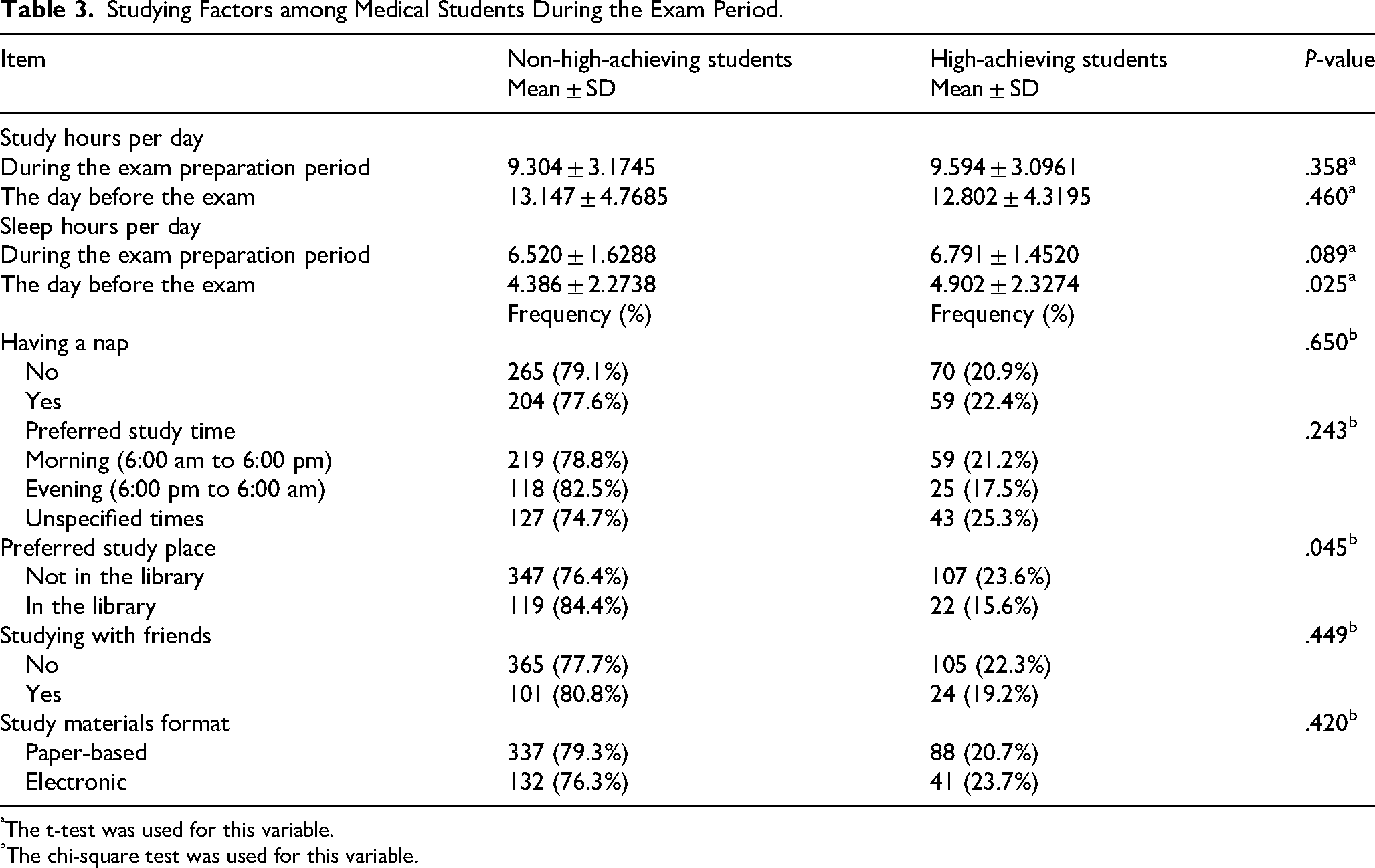
A significant difference was found between high- and non-high-achieving students in terms of hours of sleep the day before the exam. But, hours of sleep during the exam preparation period showed no significant difference between the two groups. Also, study hours or napping have no difference between the two groups.
The Place and Time Where Students Prefer to Study
A marked difference was observed in the academic performance of students who utilized the library for studying, with only 15.6% of students who opting to study at the library during the examination period are high-achieving students, while 23.6% of students who don’t use the library are high-achieving students with a P-value of .045.
Regarding preferred study time, the results showed no significant difference. Table 3 show different studying factors among medical students during the exam period, and comparing them between high- and non-high-achieving students.
Studying Factors among Medical Students During the Exam Period.
The t-test was used for this variable.
The chi-square test was used for this variable.
The Source of Studying
The usage frequency percentage of each study source is shown in Figure 1. There was no significant difference between students in terms of their performance during the examination period when studying from paper-based or electronic study materials, while there was a significant difference concerning the faculty textbooks and summarized lectures packs. In the case of lecture handouts, the P-value was found to be .13, which was subsequently entered into the regression model.

Study Sources Usage Frequent Between Medical Students.
Other sources had a P-value greater than .05.
Multi-Variate Analysis
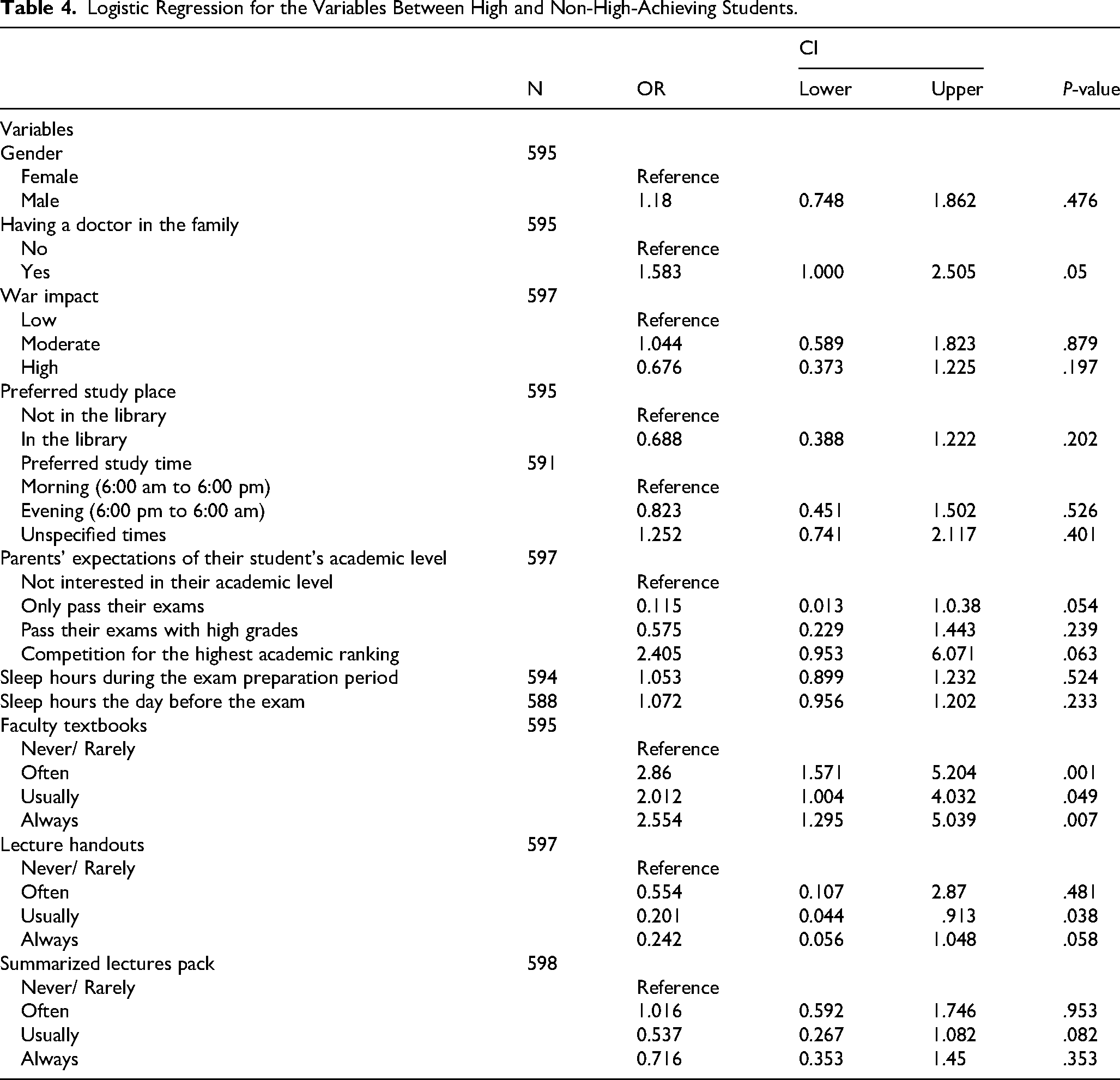
The variables that were included in the model: having a doctor in the family, war impact, preferred study place, preferred study time, parents’ expectations of their student's academic level, sleep hours during the exam period and the night before the exam, faculty textbooks, summarized lectures packs, and lecture handouts.
The regression showed that having a doctor in the family had an increased likelihood of being a high-achieving student (OR = 1.583, 95% CI: 1.000, 2.505, P = .05). According to parents’ expectation levels, there was no significant difference. Furthermore, students who used faculty textbooks often, usually or always were more likely to be high-achieving students compared to those who never/ rarely used faculty textbooks. Whereas students who used lecture handouts usually were less likely to be high-achieving students compared to those who never/ rarely used them.
The variables of gender, war impact, study place, study time, sleep hours during the exam preparation period, sleep hours the day before the exam, and summarized lectures packs were found to have no significant association with being a high-achieving student.
More details are shown in Table 4.
Logistic Regression for the Variables Between High and Non-High-Achieving Students.
Discussion
The results of this study offer significant insights into students’ study and sleep routines during the exam period, as well as the social factors that distinguish high-achieving medical students at Damascus University, as gauged by their average grades over the past two semesters. The research highlights the most effective study practices for enhancing academic performance. The findings suggest that common assumptions—such as marital status, study hours, or sleep patterns—may not reliably predict medical student success, highlighting the need to move away from one-size-fits-all academic counseling models. Regarding sleep hours and academic performance, no relationship was found in the current study, which aligns with the results of some previous studies.6,12 Other studies have focused on the negative impact of inadequate sleep on university students’ academic performance.4,13 Despite the importance of how long and when people sleep, panel analyses show that sleep quality most powerfully predicts both individual fluctuations and group differences in quality-of-life outcomes. 14 This finding could explain the results of this study and highlight the importance of sleep quality over sleep quantity. Interestingly, despite the prevalence of students in clinical years who never take naps being 17% in Saudi Arabia, 12 the current study observed that approximately 56% of the total sample did not take naps. However, no significant correlation was found between taking naps and academic performance, consistent with the results of a research conducted in 2012. 6
It is important to note that at Damascus University, exams are scheduled between 08:00 and 15:00. We did not find a significant association between any circadian preference and being a high-achieving student. According to a meta-analysis published in 2015, students’ preference for evening hours is associated with lower academic achievement in both school students and university undergraduates. Interestingly, this association appears to diminish over time, with a less pronounced negative effect observed in university students. 15 On the other hand, another meta-analysis found that individuals with an evening preference exhibit higher cognitive ability, although it is inversely associated with indicators of academic success. 16 Thus, more detailed research is needed to examine every group of skills in exams and its relation to circadian preferences.
This survey found that when parental expectations were to “only pass their exams,” the significance was inconclusive regarding the less likelihood of students being high-achieving compared to those whose parents were “not interested in their academic level,” with a P-value of .054. On the other hand, when parental expectations were “competition for the highest academic ranking,” the significance was also inconclusive regarding the more likelihood of students being high-achieving compared to those whose parents were “not interested in their academic level,” with a P-value of .063.
A meta-analysis demonstrated statistically significant effects of parental expectations on academic achievement across students of various age groups, races, genders, and nationalities. 17 Parental expectations may have both beneficial and detrimental effects. On the one hand, medical students identified self-fulfillment and achieving familial aspirations as their primary driving force. 18 Additionally, parental involvement emerged as a substantial determinant of students’ academic self-confidence. 19 On the other hand, parental career expectations indirectly affected medical students’ burnout. 20
In general, there is a significant tendency for medical school students across different countries to have a doctor in the family. The current survey found that 55.1% of medical students have doctors as relatives. A previous Austrian study found that 45.8% of final-year medical students reported having a medical relative, and 25.6% had a first-degree medical relative. 21 Previous research found that the proportion of students with doctors in the family was significantly higher in the high-performing group, 22 which aligns with the results of the present study. One possible explanation could be that parents who are doctors can provide superior advice and assistance to their children pursuing a medical education, compared to parents in different fields. 22 Moreover, a household environment shaped by medical professionals is likely to foster a culture that promotes high academic achievement. Therefore, to conclude with more specific results, future studies should investigate the aid provided by relative doctors in studying medicine and compare it with academic performance.
Considering parental education, we divided the education level into either having a university degree or not. No relationship was found with the academic performance of medical students, which matches the results of some previous studies.2,22 A possible explanation for this result could be supported by the conclusion, which found that if parents across all education levels demonstrate equal commitment to their children's education, there are no significant differences in children's school achievement. 23
This study did not take into account the details of the types and duration of students’ employment and found no relation between students working in general and academic performance. Previous studies found that working is negatively correlated with the academic performance of medical students.2,24 Other studies indicated that spending more hours working increases the probability of a negative effect on academic achievement.25,26 For instance, a study in Tatarstan found that non-professional full-time employment negatively affects the academic performance of university students, while other types of student employment have no statistically significant effect on academic performance. 27 Therefore, it is suggested to explore the type and period of work and their relation to medical students’ achievement to conclude with more precise results.
Although poverty was found to have a negative effect on student achievement, 28 the results of this research reveal interesting findings: there is no significant difference in academic performance based on financial status, matching the findings of a previous study. 6
This result sheds light on an important idea: being a high-achieving medical student is not exclusive to wealthy students.
In line with the results of this research, other studies also demonstrate that there was no difference in grades between the use of electronic textbooks and traditional textbooks.29–32 These results could be explained by the findings on preservice teachers, where some individuals reported increased mental engagement due to the ability to use e-textbook functions and interact with various media forms, including text. However, other individuals found navigating through an e-textbook challenging due to device-related distractions, eye discomfort, and a sense of being overwhelmed by options. 33 It is important to note contrasting results from a meta-analysis on school children, where e-books have the potential to enhance the teaching and learning experience in mathematics, surpassing the capabilities of conventional printed books. 34
Some research has found a correlation between longer study time and better academic performance.2,24,35 These surveys showed a variation in the estimated number of study hours, but the average number of study hours for students of all achievement levels was 9.367 h per day during the exam preparation period, reaching 13.073 h a day before the exam, without any statistically significant relation to academic performance. This matches the results of previous research. 6 These results could direct attention to the low effect of study time amount on academic performance compared to other factors. Further research should be done to investigate study strategies in addition to the number of study hours.
When considering the sources of study used during the exam period, student surveys revealed a statistically significant correlation between “usually” using of lecture handouts and a decline in academic performance compared to “never/rarely.” This may be due to lecture handouts often containing more information than required by the curriculum, leading high-achieving students to avoid this source to save time during the exam period. On the other hand, we found a relationship between “often,” “usually,” or “always” using of textbooks provided by faculty and an increase in academic performance compared to “never/rarely.” This may be due to the tendency of high-achieving students to study from the original sources recommended by the faculty. Notably, for students taking the United States Medical Licensing Examination (USMLE) Step 1, it was found that top-performing students exhibited significantly greater utilization of textbooks compared to their peers. 5 However, some studies deny the existence of significant differences between the sources used for study and academic performance. 6 In this survey, there was a high prevalence of using question banks, similar to findings on medical students in the USA 35 and Australia. 36 No difference was found between the two student groups regarding the use of previous exam questions in this study. This could be explained by the fact that both high- and non-high-performing students tend to use them, but in different situations. High-achieving students may use them after studying the material to revise and focus on the most important ideas in the curriculum, while non-high-performing students may use them as a brief source of information to help pass the exam.
It is worth noting that Damascus city and its countryside experienced military conflict between 2012 and 2018. In the current research, the degree of the effect of war on students had no relation to their academic performance, which could be due to the approximately 4-year period since the last military actions in Damascus and its surrounding areas. Previous research in Croatia found that during the war, medical students experienced a notable decline in their grades in five key courses compared to their performance before or after the conflict. 37
Limitations and Recommendation
The limitations of our research are as follows: Firstly, the study was carried out in a single university, which may limit its applicability to other universities or demographic groups. Moreover, the “study sources” are specific to this faculty. Secondly, the cross-sectional nature of the study restricts our capacity to draw causal inferences. It's crucial to acknowledge that the correlations we observed may not be exclusively due to the influence of these habits during the time of exams, as these habits might persist beyond this time. Thirdly, our study was based on self-reported data, which could be influenced by recall bias and the desire to present oneself in a favorable light. Additionally, individuals may vary in their understanding of the survey questions. For future studies, it would be beneficial to conduct longitudinal research to determine a causal link between social factors, study habits, and academic performance, and to compare the impact of these habits during and outside the exam period. Additionally, carrying out research in various institutions could broaden the relevance of our results beyond just one university.
Conclusions
This study provides evidence-based insights to help students identify if there are factors that could maximizing their exam performance. The study found no significant link between most study habits during exam periods, social factors, and high academic achievement among medical students. Specifically, variables such as age, gender, marital status, employment, parental education level, financial status, war impact, parental expectations of their student's academic level, study and sleep duration, napping, preferred study times and places, studying with friends, study material formats, and certain study sources showed no meaningful association with academic performance. However, two notable correlations did emerge: Students with a doctor in the family tended to perform better academically. Frequent use of faculty textbooks (“often,” “usually,” or “always”) was positively associated with higher achievement compared to infrequent use (“never/rarely”). Conversely, a negative correlation was observed with students who “usually” relied on lecture handouts, compared to those who used them “never/rarely.” Future research should explore these factors further using more detailed methodologies and broader, more diverse samples to enhance generalizability.
Supplemental Material
sj-docx-1-mde-10.1177_23821205251393855 - Supplemental material for Study Habits During Exam Preparation and Social Factors That Set High-Achieving Medical Students Apart in Syria
Supplemental material, sj-docx-1-mde-10.1177_23821205251393855 for Study Habits During Exam Preparation and Social Factors That Set High-Achieving Medical Students Apart in Syria by Fady Barakat, Angie Hawat, Fadi Aleid, Younes Al Dairy and Bayan Alsaid in Journal of Medical Education and Curricular Development
Supplemental Material
sj-docx-2-mde-10.1177_23821205251393855 - Supplemental material for Study Habits During Exam Preparation and Social Factors That Set High-Achieving Medical Students Apart in Syria
Supplemental material, sj-docx-2-mde-10.1177_23821205251393855 for Study Habits During Exam Preparation and Social Factors That Set High-Achieving Medical Students Apart in Syria by Fady Barakat, Angie Hawat, Fadi Aleid, Younes Al Dairy and Bayan Alsaid in Journal of Medical Education and Curricular Development
Footnotes
Acknowledgments
The authors would like to thank the participating students, teachers, and student volunteers who assisted us with distributing the questionnaires. We extend our sincere gratitude to Dr Anas Bitar for his generous assistance and thoughtful counsel.

Ethical Considerations
Our research complies with the guidelines of the Declaration of Helsinki for studies involving human subjects. The Ethical Committee of the Faculty of Medicine at Damascus University, Syria (3500, 26-5-2022) granted ethical approval.
Consent to Participate
Participants willingly joined the study. Informed consent was obtained from participants before they completed the questionnaire. The data collection process was anonymous, ensuring no personal identification information was collected.
Consent for Publication
Not applicable.
Author's Contributions
Writing the manuscript was performed by FB, AH, FA, and YA. The creation of the questionnaire was performed by FB and AH. All authors contributed to the distribution of the questionnaire. FB, FA, and YA reviewed the literature. Analyzing the data and preparing the figures were performed by AH. Supervision and general planning were done by BA. All authors read and approved the final manuscript.
Funding
The authors received no financial support for the research, authorship, and/or publication of this article.
Declaration of Conflicting Interests
The authors declared no potential conflicts of interest with respect to the research, authorship, and/or publication of this article.
Data Availability
The datasets used and/or analyzed during the current study are available from the corresponding author (FB) on reasonable request.
Supplemental Material
Supplemental material for this article is available online.
References
Supplementary Material
Please find the following supplemental material available below.
For Open Access articles published under a Creative Commons License, all supplemental material carries the same license as the article it is associated with.
For non-Open Access articles published, all supplemental material carries a non-exclusive license, and permission requests for re-use of supplemental material or any part of supplemental material shall be sent directly to the copyright owner as specified in the copyright notice associated with the article.
