




Abstract
Background
Medical knowledge is expanding rapidly at the same time as the preclinical phase of medical education is being shortened. This uniquely challenges medical students to learn efficiently and retain a large amount of information. Spaced repetition is a widely used learning technique and can be implemented through the use of a free downloadable program called Anki. Limited data exists on the use of spaced repetition through Anki and its impact on student performance in preclinical assessment, such as the Comprehensive Basic Science Subject Exam (CBSE).
Methods
This study evaluated Anki usage among 36 medical students at the Kirk Kerkorian School of Medicine at UNLV. Students consented to export their deidentified Anki data through the Stat Scraper add-on. Stat Scraper provided metrics on matured cards (those with an interval >21 days), total study hours, and number of unsuspended cards. Variables were correlated with CBSE exam scores and students were stratified into groups below and above the mean for each variable. Using this data, independent t-tests, Pearson Correlation coefficients and linear regressions were performed.
Results
Mean CBSE score was 65.2% (SD 11.6%). Linear regression demonstrated a significant positive correlation between the number of mature cards and exam scores. Significant positive correlations were also found between CBSE scores and total hours studied (P = 0.013), number of matured cards (P = 0.002), and unsuspended cards (P = 0.010). Students with above-average mature card counts scored 71.5% on the CBSE compared to 60.0% for those below average. Total study hours and unsuspended card counts similarly predicted higher scores.
Conclusions
Greater time spent using spaced repetition learning techniques through the Anki application and a higher number of matured and unsuspended cards were associated with increased performance on the CBSE exam. These findings support spaced repetition as an effective way for medical students to master and retain medical knowledge in the preclinical phase. Further research with larger sample sizes and more diverse populations is needed to validate these findings further.
Introduction
Historically, medical education has consisted of 2 years of preclinical education followed by 2 years of clinical learning in the outpatient and hospital setting. However, many medical schools are moving towards a shortened preclinical phase, or anticipate shortening this phase in the near future. 1 With potentially less time to acquire foundational knowledge in the preclinical phase, combined with estimates that medical knowledge is doubling as fast as every 73 days, students need to find innovative and effective ways to quickly learn and retain information. 2
Since the increased breadth of medical knowledge has not been met with increased study time for students, medical students must be particularly mindful of their time and what resources they utilize to study. 3 Technology has provided medical students with an array of resources, necessitating attention to both effective time management and the credibility of these resources. 4
The use of spaced repetition to learn and retain extensive amounts of medical information required of medical students is one tool that improves long-term memory of these concepts. 5 Anki is an open-source digital flash card application that is downloadable with free content. It utilizes the concept of spaced repetition to reinforce concepts for long-term retention in the learner's memory. 6 Anki cards are a digital version of traditional flashcards that have information with questions, fill in the blank, or labeling images on cards. The Anki medical student-specific decks have upwards of 30,000 cards. These decks contain concepts and information specific to information tested on medical student board exams. 7 A student can control how many Anki cards they see from their decks by using the suspend or unsuspend feature. If a card is unsuspended, it is available for the students to interact with and learn.
Anki's spaced repetition algorithm allows users to rate the level of difficulty of each flash card they come across. Users can adjust the length of time between seeing cards based on their card responses; again, hard, good, and easy. Students can personalize these settings as needed through individual setting configurations. 8 Anki increases the interval each time there is a correct answer, and once the card reaches an interval of 21 days it becomes a “matured” card. 8 This enhances long-term retention.
The time medical students spend studying and methods students use to study plausibly contributes to the effectiveness of their learning and memory of complex scientific concepts. 4 The amount of unsuspended cards likely contributes to the amount of information medical students are able to cover and learn. Additionally, students with more “matured” cards demonstrate better retention of concepts compared to those without matured or unsuspended cards. When paired with a larger amount of unsuspended cards, the spaced repetition model Anki uses likely contributes to a broader base of medical knowledge compared to peers who use Anki less frequently or not at all. In the past, medical student performance during the preclinical phase was assessed with the USMLE Step 1 Exam. This exam became Pass/Fail in January of 2022, 9 which has made it more difficult to gauge medical students’ preclinical knowledge in a standardized method. Cooper et al showed that prior to Step 1 becoming Pass/Fail, students who used Anki more consistently had a higher average score on Step 1 than those who were in the non-Anki group, although the difference in scores was not found to be statistically significant. 10 Using the Comprehensive Basic Science Subject Exam (CBSE), medical schools can assess a student's readiness to pass Step 1 and move onto the clinical phase of medical school.
Currently, little research about how spaced repetition through Anki might be used to review comprehensive medical school curriculum for exams such as the CBSE. In our current study, we analyzed how much time an individual Anki user spends studying cards, the amount of matured and unsuspended cards on students’ Anki profiles, and how these variables correlated to performance on the CBSE exam.
Methods
The UNLV Department of Medicine IRB approved participation in this study for medical students at the Kirk Kerkorian School of Medicine at UNLV (KKSOM), including cohorts from class of 2023 onwards. Students from the KKSOM class of 2026 (n = 36) cohort signed a written informed consent form to participate in this study. All students who exported data from the class of 2026 during the study collection period were included. The only exclusion criterion was if a student did not take the CBSE exam. The data collection period took place from January 3, 2024 to February 9, 2024. The CBSE was taken on January 31, 2024.
To collect data, participants installed the Anki add-on “Stat Scraper” which facilitated the export of quantitative Anki usage statistics. 11 The downloaded data consisted of statistics and information that Anki already keeps on its application for individual users. An identification code was used so that a faculty member with access to CBSE scores could match student scores to Anki usage data and provide a de-identified dataset.
The Stat Scraper exported data on the total hours, number of total cards, unlocked cards, mature cards, young learning cards, new cards, suspended cards, and unsuspended cards. In Anki, a mature card is defined as a card with an interval of 21 days or more, while a young card has an interval of less than 21 days. The interval refers to the time between when a card is reviewed and when it is reviewed again by an Anki user.
The reporting of this study conforms to the Defined Criteria To Report INnovations in Education (DoCTRINE) checklist. 12
Statistical Analysis
We calculated the average total hours, number of mature cards, and unsuspended cards and compared CBSE performance between those above and below the mean of these variables. This stratification allowed two groups of users, those above the average, and those below the average.
Independent samples t-test compared CBSE scores between students above the mean and those below the mean for total hours, number of mature cards, and unsuspended cards. Pearson correlation coefficients examined correlations between the independent variables (mature cards, total hours, and unsuspended cards). Lastly, we ran a linear regression using CBSE Scores as the dependent variable and mature cards, unsuspended cards, and total hours as the independent variables.
Results
The study variables included the number of unsuspended Anki cards in each student deck, the number of matured cards, and the total hours spent within Anki. High standard deviation across all measures (Table 1) compared to the means indicates high levels of variability among all three variables.
Descriptive Results per Independent Variable.
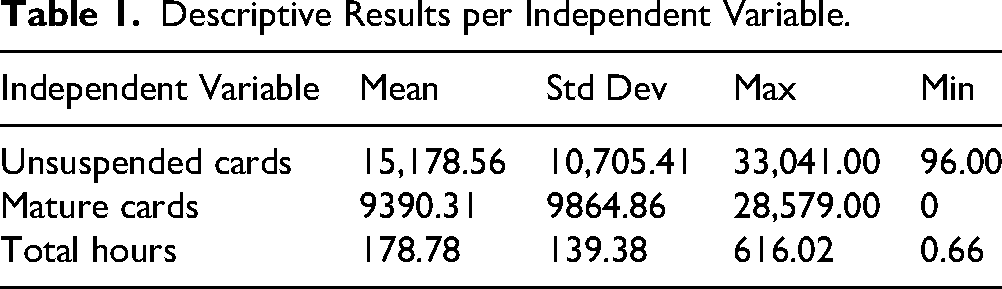
Table 2 shows the distribution of CBSE scores. The maximum score was 86.0, and the minimum was 44.0. The standard deviation of the scores was 11.58. The mean was slightly higher than the median and the mode.
Distribution of CBSE Variables.

Abbreviation: CBSE, Comprehensive Basic Science Subject Exam.
The average CBSE exam score among students was 65% with a standard deviation of 11% (n = 36), with scores ranging from 44% to 86% (Figure 1). Figure 1 and Table 1 show the number of mature Anki cards ranging from 0 to 28,579, with a mean of 9390.
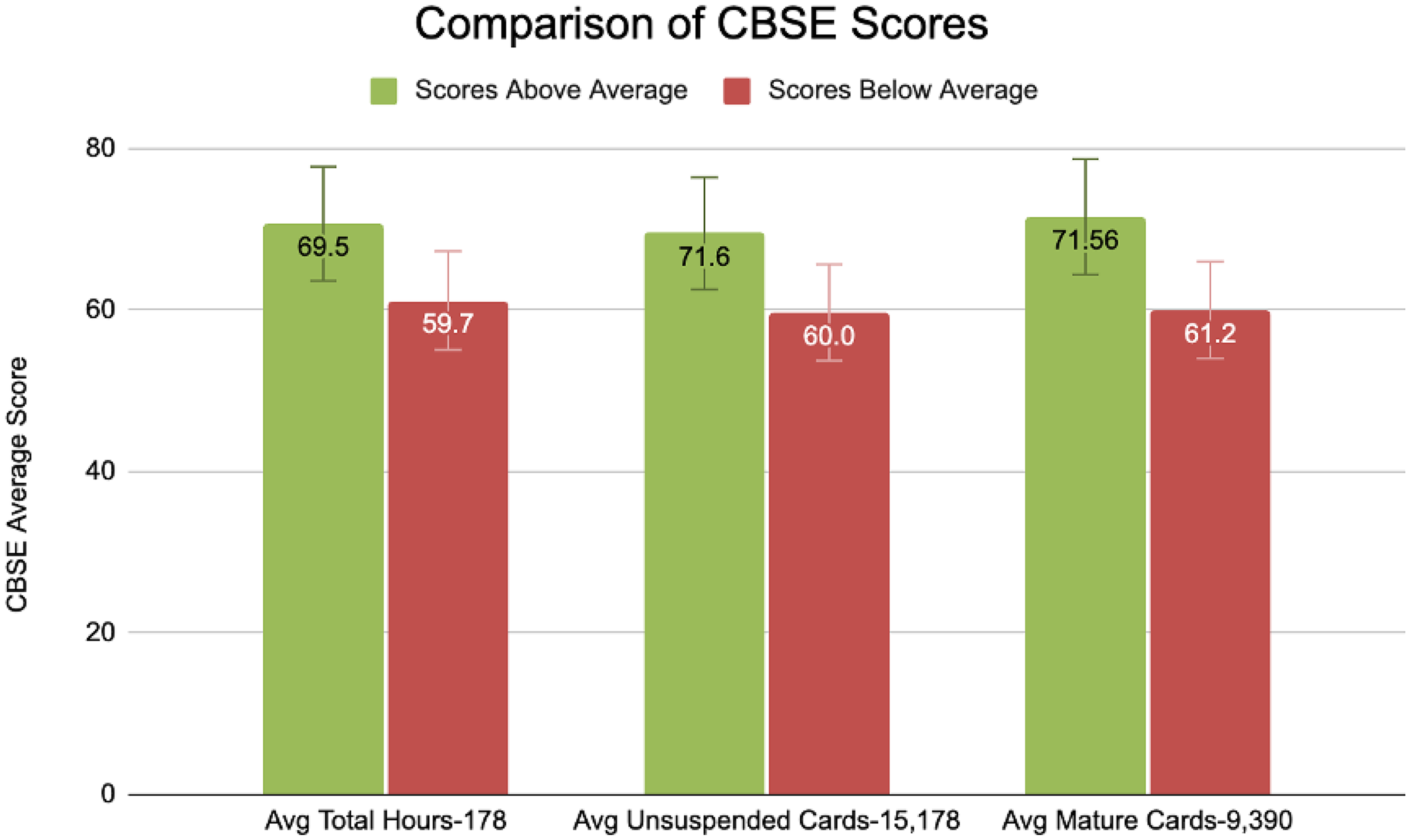
Mean CBSE Scores Based on the Scores Above and Below the Average Number of Mature Cards, Total Hours, and Unsuspended Cards.
Table 3 shows that all independent variables were significant. The variable with the greatest significance related to exam scores was matured cards. Table 3 shows the CBSE scores and standard deviation of users who had mature card counts above and below the mean value of 9390. Users who had more than the mean amount of mature cards scored an average of 71.5% (SD = 10.7%) on the CBSE exam. Users with an average card count below the mean scored an average of 60.0% (SD = 9.7%). The difference was significant with a t-test revealing a two-sided P-value of 0.002.
CBSE Mean Scores by Variables.

Abbreviation: CBSE, Comprehensive Basic Science Subject Exam.
Correlation statistics between the variables revealed a statistically significant positive correlation between the three variables (Table 4). Students with more unsuspended cards frequently have more mature cards. Students who utilize Anki as one of their main study tools tend to have more unsuspended and mature cards. The strongest correlation was between unsuspended cards and mature cards, followed by total hours spent and a greater number of mature cards. The correlation tests reveal that all three independent variables are closely correlated with one another. This presents a study limitation, as it becomes difficult to determine which of the three independent variables is the primary contributor to exam performance.
Correlation Statistics Between Independent Variables.

Linear regression analysis was run between the CBSE Scores and the independent variables. Although initial analysis revealed that all the variables were closely correlated, linear regression showed that mature cards had a significance of 0.026 (Table 5). The other two variables, unsuspended cards and total hours, did not show a statistically significant relationship with CBSE Exam scores. Table 5 shows the Beta for mature cards is 0.649, indicating a positive relationship. R squared for this linear regression is 0.427 (Table 6). The linear regression analysis shows the significance of the number of mature cards in a user's Anki profile in relation to CBSE performance.
Coefficients for Linear Regression Between CBSE Scores and Independent Variables.

Abbreviation: CBSE, Comprehensive Basic Science Subject Exam.
Model Summary of Linear Regression Between CBSE Scores and Independent Variables.

Abbreviation: CBSE, Comprehensive Basic Science Subject Exam.
Discussion
This study demonstrates that spaced repetition through the use of Anki is a valuable tool for long-term retention during the preclinical phase of medical school. Our data shows that spaced repetition via Anki usage correlates to better performance on a preclinical summative exam given at a single institution, the KKSOM at UNLV. Statistical analysis revealed a statistically significant linear regression between the number of mature cards a student had in their Anki accounts and their exam scores. The data also reveals a significant difference in exam scores between students with a higher than the average number of mature cards. Students with 9390 or more matured Anki cards performed higher on their standardized CBSE exam. This supports the notion that spaced repetition can benefit medical students as they quickly learn and must retain medical knowledge.3–4
Our results also showed a positive correlation between total hours using Anki and matured cards as well as between unsuspended cards, demonstrating that students who spent more time using Anki performed better on their comprehensive exam. The students who spent over 178 h using Anki, on average, were efficiently using spaced repetition to review concepts and mature more cards. Having more matured cards in a user's Anki deck indicates that students have reviewed and thus learned more concepts, because as a student reviews an Anki card multiple times, it becomes mature, indicating that the concept is solidified in their memory. Since medical student time is scarce, any tool that increases efficiency is indispensable. Our study demonstrates that time spent reviewing Anki cards and maturing them is associated with higher scores on standardized exams.
Data also showed a significant difference in the amount of overall unsuspended cards in students’ Anki decks, which correlated with a higher performance on the CBSE exam. This correlation demonstrates that the more information students’ review with Anki, the better they perform on standardized exams.
These results complement previous research, which reinforces that Anki is a useful study tool for medical students.10,13 However, by examining the specifics of spaced repetition and Anki usage more closely, we found that efficient use of time, reflected by a higher number of mature and unsuspended cards, is essential for effective learning and retention of medical information in the preclinical phase of medical school. The difference in average exam scores between students below and above the averages for our three variables was nearly 10%, and there was a significant difference in exam scores when students spent more than 178.78 h using Anki.
Although the results of this study are promising, the sample size does impact overall generalizability of the results. Because this study took place at one institution, it may not be representative of the overall medical student population. There are also other confounding variables that may have affected individuals CBSE scores and factors such as prior fields of study, previous standardized exam performance, and additional study resources.
Further research into specific study strategies and Anki usage is needed to help medical students focus their studies and ensure success from the beginning of their preclinical phase of medical school. By identifying the most effective learning strategies, we can better prepare future medical professionals for success.
Limitations
Although this study supports the use of spaced repetition, it does have limitations. We conducted this study with a limited sample size from a single allopathic medical school in Las Vegas, Nevada. The maximum sample size (n) was set to 240, assuming 60 students per medical school cohort class. However, our study's sample size was 36. This affects the generalizability to the greater population of medical students. Additionally, the examination scores were from a single medical school with a specific curriculum, consisting of required in-person lectures, team-based learning, and problem-based learning. Curriculum differences across medical schools limit the generalizability of the study.
We also recognize that the independent variables are all very closely correlated. Having a correlation this close may not allow us to truly identify which variable is the driving force of exam scores and thus the success of spaced repetition.
This study did not track the use of additional resources beyond Anki, such as practice test questions or external online lecture resources, which may have influenced student performance. Students at this study's institution were given a 6 week study period prior to taking the USMLE Step 1, which is another confounding factor. Students who scheduled their exam earlier in the calendar year may have increased their Anki usage in the months leading up to their test date, potentially skewing CBSE results.
Finally, if students used Anki prior to medical school, their average hours could be falsely elevated. However, we do not believe this had a significant impact on the overall study results.
Conclusions
As medical knowledge continues to expand and many medical schools opt to condense the preclinical phase, students face the growing challenge of adapting to meet the ever-increasing demands of learning and retaining medical information. Our study demonstrates a positive correlation between the time spent mastering a greater amount of content through spaced repetition and higher summative standardized exam scores. These findings offer valuable insight for incoming medical students seeking effective study strategies.
While our results demonstrate an association between the use of spaced repetition techniques, such as Anki, and improved student performance, the limited sample size at a single institution and the variability of curriculum across medical schools restrict the generalizability of the findings. Future research involving larger, more diverse populations across multiple institutions is recommended to better understand the benefits of spaced repetition through the preclinical phase of medical education.
Supplemental Material
sj-docx-1-mde-10.1177_23821205251369705 - Supplemental material for Exploring the Impact of Spaced Repetition Through Anki Usage on Preclinical Exam Performance
Supplemental material, sj-docx-1-mde-10.1177_23821205251369705 for Exploring the Impact of Spaced Repetition Through Anki Usage on Preclinical Exam Performance by Victoria Winter, Emily Ames, Marley Jacobs, Carlos Georges and Edward Simanton in Journal of Medical Education and Curricular Development
Footnotes

Ethics Approval/ Concerts
De-identified data for this study were drawn from institutional databases in accordance with an approved IRB protocol. Written informed consent was obtained from each of the study subjects prior to study initiation and data collection. Our International Review Board is the UNLV Biomedical IRB, protocol number 2022–302.
Authors Contributions
All authors contributed to manuscript work and design. VW assisted with IRB approval, and data collection. She wrote Introduction and Discussion sections. EA assisted with data collection and wrote Methods and Limitations sections. MJ assisted with data collections and wrote Results and Conclusions sections. CG developed the Anki Stat Scraper application in its entirety. ES supervised and guided this manuscript from conception. The final manuscript was read and approved by all authors.
Funding
The authors received no financial support for the research, authorship, and/or publication of this article.
Declaration of Conflicting Interests
The authors declared no potential conflicts of interest with respect to the research, authorship, and/or publication of this article.
Availability of Data of Materials
All data generated and analyzed during the current study is available from the corresponding author on reasonable request.
Supplemental Material
All supplemental material mentioned in the text is available in the online version of the journal.
References
Supplementary Material
Please find the following supplemental material available below.
For Open Access articles published under a Creative Commons License, all supplemental material carries the same license as the article it is associated with.
For non-Open Access articles published, all supplemental material carries a non-exclusive license, and permission requests for re-use of supplemental material or any part of supplemental material shall be sent directly to the copyright owner as specified in the copyright notice associated with the article.
