



Abstract
Background
Informal learning resources can be considered supportive to formal learning resources in shaping future professional identity. This study aimed to assess dental students’ preferences towards using informal learning resources, to explore challenges impacting students’ choices and to find out the motivations for using these resources.
Methods
A mixed methods study design was conducted. A total of 1000 dental students completed a quantitative questionnaire data from different universities in Syria, and qualitative semi-structured interviews (15: postgraduate student and 30: undergraduate students) were fulfilled. Data were separately collected and analyzed.
Results
Peer learning scored a high level of engagement (undergraduates: 76.2%, postgraduates: 79.6%) as did the use of social media platforms (undergraduates: 79.4%, postgraduates: 80.6%). The challenges associated with utilizing open educational resources (undergraduates: 71.6%, postgraduates: 73.2%), social media platforms (undergraduates: 73.8%, postgraduates: 74.4%), and attending conferences and workshops (undergraduates: 75.4%, postgraduates: 76.2%) were rated at a high level. The undergraduate interview participants reported that lack of time was the most important limitation for using informal learning resources whereas online payment problem for open educational resources was basic challenge for postgraduate participants.
Conclusions
Reliance on informal learning resources is an efficient and vital tool for dental students. Faculty members can play an impact role in guiding students how effectively use of informal learning resources to enhance their educational experience.
Keywords
Introduction
Learning resources encompass both human and material resources that provide students with knowledge, skills, and necessary experiences. 1 Learners today are no longer passive recipients of information but active participants in constructing their knowledge and critically evaluating sources of information. 2 Informal learning is a specific form of active learning, 3 that complements formal education by filling gaps in the curriculum and enhancing understanding. 4 Recognizing the value of informal learning is crucial for providing continuous education, 5 and establishing a strong foundation for lifelong learning. 6 Recent advancements in medical education have encouraged students to identify out the most preferable sources that meet their learning needs, 7 despite personal, technical, and country-specific challenges they encounter. 8
Open educational resources (OERs), social media platforms (SM), peer learning (PL), conferences and workshops are common types for engaging in informal learning.9,10
OERs, as defined by UNESCO, are educational resources, research materials, and teaching aids that are either in the public domain or available under open licenses. 11 This enables unrestricted use, adaptation, and sharing by all individual. Using OERs provides learners with affordable and meaningful access to lifelong learning opportunities. 12 While OERs offer information in various formats that enhance students’ performance and learning outcomes, 13 utilizing them may be time consuming as creating or locating suitable OERs can be challenging. 14 The increasing quantity of OERs across different platforms in various formats has made it increasingly difficult for educators and learners to evaluate their value and applicability. 15 Social media, is common among medical school students as it allows them to be more interactive with different educational activities. 16 Its ease of use and accessibility have attracted many learners, allowing seamless communication regardless of time and place constrains.17,18 However, a major challenge with social media is the lack of quality and reliability, as information shared can be unidentified, unreferenced, incomplete, or informal. 19 While social media can enhance learning experiences, excessive use may negatively impact academic performance by affecting sleep quality and increasing academic stress. 20
PL involves the sharing of knowledge and skills peers who are at the same status level and not professional instructors, but belong to similar social groups. 21 This method helps students validate their knowledge, boost their confidence and enhance their communication. 22 PL has the potential to enhance the quality of time spent on clinical placements by providing students with additional observations and feedback on their performance. 23 However, due to its informal nature, PL may lack consistency, sensitivity, or alignment with the organizational pretensions and norms. It could also divert attention from core responsibility, leading to produce conflicts and misconstructions. 24 Additionally, some learners may experience confidence destabilization when comparing their skills to peers. 25
Conferences offer learners the opportunity to stay updated on important studies, learn from experiences of others, and acquire new skills and techniques. 26 Participation in conferences can also improve communication skills by allowing students to meet peers from different institutions. 27 Workshops are beneficial for providing training across various academic subjects and settings, catering to undergraduate, postgraduate and continuing education needs. 28 Despite conferences being crucial for the professional development of educational communities, challenges such as location, timing, convenience, health, safety, and affordability may hinder participation. 29
Understanding the reliance on informal learning resources among undergraduate and postgraduate dental students is essential for identifying the most effective resources and addressing the challenges students encounter. This assessment can enhance students’ self-learning abilities, leading to improved educational outcomes and professional competencies in the future. This study aimed to investigate dental students’ preferences regarding the use of informal learning resources, explore the challenges influencing their choices, and uncover the motivations behind utilizing these resources in different educational contexts.
Methods
Study design
A mixed methods design was adopted to delve deeper into participants’ perceptive on using informal learning resources from September to October 2023.
This approach involved two main phases. First, a quantitative data was collected by distributing an online questionnaire via SM to both undergraduate and postgraduate dental students. The second phase involved qualitative data collection through semi-structured interviews with 30 undergraduate dental students and 15 postgraduate dental students who volunteered to participate. Both quantitative and qualitative data were collected and analyzed separately within a concurrent timeframe, followed by a phase of integrative evaluation of the collected findings.
Ethical considerations
Ethical approval was obtained from the ethical committee of the Syrian Virtual University (number: 2064/0, date: 3/8/2023). This study adheres to the ethical principles outlined in the Declaration of Helsinki. Informed, written consent encompassing study details, objectives, and benefits was obtained from all interviewees in the qualitative phase. Participants’ information and data were treated with strict confidentiality, ensuring that personal details were anonymized. The data were stored and kept on a computer protected with a password and will be disposed of once they are no longer needed.
The quantitative phase of the study was conducted and reported in accordance with the Strengthening the Reporting of Observational Studies in Epidemiology (STROBE) guidelines. 30
The qualitative phase was designed and reported according to the Consolidated criteria for Reporting Qualitative research (COREQ). 31
Participants
In this study, the sample comprised undergraduate and postgraduate dental students from the first to fifth years. The data collected from participants included gender, university name, educational group, and academic year. Both public and private universities were included to ensure a comprehensive representation of the academic landscape. Geographical limitations were minimized by involving universities from different regions in Syria, which provided a diverse range of student experiences and perspectives.
Participants were selected based on their academic year (first to fifth year), educational group (undergraduate or postgraduate), and active enrollment in a recognized dental program in Syrian universities. In the quantitative study, a cross-sectional survey using a self-administered questionnaire was distributed to dental students across different grades and schools. Snowball and river sampling were used. Snowball sampling was initiated with 30 selected “seed” participants from 5 diverse dental schools. To prevent clustering, each seed participant could refer a maximum of 3 peers, a cap that balanced network expansion with control over overrepresentation from any single group. River sampling complemented this approach by distributing survey links through official channels at all 15 dental schools as well as 10 active social media groups frequented by Syrian dental students, ensuring outreach beyond immediate peer networks. For students who are less active on social media or in formal academic networks we partnered with university officials to promote the survey through offline channels, such as classroom announcements and student networks. Social media has been adopted in the questionnaire distribution due to its cost-effectiveness, ease of design, and the ability to reach otherwise inaccessible target sample members. From an estimated 1300 invitations we received 1000 completed responses, resulting in a response rate of 76.9%.
In the qualitative phase, data were collected through face-to-face interviews with a total of 30 undergraduate dental students, including 11 were in their third year, 9 in their fourth year, and 10 in their fifth year. Additionally, 15 postgraduates participated, consisting of 3 PhDs and 12 working towards master's degrees. All selected participants in this phase completed the interviews. The research objectives were explained to them, along with their role in achieving those objectives.
Instrument of measurement
In the quantitative phase of the study, a questionnaire was developed consisting of 40 questions grouped into four categories: (A) demographic information of participants in order to ensure that the questionnaire will not be not filled out more than once; (B) frequency of informal learning resource usage; (C) challenges faced when using informal learning resources; and (D) motivations for utilizing informal learning resources. Part (B) used a Likert-type scale ranging from 1 (never), to 5 (always), while parts (C) and (D) used a scale from 1 (strongly agree) to 5 (strongly disagree). The results, presented in Table 1, were interpreted to assess the level of reliance on different types of informal learning resources, the challenges faced, and students’ motivations in each category. Prior to the main study, the questionnaire was pretested on 20 students, and content validity was confirmed by a supervisor MD (Supplementary File 1). The internal consistency of these factors was evaluated using the Cronbach’s alpha test.
Weighted Mean for 5-Point Likert Scales.

In the qualitative phase, each interview session, guided by a set of questions, lasted between 20 and 30 minutes. Findings are presented in Table 2. Data were collected through face-to-face interviews conducted by the principal investigator (M. A) at the participants’ workplaces. The interviews were initially conducted in Arabic and later translated into English for analysis.
Question Guide Used in Semi-Structured Interviews.

Statistical analysis
Data in the quantitative phase were analyzed using Statistical Package for Social Sciences version 26.0 (SPSS 26). Descriptive statistics were utilized to determine proportions, mean and standard deviation scores. An independent sample t-test was employed to assess differences in students’ responses between different education levels. Statistically significant was set at a P value of ≤.05. To measure the reliability of the questionnaire, Cronbach's alpha coefficient was employed.
The interviews in the qualitative phase were transcribed verbatim, and were analyzed using thematic content analysis. Thematic analysis of the detailed interview notes was performed using open coding to identify key concepts, which were then organized into emerging themes. Throughout the analysis, undergraduate students were denoted as P1 to P30, while postgraduate students were labeled P31 to P45.
Results
Results of the quantitative study
A total of 1000 students from 15 different dental schools in Syria participated in the survey. Among them, 45.7% were females, and 91.2% were undergraduate students. The highest number of respondents came from Manara University (14.2%), followed by Aleppo University (12.6%). The majority of participants were in their fourth year of study (28.2%). Findings are presented in Table 3.
Demographic Details of Participants.

N: number of respondents; %: percentage.
Frequency of informal learning resource usage
Table 4 shows that the utilization of OERs was comparatively low for both groups, as evidenced by the mean scores (undergraduates: 2.25, postgraduates: 2.39) and response rates (undergraduates: 45%, n = 410; postgraduates: 47.8%, n = 42). In contrast, the use of SM was significantly higher with mean scores of 3.97 (79.4%, n = 724) for undergraduates and 4.03 (80.6%, n = 71) for postgraduates. YouTube emerged as the most favored social media platform among participants with usage rate of 61.3% (n = 559) for undergraduates and 62.5% (n = 55) for postgraduates, followed closely by Facebook at 58.8% (n = 536) undergraduates and 55.7% (n = 49) for postgraduates as shown in Table 5.
Common Informal Learning Resources Among Undergraduate and Postgraduate Students.

M: mean; SD: standard deviation; %: percentage; t: t-value; P: probability value; D: difference between undergraduates and postgraduates.
Social Media Platforms Used Among Undergraduate and Postgraduate Students.

PL also scored a high level of engagement, the mean scores were 3.81 (76.2%, n = 695) for undergraduates and 3.98 (79.6%, n = 70) for postgraduates. Attending conferences and workshops was scored at a moderate level, the mean scores were 2.95 (59%, n = 538) for undergraduates and 2.87 (57.4%, n = 51) for postgraduates. There was no statistically significant difference between undergraduate and postgraduate students regarding their use of OERs resources (t = 1.652, P = .099), in using SM (t = 0.591, P = .555), reliance on PL (t = 0.451, P = .147), or in attending conferences and workshops (t = 0.648, P = .517) as presented in Table 4.
Students’ challenges of using informal learning resources
Table 6 indicates that the challenges associated with utilizing OERs were high for both groups, as evidenced by the mean scores (undergraduates: 3.58, postgraduates: 3.66). With percentages showing similar patterns (undergraduates: 71.6%, n = 653; postgraduates: 73.2%, n = 64). The primary challenge hindering the use of OER was the lack of time, leading to academic stress, with 83% (n = 757) of undergraduates and 81% (n = 71) of postgraduates reporting this as a significant issue. Similarly, challenges related to using SM were also rated at a high level, with mean scores of 3.69 (73.8% (n = 673) for undergraduates and 3.72 (74.4%, n = 65) for postgraduates. The main challenges preventing students from utilizing social media effectively was the lack of trust in information with 78.8% (n = 719) of undergraduates and 77% (n = 68) of postgraduates and inadequate facilities with 77% (n = 702) of undergraduates and 75.4% (n = 66) of postgraduates. On the other hand, challenges related to PL were rated at a moderate level, with the mean scores of 3.02 for undergraduates and 2.97 for postgraduates resulting in percentages of 60.4% (n = 551) for undergraduates and 59.4% (n = 52) for postgraduates. Distracting from peers had the least impact on the effectiveness of PL with 53.6% (n = 489) of undergraduates and 51.6% (n = 45) of postgraduates reporting this as a significant issue. The challenges associated with attending conferences and workshops were rated at a high level, with mean scores were 3.77 (75.4%, n = 688) for undergraduates and 3.81 (76.2%, n = 67) for postgraduates. The primary challenge for both groups was the effort required for traveling, with 85.8% (n = 783) of undergraduates and 85.2% (n = 75) of postgraduates highlighting this as a major concern. There was no statistical difference between the two educational groups regarding the challenges students face, whether they are related to the use of OERs (t = 1.167, P = .243), the use of SM platforms (t = 0.361, P = .719), the reliance on PL (t = 0.571, P = .568), or attending conferences and workshops (t = 0.691, P = .489). Findings are presented in Table 6.
Challenges of Using Informal Learning Resources.
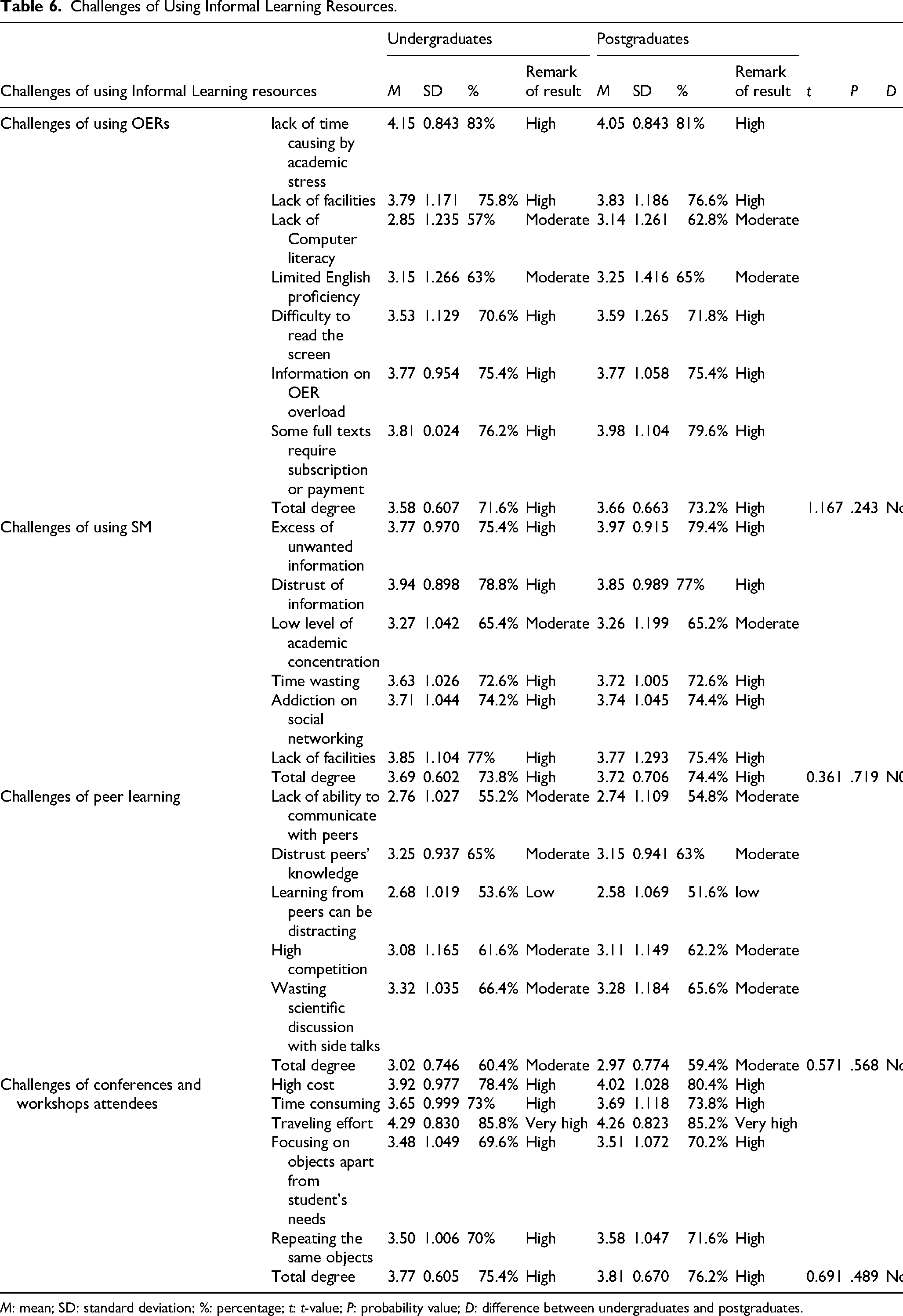
M: mean; SD: standard deviation; %: percentage; t: t-value; P: probability value; D: difference between undergraduates and postgraduates.
Students’ motivations for using informal learning resources
Develop skills and knowledge scored a very high level, with mean scores of 4.27 for undergraduates and 4.25 for postgraduates, corresponding to percentages of 85% (n = 775) and 85.4% (n = 75). There was no statistical difference in students’ motivations between two groups (t = 1.652, P = .099) as presented in Table 7.
Motivations for Using Informal Learning Resources.

M: mean; SD: standard deviation; %: percentage; t: t-value; P: probability value; D: difference between undergraduates and postgraduates.
Reliability of the questionnaire
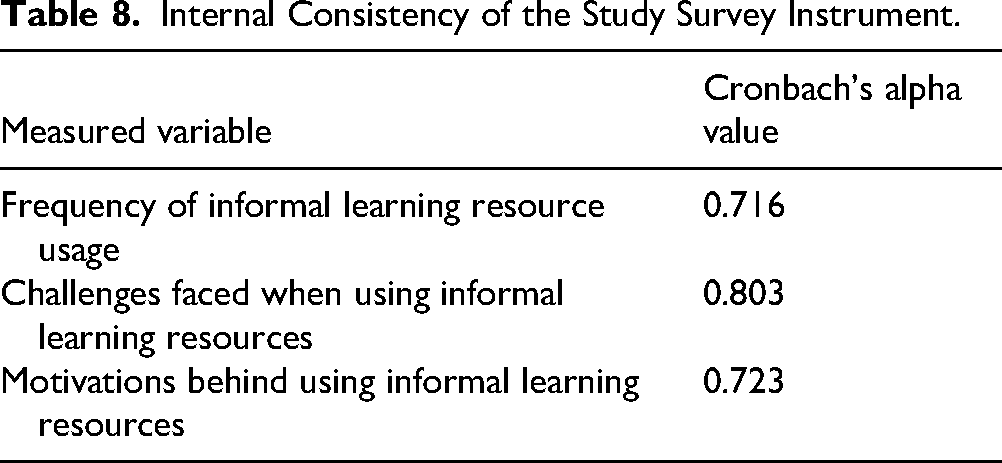
Table 8 indicates results of the Cronbach's alpha coefficient for each of the study variables. Cronbach's alpha values ranged from 0.716 to 0.803, which is considered as “good.” 32
Internal Consistency of the Study Survey Instrument.
Results of the qualitative study
Four key themes were derived from the data, highlighting the distinctive and noteworthy ways in which students engaged with informal learning resources. These themes encompassed the rationales behind students’ use of informal learning resources, the various types of informal learning resources adopted by dental students, challenges associated with relying on informal learning resources, and driving factors influencing students’ dependence motivations of reliance on informal learning resources. Figure 1 presents the themes and subthemes that emerged (Supplementary File 2). Then, four main themes emerged from the data.

Themes and Subthemes Emerged.
Theme 1. Reasons for reliance on informal learning resources
The reasons for relying on informal learning resources varied from undergraduates who see them as important to remedy their deficiencies to postgraduates who see them as vital.
Undergraduate students’ reasons. Many reasons motivated undergraduate students to rely on the informal learning resources. Entering the clinical phase and need to learn about the correct application process (6 participants). Lack of professors’ sufficient explanation (4 participants), and desire to learn about new techniques and methods in dentistry pushes students to search more details (10 participants). “Our curriculum is traditional and touches on modern technologies shyly” [P 9]. “Lack of prior knowledge that the professor assumes already exists” [P12].
Two students expressed that they do not need to rely on informal learning resources as the formal curriculum is sufficient.
Postgraduate students’ reasons. For the majority of postgraduate dental students relying on informal resources became a matter of fact and necessity rather than optional. “The Arabic Library's research has been delayed compared to that of foreign countries, so there is a constant need for updated scientific knowledge” [P32]. “At the postgraduate stage, it is possible to be exposed to dealing with atypical cases” [P34]. “At the postgraduate stage, the student is placed at the beginning of the road and held responsible for its completion” [P39].
Theme 2. Types of informal learning resources adopted
Informal learning resources adopted by dental students were categorized into five main groups.
Subtheme 1. Open educational resources
The majority of undergraduate students preferred to rely on textbooks because they provide information in a detailed and sequential manner, expanding their knowledge especially English textbooks. “Textbooks Broaden the student's thinking horizon” [P1]. “Relying on English textbooks because they are more reliable if I plan to travel abroad” [P18].
Only five participants from first stage showed that they do not rely on textbooks because they are consuming time and effort.
On the contrary, the majority of postgraduate students preferred the use of scientific articles compared to their reliance on textbooks. “Articles contain the latest updates and scientific developments that may not be contained in any textbook” [P41].
Dissertation and theses were also favorite resources for the most postgraduate students of the second stage. “Thesis provides us to recognize the method of academic writing in all its parts” [P42]. “Dissertation and thesis include reliable references that can be utilized” [P34].
Only three postgraduate students were more dependent on textbooks. “As first and second year postgraduate students, we are asked to fulfill certain seminars so we find all points we need it to present” [P38].
Subtheme 2. Social media platforms
YouTube was the number one platform in terms of usage at both university levels (21 participants). “YouTube saves time allows for both vision and hearing to be engaged, allowing for greater concentration of information” [P10]. “YouTube helps in recognizing the method of clinical working before application” [P7].
Facebook (7 participants) and Instagram (7 participants) ranked second in terms of adoption
However, five postgraduate students expressed concerns about the reliability of information on social media. “Social media is a double-edged sword if the right information is not distinguished from the wrong one” [P39]. “Most of the well-known dental pages in Syria are run by fourth- and fifth-year dental students who are unable to give accurate information” [P43].
Subtheme 3. Peer learning
The majority of participants preferred to ask their peers (36 from 45 participants), as the discussion with peers may brought their attention details that they didn’t realize. “Asking peers gives me the nuts and bolts” [P16]. “Picking up an idea faster from a peer than from a professor or supervisor” [P27].
Six participants preferred to ask professors rather than peers who may give inaccurate answers. “I don’t like to ask my peers in order not to hold them responsible for the wrong information I got from them” [P41].
Three other participants also expressed their discomfort with asking peers because they felt ashamed and embarrassed.
Subtheme 4. Attending conferences and training workshops
The majority of participants expressed their interest in attending conferences and workshops, especially if they expose them to the most recent technologies in dentistry.
Only five postgraduate students disagreed, who did not see the scientific benefit of attending conferences. “I see no scientific benefit of attending conferences except as a social occasion only” [P35] “As a PhD student, I don’t prefer to attend local conferences, and I would greatly desire to attend international conferences” [P37].
Subtheme 5. Additional informal learning resources
One of the most popular sources of additional learning for dental students was attending a private dentist's clinic as it was a real workplace where they got a high degree of feedback (15 participants). “My internship at dental clinic allows me to develop my communication skills and gives me the opportunity to learn about techniques that I don't learn at university” [P24].
Attending in state healthcare centers (3 participants) and asking a dentist whether a family member or relative (5 participants) were additional informal learning resources.
Theme 3. Challenges for reliance on informal learning resources
This theme relates to the research question “Are there any particular challenges you face when using these resources?” which is further subdivided into personal, and impersonal challenges.
Personal challenges. Most of students reported that lack of time due to their academic pressure was a major challenge. Other reported poor foreign language skills were important factor for them (4 participants). Lack of facilities specially interruptions in electricity and slow internet were important challenges for 2 participants. Lack of passion due to the Syrian crisis as was also expressed by 2 participants. “I don’t have any extra time to do additional referencing, even if I wanted to” [P12]. “English barriers since the majority of relevant references are in English” [P22]. “I’m not motivated to learn new technologies for advanced devices, due to the Syrian crisis” [P45].
Impersonal challenges. Lack of guidance on how to use OER resources (5 participants). High cost of conference registration fees (6 participants). Difficulty of obtaining paid articles and providing electronic copies of master's and PhD theses and dissertations was significant challenge expressed by most postgraduate students “I wish there was a guide to advise me on how to find additional learning resources because I often feel confused and I don't know where to start” [P11]. “Collecting modern articles and original articles is very difficult because these articles are mostly paid, so some students resort to alternative ways of collecting these sources, such as using a close person living abroad or resorting to hacked websites” [P41]. “Accessing the theses of colleagues in other universities is difficult and I may have to travel, and if this happens, I can only see the paper version and we are not allowed to access the electronic versions” [P39].
Theme 4. Motivations for reliance on informal learning resources
Undergraduate students’ motivations. Most of participants highlighted the development of knowledge and skills were important motivation for them (15 participants). The ability to answer any question was other motivation (8 participants). Some participants reported that provision of optimal patient care (3 participants) in addition to their passion for dentistry prompted them to search for additional resources (4 participants). “The high number of dental graduates imposes an extra effort on me to be able to stand out in the crowd” [P4]. “My ambition is to provide the best possible treatment service to the patient and this requires me to develop my abilities and skills” [P19].
Postgraduate students’ motivations. Most participants indicated that the responsibility of supervising undergraduate students increases their desire to develop their knowledge (8 participants). Preparing well in the research phase (2 participants) and clinical work problems (2 participants) require them to constantly search for additional sources of knowledge. Intention to enroll in a PhD was main motivation for 2 participants. “Supervising undergraduate students in the fourth and fifth years gives me the responsibility to be ready to receive any queries or questions” [P45]. “The existence of a point of contention and controversy pushes me to search for the right answer that I believe in” [P35].
Discussion
The usage of both formal and informal resources is important for students’ achievement. 33 Informal resources can be considered complementary and supportive to formal resources in order to verify learning goals and objectives. 34 To provide more comprehensive understanding of dental students’ usage of informal learning resources, a mixed methods design was used. 35 The finding reveals that dental students prefer to rely on various types of informal resources despite constraints they face.
OERs usage
The findings pointed out a low OERs usage among students in two educational groups as presented in Table 3. OER access in this study was lower than reported in previous studies 36 that was may be due to many challenges face students, most notably, lack of time, difficulty to read the screen for long period, overloaded information on OER and online payment problem for full-text articles. Lack of facilities (electricity and internet) was the important challenge students had to deal with causing by Syrian crisis. 37 Limited English proficiency can be considered a challenge less affecting on OER usage. A different observation was observed in a study from Saudi Arabia which reported that the main constrain for avoidance of textbook reading was proficiency in the English language. 38 This disparity may represent a significant strength among Syrian dental students, which could be leveraged in the future for enhancing their skills of using OERs. Lack of sufficient guidance on how to properly utilize OER resources, 39 also difficulty in obtaining electronic copies of theses and dissertations were expressed by many interviewees. We suggest creating a standardized electronic library for all Syrian universities to make it easier for students to access and benefit from its content. Faculties are asked to motivate students how to find, organize, evaluate and use OERs.
SM usage
The results indicated a high SM usage among dental students for two educational groups. Similar results were observed in Nizar study which pointed out a common use of SM by educators and students in the medical field. 40 Dental students can gain new insights, broaden their perspectives, and stay up to date with the latest advancements by engaging in group activities through which students can come together to interact, share content, engage in discussions, increase deep thinking, and communicate with their peers.40,41 According to our study, You Tube was the most popularly used SM platform among our participants followed by Facebook which matches with the results of Alsuraihi study. 42 Most of students found You Tube as an important tool due to ease of access and to find a variety of examples on the same subject. 43
Although in spite of high SM use, students had a concern about the validity and accuracy of SM content, “as it is a double-edged sword if not used properly” as one student interviewed expressed it, this was expressed by D'souza’ study which showed that learning from SM platforms can be useful while managing and observing potential risks. 44 Wasting time and addiction on using SM were important challenges for using SM in our study. This prevalence is similar to the finding of a previous study conducted among medical students in Saudi Arabia which observed a higher prevalence of social media addiction among Saudi students. 45 A considerable portion of students in our study reported that SM using decrease academic concentration. The relation between SM using and academic performance was controversial issue, some studies found that there is no significant association between frequency of daily use on SM and academic performance, 46 whereas others revealed the inverting. 36 As a result of the wide spread of SM platforms, we recommend dental schools to work on exploiting this aspect by creating effective groups that provide students with important scientific content to decrease their distraction from other topics that may be incorrect.
Reliance on peer learning
A majority of students in our study revealed high reliance on PL as a learning resource. This was also reflected in the results of the qualitative study, which showed that 36 from 45 students favored the option of asking their peers. This result is consistent with an investigation by Morris et al, which found that students valued learning from peers. 47 Our findings showed that challenges face students to rely on PL were in a moderate level in comparison with high challenges face students for using other informal learning resources, since PL may have an important role in creating a positive learning environment with less stress, and affecting in both direct learning outputs and indirect learning outputs. 48 Students’ preference for relying on their peers can be employed to undertake significant steps to update dental education activities in Syria such as in problem-based learning (PBL) sessions and in some practical sessions.
Attending conferences and training workshops
According to our results, students’ desiring in attending conferences and workshops was moderate, this is due to the opinion of several students interviewed especially post graduate students, who do not consider attending conferences to be of much scientific benefit other than as an opportunity to enhance their social networking, this is probably due to the fact that most of them are convinced of the inefficiency of scientific conferences if they are not in their field of specialization, and even if they are, for some they are local conferences that do not add much to them compared to international conferences. The most attractive factor for postgraduate students remains the attendance of exhibitions held on the sidelines of conferences, which are concerned with displaying dental equipment and instruments. Concentration on repeating same objects or discussing objects apart from students ‘concerns, high accommodation and registration costs were main challenges forward students’ desire to attend. Due to limited studies about the conference’ role as an informal learning resource, further research should be conducted to investigate more details about best conferences’ organization in order to provide real benefit to their attendees.
Outreach placement
Attending private clinics or public health centers expressed by the results of the quantitative study was important informal resource for many dental students. Outreach placements for dental student training can improve their communication skills, increased their self-confidence, and even introduced them to new techniques that not available in dental school environments. 49 We suggest further development of outreach programs to be incorporated in the existing dental curricula to improve students’ clinical competence.
Motivation for using informal learning resources
The most common motivation for students to use informal learning resources was developing knowledge and skills especially with the large crowd of graduates according to a number of students interviewed. The results support Oluwaseun's findings which suggests that most respondents rely on e-resources to keep up-to-update subject information, report writing, seminar/workshop presentation, publishing. 50
As it appears our quantitative results appeared to research the .05 threshold set as being statistically significant. Future work is still needed to confirm these findings with more sample size.
Strength and limitations
Although the strengths of this study include the inclusion of the 15 universities distributed in different geographical areas in Syria in two different educational levels, there are some possible limitations include self-selection bias due to using snowball sampling, the online distribution and the reliance on self-reported data.
Conclusion
This study has demonstrated that dental students tend to favor informal learning resources to enhance their education and develop their knowledge, even when faced with constraints. PL emerged as the dominant strategy, surpassing other informal resources in both frequency of use and level of challenges. Future studies should investigate whether this trend persists across different educational systems, which could help develop globally adaptable frameworks for blended formal-informal learning in dental education.
Supplemental Material
sj-docx-1-mde-10.1177_23821205251366918 - Supplemental material for Exploring the Informal Learning Resources Used by Dental Students: A Mixed Method
Supplemental material, sj-docx-1-mde-10.1177_23821205251366918 for Exploring the Informal Learning Resources Used by Dental Students: A Mixed Method by Maha Akkari, Mayssoon Dashash and Issam Jamous in Journal of Medical Education and Curricular Development
Supplemental Material
sj-docx-2-mde-10.1177_23821205251366918 - Supplemental material for Exploring the Informal Learning Resources Used by Dental Students: A Mixed Method
Supplemental material, sj-docx-2-mde-10.1177_23821205251366918 for Exploring the Informal Learning Resources Used by Dental Students: A Mixed Method by Maha Akkari, Mayssoon Dashash and Issam Jamous in Journal of Medical Education and Curricular Development
Supplemental Material
sj-docx-3-mde-10.1177_23821205251366918 - Supplemental material for Exploring the Informal Learning Resources Used by Dental Students: A Mixed Method
Supplemental material, sj-docx-3-mde-10.1177_23821205251366918 for Exploring the Informal Learning Resources Used by Dental Students: A Mixed Method by Maha Akkari, Mayssoon Dashash and Issam Jamous in Journal of Medical Education and Curricular Development
Footnotes
Abbreviations
Acknowledgments
The authors would like to acknowledge and thank all the students who participated in this study.

Ethics Approval
This study obtained ethical approval from the ethical committee of the Syrian Virtual University (number: 2064/0, date: 3/8/2023). Informed consent, encompassing study details, objectives, and benefits, was secured from all interviewees.
Author Contributions
MA contributed to conceptualization, data curation, formal analysis, investigation, methodology, writing (original draft, review and editing). MD contributed to methodology, review and editing, Validation, Supervision. IJ contributed to Validation, Supervision. All authors read and approved the final manuscript.
Funding
The authors received no financial support for the research, authorship, and/or publication of this article.
Declaration of Conflicting Interests
The authors declared no potential conflicts of interest with respect to the research, authorship, and/or publication of this article.
Supplemental Material
Supplemental material for this paper is available online.
References
Supplementary Material
Please find the following supplemental material available below.
For Open Access articles published under a Creative Commons License, all supplemental material carries the same license as the article it is associated with.
For non-Open Access articles published, all supplemental material carries a non-exclusive license, and permission requests for re-use of supplemental material or any part of supplemental material shall be sent directly to the copyright owner as specified in the copyright notice associated with the article.
