



Abstract
PURPOSE
With the growing interest in urology, it is increasingly important and useful to understand the factors that attract urology residency applicants to programs. We sought to investigate the impact of social media and other program-related characteristics on the application rates of urology residency programs.
Materials and METHODS
Match cycle data for 2019–2022 was collected for 140 accredited urology residency programs in the United States. The associations between the number of applicants, program social media presence and activity, Doximity rankings, program size, city population, and city quality of life were assessed. Multivariate analyses were conducted.
RESULTS
Programs with Twitter/X, Facebook, and YouTube had significantly more applicants than those without (p < 0.05). There was a significant positive correlation between application rates and activity metrics on Twitter/X but not on other platforms (p < 0.05). Programs with more residents and higher reputation rankings received more applications from 2019 to 2022, including in the multivariate model (p < 0.05). Programs in cities with larger populations, but not better city quality of life rankings, received significantly more applicants from 2019 to 2022 (p < 0.0001).
CONCLUSIONS
Programs should prioritize the use of Twitter/X to enhance their visibility, showcase their strengths, and connect with applicants. Reputation rankings and program size have the greatest effect on application rates, while city population and overall social media presence also play important roles. Residency programs can leverage these insights to enhance their appeal to potential applicants who might be the best “fit”.
Introduction
With the growing interest in urology, understanding application patterns to residency programs has become increasingly important. While the factors attracting applicants to specific programs vary for each individual, program location, reputation, culture, and operative experience consistently rank as some of the highest-valued factors.1–5 Social media (SoMe) usage in the urology match process has risen sharply, sparking widespread interest in its utility.6–8 During the 2021 match process, 76% of applicants used SoMe, primarily as a tool to gain insight into programs, interact with residents and faculty, and decide where to apply.6–9 Conversely, programs used SoMe to learn about applicants, with 61% of program directors believing social media benefited their program. 6
Previous studies that assess the factors driving application rates to urology residency programs have predominantly relied on survey data. To our knowledge, this is the first study to use objective, per-program application rates to evaluate these factors. This project aimed to use quantitative applicant data to assess the impact of SoMe and other program-related factors, such as program size, rankings, and location, on urology residency application trends.
Materials and methods
A list of 140 accredited United States urology residency programs as of July 2022 was obtained from the American Urologic Association (AUA) website. 10 Permission to use de-identified applicant data from the 2019 to 2022 application cycles was obtained from the Society of Academic Urologists/AUA. Programs without data for all four years were excluded.
SoMe accounts (Twitter/X, Instagram, Facebook, YouTube) associated with each residency program were identified manually. Accounts were included if they mentioned “urology” alongside university names, hospitals, or residency programs. Acronyms associated with programs were also used in the search. For programs with both a dedicated residency and a department account, the residency account was included. If no residency account existed, department accounts were included if they actively posted about the residency program.
SoMe presence for each program was determined through manual searches on Google and within each platform. Data on SoMe activity were either hand-counted or collected using Popsters, a social media content analytics tool that rapidly gathers profile data over selected periods of time. 11 The total number of posts in 3-month intervals from April 1, 2019, to March 31, 2022, was recorded as continuous variables for each 3-month interval. The number of followers and following for each account was recorded in July 2022.
Program sizes, defined as the total number of residents, program reputation rankings, and program research rankings were sourced from the 2022 Doximity database. Doximity rankings were selected due to their comprehensive evaluation of program quality and research output, making them a valuable resource for applicants. 12 Programs were divided into quintiles based on Doximity reputation rankings, with higher quintiles (closer to 1) indicating better rankings.
City populations were gathered from the 2022 United States Census Bureau database. 13 City quality of life (QoL) scores were derived from the 2022 “Best Places to Live in America” Niche database. The Niche database was utilized for its comprehensive and widely recognized evaluation of city QoL metrics, which provide a relevant and detailed assessment of living conditions for potential residency applicants. 14 Due to the relatively stable nature of Doximity rankings, city population, and city QoL scores, the respective 2022 data were applied retroactively to all four years.
Descriptive statistics were calculated for all qualitative and quantitative variables using the statistical software SAS 9.4, with a significance level set at 0.05. Mann-Whitney-U and Wilcoxon-Signed-Rank tests compared the number of applications, Doximity reputation and research rankings, and social media presence over time. Spearman's rank correlations were used to assess the relationships between application rates and social media activity (number of posts, followers, following), program-specific factors (Doximity reputation ranking, Doximity research ranking, program size), and city-specific factors (city population, city QoL). Chi-square tests assessed the association between social media presence and reputation quintiles. Kruskal-Wallis tests determined whether social media variables and application numbers differed by reputation quintile.
A multivariable linear regression model was calculated to assess the relationship between the mean application rates and the independent variables that were significant in the simple linear models (social media activity, Doximity reputation ranking, program size, and city population).
Results
Social Media
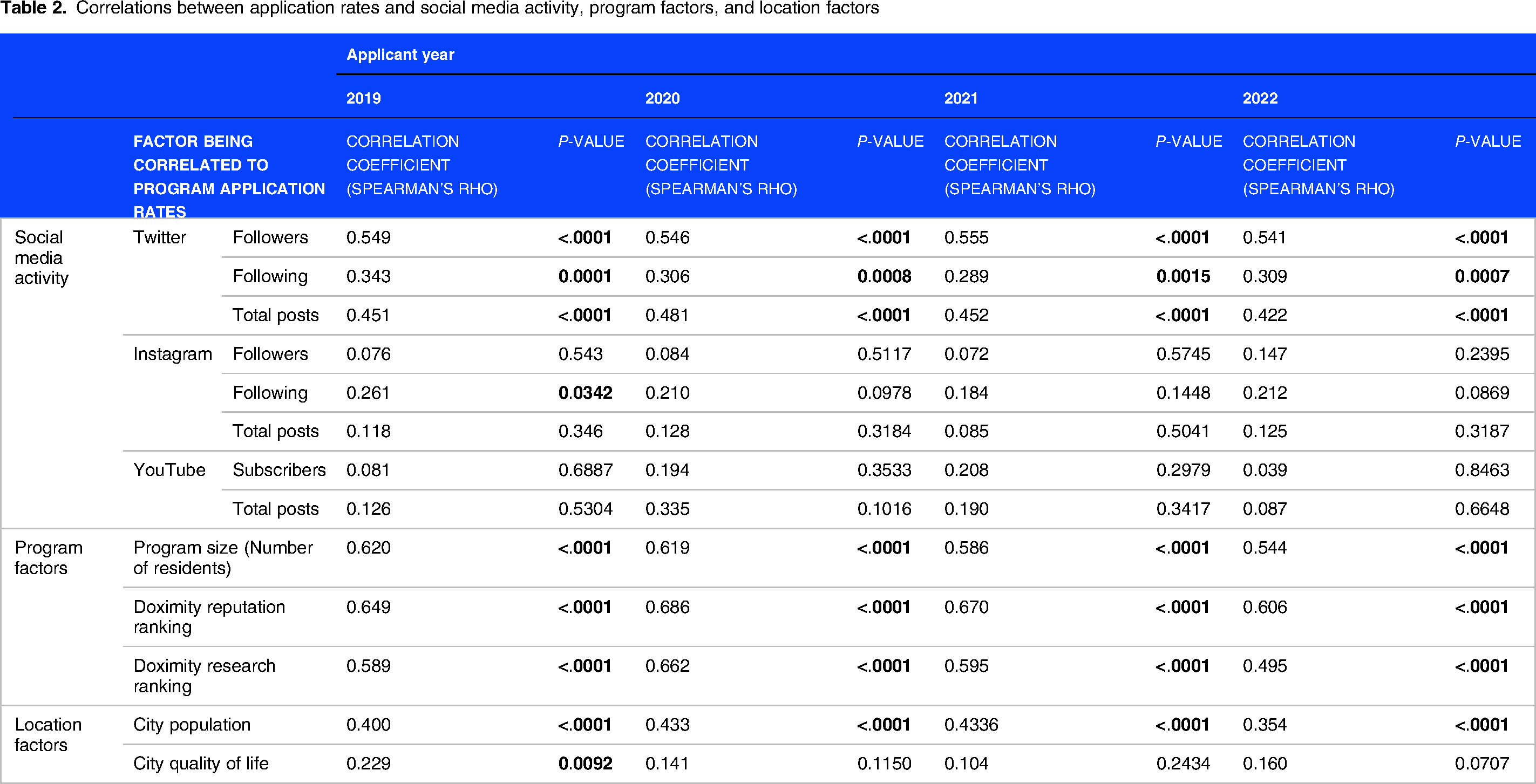
Among the 140 urology residency programs, 90.7% had Twitter/X, 50.7% had Instagram, 28.6% had Facebook, and 21.4% had a YouTube presence. Programs with Twitter/X, Facebook, or YouTube had significantly more applicants from 2019 to 2022 than those without (Table 1). There was a significant positive correlation between all Twitter/X activity metrics (total posts, number of followers, and number of accounts followed) and the total number of applications received across all four application cycles (Table 2). According to the multivariate model, however, the number of followers and following on Twitter/X were no longer significantly associated with application rates (p > 0.05). The relationship between total Twitter/X posts and application rates was unable to be assessed in the multivariate model due to multicollinearity with other remaining variables.
Descriptive statistics of application rates, program size, and Doximity rankings based on program social Media presence.

SD = Standard Deviation
Correlations between application rates and social media activity, program factors, and location factors
Programs with Twitter/X or Facebook had higher Doximity reputation and research rankings compared to those without (Table 1). All programs in the top quintile had Twitter/X accounts, and only two programs in the combined second and third quintiles lacked Twitter/X. Among programs with Facebook, 44% were in the top quintile. Programs in higher Doximity reputation ranking quintiles had significantly more posts, followers, and following on Twitter/X across all four years (Figure 1).

Twitter/X activity from 2019 through 2022 across Doximity reputation ranking quintiles. Each set of 5 columns corresponds to a different Twitter activity metric. Each column represents the average number of the respective metrics for all programs in that quintile. Data regarding posts is an average across all four years. Data regarding the number of followers and number of following was recorded in July 2022. Horizontal bars connecting columns denote statistically significant differences.
There were no associations between Instagram presence and application rates (Table 1). Additionally, we largely found no correlations between Instagram/YouTube activity and application rates or Doximity rankings in any application cycle (Table 2; p > 0.05). From pre-pandemic to post-pandemic, there was a significant increase in overall applicants and program presence on Twitter/X, Instagram, Facebook, and YouTube (p < 0.0001). The relationships remained consistent, with programs on Twitter/X, Facebook, and YouTube, but not Instagram, receiving significantly more applicants both pre-pandemic and post-pandemic (p < 0.05).
Program-specific factors
The program-specific factors assessed included program size (total number of residents), Doximity reputation ranking, and Doximity research ranking. In 2022, urology residency programs had an average of 13.4 residents per program, with a median of 15 residents. Program size was positively correlated with application rates across all four application cycles from 2019 to 2022 (Table 2). When controlling for program size using a multivariate model, the relationship between program size and application rates remained significant (p = 0.011).
Programs with higher Doximity research rankings and reputation rankings consistently received significantly more applications than those with lower rankings from 2019 to 2022 (Table 2). When assessed using a multivariate model, the relationship between reputation ranking and application rates remained significant (p < 0.0001). When comparing reputation ranking quintiles, programs in higher-ranking quintiles consistently attracted more applicants than those in lower-ranking quintiles, with a trend of increasing application rates from quintile 5 to quintile 1 (Figure 2). This trend remained stable despite the overall increase in total applications from 2019 to 2022. There was also a significant positive correlation between Doximity reputation quintile and program size (p < 0.0001).
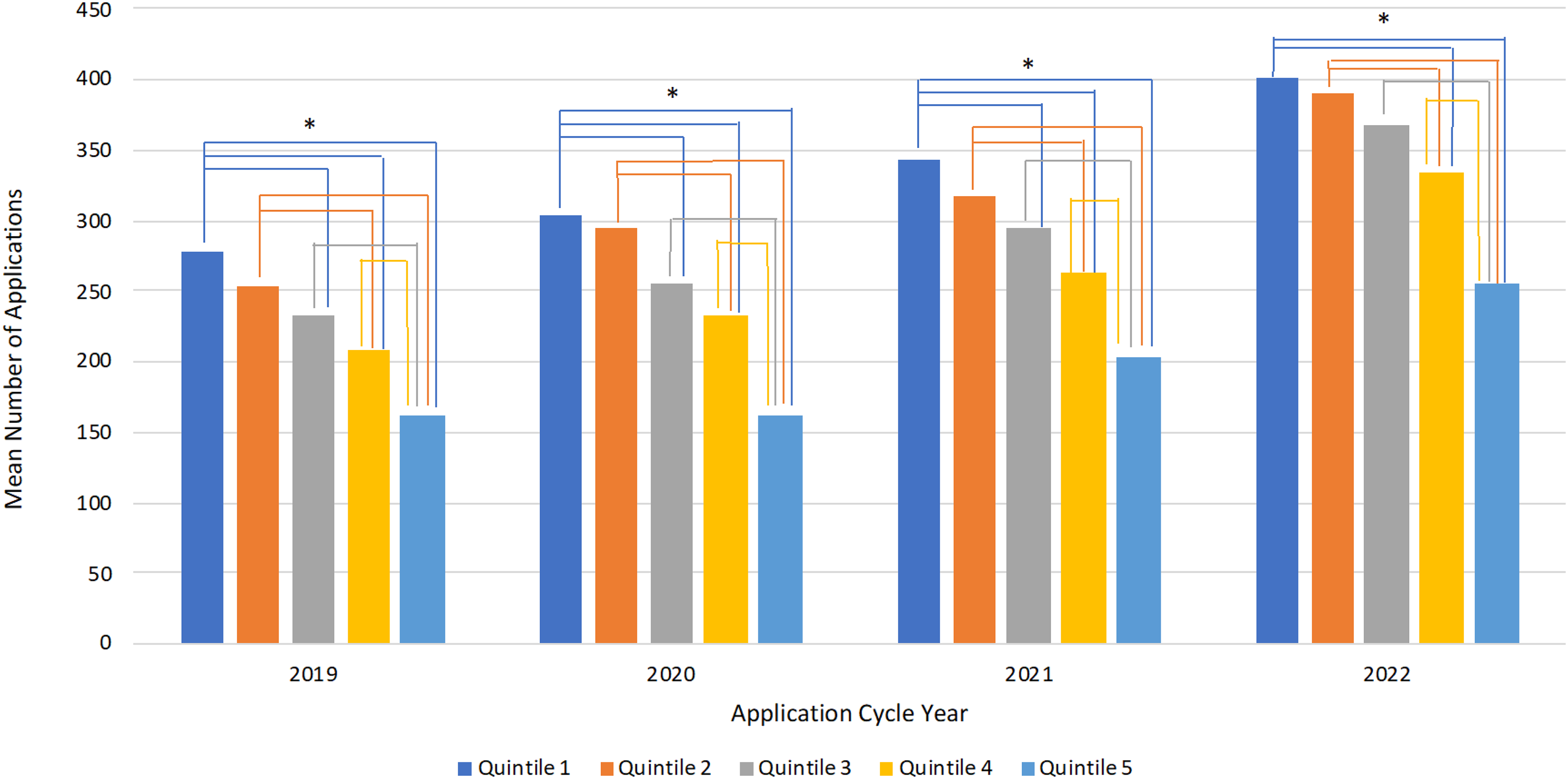
The trends in the mean number of applications received per Doximity reputation ranking quintile from 2019 to 2022. Each set of 5 columns represents one application cycle. Each column represents the average number of applications that programs in that quintile received during the respective year. Horizontal bars connecting columns denote statistically significant differences.
City-specific factors
The city-specific factors assessed included city population and city QoL ratings. Programs located in cities with larger populations received significantly more applications across all four years (Table 2). However, when assessed using a multivariate model, city population and application rates were no longer significantly associated (p > 0.05). From 2020 to 2022, no significant association was observed between city QoL and application rates (Table 2). Additionally, no significant differences in application rates were found across AUA regions from 2019 to 2022 (p > 0.05).
Discussion
This study aimed to identify the factors influencing applicants’ interest in urology residency programs by quantitatively analyzing the impact of social media (SoMe) and various program-specific and location-specific factors on application rates. We found that increased activity on Twitter/X, program size, program rankings, and city population were all associated with higher application rates. The two most significant factors driving application rates were Doximity reputation ranking and program size, according to multivariate analysis. However, due to multicollinearity, a multivariate analysis of total posts on Twitter/X could not be assessed, so it remains unclear whether this specific metric is among the most significant driving factors of application rates. Frequent interaction on SoMe, particularly Twitter/X, enhances programs’ ability to showcase their unique and attractive characteristics, while applicants can use SoMe to better assess how well a program aligns with their interests.
Twitter/X emerged as the most beneficial SoMe platform for urology residency programs, showing strong relationships with application rates and rankings. These findings align with previous studies indicating that programs and applicants find Twitter/X interactions meaningful for learning about programs.4,6,7 Although applicants consider SoMe less important than factors like program culture, operative opportunities, location, and prestige, SoMe serves as a valuable tool for gaining information about these factors.1,9 Twitter/X bridges the gap between applicants and programs, benefiting both parties by enhancing communication and information sharing.
Programs with more residents received more applications. Additionally, larger programs received more applications after controlling for overall program size. While not an exact representation of the number of applications per open residency position, this serves as a close substitute, indicating that programs with more available positions receive more applications for each of those positions. This might suggest that larger programs are more attractive to applicants, potentially due to their capacity to offer more diverse training opportunities and resources. Additionally, applicants may perceive a greater chance of matching in programs with more openings, or they might feel that larger programs offer more opportunities to find their personal and professional fit.1,5
Higher Doximity rankings, both in reputation and research, were significant predictors of increased application rates. This is particularly true with reputation ranking, which was significant in multivariate analysis. Programs in the top reputation quintiles consistently received more applications, underscoring the importance of perceived program quality and research opportunities in applicants’ decision-making processes. Given that program reputation, operative experience, and culture are among the highest-valued factors for applicants, these findings align with existing literature.1–3,5 For programs, this finding highlights the value of maintaining a strong reputation and active research involvement to attract top applicants.
In addition to increased application rates, programs in higher Doximity reputation ranking quintiles were more active on SoMe. This is a potential by-product of better-resourced programs naturally having better reputations. As a gross generalization, programs with more resources at their disposal can afford to employ personnel dedicated to the curation of SoMe accounts. Alternatively, programs with fewer resources may rely on either residents or faculty members with limited free time to maintain their online presence. While this certainly varies from program to program, it is a disparity worth noting.
City-specific factors also play a role in influencing application rates. Geographic location is a well-established influential factor for residency applicants.1–3 Programs in larger cities attracted more applications, likely due to the increased diversity of patient populations and greater professional and personal opportunities available in urban areas. However, the QoL rating of a program's city was not consistently associated with application rates, suggesting that applicants may prioritize city size over lifestyle considerations. Furthermore, while applicants may prioritize specific program locations and attributes, we found that no particular region of the country is more highly sought after.
Message to programs
Urology residency programs can leverage these findings to enhance their appeal to potential applicants. Increased Twitter/X activity can help programs showcase their unique characteristics and allow applicants to better assess program fit. However, our findings suggest that the number of followers and accounts followed on Twitter/X may be less important than the total number of posts. YouTube and Facebook also play important roles in increasing program visibility and exposure but are currently underutilized. Their relationships with application rates remained consistent during the transition from pre-pandemic in-person interviews to post-pandemic virtual interviews, further emphasizing their longitudinal value. Using these platforms alongside Twitter/X can further extend a program's reach.
Strategic SoMe posts that highlight key aspects of the program are particularly important in the era of virtual interviews, where these factors are harder to discern.2–4 Emphasizing program size and capacity, improving research involvement, maintaining strong reputations, and highlighting the unique advantages of their locations, particularly the urban aspects, can be effective strategies. Programs can also showcase these qualities through their websites and virtual information sessions. Given the competitive nature of the urology match, programs might aim to attract the “best-fit” applicants rather than a larger number of applicants. Tailoring content to emphasize specific program strengths can help attract ideal applicants and potentially reduce the number of blanket applications.
Limitations
This study has several limitations. While it identifies factors associated with increased application rates, the more realistic goal for many programs is to attract the “best-fit” applicants. Nonetheless, these findings can help programs achieve this while also managing application overload. One key limitation is the use of 2022 Doximity rankings, city population data, and city QoL scores applied retroactively to all four years due to the unavailability of these data from 2019–2021. Fluctuations in these metrics during these years could impact our results. Congruent to this idea, we attempted to assess the number of applications per available residency position, but this was difficult to assess given that some programs changed their class size during the study. To ameliorate this, we conducted multivariate analyses to control for program size and provide an equivalent analysis.
Data points such as the number of Twitter/X followers were recorded only once, in July 2022, as retroactive determination was not possible. Additionally, we did not differentiate between dedicated residency program accounts and department accounts, so we cannot conclude whether the type of account makes a significant difference. We were unable to quantify certain program-specific factors, such as culture and operative experience, which might influence application rates. As a result, unmeasured external factors could have influenced trends during this period. In conjunction with these external factors, we were unable to investigate the impact of a program's number of active faculty given the lack of a reliable information source and variable fluctuations in the number of faculty throughout the study.
The applicant data precedes the implementation of program signals, an important change in the application process that was not accounted for. Programs that became AUA-accredited between 2020–2022 were excluded from the analysis. Lastly, due to the evolving nature of Twitter/X, it is difficult to anticipate how this will impact the findings of this study. It would be an interesting proposition to repeat this study over the next four years and compare the results.
Conclusion
We comprehensively examined the factors influencing application rates to urology residency programs, highlighting the significance of program social media presence and activity, program size, Doximity rankings, and city population. Key findings indicate that Twitter/X activity is strongly correlated with higher application rates and that programs should utilize Twitter/X as a communication tool between themselves and applicants. Larger programs and those with higher Doximity reputation and research rankings also attracted more applicants, suggesting that perceived quality and opportunities for diverse training play crucial roles in applicants’ decisions. Additionally, while city population influenced application rates, the quality of life in a city was less impactful, indicating applicants may prioritize professional opportunities over lifestyle factors. Overall, urology residency programs can leverage these insights to strategically enhance their appeal to potential applicants, ultimately fostering a better fit between programs and residents.
Footnotes
Acknowledgments
Not-Applicable
Author contributions
FK, WP, LS, SG, and MT contributed to the design and implementation of the study, interpretation of the data, and writing and critical revision of the manuscript. BA contributed to the data analysis, critical revision of the work, and writing of the manuscript. ZK and JD contributed to the acquisition of data and critical revision of the work. FK and MT conceived the original idea, and MT supervised the project.
Consent to participate
Not-Applicable
Consent for publication
Not-Applicable
Data availability
The datasets generated during and/or analyzed during the study for urology residency programs are available in the AUA Website suppository. The datasets generated during and/or analyzed during the study for program rankings are available in the Doximity Website suppository. The datasets generated during and/or analyzed during the study for program applicant data are available from the corresponding author upon reasonable request.
Conflicts of Interest
Co-author JD is a shareholder of Doximity, Inc. and completed a Telehealth Fellowship with Doximity, Inc. in October 2022. The authors have no other conflicts of interest to declare.
Funding
The authors received no financial support for the research, authorship, and/or publication of this article.
Ethics
Ethics clearance was not required as we did not deal with human participants and all data was collected retrospectively without infringement of personal rights, liberties, or ethics.
