




Abstract
Background
The importance of effective leadership for improving patient care and physician well-being is gaining increased attention in medicine. Despite this, few residency programs have formalized education on leadership in medicine. The most effective ways to train graduate medical education (GME) trainees in leadership are unclear.
Methods
Our large internal medicine residency program implemented a book club to develop leadership skills in residency. Through independent reading of the selected book and resident-led small group discussions, we facilitated dialogue on the challenges of leading effectively.
Results
A survey-based curricular evaluation demonstrated that 61% of respondents felt that the book club influenced their thoughts about leadership and that 66% of participants would recommend the book club to other residency programs. Lack of time was the main barrier to participation while addition of complementary media or alternative book formats were identified as possible solutions to increase engagement.
Conclusions
Leadership book clubs are a practical and effective way to teach leadership during residency. More research is needed to identify the best formats for book club discussion and to develop additional tools to foster future physician leaders.
Introduction
Physicians serve as leaders in diverse capacities early in residency and throughout their careers. Effective leadership benefits patient outcomes, provider satisfaction, and physician well-being.1–7 Leadership skills must be taught and developed.2,3,8 Despite increasing calls for leadership development among physicians,3,9 few residency programs and health care organizations have formal curriculums to develop leadership skills and the Accreditation Council for Graduate Medical Education (ACGME) does not list leadership education as a core competency. 10 As a result, most clinicians consider themselves “accidental leaders.”3,11 Prioritizing leadership education is an opportunity to transform accidental leaders into effective and intentional leaders.3,9,11
Several residency programs have created curricula to develop physician leaders to close this “leadership gap”.8,11 Lectures, small group discussions, and case-based activities dominate the current landscape of leadership curricula.3,11 While book clubs have been utilized in a variety of specialties and settings to strengthen leadership development as well as medical education in general,12–17 they remain an underutilized instructional format within residency programs. When used appropriately, book clubs have been shown to promote critical thinking, 18 reduce burnout,19,20 and possibly improve leadership skills. 12 We developed a leadership book club at Walter Reed National Military Medical Center as part of our leadership curriculum. The purpose of this article is to examine our 6 years of experience with an annual leadership book club and explore barriers and potential solutions to effective implementation.
Methods
Leadership Intervention
Walter Reed National Military Medical Center has approximately 70 internal medicine and internal medicine psychiatry residents who are part of the National Capital Consortium. They have the option each year to participate in a leadership book club, which is a part of our larger leadership curriculum. The leadership book club promotes resident-led investigation of different leadership styles and techniques and encourages residents to reflect and see themselves as leaders. The faculty has selected a wide variety of books about leadership over the past 6 years21–26 with 1 book recommended and offered to residents each year.
The residents and faculty discuss the book's leadership content, relevance, and applicability in small groups during dedicated academic time throughout the year. Typically, 2 1-hour sessions are scheduled each year to discuss the book and related leadership topics. The sessions are formatted with question prompts related to the books to stimulate discussion on selected leadership topics.
Survey Design
During the last academic year (2020-2021), all National Capital Consortium internal medicine residents were eligible to evaluate the book club via an online survey. Finding no suitable existing survey in the literature, we developed a survey specific to our curricular intervention using survey design best practices (online Supplemental material). 20 Each survey item was developed in collaboration with a content expert, reviewed by an expert in survey design, and evaluated with cognitive interviewing with 2 internal medicine trainees.
Data Analysis
The results were analyzed using descriptive statistics. Free-text responses were extracted to provide further evidence for the findings in the descriptive statistics. No survey data were excluded.
Results
The survey had a response rate of 60% (N = 49). Overall, the evaluation of the leadership book club was positive. 53% of residents were either “satisfied” or “very satisfied” with the book club experience. Only 6% were not at all satisfied and of these residents, they reported reading “none” or “very little” of the book (Figure 1). The small group in-person discussion was well-received and strongly preferred (83.3%) over alternative formats (Figure 2). 66% of respondents would recommend book club to other residency programs as a tool for leadership development and 61% felt that the curriculum influenced their leadership thoughts and behaviors. Specifically, respondents wrote that the leadership book club: “Caused me to reflect on the styles of my role models and see how [vulnerability in leadership] is more important than I previously thought. I have increased its priority in my own style.”

Shows resident overall satisfaction with leadership book club curriculum.
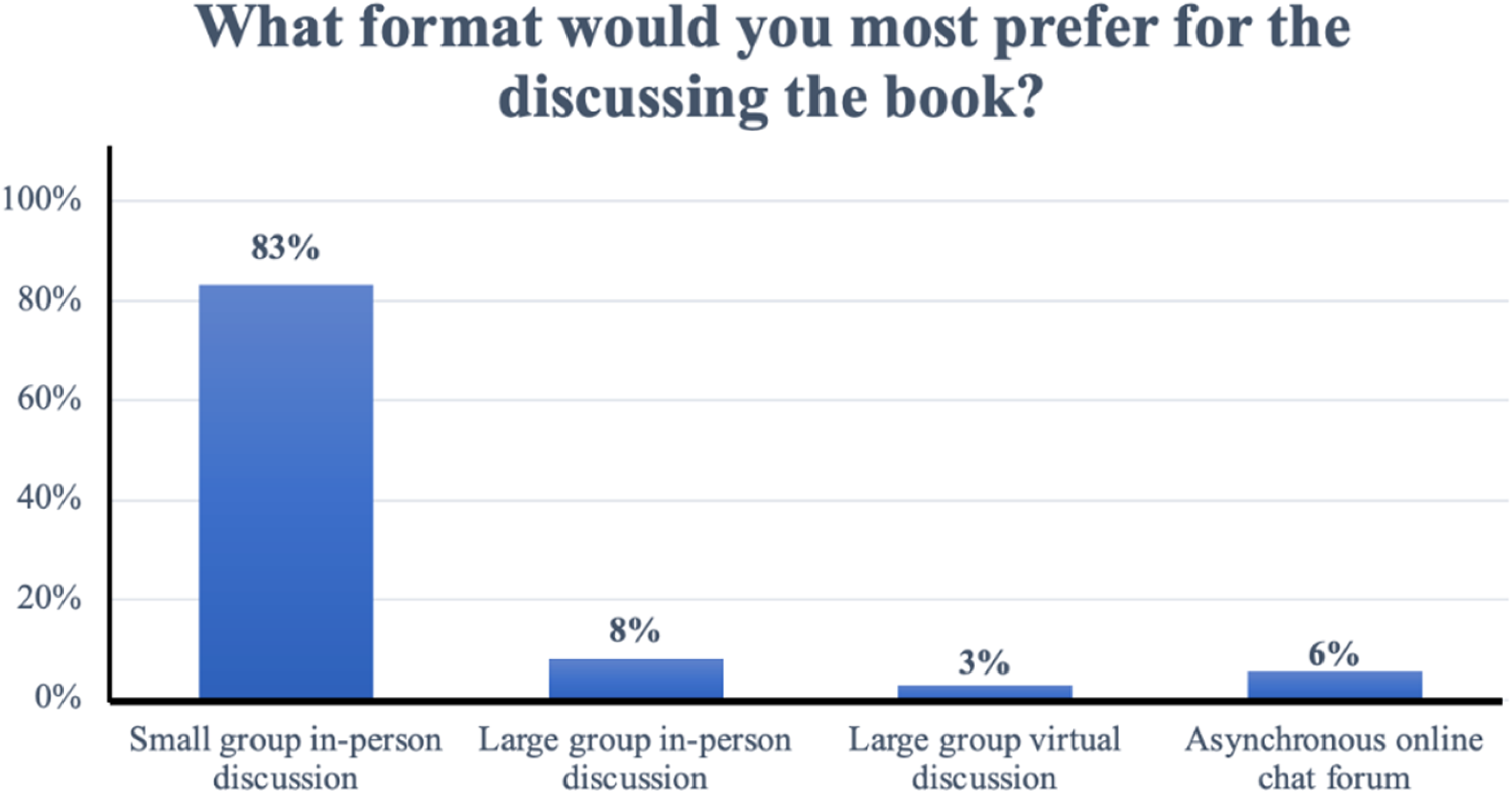
Shows resident preference for instructional format.
“Made me more mindful of my behaviors toward the group as a leader.”
“Made me more purposefully name my values and return to my values during challenging situations”
The survey results also identified opportunities for curricular improvement. Only 12% of survey responders read the entire book, while a small majority (54.5%) read at least half. Most (79.50%) cited lack of time as the most significant barrier to finishing the book. The incorporation of complementary materials (eg, blog, podcast, and video) and offering alternative book formats (eg, audiobook) may increase future participation (Figure 3). Resident involvement in the book selection may further increase participation.

Depicts opportunities for increasing resident engagement in the leadership book club.
Discussions
A leadership book club serves as a potential method for transforming graduate medical education (GME) trainees from accidental to intentionally effective leaders. We successfully implemented a leadership book club that enhanced community through meaningful discussion15,19 and likely influenced the development of leadership thoughts and behaviors, consistent with prior literature.12,13,17 Using the books to jumpstart conversation, residents discussed a wide variety of topics including teamwork, culture, vulnerability, well-being, gender equity, feedback, accountability, and values. These discussions allowed residents to better understand and learn about each other while enhancing their leadership skills. We hypothesize that our resident-led, faculty-supported small group book club discussions promoted near-peer leadership and increased resident satisfaction. This is different from other programs that have used leadership-trained faculty members as discussion facilitators. 13 In our study and the literature, small group discussion formats are preferred.11,13,16,17 More evidence is needed to determine optimal facilitation strategies.
Other studies have looked at the influence of leadership curricula in GME programs. For example, Cobb et al. compared leadership development after implementing a leadership book club curriculum in an anesthesia residency program against historic controls, finding that leadership curricular participation was associated with a non-statistically significant increase in leadership skills. 12 Other medical specialties, ranging from Emergency Medicine to Psychiatry have found similar success, fostering professional development.15,17 While our survey did not assess the attainment of leadership skills or improvement as a leader, the survey respondents reported that the discussions influenced their leadership thoughts and behaviors and allowed residents to intentionally discuss leadership in medicine. Future curricular interventions could directly assess the improvement in leadership skills of participants.
Our study is a rare example of book club implementation for leadership development in GME, providing information for other programs to implement successful leadership book clubs. Among our lessons learned, resident participation in our book club was variable, consistent with the anesthesia residency book club where 61% of residents participated. 12 To maximize participation, our results suggest that residents should participate in the book selection. In addition, our study demonstrated that the most significant barrier to implementing a book club was lack of time during residency (79.50% of responses). Respondents indicated that this could be mitigated by selecting books shorter in length that have audiobook capabilities or complementary media such as podcasts. Alternatively, programs could consider using a podcast or short article alone as an option given there are many leadership podcasts available and almost a third (32%) of residents suggesting this would improve participation. Podcasts have the additional benefit of being free which could be a useful alternative for programs without the funds to purchase books. By implementing these variations, we hypothesize that resident participation will be maximized, and resident satisfaction will increase. This is evidenced by our survey that found that the residents who were “not at all satisfied” with the experience had read “none” or “very little” of the book; suggesting that the inability to read even part of the book severely limits the benefit of the book club group discussions for that resident.
Leadership book clubs serve as a tool to foster physician leaders in many ways. Setting aside dedicated academic time emphasizes the importance of leadership development and avoids residents from having to give up their free time to participate. Allowing a small group of residents to help run the leadership book club affords residents with practical leadership and teaching experience. The residents leading the process also can help make the material more applicable to resident learners. It is important to have preformulated points of discussion for the meetings. We have started using prompts that can be discussed by anyone even if they have only read part of the book. If implementing a leadership book club, we would recommend planning ahead to gather data on its effectiveness for programmatic improvement and to potentially publish results so the medical education community can continue to learn how to effectively use book clubs for leadership development.
Limitations
The book club was conducted in a residency program consisting of military officers, which may have impacted their perceptions of need and desire to learn about leadership in comparison to civilian programs. The residency program purchased and distributed the books, limiting access as a barrier. The survey was designed for purpose of evaluating our specific curriculum, and it did not directly assess for improvement in leadership skills. While efforts were made to collect evidence to support the validity of our survey, the questions were only tested on a small percentage of the target population.
Conclusion
Leadership book clubs offer 1 relatively simple method for GME programs to longitudinally teach leadership skills to trainees. Additional research is needed to determine potential alternatives to books such as podcasts or articles, optimal discussion formats, and develop additional tools for building physician leaders of today and the future.
Supplemental Material
sj-pdf-2-mde-10.1177_23821205231164837 - Supplemental material for Read to Lead: Developing a Leadership Book Club Curriculum for Graduate Medical Education
Supplemental material, sj-pdf-2-mde-10.1177_23821205231164837 for Read to Lead: Developing a Leadership Book Club Curriculum for Graduate Medical Education by Sarah B. Schulte, William Rainey Johnson, Anthony J. Greco, John G. Blickle, Thomas R. Brooke, Melanie L. Wiseman and Joshua D. Hartzell in Journal of Medical Education and Curricular Development
Supplemental Material
sj-pdf-3-mde-10.1177_23821205231164837 - Supplemental material for Read to Lead: Developing a Leadership Book Club Curriculum for Graduate Medical Education
Supplemental material, sj-pdf-3-mde-10.1177_23821205231164837 for Read to Lead: Developing a Leadership Book Club Curriculum for Graduate Medical Education by Sarah B. Schulte, William Rainey Johnson, Anthony J. Greco, John G. Blickle, Thomas R. Brooke, Melanie L. Wiseman and Joshua D. Hartzell in Journal of Medical Education and Curricular Development
Footnotes
Acknowledgments
The authors acknowledge the residents who have participated in this curriculum and provided ongoing feedback to make it more effective.
FUNDING
The author(s) disclosed receipt of the following financial support for the research, authorship, and/or publication of this article: The books for the book club were funded through a grant from the Alpha Omega Alpha Medical Honor Society.
DECLARATION of CONFLICTING INTERESTS
The author(s) declared no potential conflicts of interest with respect to the research, authorship, and/or publication of this article.
Author’s Contribution
Sarah B. Schulte—Dr Schulte contributed to the thought content for curriculum, data interpretation, and manuscript. She wrote the first draft of the manuscript and spearheaded the incorporation of revisions to bring the manuscript to its final form.
W. Rainey Johnson—Dr Johnson contributed to the thought content for curriculum, data interpretation, and manuscript. He assisted with execution of the curriculum. He was primarily responsible for development of the survey, including the revisions. He made significant contributions to revisions of all drafts of the manuscript.
Anthony J. Greco—Dr Greco contributed to the thought content for curriculum, data interpretation, and manuscript. He assisted with execution of the curriculum. He assisted with survey development and led survey distribution/data collection efforts. He contributed to the first draft of the manuscript.
John G. Blickle—Dr Blickle contributed to the thought content for curriculum, data interpretation, and manuscript. He assisted with execution of the curriculum. He assisted with survey development and contributed to the first draft of the manuscript.
Thomas R. Brooke—Dr Brooke contributed to the thought content for curriculum, data interpretation, and manuscript. He assisted with execution of the curriculum. He assisted with survey development and contributed to the first draft of the manuscript.
Melanie L. Wiseman—Dr Wiseman contributed to the thought content for curriculum, data interpretation, and manuscript. She assisted with execution of the curriculum. She assisted with survey development and contributed to the first draft of the manuscript.
Joshua D. Hartzell—Dr Hartzell was awarded the initial grant from Alpha Omega Alpha that funded the curricular initiative. He was primarily responsible for the development of the curriculum. He was involved in every portion of the process – survey design, data collection, data interpretation, and manuscript revisions.
Consent and Ethics
This project was determined to be part of the leadership curriculum and not meet criteria for research. As a result, consent and ethics was waived off by the Institutional Review Board/Ethics Committee [Reference No.: WRNMMC-EDO-2020-0433, 922149].
Copyright Statement
I am a military service member. This work was prepared as part of my official duties. Title 17 U.S.C. 105 provides that “Copyright protection under this title is not available for any work of the United States Government.” Title 17 U.S.C. 101 defines a United States Government work as a work prepared by a military service member or employee of the United States Government as part of that person's official duties.
Disclaimer
The views expressed in this article are those of the author(s) and do not necessarily reflect the official policy of the Department of the Navy, Department of Defense, or the United States Government.

Supplemental Material
Supplemental material for this article is available online.
References
Supplementary Material
Please find the following supplemental material available below.
For Open Access articles published under a Creative Commons License, all supplemental material carries the same license as the article it is associated with.
For non-Open Access articles published, all supplemental material carries a non-exclusive license, and permission requests for re-use of supplemental material or any part of supplemental material shall be sent directly to the copyright owner as specified in the copyright notice associated with the article.
