




Abstract
Aim
Since COVID-19 has set the state of health of the country in an emergency, it is natural that in such circumstances, violation of some principles of professional ethics is inevitable. This study aimed to identify and prioritize ethical challenges in the clinical services of patients with confirmed coronavirus disease in Iran's hospitals.
Design
This study was a mixed method with an exploratory sequential design.
Methods
This study was done in 2 qualitative and quantitative phases. In the qualitative phase, a systematized review was conducted and in the quantitative phase, a questionnaire of 35 questions based on the results of Phase 1 was formulated and completed.
Results
The challenges related to the provider of clinical services (physicians and nurses), the recipients of clinical services (patients), and the organizational challenges had the most significant importance, respectively (P < .05, χ2 = 6.23).
Introduction
The expression “ethical challenges” mainly refers to ethical dilemmas and ethical conflicts as well as other scenarios where difficult choices have to be made. Ethical dilemmas are described as situations that cannot be solved; decisions made between 2 options may be morally plausible but are equally problematic due to the circumstances. Ethical conflicts, on the contrary, arise when one is aware of the necessity of proper actions but he or she may have trouble exercising these actions because of certain internal or external factors. 1
The medical staff is obliged and committed to present health care with high quality as to the ethical standards related to their profession. 2 As well as medical staff, as well as 1 of the most important providers of health services, must be aware of and respect the ethical aspects of care. 3 Although ethical challenges were and are an inseparable part of the medical profession, 4 the outbreak of emerging diseases and the crisis that is made due to them create other new ethical challenges. 5 Actually, with the emergence of emerging diseases, the need for an ethical approach in medicine has become an undeniable necessity.
The term “emerging diseases” refers to diseases that are caused by unknown new infectious agents or by known infectious agents that are geographically spread or have undergone drug resistance and are increasing in prevalence and are practically infectious diseases. 3
The COVID-19 pandemic is 1 of the new crises that all countries around the world are challenging with up to now. 6 This emerging infectious disease is spreading and has disrupted the treatment and care system of countries. Iran is 1 of the countries where the amount of infected cases has been increasing day by day so many beds in hospitals have been allocated to these patients.
Building positive relationships between nurses and patients is crucial for quality care. Nurses play an important role as advocates for their patients, but challenges can sometimes damage these connections, leading to poorer outcomes. 7 The role of medical staff in the treatment and care of patients is incredibly important. These dedicated individuals are not just the frontline providers of medical services; they also play a crucial role in enhancing patients’ quality of life. Through their specialized skills and knowledge, they effectively identify and manage clinical conditions, ensuring that patients receive the best possible care. 8 The COVID-19 pandemic significantly affected healthcare delivery, presenting unprecedented challenges for healthcare providers, particularly nurses. These professionals encountered heightened stress and faced resource constraints, leading to ethical dilemmas stemming from inadequate protective equipment and elevated infection risks. As a result, many nurses reported job dissatisfaction and contemplated leaving the profession. Research revealed that numerous nurses experienced fear and anxiety while caring for COVID-19 patients, highlighting an urgent need for attention to their safety and mental health. Ethical challenges were widespread, with many nurses feeling compelled to compromise the quality of care due to limited resources and external pressures. This underscored the critical importance of organizational support during such crises. 9
Since COVID-19 sets the state of health in an emergency, violation of some principles of professional ethics is inevitable. The outbreak of COVID-19 has challenged the treatment staff-to-patient ratio and the weakness of the surveillance system has made some imbalances. The treatment staff does not have the necessary opportunity to pay attention to the patient, and it will only be focused on the implementation of routine operations and instructions. In such cases, considering clinical ethics will gradually decrease. The lack of ethics will bring about challenges and Unpleasant consequences that will result made the decline of patient consent and the health care quality. Therefore, due to the importance of ethics in medical care for COVID-19-infected patients, the present study aimed at identifying and prioritizing ethical challenges in clinical care services for these patients from the perspective of medical experts and health staff in Iran's hospitals.
To achieve the mentioned goal, the following questions were designed:
- What are the most important ethical challenges in the clinical services of COVID-19-infected patients in Iran's hospitals? - Which of the ethical challenges in the clinical services of COVID-19-infected patients is of more importance from the perspective of medical experts and health staff?
Methods
This study was mixed methods research with an exploratory sequential design that has been done in 2 qualitative and quantitative phases. The reporting of this study conforms to the Standards for Reporting Qualitative Research (SRQR). 10
The qualitative phase
In the qualitative phase, we followed the Preferred Reporting Items for Systematic Reviews and Meta-Analyses (PRISMA) statement by the Cochrane Collaboration to conduct this systematized review. A comprehensive and transparent systematic review forms a strong foundation for qualitative analysis, providing a deep understanding of the topic backed by credible evidence. This enhances the robustness of qualitative analyses and informs new research questions.
We conducted an advanced search in PubMed, Google Scholar, Scopus, Web of Science, ProQuest, and Medline databases and considered original peer-reviewed articles published in scientific journals from 1990 to 2020. The search operators included Boolean operators (AND, OR, and NOT), parenthesis, and truncation and the keywords were “Clinical ethics,” “Medical ethics,” “Ethical consideration,” “Moral issues,” “Ethical issues,” and “Clinical moral.” “Problem*,” “barrier*,” “challenge*.” An example of a search query used to retrieve the papers was as follows: TS = ((“Clinical ethics” OR “Medical ethics” OR “Ethical consideration” OR “Moral issues” OR “Ethical issues” OR “Clinical moral”) AND (“Problem*” OR “barrier*” OR “challenge*”)). After extracting the articles, duplicated ones were excluded using Endnote X8.2.
Inclusion criteria
The inclusion criteria for this review were as follows: (1) English language, (2) peer-reviewed Peer-reviewed journal articles (3) and after 1990.
Screening process, critical appraisal, and data extraction
In the first search, 1127 resources were found. In these searches, articles that had conceptualized and introduced clinical ethic challenges, articles that had offered solutions to eliminate the clinical ethics challenges, as well as articles that directly and indirectly emphasized paying attention to clinical ethics challenges were reviewed, and anonymous, unscientific articles, those that did not conform with the research and the articles written in languages other than English and Persian were left out from the study.
After studying the abstracts of articles and deleting irrelevant articles, 62 articles existed, all of them were reviewed by the research team, and their codes and categories were extracted (Figure 1). Data analysis in this step was performed by using MAXQDA software (version 12).
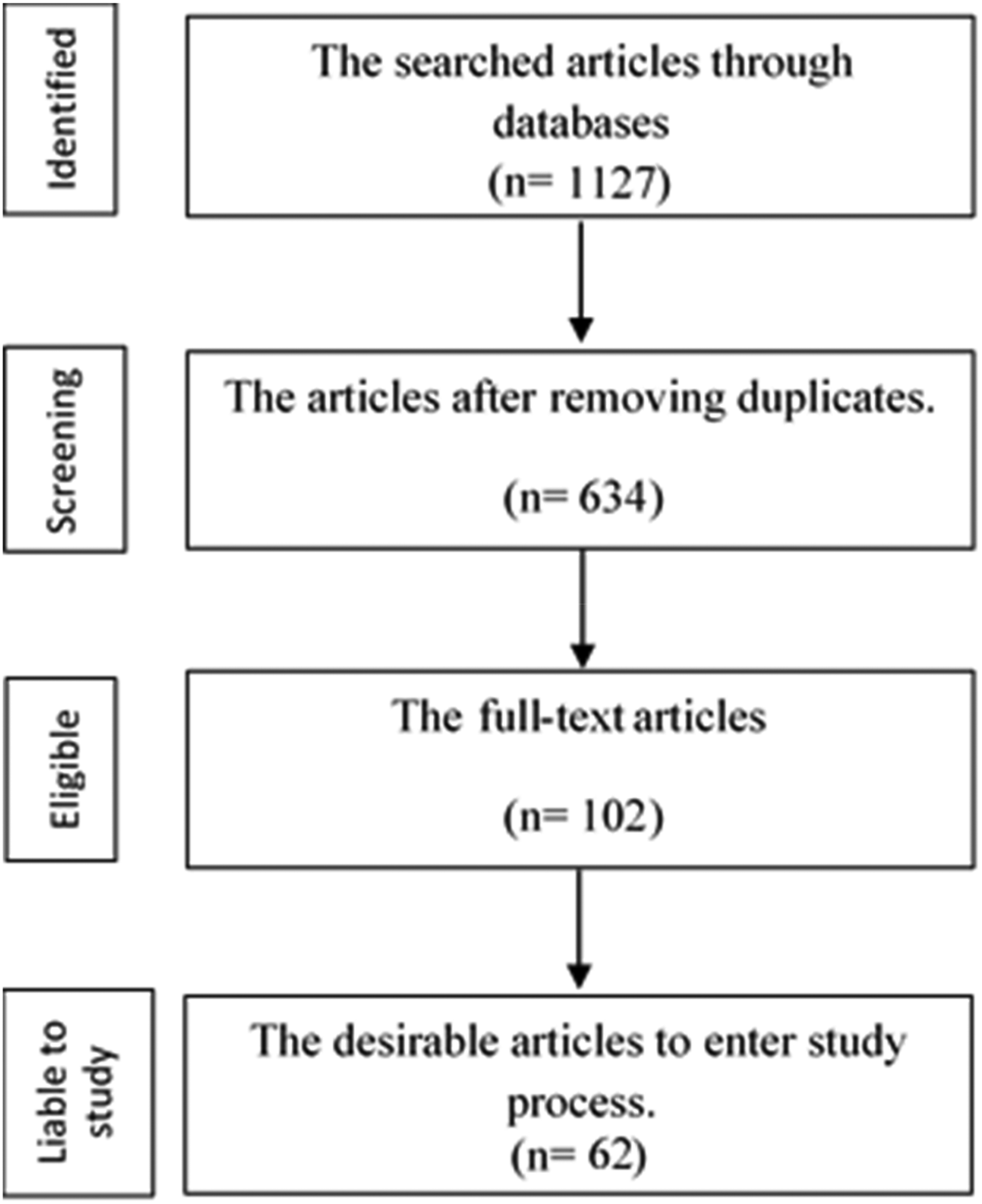
Articles review process with PRISMA 2020 flow diagram.
The quantitative phase
In the second stage of research, a questionnaire of 35 questions was formulated. The questionnaire includes 2 sections: Demographic characteristics and observed ethical challenges in patients’ clinical services, including challenges related to the recipients of clinical services (patients) (15 questions), challenges related to the providers of clinical service providers (physicians and nurses) (13 questions), and organizational challenges (7 questions). To validate the instrument, face, and content validity, the level of difficulty in understanding expressions, words, and ambiguous cases, was examined so that 10 medical experts gave their corrective comments and after applying the comments the instrument was used. The questionnaire used is designed with a 5-point Likert scale (very much, much, no opinion, little, very little).
The reliability of the instrument was measured using Cronbach's Alpha equal to 0.7. Then it was asked the 120 nursing experts to rate each item on a 5-point Likert spectrum from where they seemed not very important to very important ones, of which 102 questionnaires were completed (response rate of 85%). The participants were selected by convenience sampling. The analysis of data was done by SPSS software (version 21) and by using descriptive (mean, standard deviation) and inferential statistics (1 sample t-test, Friedman test). To consider the ethics in the research, first, the purpose and process of the study were explained to all participants and then informed consent was obtained.
Results
The results in the qualitative and quantitative phases are as follows:
The results of the qualitative phase
The purpose of the study in the qualitative phase was to identify ethical challenges in the patients’ clinical services. The results of the qualitative phase in 8 categories and 35 subcategories in 3 domains are shown in Table 1. Also, the studies related to the literature of the theme are presented in Table 2.
Identified categories, subcategories, and themes.

The main challenges in clinical services.

The results of the quantitative phase
Sample demographic information is presented in Table 3.
Sample demographic information.

The results of the 1-sample t-test showed that the calculated mean for each challenge in the sample group was significantly higher than the test value (P < .001). (Table 4). So, it can be said the challenges of patients, the challenges of physicians, and nurses, and the organizational challenges are considered important challenges from the participant's point of view.
One-sample t-test to compare the mean scores of challenges (n = 102).

Also, the Friedman test was used to find out which challenges have the higher priority to respondents. The results of the Friedman test showed that there was a significant difference between the prioritization of the importance of each identified challenge (P < .05, χ2 = 6.23).
Discussion
the coronavirus highlighted many of the complicated ethical issues that healthcare professionals face in dealing with patients and families. Pandemics and patients’ remedial services have caused a series of medical ethical conflicts at different levels. In their article titled “Triage in Medicine: Concept, History and Types,” Kent et al have distinguished between the 3 concepts of “triage,” “rationing,” and “allocation.” Firstly, the concept of allocation defines the distribution of all medical facilities, devices, and resources disregarding the principle of scarcity. Secondly, the concept of rationing deals with the distribution of medical resources while taking into account the availability and sufficiency of resources to satisfy patients’ needs. Thirdly, the concept of “triage” has a limited scope. It is used in the healthcare field to focus on decision-making about the distribution and utilization of scarce medical resources. The use of the triage concept must fulfill 3 conditions. Firstly, the omnipresence of scarce medical resources. The level of rarity or scarcity can vary significantly. It could be low when a patient comes for care to the emergency department (ED) and is not served immediately. Scarcity also could be very high, as after the COVID-19 pandemic when hundreds of patients came to the hospital and could not be treated owing to the shortage of life-saving ventilators or the absence of a bed in the Intensive Care Units (ICU). Consequently, if medical resources are sufficient, there will be no triage, but if these resources are unavailable, triage becomes inevitable. 11 The initial wave of COVID-19 has set the pressure on health systems around the world and has made hotter international debates on triage ethics, allocation of scarce resources, and medical decisions based on care standards in crisis conditions. However, these debates are not new and there has always been controversy over appropriate criteria and processes to allocate scarce critical care resources during pandemics among ethicists, healthcare institutions, and public health agencies such as Control and Prevention Centers of Diseases.12,13 However, each pandemic has its particular traits. The COVID-19 pandemic raises a wide range of concerns for the healthcare systems of the global community including initial remedial care to allocation of scarce care resources. These issues have made the pandemic more complicated. The shortage of ventilators has led some health systems to use 1 ventilator for several patients, which is challenging clinically and ethically. This pandemic has clarified the gaps that Haimer (2013) calls “ethics in books versus ethics in practice.” Some ethical challenges described in this article aren’t limited to COVID-19, but the current situation has new limitations and requires new solutions. The purpose of this study was to identify and prioritize ethical challenges in the clinical services of COVID-19-infected patients in Iran's hospitals. Several studies were done to examine ethical challenges associated with the outbreak of coronavirus that we can refer to.14,15
Morley et al (2020) in their research have stated that the most important ethical challenges that nurses face during the outbreak of coronavirus include the nurses’ safety and health, the change of nature of nurses’ relationships and treatment staff with patients and their families, and the allocation of limited resources to patients, especially ventilators with keeping the prioritization. 15 In the present study, 1 of the main components is the challenges related to the providers of services which are consistent with that research.
McGuire et al (2020) in their research have stated the most important ethical challenges arising in the coronavirus pandemic include 2 general categories: (1) Issues related to the health system, including the prognostic scoring system, childcare standards, prioritization, and protection of medical staff, providing noncritical, non-COVID-19 medical cares, informed consent from the patient, moral distress of providers of health services, hospitals financial vulnerability. (2) Social issues include social participation, critical capacity in rural and remote communities, discrimination health equality, and legal considerations. 16
In the research of Kaur et al (2022), titled Ethical Challenges in Clinical Practice during the COVID-19 Pandemic in an academic healthcare institution in Malaysia Three main themes emerged. Firstly, there was deprioritisation of care for non-COVID-19 patients resulting from resource limitations. HCPs raised concerns that there was curtailed access to various healthcare services by non-COVID-19 patients. There was also a trade-off between protecting individual patient safety and public health interests. Secondly, patients were disempowered from decision-making; the decision to segregate suspected COVID-19 patients to high-risk areas without seeking patients’ approval may result in an increased risk of infection. Lastly, HCPs expressed internal conflicts when balancing the professional duty of care against concerns about contracting COVID-19 and spreading it to their family members. 17
In their research, Ulrich et al (2023) identified 5 major themes: ethical issues that were increasingly more complex, moral distress that was “endemic,” shifting ethical paradigms from the focus on the individual to the population, fostering a supportive environment, and organizational ethics: variation in the value, roles, and policy input of clinical ethicists. 18
Melaku et al (2023) have explored the ethical challenges, and dilemmas encountered by frontline health workers amid the coronavirus disease-19 (COVID-19) pandemic in Ethiopia. The result indicated that front-line health workers have encountered ethically challenging situations during the COVID-19 pandemic. A critical ethical issue in the COVID-19 pandemic is the equitable distribution of limited available resources among patients. With limited resources such as ventilators and hospital beds, healthcare providers have been faced with the difficult task of deciding who gets access to these resources and who does not. Outpatient and inpatient health care services, including routine hospitalization and elective surgery, have been severely curtailed or postponed. Overall, the COVID-19 pandemic has presented numerous ethical challenges for healthcare providers, highlighting the importance of ethical considerations in healthcare delivery. By being aware of these dilemmas and having policies in place to address them, healthcare providers can ensure that they are providing the best possible care to their patients while upholding ethical standards. 19
Haghighat et al (2024) in their research have stated the collected content was divided into 2 areas: the most important challenges raised in the articles include 2 categories: ethical challenges of patients with emerging diseases and ethical challenges of healthcare providers with emerging diseases. It seems that in addition to dealing with the ethical needs of serving patients, dealing with issues related to the medical staff, especially the ethical aspects of their service, should also be considered. 3
Azimi et al (2024) in their research have explained the process of ethical care of patients with COVID-19 in detail. The results indicated that starting the process with a problem means a challenge of how to do the correct thing for the patient. This process is driven by the feeling of duty and inner commitment to do the right thing. The sense of responsibility or commitment is directly related to the degree of faith in a person. The actions that a nurse takes to fulfill her sense of commitment are called the faith-based behavior process. The process of behavior based on faith is done through 2 steps. Attaining the satisfaction of God and as well as the satisfaction of one's conscience is the nurses’ ultimate goal of doing the right work and being committed. 20
Conclusion
In most countries, front-line physicians have been faced with demands beyond the available resources and have been forced to make decisions about which patients to be hospitalized and prioritization for the use of ventilators. Also, during the COVID-19 pandemic, adjusting treatment policies may lead to raising ethical issues. The challenges of pandemics are affected by time constraints, logistical issues, and social distances, and as a result, there is limited opportunity to gather information. Patient informed consent is a key element of the principle of moral respect, but in a pandemic, it's more likely that the mentioned principle to be violated due to diffident conditions. On the other hand, raising the number of severely ill patients and the clinical consequences of COVID-19 disease can reduce the quality of medical care. Separating the patient from the family without permission to take preventive measures for Infection control violates the basic principles of clinical ethics. Therefore, all of these cases require a review of ethical considerations in an emergency.
Footnotes
Acknowledgment
The authors wish to express their gratitude to all participants who aided in conducting this research.
Author Contributions
Conception or design of the work, Data collection, data analysis, and interpretation: Z.M. and D.R. Drafting the article: Z.M. Critical revision of the article, and final approval of the version to be published: M.A, M.K.
Declaration of Conflicting Interests
The authors declared no potential conflicts of interest with respect to the research, authorship, and/or publication of this article.
Consent Statements
To consider the ethics of the research, first, the purpose and process of the study were explained to all participants and then informed consent was obtained.
Ethical Approval
All ethical considerations are considered in this study. The proposal for this research was confirmed by the ethical committee at Shahid Beheshti University of Medical Sciences IR.SBMU.SME.1403.027.
Funding
The authors received no financial support for the research, authorship, and/or publication of this article.
