



Abstract
OBJECTIVE
The aim of this study is to explore the application effectiveness and value of combining problem-based learning (PBL) and case-based learning (CBL) in clinical electroencephalography (EEG) education.
METHODS
A total of 104 standardized training for residents and refresher physicians from the Neurology Department of the First Affiliated Hospital of Chongqing Medical University, Neurology Department of Chongqing Yubei Hospital, and Neurology Department of Banan Hospital of Chongqing Medical University were enrolled. According to randomization principles, 52 participants were assigned into the PBL-CBL combination group and 52 subjects were assigned into the control group. We used statistical methods to compare the differences between the 2 groups in basic theory, case analysis, practical assessment scores, and teaching satisfaction.
RESULTS
In terms of basic theory, case analysis, practical assessment scores, and teaching satisfaction, there were significant differences between the 2 groups, and the PBL-CBL combination group was superior to the control group (P < .05).
CONCLUSION
In clinical EEG education, the teaching model of combining PBL and CBL has certain application effects and value.
Introduction
The electroencephalogram (EEG) is an important examination method used to reflect brain function. It has the advantages of safety, noninvasive, reliability, and relatively low cost, making it an essential electrophysiological examination method for diagnosing neurological diseases, especially seizure disorders. 1 EEG teaching is an indispensable part of training for residents in neurology. EEG involves a wide range of content and requires a high level of specialization. The content of EEG is relatively abstract and covers a lot of professional knowledge. In addition, EEG waveforms exhibit a variety of changes, which increases the difficulty for students to memorize and understand the key points during the learning process, potentially impacting their motivation to learn. There are some shortcomings in the practice of EEG teaching. Research has shown that after formal EEG training, the accuracy of EEG reading among neurology residents is still not high, and nearly half of the neurology residents are unable to read EEG correctly even under guidance.2–4 The survey has also found that residents have fewer opportunities to encounter EEG during their training, leading to poor teaching effectiveness and a lack of interest among residents. 5 Therefore, how to enable residents to further understand and master EEG within a limited time is an important issue and challenge in EEG teaching.
Problem-based learning (PBL) is one of the most successful educational innovations in higher education in the past 50 years. 6 PBL has now been expanded to over 500 higher education institutions worldwide, no longer limited to medical or engineering education, but also used in psychology, economics, biology, law, and business. 7 It is widely believed that PBL is a comprehensive education strategy that organizes students’ learning process in a way that actively participates in students. All models are student-centered, with teachers acting as facilitators of the process; all are conducted in groups; learning is organized around problems; and all models promote students’ autonomy and collaboration. 6 Using clinical cases to support teaching is known as case-based learning (CBL). 8 The goal of CBL is to prepare students for clinical practice by using real clinical cases. It integrates theory and practice by applying knowledge to cases and adopting exploratory learning methods. 9 Research has found that CBL is highly effective in improving the clinical practice, problem-solving, and analytical skills of residents and medical students.10,11
The PBL combined with CBL teaching mode combines the advantages of PBL and CBL, and some studies have found that this model has obvious advantages compared to traditional teaching mode.12–14 However, currently, the teaching model of PBL combined with CBL is rarely applied to the EEG education, and there is also a lack of a scientific and systematic academic performance evaluation system. We hypothesize that combining PBL and CBL teaching methods can better achieve efficient and high-quality learning objectives compared with traditional classroom teaching methods. Thus, we implemented these 2 methods in EEG teaching for the standardized training for residents and refresher physicians over the past 4 years to evaluate the effectiveness and acceptability of the PBL-CBL combination teaching method.
Materials and Methods
Participants
This was a prospective, randomized, controlled study. We recruited 104 participants who graduated between December 2019 and August 2023 and entered the Neurology Department of Banan Hospital of Chongqing Medical University (20 participants), Neurology Department of Chongqing Yubei Hospital (16 participants), and Neurology Department of the First Affiliated Hospital of Chongqing Medical University (68 participants) for standardized training as resident physicians and refresher physicians. Among these participants, 52 individuals were assigned to the “PBL-CBL group” (PBL-CBL combination group) and the other 52 individuals were assigned to the “control group.” During this period, the participants received PBL-CBL combination training were in the PBL-CBL combined group, while the subjects received traditional training were in the control group. The study utilized a simple randomization method, that is, all participants were randomly assigned an envelope containing grouping information generated by the PROC PLAN process step of SAS9.4 software, and participants were assigned to the corresponding PBL-CBL combination group or control group based on the grouping information inside the envelope. Each group member received a 3-month training program. Inclusion criteria: standardized training for resident physicians and refresher physicians; age 20 to 38 years. Exclusion criteria: individuals with EEG learning or EEG work experience; individuals who do not agree to participate in this study; and pregnant women. We have followed The Do CTRINEGuidelines: Defined Criteria To Report INnovationsin Education. 15
Ethical approval
We obtained WRITTEN informed consent from all subjects for the publication of this study. Ethics Committee exemption was conducted by the First Affiliated Hospital of Chongqing Medical University.
The specific learning objectives of the teaching program
The specific learning objectives of the teaching program are whether the PBL-CBL combination group is better than the traditional group in terms of basic theory, case analysis, practical assessment scores, and teaching satisfaction.
Teaching methods
The schedule for the PBL-CBL combination group is as follows. Before each class, the instructor prepares lecture videos and Supplemental materials, providing participants with relevant information on typical clinical cases, as well as 5 reference papers related to the course topic. Subjects are required to review these materials in their spare time. Before the beginning of the course, the instructor briefly introduces the daily clinical work of subjects. Next, as the first step of the classroom activity, a patient case with slides is presented. Then, under the guidance of the instructor, participants have group discussions. During these discussions, participants are encouraged to raise relevant questions and seek answers in internet and library databases. In the third step, one subject representative from each group makes a presentation reviewing the main points of the lesson, sharing their group's responses to the questions raised, and asking about any unresolved issues. Finally, the instructor summarizes the course content and reviews the challenging issues raised during the discussion. 12
The schedule for the traditional lecture group is as follows. Before the lecture, participants are instructed to only preview the course, rather than extensively watching videos or reading materials. These subjects learn the same content through traditional teaching methods. That is, the instructor provides a thorough explanation of theoretical knowledge within the official framework, rather than discussing the cases in a group. In other words, teacher-centered instruction is the primary method. 12
Evaluation of teaching effectiveness
After the end of the training, both groups of participants were required to complete a clinical teaching evaluation. The evaluation criteria included: (1) theoretical knowledge and case analysis (with a maximum score of 100 for each); (2) EEG operation (with a maximum score of 100, detailed scoring criteria can be found in Table 1); (3) self-assessment and teaching satisfaction survey: participants were asked to complete a questionnaire consisting of 10 questions, which covered their feelings and experiences in EEG learning interest, clinical analysis ability, problem-solving skills, and course satisfaction.
Scoring criteria for practical assessment of EEG performance.

Scored by experienced senior EEG physicians. Abbreviation: EEG, electroencephalogram.
All participants received informed consent and were informed that participation in the tests and surveys was voluntary. Due to the use of identification numbers rather than real names in tests and surveys, the results of the tests and surveys would not have any (positive or negative) impact on their course grades or performance. Participants independently completed the tests and surveys. 12
Sample size
We recruited 20 participants (resident physicians and refresher physicians) in the PBL-CBL combination group and 20 participants (resident physicians and refresher physicians) in control group as pre-experimental study subjects. And we calculated the sample size using practical EEG assessment scores (the most important research evaluation index) data by PASS15.0 software. Group sample sizes of 34 and 34 achieve 90% power to reject the null hypothesis of equal means when the population mean difference is μ1–μ2 = 91.35–85.50 = 5.75 with standard deviations of 6.18 for PBL-CBL group and 6.79 for control group, and with a significance level of 0.05% and 20% dropout rate using a 2-sided 2-sample unequal-variance t-test. Considering this study is a multicenter study, the final sample size is set to 1.5 times the calculated sample size. Therefore, 51 study subjects are required at least for each group in this study.
Statistical methods
Normally distributed measurement data were expressed as the mean ± standard deviation (M ± SD). The comparison between groups was conducted with the independent sample t test. Grade data and categorical data are described using frequency and percentage [n(%)], and comparison between groups was performed using chi-square test and Mann-Whitney U tests, respectively. Calculate inter-group differences and their 95% confidence intervals, after adjusting for age, gender, education level, and physician category by using covariance analysis. Statistical analysis was performed using SAS 9.4 software (Copyright ©2016 SAS Institute Inc. Cary, NC, USA). Results were considered statistically significant at 2-side P < .05.
Results
Demographic characteristics
From December 2019 to August 2023, a total of 104 standardized training for resident physicians and refresher physicians participated in the study. Fifty-two participants (20 standardized training for resident physicians and 32 refresher physicians) were assigned to the PBL-CBL combination group, while the other 52 participants (24 standardized training for resident physicians and 28 refresher physicians) were assigned to the control group. The average age of participants were 28.85 ± 3.60 years-old in PBL-CBL group and 28.27 ± 3.03 years-old in PBL-CBL group. Thirty-one (59.62%) females were in PBL-CBL group and 29 (55.77%) females were in control group. The results show that there were no significant differences between the 2 groups in terms of age, sex, education, and physician category (Table 2).
The demographic characteristics of all the participants.

There were no significant differences between the 2 groups in terms of age, sex, education and physician category. Abbreviations: CBL, case-based learning; PBL, problem-based learning.
Comparison of theoretical examination scores between the 2 groups
After the end of the training, the statistical results showed that the theoretical foundational knowledge exam scores and case analysis scores in the PBL-CBL combination group were 4.04 points (95% CI = 3.15-4.93) and 5.52 points (95% CI = 4.78-6.26) significantly higher than that in the control group, respectively (P < .05) (Table 3).
Theoretical assessment scores.

The both score of the PBL-CBL group were significantly higher than that of the control group.
The difference is the PBL-CBL group minus the control group, and adjust age, gender, education and physician category.
Abbreviations: CBL, case-based learning; CI, confidence interval; PBL, problem-based learning.
Comparison of practical EEG assessment scores between the 2 groups
After the end of the training, the statistical results showed that the theoretical foundational knowledge exam scores of EEG operation, EEG report, and total scores in the PBL-CBL combination group were 2.06 points(95%CI = 1.21∼2.91), 2.27 points (95%CI = 1.41∼3.12), and 4.90 points(95%CI = 4.11∼5.70) significantly higher than that in the control group, respectively (P < .05) (Figure 1 and Table 4). There was no significant statistical difference between the 2 groups in terms of medical history inquiry and physical examination, with P > .05.
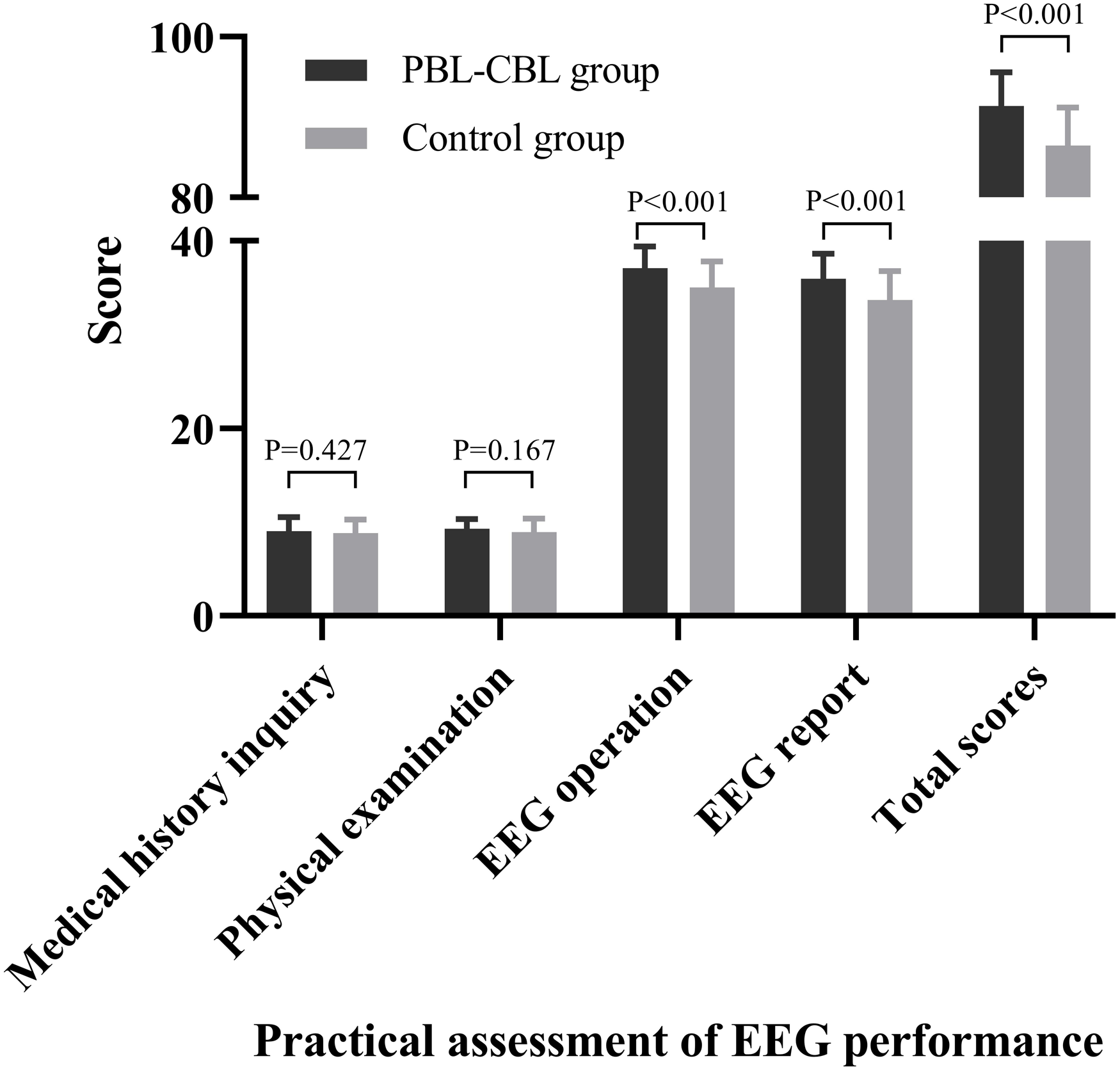
The scores of the practical assessment for 2 groups. The scores of the PBL-CBL group were significantly higher than that of the control group in EEG operation, EEG report, and total scores. Abbreviations: CBL, case-based learning; EEG, electroencephalogram; PBL, problem-based learning.
The scores of the practical assessment.

The scores of the PBL-CBL group were significantly higher than that of the control group in EEG operation, EEG report, and total scores.
The difference is the PBL-CBL group minus the control group, and adjust age, gender, education and physician category.
Abbreviations: CBL, case-based learning; EEG, electroencephalogram; PBL, problem-based learning.
Survey results
After the completion of the training, an evaluation was conducted on the subjective perceptions and experiences of the participants regarding the teaching outcomes. A questionnaire containing 10 items was administered anonymously to all participants (Supplemental file). The participants evaluated each item using the 5-point Likert Scale, ranging from 1 (strongly disagree) to 5 (strongly agree). 7 We analyzed the number of respondents for each option. The survey results showed that the PBL-CBL combination group performed significantly better than the control group in all aspects (Table 5).
Comparison of questionnaire survey results between the PBL-CBL combination group and the control group (number of participants).
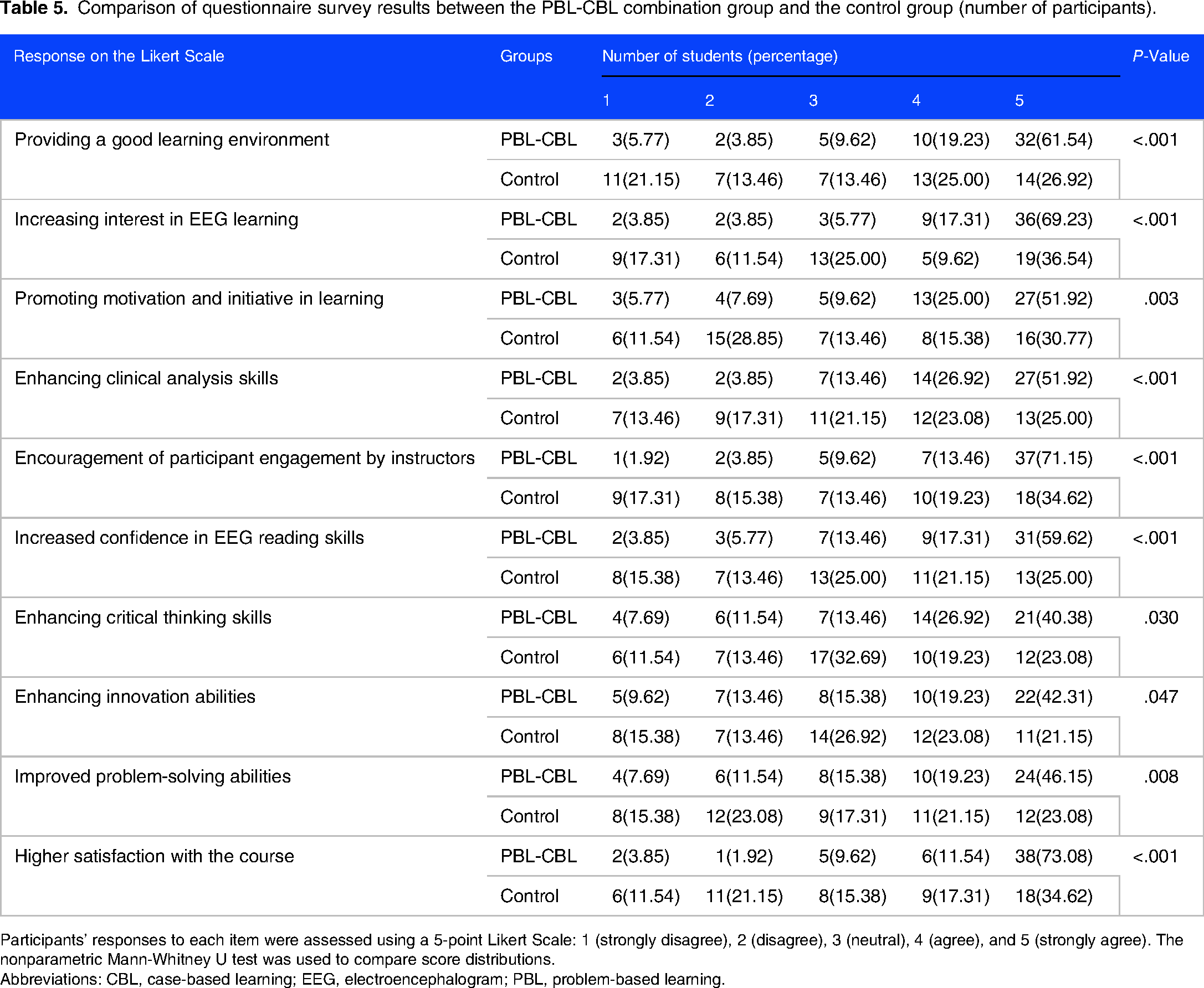
Participants’ responses to each item were assessed using a 5-point Likert Scale: 1 (strongly disagree), 2 (disagree), 3 (neutral), 4 (agree), and 5 (strongly agree). The nonparametric Mann-Whitney U test was used to compare score distributions.
Abbreviations: CBL, case-based learning; EEG, electroencephalogram; PBL, problem-based learning.
Discussion
The theoretical knowledge of EEG is dull and difficult to understand. EEG waveforms are complex, making it easy for students to feel fatigued by the course. Additionally, EEG are closely related to clinical practice and require extensive experience to accurately interpret. Therefore, for non-EEG professionals, learning this course presents significant challenges and may lead to confusion in interpreting EEG reports. The traditional teaching method is based on lecture, with teachers taking on a dominant role while students passively receive knowledge. The limitation of this model is that teachers only focus on their own understanding of the subject matter, failing to fulfill their role of guiding students to solve problem. Furthermore, students lack initiative and creativity, ultimately making it difficult for them to apply the acquired knowledge to clinical practice.16,17
Different from traditional teaching methods, PBL and CBL aim to establish real medical scenarios and encourage students to adopt an active learning attitude, shifting from a paradigm of “what I learn” to “what I want to learn”. 18 PBL is an approach that involves problem-solving through case analysis, clinical reasoning, and collaborative assistance, requiring students to have high learning initiative. However, students with lower self-directed learning abilities may struggle to adapt to this teaching method, resulting in difficulties in mastering fundamental knowledge. 19 A study in South Korea showed that insufficient self-study time, lack of initiative, and insufficient typical cases can all impact the successful implementation of PBL. Therefore, selecting representative cases is a necessary condition for the effective implementation of PBL. 20 Although PBL has shown some effectiveness in clinical EEG teaching, it also has certain limitations. For example, it requires teachers to possess comprehensive qualities and master specialized fundamental theory and clinical application knowledge. As for students, they need a high level of active learning, which can be challenging to achieve the desired outcomes. On the other hand, our understanding of CBL is a form of exploratory learning. It was first introduced in basic pathology education by Professor James Lorrain Smith at the University of Edinburgh in 1912. 21 This method prepares students for clinical practice using real clinical cases and guides them in problem-solving through a structured teaching mode that combines foundational theory and specific typical cases. This active medical education model has been widely used in the medical field. 8 Additionally, a study in the United States revealed that in dental education, PBL focuses primarily on cases, while CBL emphasizes how students can flexibly apply what they have learned in clinical settings. CBL also has more specific and explicit educational goals, utilizing guiding teaching, and discussions to ensure the achievement of learning objectives. 22 Considering their respective advantages, we combined PBL and CBL teaching method in this study, allowing them to complement each other.
Although previous studies have shown that some universities have attempted to implement PBL or CBL teaching models,11,23–26 there is limited focus on the combination of PBL and CBL in clinical medicine. To investigate the effectiveness and acceptability of the PBL-CBL combined teaching method in EEG education, we compared it with traditional teaching method. In our study, there was no significant difference in basic characteristics between the 2 groups. However, after the end of learning, the PBL-CBL combination group scored higher than the traditional group in theoretical knowledge, case analysis, and practical assessment, demonstrating the effectiveness of the PBL-CBL combined teaching model. This also indicates that PBL and CBL combined teaching method can cultivate participants’ diagnostic and differential diagnostic abilities, further enhancing their clinical thinking skills. Additionally, we assessed the subjective perceptions and experiences of the participants. The participants anonymously evaluated each item using a 5-point Likert Scale. The results showed that participants rated the PBL-CBL combined teaching model highly in terms of providing a favorable learning environment, increasing interest in EEG learning, stimulating learning initiative and motivation, enhancing clinical analysis abilities, encouraging instructor participation, boosting confidence in individual EEG reading skills, improving problem-solving abilities, and increasing overall course satisfaction. By analyzing the perspectives and self-awareness of the 2 groups of participants, we confirmed that participants in the PBL-CBL combination group tended to adopt a more balanced approach to learn and practice, thereby becoming more proactive learners.
However, there are several limitations in our study. Firstly, we only analyzed training data from the included 3 centers, therefore these results may differ from reports from other institutions. Secondly, due to the lack of blinding in our study, some analysis biases were unavoidable. Finally, the sample size of this study is small. Therefore, it is necessary to replicate our results in larger population-based cohorts.
Conclusion
In conclusion, in the EEG education, the PBL-CBL combined teaching method may effectively enhance the performance of neurologists and improve their clinical skills and abilities. Moreover, the teaching approach that combines PBL and CBL also effectively enhances students’ understanding abilities, improves teacher-student interaction and communication skills, and cultivates clinical thinking skills, self-learning ability, teamwork ability, and knowledge absorption ability.
Supplemental Material
sj-docx-1-mde-10.1177_23821205241252277 - Supplemental material for The Application of Problem-Based Learning Combined With Case-Based Learning in EEG Teaching
Supplemental material, sj-docx-1-mde-10.1177_23821205241252277 for The Application of Problem-Based Learning Combined With Case-Based Learning in EEG Teaching by Feng Li, Jing Luo and Hua Zhang in Journal of Medical Education and Curricular Development
Footnotes
Abbreviations
Acknowledgments
The authors would like to acknowledge Dr Yonglan Xiong from the Department of Neurology in Banan Hospital of Chongqing Medical University for providing 20 participants. We would like to express our gratitude to Dr Yuchuan Zhou from the Department of Neurology in Chongqing Yubei Hospital providing 16 subjects.
Author contributions
FL contributed to analysis and interpretation of data, compose figures, and manuscript draft. JL was involved in critical review of manuscript for intellectual content. HZ was involved in study concept, design, study supervision, and critical review of manuscript for intellectual content.
Declaration of conflicting interests
The authors declared no potential conflicts of interest with respect to the research, authorship, and/or publication of this article.
Funding
The authors received no financial support for the research, authorship, and/or publication of this article.
Availability of data and materials
The data supporting the conclusions of this article are available from the corresponding author upon request.
Consent for publication
All authors approved the final manuscript for submission and gave consent for publication.
Ethics approval and consent to participate
Ethics Committee exemption was conducted by the First Affiliated Hospital of Chongqing Medical University. The study was approved by all the participants.
Supplemental material
Supplemental material for this article is available online.
References
Supplementary Material
Please find the following supplemental material available below.
For Open Access articles published under a Creative Commons License, all supplemental material carries the same license as the article it is associated with.
For non-Open Access articles published, all supplemental material carries a non-exclusive license, and permission requests for re-use of supplemental material or any part of supplemental material shall be sent directly to the copyright owner as specified in the copyright notice associated with the article.
