




Abstract
OBJECTIVES
The demand for orthopedic surgery is expected to increase as the Saudi population grows and ages. Therefore, this study aimed to assess the interest of medical students and interns in orthopedic surgery and the factors that influence their interest.
METHODS
This cross-sectional study was conducted using a structured questionnaire adapted from a similar study and modified by the authors. The questionnaire was distributed via email to more than 500 medical students from the second year to the internship year. The questionnaire was designed to assess knowledge, interest, and students’ perception of orthopedics.
RESULTS
Five hundred and ten responses were obtained; 382 (74.90%) were from women. Gender, family orientation, private practice, and perceptions of orthopedic surgery as a stressful specialty or a specialty in crisis were variables that did not influence participants’ perceptions of orthopedic surgery. Further, 13% of participants showed early interest in orthopedic surgery, especially during their third year of medical school. Most of the interested participants recognized that having strong level of knowledge, future academic opportunities, a controllable lifestyle, direct patient care, experience during their clerkship, a high salary, immediate satisfaction, and a prestigious specialty were important aspects that determined their interest in considering a future career in orthopedic surgery. Work preferences that had a significant impact on interest included working with patients not requiring long-term care, working only in the hospital, working outside the hospital, and working only during the day.
CONCLUSION
There was no difference between genders in terms of interest in orthopedic surgery. This study might serve as a basis for future research assessing the interest of medical students in orthopedic surgery as well as identifying and managing the barriers that prevent students from pursuing careers as orthopedic surgeons.
Introduction
There are approximately 2645 orthopedic surgeons in Saudi Arabia. 1 According to the Saudi Ministry of Health (MOH), orthopedic surgeries are among the most sought-after therapies abroad in the Saudi community. 1 In light of this, it is important to consider that the demand for orthopedic surgeons is likely to rise as the Saudi population grows and ages. 2
Orthopedic surgery lacks gender diversity and has a significantly lower number of women compared to men than any other surgical specialty.1–3 In 2018, 19 men were newly enrolled into orthopedics in fellowship programs and higher educational institutions in Saudi Arabia; there were no women in orthopedic surgery.1,3
Previous studies have explored the rationale for this difference. A study conducted in Jeddah, Saudi Arabia to assess medical students’ and interns’ interest in a variety of specialties found that of the 16 participants who were interested in orthopedics, only three were women; the study concluded that this difference was mainly due to participants’ interest and not their grade point average, level of education, or gender. 4 A similar study found that only 2% of women participants were interested in pursuing orthopedic surgery in the future. When asked about their perceptions of orthopedic surgery, they described it as boring. 5 Another study found that women and men had similar residency preferences but different factors influenced them, such as residency length and work schedule. 6 Some studies suggest that a lack of exposure to orthopedic surgery in medical school and a dearth of same-gender role models affect women's desire to pursue this specialty, while others imply that the inability to have a good work-life balance, physical strength requirements, a shortage of strong mentorship in medical school or earlier, and concerns about family planning are all possible barriers to choosing this specialty.3,7–9
Prior literature has consistently found low interest among women in orthopedics as a specialty; however, the reasons for their low interest are multifactorial and differ across studies and levels of education. Early clinical exposure to a specialty plays a vital role in interest and career-decision making. The nature of a clinical specialty, the length and quality of training, mentoring, the existence of role models, lifestyle, female preference, and self-collected information shape students’ interest in the clinical field. Identification of factors that influence students’ interest in and choice to pursue orthopedics is crucial to understanding the roots of gender diversity, and to provide guidance to build a healthy, supportive environment for female orthopedic surgeons. It is vital to develop a greater understanding of undergraduate students’ perceptions and experiences early on in medical school to address relevant factors to create a healthy educational environment for both genders. Efforts should be made to encourage more females to go into orthopedic surgery and to implement career counseling measures to help female students become aware of all options in the field. Therefore, we aimed to explore medical students’ and interns’ interest in orthopedic surgery, the factors that influence their interest, and the reasons behind the lack of women's interest in orthopedic surgery.
Methods
Design and setting
We administered this cross-sectional study in multiple medical schools in Riyadh and Jeddah. The distribution included students from the King Saud Bin Abdulaziz University for Health Sciences, King Saud University, Princess Nourah Bint Abdulrahman University, Imam Muhammad ibn Saud Islamic University, and Alfaisal University. The estimated sample size, calculated using Raosoft, was at least 377 with a confidence interval of 95% and a population size of 20 000. We included all students from both genders, from all age groups, and excluded non-Saudi students/interns. We obtained written informed consent from all participants prior to administering the questionnaire.
Participants and procedure
We adapted and modified a structured questionnaire from a similar study.5,10 The adapted concept was based on the fact that when a student's criteria matches his/her perception of a specialty, his/her likelihood of selecting the specialty increases.5,10 For the purpose of the research, we examined the students’ interest and perceptions of orthopedics. We used the questionnaire to collect data from 510 participants who were either medical students or interns; data collection took place from March 2020 to July 2021. This period of time coincided with the COVID-19 restrictions, necessitating the use of non-face-to-face distribution methods. Thus, we distributed the questionnaire via email through student affairs departments and student clubs at each university; a reminder was sent every 2 months with a clear statement that each student who participated in the study was to ignore the reminder to prevent duplicates. The questionnaire included two sections. The first one covered participants’ demographic data (including age, gender, institute, year of study, and any previous rotation in orthopedic surgery). The second section was divided into four subsections related to factors that could influence a student's decision to pursue orthopedic surgery: (a) level of knowledge of daily activities, lifestyle, and remuneration in orthopedic surgery; (b) degree of interest in orthopedic surgery; (c) the importance of each of the 25 criteria in students’ and interns’ choice of medical specialty; and (d) perceptions of orthopedic surgery. A 5-point Likert scale was used to rate the responses to the subsections. The targeted population included all women and men in the third, fourth, fifth, and sixth years of medical school as well as interns. We used convenience sampling (non-probability). The process of distribution involved sending official emails directed at the targeted population with informed consent forms attached to the questionnaire. Our study received Institutional Review Board (IRB) approval from the King Abdullah International Medical Research Center (reference #IRBC/0414/20).
Statistical analysis
We entered all data into an Excel spreadsheet using Microsoft Excel 2019 (Microsoft Ltd, WA, USA) and then transferred them to SPSS version 23 (IBM Corporation, NY, USA) for analysis. Categorical variables are presented as frequencies and percentages. The five-point Likert scale was reduced to three categories; the two points representing negative responses and the two points representing positive responses were combined plus the middle point. We employed a chi-square test to detect differences between categorical variables. We set statistical significance at .05.
Results
Table 1 outlines the participants’ demographic data. Most participants were between 18 and 23 years of age (82.55%). Of the 510 participants, 382 (74.90%) were women. A minority were from KSAU-HS Jeddah (4.71%), while most were from KSAU-HS Riyadh (46.86%). Most participants were in their third year of study (26.27%).
Participants’ demographic data.

Note. KSAU-HS: King Saud bin Abdulaziz University for Health Sciences; KSU: King Saud University; IMSIU: Imam Mohammad Ibn Saud Islamic University; PNU: Princess Nourah Bint Abdulrahman University.
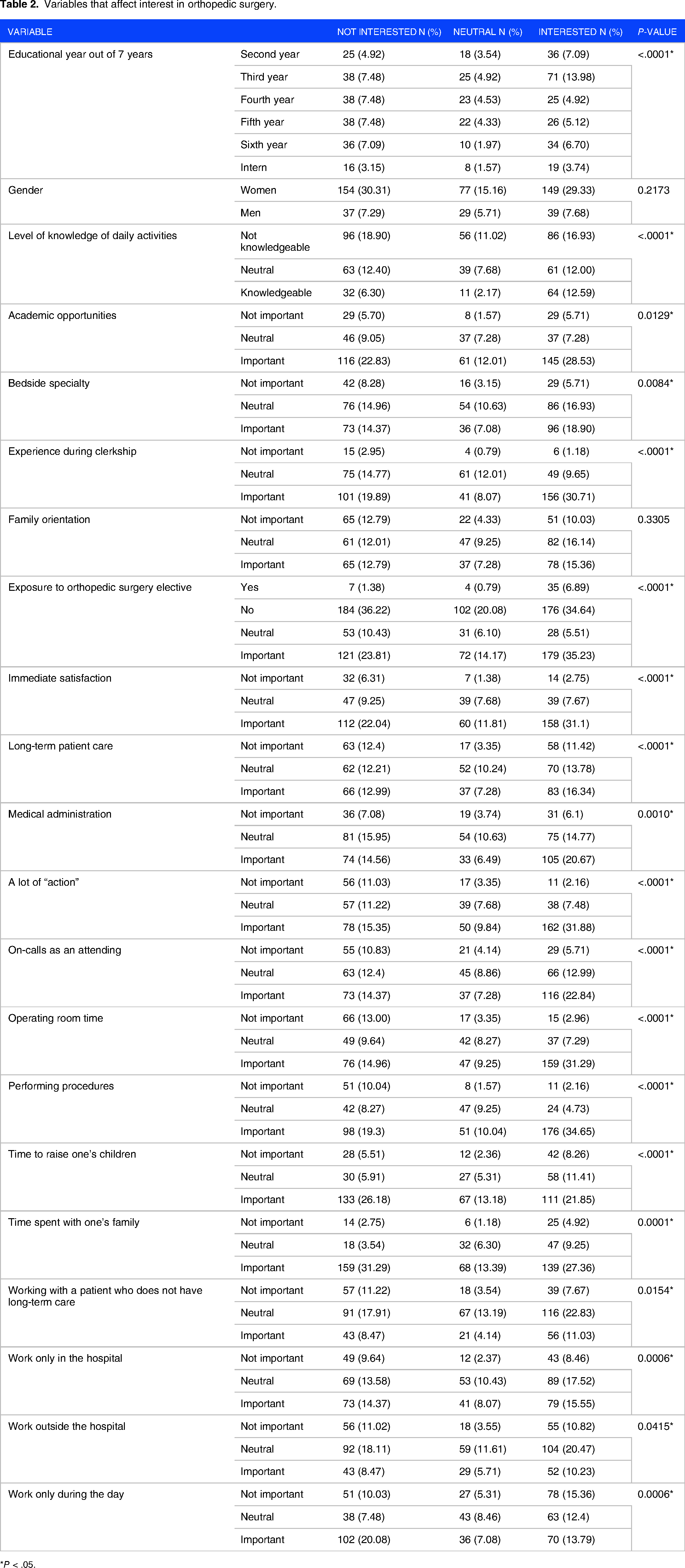
Table 2 depicts the relationship between interest in orthopedic surgery and the variables measured by the questionnaire. We used a chi-square test to compare interest in the orthopedic specialty with the variables. Year of study significantly affected interest in the orthopedic specialty (P < .0001). The majority of interns (3.74%), third-year participants (13.98%), and second-year participants (7.09%) were interested in orthopedic surgery; fourth-year (7.48%), fifth-year (7.48%), and sixth-year (7.09%) participants had no interest. Gender was not statistically significant for participants’ interest (P = 0.2173). Though, more women were uninterested (30.31%) than men (7.68%) which indicates a need for earlier exposure to orthopedic surgery in the medical school curriculum and more women representation during filed practicing. Level of knowledge regarding daily activities significantly affected interest (P < .0001): 96 participants were not interested and not knowledgeable (18.90%), 86 were interested and not knowledgeable (16.93%), and 64 (12.59%) were interested and knowledgeable. Future academic opportunities had an impact on interest (P = 0.0129): Most interested participants valued future academic opportunities (28.53%). Bedside specialty was significant (P = 0.0084): 96 participants found bedside specialty to be important and were interested in orthopedic surgery (18.90%).
Variables that affect interest in orthopedic surgery.
*P < .05.
Other significant variables were direct patient care and experience during one's clerkship (P < .0001). The majority of interested participants valued direct patient care (33.66%) and experience during one's clerkship (30.71%). Family orientation was not significant (P = .3305). Participants’ exposure to orthopedic surgery electives significantly affected their interest (P < .0001). The majority of participants had no elective exposure and were not interested (36.22%), followed by those who had no elective exposure and were interested (34.64%).
Other significant variables associated with interest in orthopedic surgery were immediate satisfaction (31.1%), long-term care (16.34%), and a lot of “action” (31.88%) (all P-values < .0001).
Medical administration was significant for interest (P = 0.0010): Most participants were interested in both orthopedic surgery and valued medical administration (20.67%). On-calls as an attending (22.84%), performing procedures (34.65%), and operating room time (31.29) were all significantly correlated with interest (all P-values < .0001).
Time to raise one's children and time spent with one's family were significant factors influencing their decision (P < .0001 and P = .0001, respectively). A greater number of participants who valued time to raise one's children (26.18%) and time spent with one's family (31.29%) were not interested in orthopedic surgery. Preferences about working conditions, such as working with a patient who does not have long-term care (P = .0154), working only in the hospital (P = .0006), working outside the hospital (P = .0415), and working only during the day (P = .0006) were all significantly associated with interest. Most of the participants who were not interested in orthopedic surgery regarded working only during the day as important (20.08%). The participants’ perceptions of orthopedic surgery had a significant impact on their interest.
Table 3 portrays the relationship between interest in orthopedic surgery and the general perception of orthopedic surgery, as measured by the questionnaire. We used a chi-square test to compare interest in the orthopedic specialty with the variables. Controllable lifestyle was significant (P = 0.0026): 144 interested participants (28.35%) agreed on the fact that orthopedic surgeons have a relatively more controllable lifestyle compared to doctors in other surgical specialties, and 286 participants who were not interested also agreed.
Perceptions of orthopedic surgery and their influence.

*P < .05.
High salary had a significant impact on interest in orthopedic surgery (P < .0001). The majority of participants who were interested in orthopedic surgery agreed that it provides a high salary (66.1%). Other significant variables associated with interest in orthopedic surgery included interesting specialty; most students interested in orthopedic surgery agreed that it is one of the most interesting specialties (74.4%).
Prestigious specialty significantly affected interest in orthopedic surgery (P < .0001). Most interested participants viewed prestigious specialty in the eyes of the public and prestigious specialty in the eyes of colleagues as important. However, uninterested participants regarded these aspects to be unimportant.
Private practice was not related to interest in orthopedic surgery (P = 0.0776). A total of 174 (34.26%) participants agreed that interest in orthopedic surgery could involve a private practice. Stressful specialty and a specialty in crisis had no effect on interest.
Discussion
During their university years, medical students choose an educational path and eventually their future career. Self-evaluation of one's interests and intellectual ability is a daunting part of choosing a career and is influenced by environmental and social factors. 11 We aimed to assess medical students’ interest in pursuing a career in orthopedic surgery and the factors that influence this decision.
Our findings suggest that gender has no significant influence on students’ interest in pursuing a career in orthopedic surgery. Although gender has no significant influence on students’ interest, the numbers of female residents are still statistically low. Baldwin et al 12 concluded that only 13.1% of orthopedic surgery residents are women and that this can be explained by other significant barriers such as a lack of mentoring in applying for residency or a lack of admission to residency programs. The recent trend in increased interest among women may be explained by the rise in female representation in surgical specialties. According to Lewis et al 13 and Al-Hariri et al, 14 surgical specialties are among the most desired specialties and both genders tend to express similar interest in pursuing them.
Participants’ interest was significantly influenced by their year of study. Third-year students showed significant interest in orthopedic surgery; this can be explained by their exposure to musculoskeletal medicine, which plays a major role in students exploring their interests. 12 According to Baldwin et al 12 and Lewis et al, 13 a lack of proper exposure to musculoskeletal medicine was associated with less interest among their participants.
Controllable lifestyle was an important factor in our sample for choosing a specialty and it significantly influenced the students’ interest. According to Alshahrani et al, 15 Saudi medical students and interns defined lifestyle as the most influential factor that affected the choice of their future medical career. Similarly, Kawamoto et al 16 concluded that work-life balance had a major influence on students’ decisions. In contrast, hectic and unpredictable lifestyles reduced students’ interest in orthopedic surgery. 12 Our results are similar to those of Lewis et al 12 and Al-Zubi et al, 11 who found that family time and the ability to have children were important factors that led to reduced interest. We believe that defining priorities is an essential factor to determine the right career path; thus, individuality in decision making should be considered. Students may define a hectic lifestyle differently; as such, they will manage their time differently. Being involved in a highly demanding specialty does not eliminate the possibility of having a family, it only highlights the importance of developing a strong work ethic as well as strong time management skills. This also emphasized on the need for gender concordant mentoring to demonstrate to the next generation of orthopedic surgeons, especially women, how to succeed in this career and how to manage between work and lifestyle.
Our participants viewed orthopedic surgery as a high income and prestigious specialty, aspects that had a significant influence on their interest. Newton et al 16 demonstrated that lifestyle as well as income have become more important to medical students in their career choices. Al-Zubi et al 11 similarly deduced that students tend to choose surgery because of the high prestige that surgeons possess and the high incomes that they earn. Increased interest may be explained by the belief that having a financially secure job will allow a person to pursue an adventurous lifestyle as well as ensure a stable environment for a future family.
Direct aid to patients, job satisfaction, dealing with challenging cases, a lot of “action,” on-calls as an attending, and operating and performing procedures made orthopedic surgery interesting, and significantly influenced participants’ decision to choose it in the future. According to Al-Zubi et al 11 and Al-Hariri et al, 14 medical students were greatly influenced by job satisfaction, and they relied on the factors that gave them satisfaction as the most important components of their decision. Satisfaction is related to multiple factors; for instance, interesting cases, challenges, and impact on patient quality of life were important reasons when selecting a future specialty.11,14
The present study has several limitations. First, this study is limited by its small sample size, and the gender composition of the study cohort is different compared to the gender composition of medical schools in Saudi Arabia. Moreover, we used a non-pilot-tested modified questionnaire to assess medical students’ and interns’ interest in, and their perceptions of, the specialty. However, we did not assess the factors associated with self-report questionnaires, based on which their perceptions were built, and we did not assess their perceptions using an objective measure. Second, the lower proportion of male participants may have affected the outcomes. Third, we carried out the study during the COVID-19 pandemic, which prevented us from distributing the surveys in person.
Conclusion
There is no difference between the genders in terms of interest in orthopedic surgery. Most of the participants were not interested in or knowledgeable about orthopedic surgery. Orthopedic surgeons should come up with a clear job description of their profession to attract more students and interns to the field. Mentoring, especially for women, is needed, in addition to clinical exposure. Women need to be able to visualize how to pursue this career and how to maintain the type of family life they envision. Incorporating orthopedic surgeons into providing interactive sessions and mentoring of medical students during their clinical training is important to increase the number of candidates for orthopedic surgery. Our findings can serve as a basis for future studies assessing medical students’ interest in orthopedic surgery and in identifying and managing the obstacles that prevent students from pursuing careers as orthopedic surgeons. Moreover, our study may help colleges to address the factors that influence medical students’ interest and assist them in developing curriculum-based strategies that could help to deepen interest in orthopedic surgery.
Supplemental Material
sj-pdf-1-mde-10.1177_23821205231217841 - Supplemental material for Students’ Interest in Orthopedic Surgery in Saudi Arabia
Supplemental material, sj-pdf-1-mde-10.1177_23821205231217841 for Students’ Interest in Orthopedic Surgery in Saudi Arabia by Wazzan Aljuhani, Arwa Albaiahy, Butoul Alanizy, Aljawhara Alabdulkarim and Abdullah Alanazi in Journal of Medical Education and Curricular Development
Supplemental Material
sj-docx-4-mde-10.1177_23821205231217841 - Supplemental material for Students’ Interest in Orthopedic Surgery in Saudi Arabia
Supplemental material, sj-docx-4-mde-10.1177_23821205231217841 for Students’ Interest in Orthopedic Surgery in Saudi Arabia by Wazzan Aljuhani, Arwa Albaiahy, Butoul Alanizy, Aljawhara Alabdulkarim and Abdullah Alanazi in Journal of Medical Education and Curricular Development
Footnotes
DECLARATION OF CONFLICTING INTERESTS
The authors declared no potential conflicts of interest with respect to the research, authorship, and/or publication of this article.
FUNDING
The authors received no financial support for the research, authorship, and/or publication of this article.

SUPPLEMENTAL MATERIAL
Supplemental material for this article is available online.
Notes
References
Supplementary Material
Please find the following supplemental material available below.
For Open Access articles published under a Creative Commons License, all supplemental material carries the same license as the article it is associated with.
For non-Open Access articles published, all supplemental material carries a non-exclusive license, and permission requests for re-use of supplemental material or any part of supplemental material shall be sent directly to the copyright owner as specified in the copyright notice associated with the article.
