




Abstract
INTRODUCTION
Radiology education is essential for nonradiologist specialists and practitioners as well as for radiologists. We conducted a survey to gather the opinions of Turkish medical students from first to sixth grade regarding their radiology curricula, radiology education content, and perceptions of various imaging modalities and to assess the amount, adequacy, and homogeneity of radiology education in various schools.
METHODS
Turkish medical students were reached by student ambassadors from 10 different schools of medicine via social media and email. They were provided with a 20-question survey—via the SurveyMonkey platform—related to their radiology curriculum and their perceptions of the radiology education at their schools and of different imaging modalities. Subjective parameters were scaled by a 4-point Likert scale and the results are reported by percentages of students.
RESULTS
A total of 988 medical students (F/M: 61%/39%) from 41 different medical schools participated in this survey. Of those, 57% were preclinical students (≤ third year of medical school), while 43% were clinical students (> third year). More than half of the students (51%) stated that the amount of radiology education included in their curriculum was too little, while 44% of them stated it was just right and only 5% stated it was too much. Only 31% of the participants stated that they were able to review radiology images on their own. When asked about their level of confidence in identifying the position of lines and tubes, pneumonia, pneumothorax, and pleural effusion on chest radiographs, 41%, 39%, 41%, and 41% of the participants, respectively, stated that they were not confident. Thirty-five percent of the participants had not received any training in comparing normal to abnormal imaging of bone fractures, pneumonia, pleural effusion, subdural hemorrhage, or pneumothorax. The majority of the Turkish medical students in this survey had never heard (57%) nor used (64%) the American College of Radiology Appropriateness Criteria.
CONCLUSIONS
The radiology curriculum in Turkey differs among various schools and most students stated that preclinical radiology course content was inadequate. Further studies and improvements must be conducted to provide high-quality, equitable radiology education that begins during preclinical training with respect to the students’ opinions.
Introduction
Medical imaging technology has demonstrated tremendous progress over the years. This rapid advancement, driven by the exponential growth of radiology research, has resulted in the development of new imaging modalities and new techniques, which have drastically increased the quality of healthcare and made radiology the backbone of patient management. 1 A comparable advancement in radiology curriculum has not been seen, even though the radiology education has become more popular in medical school curricula across Europe.2–4 Current radiology curriculum is heterogeneous between each country of Europe. Similar to Turkey, the radiology education is densest in the fourth year throughout the continent. For the assessments, written and oral examinations are used. 2 Despite the crucial role of radiology in medical practice, it is still underrepresented in the curriculum. 4
Medical school education in Turkey generally lasts 6 years and has been split into 2 parts: preclinical (≤ third year) and clinical (> third year). During their preclinical years, medical students are expected to learn the basics of medical science and the pathophysiology of disease and gain a general perspective on how to approach differential diagnosis. During their clinical years, students rotate through specialties to further develop their skills and get some hospital experience. 5 Radiology education in Turkey usually starts in the first year and continues through each subsequent year, with the most emphasis on radiology education occurring in the fourth year. The focus of radiology education is primarily on the healthy human during the preclinical years and on the patient during the clinical years. 2 In a counterpart of Turkey, the United States, the medical students in most of the schools were provided with an anatomical system-based radiology education in the preclinical years for the United States (ie, first and second years). 6
However, the radiology curriculum is not considered as important as it should be. One of the reasons for this lack of perceived importance is stated in a survey by The European Society of Radiology Education Committee in 2012: radiology education is divided into several parts spread out over the years, instead of being delivered in one block. 4 In addition, the practical application of radiological knowledge is often missing from radiology education 4 and not required within many medical schools in Turkey. Moreover, because radiology education is usually incorporated into the curricula of different disciplines, the radiology curriculum is not standardized.2,7 In Turkey, the radiology curriculum mostly covers the essential topics of radiology which will suffice in their general practitioner career path. Of those topics, chest X-ray reading and cranial hemorrhage diagnoses are the 2 top attainments that are to be given. Physiological system-based categorization is used to divide the curricula throughout the years. Even if the medical education system is different in Turkey from the United States, the main topics in the curriculum are similar. The learning objectives are mostly determined according to the universal consensus. According to the same survey by the European Society of Radiology, there is still considerable variation in radiology curricula between medical schools. 4 In addition, there are many differences between state and private universities in terms of the number of students, medical school curriculum in general, and assessment modalities.
In Turkey, unlike in the United States and most European countries, medical school graduates are allowed to work as general practitioners without residency training. This makes radiology education in medical school even more important, as general practitioners’ radiology knowledge is theoretically limited to what they were taught during medical school. Thus, appreciating the fact that a basic radiology education is essential to manage or refer a patient in daily practice, a thorough radiology education is necessary even for those who desire to be a general practitioner.
The ongoing COVID-19 pandemic has changed education around the world. 8 COVID-19 quarantine and social distancing protocols 9 have led to online and distance education. 10 This situation necessitates a change in traditional teaching.11,12 An important part of modern medical education is web-based skill and knowledge assessment, standardization of radiological procedural training using simulated or virtual patients, and worldwide video conferencing via high-quality health networks. 13 One way to provide such quality is to implement the American College of Radiology (ACR) Appropriateness Criteria in the clinical radiology routine. The use of ACR guidelines helps the radiologist choose the best option in a specific case and get the most out of the radiological imaging. ACR Appropriateness Criteria familiarity is used as a methodological tool to assess the participants’ knowledge of one of the universally accepted guidelines.
Because medical school radiology education is largely based on a master-apprentice relationship, radiologists find gaps in the curriculum and the literature. 14 As a first step in addressing the shortcomings of radiology education and contributing to the development of future radiology curricula, we asked Turkish medical students about their radiology curricula and their perceptions of the radiology education at their schools. To the best of our knowledge, this is the first survey study investigating Turkish medical students’ perspectives on radiology education; the questionable homogeneity of radiology education in state and private universities in terms of content, adequacy, and volume; and the students’ self-assessments on different imaging modalities.
Methods
IRB approval
This observational study was approved by the Baylor College of Medicine Institutional Review Board (Protocol number: H47848). A written informed consent was obtained from each participant upon their application to the seminar.
Design of the survey
The survey was designed by a group of 12 radiology faculty members from different institutions in the United States. Participants answered questions on the following topics: demographics, general information about radiology, general information about the participants, career plans, proficiency in radiology, and the design and quality of their radiology education. Survey questions were derived from similar questionnaires in the literature.15,16 The questions were reviewed by radiologists and educational specialists for clarity and to remove bias.
Recruitment and attendance
Ten student ambassadors from different regions of the country were recruited through social media networks to recruit medical students from different years and classes at their schools and also at nearby schools and distribute online interest forms to their peers through WhatsApp and email. As the primary contact information collected from prospective participants was their email addresses, the survey announcements were distributed mainly by email. The online survey was conducted by 3 session coordinators—who have distributed the surveys and collected the results-using SurveyMonkey. Subjective parameters were scaled using a 4-point Likert scale and the results of the respondents were given by percentage of the participants to conduct the statistical analysis. A written informed consent was obtained from each participant upon their application to the seminar. The inclusion criteria for the participants were to be a student in one of the medical schools in Turkey and to be able to use the Zoom platform. The exclusion criterion was to be under the age of 18 or more than the age of 65.
As seen in the literature study conducted for sample size analysis before the study, there is no quantitative study found that predicts the hypothesis of “Students want radiology education to change.” Therefore, in the part that gives “Sample Size for % Frequency of Population” made over OpenEpi: The approximate value of the population size, which is the number of Trakya University students, is 46 000; 50% to the predicted % frequency; 95% confidence interval; and when the design effect is given 1.0, the total sample size is determined as 381 (Kevin, 2022).
Because the recruitment was done at the convenience of the participants, the sample size was saturated, and they were accepted to participate more than the sample size in order not to withhold the already accessible online education for their advantages.
Place and period
The study was conducted in Turkey virtually via Zoom. The time period was confined from 07.11.2020 to 02.01.2021.
Statistical analysis
SPSS Statistics software was used for all statistical analyses. In order to investigate the relationship between the primary research variables, a Pearson correlation analysis was utilized. The P-values reported are two-tailed.
Results
There are 128 (91 state and 37 private) medical schools in total in Turkey. We managed to reach 41 (33 public and 8 private) schools in total. The demographic details are summarized in Table 1.
Participant characteristics.

Radiology education in medical schools
While 455 (46%) of the participants stated that they had not entered clinical training (ie, first-third years of medical school), 241 (24%) of them described their clinical radiology training as a required rotation and 53 (5%) of them described it as an elective.
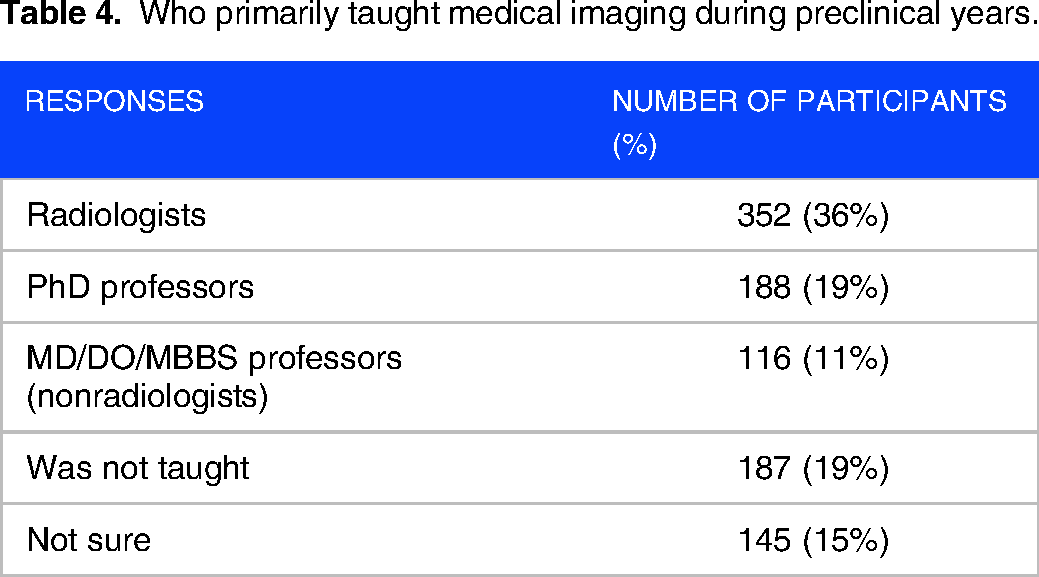
The perceived amount of radiology education in the medical school, the content of the preclinical exams in radiology imaging, and the radiology lecturers’ specialties are summarized in Tables 2 to 4, respectively.
Responses to the perceived amount of radiology education in medical school.

Preclinical exams included radiology imaging.

Who primarily taught medical imaging during preclinical years.
Students stated that they interacted with a radiologist during their clinical rotations daily (N = 54, 5%), a few times a week (N = 56, 6%), a few times a month (N = 117, 12%), only once or twice during the year (N = 152, 15%), or never (N = 211, 21%). The remaining students (40%) responded to this item with not applicable. During their clinical education, 28% (N = 278) of students discussed radiology images encountered on rounds with a radiologist; in comparison, 55% of them discussed radiology images with either a nonradiologist doctor or a training doctor. Almost a quarter of the students (23%) did not see any radiology images during their rounds. As 46% of the participants had not entered the clinical training and 5% of them described it as an elective, 21% of them have never interacted with a radiologist and 40% of them responded not applicable to the interaction question.
According to the students, their medical schools taught medical imaging mostly from lectures (65%) and problem-based small group learning dedicated to medical imaging (21%). In response to the question of whether their schools provide the resources to review radiology images on their own, 310 (31%) of the students said yes and 163 (17%) said no, while 515 (52%) of the students responded that they were not sure.
More than one-third (35%) of the participants had not received any instruction in comparing normal to abnormal imaging of bone fractures, pneumonia, pleural effusion, subdural hemorrhage, or pneumothorax.
Perception of importance and confidence
Students were asked to rate the importance of having interns interpret different radiological studies on a scale from 1 (not important) to 4 (very important). The weighted averages of the responses were 3.57, 3.81, 3.70, and 3.59, respectively, for bone radiographs, chest radiographs, head computed tomography, and abdominal radiographs (Figure 1). Additionally, students rated their level of confidence from 1 (not confident) to 4 (very confident) in being able to ascertain the position of lines and tubes, pneumonia, pneumothorax, and pleural effusion on chest radiographs. The weighted averages were 1.97, 2.06, 2.14, and 2.10, respectively (Figure 2).

Importance of having interns interpret various imaging studies.

Confidence levels of reading chest radiographs.
Content of the radiology curriculum
More participants had received formal education in reading X-rays (59%), computed tomography scans (53%), and magnetic resonance imaging scans (52%), whereas fewer had studied fluoroscopy (13%), imaging algorithms (30%), and radiation safety (35%). In addition, participants had received formal imaging education on bone fractures (56%), pneumonia (50%), pneumothorax (48%), pleural effusion (46%), and subdural hemorrhage (38%). More than a third of the participants (35%) did not receive education in any of these areas. Also, about half (51%) of the participants indicated that their radiology education covered normal radiographic anatomy, and around half (51%) said that abnormal radiographic anatomy (diseases) was covered.
ACR Appropriateness Criteria
Regarding the medical students’ familiarity with the ACR Appropriateness Criteria, most of the students (57%) stated that they had never heard of it, 35% responded with I've heard of it but am not familiar, 7% were somewhat familiar, and 1% were very familiar. We also asked how often the ACR Appropriateness Criteria was used on clinical rotations: 64% of the participants had never used it, 4% had used it a few times a year, 3% had used it a few times a month, 1% a few times a week, and ≈0% daily (not applicable, 26%).
Discussion
Basically, a sufficient radiology education from a shallow perspective is to pass all the written and oral examinations. However, a more sophisticated approach can be made with the help of the current literature. Gunderman et al 17 recommend looking into this sufficiency in 3 ways: medical student levels compared to their colleagues, the aid of the radiology to the general medicine, and the material of radiology to be used in this objective. Kourdioukova et al, 2 also, emphasized the challenges to establishing a proper definition of sufficient radiology education. She mentions about the vast amount of knowledge about what needs to be taught but points out to the lack of information of their efficiency through the students’ perspective. These results clearly shed light upon the insufficiency of the current radiology curriculum in Turkish medical schools. Although about 70% of the participants said that it was very important to gain experience in interpreting various radiographs, fewer than 15% considered themselves to have sufficient training to interpret radiographs. Also, one out of every 2 participants said that there was not enough radiology education in medical school.
Another important finding was the very limited interaction of the students with radiologists during the clinical period. Only 5% of the participants were able to see a radiologist every day. This lack of sufficient interaction during radiology training may be the reason for the students’ low self-confidence. In order to increase the interaction between the students and the radiologists the ratio of required to elective rotations can be increased. Yet, another and more feasible way to approach to this issue is to make the electives more enjoyable and informative. In other words, the desire to elect radiology rotations should be the main goal to increase by modifying the current electives according to students’ feedback.
Even if US imaging pertains to radiology, its usage has gotten more popular over the time. It is now evolving to be used by each physician regardless of their specialty. Thus, the education for US imaging may be given not only in the radiology curriculum but, also, with other topics in a concrescent manner.
As in the current study, an article published in a Canadian radiology journal in 2017 also identified a deficit in the students’ knowledge of the ACR Appropriateness Criteria, with 81% of the interns included in that study having never heard of or never used the ACR Appropriateness Criteria. 18 We found that 57% of the participants stated that they had never heard of and 63% never used this criterion in clinical rotation. This result shows that there is heterogeneity in the knowledge of common radiological guidelines among the ones who participated in this research. This could be due to heterogeneity in the backgrounds of the lecturers or the ones who prepared the curriculum.
Even if in the quantity part nearly one-third of the medical schools could be reached, the quality of these reached schools dispersed as homogenous as possible. By meaning quality, we refer to the 7 main geographical locations of Turkey; the public-to-private school ratio; and the current education year that the student is in. All 7 of the geographical regions were reached out in our sample. Public-to-private school ratio is nearly one-third in Turkey and nearly one-fourth in our sample, the discrepancy may root from the greater number of already available foreign lecturers in private schools. The current education level was tried to be homogenized mostly in the first 5 years of school, as the sixth-year students have relatively more scarce time due to licensing examination working hours.
We wanted to have a general idea about medical students—as a whole—. We did not collect answers by each student but as a total for each question as the survey was anonymous.
The students do not have equitable radiology education and we assessed this with the questions of “Describe your clinical radiology training as a medical student,” “Did your preclinical exams include radiology imaging?,” “Who primarily taught your medical imaging during preclinical years?,” and “How did your school teach you medical imaging?”
Our limitations were the inability to check the rate of completion and the major presence of preclinical students. As the survey was distributed via social media and email by the ambassadors, the completion rate compared to the number of people who started the survey is unknown. Fifty-six percent of the participants were preclinical students, and 58% of the preclinical students had taken a preclinical exam that included questions about radiology imaging. As the survey results were anonymous, we could not separate the clinical students’ results from the preclinical students’ results. Another limitation is that the responses were collected from the pool of students who applied for our radiology education sessions and gathered only from the ones who wished to participate also in the survey. Thus, this group is not completely representative of Turkish medical students as a whole. We tried to reach as many students as we could from as many schools as possible, in order to minimize this limitation. The questionnaires used in this study were designed specifically to test this population regarding their thoughts on radiology education. Thus, there were no validation studies for such questionnaires. Even if all the questions were peer-reviewed by radiology professors we count this as one of our limitations. To the best of our knowledge, this was the largest online voluntary radiology education survey ever among Turkish medical students.
Conclusions
Radiology education has an important place in the medical curriculum, and more time should be allocated to such education and appropriate methods should be used. The expectations of the students in our study were not fully met, so they perceived themselves as having skills that were inadequate, even the essential skills that are required for a general practitioner, such as evaluating a chest or bone fracture radiograph. Radiology educators need to improve the radiology curriculum in both the preclinical and clinical years. Further studies and improvements in radiology education and curriculum are needed.
Supplemental Material
sj-docx-1-mde-10.1177_23821205231181990 - Supplemental material for Seeing Radiology Curricula Through Turkish Medical Students’ Eyes: A Survey of Turkish Medical Schools’ Radiology Education
Supplemental material, sj-docx-1-mde-10.1177_23821205231181990 for Seeing Radiology Curricula Through Turkish Medical Students’ Eyes: A Survey of Turkish Medical Schools’ Radiology Education by Görkem Ayas, Emre Altinmakas, Scott A Rohren, Hakan Dogan, Omer F Dogru, Emir Y Koselerli, Orkun Turksanli, Ege Ö Efe, Mohamed Badawy, Serageldin Kamel, Parth Patel and Khaled M Elsayes in Journal of Medical Education and Curricular Development
Footnotes
Acknowledgements
This article was submitted as a preprint on the Research Square portal on May 6, 2022.
FUNDING
The author(s) received no financial support for the research, authorship, and/or publication of this article.
DECLARATION OF CONFLICTING INTERESTS
The author(s) declared no potential conflicts of interest with respect to the research, authorship, and/or publication of this article.
Ethics approval and consent to participate
This observational study was approved by the Baylor College of Medicine Institutional Review Board with the approval number of H-47856. A written informed consent was obtained from each participant upon their application to the seminar. All methods in the study were performed in accordance with the relevant guidelines and regulations.

Supplemental material
Supplemental material for this article is available online. The datasets used and/or analyzed during the current study are available in the Supplemental material named “Dataset of Seeing Radiology Curricula Through Turkish Medical Students’ Eyes – A Survey of Turkish Medical Schools’ Radiology Education” and from this Google Drive link: https://docs.google.com/spreadsheets/d/1NK7k4gHLfUvev05Is3DhwUJiypkqVhtw/edit?usp = sharing&ouid = 101644662443491289933&rtpof = true&sd = true.
References
Supplementary Material
Please find the following supplemental material available below.
For Open Access articles published under a Creative Commons License, all supplemental material carries the same license as the article it is associated with.
For non-Open Access articles published, all supplemental material carries a non-exclusive license, and permission requests for re-use of supplemental material or any part of supplemental material shall be sent directly to the copyright owner as specified in the copyright notice associated with the article.
