




Abstract
Recent decades have witnessed rapid growth of K-12 transnational education programs, but little is known about how human/nonhuman assemblages impact K-12 transnational literacy curricula and how sociomaterial assemblages affect (de)colonizing literacy practices. This study of English and Mandarin literacy curricula at a Canadian transnational education program in postcolonial Hong Kong was informed by posthumanism and theories on decolonizing curriculum. The study combined ethnographic data collection tools (curriculum documents, interviews, classroom observations) and a diffractive methodology of reading, thinking, and writing with multiple data sources and theories to explore how sociomaterial relations between humans and nonhumans shaped the (de)colonization of literacy curricula. Findings show a generative sociomaterial assemblage in the transnational education program that enabled encounters of local-global curricula, local-global languages, and academic-multimedia literacies. New forms of imperialism and colonialism also joined the assemblage and normalized binaries of L1/L2, local/global, and academic/multimedia literacies, thus constraining students’ meaning making across languages, places, and semiotic resources. The article proposes literacy curriculum and pedagogies that could foster students’ ethical relationship building with humans and nonhumans in globalized schooling contexts.
Keywords
I Introduction
Over recent decades, developed countries such as the UK, Australia, the US, and Canada have sought to enhance their global competitiveness in K-12 transnational education: education delivered by an institution in one country to students located in another (e.g. Knight, 2016). Currently, 158 accredited British schools operate overseas serving international students in more than 40 countries (UK Department for Education, 2022). Australian curricula are offered in 103 schools in 19 countries, with half of these schools located in China (Burgess & Ziguras, 2021). Canadian provincial ministries of education have certified 135 Canadian K-12 offshore schools worldwide (CICIC, 2022). There are 354 international schools sponsored by the U.S. Department of State (n = 194) or operated by the U.S. Department of Defense (n = 160) (Department of Defense Education Activity [DoDEA], 2021; Office of Overseas Schools, 2021). Despite fast-growing transnational education worldwide, little is known about how Western-centric literacy curricula are enacted in K-12 transnational education contexts (Zhang, 2019b) given that inappropriate curriculum and pedagogy are a major concern at various levels of transnational education (Knight, 2019). Adding to the scant literature exploring what happens to Canadian K-12 curricula when they go abroad (e.g. Schuetze, 2008; Wang, 2017), the author has steered case studies in Macau, South China, and inland China of transnational education programs certified by Canadian provinces of Alberta, Ontario, and New Brunswick (Zhang, 2019a, 2019b; Zhang & Heydon, 2015; Zhang et al., 2020). These studies revealed sociomaterial relationships that affect how Canadian provincial programmatic curricula (i.e. what gets instantiated in curricular documents) are actualized in offshore classrooms (i.e. the implemented curricula) and experienced by local Chinese students (i.e. the lived curricula). The studies indicate the need to learn more about literacy teaching and learning within transplanted Western-centric curricula. To shed light on literacy learning as assembled phenomena, this study was conceptually informed by Deleuze and Guattari’s (1987) theory of assemblage, which concerns how constellations of human and nonhuman entities and their emerging relationships shape the world. Responding to the scarcity of research on the sociomaterial complexity of literacy learning in globalized schooling contexts (e.g. Toohey, 2019), this study explored: What sociomaterial assemblages affected teachers’ and students’ literacy practices in English and Mandarin classes at a Canadian transnational education program in postcolonial Hong Kong?
II Literature review
1 Context and existent literature on transnational education
In Canada, changed economies and new developments in educational governance have spotlighted the internationalization of K-12 education (e.g. Cosco, 2011; Wang, 2017). Decentralized educational governance has allowed schools and school boards to innovate and become entrepreneurial (Wang, 2017). For example, Bill 34 made the province of British Columbia (BC) the first in Canada to authorize school districts to start overseas BC schools and ‘act as fee-based service providers’ (Cosco, 2011, p. 3). New Brunswick’s Early Childhood Development Department (2011) also charges program fees for curriculum licensing and service delivery. Ontario’s Ministry of Education, instead of seeking revenue, launched a six-year initiative in the 1990s and aimed at encouraging private-sector provision of transnational education by minimizing government regulations (J. Sebastian, personal communication, June 23, 2010).
Seeing education as a tradable commodity, economically developing countries now import education from developed countries through private and public sectors (e.g. Hayden, 2006). For instance, the neoliberal restructuring of education in China and the emergence of upper-middle-class families and their demands for high-quality education and global mobility have boosted the growth of Canadian transnational education and Sino-Canadian cooperative education programs (e.g. Schuetze, 2008; Wang, 2017; Zhang & Heydon, 2015; Zhang et al., 2020). As Wang (2017) notes, transnational education is a ‘win–win’ mechanism for both China and Canada under the ‘same neoliberal framework’ (p. 537) but will likely reinforce elitism and socioeconomic gaps in host countries.
Studies of existing Canadian K-12 offshore programs reveal the hybridity of Canadian provincial curricula and Chinese national curricula operating ‘under one roof’ (Schuetze, 2008, p. 5) with different languages, cultures, educational objectives, and pedagogies (e.g. Zhang, 2015). This hybridity has spurred pedagogical and scholarly discussions about what constitutes appropriate teaching and learning practices in transnational education contexts (e.g. MacKinnon & MacLean, 2021; Ragoonaden & Akehurst, 2013). Studies show that Canadian teachers’ pedagogical approaches might be preferred over local teachers’ in the offshore schools (e.g. Ragoonaden & Akehurst, 2013; Zhang, 2015). However, Canadian principals of offshore schools in China in MacKinnon and MacLean’s (2021) research found that the Chinese were generally skeptical about Canadian teachers’ learner-centered pedagogies. Wang (2017) contends that Chinese students who were raised in different educational milieux in China might struggle to understand materials encoded with Canadian values and beliefs. A Canadian school in South China opted for a hybrid programmatic curriculum that could develop learners’ abilities to read, write, and function in different languages (i.e. Zhang & Heydon, 2015). However, the implemented Canadian/Chinese literacy curricula were bifurcated along linguistic and cultural lines and did not advocate syncretic literacy practices that supported students to create new forms of meaning making across languages. Scholars also recommend ‘egalitarian’ pedagogies that fuse Indigenous conceptions of teaching and learning with Western-centric pedagogies (Ragoonaden & Akehurst, 2013, p. 109).
In the context of transnational higher education, scholarship on decolonization, de-Westernization, and de-imperialization has surged (e.g. Lee & Gough, 2020; Le Grange, 2020b). Lawton et al. (2013) caution that transnational education could act as a form of neocolonialism with limited space for differentiating host countries’ curricula when they cross borders. The International Association of Universities (2012) highlights that the prevalence of English and the presence of prestigious foreign education alternatives could diminish language diversity and jeopardize local higher education that serves national needs. Scholars argue that transnational education initiatives should respect local cultures, histories, and priorities and focus on collaboration, mutual benefits, exchange, and capacity building to optimize the benefits for involved individuals and countries (Knight, 2013, 2020; Ziguras & Lucas, 2020). However, scant research investigates the social and material entities that assemble and distribute agency to affect (de)colonizing literacy curricula and literacy practices in globalized schooling contexts.
2 Theoretical orientations: Posthumanism and decolonization of curriculum
The paradigmatic turn to posthumanism in language and literacy research (e.g. Pennycook, 2017a) informed this inquiry. The combined use of posthumanism and decolonizing curriculum helped disrupt power-producing binaries such as East/West, human/non-human, first language/second language (L1/L2), local/global, and mind/body. Posthumanist imaginaries that (re)conceptualize these binaries as interrelated continuum expand possibilities for decolonizing literacy curriculum (e.g. Pacini-Ketchabaw & Nxumalo, 2014).
Given the global resurgence of imperialism, white supremacy, capitalism, and neoliberal values, attempts to decolonize education have gained currency, but debates on decolonization remain ‘abstract and rhetorical’ (Morreira et al., 2020, p. 6). While progress has been made, decolonized curriculum is ‘an overdue, complicated, and disconcerting discourse’ (Mahabeer, 2020, p. 99). Humanist inquiries into decolonizing curriculum focus on race, ethnicity, and equity (e.g. Charles, 2019; Osborne, 2019) and disrupt the Western-centric power/knowledge matrix that affects teaching and learning practices (e.g. Morreira et al., 2020). Pertinent literature is abundant, with scholars calling for more inclusive curriculum. They question what is taught in white/Eurocentric curricula, illuminate colonial power structures (e.g. Cheang & Suterwalla, 2020; Zinga & Styres, 2019), and acknowledge that coloniality has made the epistemologies of the Global South invisible (e.g. Zembylas, 2018). Scholars argue that work to decolonize curriculum must challenge claims that Western histories, knowledges, and experiences are value-neutral and universally applicable (e.g. Subedi, 2013).
Current literature also troubles the ‘colonial anthropocentrism’ that privileges some humans and imposes certain people’s worldviews, knowledges, and control over more-than-human worlds such as nature (Pacini-Ketchabaw & Nxumalo, 2014, p. 139). Decolonizing approaches acknowledge Indigenous and former colonized people who have been represented as less than human (e.g. Snaza et al., 2014) and recenter Indigenous ways of thinking, being, knowing, and relating to the natural world (e.g. Le Grange, 2020a, 2020b; Meda, 2020; Sleeter, 2010). Zinga and Styres (2019) contend that decolonizing curriculum requires recentering indigeneity. Le Grange et al. (2020), in their four case studies of decolonizing university curriculum, conclude that findings about decentering Western knowledge and incorporating Indigenous and African knowledges are largely absent. To achieve epistemic justice, efforts to decolonize curriculum should engage students in asking important questions, such as whose knowledges are included and for whose benefit (e.g. Le Grange, 2020a, 2020b) and how the Indigeneity frame can inform anti-oppressive and decolonizing approaches (Zinga & Styres, 2019)? For Tuck and Yang (2012), decolonizing schooling means upholding Indigenous sovereignty.
Posthumanism and the decolonizing of curriculum are related in that both are influenced by Indigenous worldviews (e.g. Engman & Hermes, 2021; Sousa & Pessoa, 2019), such as relationality, which is an epistemic principle in Indigenous worldviews (e.g. Engman & Hermes, 2021). Murris (2016) suggests that posthumanism and the decolonizing of education both concern the building of ethical relationships between human and nonhuman entities such as technologies, contexts, nonhuman animals, and organic beings. Taking up the critically oriented posthumanist scholarship, this study troubles notions of human exceptionalism and accentuates the distributed agency of more-than-human elements in curriculum making and meaning making (e.g. Barad, 2007; Morreira et al., 2020; Murris & Babamia, 2018).
This study is also informed by literature that disrupts the dominance of lingua francas such as English (e.g. Ranasinha, 2019) and advocates the use of Indigenous and marginalized languages to bring forth internal epistemic relations and validate nondominant knowledges (e.g. Mahabeer, 2020; Morreira et al., 2020). Decolonial perspectives combat raciolinguistic ideologies (e.g. García et al., 2021; Mignolo & Walsh, 2018) that assign power and hierarchy to languages and their corresponding nation-states. Associated pedagogies bifurcate L1 and L2 in formal schooling, overlooking bi/multilingual learners’ abilities to create meaning on a multilingual continuum (e.g. García et al., 2021). Such pedagogies therefore fail to leverage all language learners’ full linguistic repertoires and multiple ways of being, knowing, sensing, thinking, and living (García et al., 2021). Connecting the posthumanist orientation and decolonizing moves in literacy education, scholars also question Western-centric literacy practices that privilege human cognition (e.g. Murris & Babamia, 2018). They advocate fluid meaning-making activities in which material bodies, ideas, affect, and languages constantly form relations in unexpected, creative ways and influence meaning makers’ knowing, doing, and becoming.
This study conceptualized places as generative and agentive spatial repertoires (Canagarajah, 2018) that affect transnational students’ meaning making. Barad (2014) contends that matter does not exist separately from meaning. In this study, meaning making is seen as embodied and distributed across places, people, and time (Pennycook, 2017b); embodied because it is more than cognitive processes of representation, and distributed because it always intermingles with entities outside the head. Foregrounding the mind-body continuum, the notion of spatial repertoires goes beyond internalized individual competence and links to particular places through individuals’ life trajectories (e.g. Canagarajah, 2018; Pennycook, 2018). Bodies are relationally produced through time and space (Barad, 2014; Murris & Bozalek, 2019). Focusing on the relational gathering of places, human and nonhuman bodies, languages, and histories could make visible the impacts of sociomaterial assemblages on pedagogies and knowledge production (Pacini-Ketchabaw & Nxumalo, 2014). Lysgård and Rye (2017) contend that considering transnational students’ spatial relations would generate new understandings about the impacts of these relations upon those students’ life courses. Accordingly, this study explored how the transnational students’ bodily movements and the spatial repertoires they brought from outside of literacy classes affected their meaning making, knowing, and becoming.
Posthumanist theories were developed in Western settings (e.g. de Oliveira & Lopes, 2016; Le Grange, 2020a) whereas decolonial discourses were initiated by scholars in the Global South (Le Grange, 2020a). The author therefore uses these orientations with caution to avoid recentering Western epistemology, ontology, and cosmology (de Oliveira & Lopes, 2016; Snaza et al., 2014).
III Research design
1 Research site and participants
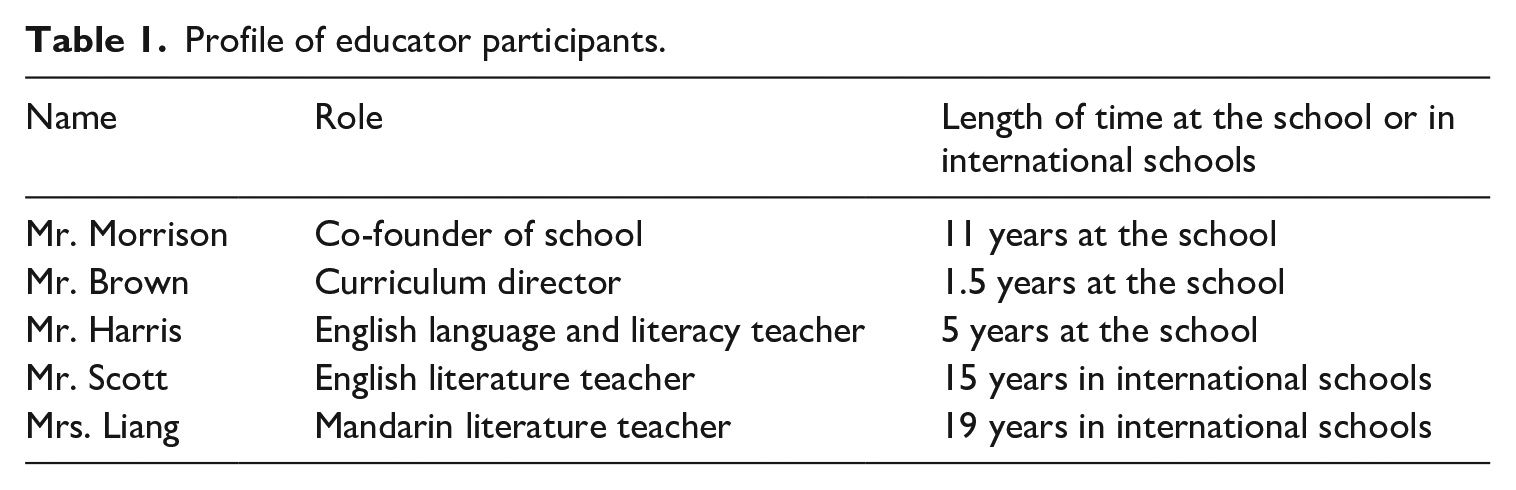
The Canadian offshore school under study was situated in postcolonial Hong Kong, which in 1841 was a colony of the British Empire. Sovereignty over Hong Kong was transferred back to the People’s Republic of China (PRC) in 1997. Hong Kong’s population is 92% Han Chinese, while 8% consists of non-ethnic-Chinese minorities, mostly Filipinos, Indonesians, and South Asians (Census and Statistics Department, 2016). In terms of language, 94.6% of Hong Kong’s population speaks Cantonese (88.9% as L1 and 5.7% as L2), 53.2% speaks English (4.3% as L1 and 48.9% as L2), and 48.6% speaks Mandarin (1.9% as L1 and 46.7% as L2). The school defined its student population as roughly 60% Hong Kong and Hong Kong Canadians and 40% expatriates. Students came from middle-class or upper-middle-class families. The high school program used both International Baccalaureate (IB) and Ontario curricula leading toward the Ontario Secondary School Diploma. The school administrator introduced the researcher to English and Mandarin teachers at the school. Interested teachers signed consent forms and invited the researcher to introduce the nature of the study to the students and observe the classes. Interested students consented to share their self-selected assignments and join the one-on-one interviews. Tables 1 and 2 show profiles of research participants: one school cofounder (Mr. Morrison), one curriculum director (Mr. Brown), two English literacy teachers (Mr. Scott and Mr. Harris), one Mandarin teacher (Mrs. Liang), and 11 students from Mr. Scott’s and Mr. Harris’s classes.
Profile of educator participants.
Profile of student participants.
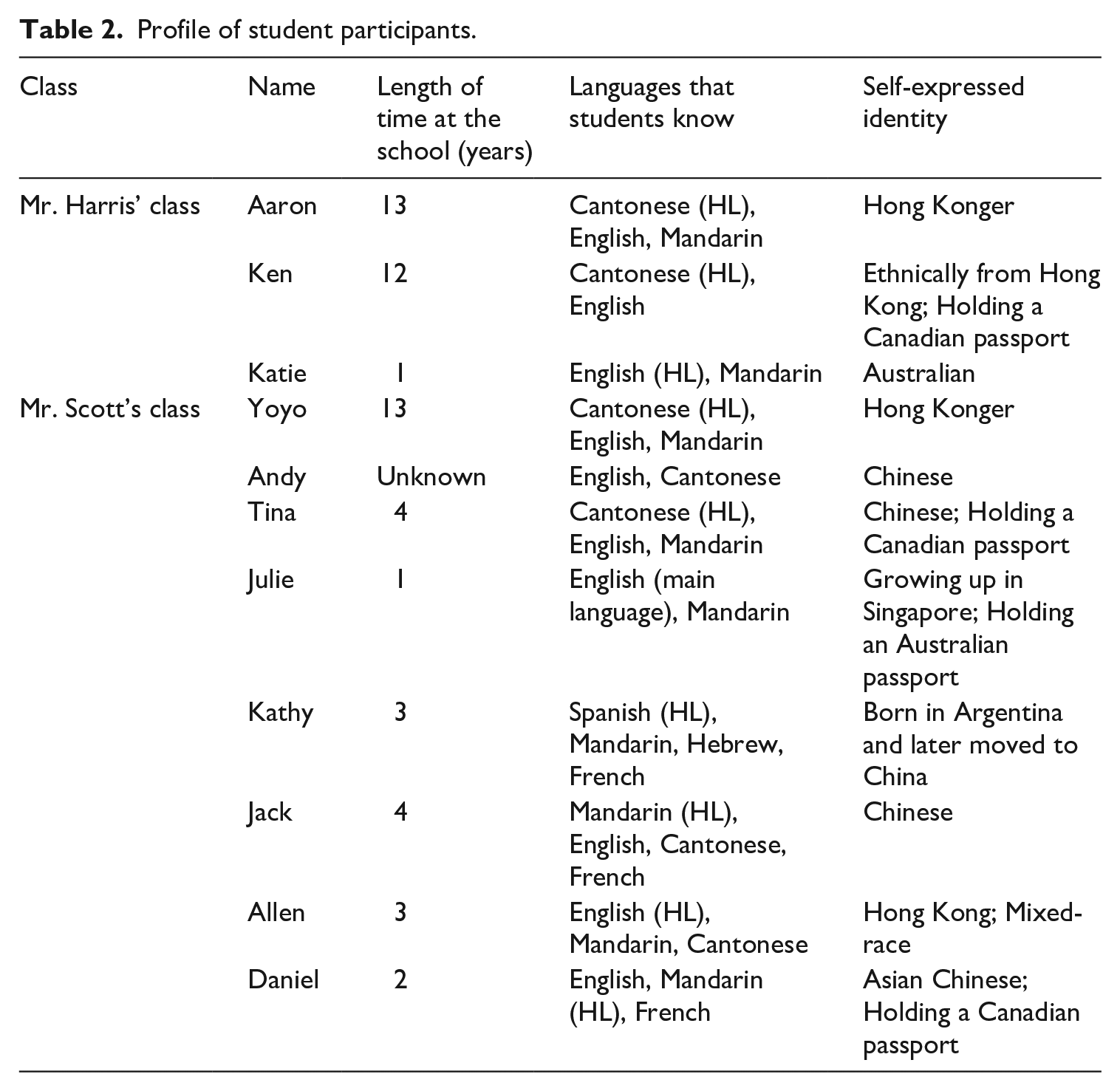
Table 2 shows student participants’ diverse cultural and linguistic backgrounds, with their heritage languages marked as HL. No students from Mrs. Liang’s class participated in the study, so class observation mainly focused on Mrs. Liang’s teaching. The researcher observed 35 sessions of English and Mandarin classes (14 sessions respectively in Mr. Harris’s and Mr. Scott’s classes and 7 sessions in Mrs. Liang’s class).
2 Reading, thinking, and writing with theories and ethnographic data
Originally, data were collected using ethnographic tools (Wolcott, 2008). Data consisted of documents that underpin the programmatic literacy curricula (the IB and Ontario secondary school literacy curricula; IB, 2011a, 2011b; Ontario Ministry of Education, 2007), interviews with Canadian administrators who were involved in developing transnational literacy curricula, classroom observation to document the particulars and dynamics of the implemented curriculum, and interviews with teachers and students about the implemented and lived curriculum.
However, when reading and rereading data, it became evident that it was necessary to reconcile the use of humanist and posthumanist inquiries to trace the assembled entities that affected literacy curricula as experienced by teachers and students; for example, the human narratives about the history of the school’s English-Mandarin biliteracy curricula and entities that were not present during the researcher’s three-month field research but were imbricated in teachers’ literacy practices and students’ assignments in various forms. Therefore, in the rereading and writing process, the study employed a diffractive methodology (Barad, 2007, 2014)—a means to make explicit entanglements and their impacts through reading, thinking, and writing with theories and multiple data sources.
Barad’s ‘diffraction’ and Deleuze and Guattari’s ‘assemblage’ are both situated in a relational ontology which holds that human and non-human entities are not randomly assembled but come into relationships to affect world-making practices (Murris & Bozalek, 2019). The diffractive methodology helped the study to be methodologically aligned with the relational ontology, that is, to read data and theories diffractively for associated entities and their impacts on literacy practices in the transnational education contexts. Methodologically, Barad’s diffraction helped the researcher to acknowledge that researchers are part of the apparatus that produces knowledge. It also helped the researcher to make explicit the power-producing binaries of East/West, human/non-human, L1/L2, local/global, and mind/body and how their interconnectedness and boundaries affected teachers’ and students’ literacy practices in the transnational education program.
Deleuze and Guattari’s ‘assemblage’ conceptually enabled the researcher to see that assemblages are purposeful. Instead of random constellation of human, materials, and actions, Deleuze and Guattari’s ‘assemblage’ is ‘the deliberate realisation of a distinctive plan’ (Buchanan, 2015, p. 385). As Buchanan (2021) argues, ‘assemblage was never intended to refer to ensembles of material things’ (p. 71), instead, it is always about the ‘arrangements of desire’ (p. 79). The study did not look for impacts that ‘just happen[s]’ when certain entities randomly come together (Buchanan, 2021, p. 106), nor did it see assemblages as ‘the product of an accumulation of individual acts’ (p. 17). This study attended to the arrangements of human bodies, languages, technologies, and other sociomaterial matter and how they intra-acted and distributed agency to impact programmatic, implemented, and lived curricula in the program. As Buchanan (2021) states, ‘It is not the items or elements in the assemblage that is decisive; it is the underlying principles of selection and arrangement that matter’ (p. 117).
Scholars contend that research informed by posthumanist or new materialist orientations is much needed to explore additional or second language learning (e.g. Toohey, 2019). St. Pierre and Jackson (2014) and Augustine (2014) also reiterate the importance of in-depth theoretical reading for postqualitative inquiries. Exploration of human-nonhuman relationality can mitigate the limitations of educational inquiries that only focus on human agency and relationships, thus expanding possibilities for knowledge making and production (Pacini-Ketchabaw & Nxumalo, 2014). Instead of looking for categories associated with human-centered mental representation activities, the ‘multiple instances’ (MacLure, 2013) related to literacy teaching and learning in multiple data sources led the researcher in many directions to reread data to explore the relations of human and nonhuman entities and the effects that these relations produced. For example, fieldnotes about Mr. Scott’s conversation with students about the IB expectation of critical analysis skills and Mr. Harris’s interview comments about similarities in the IB and Ontario curricular expectations led the researcher to reread and compare specific statements about critical literacy in the two curricula. Such diffractive reading also helped the researcher to visualize scenarios where Mr. Harris and students projected the IB rubrics on the wall and talked about the progress of the individual oral presentations (IOP). The images of students’ collective polishing of their IOP notes on Google Drive took the researcher to detailed transcriptions and fieldnotes about students’ exchanges as they critically analysed the text of Oryx & Crake (Atwood, 2013) and their moment-to-moment intra-actions with technologies in class. During the prolonged process of (re)reading and thinking with data and theories, the researcher kept writing about how the sociomaterial assemblage shaped literacy practices at the school. The diffractive (re)reading and writing involved constantly building relationships between the theories, human narratives about personal memories and school histories, and the moment-by-moment intra-actions in class, which helped the associated constituents to merge.
Because students finished most literacy assignments in after-school settings, given the ethics protocol, the researcher could not document the moment-to-moment attunement of their meaning making. Therefore, there was little data on whether or how nuances of meaning making emerged through individual students’ intra-actions with diverse semiotic resources (e.g. multimedia and multiple languages).
IV Findings and discussion
1 (Dis)connected English and Mandarin language curricula
Interview data and class observations show bifurcated literacy curricula and teaching at the school. The school incorporated English and Mandarin literacy curricula, but these local and global languages were envisioned as separate cognitive linguistic entities to be studied for the advantage of future global leaders (e.g. García et al., 2021).
The school administrators gave various reasons for the combined use of English and Mandarin curricula. Cofounder Mr. Morrison described how a key concern in the past about transnational education students’ English-language competency had prompted school leaders to incorporate the Ontario curriculum starting from kindergarten for early English immersion. He said, ‘If you start from the bottom and grow up, you don’t have the [English] language problems because you’re teaching them at young ages and you get to home-grow them.’ To meet the IB curricular requirement, the school added the Mandarin-language program to support students’ additional language learning. Mr. Morrison said the cofounders considered the long human history of Mandarin when integrating Mandarin into the curriculum. Mr. Brown shared other reasons, such as the school’s awareness of research findings about the cognitive benefits of learning a second language and the school’s alignment with the IB philosophy, stating, ‘If you’re multilingual, you have a much bigger access to being globally minded and internationally minded . . . If you are monolingual, then, to be honest, you’re at a massive disadvantage.’
The limited pedagogical interactions between Mandarin and English literacy teachers limited possibilities to help students build relationships between the two languages and make meaning across the school-promoted languages. Mr. Brown said more interactions needed to happen between the teachers. Mrs. Liang attributed the limited communications between English and Mandarin literacy teachers to their heavy teaching loads. Mr. Harris alone reported his sporadic efforts to help students shuttle between languages and texts from different cultures. He worked on a plan for grade 10 students by inviting a Chinese staff member to his English language and literature class to teach poetic concepts in Chinese and demonstrate how the Chinese write poems. He reshaped the grade 11 textbook selection by including texts from all over the world to ‘promote internationalism’. He said, ‘How else do you support global citizenship if you’re unaware of the writing and expressions of others?’ However, classroom observations and students’ shared assignments showed few opportunities for students to make meaning across Mandarin and English, let alone their heritage languages.
Situated in the transnational education context, students expressed their preferred Western-centric approaches of literacy teaching. These preferences were shaped by their encounters with different pedagogies at the transnational school and their prior educational experiences, which were largely Western-centric pedagogies that focused on interactive learning and critical analysis. Students Aaron, Kathy, and Julie observed that the A-level English curriculum and English teachers exposed students to critical literacy and expected students to use language to effect social change. For instance, Aaron said that in the English literacy classes, students learned ‘that everyone can effect social change because again, how you think and how you act does have impacts beyond that of your borders . . . because you move people, or you mobilize people through words.’ In contrast, students registered in B-level Mandarin classes as second language learners found that Mandarin classes were less interactive than their English classes (Julie) and Mandarin teachers seemed to be more teacher-centered and content-focused, with specific content to cover (Yoyo and Katie). Julie said she saw similarities in Chinese and English classes, but ‘the Chinese class, especially the class I’m in, is not as interactive as the English class.’ Katie recalled, ‘We memorize a passage and then the Chinese teacher takes out certain words and we have to fill it in, and every time she does that I keep asking her why we’re doing it.’ Having experienced the Australian education system, Katie admitted that memorization was seen as a skill in some contexts, but she had not been exposed to it much.
Teaching A-level Mandarin courses to native Mandarin speakers, Mrs. Liang resisted stereotypical perceptions of Mandarin teaching approaches. She emphasized the importance of learning the cultural richness and philosophies associated with the Chinese language, rather than learning the language as a tool. But she said that learning about the Chinese cultures is not about scratching the surface and knowing cultural facts associated with the Chinese language. She disagreed that the Chinese practices of reading aloud and memorizing classic texts are dated approaches. Instead, she said she found them helpful in laying a strong foundation for students to appreciate the beauty of Mandarin. She recounted, ‘My students created an atmosphere to recite classic texts together and found it a lot of fun. A lot of my students told me that recitation helped them tremendously.’ Mrs. Liang observed how the paralinguistic processes of recitation enhanced her students’ appreciation of the beauty of Mandarin. Her observation echoes scholarly remarks about the effects of poetic oracy, such as enabling writers to ‘write accessible lyric poems that sounded melodious’ (Greene et al., 2012, p. 1149) and engaging tongue and throat muscle movements for better coordination and energy flow that would potentially spur new inspirations in writing (Zhu, 2005).
In sum, the power of regional and global languages in postcolonial Hong Kong shaped the school’s programmatic curriculum that combined English and Mandarin programs. Findings about the implemented curricula also show that the limited pedagogical interactions between English and Mandarin teachers and stereotypical perceptions of Chinese ways of teaching constrained opportunities for students to make meaning across languages (e.g. English, Mandarin, and diverse students’ heritage languages) and appreciate the wisdom embedded in different pedagogical traditions.
2 (Dis)connected local and global languages and places
Findings show that the school’s cultural diversity and transnational students’ cross-border encounters with local-global places were agentive and intra-acted to shape students’ meaning making. However, data show limited support for students’ multilinguistic repertoires in the English-Mandarin programmatic and implemented curricula.
The school’s Canadian identity and its cultural and linguistic diversity joined the sociomaterial assemblage to impact students’ appreciation of differences and diversity, however, few data show school’s and teachers’ efforts to build the East–West connections. The curriculum director, Mr. Brown, said the students benefited from the school’s identity as ‘authentically Canadian’ given the large percentage of its alumni, parents, and students who were associated with Canada in various ways, and given the school’s association with the Canadian embassy and consulate and Chamber of Commerce. These associations gave the school a ‘Canadian identity’ and ‘culture that infuses the school, makes the school stand out, and makes kids feel part of something.’ When discussing the existing critiques of offshore schools as a form of West-East cultural imperialism, Katie noted that she appreciated the school’s efforts to maintain Canadian culture within the school: ‘I feel all the teachers do a very good job of being passionate about their subjects and about Canada and trying to keep that feeling of like we are just a little Canada inside Hong Kong.’ Mr. Morrison liked the mix of different ethnicities and perspectives at the offshore Canadian schools he had cofounded. He also applauded the practice of bringing Canadian cultures abroad and the value of appreciating differences and multiculturalism through transnational education. Student Ken viewed his experience with the school’s cultural and linguistic diversity as a privilege. He said growing up with different people at the school made it easy for him to talk to and understand people in diverse social contexts. Katie, new to Hong Kong and just starting to learn Mandarin as her first foreign language, described walking down the street hearing five or six different languages on her way home and hearing schoolmates speaking Cantonese to each other. She said, ‘Even though I don’t understand it, I really appreciate the fact that we have that diversity.’ Mr. Harris directed students to explore their parents’ and grandparents’ home language practices, such as how they ‘play with code switching, to gather language that you hear at home, you know, what are the sounds Mom and Dad make. Does Dad burp a lot? You know, what kind of anecdotes do they share with you?’ He used his scaffold questions to make students alert to life around them and what comments occur in their situated lifeworlds in terms of ‘portrayal of discrimination, either being racist or sexist or homophobic.’ He also suggested that transnational education host countries such as China have a lot of influence regarding what to learn in transnational education programs. Toward the end of his interview, he confirmed that education is ‘a political act’ that needs to nurture students’ ‘responsibility, or a potential power to mediate . . . between East and West.’ However, class observation data of the three literacy classes do not relate practices that foster such responsibilities.
The English-Mandarin programmatic curriculum was designed to nurture competitive global leaders; however, students, school administrators, and literacy teachers expressed diverging views about how the dominance of English in the school’s programmatic curriculum complicated bi/multilingual students’ literacy and identity options. Mr. Brown said the school’s explicit language policy supported all the students in acquiring two languages, but there was a relaxed policy about not speaking Cantonese or Mandarin outside of class. He said, ‘I can’t speak for why that rule was brought in, but I think it was because, as an international school . . . English is our primary language.’ He added that English was the primary language of instruction, communication, and inclusion because international students who were ‘new Mandarin learners would not be able to access conversations in the corridors that were in Mandarin.’ Student Aaron identified Cantonese as his heritage language, English as his dominant language, and Mandarin as his third language. He said, ‘I’ve been learning English throughout here . . . I do feel whitewashed to some extent . . . I do most of my thinking in English.’ English literacy teacher Mr. Scott agreed that transnational education would further cultural and linguistic imperialism, but he thought there were two forms of linguistic imperialism because English and Mandarin are dual paths at the school. Aaron’s and Mr. Scott’s concern with the dominance of regional and global languages echoes the debates Mr. Brown reported about whether Cantonese, as an official language in Hong Kong, should be included in the programmatic curriculum. Mr. Brown also agreed that there was little conversation about how to support students’ heritage languages such as Dutch, German, or Finnish. It is worth noting that most student participants did not have critical viewpoints towards learning Western-centric curricula and internationally dominant languages in a Hong Kong school. Commenting on introducing a better education system to help make things better in less developed countries, Kathy shared, It’s important to bring in . . . more developed systems into less developed countries, because it’s what improves people, it’s what drives people. I mean, things wouldn’t advance if there wasn’t something better, so by educating people with a better system, that’s what will make things better. I mean, you are bringing in a more Western culture, and the language of English.
Kathy’s viewpoint manifests her perception of how Western education empowers the global others in developing countries.
Students’ literacy assignments were infused with their spatiotemporal encounters with local-global places, such as their cross-border bodily movements, their situated lifeworlds in Hong Kong and their home countries, and their experiences in the culturally and linguistically diverse school and postcolonial Hong Kong context. Assignments in Mr. Harris’s class enabled students’ imbrication of their personal memories and cross-border bodily movements in their meaning making. For example, students’ multimodal oral presentations were situated in space and time, reflective of students’ diverse interests in current events in the local Hong Kong context. Mr. Harris asked students to make a 10- to 12-minute oral presentation that connected one of Atwood’s social criticisms with current events. In response, Aaron juxtaposed an image of crowds flocking to downtown Hong Kong in the ongoing Occupy Central movement with Jimmy’s mother’s account about past ideals to ‘make life better for people – not just people with money’ (Atwood, 2013, p. 64). Aaron talked about how segregations in society result in a lack of interclass consciousness, to the point where people’s knowledge of other classes comprises mere caricatures based on partial truths. He said, Occupy Central, despite being a movement about democracy . . . also centers around inequalities. However, we see that . . . most of the businessmen in Hong Kong . . . most of the large financial corporations have decidedly gone out to exclaim their dissent over the movement as they use economic arguments to justify why the Occupy movement shouldn’t exist. And so in terms of our ignorance and our inability to understand other classes, I’d like to ask how many of you know that Hong Kong has the highest wealth gap among developed nations? Okay. How many of you know that 20% of Hong Kong lives in poverty? . . . Okay, so from this we can see that there’s a lack of social understanding and social class consciousness and that there is ignorance, and this is why the wealth disparity in Hong Kong is so stark.
Situated in the current event of the Occupy Central movement, Aaron drew his audience’s attention to the impacts of capitalism and wealth disparity that he had lived spatiotemporally beyond the immediate literacy classrooms. Toward the end of his presentation, Aaron proposed that to end the wealth gap people needed to alter their mindsets, create forms of philanthropy, and develop scholarships, charities, and other means to allow for equal opportunities. Within the generative pedagogical spaces in Mr. Harris’s class, students’ cross-border bodily movements became performative in shaping their meaning making. Compared with his peers, Ken said he lived close to the Hong Kong–Mainland China border and his experience with Mainland Chinese people on the subway ride home influenced him a lot. In his assignment of rewriting Oryx & Crake, Ken disrupted the prevailing stereotypes of Mainland Chinese. Katie had recently moved from Australia, and her rewrite reflected her settlement in Hong Kong: Sometimes, in the business of poultry and egg farming, the handlers kept the birds confined, with wire cages and clipped wings and slots in the enclosures so they could slip morsels of food to their prisoners, said Katie's friends, and the high-density lifestyle was the same idea. High-density living was for keeping you and your buddies nice and placid inside, and for keeping the authorities in power. ‘So are we chickens and eggs?’ asked Katie. ‘We sure are,’ said her friends, quite seriously.
For Katie, the images of crooked politicians and caged birds reflected her continuous relationship building with the local context.
In sum, the dominance of English and the school’s English-Mandarin programmatic curriculum complicated bi/multilingual students’ literacy and identity options. Data also show how students’ spatiotemporal encounters with local-global places through their cross-border bodily movements became generative in their meaning making.
3 (Dis)connected academic and multimedia literacies
Findings reveal that literacy practices in both English and Mandarin classes were impacted by IB’s curricular focus on academic literacies and the school’s endorsement of new media literacies as an expedient response to nurturing global leaders. Mr. Brown, in his interview, communicated his expanded view of literacy: I think it comes down to us ensuring that our students are up to date with the current literacies out there, not just the traditional literature course of studying the classics, but looking at lots of different literacies, from media literacy to visual literacy.
Mr. Brown also noted that the rapid growth in media and digital technologies has transformed how people think and act, and that the school’s digital infusion plan would support students in integrating digital technologies into their lives. As he said, ‘If we don’t keep up with that, our students will not be prepared to critically enter the world that they live in.’ Regarding the programmatic curriculum, Mr. Brown stated that the school collaborated with Google and Apple about when and how to use space to promote learning that reflects critical media literacies and connects to students’ authentic life purposes. The school promoted seamless use of technologies and students could choose when to best use technologies. Mr. Brown also noted that instead of banning students’ use of digital devices as a classroom management technique, the school’s philosophy was to educate students to make good choices. He shared that critical analysis of different literacies and what students face in their daily lives is a focus across subjects at the school.
The student participants conveyed that several factors shaped their thinking, learning, and meaning making: the school’s technological materiality, the pedagogical spaces in the English literacy classes (e.g. teachers’ modeling and encouragement of new media use), and students’ embodied entanglement with multimedia at the school. Julie noted that her learning experience in visual arts and film at the school led her to shift from a focus on academic literacy to multimedia literacies. She recounted, ‘I was doing visual arts last year and I started to like how different types of media and multimedia can create meaning. I take film now. It’s like I really get into how different ways of projecting things create meaning.’ Aaron expressed awareness of the school’s emphasis on multimedia, saying, ‘I do feel comfortable with being multimodal.’ He said that meaning makers take action through writing or speaking and also through multimedia, visual representations, and across languages. Ken remarked that the school’s technological strengths enhanced students’ abilities as media designers while enabling their cooperative learning and presentation skills. In his presentation in Mr. Harris’s class, Ken mixed written texts, images, and cartoons. He said the texts that he read and wrote within the curriculum and the pictures he saw outside the class worked together to develop his ideas for the presentations. Concurring with Aaron and Ken, Katie noted that her old school in Australia had no such technology. She said Google Drive in particular allowed students in this school to collaborate easily.
Teacher interviews and class observations revealed the students’ entanglement with multiple semiotic resources in classrooms. Vignette 1 exemplifies how the school’s technological media enabled students’ shuttling between print and new media literacies to collectively make meaning.
a Vignette 1
It’s Halloween. Mr. Harris and some students are wearing costumes. His class is decorated with spooky flair. He is starting a bingo card activity about Oryx & Crake. Students scour the book together for components of teen or adult fiction. They need to find as many references as possible with quotations and page numbers in 40 minutes and prove that the day’s bingo categories are in the book. The categories that Aaron, Ken, and Katie’s group need to prove include growing pains, power struggle, and nondiegetic narrative. While Aaron brainstorms with his peers, he creates and shares a Google doc titled ‘Oryx & Crake Bingo’. Later he checks Wikipedia for youth and adult fiction and related themes and characters. After discussion, Aaron suggests that their team find the quotes first and then choose the strongest ones. The team’s ensuing discussion focuses on power struggle. Team members scour their books for quotes and then type them onto the Google doc.
As Vignette 1 demonstrates, technological media in the classrooms enabled students’ collaborative learning through their instant accessibility to laptops, the internet, and Google Drive. However, most in-class interactions in the observed Mandarin classes featured students’ multimodal consumption of technological media. For example, Mrs. Liang used YouTube and PowerPoint slides in her Mandarin literacy classes, but during this research, data reveal limited opportunities in her class for creative meaning making using new media.
Mr. Scott’s approach in his English literacy class aligns with the school’s promotion of meaningful critical media literacies. Mr. Scott emphasized that evaluating and understanding the risks and benefits of sources is a much more important life and literary skill than it was 30 years ago, given today’s ever-proliferating internet. He incorporated in his classes multimedia texts about a wide range of topics. Students watched the Brazilian crime film The City of God, chose Disney movies to watch and write a related op-ed, and read Zora Neale Hurston’s (1937) novel Their Eyes were Watching God and then shared insights about media portrayals of crime and poverty. Mr. Scott often prompted students to use academic language to present their take-away messages in class. His students chose where their multimedia op-eds and reviews would be published and explained why.
Both Mr. Scott’s students’ op-eds and Mr. Harris’s students’ presentations demonstrate the students’ critical sensitization to the manipulative power of new media. Drawing on the movie Finding Neverland, Kathy’s Discover Magazine op-ed drew an analogy between the processes and effects of drug use and imagination in alleviating hardships. In class, Kathy noted that she took a psychology course last year and enjoyed it, so she planned to focus her op-ed on imagination. In the group discussion, Kathy said the topic mattered to her because she felt that people were ‘slowly losing their imagination because of the effects of technology’; she intended to act on it and so addressed her op-ed to the public. In Mr. Harris’s class, Katie presented her selected theme from Oryx & Crake (Atwood, 2013): sexuality. She collaged images from the internet to question the frequent featuring of rape in the media and hyper-femininity and masculinity, child pornography, and prostitution in advertising. Explaining her presentation’s multimedia design, she recounted, ‘I was just trying to combine a whole bunch of different things to make it interesting, so I had some pictures and some quotations.’
Educator interview and class observation data show that the tension between the school’s emphasis on new media literacies and the IB expectations of academic literacy (written skills and oral presentation skills) has shaped students’ literacy learning experience. For example, Mr. Brown noted that the multimodal literacy practices the school culture advocates were ‘not necessarily represented’ in final or standardized tests. Both he and Mr. Scott suggested that the global accountability model and the universities’ comparison model forced a reliance on numbers to compare students. Mr. Brown had hoped students would be able to show what they could do in different modes through digital portfolios that universities could use to assess students’ learning journeys. He said, ‘It has happened a little bit over years.’ Mr. Scott concurred with Mr. Brown that the tension came from IB’s ‘narrow assessment portfolio’. He said, ‘I think that idea of being able to make accurate meaning from multimodal texts and to think about an audience and purpose is more complicated in discourse fields than . . . in traditional modes of expository writing.’ He saw such traditional literacy analysis skills as ‘in competition with multimodal analysis skills’. Mrs. Liang noted that the IB curriculum is relatively ‘commercialized’ and standardized to fit the general needs of students in various countries, which in turn promotes its expansion across borders. She also noticed tensions between the IB focus on creativity and criticality and its emphasis on testing. She said she hoped her students were learning Mandarin because they loved the language, not because they might get higher marks in her class. Mr. Scott admitted he could design his courses very differently if he wanted his students to get higher average scores, but he chose not to go that direction. He believed he was ‘fighting the good fight’. In class, he several times critiqued the hegemony of educational accountability, with Vignette 2 as an example.
b Vignette 2
On December 1, 2014, Mr. Scott’s class addressed the hegemony of values in Hurston’s (1937) novel about women marrying wealthier men to change their socioeconomic status and opportunities to self-actualize. Then Mr. Scott drew a parallel: ‘I think there’s a strong hegemony in this school that academic learning and results that come from that are the most important things for a 17-year-old, and I totally disagree with that.’ Talking about Janie and Hurston resisting the prevailing ideology, Mr. Scott talked about himself resisting a school norm that reinforces the importance of good grades.
Echoing the teacher’s resistance, students confirmed in the interviews that the school’s focus on academic excellence produced uncertainty and stress. For example, Ken recounted, I know a lot of people whose main focus is not on academic excellence . . . So necessarily it doesn’t make them less of a person or, you know, there are different people around and you can’t try to fit everybody into one mold.
Data show teachers’ resistance to technologies in literacy classes. Mr. Harris and Mr. Scott were skeptical that constant shifts to newer technologies would enable teachers to accomplish their pedagogical goals more effectively. To quote Mr. Harris, ‘technological militaristic authority came reaping colonial benefits from everywhere.’ He noted that the school and students were privileged by having individual laptops. Even though he himself was technologically savvy, he said he purposefully asked students to close their laptops so they could discuss the paper in front of them, and he often asked them to write by hand. Similarly, Mrs. Liang said that students had many opportunities to practice writing on computers, so in her class she insisted they use handwriting.
New media and critical media literacies were enacted in classroom activities and literacy assignments to connect with current trends in meaning making and with IB expectations. Nevertheless, neoliberal accountability and Western-centric curricular emphasis on academic literacy accompanied the globalized curricula and affected both teachers’ teaching and students’ meaning making practices.
V Conclusions and recommendations
Findings show a generative sociomaterial assemblage in the transnational education program that enabled encounters with local and global curricula, the juxtaposition of local and global languages in the programmatic curriculum, and the use of technological media in literacy education. New forms of imperialism and colonialism also joined the assemblage, such as neoliberal accountability, curricular emphasis on academic literacy, technological commodification, and linguistic imperialism associated with the high market value of regional and global languages in the postcolonial Hong Kong context. These non-human entities were assembled partially by the school’s desire for global citizenship and academic excellence, which in turn normalized binaries of L1/L2, local/global, and academic/multimedia literacies and constrained students’ meaning making across languages, places, and semiotic resources.
The school’s programmatic curriculum supported bilingual education of two regionally and internationally dominant languages: English and Mandarin. However, diverse students’ bi/multilingual competences were not buttressed by the programmatic and implemented curricula to enable their meaning making across interconnected linguistic and cultural repertoires. This Canadian transnational education program in Hong Kong provided students with easier access to Western-centric knowledges, perspectives, and pedagogical practices. However, reciprocal exchanges about different language-teaching pedagogies were scarce. Juxtaposing literacy curricula while treating languages as separate entities has limited possibility to expand students’ intellectual, epistemic, cultural, and linguistic resources for meaning making. The bifurcation of the two school-promoted languages and lack of support for students’ bi/multilingual repertoires foreground the impacts of colonizing discourses and practices on transnational literacy curricula. The school’s programmatic and implemented curricula compartmentalized the two promoted languages and focused on enhancing students’ competence with one language at a time. This approach risks isolating ‘competence to a single language structure’ (Canagarajah, 2018, p. 49), impedes diverse students’ drawing on linguistic resources to make meaning, and racializes bi/multilingual students’ repertoires and lifeways (García et al., 2021). As García et al. contend, teaching and assessing in two languages separately can never show a full picture of what learners know and are able to do. Decolonizing curriculum in transnational education requires rejecting absolute boundaries around languages and weaving the multiple languages, perspectives, knowledges, and pedagogical traditions that encounter in the cross-border space (e.g. García et al., 2021; Janks, 2019; Luke, 2018).
There is a tension between the school’s advocacy of multimedia literacies and the IB’s curricular emphasis on academic literacy. The technological materiality of the offshore Canadian school provided students with abundant semiotic resources for collaborative and creative meaning making. All three teachers attended to the paralinguistic features of meaning making and incorporated multimedia in literacy teaching and learning. The school’s technological materiality also promoted commodification of technological media. The two English literacy teachers explicitly resisted neoliberal accountability and IB’s curricular emphasis on academic excellence in their teaching. García et al. (2021) argue that focusing on academic literacy is a colonial approach that centers ‘idealized representations of texts produced mostly by white monolingual English-users occupying a socially dominant position’ (p. 7). They therefore recommend practices that leverage students’ translanguaging whereby students make meaning within a unitary assemblage of two or more languages. Translanguaging differs from code-switching and cross-linguistic transfer in that it dismisses cognitive demarcation and linguistic bifurcation and is not ‘sustained by hegemonic sociocultural structures and ideologies’ (p. 13).
The critically oriented IB and Ontario curricula, the critical literacy practices implemented in the English classes, and the students’ lived experiences combined to impact educators’ and students’ concerted efforts to disrupt power and inequity. Scholars posit that decolonizing curriculum in globalized schooling contexts could prevent socializing learners into the ‘neoliberal aspect of self-making and citizenship’ (Subedi, 2013, p. 637). Findings show, however, that apart from critically oriented literary analysis in both English classes and Mr. Harris’s salient inclusion of cultural diversity in meaning making, limited space was available for teachers and students to interrogate how colonial, capitalist, and neoliberal ideologies became normalized in their situated transnational schooling context. Admittedly, critical analysis of selected texts and multimodal redesign in the two English literacy classes problematized existing power structures with regard to class, gender, sexuality, and ethnicity. Despite students’ calls for action in the multimodal assignments, data do not reflect transnational education students’ and educators’ practices to transform the politics of their situated lifeworlds (e.g. Janks, 2014). Decolonizing curricula could provide space for teachers and students to challenge the privileging of academic literacy in the programmatic (IB) curriculum and decenter Western-centric curricula by including diverse students’ agency in curriculum making and their local knowledges and subjugated languages (García et al., 2021; Janks, 2019). Globalized curricula without a critical dimension would lead students to ‘develop stereotypes or one-dimensional interpretations of world events’ (Subedi, 2013, p. 623). Though transnational education programs hold potential to nurture responsible global citizens and enable them to enact transformative changes, transnational education institutions and educators should create alternative spaces for students to move beyond critical literary analysis and discern the entangled effects of colonialism, nationalism, globalization, linguistic imperialism, and capitalism upon diverse students’ meaning making and becoming. Also needed are pedagogical and curricular spaces to encourage students to explore why relational encounters with global Others in postcolonial Hong Kong are necessary to engage the host communities’ points of view through analysing the complexities of racialization, privilege, and colonialism (e.g. Ziguras & Lucas, 2020). Such relationship building could nurture a globally engaged future that ethically connects all countries and learners (Ziguras, 2018), thus to advocate for social and educational equity.
Students’ written assignments and oral presentations revealed their lifeworlds and how these cross-border lifeways and memories shaped students’ meaning making. Meaning-making practices that foregrounded students’ bodily movements as global citizens and transnational education students were salient in Mr. Harris’s classes but less explicit in Mr. Scott’s and Mrs. Liang’s. The students’ meaning making shows the body-mind involvement of language learners who were embroiled in multiple relationships with human and more-than-human entities (e.g. local and heritage languages, technologies, memories, Hong Kong–China borders, and cross-border traveling). Findings show that students’ bodily movements across spaces such as geography, history, culture, politics, and society also affected their meaning making. Toohey (2019) troubles the notion of identity by accentuating the relational ontology of posthumanism, namely, the inseparable identities of human and more-than-human beings that are ‘always in changing relations with one another’ (p. 940). Vasquez, Janks and Comber (2019) contend that students’ critical reading of texts is mediated through their day-to-day experiences and the places they encounter. Foregrounding students’ radical relationality with places and others, Nxumalo, Vintimilla and Nelson (2018) suggest, could help decolonize curriculum and offer rich possibilities to trouble humancentric relationality. Decolonizing education will foster ‘new connections to things, spaces, and bodies’ (Pacini-Ketchabaw & Nxumalo, 2014, p. 135) and challenge whose languages, knowledges, and histories matter in transnational education spaces, thereby enabling infinite possibilities for ethical meaning making. As Janks (2017) argues, teaching for human-centered social justice is no longer sufficient. Education must ethically respond to ‘the world in all its materiality and all its diversity’ (p. 142). Such ethical relationship building is imperative in globalized schooling contexts, where students and educators engage with sociomaterial lifeworlds and ‘participate in (re)configuring the world’ (Barad, 2007, p. 91; italics in original).
