




Abstract
For 300 years now, obstetrics has drawn on the concept of simulation training to not only teach anatomy and physiology theoretically, but to literally infuse it practically. In an 18th century scientific culture, which was predominantly patriarchal, the French royal midwife Angelique Marguerite Le Boursier du Coudray excelled in this field. Using La Machine, one of the first obstetric phantoms, she taught thousands of midwives and even physicians. The exponential increase in publications on obstetric simulations in recent years continues to underline their current relevance, and Madame du Coudray was once at the forefront with her mannequin, probably the most sophisticated phantom of its time, a symbiosis of practical-robust architecture and anatomical-theoretical accuracy. In retrospect, it is therefore worthwhile to take a closer look at this pioneer and her obstetric phantoms, applied in the first national simulation-based training course, and to evaluate them in the overall picture of the development of anatomically correct replicas for practice-oriented training with detailed, flexible exercise – back to the roots.
Introduction
Dr. Elias von Siebold in ,
1
p. 8
This was propagated in 1803 by the German gynecologist and obstetrician Dr. Elias von Siebold, at that time professor of obstetrics at the University of Würzburg, in his book Über praktischen Unterricht in der Entbindungskunst: nebst einer systematischen Uebersicht seiner praktischen Uebungen am Phantom. 1 For 300 years now, obstetrics has drawn on the concept of simulation training to not only teach anatomy and physiology theoretically, but to literally infuse it practically. 2 Obstetric educational models, so-called phantoms, are approved worldwide and their enormous added value has been proven countless times. Today, it is impossible to imagine obstetrics teaching without them, they are well-established, have even become essential and, moreover, enjoy great popularity among the medical and midwifery professions.3,4
Modeling Anatomical Illustrations
Mankind's quest for anatomical illustrations of itself can be traced back to the Venus of Willendorf from the Paleolithic period about 30,000 years ago. 5 It is rather an idealization of female body proportions than a real anatomical replica. The figurine made of limestone, which is only 11.1 cm tall, obviously convinces with essential anatomical characteristics, so that an algorithm of a well-known social network actually censored it in 2017 due to its apparent nudity. 6 From this depiction of a human being, via anatomically as lifelike replicas as possible in modern times, made from a wide variety of materials such as ivory, terracotta, clay or wax, the development progressed to practically-robust, realistic, but at the same time less anatomically correct, but repeatedly manipulable replicas of the female pelvis and its special features to simulate the birth process.2,5,7,8 In this context, the artfully designed obstetric wax sculptures “of high didactic quality” stand out in particular, they were hardly to be surpassed in aesthetics, authenticity and plasticity, but simultaneously rather unsuitable for practical simulation.2,7,9–12
Development of Obstetric Phantoms
The German physician Georg Heinrich Langsdorf dealt with obstetric simulation on phantoms more closely in his dissertation Phantasmatum Sive Machinarum Ad Artis Obstetriciae Exercitia Facientium Vulgo Fantôme Dictarum Brevis Historia (A short account of likenesses or devices for practicing obstetric skills also called phantoms) for the first time in 1797.7,13,14 To describe obstetric simulators, various terms in various languages were used in various centuries.5,14 Basically, the term phantom or fantôme seems to originate from an artistic model of a pregnant woman by the wax sculptor Marie Marguerite Bihéron (1719-1795), which she presented to the Académie Royale des Sciences in Paris in 1770.2,7 The Swiss medical historian Prof. Urs Boschung defines the term phantom as follows: “On the so-called phantom, a replica of the birth canal and the mature fetus, the child positions were demonstrated and diagnosed, manual delivery and the application of forceps were practiced.”. 7 In 1803, Dr. Elias von Siebold established ten requirements for a “well-furnished phantom”. Among others, it must “imitate nature as much as possible”, contain a “real sceletonized pelvis of a woman” and have a uterus “attached”, whose “cervix can be widened and narrowed”. 1 Probably the first obstetric phantom, albeit comparatively rudimentary but functional, can be attributed to the Swedish physician Johann van Hoorn (1661-1724), who was documented to have used a preserved female pelvic preparation with a child mannequin for teaching purposes in the early 18th century.2,4,7 In the further course of the 18th century, obstetric phantoms were finally created throughout Europe in the most diverse implementations.2,8,15 To date, the most sophisticated obstetric phantom of the French midwife Angelique Marguerite Le Boursier du Coudray - La Machine - stands out and requires special attention in retrospect.
Angelique Marguerite Le Boursier du Coudray
Angelique Marguerite Le Boursier du Coudray (ca. 1712-1794) (see Figure 1) was officially registered as a midwife in Paris in February 1740, where she initially practiced.2,16–18 In 1751 she followed the call of a wealthy, philanthropic landowner and from then on worked in a rural area.2,17,19 In October 1759, Madame du Coudray was commissioned by King Louis XV to educate rural midwives in view of the high infant mortality rate in his kingdom and the accompanying population decline – at that time, approximately 200,000 newborns died annually in rural France due to insufficient, obstetric expertise.2,5,17 In the following quarter century, Madame du Coudray educated an estimated number of 4000 to 10,000 midwives and even physicians during her Tour de France (approximately between 1759 and 1783) through France and parts of Belgium.2,17,18,20 She developed the first national simulation-based training course for rural midwives by understanding how to combine theory and practice: Systematic, standardized and structured.2,17 This training course took place over a period of about two months and consisted of 40 teaching units, with each unit taking up about one day.2,5,17 Teaching took place six days a week in the morning and in the afternoon. 17 In a patriarchal society, Madame du Coudray knew how to stand out. 17 Since the 18th century, the midwife's field of activity, which had been continuously changing and expanding, held some potential for conflict. While midwives were predominantly female until the 17th century and underwent an extensive education, from the 18th century on, they were increasingly confronted with academically privileged male physicians who scientifically shaped the field of obstetrics with additional and advanced skills. To better distinguish the role of these supposedly better educated and trained male surgeons, the obstetricians, in childbirth from that of the midwifes, the term “man-midwife” was introduced.14,21 This contrast is exaggeratedly reflected in the cartoon A Man-Mid-Wife by the Scottish painter and caricaturist Isaac Cruikshank and is still controversially discussed today.22–24 Madame du Coudray's engagement certainly contributed to building bridges between these two disciplines of one and the same profession.

Angelique Marguerite Le Boursier du Coudray. Cover in Abrégé de l’Art des Accouchements (1769). Musée Flaubert et d’histoire de la médecine, Réunion des musées Métropole Rouen Normandie.
Abrégé de L’Art des Accouchements
Her work Abrégé de l'Art des Accouchements, published alongside her course, was the first manual for practical, simulation-based training, and although the German physician and pharmacist Eucharius Rößlin wrote one of the first obstetric textbooks of the modern era as early as 1513, the theory lacked a practical counterpart until the mid-18th century.2,25,26 First published in 1759, further editions followed until 1785, meanwhile using the most modern, innovative printing technique of a multi-color procedure, which had never been used before for obstetrical illustrations, extensively illustrated and richly colored, since the students, especially in rural areas of France, were predominantly illiterate. The supplementary color coding of some of the 26 color charts in total facilitated learning enormously.2,5,8,17 Introductory theoretical principles of anatomical body structure and physiological body function were taught, describing the uterus, urinary bladder, rectum, vagina and vulva as well as relevant bones and ligaments in more detail, explaining common reproductive theories, and emphasizing the physiology of a pregnant woman with a focus on the fetus, placenta, umbilical cord and membranes, as well as the blood circulation. Students learned how to differentiate a true pregnancy from a pseudocyesis, various examination and curative practices, and were ultimately confronted to tumors of the uterus, miscarriages and stillbirths. Equipped with these theoretical basics, the course then turned to practical training on the phantom La Machine. Techniques of physiological, low-risk and then pathological, high-risk birth were taught, numerous obstetric maneuvers including twin births were practiced, the care and nursing of a newborn and the puerperium were discussed, empathy and conversation skills were taught, and finally maternal malformations and miscarriages were discussed. In addition, professional ethics were addressed and moral considerations were explored. 17
La Machine
Although Madame du Coudray was not the first to produce obstetric phantoms, her models were, however, the most sophisticated designs to date, extremely detailed and anatomically accurate and equipped with extensive accessories.5,15,19 This allowed complex deliveries with their fatal consequences to be re-enacted and trained in a safe setting. 16 First manufacted in 1756, such a phantom offered manifold features, represented a striking level of detail with enormously complex functionality, and was produced in larger numbers and different versions for the first time.2,17,19,20 As a result, their phantoms became widely known beyond the country's borders, enjoyed great popularity, and contributed significantly to the progress of practical education.8,15
It was didactically clever to simplify and vividly illustrate the birthing process for the training collective of Madame du Coudray. She overcame the barrier of combining mind and haptics. In the 18th century, the term machine was quite a common term for a simulator, without any connotation beyond a simple device manufactured for an activity or action. Thus, contrary to some assumptions, this term by itself reduces the birthing process certainly not to an “industrial process” or even pregnant women to “baby factories”.14,17 The designation of her phantom as a machine rather suggests the enlightening purpose of Madame du Coudray and can be interpreted as a practical discussion of the increasing scientific knowledge of birthing process.
The lifelike phantom La Machine encompasses the lower part of a female torso from the umbilicus down through the genital region to the upper legs (see Figure 2). In some versions, a real, female, bony pelvis acted as the supporting framework, providing the phantom with its structure and giving it stability. It is enthroned, fixed by a metal frame, on a wooden base and can be opened from the abdomen to catch a glimpse of the interior, of organs such as the vagina, uterus, adnexa, urinary bladder with ureters or rectum, whereby all anatomical structures are labeled and can be compared in parallel with the textbook.17,19,20 The uterus can mimic both the cervix of a primiparous and that of a multiparous woman. Tobacco pouch-like silk bands simulate different cervical openings to mimic the progress of labor.19,20 Numerous durable materials such as leather, linen, canvas, taffeta and sometimes silk, held together by ribbons and tough seams, make the construct or its components, some of which can be removed individually, robust and resistant.8,17,19,20 Cotton serves as a shaping and cushioning filling material that simulates the soft tissues. 8 Depending on the required condition, the tissues were processed according to their material properties for skin and soft tissues, which were sometimes dyed pink, even flesh-colored.8,19,20
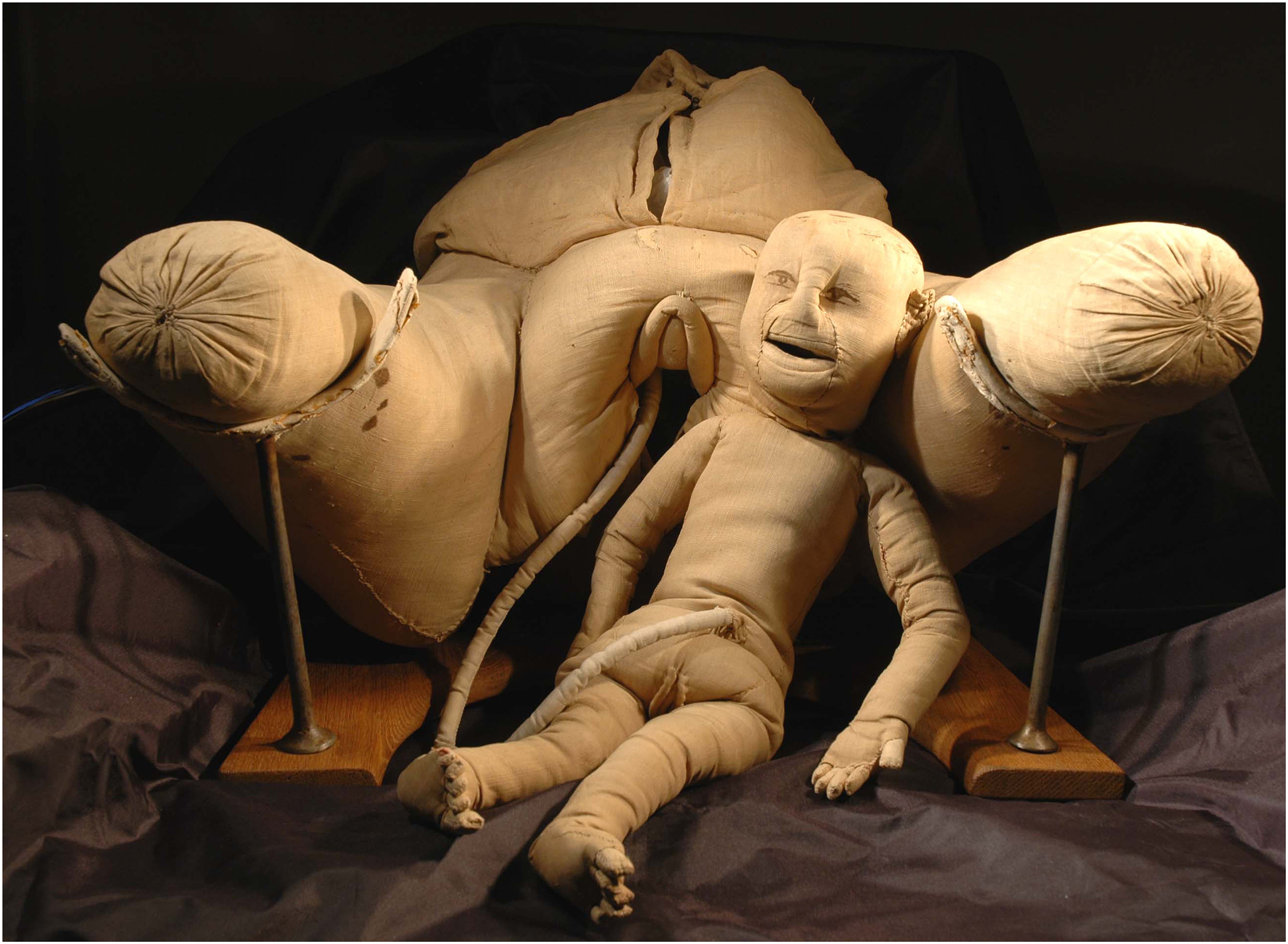
La Machine. Musée Flaubert et d’histoire de la médecine, Réunion des musées Métropole Rouen Normandie.
La Machine is complemented by handmade newborn mannequins with extremities freely movable in all positions. This flexibility, also present in the neck area, allowed a mannequin imitating a fetus to assume any physiological as well as pathological position intrauterine or subpartum. The fontanelles are easily palpable, as well as the ears and the open mouth with the tongue. Eyes and hair have been realistically painted on with ink. The shaping fetal spine has the anatomically correct number of vertebral bodies, which consists of several layers of folded thin cotton with holes, resembling today's tulle.8,17,19,20 The external female organs of the newborn mannequin depicted here are clearly visible (see Figure 2). The mannequin of a seven- to eight-month-old singleton is 50 cm long, that of a twin 26 cm, corresponding to approximately the fifth to sixth month.5,15,19,20 Different fetal heads, separated from the mannequin's torso, should represent, for example, pathologies of anencephalus or an already macerated scalp. Such a haptic demonstration was intended to sensitize the students in a drastic way to acquire help timely in case of most serious complications early rather than too late, as there was a lack of appropriate expertise, especially in rural areas.17,19,20
In addition, a placenta, flexibly connected to an umbilical cord made with red and blue embroidery threads to represent its arteries and vein (see Figure 3), and amniotic membranes complete the fetomaternal unit.19,20 In some cases, models were also manufactured in which one half of the umbilical cord could be inflated and the other collapsed to simulate the umbilical cord of a living fetus as well as a fetus that died intrauterine.2,17

Uterus with the mannequin of a fetus, umbilical cord and placenta. Musée Flaubert et d’histoire de la médecine, Réunion des musées Métropole Rouen Normandie.
In the course of her career, Madame du Coudray perfected her masterful phantoms. These were not only continuously enhanced by anatomical structures, but a fundamental distinction was made between two models: The original “dry” model, in which colored materials imitated amniotic fluid, and the modified “liquid” model, in which sponges saturated in clear or red-colored fluid were incorporated as accessories to imitate fluids such as amniotic fluid or blood.5,8,17 In other designs, wood, wicker and metal were used instead of real human pelvises to recreate the skeleton.17,19 One model is even said to have consisted of fifty-six parts, all of which were numbered consistently. In addition, a contraceptive diaphragm was available as an accessory. 8
The standard version of a phantom made of linen cost 300 livres (today about US $2800 or €2400), the price of a luxury version made of silk was a whole 500 livres. Due to the documented production in high numbers from generally available materials, a less elaborately manufactured version was also created for 200 livres compared to the previous two models.2,8,16,17
When Madame du Coudray demonstrated La Machine at the Académie Royale de Chirurgie in Paris in May 1756, obstetrician André Levret, one of the reviewers, was deeply impressed.2,8,17,18 He considered La Machine less as a fantôme than as a mannequin, a term first used around 1730 – a puppet is, after all, more tangible than a phantom. 8 The only fully preserved version of such a phantom, resembling the one of 1756, is exhibited in the Musée Flaubert et d'Histoire de la Medicine in Rouen, France today.2,8,17,19,20 Archived in Rouen in 1777 or 1778, this probably functioned more as a physical blueprint for further replicas or repairs of other phantoms than for demonstration purposes, allowing it to endure the centuries.2,8,15,17,19
Summary
Such a review of advanced developments that have significantly influenced our current obstetric standards weakens our obviousness of ubiquitous knowledge, establishes groundedness, and sharpens our understanding of our current scientific achievements. Such narratives humble us in some ways. Madame du Coudray significantly shaped education at a time when the senses were so important to learning. This still continues today, with obstetric simulation as now being key to not only skill-based learning, but also practicing collaboration between physicians and midwifery professions. Ultimately, the use of simulation has helped to bring science and humanized practice together. The Canadian professor of obstetrics and gynecology Thomas F. Baskett classifies Madame du Coudray in a predominantly patriarchally organized scientific culture as follows: “[…] she was the midwifery counterpart of William Smellie […]”. 18 The exponential increase in publications on obstetric simulation in recent years illustrates that then as now, the credo remains interdisciplinary valid: “Practice makes the practical obstetrician." 1 – and Madame du Coudray was already at the forefront as a pioneer of obstetric simulation with her mannequin, her symbiosis of practical-robust architecture and anatomical-theoretical accuracy, almost 60 years before Dr. Elias von Siebold recorded ten characteristics of a “well-furnished phantom”.
Footnotes
DECLARATION OF CONFLICTING INTERESTS
The author(s) declared no potential conflicts of interest with respect to the research, authorship, and/or publication of this article.
FUNDING
The author(s) received no financial support for the research, authorship, and/or publication of this article.
Ethical Approval
Not applicable, because this article does not contain any studies with human or animal subjects.
Informed Consent
Not applicable, because this article does not contain any studies with human or animal subjects.
Trial Registration
Not applicable, because this article does not contain any clinical trials.
