




Abstract
In undergraduate and postgraduate medical education, mentoring offers personalized training and plays a key role in continuing medical education and the professional development of healthcare professionals. However, poor structuring of the mentoring process has been attributed to failings of the host organization and, as such, we have conducted a scoping review on the role of the host organization in mentoring programs. Guided by Levac et al’s methodological framework and a combination of thematic and content analysis, this scoping review identifies their “defining” and secondary roles. Whilst the “defining” role of the host is to set standards, nurture, and oversee the mentoring processes and relationships, the secondary roles comprise of supporting patient care and specific responsibilities toward the mentee, mentor, program, and organization itself. Critically, striking a balance between structure and flexibility within the program is important to ensure consistency in the mentoring approach whilst accounting for the changing needs and goals of the mentees and mentors.
Keywords
Introduction
Mentoring boasts many benefits. Through the provision of personalized training, learning and support, mentoring facilitates “the process by which health professionals keep updated to meet the needs of patients, the health service, and their own professional development.” 1 Indeed, it not only enhances the academic, research, clinical, and personal development of both mentors and mentees, it also improves patient outcomes and boosts the reputation of the host organization managing the mentoring program (henceforth, the host).2-25 By providing opportunities for mentors and mentees to develop their social, personal, leadership, and managerial competencies, 26 mentoring plays an integral part in the continuing medical education (CME) and continuing professional development (CPD) of physicians, nurses, and health professionals from the various allied health specialities.27-29
However, lapses in support and oversight of the mentor-mentee matching process, the nurturing of relationships between the mentee, mentor and the host organization, and the cultivation of a positive mentoring environment has hindered its full potential.28-36 With 2 recent reviews30,31 attributing ethical issues such as bullying and misappropriation of the mentee’s work to neglect on the part of the host, it is critical to scrutinize their role in mentoring programs.32-41
Studying mentoring
A dearth of data on the role of the host in mentoring has been attributed to a number of issues.1-20 Perhaps most significant has been the failure of many reviews in acknowledging and contending with the impact of mentoring’s evolving, entwined, context-specific, goal-sensitive, mentee-, mentor-, relationship-, and host-dependent nature.42-49 This suggests that peer, near-peer, group, mosaic, network, leadership, patient, youth, family, and e-mentoring should not be mistakenly conflated nor intermixed with preceptorship, supervision, role modeling, and networking which have their own specific approach and role in education and training. 41 Acknowledging mentoring’s context specific nature, this review will focus on the role of the host in novice mentoring which is defined as the “dynamic, context-dependent, goal-sensitive, mutually beneficial relationship between an experienced clinician and junior clinicians and/or undergraduates focused upon advancing the development of the mentee.” 50 Novice mentoring is the dominant form of mentoring in medical education.51-60
Methods
Design
A systematic scoping review was adopted to identify “the central sources and forms of evidence available” on host organzations. 42 The flexible nature of a scoping review allows systematic extraction, synthesis, 43 and summarizing 44 of actionable and applicable information across a diverse range of study formats and settings. This circumnavigates the limitations posed by mentoring’s nature45-50 and a paucity of articles on host organizations.51-54
Levac et al’s 55 adaptations of Arksey and O’Malley’s 42 methodological framework for conducting scoping reviews was adopted to systematically study the potential size, gaps, and scope of available literature on host organizations in novice mentoring.56-60 The PRISMA-P 2015 checklist was used to develop the protocol for this study. 61
Guided by local clinicians, educators, researchers, librarians (henceforth, the expert team), and prevailing reviews of CPD practices, the 8-member research team determined the primary research question to be “what is known about the role of the host organization in novice mentoring—particularly in Internal Medicine and its subspecialties as delineated by the American College of Physicians?” 62 The secondary research question was then determined to be “what would make an effective host organization in these disciplines?” Narrowing this scoping review’s focus on novice mentoring in Internal Medicine was largely determined by the amount of prevailing data already present in the field of mentoring in undergraduate and postgraduate medical education. These questions were designed on the PCC (population, concept, and context) elements of the inclusion criteria63,64 and presented in a PICOS format (Table 1).
PICOs, inclusion criteria and exclusion criteria applied to database search.

Sampling
A search on 7 bibliographic databases (PubMed, Embase, PsycINFO, ERIC, Cochrane Database of Systematic Reviews, Google Scholar, and Scopus) was conducted between 24th April and 12th September 2018. A search of gray literature involving GreyLit, OpenGrey, and Web of Science databases was carried out between 18th October 2018 and 17th December 2018. In order to update the search so as to include articles published up to December 2019, a subsequent search of all 10 databases was conducted between 30th December 2019 and 4th January 2020. Accounts of novice mentoring prior to the year 2000 were omitted given the propensity of these articles to neglect clear descriptions of mentoring and conflate mentoring approaches.65,66 The PubMed Search Strategy may be found in Supplemental Appendix A.
Upon completion of the independent searches, each member of the research team compiled a list of titles and abstracts to be reviewed. They discussed their findings online and at weekly research team meetings, achieving consensus on the final list of titles and abstracts by using Sambunjak et al’s 67 approach to “negotiated consensual validation.”
Analysis
Braun and Clarke’s 68 approach to thematic analysis was adopted in the absence of an a priori framework and a clear definition of the host in novice mentoring.
Reiterative process
In keeping with the reiterative process outlined in Levac et al’s sixth stage, consultations with key stakeholders saw the expert team note that the themes identified were consistent with descriptions of medical education units which oversee and support multiple education programs.69,70 As such, drawing upon the roles of medical education units set out by the “AMEE Education Guide no. 28: The development and role of departments of medical education,” 71 2 independent reviewers who were not involved in the thematic analysis adopted Hsieh and Shannon’s 72 approach to directed content analysis. This process involves “identifying and operationalizing a priori coding categories” 73 which aligns with the constructivist approach adopted in this scoping review. This approach circumnavigates the wide range of research methodologies employed in the articles and prevents statistical pooling and analysis.74-77 Quantifying the data and tabulating the frequency by which the themes and categories emerge also aids as a proxy indicator of their significance. 78
In total, 18 603 abstracts were identified from the 10 databases, 231 full-text articles were reviewed, and 76 full-text articles were analyzed 79 (Figure 1: PRISMA flow chart).

PRISMA flow chart.
Majority of the articles surveyed mentees and mentors instead of the host organization and the articles were predominantly qualitative or quantitative, retrospective or prospective in nature. The characteristics of the 76 included articles are featured in Supplemental Appendix B.
Quality assessment of studies
Whilst not commonly associated with systematic scoping reviews, quality assessments were deemed important to better influence and inform future practice. This sentiment was shared by the expert team. Two authors thus carried out individual appraisals using the Medical Education Research Study Quality Instrument (MERSQI) 80 and the Consolidated Criteria for Reporting Qualitative Studies (COREQ) 81 to evaluate the quality of the quantitative and qualitative studies included in this review.
The narrative produced was guided by the Best Evidence Medical Education (BEME) Collaboration guide 82 and the STORIES (Structured approach to the Reporting In healthcare education of Evidence Synthesis) statement. 83
Results
Comparisons between the themes and categories identified using thematic and directed content analysis revealed significant consistencies.
(1) “Defining” and secondary roles
An overwhelming majority of the included articles defined the host organization by the roles they play in their respective mentoring programs.67,83-141 These papers suggest that the “defining” roles 47 of the host include:
establishing and/or complying with overarching goals, clinical standards, and curriculum requirements84,86-92,140
designing,83,88,92,95-102,132,135 influencing,47,90,92-94,122 and overseeing the mentoring program88,95,98,102-107
and nurturing the mentoring culture84,85,90-92,97,101,106,108-110 and mentoring relationships83,85,88,92,95-102
Characteristics of an effective host, in particular, were determined to be their ability to:
provide consistent leadership47,67,84,91,93,96,102,107,137,142-144
proactively support mentor and mentee participation47,67,83,85,93,96,101,103,107,111,118,120,129,134,142-145
cogently facilitate all mentoring processes47,67,87,91,92,99,101,106,107,111,118,127,138,143,144,146
proactively gather and revert feedback on the mentoring program and the mentoring relationships within47,89,101,116,126,134,142,146-148
and, finally, successfully initiate curricular reform to better meet the needs of their participants107,137,144,146
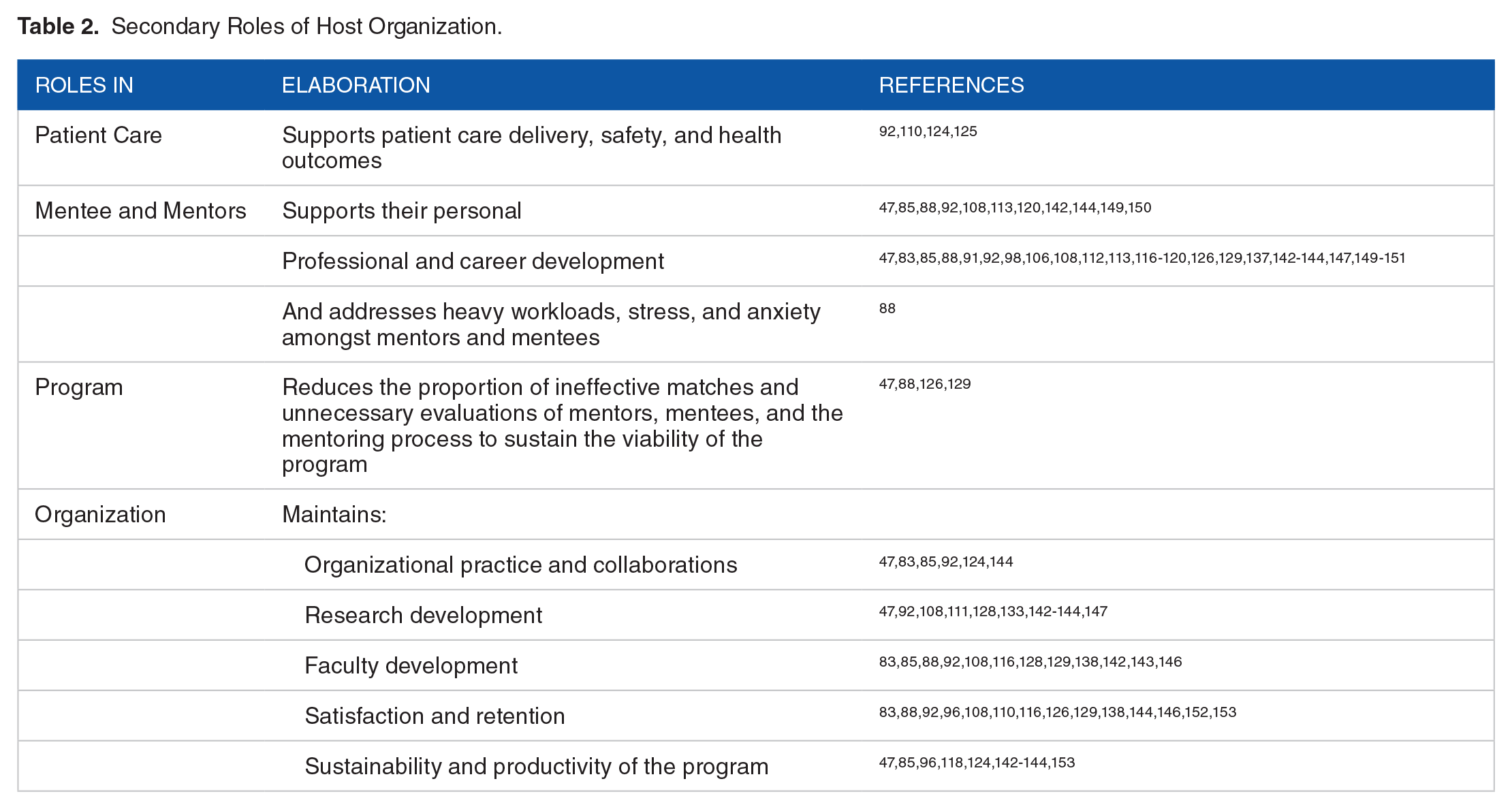
In addition, the secondary roles of the host comprise of supporting patient care and specific responsibilities toward the mentee, mentor, the overall program, and the organization itself. These are outlined in Table 2.
Secondary Roles of Host Organization.
(2) Balancing structure and flexibility
Although not a defining characteristic of the host organization, a key finding which emerged in numerous papers was the need for the host to balance structure and flexibility within the program.
Establishing a mentoring structure serves to ensure fairness and consistency in the mentoring approach and experience for all.67,83,85,88,90-93,95-101,104,107,111,118,121,123-125,129,133,134,136,138,142,144 Rigorous oversight and the just provision of support, in turn, influences the mentoring culture.47,92,104,106,107,142,151 It ensures transparent communication of the program’s mentoring philosophy, mentoring approach, as well as the goals and values of the program.47,88,95,98,101,103,104,124,149 It also facilitates recruitment and retention of mentors through the provision of financial remuneration,84,86,88,93,97,102,104,124,129,130,134,139,142,144,150 opportunities for academic promotion,83,86,93,106,138,139 formal recognition of their time and efforts,25,83,84,86,90,92,96,97,124,134,138,139,144,150 timely access to facilities, resources,47,105,144 research funding,84,136,154 and protected time.25,67,83,84,90,92,95-97,133,134,139,142,144,154
Yet, the host must also allow for flexibility 47 within the mentoring program so as to adapt to the evolving mentee-, mentor-, host organization-, and relationship-dependent nature of each individual mentoring relationship. 114 This is critical in enhancing the mentee’s sense of autonomy, connectivity, and advocacy.114,144 It is of note that flexibility is also encapsulated within the clinical standards and codes of conduct set out by prevailing host organizations.47,84,86-92 As outlined in Table 3, structure and flexibility within the mentoring program is evident in the various stages of the mentoring process.
Structure and Flexibility in Stages of Mentoring Processes.

Discussion
In addressing its primary and secondary questions, this SSR characterizes the host organization as a “team of educators and administrators83,102,104,112,116 with common values, goals and views on education and clearly delineated roles and responsibilities 86,87,90-92 who collaborate through coordinated lines of communication 104 , assessment, and reporting 88,95,98,103,104 in order to realize their “defining” and secondary roles. The “defining” roles of the host include establishing, nurturing, and overseeing mentoring relationships whilst ideally offering both structure and flexibility within the mentoring program.”83,84,86-110
To realize their “defining” roles, the host should design and incorporate the mentoring program as part of the formal curriculum.87,88,94,95,98,104,111,116,117,119,126,130,134,136,139,148,150,155 This will provide the program leaders with administrative, financial, and training support that will help streamline their response to the changing needs of the stakeholders and the mentoring process.67,87,91,92,99,101,106,107,111,118,127,138,146 Such resources will ensure that codes of conduct, standards of practice, timelines, roles, and responsibilities to be adhered to by mentees, mentors and the educationalists and administrators designing and spearheading the program are clearly overseen.84,86-92 A consistent framework is also critical in ensuring that mentoring takes place within reasonable boundaries.30,31 Establishing an implicit or contractual67,90,92-94,101,102,131 agreement between mentees and mentors on the expectations of the mentoring program would minimize the risk of misdemeanors and breaches in ethical conduct.
To ensure a flexible approach, the host must adopt adaptable, context sensitive, and stakeholder-specific assessment methods to provide mentees, mentors, and the mentoring relationship with personalized, appropriate, specific, timely, holistic, accessible, and longitudinal support.25,67,84,86,87,89-93,96,97,99,101,102,106,107,111,115,118,127,138,141,146,149 Adaptations should be guided by consistent evaluations of the mentee’s, mentor’s, and the host organization’s changing needs and goals. In the absence of a specific assessment tool, a combination of tools and assessors may be considered.83,88,91,92,96,98,106,108,110-113,116-120,124-126,128,129,133,137,138,146,147,149-153
The host should also work to establish an accessible and robust platform for mentors and mentees to communicate freely and confidentially. Such a platform would also encourage mentors and mentees to attune themselves and respond to any changes during the course of their mentoring relationship. To facilitate this, they should be provided with pre-mentoring workshops and longitudinal training programs to develop their communication and online literacy skills. Such skills will help them to circumnavigate obstacles such as conflicting schedules amidst urgent deadlines that may impede the progress of their mentoring projects.
Overall, these considerations will provide the host with the opportunity to deliver consistent, timely, appropriate, longitudinal leadership47,67,84,91,93,96,102,107,137,142-144, holistic support for the matching,47,67,83,85,93,96,101,103,107,111,118,120,129,134,142-145 and mentoring process47,67,87,91,92,99,101,106,107,111,118,127,138,143,144,146, personalized, specific and comprehensive feedback to all participants 47,89,101,116,126,134,142,146-148 and the successful development and execution of crucial curricular reform.107,137,144,146
Limitations
Too narrow a picture of the host organization may have been sketched in this scoping review given that it was explored in isolation from factors such as the dynamic nature of mentoring relationships, structures, environments, and even mentee-mentor matching processes. Concurrently, given the context-specific nature of the host and their roles in mentoring programs, conflation within the included articles of different healthcare, educational and CPD systems across different national and international contexts may prove to be problematic.
These limitations are compounded by the scoping review’s focus on articles published or translated into English. As a result, much of the data comes from North America and Europe, potentially skewing perspectives and raising questions as to the applicability of these findings in other healthcare settings. In addition, despite using the Endnote software to carry out independent searches and consolidation of the findings, relevant articles may have been unintentionally omitted.
However, despite these limitations, this scoping review was carried out with the required rigor and transparency advocated by Arksey and O’Malley, 42 Levac et al, 55 and Pham et al. 157 As a result, we believe that the findings will help to inform the design and oversight of future mentoring programs. We also believe that this review may be of interest to educators and program designers in settings beyond the mentoring landscape due to the potential applicability of the findings to other aspects of medical education.
Directions for future research
This scoping review evidences the critical role of the host in mentoring programs and hints at their applicability to undergraduate and postgraduate medical education. Riding on ever improving communication technology and advances in the dissemination of information, the increasing use of technology-enhanced mentoring platforms will also see ever increasing demands for transparency and accountability. There is a need to conduct closer evaluations of all intra and interprofessional mentoring interactions to ensure that personal and professional boundaries are maintained with codes of conduct and standards of practice strictly adhered to.
Prospective studies should be conducted to better understand how balance between structure and flexibility can be better struck to ensure maximum efficacy. However, it is only with the curation and validation of effective assessment tools accounting for mentoring’s evolving nature that mentoring can realize its true potential in CPD programs.
Lessons for practice
(a) Mentoring’s role in CPD hinges on effective support and oversight by the host organization. This may be facilitated through the development of a formal mentoring program that is overseen by the wider education and administrative team.
(b) Collaborative efforts between educators and administrators are required to ensure that a clear organizational structure is established with the aim of meeting the critical “defining” roles of the host. These comprise of establishing, nurturing, and overseeing the mentoring relationships whilst balancing structure and flexibility within the program. This process must be guided by clear outcome measures, codes of conduct, standards of practice, and assessment points.
(c) Members of the host must be trained, briefed, supported, and appraised throughout the mentoring program. Their roles, responsibilities and lines of reporting should be clearly established.
(d) Mentoring in CPD should be run as a longitudinal program that is in turn supported by mentee and mentor training workshops.
(e) Mentoring’s role in CPD is to facilitate personalized social, academic, and leadership development opportunities especially when used in conjunction with e-mentoring. However, the effectiveness of such an approach pivots upon the host’s ability to assess and respond to the evolving needs of the mentee, mentor and the mentoring relationship.
Supplemental Material
Supplementary_material – Supplemental material for The Pivotal Role of Host Organizations in Enhancing Mentoring in Internal Medicine: A Scoping Review
Supplemental material, Supplementary_material for The Pivotal Role of Host Organizations in Enhancing Mentoring in Internal Medicine: A Scoping Review by Elisha Wan Ying Chia, Kuang Teck Tay, Shiwei Xiao, Yao Hao Teo, Yun Ting Ong, Min Chiam, Ying Pin Toh, Stephen Mason, Annelissa Mien Chew Chin and Lalit Kumar Radha Krishna in Journal of Medical Education and Curricular Development
Footnotes
Acknowledgements
The authors would like to dedicate this paper to the late Dr S Radha Krishna whose advice and ideas were integral to the success of this study. The authors would like to thank the anonymous reviewers whose advice and feedback greatly improved this manuscript.
Funding:
The author(s) received no financial support for the research, authorship, and/or publication of this article.
Declaration of conflicting interests:
The author(s) declared no potential conflicts of interest with respect to the research, authorship, and/or publication of this article.
Author Contributions
EWYC, KTT, SX, YHT, YTO, MC, YPT, SM, AMCC, LKRK were involved in data curation, formal analysis, investigation, preparing the original draft of the manuscript as well as reviewing and editing the manuscript. All authors have read and approved the manuscript.

Supplemental material
Supplemental material for this article is available online.
References
Supplementary Material
Please find the following supplemental material available below.
For Open Access articles published under a Creative Commons License, all supplemental material carries the same license as the article it is associated with.
For non-Open Access articles published, all supplemental material carries a non-exclusive license, and permission requests for re-use of supplemental material or any part of supplemental material shall be sent directly to the copyright owner as specified in the copyright notice associated with the article.
