




Abstract
Law and medicine share an interest in the human body in terms of justice, well-being, and the preservation of physical integrity. Despite the long-lasting relationship between medicine and law, the tension between the two disciplines remains an unresolved issue; each requires the other, and almost all societies require them both. Therefore, there is a need to bring these two disciplines closer to render them more beneficial for society. This article addresses the need to introduce a medical law curriculum in medical schools, specifically in the Arab Gulf Cooperation Council (GCC) countries. This article first illustrates the relationship between law and medicine by defining the discipline of medical law. Thereafter, it makes a case for including a medical law curriculum in medical school and health care education programs in GCC countries, illustrating the benefits of doing so for society, individuals, and the development of the disciplines themselves. Subsequently, this article proposes an outline for a spiral and integrated medical law curriculum based on the needs and values of GCC countries. This outline is centered around the basic and advanced core topics and encourages engagement with law-medicine activities that further bridge the conceptual gap between medicine and law. This article reasserts the need to bring medicine and law closer together for the benefit of society and the development of the disciplines. One crucial way of doing so is providing formal and structured legal education for medical students.
Introduction
The relationship between medicine and law is a very old one. Both law and medicine have a shared interest in the human body. Early on, people realized that practicing medicine involves some degree of physical imposition on the human body. Poking a patient with a needle, incising one, and even touching one’s body for examination are activities that need to be regulated and legalized to maintain the body’s integrity. With human rights movements and rapid advances in technology and medicine, the relationship between law and medicine has undergone great scrutiny in recent years. Although the regulation of medical practice is not restricted to law, law continues to play a major role in setting boundaries at every level of medical activity and practice. 1
Physicians and other health care professionals struggle with legal and regulatory realities that affect their daily medical practice. 2 Current medical curricula have little, if any, opportunity to learn legal aspects of medical practice, and medical students have little, if any, knowledge about legal rules and their applications to the profession. 3 Incorporating legal education into the curriculum of medical and health schools may be one way to proactively address this struggle. In a survey of 125 US medical schools, 59% of respondents had required health law coursework. 4 Similarly, UK medical schools increasingly emphasize law as well. 5 However, many countries and medical schools still lack a structured law curriculum, even while the legal concerns of health care practitioners continue to have a significantly negative influence on compassionate, patient-centered care. 6 Health care students in general, and medical students in particular, need a structured, focused legal education as part of their medical education. Although there is no concrete evidence from available literature to confirm the outcome of such an education, the general role of education in building knowledge and changing attitudes will likely help students to build up their skills and practices within the framework of law.
Arab Gulf Cooperation Council Countries
Although I argue that all health care and medical students need a sound education in law, I focus herein on the need for legal education in medical school programs in the Arab Gulf Cooperation Council (GCC) countries. The GCC consists of 6 countries: the Kingdom of Bahrain, the State of Kuwait, the Sultanate of Oman, the State of Qatar, the United Arab Emirates, and the Kingdom of Saudi Arabia (KSA). GCC countries have a combined population of 53 million in 2019 and have experienced massive population and economic growth, particularly over the last half a century. 7 The welfare economy in these countries is largely dependent on the oil industry. These recent surges in population and economies of GCC countries have been associated with lifestyle changes as well as shifting social structures and infrastructures. Economic growth was such a strong driver of material change within GCC countries that they were able to adopt public health systems offering free health care to their citizens. In 2015, government health care institutions constituted more than 60% of the total number of health care facilities in these countries. 8
In spite of some differences, the legal systems in GCC countries share historical foundations, common rules, and a value system that is based on Islamic teachings.9,10 Law is a core curriculum in few, if any, medical schools in this region. This article argues that legal education for medical and health care professionals must be provided in GCC countries to ensure a safe and regulated practice. This legal education is preferably conducted, as Norton argued, by “. . . develop[ing] regional programs rather than single-interest competitive activities.” 11 GCC countries, with their shared historical, cultural, and legal backgrounds, form a fertile context for such regional programs. Furthermore, structured regional programs in medical law will help to establish a good basis for regulated medical practice in the region.
What Is Medical Law?
Although it is not a formal branch of law, medical law has gained a respected position in both law and medicine worldwide over the last half a century. The term “health law” is occasionally used to indicate a broader application of law in the health care field, 12 differentiating it from the narrower scope of medical law. For this discussion, however, medical law and health law will be treated as synonymous. In addition, we need to differentiate between medical law and legal medicine. The discipline of medical law is primarily concerned with the legal dimensions of issues applied to health care practice. On the contrary, legal medicine is concerned with the use of medical knowledge and skills in the legal realm. For instance, legal medicine includes forensic science and developing the competency to decipher proof of evidence.
While the expansion of science and technology has been associated with rapid and critical advances in medicine and health care, this progress is also associated with social and political obstacles that affect a patient’s health and well-being. Despite opposition, there is an increasing recognition of human rights in general, especially the rights of patients. There has been a demand for a significant expansion of regulatory oversight for both medical practice and research. 12 These developments in the fields of law and medicine have further entwined the 2 disciplines. However, tension between lawyers and health care practitioners remains an unresolved issue, as I discuss further below.
Why Teach Medical Law?
In spite of the continuous tension between lawyers and doctors, their work centered on the human body cannot be separated from each other’s practice. While lawyers require medical expertise to ensure that justice is applied in related medicolegal cases, doctors cannot escape practicing medicine within the accepted legal frameworks of their societies. Moreover, the practice of medicine itself raises both ethical and legal concerns, and its practitioners should understand both.
Law and medicine share important social dimensions in the lives of human beings, including a sense of justice, establishment of rights, and health and well-being of their patients and clients. For the benefit of society and individuals, “one must develop programs including the social perspectives of society’s needs, demands, and influences, as interrelated with the amazingly rapid progress of knowledge and techniques.” 11 This will help medicine to operate both with a close understanding of social needs and perspectives, and also within the frames and norms generally accepted by society.
Providing structured legal education is not common in GCC medical schools. In 2016, the College of Medicine at King Abdulaziz University in KSA launched “Health Empowerment and Health Rights Unit” with a longitudinal module as part of the undergraduate medical curriculum. 13 However, it remains true that most GCC medical schools fail to provide adequate, or in some cases any, legal education and training. This failure negatively impacts the knowledge and attitudes of medical staff and how they ultimately regard the legal aspects of their practice. 14 With medicolegal claims on the rise in the region, litigation for clinical negligence continues to be a major concern for lawyers, as well as health care practitioners, worldwide.
Patients are exposed to health care practitioners when in a vulnerable state. 15 Law is one mechanism available to protect the rights of vulnerable groups and individuals. Medical schools and health care training programs must prepare candidates to work within the legal regulations to which they are subject. Practitioners must not create an isolating, paternalistic environment. Rather, they must realize that they are part of a larger social system, where they can be held accountable for their actions and the results they engender.
Protection against lawsuits is a major challenge facing GCC health care systems. 16 Unfortunately, few studies have fully explored the burden of medical liability and the rise of medicolegal claims in the region, 17 although they do demonstrate that the burden exists and acknowledge that the number of claim has risen.14,17–21 These studies frequently recommend adherence to standards of medical practice to safeguard against medicolegal claims, but such claims can include aspects of negligence and unlawful violations that cannot be addressed through such standards alone. Legal education and training for health care providers are essential solutions for decreasing the number of medicolegal claims in the region. Other solutions might include a continuous and purposeful dialogue between medical and legal professionals, a regular exploration of societal perspectives and needs regarding medical activities, and training and education of legal students on the basics of medical practice.
Moreover, health care practitioners need to learn law, not only to protect themselves from litigation and unfavorable consequences of illegal medical practice, but also to provide better, safer health care that fosters the goals and objectives of health care practice. 22 Patient rights and safety are major global concerns for modern medical research and practice worldwide, and GCC countries are no exception. The 2014 Jeddah Declaration On Patient Safety reported “a high burden of unsafe care and poor compliance with even the minimal levels of safety in health care” in the Eastern Mediterranean region. 23 Among many other causes, the report asserts that insufficient national policies and legislation in conjunction with a poor safety culture impede improvement to patient safety in the region. Lacking awareness of health care rules and regulations contributes to increased morbidity and mortality. 24 This calls for law and medicine to share the goals of maintaining patient physical integrity and improving patient safety and well-being in both research and practice.
In addition, it is commonly known that medical professionals such as doctors and nurses enjoy a high level of public trust compared with lawyers. However, when crisis strikes, people turn to lawyers to fight for their rights. To complicate matters, medical professionals are seen as either angels or demons. Brazier and Cave 1 describe the phenomenon thus: “Praised to the skies for their triumphs, few individuals attract greater public odium than the doctor or nurse who falls from her pedestal.” Maintaining a good relationship and a sense of mutual understanding between health care providers, patients, and lawyers will help to keep a sense of trust between the various relationships. Health care is not only an issue of trust between individuals but also an issue of collective societal trust of the profession. This issue of trust is particularly apparent in GCC countries where health care is considered a pillar of the social contract between the public and government. 25 Therefore, it is important to maintain a high level of sociopolitical trust between the parties via a safely regulated health care system.
Law and legislation are the cornerstones for formulating public policies in any society, and health and health promotion are often a central focus of these public policies. For health care practitioners to be influential in promoting health through public policies, they need to be familiar with the language, rules, structure, and processes of law and legislation. As Williams and Winslade 22 have noted, this familiarity will help positively to develop a “more constructive involvement of physicians in the legal and political system.” Hence, physicians and legislators can speak a common practical and professional language. As has been noted above, insufficient national policies and laws contribute to the low degree of patient safety in the region, and health care professionals can contribute positively if they understand how these policies and laws are developed and rationalized.
Besides, the rising costs of medicolegal claims are a worldwide concern, especially for countries that primarily depend on free public health systems such as the GCC countries. In 2018, compensations awarded for medicolegal claims in GCC countries exceeded 1 million USD. 21 These costs are a financial burden on the public health care sector, and one way to address this issue is to improve health care providers’ legal awareness and regulatory compliance through legal education and training.
Teaching law in the medical schools of GCC countries can be advantageous for patients, health care providers, lawyers, and society. Not only are patients more likely to have safer, improved care, but health care professionals will also work in a safer environment with legal boundaries that are relatively clear and respected. Furthermore, health care professionals may be more likely to influence health and health care–related policies, just as lawyers will likely enjoy a better relationship with health care professionals with an improved sense of justice because they will share a mutual understanding of health care practices. Society will have stronger, cost-effective, legal, and medical systems that work together toward the betterment of human beings.
Developing a Medical Law Curriculum
A basic feature of law is its stability, with legislation remaining relatively unchanged over time. 26 On the contrary, medicine undergoes continuous and relatively rapid advances. Matching the stability of law with the dynamicity of medicine is becoming more challenging with the disruptive technological changes in medicine and medical practice. However, medicine and law will continue to exist in every society, and neither can neglect the presence of the other, nor operate in isolation from the other.
Medicine and law belong to 2 different worlds with different ontologies, epistemologies, and reasoning processes. It may be true, as Schwartz 27 noted, that “[t]hese different professional epistemologies are manifested in, and perhaps created by, the very different professional educations provided to medical and law students.” Hence, the first step to bridge the gap between these 2 disciplines is to tackle the issue at its core, and to bring them closer to each other by incorporating legal education into the medical curriculum and vice versa.
Since teaching law to medical students is more about understanding the legal structures, processes, and reasoning involved, a combined spiral and integrated curriculum model is likely to present a useful approach for such a subject. Harden and Stamper 28 defined spiral curriculum in medical education as “one in which there is an iterative revisiting of topics, subjects or themes throughout the course,” involving not only repetition of concepts and topics but also a deepening understanding and successive building on previous ones. They have identified 4 features of a spiral curriculum: 28
Topics are revisited.
There are increasing levels of difficulty.
New learning is related to previous learning.
The competence of students increases.
Since law is not an isolated subject in relation to a medical curriculum, as it relates to the whole process of medical practice, a spiral curriculum that diffuses through the medical training would be ideal for teaching law to medical students and trainees. This spiral curriculum needs to progress along with the development of medical students and trainees by relating their clinical exposure to the legal process and reasoning.
In addition to being spiral, a medical law curriculum needs to be integrated. An integrated medical curriculum has been defined by Brauer and Ferguson 29 as “a fully synchronous, trans-disciplinary delivery of information between the foundational sciences and the applied sciences throughout all years of a medical school curriculum.” This definition can be further modified for medical law teaching and training to be a fully synchronous, trans-disciplinary delivery of information between law and applied clinical sciences throughout all years of a medical training. Integrating the law curriculum removes the burden of an isolated additional curriculum and also requires that the integrated curriculum be kept vividly present throughout. A trans-disciplinary program is the top of the integration ladder proposed by Harden 30 for curriculum planning and evaluation.
Harden 30 further asserts, “The focus with trans-disciplinary integration for learning, however, is not a theme or topic selected for this purpose, but the field of knowledge as exemplified in the real world.” This is ideal for teaching law to medical students as it involves integrating law as a different field of knowledge into their medical field of knowledge. As Dolin and Ram 3 noted describing their experience, a long-lasting impact of teaching law to medical students needs to involve hands-on or clinical learning. Adding transdisciplinary law curriculum to medical programs is likely to be facilitated in most GCC medical schools as they already adopted integrated curriculum models into their programs. 31 An integrated curriculum in law training for health care professionals has already been proposed in KSA. 14
To fulfil the requirements, Tables 1 and 2 below present a suggested list of core topics to cover in a medical law curriculum. These topics and themes are by no means exhaustive, but rather they should be considered as examples that need to be developed, revisited, and modified according to the needs of the students and trainees at different levels of their training and practice.
Basic-level core topics.

Advanced-level core topics.

Table 1 addresses the themes and topics that are suitable to cover during the basic training of health care providers that is prior to their clinical exposure.
Table 2 addresses themes and topics that are related to higher levels of training during the clinical years and afterwards in both residency and practice. Training and teaching provide an iterative revisiting of and building of themes and topics discussed in Table 1.
By using various methods for teaching and training in medical law, the experiences of health care professionals in this field may be further enhanced. For example, an online platform can be used to augment education in medical law. Also, a compilation of summaries and learning points from closed medicolegal cases can offer an opportunity for learning and feedback.
Furthermore, as noted by Schwartz, 27 any attempt to teach law to medical students in the same way in which they are taught medical subjects will fail to teach medical students how lawyers reason and how they resolve problems. Similarly, any attempt to teach medicine to law students as if “law and medicine” were simply another substantive area of the law will leave attorneys unable to understand physicians’ practice.
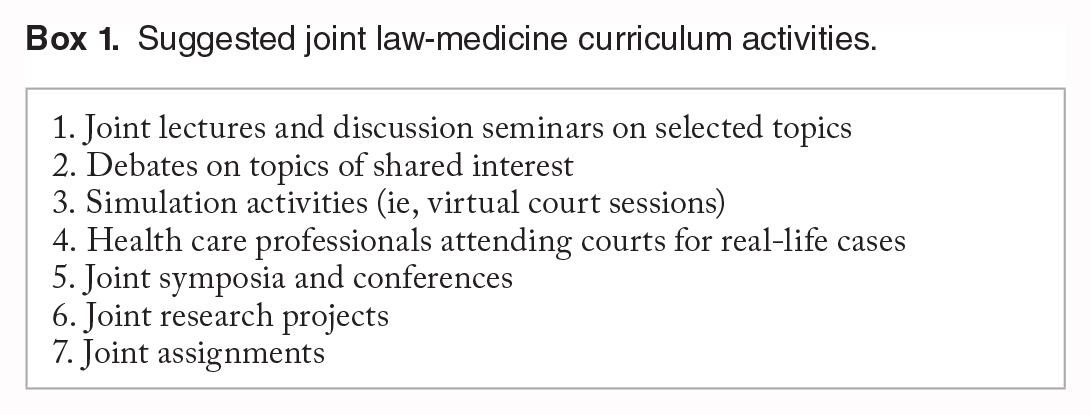
This concern can be overcome through a joint curriculum with law schools in the region which can further bridge the existing conceptual gap between lawyers and health care professionals. A joint curriculum might involve varied structured activities, such as those listed in Box 1 below.
Suggested joint law-medicine curriculum activities.
A spiral and an integrated transdisciplinary law curriculum in GCC medical schools that uses various methods of teaching and training will likely enhance and sharpen the skills of health care professionals. In addition, it will likely augment patient safety practices in the region. Although the relationship between law and medicine has not been commonly of harmony and trust, medicine needs law to keep advancing on track for the benefit of society, and law needs medicine to meet changing social needs. 32 Law and medicine will not only have to live together, but they should learn to grow and progress together for the benefit of humanity. Providing legal education in medical schools can implant the seed for a harmonized, trustful and productive relationship between law and medicine.
Conclusions
Although medicine and law belong to 2 different worlds, they hardly can survive one without the other. Medical law is still dominated by lawyers. However, as a growing discipline, it will benefit from the active involvement of health care professionals who can add new perspectives to the challenging themes of medical law. GCC countries need to have a law curriculum in their medical schools’ programs to sustain and improve their public health care systems. Law in medical curriculum needs to be spiral and integrated with an iterative revisiting of themes and topics that progress with the development of health care providers in their basic and advanced training periods. It would be a step forward to have a joint collaboration of educators and policymakers in medicine and law to enforce the first step in introducing medical law into health professionals’ education and training. This is likely to be a rewarding activity for health care policymaking, education, and practice in the region. Health systems as a whole will likely benefit from integrating legal education in medical curricula.
Footnotes
Acknowledgements
The author thanks Dr Mohamed Al-Shamsi, Chairman, Emergency Medicine Education Committee, Oman Medical Specialty Board, for his review and suggestions in an earlier version of this manuscript.
Funding:
The author(s) received no financial support for the research, authorship, and/or publication of this article.
Declaration of conflicting interests:
The author(s) declared no potential conflicts of interest with respect to the research, authorship, and/or publication of this article.
